Feeds:
Posts
Comments

Archive for the ‘Cameroon’ Category

Bafut portraits

I’m traveling for about a month in Cameroon and Kenya with a couple days’ stop off in between in Amsterdam. Yesterday morning I got an email from my mom saying ‘For some funny reason I don’t feel like you are having a great African birthday. I hope I am wrong.’

Moms are funny, that way they can sense things. And when your birthday is on July 4 (US Independence Day) you grow accustomed to a lot of fanfare. I’m not into Americana but I like the familiarity of spending my birthday in humid Indiana summer, eating watermelon, home made potato salad and cook out food, having red-white-and-blue frosted birthday cake with sparklers instead of candles on top, and sitting out in lawn chairs on the grass in the front yard, watching fireworks and slapping mosquitoes…. When I spend my birthday out of the US, I feel like I am missing something more than just my birthday.

The day ended up being very cool though.
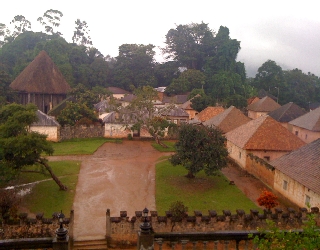
Bafut palace

Instead of eating cake and watching fireworks with my family, I spent the day in the Bafut palace (where the Fon of Bafut lives) with my colleagues Judith and Roland, and with Maa Rose, one of the Fon’s wives. A Fon is a traditional king, and this palace has been around since around 1300 AD. It’s about a 30 minute drive from Bamenda town. (See Fon of Bafut on Wikipedia).

The original palace buildings were made from bamboo and reed, but after the Germans arrived to Bafut, they were reinforced on the outside with burned bricks and tile roofs. The only truly original remaining part of the palace is the sacred place, the Achum (you can see it in the far back left side of the photo).

It was pouring rain when we arrived to the palace grounds. Roland, who was driving us, was in gorgeous all white traditional clothing. He hadn’t been to the Palace before, so he found an umbrella and went with us, holding his white pantlegs up the whole way to avoid getting them all wet and muddy.

Judith is married to a man from Bafut whose grandmother was a Bafut Queen. She was known as the ‘3 time wife of the Fon’ because her first Fon husband died, his son inherited her, he also died, and so his son inherited her and she stayed with him until her death. Judith’s 9 year old daughter is named after this grandmother and insists that she doesn’t want to be the wife of the Fon.

Wooden statue of a Bafut Queen

We arrived late afternoon and Maa Rose came out to meet us. She is the 4th wife of the current Fon, who’s been in power since 1968 when he was about 13. Having several wives is common for a Fon, but the current Fon is a modern kind of guy, educated at the University of Yaounde, and instead of taking 159 wives (or was if 152?) as his father did, he’s settled with 8. He ensures that they all are provided for and get their education.

Maa Rose showed us the old talking drum outside of the palace that calls the village when something important is happening.  She said she would tell us about the Bafut history, and that they worship their ancestors, ‘but we are Christians too.’

She shared the meaning of the waist-high stone pillars scattered around (they mark where the heads of those who have died in battle lie). She took us over to see a pair of large stones where adulterers were punished (they were tied to the stones and pieces of their bodies were chopped off until they expired, and if they were still alive in 7 days, boiling water was poured on them). She explained about the 2 forked sticks planted in the ground (they mark the place where children used to be sacrificed to ward of any deaths as people got crazy during the annual dance celebrations).

Maa Rose said it was the task of the notables (not the common people or prisoners as in some other cultures) to select and give up a child for sacrifice in the name of community safety. This act also allowed a notable to grow in stature. When the Germans came in the late 1800s, ‘they taught us that this was bad, so now goats are killed instead.’ The custom of tying adulterers to the stones has also been discontinued, and now they are simply exiled.

After we saw the exterior of the palace, we went into the courtyard ‘which is set up for our children to play’ and then saw the sacred place, the Achum, where the Fon goes to pray and to do things which are secret. The Achum was erected over a lake and has been there since the beginning of the Fon palace. (We saw pictures from the late 1800’s and the place looks almost the same; the Achum is on the list of the 100 most endangered world cultural heritage sites). Each year on grass-cutting day, everyone in the village gathers grass and makes bundles to repair the roof of the Achum.

After seeing the Achum (only from the outside) we followed Maa Rose through a meeting room. The children who live in the palace were watching a movie, and ‘The First Noel’ Christmas song was playing in the background. Maa Rose told us, ‘In the older times, decisions were only made by men, but now in these times, decisions cannot be made without women too. So this is the room where we meet to make decisions. If there are decisions that must be made without women, the Fon and his notables make them in a secret society.’
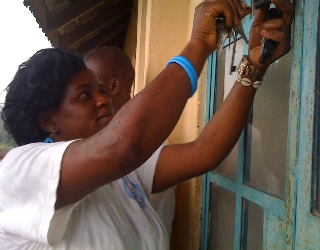
Maa Rose opening up the museum

From there, we visited the Bafut Museum, located in a big mansion that the former Fon lived in. The roof of the mansion was taken off, though, because the ancestors were not happy that he was living there, and he moved back to live in the Palace. The house has been restored and converted into a museum with German funding. Entrance fees are ‘sent to the German coffers’ to keep up the museum up.

Maa Rose took us through museum after hours as a favor to Judith (who has Bafut connections) and said she wasn’t sure how to turn on the lights. Unfortunately I forgot my camera with a flash and had to use my iPhone which doesn’t function well in the dark, plus we weren’t supposed to take photos she later told us.

She gave us a full-on explanation for each of the items in the museum, starting with the carved statues of the first German to arrive in Bafut and his wife. The coolest thing about these statues to me is that they represent Germans, but the Germans are dressed and portrayed in old Bafut style — naked and with traditional jewelry and ornaments. Maa Rose said that of course the Germans weren’t naked in those times, and that the Bafut had just carved them in their own style.
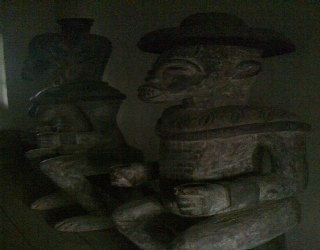
wooden statues of first Germans to arrive to Bafut

We moved along to a carved statue of a Bafut Queen. In the past, said Maa Rose, ‘Our queens were na-ked!’ They wore cowry shells to show that they were a Fon’s wife here, around the waist.’ The cowry shells on the statue dangle in front of the pubic area. ‘Today of course a Fon’s wife is not naked, ha! So if I would wear my cowry there, no one could see them. So we wear them here around the wrist.’

The cowry shells are a sign of Fon royalty.  ‘The Fon, if needed, can turn himself into an animal, like a bull or an elephant, and escape into the bush. You will see his cowry shells though. So if a hunter tries to kill him, he will just bow like this, and you will see the shells, and you will know it is a Fon and you cannot kill him.’

In addition to a lot of amazing wooden statues, rooms with old Fon royalty items, including the last elephant to be killed in the area (over 200 years ago — his foot, tusks and skull are in the museum) we saw a lot of gorgeous masks. ‘Before cameras, if you really loved someone, you could ask someone to make a carving of them.’

In the room made to look like a traditional Fon’s room, there was a bed with a lion skin on it and elephant tusks on the floor. Maa Rose said that before the Germans came, it was tradition that a Fon’s feet could never touch the floor, so he would wake up and stand on top of a person. ‘The Germans taught us that it is not right to treat a human like that, so now the Fon does not do that.’

In the museum there are also weapons that had been given to the different Fons by the Germans who were colonizing, and we heard the story of the Fon’s grandfather (the one who was married to Judith’s husband’s grandmother) who spent 1 year in jail in Limbe for refusing to surrender to the Germans.

There is also a case with some common looking German porcelaine. ‘This is the slavery room,’ Maa Rose told us. ‘It is said that for one of these, you could get two slaves. The Fons did slavery before.’ In the slavery room there are also beaded calabazas and a pair of beaded shoes that are said to have belonged to the first German to arrive to Bafut, and which were given to the Fon. ‘This German wore eye glasses, and people thought they were his actual eyes. He used to take them off and set them down, and the people would work hard there because they thought his eyes were still there, watching them.’

The Fons loved to fight, she said. ‘They would go to fight in the very front with their notables.’ (Wish we had that going on today in more places, things would likely be quite different). We saw the room of a former Fon Queen with all her things. A basket for going to farm, her cooking utensils, her bed. I like the idea of the queens cooking and farming. Judith told me later that the current Fon also has a farm, and he takes his children there with him to farm. The Fon’s current wives, also queens, nowadays have jobs. Maa Rose is a teacher.

We saw statues of ghosts. Maa Rose said that it is believed that the ancestors come to visit the current Fon to tell him what to do or how to behave. When they are upset, they come in a certain form and you know that everything is not OK. The former Fon used to beat his wives, for example. ‘Even the wives that he inherited from his father.’ So the father who was missing (‘we don’t like to say a Fon is ‘dead’ we only say he is missing’) came to tell him to stop beating his wives, and that if he didn’t stop he would be really sorry.  The cane he used to use to beat his wives is there in the museum.

When a Fon goes missing, there will be those wearing a particular mask and dress that go around to all the villages to advise them that something has happened. They will know then that they must go to prepare their things, because when it is announced that the Fon has gone missing, they will not be able to do anything for 2 months. The cannot collect wood or visit their farms. So they have to prepare.

By the time we finished our tour of the dark museum, the sun was setting.  Maa Rose invited us over to her small house within the palace complex to see her handicrafts. ‘Here we sell these small things to buy whatever the Fon can’t buy us, like our little soaps and oils and things.’ I bought a bamboo salt shaker and a wind chime, and paid a small sum for the museum and Maa Rose’s wonderful historical orientation.

She asked us to come meet 7 of her 9 children (the other 2, her eldest girls, are away at university). They were all sitting around the fire, in the small kitchen across from where we’d looked at the handicrafts, getting the oil fried to start cooking their dinner.

The kitchen is cozy and simple, with blackened walls from fire smoke. Some guinea pigs were skittering around in one corner and chickens were roosting in another. In the rafters, above the cooking fire, there were some tiny onions, strung on thin sticks, drying and smoking to be added to food later on.

Maa Rose said that next time we should come much earlier, so that we could share a meal and talk more.  She apologized for the rain and mud and that she couldn’t get the lights on in the museum or in her house so we could see things better.

I left feeling pretty sure that Maa Rose is the most beautiful Queen I’ll ever meet.

Read Full Post »

Bamenda, Cameroon

Based on my last couple of posts, apparently this week I’m a little hung up on privilege and position.

I’m in Cameroon to support staff and partners with some training. Today we drove from Bamenda out to the community where we’ll be working. We needed to do the last bit of the arrangements, greet the community notables and school principal, and see the center where we would be having the training to get a sense of how we would set things up for Monday.

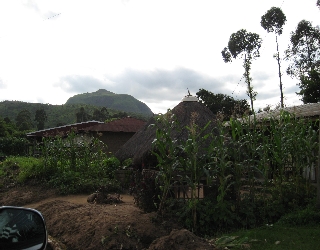
Ride out to the community, near Bamenda Town

The community is about an hour’s drive out on roads that curve through green mountains that cover over with clouds and fog from dusk until the sun burns them off mid morning. This part of Cameroon has got to be one of the richest, most fertile places I’ve ever been to.

Our meeting was at the school, and I knew once we drove up and I got a peek through the school windows, that I was going to have to sit up front on the stage at the important people’s table and give a speech. Damn. There was no way around it.

This is what it feels like when you have to sit up there:

On the plus side, experience tells me that after a couple days at the training it will feel more like this:

The kids and the community are super excited about the workshop.  The youth sang a choir style welcome song that gave me chills. It took me back to the days when I used to spend a lot of time accompanying foreign delegations to communities. This welcome was one of the finest. It’s easy to see why visitors feel so special when they go to communities in places like Cameroon.

On the drive back we stopped along the road, near the palm wine huts and kola nut sellers, for fresh boiled peanuts in the shell and roasted corn. The sun set and the fog settled in for the night as we carefully made our way back to Bamenda in near zero visibility.

I can’t wait till Monday when we move from town out to stay in the community at the training center.

On days like today I wonder what, exactly, we are talking about when we say ‘development’.

On the surface it sure seems like people up in these mountains have it pretty good.

Related posts on Wait… What?

Shotgun

Privilege

It’s not a black and white photo

Read Full Post »

I never know where to sit when I get into a car driven by a hired driver.  Do I sit in the front seat? The back? What does it mean when I sit in one place versus another?

And then there are those times when the driver’s side is on the right instead of the left like I’m used to, and I wait stupidly next to the driver’s door until he says ‘Oh, you want to drive, eh?’

I realize I have issues if these are the things I worry about, but the only drivers I’ve ever hired are street taxi drivers, and I’ve always just sat in the back unless the taxi was exceptionally crowded.

When I’m traveling and it comes to a riding in a vehicle with someone who’s hired by an organization and whose full-time job it is to drive, I’m never quite sure what to do. Do I sit in the front seat because I believe we are equals despite our position in the hierarchy? Or is that being ridiculously silly and American? And actually, which seat actually holds more status? The back or the front? And if I sit in the front, do I end up just embarrassing the poor guy with familiarity and friendliness when he’d rather I sit in the back so he can just do his job and go home? Or is it rude to hop in the back? And in the end, does the driver even care?  I  am probably being self-important to think it matters. Visitors come and go.

I Googled “where to sit hired car driver,” to try to find out, and nothing. What’s a girl to do?

And what about when there are more people than just me and the driver? What then?

Sometimes when traveling in different countries where my organization works, people offer me the front seat, but I never totally know what that means. Do they think I expect it because I’m a visitor, or from the US, or working with the regional office, or all of the above? If I don’t take the front seat, am I offending people by not accepting a gesture of respect and welcome?

Other times I end up in the back seat with 2 or 3 other women. I imagine it crosses all of our minds to try at least a little to avoid the cramped middle seat. Or we wonder if we should secretly engineer it so that a female colleague we want to show gratitude or respect to can have a window seat while we suffer with no legroom.

I don’t think I’m the only one that notices, because normally there is some kind of banter about who’s sitting where and whether they are fat or skinny and whether we all fit.

This afternoon was tricky because it was just the driver, a female colleague and me.  She said ‘Oh please, do sit in front!’ I said ‘Oh no, it’s fine, let me just sit here!’  She got in the front and I sat in the back seat, on the right hand side. Since she’d earlier been identified as my sister, because she had just gotten her US Passport, I thought it would be OK to ask her about car etiquette.

Of course, it turns out that there is etiquette. The higher status person should sit in the front, just like in the US, where parents or people being shown respect get the front seat.  (I forgot to ask if it’s common to yell ‘shotgun’ on the way to the car when everyone is of equal status to determine who gets the front seat….)

My colleague told me that in some parts of Cameroon, men always get the front, ‘because women are just getting to a place where they might think about sitting there’. Sometimes though, someone will offer you the front seat as a gesture, in which case you should take it.

She explained that if the owner of a car has a hired driver, the owner normally sits in the spot where I was sitting (right hand side, back seat). ‘This lets everyone know that he is the owner of the car…. If he’s a big man, his bodyguards will then sit in the front seat and to the left of him in the back…. And if you are riding with a group of people, you might ask or wait to be instructed where to sit so as to ensure you are not sitting in the owner’s spot or offending anyone.’

Makes total sense.

In the end, I suppose there will be slight variations to car etiquette, but it’s pretty much the same everywhere, and I should just go with my gut feeling.

But I still don’t know if I’m supposed to get in the front or the back when it’s just the driver and me, and he doesn’t indicate by nodding or opening a door.

Help.

Read Full Post »

I’m in Bamenda, a beautiful, cloudy and cool, mountainous area of Cameroon, to support some training this week. On the drive out, my colleagues revealed that they’d booked me into ‘a very nice hotel’, whereas they would be staying at the ‘Family Hotel’. I asked why we were staying at different places and it became clear that they’d be staying with relatives and friends or at hostels they didn’t think I could handle to save their per diem. The nice hotel is indeed nice – not fancy, but brand new with clean, quiet rooms, fluffy white comforters, decent pillows, a hot water shower and most importantly – there are no mosquitoes. I would have protested, but my luggage didn’t arrive and I don’t have my mosquito net for at least another couple of nights, so I let it go.

I went down to breakfast this morning and there were a couple of older guys, maybe in their 60s, waiting to be served. We greeted each other with typical pleasantries. They said they were in Bamenda to recruit students for a school they run in the UK. I waited for about 15 minutes for some acknowledgement from hotel staff that there was going to be some kind of breakfast, but nothing. Pretty soon a few obviously wealthy Cameroonians affiliated with the 2 UK guys came in. They were clearly not used to waiting and began berating the kitchen staff to hurry up and get us all some breakfast. I apologized and asked for just some hot water to take to my room to make coffee, as the driver was going to arrive shortly.

Tonight I went down to dinner. I am not a soccer fan but thought I’d watch the Brazil-Chile World Cup match since I didn’t have anything else to do, mobile internet was slow, and there was a TV on in the bar area. I ordered a Guinness and asked if there was any dinner. The hotel is pretty much food made to order based on what’s available in the kitchen since there are very few customers. The cook I had bonded with over the soccer match and my dinner selection last night suggested he stir fry up some eggplant and zucchini with garlic and ginger. Fabulous. I timed my order so that I could eat at half time. Then I realized that I was making him miss the whole first half of the game because he was cooking my meal. And I don’t even care about soccer.

My 2 UK hotel-mates from breakfast arrived back to the hotel just as I started eating, and set up at the bar. Friendly chatting ensued about my meal. The first UK guy said he’d bring his own food and spices next time and cook his native Indian food in the kitchen since hotel staff were so slow. There was a young Cameroonian woman with the second UK guy. He was tickling her in a suggestive way. The finely dressed Cameroonian guy with them said to the first UK guy “Don’t worry, your ‘drink’ will be here in 30 minutes. You know what I mean, your ‘drink’?” How obvious.

Brazil was dominating at 3-0, but I decided to wait around in the bar for the game to be over just to see how old this guy’s ‘drink’ happened to be. I was glad to see that at least she was clearly over 18. Makes me wonder what kind of ‘school’ these guy are involved with. I suppose if you were a poor family in Bamenda and some wealthy looking guy from the UK offered to take your son or daughter to study over in the UK, you’d be cool with it. Or maybe I’m reading into things.

Read Full Post »

I wrote last week about Mambe Churchill Nanje and his work with Village Diary in Cameroon. But Village Diary is not Churchill’s whole story. The other part is his company Afrovisiongroup.com and the company he was keeping when we met up for a Malta and some Castels. Photo: Churchill and Steveslil.

AfroVisioN is Churchill’s IT firm, based out of Buea, Cameroon. AfroVisioN helps local businesses build their on-line presence, and aims to help Cameroon in general realize the potential of the web. “I was in the process of trying to get a nice paying job in IT, and someone told me: ‘Don’t get a job, create jobs instead!’ so that’s what I set out to do. I wanted to show people in Cameroon that there is more online than email.”

AfroVisioN invests in research and development to cut down costs of technology to serve the local markets. They provide affordable websites and web solutions, building software packages and automated operations to facilitate management and efficiency.

Although he can’t be more than 24 years old, this is not Churchill’s first venture. In 2006, at age 20 he invested all his time and money in building up a portal to allow students to see their GCE scores online. He purchased the GCE scores from the GCE board and published them for free on a site called passgce.com. The site was promptly shut down by the GCE board. Churchill recognized that there are potential disadvantages to having the scores on the internet (an error in programming logic could show the wrong results or someone could hack into the system and change the results), but that these are easily overcome with standard security measures. He’s sure the site was closed for other reasons. “Imagine building all your hopes on something and it gets shut down….”

Not one to give up, Churchill moved on to doing small IT projects that led him to his current business model at AfroVisioN. “Our market and its people don’t have huge financial backings, but they need technology in order to make their businesses more profitable,” so the business model builds on making a web presence affordable.

But Churchill’s goal doesn’t end there. “I kept wondering, why am I exporting software and my schoolmates and family are exporting cocoa… and not earning any money through their hard work.” So Churchill’s broader goal is to make a name for himself, to earn trust and credibility so that he can attract investment to help others to progress. In addition, he’s looking for ways that IT, especially internet, can be used to gain access to information to improve farms and local businesses so that they can earn more.

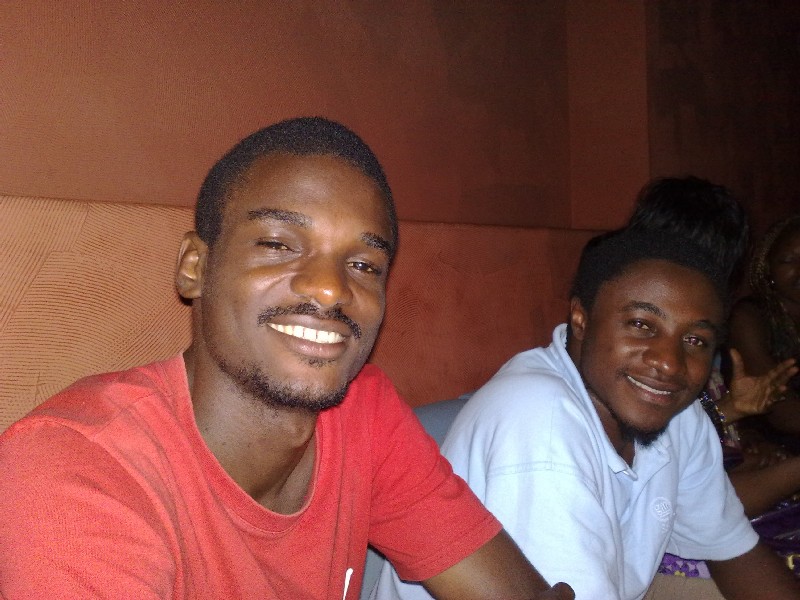
As we sipped our drinks and then rode in a crowded taxi from one side of town to the other, Churchill’s friends Steveslil and Peter also talked about their aspirations. Photo: Steveslil, Peter and Churchill.

Steveslil is an up and coming R&B singer – check out his website (powered by AfroVisioN) athttp://www.steveslil.com/flashsite.swf. He was appointed CEO of CoreSouth Records in 2005 and put out his debut album “Play my Tambourine,” fostered by Churchill, who also directed 2 of Steveslil’s videos. Steveslil is now on the BEI (Bebum Entertainment Industry) label out of Washington DC, founded in 2002 by Cameroonian-American businessman Esapa Sebastien.

Peter (@foch4T) studied at university with Churchill and they currently call on each other when there is work to be done on websites or other IT projects. Peter’s dream is to start a tour company to bring people to Cameroon. “Cameroon is the center of the world. It’s the heart of Africa. Here you have every climate, every type of thing that can be found in Africa, but all in one place.” Peter wants to bring people to Cameroon to experience the country’s beauty and culture in the most real way possible, giving them custom made tours.

Some impressive guys, to say the least. And to me, it was most heartening that not one of them talked about wanting to leave Cameroon to try to succeed elsewhere, but rather building up their country’s own potential and their own people.

Read Full Post »

I had a chance to meet with Plan Cameroon’s Program Technical Team today (including those that look at Monitoring and Evaluation, Health, Education, Sponsorship, Child Protection, Water and Sanitation, Gender and the overall Program Support Manager) to give a quick brief on the ICT4D research and training that Plan Finland is supporting with Plan offices in 8 countries in Africa (Mali, Senegal, Cameroon, Ghana, Togo, Mozambique, Kenya and Uganda).

We are working with Hannah Beardon, who wrote Plan’s Mobiles for Development guide (available in both English and French) and building on that towards some more focused and concrete ideas for ICT use in these 8 countries. We’ll share the research with staff during 2-day workshops to brainstorm and gather ideas on information and communications needs, as well as available tools that could be used or adapted to local situations.

The 2-day workshops are planned for Aug and Sept. Hannah, Mika (Plan Finland) and I are developing the methodology and will make a training DVD to send ahead of time to each country (apparently complete with our selves doing presentations!) since we don’t have funding to do face-to-face training. We’ll have a staff person in each country as the main facilitator, and 10-12 key staff, from management to frontline, will attend. Mika or I will beam in by skype to support if needed. We’ll use the Frontline SMS demo video that Mika and crew did also, (see my earlier post about this from a few months ago), show how Nokia Data Gathering Software works, share the Common Craft Social Media videos, among other things. Hannah’s methodology will also come in for thinking about how ICTs could enhance existing efforts.

The idea is to both learn about new tools as well as look at current programs and see if there are ways to use ICTs to improve impact, and how to begin tailoring them to the programs and local settings. We’re also doing research on government policies and how Plan’s work links there. I hope that we can also look at partnering with local developers and ICT4D innovators in each country….

The idea of ICT4D was a bit new to some of the Plan Cameroon staff and not at all new to others. One interesting idea they shared was using SMS in anti-malaria programs to periodically remind people to retreat their bednets. There was some concern about literacy rates if one relies on SMS, and interest in using voice response, but given the number of languages in Cameroon, voice could also be a bit of a challenge. I’ll have to try to find out if/how that’s overcome in other places. Another concern was ‘scamming’ and how to avoid that happening. But it seemed that the issue of scamming is not something that Plan alone would face, but something in general that is faced with mobile phones.

The program support manager was really keen on using mobiles for program monitoring as that is something that can always improve and be more efficient with ICT, he said, and wants to test some ideas. The ICT manager also said he wanted to write something up. The sponsorship manager suggested trying out some data collection or quicker communications tools for linking with community volunteers. And as mentioned earlier, child media and child protection are areas that can be greatly enhanced and supported via ICTs (help lines, SMS incident reporting, social media and mobile reporting).

After the 2-day workshop, we should have something really nice to go forward with.

Read Full Post »

« Newer Posts