I received a random email last night from F+W Media asking me to advertise their fundraising campaign for Japan on my blog. I wondered if they had ever read my blog. But that’s beside the point.
Their pitch?
I wanted to alert you to a special announcement from David Nussbaum, Chairman & CEO of F+W Media, Inc. Find his letter below, please feel free to share this with your (readers, constituents, fans) via the link on our website: http://fwmedia.com/japan
“Much like in your own community, school, or place of work, the employees at F+W Media wanted to do something anything to help. While the people of Japan are relocated to temporary housing, as supplying food and potable water becomes critical, the need for support in the coming weeks is even greater. Wednesday March 30th we will join with the American Red Cross to lend our support. And, we hope you will too. F+W Media will donate 50% of all profits received Wednesday from the sale of products and services via all of our 23 eCommerce stores. By choosing to make a purchase on this day, you will directly contribute to the ongoing efforts to provide medical care and relief assistance to the people of Japan.”
Well, OK…
I’ll commend F+W for raising funds and having the good sense to not try sending volunteers and goods in kind to Japan, and for working through a known organization with emergency capacity like the Red Cross.
“Following the OCHA team’s visit to Miyagi Prefecture on 23 March and after discussion with Government of Japan counterparts, OCHA notes: (1) that even though the scale of the damage following the earthquake and tsunami was significant and resulting humanitarian needs remain considerable, (2) Japan is a highly developed country and has, in principle, enough resources as well as the ability to respond to existing humanitarian needs. The country can both produce and procure relief supplies domestically and has the capacity to deliver those supplies to the affected population. Japan has a consolidated disaster management system for disaster response although coordination and logistical challenges have yet to be fully overcome.“
Nothing against Japan and its people. I was probably as shocked and stunned by the earthquake and tsunami there as anyone else who watched it from afar and who has some close Japanese friends who desperately wondered how their families were faring.
But since Japan doesn’t seem to need more funds, I wonder if F+W Media would consider another crisis in their awareness raising and fundraising efforts.
See, there is this country in West Africa called Cote d’Ivoire…
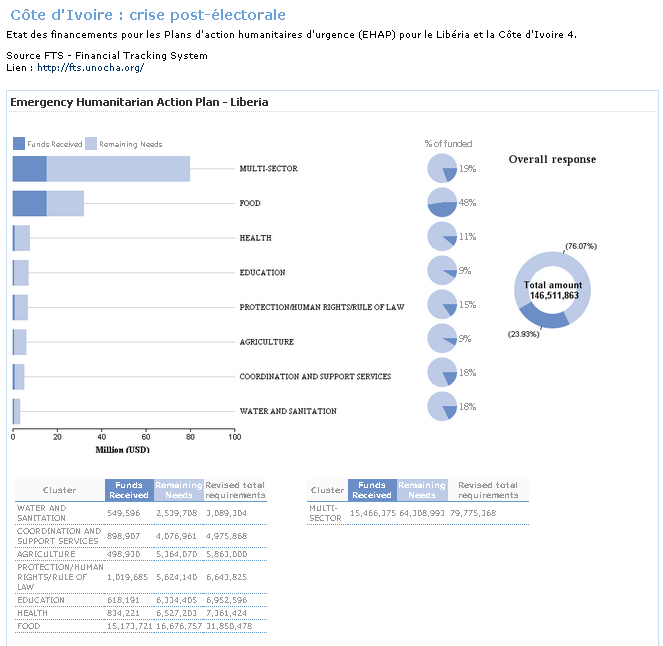
That country is entering into a civil war that has the potential to shake all of West Africa. Some 1 million people are fleeing the violence. Mercenaries from Liberia (the country next door) are already fighting in Cote d’Ivoire. According to a friend of a friend who’s in Cote d’Ivoire, Ivorian National TV is broadcasting xenophobic messages stirring aggressions against neighboring countries and their citizens in Ivorian territory. This explosive mix could throw the whole sub-region into war. For an overview on the Cote d’Ivoire crisis check my previous post “Cote d’Ivoire and the thinking trap” or Blog for Cote d’Ivoire, which lists a number of resources on the crisis.
Funds raised for Japan? As of March 28, OCHA reports $442,264,078 (including $261,292,921 in uncommitted funds)
Maybe we should be happy that the donations that Japan doesn’t need might go the unfolding and critical situation in Cote d’Ivoire, which no one seems to care about…. We should be thankful for the Asterisk, as Cynan says.
Your gift to the American Red Cross will support our disaster relief efforts to help those affected by the earthquake in Japan and tsunami throughout the Pacific. On those rare occasions when donations exceed American Red Cross expenses for a specific disaster, contributions are used to prepare for and serve victims of other disasters.”
And then there is the military intervention in Libya, which I’m not sure how I feel about. I’m following the situation there and in several countries in North Africa and it’s gruesome. But it’s hard to understand how choices are made. A friend of mine living and working in West Africa wrote to me today, and I can understand how he is feeling. It must be terrible to be there, watching “never again” happening again and being powerless to stop it.
“It seems incomprehensible why the international community does not intervene in Cote d’Ivoire whereas they are happily bombing Libya in the name of Human Rights. Strictly speaking in the case of Libya there is a revolution going on against a Head of State in power (I am not commenting here on the type of leader he is!). In Cote d’Ivoire the elected head of state cannot gain power for reasons known, and the population is persecuted and terrorized by his contestor. Wouldn’t it seem logical that the international community intervenes in Cote d’Ivoire instead? They refuse saying that Africa has the AU who should deal with this and that they were not on crusade to liberate the continent from its problems.
Why this differential treatment? Well, the answer is fairly simple: Libya has oil, Cote d’Ivoire not. In the case of Libya the AU stood still and did not comment – not surprisingly as Khaddafi pays for most of half of all country memberships in the AU and has been a tremendous support for development in individual countries. In the case of Cote d’Ivoire they mobilized themselves to act but their negotiation missions all failed. It’s a crazy world. There is no interest from the international community in Human Rights. There is only interest in access and control over resources.”
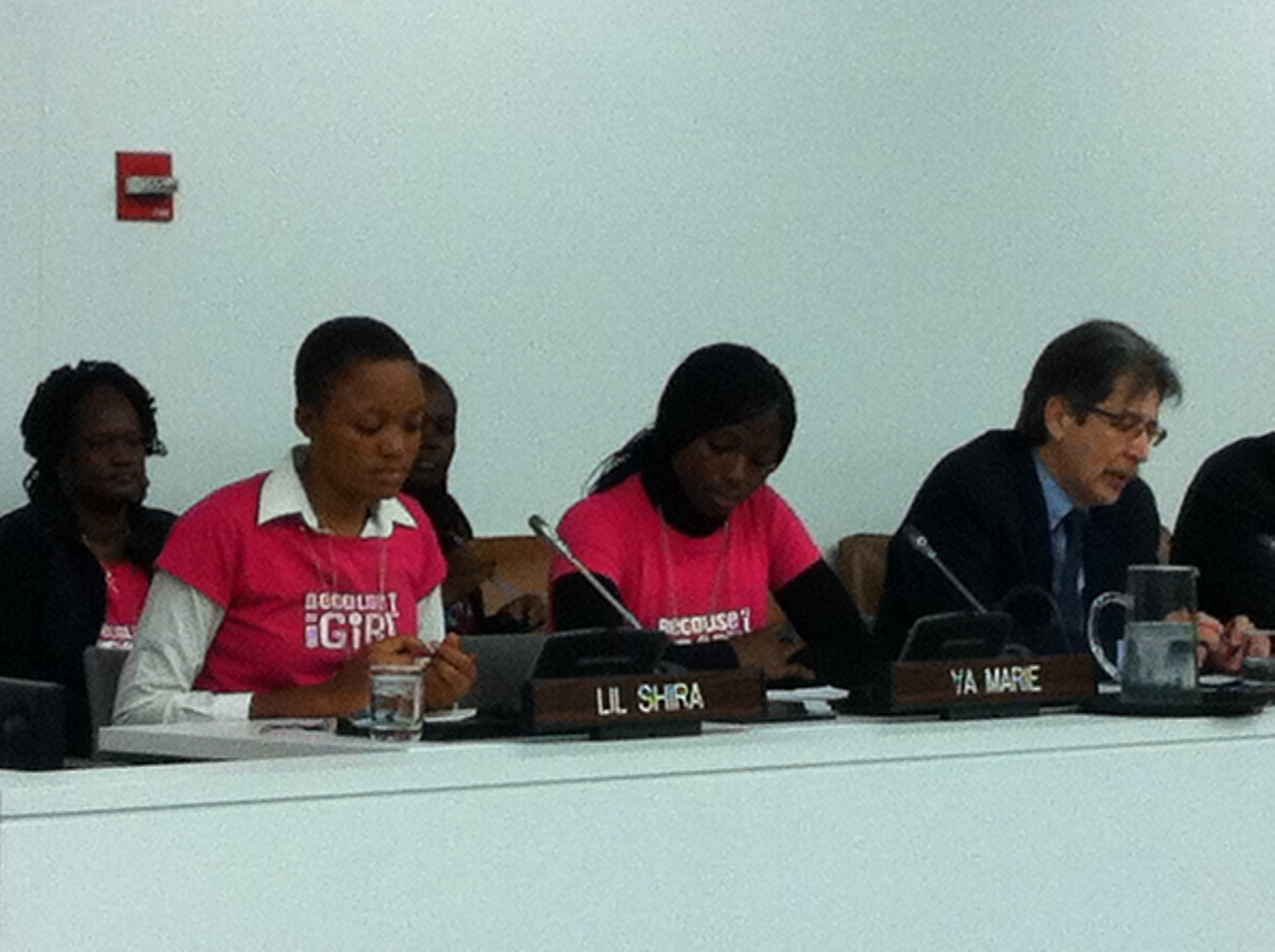
This is a guest post from Lil Shira, one of the girl delegates who attended the 55th Session of the Commission on the Status of Women in February, 2011. Lil Shira was part of a Plan led Girl Delegation which took part in high level panels, side events and caucuses. This post appears complete in its original format. You can read a post by Fabiola, another of the girl delegates from Cameroon, here.
Lil Shira in the community
My name is Lil Shira, a high school student and a Cameroonian. I am the second child out of five children in my family, three girls and two boys, and we live in a rural area. Because I am a girl I was selected by my school authority to be part of the journalism club in the school. This paved my way into YETAM (Youth Empowerment through Technology, Arts and Media) project sponsored by Plan Finland since the Journalism club was chosen for this project.
Because I am a girl I had to use the skills I have acquired in YETAM on music, media and ICTs to indentify issues like the problem of early and forced marriage, high rate of school dropout and violence against the girl child. Because I am a girl, I had to mobilize other youth (girls and boys) victims, so as to speak out as a unique voice, to raise awareness to the general public using music, drawings, drama, poems, videos, computers and overhead projector as tools. This led to many local advocacy actions spearheaded by us.
I was also very happy to celebrate the 21st anniversary, in Yaoundé in Cameroon, of the ratification of the Convention on the Rights of the Child within the framework of YETAM project. These created a big impact in my life, the lives of my friends, youth, school, family and my country. All these activities took me to a higher level because I was again selected, this time to be one of the girl delegates to represent Cameroon in the 55th session of the UN Commission on the Status of women (CSW) in New York City.
Lil Shira presenting at the CSW.
I was very happy, excited together with my friends and family members and I was planning and preparing on the role I was going to play while in New York. My expectation was to work with other youth from different region and country but did not really expect I was going to talk to Ministers from all the members’ state of the UN. I did my first presentation with the Canadian Minister on a panel about the importance of commemoration days and the importance of setting up an International day for the girls. Another thing which made me feel so opportune was the panel with UN women Ministers in the UN building.
I was very impressed seeing ministers from over two hundred countries and above listening to me and in effect giving a positive response to the issues I presented. In fact their reaction made me feel at home and so happy. I was equally happy to listen to other girls raise issues like gender based violence and discrimination in their various countries and what they have been doing to combat it.
Coming in contact with girls from Sierra Leone, Finland, United States, Indonesia, Canada and others, not mention to share our ideas, was so wonderful and exciting. This was a forum for me to dialogue with them to know more about them and some of the issues affecting them in their own country which was contrasting with mine. Though I was nervous during my first presentation, meeting new faces it all passes away like a breeze and I did not have any complex because everything was cute.
Life in the US to me was very enjoyable and meaningful, but I could not stop complaining of the cold and snow. In addition, I tried eating food not familiar to that of my home country. All these contributed greatly to the wonderful experiences I had on the weather condition and the food. I have learned to adapt to situations wherever I find myself. I hope to continue sharing this experience so that others may learn from it.
This is the time for girls to take up the challenge. I know my rights and have claim them, and no one can take them from me because I am a girl.
Thanks to Plan International, Judith Nkie our Chaperone, Kate Ezzes and Lia de Pauw.
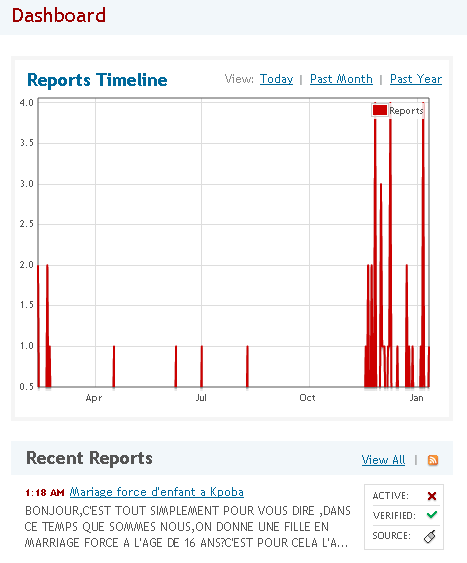
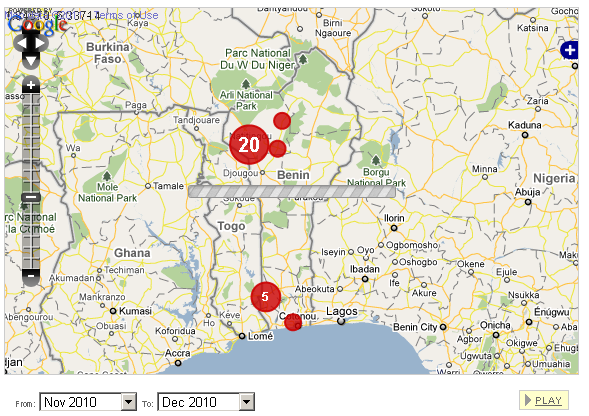
Last year, I spent some time in Benin piloting an SMS reporting system to track and respond to Violence against Children (VAC). After almost a year developing the idea and thinking it through to see if it was potentially feasible (see 7 or more questions to ask before adding ICTs), in February 2010 we conducted 2 workshops with youth, staff and local authorities in Couffo and Atacora, Benin, to design a system with their input (see Finding Some ICT answers in Benin). The main pieces of the reporting system are FrontlineSMS and Ushahidi. A few months after, staff reported back on some of the challenges with implementation (see Tweaking: SMS Violence Reporting System in Benin).
Romeo Essou, project coordinator
Since then, many of the issues have been resolved, and we’ve improved outreach so that communities are more aware of the SMS reporting system and how to use it. We’ve also been looking at the system itself, continuing testing, and seeing what improvements are needed. We didn’t have resources to dedicate someone fully to the program at first, but after seeing the potential, Plan Benin assigned Romeo (see photo) to manage the pilot project full-time in Benin. It’s been quite a pleasure working with the team there, and Romeo is no exception. Having someone dedicated full-time to working with communities and staff in the two districts has really made a difference. From November to mid-January, several additional violence cases were reported and a good number of them have been followed up on and closed.
Last week, Romeo shared what we still need to find solutions for. Some of these are issues that we’d identified last year and others are additional things that Romeo has suggested as he’s gotten down to business.
Some people still call instead of texting, or they send “call me back” texts
Cases are now coming in
The team is fairly certain this is due to illiteracy. Plan will involve more school-going youth in the initiative because they have higher literacy levels and can support others with reporting if needed.
Romeo and the team will continue doing outreach and education on how the system works both at community meetings and via radio broadcasts in French and local languages.
To address the calls that may continue to come in, a voice mail will be set up on the phone that links up to the FrontlineSMS laptop, with a message explaining that people have to send in a text. Romeo will do some research to determine which languages to use in the message for the best result (French and the 2 main local languages….).
If that doesn’t resolve the issue, Romeo and the staff will call back anyone who phones in.
Cost of an SMS continues to be a discouraging factor for people in terms of reporting. Often when Romeo or other staff visit a community, community members take advantage of their physical presence to report additional cases of violence. This is not necessarily negative, considering that we want to increase the number of incidents reported and followed up on; however, if it turns out that awareness around violence is high but the cost of the SMS is a deterring factor in reporting, more inexpensive channels to report also need to be offered. We are still negotiating with the local operators to get a free SMS line.
Spam
Some 50 spams a day are coming in. This is an issue on all mobile phones in Benin. Much of the spam comes from the mobile service providers themselves.
If the spam is coming from the same number, it’s possible that a workaround script could be written up at the point where FrontlineSMS forwards to Ushahidi. The messages can also be marked on Ushahidi as spam, but they will still be arriving via FrontlineSMS, unfortunately, unless numbers can be blocked somehow.
Needs further thought on how it might be overcome.
The Violence Tracking Platform (Ushahidi):
Ushahidi platform
We need to be 100% sure that any personal or identifying information coming in via the SMS reports is scrubbed so we do not put any children or witnesses at risk or falsely accuse anyone of violence against children by publishing the reports to the Ushahidi platform.
Romeo will develop a Privacy and Protection Checklist and train those administering the Ushahidi system to be sure to remove identifying information thoroughly before allowing it to be published on the Ushahidi site.
The identifying information still needs to be stored somewhere on the system to support with follow-up on the cases that come in. We may need additional development work on the platform to allow for that.
We hope to integrate the Ushahidi map into the Violence against Children website, which has educational material, videos and cartoons done by youth, and a discussion forum. However if the information poses a risk to anyone, we may decide to make the Ushahidi site private and keep it as a management tool rather than a public site.
Categorizing:
The staff who administer the Ushahidi website are not always clear which type of violence an incident should be categorized as (physical violence? sexual violence? psychological violence?).
Romeo will create short guidelines to help people to categorize the incidents properly. He’d like these to be incorporated into the Ushahidi platform.
Often a reported incident can fit into more than one category – eg., both physical and sexual violence. If it’s categorized in two categories, then we lose the sense of how many incidents there have been overall, and we’re unable to properly chart the data. We need to find a way to manage this on the system so that we have proper statistics.
Recent reports of physical violence, sexual violence, forced marriage and exploitation
Follow up on reported cases:
We still want a way to track response and follow-up on cases within the Ushahidi platform, as often a report requires more than one verification visit.
We need someplace within the platform to store this type of information to keep records of follow-up.
This will require work by a developer, but it might be helpful for other institutions using Ushahidi as well. It’s also possible that FrontlineSMS Medic could be used for case management rather than Ushahidi, but it might prove confusing for staff to have to store and act on the same kind of information using two different tools.
Names of villages, hamlets, etc:
We would like to have a listing on the map of the various hamlets, villages, etc. They do not currently appear on the map since there is no record of them on Open Street Maps or Google Maps. Plan has this detailed information in its internal systems and we want to add it to the base maps so that it’s easier for administrators to locate the incident in the right community.
Coordination and outreach:
In addition to the technical work on the system, Romeo will continue to coordinate and share information with local partners and other organizations working on violence against children. There are similar initiatives already in place and we don’t want to duplicate efforts. Combining and sharing help line numbers and taking reports by both phone and SMS is one option.
I spent a few days in Nairobi early last week with our education and our ICT staff from Ghana, Uganda, Senegal, Mozambique, Kenya, Egypt and a few other folks, including the brilliant Mika Valitalo from our Finnish office and people from regional and headquarters levels. We were looking at goals and challenges in our education programs and thinking about where ICTs might play a role.
The process was really interesting. Starting a few months back, each country shared their education context analysis onto a wiki. In a second round they narrowed down to a specific area in education, looked at the information and communication flow and gaps, and identified areas where there might be an ICT solution. They focused mostly on mobiles, but in many cases mobiles were supported by computers, servers and laptops as well as non-digital information and communication tools and also solar technologies. Each country team met by Skype with Mika and an external consultant to discuss the concepts and get ICT advice and support. Then they updated their concepts and got additional feedback. For the third round, they added rich pictures to show what the specific ICT solutions might look like. Everyone had an opportunity to give input into everyone else’s ideas via the wiki.
At the meeting in Nairobi, we spent a day sharing the concepts with each other for clarification and focused input. Colleagues shared the broader education context in their countries and specifically in the communities where they are working. Then they illustrated the specific education issues and the ICT solutions that they were suggesting and/or the places they felt ICTs could help. Some of the ICT solutions focused on a very specific technology or device. Others showed how different types of ICTs could be integrated at different points in the process. Others required development of a totally new ‘solution’.
Some of the areas where colleagues thought ICTs could support education included: teacher training for those working in remote communities, adult literacy (especially literacy retention post literacy training), improving exam scores, livening up and improving in-class curriculum, and transparency and accountability in education. We spent 2 days then working in different small groups on the concepts, cross-pollinating ideas and deciding which of the concepts were most relevant to all 6 countries (in order to make it more possible to scale them) and which were most feasible and do-able.
The ideas were all a good fit with our global education strategy (see page 9) which focuses on service delivery (in partnership with local governments and communities); organizing and empowering rights holders; and grassroots participatory advocacy to influence education policies, financing and practice. The strategy prioritizes actions around equal access to education, quality of education, and education governance (see page 10).
Accountability and transparency in education
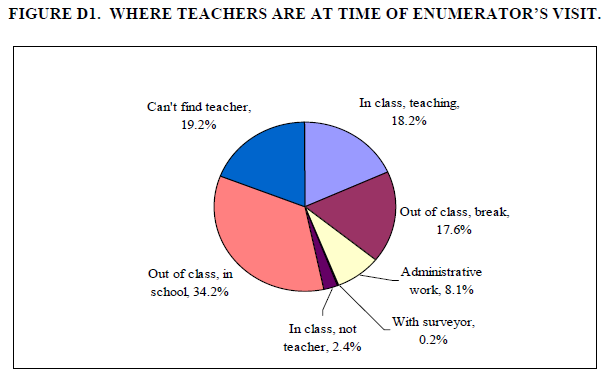
One of the concepts that captured the most interest from the whole group was that of using ICTs to improve accountability and transparency in education. Education is one of the areas where “Quiet Corruption” is often found. ‘Quiet corruption, which can take the form of absenteeism among teachers or doctors, the distribution of fake drugs, or the sale of diluted fertilizers to poor farmers, is having a damaging effect on people in Africa, according to the African Development Indicators report released by the World Bank….’ (March 18, 2010 article)
It's time for class.... where is the teacher to be found?
Edison, Charles and Erik, our colleagues from Uganda, did a short skit illustrating the different points in the primary education system where corruption happens. Their points correlated well with this summary of quiet corruption in education from a July 5, 2010 article in the Independent:
‘Early this year, the Transparency International (TI) Africa Education Watch Programme report: Africa Education Watch: good governance lessons for primary education showed that the government’s perception that massive enrollment is a sign of success of the UPE [universal primary education] programme must be revised to address the problem of overcrowding in classrooms, studying under trees, poor financial management, illegal fees, and lack of school inspection. The report exposes irritating embezzlement of UPE funds and abuse of authority by head-teachers who charge illegal fees, make students offer labour on teachers’ projects, sexual harassment, and systematic teacher absenteeism. The report noted that 85% of schools surveyed had either deficient accounting systems or none at all. In most cases, financial records were either unavailable or incomplete. The survey found limited financial documentation at district education offices and at schools. Most people who handle school grants had no training in basic finance management.
Another survey titled, The Efficiency of Public Education in Uganda, conducted in 2007 by the Ministry of Education to determine efficiency in provision of education services found an average rate of teacher absenteeism of 27% in Uganda, compared to other countries like Zambia (17%), and Papa New Guinea (15%). The aggregate loss caused by this absenteeism constituted 19% which translates into Shs 53 billion out of the Shs276 billion of the Education ministry’s wage bill.
In a swift headcount at the beginning of this year, the Education ministry established that the number of pupils listed in primary school registers was 25% higher than those actually studying. Similarly, the report established that the number of students in lower secondary schools had been exaggerated by 12%. For instance at Amaji Primary School last year, the school register had 816 pupils. But when the headcount was conducted the school administration could not account for 302 pupils.
It is reported that many districts’ chief administrative officers have failed to show proper accountability for the UPE and USE funds.’
The Uganda team also explained that:
Parental interest in education is very low because since Universal Primary Education launched, parents feel it’s the government’s responsibility. Some youth we were working with in Kenya last year made a short film about poor performance in primary schools covering the same issue (see below).
Teachers’ salaries are paid directly to their bank accounts, and there is no way to punish them if they don’t show up.
There are mechanisms to ensure that donor funds go from the national level to the district level and then on to the school, but no accountability mechanisms to ensure that they get from the school to the classroom and are translated into quality education for children.
District level government authority and accountability ends when they transfer funds to the schools; school directors can report to them that they have received funding and that everything is going fine when it’s really not.
Local school committees are often made up of people who are not neutral and who do not have the best interest of the children in mind. In some cases, school committee positions are used for personal gain and to launch individual political careers and political campaigns.
Lack of parental and community involvement in the education process and in school governance means that no one is demanding accountability from teachers and schools.
Sexual and physical violence in schools is very common and underreported. When it is reported, often nothing is done about it.
(Start playing the video, then click the small ‘cc’ button to turn on captions in English)
Colleagues from the other countries face the same challenges in their work and in their own children’s education.
Can ICTs play a role?
What is the solution then? Colleagues suggest that motivating parents and the community to get more involved in school governance and demanding transparency and accountability can begin to change the situation. This obviously requires a lot more than ICTs. So several different actions would be taken to engage and motivate parents and the community to take a bigger role in their children’s education. Then ICTs can be integrated into and support the process for sharing education information with parents, such as student absenteeism, grades, parent-school meetings, exam dates and scores, etc. Parents and students would also be able to report when teachers do not show up or suspected corruption. Students could also report abusive teachers, absent teachers, and other issues they are not happy with at the school. A neutral party would manage and hold the information that flows in and out to protect students from reprisal and to protect teachers from any abuse of the system in case fraudulent or incorrect information is reported. Commitment from those responsible for overseeing education to respond to the issues raised and take serious action is also needed, and this may be the biggest challenge overall. Plan can play a role there, leveraging existing relationships with local and national governments and Ministries.
The idea needs quite a bit of further work, a closer look at feasibility, and more research and input from local communities and parents. As mentioned, the ICTs are actually a small, but potentially very important, part of a much larger initiative to get parents and communities involved in school governance to demand transparent, accountable and quality education and budget spending.
Challenges in the process
Some of the challenges that we had to manage well during this initial piece of the longer process included:
We needed to ensure that we were starting with the context and the need for better information and communications, not starting with the technology and devices and building initiatives around them. Yet we also had to avoid getting lost in the overall context and missing the opportunity to pinpoint potential ICT solutions at specific places within the context. Role play and flip chart illustrations of the ‘problem’ and the ‘solutions’ were very useful for getting more concrete (“So, Kofi is here in his community and he wants to …. So he uses xxx to do this, and then this happens and then….).
Though we wanted to specifically look at places that mobiles and other ICTs could support, it was important to list out all the factors that needed to be in place in order for the ICTs to work and to think clearly about the constraints we might face during implementation. One good question to help with that was, after seeing an idea or ICT solution presented, to ask “What needs to be in place in order for that to happen?” Then you start to remember critical things like community motivation, government interest to actually resolve a problem, electricity, someone to set up and manage a server, a strong enough network to download multimedia content, mobile versions of websites, educational content re-design for mobiles, teacher training on how to integrate ICTs in the classroom, limitations of SMS for doing something other than rote learning, higher versions of a mobile operating system, a smart phone, etc.
We had input from a potential corporate partner during the process. We learned that corporations are thinking several years ahead to what will be coming down the line; however non-profit are normally working within existing constraints and trying to find solutions that work here and now in the resource poor places where we work or ways to get around those constraints. Multi-level solutions seemed to be a good possibility; eg., ideas that can rely on SMS today, but have potential to expand as networks expand and data enabled mobiles become more available.
A corporation tends to think in terms of vendors, results, timelines, launch dates, price points, return on investment whereas a non-profit (at least ours) tends to think in terms of community members, organizations, process, participation, local context. Our facilitator even told us that a corporation normally does a presentation by starting with the solution, and then spending the rest of the presentation showing why that is the right solution. A non-profit usually starts a presentation by sharing all the context and background, and showing the process that led to eventually reaching the potential solution, including every step along the way, how ownership was achieved in the process, why different decisions were made and who participated in them. So keeping corporate vs non-profit cultures and languages in mind is also important when working on joint initiatives.
We need to remember to establish measurable indicators of success so that we can tell if this new type of intervention has a different/ better/ greater / lesser impact than carrying out a similar process without ICTs or with a different set of ICTs. This is something we will address once the full idea is developed. Impact measurement is very important to both corporate partners and development organizations.
This was the first time many were involved a process of this kind, so keeping the balance between technology and development goals was a constant challenge. We sometimes veered too far towards focusing on all the details of the context and then back to focusing too much on that piece of the context where a potential technology solution was seen. I think we were moving toward a pretty healthy mix of both. The process is nowhere near complete, and as we continue to work on the ideas and look at feasibility and actual implementation, we should find the sweet spot.
The work above was guided by Plan Finland’s recent publication ICT Enabled Development – Using ICT strategically to support Plan’s work. On the whole, it was a great learning process for everyone involved, and we came up with some good ideas that we will flesh out in the coming months. Having the opportunity to patiently and carefully think through areas and ways that ICTs can support program goals around education and discussing the ideas at length with colleagues was a capacity strengthening exercise for all involved and will mean that we will be more prone in general to thinking about incorporating ICTs in our work going forward.
I work on digital development research, strategy and evaluation with an emphasis on responsible data use, inclusion, gender, and children and young people. I support organizations to develop, implement, and engage staff and partners in responsible data policy and practice. I enjoy facilitating and moderating convenings, workshops and learning-focused events.
I’m affiliated with:
The MERL Tech Initiative: I founded The MERL Tech Initiative, which sits at the intersection of digital technology and the social sector. We support thoughtful tech-enabled program design, implementation, and monitoring, evaluation, research and learning (MERL). We convene communities to share good practice and improve programmatic outcomes. We advocate for responsible, ethical, realistic approaches that center people, communities and societies. My consulting practice is under The MERL Tech Initiative umbrella.
Technology Salon:Technology Salon is an intimate, informal, and in person, discussion among information and communication technology experts and international development professionals. Technology Salons happen in various cities. I convene the NYC Technology Salon. Technology Salon is the non-profit arm of The MERL Tech Initiative, enabling The MERL Tech Initiative to accept 501c3 funding.
This is a personal blog that does not represent official views of my current, past or future employers, affiliates or other organizations with whom I engage. Any opinions expressed herein are my own, and I take responsibility for them.







 Wait... What?