Feeds:
Posts
Comments

Posts Tagged ‘mobile’

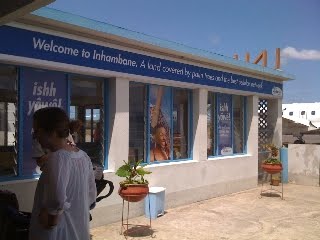
Landing in Inhambane, Mozambique, the first thing you see is the blue Vodacom sign:  ‘Welcome to Inhambane – a land covered by palm trees and the best cellular network’.  I don’t usually believe ads and this time was no exception. But I have to say, it seems to be true. My sim card is actually on mCel, not Vodacom, but the coverage is still damn good.  And the two cell phone companies are everywhere. I’m not sure which I saw more of – yellow Frelimo t-shirts (elections were last week), yellow mCel kiosks or blue Vodacom kiosks.

Which reminds me that I saw a statistic last week saying that more people have mobile phones than latrines.  And I’m not sure how I feel about that….  And then I start thinking about the hierarchy of personal needs – which perhaps needs some revising.  So does communication rank higher now than toilets?  What about food? I was certainly more worried about getting online than about eating for the past 4 days (as a vegetarian, your choice is limited unless you really make an effort).  I mean, at least I got to complain about the 4 days of fried eggs on Twitter…. but what if it were access to food in general? Where would I put my effort? hmmm. I digress….

My travel diet (in addition to the eggs) has been around 5 hours of mobile internet on my laptop a day (skype, email, blogging, Twitter, maps, google translate, and a few doses of Facebook thrown in), and several mobile internet snacks from my phone itself in between. I’ve gone through about 600 credits in 5 days, or around $4/day.  I fully recognize that is expensive for someone who is not earning a US salary, but I love that I was able to just purchase a sim card, put it in my phone, hook up my phone as a modem, and ta-dah.

Yes I’m using a ‘smart phone’ (Nokia E-63), but my point is that it’s much easier to use your phone as a modem in Mozambique than it is in the US (seems the latest i-phone update disables that so I’m afraid to download the latest update) or in the other African countries that I’ve been in over the past year.  Compared to Cameroon, Senegal and Kenya where we had to purchase a special data package and get help/permission from the phone company (or were we just not doing it right? It does get easier to figure out the more you do this stuff). In any case, internet hardly worked once we finally got connected. So in that sense, Mozambique is an internet junkie’s dream.

I asked about internet as a precursor to the social media session of the Youth Empowerment through Arts and Media (YETAM) training of trainers workshop yesterday.  We are working from a secondary school about 30 km outside of the town of Maxixe, where I expected internet would be nil (and it is, except by mobile phone modem).   Several teachers and partner organization members from the area are participating. Starting on Sunday, for two weeks they’ll work with youth to use arts and media as tools in the community development process. The same arts and media are a way for youth to put themselves, their community and their issues on the global map by uploading the photos, drawings and videos they will make to the web.

As an example during yesterday’s session, I Googled the name of the school.  All we found in the first couple of pages was Maxixe and nearby towns listed, with content related to tourist beaches. There was also a blog by Lauren, the Peace Corp Volunteer who is teaching there.  Several months back when we were planning the training, Lauren’s blog was the only information I was able to specifically find about the school and area.  Because of her blog, I was able to connect her and our local staff to work together on the whole training.  After the YETAM training, the ideas is that people will be able to find information created by the community and youth themselves, from their own perspective.

I’m really excited about the good internet, because maybe then the whole process can be done from the community – including the uploading and subtitling of the videos (usually is done from the Plan office in the US due to slow connections).  That will be huge in terms of community and youth ownership.  Im crossing my fingers that we can make this happen.  Or we’ll have to sue the land of palm trees and the best cellular network for false advertising :-).

Related posts:

It’s all part of the ICT Jigsaw: Plan Mozambique ICT4D workshops
Putting Cumbana on the Map

Read Full Post »

Plan Mozambique’s team has been discussing ICTs in their work using the distance learning packet that my colleague Mika (at Plan Finland) and I put together with lots of support from Hannah Beardon. This is part of our ICT4D research and training initiative in 8 countries (Senegal, Togo, Mali, Cameroon, Ghana, Mozambique, Kenya, Uganda) that will conclude near the end of the year.

This initiative is two-fold —

1) to consolidate some information/research on what’s currently happening in each country (in Plan programs, by other organizations, general ICT landscape, government policies) that staff and managers can use for making decisions around ICT in their programs and other work; and

2) to offer a methodology whereby local staff can identify existing information and communication needs, means, mechanisms and flows on the one hand, and learn about new technology on the other hand to see if any of the new tech is a fit (in its current state or in an adapted state) to meet the existing needs.  One really important aspect is offering ways for local staff to look at the context in which they work every day and see what tools would be useful or even usable (here I like to think of those 4 C’s of successful ICT deployment -connectivity, cost, capacity, and culture).

The end goal is to improve program impact on the ground by strengthening staff capacity to look at their programs with an ICT lens.

Our distance workshop materials (which are pretty amateur — power points with accompanying home-made videos, downloaded videos from other sources, skype calls to expand the discussions) got good feedback from staff.  (This is likely due to my colleague Mika’s great sense of humor more than anything!) We’re thinking of making a few new modules to cover new tech that we’ve heard is being used in Africa or elsewhere, or that we find out about (at workshops, via Twitter, via staff in other countries, from blogs and other sources) so that interested countries could program additional ICT4D days to continue discussions and learning about new tools.

Today we got feedback from Plan Mozambique staff. The main learning/points that came out of the workshop were:

  • Demystifying ICT. “For some of us who are only NGO workers without formal training in ICT, we get scared, we think of megabytes, how info flies, all those things.  But we found that all of us use ICT – our cell phones, our gadgets, the things we use daily, internet, intranet — it’s all part of the ICT jigsaw.”
  • ICT is not stand-alone. “It was quite a useful exercise to see how we can incorporate ICTs in our programmatic interventions.  Again- we realized that all this is now linking up with the rights based approach, with our child centered development approach.  So today and yesterday we’ve seen how ICT can serve in this perspective. Especially today it was very directly apparent how ICT integrates into these approaches. ICT is not a straight alone aspect.”
  • Learning how to map communications networks, identify local communications needs, see what added value Plan can give by improving it directly, strategically or indirectly. “This was a good way for discussing ways to address information and communication needs and ways to bring about better impact in development programs using our current rights based approach,” as one staff put it.
  • Opening windows of opportunities and identifying existing challenges. “We need to map available ICT tools and see what is appropriate in our context to apply.  Some of the common ICT tools in the Africa context are still a challenge. We don’t have electricity in most of our rural communities.  During the mapping exercises on ICTs we need to take that into account. To find the means to identify the tools that are most appropriate. Mobile phones still need to be charged. We can solar charge, but I’ve yet to see this myself.  We can use other ICTs in our programs, but mostly things like radio, TV, particular videos. These tools are already available in the community, everyone in the community has a radio. TV is a challenge. Mobile phones are challenge still.  Mobile phone could add costs to the community leaders, and later would not be sustainable. This needs to be looked into to see what kind of solutions we can find to overcome it.”
  • Gaining insight into ICT4D, its dynamics and uses in communities. “It’s important to understand that we are still a very primitive country.  Different colleagues have raised the question of infrastructure. Yet there is a huge opportunity for us to create space for growth. It’s difficult for us see – we want to really engage community members but wonder if they would feel out of place due to their levels of understanding. We feel they can deal with technologies like mobile phones but when it comes to computers it would be much more difficult. But this workshop was an eye opener. Technology is not so mysterious.  We need to try our best to make technology something simple that can be used by anyone, just like mobile phones, small children can use them. If all other technologies could be that simple it would be great.”
  • Balancing possible/feasible and creative/innovative. “We’ve seen some tools that can help us with new ideas as well as with existing programs. One thing we need to address clearly is guidelines on social media to set up a basis for those who are trying things out. Also thoughts around content management and delivery.  How can countries capture information and communicate it out in a way that gets the message across best. We can also do more learning from others about ICT4D programs, especially about their context and what is the process leading into these projects, what conditions were in place.”
  • Greening our ICT4D.  “Another thing we need to really consider is equipment which with time becomes obsolete – how can we recycle equipment and put it to better use?  Green equipment – how to stop generating trash in communities. Renewable energy sources – solar was mentioned, tapping wind energy also – how can we look at that and enter into that as well.  And what about other appropriate technologies that are not IT.  There are innovative irrigation pumps that are very effective and cheap.  Magnetic torches that don’t use batteries which come in very handy.  There are many things we could adopt and incorporate.”

Related Posts:
I and C then T
ICT ideas from Plan Cameroon
ICT4D Kenya: ICT and community development is real
Modernizing birth registration with mobile technology
In Kenya brainstorming on mobiles
Chickens and eggs and ICTs

Read Full Post »

Last week some Plan USA staff got together at Plan’s Washington, DC office as part of our ongoing discussions on how Plan globally could better use ICTs and social media as enablers in our work and to improve program outcomes.  We had the honor of some amazing minds to support us, including Josh Nesbit (@joshnesbit) from FrontlineSMS: Medic, Dave Isaak from SixBlue Data (@sixblue_data), Michael Downey from Indiana University (@downeym), and Wayan Vota from Inveneo (@wayan_vota).

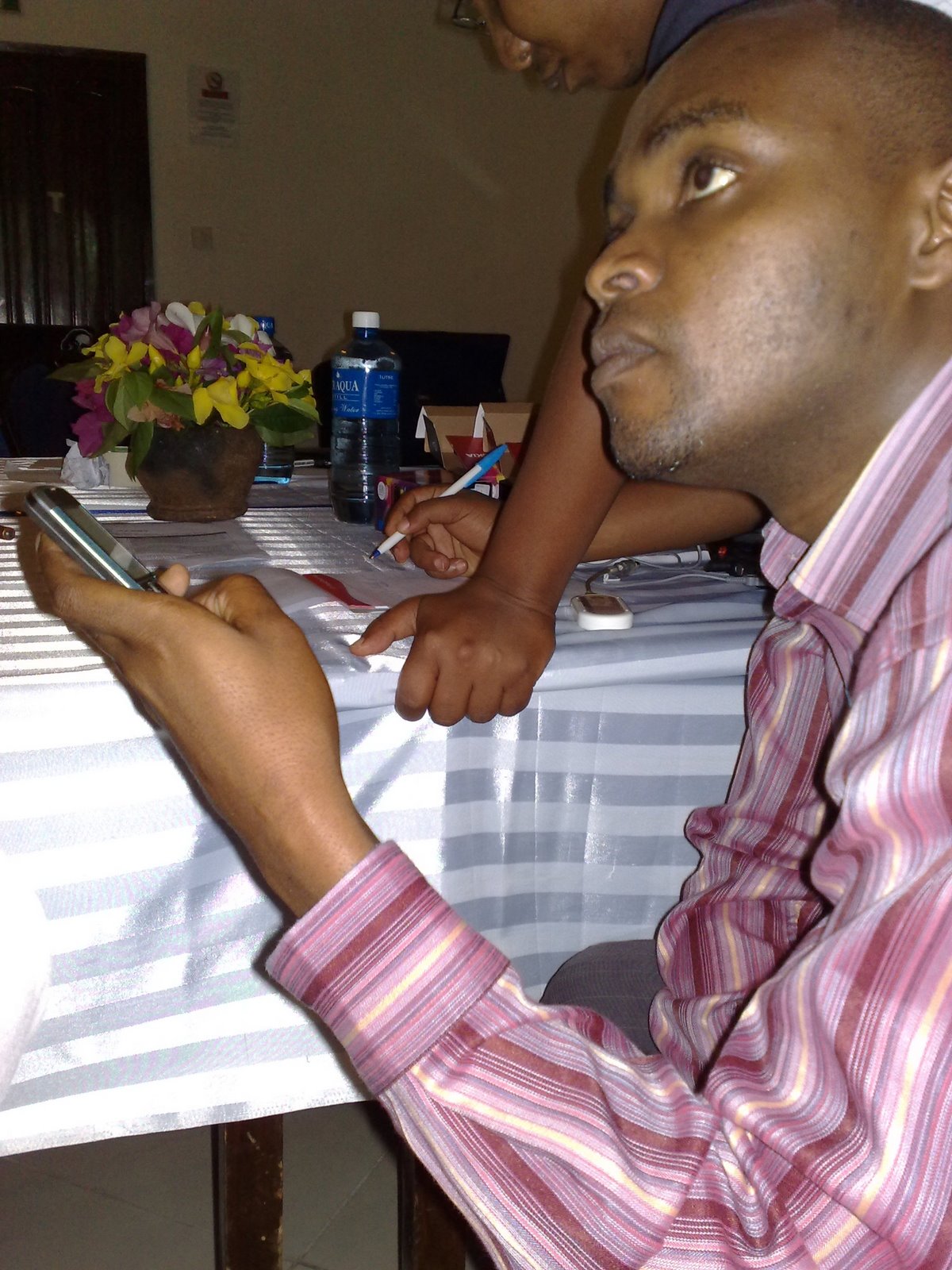
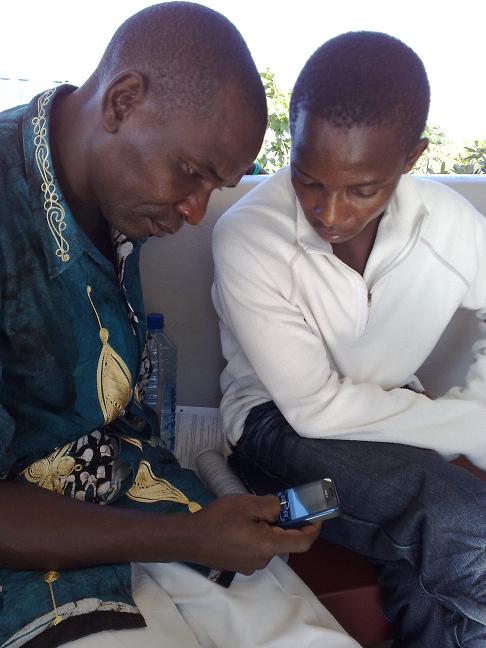
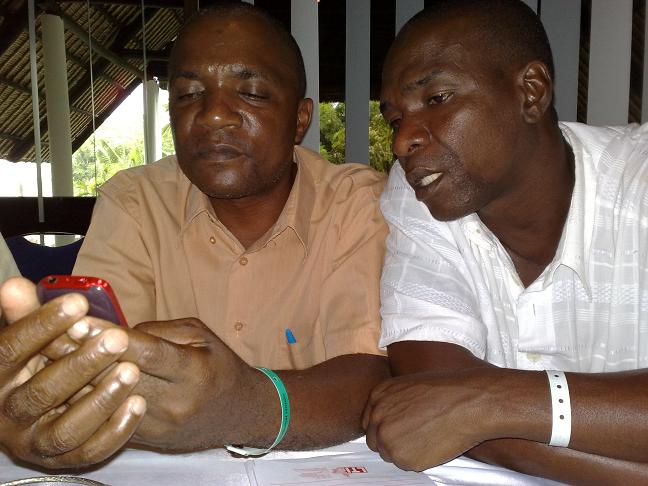
Photo: Mwendar and Ali using mobiles during a meeting on modernizing the birth registration process in Kwale, Kenya, in June 2009.

We started with an overview of ICT4D, emphasizing the importance of not starting with the tools and devices, but rather a mapping of information and communications needs.

The presentation was based on Plan’s “Mobiles for Development Guide” by Hannah Beardon.  (See the presentation here). For me, a key aspect was the 3 ways that organizations can incorporate ICTs in their work:

1) Directly:  Addressing the digital divide through improved connectivity, capacity, access

2) Strategically:  Applying ICTs to enhance the impact of development projects and programs

3) Indirectly: improving their efficiency and effectiveness

The Mobiles for Development Guide also proposes a three-step process for arriving at decisions on how ICTs can be incorporated:

Stage 1: Assess the need/potential for ICTs/mobile technology

Stage 2: Analyze the socio-technological context

Stage 3: Choose the technology and content

For me, this is kind of obvious but we seem to often forget it.  Most sound organizations wouldn’t decide that building a clinic or a school is the solution without looking at the broader situation together with community members, and analyzing together what the desired outcomes actually are, what the local resources are, what the barriers are, how sustainability will be achieved, issues of upkeep, local ownership, power and control, usability, etc.  In the same way, we clearly shouldn’t slap on 100 mobile phones and some computers and call it an ICT4D or m-Something initiative.

But sometimes technology seems like such an obvious solution that organizations start with the technology tools rather than looking at the desired outcomes:  let’s do a radio project, a video project, an m-Health project – when rather we should be stepping back and seeing what the larger goals are, how we plan to reach them, what kind of information and communication needs to happen to reach project goals, how is information and communication currently happening in the local situation and who has control over it, and lastly what types of tools might work best for relaying that information and communicating.

As an action item from the workshop, we will begin work on a more concrete methodological guide for Plan staff to use at the local level.  The concept is in place, but how to actually do this concretely when we are developing programs with communities is perhaps not so clear.  The idea is to develop a detailed and participatory methodology that could be used locally (by staff, community members, district officials, etc.) to identify information and map out communication needs in existing (or developing) initiatives, to better understand the local ‘socio-technological’ context, and to have some sort of ‘decision tree’ that could help suggest the most appropriate ICT enablers for the local context. We hope to gather input from others who have done similar work (in and outside of Plan) and to field test it in Cameroon in a Child Survival project early next year.

Related Posts:

11 concerns about ICTs and ‘social media for social good’

It’s all part of the ICT jigsaw: Plan Mozambique ICT4D workshops

ICT ideas from Plan Cameroon

ICT4D Kenya: ICT and community development is real

Modernizing birth registration with mobile technology

In Kenya brainstorming on mobiles

Chickens and eggs and ICTs

On Girls and ICTs

7 (or more) questions to ask before adding ICTs

Read Full Post »

I had a chance to meet with Plan Cameroon’s Program Technical Team today (including those that look at Monitoring and Evaluation, Health, Education, Sponsorship, Child Protection, Water and Sanitation, Gender and the overall Program Support Manager) to give a quick brief on the ICT4D research and training that Plan Finland is supporting with Plan offices in 8 countries in Africa (Mali, Senegal, Cameroon, Ghana, Togo, Mozambique, Kenya and Uganda).

We are working with Hannah Beardon, who wrote Plan’s Mobiles for Development guide (available in both English and French) and building on that towards some more focused and concrete ideas for ICT use in these 8 countries. We’ll share the research with staff during 2-day workshops to brainstorm and gather ideas on information and communications needs, as well as available tools that could be used or adapted to local situations.

The 2-day workshops are planned for Aug and Sept. Hannah, Mika (Plan Finland) and I are developing the methodology and will make a training DVD to send ahead of time to each country (apparently complete with our selves doing presentations!) since we don’t have funding to do face-to-face training. We’ll have a staff person in each country as the main facilitator, and 10-12 key staff, from management to frontline, will attend. Mika or I will beam in by skype to support if needed. We’ll use the Frontline SMS demo video that Mika and crew did also, (see my earlier post about this from a few months ago), show how Nokia Data Gathering Software works, share the Common Craft Social Media videos, among other things. Hannah’s methodology will also come in for thinking about how ICTs could enhance existing efforts.

The idea is to both learn about new tools as well as look at current programs and see if there are ways to use ICTs to improve impact, and how to begin tailoring them to the programs and local settings. We’re also doing research on government policies and how Plan’s work links there. I hope that we can also look at partnering with local developers and ICT4D innovators in each country….

The idea of ICT4D was a bit new to some of the Plan Cameroon staff and not at all new to others. One interesting idea they shared was using SMS in anti-malaria programs to periodically remind people to retreat their bednets. There was some concern about literacy rates if one relies on SMS, and interest in using voice response, but given the number of languages in Cameroon, voice could also be a bit of a challenge. I’ll have to try to find out if/how that’s overcome in other places. Another concern was ‘scamming’ and how to avoid that happening. But it seemed that the issue of scamming is not something that Plan alone would face, but something in general that is faced with mobile phones.

The program support manager was really keen on using mobiles for program monitoring as that is something that can always improve and be more efficient with ICT, he said, and wants to test some ideas. The ICT manager also said he wanted to write something up. The sponsorship manager suggested trying out some data collection or quicker communications tools for linking with community volunteers. And as mentioned earlier, child media and child protection are areas that can be greatly enhanced and supported via ICTs (help lines, SMS incident reporting, social media and mobile reporting).

After the 2-day workshop, we should have something really nice to go forward with.

Read Full Post »

Childline Kenya is about child protection. “We run at 24 hour children’s helpline which is both an emergency response service for abused children who need someone to help and an information line where children who have difficulties or questions that are bothering them can call us, we can talk to them, have a chat, do counseling on line, deal with abuse.” Irene Nyamu is the Deputy Director of Childline Kenya. She also worked at Plan for about 3 years before moving to her new post. Photo: Irene during a community visit in Kwale.

At Childline, Irene is constantly looking at new issues and situations because the field of child rights and child protection is vast. Childine works with everything from adoption issues to drug addiction to child abuse within the family and juvenile justice. “I wasn’t too versed in legislation, laws that relate to children and I’ve had to learn so much,” she says.

Before Childline, there was a government line, but it wasn’t a 24-hour line and it wasn’t free. If a child wanted help they had to have money to call. “What we’ve done as Childline is try very much to leverage support from the government’s Dept. of Children’s services.” For the last 3 years children have known that they can call to get the service. But Childline has involved government of Kenya along the way. “We’ve helped build government capacity and have proven that it’s possible to have a child helpline without a heavy cost. We’ve demonstrated its usefulness.”

When Childline first started, they had a fixed line with a free call number and got around 600 calls per month. “Since we’ve moved to mobiles, we get about 20,000 calls per month and we are still not meeting the needs of the population.” Childline Kenya’s has 9 counselors during the day and about 6 at night. To optimally operate, Irene estimates needing around 15 during day and 10 at night or more. “When we were on a landline, we had a long phone number that was difficult to remember, and most people don’t have access to fixed line. So now with the 116 short code, it’s quite easy to remember and very accessible on mobile.”

As for concerns that children cannot access a phone to report in, people should not assume children do not have access to phones. Childline confronted this and has proven that if the information is out there, children will find someone that is willing to help them make a call. “Many children now call us even without a fixed line. They have a teacher, an auntie, a big sister who will allow them to borrow the phone. I’ve seen that almost everybody in the community has a SIM card. They do not have a handset, but when they need to make a call they just borrow a handset for a few minutes and somehow they do it. We can’t make the argument that children can’t use technology. There are innovative ways of using the technology so let’s put the technology out there and stop assuming that people can’t access it.”

What about credit? This is a very important issue. “If organizations or institutions want to use SMS, then there is an investment cost unless you are able to acquire a short code.

Childline tracks how many people have dialed in and how many calls they actually receive, and they currently receive many more calls than they are able to manage. Irene thinks that one way of extending the service out to more children might be an increased use of SMS, which is extremely common and accessible in Kenya. “To meet the needs of our population, I think this FrontlineSMS training was really useful. We can now go in to explore how to use SMS for child helpline work in order to offer more alternatives to children. If you can’t call, can you SMS? And how do those numbers compare?” Photo: Learning to set up Frontline SMS for mobile data gathering, SMS outreach and auto-responses.

“I love working at Childline because every new day is different. Every new call that comes in, you can anticipate a new challenge.” One way to meet some of these challenges is via new technologies such as mobile outreach and mobile data gathering.

Read Full Post »

Jonathan Mativo, whom I first met in Kenya in December at our Social Media for Social Change workshop was one of our core FrontlineSMS trainers last month. In January, Mativo left Plan to found his own organization called ICT4D Kenya which operates in the Kilifi and Machakos districts in the Southern Coast of Kenya. He was motivated to move beyond the commercial ICT sector to ICT4 community development by his 4 years of work at Plan. “Previously I didn’t have any background on ICT4D. I only looked at ICT from the operational point of view but Plan really inspired me to work with children to see them realize their full potential.” ICT4D Kenya envisions young children confident in participatory media, children that see ICTs as enablers for development rather than just tools to perform work. “We also foresee a changed community – people who are socially together.”
Photo: Mativo is the founder of ICT4D.

ICT4D Kenya targets communities and schools, with the aim of building the capacity of youth, men and women through community ICT resource centers to introduce them to new ways of learning. ICT4D Kenya is also experimenting with interactive learning. “Normally students learn by rote. They basically take notes extracted from text books.” In their free time children expected to study, but “they are just revising materials from textbooks that have been copied into their notebooks…. They are hardly concentrating on what they are doing.” Mativo wants to introduce interactive learning materials in schools so children will be more attentive in class. He’s also planning some school linking projects where students in different districts can communicate to share culture and motive each other to improve school performance. Photo: Wajuhi and Mativo at Plan’s training on mobile data gathering in Kwale, Kenya

We’re not talking old, slow computers though. “One thing about Africa is that we are used to free things. That’s why we are congesting our country with refurbished things.” Mativo believes that to take ICT ahead in Africa, schools need access to the technology that they would get in the real market. “Often we get old computers, slow, hard to maintain and without proper e-waste solutions. We should be looking at affordable technology and ways to get ICTs to Africa rather than just dumping refurbished equipment.” So what about refurbished/donated phones? “Small gadgets are a different story. If you look at the features of a mobile, as long as it can send an SMS, it’s fine. SMS is one thing we are really looking at for social change.”

Mativo has worked with one school to install FrontlineSMS (http://www.frontlinesms.com/) in order to communicate with parents. This year there was a teachers strike. Most schools sent their children home. But this school got all the parent/caretaker contact information. “Within 2 days we had all the mobile numbers.” They keyed them into FrontlineSMS and the head teacher used the software to send an SMS to all the parents and asked if they should send the children home or not. “We got 237 out of around 400 messages back from parents on the first day saying ‘don’t send our children home’ and the rest said to send them home.’” So the head teacher kept the children at school, and when a parent questioned the decision at a parents’ meeting later in the year, he used the SMS he had saved to explain the reasons.

Now the school is using the software for all kinds of things. On annual Prize Day instead of the normal low turn-out, they had 75% turnout for the first time this year. “Parents said you communicated with us in due time by SMS and kept communicating with us over time to remind us.” Normally students are given newsletters during holiday times and parents don’t remember key dates when they finally roll around.

Mativo sees his role as demystifying ICTs and finding the best way possible to ensure people understand ICTs from a non technical point of view. “When I have to explain what a computer is, I always refer it as ‘that box there’ so that people don’t look at it as too delicate. In most cases I open the CPU for people to understand that it’s just an empty box that they shouldn’t be too afraid of.” Mativo says that many people believe it’s not possible to change their communities’ way of thinking, especially people who are working in commercial ICTs. “They need to internalize what community development is all about and that ICT can be downgraded to reach out to people in communities regardless of their skills, their background and their exposure. ICT and community development is real.”

Photo: Simplifying ICTs for people.

Related posts on Wait… What?

7 (or more) questions to ask before adding ICTs

Read Full Post »

As part of our mobiles for outreach and data gathering training last week, we went out to a community about 20 minutes away from the hotel today to hear Silla, the district civil registrar, talk about a project that Plan Kenya is supporting that aims to modernize the birth registration process. Plan Kenya is looking incorporating mobile data gathering and outreach into the project, so it was a good opportunity to test data gathering. We tested the Nokia Data Gathering Software using a form that the team had created earlier in the week based on the paper forms that the District Registrars office uses. It all worked just fine. Photo: Silas from Kwale District, and Petri, Director of the Nokia Research Center in Manaus, Brazil.

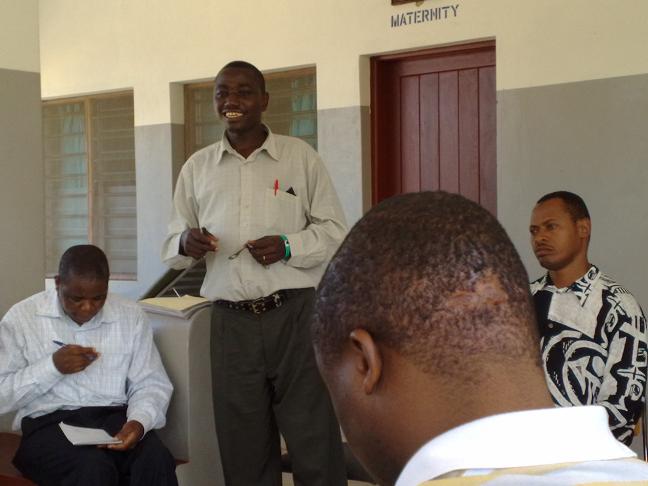
Silla is really an expert on birth registration and anything that has to do with it. He can quote you just about any law related to the subject in great detail. Currently, for registering births, people have to go to the sub-registrar/assistant chief’s office which can be quite far. Once there, sometimes there are not enough actual registration forms and they just give the registration information to someone who writes it in a school notebook. Later when they have more forms, the information is transposed to the official form, and sent along for processing. It can take awhile for processing, and people have to return to the sub-registrar’s office personally if they want to find out if it’s ready. The district is quite large, so they may have to travel up to 100 kms sometimes to go into check, and the certificate may not even be ready yet. Photo: Silla schools us on civil registration and explains why the district wants to modernize the process.

I talked to Ali M and Ali K (‘the Ali’s’ as we call them, since they are pretty much inseparable) who both work with Community Based Organizations (CBOs) that are participating in the birth registration project. (They were both at the video training with me last month here also). They explained some of the main reasons that not having a birth certificate makes life difficult:

If children don’t have birth certificates, they cannot get passports obviously, but that is the least of the issues. They cannot attend secondary school without one, nor can they benefit from any type of social service or insurance. Kwale district has a very high incidence of child marriages, yet if there is no birth certificate there is no way to prove in court that a girl is too young to be married. Other kinds of abuse also cannot be proved as child abuse. Without proper registration, the district does not get its fair share of the national budget because it’s not clear how many people are actually there. Photo: Ali K and Ali M – real leaders and innovators in community development.

As the Ali’s explained, if Kwale District is successful in incorporating SMS’s, mobile data gathering, and mobile outreach into the birth registration process, not only will they be the first district in Kenya to do it, but Kwale will be the first to even computerize the birth registration process. A couple ways they want to use mobiles are to provide a phone number that people could SMS their registration number to and find out if their certificates are ready or not, thus avoiding a long trip into the district office for nothing. They are also thinking of shifting the actual data gathering from hand written (carbon paper with several copies) to mobile data gathering and computerized data storage. In any case, a full project is being developed and piloted that will automate much of the current time consuming processes.

I remember when I lived in El Salvador and the municipality changed from hand written logs to computers. You used to have to go really early in the morning and wait in a huge line to get a number. Then you waited again till they called your number, went up and gave someone your information. That person would give your information to someone else who would look up the name/date, etc. and after an hour or 2, they’d call you and give you a little piece of paper with your record number on it. From there you would go wait in the cashier line to pay a fee for the copy of the certificate. Then you would go to another line at another window and give that number to someone else and sit down again for another few hours while that person would go into the archives books (bound books of hundreds of records) and find your certificate for you (birth, death, marriage, etc.). They’d make a copy and then it had to go to an official somewhere to authorize the copy before they’d give it to you. So basically you had to get there around 7 a.m. if you wanted to get it the same day, and it was a whole day affair.

Around 2000, they got a computer system in and modernized the process. I went in to get a copy of a document, and I clearly remember the security guard laughing at me because I looked at the certificate twice in shock when I paid my fee and was handed the actual certificate after about 30 minutes.

If the Ali’s and the Kwale District are able to get the equipment and set the project up, it could mean huge time savings for people and translate into greatly increased numbers of parents getting birth certificates for their children. The Ali’s have already taken the idea to a national level meeting and have other districts interested in their idea. Hopefully Kwale pulls it off and the model can be nationalized once any kinks are worked out! Photo: Mwenda and Ali, Kwale district CBO members.

Read Full Post »

Building on the last post, I wanted to share also some of the discussion at last week’s Kenya workshop about incorporating mobiles into our work. People in general were pretty excited. Even those people who were skeptical seemed to see mobiles as tools that could improve work we are already doing if well incorporated and done from ‘the bottom up’ in sustainable ways, based on program information and communication needs. Some great discussions came up and participants shared some potential solutions and good practices.

Issue: Access

We are working with children. How many children have phones? How do we get information from children? We work with communities who are the “poorest of the poor” – so how do we get info from them using FLSMS – do we expect them to have phones? Or people may have phones but no credit? How do you handle such circumstances?

Use a short code if you can get one

Credit is a very important issue. If organizations or institutions want to use SMS, then there is an investment cost unless you can acquire a short code. If you have a short code you deposit money to make this free or much lower cost for people.

Don’t assume that children don’t have access to mobiles

We should not assume children do not have access to phones. If the information is out there, children will find someone that is willing to help them make a call or text. Many children now call us (at the Child Help Line) even without a fixed line. They have a teacher, an auntie, a big sister who will allow them to borrow the phone. I’ve seen that almost everybody in the community has a SIM card. They do not have a handset, but when they need to make a call they borrow the handset for a few minutes and somehow they do it. We can’t make the argument that children can’t use technology. There are innovative ways of using the technology so let’s put the technology out there and stop assuming that people can’t access it. The issue is how can we make the technology reach as many as possible?

Give out SIM cards with a few minutes on them to protect privacy and confidentiality

We had a similar situation with a reproductive health project that was offering out information that most girls wanted to remain confidential. What we did was gave out 10 bo SIM cards. We passed them out in little boxes. Many of the girls had phones but wanted to send in anonymous questions so they used the SIM cards to send the SMS in, and then removed the card from the phone, put it in their pockets, and replaced their original SIM. It only costs 1 shilling via Orange. We found that normally the SMS conversation lasts for around 6 shillings. They can maintain anonymity this way. It’s cheap and they can just keep these SIMs in their pockets.

Issue: If mobiles begin to replace face-to-face contact and relationships with partner communities.

Using Frontline SMS for community outreach and communications has many advantages, particularly in terms of the information that we constantly need to gather. However, we should be careful though that it doesn’t substitute field visits. If people get used to getting information quickly they are likely to avoid going out and getting in touch with communities to see what is happening. If you just sit and wait for an SMS you will lose this face-to-face contact with the community.

Mobiles can be a tool, but must be integrated with other communication means

This point reminds us that we should not totally substitute it but use it as an additional tool in the toolbox to improve, cut costs, reduce, etc.

Issue: A text does not give enough space for full and clear information in health or other cases

We talked about using Frontline SMS for radio. In our participatory youth media programs, children bring out issues in video, in radio, etc. We are not always able to respond immediately to their concerns and issues. FLSMS could be a way to respond to these issues. Are there examples of how to pass on this type of technical information? If I’m a midwife and am too far from hospital, I need very clear information. How could this be done with SMS via an auto reply and only a short amount of text?

Use SMS to bring face to face help more quickly and to track/record incidents

SMS isn’t a solution for everything, but I know of an example of how that can work. There is another program called Ushahidi that is about crisis mapping. It’s a digitized map. Sometimes when a situation becomes extreme people are asked to share their locations using GPS and then you can send local people to these places on bicycles or through other means to help. This allows the professional help to arrive more quickly. Maybe SMS can’t solve it but it can bring help more quickly.

Use SMS as a supplement, not a replacement for human contact and long-term work

In the case of trying to change harmful practices and traditions, we need time and eye contact. If we are working with trying to make cultural changes, such as in the case of infanticide or something, you can’t just send a text that says “this is a bad practice”. You need to come close to people. I believe FLSMS can offer a secondary way or a supplement to a given community meeting, to strengthen a rapport with the community, but it’s not a replacement for our long term work and ongoing relationships with people.

Read Full Post »

I spent last week in Kwale, Kenya in the company of several colleagues learning about and discussing the use of mobiles in community development, both for outreach and communications and for mobile data gathering. There was a variety of people — from frontline staff to members of Community Based Organizations (CBO) in Kwale, to monitoring and evaluation (M&E) staff from Plan Kenya’s districts and central offices and Plan’s West Africa Regional office, to IT staff, to youth and those working with youth media, to partner organizations working on child help lines and social media outreach.

Photo: Anthony from Plan along with Mativo, a former Plan colleague, trained us on FLSMS

We looked closely at Frontline SMS (FLSMS) and Nokia’s new Data Gathering Software (NDGS) and brainstormed on ways that this type of tool might support the work that people are already doing. Really an interesting week!

In addition to the more common ideas of using mobiles for health campaigns, disaster/crisis situations and general communications and monitoring, people mentioned:

For youth media programs:

-Organizing weekly radio contests via Frontline SMS and allowing many more youth to participate in the radio program that way. Now for contests, they have to write a letter with their answer and bring it to radio station by foot. Using SMS many more could participate, increasing listeners and engagement.

-Assessing the radio show right after the recording. The youth and children could go in the audience and gather the data they normally do by hand using mobile data gathering software, thus easing the processing time and analysis of the information.

-Monitoring progress and changes made in relation to the show at a broader level — the participating youth could use mobile data gathering to monitor change related to the issues they are targeting in the radio shows and to see if youth organization and awareness building is impacting on the community over time.

Photo: people got really excited when their first forms appeared on their phones to be filled in!

For Child/Human Rights work and Global Child Rights Campaigns:

-Assessing the knowledge/awareness of the communities about rights issues and/or our global campaigns

-Receiving reports and sharing information about violations of rights (gathering info on whether children are being registered at birth, the incidence of school violence, girl’s or women’s rights violations, cases of child abuse) and offer short information on where to go for help.

-Monitoring child abuse cases, e.g. community members could text in key words such as ABUSE or MARRIAGE to report and track child abuse cases and early marriages happening in the community:

Birth Registration (UBR) implementation

-Tracking birth registration certificates and sharing information on the steps of the registration process. With auto SMS replies we could enhance information accessibility 24/7. We could provide instant feedback to people on the status of their birth registration. It would be a very quick way of sending information to many.

-Using mobile data gathering software, the birth registration process could be made paperless and computerized, thus saving time and effort for the population and increasing the number of children who are registered at birth.

Photo: Jackson and 3 other colleagues from Brazil trained us on the NDGS.

Monitor services

-Running a mobile survey or a rapid assessment to find out whether a service like Childline is reaching people and whether the service is known and being utilized in the field.

Communicating among Plan staff, CBOs, Communities

-Passing along information such as training dates, schedules, meetings, etc., to avoid making a trip out to the community to get information

-Surveying on health, school attendance, and school enrollment through a network of teachers

Communities communicating amongst themselves

-Communities have a lot of information they want to share among themselves, among the Community Health Workers (CHWs), with the other communities and other leaders – they could do this with FLSMS.

Managing Meetings and Decisions

-Inviting participants, confirming attendance, updating on the absentees when you’ve reached a decision they could be contacted this way. You could even involve those who are absent in voting by SMS if you don’t have quorum; eg., text in 1 for this candidate, 2 for this other one, or vote yes/no on something.

Photo: SMS was seen as a great way for communities and CBOs to communicate and organize.

Read Full Post »

« Newer Posts