Feeds:
Posts
Comments

Archive for the ‘El Salvador’ Category

One of the main programs I support is a youth arts, technology and media program called ‘YETAM‘.  The program supports youth to identify and raise issues that they consider important, and then helps them engage their communities to resolve the issues they’ve raised. The youth have talked a lot about water in most of the places where I’ve been working in the past couple years, probably because children and youth tend to be the ones responsible for carrying water.

As part of the project in Okola District in Cameroon last year, youth mapped their community and prioritized their issues. One of their top issues was water. They made this film together about the water problem and shared it with the community adults and local authorities.

Probleme d’eau Potable – The Potable Water Problem (for subtitles, click on the arrow on the bottom right hand side of the video player and then click on the red ‘cc’ button)

Spurred on by the project and the organized youth, a few months later the community got to work fixing one of their water sources. They put in some resources and so did our local office.

La quete d’eau potable – Lack of Potable Water part 2.

Here are a couple other videos about water filmed by youth….

The Community Water Tank from El Salvador about what happens when water sources are not kept up (click on link as it’s not available on YouTube yet)

Djiko: l’eau potable a song youth wrote to remind communities about water scarcity in Mali

Water – Amazi where youth interview a rural family about water scarcity in Rwanda

Related posts on Wait… What?

A catalyst for positive change

Youth empowerment through tech, arts and media

Meeting in the middle

An example of youth-led community change in Mali

Read Full Post »

I read Malcolm Gladwell’s piece on new media digital activism in the New Yorker and it made some sense to me at first. I’m as skeptical as the next person, and very tired of the ‘slacktivist’ social media campaigns that I come across in the US. However, I think it’s important to note that the problem isn’t in the tools being used by activists/’slacktivists’. The issue goes deeper, and it’s more about context and culture.

A few things that I’m mulling over are:

1) In a repressive environment, using social media tools to organize is just as dangerous and subversive as using ‘traditional’ ways of organizing. Organizers, activists and sympathizers use a combination of tools to participate and to reach specific goals. It doesn’t matter if the tools are digital or not. What matters is whether or not they are effective in the context where they are being employed. Lina over at Context, Culture and Collaboration has a good post on the use of tools to fit the goals.

2) The level of commitment to a cause is in direct proportion to the level of personal risk. i.e., the more committed you are, the higher the personal risk you are willing to take; the higher the personal risk, the more committed activists likely become. In the US context, unless perhaps you are gay or Muslim [update Aug 2014 — “or Black”], there is not a lot of personal risk in uniting or fighting for a cause, and most of the causes that are social media driven do not create any major personal risk to those who join them. I find a lot of US campaigns to be meaningless or misdirected compared to activism in many other places. US-based ‘activism’ campaigns are often more about cause marketing or branding an organization or collecting emails than they are about changing a serious social issue at home or abroad. This is not the fault of the social media tools or of ‘digital activism’, it’s a reflection of US culture, our current values, the organizers behind the causes, and the sociopolitical moment we are living in.

3) Some of the digital media evangelists in the US and in the US media don’t understand enough about grassroots organizing or the sociopolitical contexts in other places to see beneath the social media tools to the networks of engaged, involved people and the broader movements happening off-line. They see social media use and think it’s the core of a movement when in fact it is probably just the only piece of it that they have access to at the global level; it’s the shark’s fin. This comment from Esra’a really got me thinking about that.

When a t-shirt can get you in trouble

When I lived in El Salvador in the early 1990’s, (eg., before social media) political oppression was heavy. During the war, you could get arrested, tortured, or disappeared for something as simple as wearing a political t-shirt; criticizing someone from the ruling political party (ARENA); owning a cassette of Mercedes Sosa, Los Guaraguao, or Silvio Rodriguez; reading a book of poetry by Roque Dalton; or merely gathering in a group or having a meeting. That didn’t stop people from organizing though, both in hierarchical ways and loose networked ways.

In 1994, El Salvador held its first elections since the signing of the Peace Accords. It was the first time that the guerrilla group, the Frente Farabundo Martí para la Liberación Nacional (FMLN) was allowed to participate as a political party. It was a hopeful yet dangerous time. Only the bravest came out publicly to show their support for the FMLN, the past 14 years of repression still fresh in everyone’s minds. There were political assassinations of opposition candidates taking place, fears of widespread fraud, concerns from voters that their votes would not really be secret. ARENA had used every media channel it owned (all of them) to warn foreigners that any ‘interference’ in local political issues would get them deported.

I was working with an international organization that was hosting a group of Ecumenical Elections Observers.  One day, as part of the orientation program, I took a delegation of the observers to the office of the FMLN to meet with the head of the party, Facundo Guardado. (We had met with leaders from ARENA earlier in the week.) Facundo gave us all FLMN t-shirts.

That afternoon, coming home from work, I was walking down the alley way a couple blocks from my house, the t-shirt in my bag. I heard a couple of motorcycles come up behind me and the familiar ‘ch ch, sssss ssssss, mamacita‘. I was alone in the alleyway, so I quickened my pace to reach the little open area where the Barrio women would sit for a minute to catch their breath when coming back from the market with their heavy baskets and the older men would gather to play checkers under the trees in the afternoons. Before I could get there, one of the men pulled his motorcycle up in front of me and the other came up on my left side, cornering me. I saw that these were not just men harassing me, they were in military police uniforms and I got nervous.

They asked for my passport.

‘I don’t have my passport with me. I don’t carry it because I’m afraid it will get stolen.’

They didn’t like that answer. ‘Do you think we can go to your country and walk around without papers? No, we can’t, we’d be deported. Why do you think you can do that here?’

‘Let me look for my driver’s license. I’m sure it must be in my bag. Is that OK?’ They continued to scold me angrily.

I started digging around in my bag to try to find my local driver’s license but failed because my bag was so full of stuff. I was afraid that they were going to see the t-shirt which would lead to a lot of questions and make it look like I was getting involved in internal politics.

My neighbors started popping their heads out of their doorways and windows and watching as the military police questioned the gringa who lived in the Barrio. Just as I was going to be observing and standing witness to their upcoming elections, so they were observing and standing witness for me while I was being questioned by the authorities. Cautiously, one of them said in a respectful voice loud enough to reach the policemen ‘Ella es de aqui.’ She’s from here. Another one agreed. ‘Sí, ella vive aquí.’ The police ignored them and continued to question me. More and more people began standing around to watch from a distance.

My heart was beating loud and fast. The afternoon sun was hot. I started carefully removing things from my bag and placing them on the dirt road… the soda I was bringing home for my husband… my notebook… my sweater… hoping to make some space in my bag to find the driver’s license without the t-shirt coming out. I had no idea what was going to happen if I didn’t find my license. What if they took my bag and searched it and found that t-shirt? Would they seriously arrest me? Would I be deported?

After what seemed like hours, I saw my mother-in-law running towards us, carrying my son. Someone had alerted her that I was in trouble. Her eyes flashed like they did when she was worried, upset or angry. She was on fire. ‘Buenas tardes, oficiales. What’s the problem? What’s happening? Uh hunh, she is my daughter. My daughter-in-law. This is her son. She lives here with us, here in the Barrio.’

‘Sí, es verdad,’ it’s true, several of the neighbors called out. While they were speaking, I finally found my license. It had gotten caught up between the pages of my notebook. I showed the police and they lectured us all about the importance of carrying papers, got on their motorcycles and rode off. For a few days after the incident I felt nervous that they would follow me in the alleyway again, or find me someplace else and continue their questions, out of sight of the neighbors and far from my brave mother-in-law.

So what does that have to do with activism and ‘slacktivism’?

The simplest of things can get you in serious trouble in a repressive environment. Not carrying your identification. Listening to revolutionary songs. Discussing politics. Reading a book by someone who critiques the government. Wearing a political t-shirt. Standing on a street corner to watch a protest.

Would any of that be seen as subversive in the US? As deeply significant and meaningful? No. Most of us don’t have to carry identification. Teenagers listen to Bob Marley without even knowing what the songs are about. We critique politics openly all the time. Our kids read Marx in school. We make fun of our political leaders on TV and billboards and t-shirts. We join political campaigns and publicly demonstrate who we are voting for. These activities are all very low risk at this time in the US cultural and sociopolitical environment. Engaging in activism in the US, wearing t-shirts, joining on-line groups and the like is often seen as slacktivism because these are very easy things to do, don’t require a lot of effort or personal risk. We are not doing a great job of engaging people in real debates in the US, and I worry about some of the changes happening now in the US (think: Tea Party), but it’s hard to deny that we do enjoy an amount of freedom of expression that’s difficult to come by in many other places.

In 1994 in El Salvador, people were not using social media to organize. But if they had been, it would have been every bit as risky as wearing or owning an FMLN t-shirt and just as meaningful. Simply identifying with a cause was subversive, much more so if you actually spoke out or identified yourself publicly. Wearing a political t-shirt in that type of environment is not ‘slacktivism’. If social media had been around then, engaging in the movement digitally would have been dangerous and probably very effective considering both the hierarchical structure of the armed opposition and the networked structure of sympathizers across the country, the region, and the world. Activism is not about the tools, it’s about the movement, the cause, the social change, the level of commitment and the potential danger and risk that people place themselves in when publicly identifying with a cause and fighting for what they believe in. That is what gets people heart and soul into a movement, regardless of the tools that they are using.

I think there is a risk of a US-centric critique of all digital activism as ‘slacktivism’, when that is not always the case. Should we call out the US media and those people who are hyping up social media as the key factor in social and opposition movements such as recent ones in Iran or Moldova? Yes. Should we in the US take a closer look at and question what’s behind our shallowness and cultural propensity towards ‘slacktivism?’ Definitely.

But we should also be careful about projecting our weaknesses and cultural frameworks on all uses of social media tools in activism.

—–

Related posts on Wait… What?

11 concerns about ICTs and ‘social media for social good’

On Glenn Beck and ‘rooting out liberation theology’

It’s not a black and white photo

Read Full Post »
Mural in the Arcatao community, Chalatenango, El Salvador, reflecting what happened at Rio Sumpul in 1980

When Glenn Beck mentioned Liberation Theology around minute 12.20 of this Fox News video (which I came across courtesy of @Jay_Rosenberg), I literally sat up straighter in my chair, downsized the other 6 tabs I had open, hit rewind, turned up the volume and listened.  And I felt really unsettled.

The amount of time I normally give to Beck and the Tea Baggers is the time it takes to hit delete on an email. You know the ones… they are usually full of misinformation and have a lot of all capital letters, bright red size 64 font, and tell me to fear Obama, Mexicans, Muslim takeovers and universal healthcare.

But Beck’s coloring of Liberation Theology in this video clip “Liberation Theology and the Political Perversion of Christianity” and his take on social justice make me really angry.

In the Liberation Theology clip, Beck paints this vision of people who follow liberation theology. “These are people who, besides blowing stuff up, were also having a sexual revolution, trying to smash monogamy. This isn’t about God to them in any shape or form.”

He talks with Anthony Bradley, a ‘Black Liberation Theology Expert’ from the Acton Institute. Bradley says “One of the odd interpretations of Marxist thought and theology happened in central and south America, right in the church. And it was really the fantastic work of the current pope, who actually rooted out liberation theology from that region.”

Yes, right. Fantastic rooting out. Just fantastic, Bradley.

I’m not a Christian or a Marxist, but I lived and worked in El Salvador in the 90s. That’s right. El Salvador, one of the Central American countries where Liberation Theology was at its strongest.

Here’s what ‘rooting out liberation theology’ meant in El Salvador.

Archbishop Oscar Arnulfo Romero's famous words

It meant assassinating Archbishop Romero in 1980.

“Romero was shot on March 24, 1980, while celebrating Mass at a small chapel located in a hospital called “La Divina Providencia”, one day after a sermon where he had called on Salvadoran soldiers, as Christians, to obey God’s higher order and to stop carrying out the government’s repression and violations of basic human rights. According to an audio-recording of the Mass, he was shot while elevating the chalice at the end of the Eucharistic rite. When he was shot, his blood spilled over the altar along with the sacramental wine.” (Wikipedia)

And assassinating the 6 Jesuit Priests from the University of Central America, cutting open their heads and strewing their brains around the yard.

“Before the end of darkness on the morning of Nov. 16, with unspeakable and barbaric cruelty, armed men burst into the Jesuit residence at the University of Central America in San Salvador and shot six Jesuit priests to death. At the same time, the community’s cook and her daughter were murdered in their beds. According to reliable reports, several of the priests, my brothers, had their brains torn from their heads.” (Washington Post, Nov 19, 1989)

And beating, raping and murdering 4 Maryknoll sisters.

“In December 1980, Jean Donovan and three nuns joined the more than 75,000 people who were killed in the Salvadoran Civil War. In the afternoon of December 2, Donovan and Dorothy Kazel picked up two Maryknoll missionary sisters, Maura Clarke and Ita Ford, from the airport after the pair arrived from attending a Maryknoll conference in Managua, Nicaragua. They were under surveillance by a National Guardsman at the time, who phoned his commander for orders. Acting on orders from their commander, five National Guard members changed into plainclothes and continued to stake out the airport. The five members of the National Guard of El Salvador, out of uniform, stopped the vehicle they were driving after they left the airport in San Salvador. Donovan and the three sisters were taken to a relatively isolated spot where they were beaten, raped, and murdered by the soldiers.

The [1993] U.N.-sponsored report of the Commission on the Truth for El Salvador concluded that the abductions were planned in advance and the men responsible had carried out the murders on orders from above. It further stated that the head of the National Guard and two officers assigned to investigate the case had concealed the facts to harm the judicial process. The murder of the women, along with attempts by the Salvadoran military and some American officials to cover it up, generated a grass-roots opposition in the U.S., as well as ignited intense debate over the Administration’s policy in El Salvador. In 1984, the defendants were found guilty and sentenced to 30 years in prison. The Truth Commission noted that this was the first time in Salvadoran history that a judge had found a member of the military guilty of assassination. ” (Wikipedia)”

Rooting out liberation theology meant massacring almost 800 peasants in El Mozote in Morazan

“In a small rectangular plot among the overgrown ruins of a village here, a team of forensic archeologists has opened a window on El Salvador’s nightmarish past. Nearly 11 years after American-trained soldiers were said to have torn through El Mozote and surrounding hamlets on a rampage in which at least 794 people were killed, the bones have emerged as stark evidence that the claims of peasant survivors and the reports of a couple of American journalists were true.” (New York Times, 1992)

and another 300 people at Rio Sumpul, on the border with Honduras

“On 14 May 1980, units of Military Detachment No. 1, the National Guard and the paramilitary Organización Nacional Democrática (ORDEN) deliberately killed at least 300 non-combatants, including women and children, who were trying to flee to Honduras across the Sumpul river beside the hamlet of Las Aradas, Department of Chalatenango. The massacre was made possible by the cooperation of the Honduran armed forces, who prevented the Salvadorian villagers from landing on the other side.” (UN Truth Commission Report, 1993)

It meant assassinating, disappearing and torturing thousands who belonged to Christian Base Communities. And that was just in El Salvador.

Rev. James Martin in his Huffington Post article explains why he follows liberation theology. I encourage you to read his full post:

“Liberation theology is easy to be against. For one thing, most people don’t have the foggiest idea what you’re talking about. It’s also easier to ignore the concerns of the poor, particularly overseas, than it is to actually get to know them as individuals who make a claim on us. There are also plenty of overheated websites that facilely link it to Marxism. My response to that last critique is to read the Gospels and count how many times Jesus tells us that we should help the poor and even be poor. In the Gospel of Matthew, he tells us that the ones who will enter the Kingdom of heaven are those who help “the least of my brothers and sisters,” i.e., the poor. After that, read the Acts of the Apostles, especially the part about the apostles “sharing everything in common.” Then let me know if helping the poor is communist or simply Christian….

It’s hard to ignore the fact that Jesus chose to be born poor; he worked as what many scholars now say was not simply a carpenter, but what could be called a day laborer; he spent his days and nights with the poor; he and his disciples lived with few if any possessions; he advocated tirelessly for the poor in a time when poverty was considered to be a curse; he consistently placed the poor in his parables over and above the rich; and he died an utterly poor man, with only a single seamless garment to his name. Jesus lived and died as a poor man. Why is this so hard for modern-day Christians to see? Liberation theology is not Marxism disguised as religion. It is Christianity presented in all its disturbing fullness.”

So, Glenn Beck. Really. Really?

Let me get this straight. The people above are or were about “blowing stuff up, sexual revolutions and trying to smash monogamy.”  And this is “not about God to them in any way shape or form” so they need to be “rooted out”?

Glenn Beck, you make me sick.

Update: posts I like on this topic:

Roger Ebert in Chicago Sun Times: Put Up or Shut Up.

Matt Taibbi in Rolling Stone: Tea Party Rocks Primaries

Timothy Egan in New York Times: Building a Nation of Know Nothings

Other El Salvador related posts on Wait… What?

Orgasmatron moments

On trust and disempowerment

18 years

It’s not a black and white photo

The real story involves anti-social entrepreneurs and anthropology

Read Full Post »

I had a doctor’s appointment a couple months ago, and my doctor asked me if it was OK for a student to do the prep work, you know, the usual: height, weight, temperature, blood pressure, the like. I said sure.

What I didn’t expect though, was that the student intern was going to read through a list of health questions to try to find out if I was menopausal. Nothing against menopause – it’s a natural thing and I think some women even look forward to it. But I just turned 42, and no, I’m not having hot flashes quite yet.

I suppose it’s some kind of mandatory thing to ask a woman who is in her 40s a series of questions like that. And to be honest, I probably wouldn’t have minded if it had been my doctor asking me. I’ve been seeing her for years now, she knows me, and she knows how to ask questions in the right way. I trust her.

But sitting up on an examination table in a sterile room, clothes off save for an oversized paper gown that keeps falling off my shoulder, with a 20-something I’ve never met sitting in front of me asking if I’m incontinent, suffer from bouts of depression, and have loss of libido was a bit off putting.

It made me want to lie to her. To not reveal any sign of potential menopausal weakness. To tell her that I never feel fatigued. That I never, ever forget anything, and that I am never ever ever distracted or unfocused. I secretly shunned all her suggestions. Calcium? nope, not taking it. Multi vitamins, pah, I feel fine. Let’s get this interview over with STAT.

It felt disempowering to have this young woman, who I don’t know and haven’t developed any trust in, asking me very personal questions about myself and my life and offering scripted solutions to something she imagined I might have, and that she’d obviously never experienced herself.  Since then, I’ve been thinking about it off and on, and related life stories come to mind.

—–

Julia*, someone I was very close to in my Barrio in El Salvador (where I lived for most of the 90s) had a long history of domestic abuse. She would talk to me about it all the time – she still lived with the man, who had tapered off a bit as he got older but who was still not entirely pleasant to her. She would get depressed sometimes and talk about leaving, but she never did. As I got to know her better, I realized my role in the relationship was not trying to find solutions, or criticizing the man, or feeling enraged. It was listening and not judging. An older woman, with a small pension. Where would she go? She believed that she would be seen by the neighbors as weak, and that people would lose respect for her. She really didn’t have a lot of options. So she’d tell me and I’d listen, and that was enough. I’d tell her my work troubles too, and she’d listen, and that was also enough for me. I realize as I write this how much I miss her.

About 15 years ago at work, while still in El Salvador, I was responsible for overseeing a study on gender violence that a partner organization was carrying out and that we were funding. It was going to be a door-to-door survey mixed with some focus group discussions. I immediately thought of Julia; of all the women in the Barrio. I thought ‘Julia would never tell anyone the truth if they came knocking on her door to interview her about domestic violence.’ She would say no, that doesn’t happen here, and close the door until they went away. I doubt any of the other women in the Barrio would have acted any differently.

I felt pretty sure that the information that was produced in that study on domestic violence was not going to be valid, even though it was being managed by a group of well-known, well-educated Salvadoran feminists.  But I felt like I couldn’t say anything, because I wasn’t a well known local feminist. And after all, they’d often imply, what did I know about El Salvador? I was a foreigner. What I did feel certain about was that no one in the Barrios where they wanted to do their study was going to tell them the truth.

—–

And somehow related to that, I started thinking about the time I went to the doctor’s office with my mother-in-law, a brilliant, strong and upright woman from the Barrio, with a 6th grade education, who would be considered ‘impoverished’ by most standards. I remember vividly a young male doctor who addressed her using the familiar form of ‘you’ (vos) instead of using the respectful form of ‘you’ (Usted). I remember being furious. I don’t even use vos with my mother-in-law, out of respect. What was this young, wealthy doctor doing using it? I hated seeing her stripped of her well-earned Barrio respect once she entered the doctor’s office, just because she was poor.

—–

What am I trying to say here? I’m not entirely sure, but I guess I’m thinking about respect and the hierarchies of information and education and offices, and the importance of developing a rapport with people before you go prying around in their personal lives and offering solutions.

I’m relating that to ‘aid’ and ‘development’ work, which in my world, is an intensely personal thing. I try to work from the heart, and I hope I’m never making people feel belittled, judged, or like they need to lie to me or conceal things from me because I haven’t taken the time to get to know them. I hope I’m not disrespecting anyone, knowingly or unknowingly, and that I’m not messing around in things that are none of my business or where I haven’t got an invitation. I hope I’m not always trying to offer solutions, but rather listening and supporting people to come to their own conclusions. I hope I don’t make people feel like they are sitting, half naked on an examination table, while someone who knows nothing about them or their life politely asks them some standard questions and comes up with some generic recommendations for how to prevent or cure something they may or may not have or may not think is an illness.

*Not her real name

Related posts on Wait… What?

The real story involves anti-social entrepreneurs and anthropology

It’s not a black and white photo

18 years

Read Full Post »

our stolen flowers, still going strong after almost 18 years.... (2009, Barrio Candelaria)

My son turns 18 today, and as always, when my kids have a birthday, it makes me think back to the day they were born and I get a little lost in the memories.

When I gave birth to my son, it was 1992 and I had been living in El Salvador for almost 1 year with my husband, Memo.  The Peace Accords had been signed a few months earlier, on January 16, ending a long and bloody civil war.  We lived in Barrio Candelaria, an old barrio in downtown San Salvador where Memo had grown up. My in-laws lived in the ‘meson’ about a half a block down from where we lived.  Memo was employed as a mechanic, making almost $100 a month and I gave evening English classes a couple times a week to the daughters of the wealthy family that lived in the Barrio (the ones who owned the corner store) to help pay for tortillas and drinks to accompany our meals.  I spent my days mopping, cooking, washing and hanging the clothes out, tending to the plants in the little cement garden in back of our house, hanging out with my mother-in-law, and doing a lot of reading.  It was a nice couple years’ break after college.  At that point we didn’t really have any plans. We were just living day to day.

Niña Alicia and I (2009)

The morning of the day that Daniel was born, I had my last visit to immigration where I picked up my residency papers.  My mother in law, Niña Alicia, walked over with me. On the way back, we stopped to pick up a ‘faja’ (girdle) which she insisted was necessary for after the baby was born.  She said that when a woman gives birth, she gets air inside which puffs up her stomach, and so she needs to wear a girdle afterwards.  I wasn’t convinced, but I would always go along with her ideas when they didn’t seem to do any outward harm.

After we picked out a faja (which I realized I would probably never wear once I realized what a faja was) we made our way home, collecting (stealing) snippets of plants from the nicer houses along the way to plant when we got back.  We always did that.  Niña Alicia had an amazing green thumb, so we always had a nice garden, even though my father in law wouldn’t allow us to break the cement to plant anything in the ground.

We’d left the house around 7 a.m. to do our rounds at immigration and got back at 11.  Memo worked in the mechanic shop about 2 blocks from the house, and I was supposed to walk over with his lunch around then. But I seemed to have a bit of a stomach ache.  It was 9 days earlier than my April 30 due date, so I didn’t realize it was labor kicking in.  I laid down on the bed for a bit to see if it would go away, our cat, Irola, curled up next to me.  Cats always know when something’s going on.  After a bit, I got up and made my way over to Niña Alicia’s house and told her I thought we needed to get the midwife, and could she please let Memo know that it was time (and take him his lunch).

Daniel and Memo

Early on I had decided that I wanted a home birth.  My other options were the public maternity hospital or the social security hospital, and at that time my Spanish wasn’t so great. I worried that the male doctors would come over and gawk at me out of curiosity – I’d certainly had enough men staring, groping and asking rude questions while fully clothed and even while very pregnant – and being a spectacle at the hospital didn’t appeal to me at all.  I also didn’t want to sit on a bed with several other women in the crowded maternity ward waiting for a bed to give birth in.  I didn’t want to give birth alone, and no family members were allowed in.  I didn’t want to be medicated and didn’t trust that they would listen to me about that at the hospital. And I wanted to exclusively breastfeed and keep my baby with me, and I had heard that the hospital always took the babies away and gave them a bottle of formula right away. I had a bunch of books about midwifery and birth. I read them voraciously with the idea that I could learn enough to practically give birth by myself if necessary.

The midwife, Niña Lita, and her daughter got to the house within about an hour. Niña Lita was a wizened old woman with crinkly eyes and a sweet smile.  She said she was a Mormon, but she would invoke the Virgin Mary before she worked on anything important.  She had been coming to the house for the past several months to check in on me and to ‘sobarme’ (massage my belly).  She’d look up to the sky, say some prayers to La Virgen, warm her hands with scented oils and start massaging. She’d tell me she felt the head here, the arm there.  Her goal was to help the baby get into the right position.  (A few years after, there was a big public education campaign against midwives and traditional practices, saying that this was a bad thing to do, but it doesn’t really seem too harmful to me.)  The monthly visits helped us get to know each other and develop trust and a bond.

When she arrived to the house to help with the birth, Niña Lita patiently watched and waited and softly encouraged me.  Luckily my labor was only about 4 hours total.  I kept waiting for Memo to show up, but he never did.  Later I realized that they didn’t want him to be there.  They said that if there were too many people around, the baby would get embarrassed and wouldn’t come out.

Daniel was born right around 3 p.m.  Niña Lita cut the cord, cleaned him up and wrapped him in a blanket while my mother in law ran to the corner store and borrowed the metal scale that they used to weigh beans, rice and sugar because I insisted on knowing how much Daniel weighed.  Niña Lita carefully placed him on the balance while Nina Alicia held it up.  Nine and a half pounds.  About that time they let Memo come in and went on their way, saying they’d be back tomorrow to bathe Daniel with rose and rue to ward off any bad energy or bad spirits.

The next day after the bathing process (rose and rue is one of the most delicious scents in the world) we went to the Health Center to get Daniel’s first check up and vaccines.  A couple weeks later, we went to the City Hall to register his birth.  At that time they wouldn’t let anyone in dressed in shorts, so Memo had to wait outside while I registered Daniel and people looked on in disapproval because a father is supposed to take on this responsibility.

I had the luxury of spending the next 40 days resting with Daniel.  My mother-in-law went to the market, bought cocoa beans, and ground them into fresh homemade chocolate to drink hot to bring down my milk.  I remember eating a lot of mangos de leche too, those small yellow ones that are in season in April.  There were certain foods prohibited for the 40 day period, including eggs and beans and anything strong smelling or strong flavored.

Every day I was supposed to give Daniel a spoonful of garlic oil that Niña Alicia had prepared so that my breast milk wouldn’t upset his stomach, but I only pretended to do that.  I was also instructed to tie a ‘faja’ around Daniel’s waist (a folded piece of cotton) to keep his new belly button clean and avoid any flies or germs getting on it, and also to keep his belly button from being an outie (I stopped doing that after a day or so because I was worried it would get infected and figured it needed some air to dry out — ironically he has an outie).  I was supposed to also shape his nose and his head two times a day by rubbing baby oil on my hands, heating them over a candle, and pressing lightly to round his head and straighten his nose.

Daniel was to wear a red hat, red socks and a red bracelet with a large grey seed on it to protect him from anyone with a strong gaze who might give him ‘ojo’ (evil eye) and terrible diarrhea.  And anyone who saw him was supposed to hold him so that in case they had any underlying jealousy due to his infant beauty, it would fade out and their bad feelings wouldn’t do him any harm. I was supposed to bind him up tightly so that he would not get bowlegged, and I was scolded when I held him upright because it would make his cheeks sag down.  I had to wear socks for the 40 day period to avoid getting air in my feet which would swell my legs and stomach. I wasn’t supposed to eat dry foods like cookies or bread while breastfeeding, because the crumbs would block up the milk stream.  If I was angry or upset, I was not supposed to breast feed or the baby would get cholic.

All those rituals were something that I wasn’t sure I believed in, but they added meaning and history to Daniel’s birth.  They helped us feel that he belonged to a long line of babies that had come before, and I didn’t mind them at all.  I was surrounded by people who loved babies and wanted to hold Daniel every chance they got.

Daniel, after almost 18 years (2009, Barrio Candelaria)

We didn’t have any money, so we didn’t have any of those typical things that accompany babies in many families.  We had no bottles, diaper bags, disposable diapers, baby food, high chairs, strollers, infant seats, cribs, car seats, playpens, jumpy chairs or the like.  As he grew, Daniel continued to sleep in our bed, and when he started eating table food, he would sit on our laps and eat from our plates. He was held and carried until he could walk, and then he walked until he was tired and was carried again.  He was never strapped in and confined – he learned boundaries without physical restraint. And I have a little theory — that this helped him learn to manage freedom and establish internal boundaries and limits.  (Don’t get me started on parents who put leashes on their kids!)

Daniel played outside in the alleyway. He got dirty. He got scraped and bullied.  But there was always a neighbor around to call over to one of us:  ‘Niña Liiiindaa, Daniel is playing in the dirty water!’ ‘Niña Aliiii, Daniel is jumping up and down on an ant hill!’

When we moved back to the US in 2001 and I saw women struggling to manage work and day care and all the accessories associated with babies, I realized how privileged we were in those early years.  Daniel talks about those days too. He realizes how lucky he is to have grown up in the Barrio, like those little snippets of plants Nina Alicia and I would pick up on our long walks and that still thrive in front of her house, 18 years later.

Related posts on Wait… What?

Beginnings – the story of Clare

On trust and disempowerment

The real story involves antisocial entrepreneurs and anthropology

It’s not a black and white photo

On Glenn Beck and ‘rooting out’ liberation theology

Activism vs slacktivism: it’s about context not tools

Read Full Post »

Before I went to El Salvador in 1991 (read why in my earlier post here), I had never traveled outside the US. I had read lots of articles about the country’s Civil War and intense poverty in the LA Weekly, a lefty newspaper in Los Angeles where I went to school.  I imagined El Salvador as a somber, high contrast black and white photo, with some thick red paint dripping down it to represent the bloodshed and suffering of a noble people being crushed by US Imperialism.  (yeah, pretty dramatic)

To my surprise, El Salvador was more of a bright, animated 3-D movie with endless layers of depth and detail.  The poor, simple, suffering, downtrodden people I had imagined I would live among in San Salvador were in reality intelligent, active, politically savvy individuals who listened to a lot of loud cumbia music (and some Rock en Espanol), privately followed politics with a passion, piled into a pickup truck on Sundays for soccer games, and bustled around with intensity.  There were meals to make and bills to pay in spite of the sporadic skirmishes outside of the capital, the possibility of being outed as an opposition supporter or recruited forcibly into the military, and the lack of free speech in the company of certain individuals and in the media.

Kids went to school, played marbles, laughed and flew kites.  Although lack of money was an obvious issue and there were scary soldiers with machine guns on every street corner downtown, people lived their daily lives pretty much like people do everywhere, dealing with the good, the bad, and quite a lot of the petty.  There were no noble sufferers.  There were no simple portraits.  Life was not a black and white photo.  Rather there were people living within intricate layers of economic, political, family and personal relationships, adapting skillfully to an ugly cold war reality.

Like everywhere, each individual was complex, as was every set of relationships.  The man who beat his wife would step aside with a gracious smile to allow you to pass on a narrow sidewalk. The woman who offered to help you carry your basket from the market might also be the one burying effigies and lighting candles to bring down business at the local tienda out of envy.  The guy who handed out cash to the kids to buy a soda was likely also the one who was informing the government of the names of people who sided with the opposition.  And (as I found out on this trip) the midwife’s daughter, who accompanied your children’s births along with her mother, might one day go to prison for being part of her husband’s organized crime group. These situations were all open secrets to everyone in the Barrio.

The “80% of people living in poverty” statistic (or whatever the number was at that time) didn’t mean a lot once you dug into it. Those newspaper photos of the impoverished, suffering people were a very thin reading of reality.  Behind them there were layers and layers of economic hierarchies and social depth.

About 3 years after I moved to El Salvador I started my first NGO job. One of my responsibilities was accompanying delegations to see different community projects. In many cases, as soon as we’d arrive to the communities, people would approach me and unleash the litany of their troubles and poverty, sometimes wringing their hands or their hat, asking for help, painting themselves as victims because I was white, had arrived in a 4×4 with an NGO logo on the side and a group of foreigners, and could translate their pleas for help.

I must have seemed pretty heartless, but it was hard to see people prostrating themselves when they lived in similar conditions to the ones my neighbors and I did in the Barrio, and no one in the Barrio saw me as someone who would fix things for them.

It probably seemed to the foreign visitors that a terrible thing had happened to me.  I had become “immune to the suffering”.  But what I think was really the case is that I didn’t feel sorry for people. I had no illusions that I could solve anyone’s problems and I felt really uncomfortable in this unfamiliar hierarchy.

My biggest work-related take-away from my time in El Salvador is an awareness of the hidden community dynamics and of what I represent when I visit different communities wherever my work takes me.  I’m acutely aware that there’s a lot happening under the surface that I know nothing about, and can’t know about, especially if I don’t speak the language or live in the community for a really long time or develop close and familiar relationships with several people so I can hear different viewpoints. (Perhaps that’s the anthropologist in me).

I’m hyper sensitive that I need to stay in the background. Community members, community organizations and local staff need to take the lead.  And when I see that there is a seat for me at that table up in front of the community assembly, I die a little inside.  When possible, I grab my camera as an excuse for not sitting there and roam around taking photos (of the non-black-and-white-with-dripping-red-blood variety).

Related posts on Wait… What?:

The real story involves anthropology and anti-social entrepreneurs

18 years

Read Full Post »

People often ask me 2 questions.  How did I end up spending the 90s in El Salvador and how did I get into NGO work?  I usually give the 140 character verbal version. But the turning point was 20 years ago this week. So here is the longer story.

Back in 1989, I was in my senior year of college, studying anthropology at the University of Southern California (USC) and living in the mid-Wilshire district, home of the infamous Mara Salvatrucha (MS) gang and one of the most violent sections of Los Angeles.  The 5th floor window of my 1920s apartment building overlooked a mini-mall where the “underground economy” (as my anthropology teacher liked to call it) took place.  (I suppose today you’d call them “anti-social entrepreneurs”? J) Stolen credit cards were used at the public phone on the corner to call El Salvador and Guatemala.  Newly initiated teenaged gang members stole handbags and necklaces.  Older, tattooed MS smoked cigarettes and observed their territory, or took out bags of brown marijuana at the outside picnic tables, rolling joints and smoking them in public. Throwing up the 18th St. hand sign would get you in big trouble as this was MS territory.

On the other side of the mini mall parking lot, gunshots would go off now and then on Normandie between 7th and 8th, where the MS ran crack.  Dealers and buyers used the apartment buildings there, gorgeous old style art deco places that had lost the battle, to hide from police.  One morning I was awakened by a crazed, dreadlocked squatter leaning out a window singing Sly Stone at the top of his lungs.  I was fascinated and decided to do my senior anthropology project about this ‘underground economy’. I didn’t imagine it would be dangerous since I was part of the neighborhood and no one ever bothered me, aside from saying “hola mamacita” when I passed through on my way to the mini-mart.

I first needed an informant who wouldn’t harass me, and I decided on one of the guys that I would see often in the parking lot, hanging around chatting people up.  He worked in the local video store.  He wasn’t tattooed and didn’t seem like a gang member, but he seemed to know everyone.  He didn’t call me mamacita or make kissing noises when I walked past; he’d just flash me a dazzling smile and say ‘hey-lo’.  So I started asking him about the neighborhood, the structure of the MS. Who did what and why.  Where people came from.  What the graffiti meant.. Though he wasn’t a gang member, he knew everyone.  (“That’s how you stay safe here. You has to know them so they protect you.”) His cousin was ‘in the business’ so I got the lowdown on the structure and business strategies of the drug trade in the neighborhood. My Spanish was virtually non-existent and his English was only about 2 steps above that, but we managed to communicate.

Guillermo, “Memo” for short , was 24 at the time.  He had come into the US via Mexico when he was 18, during the peak of the civil war, because he felt trapped by parental disputes and the bleak situation in El Salvador. He feared being recruited into one or the other side of the conflict raging in his country.  Despite horrific human rights abuses — massacres, death squads, tortures and many disappeared, the US was pouring billions of dollars into supporting the rightwing military government.  US policy was that El Salvador was a ‘democracy’ thus it was virtually impossible for Salvadorans to seek entry to the US legally or be granted refugee status.  Nicaragua and Cuba?  Quite another story.

Memo had grown up in the room of a meson (a U-shaped one-story building made of adobe and tin, with 8-10  rooms surrounding a central courtyard and shared latrine/bathing area/washing area) in one of the oldest barrios in the heart of San Salvador. Some people in the barrio sold tortillas or juice.  Some sold fruits and vegetables in the Central Market, shined shoes, or dealt in metal pieces dredged up from the bottom of the Rio Acelhuate, the river-turned-sewer running alongside the barrio, or stolen side view mirrors at the hardware market. There were impromptu car repair shops and tiendas. Some women in the barrio went door-to-door selling freshly made snacks, and some were sex workers in the red light district a couple blocks away. The local economy was mostly informal, supplemented in large part by money sent home from relatives in the US or Australia.

Memo was a handful as a child. His upbringing was difficult but upright, notable from his good manners and clean-cut appearance.  As a boy, he’d studied up to 9th grade. He had passed his afternoons locked in the small room at the meson, kicking a soccer ball around with his older brother while his parents worked. They did their best to keep their sons out of trouble. Memo’s mother was a seamstress and his father a hired driver in the Central Market. Memo had begun working as an apprentice in a mechanic shop at age 12.

His journey to the US took place over a period of about 4 and a half months in 1983, most of it spent in Mexico working to save up for the rest of the trip.  He arrived to Los Angeles where his cousin and brother already lived, moving into a one-bedroom apartment with 7 other guys.  He struggled to find work, losing 4 jobs due to lack of papers but finally found a job through the Salvadoran owner of the video store (who was also involved in the drug trade).

I was fascinated by the world I was getting a look into, and by Memo himself …and the feeling was mutual.  We started going out and on Thanksgiving in 1989 we decided to get married. I was only 21, and life was getting more interesting every day. (Credit to my parents for being highly concerned but reasonably hands-off. I only wonder how I’d feel if it was my daughter!) In 1991, we decided to move down to El Salvador, in spite of the fact that the civil war was still going on.

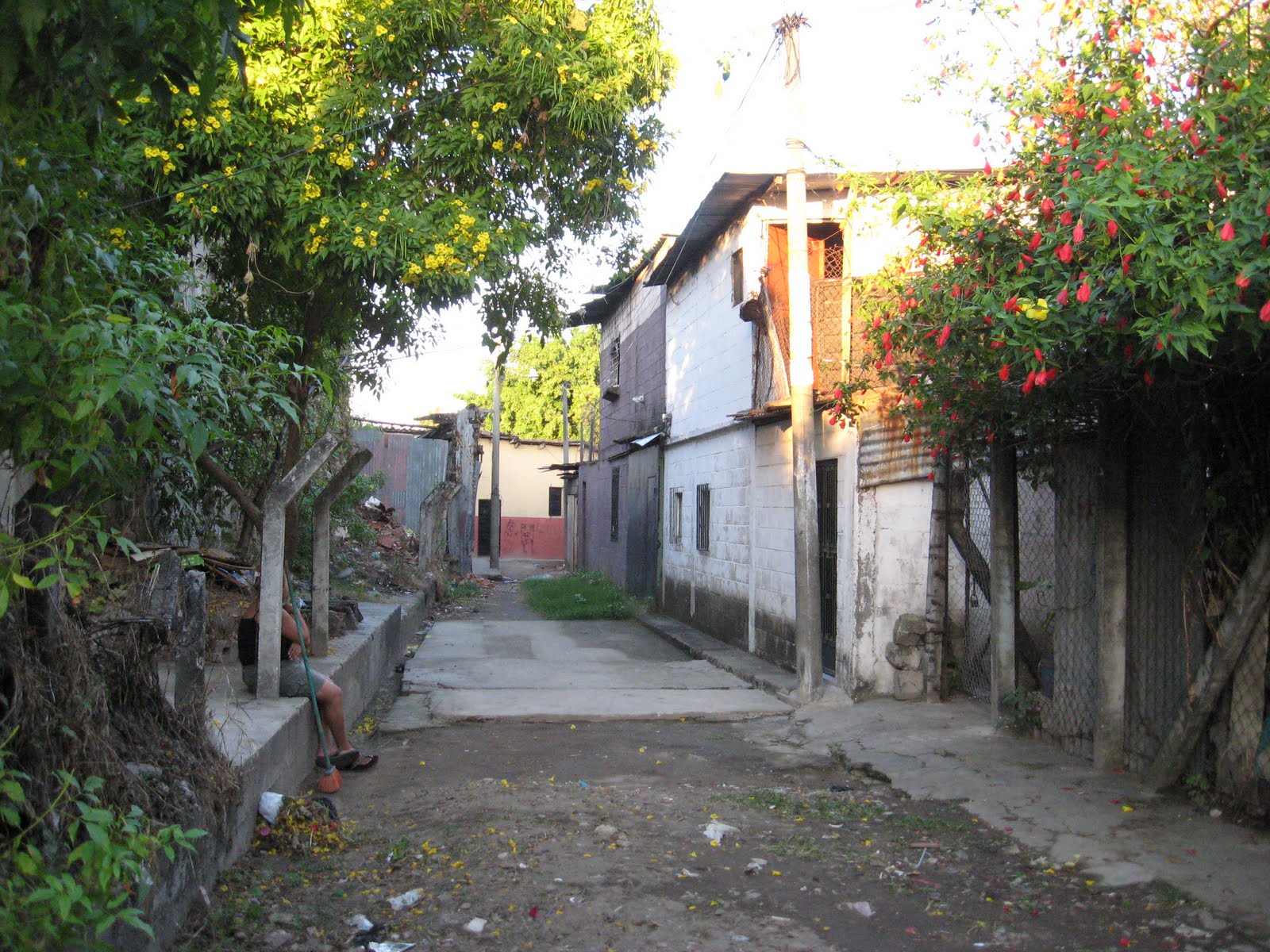
It was my first time traveling out of the States.  My new in-laws greeted me at the meson with a stilted welcome and a brand new toilet seat that I was supposed to carry to the latrine with me to place on top of the ‘stone chimney.’  They were embarrassed at the conditions they could offer to their son’s gringuita.  We set up house in the meson for about a year, and all eventually moved a half block down the alley way into 2 side-by-side apartments. We used our total savings to purchase our place for around $3,000.  (Photo above is the Barrio in 2009).

Memo picked his job back up as a mechanic in the local car shop and we lived on around $3/day for our first 3 years.  Barrio Candelaria was an amazing place.  My neighbors welcomed me with open arms and I easily became part of barrio life. Eventually we bought a refrigerator and some furniture. On weekends we’d walk a few blocks to downtown get ice cream cones or pizza as a treat. I learned to be a Salvadoran housewife. Niña Alicia, my mother-in-law, taught me to cook, clean, go to the market and small talk with the other women at the Sunday soccer games.  She also found Niña Lita, a warm and gentle midwife, to ‘sovarme’ (give me monthly belly massages) and to deliver my son Daniel at home in April 1992. I didn’t trust the conditions at the public hospital. Niña Lita was 70 years old and had been delivering babies since age 15, including her own 15 children, so I felt safe with her. I read voraciously on pregnancy and birth in order to be as prepared as possible.

Three months before Daniel was born, the war ended in Peace Accords and a huge celebration in the plaza a few blocks from our house. Memo enrolled in and completed high school in the evenings and graduated as Valedictorian, moving on to also complete his university degree. I got a job as an English teacher at a private school.  I also started a class at the National University.  It was the first time that 20th century history had ever been taught in El Salvador due to the conflict and government prohibitions to discuss certain events during that time.  A classmate was a Finnish girl, around my age.  Her father was the head of an NGO and they were looking for a translator.  I gave up my teaching job to take this one, and eventually moved into programs and communications. I’ve been in NGO work ever since.

Niña Lita attended me again in 1996 when my daughter Clare was born.  At 10 and a half pounds, it was a difficult birth, and she was so purple that at first I imagined she was dead…. but either Niña Lita was an expert or I got lucky, and we both survived.  The post-war violence and crime continued to worsen. People said that post-war was worse than during the war because it was now randomized violence, and you never knew where it would find you.  I witnessed several incidents on the bus and saw people stabbed downtown in broad daylight for a watch or wallet, but somehow came out untouched.

With my NGO job, our conditions improved over time and we were able to buy a car and send the kids to an affordable nearby private school – the level of education at the public schools near the barrio was very low.  Memo had also gotten a job at an NGO, doing HIV/AIDS prevention and rehabilitation work with inmates in the Salvadoran prison system.  We never considered moving out of the barrio since we felt safe there and Memo’s parents were next door. Every step outside the barrio though, and you knew you might not come home.  The very day I sat in my interview to start work with Plan, my second NGO job, Memo and his colleagues were assaulted on a rural road by 4 masked men with big guns and held for several hours on a plantation.  He came home stunned and depressed, missing his shoes and watch.  The elderly plantation guard, armed with only his machete, was killed in the incident.

Cultural differences and the fact that I worked and traveled a lot began to create friction. The palpable sense of random violence and crime everywhere outside the barrio added to the stress. I started to run up against limits on what I could do and achieve in El Salvador and felt trapped.  So for many of the same reasons that Memo fled from El Salvador in 1983, so did I in 2001. We parted ways and I moved back to the US with the kids. We have remained good friends and keep in touch, and we go to visit whenever we have enough money for tickets, which unfortunately is never often enough.

So, when people ask me what they should study in order to have a job like mine or how I ended up in El Salvador, I’m a bit hard pressed on what to answer. I usually give a short version that goes something like: “well, I got married to a Salvadoran and joined an NGO in El Salvador,” since the long one is pretty personal and my path to NGO work is not quite something you want to hear about at a job fair. What I do tell some people is that it’s really not what you study, it’s how you grab onto the opportunities that life offers to you and flow with them to see where you end up. It’s being willing to take risks, to follow your heart and do what you are passionate about. You don’t know where you may end up, in development or in something totally different.  But the trip will be well worth it.  20 years later… I look back and I wouldn’t change a thing.

—————

Related posts on Wait… What?

It’s not a black and white photo

18 years

Beginnings

Read Full Post »

« Newer Posts