
Where are the spaces for youth participatory governance?
‘People no longer rely on governments alone to improve governance. All over the world we are seeing experiments in ‘participatory governance’. People and organisations are grasping the opportunities offered by decentralisation and other reform processes to demand more of a say in the public policy and budget processes that affect them. These ways of holding the state to account are often called ‘social accountability’. Examples include participatory budgeting, monitoring electoral processes, using online and mobile technology, and citizen evaluation of public services. These forms of citizen engagement and social accountability are particularly promising for young people, who often face challenges in getting their voices heard in formal policy and governance processes.’
The ‘youth bulge‘ is impacting or will impact hugely in many countries in Africa, but there is limited documentation on youth involvement in social accountability processes in Sub-Saharan African countries. Youth and governance efforts have been ‘largely unsystematic and often constrained by the vague and paternalistic parameters of the UN Convention on the Rights of the Child (McGee, forthcoming 2010). However this is changing and there are calls for new models, tools and approaches that enable young people to take a more meaningful role in decision-making.’ (call for submissions for the upcoming Participatory Learning and Action Journal (PLA) special issue on Youth and Participatory Governance).
****
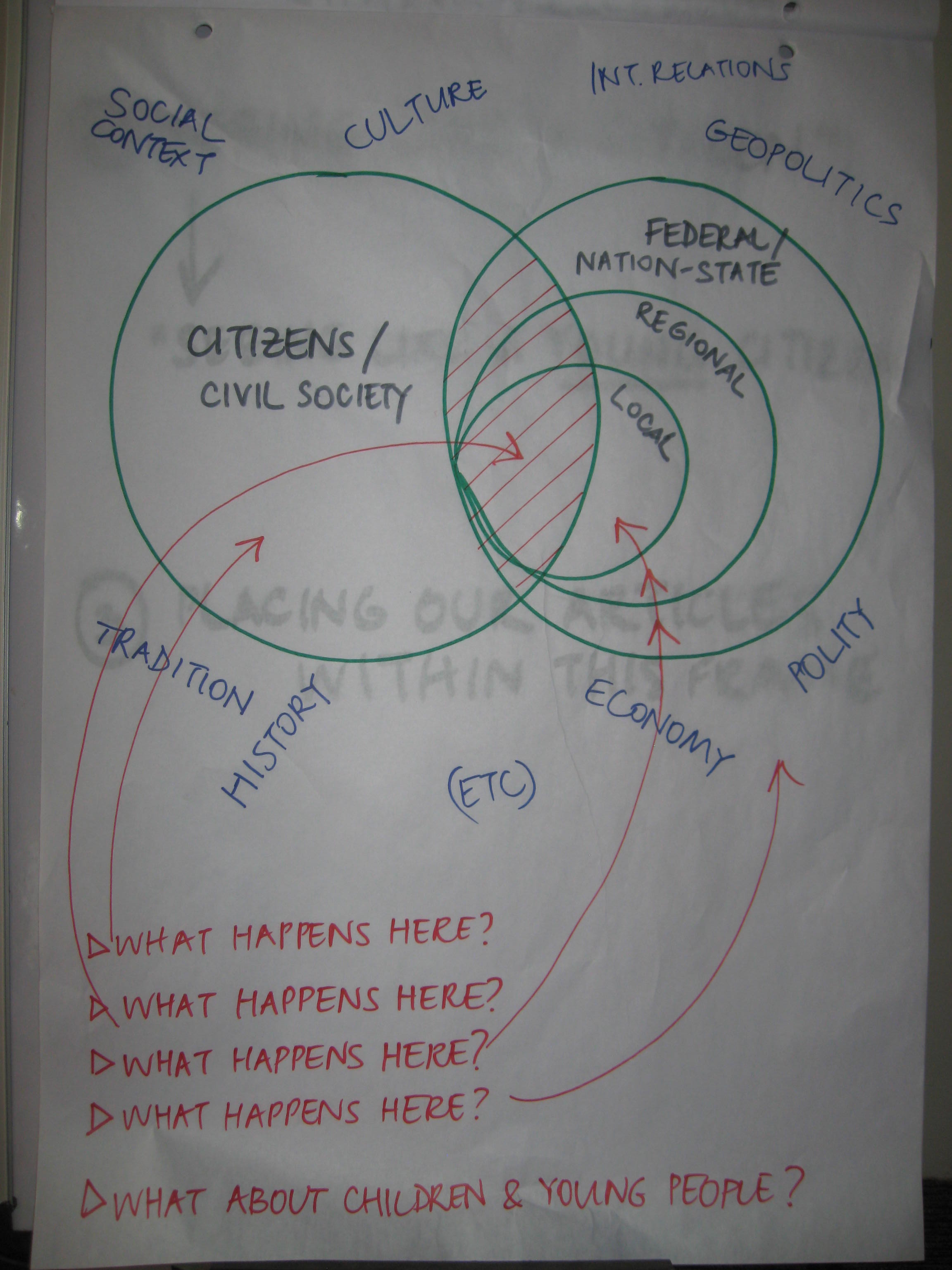
In March I attended a “writeshop” put on by Plan UK, the Institute of Development Studies (IDS), and the International Institute for Environment and Development (IIED) to share different youth participatory governance initiatives, reflect on challenges and successes therein, learn how to write better, and finalize articles on the above topic for a PLA Special Issue in December 2011. The special issue will highlight some of the different ways young people are engaging with government to participate in public policy, planning and budgeting processes at local, national, regional, and international levels. Practitioners, youth and government officials from Kenya, Zimbabwe, Sierra Leone, Nigeria, Mali, Senegal, Lesotho, the US, the UK, Ghana, Germany and Liberia attended the writeshop. (The PLA will also have articles from Cameroon and Somalia).
The first day we did a cool exercise revolving around 4 statements on voice, youth, participation, and governance. I learned a lot from the discussion and I wanted to share it here.
So, what do you think? and why?
Statement 1. The author’s voice will always be louder than the voices of the people he/she is writing about.
Strongly agree ___
Agree ___
Disagree ___
Strongly Disagree ___
Statement 2. Increased transparency leads to increased accountability.
Strongly agree ___
Agree ___
Disagree ___
Strongly disagree ___
Statement 3. It is possible to do governance work without engaging in politics.
Strongly agree ___
Agree ___
Disagree ___
Strongly disagree ___
Statement 4. Citizen led/social accountability processes offer more potential for youth than traditional accountability processes.
Strongly agree ___
Agree ___
Disagree ___
Strongly disagree ___
****
Here’s what we discussed at the writeshop. I’d be interested in what you think about the statements too…
Statement 1. The author’s voice will always be louder than the voices of the people he/she is writing about:
Discussion: The group mostly concluded that it’s difficult for the author’s voice to stay in the background – it will inevitably jump out and become stronger than the voice of those he or she is writing about.
‘Regardless of that, the author has been given an opportunity to project the voices of those that don’t have a platform to speak for themselves, so he or she should take advantage of the opportunity.’
‘Just by choosing what goes into the piece, the writer is already showing some type of bias. One or the other idea or opinion will be louder than the others because it serves the author’s own purpose.’
‘Writers need to think carefully about their approaches as authors and be self-aware of what biases are coming through in their pieces. This is an issue of credibility.’
‘One thing to aim for in our work with youth is finding more opportunities for them to author their own stories, because they can speak louder and stay true to their own agendas.’
‘How many of us here sat down and wrote our submissions together with youth? What are some methodologies that we can use to ensure that youth are writing about their own work, rather than always being written about?’
Note: Some methods for involving youth in the writing process will be covered in the upcoming Special Issue, based on experiences from the group attending the writeshop.
Statement 2. Increased transparency leads to increased accountability.
Discussion: Most everyone disagreed with this statement, saying that there is no causal relationship between transparency and accountability.
‘Many civil society and faith-based organizations really engage citizens, but if you look deeply, that engagement hasn’t translated into accountability.’
‘Including people in governance and keeping them informed about what is happening can lead to accountability. People will start to take responsibility, report about actions. If they are involved, included and informed they will start to question things.’
‘There is not always a causal link between transparency and accountability.’
‘Having transparent information is one thing, but accountability is what you actually do with the information. Having the habit of discussion, questioning is one thing, but ensuring that feedback is actually taken into consideration is another.’
‘Often those in power say “we’ve heard” but they don’t do anything to change. Accountability isn’t only about voice, you need to have opportunities for redress.’
‘Without transparency there is no accountability. This can mean access to information. We need legislation to make access to information possible. It’s a pre-requisite for increased accountability.’
‘There are NGO and donor accountability issues also. Just because NGOs or donors put information on-line doesn’t mean that they are being accountable. There is the issue of literacy, of whether people seek out information, of access to the information in a variety of languages, of what format the information is shared in and the sheer quantity of information. Who really has access to the information they are sharing? Can those who are supposed to be benefiting from NGOs and donors programs access the information?’
‘Another thing is making people and institutions understand why they should be held to account, why they need to be accountable, changing mindsets about why leaders and power holders need to be accountable.’
‘Flooding people with information so that people don’t know where to look for what is relevant to them or posting the information on-line, in a language that isn’t useful to them, is not really being transparent. Often calls for transparency don’t really go far enough. Transparency is about making the information usable and about information demand.’
One of our facilitators (Rosemary McGee from IDS) pointed us to Jonathan Fox at UCLA who says:
‘Transparency can be ‘opaque’ (the dissemination of information that does not reveal how institutions actually behave) or ‘clear’ (access to reliable information about institutional behaviour). Accountability can be ‘soft’ (‘answerability’ – demanding answers from duty-bearers) or ‘hard’ (answers plus consequences). Information dissemination does not automatically lead to answerability, nor answerability to the possibility of sanctions. If access to information is to guarantee the sanctions that hard accountability requires, public sector as well as civil society actors must intervene.’
Statement 3. It is possible to do governance work without engaging in politics.
Discussion: The group was pretty evenly divided between strongly agree, agree, disagree and strongly disagree, so the discussion was really interesting.
‘I strongly disagree because government is about service delivery and politics is about the opinions of the people. Everyone is a political animal. There is a difference between politics and partisan politics, though.’
‘Every action has a vision and a political orientation. You can’t change a situation without being involved in politics.’
‘Governance has nothing to do with politics; the government can be left or right; but governance means the same thing. It’s being transparent and accountable to the people; and it’s also about including other stakeholders, NGOs, private sector and responding to the citizens needs. Governance is impartial and non political.’
‘Governance is about how power is exercised. It’s about certain practices and systems – in state, family, community, etc. If you are challenging power, whether policy change or change in practice, whether it’s gender or whatever, you want to address unjust power relations, so at some point you need to confront the polity of those structures. However being engaged in governance is not about partisan politics. There’s a difference between a political party and the issue of politics. If I say I’m in solidarity with children, I’ve taken a political position. Political parties are about obtaining power. But governance is about challenging power relationships.’
‘We need to distinguish “governance and politics” and “party politics.” It’s difficult to say that things will naturally happen based on a structure. But the structures will adjust, they will be used differently according to who is in power. You need to know politics and the opinions of political leaders in order to effectively get your agenda through. You need to understand the political dynamics in terms of what happens in the country, what is the ideology, what is their strategy and what are their plans. If you don’t understand that, you can’t address the issues that you are trying to resolve via governance.’
‘It’s not possible to work on governance and not engage in politics. I work in government. Our mandate ends after 5 yrs. We must go back to elections and the people must give us the mandate again to exercise power on their behalf. This is the only clear mechanism whereby the people can engage in politics. Politics is about opinions and perceptions. People have diverging opinions, those opinions will create debate and that leads to political actions. Whenever there is a debate involved about something, that is politics. It’s not easy to exercise power without debate. To give services to people, to exercise power on their behalf, it’s not easy if you don’t take into consideration the opinions coming from them, they need to debate and the debate then needs to be translated into policies.’
‘The people who are most engaged in governance should not be politically engaged. When you work from civil society on governance issues, you should not have a party affiliation. Because then you will carry a bias. To do good governance work you need to be impartial and unaffiliated with a party, or people will consider you to be biased.’
‘If we look at governance and politics, politics is just a subset of governance. There are actually lots of issues under governance. In governance we expect everyone to take part in how things are governed. We see different political actors. Governance encompasses more than politics, it’s above politics.’
Statement 4. Citizen led / social accountability processes offer more potential for youth than traditional accountability processes.
Discussion: Everyone sat on the strongly agree or agree side of this debate.
‘Citizen led processes offer much more openness to youth.’
‘We need to define citizen-led and traditional accountability processes. Citizen led, social accountability processes are where those spaces are claimed by citizens themselves. Secondly the citizen-led social accountability process tends to be less vertical. There is collectivization of the aspirations of the people who are supposed to benefit from a service or a process. The power relationships are much fairer in that situation. Traditional accountability is like something done within government, something led by World Bank or the IMF. In that case, the state creates space for citizens to participate, information is shared but there is actually not much action taking and questioning because it is the state itself running the accountability initiative on its own behalf. But with social accountability, it’s driven and led by people, by civil society, and there is more questioning and participation.’
‘I was being ethnocentric and thinking as a Westerner about “traditional” as meaning “government and voting,” but I’m realizing that there is a range of understandings of “traditional accountability” processes.’
‘If there is a mainstream more traditional accountability process vs a parallel citizen led process it can be confusing. Often youth are not clear how to link the parallel transparency and accountability that they are creating up to the official structures. There is a lack of connection there. Youth get a lot out of the processes individually, but are they also increasing state accountability? There is also the concept of traditional accountability. Traditionally led accountability comes from many sides.’
‘There are formal and informal politics. What does it all mean? Based on all of your submissions, we would like to be able to start giving some definitions and an “OK” on all these terms and interpretations. There is a gap in understanding on social accountability, citizen-led accountability and the role of young people in these processes. That is why we wanted to do this PLA Journal.’
****
Look for the PLA Special Edition coming out on paper and on-line in December 2011. In the meantime, check out the current editions here, including PLA 59: Change at Hand – Web 2.0 for Development and PLA 54: Mapping for Change – Practice, Technologies and Communication.
Read Full Post »





 Wait... What?
