Feeds:
Posts
Comments

Archive for the ‘random, musing or confusing’ Category

Clare and I

14 years ago today it was a chilly December morning in Barrio Candelaria, San Salvador. I’d spent the night before doing something mundane yet extraordinary… giving birth to a baby girl. She was still a little blue that morning, having had a tough time making it through to the light of day. Being born when you weigh 10.5 pounds is not an easy thing for a baby, or for a mother. But she was nursing and we had her wrapped up in a warm blanket and a little hat.

Niña Lita, my elderly midwife, stopped by around 7 a.m. that morning to bathe the baby, Clare, in the customary rose and rue to ward off any evil spirits or bad vibes.  She had come back early in the morning rather than waiting till later because she was concerned about us. The night before she was worried that neither of us would survive. She didn’t say so of course, but it was clear from her eyes and the lines of concern on her face as she helped us through the short, 4 hour labor.

I had gone to work on the 13th, the last day before Christmas break. My stomach was so big it was hard to eat or breathe. The baby was taking up all the possible space in my abdomen. I grabbed the bus home as usual, made dinner, read my son his bedtime story, and got ready to sleep. Around 11 I felt the first labor pains and called Niña Lita. She had attended me with my son Daniel (see my 18 years post) and had been coming around every month to ‘sobar‘ me – massage my stomach – and check in on how I was doing. I’d been to the ‘real’ doctor a few times also, but the pervasive medical approach in El Salvador at the time was a mix of fear and pharmaceuticals and that wasn’t my thing. So my pre-natal care was pretty infrequent and I was mostly just going through the motions.

As with Daniel’s birth almost 5 years earlier, I had decided to have my baby at home in the small room attached to our bedroom. We didn’t have the money for me to go to a private hospital, and the public hospital horror stories had me turned off. I wanted a natural birth with my family nearby. I wanted to breastfeed immediately and keep the baby close at all times – things that the public hospitals didn’t promote at the time.

Niña Lita arrived around midnight with her daughter A., a registered nurse who owned a hair salon down the street (and who had a mafioso for a husband – I learned last time I was in El Salvador that A. and her husband are in prison.) She made me some cinnamon tea to help speed up the labor, and I promptly threw it up. It was freezing in the house and the power was being funky so we relied on the flickering lightbulb and kept the candles handy. My mother-in-law was next door, I later found out, awake and vigilant, lighting candles to la Virgen and on her knees praying for a safe birth. She later said she’d had a bad feeling. My husband and Daniel were in the next room, dozing off and waiting.

Labor came hard and fast, but then the pains stopped despite the fact that the baby hadn’t arrived. She had crowned but she was stuck. I looked at Niña Lita, in pain and wondering what was happening. What was I supposed to do now? I wanted her to fix something, to make it better. She worked her calm magic, carefully reaching inside and untangling the baby’s umbilical cord from around her eyes and her neck. Random and harried thoughts marched through my head as I waited. Wondered. Time stopped and everything was silent. Then she gave me a penetrating look. ‘Tenés que empujar mamita. You have to push, mama.’No puedo, I can’t.’ ‘You must.’ There were no longer any labor pains to help me out but I managed. Finally the baby was born and relief set in – until I propped myself up a little more and looked down between my legs. A big baby. A girl. Her chubby body from the neck down was a beautiful rosy pink…. but she was still. Her entire head was bluish purple, her eyes swollen and puffed closed. Oh God. She’s dead.

Not possible. Not happening. Why? Why am I so stupid and stubborn? Why did I insist on having a baby at home?! This can’t be happening.

A. stepped back from attending me. Niña Lita bent down somberly. She rolled the baby onto her side and tapped her back gently while she murmured some prayers. The baby started to cry. ‘Una niña,‘ said Niña Lita with her crinkly smile. ‘Una bebecita gordita. Ay, que hermosura, que hermosura. What a beauty.’

A. cradled the baby while they cut the cord and cleaned her up. She was a bit scary looking, with her blue face and head attached to a chubby, healthy, pink body. Niña Lita put a little white hat on her and swaddled her up and gave her to me. She immediately started nursing and the fear left me. I knew she would be OK, despite her funny looking blue head…. it was about 5 a.m. and the sky was just starting to lighten.

My husband had come in from the bedroom to see the baby and pay the midwife. He had no idea of the tragedy we had just avoided. I heated up some water and took a bucket bath – I was exhausted and shaky. I crawled into bed with him and my son and Clarita, relieved.

My parents-in-law came over early to see the new baby and word spread quickly through the Barrio. My mother-in-law held her and gave thanks to la Virgen Maria. The night before she had promised that the baby would be a child of la Virgen, and that she would keep the tradition of celebrating the 12th of December – the feast day of La Virgen de Guadalupe. The visit to bathe Clarita left Niña Lita feeling relieved also. ‘Estaba bien preocupadita mamita,’ she said, ‘I was very, very worried.’ We got the scale from the corner store: 10.5 pounds. No wonder, we all thought. No wonder.

Clare and her dad

The following day we took Clarita over to get her first vaccines and her foot prints at the local health unit. ‘Where was the baby born?’ ‘At home.’ ‘En casa? ohh.’ ‘And how old is the baby?’ ‘2 days.’ ‘2 months you mean?’ ‘No, 2 days.’ ‘A baby of this size? Are you sure? Let’s weigh her. 5 kilos?’ They looked at me suspiciously. They looked at each other. Clarita was big, healthy, pink and strong. I was in good shape with no belly sticking out. I wasn’t wearing socks and didn’t have cotton in my ears as would a normal Salvadoran woman who had just given birth. I was very obviously a white woman. The baby looked very Salvadoran. ‘Would you like to have an exam?’ ‘No.’ ‘I think we should examine you. We need to examine you.’ they insisted. I realized they didn’t believe this was my baby. I agreed to the exam… certainly I didn’t want anyone accusing me of child trafficking. I passed the exam and went home for my 40 days of rest…. Well, actually I didn’t get that, but that’s another story.

Birth was only my first big scare with Clare. There were a couple other times that I thought I was going to lose her.

When she was 9 months old I took her to the clinic to get her MMR vaccine. I was walking home with her, and after a couple blocks her skin began to mottle. Then she fainted. I rushed back to the clinic with her, knowing that she was having a bad reaction. The doctors were nowhere to be found. The nurses were slow and bored. They thought I was overreacting. ‘She probably was scared of the vaccine.’ ‘No, this is something else. She didn’t even cry when she got the vaccine. She’s having an allergic reaction. Please can you do something?’ ‘The doctor isn’t here yet. Sit there and he’ll be in.’ ‘No I need something now. Do you see her? She needs something now.’ Eventually one of the nurses took us into an examination room and gave her some Benedryl while they searched for a doctor. Luckily the Benedryl worked, and she was fine. It felt surreal walking out of the clinic into the warm sunshine, birds singing.

Once she was feverish and dehydrated and the hospitals were closed. We had to wait until the next day to take her in. Meanwhile my mother-in-law took her to a traditional healer. Trying to leave for the doctor, then, we had a huge family fight because my in-laws said the healer said that Clarita had to stay inside because any air blowing on her would kill her. My husband and I wanted to get her medical attention as soon as possible. It escalated into a rift that was difficult to subsequently repair between my husband and my father-in-law. An argument of tradition vs ‘modernity’. Quien crees que sos, con tu esposa chelita y tu título de bachiller? Who do you think you are with your white wife and your high school degree? Crees que sabes mejor que tus padres? Do you think you know more than your parents?

My mother-in-law always counted on la Virgen to keep Clare safe and sound, and though I am not religious, I’ve always taken great comfort in her ability to pray.

14 years later Clare is still a survivor. She’s smart, strong, independent and beautiful. Beginnings always shape things and Clare’s beginnings shaped her. They shaped me. They shaped all of us.

Related posts on Wait… What?

18 years – the story of Daniel’s beginnings

On trust and disempowerment

The real story involves antisocial entrepreneurs and anthropology

It’s not a black and white photo

On Glenn Beck and ‘rooting out’ liberation theology

Activism vs slacktivism: it’s about context not tools

Read Full Post »

I got a great comment from Gareth on my last post Why aid and development workers should be reading blogs:

Do you know of any good blogs from local aid workers? I enjoy reading all these blogs from western-educated aid workers like myself, but we do tend to have a fairly similar way of looking at things, so it’d be great to read something from a different perspective. Any suggestions?

He’s right of course.  It would be nice to add some local perspectives to the lists of aid and development bloggers that float around.

Two well-known sites to find ‘local’ voices are Global Voices and Rising Voices. There is also Maneno which is (used to be?) a platform for bloggers in Africa, but it seems to be under maintenance while an open source platform is developed. I’m not sure how many of the bloggers on those platforms technically work at aid or development organizations, but regardless of that minor detail, you will get great local perspectives on aid and development issues there.

But the question stands – where can we find local aid and development worker blogs?

Suggestions please!

Read Full Post »

Star-shaped Jell-o molds

I finally started a serious de-cluttering process — one that goes farther than my normal spring and fall cleaning. Yesterday was Day 1: Kitchen.

I’ve always been a bit of a pack-rat and as a teenager was one of those ‘alternative’ kids who purchased second-hand clothing from the 60s and 70s to make a fashion statement. But I’ll credit (blame?) my mother-in-law and my mother, for quite different reasons, for encouraging me and enabling me to continue that trend.

If you’ve been reading my blog or know me personally, you’ll know that I lived in an urban barrio in El Salvador for about 10 years in the 1990s. I lived there with my husband, next door to my parents-in-law. My husband’s family had always struggled economically, and we did too for several years after we moved there.

My mother-in-law taught me to never throw anything away because you might need it later. In the fenced-in area in front of the side-by-side apartments that we shared from 1991-2001, you will still find old pieces of tin, plastic, wood and rope. We’d pound nails out of wood we’d scavenged and save them to use later.  Old powdered milk cans served as planters and anything that broke was repaired or reused to the fullest. (I remember my father-in-law and the guy from the water company trying to stop the toilet from running by tying a rock to the pump mechanism to weight and balance it. They didn’t want to listen to my advice so I snuck in afterwards and adjusted the little screw on the top and removed the rock :-)). Last time I went back to visit, I saw that she had turned a psychedelic 1960 dress I’d gotten at the Good Will into pillow cases. Nothing went to waste at the house, and we never threw anything away because it might always come in handy at some point. Talk about living sustainably.

Tiny forks... maybe I should save them for when I have grandkids who come to visit.

My own mother also knows the value of reusing, but she focuses on another aspect: reselling. She currently owns an auction (and no, she is not the auctioneer!), does appraisals, and has worked with antiques. So she collects and sorts things that other people have owned or saved, and sells them for a profit. She’s very good at looking at something and determining its resale value, and she knows how to move merchandise. My family jokes that she’d sell our family photo albums if we let her get a hold of them. (I’m a little bitter about this talent of hers because she gave my entire record collection — including rare bands and hard to find classics — away to the Salvation Army after I moved to El Salvador because they were taking up space and I could ‘just get them all on CD’.) My mother has been sending me boxes of used things that won’t sell at auction for many years now, and I sort through and keep what I like and give away or throw away the rest.

The accidental wedding present - someone put the wrong wedding present for my parents in the box. My aunt was reportedly mortified.

For someone who came back to the US in 2001 with 2 kids and 6 suitcases I’ve certainly amassed a ton of stuff. Through the auction, my mom was able to hook me up with all the basics for furnishing a house when we arrived – bed frames, tables, chairs, couch, dishes, china cabinet, dressers and the like – for really cheap. Most of it is still in use (I’ve been told this ‘look’ is called ‘shabby chic’). I’ve also picked up good condition furniture from neighbors and friends. Add that to the random boxes of auction goods each year and it’s easy to see why my house has gotten increasingly cluttered. I haven’t been able to shake the mindset that things will be useful later and that it’s a shame to throw away something that is perfectly good or oddly interesting.

The ghost of cognitive surpluses past... tiny crocheted teacups and saucers.

This of course is a terribly un-cool and outdated concept on the one hand. Minimalism is the new hip and secretly I’d love to be one of those streamlined design types. But I think many of today’s minimalists are able to rid themselves of everything because they feel confident that they will have the means to replace whatever they might be missing. Downsize and get rid of anything extraneous, and if you are in a bind, just go buy what you need. That’s not something that we could do in El Salvador or even something I can do now.

On the other hand, the reduce, reuse, recycle mindset continues to gain more traction these days. I suppose I could be a poster child for that movement…. Or maybe there are more like me out there with those depression era values, as TalesfromtheHood reminds us in his post American culture 103: still useful after all these years.

The meanings attached to things

I’m not in a situation today where I save old nails, but I still have a hard time getting rid of some things. While de-cluttering the kitchen yesterday, I got to thinking about what the things I don’t use but that I’m loathe to part with say about 1) the person I have been and believe I might become again; and 2) the person I have never been, but imagine I might be one day.

I might one day decide to become a real mom who bakes cakes that go into real cake pans.

Maybe I will make applesauce again the old-fashioned way like I used to 7-8 years ago and I’ll need that early 1900’s style fruit grinding apparatus. In fact it probably would have served for making that cranberry sauce this Thanksgiving…. Maybe one day I will be a real mom and bake cakes and put them inside those 1950s cake pans that I can’t bear to give away…. And won’t it be nice if one day I have grandchildren and I can invite them over and make them jello in little star-shaped molds? Or they can use those tiny colorful forks that only grandma has to eat their dinner. And what about those dinner parties I might host one day, where I’ll use those fancy candle holders, the beautiful antique silverware and the fragile and ornate dishes from the china cabinet…?

Then there are those things that I can’t stand to give away because of nostalgia. They represent something I know I’ll never be and a culture that will probably never return. Who in this day and age would crochet tiny tea cups? (That’s some cognitive surplus if I ever saw it.) And what on earth would they be used for? But how can I part with them? And what about those little silver salt shakers? And those slim, 1960s Danish candles (that my daughter once decided to light in a bundle and almost burned the house down). Or the hand-made doilies that should go under the vases that are stored away because I don’t have a flower garden….

As the only daughter, I automatically got the china....

There are also the things that I don’t use but I keep because they have personal relevance: my great great grandmother’s hand painted Austrian china, brought over with her from Germany on the boat. The pig pitcher that was an accidental wedding gift to my parents from my aunt (she had ordered something by mail, and wasn’t that a bit awkward when my mom opened the box at the reception….)

The de-cluttering’s only just started but I’m thinking a lot about meanings attached to things, and struggling a bit to detach myself at times. I have a feeling I’ll never achieve minimalist stature.

My son goes to college next fall so he will be the lucky recipient of a set of dishes and the linens that will go into the pile when I get started on the closets… I’ll save some other things for my mother-in-law for our next trip down to El Salvador — the good thing is that I can actually ask her what she wants and needs and go from there.  The rest of it will go to the local second-hand shop or into the trash if the life cycle is truly over.

Aid and development workers don’t despair, I will NOT try to send any of my #SWEDOW ‘to Africa’ no matter how wonderful and useful I think my old stuff might be.

Update: The Grandmaster of #SWEDOW has come to the rescue and the best of my personal #SWEDOW will now be put to good use as prizes for The 2010 Best in SWEDOW Contest! Send your nominations for Best Swedow of 2010 to @talesfromthhood and you could win either of the prizes below, or one of the items listed above!

Tilt head back, hear him threaten 'Stop! Move away from the cookie jar. (No recollection of why this is in my house or where it came from).'

I think this is a mobile phone holder from Japan. It says 'Leave your stuffs with me But don't iron my body!' (Sentimental value)

Read Full Post »

Last summer I had the chance to meet with War Child in Holland to talk about our shared excitement and common challenges in using social media and ICTs in program work (eg., to further program goals and as enablers in community level work with children and youth). I met Ernst Suur there, and over the past several months we’ve been trying to find an on-line Masters Degree in ICT4D. There are a couple places that are considering this type of course in the future, but we were not able to lay our fingers on anything concrete at this point.  As Ernst says: Isn’t it funny that you can learn online how to knit, but ICT4D isn’t taught much online yet?

The constraints that both Ernst and I have are that we work full-time (and then some) at jobs that require a lot of travel so it’s impossible to attend a normal schedule of university classes. We also live on salaries that don’t leave extra for furthering our education and we don’t want to spend the rest of our lives in debt. We would like a program that is not completely focused on the technology, but that instead really goes into depth on how ICTs can enable better processes, results and outcomes in development work. We are both working on program initiatives that would benefit from focused ICT4D research and deeper thinking that a guided process of shared learning and discussion could provide. We work with colleagues across our organizations who, like us, are interested in and would benefit from more systematic learning and focused ICT4D capacity strengthening but who are also not in a position to attend traditional university courses (or these courses are simply not offered where we live).

We are assuming that there are others out there from other organizations in similar conditions with similar interests. For example, at the October 2010 International Conference on Crisis Mapping (ICCM) in Boston there was mention of the need for further education opportunities on ICTs in Crisis Situations.

After doing some on-line research to find options and contacting some individuals, Ernst and I thought a next step would be to do a bit of crowd sourcing to find out if there is something that already exists that we are missing. As Ernst said: Better well stolen than badly invented.

If anyone has any thoughts, please share them in the comments section or contact me at lindaraftree at gmail.

For example:

  • Are there existing on-line masters level courses that we have missed out on in our desktop research?
  • If you could design an on-line ICT4D masters program that would fit your needs, what would it look like – eg, would there be face-to-face meetings? How often and for how long? Where?
  • What are the key topics/areas/disciplines that would be covered in an on-line ICT4D course?
  • What would some of the required courses be and who could teach us?
  • What would a reasonable cost be?
  • Who might be willing to offer scholarships for this type of study course? Eg., in whose interest is it to strengthen these capacities?

Please share your thoughts and ideas so we can build a strong case, because we believe that ICT4D should walk the talk and talk the walk and make online higher education and distance learning available for everyone.

Read Full Post »

When my son was 15 or 16 we used to have go-arounds about selfishness and self-centered behavior. He was at the height of both.

One time he was explaining what he wanted to do with his life. ‘I want to do something like science or research, but I don’t want to have to help people with it. I just want to do it for me, because I want to learn it, but not to help anyone. Are there jobs like that? Like, where you don’t have to help people?’

‘One day you’ll mature,’ I remember saying sarcastically. ‘One day your brain will grow a little and you’ll develop some empathy, and then you won’t be so selfish with your brilliance.’

I wasn’t too worried that he’d stay selfish forever. I figured it would run its course.

He and I both play a Brazilian martial art called capoeira.  (Read this old post for more about this beautiful game and life philosophy). Once a year we have a big event called a batizado where people get tested and they can advance a level. It’s a lot of work, the testing is nerve-wracking, and the celebrations afterwards are huge. Our capoeira group is a tightly knit social group, so it’s always a big deal and one of the best times of the year for us.

About 6 months after my son and I had our conversation about selfishness, it was batizado time. We saw one after the other of our friends go in for testing and get their cords. There was cheering, hugging, back slapping and congratulations galore.

Towards the end of the event, my son came over to me, his face all lit up in a huge smile. ‘Mom! Mom! Oh my god I’m so happy for everyone! And Mom, Mom, I got that thing! That thing you said I’d get.’

‘Huh?’ (confused look).

‘You know, that thing… Come on, Mom, that thing you said I’d get. That thing where you care about other people and you put yourself in their place and you feel what they feel? That thing… what’s it called? Because I have it now!’

Empathy.

Nice. I love being right. 🙂

Related posts on Wait… What?

A piece of capoeira in Cameroon

18 years

Read Full Post »

Coming from the viewpoint that accountability and transparency, citizen engagement and public debate are critical for good development, I posted yesterday on 5 ways that ICTs can support the MDGs. I got to thinking I would be remiss not to also post something on ways that ICTs (information and communication technologies) and poor or questionable use of ICTs and social media can hinder development.

It’s not really the fault of the technology. ICTs are tools, and the real issues lie behind the tools — they lie with people who create, market and use the tools. People cannot be separated from cultures and societies and power and money and politics. And those are the things that tend to hinder development, not really the ICTs themselves. However the combination of human tendencies and the possibilities ICTs and social media offer can can sometimes lead us down a shaky path to development or actually cause harm to the people that we are working with.

When do I start getting nervous about ICTs and social media for social good?

1) When the hype wins out over the real benefits of the technology. Sometimes the very idea of a cool and innovative technology wins out over an actual and realistic analysis of its impact and success. Here I pose the cases of the so-called Iran Twitter Revolution and One Laptop per Child (and I’ll throw in Play Pumps for good measure, though it’s not an ICT project, it’s an acknowledged hype and failure case). There are certainly other excellent examples. So many examples in fact that there are events called Fail Faires being organized to discuss these failures openly and learn how to avoid them in the future.

2) When it’s about the technology, not the information and communications needs.  When you hear someone say “We want to do an mHealth project” or “We need to have a Facebook page” or “We have a donor who wants to give us a bunch of mobile phones–do you know of something we can do with them?” you can be pretty sure that you have things backwards and are going to run into trouble down the road, wasting resources and energy on programs that are resting on weak foundations. Again, we can cite the One Laptop per Child (OLPC) initiative, where you have a tool, but the context for using it isn’t there (connectivity, power, teacher training and content). There is debate whether OLPC was a total failure or whether it paved the way for netbooks, cheap computers and other technologies that we use today. I’ll still say that the grand plan of OLPC:  a low-cost laptop for every child leading to development advances; had issues from the start because it was technology led.

3) When technology is designed from afar and parachuted in. If you don’t regularly involve people who will use your new technology, in the context where you’re planning for it to be used, you’re probably going to find yourself in a bind. True for ICTs and for a lot of other types of innovations out there. There’s a great conversation on Humanitarian Design vs. Design Imperialism that says it all. ICTs are no different. Designing information and communication systems in one place and imposing them on people in another place can hinder their uptake and/or waste time and money that could be spent in other ways that would better contribute to achieving development goals.

4) When the technology is part of a larger hidden agenda. I came across two very thought-provoking posts this week: one on the US Government’s Internet Freedom agenda and another from youth activists in the Middle East and North Africa region who criticize foundations and other donors for censoring their work when it doesn’t comply with US foreign policy messages. Clearly there are hidden political agendas at work which can derail the use of ICTs for human rights work and build mistrust instead of democracy. Another example of a potential hidden agenda is donation of proprietary hardware and software by large technology companies to NGOs and NGO consortia in order to lock in business (for example mHealth or eHealth) and prevent free and open source tools from being used, and which end up being costly to maintain, upgrade and license in the long-term.

5) When tech innovations put people and lives at risk. I’d encourage you to read this story about Haystack, a software hyped as a way to circumvent government censorship of social media tools that activists use to organize. After the US government fast-tracked it for use in Iran, huge security holes were found that could put activists in great danger. In our desire to see things as cool, cutting edge, and perhaps to be seen as cool and cutting edge ourselves, those of us suggesting and promoting ICTs for reporting human rights abuses or in other sensitive areas of work can cause more harm than we might imagine. It’s dangerous to push new technologies that haven’t been properly piloted and evaluated. It’s very easy to get caught up in coolness and forget the nuts and bolts and the time it takes to develop and test something new.

6) When technologists and humanitarians work in silos. A clear example of this might be the Crisis Camps that sprung up immediately after the Haiti Earthquakes in 2010. The outpouring of good will was phenomenal, and there were some positive results. The tech community got together to see how to help, which is a good thing. However the communication between the tech community and those working on the ground was not always conducive to developing tech solutions that were actually helpful. Here is an interesting overview by Ethan Zuckerman of some of the challenges the Crisis Commons faced. I remember attending a Crisis Camp and feeling confused about why one guy was building an iPhone application for local communities to gather data. Cool application for sure, but from what people I knew on the ground were saying, most people in local communities in Haiti don’t have iPhones. With better coordination among the sectors, people could put their talents and expertise to real use rather than busy work that makes them feel good.

7) When short attention spans give rise to vigilante development interventions. Because most of us in the West no longer have a full attention span (self included here), we want bite sized bits of information. But the reality of development is complicated, complex and deep. Social media has been heralded as a way to engage donors, supporters and youth; as a way to get people to help and to care. However the story being told has not gotten any deeper or more realistic in most cases than the 30 second television commercials or LiveAid concerts that shaped perceptions of the developing world 25 years ago. The myth of the simple story and simple solution propagates perhaps even further because of how quickly the message spreads. This gives rise to public perception that aid organizations are just giant bureaucracies (kind of true) and that a simple person with a simple idea could just go in and fix things without so much hullabaloo (not the case most of the time). The quick fix culture, supported and enhanced by social media, can be detrimental to the public’s patience with development, giving rise to apathy or what I might call vigilante development interventions — whereby people in the West (cough, cough, Sean Penn) parachute into a developing country or disaster scene to take development into their own hands because they can’t understand why it’s not happening as fast as the media tells them it should.

8 ) When DIY disregards proven practice. In line with the above, there are serious concerns in the aid and development community about the ‘amateurization’ of humanitarian and development work. The Internet allows people to link and communicate globally very easily. Anyone can throw up a website or a Facebook page and start a non-profit that way, regardless of their understanding of the local dynamics or good development practices built through years of experience in this line of work. Many see criticism from development workers as a form of elitism rather than a call for caution when messing around in other people’s lives or trying to do work that you may not be prepared for or have enough understanding about. The greater awareness and desire to use ‘social media for social good’ may be a positive thing, but it may also lead to good intentions gone awry and again, a waste of time and resources for people in communities, or even harm. There’s probably no better example of this phenomenon than #1millionshirts, originally promoted by Mashable, and really a terrible idea. See Good Intents for discussion around this phenomenon and tools to help donors educate themselves.

9) When the goal is not development but brand building through social media. Cause campaigns have been all the rage for the past several years. They are seen as a way for for-profit companies and non-profits to join together for the greater good. Social media and new ICTs have helped this along by making cause campaigns cheap and easy to do. However many ‘social media for social good’ efforts are simply bad development and can end up actually doing ‘social harm’. Perhaps a main reason for some of the bad ideas is that most social media cause campaigns are not actually designed to do social good. As Mashable says, through this type of campaign, ‘small businesses can gain exposure without breaking the bank, and large companies can reach millions of consumers in a matter of hours.’ When ‘social good’ goals are secondary to the ‘exposure for my brand’ goals, I really question the benefits and contribution to development.

10) When new media increases voyeurism, sensationalism or risk. In their rush to be the most innovative or hard-hitting in the competition for scarce donor dollars, organizations sometimes expose communities to child protection risks or come up with cutesy or edgy social media ideas that invade and interrupt people’s lives; for example, ideas like putting a live web camera in a community so that donors can log on 24/7 and see what’s happening in a ‘real live community.’ (This reminds me a bit of the Procrastination Pit’s 8 Cutest and Weirdest Live Animal Cams). Or when opportunities for donors to chat with people in communities become gimmicks and interrupt people in communities from their daily lives and work. Even professional journalists sometimes engage in questionable new media practices that can endanger their sources or trivialize their stories. With the Internet, stories stick around a lot longer and travel a lot farther and reach their fingers back to where they started a lot more easily than they used to. Here I will suggest two cases: Nick Kristof’s naming and fully identifying a 9-year-old victim of rape in the DRC and @MacClelland’s ‘live tweeting’ for Mother Jones of a rape survivor’s visit to the doctor in Haiti.

Update: Feb 22, 2011 – adding a 10a!

10a) When new media and new technologies put human rights activists at risk of identification and persecution. New privacy and anonymity issues are coming up due to the increasing ubiquity of video for human rights documenting. This was clearly seen in the February 2011 uprisings in Egypt, Tunisia, Libya, Bahrain and elsewhere.  From Sam Gregory’s excellent piece on privacy and anonymity in the digital age: “In the case of video (or photos), a largely unaddressed question arises. What about the rights to anonymity and privacy for those people who appear, intentionally or not, in visual recordings originating in sites of individual or mass human rights violations? Consider the persecution later faced by bystanders and people who stepped in to film or assist Neda Agha-Soltan as she lay dying during the election protests in Iran in 2009. People in video can be identified by old-fashioned investigative techniques, by crowd-sourcing (as with the Iran example noted above…) or by face detection/recognition software. The latter is now even built into consumer products like the Facebook Photos, thus exposing activists using Facebook to a layer of risk largely beyond their control.”

11) When ICTs and new media turn activism to slacktivism. Quoting from Evgeny Morozov, “slacktivism” is the ideal type of activism for a lazy generation: why bother with sit-ins and the risk of arrest, police brutality, or torture if one can be as loud campaigning in the virtual space? Given the media’s fixation on all things digital — from blogging to social networking to Twitter — every click of your mouse is almost guaranteed to receive immediate media attention, as long as it’s geared towards the noble causes. That media attention doesn’t always translate into campaign effectiveness is only of secondary importance.” Nuff said.

I’ll leave you with this kick-ass Le Tigre Video: Get off the Internet.… knowing full well that I’m probably the first one who needs to take that advice.

‘It feels so 80s… or early 90s…  to be political… where are my friends? GET OFF THE INTERNET, I’ll meet you in the streets….’


Related posts on Wait… What?

3 ways to integrate ICTs into development work

5 ways ICTs can support the MDGs

7 (or more) questions to ask before adding ICTs

Amateurs, professionals, innovations and smart aid

I and C, then T

MDGs through a child rights lens


Read Full Post »

A couple weeks ago, I tweeted that I was really digging some new music my brother gave me after he got back from Lollapalooza, including The XX@scarlettlion clued me in that there was a mash-up of The XX and Notorious B.I.G. by somebody who goes by, get this, ‘Wait What.’

The Notorious XX by Wait What

This reviewer explains that

Wait What mashed up Biggie with every song on the xx’s debut album. Charlie, the man behind Wait What, described the mashup album The Notorious xx on his site. I posted the bio below:

the notorious xx began as an idea in my sister’s apartment, where I was trying to figure out what it would sound like hearing juicy over vcr, and since then expanded to include all 11 tracks of the xx’s debut album chopped, sliced, and mashed up with biggie’s vocals. I made it over the span of a few weeks in boston, williamstown, albany, chicago, aspen, denver, and san francisco, and then mastered over 10 days in zurich, zermatt, london, san francisco, dallas, baton rouge and new orleans.’

What a trip! (For those of you who are not getting the connection, my blog, the one that you’re reading right now, is also called Wait… What).

So big shout out to Wait What and The Notorious XX. You can hear and download it here.

Listen and think of me and Charlie, randomly connected through the Interwebs all because of a Tweet. 🙂

Read Full Post »

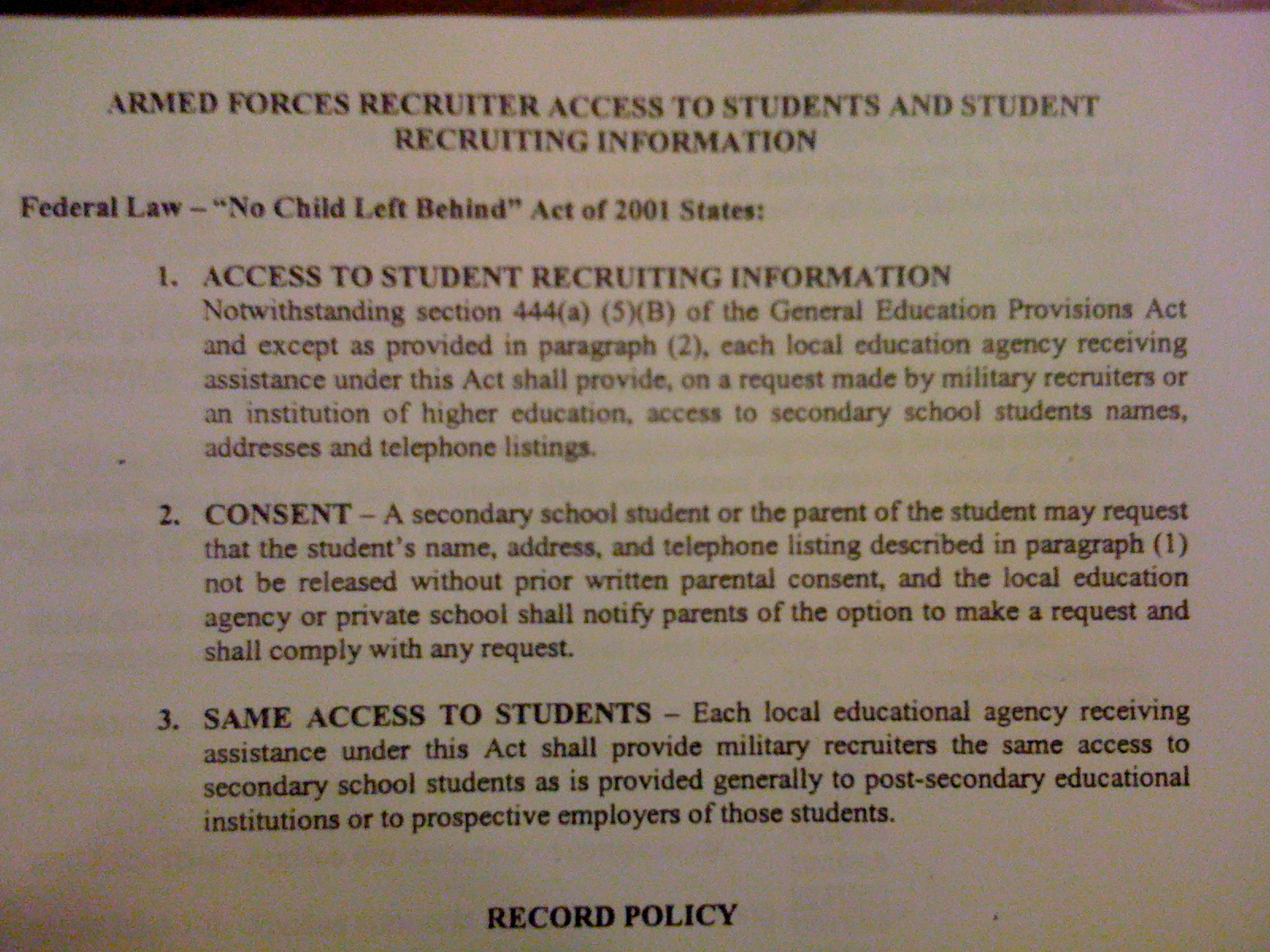
No Child Left Behind?

Per paragraph 3, ‘each local education agency receiving assistance under the No Child Left Behind Act shall provide military recruiters the same access to secondary school students as is provided generally to post-secondary educational institutions or to prospective employers of those students.’

This bothers me.

Every year, since my children started 6th grade, I’ve written a note to the school to ask them NOT to provide my children’s information to military recruiters. Why do military recruiters need access to my children when they start middle school, eg., when they are 12?

Read Full Post »

Mural in the Arcatao community, Chalatenango, El Salvador, reflecting what happened at Rio Sumpul in 1980

When Glenn Beck mentioned Liberation Theology around minute 12.20 of this Fox News video (which I came across courtesy of @Jay_Rosenberg), I literally sat up straighter in my chair, downsized the other 6 tabs I had open, hit rewind, turned up the volume and listened.  And I felt really unsettled.

The amount of time I normally give to Beck and the Tea Baggers is the time it takes to hit delete on an email. You know the ones… they are usually full of misinformation and have a lot of all capital letters, bright red size 64 font, and tell me to fear Obama, Mexicans, Muslim takeovers and universal healthcare.

But Beck’s coloring of Liberation Theology in this video clip “Liberation Theology and the Political Perversion of Christianity” and his take on social justice make me really angry.

In the Liberation Theology clip, Beck paints this vision of people who follow liberation theology. “These are people who, besides blowing stuff up, were also having a sexual revolution, trying to smash monogamy. This isn’t about God to them in any shape or form.”

He talks with Anthony Bradley, a ‘Black Liberation Theology Expert’ from the Acton Institute. Bradley says “One of the odd interpretations of Marxist thought and theology happened in central and south America, right in the church. And it was really the fantastic work of the current pope, who actually rooted out liberation theology from that region.”

Yes, right. Fantastic rooting out. Just fantastic, Bradley.

I’m not a Christian or a Marxist, but I lived and worked in El Salvador in the 90s. That’s right. El Salvador, one of the Central American countries where Liberation Theology was at its strongest.

Here’s what ‘rooting out liberation theology’ meant in El Salvador.

Archbishop Oscar Arnulfo Romero's famous words

It meant assassinating Archbishop Romero in 1980.

“Romero was shot on March 24, 1980, while celebrating Mass at a small chapel located in a hospital called “La Divina Providencia”, one day after a sermon where he had called on Salvadoran soldiers, as Christians, to obey God’s higher order and to stop carrying out the government’s repression and violations of basic human rights. According to an audio-recording of the Mass, he was shot while elevating the chalice at the end of the Eucharistic rite. When he was shot, his blood spilled over the altar along with the sacramental wine.” (Wikipedia)

And assassinating the 6 Jesuit Priests from the University of Central America, cutting open their heads and strewing their brains around the yard.

“Before the end of darkness on the morning of Nov. 16, with unspeakable and barbaric cruelty, armed men burst into the Jesuit residence at the University of Central America in San Salvador and shot six Jesuit priests to death. At the same time, the community’s cook and her daughter were murdered in their beds. According to reliable reports, several of the priests, my brothers, had their brains torn from their heads.” (Washington Post, Nov 19, 1989)

And beating, raping and murdering 4 Maryknoll sisters.

“In December 1980, Jean Donovan and three nuns joined the more than 75,000 people who were killed in the Salvadoran Civil War. In the afternoon of December 2, Donovan and Dorothy Kazel picked up two Maryknoll missionary sisters, Maura Clarke and Ita Ford, from the airport after the pair arrived from attending a Maryknoll conference in Managua, Nicaragua. They were under surveillance by a National Guardsman at the time, who phoned his commander for orders. Acting on orders from their commander, five National Guard members changed into plainclothes and continued to stake out the airport. The five members of the National Guard of El Salvador, out of uniform, stopped the vehicle they were driving after they left the airport in San Salvador. Donovan and the three sisters were taken to a relatively isolated spot where they were beaten, raped, and murdered by the soldiers.

The [1993] U.N.-sponsored report of the Commission on the Truth for El Salvador concluded that the abductions were planned in advance and the men responsible had carried out the murders on orders from above. It further stated that the head of the National Guard and two officers assigned to investigate the case had concealed the facts to harm the judicial process. The murder of the women, along with attempts by the Salvadoran military and some American officials to cover it up, generated a grass-roots opposition in the U.S., as well as ignited intense debate over the Administration’s policy in El Salvador. In 1984, the defendants were found guilty and sentenced to 30 years in prison. The Truth Commission noted that this was the first time in Salvadoran history that a judge had found a member of the military guilty of assassination. ” (Wikipedia)”

Rooting out liberation theology meant massacring almost 800 peasants in El Mozote in Morazan

“In a small rectangular plot among the overgrown ruins of a village here, a team of forensic archeologists has opened a window on El Salvador’s nightmarish past. Nearly 11 years after American-trained soldiers were said to have torn through El Mozote and surrounding hamlets on a rampage in which at least 794 people were killed, the bones have emerged as stark evidence that the claims of peasant survivors and the reports of a couple of American journalists were true.” (New York Times, 1992)

and another 300 people at Rio Sumpul, on the border with Honduras

“On 14 May 1980, units of Military Detachment No. 1, the National Guard and the paramilitary Organización Nacional Democrática (ORDEN) deliberately killed at least 300 non-combatants, including women and children, who were trying to flee to Honduras across the Sumpul river beside the hamlet of Las Aradas, Department of Chalatenango. The massacre was made possible by the cooperation of the Honduran armed forces, who prevented the Salvadorian villagers from landing on the other side.” (UN Truth Commission Report, 1993)

It meant assassinating, disappearing and torturing thousands who belonged to Christian Base Communities. And that was just in El Salvador.

Rev. James Martin in his Huffington Post article explains why he follows liberation theology. I encourage you to read his full post:

“Liberation theology is easy to be against. For one thing, most people don’t have the foggiest idea what you’re talking about. It’s also easier to ignore the concerns of the poor, particularly overseas, than it is to actually get to know them as individuals who make a claim on us. There are also plenty of overheated websites that facilely link it to Marxism. My response to that last critique is to read the Gospels and count how many times Jesus tells us that we should help the poor and even be poor. In the Gospel of Matthew, he tells us that the ones who will enter the Kingdom of heaven are those who help “the least of my brothers and sisters,” i.e., the poor. After that, read the Acts of the Apostles, especially the part about the apostles “sharing everything in common.” Then let me know if helping the poor is communist or simply Christian….

It’s hard to ignore the fact that Jesus chose to be born poor; he worked as what many scholars now say was not simply a carpenter, but what could be called a day laborer; he spent his days and nights with the poor; he and his disciples lived with few if any possessions; he advocated tirelessly for the poor in a time when poverty was considered to be a curse; he consistently placed the poor in his parables over and above the rich; and he died an utterly poor man, with only a single seamless garment to his name. Jesus lived and died as a poor man. Why is this so hard for modern-day Christians to see? Liberation theology is not Marxism disguised as religion. It is Christianity presented in all its disturbing fullness.”

So, Glenn Beck. Really. Really?

Let me get this straight. The people above are or were about “blowing stuff up, sexual revolutions and trying to smash monogamy.”  And this is “not about God to them in any way shape or form” so they need to be “rooted out”?

Glenn Beck, you make me sick.

Update: posts I like on this topic:

Roger Ebert in Chicago Sun Times: Put Up or Shut Up.

Matt Taibbi in Rolling Stone: Tea Party Rocks Primaries

Timothy Egan in New York Times: Building a Nation of Know Nothings

Other El Salvador related posts on Wait… What?

Orgasmatron moments

On trust and disempowerment

18 years

It’s not a black and white photo

The real story involves anti-social entrepreneurs and anthropology

Read Full Post »

Praia Vermelha, Rio de Janeiro, Brasil

I’m on vacation for a week. In Rio de Janeiro. On a supposed social media break. But I’m on-line right now instead of on-thebeach; in stealth mode, secretly reading Tweets and Google Reader over morning coffee while my fellow vacationers sleep on and sun pours in the huge open window in the apartment we’re sharing in Copacabana.

I was supposed to quit social media and email for the week, but I’m at that point where I question whether I really wanted to go offline at all, and why…. being addicted to Twitter isn’t really a bad thing, is it? If you’ve ever tried to quit smoking or go on a diet and failed, you’ve been here.

I’m sneaking peaks, but not conversing and sharing. Pretending I’m not online, because supposedly I need a social media break (and because being addicted is somewhat embarrassing). But the truth is that my vacation is awesome and I enjoy being online, probably similar to how some people enjoy reading the Sunday paper.

Some highlights I discovered and didn’t share during last week’s feigned Twitter hiatus…

Aid and development

Loved @lrakoto’s great piece on some of the current big dilemmas/discussions in aid…. Aid is about the people, right?

Read @morealtitude’s intense and harrowing World Humanitarian Day series part 1part 2, and part 3. Wow. Watched OCHA’s beautifully done world humanitarian day video (and couldn’t help but wonder how much it cost to make it). Felt sad that humanitarian aid needs so much marketing lately to be seen as good. Went back and forth as usual, reading this week’s pros and cons of how humanitarian/international aid work needs a total overhaul and how it’s vital work in many places.

Saw Pakistan continue to get less attention than Haiti even as the situation gets worse and worse. Read an interesting piece from a colleague on how women and girls and culture are being impacted by the floods. Saw another colleague, @warisara, (experienced communicator who worked on the ground during the Asian tsunami and who’s now arrived to Pakistan) questioning why aid organizations have to keep showing graphic, horrifying visual images in order to draw any attention to a crisis, and wondering if each disaster has to be worse than the last in order to get the public to care. What an unfortunate dilemma — how to avoid undignified, disrespectful images and still manage to raise any funds.

Saw a sad exchange after my employer posted an appeal for Pakistan… Someone argued that we should not help Pakistanis because ‘they wish to see us dead’. They based their reasoning on ‘Christian principles’. What was heartening at least were all the other comments arguing against that view, arguing for helping Pakistan after the devastating floods, and seeing past religions and hatred and fundamentalist behavior.

Was flattered to get listed in the Activist Writer’s top 10 blogs along with aid bloggers I really admire. Discovered @aaronausland’s blog Staying for Tea.

ICT4D and m4D

Enjoyed the debate started by @Kiwanja on the need for an active mobile community for addressing fundamental, deep questions and thinking, and bridging the gap between development folks and technology folks. (Something I encounter and write about often, such as here and here). Liked this Venn Diagram on the intersection of m4D, apps4D and ICT4D.

Noticed that @mambenanje got himself a copy of an article about him in Brussels Airlines in-flight mag (also incuded Erik Hersman, Ethan Zuckerman). Remembered how cool it was being on that flight to Kenya, opening up the in-flight magazine, and seeing names of people I know.

Saw that @wayan_vota has a beautiful new baby girl.  And that miraculously he’s been able to re-follow me on Twitter after months of his account auto-unfollowing me time and time again (though he’s explained it also happens when he tries to follow @billeasterly…. weird – and really not sure what I have in common with the esteemed Professor that makes Wayan’s account consistently unfollow us both….).

Pakistan and the ‘Ground Zero mosque’

Due to my self-imposed Twitter ban and bet with @ernstsuur that I could really stay off Twitter for a week, I reverted to posting on Facebook and managed to upset the good folks back home in the heartland (Indiana) when I posted a link about the so-called ‘Ground Zero Mosque’. Normally I don’t post political stuff on FB because of the variety of people that I’m connected to there — it’s hard to not offend at least someone. Facebook has become everything and nothing, pretty much.  I also re-posted an article on the ‘mosque’ and elitism (and thought it would be pretty fun to see Palin and @talesfromthhood debating elitism) and a link to the Daily Show giving it to Fox News. This provoked pretty emotional and strong comments (see below) from someone I was very good friends with in high school, but who’s gone down quite a different path than I have… eg, the military:

“So lets encourage all of our moderate Muslim friends to fulfill their religious duty. If they beleive (sic) that the extremist versions of Jihad and Sharia are incongruent with the teachings of Mohammed, then it is their responsibility to wage Jihad (lets let them pick the definition) against the extremists. When have created a predominantly tolerant Islam, I will finance a Catholic church in Saudi Arabia and will bless the establishment of a mosque anywhere in the U.S.

Until then, me and others like me will continue to spread AND DEFEND the basic rights that everyone in America, including the Muslim Americans who want to build this Mosque, enjoy. I invite all do-gooders everywhere to stand shoulder to should with me and my Soldiers in those countries where Muslims are not tolerant under Sharia……Saudi Arabi, Sudan, Iran, Pakistan, Nigeria (Muslim areas), Egypt, Buhrain, Azerbaijan, Yemen, Oman, UAE, Algeria, Mauritania, Somalia, etc., etc. “

Rather than get into a debate, I went with that whole “let’s agree to disagree” thing.  But seriously.  I can’t wait to get back to Twitter.

Pao de Azucar, Rio de Janeiro, Brasil

Rio de Janeiro

Luckily I’m not actually spending all my time in front of my computer. I’m mixing in a lot of other good stuff, like deep philosophical conversations with my 18 year old son, capoeira with him at Grupo Capoeira Senzala Cultural Center in Bairro Botafogo, naps, beach, pictures from the top of Pao de Azucar, and late night samba and caipirinhas at Rio Scenarium and other great places with good friends, old and new….

Read Full Post »

« Newer Posts - Older Posts »