Feeds:
Posts
Comments

Archive for the ‘YETAM’ Category

I got into Maputo (capital of Mozambique) around 3 on Friday and stopped by the Plan Mozambique office to meet the staff on the way to my hotel. The office here is small. Plan’s only been working in Mozambique since 2007 and in one province only so far. Maputo is absolutely gorgeous.  It’s calm, not at all crowded, and on the coast.

I’ll be here for about 3 weeks working on the Youth Empowerment through Arts and Media (YETAM) project in a community near Maxixe, which is a 50 minute plane trip north. The coordinator for the project in Mozambique is Pedro, the IT Director, and we had a nice discussion today over lunch.

Pedro is from the IT sector and used to work for a government ministry and came to Plan right when we opened here.  He’s convinced that “Plan is not in the IT business.  We’re in the business of community development, so our IT has to be in service of community development, not just the office.”  So ICT4D is high up on his list of interests, and he’s hoping that over the next few weeks we can share lots of ideas.  We discussed how just like media, ICTs are becoming more easily accessible for people, so a good ICT person should know how to support and train other people, to take the mystery out of ICT.  He or she also has to know how to see the trends coming down the line to stay ahead of the game.

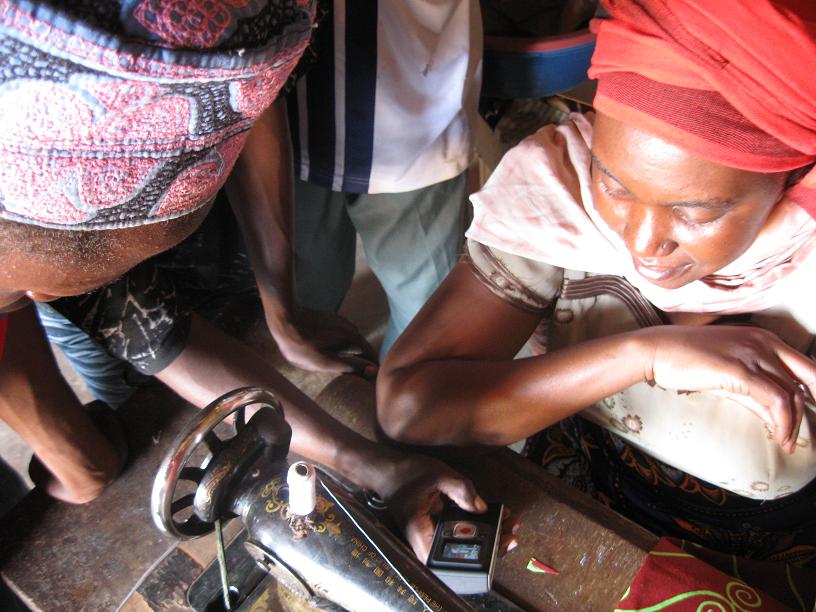
Aside from lunch, we spent most of the day installing software on the computers that we’ll be using in the media project.  We got the anti-virus going on all of them – a lesson learned and never forgotten on my part.  We also got the Nokia phones and laptops synced so we can use them for mobile internet while in the community.  Pedro said that mobile internet is a huge eye opener.  “If it works there, communities will know that if they can get the phone, they don’t need to go all the way to the city to access the internet.”  I’m crossing my fingers that the signal will be strong enough to make this a reality.  We shall see….  That social media session I have planned will not make much of an impact if we can’t get online.  Which reminds me how great it always is to get your feet back on the ground and adjust ideas to reality.

Related posts:

It’s all part of the ICT jigsaw: Plan Mozambique ICT4D workshops
Inhambane: land of palm trees and cellular networks


Read Full Post »

Mid week the first week of the community youth training, the youth chose what they wanted to do: arts or video/photos, and they split into groups for more focused training. The media group further split into 6 small groups of 4-5 people (one for each set of equipment) to then develop their interviews and ideas for their short films, based on the list of topics that had been created earlier by the youth and community members. The arts group chose topics from the list also to develop out. Photo: Some of the arts group.

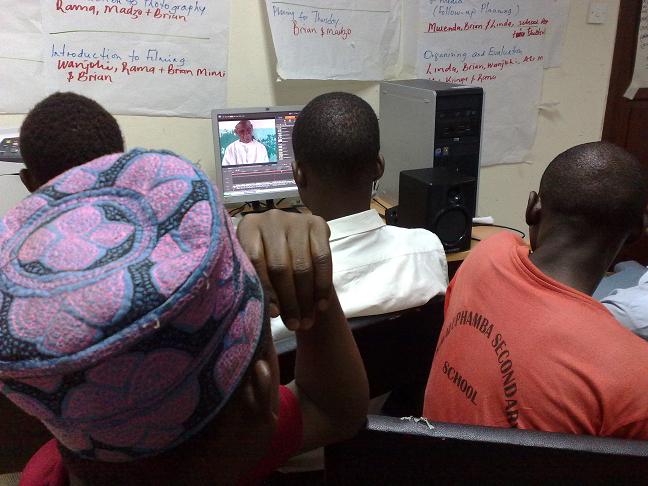
The first Saturday (after 4 days of theory and practice) we did a community field visit to get a better sense of what to film and to make appointments with resource people for interviews. The arts groups did rough sketches of the things they wanted to draw. On Sunday the groups started filming and working more closely on their chosen drawings. We filmed for about 3 days in small groups, and by the 2nd day had some groups stay back to learn editing, then switching and going to film in the afternoons while another group stayed back to edit. The arts group worked in watercolor and gauche to finalize their works. By the end of the week we had 15 films and about 12 really nice drawings! Photo: Filming on Birth Registration

The films that we finished included:

· Meeting Places/Community Resources

· Alcohol Abuse

· A quick trip around the rural areas

· Forest resources

· Universal Birth Registration (and issue of not declaring births)

· History of Mva’a

· Installation of the church in Mva’a

· Water

· How mud houses are constructed

· The market

· Raising pigs

· The long walk to school

· Relationships between parents and children

· Agriculture

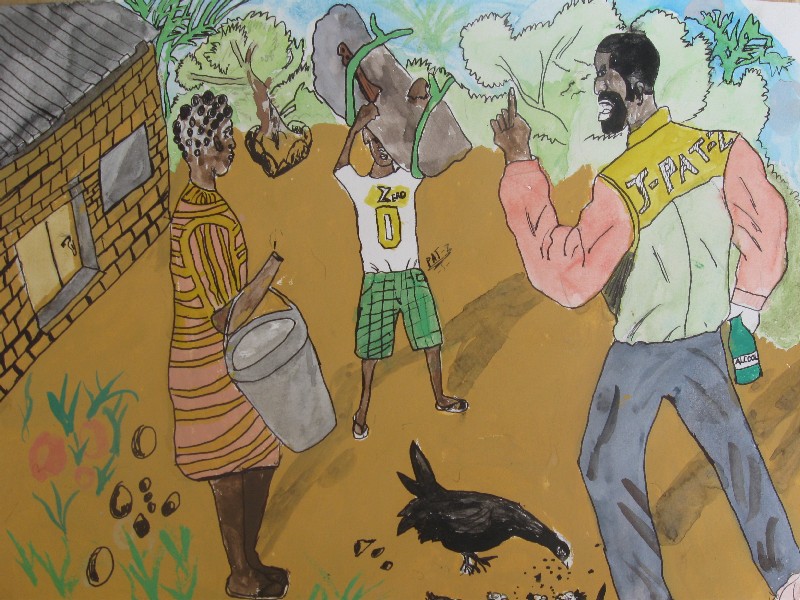
The drawings were really powerful, touching on themes that went deeper than the films, due to the nature of the two media. Drawing topics included Alcohol Abuse, A family losing their home to high winds/storms, Church, Long walk to school, Education, Hunting, Distance to health centers, People working on Sundays instead of attending church, Water, People not using latrines, Dangers of transport means, Recreation, Well/water sources, and Child abuse/Child labor

We closed out with a community film showing where the Mayor and community members and parents were invited to see the work of the youth. The youth, teachers and community members worked on an action plan to determine how they will follow up via concrete activities in the coming 6 months. Plan Cameroon is hoping to expand the program to additional communities, so it was important that the Mayor’s office attended as maybe they would have funds to support project expansion….

Read Full Post »

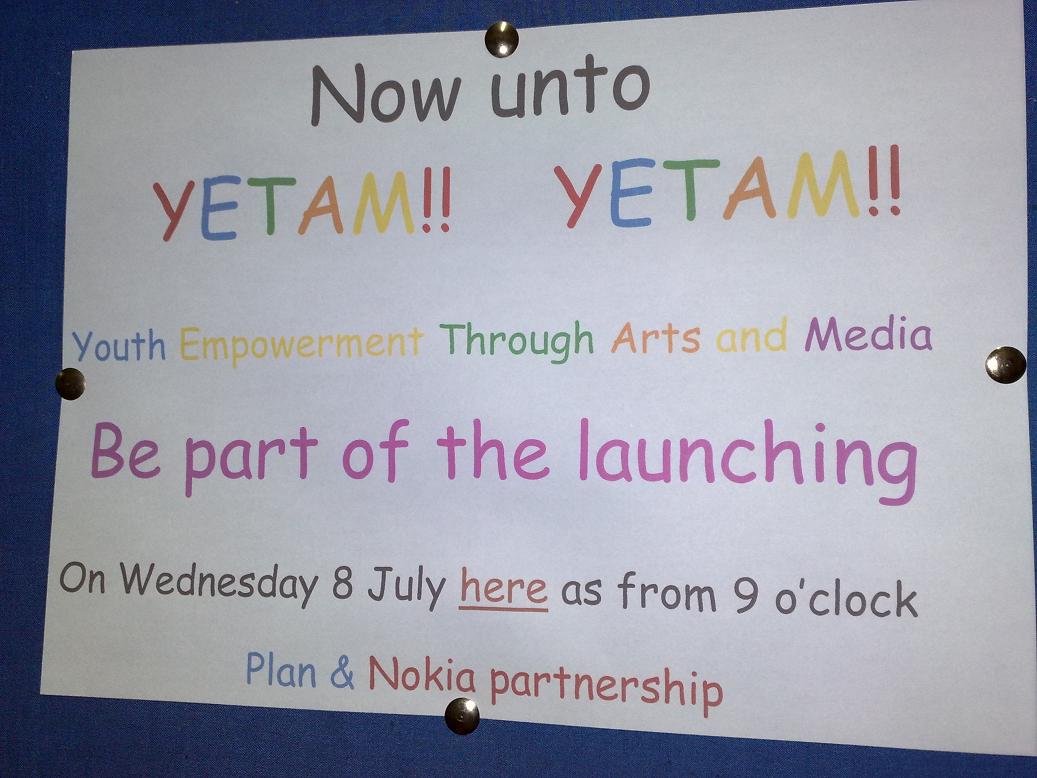
The Youth Empowerment through Arts and Media project (YETAM) kicked off on Wednesday with a press event, and then a training of trainers until Friday. At the press launch, I had to give an overview of social media and the YETAM project. The focus was on how social media can serve as a tool for community development, social change and augmenting participation, because it is based on some of the same principles and approaches as good community development work: partnership, ownership, collaboration, sharing, openness, communication, voice, power sharing, accountability, transparency, and democratic processes. I was bit afraid to use any examples of human rights/election monitoring or mention how social media is forcing the media business to change and impacting on social ‘revolutions’, not knowing if it could be threatening to the government and media attending, so it seemed better not to bring it up! Photo: YETAM launch announcement hanging in the lobby at Plan Cameroon.

For me the most interesting part of the 3-day workshop was listening to the participants debate about whether arts/media are tools or products. People said that they really learned something from the debate, that it really sparked their thinking about what is art and what is media and what both are for. They concluded (as I had hoped) that arts and media can be tools that help youth (in our case) research and deepen their understanding of themselves and their communities during the creation process. Yet arts and media are also products that are ‘consumed’ afterwards, catalyzing more debate and dialogue (sometimes via more arts and media) and if successful, eventually lead to some kind of positive social change. And the cycle goes around and around. Photo: Press event for the closing of the training of trainers.

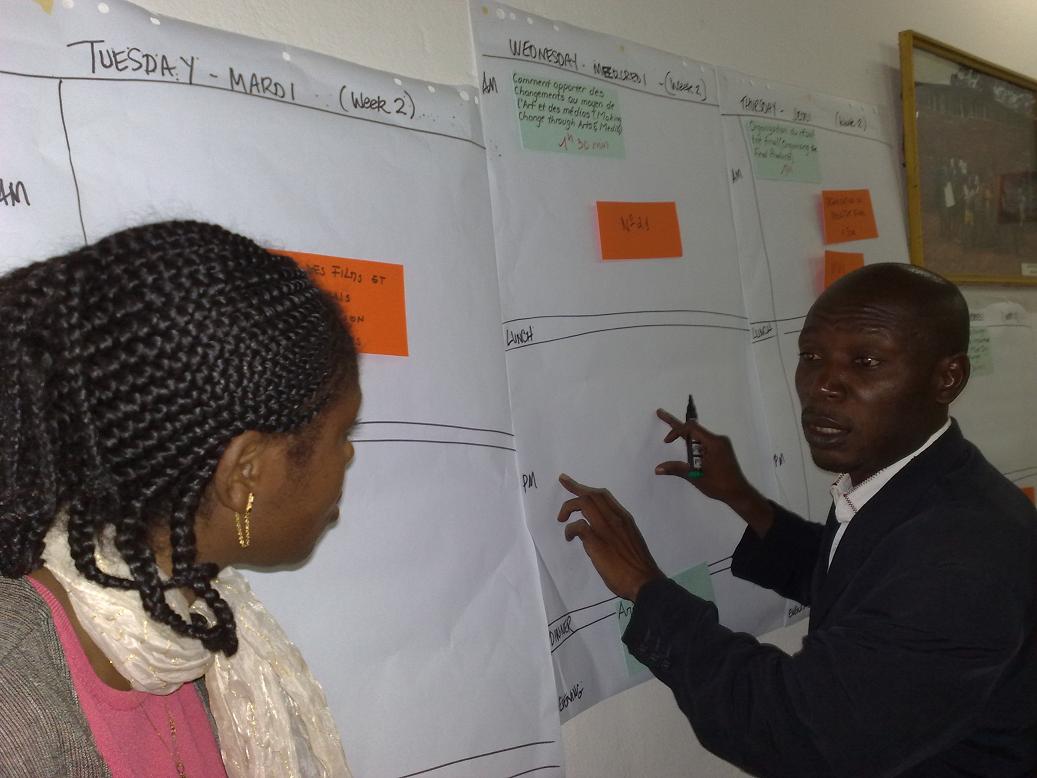
The idea of tool vs product can be a struggle sometimes when we start work on YETAM and the concept of participatory video or social media for social change and working with rural communities. Sometimes people think that we want fancy commercials or television spots or 30 minute professional documentaries or fiction films, or they don’t believe children/youth will have the capacity to make their own videos or edit their own films, or that people from rural communities can learn to use the equipment. It can be hard to explain that we don’t need to write long scripts and set up scenes with lights and big media teams with large expensive cameras, and that if we bring the technology down to simple language and hand over the camera, it’s very doable. We don’t need a week of theory before we allow the kids to touch the cameras or to paint something, that the media and the art are the means for having the discussions and theorizing about the issues as well as the end for continuing on with the discussions. And we don’t need to disrupt the community and or have ‘outsiders’ doing it for the media or art to matter. Local people can make their own media and it can be even more meaningful that way. Photo: Plan and partner staff working on the agenda for the youth training that starts on Monday.

Read Full Post »

Yippee!!! Mika and his colleague Ville at Plan Finland have been working on a tutorial video for using Frontline SMS since our Social Media for Social Change (SM4SC) workshop in December. They just posted it and it’s really helpful to better understand how mobile data gathering works in general.

http://frontlinesms.ning.com/video/video/show?id=2052630%3AVideo%3A11014

We’ll be having a workshop coming up in June in Kenya to see how to use Nokia’s Mobile Data Gathering Software, so soon I hope I’ll have a good understanding of how this whoe thing works so that we can train others to use it.

For YETAM we are looking at how we can use mobile data gathering software to do follow up monitoring in the communities following the YETAM workshops. The idea is that during the arts and media workshops, the kids are discussing issues most important to them. Then they make videos, photos, arts, etc. to investigate the issues, and bring them out, and to generate dialogue in their communities on the issues in order to try to bring about positive change by engaging peers, community at large, decision makers, and Plan (in case Plan hasn’t been aware of the particular issues the youth are looking at). But how are we monitoring afterwards to see what is happening at the individual youth level, and at other levels? How are the youth able to measure their impact on the issues they’ve chosen?

So we are planning to work with them to develop mobile surveys related to the changes they hope to create in the communities, and then they could monitor their progress on the issues through the surveys. They would also make videos/photos, etc. to show their progress, but in addition now they would have some data as well to help them shape their approach and measure their impact.

Sounds cool to me!

Read Full Post »

Jetlagged


Ali K, Ali M, Rama, Wajuhi and I went to a second hotel to work for the last 3 days on editing final versions and translating from local languages (Digo, Duruma) into Swahili. We didn’t have enough time to get them into English so I have to follow up on that from home. We worked from 9 a.m. till sometimes 2 a.m. and eventually finished 9 short videos on the themes of:

  • Coconut as an economic activity
  • Disability and traditions part 1 and 2
  • Overcoming disability to succeed
  • Traditional healer
  • Poor performance in school
  • Amina’s Story
  • Women’s group
  • Tuff Gong Town Cleaners

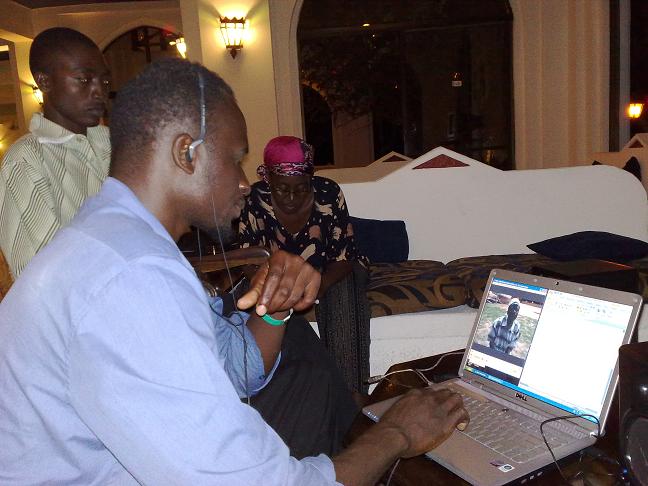
My favorite surreal night was sitting in a lounge area near the hotel bar with our laptops and headphones, etc. Outside near the pool was a tourist show of Maasai comedians, leading into Maasai singing/dancing. Amazing music, but not sure how I felt about the location of it — not quite the same as it might have been in situ. Following that, they put on 80s German techno music. When that was over, we watched Wrestlemania’s 25th anniversary in the background until around 2, slapping mosquitoes and yawning while Ali M and Ali K transcribed videos. Ali K asked me if it was real.

The flights home were uneventful but long…. and I’m so jetlagged! I was supposed to go to a capoeira event Friday night and then all day Saturday but forget it! Am hanging out with the kids and getting caught up on housework instead!

Read Full Post »

The kids are doing such an awesome job with the cameras – taking great shots. And the film quality from the little cameras is so nice – it really picks up the light well and you can even film inside a hut. (Just wish there wasn’t this glitch with having to convert all the Flip films before using with Adobe….)

We have stories in production by now on several topics – change of attitude towards religion, use of coconuts and their byproducts, the local dispensary (clinic), early marriage, games children play, the Kaya ceremony and traditional dances, poor performance in school, water, economic activities, child pregnancies, town cleaners, and disability from the angle of tradition and from the angle of a disabled man who’s gotten ahead in life. You can hear the kids analyzing, looking at things in a broader way, thinking through their stories and how they will show different angles of the situation/issue/story. It’s so cool to see them building up those analysis and communications skills.

We’ve been trying to do both filming and editing, splitting into groups to make the most of the equipment and space, transportation, etc., and it’s been flowing really nicely! The power outages have been a small issue but we’ve got great laptop batteries – extra batteries for each laptop, which means we can work without power for up to 6-8 hours on each laptop. So power is not such a problem with editing if we do it in small groups. Yesterday the water went off too, and we got a little nervous that the training center staff would go home for the weekend and leave us without water, but it came back on again around 9. Relief!

As for internet access, there is this amazing little modem that you can get for like $40 and you just buy minutes for it like you would for a mobile phone. Connect it up to your computer and run internet off the 3G network. I’m wondering why I don’t have one! And if it’s possible to get one that works in multiple countries with local sim cards. I’m sure I should already know this, but I don’t so will investigate…..

We’ll finish up filming and editing at least the rough cuts today. Tomorrow we’ll do the follow up planning with the youth and the evaluation. They will go home and I’ll stay here till Wednesday night with 3 of the older community members/youth to make the final edits and do the transcriptions and translation, as well as ensure all the photos are captioned and everything is organized. Lots to do still, but we are getting near to the end and we’re on track. It’s cool to see how much discussion goes on when they kids are editing about what to put in, what to take out, what makes the story and what angle. Really feel that it’s important that they do the process from beginning to end. We can polish their videos after if necessary, but it’s important that they put them together from their own point of view.

Read Full Post »

Darn Bus!

Mimi, the project liaison, came from Plan Finland yesterday afternoon, and we ventured out for a beer last night. It was really warm, so not quite the beer I was imagining…. I’m giving up!

We tried to go to the community this morning but the bus broke down and we never made it! We spent most of the morning getting half way there and back…. After lunch we started doing some technical and practical training with the cameras. The youth always love getting their hands on the cameras. And they did a really good job for not having held cameras before! We’ll try to go back to the community again tomorrow….

Had some great tips and conversation with Mimi that will help improve the project. She is also going to film some testimonials and take some photos of the kids, which should be really helpful for the reporting.

Read Full Post »

The main thing that we did today was to go back to the map to see what the different issues in the community are, and what kind of stories could be told about the issues. How can we tell stories that touch the heart? That move people to action? That are real and relevant and educational? The personal examples that went behind the stories were super interesting. I hope the youth will capture a lot of these stories in their videos… I also hope that we’re able to produce videos that work to stimulate dialogue in the community, and that also are interesting to an external audience. That is one of the big challenges in this project.

Some stories that came out:

“There is a story about old men that go to the farms w/their tools but they don’t actually have to work, the spirits come to do the work for them; so a woman wanted to see the ghosts and she came up with a scheme to watch. When the spirits discovered the woman had seen them they stopped working and the men were angry and made women work tilling the fields ever since.”

“There is the story of witchcraft in the community. If people see someone progressing they perform some witchcraft rituals that make them go crazy or take them down.”

“Girls are being targeted for harassment; it’s a real story. It happens often. Even beyond this harassment there are threats of physical harm and sometimes charms/witchcraft. But the community is responding and these people are being arrested now.”

“A story about the way girls are married. They are married very early and marriage is an obligation. They stop attending school. Because girls are not allowed to inherit anything, they don’t see a purpose in education or in community development because they never have any decision making power. Bride price contributes to harassment. If you get married and get 12 cows as a dowry, then the family just equates you to that – 12 cows.”

“Sometimes girls come to school on opening day for boarding school, parents say that school is supposed to be free, so they haven’t even provided the girls with anything. The matatu (public transportation minibuses) drivers take advantage of them and then deny that they’ve had anything to do with them.”

“There is a belief that only basic education is important and that anything beyond is not necessary. So even if a girl/boy qualify for university, parents won’t support them. Some parents don’t believe in white collar jobs, if you aren’t a soldier or watchman which is something they can understand, if you don’t have a practical skill like carpentry, the parents don’t feel it’s a job. They are only willing to pay for an education for a skill that they can understand.”

“There is a belief the disabled children should not be allowed to live. Sometimes they are killed or they are kept out of sight and in bad conditions. Sometimes if someone has a disabled child, it’s seen to be related to the fact that they have some wealth and they’ve traded their family for wealth.”

Read Full Post »

So I’m sitting in my new 4th floor room. There are no flying termites in the bathroom! Yay. And the view off the balcony is gorgeous. It looks out over green fields and hills to the sea. The group that was here last week has gone and they’ve moved us up to the top floor. I’m reading on Twitter about swine flu and wondering if it’s something I should be worried about at some point…. Maybe later.

We went this morning around 9 on a rickety microbus, like the ones you see pretty much everywhere in the world, to Kwale Town to the Kaya Ceremony. There were 9 tents set up around a center stage, one for the elders and clan from each of the 9 ethnic groups making up the coastal area. The place was a big tree covered park with a central clearing. It was pretty empty but filled up as the morning went on. The team went around in pairs to do the interviews that they’d planned out yesterday. I just roamed around filming what seemed like good background shots with the Nokia N-82, and the others used the Flip cameras supported by small Sony recorders since sound can be a bit iffy with the Flip cams.

The coolest thing was each different ethnic group had a dance group. We filmed a few of them and Anthony did some interviews. Around 1.30 or so the new Kaya came in surrounded by the other elders, chanting “kaya! kaya! “ He had been in another ceremony last night that was private and today was the public one.

The dances started and soon after speeches – and I rather lost interest as did most of our team, saying that the whole tradition had become political and it was not much about culture anymore, but politics. The main story that the team is agreed to focus on yesterday is that most youth don’t really know what the kaya is all about, yet the kaya holds lots of power, and the youth hope to access that power someday, yet how will the access it if they don’t know anything about it. Another story that they want to do is related to women and power. The whole group is really gender sensitive which I’m finding really interesting because lots of gender issues are coming up and their insights are really profound as related to culture, tradition, and today’s world.

Ali K was talking at dinner about inheritance, and that in his community/culture, women cannot inherit. If their husband passes away, they must return to their parents’ home and be cared for by a father or brother. Ali’s father passed away several years ago and this was his situation. “I became aware of this as a problem because of my own situation, and since then I’ve become very supportive of girls and women.” Anthony translated for me the discussion that ensued about how girls often don’t feel there is any point in being involved in the development process or in school because they can never own or make any decisions, so what is the point.

The kids come tomorrow late morning. We’re trying to get ready for that, and also figure out an issue with the Flip Cams because they won’t import into Adobe Elements. I’m trying to download a possible solution…. Internet is great for problem solving. Let’s hope the solution works!

Read Full Post »

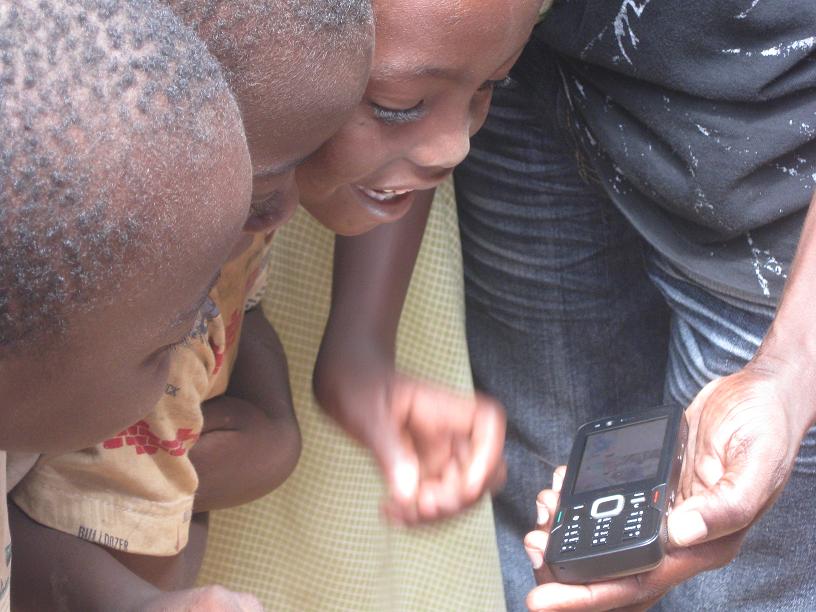
I got myself up around 7 and showered. Put my same clothes back on and called Bedo. He and the guys from the Kids Waves radio program came to get me about 8 and we drove about an hour and a half out to the community. We dropped the radio guys off first in one community where we will visit tomorrow and where they will do a live Kids Waves show. The YETAM community was a decent drive down a pretty dusty road, but not really too bad. The kids were all in the school house. They had a whole program planned where they showed the theater and songs that they had made up during the project and since then. They also showed me the photos that they’d taken as part of the project. I took a bunch of video with my phone so that I could make some short testimonials for Nokia about the project. I was really impressed with the kids and the topics they chose – they did one play about female genital cutting, one about the dangers of selling bad meat in the community, and had a song motivating people to go out and vote. Really relevant stuff for community awareness and motivation.

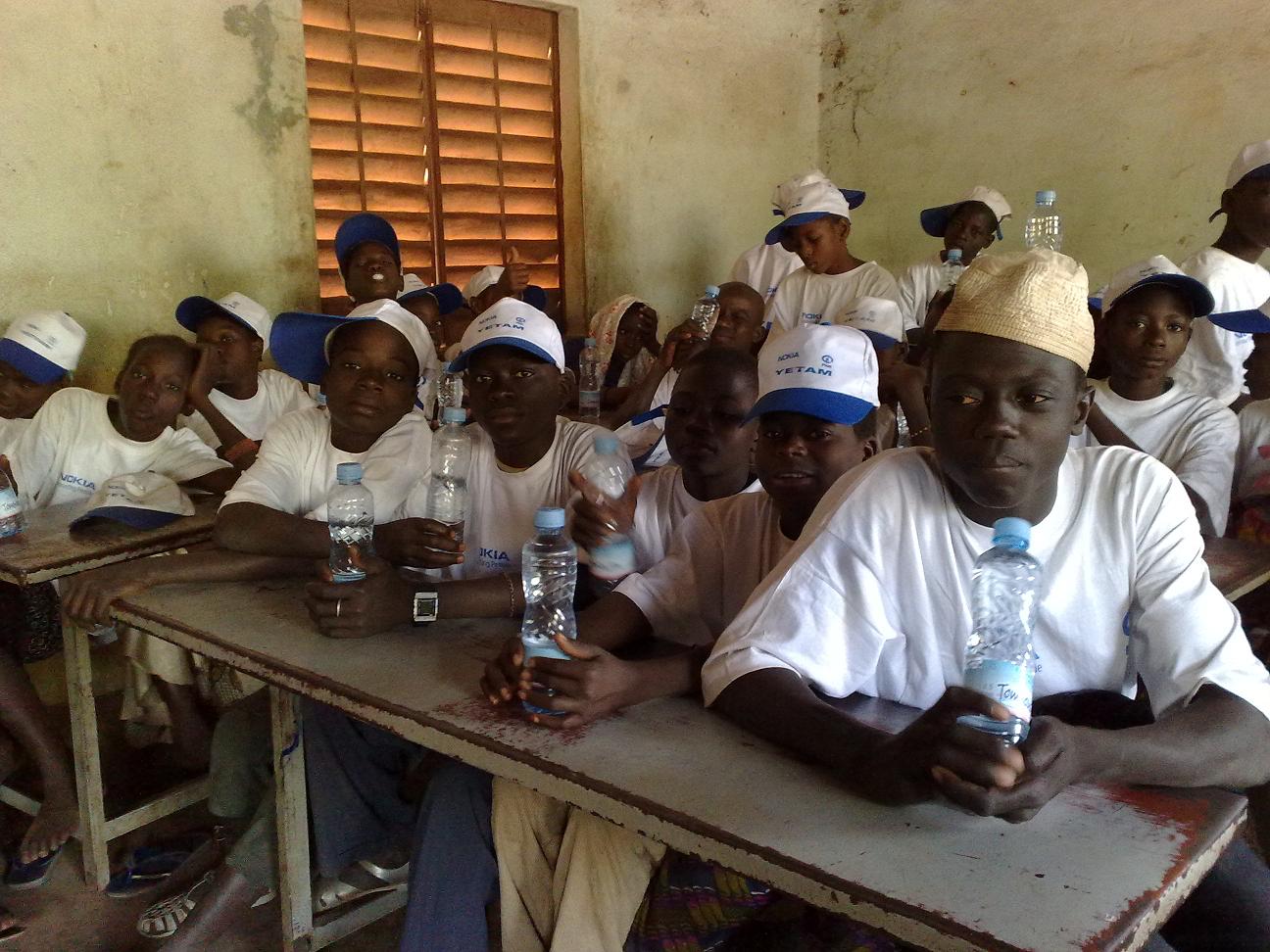
Photo: kids who are participating in the YETAM project.
About 2 we finished the community program and they served lunch. It was rice with meat – goat I think. So as usual I was faced with the vegetarian’s dilemma (as opposed to the omnivore’s dilemma, ha) of how to avoid being rude. In the end I just ended up eating the rice with all the goat ‘juice’ on it. People crowd up and share a big platter of food. They wash up and then each person squats around the platter and uses their right hand to scoop out some rice and form a ball with it, and then eat it along with some of the meat and vegetables. It’s nice to have a communal plate like that. I’ve seen it in many countries and it really feels more like you are sharing the meal rather than each eating from your own private space. I just wasn’t sure how the meat juices and grease would settle since I haven’t eaten meat for so many years…. I was feeling a big woozy by the time we got back, but mainly due to lack of sleep and water since I didn’t drink any water all day and it was pretty hot. (Didn’t want to have to go to the toilet!)

Read Full Post »

« Newer Posts - Older Posts »