Feeds:
Posts
Comments

Posts Tagged ‘YETAM’

We started the YETAM training with the youth on Tuesday morning, after an official launch. The mayor of Okola attended as well as some of the Plan staff from the Country Office in Yaounde.

Since the youth had already had training via Plan and IRONDEL on the Rights of the Child, and some had worked with Plan’s Kids Waves radio show, they were really well equipped for moving onto video and arts work. They started with their community map where they had detailed, along with the community organization members, everything in their community.

The youth presented the map and everyone worked in groups to organize and flesh out the information from the map in 4 categories: community history, community description, community resources, and the situation of child rights and protection. Photo: youth presenting the map.

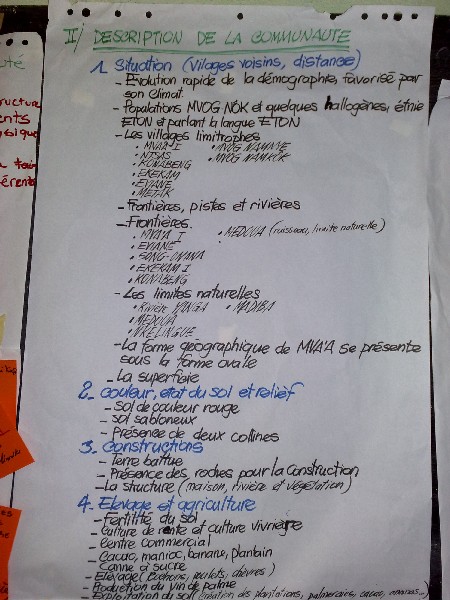
They wrote their ideas on note cards which were posted on flipcharts and then sorted to come up with final categories. These formed the basis for all the upcoming work. Photos: flipcharts with the different topics for filming and arts work.

After the map work, we went into introductions to the different things that we’d be doing: photography, film and drawing/painting. We had a bit of a struggle within the team getting facilitators to move from too much theory onto practical work. They kept going back to presentations and lots of long flipcharts and technical descriptions. Photo: The arts group re-drew a nicer version of the community map later in the week.

We realized later in the week that we didn’t all have the same understanding of the project methodology. Some thought that we were doing 1 week of theory, and 1 week of practice, and then afterwards would start making some videos, when in reality the idea is that we would not focus too much on theory because the media equipment is very simple to use, and we can use practical, hands-on exercises to build the technical skills.

The idea is to quickly get hands on during the first week, and then start making a first round of arts and videos near the end of the first week, continuing through the second week, and then getting into editing by the middle of the 2nd week. In the evenings we’d look at the footage as a whole group, and participants would talk about what looked good, what didn’t and how to improve. Once that got cleared up things moved on splendidly. Photo: Practice and group reflection is the best teacher.
Read Full Post »

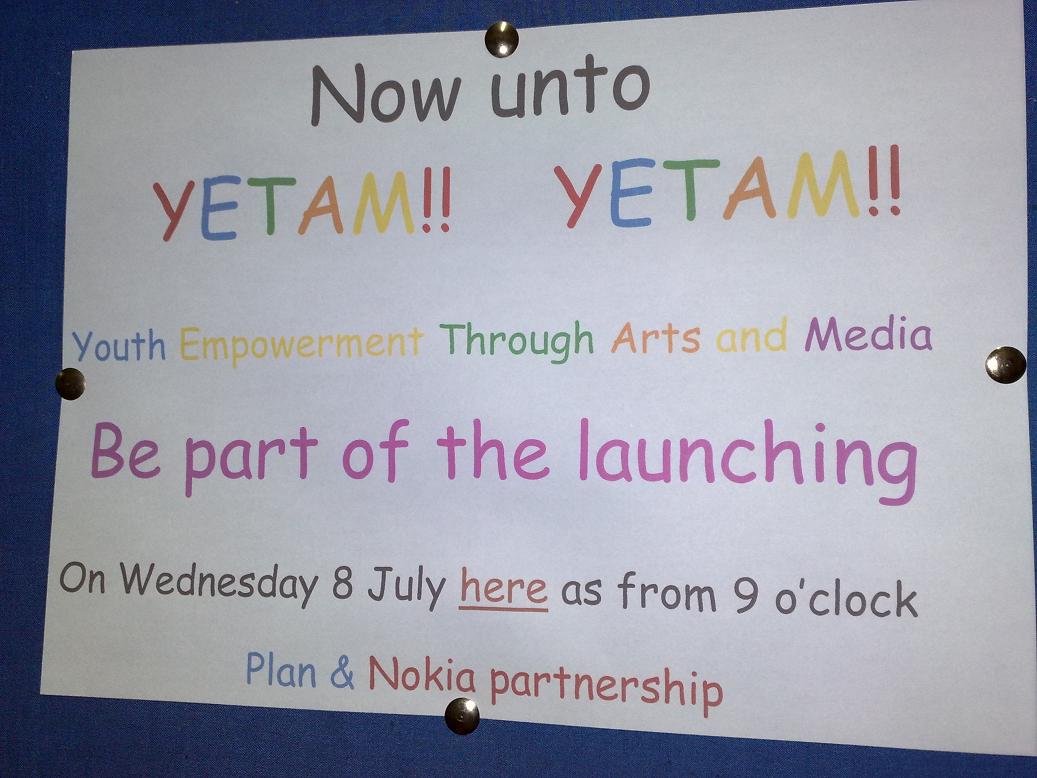
The Youth Empowerment through Arts and Media project (YETAM) kicked off on Wednesday with a press event, and then a training of trainers until Friday. At the press launch, I had to give an overview of social media and the YETAM project. The focus was on how social media can serve as a tool for community development, social change and augmenting participation, because it is based on some of the same principles and approaches as good community development work: partnership, ownership, collaboration, sharing, openness, communication, voice, power sharing, accountability, transparency, and democratic processes. I was bit afraid to use any examples of human rights/election monitoring or mention how social media is forcing the media business to change and impacting on social ‘revolutions’, not knowing if it could be threatening to the government and media attending, so it seemed better not to bring it up! Photo: YETAM launch announcement hanging in the lobby at Plan Cameroon.

For me the most interesting part of the 3-day workshop was listening to the participants debate about whether arts/media are tools or products. People said that they really learned something from the debate, that it really sparked their thinking about what is art and what is media and what both are for. They concluded (as I had hoped) that arts and media can be tools that help youth (in our case) research and deepen their understanding of themselves and their communities during the creation process. Yet arts and media are also products that are ‘consumed’ afterwards, catalyzing more debate and dialogue (sometimes via more arts and media) and if successful, eventually lead to some kind of positive social change. And the cycle goes around and around. Photo: Press event for the closing of the training of trainers.

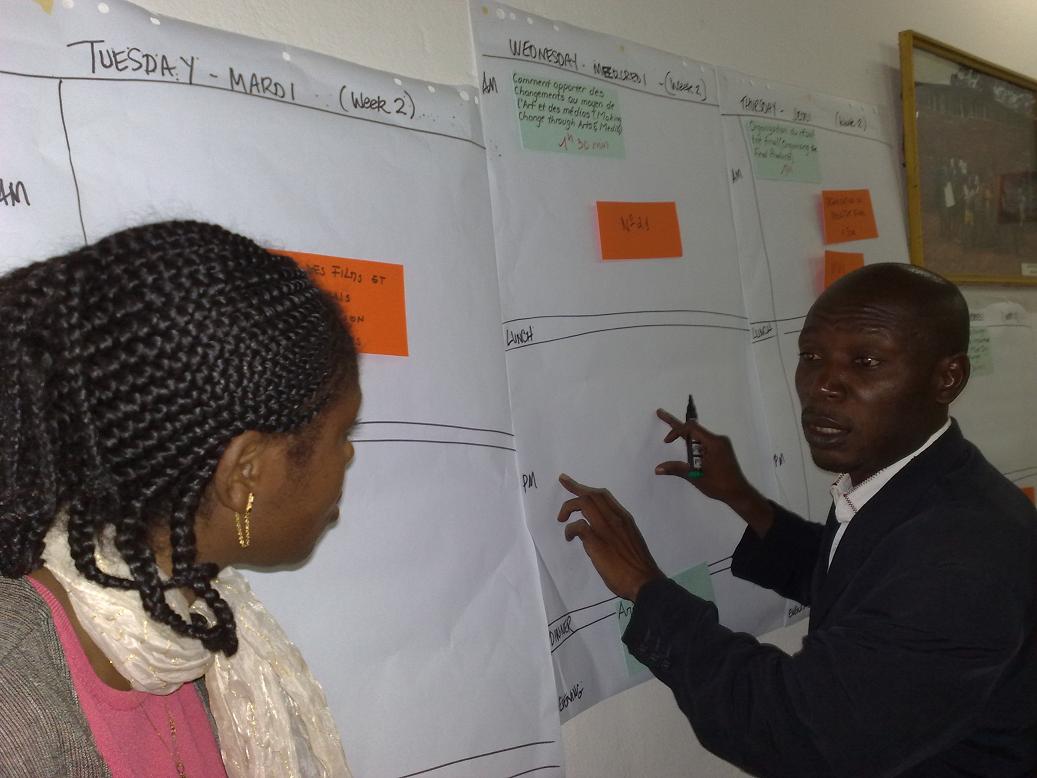
The idea of tool vs product can be a struggle sometimes when we start work on YETAM and the concept of participatory video or social media for social change and working with rural communities. Sometimes people think that we want fancy commercials or television spots or 30 minute professional documentaries or fiction films, or they don’t believe children/youth will have the capacity to make their own videos or edit their own films, or that people from rural communities can learn to use the equipment. It can be hard to explain that we don’t need to write long scripts and set up scenes with lights and big media teams with large expensive cameras, and that if we bring the technology down to simple language and hand over the camera, it’s very doable. We don’t need a week of theory before we allow the kids to touch the cameras or to paint something, that the media and the art are the means for having the discussions and theorizing about the issues as well as the end for continuing on with the discussions. And we don’t need to disrupt the community and or have ‘outsiders’ doing it for the media or art to matter. Local people can make their own media and it can be even more meaningful that way. Photo: Plan and partner staff working on the agenda for the youth training that starts on Monday.

Read Full Post »

Today we worked out the whole rest of the media training plan and who would facilitate what parts. Everyone is taking on different roles according to their strengths and knowledge, and we’ll facilitate in pairs or teams. We spent the afternoon trying out the cameras, testing mics, etc., and then Anthony took us through the editing process in the evening.

Mercy told us that there will be an induction ceremony in Kwale Town for a man who will become an elder. There are both cultural and political connotations to his induction and the whole area will turn out for the celebration and ceremony. Wajuhi suggested that we film it as practice, so we took the afternoon to plan out how we would do that, what stories we would catch from which perspectives, and who would interview and film whom/what. We worked together on the interview questions for men, women, youth, children. It should be pretty interesting.

The manager from the center where we’re staying stopped in and hooked up the internet so that is great!

Read Full Post »

The first day of training went by pretty smoothly. We had present Mwendar, the Community Based Organization (CBO) Chairman of Mwangaza, the community we’ll be working in, Ali a local artist and CBO secretary from Msambweni, Mercy the district information officer who’s also studied participatory video, Rama a university student from the area who’s studying media and communications, Madzo, who is involved with a youth environmental organization, and Anthony, Wajuhi and me from Plan. In the evening, Ali K, another youth also joined us.

It’s been really interesting seeing how Anthony and the Plan Kenya team have worked hard to ensure that the project is really fully integrated and tied into the existing work and programs so that it’s not seen as a parallel project. It is being integrated into the community planning process, and grounded by the recent child rights based situation analysis that was done in all the Plan Kenya work areas. It’s also linked in with the community radio project and informed by the existing community ICT programs.

We spent the morning getting set up and trying to get a generator since Thursday’s is “no power” day in Kwale. The generator came but it didn’t work, so we had to manage without electricity. It wasn’t too big of a deal since both laptops we are using have good battery life. The main things we covered were introductions, expectations, a project overview, and child protection and ethics. Merci also gave an explanation of participatory video.

We discussed with the community chairman how to manage/handle any issues of potential conflict if they came up. Having the CBO chairman is really valuable because working together, youth and CBO, will limit potential conflicts around topics that might be addressed. Wajuhi and Anthony are really stressing the importance of community ownership, the ways that video and photos and art can be used to catalyze discussions in the community, and the importance of the follow up and documentation process. We discussed ethics, and the use of the community’s name in case possible difficult subjects, and child protection in terms of possible implications of discussion particular topics. The chairman said that it would be fine to use the community name, but that in the case of sensitive or taboo topics, it would not be right to identify certain persons. He suggested that those types of issues be dealt with using drama instead so that the topics would still be raised by in a less conflictive way. In the end, he also said, this is a joint project with the youth and the community, so the topics would be agreed upon by all, even if they were addressed from the youth’s own perspective.

Wajuhi told today about a video project she had worked on in the past where one of the participating children was orphaned and had been mistreated in the community, stigmatized, called names, etc. The youth did a drama film based on her story. It was shown to several CBOs at once. The CBOs from other communities began asking, “is that how you treat orphans in your community?” And the discussion led to “What about us? Do we treat orphans any differently?” On that came the question “Why are there orphans in our communities” and the answer: because of HIV/AIDS. So the community began planning efforts to deal with HIV as well as the situation of orphans.

The first step in the project process is mapping the community. Since Ali had experience doing community mapping, he led us through a practice mapping exercise at the end of the day to get a concrete idea of how community mapping can be a tool for identifying resources and assets, talking about community history and the community’s uniqueness, bringing up child rights issues (both where rights are being realized and where not), and making plans for what to film and photograph. Ali, the artist, is also a CBO member in his own community. It was great to hear him really focus in on ownership of the community’s challenges and not expecting others to come in to resolve things.

Someone mentioned that there was a dye factory that used to provide jobs, but that had closed. Ali asked if it was in the community, and said that if not, then we shouldn’t be putting it on the map. That we should deal with things in the community. Wajuhi added that because this project is about empowerment and advocacy, that when the youth had built up all the skills that we hope to strengthen within the project, that they could then look at issues that had causes outside the community, and get the support of the community as a whole to address them with anyone outside the community with power to make change on a particular issue.

Read Full Post »

YETAM Kenya

So I’m off to Kenya tonight – just about ready to head to the airport…. We’ll be training in the Kwale Program Unit district with about 20 high school aged youth from one of the nearby communities. They have to go back to school on May 3, and we weren’t able to negotiate any additional time with them, so we will have to fit the 2 week training into just about 9 days — we’ll see how that goes. I’m pretty stressed right now about it actually… but normally it all works out.

I’ll fly from Boston to Nairobi and then take a short flight to Mombasa, stay over night there, and then will be picked up in the morning to go to the training center. I’ll meet with the Plan Kenya staff to prepare, and then Thurs-Sat we’ll have the facilitator’s training and work out all the details for the following week with the youth. We have a basic outline that just needs fleshing out. We’ll also check over all the equipment, etc. and be sure we’re ready. We’ll start the training with the youth on Sunday Apr 26 and run through May 3, and then I’ll stay a few extra days to finish up.

I’m going to try tweeting from there to see how that goes…. could be interesting to use the YETAM twitter account for the youth to post what is going on during the training and the project, but we’ll see if they are interested and if we have a good enough connection….

Read Full Post »

The groups all worked again today finishing things up. The IT person from the Program Unit office is still here trying to resolve the issues with the computers. He fixed the USB port on the one and is going to purchase a CD player for each computer so that the software can be installed.

The Program Support manager visited today with the advocacy coordinator from Plan Canada. It’s very clear that there will be good follow up from the Rwanda office on everything coming out of the project. The Program manager was quite keen on the ideas that the kids and partners have come up with and commited to building Plan’s interventions around the topics/issues coming out from the kids’ work.

We worked until 3 and then I said goodbye to the kids. They gave me some really sweet drawings and letters to take home with me. Chrystel and I stayed at the hotel until around 6:30 and then we drove back to Kigali where I checked back into the Ninzi Hill Hotel and took my first hot shower with running water in the past 2 weeks – that sure felt good!

I got online to check in on my other life, and almost immediately Julie Skyped in and said that she was having trouble getting passports and visas sorted out for Noe (her small son who was supposed to come with her for the last week of training). It sounded like a big hassle for her to try to sort it out, so we agreed that she would not come. I felt that the team was really on track anyway, and didn’t require us anymore. I think the important thing is the first week or 2 and by then things just roll along. Julie said the same thing happened with the Senegal training, so we agreed she’d cancel her trip. Though she was disappointed, I think it will be OK.

Around 10:30 Jacques and Olivier came to pick me up to go hear some live reggae at the KBC (Kigali Business Club). Really nice place and good music. We stayed pretty late and then walked back to the hotel and I crashed. Photo: Kigali by night.

Olivier, Joseph and Tony came in the morning to say goodbye. Chrystel took me to the airport around 2:30, (stopping on the way to pick up some Waragi to take home as a souvenir)!

My flights home were uneventful. I think I slept for about 16 hours! Picked up some coffee in Ethiopia airport and made it home to my house around noon on Sunday. I’m still exhausted, and with such lovely memories of the trip. One of my favorites of all time….

And now back to the grind!

Read Full Post »

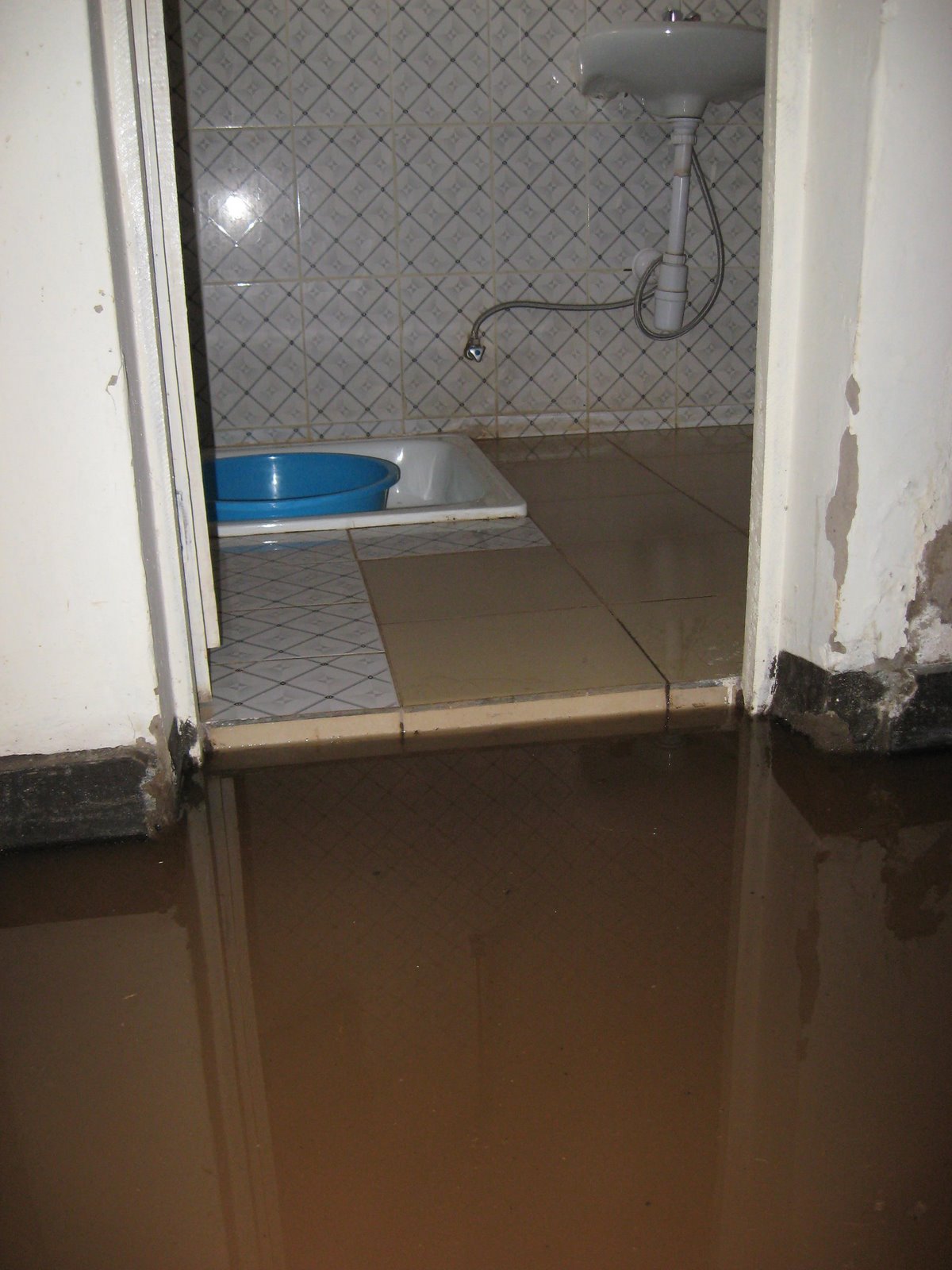
The groups continued working today on their different ‘products’. Chaka’s group will be ready with the community map by Wednesday. I spent a little time going over the maps that other groups had done in the smaller group so that the kids could see more how the computer works and what the virtual visit set up is and how the map will play into it. They are doing something more symbolic with the map that looks really interesting. They will make representations of the 3 kinds of lifestyle found in the district – the most ‘pure’, the medium developed, and the city type life. These will be combined into one map and they’ll also add drawings of the different things they saw out when they were surveying to prepare to draw the map. Originally we had worried about letting the kids join other groups but now it doesn’t seem to be much of a problem. Each group has solidified and they all feel proud to be in the group they are in. Photo: the rainstorm flooded my hotel room!

The theater group practiced with a dress rehearsal and we planned to film it but there was a huge rainstorm in the afternoon and we couldn’t go out to film. The video guys continued editing and filming, but we are still having some computer issues and the kids were not able to learn much editing today.

Tomorrow we will go over the ‘list’ of things that we need to accomplish by the end of the training to see where we are and so that next week Julie can ensure that we produce everything. This includes:

1 community map
15 community videos
5 drama videos
30 drawings/paintings
3 sets of 12 photos each by theme
3-5 music recordings/music videos of the kids singing
1 ‘making of’ video
25 ‘making of’ photos
5 testimonials for Nokia (30 seconds each)
1 follow up plan which can then be turned into a project to be funded by the website donations (i.e., the training center?)
Media coverage (local media when we have the parents/community presentation, and national media coverage plan via television, print and film festivals, etc.)
Report
Face photos/names/ages of all participants and partners/facilitators

Tomorrow is my last day here…. Photo with Chrystel, the Rwanda project coordinator.

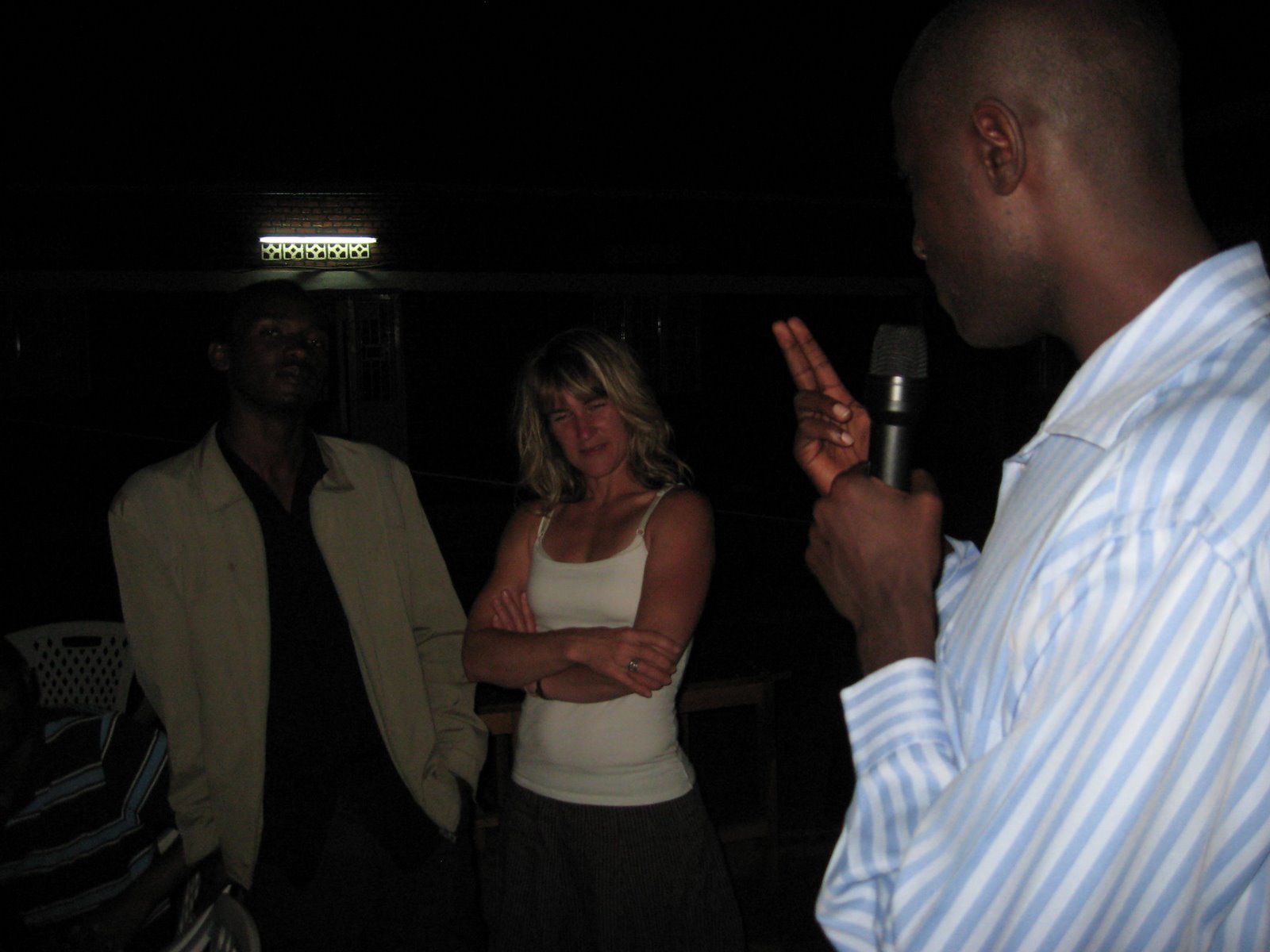
We set up the sound system in the hotel courtyard and had a big farewell party in the evening. Photo: Bernard and Chaka setting up the music for the evening.
People went around and said good things to each other about how great it was to work together, etc. It was a really nice time. I’m really sad to leave! Photo: Joseph, my faithful friend and translator, and Patrick saying lovely things about me….

Read Full Post »

We arrived a bit late this morning. We brought over the desktops and set them up in the training center so that they could start editing today. The Country Director (CD) arrived around 10 and visited each one of the groups and talked to each of the partners. He seems quite happy with the project and open to the necessary follow up with the kids and through the partners. I was really happy about that. We relaxed most of the rest of the morning and after lunch I worked on some reporting. The arts group went back out to do some more community surveying. Photo: Mamadou Kante, the Plan Rwanda Country Director.

The main issue today is that the electricity was coming on and off which made it hard to work. The country office will send us a UPS that we’d accidentally left there for each computer for tomorrow morning. Photo: Saide, Jacques, Lauben and Bernard.

The monitoring and evaluation coordinator visited along with the CD and had a chance to talk with the different partners about sustainability of the project and follow up. Some good ideas came out such as how to respond to the kids requests for forming an association and how to offer them other kinds of training or good follow up and more depth on the skills they are learning in this workshop. One idea that is coming up from different sides is that it could be possible to open some kind of training center in the area, managed by partner organizations, to house the equipment and conduct further training in the 3 areas plus areas that the youth identify during follow up planning. Photo: the theater group getting ready show their work to the CD.

It was quite a good day and I feel like the follow up with all the partners will really happen.

At the debrief, people were happy with the results of the day. Amina said that the theater group had stepped it up somehow and all the issues with the play were resolved.

Read Full Post »

Today we had transportation so I went with the 2 video groups to film in the community. Olivier and Bernard went with one group to film one topic the kids had that was ‘we are developing and progressing, so they filmed different things that they see as progress. I went with Jacques and his group, along with Joseph for translation. We drove quite a long way with 21 people in the minivan. Bernard showed me the half-hour t.v. show that he does every Friday called “B-Kool” which covers fashion, music videos, and what’s cool. He showed me also some of the latest videos he’s made, one included Chaka as an angry father who beats up a guy for going out with his daughter. Photo: the video group for today.

Our group got out first and we filmed the dam which irrigates the rice paddies, and then Joseph and I stayed near the dam caretaker’s house while the others went off to film a couple other stories, like rice growing and fishing. We ended up waiting for over 2 hours for them to come back. But mainly Jacques figured that if I went, we’d get the crowd following me shouting muzungo again. I think this time it wouldn’t have happened and I would have liked to have gone, but it was also nice to stay up and sit outside for a few hours enjoying the fields, weather and sunshine. Around 12 the caretaker came out with a bowl of amazing food – cooked green bananas, beans, carrots, a small squash type vegetable all in a mild chili sauce. So delicious. Joseph and I shared it with the 2 girls who had stayed back with us. Photo: filming a rice grower in the storage shed.

Finally the group came back and reported on what they’d been filming, and that they had lots of great footage, with just one problem – that they’d dropped the camera in the water…. But Jacques figured it would be OK (and it was). We sat for another hour or so waiting for the car to pick us up and I learned a whole bunch of phrases in Kinyarwandan which was cool. Photo: fisherboy.

In the afternoon we mainly sat around while the groups worked. I met with Patrick from PAJER to learn more about what they are doing, and to talk about some things we could work on together and possibilities I had thought of for places/people I could connect him with, including possible ideas for collaboration with Plan. We broke at 4, took naps and met again from 7-9.30 to plan for tomorrow.

We are still adapting the schedules for the different groups. Amina still felt her group wasn’t progressing as she had imagined, so different people were giving her advice. We reminded her that the goal is not having perfect theater students, but using theater to support expression, and that if there was something that the students were able to do that she should focus on building that up, not on making a long play.

Chaka explained how he’s making the map. It will be stylized showing the 3 different zones of Kiziguro – the very rural/not developed areas, the semi-developed areas and the town area. They are also working on drawing pictures of the things they have seen when they are out surveying for the map.

Tomorrow the country director is coming to visit around 11. We decided to have the video group focus on some photographing around the training center, the arts and theater groups would continue working. In the afternoon we’d have a debrief of all groups and the kids would move into new groups for Thursday.

Read Full Post »

We decided yesterday to only take what we need to the training center instead of lugging tons of stuff over there every morning. The kids were in groups again today, and in the morning they worked out a plan for what they were going to film and then around 11.30 we started out. I went with Jacques and about 7 kids. We ended up walking to Lake Muhazi (where we’d spent the weekend) but reaching it from a different side, which took about an hour, and taking pictures along the way. The walk was along a very clean and well kept up dirt road with squarish adobe houses along the way. It was a bit uncomfortable in a few places as we gathered quite the posse of kids following us saying muzungo (white person) the whole way. It was pretty alright until we got to the primary school, which unfortunately was on break time, so then they followed us (well, me) for a couple miles saying muzungo, muzungo. A couple adults came out and took a picture of me which felt strange but I readily accept – it’s a 2-way street. Photo: kids in the trees next to Lake Muhazi, taken by the video trainees.

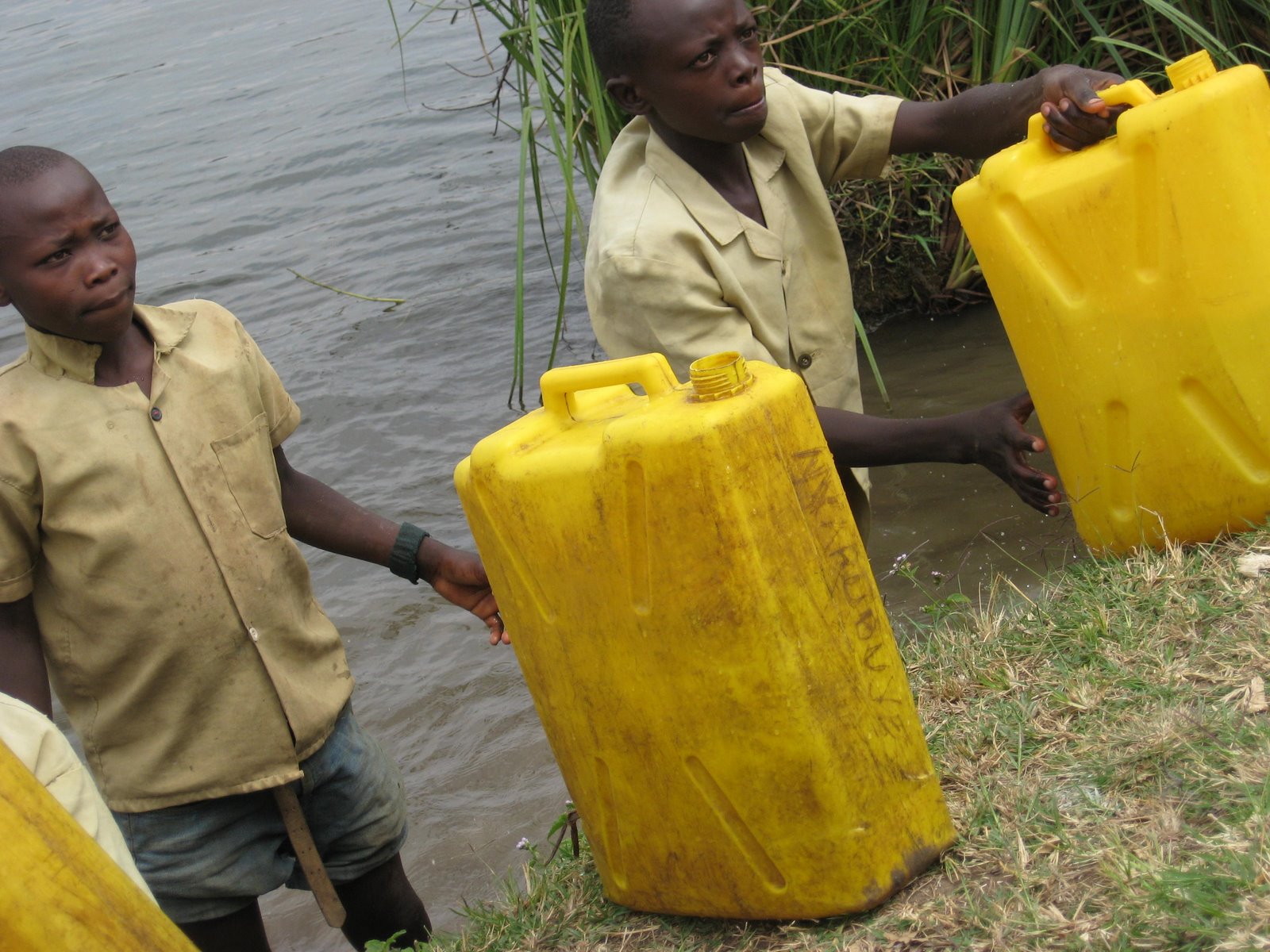
At the lake the kids did an interview of one of the girls in the training explaining how they use the water from the lake for everything. You see lots of guys on bicycles with yellow jerry cans everywhere bringing water for cooking and washing. And you understand why not much washing is really done since the water is so scarce and from so far away.

After the interview, we sat awhile waiting for someone to come to collect water so we could film it. It took awhile because it started raining (pretty gently) and I guess it wasn’t really water gathering time. Some cows came along so they interviewed the herders. Then a boat came across the water from the other side so they filmed that and interviewed the water taxi people, and people riding on the boat. Then finally some of the school kids who´d been trailing me came back with their jerry cans and went swimming and got some water, so the kids filmed that and we started the walk back. Photo: kids collecting water. Taken by the video trainees.

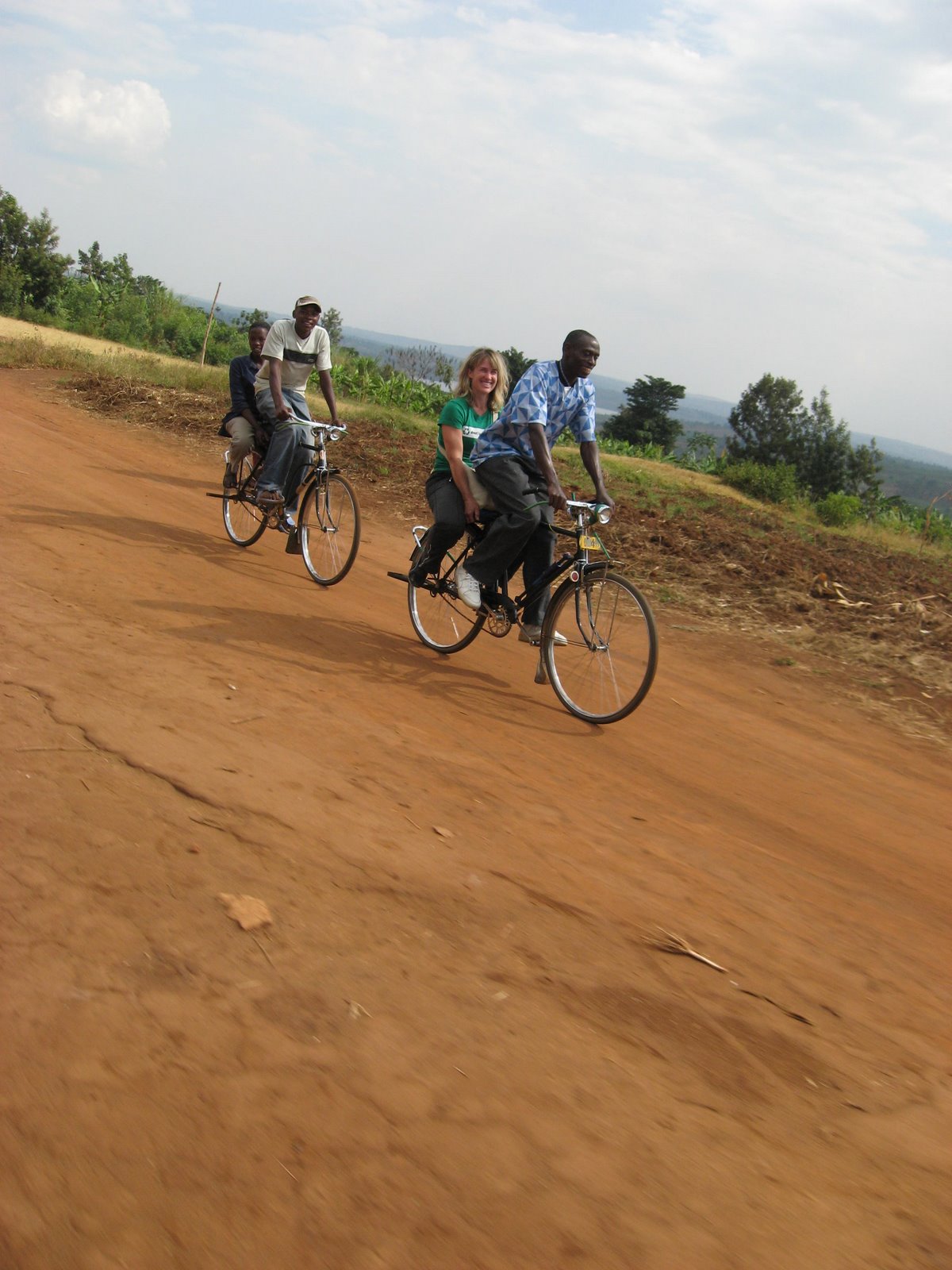
We came upon a wedding so we stopped and took some pictures and film of that too. Then Jacques said we should catch bikes back to the training center so we wouldn’t have to walk – it was already 2.00 and we’d missed 1.00 lunch. It took awhile to find 10 bike driver guys, and they all wanted to carry the muzungo. We finally had all 10, but then they upped the price, so Jacques decided we’d walk. And so we started walking. After about 10 minutes of the guys on the bikes following us as we walked they agreed to down the price to 200 Rwandan francs (like 50 cents in US dollars) each. They still all wanted to carry the muzungo, and finally Jacques told them ‘great, you can carry her, but she’s not paying’. He told me not to go with this one guy who’d been a bit obnoxious and found another one for me to go with. And we started out, 10 people on the back seat of 10 bikes with our drivers carrying us along the red dirt road, over potholes and up and down hills. We rode for something like 30 minutes before getting back to the training center. Along the way all I could hear was people shouting out muzungo this and muzungo that to the guy taking me. I could only imagine what they were saying. It was nice though despite being a main attraction. The breeze, the quiet little town with plantains and mango trees on all sides. I like this place. Photo: me on a bike!

We got back and they still had some lunch for us – yay! The 2nd film group got back about 10 minutes after we did, and the first thing Olivier said was that if I’d seen where they went today, I’d ask him to take me on a picnic there. They went to see the palace of the traditional king from the area. They got a tour of the place and interviewed him, etc. I can’t wait to see the footage. He and Bernard were quite impressed. They got about 4 stories out of it they said. So together with the water story, potential wedding (if they got good footage), their 4 stories, and the films (to be taken later) of Amina’s theater group, we’re well on our way. We’ll film again tomorrow morning and then start editing in the afternoon I think.

We went straight back to the hotel at 4 as everyone was tired. We met at 7 to debrief and plan for tomorrow. Some of the issues that came up were related to logistics – we walked for an hour to get to the place to take the video, and hopefully tomorrow there will be transportation…. The drama group isn’t progressing as quickly as Amina would hope because some of them have poor reading skills and they can’t remember lines. We are starting to pull together the report of what we’ve done up to now, and what we’re planning to do for the rest of the time to ensure that we meet all the goals.

Read Full Post »

« Newer Posts - Older Posts »