Feeds:
Posts
Comments

Archive for the ‘ICTs, mobile and technology’ Category

Almost a year ago, I met Ernst Suur (@ernstsuur) for the first time. We bonded in frustration over the irony of not being able to find any on-line courses to study ICT4D. We each did some research and didn’t come up with much, so we agreed I should write a blog post (See: Where’s the ICT4D distance learning?) to see if we could crowd source anything to help us out. We got some great comments with some good resources for the few courses that do exist or the ones that are in design.

We also discovered TechChange, a newish organization looking to develop some on-line ICT4D courses. We all chatted a couple of times and decided to co-host a ICT4D chat on Twitter to see if we could come up with some additional ideas on what kinds of courses people were interested in. (See the chat summary here). I also had a chance to meet with Nick, Mark and Jordan in their DC office to discuss ideas.

So I’m really excited to see that now TechChange has 3 new on-line courses happening this year:

1) Tech Tools and Skills for Emergency Management from September 5-23.

‘This course will explore how new communication and mapping technologies are being used to respond to disasters, create early warning mechanisms, improve coordination efforts and much more. It will also consider some of the key challenges related to access, implementation, scale, and verification that working with new platforms present. The course is designed to assist professionals in developing concrete strategies and technological skills to work amid this rapidly evolving landscape.  Participants can expect a dynamic and interactive learning environment with a variety of real world examples from organizations working in the field including those involved in the humanitarian response to the Haitian earthquake’

Course topics include: Crisis mapping, human rights violations and elections monitoring, citizen journalism and crowd sourcing, and information overload and decision-making in real-time.

ICT tools covered include: Ushahidi, Quantum GIS, FrontlineSMS, Open Street Map, Managing News.

2) Global Innovations for Digital Organizing: New Media Tactics for Democratic Change from September 26-October 4.

‘New platforms of communication are revolutionizing social dynamics by democratizing access to and production of media. From Barack Obama’s youth mobilization efforts to the ongoing uprisings across the Middle East and North Africa, this course will examine how new channels of communication are being utilized and to what extent these efforts and techniques are successful or unsuccessful in a given context.  It will also provide participants with strategies for maximizing the impact of new media and train them in the effective use of a range of security and privacy tools.’

Course topics include: the new media landscape, offline organization and change through online mobilization, data and metrics, censorship, privacy and security.

3) Mobiles for International Development: New Platforms for Health, Finance and Education from October 16-November4.

‘The mobile phone is rapidly bringing communication to the most remote areas of the world. NGOs, governments and companies alike are beginning to realize the potential of this ubiquitous tool to address social challenges. This course will explore successful applications that facilitate economic transactions, support public health campaigns and connect learners to educational content. It will also critically engage with issues of equity, privacy and access.’

Course topics include: mobile money systems, mHealth and mobile diagnostics, data management for monitoring and evaluation, many-to-many communications integrating mobiles and radio, and mobile learning.

ICT tools covered include: mPesa, RapidSMS/Souktel, Sana Mobile, Medic Mobile, TxtEagle and FreedomFone.

Modalities:

Each course costs $350 (or $250 early bird price) and runs for 3 weeks. The courses require a time commitment of at least 6 hours per week in order to earn the certificate. There are also plenty of opportunities for those that want to spend more time to engage with additional materials and students can access content up to 6 months after course is over. The entire course will be delivered on-line ‘involving a variety of innovative online teaching approaches, including presentations, discussions, case studies, group exercises, simulations and will make extensive use of multimedia.’

I’ll be attending the 3rd course gratis in exchange for helping TechChange continue to shape the content and curriculum and providing feedback on the features and content. (Thank you, social media. Thank you, barter system!)

Register for any of the 3 courses here.

Read Full Post »

In my last 2 posts, I wrote about reality (how rural youth in Africa are currently harnessing ICTs to generate income), and possibilitysome new technology uses and concepts that I learned about at the “Can youth find economic empowerment via apps, m-payments and social media?” Tech Salon, hosted by ICT Works and the UN Foundation Technology Partnership.

This third and last post of the series explores some of the broader aspects that need to be in place or considered when looking at youth economic empowerment and the role of ICTs.

During our Tech Salon conversations, someone reminded the room that a large population of well-educated youth with no prospective jobs (think Tunisia or Egypt) is one thing. A large population of (rural) youth with low education levels is another.

Francis Fukuyama kind of sums this up based on Samuel Huntington’s ‘Political Order in Changing Societies,’ written some 40 years ago: ‘increasing levels of economic and social development often led to coups, revolutions and military takeovers rather than a smooth transition to modern liberal democracy. The reason, he pointed out, was the gap that appeared between the hopes and expectations of newly mobilized, educated and economically empowered people on the one hand, and the existing political system, which did not offer them an institutionalized mechanism for political participation, on the other. He might have added that such poorly institutionalized regimes are also often subject to crony capitalism, which fails to provide jobs and incomes to the newly educated middle class. Attacks against the existing political order, he noted, are seldom driven by the poorest of the poor; they instead tend to be led by rising middle classes who are frustrated by the lack of political and economic opportunity….’

So if the behaviors of these two basic groups (for simplicity’s sake let’s assume there are only 2 basic groups) are quite different, also the approaches to supporting the two groups are quite different, and their views of and reactions to economic crises also tend to be quite different. The first group (the newly educated middle class) is in a better position to access ICT-fueled economic opportunities, whereas the second group likely needs to strengthen its knowledge of things like savings, basic skills, and assets. Context, as always, is critical, and there will not be one single recipe that addresses the economic and development needs of the ‘youth bulge’.

Youth bulge. Image courtesy of Wikipedia.

Some would say that economic opportunities created for the newly educated middle class will mean eventual trickle down opportunity to the rural poor — in which scenario app development, Facebook, microtasking and such might be seen as key enablers for economic empowerment for certain youth. But how can we more immediately support those who are not part of this newly educated middle class. And what about the countries that don’t have a large population of well-educated middle class tech-savvy youth? What are some key things for supporting economically disadvantaged rural youth?

Financial Literacy

Financial literacy for both children and adolescents is one key element. Financial literacy helps drive reasoning, conceptual skills, and leads to better engagement later with formal and informal sectors.  At an early age, say around 8 years, financial literacy should include basic skills like counting, math, logical reasoning, value. Later on, financial literacy needs to move into understanding loans, down payments, interest rates, credit. In terms of ICTs, yes, mobiles could offer tools for youth to save and to build assets, but youth need to know the importance of building assets in the first place. Aflatoun is one example of programs that focus on financial literacy and the importance of saving. The educational children’s program Sesame Street also does its part. As background, this very interesting mPesa report says that around 21% of mPesa customers use the service for saving/storing money.

Life skills

A colleague at the Tech Salon noted that financial literacy and financial education need to be wrapped up into youth life skills education, also covering aspects like reproductive health, hygiene, emotional health. Youth need financial literacy but they also need basic literacy and increasingly media literacy. They need to know more about career development and to get help making good career choices; help understanding: What is real? What are their realistic expectations for a career? What does the current labor market look like? What do they need to do to prepare for a particular career or job? What are their real options? ICTs could be educational tools here, and not necessarily new ICTs. Television or radio can be just as, or more, effective.

Local Context

It’s also critical that program designers and implementers who want to improve the economic outlook for youth ensure that their program designs and interventions fit with the reality on the ground. Eg, what are the language, literacy, connectivity and gender considerations? What tools are readily accessible to the population they are working with? Who is left out? What tools and information channels do people trust? (Radio is still probably the most widespread ICT for educational purposes in rural areas). We need front-end research, participatory user input, and contextual analysis. We need to talk to actual rural youth where we are planning programs, and incorporate their thoughts, aspirations, realities and suggestions into program design.  We need to consider long-term sustainability and local partnerships. We need to think about how the different approaches support the building up of sustainable local economies. All this hard work up front is the most important in program design. And, as several people noted, often agencies only have 30 days or so to design a good proposal for funding.

Opportunities

Preparing up individual youth is still only one side of the coin, as another colleague added. At the end of the day youth need jobs to go into. So yes, there need to be programs that help youth develop (skills, assets, access) but there also needs to be economic development at a broader scale that allows youth to either become entrepreneurs or to work for others, formally or informally. What are the broader job markets or the financial systems and services that youth can access?

There is also the question of whether youth want to be self-employed. A Tech Salon participant commented that informal employment and entrepreneurship are not always the most desirable future for youth. Many youth would prefer a steady job with benefits and security — this is still the measure for success and prestige in many countries. The issue however, as another participant pointed out, is that there are simply not enough steady jobs for youth, so they are forced to be entrepreneurs.

Forbes refers to this with reference to Haiti: ‘In countries with high structural unemployment, entrepreneurship has less of an impact on growth than development economists previously thought. In Haiti, where 75% of the population is unemployed, people turn to entrepreneurship as a last resort. In Port-au-Prince and throughout the country, the term “entrepreneur” has a different meaning than it does in the developed world. Entrepreneurship is borne out of necessity, not the desire to act on business opportunities.

In the absence of a formal economy, Haitians become “necessity” entrepreneurs and must take to the streets and markets to earn their living. The road outside of Port-au-Prince’s Toussaint Louverture airport is lined with salesmen pushing a variety of products, from loaves of bread to toiletries. Children sell sugar cane, produce, and potable water while women walk from market to market selling products along the way. According to the Global Entrepreneurship Monitor, a non-profit research organization, economic growth is not driven by these “necessity” entrepreneurs, who decrease in number as the economy develops. The key to fostering growth is to support “opportunity” entrepreneurs, who choose to start new enterprises in response to market needs.

Barriers

Urban and rural conditions and access to technology and employment in the two contexts are drastically different; this needs to be remembered in the ICT and youth economic empowerment discussion. It often gets overlooked amidst all the tech hype and tech incubator excitement. The difference between the fast-paced urban tech scene and a more remote rural community is vast. And not all countries possess a fast-paced urban tech scene. In addition, it can’t be assumed that just because a developer is from Nairobi, he or she knows the context well enough to develop applications or create opportunities that are fitting for youth in, say, Kilifi. Co-design and participant input are still critical. Urban developers could better understand rural contexts by spending time there.

Girls’ access to opportunities. We know that girls have less access to technology and typically less access to education. How can we support STEM (Science, Technology, Engineering and Math Education) and other opportunities for girls? How can we convince parents to allow girls to participate in programs and access technologies and other opportunities? How do we find more women role models for girls, both in technology and in work and other areas that take girls outside of the home and allow them access to income, which will also allow them to have more power? How do we create safe spaces for women and girls to access technologies? Often they do not feel safe in Internet cafés or are not permitted to frequent them. In addition, less girls and women own their own mobile phones than men. How can we work to help overcome all the barriers that girls face?

Access to information about existing opportunities. In some countries, Kenya for example, there are government-supported initiatives for youth employment and entrepreneurship, but many youth don’t know about them or how to access them. ICTs can play a role in connecting youth to information about opportunities for jobs, financial services and further education. Different media (radio, television, print, SMS and other) can be used for public education and financial literacy. In addition, media can help inform the population of what governments have promised by way of programs and opportunities for youth employment, and in this way support governance and accountability around youth employment.

4 basic ways…

By the end of our hour-long conversation at the Tech Salon, we mostly agreed that there are 4 basic ways to think about the intersection of youth, technology and economic empowerment:

  1. Technology as a job unto itself
  2. Technology to facilitate asset building
  3. Technology for learning and skill building
  4. Technology to access info about employment opportunities
We agreed that if they are to support youth economic empowerment, ICTs need to be contextualized and they need to be one part of a broader, holistic, and sustainable system. And I think that about sums it up. In case you missed them, check post 1 on ways that rural youth are currently generating income through ICTs and post 2 on some of the newer ways that ICTs could enable economic empowerment. If this topic is of interest, check out the Making Cents conference this September.
.

Read Full Post »

Last week’s Tech Salon, hosted by ICT Works and the UN Foundation Technology Partnership, asked “Can youth find economic empowerment via apps, m-payments and social media?” I did a bit of reality checking and wrote in my last post about some of the ways that youth in African countries are harnessing ICTs to generate income. And it’s not really through apps, Facebook and mPayments.

So if developing apps isn’t the key to unlocking youth’s economic potential, is there another way that ICTs can support youth economic empowerment? At the Tech Salon we discussed a few other options.

Microtasking

Samasource’s work with “microtasking’ looks pretty interesting. TxtEagle, another microtasking initiative, just raised 8.5 million in start-up funding.

Txteagle is a commercial corporation that enables people to earn small amounts of money on their mobile phones by completing simple tasks for our corporate clients.

The types of tasks Txteagle’s African workers have done are:

  • enter details of local road signs for creating satellite navigation systems
  • translate mobile-phone menu functions into the 62 African dialects (for Nokia)
  • collect address data for business directories
  • fill out surveys for international agencies

Txteagle seems similar to Amazon’s Mechanical Turk, except that workers only need a simple mobile phone – no computer or Internet access is needed.’

I hadn’t been paying attention to the microtasking phenomenon, so I did a little digging after the Tech Salon. Microsoft Research did an interesting study called Evaluating and Improving the Usability of Mechanical Turk for Low-Income Workers in India. They found some issues with the interface and make up of Mechanical Turk that made it difficult for low-income workers to benefit and provided some suggestions to improve micro tasking and make it accessible for low-income workers or those with lower education levels. When they improved the interface and instructions (in local language), test subjects’ ability to complete a task rose dramatically. “The most striking result of our study is that there exist tasks on MTurk for which the primary barrier to low-income workers is not the cognitive load of the work itself;  rather, workers are unable to understand and navigate the tasks due to shortcomings in the user interface, the task instructions, and the language utilized.”

I’m sure we’ll be hearing lots more about microtasking (and I’m probably really late to the party here). It seems more reasonable that rural youth could access microtasking work than that they would develop their own apps.

De-skilling

Others at the Technology Salon talked about de-skilling and the job potential that can open up for youth when technology or better access to information allows them to take on roles formerly reserved for more skilled professionals. It seems this is going on quite a bit in the health sector, for example. The de-skilling phenomenon has been around for awhile but I hadn’t seen it as a way for youth in rural areas to access jobs and income, so I thought this was quite interesting.

I’m not sure how much de-skilling is being seriously looked at as a way to connect youth to jobs, or how many youth it’s employing in the rural areas, but it is something I’ll be keeping an eye on and learning more about. I’m thinking that many of us have been looking at de-skilling as a way to engage community volunteers in improving other aspects of community development, eg., allowing community health workers to do their volunteer work more efficiently; but not so much as an income generator for youth.

Job matching and mobile marketplaces

My Finnish colleagues sent me some other examples of mobile (SMS) initiatives that could support economic empowerment and that are good for pushing thinking on how rural youth could tap into opportunities. I think the key is that for now, anything aimed at rural populations needs to be SMS based, as mobile internet is still very uncommon in most rural areas. There’s no harm in planning for the day when most people have Internet-enabled phones, but for now, we’ll probably want to work with what people have, not what we wish they had….

  • Google SMS Applications allow you to use some Google services via SMS text message.
  • Esoko consists of mobile updates for farmers and traders delivered by SMS that include market prices and buy/sell offers, bulk SMS functionality, websites for small businesses and associations, and SMS polling technology. Their blog (which I spent some time on today) is great for sharing how they are going about getting Esoko to function well. Again it’s clear that the technology is the tip of the iceberg….
  • Tradenet is a fully mobile integrated buy and sell portal in Sri Lanka. It has agricultural prices as well.
  • Babajob is a job matching service from India that is fully mobile integrated.
  • Cellbazaar is an SMS marketplace in Bangladesh.
  • Tagattitude is a service that allows international mobile money transfers and purchases; eg., remittances.
  • Souktel’s JobMatch uses SMS to connect employers with youth looking for jobs.

What else?

In addition to micro tasking and mobile applications, there are some more formal technology education programs such as the CISCO Networking Academies, not to mention plenty of locally created computer and technology academies and schools that formally train youth on ICTs with the aim of generating employment. I wonder though how many of the local training academies are focused on more traditional aspects of technology (eg., if you walk into one of these, do you see a room of oldish desktop computers?) and how many are also combining computer education with mobile, and advancing their education and training curricula as technology advances? Colleagues in Egypt told me that some initiatives exist that train up young people to repair cell phones. I’m wondering if this is widespread in other places as well. In any case, formal training opportunities are still difficult for youth in rural areas, and especially girls, to access.

In Kenya the government is promoting community digital centers through an initiative called the Pasha Centers. These centers are linked to youth structures in the constituency areas. Colleagues of mine reported that youth are accessing loans from the government youth fund and starting cyber kiosks, and mPesa centers that are promoting mobile banking.

On top of the government or NGO programs, the mobile phone industry itself opens a job market for young men and women who know how to set up phones, register SIM cards, etc., and there is a whole side industry, obviously, around mobile phones. But again, the more formal opportunities are in the capital or in secondary cities which can still be quite distant from where rural youth live.

Though use of apps, mPayments and Facebook may not be so widespread at the moment in the places I’ve traveled and where my colleagues are working, as outlined in post 1 of this series, and it’s not at all common for rural youth to develop applications themselves, there do seem to be some other possibilities for ‘youth economic empowerment’ that have a mobile or ICT component. I’m sure there are things I’ve missed out as well, that could be quite inspiring.

The question is how to connect these new opportunities with the young people who are typically excluded: youth in rural areas, especially girls. How to scale up the opportunities while ensuring that they are adapted to local contexts, which can vary significantly. Do youth in rural communities have the education levels and skills to access microtasking and to take advantage of ‘de-skilling’ opportunities on a broad scale? Do they know how and where to access microtasking jobs. How are the connections being made with these opportunities? Who has access to these kinds of jobs? How can rural youth find out about these opportunities?

In my next post, I’ll cover some of the other considerations for youth economic empowerment that we discussed at the Tech Salon.

Read Full Post »

Last week’s Tech Salon, hosted by ICT Works and the UN Foundation Technology Partnership, was on the topic ‘Can youth find economic empowerment via apps, m-payments and social media?’ Fiona Macaulay from Making Cents and I gave some of the opening remarks to get the conversation started (and Wayan Vota kept things lively as usual).

The premise of the Salon was that ‘today’s youth population is the largest in the history of the world, and 90% of these young people live in developing countries. The global youth unemployment rate is the highest on record, and we’re seeing discontent and disenfranchisement play out on the news each day. In fact, the revolution in Tunisia started with an under-employed youth committing self-immolation in frustration…. Technology-based models hold great promise for increasing and improving economic opportunities for young people: low barriers to entry for youth-built apps, the widespread use of Facebook and its promise as a marketing platform, the ubiquity and ease of m-Payment systems like MPESA – these should be a recipe for youth economic empowerment.

During the Salon we explored 3 key questions:

1) How are youth starting businesses or getting jobs in growth-oriented ICT sectors around the world?

2) How are organizations and programs utilizing technology to reach and engage young people?

3) Where should we be cautious or enthusiastic with technology with respect to youth economic empowerment?

This is the first of 3 posts on those questions, starting with Question 1:

How are youth starting businesses or getting jobs in growth-oriented ICT sectors around the world?

I was pretty skeptical about the potential for apps, Facebook and m-payments to resolve the youth employment/income crisis, at least in the context of the rural communities in Africa where I’ve worked over the past several years. So leading into the Salon, I did an informal survey among some colleagues working in Africa to find out how they observed youth making money using technology, and to see whether the idea above had any legs. My thoughts were pretty much confirmed – in the places we are working, some youth are using technology to generate income, but not so much apps, mPayments and Facebook.

In Egypt, colleagues said that youth are repairing cell phones, serving as DJs at wedding parties, setting up photocopy shops and internet cafes, selling phone calls and airtime, running shops that provide children and young people with the opportunity to play games, and using computers to make flyers and posters for certain producers and products in the communities. They also provide satellite connections for poor families to access national and international TV channels – this service is not legal but generates good income for young people.

In Kenya you’ll find youth managing Mobile Phone Kiosks popularly known as ‘Simu Ya jamii’ (community phones). These double up as phone charging points. Pirated music is big business for some youth and phone unlocking services are increasing. One colleague noted that youth are not really creating applications, but in some of our programs, they are involved in piloting new applications, and thus influencing their development. In Zambia, you don’t see much of this type of activity in rural areas, according to a colleague there. But there are village telcos being operated by youth groups and some village groups are setting up banks of solar chargers to support solar lighting. (Cool result: When they set them up at a schools, encouraging women to come each day to charge their lights, they found that school attendance increased).

In Burkina Faso it’s common to see youth selling telephone scratch cards, renting out their phones, offering video services to film at private events, charging up phones for a price. In Senegal, some take phones from one area to another to charge them up for a fee. All over Africa you see video pirating and movie houses, video game houses, video downloading to mobile phones, music on flash drives and flash drives that plug into radios in cars and in collective transportation vans and busses.

There is ‘negative’ business also

Some would place ‘pirating’ and stolen satellite connections here. There is also transactional sex by girls to obtain mobile phones, which are a status symbol. We hear in some communities that adolescents with mobile phones are ‘bad.’ In Cameroon girls said that some boys only use phones to scam people and to steal. Mobiles can also facilitate prostitution. One colleague commented that in Ouagadougou (Burkina Faso) she has seen girls on motorbikes offering themselves by presenting their phone number on their back. We heard from youth in Cameroon that mobiles are commonly stolen and traded. Some parents in various countries do not like movie and game houses, associating them with porn and western culture.

Are youth in rural areas creating ‘apps,’ using ‘apps’ or tapping into ICT development or programming opportunities?

Not really, from what I have seen and what colleagues tell me. There are some shining stars here and there, but this isn’t very widespread yet, and the youth who are developing apps and such tend to be well-educated urban youth. This 2009 study on how the African Movement of Working Children and Youth (MAEJT) uses ICTs is quite interesting in this regard.

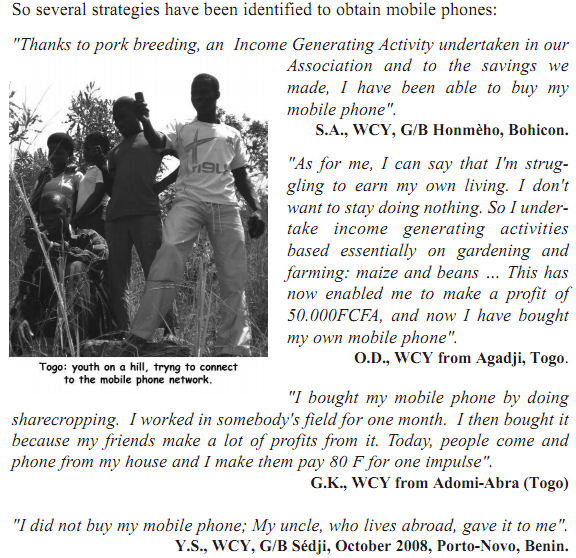
How do youth obtain and use mobiles? (MAEJT study, 2009)

In Egypt, colleagues said Facebook and Twitter groups around specific issues are common among young people in communities. But using ICT specifically for generating income is not. There is inadequate awareness among poor communities on how to make this happen. Although many youth have access to cell phones, ICT is still expensive and non-affordable for many others. Most of the families who have phones in their houses do not have a direct line, which means that they cannot get access to internet through cheap lines. Internet is still very expensive. Getting jobs through the internet is only common among advantaged, well- educated youth, not disadvantaged youth.

In Nairobi, Kenya, iHub and NAiLab have a big pool of developers and there is a lot of action. In rural Kenya, however, access is limited. There is a lot of interest from the youth who have started to catch on though, so colleagues felt it was possible that there could be some type of rural-urban mentoring or connections to help rural youth get on board. In rural Zambia, according to colleagues, sheer poverty means that very few additional resources and capital are available to take on new ideas. There is still very poor mobile phone coverage in some areas, and many young people have already left for urban areas. My colleagues in West Africa did not report seeing any youth developing apps or using Facebook combined with mPayments to generate income. In Kenya, Cameroon, Uganda and some other places, innovation hubs and labs are generating opportunities, but these again seem to be available to secondary- or even more often university-educated youth from urban areas and capital cities or large cities outside the capital.

So, is this bit about apps, mPayments and social media all hype? I’ll explore that a bit more in post 2 of the series. In post 3, I’ll cover the longer term considerations for ICTs and youth economic empowerment and some broader aspects that need to be kept in mind.

Read Full Post »

This is a guest post from Lil Shira, one of the girl delegates who attended the 55th Session of the Commission on the Status of Women in February, 2011. Lil Shira was part of a Plan led Girl Delegation which took part in high level panels, side events and caucuses. This post appears complete in its original format. You can read a post by Fabiola, another of the girl delegates from Cameroon, here.

Lil Shira in the community

My name is Lil Shira, a high school student and a Cameroonian.  I am the second child out of five children in my family, three girls and two boys, and we live in a rural area. Because I am a girl I was selected by my school authority to be part of the journalism club in the school. This paved my way into YETAM (Youth Empowerment through Technology, Arts and Media) project sponsored by Plan Finland since the Journalism club was chosen for this project.

Because I am a girl I had to use the skills I have acquired in YETAM on music, media and ICTs to indentify issues like the problem of early and forced marriage, high rate of school dropout and violence against the girl child. Because I am a girl, I had to mobilize other youth (girls and boys) victims, so as to speak out as a unique voice, to raise awareness to the general public using music, drawings, drama, poems, videos, computers and overhead projector as tools. This led to many local advocacy actions spearheaded by us.

I was also very happy to celebrate the 21st anniversary, in Yaoundé in Cameroon, of the ratification of the Convention on the Rights of the Child within the framework of YETAM project. These created a big impact in my life, the lives of my friends, youth, school, family and my country. All these activities took me to a higher level because I was again selected, this time to be one of the girl delegates to represent Cameroon in the 55th session of the UN Commission on the Status of women (CSW) in New York City.

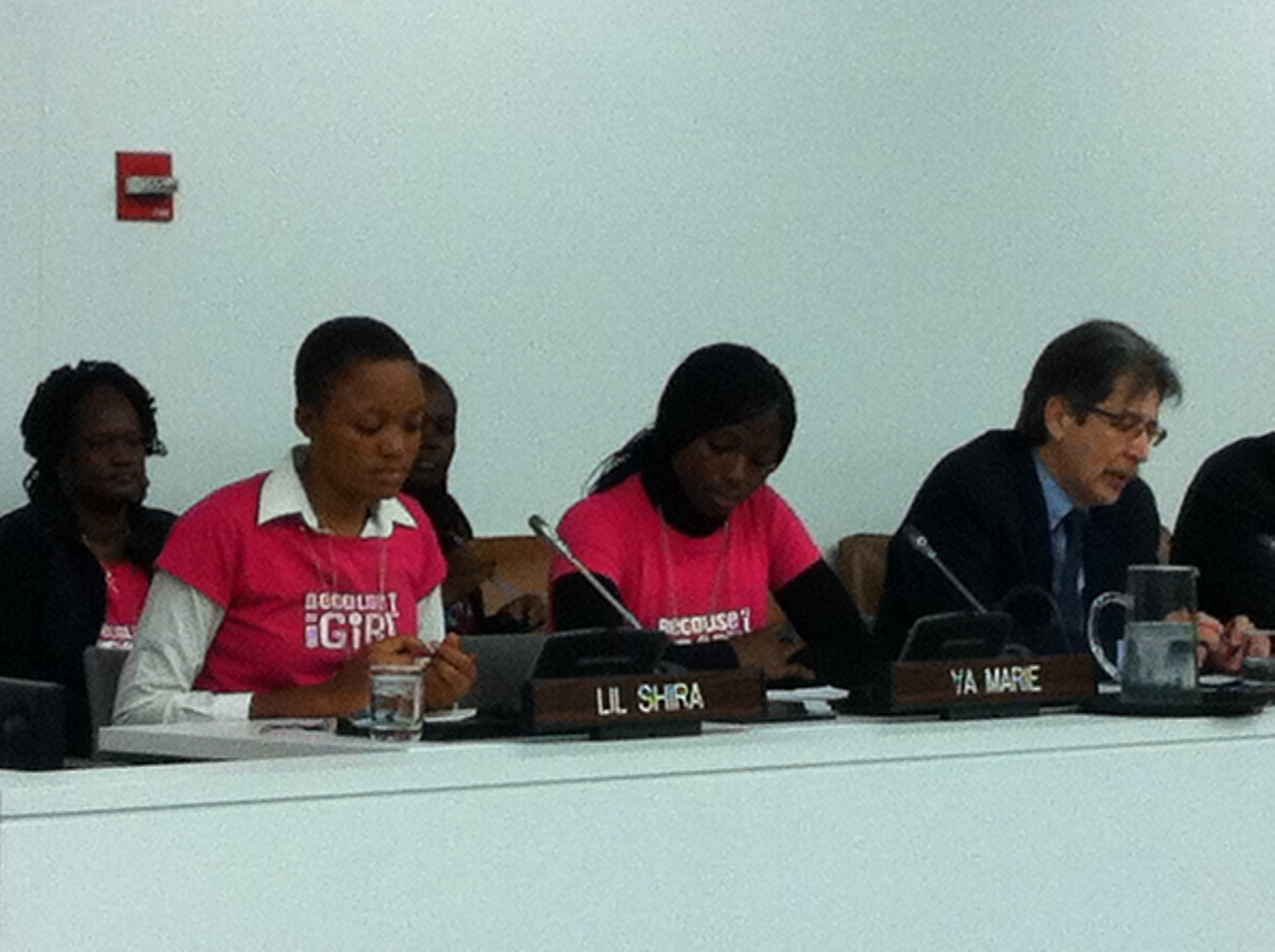
Lil Shira presenting at the CSW.

I was very happy, excited together with my friends and family members and I was planning and preparing on the role I was going to play while in New York. My expectation was to work with other youth from different region and country but did not really expect I was going to talk to Ministers from all the members’ state of the UN. I did my first presentation with the Canadian Minister on a panel about the importance of commemoration days and the importance of setting up an International day for the girls.  Another thing which made me feel so opportune was the panel with UN women Ministers in the UN building.

I was very impressed seeing ministers from over two hundred countries and above listening to me and in effect giving a positive response to the issues I presented. In fact their reaction made me feel at home and so happy. I was equally happy to listen to other girls raise issues like gender based violence and discrimination in their various countries and what they have been doing to combat it.

Coming in contact with girls from Sierra Leone, Finland, United States, Indonesia, Canada and others, not mention to share our ideas, was so wonderful and exciting.  This was a forum for me to dialogue with them to know more about them and some of the issues affecting them in their own country which was contrasting with mine. Though I was nervous during my first presentation, meeting new faces it all passes away like a breeze and I did not have any complex because everything was cute.

Life in the US to me was very enjoyable and meaningful, but I could not stop complaining of the cold and snow. In addition, I tried eating food not familiar to that of my home country. All these contributed greatly to the wonderful experiences I had on the weather condition and the food.  I have learned to adapt to situations wherever I find myself. I hope to continue sharing this experience so that others may learn from it.

This is the time for girls to take up the challenge. I know my rights and have claim them, and no one can take them from me because I am a girl.

Thanks to Plan International, Judith Nkie our Chaperone, Kate Ezzes and Lia de Pauw.

Girls, claim your rights!

Related posts and videos about YETAM and the CSW:

Girls voices in global forums

Girls in rural Cameroon talk about ICTs

55th CSW: Women, girls, education and technology

A catalyst for positive change

On the map: Ndop, Okola and Pitoa


Read Full Post »

As I mentioned in an earlier post, I spent last week at the 55th meeting of the Commission on the Status of Women. The organization where I work supported 12 girls from various countries to attend and speak at different panels and side events during the week.

Why is it important for girls’ voices to be heard at global events like the CSW? Why should they be allowed to sit at tables with adult decision makers? Is this a wise investment when we could have spent that money to bring an adult staff member instead? Well, from a strictly rights-based perspective, it’s because girls have a right to participate in decisions that impact on their own lives.

But there are so many other reasons that girls need to be present at these events. They bring perspective that is otherwise missing. Before women are women, they are girls. It’s well known and well documented that investing in girls’ education and other areas has impacts that go far beyond schooling. At these big meetings, issues that impact girls and women are being addressed and discussed – so there needs to be space for girls and women who feel these issues directly to speak for themselves, especially girls and women who are typically left out of these processes. Girls bring a reality check. They offer ideas and solutions from their own contexts. They bring points home that can otherwise be missed. They are often amazing speakers and have incredible wisdom and insight to share. We can all learn from them. And bringing girls and their opinions and voices to a huge event like the CSW can really have a positive impact both on the event, the event participants, the decisions made there, and on the girls themselves, as they return home with a mandate to live their leadership in their own communities and countries.

Early in the week, I shared a panel with Fabiola, one of the girl delegates from Cameroon, and she truly stole the show. Here’s how:

Fabiola participates in the Youth Empowerment through Technology, Arts and Media (YETAM) project, and was selected by her peers to represent her group and Cameroon at the CSW. More information about Fabiola and Shira, the other girl delegate from Cameroon are in this post: Girls in rural Cameroon talk about ICTs. Shira also spoke at high level panels, as did the girls from Sierra Leone, Indonesia and Finland.

The girls also planned and managed their own side event where they talked about girls and new communications technologies.  In preparation for the event, they brought with them videos from their home countries, and Kirby, one of the girls from the US, edited them together into one piece. The video was shared at a few different events, and the girls were even asked to show it at the general assembly (at the last minute they weren’t allowed to for one reason or another). In any case, you can see it here:

On the last day that the girls were in New York, 3 of them sat on a panel in front of hundreds of high level decision-makers: UN officials, Ministers and government representatives. They talked about the challenges girls face in terms of accessing ICTs and raised the issue of violence against girls and how violence in schools impacts heavily on girls’ education.

My Cameroonian colleague, Judith, who works on the YETAM project with the girls, told me afterwards that she felt unbearably proud, seeing them there in front of the whole room, with everybody hanging on their every word. “I was floating,” she said. “As if my feet were not even touching the ground.” She was proud that Shira didn’t only present the issues that girls are facing in accessing ICTs or in terms of violence or early marriage, but Shira went further and talked about what they are doing in the community and how they are working with ICTs and conducting advocacy with decision makers and traditional councils to resolve the issues, and what impacts they have already had.

Josephine, one of the girls from Sierra Leone, said afterwards: “When I was there, speaking, I felt like I was on top of the world because people were listening to my voice.”

There needs to be more of this!

But if you are still not convinced, my fabulous colleague Keshet Bachan, coordinator of this year’s Because I am a Girl Report and the previous 3 reports, gives a convincing overview here about why girls and why now. Worth watching.

Read Full Post »

The 55th Session of the Commission on the Status of Women is taking place this week in New York City, with the core theme of: “Access and participation of women and girls to education, training, science and technology, including for the promotion of women’s equal access to full employment and decent work.”

Some of the girls that we’re working with in our programs are participating, including Fabiola and Shira from Cameroon. I met them both last July when we worked together on the Youth Empowerment through Technology, Arts and Media (YETAM) project. The YETAM coordinator in Cameroon, Judith Nkie, is also attending the CSW as the girls’ chaperone. She certainly also has a lot to contribute on girls, women and ICTs. Judith once said to me “This project is a catalyst in my body.” Judith is awesome.

Girls from the YETAM project worked to prepare the interviews, film and videos below. Each girl interviews another girl from the community about the role of ICTs in their lives. The videos are worth watching as the questions and the responses of the girls are very insightful.

The interviewee in the first video says ICTs help you find out what is happening around the world. She comments that she found out about what just happened in Egypt (the February revolution) because of ICTs. Some of the other things I found most interesting in the videos are:

  • The girls’ recognition of the importance of information for making good decisions
  • The technologies that girls have most access to (mobile phone!)
  • The first time the girls encountered a mobile phone (a few years ago, at a local call box for one, and via an uncle who brought one back from travels for the other)
  • Why it is hard for girls to use ICTs in the community (lack of ICT devices, cost, parents don’t allow girls to learn about ICTs, at school the computers are few – you will see at least 20 persons per computer – and half are broken, the boys are very powerful and they fight us to occupy the computers, girls’ illiteracy, girls don’t continue in school)
  • How often the girls use ICTs (mobiles are used every day, there is only one place to access Internet in the community)
  • What they like most about ICTs (ICTs help me to know what is happening in other countries, I came to know about what happened 2 days ago in Egypt via communication technologies, many youth have been able to be employed through their mobile phones)
  • What they like the least about mobile phones and Internet (scamming, its easy to tell lies by mobile)
  • How can ICTs be helpful to girls (in my community a girl was able to borrow a phone from a friend to report that she was to be married at the age of 12, and the marriage was stopped)
  • Can ICTs be used to hurt girls? (yes, the girls who can afford their own mobile phones are those who are wealthy, when the poor girls see the wealthy girls with their phones, they go into competition, they can go into prostitution to have money to get a phone; but on the other side, girls are also self-employed through the phones, so the mobile phone hurts but it also helps girls)
  • How the communities use the Internet to sell their products (most people in the community use ICTs to communicate to find buyers for their products)
  • What girls would like parents, community leaders and government to do regarding ICTs (improve our access to ICTs, bring in programs and projects that can support youths to use ICTs and learn to use them better, educate parents to help them to see that girls also should be allowed to access this type of training and technology)
  • What hurts most about this ICT thing (when those who are really privileged and who can use the Internet don’t put their talents and privileges to good use, they go there to scam, to do robbery, not to do good; if these youth have the time and this privilege they should not do harm but they should do good.)
Kirby, one of the girls from the US, edited together portions of the videos above with video footage from the rest of the girls in the group, and they used the video to kick off their ‘Girl Led Side Event’ today. The turnout was great. They will continue throughout the rest of the week getting their ideas and messages across in different events and panels. You can follow their thoughts and impressions on the Plan Youth Tumblr or by following @plan_youth on Twitter. My colleague @KeshetBachan is also blogging from the CSW at the Girls Report blog.

Read Full Post »

The 55th Commission on the Status of Women (CSW) happens in New York City Feb 21-25, 2011. For me, the most exciting thing about the event is that several girls from some of the countries where we are working (Canada, US, Finland, Cameroon, Sierra Leone and Indonesia) will be participating and speaking. This aspect of our work – helping to bring young people’s voices into these large influential forums – (when done properly) can be very effective at bringing a reality check to the ivory tower and helping influence decision makers at the very highest levels.

This year’s CSW is especially interesting to me since I work in the area of ICTs, and the theme of the CSW is:

“Access and participation of women and girls to education, training, science and technology, including for the promotion of women’s equal access to full employment and decent work.”

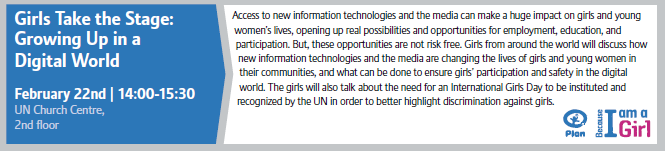
The girls will be presenting at the Girls Take the Stage: Growing up in a Digital World on Feb 22nd:

I’ll be presenting with Fabiola from Cameroon at the Empowering Girls: Education and Technology” session on February 23.

I’ll also talk at a panel-workshop hosted by the Buddhist Tzu Chi Foundation on Tuesday Feb 22, from 10-11.30, called “Breaking the Cycle of Poverty of Women and Girls through Education and Training,” on the 2nd floor room of the CCUN (Church Center of the UN).

Update: Ika one of the girls from Indonesia, will speak at a panel on Commercial Sexual Exploitation and the Girl Child: A Human Rights Approach at the Main Auditorium, Salvation Army Social Justice Center, 221 East 52nd St between 2nd and 3rd Ave, on Feb 24th from 2-3.30 pm.

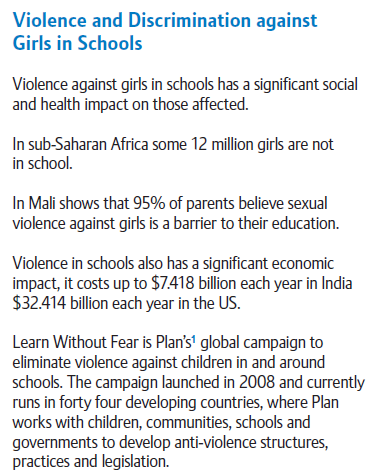
Update: Lil Shira from Cameroon will present on Violence and Discrimination against Girls in School, along with Marta Santos Pais (UN Special Representative to the Secretary General on Violence against Children) and others on Feb 22, from 16-17.30 at UN Church Center, 777 United Nations Plaza, Drew Room, Ground Floor.

Join us at the some of the sessions or come for an evening with the 21+ crowd at #ICT4Drinks Feb 23rd at 6 pm at Me Bar.

We’re trying to interest the girls in tweeting during the CSW on the @plan_youth account and to blog at  http://plan_youth.tumblr.com, so check it out as of this Monday. (We’ll see if they are willing or not!)

You can follow the events on Twitter at the hashtag #CSW55.

Read Full Post »

In the past couple years, social media combined with traditional media has allowed people all over the world to feel they are supporting and participating in very visible revolutions (think Iran, Tunisia, Egypt). There is also a slow and steady revolution happening as more and more communities around the world access the tools to tell their own stories in their own words from their own perspectives.

I came across the Mathare Valley blog this weekend. It’s beautiful, artful and powerful.

Prayer of a slum dweller from the Mathare Valley blog

According to the ‘about’ page, the authors of the blog:  Simon Kokoyo, Ivyonne Tiany and Jeff Mohamed, grew up in or around Mathare. They are now involved in community programs there, including the Map Mathare Initiative.

Jamie Lundine, who works at MapKibera and who’s supporting some community mapping in Mathare, wrote an excellent post about integrating participatory community development work and digital mapping in Mathare, showing how development and tech folks can combine their expertise and work together with communities to strengthen local development processes.

In my last post, I wrote about how communications (and ICTs) should be ‘built in, not bolted on‘ to development initiatives. The Mathare Initiative looks like a good example of that, with community members taking a strong lead.

Read Full Post »

This is a summary of the January 20th Technology Salon. It’s cross-posted from the Technology Salon blog.

Using GPS in Kwale, Kenya

At the Technology Salon on “How to Incorporate ICT into Proposals”, we discussed some of the challenges and solutions for proposal writers when they try to incorporate information and communication technologies into future program design. (Sign up to get info on the next Salon)

Problems with Incorporating ICT into Proposals

Essentially, short time frames for preparing proposals don’t allow for participation and end-user involvement and feedback during development of technology solutions. Donors often want details about a technological solution within a proposal; however, in order to define details, more knowledge of local context, a participatory local communications assessment, end-user testing and more need to be done.

This causes proposal writers to sometimes put unrealistic goals in proposals in order to secure funding or because they don’t have information about the local context and actual feasibility of a proposed technology solution; implementors may find later that they are unable to deliver

The issue is compounded by the real lack of organizational buy-in to allow for testing and iterating, for trial and error, and even failure, in organizations and within projects to learn what works and what can be scaled up through proposals and donor funding.

Solutions to Including ICT in Proposals

Overall, organizations that want to integrate ICTs in their work need to plan ahead, strengthen their staff capacity on the ground, and have a clear understanding of the steps to follow when integrating ICTs into proposals. And rather than detailing an exact tech solution into a proposal, the proposal writer could offer a few options, say that “a solution could be” or “might look something like this”, or be clear when negotiating with the donor that an idea will be tested but may change along the way when participatory work is conducted with end users, and as it is tested and adapted to the local context.

This can help remind donors that digital technology is only one way to innovate, and technology needs to be seen as one tool in the information and communication toolbox. For example, SMS might be just one communication channel among many options that are laid out in a project or program, and the most appropriate channels (which might also include face-to-face, paper, community bulletin board, phone calls, etc.) need to be chosen based on a local situation analysis and end-user input.

For staff, integrating ICTs as smaller aspects in programs can offer opportunities for small trial and error and learning; eg., using SMS as one channel of communication in an education or health program and comparing results with a program that didn’t use SMS could allow an organization to test small ICT efforts and slowly learn, modify and integrate those that work. (See How Plan Kwale has been using ICT in their programs since 2003)

When staff experiment with and experience ICTs in one program, they may be more likely to innovate with technology in another program. As ICTs become more commonly used in communities and by local development practitioners, space for innovations grows because innovation can happen right there, closer to the ground rather than being designed in an office in DC and parachuted into communities in other places.

Experimentation with youth programs is a good place to start with tech innovations because youth tend to be more literate (if they are school going youth) and they pick up technology skills easily in many cases. Adults need not be left out, but the learning methodology may need to be different. Engaging the community in detailing potential protection and privacy risks in data collection is key to finding ways to minimize risks. (See 8 Elements for a Positively Brilliant ICT4D Workshop)

The Plan Example

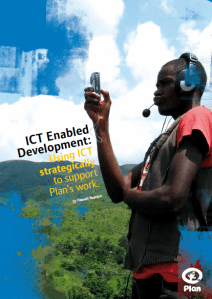
Plan Finland with support from Plan USA commissioned the ICT Enabled Development guide (PDF) to better understand and document the ICT4D context in several of the countries where Plan is working in Africa. Country offices wanted to strengthen their capacities to strategically incorporate ICTs into their work and to ensure that any fund-raising efforts for ICTs were stemming from real needs and interest from the ground. Plan offices were also in the process of updating their long-term strategic plans and wanted to think through how and where they could incorporate ICTs in their work internally and with communities.

The report process included 2-day workshops with staff in 5 countries, based on a set of ICT distance learning materials and discussion questions. The idea was to combine background and situational research, learning about ICT4D, and further input from Country Office colleagues into this process to come up with a realistic guide on how and where Plan could begin integrating ICTs into its work directly, strategically and indirectly (See 3 ways to integrate ICTs into development work).

The report team worked by Skype and email with a point person in each office who planned and carried out the workshop. The report team also developed the multi-media training pack with materials that the point persons used to support the workshop, and compiled the ICT-Enabled Development guide based on the experience.

From the report and this experience, Plan produced a 10-step process for integrating ICTs into development initiatives:

  1. Context Analysis: what is happening with ICT (for development) in the country or region?
  2. Defining the need: what problems can ICT help overcome? what opportunities can it create?
  3. Choosing a strategy: what kind of ICT4D is needed? direct? internal? strategic?
  4. Undertaking a participatory communications assessment: who will benefit from this use of ICT and how?
  5. Choosing the technology: what ICTs/applications are available to meet this need or goal?
  6. Adjusting the content: can people understand and use the information provided for and by the ICTs?
  7. Building and using capacity: what kind of support will people need to use and benefit from the ICT, and to innovate around it?
  8. Monitoring progress: how do you know if the ICT is helping meet the development goal or need?
  9. Keeping it going: how can you manage risks and keep up with changes?
  10. Learning from each other: what has been done before, and what have you learned that others could use

See the 3-page “ICT-Enabled Development Checklist” for more detail on how to go about integrating ICTs into a development proposal and be sure to download the ICT Enabled Development guide (PDF).

Read Full Post »

« Newer Posts - Older Posts »