Last week some 40 people from more than 20 different organizations with national and global humanitarian and relief missions attended a Google Partnership Exploration Workshop in Washington, DC, to share information in an interactive setting and explore how the organizations and Google geo & data visualization technologies can further each others’ missions.
Lucky me – I got to go on behalf of Plan. Much of the meeting centered on how Google’s tools could help in disasters and emergencies, and what non-profits would like to be able to do with those tools, and how Google could help.
The meeting opened up with a representative of FEMA talking about the generally slow and government centered response of FEMA, and how that needed to turn into a quick, user generated information network that could provide real information in real time so that FEMA could offer a real, people centered response. I loved hearing someone from government saying things like “we need to look at the public as a resource, not a liability.” The conclusion was that in a disaster/emergency you just need enough information to help you make a better decision. The public is one of the best sources for that information, but government has tended to ignore it because it’s not “official.” Consider: a 911 caller is not a certified caller with a background check and training on how to report, but that’s the background of our 911 emergency system. Why can’t it be the same in a disaster?
We also heard about the World Bank’s ECAPRA project for disaster preparedness in Central America. This project looks at probabilistic risk assessment, using geo-information to predict and assess where damage is likely. The main points from the WB colleagues were that for SDI (Spatial Data Infrastructure) we need policies, requirements, and mandates, yes, but this is not sufficient – top down is not enough. We also need software that enables a bottom up approach, aligned incentives that can drive us to open source agenda. But not just open source code software, we’re talking mass collaboration – and that would change everything. So then the challenge is how we help civil societies and govts to share and deliver data that enables decision making? How do we support data collection from the top down and from the bottom up? The WB is working with developers on some collaborative data collection mobile applications that allow people to easily collect information. In this system, different institutes still own the data but others can update and add to it. WB hopes to embed this within Central American national disaster planning systems, and to train and support the national systems to use these tools. They will be free to use the elements that most link with the local situations in each country. Each country is developing these open source applications themselves, and can choose the tools that work best for them.
Google stepped in then to share some Google Visualizations — Google Fusion Tables, Visualization API, Chart API and Motion Charts (Gapminder). With these applications, different sources can share data, or share some data and keep other data private. You can compare data from different sources. For example, there is a chart currently residing in Google Fusion Tables that pulls GDP data from the CIA Fact Book, the World Bank and the IMF, and allows you to compare data across countries from different sources. You can then use that data to create your own data visualizations, including maps, tables, charts, and the fabulous Gap Minder/motion visualization charts (first made popular at TED by Hans Rosling). These can all be easily transferred to your own webpage. If you have public data that deserves to be treated separately you can become a Google trusted source. (Click on the “information for publishers” link to see how to get your data made public) For a quick tutorial on how to make your own cool Gap Minder chart check out this link. *Note Gapminder is not owned by Google. Gapminder is a foundation of its own, totally independent from Google. Google bought the software [Trendalyzer] to improve the technology further.
Next up was the American Red Cross who shared some of the challenges that they face and how they use geo-spatial and information mapping to overcome them. Red Cross has a whole mobile data gathering system set up and works via volunteers during disasters to collect information. They also have over 30 years of disaster data that they can use to analyze trends. The ARC wants to do more with mapping and visualizations so that they can see what is happening right away, using maps, charts and analyzing trends. What does the ARC want to see from Google? A disaster dashboard – eg using Google Wave? Inventory tracking and mapping capability. Data mining and research capabilities such as with Fusion tables. They want people to be able to go to the ARC and see not what the Red Cross is, but what the Red Cross does. To use the site for up to date information that will help people manage during disasters and emergencies.
Wow, and this was all before lunch!
—————
Related posts:
I saw the future of geovisualization… after lunch
Is this map better than that map?
Ushahidi in Haiti: what’s needed now
Archive for the ‘mapping’ Category
I saw the future of geo-visualization…. before lunch
Posted in disaster and emergencies, ICT4D, ICTs, mobile and technology, mapping, tagged api, geo, Google, humanitarian aid and development, maps, non, organization, profit, tools, visualization, workshop on October 19, 2009| Leave a Comment »
ICT4D Ideas from Plan Cameroon
Posted in Cameroon, development, ICT4D, ICTs, mobile and technology, m4D, mapping, tagged Cameroon, data, development, gathering, ICT, ICTs, mobile, mobile and technology, Plan on July 28, 2009| 1 Comment »
I had a chance to meet with Plan Cameroon’s Program Technical Team today (including those that look at Monitoring and Evaluation, Health, Education, Sponsorship, Child Protection, Water and Sanitation, Gender and the overall Program Support Manager) to give a quick brief on the ICT4D research and training that Plan Finland is supporting with Plan offices in 8 countries in Africa (Mali, Senegal, Cameroon, Ghana, Togo, Mozambique, Kenya and Uganda).
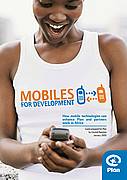
We are working with Hannah Beardon, who wrote Plan’s Mobiles for Development guide (available in both English and French) and building on that towards some more focused and concrete ideas for ICT use in these 8 countries. We’ll share the research with staff during 2-day workshops to brainstorm and gather ideas on information and communications needs, as well as available tools that could be used or adapted to local situations.
The 2-day workshops are planned for Aug and Sept. Hannah, Mika (Plan Finland) and I are developing the methodology and will make a training DVD to send ahead of time to each country (apparently complete with our selves doing presentations!) since we don’t have funding to do face-to-face training. We’ll have a staff person in each country as the main facilitator, and 10-12 key staff, from management to frontline, will attend. Mika or I will beam in by skype to support if needed. We’ll use the Frontline SMS demo video that Mika and crew did also, (see my earlier post about this from a few months ago), show how Nokia Data Gathering Software works, share the Common Craft Social Media videos, among other things. Hannah’s methodology will also come in for thinking about how ICTs could enhance existing efforts.
The idea is to both learn about new tools as well as look at current programs and see if there are ways to use ICTs to improve impact, and how to begin tailoring them to the programs and local settings. We’re also doing research on government policies and how Plan’s work links there. I hope that we can also look at partnering with local developers and ICT4D innovators in each country….
The idea of ICT4D was a bit new to some of the Plan Cameroon staff and not at all new to others. One interesting idea they shared was using SMS in anti-malaria programs to periodically remind people to retreat their bednets. There was some concern about literacy rates if one relies on SMS, and interest in using voice response, but given the number of languages in Cameroon, voice could also be a bit of a challenge. I’ll have to try to find out if/how that’s overcome in other places. Another concern was ‘scamming’ and how to avoid that happening. But it seemed that the issue of scamming is not something that Plan alone would face, but something in general that is faced with mobile phones.
The program support manager was really keen on using mobiles for program monitoring as that is something that can always improve and be more efficient with ICT, he said, and wants to test some ideas. The ICT manager also said he wanted to write something up. The sponsorship manager suggested trying out some data collection or quicker communications tools for linking with community volunteers. And as mentioned earlier, child media and child protection are areas that can be greatly enhanced and supported via ICTs (help lines, SMS incident reporting, social media and mobile reporting).
After the 2-day workshop, we should have something really nice to go forward with.
Chickens and Eggs and ICTs
Posted in ICT4D, ICTs, mobile and technology, m4D, mapping, tagged Africa, how, ICT, ICTs, media, mobile and technology, Plan, program, research, start on June 1, 2009| 1 Comment »
We’ve been thinking and discussing the best way to follow up on the Social Media for Social Change workshop that we had in December in Kenya. Ideas have been going back and forth about the best way to really find out what the Information and Communication needs are in the countries where we are working, and then how to support the different offices and staff to find the best and most appropriate Technology solutions.
We ended up with a chicken and egg situation in a way…. if ICT4D is not your top priority, and you don’t spend your life trying to figure out what is happening with ICT4D, you may not know what all is out there. (Ha, even if you do spend your life doing it, you don’t know what all is out there). So it can be hard to imagine tools and solutions if you’ve not seen them in action, used them yourself, or heard about how others are using them. At the same time, each local situation is different, so one size doesn’t fit all, so in order to find a tool or a solution, the situation analysis must come from those who would use that ‘solution.’ So what do you do first — learn about different tools and potential solutions so that the lightbulb goes off on ways to incorporate/adapt the existing tools to your needs, or discuss your ‘needs’ and design something that works — sometimes re-inventing the wheel. We thought that the best way we could manage the situation was to try to do both at once.
What we want to do is to activate our knowledge and study more about the concrete information and communications needs at the community level as well as in Plan’s program work that could be supported by ICTs. So we are hoping that we can produce a document which offers specific recommendations about utilizing ICTs in our work in the participating countries in Africa. And we then hope that we can identify areas to be developed further including successful initiatives currently being implemented by Plan itself and also those areas where we can build on existing synergy with governmental strategies. We are also hoping to better understand the capacity building needs among Plan and its partners.
It should be interesting research/training and hopefully will take us one step further towards incorporating appropriate technology to improve our communications and management of information so that we can have greater impact in our existing programs or even develop new programs that we didn’t think were possible before….
ooof SM4SC and what next!
Posted in ICT4D, ICTs, mobile and technology, Kenya, m4D, mapping, social media, tagged ICT4D, m4d, mapping, social change, social media on December 14, 2008| 2 Comments »
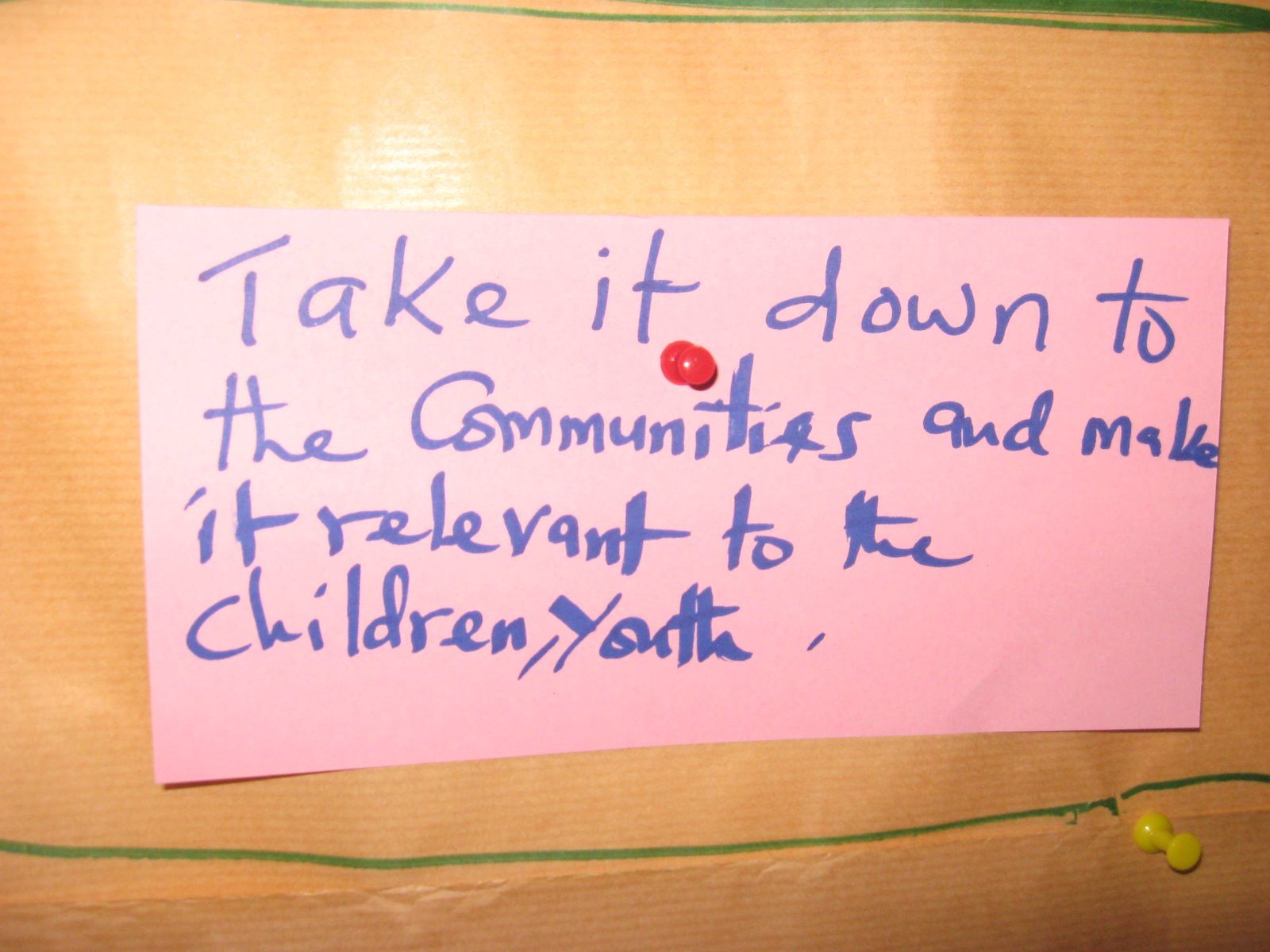
 Wow what a week. My head is spinning from all the discussions and possibilities from our workshop in Kenya. So it’s 3 a.m. and I’m back home, and here I am again at the computer. My New Year’s resolution is to work less, but it’s not New Year’s yet… and I’m still on Kenya time, so fell asleep at 6 and woke up at 1.30. So why not grab my coffee and get going. Photo: one of the ‘take aways’ on the last day.
 We talked about how organizations need to modernize and open up new ways to engage the public in their work based on concepts of social media. We used SMS to send messages and talked through specific ways we could use Frontline SMS (http://www.frontlinesms.org/) to make it easier for children to get birth certificates and access their rights at citizens. Imagine instead of having to trek miles to the district capital if mobiles could help communicate and ease that process. We looked at specific existing projects and thought about how to use SMS and other social media to improve them.
  We presented and discussed the YETAM project, and heard things like “every country should do this” and got great feedback for making the project more relevant and to increase its impact from the local level upwards. I had a lot of time to brainstorm with Mimi (the link between YETAM and Nokia via Plan Finland) for once about the project and to start working out the action plan for next year. Photo: Me and Mimi
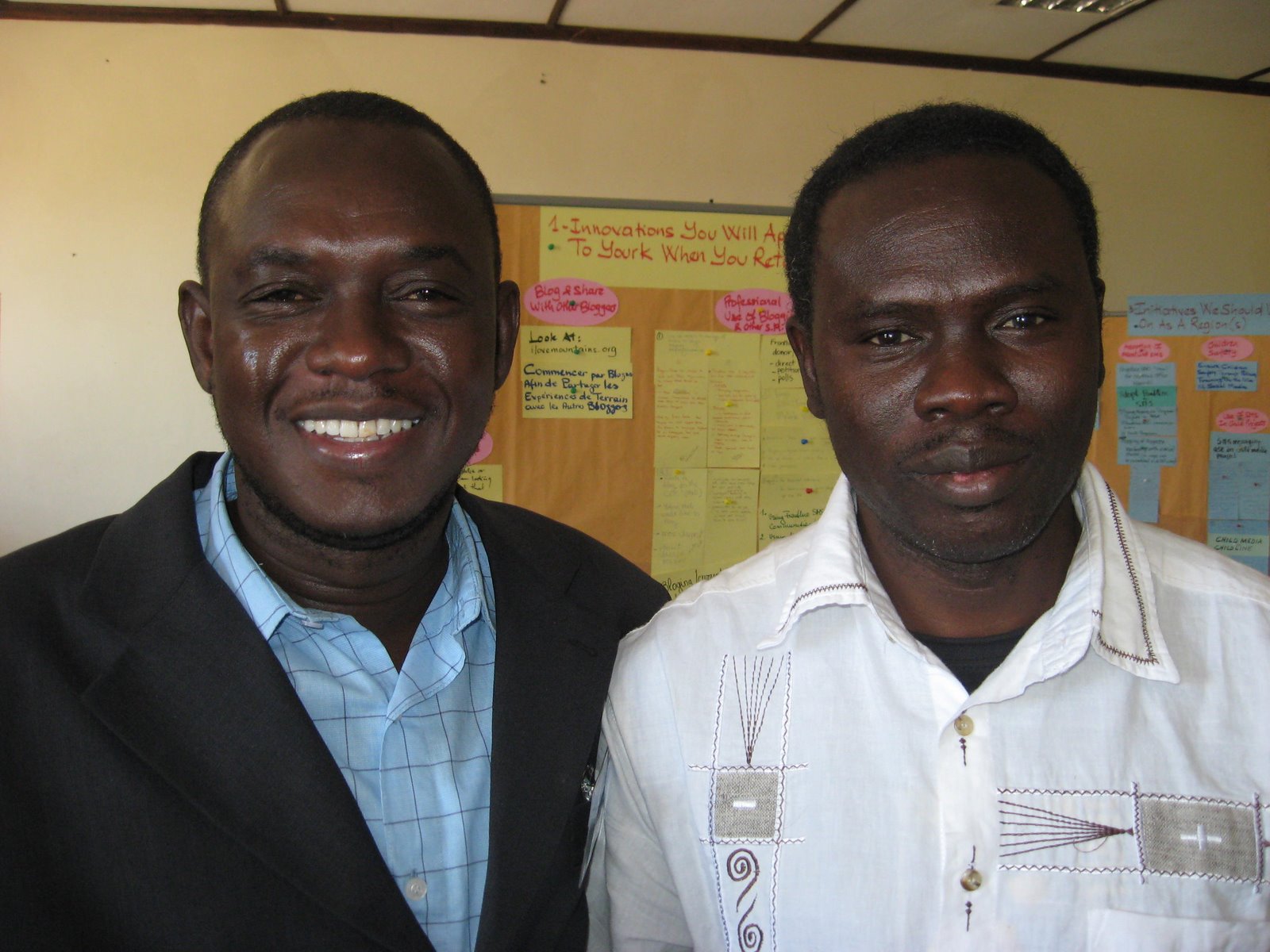 We heard so many opinions from everyone, and the French translation and bi-lingual nature of the workshop meant that we heard from everyone there, whereas often those who speak French keep quiet since English is the ‘official working language’. Photo: PapaSidy and Bedo.
 Now Mika and I will do the report. We asked people to state a few concrete ways they will follow up on the workshop and then our job along with the different offices involved is to support their work and help address any challenges or obstacles that come up. Photo: the fearless Mika!
Search this blog
Affiliations & Projects
I got podcasted!
Publications
-
Latest posts
- A discussion on power and structural bias in tech journalism
- Exploring digital mental health and psycho-social support for displaced and stateless adolescents
- Nine considerations for designing safe digital solutions for sensitive services
- Taking Stock: MERL Tech State of the Field 2014-2019
- How can we save ourselves from deepfakes?
-
Disclaimer
Archives
- April 2023
- March 2023
- July 2020
- November 2019
- October 2019
- September 2019
- June 2019
- April 2019
- March 2019
- February 2018
- December 2017
- November 2017
- August 2017
- April 2017
- March 2017
- February 2017
- November 2016
- October 2016
- May 2016
- April 2016
- March 2016
- January 2016
- December 2015
- November 2015
- October 2015
- September 2015
- July 2015
- June 2015
- April 2015
- March 2015
- January 2015
- December 2014
- November 2014
- October 2014
- September 2014
- August 2014
- July 2014
- June 2014
- May 2014
- April 2014
- March 2014
- February 2014
- December 2013
- November 2013
- October 2013
- September 2013
- August 2013
- July 2013
- June 2013
- May 2013
- April 2013
- March 2013
- February 2013
- January 2013
- December 2012
- November 2012
- October 2012
- September 2012
- August 2012
- July 2012
- June 2012
- May 2012
- April 2012
- March 2012
- February 2012
- January 2012
- December 2011
- November 2011
- October 2011
- September 2011
- August 2011
- July 2011
- June 2011
- May 2011
- April 2011
- March 2011
- February 2011
- January 2011
- December 2010
- November 2010
- October 2010
- September 2010
- August 2010
- July 2010
- June 2010
- May 2010
- April 2010
- March 2010
- February 2010
- January 2010
- December 2009
- November 2009
- October 2009
- September 2009
- August 2009
- July 2009
- June 2009
- May 2009
- April 2009
- February 2009
- January 2009
- December 2008
- November 2008
- October 2008
- September 2008
- August 2008
- July 2008
- June 2008
who’s visiting?
Contact info

 Wait... What?