Feeds:
Posts
Comments

Archive for the ‘politics’ Category

In her post ‘Prostitutes of God:’ Film Mocks, Belittles Sex Workers, Bebe Loff, explains that:

‘Last week,  four episodes of a film entitled Prostitutes of God were posted on VBS.TV, which is owned by Vice Magazine. Prostitutes of God producer Sarah Harris, spent time with members of Veshya Anyay Mukti Parishad (meaning ‘Prostitutes’ Freedom from Injustice’) or “VAMP,” [who] let her into their lives, their families and their workplace.  The result?  Films that are inaccurate and misrepresentative, and insulting to the people who agreed to participate and to the Hindu culture.’

The ‘Prostitutes of God’ film is part of the Vice Guide to Travel where ‘correspondents from VBS and Vice magazine are dispatched around the world to visit the planet’s most dangerous and weird destinations.’

This afternoon I didn’t have 30 minutes to watch the film that was being criticized in the post above. I did have 3 and a half minutes to watch the video response (below) from some of the sex workers and their family members who were part of the documentary.

Their reaction is one of anger and feelings of betrayal. They denounce the filmmaker (Sarah Harris) for laughing at them, making fun of them, disrespecting them, misinterpreting their stories and making public judgment calls on their religious practices.

They say ‘… Your analysis is wrong and we do not agree with it. Who is Sarah Harris? What is the research that informs her story?’‘ They ask ‘Who gave you the right to laugh?‘ They wonder ‘If I had come to your town and insulted your gods would you have liked it?

Tonight I watched the 30 minute film. To be honest, it doesn’t strike me as any worse than a lot of other stories told about people from developing communities or exotic or marginalized groups. We see these kinds of stories all the time, where people are held up to view with sensationalism, superiority and for purposeful shock value.

What is interesting about this case is that the community saw it and reacted publicly. It made me wonder, what is the back story? What steps were taken by the filmmaker to secure informed consent? What were members of the different communities expecting the film to be about? What about the local organization, what were they expecting? Where was the communication breakdown and what steps were taken to try to avoid it? What ownership of the content of the film and the storyline did the community members have? Did they expect to be paid? Were they put at high risk or otherwise threatened when the filmmaker released her film? Did the filmmaker think about the ramifications that her film would carry for the communities where she had filmed? What was the filmmaker’s purpose for telling this story?

I think we are going to see more and more of this type of scenario. I hope it will force media practices and ethics to be updated, more respectful and more legal when filming marginalized or disenfranchised groups in ‘developing countries’.

A third film about the Devadasi

I know of a third film about the Devadasi. I saw this one several years ago, and it was made by a group of Indian child journalists as part of a child media project. In that case, the children successfully used the film at the community level to press for compliance with established laws against the Devadasi practice and to discuss culturally appropriate alternatives.

I’m a big fan of local activists using media tools to push for social change on their own terms.

Here’s Insight Share’s great rights-based approach to participatory video guidebook.

Related posts on Wait… What

Good Job

Child protection, the media and youth media programs

Read Full Post »

I read Malcolm Gladwell’s piece on new media digital activism in the New Yorker and it made some sense to me at first. I’m as skeptical as the next person, and very tired of the ‘slacktivist’ social media campaigns that I come across in the US. However, I think it’s important to note that the problem isn’t in the tools being used by activists/’slacktivists’. The issue goes deeper, and it’s more about context and culture.

A few things that I’m mulling over are:

1) In a repressive environment, using social media tools to organize is just as dangerous and subversive as using ‘traditional’ ways of organizing. Organizers, activists and sympathizers use a combination of tools to participate and to reach specific goals. It doesn’t matter if the tools are digital or not. What matters is whether or not they are effective in the context where they are being employed. Lina over at Context, Culture and Collaboration has a good post on the use of tools to fit the goals.

2) The level of commitment to a cause is in direct proportion to the level of personal risk. i.e., the more committed you are, the higher the personal risk you are willing to take; the higher the personal risk, the more committed activists likely become. In the US context, unless perhaps you are gay or Muslim [update Aug 2014 — “or Black”], there is not a lot of personal risk in uniting or fighting for a cause, and most of the causes that are social media driven do not create any major personal risk to those who join them. I find a lot of US campaigns to be meaningless or misdirected compared to activism in many other places. US-based ‘activism’ campaigns are often more about cause marketing or branding an organization or collecting emails than they are about changing a serious social issue at home or abroad. This is not the fault of the social media tools or of ‘digital activism’, it’s a reflection of US culture, our current values, the organizers behind the causes, and the sociopolitical moment we are living in.

3) Some of the digital media evangelists in the US and in the US media don’t understand enough about grassroots organizing or the sociopolitical contexts in other places to see beneath the social media tools to the networks of engaged, involved people and the broader movements happening off-line. They see social media use and think it’s the core of a movement when in fact it is probably just the only piece of it that they have access to at the global level; it’s the shark’s fin. This comment from Esra’a really got me thinking about that.

When a t-shirt can get you in trouble

When I lived in El Salvador in the early 1990’s, (eg., before social media) political oppression was heavy. During the war, you could get arrested, tortured, or disappeared for something as simple as wearing a political t-shirt; criticizing someone from the ruling political party (ARENA); owning a cassette of Mercedes Sosa, Los Guaraguao, or Silvio Rodriguez; reading a book of poetry by Roque Dalton; or merely gathering in a group or having a meeting. That didn’t stop people from organizing though, both in hierarchical ways and loose networked ways.

In 1994, El Salvador held its first elections since the signing of the Peace Accords. It was the first time that the guerrilla group, the Frente Farabundo Martí para la Liberación Nacional (FMLN) was allowed to participate as a political party. It was a hopeful yet dangerous time. Only the bravest came out publicly to show their support for the FMLN, the past 14 years of repression still fresh in everyone’s minds. There were political assassinations of opposition candidates taking place, fears of widespread fraud, concerns from voters that their votes would not really be secret. ARENA had used every media channel it owned (all of them) to warn foreigners that any ‘interference’ in local political issues would get them deported.

I was working with an international organization that was hosting a group of Ecumenical Elections Observers.  One day, as part of the orientation program, I took a delegation of the observers to the office of the FMLN to meet with the head of the party, Facundo Guardado. (We had met with leaders from ARENA earlier in the week.) Facundo gave us all FLMN t-shirts.

That afternoon, coming home from work, I was walking down the alley way a couple blocks from my house, the t-shirt in my bag. I heard a couple of motorcycles come up behind me and the familiar ‘ch ch, sssss ssssss, mamacita‘. I was alone in the alleyway, so I quickened my pace to reach the little open area where the Barrio women would sit for a minute to catch their breath when coming back from the market with their heavy baskets and the older men would gather to play checkers under the trees in the afternoons. Before I could get there, one of the men pulled his motorcycle up in front of me and the other came up on my left side, cornering me. I saw that these were not just men harassing me, they were in military police uniforms and I got nervous.

They asked for my passport.

‘I don’t have my passport with me. I don’t carry it because I’m afraid it will get stolen.’

They didn’t like that answer. ‘Do you think we can go to your country and walk around without papers? No, we can’t, we’d be deported. Why do you think you can do that here?’

‘Let me look for my driver’s license. I’m sure it must be in my bag. Is that OK?’ They continued to scold me angrily.

I started digging around in my bag to try to find my local driver’s license but failed because my bag was so full of stuff. I was afraid that they were going to see the t-shirt which would lead to a lot of questions and make it look like I was getting involved in internal politics.

My neighbors started popping their heads out of their doorways and windows and watching as the military police questioned the gringa who lived in the Barrio. Just as I was going to be observing and standing witness to their upcoming elections, so they were observing and standing witness for me while I was being questioned by the authorities. Cautiously, one of them said in a respectful voice loud enough to reach the policemen ‘Ella es de aqui.’ She’s from here. Another one agreed. ‘Sí, ella vive aquí.’ The police ignored them and continued to question me. More and more people began standing around to watch from a distance.

My heart was beating loud and fast. The afternoon sun was hot. I started carefully removing things from my bag and placing them on the dirt road… the soda I was bringing home for my husband… my notebook… my sweater… hoping to make some space in my bag to find the driver’s license without the t-shirt coming out. I had no idea what was going to happen if I didn’t find my license. What if they took my bag and searched it and found that t-shirt? Would they seriously arrest me? Would I be deported?

After what seemed like hours, I saw my mother-in-law running towards us, carrying my son. Someone had alerted her that I was in trouble. Her eyes flashed like they did when she was worried, upset or angry. She was on fire. ‘Buenas tardes, oficiales. What’s the problem? What’s happening? Uh hunh, she is my daughter. My daughter-in-law. This is her son. She lives here with us, here in the Barrio.’

‘Sí, es verdad,’ it’s true, several of the neighbors called out. While they were speaking, I finally found my license. It had gotten caught up between the pages of my notebook. I showed the police and they lectured us all about the importance of carrying papers, got on their motorcycles and rode off. For a few days after the incident I felt nervous that they would follow me in the alleyway again, or find me someplace else and continue their questions, out of sight of the neighbors and far from my brave mother-in-law.

So what does that have to do with activism and ‘slacktivism’?

The simplest of things can get you in serious trouble in a repressive environment. Not carrying your identification. Listening to revolutionary songs. Discussing politics. Reading a book by someone who critiques the government. Wearing a political t-shirt. Standing on a street corner to watch a protest.

Would any of that be seen as subversive in the US? As deeply significant and meaningful? No. Most of us don’t have to carry identification. Teenagers listen to Bob Marley without even knowing what the songs are about. We critique politics openly all the time. Our kids read Marx in school. We make fun of our political leaders on TV and billboards and t-shirts. We join political campaigns and publicly demonstrate who we are voting for. These activities are all very low risk at this time in the US cultural and sociopolitical environment. Engaging in activism in the US, wearing t-shirts, joining on-line groups and the like is often seen as slacktivism because these are very easy things to do, don’t require a lot of effort or personal risk. We are not doing a great job of engaging people in real debates in the US, and I worry about some of the changes happening now in the US (think: Tea Party), but it’s hard to deny that we do enjoy an amount of freedom of expression that’s difficult to come by in many other places.

In 1994 in El Salvador, people were not using social media to organize. But if they had been, it would have been every bit as risky as wearing or owning an FMLN t-shirt and just as meaningful. Simply identifying with a cause was subversive, much more so if you actually spoke out or identified yourself publicly. Wearing a political t-shirt in that type of environment is not ‘slacktivism’. If social media had been around then, engaging in the movement digitally would have been dangerous and probably very effective considering both the hierarchical structure of the armed opposition and the networked structure of sympathizers across the country, the region, and the world. Activism is not about the tools, it’s about the movement, the cause, the social change, the level of commitment and the potential danger and risk that people place themselves in when publicly identifying with a cause and fighting for what they believe in. That is what gets people heart and soul into a movement, regardless of the tools that they are using.

I think there is a risk of a US-centric critique of all digital activism as ‘slacktivism’, when that is not always the case. Should we call out the US media and those people who are hyping up social media as the key factor in social and opposition movements such as recent ones in Iran or Moldova? Yes. Should we in the US take a closer look at and question what’s behind our shallowness and cultural propensity towards ‘slacktivism?’ Definitely.

But we should also be careful about projecting our weaknesses and cultural frameworks on all uses of social media tools in activism.

—–

Related posts on Wait… What?

11 concerns about ICTs and ‘social media for social good’

On Glenn Beck and ‘rooting out liberation theology’

It’s not a black and white photo

Read Full Post »
Coming from the viewpoint that accountability and transparency, citizen engagement and public debate are critical for good development, I posted yesterday on 5 ways that ICTs can support the MDGs. I got to thinking I would be remiss not to also post something on ways that ICTs (information and communication technologies) and poor or questionable use of ICTs and social media can hinder development.

It’s not really the fault of the technology. ICTs are tools, and the real issues lie behind the tools — they lie with people who create, market and use the tools. People cannot be separated from cultures and societies and power and money and politics. And those are the things that tend to hinder development, not really the ICTs themselves. However the combination of human tendencies and the possibilities ICTs and social media offer can can sometimes lead us down a shaky path to development or actually cause harm to the people that we are working with.

When do I start getting nervous about ICTs and social media for social good?

1) When the hype wins out over the real benefits of the technology. Sometimes the very idea of a cool and innovative technology wins out over an actual and realistic analysis of its impact and success. Here I pose the cases of the so-called Iran Twitter Revolution and One Laptop per Child (and I’ll throw in Play Pumps for good measure, though it’s not an ICT project, it’s an acknowledged hype and failure case). There are certainly other excellent examples. So many examples in fact that there are events called Fail Faires being organized to discuss these failures openly and learn how to avoid them in the future.

2) When it’s about the technology, not the information and communications needs.  When you hear someone say “We want to do an mHealth project” or “We need to have a Facebook page” or “We have a donor who wants to give us a bunch of mobile phones–do you know of something we can do with them?” you can be pretty sure that you have things backwards and are going to run into trouble down the road, wasting resources and energy on programs that are resting on weak foundations. Again, we can cite the One Laptop per Child (OLPC) initiative, where you have a tool, but the context for using it isn’t there (connectivity, power, teacher training and content). There is debate whether OLPC was a total failure or whether it paved the way for netbooks, cheap computers and other technologies that we use today. I’ll still say that the grand plan of OLPC:  a low-cost laptop for every child leading to development advances; had issues from the start because it was technology led.

3) When technology is designed from afar and parachuted in. If you don’t regularly involve people who will use your new technology, in the context where you’re planning for it to be used, you’re probably going to find yourself in a bind. True for ICTs and for a lot of other types of innovations out there. There’s a great conversation on Humanitarian Design vs. Design Imperialism that says it all. ICTs are no different. Designing information and communication systems in one place and imposing them on people in another place can hinder their uptake and/or waste time and money that could be spent in other ways that would better contribute to achieving development goals.

4) When the technology is part of a larger hidden agenda. I came across two very thought-provoking posts this week: one on the US Government’s Internet Freedom agenda and another from youth activists in the Middle East and North Africa region who criticize foundations and other donors for censoring their work when it doesn’t comply with US foreign policy messages. Clearly there are hidden political agendas at work which can derail the use of ICTs for human rights work and build mistrust instead of democracy. Another example of a potential hidden agenda is donation of proprietary hardware and software by large technology companies to NGOs and NGO consortia in order to lock in business (for example mHealth or eHealth) and prevent free and open source tools from being used, and which end up being costly to maintain, upgrade and license in the long-term.

5) When tech innovations put people and lives at risk. I’d encourage you to read this story about Haystack, a software hyped as a way to circumvent government censorship of social media tools that activists use to organize. After the US government fast-tracked it for use in Iran, huge security holes were found that could put activists in great danger. In our desire to see things as cool, cutting edge, and perhaps to be seen as cool and cutting edge ourselves, those of us suggesting and promoting ICTs for reporting human rights abuses or in other sensitive areas of work can cause more harm than we might imagine. It’s dangerous to push new technologies that haven’t been properly piloted and evaluated. It’s very easy to get caught up in coolness and forget the nuts and bolts and the time it takes to develop and test something new.

6) When technologists and humanitarians work in silos. A clear example of this might be the Crisis Camps that sprung up immediately after the Haiti Earthquakes in 2010. The outpouring of good will was phenomenal, and there were some positive results. The tech community got together to see how to help, which is a good thing. However the communication between the tech community and those working on the ground was not always conducive to developing tech solutions that were actually helpful. Here is an interesting overview by Ethan Zuckerman of some of the challenges the Crisis Commons faced. I remember attending a Crisis Camp and feeling confused about why one guy was building an iPhone application for local communities to gather data. Cool application for sure, but from what people I knew on the ground were saying, most people in local communities in Haiti don’t have iPhones. With better coordination among the sectors, people could put their talents and expertise to real use rather than busy work that makes them feel good.

7) When short attention spans give rise to vigilante development interventions. Because most of us in the West no longer have a full attention span (self included here), we want bite sized bits of information. But the reality of development is complicated, complex and deep. Social media has been heralded as a way to engage donors, supporters and youth; as a way to get people to help and to care. However the story being told has not gotten any deeper or more realistic in most cases than the 30 second television commercials or LiveAid concerts that shaped perceptions of the developing world 25 years ago. The myth of the simple story and simple solution propagates perhaps even further because of how quickly the message spreads. This gives rise to public perception that aid organizations are just giant bureaucracies (kind of true) and that a simple person with a simple idea could just go in and fix things without so much hullabaloo (not the case most of the time). The quick fix culture, supported and enhanced by social media, can be detrimental to the public’s patience with development, giving rise to apathy or what I might call vigilante development interventions — whereby people in the West (cough, cough, Sean Penn) parachute into a developing country or disaster scene to take development into their own hands because they can’t understand why it’s not happening as fast as the media tells them it should.

8 ) When DIY disregards proven practice. In line with the above, there are serious concerns in the aid and development community about the ‘amateurization’ of humanitarian and development work. The Internet allows people to link and communicate globally very easily. Anyone can throw up a website or a Facebook page and start a non-profit that way, regardless of their understanding of the local dynamics or good development practices built through years of experience in this line of work. Many see criticism from development workers as a form of elitism rather than a call for caution when messing around in other people’s lives or trying to do work that you may not be prepared for or have enough understanding about. The greater awareness and desire to use ‘social media for social good’ may be a positive thing, but it may also lead to good intentions gone awry and again, a waste of time and resources for people in communities, or even harm. There’s probably no better example of this phenomenon than #1millionshirts, originally promoted by Mashable, and really a terrible idea. See Good Intents for discussion around this phenomenon and tools to help donors educate themselves.

9) When the goal is not development but brand building through social media. Cause campaigns have been all the rage for the past several years. They are seen as a way for for-profit companies and non-profits to join together for the greater good. Social media and new ICTs have helped this along by making cause campaigns cheap and easy to do. However many ‘social media for social good’ efforts are simply bad development and can end up actually doing ‘social harm’. Perhaps a main reason for some of the bad ideas is that most social media cause campaigns are not actually designed to do social good. As Mashable says, through this type of campaign, ‘small businesses can gain exposure without breaking the bank, and large companies can reach millions of consumers in a matter of hours.’ When ‘social good’ goals are secondary to the ‘exposure for my brand’ goals, I really question the benefits and contribution to development.

10) When new media increases voyeurism, sensationalism or risk. In their rush to be the most innovative or hard-hitting in the competition for scarce donor dollars, organizations sometimes expose communities to child protection risks or come up with cutesy or edgy social media ideas that invade and interrupt people’s lives; for example, ideas like putting a live web camera in a community so that donors can log on 24/7 and see what’s happening in a ‘real live community.’ (This reminds me a bit of the Procrastination Pit’s 8 Cutest and Weirdest Live Animal Cams). Or when opportunities for donors to chat with people in communities become gimmicks and interrupt people in communities from their daily lives and work. Even professional journalists sometimes engage in questionable new media practices that can endanger their sources or trivialize their stories. With the Internet, stories stick around a lot longer and travel a lot farther and reach their fingers back to where they started a lot more easily than they used to. Here I will suggest two cases: Nick Kristof’s naming and fully identifying a 9-year-old victim of rape in the DRC and @MacClelland’s ‘live tweeting’ for Mother Jones of a rape survivor’s visit to the doctor in Haiti.

Update: Feb 22, 2011 – adding a 10a!

10a) When new media and new technologies put human rights activists at risk of identification and persecution. New privacy and anonymity issues are coming up due to the increasing ubiquity of video for human rights documenting. This was clearly seen in the February 2011 uprisings in Egypt, Tunisia, Libya, Bahrain and elsewhere.  From Sam Gregory’s excellent piece on privacy and anonymity in the digital age: “In the case of video (or photos), a largely unaddressed question arises. What about the rights to anonymity and privacy for those people who appear, intentionally or not, in visual recordings originating in sites of individual or mass human rights violations? Consider the persecution later faced by bystanders and people who stepped in to film or assist Neda Agha-Soltan as she lay dying during the election protests in Iran in 2009. People in video can be identified by old-fashioned investigative techniques, by crowd-sourcing (as with the Iran example noted above…) or by face detection/recognition software. The latter is now even built into consumer products like the Facebook Photos, thus exposing activists using Facebook to a layer of risk largely beyond their control.”

11) When ICTs and new media turn activism to slacktivism. Quoting from Evgeny Morozov, “slacktivism” is the ideal type of activism for a lazy generation: why bother with sit-ins and the risk of arrest, police brutality, or torture if one can be as loud campaigning in the virtual space? Given the media’s fixation on all things digital — from blogging to social networking to Twitter — every click of your mouse is almost guaranteed to receive immediate media attention, as long as it’s geared towards the noble causes. That media attention doesn’t always translate into campaign effectiveness is only of secondary importance.” Nuff said.

I’ll leave you with this kick-ass Le Tigre Video: Get off the Internet.… knowing full well that I’m probably the first one who needs to take that advice.

‘It feels so 80s… or early 90s…  to be political… where are my friends? GET OFF THE INTERNET, I’ll meet you in the streets….’


Related posts on Wait… What?

3 ways to integrate ICTs into development work

5 ways ICTs can support the MDGs

7 (or more) questions to ask before adding ICTs

Amateurs, professionals, innovations and smart aid

I and C, then T

MDGs through a child rights lens


Read Full Post »

I’ll be speaking on a panel called ICT4D, Innovations and the MDGs next week during UN Week in New York and another on Girls and Mobiles hosted by Mobile Active. So, I’ve been putting together my thoughts around girls, child rights, ICTs and the MDGs.  The angle I’m taking is not from the large donor, top down, huge institutional program side, but instead, looking at examples from the work I’ve been closest to over the past few years at the community and district level, mostly focused on child and youth participation in the development process. Check my MDGs through a child rights lens post for more background.

My last post (3 ways to integrate ICTs into your development organization) uses Hannah Beardon’s framework to discuss how organizations can integrate ICTs into their work. Hannah suggests that ICTs can be integrated directly(providing access to ICTs), strategically (using ICTs as tools to support development processes) and indirectly (using ICTs to improve efficiency and communication within the organization).

To complete that post, I’m listing below 5 ways that ICTs can facilitate accountability and transparency, citizen engagement, and public debate, all of which are necessary to bring about development improvements and achieve the MDGs. Obviously these are not the only ways ICTs can support the MDGs, but this post would have been miles long if I’d listed all the initiatives that are out there.

1) Engaging children and youth in the development process

An engaged and active population is a key ingredient for good development programs. Children and youth have much to offer, are directly targeted in the MDGs and many other development initiatives, offer valuable ideas and energy, and make up around half the population in many of the countries that are lagging in reaching the MDGs. ICTs can help children and youth engage in the development process and bring their ideas, opinions and voices alive at the community, district, national and global level. ‘Using new technology, new media, children and youth can claim a space that they didn’t have before. They can influence certain things, advocate on particular issues that are important to them, take ownership in communities and in leadership. ICTs excite them and encourage them to be more involved and engaged.’ Anthony Njoroge, Plan Kenya Community ICT Manager.

ICTs empower young people with skills that make them more confident and more involved at the community level.‘Using ICTs, children and youth have become more responsible because they are not waiting for adults to come in with something. Now they are designing it themselves, they are creating space for themselves and bringing their agenda to adult meetings instead of waiting to be invited in or having to work within the agenda of the adults. It used to be that you’d start working with 20 youth, you’d invite them into a community meeting. You’d see the number go down to 10, to 4, to 3, because they didn’t see any relation to themselves in the topics and the goings on. With integration of technology and the arts however, youth have a high level of interest. It’s really bringing in their opinions, their thoughts and ideas to join their voices with parents. Now they use arts and media to promote communication, dialogue on their issues and look for ways to resolve them. Before they were totally missing from the discussion, but now they are here.’ Judith Nkie, Plan Cameroon Youth Empowerment through Arts and Media Project Coordinator.

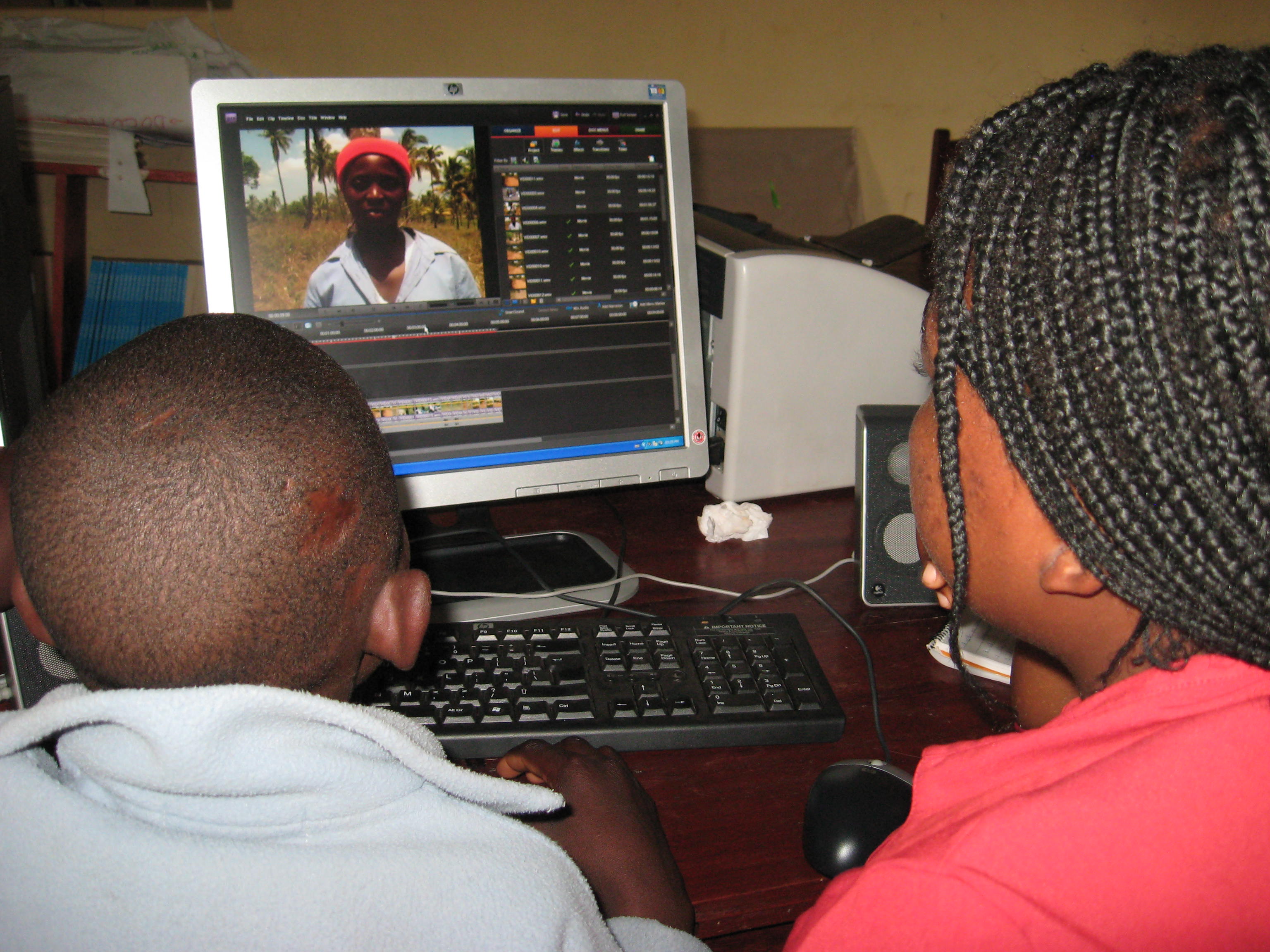
Arts and ICTs were used in the above-mentioned project as tools for youth engagement, mapping and prioritizing, research and community dialog. The media produced with the ICT tools was shared first within the community and then outside at the district, national and global levels as a way of engaging decision makers and the public in the youths’ agenda.  For more on how arts and ICTs are being used in the above-mentioned project, see this post. Watch 100 videos made by youth in 6 African countries on topics they are passionate about.

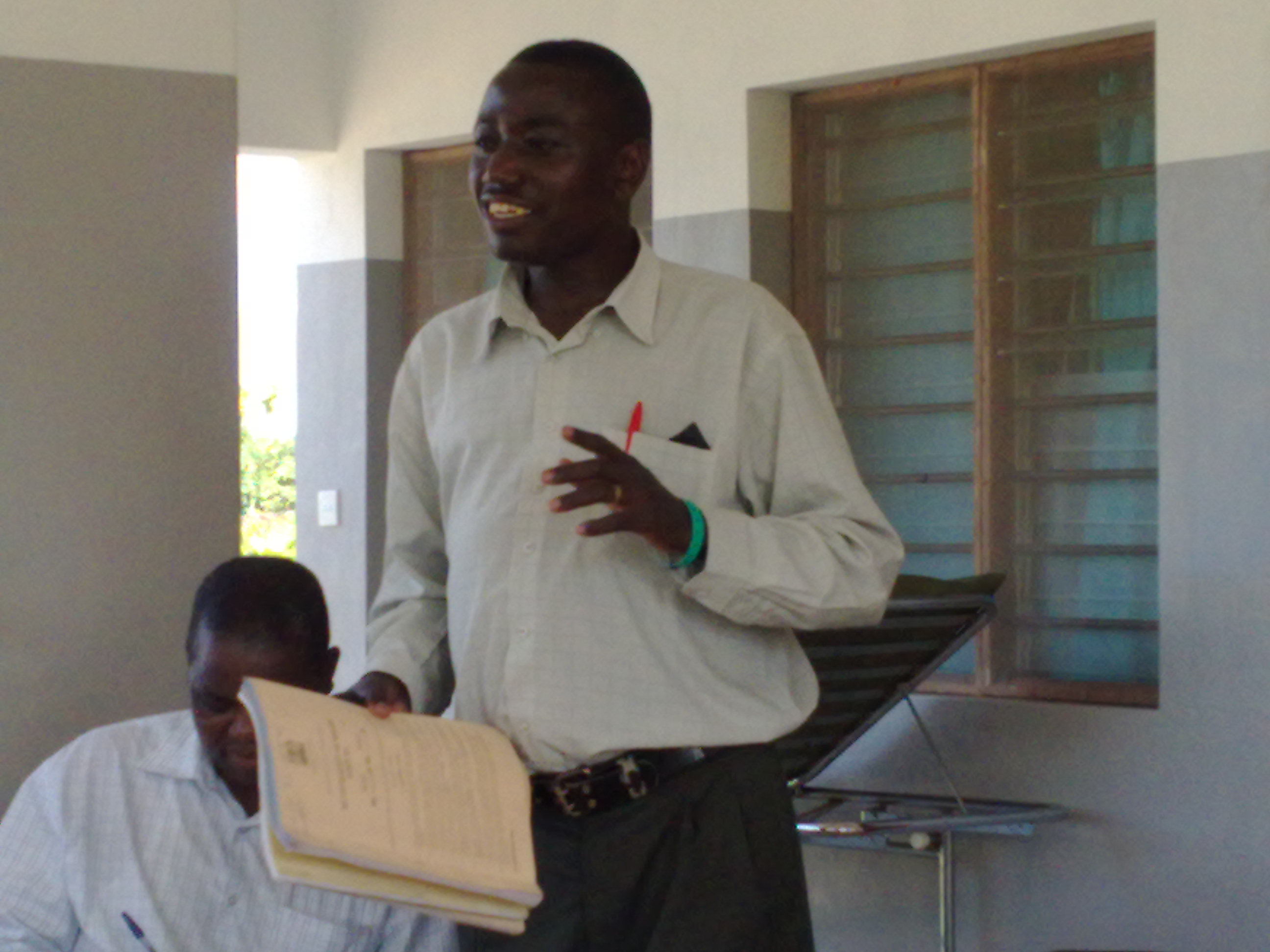
GPS work in Kwale, Kenya

2) Identifying resources and mapping patterns for better decision-making

Tracking and visualizing information is an excellent way to improve decision-making capacity. The advent of simpler and open source participatory digital mapping tools allows community members to map their communities digitally and to have more ownership of the information. Mapping helps identify patterns that may not have been visible before. Local maps shared on-line allow local people to provide their own information from their own perspective, and that information serves multiple purposes at the local level and beyond.

Digital mapping can be helpful when governments decentralize. Municipalities are mapping resources as well as projects and interventions. District authorities can track their own initiatives and those by local and international organizations to avoid duplication of efforts and wasted resources. When maps are public, the population can better demand answers about where resources are being allocated and why. Maps can help with disaster risk reduction and tools such as Ushahidi can help during emergency response. Mapping information is also useful for holding up a mirror to the population to ask them questions about themselves and their behaviors and for showing the direct consequences of actions; for example in a Community Total Led Sanitation mapping project, the community faces its realities about where their own waste is entering food and water sources.

Map Kibera is a good example of participatory digital mapping. mGEOS is a mobile mapping tool developed to help Plan Kenya staff to gather and share data needed for their daily work. Map Kibera and Plan Kenya are collaborating in Kwale on youth and governance work, and in Mathare to work on Community Total Led Sanitation using digital mapping tools (see July 27th entry). In this video, a district youth officer in Kenya talks about why digital mapping is useful for his community.

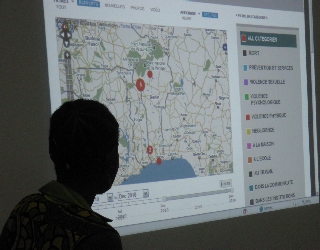
Mapping Violence against Children in Benin

3) Pulling in quick information to guide further investigation, response, or advocacy; pushing out information for targeted actions

ICTs can be used to gather quick information from a broad population. This can be useful in a variety of situations and themes, including those outlined in the MDGs. For example, SMS are being used to report on whether teachers are showing up at school, where violence against children and women is happening, where help is needed in the aftermath of a disaster, and for tracking endangered wildlife. Crowd sourced information can help governments and agencies get preliminary information so that further investigation and support can be provided in a particular area. Another example is the use of mobiles in different health initiatives, including:  child-birth care; HIV and AIDS prevention and treatment programs; support for volunteer community healthcare workers; and bed net treatment reminders. Most of the ICT and development world is also already familiar with the work of two organizations:  Ushahidi and FrontlineSMS who have been combining SMS with digital mapping.

A program that I’m closely involved with is SMS reporting of violence against children in Benin, where local communities, government agencies and NGOs are collaborating to improve the child protection system. This type of program shows promise if heed is paid to the pros and cons of collecting information by SMS, and if those implementing are clear about the type of information that will be gathered, privacy implications, and how the system will complement existing systems. (Here is one document that outlines some considerations). Increasing controls by governments and mobile phone companies, including SIM card registry and Mozambique’s recent government shut down of SMS services during the bread riots are good examples of how quickly the ICT landscape can change, and how flexible and agile those working in the area of ICTs need to be.

Checking info on constituency development fund

4) Supporting accountability and transparency

ICTs are useful to support accountability and transparency, necessary for attempts to track and ensure good use of funding for different efforts, including those related to the MDGs and other aid and development programs. Making information more available to the public by mobile is one such way.  SODNET’s budget tracking tool, for example, informs Kenyans of how much funding is allocated by the Constituency Development Fund to different municipalities in different categories. Combined with mapping, as outlined in this post, the budget information can help constituents to track where their funds are actually being spent.  Other interesting examples of how ICTs can be used for transparency and accountability can be found at TacticalTech’s Info Activism site and at Technology for Transparency.

Paper forms will soon be digitized….

5) Improving municipal services and information management

Civil registration documents, especially a birth certificate, are a precursor to demanding any number of rights or accessing a wide array of services. Without a birth certificate a child may not be able to sit for school exams, receive immunizations or free health care or claim rights to inheritance or legal protection in courts of law. Proof of age is critical in successfully prosecuting perpetrators of crimes against children such as child trafficking, sexual offenses, early recruitment into the armed forces, child marriage and child labor. ICTs are being used to digitize civil registry in Kenya, for example. Not only are records being digitized, but mobile phones are used to make it more convenient for the population to know when their documents are ready. This saves people time and money and means that more parents will register their children.

But wait, there’s more!

These are only a few examples of ways that ICTs are being used at the grassroots level to improve participation, transparency, accountability, debate and ownership of the development process.  The MDGs are lofty, but informed local community participation and ownership is key in efforts to reach them and in ensuring that marginalized populations can also be included.

Please add your examples of ways that ICTs can support development and ICTs in the comments section!

Related posts on Wait… What?

3 ways to integrate ICTs into development work

11 concerns about ICTs and ‘social media for social good’

I and C, then T

MDGs through a child rights lens

7 (or more) questions to ask before adding ICTs

A positively brilliant ICT4D workshop in Kwale, Kenya

The road to Wa is paved

Read Full Post »

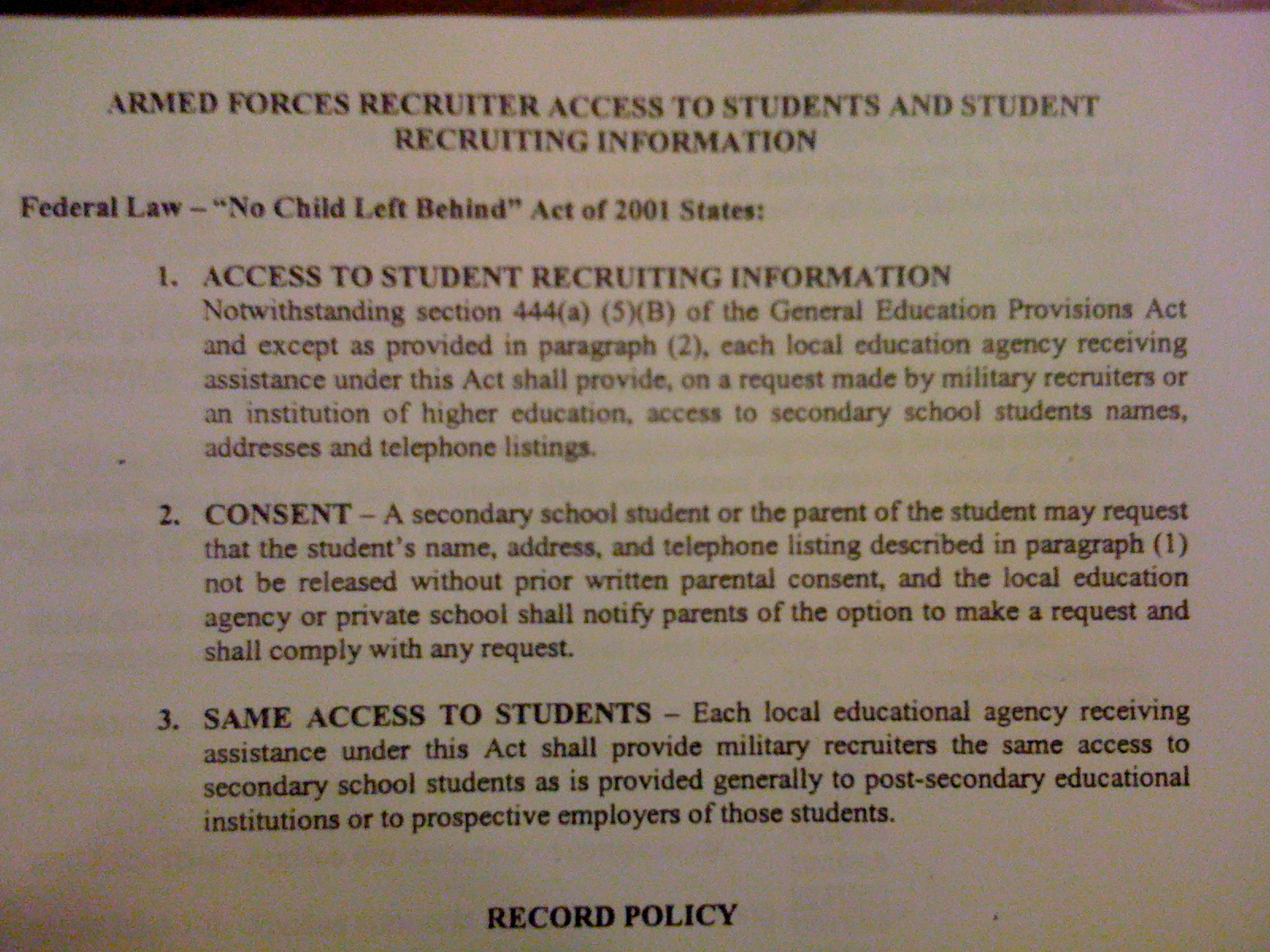
No Child Left Behind?

Per paragraph 3, ‘each local education agency receiving assistance under the No Child Left Behind Act shall provide military recruiters the same access to secondary school students as is provided generally to post-secondary educational institutions or to prospective employers of those students.’

This bothers me.

Every year, since my children started 6th grade, I’ve written a note to the school to ask them NOT to provide my children’s information to military recruiters. Why do military recruiters need access to my children when they start middle school, eg., when they are 12?

Read Full Post »

Mural in the Arcatao community, Chalatenango, El Salvador, reflecting what happened at Rio Sumpul in 1980

When Glenn Beck mentioned Liberation Theology around minute 12.20 of this Fox News video (which I came across courtesy of @Jay_Rosenberg), I literally sat up straighter in my chair, downsized the other 6 tabs I had open, hit rewind, turned up the volume and listened.  And I felt really unsettled.

The amount of time I normally give to Beck and the Tea Baggers is the time it takes to hit delete on an email. You know the ones… they are usually full of misinformation and have a lot of all capital letters, bright red size 64 font, and tell me to fear Obama, Mexicans, Muslim takeovers and universal healthcare.

But Beck’s coloring of Liberation Theology in this video clip “Liberation Theology and the Political Perversion of Christianity” and his take on social justice make me really angry.

In the Liberation Theology clip, Beck paints this vision of people who follow liberation theology. “These are people who, besides blowing stuff up, were also having a sexual revolution, trying to smash monogamy. This isn’t about God to them in any shape or form.”

He talks with Anthony Bradley, a ‘Black Liberation Theology Expert’ from the Acton Institute. Bradley says “One of the odd interpretations of Marxist thought and theology happened in central and south America, right in the church. And it was really the fantastic work of the current pope, who actually rooted out liberation theology from that region.”

Yes, right. Fantastic rooting out. Just fantastic, Bradley.

I’m not a Christian or a Marxist, but I lived and worked in El Salvador in the 90s. That’s right. El Salvador, one of the Central American countries where Liberation Theology was at its strongest.

Here’s what ‘rooting out liberation theology’ meant in El Salvador.

Archbishop Oscar Arnulfo Romero's famous words

It meant assassinating Archbishop Romero in 1980.

“Romero was shot on March 24, 1980, while celebrating Mass at a small chapel located in a hospital called “La Divina Providencia”, one day after a sermon where he had called on Salvadoran soldiers, as Christians, to obey God’s higher order and to stop carrying out the government’s repression and violations of basic human rights. According to an audio-recording of the Mass, he was shot while elevating the chalice at the end of the Eucharistic rite. When he was shot, his blood spilled over the altar along with the sacramental wine.” (Wikipedia)

And assassinating the 6 Jesuit Priests from the University of Central America, cutting open their heads and strewing their brains around the yard.

“Before the end of darkness on the morning of Nov. 16, with unspeakable and barbaric cruelty, armed men burst into the Jesuit residence at the University of Central America in San Salvador and shot six Jesuit priests to death. At the same time, the community’s cook and her daughter were murdered in their beds. According to reliable reports, several of the priests, my brothers, had their brains torn from their heads.” (Washington Post, Nov 19, 1989)

And beating, raping and murdering 4 Maryknoll sisters.

“In December 1980, Jean Donovan and three nuns joined the more than 75,000 people who were killed in the Salvadoran Civil War. In the afternoon of December 2, Donovan and Dorothy Kazel picked up two Maryknoll missionary sisters, Maura Clarke and Ita Ford, from the airport after the pair arrived from attending a Maryknoll conference in Managua, Nicaragua. They were under surveillance by a National Guardsman at the time, who phoned his commander for orders. Acting on orders from their commander, five National Guard members changed into plainclothes and continued to stake out the airport. The five members of the National Guard of El Salvador, out of uniform, stopped the vehicle they were driving after they left the airport in San Salvador. Donovan and the three sisters were taken to a relatively isolated spot where they were beaten, raped, and murdered by the soldiers.

The [1993] U.N.-sponsored report of the Commission on the Truth for El Salvador concluded that the abductions were planned in advance and the men responsible had carried out the murders on orders from above. It further stated that the head of the National Guard and two officers assigned to investigate the case had concealed the facts to harm the judicial process. The murder of the women, along with attempts by the Salvadoran military and some American officials to cover it up, generated a grass-roots opposition in the U.S., as well as ignited intense debate over the Administration’s policy in El Salvador. In 1984, the defendants were found guilty and sentenced to 30 years in prison. The Truth Commission noted that this was the first time in Salvadoran history that a judge had found a member of the military guilty of assassination. ” (Wikipedia)”

Rooting out liberation theology meant massacring almost 800 peasants in El Mozote in Morazan

“In a small rectangular plot among the overgrown ruins of a village here, a team of forensic archeologists has opened a window on El Salvador’s nightmarish past. Nearly 11 years after American-trained soldiers were said to have torn through El Mozote and surrounding hamlets on a rampage in which at least 794 people were killed, the bones have emerged as stark evidence that the claims of peasant survivors and the reports of a couple of American journalists were true.” (New York Times, 1992)

and another 300 people at Rio Sumpul, on the border with Honduras

“On 14 May 1980, units of Military Detachment No. 1, the National Guard and the paramilitary Organización Nacional Democrática (ORDEN) deliberately killed at least 300 non-combatants, including women and children, who were trying to flee to Honduras across the Sumpul river beside the hamlet of Las Aradas, Department of Chalatenango. The massacre was made possible by the cooperation of the Honduran armed forces, who prevented the Salvadorian villagers from landing on the other side.” (UN Truth Commission Report, 1993)

It meant assassinating, disappearing and torturing thousands who belonged to Christian Base Communities. And that was just in El Salvador.

Rev. James Martin in his Huffington Post article explains why he follows liberation theology. I encourage you to read his full post:

“Liberation theology is easy to be against. For one thing, most people don’t have the foggiest idea what you’re talking about. It’s also easier to ignore the concerns of the poor, particularly overseas, than it is to actually get to know them as individuals who make a claim on us. There are also plenty of overheated websites that facilely link it to Marxism. My response to that last critique is to read the Gospels and count how many times Jesus tells us that we should help the poor and even be poor. In the Gospel of Matthew, he tells us that the ones who will enter the Kingdom of heaven are those who help “the least of my brothers and sisters,” i.e., the poor. After that, read the Acts of the Apostles, especially the part about the apostles “sharing everything in common.” Then let me know if helping the poor is communist or simply Christian….

It’s hard to ignore the fact that Jesus chose to be born poor; he worked as what many scholars now say was not simply a carpenter, but what could be called a day laborer; he spent his days and nights with the poor; he and his disciples lived with few if any possessions; he advocated tirelessly for the poor in a time when poverty was considered to be a curse; he consistently placed the poor in his parables over and above the rich; and he died an utterly poor man, with only a single seamless garment to his name. Jesus lived and died as a poor man. Why is this so hard for modern-day Christians to see? Liberation theology is not Marxism disguised as religion. It is Christianity presented in all its disturbing fullness.”

So, Glenn Beck. Really. Really?

Let me get this straight. The people above are or were about “blowing stuff up, sexual revolutions and trying to smash monogamy.”  And this is “not about God to them in any way shape or form” so they need to be “rooted out”?

Glenn Beck, you make me sick.

Update: posts I like on this topic:

Roger Ebert in Chicago Sun Times: Put Up or Shut Up.

Matt Taibbi in Rolling Stone: Tea Party Rocks Primaries

Timothy Egan in New York Times: Building a Nation of Know Nothings

Other El Salvador related posts on Wait… What?

Orgasmatron moments

On trust and disempowerment

18 years

It’s not a black and white photo

The real story involves anti-social entrepreneurs and anthropology

Read Full Post »

« Newer Posts