Feeds:
Posts
Comments

Archive for the ‘random, musing or confusing’ Category

I taught English in El Salvador when I was 24. A few of the students liked to talk with me about music. One day they wanted me to hear ‘this great song by Sepultura’, and I was like ‘Cool! That’s Orgasmatron!‘ and mentioned that I knew the Motorhead version. I don’t know what shocked them more: that I knew that particular song, or that their Sepultura version wasn’t the original.

I find myself having my fair share of those moments these days. I’m happy when good ideas in development and aid work are taken up, and especially happy when they are improved on (though I have to say that I like Motorhead’s version better than Sepultura’s). But it kinda bugs me when people talk about those ideas as if they are brand spanking new when they’ve actually been around for awhile. It seems like people should do some research, to at least know what came before.

What are some examples of 2010 re-makes?

Bottom up development

I find it weird that we are still discussing ‘bottom up’ development as a new or innovative thing in the year 2010 when it’s clearly been around for a really long time.

I started in development in 1994 in El Salvador. Most of the work that local NGOs were doing at that time was focused on helping grassroots groups and communities organize and manage their own development. A lot of time was spent in communities with community organizations. But this concept wasn’t born in the 1990s. It was grounded in Liberation Theology and Paulo Freire’s Pedagogy of the Oppressed.

Liberation Theology emerged in the 1960s ‘as a result of a systematic, disciplined reflection on Christian faith and its implications’ as the Catholic church in Latin America was reflecting on itself and its relationship with the poor. Those who formulated the concept worked closely in communities with the poor and saw the social and economic injustice begun by colonization and continued through those in power both in governments and within the church. Liberation theology re-interpreted the scripture in a way that affirmed the dignity and self worth of the poor and their right to struggle for a dignified life. ‘Liberation theology strove to be a bottom-up movement in practice, with Biblical interpretation and liturgical practice designed by lay practitioners themselves, rather than by the orthodox Church hierarchy.’  Check here and here for good links on Liberation Theology.

Pedagogy of the Oppressed. Brazilian Paolo Freire, based on his experiences working on literacy with poor communities developed his Pedagogy of the Oppressed all the way back in 1968, around the same time that Liberation Theology was emerging. Freire’s philosophy has been heavily drawn from and applied to development. Especially pertinent is the concept of dialogics an instrument to free the colonized, through the use of cooperation, unity, organization and cultural synthesis (overcoming problems in society to liberate human beings). This is in contrast to antidialogics which use conquest, manipulation, cultural invasion, and the concept of divide and rule’. Freire’s ‘emphasis on dialogue struck a very strong chord with those concerned with popular and informal education…. However, Paulo Freire was able to take the discussion on several steps with his insistence that dialogue involves respect. It should not involve one person acting on another, but rather people working with each other. For more on Freire (I certainly did not do him justice) check here and here.

These 2 philosophies closely mirrored ideas that arose during the Civil Rights Movement in the US. There’s a brilliant book called “We Make the Road by Walking: Conversations on Education and Social Change” where Paulo Freire and Myles Horton (who started the Highlander Folk School in 1932 and influenced Rosa Parks and Martin Luther King Jr.) discuss the similarities between their philosophies.

Public policy and advocacy

Fast forward to 1996, where we get a new director at the organization where I’m working, a Brazilian. He simply won’t stop talking about ‘civil society’ and ‘public policies’.  ‘There will be no sustainable changes if we don’t have an impact on the level of policies and their implementation. How does this program idea impact on public policies? How is civil society involved in holding the government accountable? Where is the budget for Peace Accords implementation going?’ Changing systems, transparency, political participation by those formerly excluded, and moving away from hand outs and emergency type programs were key in the vision of how the country would improve.

Working with local partners

To that aim, we funded different local organizations that raised awareness in rights holders on their rights and that advocated for the implementation of the 1992 Peace Accords. We worked with an association of women who were demanding that the alimony laws be operationalized, ex-combatants groups from both sides of the conflict who were not getting the benefits promised them in the Peace Accords, sex workers who were being harassed and abused by police, civic education, environmental organizations who worked with local communities on issues such as deforestation, water and land rights, etc. We also met and discussed a lot with other international organizations, and many of them were doing similar kinds of work.

Local management of the development process

I was pretty much ineligible for any advancement in the organization because the director’s mandate was to nationalize and hand over the program, now that the civil war and the ‘state of emergency’ were over. Local organizations now had more political space to work without the protection of international organizations. The idea was to strengthen capacities of all local staff, to move over to a national board of directors and to nationalize the organization. At the same time, the thought was to build the administrative capacity of local organizations so that they could function transparently with full accountability.

Participatory design/participatory development

I moved to a different organization in 1998, and one of my first tasks was to help write the organization’s strategic plan. The first step in developing that plan was community consultation. Staff (all of them local by the way) facilitated a consultation process with people  in the 400+ communities where we worked. In addition, they met and consulted with community based organizations, local NGOs, local governments, national level ministries as well as other international organizations, to learn of their plans and to avoid duplication of efforts.

The community consultations were done using PRA (aka ‘participation, reflection, action’) methodologies. Many of the tools staff used were developed and written about by Robert Chambers. Check here for a great overview of PRA or these 2003 notes on PRA since 1998.  PRA traces many of its roots back to Freire’s Pedagogy of the Oppressed and looks to make communities the real owners of the development process. Any externals involved act as facilitators of a process (not drivers of the discussion) who ‘hand over the stick’ to local people as often as possible so that they fully manage their own processes. Chambers warns against ‘fascipulation’ – facilitation + manipulation, and surface PRA, saying the main ingredient in PRA is having real respect for local knowledge and local people. Some reading suggestions here.

(Side note to get an idea of how awesome Chambers is. I went to a workshop with him once and he walked in barefoot, pants rolled up, hair askew. He stood in front of us holding a map. It was upside down. Someone raised their hand to tell him it was upside down. He looked down at it and said ‘it looks fine from my perspective’. Then he went into a whole discussion about perspective. As part of that discussion, he started talking about computers and network thinking and how birds fly in flocks. This guy is some kind of genius.)

Community managed projects

Following the strategic consultations, staff worked with communities to design, plan and carry out their own projects, which were also administered by the community once they had gone through project administration training and had opened their community bank account to receive deposits.

Orgasmatron moments

Thinking about sustainability and working with local communities is really not a new concept, nor is the idea of working yourself out of a job if you work in development. The buzz words of transparency and accountability have also been around for awhile. Participatory design is not new either.

I don’t know. Maybe the organizations I’ve worked with in the 1990s and up to now are just amazingly progressive. Or maybe I’m missing something and when people use the terms above they are talking about something different and much more advanced and innovative than what I’m talking about.  I mean, the White Stripes first album was a total Doors/Zeppelin rip off, but they did go on to develop their own sound as they matured, and their third album was brilliant.  Snoop’s Upside Ya Head is obviously drawing on the Gap Band’s Ooops Upside Ya Head, but both versions are excellent. I do actually like a lot of the re-makes that are out there and there are also some really good new concepts and ideas and some great people and organizations that I learn from on a regular basis.

However, Green Day are not the ‘godfathers of punk rock’ (sign the petition here and help settle that issue once and for all) – How could they be if they came out in the late 80s and punk started in the early 70s? And I keep having Orgasmatron Moments when I see people gushing over an NGO that hires local staff (no brainer) or has a child protection policy (implementing ours since 2003) or consults with communities (why wouldn’t you consult with local communities?).

I suppose, like with my students in El Salvador, it kind of sucks when you realize your idea or your version isn’t the original. But you can be annoyed or bummed out or remain in denial, or you can go back and do some research, and see what you can learn from the original and try to improve on it. With music, knowing about the original song (even if it’s horrible and the new version is much much better), usually scores you some points for legitimacy.

Related posts on Wait… What?

Nothing new under the sun: trends & development mash-ups

Amateurs, professionals, innovations and smartaid

Mind the Gap

Meeting in the middle

Read Full Post »

I had a doctor’s appointment a couple months ago, and my doctor asked me if it was OK for a student to do the prep work, you know, the usual: height, weight, temperature, blood pressure, the like. I said sure.

What I didn’t expect though, was that the student intern was going to read through a list of health questions to try to find out if I was menopausal. Nothing against menopause – it’s a natural thing and I think some women even look forward to it. But I just turned 42, and no, I’m not having hot flashes quite yet.

I suppose it’s some kind of mandatory thing to ask a woman who is in her 40s a series of questions like that. And to be honest, I probably wouldn’t have minded if it had been my doctor asking me. I’ve been seeing her for years now, she knows me, and she knows how to ask questions in the right way. I trust her.

But sitting up on an examination table in a sterile room, clothes off save for an oversized paper gown that keeps falling off my shoulder, with a 20-something I’ve never met sitting in front of me asking if I’m incontinent, suffer from bouts of depression, and have loss of libido was a bit off putting.

It made me want to lie to her. To not reveal any sign of potential menopausal weakness. To tell her that I never feel fatigued. That I never, ever forget anything, and that I am never ever ever distracted or unfocused. I secretly shunned all her suggestions. Calcium? nope, not taking it. Multi vitamins, pah, I feel fine. Let’s get this interview over with STAT.

It felt disempowering to have this young woman, who I don’t know and haven’t developed any trust in, asking me very personal questions about myself and my life and offering scripted solutions to something she imagined I might have, and that she’d obviously never experienced herself.  Since then, I’ve been thinking about it off and on, and related life stories come to mind.

—–

Julia*, someone I was very close to in my Barrio in El Salvador (where I lived for most of the 90s) had a long history of domestic abuse. She would talk to me about it all the time – she still lived with the man, who had tapered off a bit as he got older but who was still not entirely pleasant to her. She would get depressed sometimes and talk about leaving, but she never did. As I got to know her better, I realized my role in the relationship was not trying to find solutions, or criticizing the man, or feeling enraged. It was listening and not judging. An older woman, with a small pension. Where would she go? She believed that she would be seen by the neighbors as weak, and that people would lose respect for her. She really didn’t have a lot of options. So she’d tell me and I’d listen, and that was enough. I’d tell her my work troubles too, and she’d listen, and that was also enough for me. I realize as I write this how much I miss her.

About 15 years ago at work, while still in El Salvador, I was responsible for overseeing a study on gender violence that a partner organization was carrying out and that we were funding. It was going to be a door-to-door survey mixed with some focus group discussions. I immediately thought of Julia; of all the women in the Barrio. I thought ‘Julia would never tell anyone the truth if they came knocking on her door to interview her about domestic violence.’ She would say no, that doesn’t happen here, and close the door until they went away. I doubt any of the other women in the Barrio would have acted any differently.

I felt pretty sure that the information that was produced in that study on domestic violence was not going to be valid, even though it was being managed by a group of well-known, well-educated Salvadoran feminists.  But I felt like I couldn’t say anything, because I wasn’t a well known local feminist. And after all, they’d often imply, what did I know about El Salvador? I was a foreigner. What I did feel certain about was that no one in the Barrios where they wanted to do their study was going to tell them the truth.

—–

And somehow related to that, I started thinking about the time I went to the doctor’s office with my mother-in-law, a brilliant, strong and upright woman from the Barrio, with a 6th grade education, who would be considered ‘impoverished’ by most standards. I remember vividly a young male doctor who addressed her using the familiar form of ‘you’ (vos) instead of using the respectful form of ‘you’ (Usted). I remember being furious. I don’t even use vos with my mother-in-law, out of respect. What was this young, wealthy doctor doing using it? I hated seeing her stripped of her well-earned Barrio respect once she entered the doctor’s office, just because she was poor.

—–

What am I trying to say here? I’m not entirely sure, but I guess I’m thinking about respect and the hierarchies of information and education and offices, and the importance of developing a rapport with people before you go prying around in their personal lives and offering solutions.

I’m relating that to ‘aid’ and ‘development’ work, which in my world, is an intensely personal thing. I try to work from the heart, and I hope I’m never making people feel belittled, judged, or like they need to lie to me or conceal things from me because I haven’t taken the time to get to know them. I hope I’m not disrespecting anyone, knowingly or unknowingly, and that I’m not messing around in things that are none of my business or where I haven’t got an invitation. I hope I’m not always trying to offer solutions, but rather listening and supporting people to come to their own conclusions. I hope I don’t make people feel like they are sitting, half naked on an examination table, while someone who knows nothing about them or their life politely asks them some standard questions and comes up with some generic recommendations for how to prevent or cure something they may or may not have or may not think is an illness.

*Not her real name

Related posts on Wait… What?

The real story involves anti-social entrepreneurs and anthropology

It’s not a black and white photo

18 years

Read Full Post »

HSBC Ad Campaign

If you’ve done any international travel lately, you’ll likely have seen the HSBC Ad Campaign on the walkway as you get on your plane. You know the one. It has 3 identical photos, each with one word or phrase written on it, showing different perspectives.

Well, last week in Ndop, Cameroon, I had a random and cool experience that I was a tiny bit hesitant to post about.  But thanks to HSBC Advertisements, I figured something out. (Note, I still really don’t know who HBSC is or what in particular they do nor do I have any intention of using their bank).

I was with some of the youth participating in the YETAM project, filming at a local craft shop called PresPot. When we’d finished filming, we walked down the road towards the local Fon’s (King’s) Palace to meet another group that was filming there. The plan was to eat our packed lunch together.

There were more people than normal out on the road we were walking on, so it seemed to me that something was up. Then one of the kids pointed down the road to show the reason why.

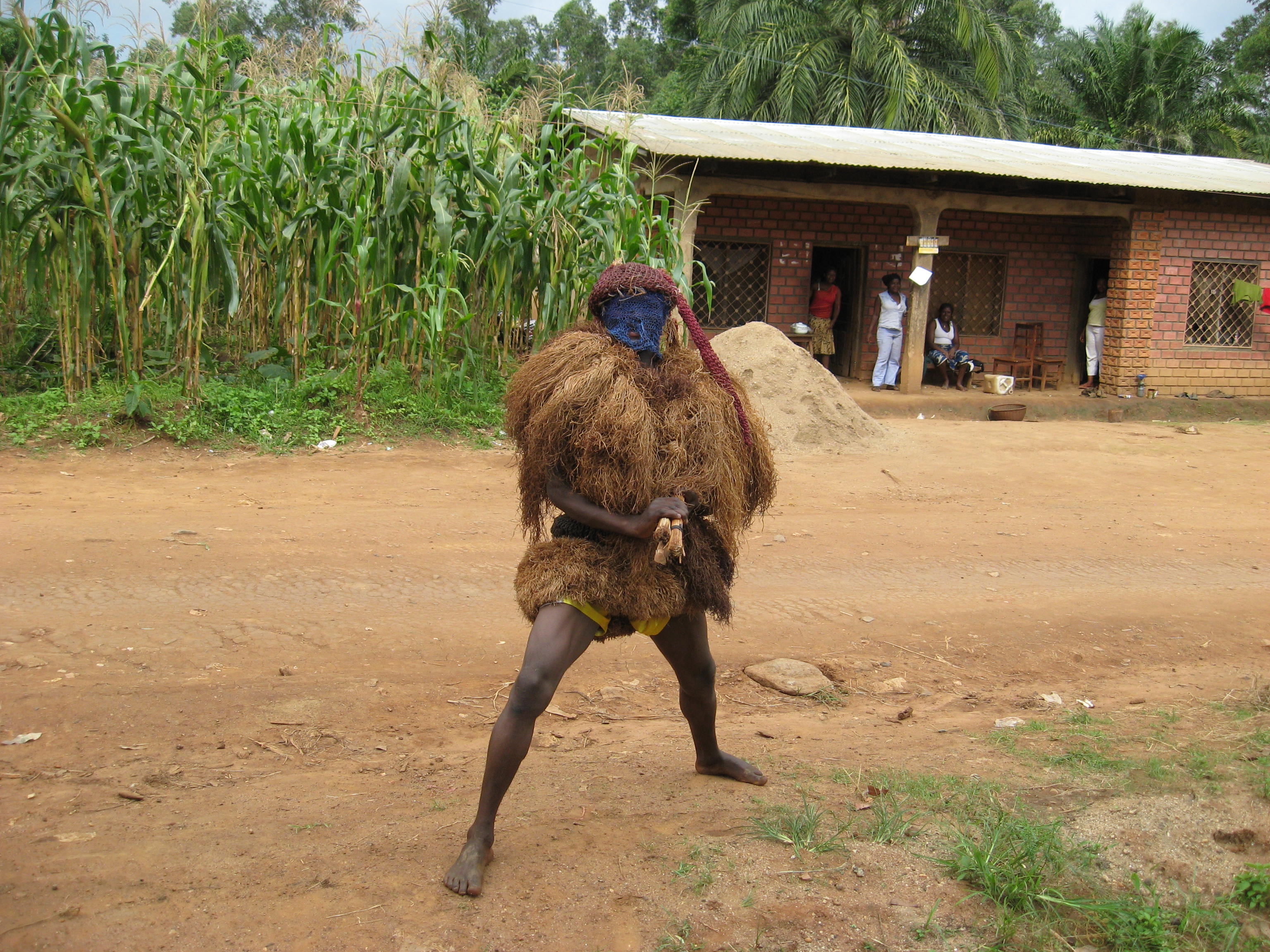
The Ndobo were coming. ‘Ndobo?’ I asked? I could make out what looked like small group of people, some of them dressed in brown grass skirts.

Ndobo

As they got closer, I remembered a blog post (perhaps ScarlettLion’s or maybe a link she posted?) a few months back, where someone had taken shots of people in different places – I think mostly in Africa and in Haiti – wearing similar types of costumes to the ones the Ndobo were wearing. In any case, the Ndobo were definitely something to behold, and since I’d seen that post, they were now sitting within some kind of broader framework for me.

[Update: Thanks to Meghan for her comment below, with this link to the blog post I am referring to with the stunning photos. They are by Phyllis Galembo and on exhibit at the Tang Museum: “These portraits of masqueraders build on Galembo’s work of the past twenty years photographing the rituals and religious culture in Nigeria, Brazil, Cuba, Jamaica and Haiti, as well as the homegrown custom of Halloween in the United States. Organized by Ian Berry, Malloy Curator of the Tang Museum, in collaboration with the artist.”]

‘So what are we supposed to do?’ I asked.  ‘Are the Ndobo scary? Are we supposed to run away? Stay here? Get off the road? Bow down?’

‘Just watch them when they come,’ one of the girls told me. ‘They will ask you for some coins and you just give them some.’ ‘Are we allowed to film?’ I asked. ‘Yes, once you give them some coins they will be happy and you can film.’  I dug around in my bag to find some coins.

There were about 6 Ndobo, all teen-aged boys and young men, and a bunch of excited younger boys with them.  They moved in a way that was part stealth, part walking and part dancing as they approached. Someone played flutes as they moved along.

‘Why are they here? Why today? Who are they? What do they represent?’ I wanted to know. The kids had all kinds of different answers. ‘They come out to announce the corn harvest season is here.’ ‘They are just looking for money, so they make those shirts and clothing at home, and then they become Ndobo.’

‘In my village,’ said one of my co-trainers, ‘only certain of the young men are allowed to be Ndobos.’ ‘No,’ said one of the girls. ‘here any boy who wants to can just make his clothing and go out. My brother, when he became that age, he made that clothing and went out just to get some coins.’ Another of the kids said ‘They come out when there is a town hall meeting to ask for money.’ ‘Ha, it’s an income generation project for the youth,’ said one of the other co-trainers.

Meanwhile the Ndobo were approaching, and everyone was waiting and kind of excited to see what they would do. It was one of those amazing and random moments that make me love life. It was not scheduled purposely so that a white person could see some ‘local traditions’. It was not a tourist show. There were no tables with locals performing for respected visitors. It would have happened regardless of me being there or not. In my line of work, those moments can be rare and I was savoring this one.

We stood off the road in a clearing, and watched the Ndobo arrive, their entourage of overexcited sparkly eyed young boys with them watching us from a distance, flicking their eyes at me regularly. Maybe they wanted to know what I was going to do also, how I was going to react to the Ndobo and vice versa. I wondered also if it was going to be somehow weird because I was there. I was thinking how surreal it was, and how cool their ‘costumes’ were, remembering that blog post about young men in similar dress with photos that seemed to be from some kind of museum exhibit… thinking that this was real life, not a museum…. Then thinking about how in museums things from Africa are often called ‘handicrafts’ or ‘anthropological exhibits’ whereas things from Europe are called art…. Wondering what the difference really is.

The Ndobo  took their stance for a moment in front of us. They were carrying little sticks and whips made of grass and palm. They surrounded us and started lightly thrashing me and my colleague Georges with their sticks and whips in a vaguely threatening way, but not one that caused any fear. The feeling was someplace between theater and in-your-face reality. I found my coins again, and several hands came forward to collect them. The kids with us were watching and laughing, the little boys accompanying the Ndobo were giggling.

After I’d given out my coins I looked behind me and saw that one of the Ndobo had a stick against the back of Georges’ neck and another was holding his grass whip against Georges’ shins. Georges rolled his eyes and dug around to find some coins for them, also laughing. He dropped the coins into the outstretched hands and the Ndobo let him go. One of them stood in front of us to get his picture taken, and then they moved off down the road. We carried on towards the Fon palace.

When we arrived to the Fon palace, the other group of youth asked ‘did you see the Ndobo?! They came here and danced right in front of us! We took pictures and films!’  They were pretty animated too, so I felt less like a silly foreigner, getting excited about seeing ‘local tradition’.

We sat on the steps of the local council’s building and started in on lunch – boiled plantains and koki bean. The rest of the day, all the kids could talk about was the Ndobo. I kept thinking that the Ndobo reminded me of Halloween… harvest time festival, costumes to hide your identity, playing tricks and asking for treats.

I posted a picture of the Ndobo on Twitter. But I hesitated before doing it. A colleague saw it and said something about Africa stereotyping. So she had the same reservations.

I held off on the blog post… but then HSBC came to the rescue.

African Tradition

African Stereotype

African Entrepreneur

It’s interesting how uncomfortable ‘Africa’ can make us. But I guess so can anything, anyone or anyplace that is complex and involves human behavior and culture… I guess you could say the Ndobo are a small piece of a much larger ball of string, just like high heeled shoes, plastic surgery, tattoos and henna, and shaved heads. Ask HSBC.

Read Full Post »

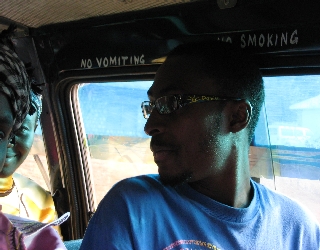
I recently wrote about how difficult I find it to know what the etiquette is when riding in a car with a hired driver. So I was happy to see that the owner of this van, hired to take the youth out to film in Ndop, Cameroon, last week, had the good sense to clearly inform passengers of the rules.

No fighting.

Don't send your head or hands outside.

Sit down when the car is moving.

The driver is not responsible for any unpaid load.

No discussion with the driver when the car is moving.

No vomiting. No smoking.

Read Full Post »

Bafut portraits

I’m traveling for about a month in Cameroon and Kenya with a couple days’ stop off in between in Amsterdam. Yesterday morning I got an email from my mom saying ‘For some funny reason I don’t feel like you are having a great African birthday. I hope I am wrong.’

Moms are funny, that way they can sense things. And when your birthday is on July 4 (US Independence Day) you grow accustomed to a lot of fanfare. I’m not into Americana but I like the familiarity of spending my birthday in humid Indiana summer, eating watermelon, home made potato salad and cook out food, having red-white-and-blue frosted birthday cake with sparklers instead of candles on top, and sitting out in lawn chairs on the grass in the front yard, watching fireworks and slapping mosquitoes…. When I spend my birthday out of the US, I feel like I am missing something more than just my birthday.

The day ended up being very cool though.

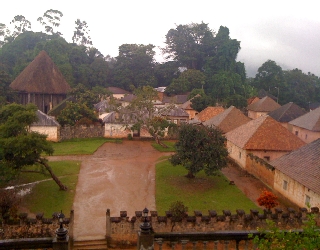
Bafut palace

Instead of eating cake and watching fireworks with my family, I spent the day in the Bafut palace (where the Fon of Bafut lives) with my colleagues Judith and Roland, and with Maa Rose, one of the Fon’s wives. A Fon is a traditional king, and this palace has been around since around 1300 AD. It’s about a 30 minute drive from Bamenda town. (See Fon of Bafut on Wikipedia).

The original palace buildings were made from bamboo and reed, but after the Germans arrived to Bafut, they were reinforced on the outside with burned bricks and tile roofs. The only truly original remaining part of the palace is the sacred place, the Achum (you can see it in the far back left side of the photo).

It was pouring rain when we arrived to the palace grounds. Roland, who was driving us, was in gorgeous all white traditional clothing. He hadn’t been to the Palace before, so he found an umbrella and went with us, holding his white pantlegs up the whole way to avoid getting them all wet and muddy.

Judith is married to a man from Bafut whose grandmother was a Bafut Queen. She was known as the ‘3 time wife of the Fon’ because her first Fon husband died, his son inherited her, he also died, and so his son inherited her and she stayed with him until her death. Judith’s 9 year old daughter is named after this grandmother and insists that she doesn’t want to be the wife of the Fon.

Wooden statue of a Bafut Queen

We arrived late afternoon and Maa Rose came out to meet us. She is the 4th wife of the current Fon, who’s been in power since 1968 when he was about 13. Having several wives is common for a Fon, but the current Fon is a modern kind of guy, educated at the University of Yaounde, and instead of taking 159 wives (or was if 152?) as his father did, he’s settled with 8. He ensures that they all are provided for and get their education.

Maa Rose showed us the old talking drum outside of the palace that calls the village when something important is happening.  She said she would tell us about the Bafut history, and that they worship their ancestors, ‘but we are Christians too.’

She shared the meaning of the waist-high stone pillars scattered around (they mark where the heads of those who have died in battle lie). She took us over to see a pair of large stones where adulterers were punished (they were tied to the stones and pieces of their bodies were chopped off until they expired, and if they were still alive in 7 days, boiling water was poured on them). She explained about the 2 forked sticks planted in the ground (they mark the place where children used to be sacrificed to ward of any deaths as people got crazy during the annual dance celebrations).

Maa Rose said it was the task of the notables (not the common people or prisoners as in some other cultures) to select and give up a child for sacrifice in the name of community safety. This act also allowed a notable to grow in stature. When the Germans came in the late 1800s, ‘they taught us that this was bad, so now goats are killed instead.’ The custom of tying adulterers to the stones has also been discontinued, and now they are simply exiled.

After we saw the exterior of the palace, we went into the courtyard ‘which is set up for our children to play’ and then saw the sacred place, the Achum, where the Fon goes to pray and to do things which are secret. The Achum was erected over a lake and has been there since the beginning of the Fon palace. (We saw pictures from the late 1800’s and the place looks almost the same; the Achum is on the list of the 100 most endangered world cultural heritage sites). Each year on grass-cutting day, everyone in the village gathers grass and makes bundles to repair the roof of the Achum.

After seeing the Achum (only from the outside) we followed Maa Rose through a meeting room. The children who live in the palace were watching a movie, and ‘The First Noel’ Christmas song was playing in the background. Maa Rose told us, ‘In the older times, decisions were only made by men, but now in these times, decisions cannot be made without women too. So this is the room where we meet to make decisions. If there are decisions that must be made without women, the Fon and his notables make them in a secret society.’

Maa Rose opening up the museum

From there, we visited the Bafut Museum, located in a big mansion that the former Fon lived in. The roof of the mansion was taken off, though, because the ancestors were not happy that he was living there, and he moved back to live in the Palace. The house has been restored and converted into a museum with German funding. Entrance fees are ‘sent to the German coffers’ to keep up the museum up.

Maa Rose took us through museum after hours as a favor to Judith (who has Bafut connections) and said she wasn’t sure how to turn on the lights. Unfortunately I forgot my camera with a flash and had to use my iPhone which doesn’t function well in the dark, plus we weren’t supposed to take photos she later told us.

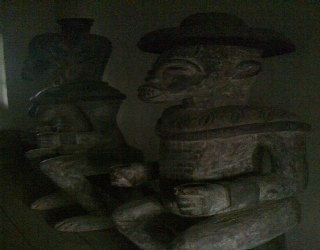
She gave us a full-on explanation for each of the items in the museum, starting with the carved statues of the first German to arrive in Bafut and his wife. The coolest thing about these statues to me is that they represent Germans, but the Germans are dressed and portrayed in old Bafut style — naked and with traditional jewelry and ornaments. Maa Rose said that of course the Germans weren’t naked in those times, and that the Bafut had just carved them in their own style.

wooden statues of first Germans to arrive to Bafut

We moved along to a carved statue of a Bafut Queen. In the past, said Maa Rose, ‘Our queens were na-ked!’ They wore cowry shells to show that they were a Fon’s wife here, around the waist.’ The cowry shells on the statue dangle in front of the pubic area. ‘Today of course a Fon’s wife is not naked, ha! So if I would wear my cowry there, no one could see them. So we wear them here around the wrist.’

The cowry shells are a sign of Fon royalty.  ‘The Fon, if needed, can turn himself into an animal, like a bull or an elephant, and escape into the bush. You will see his cowry shells though. So if a hunter tries to kill him, he will just bow like this, and you will see the shells, and you will know it is a Fon and you cannot kill him.’

In addition to a lot of amazing wooden statues, rooms with old Fon royalty items, including the last elephant to be killed in the area (over 200 years ago — his foot, tusks and skull are in the museum) we saw a lot of gorgeous masks. ‘Before cameras, if you really loved someone, you could ask someone to make a carving of them.’

In the room made to look like a traditional Fon’s room, there was a bed with a lion skin on it and elephant tusks on the floor. Maa Rose said that before the Germans came, it was tradition that a Fon’s feet could never touch the floor, so he would wake up and stand on top of a person. ‘The Germans taught us that it is not right to treat a human like that, so now the Fon does not do that.’

In the museum there are also weapons that had been given to the different Fons by the Germans who were colonizing, and we heard the story of the Fon’s grandfather (the one who was married to Judith’s husband’s grandmother) who spent 1 year in jail in Limbe for refusing to surrender to the Germans.

There is also a case with some common looking German porcelaine. ‘This is the slavery room,’ Maa Rose told us. ‘It is said that for one of these, you could get two slaves. The Fons did slavery before.’ In the slavery room there are also beaded calabazas and a pair of beaded shoes that are said to have belonged to the first German to arrive to Bafut, and which were given to the Fon. ‘This German wore eye glasses, and people thought they were his actual eyes. He used to take them off and set them down, and the people would work hard there because they thought his eyes were still there, watching them.’

The Fons loved to fight, she said. ‘They would go to fight in the very front with their notables.’ (Wish we had that going on today in more places, things would likely be quite different). We saw the room of a former Fon Queen with all her things. A basket for going to farm, her cooking utensils, her bed. I like the idea of the queens cooking and farming. Judith told me later that the current Fon also has a farm, and he takes his children there with him to farm. The Fon’s current wives, also queens, nowadays have jobs. Maa Rose is a teacher.

We saw statues of ghosts. Maa Rose said that it is believed that the ancestors come to visit the current Fon to tell him what to do or how to behave. When they are upset, they come in a certain form and you know that everything is not OK. The former Fon used to beat his wives, for example. ‘Even the wives that he inherited from his father.’ So the father who was missing (‘we don’t like to say a Fon is ‘dead’ we only say he is missing’) came to tell him to stop beating his wives, and that if he didn’t stop he would be really sorry.  The cane he used to use to beat his wives is there in the museum.

When a Fon goes missing, there will be those wearing a particular mask and dress that go around to all the villages to advise them that something has happened. They will know then that they must go to prepare their things, because when it is announced that the Fon has gone missing, they will not be able to do anything for 2 months. The cannot collect wood or visit their farms. So they have to prepare.

By the time we finished our tour of the dark museum, the sun was setting.  Maa Rose invited us over to her small house within the palace complex to see her handicrafts. ‘Here we sell these small things to buy whatever the Fon can’t buy us, like our little soaps and oils and things.’ I bought a bamboo salt shaker and a wind chime, and paid a small sum for the museum and Maa Rose’s wonderful historical orientation.

She asked us to come meet 7 of her 9 children (the other 2, her eldest girls, are away at university). They were all sitting around the fire, in the small kitchen across from where we’d looked at the handicrafts, getting the oil fried to start cooking their dinner.

The kitchen is cozy and simple, with blackened walls from fire smoke. Some guinea pigs were skittering around in one corner and chickens were roosting in another. In the rafters, above the cooking fire, there were some tiny onions, strung on thin sticks, drying and smoking to be added to food later on.

Maa Rose said that next time we should come much earlier, so that we could share a meal and talk more.  She apologized for the rain and mud and that she couldn’t get the lights on in the museum or in her house so we could see things better.

I left feeling pretty sure that Maa Rose is the most beautiful Queen I’ll ever meet.

Read Full Post »

I never know where to sit when I get into a car driven by a hired driver.  Do I sit in the front seat? The back? What does it mean when I sit in one place versus another?

And then there are those times when the driver’s side is on the right instead of the left like I’m used to, and I wait stupidly next to the driver’s door until he says ‘Oh, you want to drive, eh?’

I realize I have issues if these are the things I worry about, but the only drivers I’ve ever hired are street taxi drivers, and I’ve always just sat in the back unless the taxi was exceptionally crowded.

When I’m traveling and it comes to a riding in a vehicle with someone who’s hired by an organization and whose full-time job it is to drive, I’m never quite sure what to do. Do I sit in the front seat because I believe we are equals despite our position in the hierarchy? Or is that being ridiculously silly and American? And actually, which seat actually holds more status? The back or the front? And if I sit in the front, do I end up just embarrassing the poor guy with familiarity and friendliness when he’d rather I sit in the back so he can just do his job and go home? Or is it rude to hop in the back? And in the end, does the driver even care?  I  am probably being self-important to think it matters. Visitors come and go.

I Googled “where to sit hired car driver,” to try to find out, and nothing. What’s a girl to do?

And what about when there are more people than just me and the driver? What then?

Sometimes when traveling in different countries where my organization works, people offer me the front seat, but I never totally know what that means. Do they think I expect it because I’m a visitor, or from the US, or working with the regional office, or all of the above? If I don’t take the front seat, am I offending people by not accepting a gesture of respect and welcome?

Other times I end up in the back seat with 2 or 3 other women. I imagine it crosses all of our minds to try at least a little to avoid the cramped middle seat. Or we wonder if we should secretly engineer it so that a female colleague we want to show gratitude or respect to can have a window seat while we suffer with no legroom.

I don’t think I’m the only one that notices, because normally there is some kind of banter about who’s sitting where and whether they are fat or skinny and whether we all fit.

This afternoon was tricky because it was just the driver, a female colleague and me.  She said ‘Oh please, do sit in front!’ I said ‘Oh no, it’s fine, let me just sit here!’  She got in the front and I sat in the back seat, on the right hand side. Since she’d earlier been identified as my sister, because she had just gotten her US Passport, I thought it would be OK to ask her about car etiquette.

Of course, it turns out that there is etiquette. The higher status person should sit in the front, just like in the US, where parents or people being shown respect get the front seat.  (I forgot to ask if it’s common to yell ‘shotgun’ on the way to the car when everyone is of equal status to determine who gets the front seat….)

My colleague told me that in some parts of Cameroon, men always get the front, ‘because women are just getting to a place where they might think about sitting there’. Sometimes though, someone will offer you the front seat as a gesture, in which case you should take it.

She explained that if the owner of a car has a hired driver, the owner normally sits in the spot where I was sitting (right hand side, back seat). ‘This lets everyone know that he is the owner of the car…. If he’s a big man, his bodyguards will then sit in the front seat and to the left of him in the back…. And if you are riding with a group of people, you might ask or wait to be instructed where to sit so as to ensure you are not sitting in the owner’s spot or offending anyone.’

Makes total sense.

In the end, I suppose there will be slight variations to car etiquette, but it’s pretty much the same everywhere, and I should just go with my gut feeling.

But I still don’t know if I’m supposed to get in the front or the back when it’s just the driver and me, and he doesn’t indicate by nodding or opening a door.

Help.

Read Full Post »

I’m in Bamenda, a beautiful, cloudy and cool, mountainous area of Cameroon, to support some training this week. On the drive out, my colleagues revealed that they’d booked me into ‘a very nice hotel’, whereas they would be staying at the ‘Family Hotel’. I asked why we were staying at different places and it became clear that they’d be staying with relatives and friends or at hostels they didn’t think I could handle to save their per diem. The nice hotel is indeed nice – not fancy, but brand new with clean, quiet rooms, fluffy white comforters, decent pillows, a hot water shower and most importantly – there are no mosquitoes. I would have protested, but my luggage didn’t arrive and I don’t have my mosquito net for at least another couple of nights, so I let it go.

I went down to breakfast this morning and there were a couple of older guys, maybe in their 60s, waiting to be served. We greeted each other with typical pleasantries. They said they were in Bamenda to recruit students for a school they run in the UK. I waited for about 15 minutes for some acknowledgement from hotel staff that there was going to be some kind of breakfast, but nothing. Pretty soon a few obviously wealthy Cameroonians affiliated with the 2 UK guys came in. They were clearly not used to waiting and began berating the kitchen staff to hurry up and get us all some breakfast. I apologized and asked for just some hot water to take to my room to make coffee, as the driver was going to arrive shortly.

Tonight I went down to dinner. I am not a soccer fan but thought I’d watch the Brazil-Chile World Cup match since I didn’t have anything else to do, mobile internet was slow, and there was a TV on in the bar area. I ordered a Guinness and asked if there was any dinner. The hotel is pretty much food made to order based on what’s available in the kitchen since there are very few customers. The cook I had bonded with over the soccer match and my dinner selection last night suggested he stir fry up some eggplant and zucchini with garlic and ginger. Fabulous. I timed my order so that I could eat at half time. Then I realized that I was making him miss the whole first half of the game because he was cooking my meal. And I don’t even care about soccer.

My 2 UK hotel-mates from breakfast arrived back to the hotel just as I started eating, and set up at the bar. Friendly chatting ensued about my meal. The first UK guy said he’d bring his own food and spices next time and cook his native Indian food in the kitchen since hotel staff were so slow. There was a young Cameroonian woman with the second UK guy. He was tickling her in a suggestive way. The finely dressed Cameroonian guy with them said to the first UK guy “Don’t worry, your ‘drink’ will be here in 30 minutes. You know what I mean, your ‘drink’?” How obvious.

Brazil was dominating at 3-0, but I decided to wait around in the bar for the game to be over just to see how old this guy’s ‘drink’ happened to be. I was glad to see that at least she was clearly over 18. Makes me wonder what kind of ‘school’ these guy are involved with. I suppose if you were a poor family in Bamenda and some wealthy looking guy from the UK offered to take your son or daughter to study over in the UK, you’d be cool with it. Or maybe I’m reading into things.

Read Full Post »

While writing my last post on amateurs, professionals, innovations and smart aid, I was also thinking about why organizations or institutions offer volunteering, voluntourism and exchange visits as an option for their donors, students, constituents, and why people (including US volunteers and overseas communities or organizations that receive volunteers/visitors) participate in them.

As another mental exercise, I came up with 4 categories that these programs fall into (feel free to differ or add others if I skipped over something, this is in no way scientific research or a desk study, just thoughts based on my experiences and observations):

Relationship building, cross-cultural learning, solidarity

  • Some initiatives are primarily aimed at learning, engaging with the world outside a person’s home country, strengthening cross-cultural relationships, and building links and global movements. These programs tend to stem from a core belief that in order to achieve a better and more peaceful world, we need to reach out and strengthen relationships across cultures and countries; enhance our understanding of one another; better comprehend our global interconnectedness; and build global movements around  particular themes to push forward change. This kind of program is sometimes also heavily funded by governments as part of foreign aid (Peace Corps, development education programs funded by USAID, ‘democracy strengthening’ exchange programs) with a goal of improving relations, transferring skills, and showing that Americans really are nice, helpful, friendly people and that democracy is the best form of government.
  • Those that sign up for these initiatives are often highly engaged with a particular cause (solidarity movement, peace, environment, religious, women, political viewpoint). They may be going overseas to show their solidarity, share knowledge and skills, or connect around issues they are passionate about.  Or they may simply want to travel abroad and have an interest in global issues and a desire to help. Volunteering, voluntourism and exchange programs offer a way travel and/or live abroad in a non-touristy way. These types of programs can be very attractive for youth and people late in their careers or retired.

Career development, field study and gaining experience

  • Some programs are offered by academic institutions, non-profits (or perhaps private companies) whose work is focused on or in the developing world, and who believe their students (or employees) need experience in the developing world in order to do quality work that is well adapted to the cultures and people that they will deal with/serve/sell to in the future.  These are programs that offer career development, internships or study opportunities via NGOs, universities, etc.; language learning; resume building and experience for future careers in a variety of fields; opportunities to live with and learn about or research a particular culture or field; a chance to better understand the poor and design products and services for/with the Bottom of the Pyramid (BoP); insight to build social enterprises, etc.
  • Those looking for these types of experiences are often university students, recent graduates, missionaries, foreign language students, or adventurers looking for a way to live abroad. For many in this group, overseas experience is a key factor that will set them apart; build a skill set; allow them to progress in their chosen field of work; and help them be more effective in the types of processes, services and products that they eventually develop. There is pretty much no way to get this kind of experience outside of volunteering, overseas interning or doing an exchange trip during a semester, a vacation period or a summer.

Cultural belief in community service and charity

  • Another common reason that organizations offer these opportunities is belief that volunteering is good, charity is an important value, we should appreciate what we have and give back. In the past 10 years or so, mandatory volunteering and community service is growing in US schools as a way to build certain habits and values in young people. Many teachers and parents believe America is the best country in the world, and want their students/children to ‘experience poverty’ so that they will ‘realize how good they have it.’ This type of program sometimes comes from a charity mindset (donor/recipient, rich/poor, us/them, developed/developing) and is based in beliefs about philanthropy that are prevalent in the US (and apparently in Canada, Australia, Europe and some other places too). These kinds of programs seem to be the most common and the easiest to sign up for.  (See @TalesfromthHood’s series on American Culture 101, 102 and 103 and related discussions.)

  • Those who participate here are often students that need to fulfill community service requirements for graduation. They may also be from church groups or other organized groups that do volunteering as a part of their culture, their way of being, and their belief structure. Many people in the US feel guilty that they are spending money on a vacation and want to alleviate their guilt by doing a bit of ‘service’. Or they are at a time in their lives where they have the means to ‘give back’ and they want to do it physically and personally, in the ‘poorest’ of places, and/or where it’s most convenient for them (like while they are on vacation). There is a belief in the US that giving money is ‘not enough,’ is too easy, and that if you really care, you will go and do. People are often not satisfied with ‘just giving money’ and really have a desire to try to know and understand the people that they are ‘helping’, but they don’t have a lot of time, and don’t want to become professional aid workers.

Donor engagement, fund raising, brand awareness

  • Organizations are aware that philanthropy is changing. Articles abound in philanthropic journals about how major donors are tired of bureaucracy; want to ‘do development’ using for-profit models; want to start their own organizations and get directly involved in managing projects they are funding. Organizations are also aware that younger adults, say 18-40, may not have a lot of money to give, but they are at a critical juncture where they are forming ideas about philanthropy, as well as bonds and alliances with the organizations that they will give to in the future.  NGOs are aware that Americans believe that it means more to do than to give, and that doing is a richer personal experience for donors.
  • Many organizations have programs to engage donors in ways other than giving money. They have volunteer programs; use social media to stimulate community and loyalty; build advocacy programs where donors can engage by clicking and sending something on-line or ‘like’ something to show their support. Voluntourism, exchanges and hands-on volunteering are another way to engage donors. The main goal here is not so much the advocacy or the ‘help’ that the volunteer gives, but rather the opportunity to gain an email address and build a relationship over time that turns into a loyal donor who gives what organizations really need in order to carry out their programs:  cash donations, major gifts and bequests. Advocacy and volunteering/voluntourism have an added benefit that they can also build brand awareness and PR for the organization.
  • Those that participate in this type of program are similar to those in point 3 above, and don’t want only a financial relationship with an organization. They want to do something direct and meaningful aside from giving money.

What do communities want?

I haven’t directly asked any communities or found any ‘poor’ communities themselves blogging about volunteers, voluntourism, exchange visits or amateurs.  From being involved in different negotiations around volunteers and exchanges and donor visits/trips over the years, however, here are some of the things I’ve seen, heard and experienced.

Communities (considered here as geographical or cause-based communities receiving volunteers, voluntours, exchange visits or hosting small new NGOs) that participate in these programs often hope to

  • receive funds locally to support their work
  • maintain a link to a broader movement or cause that benefits them
  • be invited to spend some time outside of their community/country in return
  • make social, financial and political connections through volunteers and visitors
  • get concrete support for a particular area or build knowledge and skills by learning from those who are volunteering
  • get some financial or other kind of direct benefits back through a project or program related to the expertise or study area of the volunteer or organization that sent the volunteer.

Communities may also take and house volunteers as a favor to an organization or institution that they are working with and as their contribution to a partnership relationship. They may genuinely enjoy the company of volunteer groups who bring a burst of energy and excitement into the community. Often projects that volunteers come to work on (eg, infrastructure, certain types of specialized training over the long term) would not be funded or available if it weren’t for the volunteer set-up or small non-profit, and communities are aware of this, so they gladly take an infrastructure project with some volunteers.

In a few cases, local people and organizations might be looking to take advantage of naive volunteers, inexperienced non-profit starters, and voluntourists. [Not forgetting here that volunteers, voluntourists, investors and non-profits can also do harm to a community and the people who live there, either intentionally or unintentionally, if they have bad intentions or don’t know what they are doing].

How is success defined?

You can tell a lot about the real reasons an organization or institution offers these programs if you can find out what the stated program goals are, or how they are measuring/defining program success.

Are they measuring…

  • development outcomes and sustainability at the community level? (eg., school attendance, quality of education, health indicators, etc.)
  • successful and sustainable entrepreneurial initiatives at the community level?
  • the number of schools, latrines, houses, etc., built in a community?
  • success in terms of a particular advocacy issue or broader movement around an issue?
  • changes in attitudes about something?
  • the number of students/volunteers/donors who enroll and complete the program/tour/exchange visit?
  • community satisfaction with the program?
  • profit from the actual volunteer/voluntour/exchange program? (above and beyond costs to run the program)?
  • the number of emails they get that they can add to their list for sending out appeals?
  • funds and donations raised during/after the program directly for the participating community?
  • funds and donations raised during/after the program for the organization’s work in general?

Who is volunteering/ overseas exchange mostly about?

I realize that there is no category above where the end goal is ‘providing communities with particular skills that only an overseas volunteer can offer’ or ‘providing necessary (unskilled, inexperienced) support in emergency situations.’ I suppose I don’t believe that organizations and institutions really have those goals for their volunteer programs, but feel free to correct me if I’m wrong.

I’m pretty sure that if you did some research, you would find that in the short term, volunteer and exchange programs are almost always mostly about the volunteer or the organization’s goals, not about the outcomes and impact at the community level. In the long term, however, they may be directly or indirectly beneficial to communities or the world at large.

I would be interested to know what, if any, is the long-term direct positive impact of volunteering/ voluntourism/ exchange visits

  • on ‘poor’ communities (do their development indicators rise?)
  • on political and voting tendencies of volunteers (do they vote for candidates who make decisions that favor the poor overseas? do they participate in direct advocacy with the US Government on issues related to their experiences?)
  • on business practices (do business owners who have volunteered implement better business practices? do they have fairer practices and policies toward developing countries?)
  • on world views (do participants see the world as more interconnected? does that impact on their personal actions and lifestyle choices?)
  • on fundraising for the organization’s general programs or for participating communities

Finally, to be honest about it, some volunteers/voluntourists/exchange visitors might not even care what the real reasons are that an organization offers these programs. They just want to travel and feel good that they are ‘helping’.

[Update: I’ve been traveling and behind on my reading – I didn’t see A View from a Cave’s entire great series on Volunteering until now. Highly recommend checking it out!]

———————–

Related posts on Wait… What?

Amateurs, professionals, innovation and smart aid

Mind the gap

The elephant in the room

Read Full Post »

I’ve been following the debates surrounding professionalism, amateurism, innovation and good practice in aid and development work on the blogosphere and Twitter for awhile now.  In their most extreme and exaggerated form, they go something like this:

Extreme side 1: Amateurs are evil

Aid is about the poor.  Amateurs and would-be overseas volunteers should stay home, give money to experienced international organizations, volunteer locally, and stop getting in the way of professionals who are trying to get some serious work done. Aid and development are complicated and there is no silver bullet. They require experience and expertise. Amateurs, voluntourists and unskilled volunteers do more harm than good — they are clueless, showing up with no experience or concept of good aid or development processes. They bypass coordination structures, create confusion and duplication, repeat mistakes and don’t follow known best practices or proven ethical and industry guidelines. You may be a brilliant designer, marketer, manager or engineer but if you don’t have experience in aid and development, please use your skills elsewhere.

Amateurs make major mistakes and get themselves into trouble, and then professionals have to waste their time dealing with them instead of on the people in most need of help.  They parachute in ideas and technologies designed from afar that have no basis in reality because they don’t have any experience in aid, development or the developing world and they don’t listen to past experiences or lessons learned. They come up with stupid ideas, take away paid jobs from local people, create hand-out schemes and other unsustainable and inappropriate models of helping, and then leave. In no other field are amateurs allowed to go in and muck around in other people’s lives with no preparation or experience just because they have good intentions, so why are they allowed to barge into poor communities and bumble around just because they feel guilty about their own wealth and privilege or think it’s their right to help? The poor deserve better than that. Aid should be left to professionals who know what they are doing.

Extreme side 2: Aid and aid workers are evil

There’s no point in talking about professionalism because aid workers and aid and development in their totality have been an utter failure, regardless of how professional aid workers think they are.  Aid is aid, how hard can it be? We need to get things done! Everyone can and should get involved in helping, because it’s everyone’s right and responsibility to help. How will things advance if new ideas and innovations aren’t tested? And by the way, my latest product/ invention/ idea would easily solve that issue that aid workers have been struggling with for centuries…. I just need a place to test it out, got any communities? Volunteers and people with good intentions can do just as good a job as professional aid workers, who have made a total mess of everything anyway with their outdated models and bureaucratic, slow, top down procedures.

New ways of doing things and ideas brought in by youth, volunteers, design students and for-profit innovators from different sectors are beneficial to aid, which is currently stagnated and ineffective and needs an overhaul, or better yet, total annihilation. Aid workers drive around in giant SUVs and don’t have any commitment to local people because they live in fancy ex-pat houses with servants, getting rich off of the backs of the poor they profess to help. It’s just a big business that is perpetuating itself and preventing the poor from developing.  On top of that, the only way you can get into it is to start as a volunteer, but volunteering is discredited by those same aid workers. The dying field of aid and development is a closed and exclusive club. Aid should be abolished, and/or bypassed by small groups of dedicated, good-hearted, every-day individuals and/or social entrepreneurs and capitalists with good intentions who really care about people in the developing world, and can bring in new ways of working and innovations.

Hmmmm.

I’m finding the arguments really interesting.  A little mixed up and too generalized sometimes, but both sides resonate with me because I’ve seen concrete examples of a lot of the above.  (By the way, I hope no one takes offense at how I’ve portrayed the sides – this is just an exercise here – I love you all).  So I was trying to step back and look at the discussion.

It struck me that the arguments sound a lot like the old media – new media arguments.  New media is less professional, less rigorous, and sometimes unethical and low quality. But it often it brings innovations and truths that old media misses. It’s quick, accessible, open, less controlled and often pretty freaking amazing and right on.  Old media is solid and has a long history of quality and impact, but it’s also slow, unresponsive and conservative at times. Old media that’s not finding a way to integrate and learn from new media is dying.

So how might old aid, old development and new aid, new development work together? What can traditional non-profits learn from traditional media outlets that have embraced new media or morphed their old models into something that is still solid and proven, yet offers a space for participation and innovation by the public?

What general standards and knowledge need to be out in the public to help amateurs or people from non-aid and non-development backgrounds who want to engage avoid pitfalls and known errors, and avoid breaking laws or forging forward unethically or foolishly, and doing damage? Can old and new come to terms and work together? What examples are there of this already happening in a way that both old and new agree is working?  Or are these two sides totally incompatible and doomed to work against each other?

[Update] See Deconstructing volunteerism and overseas exchanges for a Part 2 to this post.

For more background….

Update:  Penelope has written a great post called “On Entrepreneurship and NGOs

Saundra over at Good Intentions are not Enough does a great job of sharing standards, practices and educating on how to select good charities/organizations, and has published a “Smart Aid Wish List” you can add to.

Check out this excellent chapter (.pdf) by ALNAP on Innovations in International Humanitarian Action (thanks to @talesfromthhood for sharing).

[update] Michael Keizer at A Humorless Lot wrote a great response post here:  The professional volunteer (impossible in aid?) and how about the salaried amateur?

Check out the #smartaid and the #1millionshirts hashtags on Twitter.

Follow some of the bloggers on my blogroll — they pretty much span the different sides of the issue in less extreme and more nuanced ways than I’ve done in my exaggerations above.

Related posts on Wait… What?

Deconstructing volunteerism and overseas exchanges

Mind the gap

The elephant in the room

Read Full Post »

I went to get my car tuned up a last week and ended up having to leave it at the shop for a couple of days while I figured out how I was going to pay for it: over a thousand dollars of work in order to pass state inspection. The car shop had their man, Jack, drive me home. He was 70-something guy, probably a smoker, with the kind of Rhode Island accent it took me awhile to get used to when I moved here.  Jack tried to make small talk but I wasn’t in a chatty mood, absorbed in figuring out what I was going to juggle around to pay for the repairs.

A couple days later the car place arranged for Jack to pick me up, early in the morning, to get my car back. It was a gorgeous spring day. The birds had woken me up early. The shock of the thousand dollars was a little worn off. On the way back to the car place, Jack and I conversed about life and business ethics. He was a former used car salesman who’d left the business because ‘well, ya know, things change, an’nat’s all I’m gonna say.’

“I use ta just tell people, even if they loved a ca’ cause it looked good onna outside, ‘I’m not sellin’ it to ya.’  The people who came in widda lotta money, well, they always wanted the best deals, but me, I useta give the best deals t’da people wit the least money, and I wouldn’t let ‘em walk off widda bad ca’.”

I got out of the vehicle at the shop feeling happy. ‘Salt of the earth’ as they say in this part of the country. Good people. And goodness is catching. I waved good bye to Jack, drove off, in a sunny mood, and realized I needed some gas.

The car place is about 40 minutes south of Providence, out near the Rhode Island beaches, small towns and organic farms. I pulled into the nearest gas station and got out to pump. The attendant, a smallish, roundish, oldish man with the sweetest smile in the world appeared immediately, ready to give me a hand. ‘Oh, you’re full serve?’ He grinned at me, ‘Oh yes young lady, there’s the sign.’ Indeed, there it was: We pump your gas. ‘Just relax and I’ll get you all settled.’

I sat back in the car, all smiles, the breeze blowing through the windows. Vittorino, the attendant finished up and came over to the car window. “There, you’re all set now.” I signed the credit card slip. ‘See, we take good care of you here. We even give you fresh herbs.’ I couldn’t tell if he was flirting with me now or teasing me. I perceived an Italian accent but his smile made me wonder if he was putting it on or if it was real. I was kind of in a daze. I didn’t know if I was misunderstanding this bit about the herbs, or if he was pulling my leg. I flashed him another big smile and thanked him again, and started up the car.

‘So you don’t want any parsley? You wait – I give you some fresh parsley.’ So he was for real. I turned the engine off, and he walked with a slight limp over to a bed of parsley, picked off a few bunches and came back.  ‘How about some oregano?  It’s Italian oregano.’  Most definitely.  ‘And here I got flowers too.  Marigolds. They are just starting to come up but they’ll be beautiful soon.  Come back again. I give you flowers. And tomatoes.’ Another huge, flirtatious exchange of grins. Vittorino handed me my Italian oregano, gave me a wink and I was off.

I spent the sunny, breezy drive home thinking about the gentle, kind and good-hearted old men that I have encountered in my life….

There was Dr. Yen, originally from Kunming, China, ‘in the mountains, where we are tall’ as he liked to say. He was in his 60s, leading the civil and environmental engineering department at the University of Southern California. He hired me for my work-study job in college. I showed up for the interview with spiky blue hair, wearing all-black clothing from the Goodwill and a nose ring. Dr. Yen ignored my appearance, asked me if I could type, and hired me on the spot. I worked for him for 4 years.

He treated me like a daughter, counseled me, guided me, and bounced ideas off me about how to handle his graduate students. He’d eat traditional foods at lunchtime, and then laugh if I’d catch him with his chopsticks. “Ah Mrs. Yen, she doesn’t like me to eat this. She says it’s Buddha food.” He co-signed for me on my apartment when I moved off campus. He let me take time off work to get married in my senior year and told me he’d help me out if I needed anything. He helped me find a job with another department on campus my first year out of college when I had no idea what I was going to do with myself.

And there’s Bert who lives across the street from me.  He is in his 80s by now, originally from Scotland.  When I moved to the States with my kids in 2001, my mother-in-law came up with us from El Salvador for a couple months. She had no English whatsoever, and would spend her days alone in the house, cleaning and tending the yard while the kids were at school and I was at work. Bert would come over in the mornings and give her a smile and a wave and a brown bag full of tomatoes from his garden. He made her feel welcomed into the neighborhood through a language she understood well. It was often the highlight of her day.

I think of both my grandfathers, one quiet and reserved, one flamboyant. My mom’s father, a soft spoken Chicago Cubs fan, collected stamps and raised show pigeons in a coop in the garage. The smell of lots of pigeons always takes me back to my childhood and my grandpa.  He liked to tease us by grabbing our shoulder blades and saying “Look at those wings! They’re growing pretty fast. By the next time you come to visit, you’ll be ready to fly!” Or he’d grab our bare toes on summer evenings and sing “Stinky feet from Eddy Street”.

He was a gold beater and worked in a little artisan’s shop near the house on Eddy Street that he’d grown up in. He’d buy gold, boil it down, cool it and beat it into delicate, thin gold leaves.  At the shop and at his workbench at the house, where my grandmother would often spend her evenings, there were little packs of tissue paper and round leaves of beaten gold. My grandparents had a tool to cut the fragile, finely beaten gold into perfect squares. Then they’d lift each square carefully onto stack with special tweezers, add a square of thin tan tissue paper in between and make packs of gold leaf, ready for shipping out.  The gold was used to cover fine mirrors or gold domes on fancy buildings. My grandfather was the last known person in the US to hand-prepare gold leaf, and was featured once in National Geographic as one of the last artisans of his kind in the US. He was always referred to as ‘a fine, fine man.’

My dad’s dad was loud and boisterous; an engineer who loved music and theater, especially when he was starring in it. He would play jazz and swing at top volume in the downstairs of the house in Freeport, Illinois, whistling and scatting to the music. Family stories abounded about his brilliance. He was ambidextrous and could write two different sentences at the same time. I remember one Christmas as a child, I woke up around midnight and snuck downstairs. My grandfather was in our front room and the television was on, and it was now in color. Such was the legend of my grandpa’s amazing abilities, I imagined he had turned our black and white television into a color one.

My grandmother got Lou Gehrig’s disease when she was about 70. She slowly became paralyzed from the feet up, and my grandfather became her fulltime caretaker. He’d set her up in a chair at 5 p.m. for their habitual evening cocktail.  A scotch sour for my grandmother and a whiskey sour for him.  He’d put a straw in my grandmother’s glass so that she could drink it without help. She hated being dependent.  By the end, my grandfather had to help my grandma with the slightest thing.  She’d wake him in the middle of the night to help her move her legs into different position because they’d become painful. Over time, he had ceded the center of attention to her and moved himself to the background.

My own father too is becoming an ‘old man’. (Sorry, there’s no way around it, Dad). With age, his kindness also grows. He’s been there for me on countless occasions, when I couldn’t tell anyone else what was going on with me. I love to watch him with my kids, his patience and sweetness expanding with the years as he settles into his age.

So this little post is dedicated to these men and all the other ‘old men,’ the salt of the earth, who’ve passed through my life in one way or another, expecting nothing in return, and making the world a kinder and gentler place.

Read Full Post »

« Newer Posts - Older Posts »