Feeds:
Posts
Comments

Archive for the ‘smart aid’ Category

I was in a global strategy meeting at the organization where I work last week. We had people from various disciplines present from across the organization and the goal was to chart a path to 2015 and beyond.

For the first couple days it seemed like a lot of talk and a lot more talk. We had very bright, very capable people representing different aspects of our work in the room. This can make things quite messy and tiring, and it can feel like everyone is talking in circles because there are so many perspectives and angles and factors that need to be considered in finding shared ground. Sometimes we are so participatory and complicated that we get in our own way. But by the 3rd and final day the perspectives had come together into a much clearer view of where the organization is headed, and we had the beginnings of a shared plan for how to get there.

We worked in a few main groups, and I participated in the Communications group. Much of our discussion centered around integrating better communication in all aspects of our work rather than seeing the role of Communications (and the Comms Team) as designing one-way messages out to the public. One colleague described this as ensuring ‘built in’ rather than ‘bolted on’ communications.

For me the discussions and end decisions were great, because there was a shared push in the group to move the organization towards things that I think are very important.

Some of the aspects we talked about included:

Communicating within programs

  • the critical role of Communications within programs – eg., Communications shouldn’t only happen at the end of a program (press releases, events or media work to share what was done); rather communication is a critical tool within programs to help reach program and development goals at various levels
  • the role of information and communications tools (new and old ones, high and low tech) at the community level to improve impact, efficiency, reach, engagement, decision-making, transparency and accountability
  • the need to strengthen our ability to better integrate information and communication tools into program efforts, measure the impact of different tools and efforts, and share experiences around this
Communicating with ‘the public’ (our ‘stakeholders’)
  • ensuring consistency in what we do and how we talk about what we do
  • space for children and young people to tell their own stories both behind the camera and in front of the camera, as producers of media not as objects of or consumers of media
  • reaching people through the ‘heart’ (which we are quite good at) as well as the ‘head’ (which we need to get better at)
  • communicating evidence of impact as well as anecdotal and personal stories
  • using different information and communication tools to communicate at varying levels of complexity and technicality to different ‘audiences’
  • using various kinds of media to tell a deeper and more complex story than is currently told
  • finding the sweet spot between a) talking to ourselves in boring technical language and b) over-simplifying or ‘dumbing down’ the complexity of people’s lives and the work that we’re involved in
  • having a strong and unified global goal so that each team or office can move towards that shared goal, but allowing the flexibility to take the path that makes the most sense locally
  • good communication at every level — community, district, national, global, ‘North’ and ‘South’, internal and external, networked — to involve people (including ‘beneficiaries’, ‘supporters’, ‘advocates’ and any other ‘stakeholder’) in community development work and in achieving child rights
  • opening the channels and lessening hierarchical controls on communications so that staff can feel more confident about communicating and using social media both internally and externally
  • using a combination of communication channels to reach our goals; eg., community radio enhanced by SMS; television programs enhanced by use of web and vice versa
  • new communications technology to facilitate connections among the network of people we reach (the ‘participants’ and the ‘supporters’ and all those in between)
Communicating for decision-making and accountability
  • the role of communications in knowledge sharing and knowledge management, internally and externally
  • creating better feedback and accountability loops to enable communities and the children and youth that we work with to have more of a say about the work we are doing and how we talk about it
  • using new technology to better organize, share and use the information that we already have, both internally and externally
  • using info-graphics to visualize information so that we can make better decisions about programs and to be more accountable to the public and to program participants
Even more important than ‘talking about’ the topics above, we worked on plans to actually do them…!
Note: this is not an official meeting report but rather my own take-aways from the workshop.

Read Full Post »

This is a post by Jo-Ann Garnier-Lafontante. Jo-Ann and I go back a long way. We worked together on a few youth media and participation programs in the past and became friends. She and the youth that I met through her were the first people I thought of when I heard about the earthquakes in Haiti last January. It’s people like Jo-Ann and the youth she works with who are bringing Haiti back to its feet.

On January 12th at 4h53pm I was in my third-floor office at Plan Haiti, meeting with Guerdy the Human Resources Manager and talking about staff issues and projects for the New Year. Suddenly the ground seemed furious with us. I can still hear the sound of heavy concrete collapsing and people screaming. After I saw the toilet literally explode in front of us, I told Guerdy “We’re going to die.” I saw images of my family before me. I tried to call them, but I could not get through. I was terrified. My husband worked in a 6-story building and I could not reach him…

Between three violent aftershocks Guerdy and I managed to get out of the building and into the parking lot. I remember seeing several shoes my colleagues had lost in the stairs while running out of the office. I saw my other colleagues horrified, crying and trying desperately to communicate with their loved ones on their cell phones. I saw this little girl, maybe she was 12, who had come to hide in our parking lot. I had never seen her before… she smiled at me. She told me she lived in the neighborhood, that she escaped from her house and the rest of her family was still missing. She was wounded, the features of her face hidden behind dust.

Four hours later, my husband miraculously appeared in our parking lot, sweating and breathless. I had tears in my eyes when I saw him.  He told me about the things he saw on his way to Plan’s office and we started the journey home together. It was awful. We saw people either walking like zombies, screaming, crying, carrying injured people or dead bodies—or desperately looking for loved ones. When we got home, my mother, my 1-year-old daughter and 7-year-old son were in the street in front of our house…stunned and speechless. I grabbed them and held them so tight. I heard that my father and nieces were stuck downtown but they were okay. Now… what about the rest of the family, friends … we could only wonder.

I remember the funerals of my aunt and my grandmother. My father had to remove his own mother from the rubble that had been her home, after six days of digging. We had gotten my aunt out of her collapsed home after two days of digging but she died on the way to the hospital—and then her body was lost among the other bodies and we never found her again.

I remember seeing so many people around Port-au-Prince queuing for burial ceremonies for their loved ones. I thought Haiti had died.

On the last day of 2010, I sat at a meeting at Plan’s new office in Port-au-Prince. It was for the children’s and youth event we are planning for the anniversary of the earthquake. I was amazed at the change since last January. At the meeting we talked about celebrating life. We talked about a new beginning for Haiti and how the engagement of children and youth is essential to its success. I felt our excitement. I feel so proud to be a part of this.

According to what I have witnessed over the past year, Haiti’s promising future is guaranteed because of the potential inside its children and youth. After the earthquake, I saw how young people were so keen and motivated to support their peers. Now I see them mobilizing again to raise awareness about cholera and saving lives.

The earthquake devastated Haiti, but it also provided a chance for this country to be reborn. Children and youth immediately understood their role in this reshaping—they played a key part in the emergency response and they have told us from the beginning that they are ready to do whatever it takes to help reconstruct their country. We adults—and especially the decision makers among us—should listen to their insights and follow in their footsteps and do whatever it takes to fulfill our responsibilities to this country. In the near future, I think there should be a group of young advisors standing behind the President and each Minister.

Today I weep for my aunt, Gagaye (this is how we called her), and my grandmother, Nini, and so many other family members and friends whom I am missing, and also for those I did not know and who left us too soon. But today I also celebrate life. I celebrate the strength I see in the communities where Plan works. I understand the wise person who said “a country never dies…” I now know this is true more than ever because a country like Haiti can count on its children and youth to keep it alive.

Jo-Ann narrates the video below about the work she’s been involved in over the past year. It’s worth a look.

Related posts on Wait… What?

Haiti through our eyes – an uplifting series of photos by Haitian youth

Children and young people’s vision for a new Haiti – 1000 youth input into Haiti’s reconstruction plan

Children in Emergencies: Applying what we already know to the crisis in Haiti – lessons learned from past disasters

Read Full Post »

When people tell their own stories and take photos of themselves, the results are quite different from when outsiders bring in their stereotypes and their agendas.

I love love love this photo series by youth in Croix des Bouquets and Jacmel.

In October, 2010, Plan commissioned Natasha Fillion, a Canadian photojournalist based in Port-au-Prince, to train and work with 22 teenagers to document their own lives in their own home, neighborhoods and schools. The youth, ages 14-19, got a crash course in photography and were given a digital camera and sent out ‘on assignment’ in their communities. Their brief was to cover topics such as home life, education, leisure, friends, everyday Haiti, and anything about which they were passionate. The photos were taken over a period of 2 weeks.

Fillion commented ‘I go out and I’m covering demonstrations, violence and destruction but there’s a whole side of Haiti that the media, the whole world doesn’t get to see, and I told the students — this is your opportunity to show people what Haiti is really like. These are photos that tell the story of Haiti as a whole, not just news.’

February 3, 2011, update:

Interview with 2 of the youth photographers and Natasha Fillion.

Related posts on Wait… What?

Read Full Post »

Dave Algoso, a grad student at NYU, just published a great post called A Grad Student’s Guide to the International Development Blogosphere wherein he explains why grad students should be reading blogs. It struck me that many of the reasons he recommends students read blogs are similar to why I recommend that you, my dear colleagues and friends who are development or aid practitioners or who sit in headquarters or fundraising or regional offices, or who make policy decisions, read blogs.

I’m a bit hesitant to share these tips because then you will realize that I’m not really all that smart, I just read a lot of blogs and discuss them a lot on Twitter…. On the other hand, I’m fairly confident that no matter how much I recommend blogs and Twitter, most of you will say you don’t have time, and I’ll still come out looking like a genius for knowing what’s going to hit the New York Times 2-3 days ahead of when you read it and forward it to me asking me if I’ve seen it!

You can read Dave’s post here and I encourage you to do so – so that he will get additional hits to his site and because he deserves the credit for writing the original post.

Below, I’ve taken Dave’s post (note: with permission) and substituted “development and aid workers” for “grad student” and switched it up just a bit to make it fit that context.

Here’s Dave’s post with my changes in italics:

Several friends have recently asked me which blogs I read and how I manage my reading. This post is targeted at my fellow aid and development practitioners, but those of you who work on policy, advocacy, customer service, grant writing and technical support, communications, marketing, and anyone who wants to know what’s happening in aid and development should find it useful as well. Let’s start with why to read blogs, then move on to the how, and finally the what.

1. Why should I read blogs? I do plenty of reading for work already…

I’m a fan of reading blogs. No big surprise there. Reading blogs should be part of how you get smart about your field. You read the news, right? New York Times or the Economist or People Magazine (you know who you are!) or whatever? Well newspapers write for general audiences. They won’t get very far into the complexity and nuance. You read a bunch of internal reports for work too? Well most reports are written for donors. They generally won’t tell you about what the theories and the practical work have to do with the larger picture of development. They also won’t critique the way you do business or offer you a cross cutting picture of where development and aid are headed across sectors and across organizations.

Blogs cover many of the same issues as both newspapers and journals and project reports, but with an eye toward what they mean for practitioners and policy makers. You’ll get stories from the field, scathing critiques of the latest development fads, and heated debates on everything from microfinance to conflict minerals. The blogosphere is the one place where geography is no barrier to the conversation. Academics, journalists, donors, Washington think tank-ers, UN or NGO staff — they all bounce ideas around here.

For a development worker, blogs also provide a check on what the experts, your bosses, top government officials, donors, advocates, marketers, policy-makers and celebrity spokespersons say. You’ll find out pretty quickly which issues are actually top-of-mind for practitioners and which issues only matter to the Ivory Tower types, those sitting in offices making policies, and those making things up. And if work, work meetings, conferences and discussions around the water cooler don’t allow you to delve far enough into an issue you care about, blogs can make up for that.

2. Blogs can be overwhelming. How do I manage the information flow?

First and foremost: You do not need to visit every blog’s website to check for new posts. In fact, you shouldn’t. You can subscribe by email if you like (most blogs have a button on the right hand side where you can subscribe by email) but even that can be overwhelming as blog posts mix with your normal emails.

There’s an easier way to read blogs. Instead of subscribing by email, you subscribe to the blog’s RSS feed. RSS means “really simple syndication.” You just subscribe to the RSS feed using a feed aggregator, and you’ll get all of your blogs in one place.

Some email programs (e.g. Outlook) can act as feed aggregators. I prefer to use Google Reader; if you have a Google Mail account, then you already have a Google Reader account. If you are on the road someplace with spotty internet connections, you can use a free program called FeedDemon; it’s a little clunkier than Google Reader, but it can download posts for viewing when you’re offline. On your iPhone, you can use another free program called MobileRSS. Both FeedDemon and MobileRSS sync with Google Reader, so your RSS subscriptions or starred items will always be the same in all three. (There are also many other options for feed aggregators.)

Once you have a feed aggregator, start subscribing. Most sites with feeds will have a link that looks like this orange square. Click on it to subscribe. Often you can just type the site’s URL into the feed aggregator, and it will figure out the rest.

The practical upshot of this feed aggregator stuff is that you can go to one place and see all of the new posts from all the blogs you follow. You can also “follow” your normal news (more on this below). This keeps you from being overwhelmed, so you’re more likely to keep up with them.

3. Okay, I’m sold. What should I be reading?

In my opinion, there are seven must-read blogs for any one working in the field of aid and development.

Following these seven will keep you up to speed with the debates of the day, and you’ll get links to the most interesting posts from other blogs. Seriously, if you read nothing else, at least subscribe to these seven.

4. C’mon. Only seven? I can handle a few more.

I hoped you’d say that. Here are some others that I highly recommend.

Most of the blogs above are pretty general, though everyone brings different perspectives and interests. There are also many issue/region-specific blogs you may want to check out. Here are a few that I recommend.

(Note from Linda here: I also have a list of blogs I read regularly – you can see it here on the right hand side bar under the title ‘blogroll’. Check some of them out when you have a chance. Or if you have a particular area of development or aid that you are interested in, let me know and I’m happy to give you some recommendations on specific blogs on that topic to get you started.)

I generally steer away from the blogs of NGOs and donor agencies. The content tends to be fluff. Of course, if you work for (or want to work for) a particular organization, it might be worth following them. There are two that I would recommend as generally thoughtful and interesting:

Finally, there’s news. Almost every news website does RSS feeds, so you can subscribe to them through Google Reader. I get the Economist, the New York Times Africa feed, the East AfricanForeign Policy, and others bundled together with my blogs. I also subscribe to TED talksxkcdGallup World polls, and more. If a site publishes regular content, it probably has an RSS feed. I barely even go to websites anymore.

5. But hey, you forgot about…

Am I missing anything? Feel free to fill the comments section here and on Dave’s post with suggestions.

Please don’t be offended if I failed to include you or your favorite blog above. This isn’t meant as a definitive list. Here are some more blogs I think are worthwhile. The full list of what I follow is longer still. The above is simply meant to get people started — and I don’t want to scare off the newcomers.

*****

Thanks to Dave for the great post, and hopefully some of you colleagues who haven’t caught the blog bug yet will get motivated!

Hopefully some more of you will start writing blogs too…. here are a couple links that talk about some of the reasons that blogging and other kinds of social media can be helpful in thinking about our program work:

Working and living out loud

Social media and humanitarian response

Read Full Post »

Star-shaped Jell-o molds

I finally started a serious de-cluttering process — one that goes farther than my normal spring and fall cleaning. Yesterday was Day 1: Kitchen.

I’ve always been a bit of a pack-rat and as a teenager was one of those ‘alternative’ kids who purchased second-hand clothing from the 60s and 70s to make a fashion statement. But I’ll credit (blame?) my mother-in-law and my mother, for quite different reasons, for encouraging me and enabling me to continue that trend.

If you’ve been reading my blog or know me personally, you’ll know that I lived in an urban barrio in El Salvador for about 10 years in the 1990s. I lived there with my husband, next door to my parents-in-law. My husband’s family had always struggled economically, and we did too for several years after we moved there.

My mother-in-law taught me to never throw anything away because you might need it later. In the fenced-in area in front of the side-by-side apartments that we shared from 1991-2001, you will still find old pieces of tin, plastic, wood and rope. We’d pound nails out of wood we’d scavenged and save them to use later.  Old powdered milk cans served as planters and anything that broke was repaired or reused to the fullest. (I remember my father-in-law and the guy from the water company trying to stop the toilet from running by tying a rock to the pump mechanism to weight and balance it. They didn’t want to listen to my advice so I snuck in afterwards and adjusted the little screw on the top and removed the rock :-)). Last time I went back to visit, I saw that she had turned a psychedelic 1960 dress I’d gotten at the Good Will into pillow cases. Nothing went to waste at the house, and we never threw anything away because it might always come in handy at some point. Talk about living sustainably.

Tiny forks... maybe I should save them for when I have grandkids who come to visit.

My own mother also knows the value of reusing, but she focuses on another aspect: reselling. She currently owns an auction (and no, she is not the auctioneer!), does appraisals, and has worked with antiques. So she collects and sorts things that other people have owned or saved, and sells them for a profit. She’s very good at looking at something and determining its resale value, and she knows how to move merchandise. My family jokes that she’d sell our family photo albums if we let her get a hold of them. (I’m a little bitter about this talent of hers because she gave my entire record collection — including rare bands and hard to find classics — away to the Salvation Army after I moved to El Salvador because they were taking up space and I could ‘just get them all on CD’.) My mother has been sending me boxes of used things that won’t sell at auction for many years now, and I sort through and keep what I like and give away or throw away the rest.

The accidental wedding present - someone put the wrong wedding present for my parents in the box. My aunt was reportedly mortified.

For someone who came back to the US in 2001 with 2 kids and 6 suitcases I’ve certainly amassed a ton of stuff. Through the auction, my mom was able to hook me up with all the basics for furnishing a house when we arrived – bed frames, tables, chairs, couch, dishes, china cabinet, dressers and the like – for really cheap. Most of it is still in use (I’ve been told this ‘look’ is called ‘shabby chic’). I’ve also picked up good condition furniture from neighbors and friends. Add that to the random boxes of auction goods each year and it’s easy to see why my house has gotten increasingly cluttered. I haven’t been able to shake the mindset that things will be useful later and that it’s a shame to throw away something that is perfectly good or oddly interesting.

The ghost of cognitive surpluses past... tiny crocheted teacups and saucers.

This of course is a terribly un-cool and outdated concept on the one hand. Minimalism is the new hip and secretly I’d love to be one of those streamlined design types. But I think many of today’s minimalists are able to rid themselves of everything because they feel confident that they will have the means to replace whatever they might be missing. Downsize and get rid of anything extraneous, and if you are in a bind, just go buy what you need. That’s not something that we could do in El Salvador or even something I can do now.

On the other hand, the reduce, reuse, recycle mindset continues to gain more traction these days. I suppose I could be a poster child for that movement…. Or maybe there are more like me out there with those depression era values, as TalesfromtheHood reminds us in his post American culture 103: still useful after all these years.

The meanings attached to things

I’m not in a situation today where I save old nails, but I still have a hard time getting rid of some things. While de-cluttering the kitchen yesterday, I got to thinking about what the things I don’t use but that I’m loathe to part with say about 1) the person I have been and believe I might become again; and 2) the person I have never been, but imagine I might be one day.

I might one day decide to become a real mom who bakes cakes that go into real cake pans.

Maybe I will make applesauce again the old-fashioned way like I used to 7-8 years ago and I’ll need that early 1900’s style fruit grinding apparatus. In fact it probably would have served for making that cranberry sauce this Thanksgiving…. Maybe one day I will be a real mom and bake cakes and put them inside those 1950s cake pans that I can’t bear to give away…. And won’t it be nice if one day I have grandchildren and I can invite them over and make them jello in little star-shaped molds? Or they can use those tiny colorful forks that only grandma has to eat their dinner. And what about those dinner parties I might host one day, where I’ll use those fancy candle holders, the beautiful antique silverware and the fragile and ornate dishes from the china cabinet…?

Then there are those things that I can’t stand to give away because of nostalgia. They represent something I know I’ll never be and a culture that will probably never return. Who in this day and age would crochet tiny tea cups? (That’s some cognitive surplus if I ever saw it.) And what on earth would they be used for? But how can I part with them? And what about those little silver salt shakers? And those slim, 1960s Danish candles (that my daughter once decided to light in a bundle and almost burned the house down). Or the hand-made doilies that should go under the vases that are stored away because I don’t have a flower garden….

As the only daughter, I automatically got the china....

There are also the things that I don’t use but I keep because they have personal relevance: my great great grandmother’s hand painted Austrian china, brought over with her from Germany on the boat. The pig pitcher that was an accidental wedding gift to my parents from my aunt (she had ordered something by mail, and wasn’t that a bit awkward when my mom opened the box at the reception….)

The de-cluttering’s only just started but I’m thinking a lot about meanings attached to things, and struggling a bit to detach myself at times. I have a feeling I’ll never achieve minimalist stature.

My son goes to college next fall so he will be the lucky recipient of a set of dishes and the linens that will go into the pile when I get started on the closets… I’ll save some other things for my mother-in-law for our next trip down to El Salvador — the good thing is that I can actually ask her what she wants and needs and go from there.  The rest of it will go to the local second-hand shop or into the trash if the life cycle is truly over.

Aid and development workers don’t despair, I will NOT try to send any of my #SWEDOW ‘to Africa’ no matter how wonderful and useful I think my old stuff might be.

Update: The Grandmaster of #SWEDOW has come to the rescue and the best of my personal #SWEDOW will now be put to good use as prizes for The 2010 Best in SWEDOW Contest! Send your nominations for Best Swedow of 2010 to @talesfromthhood and you could win either of the prizes below, or one of the items listed above!

Tilt head back, hear him threaten 'Stop! Move away from the cookie jar. (No recollection of why this is in my house or where it came from).'

I think this is a mobile phone holder from Japan. It says 'Leave your stuffs with me But don't iron my body!' (Sentimental value)

Read Full Post »

I have issues with the word ‘charity.’ It makes me squirm and wrinkle my nose when I’m introduced or described as working for a ‘charity.’

‘Charity’ conjures up images of wealthy church ladies in Victorian times, assembling baskets of Christmas food for the poor that their husbands maintain working for miserable salaries the rest of the year. ‘Charity’ to me is working at a soup kitchen but never asking why people don’t have enough to eat, and who should be doing something about it and what needs to change. ‘Charity’ is the community members having to kowtow to the big man in the community for some of his left-overs in difficult times.

‘Charity’ is about power. ‘Charity’ is having pity for those that you are ‘helping’ and seeing ‘the poor’ as helpless victims. ‘Charity’ rests on foundations of guilt, privilege and the belief the ‘the poor will always be with us’.

Most everyone understands the act of ‘charity’. I have more than you do, so I give you some of what I have. You feel grateful for my generosity. I feel good about my generosity. Everyone’s momentarily happy. We do it again next season, nothing changes or gets better; and ‘the poor are always with us’ and kept in check by power imbalances.

‘Charity’ is related to a ‘needs-based’ approach, still used by some non-profit organizations, both large and small.

—–

There’s another approach that is referred to as social justice, related to the ‘rights-based’ approach. This type of approach is a little more complicated, but still not too hard to grasp on the surface.

Needs-based vs. Rights-based

However, social justice or rights-based approaches are not so easy to actually implement, because they imply shifting power, changing systems, demanding that governments and other authorities fulfill their obligations, pushing citizens to take on their civic responsibilities, and getting political. They require those who have power to question why they have it, and they require those who are claiming rights to be empowered and organized. They often require examining one’s own behavior on a broader level. These approaches are not so easy as giving someone some money or your old clothes or a turkey at Thanksgiving. Talk of justice and rights makes a lot of people afraid, both those who hold wealth and power and those that the wealthy and powerful manipulate through the media. However these approaches can lead to long-term and sustainable changes.

This blog post at the Episcopal Cafe (I recommend reading the whole post – it’s short) sums up the difference between charity and social justice quite well. It starts off with this quote:

“Had I but one wish for the churches of America I think it would be that they come to see the difference between charity and justice. Charity is a matter of personal attributes; justice, a matter of public policy. Charity seeks to eliminate the effects of injustice; justice seeks to eliminate the causes of it. Charity in no way affects the status quo, while justice leads inevitably to political confrontation.” – The Rev. William Sloane Coffin, Jr., from his book Credo.

—–

When I read about some of the initiatives being promoted these days – the #SWEDOW projects of the world and the idea that ‘anyone can do aid or development’ – more than anything, what irks me is that many (not all) of them are coming from a charity mentality. Sure, if all you need to do is hand out some of your old stuff or build something, maybe anyone can do it. But that’s not really helping much in the long term.

It doesn’t matter if it’s a non-profit, a do-it-yourselfer, an innovator, a business person, a religious-based group, a social media guru, or a movie star who wants to help out. And it doesn’t matter if the person is from (or working in) the US or a ‘developing’ country. The first thing that I look at in an initiative is the approach — is it coming from a charity mentality (in which case I will groan and fume) or is it questioning why the problem is happening in the first place and does it work in a non-patronizing, non-romanticized, respectful way with the people who are affected by the issue in an effort to help resolve it? (In which case I’ll then look further to see if the person or organization initiating the project has done their research to find well-documented good practices and avoid repeating mistakes or potentially doing harm or doing something that’s totally unsustainable.)

I recognize that social justice is not nearly as easy to achieve as ‘charity’. And I recognize that sometimes people need to be fed so that they have the strength to question why they are hungry and so that they have the energy to do something about it. And I don’t want to give the impression that solutions come from the outside, because most of the time they don’t.

I also recognize that ‘people want to do something’. But if ‘doing something’ means ‘charity’ then I am not in favor. It’s important to address the causes, not just treat the symptoms.

Social enterprise with its triple bottom line (people, planet, profit) has come up heavily in the past few years as one way to address poverty. Social entrepreneurship is also a trend that allows people a way to ‘do something’. I’m not as familiar with these approaches as I am with the other approaches, and I admit that I get the two terms confused.

I like that they move away from the charity mentality. But I’m not entirely sure that these approaches do enough on the side of changing power structures and ensuring that those who are marginalized can access their rights. I’m not convinced that the market takes care the people ‘at the bottom’, or balances out society. I’m also concerned that when push comes to shove, the profit motive will always win out over people and planet, and we are back to where we started perhaps… ‘the poor will always be with us’…. The jury is still out on that one for me.

I’m looking forward to seeing what hybrids develop over the next years, and if we will ever finally eliminate poverty and injustice. In any case, I feel pretty confident saying that it’s time to retire the charity mentality.

Some Resources:

Dochas Network’s simple overview of the Rights Based Approach

Bamboo Shoots – a tookit for facilitators working with children using a rights-based approach

Participatory Rural Appraisal (aka Participatory Research and Action) overview

Paulo Freire’s Pedagogy of the Oppressed

Anything by Robert Chambers (my development hero!)

Applying a Rights-Based Approach (.pdf)

Related posts on Wait… What?

On Glenn Beck and ‘rooting out’ liberation theology

Orgasmatron moments

Meeting in the middle

Read Full Post »

Bamboo Shoots training manual

I like to share good training guides when I come across them, so here is a quick summary and a link to Bamboo Shoots. It was originally created by Plan in Cambodia.

Bamboo Shoots is a training manual on child rights, child centered community development and child-led community actions for facilitators working with children and youth groups. You can download it here.

Bamboo Shoots was developed to: Increase children’s understanding of their rights as defined by the United Nations Convention on the Rights of the Child (UNCRC); raise children’s awareness of their rights and build their capacities to claim them; create opportunities for children to recognize, identify and prioritize issues and problems or gaps in relation to child rights violations; and provide opportunities for children to influence agendas and action regarding identified and prioritized child rights violations.

Bamboo Shoots takes complicated concepts and breaks them down into easy language and engaging, interactive sessions. It also offers good resources and background material for facilitators so that they can manage the sessions well.

Part One:

I like this manual because it starts off right in the first chapter with the importance of setting the tone and the context for good child and youth participation. It provides ideas on selecting participants and facilitators, and gives a description of a good facilitator. It provides recommendations on the setting and practical considerations for managing a workshop with children, as well as good paragraph to help think through when and when not to include other adults in the training.

The guideline goes through the 6 principles for making child participation a reality:

  1. Non-discrimination and inclusiveness
  2. Democracy and equality of opportunity
  3. Physical, emotional and psychological safety of participants
  4. Adult responsibility
  5. Voluntarism, informed consent and transparency
  6. Participation as an enjoyable and stimulating experience for children

It shares Plan’s code of ethics on child participation and important steps to follow in working with children, as well as tips on how to establish a good working relationship with children, how to help children learn and develop their potential, how to help children build self-confidence and self-esteem, and how to encourage children to develop a responsible attitude towards others and a sense of community. There is a section on how to keep children safe also and an explanation of a facilitator’s ‘duty of care’.

A last section of part one lists common facilitation techniques and tools, such as: role-play, working in pairs and groups, idea storming, whole group discussion, questioning, projects, buzz sessions, drawing, photographs, video, word association, recreating information and more; and gives ideas on when they are most useful.

Part Two:

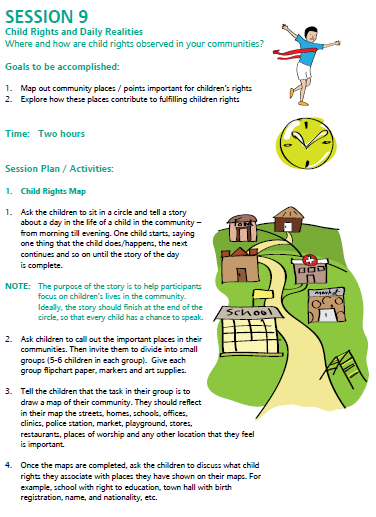
Section 9 on community mapping

The next section has very complete sessions on:

  • the concept of rights
  • the history of human rights, and international treaties on rights
  • children’s rights as human rights
  • duties and responsibilities in relation to child rights
  • making sure children are involved
  • child rights and daily realities and making a child rights map
  • gaps in fulfilling child rights
  • setting priority problems and violations of child rights
  • creating an action agenda and proposed solutions to the gaps identified

Each session comes complete with a pre-training assessment, reading material for facilitators and handouts for participants.

Part Three:

The last section of the manual helps facilitators take children through the steps to child-led community action, including children’s participation in all the program and project cycles: assessment, planning, implementation, monitoring and evaluation.

Needs-based vs. Rights-based

It also explains Plan’s rights-based child-centered community development approach, the foundations of that approach, and the difference between needs-based approaches and rights-based approaches. It goes on to cover planning and supporting child-led community action.

The last section of the guide offers a list of resources and references.

For anyone working with children, or even anyone looking for an excellent comprehensive community training package on rights and community-led action, I really recommend checking out Bamboo Shoots. Whether you are working through media and ICTs or using more traditional means for engaging children, this is a great guide on how to do it well from start to finish. I’ll be referring to it often.

Additional Resources:

Minimum standards for child participation in national and regional consultation events

Protocols and documents to help ensure good quality child participation

United Nations Convention on the Rights of the Child

Insight Share’s rights-based approach to participatory video toolkit

Related posts on Wait… What?

Child participation at events: getting it right

Community based child protection

Child protection, the media and youth media programs

Read Full Post »

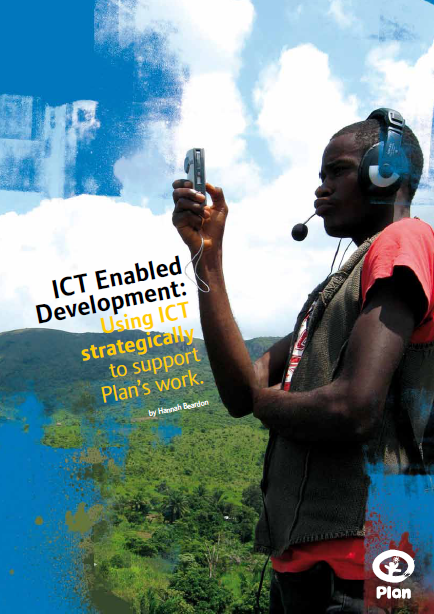
Plan just released a new report called ICT Enabled Development: Using ICT strategically to support Plan’s work. The report is part of an on-going process by Plan Finland (kudos to Mika Valitalo for leading the process) in collaboration with Plan USA to support Plan’s country offices in Africa to use ICTs strategically and effectively in their development work. It was written by Hannah Beardon and builds on the Mobiles for Development Guide that Plan Finland produced (also written by Hannah) in 2009.

The idea for the report came out of our work with staff and communities, and the sense that we needed to better understand and document the ICT4D context in the different countries where we are working. Country offices wanted to strengthen their capacities to strategically incorporate ICTs into their work and to ensure that any fund-raising efforts for ICTs were stemming from real needs and interest from the ground. Plan offices were also in the process of updating their long-term strategic plans and wanted to think through how and where they could incorporate ICTs in their work internally and with communities.

The process for creating the report included 2-day workshops with staff in 5 countries, using a methodology that Mika, Hannah and I put together. We created a set of ICT training materials and discussion questions and used a ‘distance-learning’ process, working with a point person in each office who planned and carried out the workshop. Mika and I supported via Skype and email.

Hannah researched existing reports and initiatives by participating offices to find evidence and examples of ICT use. She also held phone or skype conversations with key staff at the country and regional levels around their ICT use, needs and challenges, and pulled together information on the national ICT context for each country.

The first section of the report explains the concept of ‘ICT enabled development’ and why it is important for Plan and other development organizations to take on board. “With so many ICT tools and applications now available, the job of a development organization is no longer to compensate for lack of access but to find innovative and effective ways of putting the tools to development ends. This means not only developing separate projects to install ICTs in under-served communities, but looking at key development challenges and needs with an ICT eye, asking ‘how could ICTs help to overcome this problem’?

Drawing on the research, conversations, workshop input and feedback from staff, and documented experience using ICTs in Plan’s work, Hannah created a checklist with 10 key areas to think about when planning ICT-enabled development efforts.

  1. Context Analysis: what is happening with ICT (for development) in the country or region?
  2. Defining the need: what problems can ICT help overcome? what opportunities can it create?
  3. Choosing a strategy: what kind of ICT4D is needed? direct? internal? strategic?
  4. Undertaking a participatory communications assessment: who will benefit from this use of ICT and how?
  5. Choosing the technology: what ICTs/applications are available to meet this need or goal?
  6. Adjusting the content: can people understand and use the information provided for and by the ICTs?
  7. Building and using capacity: what kind of support will people need to use and benefit from the ICT, and to innovate around it?
  8. Monitoring progress: how do you know if the ICT is helping meet the development goal or need?
  9. Keeping it going: how can you manage risks and keep up with changes?
  10. Learning from each other: what has been done before, and what have you learned that others could use?

The checklist helps to ensure that ICT use is linked to real development needs and priorities and appropriate for those who are participating in an initiative or a project. The report elaborates on the 10 key areas with detailed observations, learning and examples to illustrate them and to help orient others who are working on similar initiatives. It places the checklist into a 4-stage process for ICT integration.

  1. Understanding the context for ICT work: includes external context and internal experience and capacity
  2. Finding a match between priorities and possibilities: rooting the system in local needs and priorities and finding good uses for tools and applications
  3. Planning and implementing concrete initiatives: carrying out participatory assessments, linking to other development processes and addressing technical issues and concerns
  4. Building a culture of systematic, sustained and strategic use of ICTs: linking ICTs with program work, transforming the role of ‘the ICT guy’, and building expertise on the cultural and social aspects of ICT use

Additional material and case studies, ICT country briefings, and an overview of Plan’s current work with ICT4D in Africa are offered at the end of the report.

The report includes input from Plan staff in Ghana, Mali, Mozambique, Senegal and Uganda who participated in the ICT4D workshops. It also draws heavily on some of the work that Mika has been doing in Finland and Kenya, and work that I’ve been involved in and have written about in Mali, Cameroon, Mozambique, Ghana, Benin and Kenya involving staff, community members and community youth. You can contact Mika to get the workshop methodology in French or English or to comment on the report (ict4d [at] plan [dot] fi).

There’s so much rich material in the report that I almost want to summarize the whole thing here on my blog, section by section, so that people will take the time to read it…  I think this is a really important and useful piece of work and we’re very excited that it’s now available! Download it here.

Related posts on Wait… What?

ICT4D in Uganda: ICT does not equal computers

Demystifying Internet (Ghana)

It’s all part of the ICT jigsaw: Plan Mozambique ICT4D workshops

A positively brilliant ICT4D workshop in Kwale, Kenya

7 or more questions to ask before adding ICTs (Benin)

A catalyst for positive change (Cameroon)

Salim’s ICT advice part 1: consider both process and passion (Kenya)

Salim’s ICT advice part 2: innovate but keep it real (Kenya)

Meeting in the middle

I and C, then T (US)

Read Full Post »

Coming from the viewpoint that accountability and transparency, citizen engagement and public debate are critical for good development, I posted yesterday on 5 ways that ICTs can support the MDGs. I got to thinking I would be remiss not to also post something on ways that ICTs (information and communication technologies) and poor or questionable use of ICTs and social media can hinder development.

It’s not really the fault of the technology. ICTs are tools, and the real issues lie behind the tools — they lie with people who create, market and use the tools. People cannot be separated from cultures and societies and power and money and politics. And those are the things that tend to hinder development, not really the ICTs themselves. However the combination of human tendencies and the possibilities ICTs and social media offer can can sometimes lead us down a shaky path to development or actually cause harm to the people that we are working with.

When do I start getting nervous about ICTs and social media for social good?

1) When the hype wins out over the real benefits of the technology. Sometimes the very idea of a cool and innovative technology wins out over an actual and realistic analysis of its impact and success. Here I pose the cases of the so-called Iran Twitter Revolution and One Laptop per Child (and I’ll throw in Play Pumps for good measure, though it’s not an ICT project, it’s an acknowledged hype and failure case). There are certainly other excellent examples. So many examples in fact that there are events called Fail Faires being organized to discuss these failures openly and learn how to avoid them in the future.

2) When it’s about the technology, not the information and communications needs.  When you hear someone say “We want to do an mHealth project” or “We need to have a Facebook page” or “We have a donor who wants to give us a bunch of mobile phones–do you know of something we can do with them?” you can be pretty sure that you have things backwards and are going to run into trouble down the road, wasting resources and energy on programs that are resting on weak foundations. Again, we can cite the One Laptop per Child (OLPC) initiative, where you have a tool, but the context for using it isn’t there (connectivity, power, teacher training and content). There is debate whether OLPC was a total failure or whether it paved the way for netbooks, cheap computers and other technologies that we use today. I’ll still say that the grand plan of OLPC:  a low-cost laptop for every child leading to development advances; had issues from the start because it was technology led.

3) When technology is designed from afar and parachuted in. If you don’t regularly involve people who will use your new technology, in the context where you’re planning for it to be used, you’re probably going to find yourself in a bind. True for ICTs and for a lot of other types of innovations out there. There’s a great conversation on Humanitarian Design vs. Design Imperialism that says it all. ICTs are no different. Designing information and communication systems in one place and imposing them on people in another place can hinder their uptake and/or waste time and money that could be spent in other ways that would better contribute to achieving development goals.

4) When the technology is part of a larger hidden agenda. I came across two very thought-provoking posts this week: one on the US Government’s Internet Freedom agenda and another from youth activists in the Middle East and North Africa region who criticize foundations and other donors for censoring their work when it doesn’t comply with US foreign policy messages. Clearly there are hidden political agendas at work which can derail the use of ICTs for human rights work and build mistrust instead of democracy. Another example of a potential hidden agenda is donation of proprietary hardware and software by large technology companies to NGOs and NGO consortia in order to lock in business (for example mHealth or eHealth) and prevent free and open source tools from being used, and which end up being costly to maintain, upgrade and license in the long-term.

5) When tech innovations put people and lives at risk. I’d encourage you to read this story about Haystack, a software hyped as a way to circumvent government censorship of social media tools that activists use to organize. After the US government fast-tracked it for use in Iran, huge security holes were found that could put activists in great danger. In our desire to see things as cool, cutting edge, and perhaps to be seen as cool and cutting edge ourselves, those of us suggesting and promoting ICTs for reporting human rights abuses or in other sensitive areas of work can cause more harm than we might imagine. It’s dangerous to push new technologies that haven’t been properly piloted and evaluated. It’s very easy to get caught up in coolness and forget the nuts and bolts and the time it takes to develop and test something new.

6) When technologists and humanitarians work in silos. A clear example of this might be the Crisis Camps that sprung up immediately after the Haiti Earthquakes in 2010. The outpouring of good will was phenomenal, and there were some positive results. The tech community got together to see how to help, which is a good thing. However the communication between the tech community and those working on the ground was not always conducive to developing tech solutions that were actually helpful. Here is an interesting overview by Ethan Zuckerman of some of the challenges the Crisis Commons faced. I remember attending a Crisis Camp and feeling confused about why one guy was building an iPhone application for local communities to gather data. Cool application for sure, but from what people I knew on the ground were saying, most people in local communities in Haiti don’t have iPhones. With better coordination among the sectors, people could put their talents and expertise to real use rather than busy work that makes them feel good.

7) When short attention spans give rise to vigilante development interventions. Because most of us in the West no longer have a full attention span (self included here), we want bite sized bits of information. But the reality of development is complicated, complex and deep. Social media has been heralded as a way to engage donors, supporters and youth; as a way to get people to help and to care. However the story being told has not gotten any deeper or more realistic in most cases than the 30 second television commercials or LiveAid concerts that shaped perceptions of the developing world 25 years ago. The myth of the simple story and simple solution propagates perhaps even further because of how quickly the message spreads. This gives rise to public perception that aid organizations are just giant bureaucracies (kind of true) and that a simple person with a simple idea could just go in and fix things without so much hullabaloo (not the case most of the time). The quick fix culture, supported and enhanced by social media, can be detrimental to the public’s patience with development, giving rise to apathy or what I might call vigilante development interventions — whereby people in the West (cough, cough, Sean Penn) parachute into a developing country or disaster scene to take development into their own hands because they can’t understand why it’s not happening as fast as the media tells them it should.

8 ) When DIY disregards proven practice. In line with the above, there are serious concerns in the aid and development community about the ‘amateurization’ of humanitarian and development work. The Internet allows people to link and communicate globally very easily. Anyone can throw up a website or a Facebook page and start a non-profit that way, regardless of their understanding of the local dynamics or good development practices built through years of experience in this line of work. Many see criticism from development workers as a form of elitism rather than a call for caution when messing around in other people’s lives or trying to do work that you may not be prepared for or have enough understanding about. The greater awareness and desire to use ‘social media for social good’ may be a positive thing, but it may also lead to good intentions gone awry and again, a waste of time and resources for people in communities, or even harm. There’s probably no better example of this phenomenon than #1millionshirts, originally promoted by Mashable, and really a terrible idea. See Good Intents for discussion around this phenomenon and tools to help donors educate themselves.

9) When the goal is not development but brand building through social media. Cause campaigns have been all the rage for the past several years. They are seen as a way for for-profit companies and non-profits to join together for the greater good. Social media and new ICTs have helped this along by making cause campaigns cheap and easy to do. However many ‘social media for social good’ efforts are simply bad development and can end up actually doing ‘social harm’. Perhaps a main reason for some of the bad ideas is that most social media cause campaigns are not actually designed to do social good. As Mashable says, through this type of campaign, ‘small businesses can gain exposure without breaking the bank, and large companies can reach millions of consumers in a matter of hours.’ When ‘social good’ goals are secondary to the ‘exposure for my brand’ goals, I really question the benefits and contribution to development.

10) When new media increases voyeurism, sensationalism or risk. In their rush to be the most innovative or hard-hitting in the competition for scarce donor dollars, organizations sometimes expose communities to child protection risks or come up with cutesy or edgy social media ideas that invade and interrupt people’s lives; for example, ideas like putting a live web camera in a community so that donors can log on 24/7 and see what’s happening in a ‘real live community.’ (This reminds me a bit of the Procrastination Pit’s 8 Cutest and Weirdest Live Animal Cams). Or when opportunities for donors to chat with people in communities become gimmicks and interrupt people in communities from their daily lives and work. Even professional journalists sometimes engage in questionable new media practices that can endanger their sources or trivialize their stories. With the Internet, stories stick around a lot longer and travel a lot farther and reach their fingers back to where they started a lot more easily than they used to. Here I will suggest two cases: Nick Kristof’s naming and fully identifying a 9-year-old victim of rape in the DRC and @MacClelland’s ‘live tweeting’ for Mother Jones of a rape survivor’s visit to the doctor in Haiti.

Update: Feb 22, 2011 – adding a 10a!

10a) When new media and new technologies put human rights activists at risk of identification and persecution. New privacy and anonymity issues are coming up due to the increasing ubiquity of video for human rights documenting. This was clearly seen in the February 2011 uprisings in Egypt, Tunisia, Libya, Bahrain and elsewhere.  From Sam Gregory’s excellent piece on privacy and anonymity in the digital age: “In the case of video (or photos), a largely unaddressed question arises. What about the rights to anonymity and privacy for those people who appear, intentionally or not, in visual recordings originating in sites of individual or mass human rights violations? Consider the persecution later faced by bystanders and people who stepped in to film or assist Neda Agha-Soltan as she lay dying during the election protests in Iran in 2009. People in video can be identified by old-fashioned investigative techniques, by crowd-sourcing (as with the Iran example noted above…) or by face detection/recognition software. The latter is now even built into consumer products like the Facebook Photos, thus exposing activists using Facebook to a layer of risk largely beyond their control.”

11) When ICTs and new media turn activism to slacktivism. Quoting from Evgeny Morozov, “slacktivism” is the ideal type of activism for a lazy generation: why bother with sit-ins and the risk of arrest, police brutality, or torture if one can be as loud campaigning in the virtual space? Given the media’s fixation on all things digital — from blogging to social networking to Twitter — every click of your mouse is almost guaranteed to receive immediate media attention, as long as it’s geared towards the noble causes. That media attention doesn’t always translate into campaign effectiveness is only of secondary importance.” Nuff said.

I’ll leave you with this kick-ass Le Tigre Video: Get off the Internet.… knowing full well that I’m probably the first one who needs to take that advice.

‘It feels so 80s… or early 90s…  to be political… where are my friends? GET OFF THE INTERNET, I’ll meet you in the streets….’


Related posts on Wait… What?

3 ways to integrate ICTs into development work

5 ways ICTs can support the MDGs

7 (or more) questions to ask before adding ICTs

Amateurs, professionals, innovations and smart aid

I and C, then T

MDGs through a child rights lens


Read Full Post »

I’ll be speaking on a panel called ICT4D, Innovations and the MDGs next week during UN Week in New York and another on Girls and Mobiles hosted by Mobile Active. So, I’ve been putting together my thoughts around girls, child rights, ICTs and the MDGs.  The angle I’m taking is not from the large donor, top down, huge institutional program side, but instead, looking at examples from the work I’ve been closest to over the past few years at the community and district level, mostly focused on child and youth participation in the development process. Check my MDGs through a child rights lens post for more background.

My last post (3 ways to integrate ICTs into your development organization) uses Hannah Beardon’s framework to discuss how organizations can integrate ICTs into their work. Hannah suggests that ICTs can be integrated directly(providing access to ICTs), strategically (using ICTs as tools to support development processes) and indirectly (using ICTs to improve efficiency and communication within the organization).

To complete that post, I’m listing below 5 ways that ICTs can facilitate accountability and transparency, citizen engagement, and public debate, all of which are necessary to bring about development improvements and achieve the MDGs. Obviously these are not the only ways ICTs can support the MDGs, but this post would have been miles long if I’d listed all the initiatives that are out there.

1) Engaging children and youth in the development process

An engaged and active population is a key ingredient for good development programs. Children and youth have much to offer, are directly targeted in the MDGs and many other development initiatives, offer valuable ideas and energy, and make up around half the population in many of the countries that are lagging in reaching the MDGs. ICTs can help children and youth engage in the development process and bring their ideas, opinions and voices alive at the community, district, national and global level. ‘Using new technology, new media, children and youth can claim a space that they didn’t have before. They can influence certain things, advocate on particular issues that are important to them, take ownership in communities and in leadership. ICTs excite them and encourage them to be more involved and engaged.’ Anthony Njoroge, Plan Kenya Community ICT Manager.

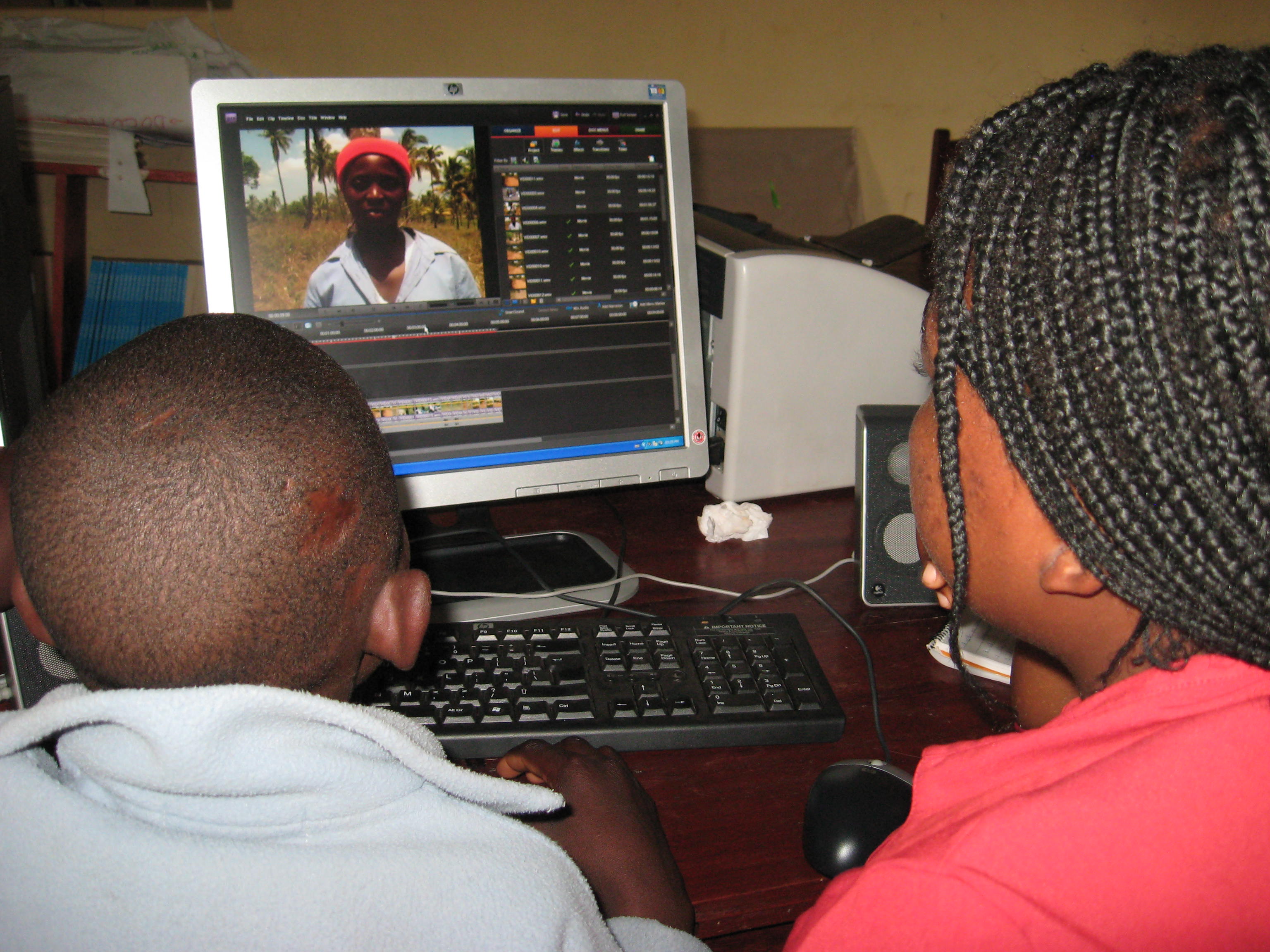
ICTs empower young people with skills that make them more confident and more involved at the community level.‘Using ICTs, children and youth have become more responsible because they are not waiting for adults to come in with something. Now they are designing it themselves, they are creating space for themselves and bringing their agenda to adult meetings instead of waiting to be invited in or having to work within the agenda of the adults. It used to be that you’d start working with 20 youth, you’d invite them into a community meeting. You’d see the number go down to 10, to 4, to 3, because they didn’t see any relation to themselves in the topics and the goings on. With integration of technology and the arts however, youth have a high level of interest. It’s really bringing in their opinions, their thoughts and ideas to join their voices with parents. Now they use arts and media to promote communication, dialogue on their issues and look for ways to resolve them. Before they were totally missing from the discussion, but now they are here.’ Judith Nkie, Plan Cameroon Youth Empowerment through Arts and Media Project Coordinator.

Arts and ICTs were used in the above-mentioned project as tools for youth engagement, mapping and prioritizing, research and community dialog. The media produced with the ICT tools was shared first within the community and then outside at the district, national and global levels as a way of engaging decision makers and the public in the youths’ agenda.  For more on how arts and ICTs are being used in the above-mentioned project, see this post. Watch 100 videos made by youth in 6 African countries on topics they are passionate about.

GPS work in Kwale, Kenya

2) Identifying resources and mapping patterns for better decision-making

Tracking and visualizing information is an excellent way to improve decision-making capacity. The advent of simpler and open source participatory digital mapping tools allows community members to map their communities digitally and to have more ownership of the information. Mapping helps identify patterns that may not have been visible before. Local maps shared on-line allow local people to provide their own information from their own perspective, and that information serves multiple purposes at the local level and beyond.

Digital mapping can be helpful when governments decentralize. Municipalities are mapping resources as well as projects and interventions. District authorities can track their own initiatives and those by local and international organizations to avoid duplication of efforts and wasted resources. When maps are public, the population can better demand answers about where resources are being allocated and why. Maps can help with disaster risk reduction and tools such as Ushahidi can help during emergency response. Mapping information is also useful for holding up a mirror to the population to ask them questions about themselves and their behaviors and for showing the direct consequences of actions; for example in a Community Total Led Sanitation mapping project, the community faces its realities about where their own waste is entering food and water sources.

Map Kibera is a good example of participatory digital mapping. mGEOS is a mobile mapping tool developed to help Plan Kenya staff to gather and share data needed for their daily work. Map Kibera and Plan Kenya are collaborating in Kwale on youth and governance work, and in Mathare to work on Community Total Led Sanitation using digital mapping tools (see July 27th entry). In this video, a district youth officer in Kenya talks about why digital mapping is useful for his community.

Mapping Violence against Children in Benin

3) Pulling in quick information to guide further investigation, response, or advocacy; pushing out information for targeted actions

ICTs can be used to gather quick information from a broad population. This can be useful in a variety of situations and themes, including those outlined in the MDGs. For example, SMS are being used to report on whether teachers are showing up at school, where violence against children and women is happening, where help is needed in the aftermath of a disaster, and for tracking endangered wildlife. Crowd sourced information can help governments and agencies get preliminary information so that further investigation and support can be provided in a particular area. Another example is the use of mobiles in different health initiatives, including:  child-birth care; HIV and AIDS prevention and treatment programs; support for volunteer community healthcare workers; and bed net treatment reminders. Most of the ICT and development world is also already familiar with the work of two organizations:  Ushahidi and FrontlineSMS who have been combining SMS with digital mapping.

A program that I’m closely involved with is SMS reporting of violence against children in Benin, where local communities, government agencies and NGOs are collaborating to improve the child protection system. This type of program shows promise if heed is paid to the pros and cons of collecting information by SMS, and if those implementing are clear about the type of information that will be gathered, privacy implications, and how the system will complement existing systems. (Here is one document that outlines some considerations). Increasing controls by governments and mobile phone companies, including SIM card registry and Mozambique’s recent government shut down of SMS services during the bread riots are good examples of how quickly the ICT landscape can change, and how flexible and agile those working in the area of ICTs need to be.

Checking info on constituency development fund

4) Supporting accountability and transparency

ICTs are useful to support accountability and transparency, necessary for attempts to track and ensure good use of funding for different efforts, including those related to the MDGs and other aid and development programs. Making information more available to the public by mobile is one such way.  SODNET’s budget tracking tool, for example, informs Kenyans of how much funding is allocated by the Constituency Development Fund to different municipalities in different categories. Combined with mapping, as outlined in this post, the budget information can help constituents to track where their funds are actually being spent.  Other interesting examples of how ICTs can be used for transparency and accountability can be found at TacticalTech’s Info Activism site and at Technology for Transparency.

Paper forms will soon be digitized….

5) Improving municipal services and information management

Civil registration documents, especially a birth certificate, are a precursor to demanding any number of rights or accessing a wide array of services. Without a birth certificate a child may not be able to sit for school exams, receive immunizations or free health care or claim rights to inheritance or legal protection in courts of law. Proof of age is critical in successfully prosecuting perpetrators of crimes against children such as child trafficking, sexual offenses, early recruitment into the armed forces, child marriage and child labor. ICTs are being used to digitize civil registry in Kenya, for example. Not only are records being digitized, but mobile phones are used to make it more convenient for the population to know when their documents are ready. This saves people time and money and means that more parents will register their children.

But wait, there’s more!

These are only a few examples of ways that ICTs are being used at the grassroots level to improve participation, transparency, accountability, debate and ownership of the development process.  The MDGs are lofty, but informed local community participation and ownership is key in efforts to reach them and in ensuring that marginalized populations can also be included.

Please add your examples of ways that ICTs can support development and ICTs in the comments section!

Related posts on Wait… What?

3 ways to integrate ICTs into development work

11 concerns about ICTs and ‘social media for social good’

I and C, then T

MDGs through a child rights lens

7 (or more) questions to ask before adding ICTs

A positively brilliant ICT4D workshop in Kwale, Kenya

The road to Wa is paved

Read Full Post »

« Newer Posts - Older Posts »