Feeds:
Posts
Comments

Image captured from page 19 of the Polis report.

Who cares? Challenges and opportunities in communicating distant suffering: a view from the development and humanitarian sector, a study conducted by Polis, (the journalism think-tank within the Department of Media and Communications at the London School of Economics- LSE) with Plan UKlaunched yesterday in London.
.
The study complements several pieces of research released over the past year or two on the UK public’s perception of foreign aid, development, giving, and the NGO sector; including Intermedia’s Building Support for International Development, the UK Public Opinion Monitor/Institute of Development Studies’ What Does the Public Think, Know and Do about Aid and Development? report, the Oxfam/Bond/DfID Finding Frames report and the Overseas Development Institute’s Understanding Public Attitudes to Aid and Development.

Whereas the other reports focus on various aspects of how the public sees charity, development and foreign aid, the Polis report gives a window into the debates and challenges of those working in advocacy, marketing, campaigning, fundraising and communication departments at INGOs. As my Plan UK colleague, Leigh Daynes, writes in the introduction:

‘…Our work to inform, to educate, to campaign for change and to recruit long-term supporters to fund change is valid. Often it is life-saving. Yet the least understood area of our work often is the impact of our communications on public understanding of and support for aid and development. The public are telling us they are saturated with suffering, that we are charming or disarming them into acts of compassion, and that we are abusing their emotions….

…Understanding the impact of the “lingua franca” of our industry matters because it has fuelled a template approach to the media reporting of suffering. It matters because the exponential growth in access to mobile and social media technology and platforms means we are no longer the de facto guardians we once were. And it matters because it speaks to the power between us and them, and you and me.’

As more and more research is done, the ways that the sector is shifting become clearer and I hope we will start to see some positive changes in the aid and development industry and the way it communicates with the general public.

Some angles and voices that could help round out the discussion are still missing, however. I would like to see research on the opinions of local and international staff managing programs on the ground. Most organizations have fierce internal discussions on how marketing and fundraising is done, as program staff often feel that some marketing and fundraising approaches are demeaning, disrespectful and undignified in their portrayal of program participants.  (For more on this, ask Talesfromthhood to share some of his blog posts with you, join some of the discussions on AidSource, or follow the #smartaid hash tag on Twitter). Some program staff worry that the long-term impact of media and fundraising shock tactics and overly simplistic messaging ‘cancels out’ the short-term gains achieved through program or emergency aid funding – a point that is raised in some of the research above – and that this contributes to two-dimensional views on aid and development and to the negative stereotypes about certain countries in Africa, Latin America and Asia that deter longer-term development and self-determination. It would be interesting to know more from this perspective.

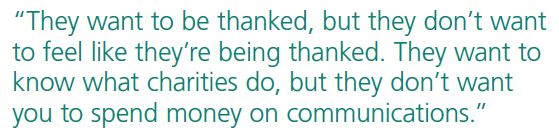
What do donors want? Image captured from page 9 of the report.

At the same time, INGOs are hard-pressed to come up with different and viable ways of funding their work, so this type of campaigning and fundraising continues. Although I’m familiar with some of the challenges my marketing colleagues face, I was struck seeing the kinds of donor demands that INGOs are expected to meet listed in the report. I was reminded of something a marketing colleague once said: ‘Poverty porn. That’s a good term. It is a lot like real porn. People don’t like to publicly admit to watching and responding to it, but in private it’s another story. People say they don’t like poverty porn and sad, desperate stories, but when you look at the numbers, it’s what makes them reach into their pockets and give.’

I would also like to see some research with the subjects (unfortunately often presented as ‘objects’) of INGO aid and marketing materials.  How do program participants feel about how they are portrayed? What impact does it have on them and their own perspectives and self-determination, if any? Strong voices on this come from diaspora communities and from blogs such as Africa is a Country, Uganda 2012: Trending Our Own Stories, and great projects like My Africa Is; but I’d also like to see some in-depth research and objective focus groups that talk with those who are most often shown in INGO marketing. Are people aware of how they are being represented? Do they care? Many of us speculate about this when we bash ‘poverty porn’ but I’ve yet to see published research that involves actual ‘beneficiaries’ of INGO programs or people and communities appearing in INGO marketing and fundraising pieces in this discussion. (Maybe I’ve missed it – if you know of  any, please share!)

The ‘Who Cares’ report notes in the conclusion that:

  • transparency, accountability, ‘value for money,’ and impact are becoming more important to the donor public
  • public trust is a central concern for NGOs in their work and their communications
  • the sector needs to assume more collective responsibility for ethically appropriate portrayal of disaster victims (eg, in compliance with Article 10 of the Red Cross Red Crescent Code of Conduct)
  • new technologies and competition mean that fundraisers are seeking supporters outside of their traditional constituencies
  • traditional gatekeepers of aid are being challenged by new media’s ability to put donors and ‘beneficiaries’ in more direct contact

As INGO institutional leadership space opens up to more people from ‘the global South’, diaspora communities grow, social media allows for commercials and fundraising appeals to reach global audiences (including people in the countries where INGOs implement their programs), attention is paid to the ‘new bottom billion‘ and new fundraising mechanisms arise (for example, INGOs raising funds within countries where they are implementing programs), it will be interesting to see how the conversations and approaches shift and change — or if they remain the same with new actors taking on the same challenges.

Stay tuned for further research and reporting over the next couple of years from Polis and download the report here.

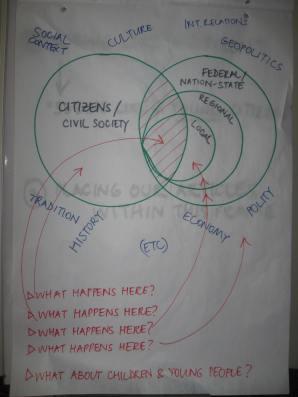
Where are the spaces for dialogue on good governance? (Image from a workshop on youth participatory governance, April 2011)

As I mentioned in my ‘governance is *so* not boring’ post, I am recently back from an internal workshop where some 20 colleagues from across the organization where I work (Plan) pulled together some basic elements for a global program strategy on Youth, Citizenship and Governance.

One of the key elements that we talked about was the importance of information literacy in citizenship and governance work, including at the level of governments, duty bearers and decision makers and of course at the level of citizens — in our case, especially children and young people. Information literacy is defined by the University of Idaho as “the ability to identify what information is needed, understand how the information is organized, identify the best sources of information for a given need, locate those sources, evaluate the sources critically, and share that information”. (I can hear my librarian friends cheering right now, as they’ve been working on this for years).

Openness as an attitude came up as something that’s important all around for good governance. This doesn’t only mean ‘open’ as a technological specification for data, but rather openness as an entire approach and attitude towards governance, citizen participation and the nature of relationships and interactions in the spaces where citizens and government overlap. We were able to link our work up very well with the concepts of open development, open government and open data; all of which can contribute to better transparency, accountability and governance and which require information literacy and a number of other skills and capacities in order to take advantage of.

My practitioner colleagues said over and over at the meeting ‘we don’t have access to the information we need to do better governance work.’ I was left wondering how those of us working at various levels, including the field of ICT4D and related, can do a better job of supporting access to information, and what are the technology and non-technology tools and approaches that work best. There is still a huge gap between the community- and district-level governance work that my colleagues are working on with children, youth and communities and the big on-line data sets that are part of open data and open government. Both very important, but there really needs to be a stronger link between the two so that they can feed into each other to achieve better governance. Once again – the questions ‘open for who? and open for what?‘ come in, as well as the need for a two-way (multi-way?) information flow.

We talked about how social accountability tools like community scorecards, social audits, budget tracking and monitoring, and participatory budgeting can be an important way for engaging marginalized and excluded populations in governance work outside of more formal channels (eg, elections, law courts, planning and auditing of public expenditure). Social accountability tools and processes allow people to more directly participate in the accountability process and make themselves heard rather than leaving accountability in the hands of the government or relying only on formal mechanisms. During our workshop, we watched the International Budget Partnership’s video ‘It’s our money, where has it gone‘ on using social accountability tools in Kenya. (Long, but very worth watching)

Following the video I explained open data in a nutshell by asking people to imagine that the budget information that the community had to get via their district officials was available online and could be accessed without going through the district officer. It was a good opportunity to think about the potential of open data and open government and how they can fit in with social accountability work.

The video highlights the very real dangers that can be present when working on transparency and accountability. Since in our case we are working with children and youth, we need to be especially aware of potential risks involved in transparency, accountability and good governance work, because this kind of work raises questions and aims to shift power and politics and resources. We need to be very sure that we are not somehow pushing our own agenda through children and youth, or handing them a hot potato that we don’t want to take on as adults or organizations, or even unintentionally putting them at risk because we haven’t fully thought through a project or initiative. We need to be sure that we are conducting thorough, participatory and shared risk assessments together with children and youth and establishing mechanisms and ways of mitigating risks, or making decisions on what to pursue and what to leave for others. Child protection, our own responsibilities as duty bearers, and the notion of ‘do no harm’ are massively important to bring in here.

We spent time talking about what we need to do as an institution to support good governance, and emphasized that openness and good governance is a key element of institutions, INGOs, local NGOs and CBOs who want to be credible in this space.  Organizations that are working with communities to push for local and/or national government transparency and accountability should expect that these same demands will be turned around to them, and the same questions asked of government and decision-makers will be asked of them. Taking those steps internally towards openness, accountability and good governance is critical. When working with youth associations and children’s groups, this is also a point for strengthening so that openness, transparency, accountability, positive leadership and other capacities, capabilities and skills are enhanced. If local associations replicate the bad governance practices that they are trying to change, then things are really not advancing much.

Successful governance work addresses multiple sides of the governance issue. Working only with citizens can create a demand that outstrips government interest, capacity or responsiveness and lead to apathy, frustration and/or conflict. So it’s really important to work with duty bearers and decision makers as well as with children and youth and their communities, and with other non-state adult actors, such as parents, teachers, community leaders and the media; to help create an environment for better governance. In addition, it’s important to understand the  incentives and disincentives that shape the behaviors of different service providers, for example teachers and health care workers.

As my colleague Wale Osofisan from our UK office pointed out today after I shared these videos on governance work: “It is not enough to get the students and communities to monitor absenteeism without really examining the root causes of the problem from the point of view of the teachers and doctors. For example, in the DRC health care workers at PHCs particularly in the rural areas don’t get their salaries paid on time – sometimes for 6 months. Hence, they are forced to abandon their official duty posts and find alternative ways of earning an income either working informally for a private clinic which pays them or they engage in other economic activities. Same goes for the teachers. Thus, civil society interventions also need to focus on the problems encountered in the supply side of the equation… This is quite a challenge because it would require tackling the perverse politics of service delivery in many developing countries and NGOs always find it very uncomfortable to engage in such terrain.”

Good governance work uses existing spaces for collaboration and dialogue among the various actors or creates new space if none exists. It builds skills and capacities in both citizens and government officials. Children and youth, for example, need to have capacities to work effectively together, organize, prioritize, influence, use media and new communication technologies, access information and interpret/analyze it, and to develop partnerships and networks. Decision-makers need to strengthen capacities to engage with children and young people, to hear, respond, follow up and provide feedback. Government institutions need to have the attitudes as well as the resources to be more responsive to citizens’ needs and rights. Government employees, as mentioned above, need to also have the space to share what makes it difficult for them to do their jobs.

We did some group work around the 3 key actors in our citizenship and governance work: the State, children and young people, and other non-state adult actors. I participated in the group that looked at the changes that would need to happen at the level of the State and was again reminded how this work requires so much more than accountability mechanisms, new ICT tools and data. We talked about what would motivate a State to have an open information policy. What is in it for elected officials? How can State actors be motivated to change their attitudes to one of more openness and accountability? Can citizens push the State to be more open? Is international donor or political pressure the only motivator that has been successful so far in most countries? If a State is not governing well, what are the common root causes? If openness is an attitude, what motivates a State and its different bodies to be open? External pressure and citizen demand are one thing, but what about addressing other factors that prohibit good governance?

Linking and promoting collaboration between and among children’s and youth groups was noted as another key piece of citizenship and governance work with young people. This can be supported at a face-to-face level but also needs to happen from the local to the global level, so that young people can connect and share common agendas and experiences both ‘horizontally and vertically.’ The web is a key tool here for taking local issues to the global level and back down again to community level. A question in my mind here was how INGOs can do a better job of linking youth and governance work that they are supporting at local levels with the external social and political environment so that they are not happening in parallel or in a vacuum. Another was whether we are thinking enough about broader social and political movements as related to major events or changes happening in a country or globally (eg, Arab Spring, Occupy Wall Street, Rio+20) and our role and position and purpose there. And what about on-line organizing and activism and ‘direct democracy’ as more young people access on-line networks and activism happens in virtual spaces?

We discussed quite a lot about how supporting overall behavior changes and public opinion are critical to creating an environment that supports public accountability and openness and gets these on the agenda. It’s also important to change attitudes with relation to how children and young people are perceived so that adults and decision-makers will listen to them and take their opinions and claims into consideration. Programs that engage children and youth and showcase their capacities and abilities can help decision-makers and other non-state adults to see that the younger generation does have valid points, opinions and ideas for positive change.

And lastly, there is the importance of ensuring that staff are well versed in local political contexts and how government systems work. Without a strong and nuanced understanding of the local context, local power dynamics, local political and local cultural contexts, and how children and young people and other excluded groups are viewed, programs may be over ambitious, wrong-headed, create dangerous conflict, set back governance and accountability work, or put children and young people in harm’s way. The complexity of this kind of work combined with the complexity of the various settings mean that a clear theory of change is needed to guide efforts and expressly address the specific changes that are sought so that initiatives can be well-designed, implemented, monitored and evaluated, and so that there is a better chance of a good impact.

Related posts:

Young citizens: youth, and participatory governance in Africa

A practitioner’s discussion on social accountability and youth participatory governance

Governance is *so* not boring

Does ‘openness’ enhance development?

New technology and good governance

ICTs, social media, local government and youth-led social audits

Digital mapping and governance: the stories behind the maps

What would an International CSO Governance revolution look like?

Resources:

IIED’s Participatory Learning and Action Journal: Young Citizens: Youth and participatory governance in Africa

Plan UK’s Governance Learning Guide

Technology for Transparency network

I’ve been told that mention of the term ‘governance’ makes people want to immediately roll over and fall asleep, and that I’m a big weirdo for being interested in it. But I promise you governance is *so* not boring! (I’m also fairly sure that whatever my teacher droned on about as I slept through my ‘Government’ class senior year of high school was not ‘governance’.)

If you get excited about the concepts of ‘open’ or ‘transparent’ or ‘accountable’ or ‘sustainable’ or ‘human rights’ or ‘politics’ then you need to also get pumped about ‘governance’ because it includes elements of all of the above.

I am just back from a week-long workshop where, based on our different practical and strategic and thematic experiences, internal and external evaluations and reviews of good practice, videos and documents from other organizations, input from children and youth in several countries (and with the support of a fantastic facilitator), several of us from different Plan offices worked to define the basic elements for a global program strategy on Youth, Citizenship and Governance (to be completed over the next several months).

At the workshop, we got a copy of A Governance Learning Guide, which I’m finding very useful and am summarizing below.

Why is governance important?

Our focus is on children and youth, but many of the reasons that governance is important for them extend to governance overall.

From Plan UK’s Governance Learning Guide, chapter 1.

So what exactly do we mean by the term “governance”? 

In our case, we link governance work with our child-centered community approach (a rights-based approach) and in this particular strategy, we will be focusing on the processes by which the state exercises power, and the relationships between the state and citizens. We have separate yet related strands of work around child and youth participation in our internal governance structures (here’s one example), effectiveness of our institutional governance overall (see this discussion on International CSO governance, for example), and the participation of children and youth in high level decision-making fora.

Our concept of governance for the youth, citizenship and governance strategy is based on the following governance concepts*:

Accountability and responsiveness.  This includes formal government accountability as well as citizen-led accountability. Opportunities for children and youth to participate in formal accountability processes are often limited due to their age — they cannot participate in elections, for example. Citizen-led accountability can open new opportunities for children, youth and other more marginalized groups to hold those in power more accountable.

‘People no longer rely on governments alone to improve governance. All over the world we are seeing experiments in ‘participatory governance’. People and organisations are grasping the opportunities offered by decentralisation and other reform processes to demand more of a say in the public policy and budget processes that affect them. These ways of holding the state to account are often called ‘social accountability’. Examples include participatory budgeting, monitoring electoral processes, using online and mobile technology, and citizen evaluation of public services. These forms of citizen engagement and social accountability are particularly promising for young people, who often face challenges in getting their voices heard in formal policy and governance processes.’ (from the call for submissions for the Participatory Learning and Action Journal (PLA) special issue on Young Citizens: youth and participatory governance in Africa, published in December, 2011)

Accountability is also linked with openness and sharing of information such as local government budgets and plans (this is also referred to as ‘transparency’). Responsiveness, in our case, refers to ‘the extent to which service providers and decision makers listen, meet and respond to the needs and concerns of young people.’ Responsiveness includes the willingness of those in power to engage seriously with young people and a government’s commitment to ‘be responsive’ to the issues raised by citizens, including children and young people. Responsiveness entails also the administrative and financial capacity to respond concretely to a population’s needs, rights and input.

Voice and participation.  This refers to the capacity of young people to speak, be heard and connect to others. Voice is one of the most important means for young people to participate. Within the concept of ‘voice’ we also consider voice strategies for raising and amplifying voices, capacity to use voice in a variety of ways to bring about change, space to exercise the raising of voices, and voice as a means to participate and exercise citizenship rights. (We consider that every child has citizenship rights, not only those who hold citizenship in a particular country). It’s also important to qualify the use of the term participation. In the case of young people’s participation in governance, we are not referring to the participatory methods that we commonly use in program planning or evaluation (we are also not discounting these at all – these are critical for good development processes!). In governance work, we are rather taking it further to refer to the meaningful inclusion of children and young people in decision-making processes.  

Power and politics. These are key in governance work. It is essential to be aware of and understand politics and power dynamics so that children and young people (and other oft-excluded groups) are not overlooked, manipulated, intimidated or disempowered.

Image captured from Plan UK’s Governance Learning Guide, chapter 2 page 14.

A key question here is what children and young people are participating in, and what for. Another important question is where are children and young people participating? Is it in special events or spaces designated just for them or are they participating in adult spaces? How does the place and space where children and young people are participating impact on their ability to influence decisions?

It’s important to note the 4 types of power that are typically considered in power analyses (from VeneKlasen, 2007): power over (domination or control), power within (self-worth), power to (individual ability to act, agency) and power with (collective action, working together). These need to be analyzed and understood, including their social, cultural and historical factors that create and sustain different power dynamics in different situations and spaces.

Capacity. We refer here to the capacity of both decision-makers and young people. Decision makers need to have the ability to perform their duties and ensure services are delivered. This, in our case, includes the abilities of decision makers to interact, engage and listen to children and young people and to take them seriously and to be responsive (see above) to their views, needs and rights. Young people also need to have the capacity to hold decision makers to account and to express their concerns and their views, including the views of other children and young people who may be excluded and marginalized from the decision making process or from participating fully. Information literacy and the capacity to access, interpret and analyze information is a critical skill for children and young people.

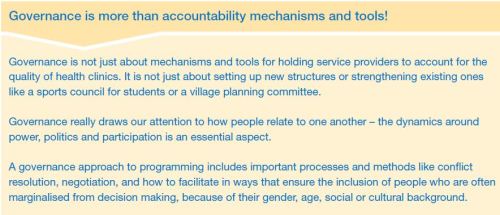
Interactions between children and young people and decision makers. These spaces encompass critical aspects of participation, power and politics. An example of a space for interaction would be where children and young people, local government and school leaders come together to discuss budget plans and available resources for school infrastructure. These spaces are shaped by a number of factors, including social, economic, cultural ones. They are also not free of personal agendas, desires, intentions and prejudices. It’s critical to remember this in governance work — ‘tools’ and ‘mechanisms’ are not enough. (ICT4Governance and Tech for Transparency friends, I’m looking at you! Though I think most of us see this point as ‘beating a dead horse’ by now.)

From Chapter 2 of the Governance Learning Guide by Plan UK

*Summarized from Chapter 1 and Chapter 2 of Plan UK’s extremely useful and easily downloadable A Governance Learning Guide. The guide also has a number of practical use cases on different governance initiatives as well as an extensive section on additional resources.

Here’s a follow-up post (since governance is so clearly *not* boring and I’m sure there is high demand for more!) called 15 thoughts on good governance programming with youth.


This is a cross-post by Laura Pohl who works at the Bread for the World. The post is a summary of the latest Humanitarian Photography group meeting. The meetings are part of a series of meetings about photography in humanitarian work organized by CORE Group. (The original is posted here)

An employee at the Yemi Hanbok factory near Yanji, China, examines a traditional Korean skirt she is dyeing.The factory’s unique geographic position in China, near North Korea, means it can have work done cheaply in both countries and then sell to customers in South Korea. Photo © Laura Elizabeth Pohl

One of the most common questions I get asked at work is, “Can I use this picture?”

Oh, there are so many answers — and we talked about most of them at our latest Humanitarian Photography Group meeting this past Tuesday. Jim Stipe of Catholic Relief Services, Ann Hendrix-Jenkins of CORE Group and I organized the meeting. I led it, starting off with a talk on figuring out whether a photograph is yours or not. Sounds easy, right?

Well, if someone on your staff shot the picture then yes, the answer is easy: you can use it. But should you use it? (More on that later.) If your organization hired a freelancer to shoot pictures for you, then yes, you can use the pictures but possibly with restrictions. It depends on the type of contract between you and the photographer. The main point here is that the photographer usually still retains copyright to the picture and your organization is licensing the pictures. If this all sounds complicated and legalistic, don’t worry; we’ll be delving into copyright, contracts and licensing in a future meeting. Finally, if you don’t know who shot the photograph, where it came from or who owns the copyright, it’s best not to use the picture.

Next I talked a bit about Creative Commons licenses, which photographers use when they want to let the public publish their pictures without paying a licensing fee. CC-licensed photos abound on Flickr, a frequent source of pictures for nonprofit organizations. Just be sure the picture editor at your organization (or the person in this role) understands all six CC licenses and when a picture is fully copyrighted, all rights reserved. When I was a freelance photographer, an NGO once published my copyrighted photographs from Flickr without my permission. I found the copyright violation and sent the organization a stern letter and invoice for the pictures. The organization paid up. They never apologized, though. The organization had tasked their intern with finding pictures. It turns out he didn’t understand copyright.

Finally, I talked about content and technical criteria for publishing pictures, showing about 20 “bad” photos that Jim and I found. There are many reasons photographs shouldn’t see the light of day but I think the best way to summarize the photo usage criteria listed below is, “Do unto others as you would have them do unto you.” That out-of-focus photograph of 10 bored-looking people sitting in a meeting? You don’t have to use it. That portrait of a person with a strange expression on his face? Just don’t publish it. As Jim often says, “It’s better not to use a photograph than to use a bad photograph.”

  • Dignity – No emaciated children, flies in eyes, violence or stereotypical images.
  • Safety – Could the picture put the photo subjects in danger, even if they agreed to be photographed?
  • Context – No pretending photos of one thing are of something else. Sometimes photos published as a collection make sense together but one photo on its own from the collection doesn’t make sense.
  • Caption – Who’s in the picture? Where was it taken? Why is this picture important? Even if you can’t publish this information because of safety concerns, it’s important to have the information for your internal records.
  • Credit – Who took the picture? It’s just like attributing a quote.
  • Third effect – Two pictures paired together can take on a new meaning.
  • Focus – Is the picture sharp or blurry?
  • Framing – Is the photo framed well?
  • Exposure – Is the picture properly exposed?
  • Color – Does it look natural?

People had great comments and questions at the end. (By the way, Jim did a nice job tweeting the meeting at #NGOphoto.) A woman named Aubrey said her organization works on a lot of construction projects, roads, latrines, etc. They often shoot before and after photographs to show the impact of their projects. Another person asked about setting up or staging shots. Some people wanted to know more about contracts and how to work with country programs to set up photo shoots. These are all meaty topics. I can’t wait to get into them more in future meetings. We’re taking a break for the summer but we’ll meet again in September, so get in touch if you’d like to join us.

You can find summaries of other meetings here:

April: On the ethics of photos in aid and development work

May: Aid, ethics, photography and informed consent

‘Breast flattening,’ also known as ‘breast ironing’ or ‘breast massage,’ is a practice whereby a young girl’s developing breasts are massaged, pounded, pressed, or patted with an object, usually heated in a wooden fire, to make them stop developing, grow more slowly or disappear completely.

Rebecca Tapscott* spent last August in the area of Bafut, in the Northwest, Anglophone region of Cameroon, where a 2006 study by the German Society for International Cooperation (GIZ) found an 18% prevalence rate of breast flattening. The practice has been known as breast ‘ironing,’ however, Rebecca opts to use the term ‘flattening’ to decrease stigma and encourage open conversation about a practice that remains largely hidden.** Rebecca wanted to understand the role of breast flattening in the broader context of adolescence in Cameroon, including past and present motivations for breast flattening; cultural foundations; relation to other forms of gender-based violence such as female genital mutilation or cutting (FGM/C); how and where it is practiced; the psychological and the physical implications of the practice on individual girls.

Rebecca published her findings via the Feinstein International Center in May 2012, in a paper titled: Understanding Breast “Ironing”: A Study of the Methods, Motivations, and Outcomes of Breast Flattening Practices in Cameroon.

She visited our office late last year to share the results of her work with staff at the Plan USA office, explaining that there is currently very little research or documentation of breast flattening. The GIZ study is the only quantitative study on the practice, and there do not seem to be any medical studies on breast flattening. It’s a practice that is believed to affect 1 out of 4 girls in Cameroon, more commonly in some regions than in others. Of note is that research on breast flattening has thus far only been conducted in Cameroon, thus creating the impression that the practice is uniquely Cameroonian, when in reality, it may be a regional phenomenon.

Organizations working to end breast flattening do so with the aim of protecting girls. However, the question of protection is an interesting one depending on who you talk with. Rebecca found that those who practice breast flattening also believe they are protecting girls. “Many mothers believe that unattended, a girl’s breasts will attract advances of men who believe physically developed girls are ‘ripe’ for sex. Breast flattening is seen as a way to keep girls safe from men so that they are able to stay in school and avoid pregnancy.”

According to Rebecca, breast flattening is practiced out of a desire to delay a girl’s physical development and reduce the risk of promiscuous behavior. Proponents of the practice consider that “men will pursue ‘developed’ girls and that girl children are not able to cope with or deter men’s attention. They see that promiscuity can result in early pregnancy, which limits educational, career, and marriage opportunities, shames the family, increases costs to family (newborn, loss of bride price, health complications from early childbirth or unsafe abortion).” In addition, there is the belief that girls are not sufficiently intellectually developed to learn about puberty, and therefore should not yet develop breasts. Another reason given for the practice is the belief that girls who develop before their classmates will be the target of teasing and become social outcasts. There is also, for some, the belief that large breasts are unattractive or not fashionable.

Rebecca cites a poor understanding of human biology as one reason that the practice persists. Some of the beliefs around it include: “Belief that sensitivity and pain during breast development indicates that the growth is too early and must be artificially delayed until the girl is older. Belief that when a girl develops breasts she will stop growing taller. Belief that puberty can be delayed by delaying breast development. Belief that for breasts to grow properly, the first growth should always be repressed (like baby teeth). Belief that if breasts begin growing at a young age, they will grow too large or be misshapen, resulting in a displeasing or disproportionate female form. Belief that breasts and other outward signs of sexuality develop in accordance with a girl’s interest in sex, and therefore a developed girl is soliciting sexual advances or is a ‘bad’ girl. Belief that when a girl develops breasts, she believes she has matured and subsequently, she becomes less obedient. Belief that it will improve breast feeding at a later age.”

“…For mothers there is the perception that we should delay the development of girls as much as possible, believing that physical development shows maturity. Men look at girls and talk amongst themselves and say, “she’s ripe for sex.” They are not looking for marriage prospects…Men are aggressive. In pidgin, they say “she got get done big,” meaning, she’s matured and ready for sex. I can go after her now. Women, on the other hand, know that their daughters are just kids.” ~ journalist that Rebecca interviewed.

Rebecca also heard explanations such as “A girl will stop growing taller because the weight of her breasts will hold her down. One can delay puberty by delaying breast growth. If the breasts hurt during puberty, they are developing too early.” There are also many beliefs related to a girl’s development and her sexual reputation. Some of these beliefs include that a girl with large breasts is a ‘bad girl’. This stems from the belief that breasts start to develop when a man touches them or if a girl is thinking about sex, going to night clubs or watching pornography. Rebecca found that many of these beliefs were held across all segments of society, from the very well educated to those with no formal education.

“The body responds to psychological ideas. If a girl looks for a “friend,” her breasts will grow faster. If she is interested in boys or watches pornography, her body will develop faster.” ~ Interviewee at the Ministry of Social Affairs

“If a girl is interested in sex and thinks about it a lot, she will develop faster. I saw two girls of 12 years, one of whom was very developed physically and the other was not. The one who was developed could speak very frankly about sex, showing that she was knowledgeable from some experience, while the other girl was very naive and shy.” ~ Teacher

Because of potential stigma or harm to girls who talked about undergoing breast flattening, Rebecca only interviewed a few teenaged girls directly during this phase of her research. Instead, she mainly interviewed older women, as well as a few boys and men. She found that most women who had experienced breast flattening didn’t seem to remember the experience as extremely traumatic; however, she commented, “most are remembering from back in the day. Most at first said didn’t really hurt but then after a while into the interview, they’d remember, well, yes it hurt.” Rebecca was surprised at the number of people who said that heated leaves were used, because the media normally reports that a grinding stone or pestle is used for breast flattening.

“When I was 11 years old, my grandmother did a form of breast flattening to me. This was in 1984. I was walking around with her shoulders hunched forward to hide my developing chest, so my grandmother called me to the kitchen. She warmed some fresh leaves on the fire and said something in the dialect, like a pleading to the ancestors or spirits. Then she applied the leaves to my chest, and used them to rub and pat my breasts flat. She would also rub and pat my back, so as to make the chest flat and even on the front and the back. It hurts because the chest is so sensitive then—but they are not pressing too hard.” ~ 38 year old woman from the community

“To do the practice, I warmed the pestle in the fire, and used it in a circular motion to press the breasts flat. I did it once per day for over a week—maybe 8 or 9 days. I massaged them well, and they went back for seven years.” ~ 53-year-old woman attending a maternal health clinic in Bafut, attending with a different daughter whose breasts she did not flatten

“Until about a year ago, I believed that when a girl is interested in sex, watches porn, or lets boys touch their breasts, her breasts will grow larger. I think my mother must believe this. My ideas changed when I saw my own friends—I knew they were virgins, but they had large breasts. Also when my own breasts got bigger, and it was not because a man was touching them.” ~ Journalist in Bamenda

There is currently no consensus on whether the practice is effective at reducing the size of a girl’s breasts or if it has long-term effects on breast size. “People told me completely different things gave the same result, or people cited the very same practices as yielding different results,” said Rebecca.

Rebecca’s findings indicate that the practice of breast flattening is not a longstanding ‘traditional’ practice. Many people reported that it became more popular with urbanization. “People [who immigrated to cities] didn’t know their neighbors and they were worried about the safety of their daughters. It seems that an old practice that was used for ‘shaping’ was repurposed and adapted. Breast flattening is a very intimate and personal thing between mother and daughter. It doesn’t happen to all daughters. It’s very difficult to track, and there is no association with ethnic groups, education, socioeconomic levels, religion, etc.,” she explained.

“Most men don’t know about it. One boy said he thought it was good to protect girls.” When she talked holistically with men about what they look for in a woman, Rebecca said, “an interest in chastity and virginity came out very clearly. In Cameroon the average age for girls to lose virginity is 13-17, and it’s the same for boys. According to studies, for most, the first sexual experience is unwilling.”

Most doctors that Rebecca talked to had never heard of the practice. One doctor in Yaoundé said he had seen first and second degree burns as a result. Some cite that edemia may be a result. Development organizations like GIZ say it can cause cysts, cancer, and other difficulties but also cited that only 8% of women report suffering negative side effects, while 18% report that their breasts “fell” or sagged at an early age.

Many women who Rebecca interviewed considered the practice a very low concern compared to other problems that impact on their development, such as illiteracy, sexual exploitation, poverty and unemployment. “The women that I talked to,” said Rebecca, “often asked me, ‘Why are you asking me about this? It’s such a small thing compared to other things we have to face.’”

Given that there is not much research or consensus around breast flattening in Cameroon and the broader region, Rebecca’s work may be of use to local and international organizations that are working to promote women’s and children’s rights. Rebecca emphasizes that most people who engage in what are commonly referred to as ‘harmful traditional practices’ including female genital cutting (FGC) and breast flattening, actually do so with their child’s best interest in mind, as a means of protecting and promoting the child within the community and following social norms. Therefore, frightening or berating people may not be the best approach to discourage the practice of breast flattening. Community input will be needed to identify the root causes of the practice for it to become obsolete. Better sex education and a reduction in stigma around talking about sexual reproductive health may also help. Men will need to be part of the solution, and so will mothers who currently feel the need to take protection of their daughters into their own hands. Like many similar practices, it’s not likely that breast flattening will end until other systems and environments that set the stage for it also change.

*Rebecca worked with Plan Cameroon for several weeks on the Youth Empowerment through Technology, Arts and Media (YETAM) Project last June and July. She traveled to Bafut following her internship to conduct independent research.

**This distinction is similar to the difference between the terms female genital ‘mutilation’ and female genital ‘cutting.’

Read the full report.

Contact Rebecca for more information: rebecca.tapscott [at] gmail.com

The Technology Salon* hosted at IREX on Thursday, June 6, focused on what the International Aid Transparency Initiative (IATI) would mean for international development, especially for US-based NGOs and government contractors.

Tony Pipa, Deputy Assistant Administrator, Policy, Planning and Learning at USAID, started the Salon off by noting that IATI is an inter-agency US government commitment, not only a USAID commitment. USAID is the lead agency for developing the IATI implementation plan, building on existing agreements on transparency, enhancing the US Government’s commitments to transparency, openness and accountability. A key element of these efforts is the Foreign Assistance Dashboard which places the data into the public realm in a user friendly way, making it easier to understand visually and also more accessible and easy to find. The goal is not only transparency, but greater accountability. The US Government hopes to streamline reporting requirements, meeting multiple requirements for a range of international and national reporting standards. The goal for USAID is making aid more useful for development.

Steve Davenport from AidData followed, giving some background on IATI itself. IATI was initially sponsored largely by DFID, but has since grown as a partnership. Over 75% of development assistance is represented by signatories to IATI now. Eight donors are now publishing and twenty-three developing countries have signed on (involving partner countries at the local level as well). Different groups are conducting pilots to see how to implement as IATI gains more traction. For this reason, it would be a good move for US INGOs and contractors to get in front of the transparency and accountability curve rather than get hit by the wave. Better transparency allows organizations to better show their results. The IATI standard can lead to better coordination among the different actors, making it easier to broaden our collective impact. This is especially important now given that aid budgets are being reduced. IATI can be thought of as a group of people, a set of commitments, and an XML standard for moving data from point a to point b. Application developers are beginning to pick this up and develop tools that allow for new ways of visualizing the data, making it actionable and improving accessibility, which can lead to better accountability.

Larry Nowels (Consultant at Hewlett, ONE campaignspoke about Hewlett experience with IATI. Hewlett has made a large investment in transparency and accountability, supporting US and European organizations as well as startups in Africa and Asia over the past 10 years. Transparency is a key building block, so that governments and their citizens know what is being spent, where and on what, and how to make better decisions about resources and reducing waste. It also allows citizens to hold their governments accountable. Hewlett was one of the original signatories and the second publisher to the IATI standard. A key question remains: What’s in it for an organization that publishes according to the standard? For some teams, IATI makes all the sense in the world, but for others it seems to be a waste of resources. The Obama Administration (Open Government Directive, Open Government Partnership, Foreign Assistance Dashboard), all show a strong commitment to transparency. The tough part is implementation of IATI standards and details are still being worked out to find an ideal way.

Larry considers a central repository ideal, but there are issues with quality control and the Foreign Assistance Dashboard does not add data that was not already publicly available. In addition, many US Government agencies have not been added to the Dashboard yet, and getting them on board will be difficult if they are less dedicated than USAID or State. It’s critical to institutionalize IATI and related initiatives and internalize them, given that we cannot assume Obama’s will be a multi-term presidency. In the past 3 years, a number of bills around the theme of accountability and transparency have been introduced by both parties. The Poe-Berman Bill (HR 3159) provides a law to entrench the use of tools like the Dashboard. The Administration, especially the State Department, however, has not engaged Congress enough on these issues, and this has led to some roadblocks. White House pressure could help strengthen support for this initiative; however, there may be pushback by Republicans who generally oppose the US subscribing to international standards.

Discussion**

What is the overlap between the Open Government Partnership (OGP) and IATI?

What is the practical, on-the-ground use or application of IATI data? What does it look like when it is working how it should? What would it ideally look like 5 years from now?

  • There is enormous need for data sharing in a crisis – it is essential for coordinating and understanding the unfolding situations in real-time in order to save lives. There is much more scrutiny as well as a need for rapid coordination and response during a humanitarian crisis, so it requires a higher level of transparency than development work. One way that has been suggested for getting more organizations on board is to start sharing more information during crises and draw the lessons over to development.
  • A project in Mexico City has run investigative campaigns on spending. This has led to the prosecution and resignations of political figures and even some threats against staff, which demonstrates how unsettling this open information can be to the powers that be. It is not about transparency for transparency’s sake. It’s about having a tool that can be used to inform, interpret situations and hold governments and donors accountable. It opens the system up for sharing information.
  • Currently this type of information isn’t available to Country Governments for coordination. Countries need to plan their fiscal year budgets, but rely heavily on donors, and both run on a different fiscal calendar. If donor information were more readily available, countries could plan better.
  • On a 5-year horizon, we would ideally see aid tracking down to the beneficiary level. Tools like IATI can help collect data in more automated ways. Open data can help us track both where funding is allocated and also what is actually being implemented. Additional work is needed on this side; for example, training journalists to understand how to use this data, how to access it – handing them a data file isn’t a very useful thing in and of itself.

That’s great, but great for whom? What does it mean? Does this lead to better aid? Better spending? And what if it creates unrealistic timelines, where development becomes more like a for-profit company that must demonstrate impact within a fiscal quarter? We all know that development initiatives and impact take much longer than three months. Will IATI mean that we will stop doing things that take longer? Things that cannot be checked off on a checkbox? Will we actually lower the quality of our programs by doing this?

  • IATI, like any form of transparency, is only one element of a whole stream of things. The new USAID monitoring and evaluation system is a breakthrough for actually learning from evaluations and data. It’s a longer-term investment than Congress is used to, so it’s a matter of convincing Congress that it is worth the value. There is a better chance of USAID admitting failure in the future if the systems are in place to demonstrate these failures in hard data and learn from them. It’s about discovering why we failed – if we spend money and it doesn’t work, we can at least then identify weaknesses and build on them. Showing failures also demonstrates credibility and a willingness to move forward positively.
  • We can err on the side of openness and transparency and engage congress and the public, making a distinction between performance management and the long-term impact of development projects. There is no way of holding back on publishing information until it is in a format that will be readily understandable to congress and the public. This is a reality that we are going to have to live with; we have to put the data out and build on it. This can help to start important conversations. IATI is important for closing the loop, not just on public resources but also private resources (which is why Hewlett’s commitment is important). As private development resources increase, USAID becomes less dominant in the development landscape. Making sure data from many sources comes in a common format will make it easy to compare, and bring this data together to help understand what it going on. The way to visualize and think of it now is different because we are still in early days. IATI will begin to change the approach for how you evaluate impact.
  • IATI data itself does not tell the whole story, so it’s important to look at additional sources of information beyond it. IATI is only one part of the monitoring and evaluation effort, only one part of the transparency and accountability effort.

How do you overcome conflicts of interest? If development outcomes or data that is opened are not in the interest of the country government, how do we know the data can be trusted, or how does it feed back to the public in each country?

  • China’s investment in Africa, for example, may make it more difficult to understand aid flows in some ways. It will take a while to enforce the standards, particularly if it is done quickly, but we can draw the BRICs into the conversation and we are working with them on these topics.

The hard part is the implementation. So what are the time lines? How soon do we think we will see the US publish data to IATI?

  • At this time, the US Government hasn’t created an implementation timeline, so the first order of business is to get IATI institutionalized, and not to rush on this. It’s a larger issue than just USAID, so it must be done carefully and tactfully so it stays in place over the long term. USAID is working on getting data on the Dashboard to get the Obligation of Spending data up and project level data up. USAID is trying to balance this with consistency and quality control. How do you produce quality data when you are publishing regularly? These issues must be addressed while the systems are being developed. Once USAID puts data on the Dashboard, it will begin being converted to IATI data

IATI is still a donor-led initiative. NGOs involvement opens this data up to use by communities. Training individuals to use this information is not necessarily sufficient. Are there plans to build institutions or civil society organizations to support the data to be useful for communities and the general public?

  • The data can assist with the development of watchdog organizations who provide a platform for citizens to act together for accountability. Examples of organizations that are currently receiving funding to do this are Sodnet and Twaweza. There has also been support to think tanks throughout Africa to build the capacity of objective, independent policy analysts who write critiques of government initiatives.
  • There is a definite need to mainstream IATI and bring everyone together into one single conversation instead of setting up parallel structures.

So how do you build these institutions, watchdogs, etc? Will USAID really put out RFPs that offer funding to train people to criticize them?

  • This is where Hewlett and other organizations come in. They can run these trainings and build capacities. The Knight News Challenge is doing a lot of work around data-driven journalism, for example.

This is going to put a lot of pressure on people to be more efficient and might drive down resources in these spheres. There is a limited amount of incentive for organizations to involve themselves. Is there a way to incentivize it?

  • It will also drive some internal efficiencies, creating greater internal coherence within development organizations. It’s very hard to pinpoint impact within organizations because there isn’t an easy way to draw comparisons between projects, implementation strategies, etc. People always worry: What if we find something that makes us look bad? So IATI is just one part of a bigger effort to push for commitment to transparency across the board. Committing to IATI can lead to a mindset which focuses organizations on efficiency, transparency and accountability.
  • Filling out the Dashboard will be helpful in many respects, and it will make information more accessible to the general public, as well as congressional staffers, etc. It can serve multiple constituencies while making data more usable and transparent. USAID is going to be as aggressive as possible to get information on the dashboard into IATI format. There has not been a conversation about requiring implementing partners to meet IATI standards, but USAID itself is committed.

***

Thanks to IREX for hosting the Salon, our fantastic lead discussants and participants for stimulating discussion, Wayan Vota for inviting me to coordinate the Salon and Anna Shaw for sharing her Salon notes which were the basis for this blog post.

Sign up here if you’d like to be on the invitation list for future Salons.

*The Technology Salon is sponsored Inveneo in collaboration with IREX, Plan International USA, Jhpiego and ARM.

**The Salon runs by Chatham House Rule, so no attribution has been made for the discussion portion of the Salon.

This is a guest post from David Schaub-Jones who works with SeeSaw, a social venture that focuses on how technology can strengthen sanitation and water providers in developing countries. “SeeSaw starts from the point that technology is no silver bullet, but when applied right, it can harness and strengthen the ‘business models’ of those that provide services. SeeSaw helps to focus on the sorts of institutional partnerships and relationships needed to support progress at scale. So SeeSaw is about empowering sanitation and water providers.” (Follow @ontheseesaw)

One of the early trends of this decade is how ICT (Information and Communications Technology) tools are changing the way that service delivery works – with radical improvements being hoped for in the way that health, education and other sectors function, particularly in developing countries.

The water sector has not been as quick as some others to take up these new tools, but as the field matures somewhat, interest is growing. The of cellphones to read meters, pay bills, report faults is of great interest to water utilities specifically – whilst regulators, governments, donors and NGOs are all interested in how it can help them better understand what is happening on the ground, react to changing situations and plan and invest better.

To look into this area SeeSaw, a social enterprise that customises technology to support sanitation and water providers has partnered with iComms, a University of Cape Town research unit (Information for Community Oriented Municipal Services).

Today marks the second day of the two-day workshop “But Does it Float?” where practitioners have been both enthusiastic and cautious. While the potential for ICTs in the water sector is fairly clear, it is also clear that there are hurdles to be jumped. Partly this is because getting water and sanitation up and running in poor communities is a very difficult challenge – and is not so much a technological challenge as it is an institutional challenge. It is the messy politics, the lack of voice and visibility, issues around land tenure and poverty, that make it ‘hard to do’, not the technology per se.

Yet practitioners also believe that new technology offers them a way to change some of these relationships for the better, particularly where systems are planned to take account of the different incentives and barriers that key stakeholders face in adopting them.

As Professor Rivett put it to a journalist covering the event, “We wanted to have a very real discussion about the possibilities – but also the challenges – in this area… Many people think using information technologies offers an easy – often even glamorous – solution to research problems. The reality, of course, is sometimes quite different. There are challenges to using mobile technology in everything from reception coverage and system failure to education barriers and municipal capacity to act on the information we gather. This workshop lets us share those challenges honestly and, hopefully, begin to find their solutions.”

In our work at SeeSaw, we’ve noted that one of the key opportunities is that in talking openly about how we can use cellphones to improve services, we are able to also discuss some of the visible and not-so-visible challenges that are currently blocking service delivery. Bringing cellphones into the equation – discussing how they enable us to build confidence, share information, reduce costs – means that we need to focus on practical improvements that can be rolled out widely and, importantly, sustained over time. So even if no cellphone-based system is eventually adopted, we still get valuable insights into what needs to be done.

Members of the media, academic community and public will join the practitioners today for the second day of discussions.

Stay tuned over the next couple of weeks for another post where SeeSaw and iComms share the background paper and post-workshop summary. You will also be able to find links and video in the coming days on SeeSaw’s blog.

“Google employees get to take 20% of their time to do their own thing,” is a phrase that is often repeated and praised in the circles where I run. I have to agree that it’s a fantastic idea — I’m a big fan of side projects.

Chade-Meng Tan works for Google, and he took his 20% time to work on the idea of bringing ‘mindfulness’ into the workplace. (His long-term goal is the loftier one of world peace–but more about that later.)

Meng’s idea turned into a course for Google employees called “Search Inside Yourself” (pun intended). It was a kind of meditation course for geeks and engineers. His book (by the same title) walks readers through the course, going from very very simple ‘learning how to meditate’ to (my favorite) ‘mindful emailing’ and onto his idea that if we each start by developing peace and happiness within ourselves, we will develop compassion, and if everyone is happy, at peace, and compassionate, we can create the foundation for world peace.

I was skeptical about reading Search Inside Yourself because I’m not big on self-help books or reading about hot business management trends or which ‘7 Habits’ will transform my life. I’m also not super touchy-feely. I did enjoy the book, however. It was a pleasant and easy read, and I’m guessing it rolls the key points of most of those other self-help books into one. (Though I could be mistaken, since I haven’t read any of them!)

Search Inside Yourself is meditation and mindfulness merged with emotional intelligence and research on how the brain works applied to the workplace, relationships and life in general. Throughout the book are quotes and conversations with renowned Buddhists such as Matthieu Ricard, (noted for being ‘the happiest man in the world’), the Dalai LamaRichard Davidson and Jon Kabat-Zinn (pioneers in the field of contemplative neuroscience), Norman Fischer and Yongey Mingyur Rinpoche.

Meng starts us off with very accessible exercises to learn to meditate. (Chapter 1 is titled ‘Even an Engineer Can Thrive on Emotional Intelligence’) Starting with 2 minutes a day, he says, you can get going. (I tried, and even I was actually able to slow myself down for 2 minutes). He moves on to ‘mindful activity,’ and ‘other-directed mindfulness,’ and  ‘mindful conversation’ exercises that help develop non-judgmental listening, empathy and compassion.

Next, he walks us through moving from emotional self-awareness to accurate self-assessment to self-confidence, focusing quite a bit on the concept of ego. Following this, Meng covers ‘self mastery,’ managing pain and stress, and dealing with distress and managing emotions. One quote I particularly liked was by Thich Nhat Hanh:  ‘wilting flowers do not cause suffering; it is the unrealistic desire that flowers not wilt that causes suffering.’ There is a nice section on dealing with emotional triggers and managing negative emotions with calm.

Meng backs up his ideas with neuroscience and behavioral theories, including those of Tony Hsieh who started Zappos Shoes and Daniel Pink who emphasizes that the best way to find motivation at work is to spend most of our time and energy working towards higher purpose rather than short-term pleasure chasing. ‘If we know what we value most and what is most meaningful to us, then we know what we can work on that serves our higher purpose. When that happens, our work can become a source of sustainable happiness for us,’ writes Meng.

I found the parts of the book that talk about empathy to be quite applicable to the work that aid and development agencies (and non-profits in general) do, especially in terms of results, accountability and effectiveness and how development agencies interact with staff and partners at all levels, internally and externally. People often imagine that at non-profits, everyone is there for a good cause, therefore everyone is nice and there are no nasty internal politics or bad management issues or unpleasant interactions with ‘beneficiaries’ and participants or staff. I promise you this is not true – non-profits need to work on this every bit as much as for-profits — and maybe even more since there are usually less resources to go around or to invest in management and staff training in these areas.

One section I really liked was where Meng refers to Patrick Lencioni’s five dysfunctions of  a team: absence of trust, fear of conflict, lack of commitment, avoidance of accountability and inattention to results. The only way to change this, says Meng, is starting off with sincerity, kindness and openness and with 3 assumptions: that everybody in the room is there to serve the greater good until proven otherwise; that no one has any hidden agenda unless proven otherwise; and that we are all reasonable, even when we disagree, until proven otherwise. Also helpful, he says, is ’empathetic listening’ and ‘political awareness,’ eg., the ability to read an organization’s emotional currents and power relationships.

Meng talks about compassionate leadership and offers advice on turning foes into friends and on dealing with difficult conversations and situations, based on David Rock’s SCARF model for the social brain which describes how status, certainty, autonomy, relatedness and fairness are major drivers of social behavior. This is where we get our tips on ‘mindful emailing.’

The book closes out with an explanation of how Meng would like to see meditation and mindfulness enter the public sphere in the same way that exercise has. Eg., one day everyone will know that meditation is good for them, anyone will be able to learn how to do it, companies will understand that it is good for business, and meditation will be taken granted: eg, ‘Of course you should mediate…. duh.’

Search Inside Yourself is great example of what can be created when employees have time to think and work on those side projects that add meaning to their lives and value to the greater good. I enjoyed seeing where I’m already being mindful, empathetic and compassionate, analyzing where I could improve, and having some clear and concise instructions on how to get started working on areas that need more effort. Meng has taken an excellent step towards his dream of making these concepts accessible to everyone.

*****

Thanks to TLC Book Tours for sending over the complimentary copy of Search Inside Yourself for review!

I’ve been a runner for probably 7 or 8 years now, but it wasn’t until this past January that I finally started ‘barefoot running‘. The funny thing is that I still wear shoes when I run, but I’ll get into that later…. The story starts about a year ago with the purchase of a new pair of same-shoe-new-model Nikes that trashed my knees and ankles and spiraled me into not being able to run, gaining a few pounds, struggling to keep up my capoeira game, and dealing with the thought that I’m just going to have to face the fact that I’m getting old.

Luckily my mid-term memory is better than my short-term memory, and I kept thinking about the book I’d read over Christmas break in 2009: Born to Run: A Hidden Tribe, Super Athletes, and the Greatest Race the World has Never Seen by Christopher McDougall.

Hype generally turns me off (and there is certainly a lot of hype right now around barefoot running), but this book touched all the right nerves: anthropology, natural fitness, shifting paradigms, sticking it to the man, history and culture, a great story, good writing, running, and being barefoot. It finally hit me, after 6 months of joint pain, that I could blame everything on those damn Nike shoes and start over.

Meanwhile, 2 of my brothers had also read Born to Run. My youngest brother has always been a slender, healthy runner. My middle brother is tall, super muscular and has perpetually complained that his bad joints prevent him from running. Without even knowing it, the three of us were on the same barefoot running track.

My middle brother and I spent last Fall obsessively sharing information about barefoot running on Facebook, dropping articles and videos and instructions back and forth. My youngest brother would chime in now and then, though he was already easily doing double-digit mile runs in the San Francisco hills.

Finally while I was visiting my middle brother in New York in December, he and I decided we’d both get serious, invest in some official barefoot running shoes, and (re)train ourselves to run.

‘Barefoot running shoes’ (oxymoron much?)

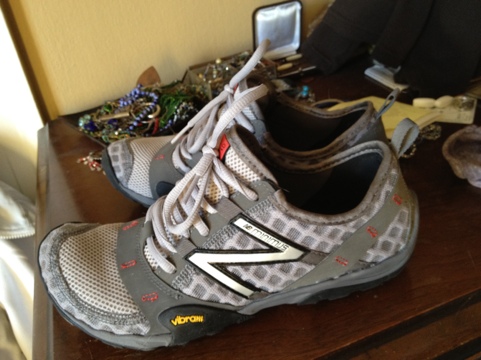
This is where I explain that most people who ‘run barefoot’ actually wear some kind of ‘barefoot running shoe’. Normally this means Vibram Five Fingers, which look like a wet suit glove for your feet; huarache sandals (apparently the ‘next big thing in barefoot running’); or some kind of minimalist shoe, as in the photo below.

All this footwear is designed to be as minimal as possible while still protecting your feet from concrete or glass or whatever you might find on the ground while running. Part of the logic behind barefoot running is that the overdone structure in most running shoes weakens the muscles in your feet and calves (kind of like putting your foot into a plaster cast). Regular running shoes also encourage you to land hard on your heel rather than gently on your forefoot, causing all kinds of knee, ankle, back and hip stress and injury. Running with proper form (see graphic below) reduces shock to the joints and allows you to put less stress on your body. It is one of the main reasons that people learn to ‘barefoot run‘.

A Wired Science article (To Run Better, Start by Ditching your Nikes) by Dylan Tweeny notes “strong evidence shows that thickly cushioned running shoes have done nothing to prevent injury in the 30-odd years since Nike founder Bill Bowerman invented them, researchers say. Some smaller, earlier studies suggest that running in shoes may increase the risk of ankle sprains, plantar fasciitis and other injuries. Runners who wear cheap running shoes have fewer injuries than those wearing expensive trainers. Meanwhile, injuries plague 20 to 80 percent of regular runners every year.” (Unfortunately, now the shoe industry is going to make a killing out of making those cheap shoes really expensive…)

(Ditching the Nikes – The new model of Nikes that I mention in the first paragraph were Nike Frees. I had been wearing Nike Frees for a long time, but the new model had a slightly different design and more spongy cushioning than the old model, and this turned out to be a bad thing for my ankles and knees.)

According to a 1997 study in Sports Medicine (Hazard of deceptive advertising of athletic footwear), “Athletic footwear are associated with frequent injury that are thought to result from repetitive impact. No scientific data suggest they protect well. Expensive athletic shoes are deceptively advertised to safeguard well through “cushioning impact”, yet account for 123% greater injury frequency than the cheapest ones.”

A team at Harvard is dedicated to “comparing habitually barefoot runners with runners who normally run in modern running shoes with built-up heels, stiff soles and arch support”. Their research notes that “barefoot runners experience a shock of only 0.5 to 0.7 times their body weight, whereas shod heel strikers experience 1.5 to two times their body weight–a threefold to fourfold difference.” (Unfortunately much of the ‘barefoot running’ research is funded by shoe companies like SOLE and Vibram, so I like reading around and finding testimonies by real people who aren’t trying to sell me shoes, too.)

Social fitness and apps

So anyway, my brother got the funny looking Vibram shoes and I went for the less obnoxious-looking ones (in the photo above). As of January 1, we started re-training ourselves to run with a proper ‘barefoot stride’ for short distances on the treadmill. We’d regularly text, message and email each other about our progress. By March it was warmer and we both got to running outside. Whenever I am in NYC, we plan our days around long runs together over the Brooklyn and Manhattan bridges.

My eldest brother who lives in Los Angeles had also started running (though we’ve yet to evangelize him to go barefoot). He and my middle brother started using the Nike+GPS app to track their routes, distance and pace. I started seeing all kinds of comments on their pages from friends and fellow runners, barefoot and not.

I resisted the Nike app for a number of reasons but eventually caved. Once I started using it, I joined the group of motivators and found myself motivated too. I was more aware of my pace because the app was notifying me each half mile how fast I was running. I’d always run a slow and easy pace of 10 minutes per mile over a maximum of 5 miles and had no real interest in picking it up or pushing myself. I still can’t totally keep up with my brothers and their friends in terms of pace, but I’m now running more hills and I’ve shaved 48 seconds off my mile average in the past month since I installed the app.

On top of running better and longer and faster, I wanted to ditch those few extra pounds that had accumulated from my months of not running. So in early January, I downloaded a free app called “Lose It,” which allows you to research and track everything you eat and to plug in calories burned through exercise. It helped me pay better attention to what I was eating, make healthier and more natural food choices, and ensure that I was not eating more than I was burning off through exercise. My daughter downloaded it too, and it’s been a helpful neutral tracking tool for us to motivate each other. Being lighter is helping me to run more gently, and it’s also meant my speed and agility in capoeira have picked up. Not to mention, my knees and ankles feel great (knock on wood).

The barefoot running obsession is not only mine and my brother’s. My son was with us at the shoe store in December and hinted around that he needed a new pair of running shoes. My brother told him that if he read Born to Run, he’d give him $50 towards a pair of Vibrams. Deal complete, my son got his shoes in March, worked on his barefoot stride a bit, and is off and ‘running barefoot’ as well. Via Facebook I discovered a few other friends are into it, including a college roommate I hadn’t seen in 4 years and a fellow development worker, Weh Yeoh, who does barefoot running training in Phnom Penh and has even done a “Nerd Night” talk on it. (Check out Weh’s awesome other project here). Below is his video on how to run with proper ‘barefoot’ stride.

I’ve never been someone who needs to have the latest shoes or apps or gadgets.  But since January, this perfect storm of  information, communication and technology (books, videos, articles, blog posts, social networking, improved shoes and a couple of mobile apps) along with self-motivation and the encouragement of family and friends, has allowed me hit my sweet spot and reach my health, fitness, running and capoeira goals.

For some really interesting research, reasoning and background on barefoot running, check out this 2009 post by fellow anthropologist and capoeirista (check out his book) Greg Downey – Neuroanthropology: Lose your Shoes: Is barefoot running better?

And by the way – new research is showing that running (and other exercise) makes you smarter too :-).

Starting next week, I’ll be participating in TechChange‘s course on Global Innovations for Digital Organizing: Open Data, Good Governance and Online/Offline Advocacy. I’m excited about it because the topics are among the things I’m most interested in, and I think they deserve a closer and more focused look.

I wrote a post back in November 2010 asking “where’s the ICT4D distance learning.” This led me to discover TechChange, and in January 2011 we co-hosted an “ICT4D Distance Learning Tweet Chat.” Since then I’ve been collaborating with the team to input into course ideas. I also participated as a moderator in the Mobiles in International Development course last year.

So after a year of running courses, what has TechChange learned? Nick Martin, TechChange founder, says that online learning needs to be social in order for it to be effective. “Most organizations think of ‘online learning’ as uploading powerpoints or manuals onto their website or hosting monthly webinars for their employees, but it can and should be so much more than this. By emphasizing social elements such as video chats, collaborative simulations, small group discussions and through the use of video game mechanics (point systems, progress bars, and good graphics) we keep participants engaged and connected with one another, not just the content.”

Working across time zones can be a challenge, as I also discovered when moderating the Mobiles in Development course. Scheduling in side chats was difficult, but that’s not something that’s easy to fix. TechChange tries to address this by “combining synchronous and asynchronous learning in the same platform and keeping the balance between a persistent learning network where people can socialize (via video, audio, and text) with each other and experts, and allowing people to get caught up on weekends when they fall behind so that they don’t feel left out,” according to Nick.

One thing the group learned about running this kind of course is that when engaging external experts in webinars and chats, informal-yet-direct interaction is much better than more produced content.

“We tried doing formal studio-style interviews with our experts, but found that most students just tuned out like they were watching a TV show. When the experts were just talking directly to the camera from their laptops, we found students asked more questions and participated more. They really appreciated the access to experts and weren’t particular about the production value of the webcast. Sometimes less is more,” Nick says.

Personal attention can still be a challenge, however. So TechChange emphasizes the role and importance of moderators. Their last Mobiles for International Development course had 70 students from 30 countries (see map below), making moderators a key part of personalization.

TechChange recently ran an online course for Pakistani students in partnership with IREX, where Nick says the challenge was keeping up with the students. “They brought creative ideas from their cultural exchange program with Global UGRAD-Pakistan, so we were always trying to tailor lessons around ways to improve or discuss their experiences. IREX was very focused on using our platform to create a tailored four-week program for the students, so we were able to tweak it as we went along.” (Read more here: TechChange Lessons from Training Pakistani Students Online)

The class with the Pakistani group was based on the Global Innovations for Digital Organizing course. TechChange had information ahead of time on the participant profile (the students were from Pakistan, undergraduate education, good English, decent connectivity), so they were able to maximize the experience by bringing in local partners like Pakistan Youth Alliance and Khudi and targeting youth leaders that they thought would resonate (like Prashan De Visser of Sri Lanka Unites). However, doing a class in Pakistan presented some difficulties, such as rolling power outages and load shedding. “We had to really make sure everything was optimized for low bandwidth and archiving.”

What does the future hold for TechChange? According to Nick, the group is pushing ahead on two fronts:

  1. Working with technology firms to create courses that can help them better engage their user communities
  2. Helping international development organizations integrate online learning into their local capacity building projects.

The open enrollment courses will remain, but the team will be focusing more on partnering with tech/development firms to help them build out their engaged communities. “There’s already a ton of cool tools out there that we love to teach, like Ushahidi and OpenStreetMap, but the biggest challenge isn’t tech–it’s educating and engaging communities of practice. We’re really excited about our upcoming Ushahidi course, which we developed in partnership with Ushahidi (developer Rob Baker will be the lead facilitator), but we see it as the first of many. Developers have great manuals, products, and organizations, but we can often add value by helping them educate their existing audiences and reach out to new ones.”

TechChange plans to work in the area of technical capacity building by developing more custom courses for organizations. “We see our role as changing from being the central learning location for individual students to helping development/nonprofit organizations reach out to their key stakeholders. This fulfills a key part of our mandate. It lets us provide tailor-made courses for organizations in fragile states and countries in transition.” TechChange is also looking to integrate their platform into other online learning opportunities, such as accredited courses and online conference opportunities.

It’s inspiring for me to see how quickly TechChange has built their online learning platform and how adaptable they are to the topics and themes that different people and organizations need to get a handle on in the area of ICTs and development and related humanitarian fields. I’m looking forward to participating (and speaking as a guest) in the Digital Organizing course starting on Monday!