Feeds:
Posts
Comments

Seeing youth as assets

Assets, contributors, thinkers and doers, not problems to be solved.

Making Cents International’s Global Youth Economic Opportunities Conference happened last week (September 7-9). The focus of the conference was ‘Breakthroughs in Youth Enterprise, Workforce Development, Financial Services and Livelihoods.’ I attended most of the plenary sessions and followed the Adolescent Girls and Young Women track.

The main messages I took away from the 2 and a half day conference included:

Seeing youth as assets

The youth development approach has been around for quite a while, and some of the organizations and people I respect the most and have learned a lot from are those that use this approach with young people (shout out to one of my youth development approach mentors, Jeremy Phillips).  Still, it’s encouraging to hear big agencies like USAID talking about the youth development approach, emphasizing the importance of youth participation, seeing potential in the youth population, and working with youth as assets and valuable people in their own right with something to offer rather than fearing the ‘youth bulge’ and using a heavy-handed approach to control, contain and suppress young people, their voices, their needs and their rights.

Ambassador Donald Steinberg, deputy director of USAID, spoke on Wednesday morning, saying ‘If you stop looking at people as a development challenge or a threat, and instead see people’s potential to be something great, your perspective totally changes.’ USAID is doing their first ever youth in development policy and is working on integrating youth concerns into their 6 focus areas.

According to Clare Ignatowski, USAID’s Senior Advisor on Workforce Development and Youth, the agency’s positive youth development approach includes youth engagement and valuing youth as assets, ensuring multi-stakeholder participation, offering second chance opportunities for youth, and ‘engendering’ youth work. The idea is that by empowering youth and helping them have basic skills and opportunities; a sense of safety, structure, belonging and membership; self-worth and valuable opportunities to contribute; independence and control over own lives; a sense that they are competent and able to do something with their lives; and solid and supportive relationships – we can help young people make something out of their lives.

What role can technology play?

The youth and ICTs panel mentioned a few of the many areas where new technologies can be integrated in youth development work. To begin with, as moderator Wayan Vota from Inveneo mentioned, technology is one area where youth are viewed as experts over adults. They are often seen as thought leaders in ICTs. Via mobile phones, youth are starting to open bank accounts, according  to David Mukaru from Equity Bank in Kenya, and this is demystifying aspects of finances and banking, even in rural and slum areas.

There are challenges though, as Lia Gardner from TakingITGlobal reminded. ‘ICT is not a self-fulfilling circle; you can share great ideas but what about taking online connections into the offline world?’ Jacob Korenblum from Souktel  considered adults to be the biggest barrier. ‘Adults don’t see how tech can be leveraged and utilized for serious purposes. Older people really need to come on board and take youth seriously. Tech is a good way for youth to express views.’ Peter Broffman from Intel Learn Program recommended showcases with parents, teachers and community leaders to allow adults to see how youth and technology can be harnessed to address things that matter and to resolve problems in the community.

ICTs can also be used to engage youth and hear their voices and opinions. Korenblum commented that Souktel’s JobMatch idea was adapted and used to get feedback on 2 large-scale radio broadcast projects in Sudan and Somalia. The program implementers didn’t know what the audiences thought about the programs. Souktel developed a way for people to text in for free to give feedback. Some of the comments were selected and read out on the air. The texts began to inform the content of the radio programs. “We saw hundreds, even thousands of SMS coming in. In one case we had thousands of messages coming in from Orphans and Vulnerable Children [after we did a radio show on the topic]. They were saying ‘No one has ever asked me about my concerns, thanks for this radio show.’” In another case, thousands of people texted in saying they were not aware of the potential dangers of skin lightening creams. “We also had very frank and candid feedback like ‘you don’t represent enough Sudanese on your program.’ In Gaza we asked several thousand youth about the potential for a ceasefire. Youth wrote back their thoughts and said ‘this is the first time anyone has asked or cared about what I have to say.’” The feedback was shared with the television and radio stations so they could improve their programs, and in some cases it was played along the ticker tape on the bottom of Al Jazeera.

Mukaru commented that Equity Bank is known to be the ‘listening and caring financial partner’ in Kenya. ‘We listen to youth and clients. We have gone out to do focus group discussions to get to understand what youth are asking us to change, to do better, what they want to see in our services. We also use technology, SMS feedback. Our mobile phone number is displayed in our lobby where youth can interact with us and give their feedback. We’ve changed a number of things….They didn’t like our website – they said it’s too old, that it wasn’t talking to the youth. So we redesigned it to speak to the youth better. They said they want to bank small amounts of money and it costs them a lot to go into town, so this is why we started local agencies,’ he said.

It was encouraging to hear so many people highlighting the importance of the youth development approach and the fact that youth need to be listened to, respected and seen as valued partners in their own development as well as in the development of their communities and nations.

I’ll cover some of the other key take aways in my next few posts here on Wait… What?!

FMLN guerrilla with rifle poised in town of Chalatenango, El Salvador, 1988. This photo is from the article referred to below. Original at http://www.ontheissuesmagazine.com, Winter 1994.

A version of this post was originally published on the Peace Dividend Trust blog.

I lived in El Salvador for about 6 months during the civil war and over 9 years post-conflict.  So I was quite interested in the Society for International Development (SID) Congress July 30th panel on the “Nexus of Conflict and Development.”

The panel was composed of a high-powered, high level group of men*, presided over with humor and grace by a woman of the same caliber, Tessie San Martin, President and CEO of Plan International USA, SID Board Member (and my boss!).

Arthur Keys, President and CEO of International Relief and Development introduced the panel, asking questions like:  Can development be done in a conflictive environment. Is settlement of conflict needed before development can take place? Can development assistance be used as a tool for peacemaking?

Keys noted the changing, fluid environments in conflict zones and their inherent complexities – the interconnectedness of many variables that cannot be addressed in isolation.

Within that context the panelists discussed a variety of issues, from the changing nature of conflict and violence, to the pillars of post-conflict reconstruction, to local ownership and local government credibility and legitimacy to the role of the military in ‘delivering’ development to front loading funds in conflict areas to USAID branding in conflict zones. Listening to the discussion, I realized many of the questions that we were asking ourselves 20 years ago in post-conflict El Salvador are still unresolved today.

One of the most interesting conversations of the panel was catalyzed by San Martin’s question on local ownership and legitimacy. “We’re talking about ownership and local voices, but one question is whose local voice? There are a number of vulnerable groups,” she said. “How do you deal with the question of ‘whose voice’?”

Donald Steinberg, Deputy Administrator of USAID, answered by telling the story of his experiences negotiating a peace agreement in Angola under Bill Clinton.

“When I was asked how this agreement benefits women, I answered that not a single part of this agreement discriminates against women,” he said. “But what I learned is that a peace agreement that calls itself gender neutral is actually working against women.”

The Angola agreement was based on 13 separate amnesties, he said.

I learned that ‘amnesty’ means ‘men with guns forgive other men with guns for crimes committed against women.’”

Steinberg went on to comment that the closest woman to the peace process in Angola was a female interpreter, who would “raise her eyebrows when we men did something stupid.”

He described the peace agreement as being “come and hand in your weapons and you get benefits.” But most women involved in the conflict were not bearing arms, they were playing other roles. So when demobilization came, they got no benefits. On top of that, “we sent men back to communities where women had become very empowered in their absence,” he said. “The men returned and there was no role for them. Many drank off all their benefits. They started beating their wives. The incidence of sexual aggression rose. So you saw that the end of the one conflict brought about a new insidious form of violence against women.”

Another area where the peace agreements forgot about women was in de-mining activities. “We cleared the roads of mines,” said Steinberg. “But we didn’t clear the fields. The water points. Places where women gathered wood. As communities returned home, and women went back to collecting water and firewood, they were blowing their legs off with remarkable regularity.”

The peace process started to fall apart a couple of years later, he said, but by then it was too late to bring women’s organizations into the process. “We tried to work with women’s groups but they would say, ‘This isn’t about us, it was about the men with guns. It hasn’t involved us at all.’” The country erupted into war again.

Steinberg said he was happy that USAID is addressing these issues now. “The first thing I put into place was support to women’s participation in peace processes and to provide them with protection to do so, as it’s dangerous for women to be involved in this work. Nothing about them without them – this is our phrase,” he said, and cited UN Security Council Resolution 1325 as a strong influence on him:

“The Security Council adopted resolution (S/RES/1325) on women and peace and security on 31 October 2000. The resolution reaffirms the important role of women in the prevention and resolution of conflicts, peace negotiations, peace-building, peacekeeping, humanitarian response and in post-conflict reconstruction and stresses the importance of their equal participation and full involvement in all efforts for the maintenance and promotion of peace and security. Resolution 1325 urges all actors to increase the participation of women and incorporate gender perspectives in all United Nations peace and security efforts. It also calls on all parties to conflict to take special measures to protect women and girls from gender-based violence, particularly rape and other forms of sexual abuse, in situations of armed conflict. The resolution provides a number of important operational mandates, with implications for Member States and the entities of the United Nations system.”

Ambassador Rick Barton, US Representative to the Economic and Social Council of the UN, agreed that the role of women is critical, and “it starts with who’s negotiating the peace process.” Barton noted that the percentage of women in peace negotiations is 5-7%, and that it’s a recurring concern. “If you are not there at the start of the race, it will be designed in a certain way and you will be disadvantaged. I’m hopeful that the UN Women’s Commission, led by Michelle Bachelet will bring attention and focus to this issue.”

“What about men and boys?” a woman in the audience asked. “It’s great to empower women, but what are you doing to change the attitudes and beliefs that men have? How can we get them to realize we are equal?”

Barton agreed that getting men’s attention is critical. “These are not women’s issues, they are society’s issues. Men and boys need to come a long way.”

“It’s easy to work on gender with this administration,” commented Steinberg, noting that USAID is trying to institutionalize it through the position of Senior Coordinator for Gender Equality and Women’s Empowerment. “It’s not only about protecting women or about victimization,” he said. “It’s about changing attitudes and instilling into our DNA the notion that women are key to building stable societies, ensuring sustainable growth and recovering from conflict situations. We need to focus on gender in addition to women.”

Sitting, there, listening to the panel discussions, I kept thinking about a Salvadoran friend from some 20 years ago. She was from a ‘conflict zone’ but would have never called herself an ex-combatant. For several years, she had moved around with the guerrilla, cooking and supporting the cause, but didn’t carry a weapon. Post conflict, she had lingering health problems stemming from that period, when she had been chronically malnourished. During her time with the guerrilla, she had contracted glandular TB, a condition that embarrassed her. At 34 years of age then, she had the ruddy, freckled and fresh face of a young girl, but she wore dentures as she had lost all of her teeth. She worked cleaning an office and always struggled financially. I’m not sure she ever got any benefits from demobilization.

I’m also reminded of a rather large post-conflict program that I was responsible for monitoring at the time, together with a few other privately funded donor agencies. Aimed at providing community-based psycho-social support to returning ex-combatants in several zones formerly held by the guerrilla, the program ended up mostly supporting women and children who were suffering domestic violence at the hands of the demobilizing men. The male ex-combatants either didn’t feel they needed psycho-social support or didn’t want to face the stigma of seeking it out, but the women took advantage of it. Community psycho-social support agents fully recognized that they were treating a secondary effect and not addressing the real causes of the violence.

According to a 1994 article by Betsy Morgan in On the Issues Magazine, ”Nearly one third of the FMLN guerrilla forces, who fought for 12 harrowing years in the mountains, were women. But neither of the restructuring plans [that of the government or that of the rebels] directly addressed women’s issues: equality in education, health care, job opportunities, and legal justice in instances of rape and domestic abuse…. Two female commandantes from the FMLN were on the negotiating team. However, when the peace accords were signed on January 16, 1992, all the signatories were male. The subsequent reconstruction plans called for demilitarization, but neither the government nor the FMLN addressed the hidden violence – domestic abuse, rape and incest – that invariably accompanies a military climate of violence, and neither side made provisions for the fair treatment of female ex-combatants, particularly in terms of land tenure. It can only be concluded that for all of the women’s influence during the war, at the point of peace, the women’s movement was still seen as a thing apart from the arena where real decisions were made.”

There were women involved in all aspects of the war, including negotiating the Peace Accords in El Salvador, but it didn’t guarantee that women’s needs were addressed during the negotiations.  It didn’t ensure that the post-conflict programs agreed to in the Accords were fully funded or that programs were designed and planned with participation of those they were meant to benefit or that women got fair treatment. It did not guarantee that the different efforts were non-politicized or that they were well-implemented. As Keys pointed out when introducing the panel: the nexus of conflict and development is a complex place, with every element impacting on every other, and as Steinberg and Barton pointed out, it’s not only about women, it’s about gender.

I’m glad to see the discussions taking place, and I hope that experiences, failures and successes from places like Angola, El Salvador, Colombia, Iraq, Afghanistan and so many others are fully examined and shared to see what more can be done to create environments where women are in decision-making roles before, during and after conflict; where the broader implications of gender and gender roles are considered; and where both women and men who achieve positions of power are really reaching out to, listening to and representing those who don’t have a seat at the table.

*Members of the panel:

Tessie San Martin, President and CEO, Plan International USA and SID Board Member (moderator)

Ambassador Rick Barton, US Representative to the Economic and Social Council of the United Nations

Alonzo L Fulgham, Vice President, IRD

Donald Steinberg, Deputy Administrator, USAID

Tom Wheelock, Vice President and Sr Director, Communities in Transition, Creative Associates

The number of international aid and development blogs has expanded rapidly in the past few years, and the number of people reading them has also grown. But aside from retweets, comments, and  ‘hits’ to our blog sites, those of us who blog about aid and development really haven’t got a very good idea of who reads our blogs, what interests our readers, if our posts have any kind of impact, and what our readers do with the information they find on our blogs (if anything!).

To get a sense of that, several aid and development bloggers have joined together to do a small survey of our readers to see what we could find out.

I’d be quite pleased if you, dear reader, would take 5 minutes to take the survey (click here). All responses are anonymous.

If you also have an aid or development focused blog, please share the link on your blog too.

Thanks very much!

This is a guest post by Bertil van Vugt, who works as the content director at Africa Interactive.  Bertil and I met for the first time about a year ago at a tweet up in Amsterdam, though I had known about Africa Interactive’s fantastic work with African media professionals for much longer. I was thrilled to hear from Bertil last week that they’ve been working with Plan in West Africa, and have made 4 videos about the Girls Making Media project that I had written about earlier this month. 

Girls Making Media in Ghana

Men dominate the African media sector. Looking at our own database of over 2000 media-professionals in 50 African countries we see predominantly males. Fortunately we are also working with many talented women throughout the continent. When we were asked to produce videos and case studies about Plan’s Girls Making Media Project we got really exited about the initiative that is preparing young girls for a career in the media sector.

I work for Africa Interactive, a social venture delivering media and communication services with offices in Amsterdam, Nairobi and Accra. As I mentioned earlier we are working with local reporters, camera-crews and photographers throughout Africa to document activities of NGOs, multinationals and governments. While these organizations previously worked with Western crews who travelled to Africa, we work with African media-professionals and guarantee the quality of the productions.

Local film-crews

There are many advantages of working with local crews. They know their way around; they speak the languages and understand the culture since it is theirs. These people can be fixer, translator and journalist at the same time. And not unimportant: the costs are lower compared to flying people in. For this Plan assignment we worked with experienced crews (male AND female) in Lomé (Togo), Bomi (Liberia), Makeni (Sierra Leone) and Sogakope (Ghana). Our, by the way female, employees in Accra and Nairobi did the video editing and we finalized the videos in our Amsterdam office.

GMM

The Girls Making Media project’s goal is to contribute to the elimination of gender discrimination and benefits at least 140 adolescent girls and 30 adult journalists in the most marginalized areas in each country. With this project, girls and adult journalists are trained on various topics aiming at increasing their capacity to produce quality information concerning girls’ rights. It is also empowering girls to advocate on issues concerning their well-being.

In the four videos we focus on the three-year program (which started one year ago) and show the development, achievements and challenges so far. We hear about the effect the project has on the girls and their communities. Also, the girls explain how they see themselves after learning media skills and talking about gender related issues on the radio and TV.

Liberia

Ghana

Sierra Leone

Togo

Girls interact with journalists

Together with the Plan West Africa office in Ouagadougou we developed the idea that the video-shoot should also be an opportunity for the girls to interact with our crews and learn from them. During the filming days there was room for questions and sharing of experiences. We received positive feedback from the crews and the Plan offices about the cooperation with the girls. I would like to use this space to thank the camera-crews who did a great job to create the videos:  Comfort + Yudawhere (Liberia), Wotay + Idriss (Sierra Leone), Paul + Gary (Ghana) and Rodrique + Anselme (Togo).

Let me conclude by saying that I hope to welcome the girls to our network after they have finalized the GMM project!

If you are looking for any content on your activities in Africa, just contact me via e-mail: bertil [at] africanews.com or Twitter: @brutuz.

“The story of a boy from Baltimore who evolves from a safecracking, jewel-heisting, deep-sea diving, ultimate-fighting, international playboy into a globetrotting humanitarian.”

Why yes, thank you very much, I would like to review that book…. My snark glands start working in anticipation.

Book arrives in the mail and I open to the preface where I read that Stefan Templeton, the troubled and risk-loving misfit hero of the story, has an innocent bright-eyed son and a good, virtuous, hard-working wife in the kitchen. Neither his son nor his wife knows about his sordid past. He risks his family’s well-being to be “a recurring presence in the aftermath of some of the last decade’s worst man-made and natural disasters”. He’s now heading to “the genocide-ravaged Horn of Africa…. On this mission, as on all the others, he would receive no payment.” 

OK, so this will be a story about one of those self-made, selfless martyr, I-have-seen-the-light types who wakes up one day and feels compelled to give up everything to save the world. And there will be fighting too!

We learn that the author David Matthews and Stefan, the hero, grew up together off and on in a hard-knock area of Baltimore, MD. That they are both ‘mixed’ race and that Stefan loves fighting and telling elaborate, hard-to-believe stories. Matthews’ re-encounter with Stefan starts off something like this:

****

“You taking all this stuff? I yelled to him in the bedroom…

…What’s this? I pointed at the black square.

I removed the device. A block of plastic the size of a primordial cell phone.

He shook his head. It’s a Taser, knucklehead.

Jesus, I said, Get pretty rough out there saving babies?

Stormy clambered into the room, midway through his drawing. What’s a Taser, Poppa?

A Taser makes bad people jump, Stormy-bear. Stormy held up his drawing. I could make out some red and black stick people with what looked like blue arrows raining down on them.

That’s amaaazing, Stefan said.

It’s the African children when you put water on them, Poppa.”

****

Jesus. I thought. Get pretty rough out there writing good dialog?

Regardless, I continue. The book starts to flow a little better as the story takes off.

I read that Stefan’s parents are from very different cultures — his father: a rigid African-American martial artist from a well-educated family in a rough Baltimore neighborhood, permanently affected by a stint in Vietnam; his mother: a Danish flower child from a wealthy family that runs a new-age spiritual healing school where people do primal screaming and other types of psycho-spiritual curing.

Early in the book, the author sets Stefan up as a pure-hearted good guy with bad luck, a poor hero who gets screwed time and time again by the system. His father’s hard-fighting rigidity combined with his mother’s heal-the-poor hippie sensibilities are lived out through Stefan who gets himself into one tricky situation after another, but only because he is compelled to perpetually defend the defenseless, to be a man.

His weakness for women is made clear early on, as is the idea that women are weak. (Almost all the women we run into in this book are extremely hot, in need of Stefan’s protection, and willing to drop anything to get with our hero.)

It’s Chapter 3 where Stefan has his “incredible hulk” breaking point transformation. A trained fighter who continually turns the other cheek, he is pushed to fight back when a couple of local thugs try to steal his house keys. He pulverizes them both and the defining moment emerges: “This was neither good, nor bad. Right, nor wrong. It was just.” 

Yep, and you won’t like him when he’s angry. Superhero moment complete.

Soon after, Stefan has his first sexual experience while living in a castle in Europe belonging to his mother’s side of the family. Unsurprisingly, it’s with a sexy older woman and Stefan is quite well-endowed: “Ach… zu gross… (oh so big)….” the woman exclaims. “Your mother would kill me.”

Throughout the rest of the book, the system continues making things difficult for Stefan. He tries and tries to make something of himself and his innate superior intellect, physical perfection and sexual prowess but time and time again he’s let down or has to fall back on his unstoppable fighting techniques and knack for straightforward, ethical crime, or he’s simply forced to put himself at risk to save someone at the wrong time or place. Poor guy, he’s just trying to help and it just never works out.

So what better place for him to end up than helping poor people in Africa, Asia or Latin America? By the end of the book, he has blundered his way into humanitarian aid work, yet again, the system has no place for him and he must go at it in selfless, renegade, superhero style, saving the poor because the locals need him and the humanitarians can’t get it right.

Matthew’s writing was entertaining enough to keep me reading throughout, but the marketers’ promise was more than what the book could live up to. But I expected that. “The story of a boy from Baltimore who evolves from a safe-cracking, jewel-heisting, deep-sea diving, ultimate-fighting, international playboy into a globetrotting humanitarian” is a bit much to swallow without a grain of salt.

Kicking Ass and Saving Souls is very much a man’s book. I felt throughout that the author was imagining the story embellished a bit further and on the big screen, and judging by the public’s hunger for violent, misfit heroes and feel-good stories about helpless poor people, I wouldn’t be surprised to see it there one day.

As for me though, I’ve had quite too much of the Sean Penn style of humanitarian work to be excited. I’m wary of erratic amateur do-gooders. Not to mention I have some pretty major concerns about  Sam “the Machine Gun Preacher” Childers‘ and Peter “Advisor to Michelle Bachman (and hero of this hilariously scary film)” Waldron style forays into South Sudan and Uganda and such. So I’m the wrong audience for this kind of book.

I’m sure Stefan means well, and certainly Matthews is impressed with him. But I think Stefan is more the kind of guy you would enjoy running into at a bar overseas and trading crazy stories with and leaving it at that. You’d probably go home wondering how much of his shtick was bullshit (while he went home with one of the new volunteers or the local female bartender). And you’d probably have some real concerns about his modus operandi if any of his stories were true.

But the book didn’t really grab me. I’m tired of shoot-em-up-punch-em-up humanitarian aid heroes.  They take energy away from the real issues and the real people, local and non-local, who are doing the work that has long-term impact. And they can actually cause real problems, no matter how good their stories seem and how helpful they think they are being.

Thanks to the author and TLC Book Tours for sending me a copy of the book to review.

About David Matthews

David Matthews is the author of the 2007 memoir Ace of Spades, which was selected as an Editor’s Choice pick by The New York Times.  Matthews’s work has also appeared in Salon, The New York Times, The Washington Post, and The Autobiographer’s Handbook: The 826 National Guide to Writing Your Memoir.  He lives in Manhattan, but can’t wait to move back to Brooklyn.

This is a guest post by Joe Pavey who, along with Rebecca Tapscott, interned with us in Cameroon on the Youth Empowerment through Technology, Arts and Media (YETAM) project during July and August. Reading Joe’s post I couldn’t help but think about how positive the contributions of youth can be, and about the attitudes that adults and elected officials need to have in order to encourage youth to engage in actions to make their communities better, and how important it is for communities to show young people that they are valued for the contributions that they make and respected for the role that they play.  

The original post appears on Joe’s blog Yakcast 2.0, titled Youth Led Action in Bamessing.

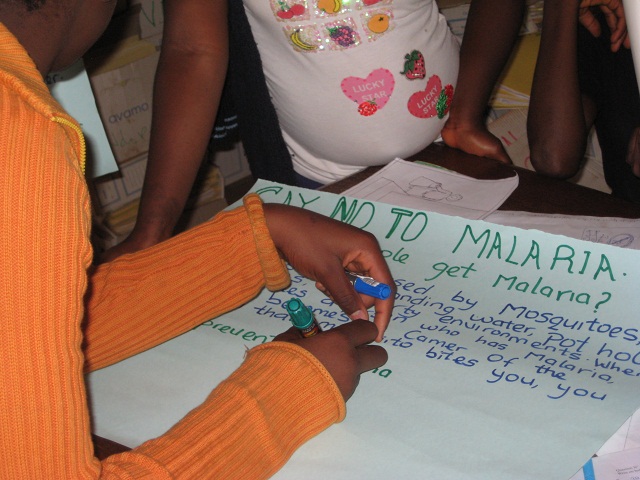
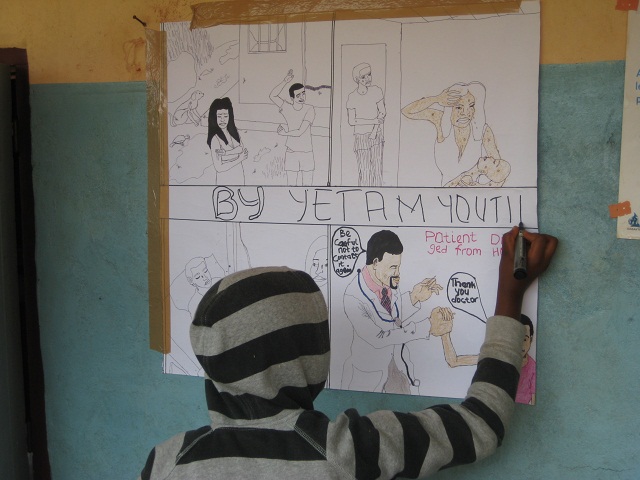
Following the conclusion of the refresher course at GBHS Bamessing, the YETAM youth began work on their first advocacy campaign of the summer. After much discussion the youth decided that the first topic they would take on would be the high prevalence of malaria in their community.

Malaria is one of the biggest killers of children under the age of six in Africa, but lack of health education means many people here still are not aware of how the disease is contracted, and how it can be avoided. Additionally, the direct relationship between cleanliness and the spread of this disease runs counter to many of the choices the environment here encourages. The long periods that often come between availability of running water, forces villagers to store water in containers, and collect it from the frequent rains. This water is frequently left sitting in open containers. Mosquitos will lay their eggs in this water, leading to an increase in the insect population. More mosquitos, means more carriers for the disease, which in turn leads to more people contracting the illness. Additionally, mosquitos tend to thrive in places with tall grass. Lack of funds to clean communal areas often means that shrubbery in public places such as the market square, aren’t cleared regularly. Ignorance of this cycle is what the youth intended to combat. Not an easy thing since explaining these correlations requires the understanding of multiple stages of cause and effect.

In order to get the attention of the village, the youth decided to hold a series of clean-up and sensitization campaigns, intended to illustrate the sort of changes they felt the village needed to make. The first stage was a clean-up at three of the local health centers. The youth divided themselves into three separate groups, and spent several hours clearing brush, dirt, and standing water, from outside these centers. They posted sensitization signs outlining the causes of malaria and what can be done to minimize it. Despite the fact that many of the youth had left town for holiday, there was excellent youth turnout at all three health centers. After the morning of the clean-up these centers were models of how the village should maintain their environment.

Next a major cleanup campaign was performed at the BamessingTown Square, the day before Market Day. Market day here is a huge event, so the time and location of this clean-up had been chosen for maximum exposure. Twenty-four youth and two facilitators (myself included) spent nearly seven hours cleaning brush, shoveling dirt, and picking up trash to make the campaign a success. The youth took turns documenting this work with both video and still cameras. When the clean-up was completed they hung signs in main areas of the market urging the community not to dump dirt and trash in the market square. Another sign was created instructing people to a landfill pit where waste could be properly disposed.

The next morning, when Market Day was in full swing, the youth headed down in their bright yellow YETAM t-shirts to explain to market sellers and patrons what they had done and why they had done it. Their message was well received. Community members were thankful for the hard work the youth had performed, and therefore open to hearing their advice. At the end of the day there was a marked increase in people disposing of their trash appropriately.

Finally, the youth invited members of the village community and high-ranking officials to a workshop to discuss the causes of malaria and what could be done about it. My colleague Rebecca had arranged for a Peace Corps volunteer working on health education to come to the event to give a brief presentation. Unfortunately, only one community member apart from YETAM youth and facilitators attended the workshop. Thankfully this attendee was a member of the Sanitary Committee, so all was not lost. She arrived to the workshop quite late (just as we were finishing), so a short recap was given for her benefit.

The woman from the Sanitary Committee requested that the youth express their concerns to the village council, which they did two days later. The council was happy to receive the youth’s concerns and invited them to sing the national anthem at a special ceremony celebrating the arrival of the District Officer later in the week.

This ceremony turned out to be the closest thing to a festival I experienced during my time in Bamessing. Well over 1000 villagers attended the event. There was dancing and singing. There were masked characters called Ndobo, who shook fistfuls of brush at passers-by. (Check out this link for a great post on Ndobo by Plan USA’s Linda Raftree.) There were Muslim men in full regalia riding bucking, wild horses. There were flute players, and drummers, and dignitaries. Everyone arrived dressed in their finest traditional outfits. The Fon of Bamessing (the village ruler), a proud mountain of a man, oversaw the ceremony from the perch of his throne. If his hulking stature weren’t enough to separate him from the massive crowd outside the palace, he was seated on top of an authentic (and I’m sure locally made) animal skin rug to emphasize his authority.

YETAM was represented at the event in two ways: First, several of the youth led the singing of the national anthem. Second, the President of YETAM Bamessing, Martin, gave a short speech informing the District Officer about the activities of YETAM. His was the only speech not given by a high-ranking dignitary. Martin presented the District Officer with a copy of a Small-Grant Project Proposal To Increase School Attendance in the Bamessing Community which the youth had written for an upcoming advocacy project.

It cannot be over-emphasized how big an event this was for the community, and how impressive it was that the Village Council chose to make the YETAM youth such an integral part of the proceedings. Whether the youth’s efforts will lead to lasting behavioral change in the community is unknown, but it was a fascinating thing to see this project escalate over the course of the month. I couldn’t have had an experience like this without investing the length of time I did here this summer. And for me at least, that made the experience worthwhile.

Charles Suglo, Bestway Zottor and Francis Diamenu from Radio Tongu

Sometimes among all the ICT4D hype, we forget about one of the biggest and oldest ICTs there is:  radio.

Last month while in Ghana, I visited Radio Tongu in Sogakofe. The compound where this community radio station sits also serves as a community center, with computer training, a press center and Internet access for a discounted rate.

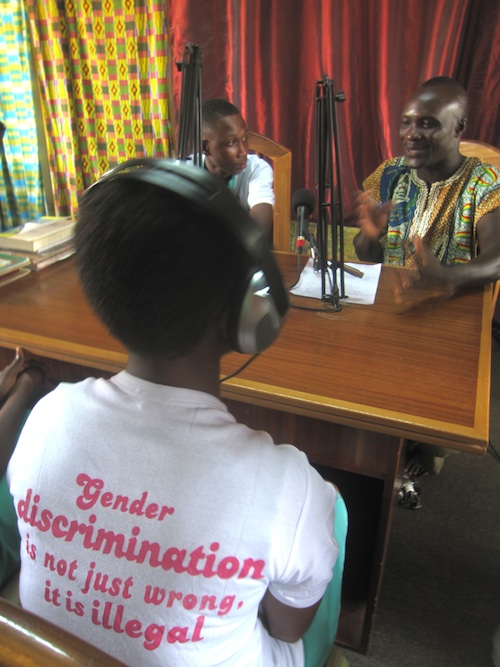
Plan Ghana staff was meeting with the radio director, Bestway Zottor, and two of the managers, Francis Diamenu and Charles Suglo, to discuss the idea of offering internships for 6-8 youth from the nearby school-based Girls Making Media (GMM) program Plan Ghana and Plan US are supporting.

Charles explained to us that the station gets some 70% of its news from the Internet. The other 30% is sourced from local communities, and recorded on the ground wherever the news is happening. ‘The voice is reality,’ he said. ‘It’s what promises that the news is real. It’s what makes people believe.’ The station broadcasts in 3 languages: Ewe, English and French.

If the youth in the GMM program want to be radio hosts, according to Charles, they need to be well trained and professional, especially since the topics that the youth are bringing up — violence against children and bullying — are sensitive. ‘We have our credibility as a radio station,’ he said. ‘So they need to be well-trained on radio program hosting, know how to manage on air, be skilled on how to ask good questions and follow-up questions.’

There are all kinds of jobs that the youth can do at the radio station, including news, marketing, voice, or running the cafe. Having job skills such as these can begin to give the youth some experiences that will serve them later in life. The training and work they’ve done through the GMM project over the past year give them a foundation for the internship positions at Radio Tongu.

Following the visit to the radio station, we went to the school to meet with the media club. It’s called the  ‘Eye Media Network.’ The group’s slogan is ‘Our eyes are always watching.’

The GMM program began last year with a workshop for 20 of the students on media skills and gender. Following that the Club received a small media kit consisting of digital cameras, voice recorders, a radio, a notice board and Flip cameras. The girls work with 2 advisers and now several boys have also joined the Club. The club plans its own programs and actions, and does a school-wide newscast every Wednesday during the school assembly.

A student reads us the news they've posted on the Notice Board

As part of the program, the Club meets and interviews local and national figures, with a focus on women journalists, government officials and businesswomen. The group has covered school elections and put into place a ‘Walk your Talk’ Accountability initiative.

They conducted a bullying campaign with the goal of reducing the incidence of bullying by 30%. After the campaign, which included posters, educational sessions and other outreach, the Senior Housemaster claimed that bullying had been reduced by 90% compared to the year before. They will begin a campaign against sexual harassment in the coming year.

Some of the challenges that the group faces include posters being ripped down, friends trying to discourage them, boys suffering discrimination for belonging to the “Girls Making Media” club, and not having enough equipment. The club hopes to obtain their own modem, computer, printer and more cameras.

The first week of August, select students from the GMM group participated  in social media training, where they learned how to shoot video, subtitle, access different social networking sites to post their content, and stay safe while online.

The girls in the club said the project has helped them to build confidence and take up leadership positions. ‘We learn how to find information and to bring out problems and get solutions,’ said one girl.

Another said ‘We took bullying as a normal thing. Now we know that bullying is not normal. Now when we see something, we are alert.’

‘I used to walk around without seeing,’ added another ‘but now I see everything because I am looking for news. My mind has been opened.’

The Girls Making Media program covers 7 schools in Ghana. Several other groups in Togo, Liberia, and Sierra Leone also participate in the GMM program.

This week I came across the “Feedback Mechanisms in International Assistance Organizations” report by CDA Collaborative Learning Projects, based on research undertaken by the Listening Project and funded by the Gates Foundation.

The findings and recommendations are very intuitive and it’s nice to have them gathered in one place. The report can serve as a starting point or a pause-and-reflect moment for organizations working specifically on humanitarian accountability as well as those who are looking to integrate better ‘downward’ or beneficiary feedback into development or humanitarian work overall. It also offers good food for thought for those interested in crowd sourcing and the use of new technology for citizen engagement and input.

The report is not too long, and it’s easily laid out for a quick read, so I’d recommend downloading the .pdf and digesting it fully.

To whet your appetite, here are some points I found interesting:

Why do agencies seek recipient feedback?

Four reasons were identified in the report: to improve accountability, to improve effectiveness, to respond to donor requirements or media pressure, and to increase security for staff. Feedback from recipients* was seen to give staff the fuel needed to pressure higher-ups for necessary changes in programming; beneficiary feedback often improved program quality and recipient satisfaction, and seeking dialogue and communication with communities tended to reduce threats of violence. When accountability was a donor requirement but wasn’t part of a larger organizational buy-in or value, unsurprisingly, initiatives were less successful.

To many reading this post or who may read the CDA report, the benefits of participation and feedback and accountability are already obvious, nonetheless it’s  good to see them captured and documented in a report as a support to those who are trying to establish accountability and transparency mechanisms in less-friendly or convinced atmospheres.

Other key points (any quotes come directly from the report):

  • All practitioners interviewed for the study “expressed their unequivocal commitment to participatory and inclusive approaches to humanitarian and development work, and placed significant emphasis on accountability mechanisms.” In addition, many organizations have signed different charters and standards including SPHERE  Guidelines, the Humanitarian Accountability Partnership (HAP) Standard in Accountability and Quality Management and the INGO Accountability Charter. This rather contradicts the impression the media often likes to give about aid agencies as being totally unaccountable to anyone. Or maybe certain parts of aid agencies are more interested and prone to seek accountability and transparency than others.
  • The report says, however, that there are still issues with continuous feedback loops and information doesn’t always return from whence it came. “Typically information gathered from primary stakeholders flows through different parts of organizations, but decisions are rarely communicated back to communities.” One could also ask how often this feedback (or similarly, any information, or data) is returned to communities in accessible formats so that they can use it as well for their own purposes.
  • Good accountability mechanisms are not possible without management buy-in or staff competency. Managers play a critical role in “creating incentives and requirements for field staff to regularly solicit and utilize feedback.” Organizations need to invest in the skills necessary to ensure honest feedback can happen at community level, and/or among the various people and organizations involved (community members, CBOs, local partners, local staff, management staff, headquarters, government, etc).
  • Different agencies are working to develop frameworks to improve feedback and accountability mechanisms. “Some of these new approaches have built-in mechanisms for integrating recipient voices into program strategies and operations.” Some organizations have been collecting primary stakeholder feedback and sharing information with recipients for years as part of participatory development processes. However, the report says, often the exercises are very focused on individual projects or towards particular practical results and the richness of the feedback is not fully appreciated or systematically fed into broader decision-making processes.  “The practices of systematically listening to, gathering and analyzing people’s perspectives, recommendations and complaints have not become routine in many agencies.”
  • Feedback mechanisms need to be designed together with recipients. “Mechanisms must also be appropriate to the specific contexts where they are intended to operate, and agencies have to consider the most appropriate name for the [system], channels, and methods for raising complaints, and culturally appropriate ways of responding.” This is especially important in tense environments or with people who are not accustomed to voicing their opinions.
  • Trust is important, and according to the report is “the first step in getting meaningful feedback. Providing information about the goals and expectations of the organization is the first step in building trust…. Organizations need to establish systematic procedures for reviewing, investigating and responding to feedback or complaints. All this needs to occur in a consistent, timely manner for people to believe in the system and use it.” My own experience with children and youth participation initiatives, has taught me it’s also critical to discuss and agree on clear and honest expectations about what can and will be done with the feedback, and the degree to which feedback will actually be able to change a situation. This goes back to the report’s point on management buy-in and institutional systems. Unless your organization really wants to hear the feedback, is willing to change itself or its actions or viewpoints to respond to the feedback, and has the internal capacity to respond and modify how it’s doing things, asking people what they think can be really tricky and potentially demoralizing for all involved. It’s never nice to hear people say “why did you ask us if you didn’t want to know” or “what is the point of knowing what we think if you’re not going to change?”
  • New and emerging approaches are being tested, including those that use innovative tools and technologies such as SMS and social media. However, the same principles apply to these new technologies as to any other type of feedback loop, and it’s clear that there are still challenges with new technologies.  As mentioned earlier in the report “Most organizations that were successful in gathering feedback… and distributing information back… found it necessary to have more than one mechanism in place…in order to provide options for all of the different groups within the local community to provide feedback and to get information.” This is especially true with new technologies, given the large numbers of people left out of feedback loops due to cost, literacy, age, gender, and access if only SMS or social media are used. Specific challenges with new technologies are highlighted in the report, such as the case of Haiti where an SMS service was set up and people were very willing to use it, “but the agencies had not incorporated a way to monitor the replies and feedback. This resulted in some frustrations and a lost opportunity for a feedback loop between recipient and aid agencies.”

Page 17 of the report offers some good examples of what effective feedback loops look like, page 20 lists several areas that need investment and incentive to ensure effective feedback mechanisms and to guarantee that information is properly gathered and well-utilized, and page 23 offers a list of recommendations for effective and comprehensive feedback loops.

Read the full report here.

*I’m not a big fan of the terms ‘recipient’ and ‘beneficiary’ but have used them here because they are the terms used in the report.

Related Posts:

Ian Thorpe does a good job of commenting some of the portions of the report I didn’t expand on:  “Listening to the people we work for

This is a guest post by Jamie Lundine. Jamie is a health geographer who works with Map Kibera in Kenya. We first met about a year ago when Plan began thinking about using digital mapping as an element of the Youth Empowerment through Technology, Arts and Media (YETAM) project and we started discussing how we could work together. Since then it’s been exciting to see how Plan Kenya and Map Kibera are collaborating to bring together child-centered community development work and ICTs in programs such as YETAM, youth and governance work, and community led total sanitation (CLTS) programs. Globally Plan is committed to building its capacity to use ICTs where appropriate in its work and to support youth, communities and local governments to use ICTs where useful for their goals. Plan Kenya is one of the offices that is leading the way in ICT4D at Plan, and there is much that the rest of us can learn from their approach and experiences.

Jamie’s original post appears on her blog Health Geography as ‘Documenting a participatory digital mapping workshop with Plan Kenya‘ and on the Map Kibera blog. Michael Warui, Plan Kenya’s ICT director, sent me the workshop report and I was planning to write about it here, but Jamie’s already done all the work, so I’m re-posting.

Map Kibera Trust recently facilitated a 3 day training to introduce participatory digital mapping to target staff at Plan Kenya. The participants in the workshop included programme staff and ICT staff from the Kenya Country office and regional offices around the country. Participants came from Homabay, Kisumu, Kilifi, Kwale, Tharaka, Machachos, Bondo, the Kenya Country Office and the Urban Programme (Nairobi). Their backgrounds ranged from ICT support staff, to Child Rights & Gender Advisor, to M&E Coordinator, to programme staff in 4 of Plan’s 5 focus areas (Protection and Inclusion, Health, Education and Governance).

The training was planned at the beginning of the implementation of the new Kenya country strategic plan (CSP) 2011-2015 for Plan Kenya. Building on the success of Plan Kenya’s work in Kwale on universal birth registration and also from digital mapping work with POIMapper and Map Kibera Trust, the new CSP highlights the importance of ICT in the improved efficacy of Plan’s work. Plan Kenya has chosen to place an explicit focus on participatory ICT in its work. This is in line with Plan International’s focus and leadership in ICT4D globally.

In this context, the workshop aimed to:

  • Introduce participatory digital mapping theories, techniques and tools that Map Kibera Trust employs in its work
  • Provide hands on experience in GPS data collection and data editing using Open Street Map
  • Learn more about how Plan Kenya programmes use information and communicate
  • Brainstorm ideas about how to integrate ICT into programme work

We began with an introduction to Information Communication Technology for Development (ICT4D) by exploring some questions to consider before introducing ICT into programme work. The questions were (and are) meant to stimulate discussion and encourage participants to think systematically about the integration of ICT into new and existing programmes. The questions identify the reasons why you would use ICT, assess what constraints and opportunities exist in the framework you are working in, and explore how people are communicating in order to design appropriate and sustainable systems to build upon existing channels of communication. The questions are modified from Linda Raftree’s post “7 or more questions to ask before adding ICTs,” so thanks to Linda for the inspiration!

  1. Why are you considering the use of ICT?

The Plan Kenya staff identified that using ICT, particularly mobile phones and the internet, has become a desired lifestyle choice that the majority of Kenyans around the country have embraced. This was an important point that the participants wished to build upon and capture in their use of ICT in various communities. The group generally agreed that ICTs are available and can be accessed by many Kenyans. The staff also mentioned that ICTs could improve communication and be used to easily mobilize communities (for example sending one SMS to many people to attend a meeting). ICTs are flexible and can improve accuracy and consistency in information, which can then be easily stored and shared. There was also mention of improved efficiency in programme work through the collection and processing of real-time information.

  1. What are the programme goals or programme framework you are working within?

Most of the participants identified the new country strategic plan for the organization as the overarching framework that Plan Kenya staff are working with. The country strategic plan identifies 5 areas of focus: Health, Livelihoods, Education, Protection & Inclusion and Governance.

  1. What are your specific information and communication needs?

The information needs of Plan Kenya staff members were largely related to programme work. The needs included collecting accurate data for baseline surveys for Monitoring and Evaluation and thus to assess programme impact. There were some suggestions of improving communication through digitizing information that can more easily be shared to large numbers of people. The group suggested that this could improve accountability to other staff members, donors and to beneficiaries in communities. ICT can also improve the ability of Plan Kenya staff to analyze information and make decisions.

  1. How are you already using information and communicating?

In order to integrate ICT into existing programmes within communities, it is important to know how staff members are already using information and communicating in their daily lives. The group came up with a long list of communication tools: email, internet, intranet, websites and social netoworks – namely Twitter, Facebook, Flickr, MySpace), applications (Skype, Yahoo Messenger), SMS and telephone calls, radio, and television. The group is using information during baseline data collection. Some are involved in a project that integrates SMS applications into the birth registration process in Kwale District.

  1. Who are the actors involved in the particular issue you are seeking to address with ICT?

 The Plan Kenya staff won’t be (and aren’t) using ICT in isolation. There are important stakeholders they work with on particular issues, programmes and projects. These include the general community – with a particular focus on youth and children. Important sub-sections of the community include teachers, school administration, Government of Kenya, civil society organizations, Plan Kenya partners (such as Childline Kenya, Community Cleaning Services), the media and private sector actors. Different groups of people use technology differently, and depending on the answer to question 1) and question 6 (below) the staff may need an ICT strategy that is diverse enough to reach the various stakeholders.

  1. How do people use ICT already?

This list of the ways in which Kenyans are already using ICT is a testament to the idea that the group tapped into when answering question 1. The use of ICT in Kenya, specifically mobile phone applications, has become a lifestyle choice. Kenyans use phones for mobile money transfer, SMS, calling, accessing the internet, paying their bills, paying for goods, calling toll-free lines (e.g. Childline call centre, police hot lines) and for data collection and dissemination. Kenyans also listen to the radio, use computers, blog, email, chat, shop online, bank online, join online discussions and news groups and use various forms of social media. They do this for work, but also for pleasure. These were the means identified by the group, however this is not an exhaustive list.

  1. How do people access technology already?

This was a sub-section of question 6 and the group answered: mobile phones (including GPS enabled and internet enabled phones), street phones, computer, internet connection in office and homes, internet modems, cyber cafés, radios, TVs, toll free lines, and resource centres.

  1. How will you close the feedback loop and manage expectations?

How do you make sure the information you are generating, no matter the medium or tool you are using, gets back to the community? How do you promote the use of technology without seemingly presenting a silver bullet solution (even if you don’t intend to do so)?

These questions were answered in several ways. One idea about both closing the feedback loop and managing expectation was to network  with other organizations and partners in the community to share information and raise awareness about the use of ICT and the opportunities and limitations of ICT4D projects.

Another option for closing the feedback loop was to both collect and disseminate information on popular social media sites such as Facebook and Twitter.

A third suggestion was to close the feedback loop and manage expectations through an informed resource person and/or resource centers and staff having sessions with the community.

Finally, there was the suggestion to start the integration of ICT in development work by outlining and communicating clear expectations and at the end have feedback sessions to monitor the whole process.

  1. What is your sustainability plan?

The final question, and likely the most difficult (we only had a one hour brainstorming session and did not expect participants to come up with final answers to this question but simply consider it as an important component to any project with an ICT component).

One idea was to equip community members, and particularly youth, with skills that will be applicable beyond the program (or project) timeline. The YETAM project (youth empowerment thorough arts and media) was designed in this way and the group agreed that this design was beneficial to the young people involved in the program.

Another suggestion was to involve the beneficiaries/community in the entire process of choosing/customizing appropriate ICT tools that suit their needs and for further development so that it is community owned process and will in theory continue beyond the project/program lifecycle. Other ideas included:

  •  Build partnership with Government and NGOs.
  • Integrate fund raising or income generating activities into the project.
  • Use affordable technology (free and open source)
  • Ensure follow-up mechanisms are built into the project

We discussed the use of mapping, open information and ICTs for development. We also used two of the three training days to focus on hands-on training and skills building. We facilitated training in handling the GPS devices, collecting data and using Java Open Street Map (JOSM) and Potlatch to record open spatial information into the OpenStreetMap databases. As we’ve found in the past, the hands on training is exciting and motivating. The theorietical discussions, combined with the practical field work inspired discussion and debate on ideas on how to integrate participatory digital mapping andICTs into programme work.

The following are ideas generated by the Plan Kenya staff:

  • Ushahidi could be useful for referral partners mapping and identifying the hot spots of child abuse
  • Use of SMS for communication with hearing and speech impaired within the community
  • Using reports and sharing the same information to various media channels. E.g. PPM, a in-house system that is used to track and monitor information and projects progress
  • In governance as a tool for enhancing social accountability, where ICT can be used to track projects
  • Digitization of data collection e.g. in sponsorship (especially photography), child abuse hotspots
  • Involving children in participatory community mapping by mapping schools using walking papers
  • Using blogging as a tool for youth to document governance issues in the new good governance project for the Urban Programme
  • In Kilifi the team is doing a 2 year study on Open Defecation Free villages and health outcomes. They could use mapping and spatial statistics to document findings.
  • Mapping and other ICT4D tools could be used to document and share participatory activities that Plan already undertakes, such  as transect walks and participatory situational analyses

The training ended with a note of caution – the team recognized the potential tension between the processes that are needed for ownership of a community map (and any other ICT4D project) and the haste of development partners to use the budget and report progress to donors. In this case, many projects (ICT4D, mapping and any other project) may “leave the community behind.”

It is thus important to ask the following questions and consider the answers carefully when designing projects:

  • For whom are we doing the mapping (or any project really)? And whose map is it?
  • Of what use is the (spatial) information, what will it compliment?

After another successful workshop with Plan Kenya, we look forward to building on the excitement and enthusiasm generated during the training! Let’s see some of the great ideas turned into reality!

This is a guest post by Rebecca Tapscott who, along with Joe Paveyis interning with us in Cameroon for the next couple months. Rebecca wrote a first post about the what and the why of setting up an Ushahidi system in Cameroon to track violence against children and Joe goes more into depth about the technical side of setting the actual system up in his post Digitizing violence reporting. Sounds complicated… because it is!.

Here Rebecca writes about how she and Joe are better understanding mobile phone use and community context by living in the community. She also goes into how the team is training youth on how the system works and getting youth’s input into the design and use of this type of system in their community

Learning what information to include when sending SMS reports on child abuse.

One component of our ICT4D internship with Plan is working “in the field” with the community to help implement the Ushahidi reporting system for violence against children (“VAC”).  To this end, Joe and I are living in Bamessing community, a village in the North West Region of Cameroon, also one of the three program units (“PUs”) hosting the YETAM program.

Bamessing has no running water, limited network coverage, and sporadic electricity.  The region is also known for high rates of child/forced marriage, domestic violence and school dropouts.  If a VAC Ushahidi system can work here, it can work anywhere.

Piloting the site in Bamessing has several benefits as well.  First, we are working with a group of motivated youth who have received extensive training on the four categories of  child abuse and violence against children (physical, psychological / emotional, sexual, and neglect or negligent treatment), as well as their legal rights under the UN Convention on the Rights of the Child and other international and national protocol.

Second, the Bamessing community is saturated with cell phones, and most of the youth in the YETAM group have their own personal cell phones.  Joe and I had a discussion with Odelia, our “land lady” and the 30-year-old widow of the late pastor, who told us that she first noticed cell phones in Bamessing in 2010 (though some say they’ve been around since 2004).  Since then, she has owned five cell phones, although she never uses one to text, and makes only one or two calls a week.  Instead, cell phones seem to serve as a sort of portable doorbell.  Neighbors, friends, and acquaintances “beep” each other (give a missed call, which does not cost any credit) to relay a predetermined message.  Credit is expensive relative to other daily costs and, as previously mentioned, the network here is tenuous.  Texting requires literacy, dexterity, and decent vision, which are limiting factors for many of the adults in the community.

Finally, Cameroon seems to have the advantage of a functioning (albeit imperfect) offline system for reporting and responding to VAC.  I spoke with a delegate from the Ministry of Social Affairs (“MINAS”), who explained some of the system’s weaknesses to me, namely that the ministry is highly underfunded and understaffed.  He also lamented that reporting is lacking, due to inadequate knowledge of civil law (instead, most people are familiar with customary law, which often reinforces certain rights violations), and inability to report violations.  While knowledge of civil law must come from human led sensitization and education projects, the Ushahidi platform can enhance reporting ability in Cameroon.  Through our discussions with Plan staff in Yaoundé, we came to the optimistic conclusion that the government might increase investment in staff, resources, and educative programs in direct response to the number and severity of reports that come through the Ushahidi system.

Given these caveated benefits, our current challenge is to introduce the concept of reporting through Ushahidi to the YETAM youth group, teach the youth how to report incidents, integrate their feedback into the system, get the online system up and running, pilot it, and present it to MINAS.

Our first opportunity to present Ushahidi to the youth was during the YETAM refresher training, held June 22 – June 27, 2011 at a local high school in Bamessing.  Joe and I worked with Georges (Plan Cameroon’s ICT coordinator for the area) and Judith (the YETAM coordinator in Cameroon) to design a module to introduce Ushahidi and our particularized reporting system.  First, Georges and Joe explained Ushahidi and answered questions on a theoretical level.  We then described our intention to use Ushahidi for reporting VAC, what information must be included in reports of VAC, and what information will be displayed on the Ushahidi site.

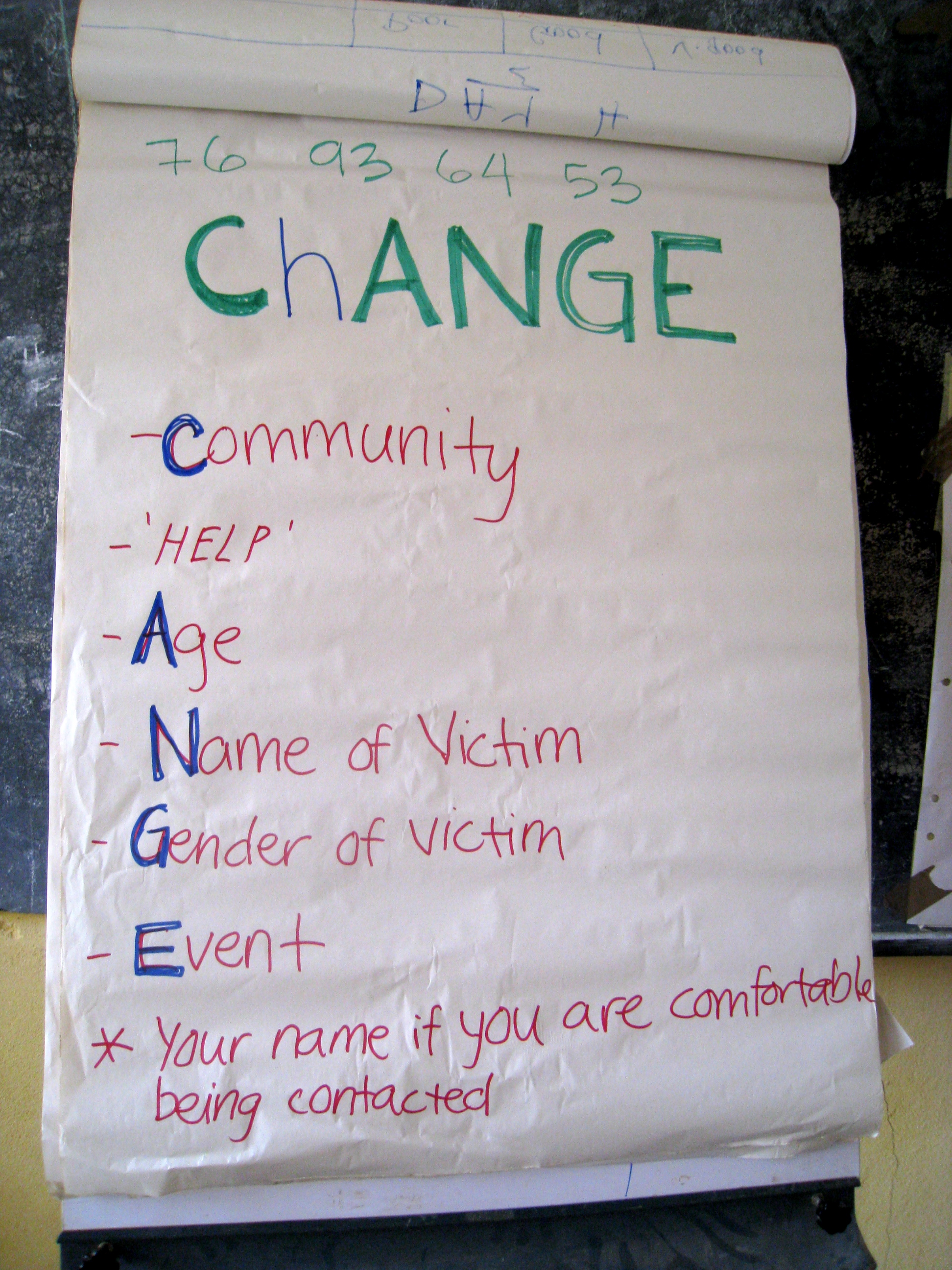
We created an acronym (ChANGE) to help the youth remember what information to include in text message reports. (C: Community; h: False letter– we said “help” so people can remember, but really nothing should be reported there, A: Age, N: Name of victim, and your own if you are comfortable reporting it, G: Gender, E: Event.)  Then we gave a practice scenario and asked five participants in the class to show how they would report the message. We reviewed each message for number of characters, noting that a single text message is limited to 140 characters, and also checked to make sure that all the necessary components were included.  All five messages were similar, reading something like:

My name is Judith. I beg of you for my friend Mary who is 14 years old and whose father is taking her from school to give to a 60 year old man for marriage in Bamessing community.

Most of the messages ran long, but did include the five required components.  One area of confusion was what level of geographic specificity to include.  We explained that while the report must be as specific as possible to facilitate a response, the Ushahidi site will present a more general geographic location so as to preserve anonymity for victims and reporters.

We asked the youth for feedback on the system, which resulted in more questions clarifying what is appropriate to report, and the level of confidentiality of reporting.  One concern was that often the phone network is down, making it impossible to send text messages.  We clarified that all the old methods of reporting still exist, and that community animators and Plan staff can be sought out to report either by text message or the other ways.  By the end of the training, the youth agreed that this would be a useful system, and some commented that they particularly appreciate the unique level of anonymity associated with SMS reporting.

This month, Joe and Georges will finalize the Ushahidi system, Joe will create brief manuals for system users, and Joe and I will provide additional training on using the system.  We hope to have the youth send sample text messages to the site in the next month to test the system, to train the youth, and to provide sample data to present the site to potential government partners. Our colleague Nathalia (the Child Protection Advisor in Plan Cameroon) also suggested that we create a ‘child and youth friendly’ guide to how Ushahidi works that can be used for training, so we’ll get going on that also.