Feeds:
Posts
Comments

On January 11, 2011 from 11-12am, TechChange and I co-hosted a tweet chat on ICT for Development (ICT4D) distance learning. The idea came up after Ernst Suur and I spent a few months lamenting the irony that we couldn’t find any good on-line training around ICT4D, nor did we see ourselves being able to quit our jobs or reduce our work-related travel, move to where a university offering ICT4D is located, and accumulate a huge debt by going back to get an advanced university degree the traditional way. We wrote a post asking “Where’s the ICT4D Distance Learning” and had a few conversations with the guys at TechChange and a few others who are working on developing some solutions to that issue.

During the Twitter chat, we asked a set of questions about topics, timing, accreditation, skills, and delivery models to get a sense of what might appeal to potential learners. We had almost 60 people participate in the chat, and apparently our hashtag, #ICT4DDL, was even a top trending topic in Washington DC at around 11:30. Here’s the archive.

—–

I had a chance to meet in person with Mark, Nick and Jordan from TechChange last week while I was in DC and these guys are smoking! They are seriously moving on creating visually attractive, stimulating and engaging e-learning in the area of ICT4D. I’m looking forward to collaborating more with them as they develop courses and methodologies that can help people from different backgrounds and with different needs to access ICT4D training and learning. I like their approach of involving practitioners, looking at ICT4D strategically (eg, integrating it to achieve goals, learning how to choose the right technology and decide if technology is necessary at all) and supporting on the practical side (how to use specific ICT tools) and I think this type of training, if all goes well, will be a great opportunity for us all to get trained up in those areas we feel we are still missing.

Mark wrote up the following summary of the themes and highlights from the chat [the original post is here on TechChange’s site: Recap of ICT4D Tweet Chat (#ICT4DDL)].

Course Topics: Some of the most popular ideas for courses included: social media for social change, sustainability, mobiles for development, and a course on ways to create and sustain collaboration through an online community. It was pointed out that users needs would be different based on access to and familiarity with technology. @fiona_bradley mentioned the need for strategic thinking and project planning for veteran change agents, because “tools change fast”.

Delivery: There was a desire expressed for blended learning models (face-to-face and online) and a sentiment that ICT4D face-to-face training was important. (list of existing ICT4D programs). There was also a feeling that experienced practitioners should be part of the course experience and that more needs to be done to engage them (@ICT_Works). Others stressed the fact that distance learning is the only option for those working in remote areas.

Credit vs. Certification: People generally preferred courses for credit, but some acknowledged that they had neither the time nor the funding for a full university degree course. Shorter-term certificate courses on specific topics appealed to many in the group.

The feedback we received throughout the tweet chat was quite useful, and as expected there was a wide variety of opinions expressed. As TechChange moves forward, we look forward to tailoring our courses to the needs of these and other users. We’re in the process of developing a 10-week online flagship course on Technology for Social Change. Everyone will be able access Unit 1 for free. From there we will develop more specialized courses and certification programs on subjects such as Technology for crisis response, Social media for social change, mHealth, and the Future of mobile devices for development. We are also working with individual organizations such as FrontlineSMS to create learning tools tailored specifically for their applications.

I’m really looking forward to taking some of the courses that TechChange comes up with and helping develop materials for some of them too.

Last year, I spent some time in Benin piloting an SMS reporting system to track and respond to Violence against Children (VAC). After almost a year developing the idea and thinking it through to see if it was potentially feasible (see 7 or more questions to ask before adding ICTs), in February 2010 we conducted 2 workshops with youth, staff and local authorities in Couffo and Atacora, Benin, to design a system with their input (see Finding Some ICT answers in Benin). The main pieces of the reporting system are FrontlineSMS and Ushahidi. A few months after, staff reported back on some of the challenges with implementation (see Tweaking: SMS Violence Reporting System in Benin).

Romeo Essou, project coordinator

Since then, many of the issues have been resolved, and we’ve improved outreach so that communities are more aware of the SMS reporting system and how to use it. We’ve also been looking at the system itself, continuing testing, and seeing what improvements are needed. We didn’t have resources to dedicate someone fully to the program at first, but after seeing the potential, Plan Benin assigned Romeo (see photo) to manage the pilot project full-time in Benin. It’s been quite a pleasure working with the team there, and Romeo is no exception. Having someone dedicated full-time to working with communities and staff in the two districts has really made a difference. From November to mid-January, several additional violence cases were reported and a good number of them have been followed up on and closed.

Last week, Romeo shared what we still need to find solutions for. Some of these are issues that we’d identified last year and others are additional things that Romeo has suggested as he’s gotten down to business.

Some people still call instead of texting, or they send “call me back” texts

Cases are now coming in

  • The team is fairly certain this is due to illiteracy. Plan will involve more school-going youth in the initiative because they have higher literacy levels and can support others with reporting if needed.
  • Romeo and the team will continue doing outreach and education on how the system works both at community meetings and via radio broadcasts in French and local languages.
  • To address the calls that may continue to come in, a voice mail will be set up on the phone that links up to the FrontlineSMS laptop, with a message explaining that people have to send in a text. Romeo will do some research to determine which languages to use in the message for the best result (French and the 2 main local languages….).
  • If that doesn’t resolve the issue, Romeo and the staff will call back anyone who phones in.
  • Cost of an SMS continues to be a discouraging factor for people in terms of reporting. Often when Romeo or other staff visit a community, community members take advantage of their physical presence to report additional cases of violence.  This is not necessarily negative, considering that we want to increase the number of incidents reported and followed up on; however, if it turns out that awareness around violence is high but the cost of the SMS is a deterring factor in reporting, more inexpensive channels to report also need to be offered. We are still negotiating with the local operators to get a free SMS line.

Spam

  • Some 50 spams a day are coming in. This is an issue on all mobile phones in Benin. Much of the spam comes from the mobile service providers themselves.
  • If the spam is coming from the same number, it’s possible that a workaround script could be written up at the point where FrontlineSMS forwards to Ushahidi. The messages can also be marked on Ushahidi as spam, but they will still be arriving via FrontlineSMS, unfortunately, unless numbers can be blocked somehow.
  • Needs further thought on how it might be overcome.

The Violence Tracking Platform (Ushahidi):

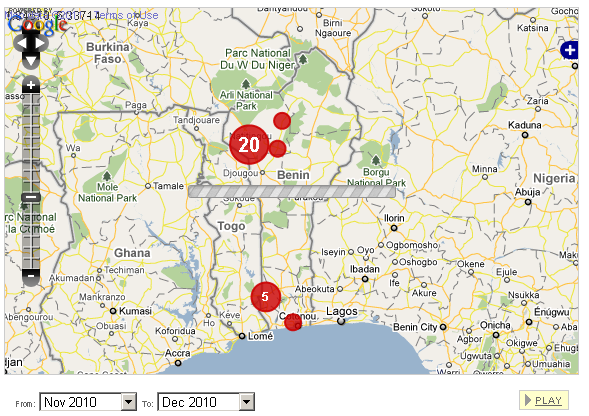
Ushahidi platform

  • We need to be 100% sure that any personal or identifying information coming in via the SMS reports is scrubbed so we do not put any children or witnesses at risk or falsely accuse anyone of violence against children by publishing the reports to the Ushahidi platform.
  • Romeo will develop a Privacy and Protection Checklist and train those administering the Ushahidi system to be sure to remove identifying information thoroughly before allowing it to be published on the Ushahidi site.
  • The identifying information still needs to be stored somewhere on the system to support with follow-up on the cases that come in. We may need additional development work on the platform to allow for that.
  • We hope to integrate the Ushahidi map into the Violence against Children website, which has educational material, videos and cartoons done by youth, and a discussion forum. However if the information poses a risk to anyone, we may decide to make the Ushahidi site private and keep it as a management tool rather than a public site.

Categorizing:

  • The staff who administer the Ushahidi website are not always clear which type of violence an incident should be categorized as (physical violence? sexual violence? psychological violence?).
  • Romeo will create short guidelines to help people to categorize the incidents properly. He’d like these to be incorporated into the Ushahidi platform.
  • Often a reported  incident can fit into more than one category – eg., both physical and sexual violence. If it’s categorized in two categories, then we lose the sense of how many incidents there have been overall, and we’re unable to properly chart the data. We need to find a way to manage this on the system so that we have proper statistics.

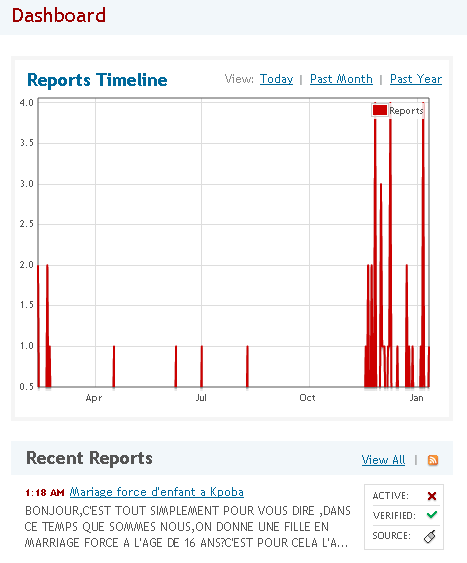
Recent reports of physical violence, sexual violence, forced marriage and exploitation

Follow up on reported cases:

  • We still want a way to track response and follow-up on cases within the Ushahidi platform, as often a report requires more than one verification visit.
  • We need someplace within the platform to store this type of information to keep records of follow-up.
  • This will require work by a developer, but it might be helpful for other institutions using Ushahidi as well. It’s also possible that FrontlineSMS Medic could be used for case management rather than Ushahidi, but it might prove confusing for staff to have to store and act on the same kind of information using two different tools.

Names of villages, hamlets, etc:

  • We would like to have a listing on the map of the various hamlets, villages, etc. They do not currently appear on the map since there is no record of them on Open Street Maps or Google Maps. Plan has this detailed information in its internal systems and we want to add it to the base maps so that it’s easier for administrators to locate the incident in the right community.
Coordination and outreach:
  • In addition to the technical work on the system, Romeo will continue to coordinate and share information with local partners and other organizations working on violence against children. There are similar initiatives already in place and we don’t want to duplicate efforts. Combining and sharing help line numbers and taking reports by both phone and SMS is one option.
Related posts on Wait… What?

This is a post by Jo-Ann Garnier-Lafontante. Jo-Ann and I go back a long way. We worked together on a few youth media and participation programs in the past and became friends. She and the youth that I met through her were the first people I thought of when I heard about the earthquakes in Haiti last January. It’s people like Jo-Ann and the youth she works with who are bringing Haiti back to its feet.

On January 12th at 4h53pm I was in my third-floor office at Plan Haiti, meeting with Guerdy the Human Resources Manager and talking about staff issues and projects for the New Year. Suddenly the ground seemed furious with us. I can still hear the sound of heavy concrete collapsing and people screaming. After I saw the toilet literally explode in front of us, I told Guerdy “We’re going to die.” I saw images of my family before me. I tried to call them, but I could not get through. I was terrified. My husband worked in a 6-story building and I could not reach him…

Between three violent aftershocks Guerdy and I managed to get out of the building and into the parking lot. I remember seeing several shoes my colleagues had lost in the stairs while running out of the office. I saw my other colleagues horrified, crying and trying desperately to communicate with their loved ones on their cell phones. I saw this little girl, maybe she was 12, who had come to hide in our parking lot. I had never seen her before… she smiled at me. She told me she lived in the neighborhood, that she escaped from her house and the rest of her family was still missing. She was wounded, the features of her face hidden behind dust.

Four hours later, my husband miraculously appeared in our parking lot, sweating and breathless. I had tears in my eyes when I saw him.  He told me about the things he saw on his way to Plan’s office and we started the journey home together. It was awful. We saw people either walking like zombies, screaming, crying, carrying injured people or dead bodies—or desperately looking for loved ones. When we got home, my mother, my 1-year-old daughter and 7-year-old son were in the street in front of our house…stunned and speechless. I grabbed them and held them so tight. I heard that my father and nieces were stuck downtown but they were okay. Now… what about the rest of the family, friends … we could only wonder.

I remember the funerals of my aunt and my grandmother. My father had to remove his own mother from the rubble that had been her home, after six days of digging. We had gotten my aunt out of her collapsed home after two days of digging but she died on the way to the hospital—and then her body was lost among the other bodies and we never found her again.

I remember seeing so many people around Port-au-Prince queuing for burial ceremonies for their loved ones. I thought Haiti had died.

On the last day of 2010, I sat at a meeting at Plan’s new office in Port-au-Prince. It was for the children’s and youth event we are planning for the anniversary of the earthquake. I was amazed at the change since last January. At the meeting we talked about celebrating life. We talked about a new beginning for Haiti and how the engagement of children and youth is essential to its success. I felt our excitement. I feel so proud to be a part of this.

According to what I have witnessed over the past year, Haiti’s promising future is guaranteed because of the potential inside its children and youth. After the earthquake, I saw how young people were so keen and motivated to support their peers. Now I see them mobilizing again to raise awareness about cholera and saving lives.

The earthquake devastated Haiti, but it also provided a chance for this country to be reborn. Children and youth immediately understood their role in this reshaping—they played a key part in the emergency response and they have told us from the beginning that they are ready to do whatever it takes to help reconstruct their country. We adults—and especially the decision makers among us—should listen to their insights and follow in their footsteps and do whatever it takes to fulfill our responsibilities to this country. In the near future, I think there should be a group of young advisors standing behind the President and each Minister.

Today I weep for my aunt, Gagaye (this is how we called her), and my grandmother, Nini, and so many other family members and friends whom I am missing, and also for those I did not know and who left us too soon. But today I also celebrate life. I celebrate the strength I see in the communities where Plan works. I understand the wise person who said “a country never dies…” I now know this is true more than ever because a country like Haiti can count on its children and youth to keep it alive.

Jo-Ann narrates the video below about the work she’s been involved in over the past year. It’s worth a look.

Related posts on Wait… What?

Haiti through our eyes – an uplifting series of photos by Haitian youth

Children and young people’s vision for a new Haiti – 1000 youth input into Haiti’s reconstruction plan

Children in Emergencies: Applying what we already know to the crisis in Haiti – lessons learned from past disasters

Every January as I’m signing up for the gym, I feel the need to tell the person at the desk that I’m not one of those people who sign up as a short-lived New Year’s resolution. I get the urge to explain that I play capoeira year-round and that I normally run outside and am only coming to the gym now because it’s cold and icy. I want to let that guy at the desk know that if I do happen to stop showing up, it will likely be because I am traveling somewhere or because the weather got warm, not because I bailed on a New Year’s fitness resolution.

‘Oh man, we been full on,’ the guy at the counter says to the other guy coming on shift today as I stand there filling out my registration forms. ‘New Year’s rush. We signed up 88 people since yesterday.’

I resist the urge to launch into an explanation about how that isn’t my situation. I stop myself from casually informing him that if he’s assuming I’m one of the New Year’s resolution people, he is wrong.

I doubt he really cares. And really, what does it matter to anyone other than me?

I do my time on the treadmill and watch other people doing their gym thing. I start wondering how many of the statistics that we collect in our jobs in aid or development or public health or education aren’t really what we think they are. But I also start thinking about how we all believe that somehow our own little stories and motivations matter in the larger scheme of things.

My experience trying to get to and from beautiful and restful Costa Rica for a family holiday using Orbitz has been entirely depressing. Flying these days is akin to trudging across a barren desert full of rattlesnakes and mirages, only made mentally and emotionally possible by holding firmly in your mind the hope that you might finally reach your destination. It didn’t used to be this way.

What used to be the ‘friendly skies’ is now more commonly referred to by most of my peers and colleagues as ‘airport purgatory’. I can remember back when you were treated like a paying customer. Nowadays once you enter airport purgatory you’re treated like a potential criminal/potential terrorist and a burden that needs to be schlepped from one side of the world to the other as cheaply as possible without much regard to your own comfort. It’s sad. If I could get to where I need to go by horseback, train, bus, bicycle, boat or foot in a reasonable time I certainly would.

Before entering airport purgatory, you have to spend some time in the ‘antechamber of airport purgatory’: purchasing tickets. Oftentimes, due to weather or some other issue, you have to make changes to the ticket, and you go swiftly from the antechamber, to airport purgatory, to full on travel hell where you have to deal with ‘customer service’. You wish you could stab yourself in the eyes with a corkscrew rather than be held there listening to hideous music, pre-recorded messages, attempts to up-sell you something, and travel hell agents who don’t really help you with anything.

For the past 10 years or so, I’ve allowed Orbitz to guide me through the antechamber of airport purgatory. I’ve gotten my tickets through them. It’s been fine as long as nothing out of the ordinary happens — eg, if the weather is fine, there are no delays, plans don’t change, and I don’t miss any connections. Unfortunately, things out of the ordinary do happen, and increasingly it seems I’m spending a lot of time with Orbitz in travel hell. That’s what happened on this last trip.

I can only remember 2 other instances that I’ve felt as dis-empowered and pent-up angry as I did when dealing with Orbitz this time around:  1) when visiting someone in prison and 2) when working with immigration officials in a country under a military dictatorship. (Coming in a close third is being on the phone with Dell’s customer service about a faulty computer….)

This recent experience in full on travel hell with Orbitz, combined with lesser annoyances throughout the past couple years has me so totally done with the airline system and its intermediaries that I do anything in my power not to fly. Unfortunately that impacts on my ability to do my job so I’m not always successful at avoiding it. Not even the environmental movement has been able to move me as emotionally far towards flight avoidance as the airline system and all its corollary parts.

Since I’m still really pissed off at being royally screwed by Orbitz, I thought I’d write down a few things that I wish I had done to avoid the pain of travel booking with them. I just sent off a long email to Orbitz and will be contacting them on paper too, so I will spare you the details. It’s probably not productive anyway to re-hash it all. I’d rather try to make something positive out of this to add this to my ‘Travel Tips for my Female Friends‘ post as an additional tip from someone who spends a lot of time traveling and arranging travel logistics.

The problem with Orbitz:

1) Orbitz doesn’t seem to keep any record of their interactions with customers. This means that every time you call, you have to re-explain your whole story. I used to work in customer service and we had a system where we stored notes and details on each call so that if a person called a second or third time, there was a record on file and anyone on the team could help. I’m blown away that each time I called Orbitz, they said they had no record of anything and I had to start over explaining from zero.

2) Orbitz treats the customer as if the customer is always wrong. They try to make it seem as if they are actually helping you on the phone, when in actuality you could do the same thing for yourself by calling the airlines directly. In the process, they keep saying they are ‘very sorry’ but never actually resolve anything for you. If you press them, they actually become rude. When I worked in customer service, and even back in high school when I was working retail at the mall, we were not allowed to deal in a less than friendly way with customers unless they were yelling or swearing at us. It’s bad for business. We were trained to be calm and polite. Not the case with Orbitz. I was not yelling or swearing or being unreasonable, and I spent no less than 14 hours on the phone with them in the past few months trying to resolve different aspects of the same tickets (not to mention time on emails, time wasted in airports and the night my kids and I slept on the cold floor at the entrance of the San Jose airport). That plus the fact that I have had an Orbitz account for over 10 years and I book tickets through them several times a year should flag me as a customer to treat with care. Apparently none of that matters to Orbitz. They were still rude to me.
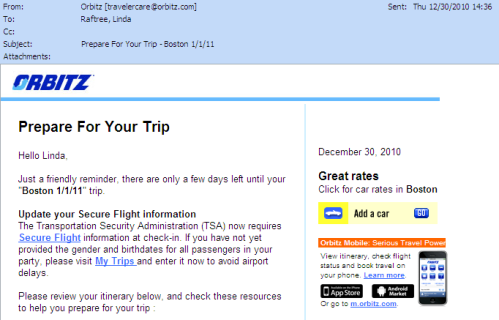
Prepare for my trip? You mean the one that was cancelled back in October?

3) Orbitz’ systems are not synced with what is actually happening with your tickets and the airlines. With this one trip from Boston to Costa Rica, lack of synchronization caused me major problems and ended up quadrupling the cost of my trip – something I was not prepared for but didn’t have any way around by the time I was stuck with 2 kids in San Jose on New Year’s Day. First, I was informed by automated email repeatedly in August and September that my tickets were being refunded due to an airline going out of business. Each time I called customer service about it I was told that only one leg of my trip was being cancelled and refunded and not to be concerned with the other portion, it was still good. I was advised to purchase a one-way ticket to make up for the portion from the airlines that went bankrupt. This in the end was not true, the round trip ticket had actually been cancelled and refunded, and I ended up with the 3 one-way return tickets I had purchased and no outbound flights [Note: this happened while the tickets were under the auspices of http://www.cheaptickets.com. I found out, after going up the ‘customer service’ ladder and being referred over to Orbitz, they are owned by and share ‘customer service’ with Orbitz]. Orbitz subsequently seemed to get this all worked out. But then they continued to send “Prepare for your Trip” emails for cancelled tickets on the same flight path, same date and same airline as my valid tickets, causing confusion over what our actual flight time was. Due to this confusion, we showed up at the airport for a flight that had been cancelled and refunded months ago instead of for the earlier flight we were supposed to be on, and Orbitz was not willing to do anything to help us get on another flight unless we bore the total cost and waited up to 3 days for available flights on the original airline.

My recommendations of how to avoid getting screwed by Orbitz:

1) Don’t ever try to fix anything via Orbitz after you buy your ticket. You will call Orbitz expecting them to help you since you paid them a fee already for booking. They will put you on hold and call the airline and tell you the same thing the airline would. Sometimes the airline can actually do something for you that Orbitz can’t. So just book directly with the airline and deal with the airline directly. You may not get any better service but at least you are working directly with the company not an intermediary. Don’t bother with Orbitz. Be sure to have the international number of the airline with you when you travel.

2) Use Orbitz to find flights but never book via Orbitz. Once you book, Orbitz will pass everything over to the airline anyway, but then the airline can blame Orbitz for screw ups, Orbitz blames the airline, and you get stuck in the middle. It’s probably better to deal directly with the airlines as they have more information anyway about their own flights, and may want to retain you as a customer.

3) Just skip Orbitz altogether and find flights on Kayak, then book directly with the airline or via a real live travel agent in your area who you can hold accountable. Pay the travel agent the $30 instead of Orbitz. You’ll be helping the local economy and you know who they are when things go screwy. It kills me to say that since I do everything online and it’s so easy to find a ticket and click “purchase” but I’m realizing it’s worth the extra time at the beginning to save the time and increased costs later.

4) If you ever have a question or a claim for Orbitz, talk to them by chat and save a copy of the chat session. Then when they tell you something different each time, you can let them know that you actually have a copy of what was discussed as backup, and that you’re happy to share it with them to prove your point. This has gotten me further than working by phone where you have no way to keep a record of what they are telling you.

In the end, air travel will probably continue to be some variation of hell. The ticket wars are heating up lately as Delta and American Airlines are pulling their flights off of sites like Orbitz, and Expedia has fought back by allegedly making American flights difficult to find on their site.  They all purport to be ‘thinking of consumers,’ but that seems like a load of bull to me. They are thinking of their own piece of the pie. Maybe they could think about offering a decent experience to travelers and drawing in customers that way?

In 2011, I predict that purchasing airline tickets and getting to your destination will continue to suck. But maybe you can make it a little better by taking a few of the precautionary steps above.

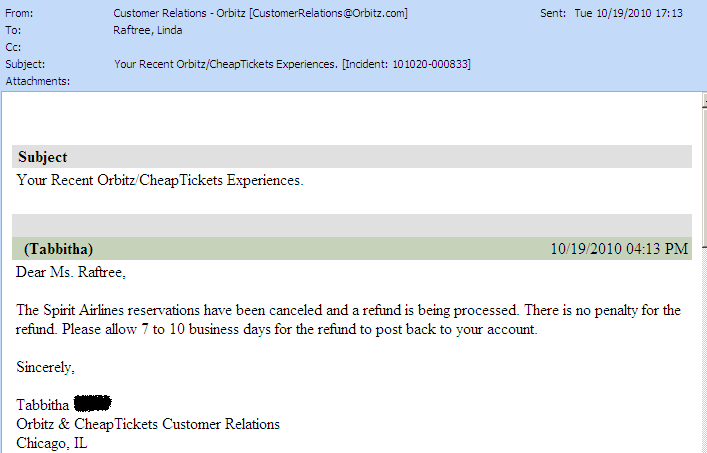
Update: Ahhh, wonderful response from Orbitz to my lengthy email and a generous $50 voucher for my troubles. They say that I contacted the airlines directly (not true) and that “Orbitz was never notified of these cancellations, and therefore, was unaware.” That’s funny, considering the email below:

Uh huh... "Orbitz was never notified of these cancellations, and therefore, was unaware."

Update #2: Ah lovely lovely Orbitz. After appearing that they were going to help me and getting my hopes up, they’ve come back now and “for my confusion” they are giving me three $100 vouchers to use on, yes you guessed it, Orbitz. They “deeply regret each of my disappointing experiences.” I feel oh so much better. Not.

Related post on Wait… What?

Travel tips for my female friends

Snails

I’m on my way home from 10 days in Costa Rica with my extended family. We stayed at my mother’s house, and biked over to a big stretch of solitary beach every day.We cooked together, read books, saw monkeys and crocodiles, walked the beach, watched movies, talked and sometimes just sat in silence listening to the birds and the waves. It was nice to take a break and get offline for a while. I finally stopped dreaming in email and twitter.

One of the coolest things on the beach in Costa Rica was the snail trails.

If you walked on the beach after the tide went out, you could see extensive areas full of twisty, winding, seemingly directionless patterns in the sand that crisscrossed into a beautiful curvy pattern along the shoreline. Snails just doing their thing.

2010 was a full year. One of the most satisfying things for me was being part of a diverse and brilliant global network of people, each following our own trails but learning, discussing, disagreeing, and building on ideas and initiatives together when we cross paths along the way. A huge thanks to you all for enriching the world with your thoughts, your actions and your work. I look forward to more in 2011!

Growing up with Harry

My Twitter pal Bonnie Koenig and I were chatting about how we have both enjoyed watching our kids grow up with Harry Potter. We thought we’d share our stories, imagining that they are not so far from the stories of others who have children of similar ages. Read Bonnie’s post Harry Who? We’d love to hear other stories too….

This past November was the first time that my kids and I have spent Thanksgiving on our own at our place. We’ve always either been in a country that doesn’t celebrate it, or with my family. (And there was one year I missed it altogether because I was at a work meeting in Bangkok….)

This year the 3 of us made Thanksgiving dinner together. We each cooked our specialty and broke out the fancy china. It was a nice, cozy time. During dinner, my son Daniel said ‘We should go see Harry Potter. It’s tradition.’

We saw the first Harry Potter movie with our entire extended family in Oregon on our first Thanksgiving in the US after moving up from El Salvador. My kids always remember because there was a huge snowstorm, and they had never seen snow before. Subsequent Thanksgivings and Christmases, if there was a Harry Potter out, we’d make a point of all going together. I associate the movies with warmth and holiday, even though the themes of the movies are often dark.

Harry Potter for us didn’t start with the movies though. When Daniel was 7 and we lived in El Salvador, I picked up the first Harry Potter book on a work trip to the UK, having no idea what it was or what it was about. (I did the same thing with Radiohead’s Kid A now that I think about it. That was an influential trip!)

I started reading Harry Potter to Daniel, a chapter a night. He was in first grade, and reading short story books in Spanish. He read English at a slower pace. After we got through the first few chapters, he couldn’t wait for me. He would take the book to school in his backpack and read on his own at my mother-in-law’s house after school. He quickly finished the book without me.

We got hold of the second book while still in El Salvador. Then we moved to the US in the summer of 2001 when he was 9 and he spent a good deal of his waking hours devouring and re-devouring the 3rd and 4th books.

The Nimbus...

By that time he was a fast reader. We had to buy the hard copy versions of the books because he couldn’t wait for the paperbacks to come out. Since we were in the US, he had access to the Harry Potter paraphernalia too. We had the Nimbus Quiddich broom (which you may remember due to it’s funky reputation), and the Harry Potter Lego set. Daniel’s best friend at the time was a shoe-in for Harry, glasses and all.

As we left the theater after seeing the latest Harry Potter movie this Thanksgiving, Daniel commented on the new layer of connections he’d made between the film and life. Now that he was older, he could see themes of racism, government control, censorship and genocide and relate them to the real world. ‘I need to go back and read the books again,’ he said, ‘to understand what they are really about.’ Later that night while I was washing up the dishes, we got to talking. ‘Mom, I’ve been thinking how important reading is,’ he said. ‘People who don’t read, they’re just missing so many things. I’m glad I like reading. I’m glad you got me to like reading. Remember? Harry Potter was the first book I ever read. And in English!”

I am thinking maybe it’s time for me to get off the Internet and start reading books again too….

A little more than a month ago, I wrote a post asking ‘Where is the ICT4D distance learning.’ Ernst Suur and I had been trying to figure that out since last July.

A bunch of ideas and information came in via the comments section that helped us to figure out what is happening in the space, including info about ICT4D advanced degrees options, short courses, related courses, etc.

In addition to following up with a couple established universities to see if (and when) they might be offering Masters level ICT4D programs, Ernst and I had a skype meeting with Mark Weingarten and Nick Martin, the folks over at TechChange (the Institute for Technology and Social Change).

TechChange is a new organization dedicated to training practitioners and students to effectively leverage emerging technologies for social change. They are building tools and courses for ICT4D and have already partnered with a number of universities — eg., American University, George Washington University, the UN University for Peace — to deliver face-to-face courses in topics like ‘technology for crisis response’ and ‘social media for social change.’ They also have upcoming projects planned with U4UshahidiSouktel, and FrontlineSMS. In addition to in-person trainings, TechChange is designing learning tools for use in online courses and degree programs.

As Mark commented, ‘We are developing curricula for practitioners (including those working in the field), and recognizing that needs and schedules vary. Some people and organizations might want to quickly learn how to use specific ICT tools, but others may want a more in-depth understanding of the entire ICT4D ecosystem, its successes, its failures, and where things are headed in the future. We want to better understand this range of needs and tailor our courses. We’re also interested in knowing more about what else is being done in this space and what other examples we can learn from.’

In order to get some wider input, we invite you to join us for a twitter chat on ICT4D Distance Learning on Friday, January 14th at 11 am EST. The hashtag will be #ICT4DDL.

We will cover 5 questions:

  1. Topics: What sorts of courses would interest you most? What topics are most relevant?
  2. Timing: What timeframe for distance learning courses would best suit your schedule and needs? Short-term courses on specific topics (or tools) vs. more in-depth courses?  3 hr modules or ten week facilitated trainings?
  3. Credit: How important are things like credit or degree programs? Are certifications enough?
  4. Skills: What skills would you like to gain as a participant – considering 1) university students just entering the field and 2) practitioners taking professional development courses.
  5. Delivery: How does connectivity affect your ability to take courses? What about in the case of others who might be interested in this type of training but are not on Twitter/online as often? Is a mobile option a good idea?

Tips for a good Twitter Chat:

  • Login 5 mins ahead of time and be ready with a short introduction (eg, Cathy here, I manage maternal health pgms at XYZ in Malawi, we’re just getting started with ICT4D).
  • Tools like TweetChat which automatically add the hashtag and refresh often are helpful to keep up with the conversation.

We look forward to chatting on Friday, January 14th at 11 am EST and welcome any questions or comments before then!

Related posts on Wait… What?

Where is the ICT4D Distance Learning?

3 ways to incorporate ICTs into development work

Demystifying Internet

ICT4D in Uganda: ICT does not equal computers

It’s all part of the ICT4D jigsaw: Plan Mozambique ICT4D workshop

DREAMs

My children were not born in the United States. They were born in El Salvador. We moved to the US when they were 9 and 4 years old. Their father is not and never has been a US citizen or legal resident. They’ve likely lived in the US a lower percentage of their lives than many of the young people who just had their dreams dashed when US Senate blocked the DREAM act, legislation that would have provided legal residency to young people who came to the US illegally before age 16 and who graduated from high school, completed 2 years of college or military service and had no criminal record.

My son is applying for college. He’s just been accepted at one of his top choice schools. He is eligible for scholarships, grants and loans that will cover almost the entire cost of his education. He worked his ass off to get where he is. But what if we’d ended up staying in El Salvador? If he’d worked just as hard there in El Salvador, would he be planning to go to one of the world’s top schools in the Fall? Would his education have prepared him to go? Or what if instead of having me for a mother, he’d had another woman as a mother? A woman exactly like me who wasn’t a US citizen when we moved to the US. What then?

How are my children any more worthy than other young people their same age who came to the US as young children, but whose parents were not able to obtain legal status? Why do my children have more privileges?

Ah, right. Because I happen to be their mother and I happen to have been born in the US. That’s the only reason. It just seems so unfair.

Related posts on Wait… What?

The real story involves anti-social entrepreneurs and anthropology

Beginnings

18 years

When people tell their own stories and take photos of themselves, the results are quite different from when outsiders bring in their stereotypes and their agendas.

I love love love this photo series by youth in Croix des Bouquets and Jacmel.

In October, 2010, Plan commissioned Natasha Fillion, a Canadian photojournalist based in Port-au-Prince, to train and work with 22 teenagers to document their own lives in their own home, neighborhoods and schools. The youth, ages 14-19, got a crash course in photography and were given a digital camera and sent out ‘on assignment’ in their communities. Their brief was to cover topics such as home life, education, leisure, friends, everyday Haiti, and anything about which they were passionate. The photos were taken over a period of 2 weeks.

Fillion commented ‘I go out and I’m covering demonstrations, violence and destruction but there’s a whole side of Haiti that the media, the whole world doesn’t get to see, and I told the students — this is your opportunity to show people what Haiti is really like. These are photos that tell the story of Haiti as a whole, not just news.’

February 3, 2011, update:

Interview with 2 of the youth photographers and Natasha Fillion.

Related posts on Wait… What?