Feeds:
Posts
Comments

Archive for the ‘development’ Category

It’s disturbing how many creative, smart, capable, ethical people I talk with lately are feeling really de-motivated and sometimes plain disgusted with our field and our profession. At least a few times a month, people contact me wanting to chat through a crisis of purpose, worried that they are losing their souls if they keep working in the belly of the aid/ development/ humanitarian beast. They wonder if it’s possible to keep doing the part of the work that they still believe in from the margins rather than from the center. As the kind of work that we do turns more and more into big business, they wonder what can be done to maintain a level of integrity that they can live with. I often ask myself the same thing.

I won’t spoil the end of Mad Men for those who haven’t watched it yet, but the finale really resonated. The ad industry – the aid industry. How much are they actually different? How alienated and empty do you feel at the end of the day sometimes, even when you are great at what you do and you are hitting your targets (Don)? How much does your sex/gender/race prohibit you from advancing (Joan) (Dawn) (Shirley)? How much do you still believe that you can keep on keeping on, making your job your life, doing everyone else’s work, and thinking that one day, you’ll be recognized (Peggy)? And the final ad shown on Mad Men (one I remember so well from my childhood) perfectly combines commercialism and ‘saving the world’.

A couple of months ago, Stephan Ladak interviewed me as part of a podcast series over at Aidpreneur. It was a fun talk but (as probably happens to a lot of people) as soon as it was over I started doubting everything I said, wondering if I’d been too honest or if I was not sounding positive enough. It was published today. So, I held my breath and listened to it this morning and I’m actually quite OK with it. It’s about work, personal relationships, children, tech, entrepreneurship, and trying to keep your values and integrity as you navigate life at the margins of the aid industrial complex. Have a listen to it here if you’re interested.

Read Full Post »

Screen Shot 2015-04-23 at 8.59.45 PMBy Mala Kumar and Linda Raftree

Our April 21st NYC Technology Salon focused on issues related to the LGBT ICT4D community, including how LGBTQI issues are addressed in the context of stakeholders and ICT4D staff. We examined specific concerns that ICT4D practitioners who identify as LGBTQI have, as well as how LGBTQI stakeholders are (or are not) incorporated into ICT4D projects, programs and policies. Among the many issues covered in the Salon, the role of the Internet and mobile devices for both community building and surveillance/security concerns played a central part in much of the discussion.

To frame the discussion, participants were asked to think about how LGBTQI issues within ICT4D (and more broadly, development) are akin to gender. Mainstreaming gender in development starts with how organizations treat their own staff. Implementing programs, projects and policies with a focus on gender cannot happen if the implementers do not first understand how to treat staff, colleagues and those closest to them (i.e. family, friends). Likewise, without a proper understanding of LGBTQI colleagues and staff, programs that address LGBTQI stakeholders will be ineffective.

The lead discussants of the Salon were Mala Kumar, writer and former UN ICT4D staff, Tania Lee, current IRC ICT4D Program Officer, and Robert Valadéz, current UN ICT4D staff. Linda Raftree moderated the discussion.

Unpacking LGBTQI

The first discussant pointed out how we as ICT4D/development practitioners think of the acronym LGBTQI, particularly the T and I – transgender and intersex. Often, development work focuses on the sexual identity portion of the acronym (the LGBQ), and not what is considered in Western countries as transgenderism.

As one participant said, the very label of “transgender” is hard to convey in many countries where “third gender” and “two-spirit gender” exist. These disagreements in terminology have – in Bangladesh and Nepal for example – resulted in creating conflict and division of interest within LGBTQI communities. In other countries, such as Thailand and parts of the Middle East, “transgenderism” can be considered more “normal” or societally acceptable than homosexuality. Across Africa, Latin America, North America and Europe, homosexuality is a better understood – albeit sometimes severely criminalized and socially rejected – concept than transgenderism.

One participant cited that in her previous first-hand work on services for lesbian, gay and bisexual people; often in North America, transgender communities are prioritized less in LGBTQI services. In many cases she saw in San Francisco, homeless youth would identify as anything in order to gain access to needed services. Only after the services were provided did the beneficiaries realize the consequences of self-reporting or incorrectly self-reporting.

Security concerns within Unpacking LGBTQI

For many people, the very notion of self-identifying as LGBTQI poses severe security risks. From a data collection standpoint, this results in large problems in accurate representation of populations. It also results in privacy concerns. As one discussant mentioned, development and ICT4D teams often do not have the technical capacity (i.e. statisticians, software engineers) to properly anonymize data and/or keep data on servers safe from hackers. On the other hand, the biggest threat to security may just be “your dad finding your phone and reading a text message,” as one person noted.

Being an LGBTQI staff in ICT4D

 Our second lead discussant spoke about being (and being perceived as) an LGBTQI staff member in ICT4D. She noted that many of the ICT4D hubs, labs, centers, etc. are in countries that are notoriously homophobic. Examples include Uganda (Kampala), Kenya (Nairobi), Nigeria (Abuja, Lagos), Kosovo and Ethiopia (Addis). This puts people who are interested in technology for development and are queer at a distinct disadvantage.

Some of the challenges she highlighted include that ICT4D attracts colleagues from around the world who are the most likely to be adept at computers and Internet usage, and therefore more likely to seek out and find information about other staff/colleagues online. If those who are searching are homophobic, finding “evidence” against colleagues can be both easy and easy to disseminate. Along those lines, ICT4D practitioners are encouraged (and sometimes necessitated) to blog, use social media, and keep an online presence. In fact, many people in ICT4D find posts and contracts this way. However, keeping online professional and personal presences completely separate is incredibly challenging. Since ICT4D practitioners are working with colleagues most likely to actually find colleagues online, queer ICT4D practitioners are presented with a unique dilemma.

ICT4D practitioners are arguably the set of people within development that are the best fitted to utilize technology and programmatic knowledge to self-advocate as LGBT staff and for LGBT stakeholder inclusion. However, how are queer ICT4D staff supposed to balance safety concerns and professional advancement limitations when dealing with homophobic staff? This issue is further compounded (especially in the UN, as one participant noted) by being awarded the commonly used project-based contracts, which give staff little to no job security, bargaining power or general protection when working overseas.

Security concerns within being an LGBTQI staff in ICT4D

A participant who works in North America for a Kenyan-based company said that none of her colleagues ever mentioned her orientation, even though they must have found her publicly viewable blog on gender and she is not able to easily disguise her orientation. She talked about always finding and connecting to the local queer community wherever she goes, often through the Internet, and tries to support local organizations working on LGBT issues. Still, she and several other participants and discussants emphasized their need to segment online personal and professional lives to remain safe.

Another participant mentioned his time working in Ethiopia. The staff from the center he worked with made openly hostile remarks about gays, which reinforced his need to stay closeted. He noticed that the ICT staff of the organization made a concerted effort to research people online, and that Facebook made it difficult, if not impossible, to keep personal and private lives separate.

Another person reiterated this point by saying that as a gay Latino man, and the first person in his family to go to university, grad school and work in a professional job, he is a role model to many people in his community. He wants to offer guidance and support, and used to do so with a public online presence. However, at his current internationally-focused job he feels the need to self-censor and has effectively limited talking about his public online presence, because he often interacts with high level officials who are hostile towards the LGBTQI community.

One discussant also echoed this idea, saying that she is becoming a voice for the queer South Asian community, which is important because much of LGBT media is very white. The tradeoff for becoming this voice is compromising her career in the field because she cannot accept a lot of posts because they do not offer adequate support and security.

Intersectionality

Several participants and discussants offered their own experiences on the various levels of hostility and danger involved with even being suspected as gay. One (female) participant began a relationship with a woman while working in a very conservative country, and recalled being terrified at being killed over the relationship. Local colleagues began to suspect, and eventually physically intervened by showing up at her house. This participant cited her “light skinned privilege” as one reason that she did not suffer serious consequences from her actions.

Another participant recounted his time with the US Peace Corps. After a year, he started coming out and dating people in host country. When one relationship went awry and he was turned into the police for being gay, nothing came of the charges. Meanwhile, he saw local gay men being thrown into – and sometimes dying in – jail for the same charges. He and some other participants noted their relative privilege in these situations because they are white. This participant said he felt that as a white male, he felt a sense of invincibility.

In contrast, a participant from an African country described his experience growing up and using ICTs as an escape because any physical indication he was gay would have landed him in jail, or worse. He had to learn how to change his mannerisms to be more masculine, had to learn how to disengage from social situations in real life, and live in the shadows.

One of the discussants echoed these concerns, saying that as a queer woman of color, everything is compounded. She was recruited for a position at a UN Agency in Kenya, but turned the post down because of the hostility towards gays and lesbians there. However, she noted that some queer people she has met – all white men from the States or Europe – have had overall positive experiences being gay with the UN.

Perceived as predators

One person brought up the “predator” stereotype often associated with gay men. He and his partner have had to turn down media opportunities where they could have served as role models for the gay community, especially poor, gay queer men of color, (who are one of the most difficult socioeconomic classes to reach) out of fear that this stereotype may impact on their being hired to work in organizations that serve children.

Monitoring and baiting by the government

One participant who grew up in Cameroon mentioned that queer communities in his country use the Internet cautiously, even though it’s the best resource to find other queer people. The reason for the caution is that government officials have been known to pose as queer people to bait real users for illegal gay activity.

Several other participants cited this same phenomenon in different forms. A recent article talked about Egypt using new online surveillance tactics to find LGBTQI people. Some believe that this type of surveillance will also happen in Nigeria, a notoriously hostile country towards LGBTQI persons and other places.

There was also discussion about what IP or technology is the safest for LGBTQI people. While the Internet can be monitored and traced back to a specific user, being able to connect from multiple access points and with varying levels of security creates a sense of anonymity that phones cannot provide. A person also generally carries phones, so if the government intercepts a message on either the originating or receiving device, implications of existing messages are immediate unless a user can convince the government the device was stolen or used by someone else. In contrast, phones are more easily disposable and in several countries do not require registration (or a registered SIM card) to a specific person.

In Ethiopia, the government has control over the phone networks and can in theory monitor these messages for LGBTQI activity. This poses a particular threat since there is already legal precedent for convictions of illegal activity based on text messages. In some countries, major telecom carriers are owned by a national government. In others, major telecom carries are national subsidiaries of an international company.

Another major concern raised relates back to privacy. Many major international development organizations do not have the capacity or ability to retain necessary software engineers, ICT architects and system operators, statisticians and other technology people to properly prevent Internet hacks and surveillance. In some cases, this work is illegal by national government policy, and thus also requires legal advocacy. The mere collection of data and information can therefore pose a security threat to staff and stakeholders – LGBTQI and allies, alike.

The “queer divide”

One discussant asked the group for data or anecdotal information related to the “queer divide.” A commonly understood problem in ICT4D work are divides – between genders, urban and rural, rich and poor, socially accepted and socially marginalized. There have also been studies to clearly demonstrate that people who are naturally extroverted and not shy benefit more from any given program or project. As such, is there any data to support a “queer divide” between those who are LGBTQI and those who are not, he wondered. As demonstrated in the above sections, many queer people are forced to disengage socially and retreat from “normal” society to stay safe.

Success stories, key organizations and resources

Participants mentioned organizations and examples of more progressive policies for LGBTQI staff and stakeholders (this list is not comprehensive, nor does it suggest these organizations’ policies are foolproof), including:

We also compiled a much more extensive list of resources on the topic here as background reading, including organizations, articles and research. (Feel free to add to it!)

What can we do moving forward?

  • Engage relevant organizations, such as Out in Tech and Lesbians who Tech, with specific solutions, such as coding privacy protocols for online communities and helping grassroots organizations target ads to relevant stakeholders.
  • Lobby smartphone manufacturers to increase privacy protections on mobile devices.
  • Lobby US and other national governments to introduce “Right to be forgotten” law, which allows Internet users to wipe all records of themselves and personal activity.
  • Support organizations and services that offer legal council to those in need.
  • Demand better and more comprehensive protection for LGBTQI staff, consultants and interns in international organizations.

Key questions to work on…

  • In some countries, a government owns telecom companies. In others, telecom companies are national subsidiaries of international corporations. In countries in which the government is actively or planning on actively surveying networks for LGBTQI activity, how does the type of telecom company factor in?
  • What datasets do we need on LGBTQI people for better programming?
  • How do we properly anonymize data collected? What are the standards of best practices?
  • What policies need to be in place to better protect LGBTQI staff, consultants and interns? What kind of sensitizing activities, trainings and programming need to be done for local staff and less LGBTQI sensitive international staff in ICT4D organizations?
  • How much capacity have ICT4D/international organizations lost as a result of their policies for LGBTQI staff and stakeholders?
  • What are the roles and obligations of ICT4D/international organizations to their LGBTQI staff, now and in the future?
  • What are the ICT4D and international development programmatic links with LGBT stakeholders and staff? How does LGBT stakeholders intersect with water? Public health? Nutrition? Food security? Governance and transparency? Human rights? Humanitarian crises? How does LGBT staff intersect with capacity? Trainings? Programming?
  • How do we safely and responsibility increase visibility of LGBTQI people around the world?
  • How do we engage tech companies that are pro-LGBTQI, including Google, to do more for those who cannot or do not engage with their services?
  • What are the economic costs of homophobia, and does this provide a compelling enough case for countries to stop systemic LGBTQI-phobic behavior?
  • How do we mainstream LGBTQI issues in bigger development conferences and discussions?

Thanks to the great folks at ThoughtWorks for hosting and providing a lovely breakfast to us! Technology Salons are carried out under Chatham House Rule, so no attribution has been made. If you’d like to join us for Technology Salons in future, sign up here!

Read Full Post »

Our April 16th Technology Salon Brooklyn, co-hosted with the Brooklyn Community Foundation (BCF) and AfroLatin@ Project explored the issue of tenant rights within the wider context of structural discrimination. We aimed to think about how new technology and social media might be a tool for helping community organizations to support Brooklyn residents to know their rights and report violations. We were also curious about how better use of data (and ‘big data’) might help housing rights activists and community organizations to more successfully engage residents and advocate for change.

Our lead discussant was David Reiss from Brooklyn Law School, who provided an overview of the wider housing market and challenges in New York City as well as information on some applications that are helping landlords do a better job of keeping properties up to standard. We also heard from Tynesha McHarris (BCF) and Amilcar Priestly (AfroLatin@ Project).

Brooklyn: lots of cool, lots of inequality

Kicking off the Salon, one discussant talked about the essence of Brooklyn. “What do you think of when you hear ‘Brooklyn’?” she asked. “It’s incredibly ‘cool,’ yes. But it’s also incredibly inequitable and there is incredibly inequality, mainly for people of color.” Brooklyn is the hub of New York’s tech industry, yet it’s also where tenants are being displaced, harassed and finding it difficult to live. “We want to see how tech can be used as a tool for, not a tool against,” she said, “how can we support folks to understand, advocate and organize around their rights, how we can use tech to organize in as well as across communities, because these issues don’t just affect some people, they affect all of us who live here.”

She noted that technology is a tool with potential, and donors could be funding projects that use tech to help organize and advocate on tenant rights, but there is insufficient evidence to know how to approach it. To date technology has not really been part of the bigger picture.

Another discussant talked about the housing market as a whole in New York City, citing that there available affordable housing has not kept up with the huge influx of population over the past several years. “Technology will not fix the underlying problem,” he noted. “It can’t expand the supply of affordable housing.” The real potential for technology is more in helping protect the rights of current tenants.

Some examples of how tech is supporting housing rights include applications and portals aimed at improving communications between landlords and tenants, so that problems can be more easily reported by either side, and record is kept of complaints, he commented. Incentives for landlords include free advertising of their units on the site and some reduced legal fees for things like rent stabilization approval. An interesting aspect of these sites is that the data can be analyzed to see where the largest number of complaints are coming from, and in this way patterns can be found and identified. For example, who are the bad landlords? Other sites offer lots of data for those who are interested in purchasing units, and this same type of data could be repurposed and made more accessible for lower-income and less technologically savvy residents.

One participant noted that gentrification and policing are very connected. “As we talk about legal rights and landlord-to-tenant conversations,” she noted, “we need to also bring in aspects of policing and racial justice. These are closely linked.“ As neighborhoods gentrify, newer residents often call for a greater police presence, and this can lead to harassment of long-time residents.

What other roles could technology play in strengthening existing work?

Connecting people and organizations

Lots of community organizations are working on the issues of tenant rights and gentrification, and there is a desire to build a network across these organizations. Tech could help to bring them together and to support stronger advocacy and organization. People don’t always know where they can go for help. One idea was to map organizations in different neighborhoods where people can go for help on housing issues. People also may think that they are the only tenants in a building who are having trouble with a landlord. Improved communication via tech might help let residents know they are not alone and to reduce the fear of reporting and speaking out about housing violations. One idea was to use the new system of NYC neighborhood domains to provide local information, including housing rights and specific information on buildings and their histories.

Transferring tactics from one movement to another

We’ve seen the huge role that mobile video has played in raising awareness on the issue of police violence, noted one discussant. “Technology has become a very powerful tool for communication and accountability, look at the case of Walter Scott (who died at the hands of a volunteer policeman). The young man who filmed Scott’s death knew just what to do. He pointed his camera and captured it. How can we transfer this kind of action over to the housing movement? How can we get people to use their cameras and record housing violations and landlord harassment?”

Offering new, potentially more effective ways to report housing violations

Tech can offer different dissemination channels for different people – for example, in Detroit the elderly are particularly vulnerable to housing violations, said one Salon participant. One organization encourages people to report housing harassment via SMS. They included a call-back option to cater to older people who did not feel comfortable with SMS. Stories are also an important part of campaigns and public awareness, noted another participant. Sandy Storyline created a way to share text plus a photo via SMS for those who wanted to communicate stories but who were offline. This type of application could serve as a way of keeping record of housing violations, when/where they are reported and what the outcomes are.

Tracking housing violations

One way that tech is already helping is by tracking whether public housing buildings have heat and water. Sensors are attached to the buildings, and the information is sent to journalists who then write stories when building violations happen, mentioned one Salon participant. This could be accompanied by text messages out to residents of these buildings to inform them of the status of their building. Knowing that they are not the only ones noticing problems could help residents feel more confident about speaking out and confronting bad landlords. “It’s information that says to someone: ‘this message it not only for you, it’s for everyone in your building, and here is the number you can call to get support or if you fear retribution for reporting.’” Media attention puts pressure on landlords and can help bring violations to light and make people feel safer reporting them.

Encouraging local politicians to get involved

A study in Kenya found that youth tend to bypass local politicians and pay more attention to national government and governance. Similar trends are found in the US where although local political decisions may impact more directly on residents fewer are involved in or aware of local political processes than national ones. Tech could play a role in helping connect residents to local representatives who could take action to support fair housing, address bad landlords, and support longer-term solutions as well. Some local political offices have been very open to integrating technology into their work, said one participant, and these offices might be good places to think about partnering on initiatives that use technology to better connect with their constituencies.

Tracking and predicting trends and population movements and displacement

Mapping and big data sets are providing investors with incredible amounts of information on where to purchase and invest. How can organizations and advocates better use this information, not just to identify movement and displacement and conduct research on it, but also to predict it, prepare for it, and fight it together with residents? How is information that data scientists and research institutes have, as well as open data sets on New York City used by local organizations, some wondered, and where could it be better brought to bear? “Rather than coming up with parallel studies, how can we advocate for more and better open data from New York City on housing?” asked one participant.

Other recommendations

Don’t forget about the legalities of videotaping and sharing

Some people and politicians are pushing to make things like police videotaping illegal. This happened recently in Spain with the so-called “Citizen Security” law that has made it illegal to videotape a police officer in some cases. One discussant mentioned that some US Senators are also trying to restrict the rights of citizens to film police, and that advocates of social justice need to fight to keep these rights to document authorities.

Use the right technology for the audience

One participant noted that you can create great apps with all kinds of data and patterns, but the question is more about who will access and use them, and who is benefiting from them. Wealthy white men and already-privileged people will likely find it very simple to find and use the information and these applications, giving them an advantage in terms of finding good apartments at lower prices, with good landlords. The best way to reach lower income people, he said, as personally experienced from working on political campaigns, is knocking on doors and reaching out personally and directly. “We need to see how to marry community organization and technology.”

Understand the landscape

In order to understand what tech tools might be useful, it we need to understand the communication and technology landscape in which we are working. Though Salon participants mentioned the importance of certain print publications, community radio stations in various languages, and increasing use of smart phones by young people, no one was aware of any current and widespread information on the information and communication habits of residents of Brooklyn that could help to target particular outreach efforts to different groups who were at risk of housing violations.

SMS is not a silver bullet – and trust is key

SMS can be extremely accessible, and there are many examples where it has worked very well. But experience shows that SMS works best where there are already strong networks in place, and trust is hugely important. One participant cautioned, “People need to trust where the text message is coming from. They need to know who is sending the text.” SMS also has limits because it is hyper local. “You won’t find it working across an entire Borough,” said one participant.

Local organizations are key

Along with the issue of trust is the critical component of local organizations. As one participant reminded us, “especially faith-based organizations – temples, churches, mosques. They know everyone in the neighborhood and what’s going on. They tend to know how to walk a fine line on local politics.”

Youth could play a role

Because youth around the world, including in Brooklyn, tend to be up on the latest technology, they could play a role in helping parents and grandparents with housing rights violations, especially in communities where older people are not comfortable with English or where they may fear the police due to undocumented status or other past experiences. One idea was bridging the technology and age gap by engaging young people, who could help older people find out about their rights, legal support services and where to find help. Some research has shown that young people are starting to rely on technology as an institution, said one participant, with technology and online institutions replacing physical ones for many of them.

Be careful about creating demand without adequate response capacity

As with any tech project, creating demand for services and informing people about the existence of those services is often an easier task than building and sustaining the capacity to provide quality support. Any efforts to generate greater demand need to be accompanied by capacity and funding so that people do not become apathetic or feel that they’ve been tricked if they report a violation and do not receive the support they expect or were promised. Previous experiences with service providers or legal institutions will also impact whether people trust these efforts, even if they come through new channels like technology.

Figure out how community organizations and technology partners can work together

An important thing to work out is what a relationship between community organizations and technology partners might look like. “Community organizations don’t need to become technology experts, we could partner and work together on resolving some of these challenges,” said one participant, “but we need to figure out what something like that would look like.” In some cases, community organizations in Brooklyn have low capacity and extremely poor infrastructure due to limited funding, commented one participant. “How can we reach out and engage with them and ask if they are interested in working with tech partners? How can we find out from them what tech would be supportive for them in their work?”

Think about short and long-term efforts

It will be important to look at both supporting residents and community organizations in the immediate term, and thinking about how to use data and information to help address the long term and the wider structural issues that are playing a role in housing rights violations and differential impacts of the housing situation on specific groups, for example, the elderly and people of color. It’s also important to try to address some of the root causes – for example, as one participant asked, “Who is funding predatory landlords? Who are the investors in these vulture funds?”

***

In conclusion, participants expressed their interest in continuing discussions and a desire for greater participation by community organizations in future Salons. The hope is that the Salon can help to connect community organizations and those in the tech space in order to work together to address some of the issues that Brooklyn residents face.

If you’d like to join us for our next Salon, sign up here.

Many thanks to the Brooklyn Community Foundation for their fabulous hosting and AfroLatin@ Project for helping make the Salon happen!


Read Full Post »

I had a few welcome breaks from my habitual ‘learning’ zone this past month — got away from workshops, conferences, panels, academic reports, meetings, articles and posts for a bit and popped into a little art, comedy and fiction.

Art

Marlene Dumas’ superb exhibit at the Tate Modern in London is called ‘The Image as Burden‘ (it’s on till May 10 so go check it out!). It’s quite relevant for those of us thinking about poverty porn and ethical use of image and narrative in development work, especially Black Drawings. The description of the piece said that she found old photos of Africans, usually taken by anthropologists or colonizers, and where the focus was almost always on black bodies, not on persons, and where individuals were never named. She enlarged the photos and painted close-ups of the faces as portraits, re-focusing on the individuality and humanity of each person.

As I stood there absorbing the wall of faces, it struck me that no amount of ranting and preaching to people about the single story narrative or the way that Africans and the poor are so often stereotyped and filmed and photographed as objects rather than subjects can really bring the point home like this.

Dumas also has a moving piece called Great Men, where she’s done portraits of famous men in history who were gay, using a similar technique of close up painted portraits, here each with a short biography.

Comedy

Last week, I went to my second stand-up comedy show from America Meet World, where comedians from different countries showcase their craft to US audiences. Trina Das Gupta, who has always been irritated by poverty porn and the aid industry’s single story penchant, runs the production. She started it as a way to lower cultural barriers and introduce the ‘rest of the world’ to Americans. What better way than comedy, she figured. When she told me about her idea a few years ago, I wondered how comedy would translate — they always say humor is cultural, but her strategy is proving to be brilliant. The two shows I hit were hilarious, and I don’t normally follow comedy. The Daily Show is also embracing the idea of a more globalized comedy in the US, with their recent choice of Trevor Noah to replace Jon Stewart. Comedy, when done right, is so good for pointing out absurdities and making you think about yourself and your culture in different ways. (It’s even better when you go out dancing afterwards.)

Fiction

J. (formerly @talesfromthhood) just put out his latest book, one of the very few in the genre of ‘humanitarian fiction’. This is J’s third novel and he’s firmly settling into the role of writer. In Honor Among Thieves, he introduces readers to likable characters struggling to be ethical in their various roles as development workers. By exploring the challenges and obstacles that people at different levels and in different sides of the industry face, he helps those already inside the industry and those just getting into it to deepen their understandings of the contradictions inherent in the aid system. It would be great reading for some of the journalists and aid critics who like to bash individual aid and development practitioners without understanding the trade-offs they often have to make. The book is entertaining and easy to get through on a plane ride. It critiques the industry but in a more fun and accessible way than articles and posts from academics and journalists and aid critics. (If Honor Among Thieves is too serious, the old fallback ‘Disastrous Passion‘ explores many of the same themes but takes the form of a ‘humanitarian romance novel’, with hilariously over the top sex scenes to break up any serious talk).

We need more art and edutainment

We could classify all these as ‘edutainment’. I looked up the term to see how long ‘edutainment’ has been around. According to Wikipedia, it’s about 50 years.

Since the 1970s, various groups in the United States, the United Kingdom, and Latin America have used edutainment to address such health and social issues as substance abuse, immunization, teenage pregnancy, HIV/AIDS, and cancer.

Parables and fables have been around for quite a bit longer the entry notes (obviously). And of course fairy tales and nursery rhymes sneak advice and warnings inside of clever poems, songs and stories. Some might say that the sacred texts of the world’s major religions are edutainment. But at the risk of offending, I will keep quiet about that.

It’s kind of funny that we (meaning ‘we aid and development people’) like to use edutainment to achieve behavior change with ‘the poor’ but we don’t do nearly enough of it with ourselves and our donor publics.  I, for one, think we need more edutainment. More Fail Fests (comedy plus theater). More satire like Africa for Norway and Tim’s Revolutionary One for One campaign. More shows like The Samaritans and blogs like Stuff Expat Aid Workers Like.

More, more, more!

Read Full Post »

by Hila Mehr and Linda Raftree

On March 31, 2015, nearly 40 participants, joined by lead discussants Robert Fabricant, Dalberg Design Team; Despina Papadopoulos, Principled Design; and Roop Pal, PicoSatellite eXploration Lab; came together for Technology Salon New York City where we discussed the future of wearables in international development. As follows is a summary of our discussion.

While the future of wearables is uncertain, major international development stakeholders are already incorporating wearables into their programs. UNICEF Kid Power is introducing wearables into the fight against malnutrition, and is launching a Global Wearables Challenge. The MUAC (mid-upper arm circumference) band already exists in international health. Other participants present were working on startups using wearables to tackle global health and climate change.

As Kentaro Toyama often says “technology is an amplifier of human intent” and the Tech Salon discussion certainly resonated with that sentiment. The future of wearables in international development is one that we–the stakeholders as consumers, makers, and planners–will create. It’s important to recognize the history of technology interventions in international development, and that while wearables enable a new future, technology interventions are not new; there is a documented history of failures and successes to learn from. Key takeaways from the Salon, described below, include reframing our concept of wearables, envisioning what’s possible, tackling behavior change, designing for context, and recognizing the tension between data and privacy.

Reframing our Concept of Wearables

Our first discussant shared historical and current examples of wearables, some from as far back as the middle ages, and encouraged participants to rethink the concept of wearables by moving beyond the Apple Watch and existing, primarily health-related, use cases. While Intel, Arm, and Apple want to put chips on and in our bodies, and we think these are the first cases of wearables, glasses have always been wearable, and watches are wearables that change our notions of time and space. In short, technology has always been wearable. If we stay focused on existing, primarily luxury, use cases like FitBit and Apple Watch, we lose our creativity in new use cases for varying scenarios, he said.

In many cases of technology introduction into a ‘developing world’ context, the technology adds a burden rather than contributing ease. We should be thinking about how wearables can capture data without requiring input, for example. There is also an intimacy with wearables that could eliminate or reframe some of the ingrained paradigms with existing technologies, he noted.

In the most common use cases of wearables and other technology in international development, data is gathered and sent up the chain. Participants should rethink this model and use of wearables and ensure that any data collected benefits people in the moment. This, said the discussant, can help justify the act of wearing something on the body. The information gathered must be better incorporated into a personal-level feedback loop. “The more intimate technology becomes, the greater responsibility you have for how you use it,” he concluded. 

In the discussion of reframing our notion of wearables, our second discussant offered a suggestion as to why people are so fascinated with wearables. “It’s about the human body connected to the human mind,” she explained. “What is it to be human? That’s why we’re so fascinated with wearables. They enlarge the notion of technology, and the relationship between machine, human, and animal.”

Envisioning What’s Possible

In discussing the prominent use of wearables for data collection, one participant asked, “What is possible to collect from the body? Are we tracking steps because that is what we want to track or because that is what’s possible? What are those indicators that we’ve chosen and why?”

We need to approach problems by thinking about both our priorities and what’s possible with wearable technology, was one reply. “As consumers, designers, and strategists, we need to push more on what we want to see happen. We have a 7-year window to create technology that we want to take root,” noted our lead discussant.

She then shared Google Glass as an example of makers forgetting what it is to be human. While Google Glass is a great use case for doctors in remote areas or operators of complex machinery, Google Glass at dinner parties and in other social interactions quickly became problematic, requiring Google to publish guidelines for social uses cases. “It’s great that it’s out there as a blatant failure to teach other designers to take care of this space,” she said. 

Another discussant felt that the greatest opportunity is the hybrid space between specialized and the generalized. The specialized use cases for wearables are with high medical value. And then there are the generalized cases. With expensive and new technology, it becomes cheaper and more accessible as it meets those hybrid use cases in-between specialized and generalized to justify the cost and sophistication of technology. Developing far out and futuristic ideas, such as one lead discussant’s idea for a mind-controlled satellite, can also offer opportunities for those working with and studying technology to unpack and ‘de-scaffold’ the layers between the wearable technology itself and the data and future it may bring with it.

Tackling Behavior Change

One of the common assumptions with wearables is that our brains work in a mechanical way, and that if we see a trend in our data, we will change our behavior. But wearables have proven that is not the case. 

The challenge with wearables in the international development context is making sure that the data collected serves a market and consumer need — what people want to know about themselves — and that wearables are not only focused on what development organizations and researchers want to know. Additionally, the data needs to be valuable and useful to individuals. For example, if a wearable tracks iron levels but the individual doesn’t understand the intricacies of nutrition, their fluctuations in iron levels will be of no use.

Nike Plus and its FuelBand has been one of the most successful activity trackers to date, argued one discussant, because of the online community created around the device. “It wasn’t the wearable device that created behavior change, but the community sharing that went with it.” One participant trained in behavioral economics noted the huge potential for academic research and behavioral economists with the data collected from wearables. A program she had worked on looked closely at test-taking behaviors of boys versus those of girls, and wearables were able to track and detect specific behaviors that were later analyzed and compared.

Designing for Context

Mainstream wearables are currently tailored for the consumer profile of the 35-year-old male fitness buff. But how do we think about the broader population, on the individual and community level? How might wearables serve the needs of those in emergency, low resource, or conflict settings? And what are some of the concerns with wearables?

One participant urged the group to think more creatively. “I’m having trouble envisioning this in the humanitarian space. 5-10 years out, what are concrete examples of someone in Mali, Chad, or Syria with a wearable. How is it valuable? And is there an opportunity to leapfrog with this technology?”

Humanitarian disaster contexts often face massive chaos, low literacy rates, and unreliable Internet connectivity, if Internet exists at all. How can wearables be useful in these cases? One participant suggested they could be used for better ways of coordinating and organizing — such as a warning siren signal wearable for individuals in warzones, or water delivery signal wearable for when water arrives — while keeping in mind real restrictions. For example, there are fears today about vaccines and other development agency interventions. This may escalate with wearable devices or edible tracking devices.

No amount of creativity, however, replaces the realistic and sustainable value of developing technology that addresses real needs in local contexts. That’s where human-centered design and participatory processes play a vital role. Wearable products cannot be built in isolation without users, as various participants highlighted.

As one lead discussant said, we too often look at technology as a magic bullet and we need to avoid doing this again when it comes to wearables. We can only know if wearable technology is an appropriate use case by analyzing the environment and understanding the human body. In Afghanistan, she noted, everyone has an iPhone now, and that’s powerful. But not everyone will have a FitBit, because there is no compelling use case.

Appropriate use cases can be discovered by involving the community of practice from day one, making no assumptions, and showing and sharing methodology and processes. Makers and planners should also be wary of importing resources and materials, creating an entire new ecosystem. If a foreign product breaks with no access to materials and training, it won’t be fixed or sustainable. Designing for context also means designing with local resources and tailored to what the community currently has access to. At the same time, international development efforts and wearable technology should be about empowering people, and not infantilizing them.

The value of interdisciplinary teams and systems maps cannot be overlooked, participants added. Wearables highlight our individual-centric nature, while systems thinking and mapping shows how we relate with ourselves, our community, and the world. Thinking about all of these levels will be important if wearables are to contribute to development in a positive way.

Tensions around Privacy, Data, and Unethical Uses

Wearables exist in tension with identity, intimacy, and privacy. As consumers, users, makers, and planners of wearables, we have to think critically and deeply about how we want our data to be shared. One discussant emphasized that we need to involve VCs, industry, and politicians in discussion around the ethical implications of wearable technology products. The political implications and erosion of trust may be even more complex in developing world contexts, making a consortia and standards even more necessary. 

One participant noted the risks of medical wearable technology and the lack of HIPAA privacy requirements in other countries. The lack of HIPAA should not mean that privacy concerns are glossed over. The ethics of testing apply no matter the environment, and testing completely inappropriate technology in a developing context just for the captive audience is ethically questionable.

Likewise, other participants raised the issue of wearables and other types of technology being used for torture, mind control and other nefarious purposes, especially as the science of ‘mind hacking’ and the development of wearables and devices inserted under the skin becomes more sophisticated.

Participants noted the value in projects like the EU’s Ethics Inside and the pressure for a UN Representative on privacy rights. But there is still much headway to be made as data privacy and ethical concerns only grow.

The Future We Wear

The rapid evolution of technology urges us to think about how technology affects our relationships with our body, family, community, and society. What do we want those relationships to look like in the future? We have an opportunity, as consumers, makers and planners of wearables for the international context to view ourselves as stakeholders in building the future opportunities of this space. Wearables today are where the Internet was during its first five mainstream years. Now is the perfect time to put our stake in the ground and create the future we wish to exist in.

***

Our Wearables and Development background reading list is available here. Please add articles or other relevant resources or links.

Other posts about the Salon, from Eugenia Lee and Hila Mehr.

Many thanks to our lead discussants and participants for joining us, and a special thank you to ThoughtWorks for hosting us and providing breakfast!

Technology Salons run under Chatham House Rule, therefore no attribution has been made in this summary post. If you’d like to join future Salons to discuss these and related issues at the intersection of technology and development, sign up at Technology Salon.

Read Full Post »

panel session photoIn line with my last post (10 myths about girls empowerment and mobile learning), I thought I’d also share what we covered during our panel on ‘Gender Sensitive Content and Pedagogy’ during UNESCO and UN Women’s Mobile Learning Week 2015. This year’s theme was ‘leveraging technology to empower women and girls.’ UN Women did a fantastic job of finding really smart women with varied backgrounds to join the panel, including: Sarah Jaffe, Worldreader;  Andrea Bertone, FHI360; Hongjuan Liu, Beijing Royal School; Catherine King, Global Fund for Women; and Anne Githuku-Shongwe, Afroes. I had the pleasure of moderating the conversation, and here’s some of what we talked about. I’ll put up a few more posts after this one to share the full session.

First, what is ‘gender responsive content?’ Hongjuan sent over a general introduction to include in this post. To begin with, she said, simply having access to schools does not guarantee a proper education and a better future. “Outdated teaching materials silently reinforce girls’ sense of inferiority. Materials rarely picture woman as managers, pilots, doctors or political leaders. The subconscious words neglect the contributions of girls and women to the modern economic world and show women as subordinate to men.” Even worse, she noted, “unless they are trained on gender sensitivity, most teachers and parents are not knowledgeable enough to banish gender bias. Silence in the face of discrimination is the equivalent of allowing lies and distorted facts to continue. And, such blindness is even more dangerous to the gender-bias content itself. As a result, these mistakenly delivered messages will denigrate girls and women from one generation to another.”

According to Hongjuan, teachers are a critical part of efforts to “dig out the seeds of gender-bias in our children’s heart” and they should be paying attention to both content and pedagogy. “Given that boys and girls learn differently, we need to employ diverse pedagogies in order to respond to different learning styles –from small group, individual, lecture, reading, experiences, laboratory work, etc. Diversity in pedagogy matters and increases the opportunities for all students to learn.”

Overturning gender stereotyping must be a collective and universal effort, she said. “Institutions must respond to the call to overturn gender bias discrimination. Some citizens are too weak to resist the strong stereotypes present in their countries and religions. Life is too short to wait to base our actions on a collective worldwide outcry for a harmonious world where woman and man are equally accepted, appreciated and treated. At the very least we should live by our words and deeds so that we are seen as desiring and fighting for equality. We should wish to be painted as believing in not only the potential of women and girls, but the rights they should have. That will inspire women to work to craft their own more promising future.”

Andrea noted that we should pay attention to gender responsive content and pedagogy because “if we don’t prioritize gender responsive content we see the consequences: girls and boys who stay disempowered and miss out on learning opportunities which challenge the unequal gender norms that they are socialized to believe.” In addition, she said, gender-responsive content offers rich tools that we can use to transform unequal gender norms — “those norms that dictate to girls what they can and can’t do, where they can or can’t go, or norms that encourage boys to engage in harmful behaviors against themselves and others.” We have the potential to link two extremely relevant and potentially transformative mechanisms — mobile and gender sensitive content and pedagogy — in the education space, “and that is quite exciting!” Andrea added.

Sarah agreed, noting that what we experience in media and literature shapes us, particularly as children.  “If a girl never sees an example of a woman neuroscientist, in either fiction or non-fiction, how will she know that is a possibility for her?”  We know life gives us all sorts of examples that challenge literary tropes, but “when we are inundated with one-note ideas of what it means to be a boy or a girl, these shape us in subconscious ways,” she said. “This example applies mainly to fiction, but of course, non-fiction and informational gender responsive content is also key.”

Hongjuan shared how she was influenced by gender stereotyping. “I chose to be a teacher, because this is the best thing I found in books. Women were never pictured in other roles. These subconscious words imply that a girl’s sweat is so cheap that it will never win them a higher social status,” she said. “We need to change these gender biases. These mistaken messages poison girls and woman from one generation to another.”

“We need to be a part of combating these persistent stereotypes,” continued Catherine. “A lack of representation and the misrepresentation of women and girls persist in mainstream media.” We see this as well in non-traditional sectors, including in the online environment, she noted. “As content developers, we have an opportunity – a responsibility – to disrupt pervasive stereotypical and counterproductive images.” Catherine explained that the Global Fund for Women has expanded its mission to prioritize raising the voices of women via digital storytelling and advocacy campaigns as an equal lever to grant making to create greater momentum for the change we all want to see in the long term.

Finally, Anne noted that “today, even in Africa, we live in a connected world that is more transparent, where oppression, harassment or discrimination are not cool and are in fact are exposed because of our connectedness.” She referred to stories we’ve all become aware of — rape in India, pedophiles, the Arab Spring. “On the other hand, gendered relationships at home, at work and in public spaces have changed forever as women’s choices open up more and more.” In the meantime, however, “we old school parents and teachers continue to enforce old stereotypes that are close to dead to the world – confusing our young ones.” Anne emphasized that it is critical to equip young men and women – our future leaders – for a new reality. “In our work building motivated learning products on mobile — using games and gamification rules — we are at pains in our engaged user-based design and testing processes to challenge gender stereotypes and offer a platform to shape new ones. Gender-responsive content is not a nicety, it is imperative!!”

Tune in over the next week or two for summaries of the other areas covered on the panel, including: combating unconscious gender bias; the role of mobile in creation/implementation of gender-responsive content and pedagogy; challenges in the area of gender-sensitive mobile learning; and thoughts on where we can expect mobile technology and gender-responsive content and pedagogy to head in the future.


Read Full Post »

Cameroon - realizing phone takes videoI had the chance to share some thoughts at UNESCO’s recent Mobile Learning Week. My presentation explored some myths about girls empowerment and mobile learning and offered suggestions of things to think about when designing and implementing programs. Ideas for the presentation were drawn from research and practitioner experiences (mine and those of others that I’ve talked with and worked with over the past few years). Here’s what I talked about below. Since realities are subjective and complex, and contexts differ immensely around the world, I’m putting these out mainly as discussion starters. Some seem super obvious and some contradict each other (which may speak to the point that there is no universal truth!), so I’m curious to know what other people think…

Myth 1: Mobile as a stand-alone solution.

Reality: The mobile phone is just one part of the informational and cultural ecosystem. There is a lot of hype about mobile. I think as a sector we are mostly past the idea of mobile as a stand-alone solution, but in case not, it’s the first myth I’d challenge. There is not a lot that a mobile phone can do as a stand-alone tool to empower girls or improve their education and learning. 

Things to consider: The mobile phone is the device that is most likely to already be in the hands of your target user — but the possibilities and channels don’t start and end with mobile phones. It’s important to think of the mobile phone as just one part of a much wider informational, social, cultural and educational ecosystem and see where it might fit in to support girls’ learning. It’s likely that mobile phones will be used more outside of the classroom than in – in my experience, I’ve found that schools often don’t allow mobiles to be brought into class. So, it’s more about integrating mobiles as a tool that supports rather than as the sole channel for learning and information sharing.

Myth 2: It’s the technology that’s mobile.

Reality: In most cases, the learner is mobile, too. This is one of the exciting things about technology and learning. It’s something I heard John Traxler say a few years ago, and I thought it was really smart. John said we should really be thinking about mobile learners, not just mobile technology. Learners access and share information in all kinds of ways, at different locations, using different devices or not using devices at all.

Things to consider: Rather than starting with the mobile phone, think about design based on a clear understanding of ’digital repertoires’ – in other words, user behaviors or patterns that span places and devices based on factors like data capacity, cost, purpose. These repertoires will differ according to culture, sex, economic status, and availability of information points and sources. For example, maybe some girls use Google search to do homework at an Internet café but use their own phone or a borrowed phone for quick, short text reminders or questions to friends about schoolwork. Maybe other girls are not allowed to go to Internet cafés or they feel uncomfortable doing so, and they rely more on their mobile phone and their friends. This was the case in one community near Jakarta that I was in last month. One of the girls talked about her 15-year-old friend:


“She’s too shy to go to the Internet shop…. Boys are always sitting out, calling you to ask ‘where are you going?’ or whistling. She feels too embarrassed to go into the shop because everyone will look at her.”

In a consultation conducted by Plan in 2011, girls in some countries said it was too dangerous to travel to the Internet café, especially at night. When men and boys watch porn and play video games in Internet cafes, girls tend to feel quite uncomfortable. Libraries, if available, may be places where girls go to access Internet because they feel safer. Girls may face reputation risk if they go too often to the Internet café. So in this case, girls may rely on phones. In some parts of East and West Africa, however, girls with mobile phones may be accused of having ‘sugar daddies’ or selling sex for airtime or nice phones, so the phone also carries reputation risk. All of these situations impact on girls’ communication repertoires, and program designers need to take them into consideration. And perhaps most importantly, ‘girls’ are not a homogeneous group so we always need to unpack which girls, where, when, what, at what age, living where, with what kinds of social or cultural restrictions, etc.

Myth 3: Vulnerable girls don’t have access to mobiles.

Reality: Many girls with phones are more vulnerable than we think, and more girls that we consider vulnerable are accessing mobiles. This is something that Colman Chamberlain from the Girl Effect’s mobile initiative pointed out. “We often hear that the most vulnerable girls don’t have access to mobile phones,” he says, “but this depends on how we understand and define vulnerability. Many girls with phones are vulnerable, and many vulnerable girls are starting to access mobile. This means we have a real chance to reach and engage with them.”

Things to consider: Age does normally play a role in access to mobiles. Younger girls from lower income families in most countries do not have their own mobile phones. Upper class children may, however, have phones. It really varies. Recent research (unpublished) found that it was common for 14-15 yr olds in Indonesia to have their own phones. In India and Bangladesh, that age was closer to 18. Girls who were no longer in school often had a mobile — some had even dropped out to get jobs in order to purchase a mobile. Sometimes married girls’ husbands purchase them a phone, yet it may be primarily to control and monitor their whereabouts.

When designing programs, it’s really important to take the time to learn whether the girls you’d like to work with own or borrow mobile phones and whether their access is controlled by someone else or if they are free to use a mobile however they’d like. Design for different scenarios and ‘user repertoires’ based on girls’ access and use habits. Don’t make assumptions on which girls access mobiles for what and how based on perceived vulnerability, do the research and you may be surprised when you get into the weeds.

Myth 4: Cost is the biggest barrier to girls’ mobile phone access and use. 

Reality: Cost is a barrier, but perhaps not the biggest one. Clearly cost is still a big barrier for the poorest girls. But the unwillingness to invest in a girl’s access to mobile or to information and learning is linked to other aspects like a girl’s position in her family or society. Mobiles are also becoming cheaper, so the cost barrier has been reduced in some ways. Overall, compared to landlines, as Katie Ramsay at Plan Australia notes, mobile is cheaper and that opens up access to information for even the poorest families.

Research conducted this past year in India, Bangladesh and Indonesia, found that in some communities girls have much greater access than assumed, and cost was a lower barrier than originally thought. Parents and gatekeepers were actually a bigger barrier in some countries. For many of us this is a total no-brainer, but I still think it’s worth bringing up.

Things to consider: As already mentioned, the key when developing programs is to dig deep and talk with girls directly to understand and help them to overcome different barriers, whether those are personal, familiar, economic, societal or institutional.

In order to help get past these barriers, mobile-enabled programming or product/service offerings need to have real value to girls as well as their gatekeepers, so that girls’ participation in programs and use of mobiles is seen by gatekeepers as positive. This was shown clearly in a UNESCO girls’ literacy program in Pakistan, where 87% of parents changed from a negative opinion about girls using a mobile phone to a positive perspective by the end of the program, because they saw the utility of the phone for girls’ literacy.

It’s important to do work on educating and changing behaviors of parents. Katie Ramsay also notes that in places where men own the tech, there is a huge opportunity for targeting them to gain their support for girls’ education. So it’s worth re-thinking the role of mobiles in girl-focused programs, especially where girls’ access to mobile is low or controlled. The best use of mobiles for learning may not be ‘delivering content’ to girls via a mobile device. Instead it might be using mobile and other media to target gatekeepers to change their behavior and beliefs around girls’ education and girls’ empowerment.

Myth 5: Girls share their phones.

Reality: Phone sharing brings with it a challenging social power dynamic. Many people in ‘the West’ hold the romantic notion that people in ‘developing countries’ like to share everything and live communally. Now, I’m not saying that girls are not generous, but when it comes to girls and phones, we have not really seen a great desire to share.

In some of the unpublished research conducted in Asia (and previously referenced in this post), girls without phones said that they do borrow phones, often from family members or friends, but they don’t necessarily like doing so. They said that borrowing here and there just isn’t enough to do anything substantial on a phone. Girls described girls who do not have mobile phones as sad and unpopular. They drew girls with phones as happy, popular, and successful. Some girls also described girls with phones as stuck up and selfish and said that girls who have phones don’t share them with girls that don’t have phones.


“A girl with a phone would look down on me, and show off what her phone does. She would let me hold it, but only because she would like to take it back from me again.” —Girl, 18, Dhaka

I was at a school in Cameroon last year, when a big fight broke out because one girl had taken another girl’s phone and thrown it in the toilet. The professor said that fighting over mobile phones was common among students. Phones had been prohibited at school in part to reduce conflicts, and sometimes students ratted each other out for having phones at school. This is not specifically a “mobile phone” problem, it’s a wealth or class or equity issue, but it manifests itself with phones because they are an asset that defines haves and have-nots. 

Things to consider: Don’t assume it’s easy for girls to borrow phones. If you find that many of your targeted users for a mobile-enabled initiative are borrowers, then it’s important to design short, to-the-point options for them, because they may have only a few minutes at a time with a mobile. Girls may not share their phones unless there is some kind of incentive for doing so. If you are designing for borrowers, think about rapid communication in bursts, and don’t communicate about anything that would put a girl at social or reputation risk if the person she borrows the phone from should see it.

Myth 6: All girls (& all youth) are tech savvy.

Reality: Many girls are indeed tech savvy, but some are still behind the curve. In many places, girls with phones are way more tech savvy than their parents. And most young people around the world are pretty quick to pick up on technology. But girls’ level of savvy will obviously depend on what they have access to.

Girls I talked with in the urban slums areas of Jakarta were quite tech-adept and had Internet-ready phones, but they still only used Facebook and Google. They also mixed up ‘Facebook’ and ‘Google’ with ‘The Internet’ and did not use email. They were unfamiliar with the concept of an “app”. Girls knew how to search for jobs online (via Google), but they said they had trouble understanding how to fill out online forms to apply for those jobs. So regardless of a girl’s level of tech savvy, in this case, she was still missing certain skills and relevant online content that would have helped her get to the next level of job-seeking.

Things to consider: It’s really important to do your research to understand what technologies and platforms girls are familiar with and be sure to plan for how to engage girls with those that they are unfamiliar with. Basic literacy might also still be a huge issue among adolescent girls in some places.

Basically, the message here again is to avoid making assumptions, to do your research, and to remember that girls are not a homogeneous group. Market research techniques can be helpful to really start understanding nuances regarding which girls do what, where and how on a mobile device.

Myth 7: Girls don’t have time to use mobile phones.

Reality: You might be surprised by which girls find time to spend on a mobile phone. This again really depends on which girls, and where! Girls find the time to use mobile, even if it’s not at the always on-line levels that we find in places like the US and Europe, notes Colman from Girl Effect. Spending time in the communities you’re working with can allow you to find times that girls have free and uncontrolled access. Jessica Heinzelman from DAI told us that in one project she was working on, they had assumed that girls in more traditional communities and rural geographies would have less access to mobiles. In reality, it was common for girls to be sent on errands with mobiles to places where there was connectivity to contact relatives on behalf of the family, leaving the girls with at least some alone time with the mobile.

Schoolgirls in the slum area of Jakarta that I worked in earlier this year said they checked their Facebook every day. Out of school urban girls checked at least a few times per week, and rural out of school girls also usually managed to borrow a phone to check Facebook quickly now and then.

Things to consider: I’m beating the drum again here about the importance of on-the-ground research and user testing to find out what is happening in a particular context. Alexandra Tyers from GSMA points out that user testing is really a critical piece of any girls and mobile learning effort, and that it can actually be done for a reasonable price. She notes that in her case, “Bangladesh user testing cost $5,000 USD for fifty tests in five different locations around the country. And yet the return on investment by making those necessary changes is likely to be large because making sure the product is right will ensure easy adoption and maximum uptake.”

Myth 8: Mobile phones can’t address girls’ real needs.

Reality: Mobile phones can help address girls’ real needs, but probably not as stand-alone devices, and maybe not as ‘content delivery’ channels. There is a lot of hype around mobile learning and mEducation, and as some presenters talked about at Mobile Learning Week, there is little evidence to help us know how to integrate mobiles in ways that could scale (where appropriate) and offer real results. I sometimes think this is because we are expecting mobile and ICTs in general to do more than they feasibly can.

Depending on the context and situation, where I have seen the greatest opportunity for mobiles is:

  • enabling girls to connect with peers and information
  • allowing girls more opportunities for voicing their opinions
  • linking girls to online support and services
  • linking girls with offline support and services.
  • helping organizations to track and monitor their programs (and hopefully then do a better job of adapting them to girls’ real needs).

Things to consider: It’s really important to think through what the best role for mobile is (if any role at all). Here is where you can (and should) be super creative. You may not get the biggest impact by involving girls as the end user. Rather, the best place might be aiming your mobile component at behavior change with gatekeepers. Or sending text messages that link a girl to a service or opportunity that lives offline. It might be getting feedback on the school system or using mobile to remind parents about school meetings.

Myth 9: Mobile phones are dangerous.

Reality: Many girls and women say a mobile helps them feel safer, more independent, and more successful. The 2011 Cherie Blair/GSMA study on women and mobiles noted that 93% of women said a mobile made them feel safer and 84% felt more independent. Tech can also offer a certain level of anonymity for girls that can be beneficial in some cases. “Tech is good for girls because they can be anonymous. If you go to the bank, everyone can see you’re a girl. But if you start a business online, they don’t know that you’re a girl, so you don’t have to deal with the stereotypes,” according to Tuulia Virha, formerly of Plan Finland. Parents may also see mobiles as a tool to help them keep their children safe.

Things to consider: Mobiles can help with an increased sense of security, safety and autonomy, depending on context and situation. However, and this is what I’ll say next, mobiles also bring risk with them, and most girls we talked to for our research were aware of obvious risks – meeting strangers, exposure to pornography, pedophiles and trafficking – but not so aware of other risks like privacy. They were also not very aware of how to reduce their risk levels. So in order to really reap the safety and empowerment rewards that mobiles can bring, initiatives need to find ways to improve girls’ digital literacy and digital safety. Data security is another issue, and organizations should develop responsible data policies so that they are not contributing to putting girls at risk.

And that brings us to the other side of the coin – the myth that mobiles make girls safer.

Myth 10: Mobiles make girls safer.

Reality: Mobiles can put girls at risk. That sense of being safer with a mobile in hand can be a false one, as I noted above. Dirk Slater, from Tactical Technology Collective noted, “A big issue of working with adolescent girls is their lack of awareness of how the information they share can be stored and used. It’s important to educate girls. Look at how much information you find out about a person through social media, and what does that mean about how much information someone else can find about them.”

Things to consider: Institutions should aim to mitigate risks and help to improve girls’ digital security and safety.

Girls face safety risks on mobile at a number of levels, including:

  • Content
  • Contact
  • Data privacy and security
  • Legal and political risk (in some places they may face backlash simply for seeking out an education)
  • Financial risk (spam, hacking, spending money they don’t have on airtime)
  • Reputation risk (if they participate on social networks or speak out)

It’s also key for organizations working with girls and mobile to develop ethical policies and procedures to mitigate risks at various levels.

And that’s that for the top 10 myths! Curious to know what you think about those, and if there are other myths you find in your work with girls, mobile and learning….


Read Full Post »

AnthropologyThere’s a popular saying amongst the tech and development crowd that 10% of an ICT4D initiative is the tech and the rest is…. well, the rest. I’ve recently heard a modified version that says 5% is the idea and 10% is the business model, and the other 85% is…. well, the rest. The ‘rest’ is mostly made up of people, culture, context and the stuff of anthropologists.
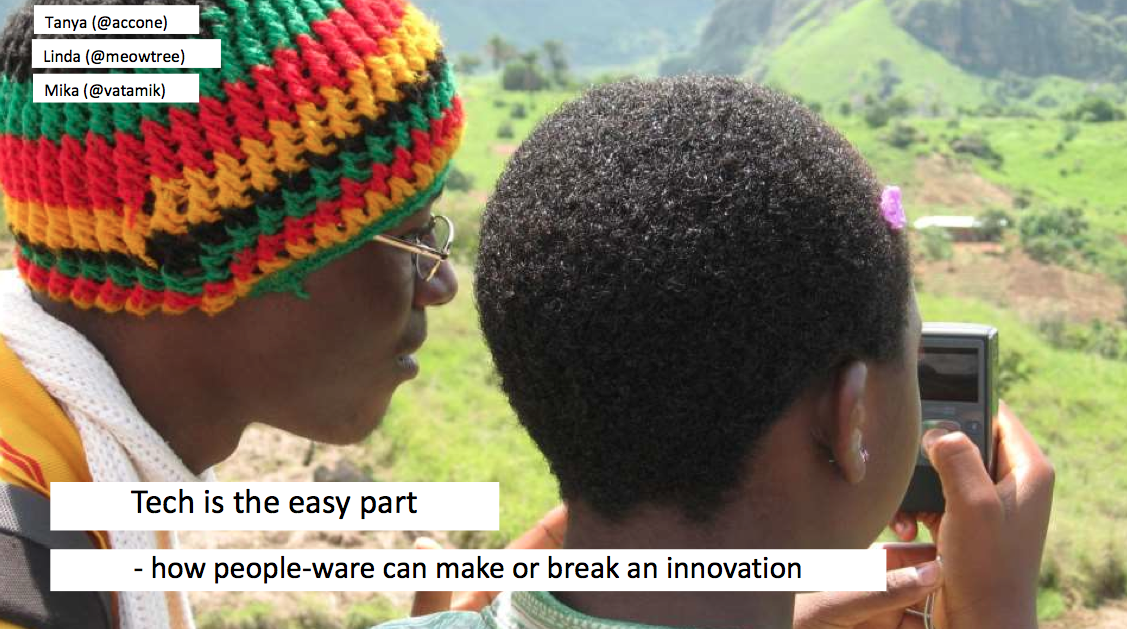
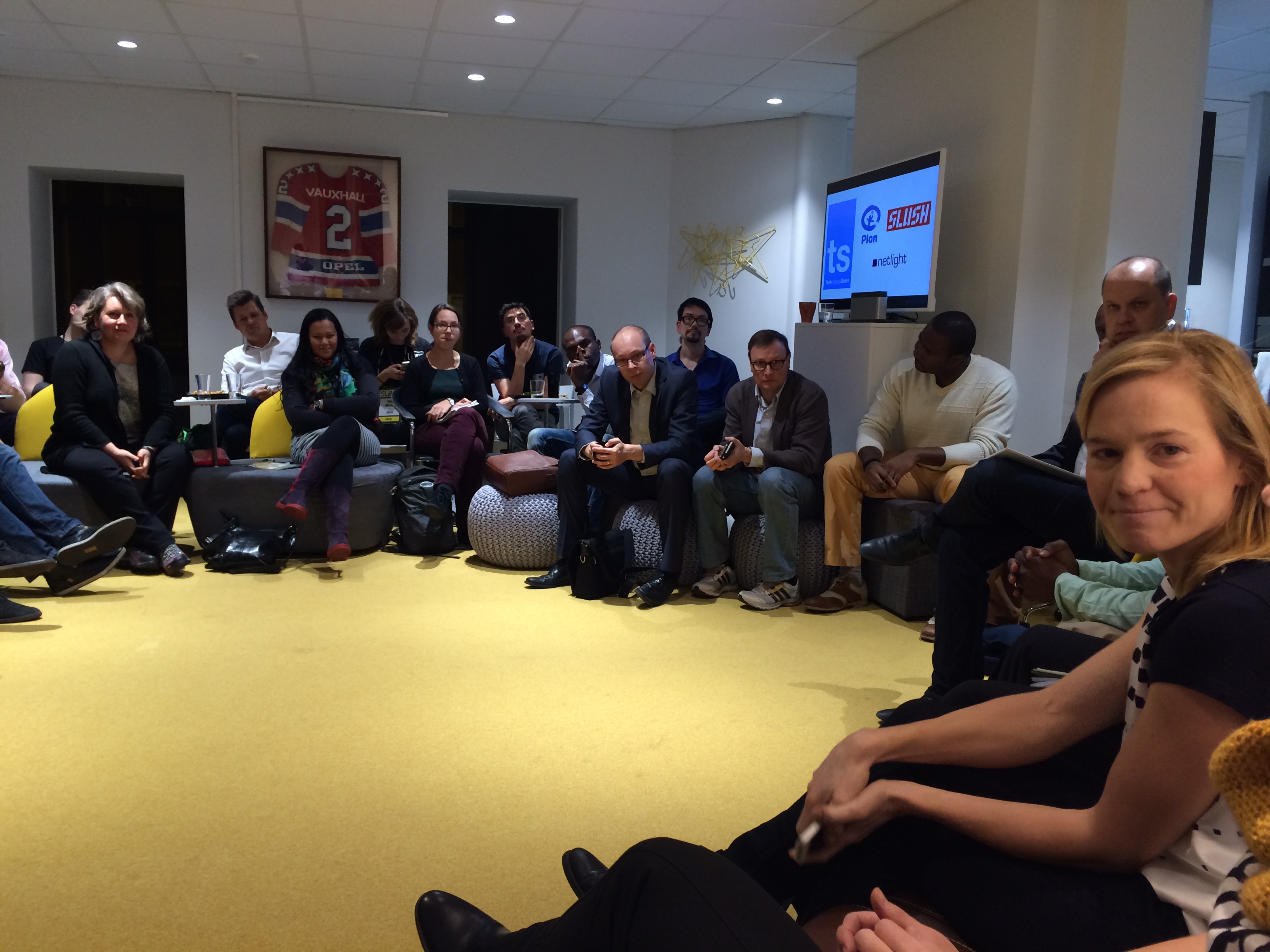
At the Slush conference in Helsinki in November, I joined a short ‘Fireside Chat’ with Tanya Accone (UNICEF) and Mika Valitalo (Plan Finland) about the importance of that other 85-90%, which Tanya referred to as ‘peopleware’.

Tanya kicked off the panel by asking people to think about how much time they’d dedicated to the technology of their start-up idea or their tech solution – the hardware and the software – and to then ask themselves how much time they’d spent on the people component. “People are what will make or break your idea,” she said. When it comes to mobile adoption, for example, we are seeing an exponential adoption pattern all over the world, and people are driving that. “I bet every single one of you at SLUSH hopes to see that curve in your future.”

She went on to note that conventional wisdom is that ‘content is king,’ however a key takeaway from her work in the mobile and social entrepreneurship space is that content been deposed by context. For example, when working with the U-Report project in Liberia, lessons from other countries where it had been rolled out were incorporated, but they had to be contextualized to make them work in Liberia. This involved talking and working directly with youth to ensure that the programming could be adapted properly.

Screen Shot 2014-11-29 at 4.34.47 PMMika agreed that ‘peopleware’ is a critical consideration. “I’ve witnessed this 10:90% ratio several times when co-designing and supporting projects using technology for social impact in African countries,” he said, and told the story of working on enhancing birth registration in Kenya, where the slow and manual flow of information between people and the government seemed to be a key challenge that could be tackled with use of mobiles and computers and applications.

“However, the deeper we dug the more varied the challenges seemed to be. We realized that people might be reluctant to register children when local practices were not in sync with the existing legislation. For example, if men are marrying girls under the age of 18, they might not like the idea of birth registration as it would prove a girl’s age. People living near the Kenya-Tanzania border might not want to be identified as being from one or the other country, because being unregistered may allow them to move back and forth across the border more easily and receive some type of benefit or commerce opportunity.

Even with a functioning mobile phone and app in their hand, people will weigh multiple aspects based on their personal situation before taking action. So, spending enough time with end-users and trying to see the world through their eyes as much as possible is crucial, especially when working in places that are not familiar to you. This may sound self-evident, but I’d encourage everyone keep this top on the list.”

Screen Shot 2014-11-29 at 4.28.39 PMI shared two of the key points from the Technology Salon earlier in the week on the topic of start-ups and social impact: a) the importance of partnership and collaboration (eg, people), and b) knowing the local context — not just the technical landscape, but people and culture.

These two aspects were really highlighted for me when I was working on a project in Cameroon that trained youth to use mobile phones to make short videos that they used to organize and advocate for change in their communities and more broadly. The donor was a large mobile phone manufacturer who assumed youth would use their higher-end phones to create the videos. The youth, however, were much more familiar with simple phones like the Nokia 1100. The phones we purchased in order to get good video quality had too many layers and folders and features. So we ended up getting some Flip cameras, because what we really needed was a push and shoot video camera, and this design was a better fit for low-income rural youth who had limited experience with technology.

We also realized that though the training was set up for youth, community adults were really interested in learning to make videos too. So we had to find ways to engage them so that they would not feel left out and so that we could ensure their continued support for the youth’s efforts. This meant we had to spread our resources out a little further than we had imagined, but we saw it as necessary. In all these processes we had to balance the context and reality on the ground, the expectations of the youth and community, expectations of our local partners, and those of the donor.

Tanya added that achieving success with social impact sometimes means rethinking your business model, because you’re in pursuit of the double dividend of financial return and social impact. She gave an example in Burundi where only 3% of the population has access to the electricity grid. “You would think it’s a market ripe for alternative energy solutions. But many businesses avoided it because their existing retail and distribution models simply would not work in that context. It took deconstructing and reconstructing business models to create something that does work — a network of microfinanced microfranchises operated by village-level entrepreneurs.” Now the families use robust, fast-charging LED lights recharged through a pedal-powered generator, a system that also recharges mobile phones. 

Another aspect is understanding the value proposition, she said. It would seem to be basic business, but all too often well-intended initiatives forget this and rush in with a cheaply-made solution. “In the process, they trample over the basic human dignity of their target consumer or beneficiary.” She suggested keeping in mind that people with limited resources are among the most discerning consumers because they don’t have disposable income. They are cost conscious, and equally, they are looking at value for money and return on investment in the durability, feature sets and total cost of ownership of everything they buy and value. This means that more energy-efficient chips, better battery technology, and robust handsets are important to economically challenged users.

Tanya also noted that ‘base of the pyramid’ users are no less style-conscious or aspirational than consumers in general, so “don’t disrespect them by skimping on the design and delivery of your solution. And like you and me, consumers in marginalized communities seek enjoyment and entertainment and fun too. Music has huge pull and potential… and don’t forget that pay-as-you-go comes with data!”

Screen Shot 2014-11-29 at 4.29.41 PMMika shared an example where the technology that was introduced carried almost too much power with it. In this project, a mobile phone was loaded with videos and connected to a portable projector. Daycare workers and parents were able to watch good childcare practices from model early childhood care and development centers. “What we found out was that using new technology not seen before sometimes amplified the message so much that caregivers wanted to discard what they already knew and replace it with what they saw on the screen from the model daycare centers.” Though the project showed the power of tech, unintended consequences may come up at the intersection of software, hardware and ‘peopleware’.

Mika talked about another project in Uganda that supported parents’ involvement into school activities. Plan realized that men were more willing to come to parent-teacher meetings once they introduced a mobile SMS service through which they sent invitations. The technology lowered the threshold for men to participate in issues they might have previously considered ‘women’s issues’. These subtle dynamics in the local context can have a big influence on how an innovation works, he noted.

Mika’s takeaways for startups and innovators were that civil society organizations might offer good synergy for co-designing, testing out and distributing products and services. “I’ve seen startups getting needs and ideas from the ground through NGOs, and then innovating products and services together. For example we produced a start-up mobile data gathering tool called Poimapper based on the needs coming from our frontline staff. We did on the ground pilots and product development in Kenya with actual end users who gave crucial feedback to make the service work well. Peopleware matters and partnering with NGOs can help startups to get it right,” he said.  “INGOs often have a wide presence around the world, and they are on the ground in communities and the surrounding society. They know quite a lot about peopleware, participatory methods, and community engagement. Then again, they don’t necessary have the same agility and fast innovation processes combined with new business models that startups are often good at.  So, my advice to NGOs is to go and meet startups and visa versa.”

I added that it’s important to understand who has access to and control of devices, and to ensure that a product or service is valuable to people in the long-term. So first — Who owns the phone? Who controls it? Often the story is that everyone has a phone but you may find that some people own 2 phones, some don’t have any. You may find that the people you least expect to have phones have them or can access them, and those you’d think would have a phone don’t. This is critical especially when working with girls and women who typically have lower access and control – and of course you should be sure the project is including girls and women!

Screen Shot 2014-11-29 at 4.31.42 PMAlso, you may be working with people who have very little disposable cash – but if your application or idea saves time and money and meets a real need, they may be willing to move their resources from one thing to another. For example, using solar for light and charging up phones can save money and time as well as eliminate the health risks of kerosene lamps. However, you need to make sure that what you offer is a long-term and sustainable change. When people have limited resources, they’ll be hesitant to invest in something new if they are not assured that it will be available, sustainable and cheaper in the long term.

Lastly, as Mika said, partnering with non-profits can offer start-ups a way to reach communities, because some non-profits are quite well-known and respected by the community (though of course, some are not too!). But ethical non-profits will not risk their reputations on ideas that they do not believe in, that are unconvincing, or that seem to take advantage of the poor. Start-ups will need to have clear ideas and evidence that a proposition is solid, because most non-profits have a low tolerance for risk and failure and (one hopes) a higher ethical standard than a basic money-making operation.

Tanya closed us out by summing up the key points:

  1. People are your critical success factor. “People” include your end-user as well as those that you may be partnering with.
  2. Context is king! Understand the social dynamics, know who owns and controls the device, know what people spend money on.
  3. Build a better business model.
  4. Understand the value proposition — Figure out how your application/tool/innovation can help save precious $ and time.
  5. Understand your partners — Remember that brand and reputation are very important to non-profits, and they don’t like risk.

Thanks to Tanya and Mika for co-collaboration on the Fireside Chat and this blog post!

Read Full Post »

IMG_5689Technology Salon Helsinki kicked off as part of Slush, a fantastic start-up and technology event that takes place with about 10,000 people every Fall in the Finnish capital. Slush added a social impact stream for the first time this year, making it a good fit for Technology Salon. Plan Finland organized the Salon and Netlight hosted.

Our topic for this Salon was broad – how can technology increase social impact? – but lead discussants (Jussi Hinkkanen of Fuzu, René Parker from rLabs, and Mika Valitalo of Plan Finland) brought inspiring personal stories, fundamental questions, practical experiences, challenges and questions that made for an intimate and lively conversation that incorporated expertise from everyone in the room.

The discussion raised a number of key points for social impact start-ups and those working in the development space:

1. Making a direct contribution to social impact is a prime motivator. Most people in the room who considered themselves to be entrepreneurs or who felt they were working with a ‘start-up’ or ‘social innovation’ mentality had tried different pathways before landing on their current one, yet had found them unsatisfying due to bureaucracy, lack of agility, unsustainable efforts, systems not based on merit, and feelings of not being able to input into or control decisions. “Do I want a job where I’m comfortable, well-paid and getting accolades for the supposed social good I’m doing, but where I know I’m not having any real impact, or do I want to be somewhere that I’m paid less but I’m actually doing something worthwhile?” summed up one participant.

2. It’s not clear how to best achieve social impact at scale. There was some disagreement in the room regarding whether it was better to work outside of the system to avoid the above-noted problems with corporate social responsibility efforts, governments, multi-laterals and international development agencies, or whether it was imperative to work with those institutions in order to achieve longer-lasting impact at scale. Questions were also raised about what is meant by scale. If we help communities to demand better government services through some kind of innovative approach, that can also lead to a scaled impact and more resources and social good coming into a community, even though the scaled impact is not so directly attributable. The big question is how to achieve scale yet remain locally relevant and contextually sensitive.

3. Keeping a social impact focus is a challenge. It’s critical to think about both social impact and sustainability from the very beginning, participants agreed. A social impact start-up, like any business, needs to pay salaries and other costs, so it needs a good business model that brings in enough revenue. “If you do not show revenue and growth, you will drive off investors,” said others, “and then your start-up won’t grow.” Yet those in the lowest income bracket will not have the highest capacity to pay for services, and donors often have policies prohibiting them from funding profit-building entities, even if they start off as non-profits. Ensuring that investors have a social impact motivation so that the mission of the start-up does not skew as it grows can also be a challenge. This area is being somewhat addressed by ‘social impact investing’ however, “as a start-up entrepreneur,” said one participant, “you know that next phase investors don’t like it if you have an impact investor already on board, so that makes it difficult to get further funding.” This all poses real challenges for start-ups.

4. Social good is in the eye of the beholder. Everyone will say that their company is values-based and that it’s ‘doing good’ but who decides on and judges the social function of a company? “Maybe one way is to see if it motivates Generation Y,” said one participant. Another pointed out that one company might be doing something that is perceived as ‘socially good’, but it might have a very small impact. Whereas another company might be doing something not perceived as ‘socially good’ (say, selling clothing) yet it has embedded strong values, good business ethics, pays workers well with good benefits, doesn’t pollute the environment and contributes to local economic growth in a large way. People won’t think of the second company as doing social good even if its social impact is greater than the first company. The idea of social impact is largely in the mind of the beholder, concluded one person, it’s in the psyche.

5. Staying true to social impact values in the long-term is difficult. As one discussant noted, keeping the social impact mindset requires constant consideration as to whether you are doing good with and for your employees, but you also need to ask the community that you are serving what they think. “It’s easy to say you are doing social good, but if you go directly to ask people in the community whether your initiative is doing what it says and if it’s having a good impact, you’ll see it’s not easy. When an investor comes along who wants to change things, you always have to go back to look at who you are, how you started, how a particular change will impact the organization, and how it will impact on the thousands of people who rely on you.”

6. A sustainable business model helps bring autonomy according to one discussant. A start-up can remain agile and make its own decisions if there are no donors or external funders. Having its own sustainable revenue stream will allow it to stay true to its vision and to community needs, or at least provide enough to cover staff and operations costs. However, partnership and collaboration are key. “You have to work with other people whether you like it or not. If you are working as a social impact start-up, you’ll need to partner with those already working in the community, and work with everyone to bring in their part. Just because there is a community out there somewhere, you can’t assume that they don’t know what is happening or that they don’t know anything. You need to partner with these local groups and work with the existing community context and structures.”

7. An innovative business model trumps innovative technology. Many of the places where non-profits are working and where people may think about ‘social good’ start-ups are those where the market doesn’t work and people have very few resources. Yet these are the very people we want to support the most in terms of social impact, said one discussant, so how can we do it? Targeting solutions and payment for different parts of the markets might be one way, for example, offering a solution to the segment of the market that can pay and in that way extending the services to those who cannot pay. “The most innovative thing here is the business model, not the technological solution,” advised another person. “And if you really listen to people and you build according to people’s needs, you may uncover needs as well as new markets and business models.” Your services will need to keep evolving over time, however, as people’s needs and the context changes. “You need to go there and spend time with people in order to deeply understand their needs, their contexts and their behaviors.”

8. People won’t think like you think. Another participant quoted activists in the disability movement “Nothing about us without us,” saying that start-ups should follow that mantra also. All the really bad examples of NGO, government, development or corporate failures have been when people are looking top-down or outside-in, she said. “When you think ‘since those people are poor, they have nothing, they will really want this thing I’m going to give them,’ you will fail,” she added. “People everywhere already have values, knowledge, relationships, things that they themselves value. This all impacts on what they want and what they are willing to receive. The biggest mistake is assuming that you know what is best, and thinking ‘these people would think like me if I were them.’ That is never the case.”

9. There is space for various approaches. You won’t want one single product or service to monopolize, said one person. “There are roles and limitations for different entities in any community. There are some non-income generating things that can and need to happen, and that is actually fine. It used to be a charity and welfare mentality, but now we think markets will solve everything. Neither extreme is correct. We need to have space for various partners and efforts.” At the same time, there needs to be space for different partners at different stages in time. It is important for the various partners to understand what their role is. Emergency support is good in an immediate post-conflict stage, for example, but then humanitarian organizations need to step aside and open space for other actors when a community or country moves to a more stable development and growth period.

10. It’s difficult to find investors for social impact in ‘the South.’ The perceived risk in investing in start-ups that want to ‘go South’ or start-ups already based in ‘the South’ makes it hard to find investors. “Finnish investors are myopic,” said one person. “Finland has already provided examples of how companies can access these new opportunities and also have a social impact. Spending power has skyrocketed in some countries. If investors looked properly, they would see the potential of making more money in some of these vast markets than they can in Europe or Finland,” noted another person. The risk is indeed greater due to various elements in some of these countries, added one person. “It’s like courtship – you can’t go after people who are not in your league or not right for you. But if you find the right investor who understands the risk as well as the significant potential returns, it can be a great marriage.”

11. NGOs and start-ups can be great partners. They can come up with ideas from scratch, or they can partner later in the process. NGOs can take advantage of start-up applications and services, whereas the start-ups can find new customers, build a portfolio, do field-testing and get feedback on what to improve with their idea. In addition the two have a lot to teach each other, said one discussant. “NGOs can learn a lot from start-ups about how to operate. They should be learning how to think about iterative improvements, pivoting and changing quickly, failing fast and learning fast.” Start-ups can also learn from NGOs. “Some NGOs are quite good at participatory practices, knowing the community well, collaborating at multiple levels with various stakeholders, communities and governments.” In addition, community-based organizations know the community very well and often work together well with start-ups and NGOs.

12. Pacing and timing can make collaboration tricky. The pacing in these different organizations and partners is quite different, however, and that causes friction and frustration. But even large multi-lateral agencies can be helpful for start-ups who want to gain entry into different countries or communities because they are well-known and because they can provide an ethical and legal framework that helps protect the start-up from making big mistakes due to a lack of understanding of these key elements. NGOs can also serve as a kind of infrastructure upon which to build start-up efforts. Lack of NGO and donor agility however sometimes causes efforts to fail. Hybrid models of funding that can enable start-up-NGO collaboration are needed. One discussant emphasized the importance for start-ups to generate their own funding on the one hand while seeking donor funds for some things too, but never doing anything for a donor that is not part of the organizations core mission.

13. You need to lose the ego. In every sector, egos and brands get in the way of social impact. Start-up founders have egos too, and the start-up personality may often be one that wants the spotlight, or in order to obtain funding the start-up may need to act in a particular way, and this can be detrimental. “For social impact work, we need to think about catalyzing something, not being the center of it. We need to help bring snowballs to the top of the hills, and then let them roll down on their own without branding,” recommended one participant. “We hear that 60% of mHealth initiatives die before they thrive. They are isolated, with little connection and interface with one another. We need more platforms and sharing, less egos and brands.”

IMG_5690Next Technology Salon Helsinki. Plan Finland is hoping to continue convening in Helsinki. If you are interested, sign up to get invitations at Technology Salon!

I’d also recommend attending Slush next year – especially if you like high energy, high-tech, Helsinki and lasers! I’m sure next year’s impact stream will be as good or even better than this year.

Thanks again to Plan for convening and sponsoring the first Salon, to Slush for including it as part of their Social Impact Stream, and to Netlight for hosting at their beautiful offices!

Read Full Post »

The first two and half years that I lived in San Salvador, back in the early ‘90s, I didn’t work. I spent my time adapting, perfecting my Spanish, and learning from my mother-in-law how to cook, wash clothes, and take care of a house and family the Salvadoran Barrio way.

The other thing I did was read. I’d read anything I could get my hands on, often finishing a book in a day or two if my supply was plentiful.

A few months after I arrived, however, I had run out of things to read and was getting a little bored. By then my husband had started working as a mechanic in the shop where he had apprenticed as a teenager. We were not taking trips out to the beach or hanging out on the patio anymore, and I had mastered much of the housewifely chore learning. I was looking for something to do with my time and my attention turned to finding books.

Aside from the newspaper, reading was not something that anyone I knew in San Salvador did. Most of the people in the Barrio, including those in my new family, had not studied past 6th or, in some cases, 9th grade, nor did they have extra cash for things like books. (A Finnish friend who lived for a few years in El Salvador once said that she had loved visiting Suchitoto, a town outside the capital, because, “Linda, I saw people sitting around reading! And it wasn’t the bible!”)

I realized that finding books was going to be a challenge. There were no bookstores in downtown San Salvador, which was the extent of my range of movement at the time. So I asked my husband if there was a university anywhere, because certainly they would have a bookstore.

Y vos, ¿quién te crees? Who do you think you are?” he asked, pointing his chin at me, a little surprised at my question. “You think you can just waltz into a university campus and go in their bookstore?”

I didn’t know what to say.

So I asked what the problem was. Why couldn’t we? He explained that people like him, people from the Barrio, didn’t go to universities, and that if poor people went where the fufurufu (Salvadoran slang for wealthy, snobby, fancy, powerful people) lived, the police would chase them out. If as kids he and his brother had dared to walk into places where they didn’t belong, he said, the police (which was, at that time, the feared military police) would want to know what they were doing there and they’d be in big trouble. So they didn’t go to places like that.

With the idea of going to a university bookstore ruled out, he suggested that we go to “La Hispanoamerica,” a school supply shop downtown, to see if we could find something there. I was in luck — Hispanoamerica had a shelf full of classics in Spanish and even some in English, so I started browsing. A clerk quickly came over. She was annoyed that I was behind the glass counter touching the books.

“What book are you looking for?” she asked. “I don’t know, I’m just looking,” I answered. “Pues sí,” she said, “but which one are you looking for?” I answered again that I wasn’t sure, I just wanted to see what they had. By then she was even more exasperated. “Yes, but what is the title? Which book did they tell you to read? Give me your reading list and I’ll find the books for you.”

At this point I understood that this was not a place where people browsed to find something to read, it was a place you came to buy the books that you had been assigned to read. Foiled again.

I felt sheepish for not understanding the situation, and my husband was a little embarrassed by my walking behind the counter in the first place, and because the clerk seemed to think I was an idiot. “You can’t just walk behind the counter,” he told me. I felt like again he was asking me, “Just who do you think you are?” So I ended up not buying anything.

Instead, I asked my mother if she could send me books. She was running an auction house in Indiana at the time. So she would find and send me whatever used books came along that she thought I’d like. (She’d also send me envelopes full of newspaper clippings a couple of times a week. I like to think of this as the original Twitter. :))

These books ranged from romance novels to best sellers to biographies. I’d go to the post office a few blocks away downtown and spend the entire morning standing in lines, filling out paper work and waiting for signatures, purchasing colorful tax stamps at the bank and returning to the post office so that the clerks could wet and affix them to the boxes and mark them with government seals. It was an education in how the bureaucratic system of the country worked, learned through the simple act of picking up a box of used books.

I didn’t have much choice, so once I finally had them back to the house, I read them all. I remember reading a fascinating biography about a woman named Nora Barnacle, the wife of author James Joyce, a famous (I then discovered) Irish author.

At that time in my life, I never imagined that I’d end up one day having a job where I could travel the world. I wasn’t even able to get my hands on a copy of James Joyce’s books at that point, much less think about visiting his home country of Ireland.

***

Last week, however, there I was in Dublin, where Joyce did much of his writing. Before leaving home, I grabbed a copy of his book Dubliners from my college-aged son’s bookshelf for the trip. I figured it was high time I finally read some Joyce. Dubliners is a set of short stories written by Joyce when he was only 25 years old, just slightly older than I was when I was milling around San Salvador looking for books, and learning how to live in the Barrio. The stories focus on ordinary life in Dublin in the 19th century, after the city had weathered a long decline. They talk of grimy children, tenements, poor sewage systems, and a working class that struggles to make ends meet. The comparisons with Salvadoran barrios are easy to make.

At dinner in a nice restaurant with friends one evening last week, something triggered me to tell my tablemates the story of finding books in San Salvador, and how it had made me examine my own privilege and to consider the limits that my husband had set for himself as someone who identified himself as being ‘poor’ and ‘from the Barrio.’ How often we self-marginalize because we feel like we don’t belong, or because a dominant class or culture sets clear boundaries that we are not supposed to think about crossing. These boundaries become strong mental and physical barriers and deter us from entering both the spaces and places of the privileged.

Because humans are adaptable, however, these can be learned and unlearned. I discovered, for example, that I wasn’t supposed to do certain things in San Salvador because of the class that I had married into or because I was female, and I altered my behavior. When I moved back to the US, I re-learned things I had unlearned in El Salvador about what women should and shouldn’t, can and can’t do. Similarly, over time, my (now ex) husband learned that he could do things that he thought he wasn’t supposed to. He ended up returning to finish high school, and eventually went on to get a university degree. This was in part because he started to believe that he could, part because universities became more accessible, and part because I had started working and we had a little more money to allow him to pay fees and to work less.

I think about this experience a lot in the work I do, because I’m often working with or writing about marginalized groups and ways to improve inclusion. How can we help people overcome self-imposed barriers? What should institutions and social spaces look like physically, culturally and attitudinally, so that they can be inclusive? How do girls and women in particular self-exclude, and what kinds of wider environments are needed to reduce gender exclusion? I know that these barriers can be unlearned and overcome, but not without some work, support and effort on different fronts, including from those institutions and spaces that are excluding.

***

Book of Kells

Yesterday a friend from the Dublin dinner conversation emailed me while I was sitting in a little coffee shop, getting some work done. He was over at Trinity College at the Book of Kells exhibit. “Was only here for a few moments when I thought of you and your book story,” he wrote. So I met him there to see it. The Book of Kells is a very old bible, from 800 a.d.. It is housed in a glass case, and it’s full of gorgeous illustrations in amazing color. Upstairs from the Book of Kells itself is a library full of other old books. They are all roped off or encased in glass, physically off limits like the ones at the Hispanoamerica and the university bookstore that we were not supposed to go into back in El Salvador — yet for slightly different reasons.

Afterwards, we went to grab a quick lunch. We wandered down a small street where I had spied a sign that looked to me like it said ‘Daily Bread.’ “Let’s see what they have,” I said. (Oh, my terrible eyesight!) The shop was actually a pub called “Davy Byrnes,” but no matter, it was 3pm and they were still serving food. In fact, inside there were a lot of people having an early happy hour and lively conversations. We ordered some hearty food.

My friend ate quickly and ran off to catch his flight. I stayed around to finish my lunch and decided to order a glass of wine, as the atmosphere was warm and friendly (and inclusive!). In the process of eating, I knocked my knife off the table and onto the floor. It clattered loudly and landed in right between the feet of an elderly man with a cane sitting next to me. I apologized and leaned over to pick it up.

“A harrrr!” He turned to me and laughed loud and long, perhaps a bit tipsy from the port he was drinking. “Soooo! Now I’m gonna trow a pen at you!” he said, and reached into his vest pocket while wiggling his eyebrows and staring at me intently with watery pale blue eyes. He cackled like a pirate and threw a pen onto the floor near my feet.

I was being a bit slow, so he explained. “The pen is might-ier than the sword! Ha ha ha ha ha!”

He was ripe for a good chat, and I was enjoying the banter. “Don’t miss the Joyce exhibit while you are here,” he told me. I said that in fact, I was reading Dubliners but had barely cracked the book open yet. “Ah, he said. Dubliners is easy. Now Finnegan’s Wake, that’s the one that’s hard to crack!”

He went on to tell me some short stories of his own, riddled with the kind of swearing that you might expect from a feisty old Irish man you find in a pub. He finally leaned on his cane to get up and head home, leaving behind his book from the Joyce exhibit and his cap. The bartender assured me he would be back to get them.

As I settled up my bill, I asked what was the story of the pub, since it was unlike any other I’d ever patronized. Strangely enough I learned that Davy Byrnes, the pub we’d randomly wandered into, is famous for its association with Joyce. He spent time there, wrote there, mentions said “Davy Byrnes” in his books, and it’s been known since 1889 as Dublin’s most famous literary pub.

It’s weird how people, things and themes wander through your life and come together at points you never expect. The question “Who do you think you are?” has stuck with me, for better or worse, and it pops into mind at different times. “Who do you think you are? Do you think you can just walk in there and…?” It’s a good one for examining privilege, or on the flipside, exclusion.

Read Full Post »

« Newer Posts - Older Posts »