Feeds:
Posts
Comments

Archive for the ‘disaster and emergencies’ Category

Ann Blackman’s Off to Save the World is a chronicle of the life of Julia Taft. The book showcases how rare it was for women to be involved in high level politics in the 70s and 80s, and how Taft skillfully maneuvered herself in circles that were not open to many women in US Government or international affairs at the time. Taft was clearly a charming, witty, strong and determined woman who endeared herself to most everyone she met.

As the book preface notes “Julia Vadala Taft became one of the country’s top humanitarian relief experts, a friend and ally of the world’s most impoverished people. Starting in 1975, when she directed the Indochina refugee task force, Julia essentially invented the way the United States government responds to natural and man-made disasters around the world, demanding basic rights for those whose lives are turned upside down by civil war, famine, religious persecution, earthquakes, floods and insect infestations.”

I was struck while reading, however, that most of the relief efforts that Taft was involved in sounded an awful lot like operational failures, though they were hailed as diplomacy successes. This gave me much to consider both in terms of political motivations for relief and development efforts, and for observing how far relief work has come since then in terms of understanding the need to be prepared, to take direction from local governments and local populations, to set up proper logistical arrangements, and to maintain neutrality during humanitarian crises. Today, guidelines like the Sphere Handbook and the Red Cross Red Crescent Code of Conduct help orient aid workers and give them support and guidance during humanitarian relief operations.

My favorite anecdote in the book was that following the December 7, 1988 Armenian earthquake “Bush [Senior] told Julia that his son and grandson would like to go to Armenia to hand out Christmas presents. [Taft] stifled a laugh: “I thought to myself ‘for God’s sake, this is not a good idea.’ But all I said was, ‘When would you go?'” “The 24th of December,” Bush replied. Taft informed them that Armenians celebrated Christmas on January 6th, and “between now and then, they have a few other things to do besides worry about your security and accepting gifts.” Unfortunately, even though Taft spoke with Colin Powell about the ridiculous idea, they were unable to get them off of the idea of handing out Christmas presents, and “Bush’s son, Jeb, and grandson, George P. Bush, left for Armenia….”

The book reads a bit like a history text book, which was its downfall for me. I would have much preferred a more personal style that engaged me more emotionally. In any case, it is great to see a strong female character like Taft highlighted, and she was clearly much loved by her colleagues, peers and family.

Ann Blackman is the author of many biographies including Seasons of Her Life, Wild Rose, and co-author of The Spy Next Door: The Extraordinary Secret Life of Robert Philip Hanssen. She previously worked at TIME magazine and The Associated Press, and has appeared on various national TV and radio shows such as A&E Biography, The Diane Rehm Show, Hardball with Chris Matthews, CNN, Fox Morning News, CSPAN, to name a few. She currently lives in Washington, DC, and on the coast of Maine.

Read Full Post »

Last October, UNICEF West Africa wrote up a nice briefing note on mobile tech and its relevance in child protection programming. You can download it here.

According to the document, pulled together by Mirkka Mattila, ‘This is an area of rapid innovation and new applications are being developed all the time. Telecommunications is one of the fastest growing sectors in Africa and the relevance and reach of mobile technologies for development and humanitarian work is only going to increase over the coming years. Many technical, legal and security aspects of these new technologies remain to be fully addressed and worked out. The dependence on technology, network coverage and electricity supply also mean that mobile technologies cannot be used everywhere.’

The paper includes examples on the use of mobile technologies for:

  • gathering and transmitting data by child protection service providers; including surveys, rapid assessments, case management, family tracing and reunification of separated children, and birth registration
  • self-protection and complaints mechanisms; such as child helplines, violence reporting and community mapping for violence prevention
  • transmitting information and money via mobile; eg, SMS campaigns and cash transfers.
Some of the examples and tools highlighted include: RapidSMS, RapidFTR, Nokia Data Gathering, Child HelpLines, FrontlineSMS, Ushahidi, OSM and Map Kibera, and M-PESA.

It pulls out challenges and advantages of the different use cases and offers some guiding questions to assist in the selection of the most appropriate applications, such as:

  • Is there a need to create new applications or can existing solutions be used?
  • What are the characteristics of the user group and the environment (urban – rural, existing networks and coverage etc.)?
  • What technical expertise is required for installing and maintaining the system?
  • How well will investments in equipment and capacity meet the needs, expected impact, benefits and outcomes in terms of results delivery?
  • What are the potential partnerships for sustainable capacity-building and service delivery? What are the roles of public and private service providers?
  • What are the financial resources needed in the short, medium and long-term to establish and maintain the system?

The document ends with some arguments and counter arguments around the use of mobiles in child protection work. It’s nice to see this paper as there is not a whole lot of research and/or documentation on use of mobiles and ICTs specifically in child protection work.

Download it here.

****

Other child protection resources/posts on Wait… What?:

Child Protection: From emergency response to a sustainable mechanism

Community Based Child Protection

Child Protection, the media and youth media programs

Children in Emergencies: Applying what we already know to the crisis in Haiti

Read Full Post »

A recipient signs for a cash transfer (Photo: http://www.plan-international.org)

The popularity of cash transfer programs in the academic and aid blogosphere over the past few years, got me wondering what the difference is between the kind of cash hand-out programs that sponsorship organizations were doing in the early days and today’s cash transfer and conditional cash transfer programs.

What prompted the shift in thinking from ‘line up and get your cash’, to ‘cash handouts are paternalistic, ineffective, unsustainable and create dependency,’ to ‘cash transfers are innovative ways of achieving development gains’ and/or ‘cash transfers empower local people to purchase what they really need?’ How are cash transfers different today from 40+ years ago?

I happen to work for an organization that raises a good percentage of its funding through child sponsorship. From what I’ve heard, for the first few decades of our existence, cash handouts were simply how the organization worked. Along with most other development agencies, we moved away from direct handouts in the 80s. Like some other organizations, by the end of the 1990s we had adopted a rights-based approach. We are also now doing cash grants again in some cases such as this program in Vietnam. I’ve asked around a bit internally and haven’t found anyone able to point me to documentation on what in particular prompted the move from cash handouts to community-based development in the 80s. Obviously it was a change happening most everywhere, not just in the organization where I work. I assume there was a process and a lot of discussion around this like there is with any change in approach, but it’s most likely on paper and not on-line. I do wonder what has been or could be learned about cash transfers from that process of discussion and change in methods.

There is certainly a lot of debate today about cash transfers. When I’ve asked people outside my organization what the difference is between today’s cash transfers and those of 40 years ago, most pro-cash transfer folks say that today’s approach to cash transfers is different or that cash transfers are included as part of broader programs, or that cash transfer programs that succeed are done by governments and not INGOs.

The anti-cash transfer folks tend to feel that cash transfers are not sustainable development, encourage dependency, and cause community conflict, and that they do nothing to improve systems or infrastructure in the long run; eg., what good is having cash if there is no health system? no food to purchase?  no school to attend? Or they consider cash transfers to be individualistic rather than a way to support an entire community or district’s development or worry that conditioning cash transfers can cause unintended consequences. (Here’s a fun piece that talks about what the cash transfer debate says about the international humanitarian community.)

There are tons of studies (mostly by economists it seems) showing that cash transfer and conditional cash transfer programs have improved health, nutrition and education enrollment. Some caution that cash transfer programs such as Brazil’s Bolsa Familia are not a panacea and need to be complemented with other types of programs.

I liked this recent paper ‘Richer but resented: What do cash transfers do to social relations and does it matter‘ by MacAusland and Riemenschneider (HT @rovingbandit). It questions the impact of cash transfers on less visible, more contextualized local and national relationships and power dynamics and suggests a need to go beyond material analysis during design, implementation and impact evaluations of cash transfer programs.

Especially helpful for someone like me who is trying to better understand the discussion around cash transfer programs is the paper’s reference to Copestake’s (2006) aspects of well-being (material, relational and symbolic) and three views on social protection as applied to cash transfers.

I’m pasting in the paragraphs I found especially useful to tempt you into reading the whole paper. I liked the excerpt below because it provides good insight into how different development theories color the objectives set in cash transfer programs and the way that success and impact are measured.

‘…An „income-first view of social protection focuses on the consequences of cash transfers for recipients’ incomes and on their costs, including fiscal costs and perverse incentives to stop working or to seek rents. Second, a needs-first view starts from a more multidimensional view of poverty and focuses on the states role in guaranteeing access to basic needs, including livelihoods, assets, and public action. This would criticise the income-first view for being too narrow. Third, a rights-first view identifies injustice as a key cause of poverty, and criticises the „needs-first approach for being paternalistic.

Very broadly, these views can be identified with philosophical approaches to development. The income-first view is most closely identified with a  modernisation theory and Washington Consensus approach, which is rationalist, individualist and utilitarian in nature, measuring utility primarily in terms of income. The appeal of this view in part lies in the measurability and equivalence of outcomes and costs – so that outcomes measured in dollars can be compared to costs measured in dollars. This possibility is very attractive for planners, since it enables an unambiguous (on this single metric) judgement of whether an intervention should proceed. In terms of approaches to social protection, the income-based view is reflected most clearly in the safety nets approaches of the early 1990s (World Bank 1990).

The needs-first view starts from a similarly utilitarian and individualist standpoint but broadens this by introducing other dimensions of well-being, largely adding material dimensions (such as education, health, and livelihoods) but in some cases relational aspects (such as a capacity for social action). This draws in part from Sens capability perspective (Sen 1985) and is currently being operationalised through the Millennium Development Goals and now multidimensional poverty indices (see e.g. Alkire and Foster 2009). In the social protection literature, this view is closest to the transformative social protection approach (Devereux and Sabates-Wheeler 2004) that emphasises the role of social protection in overcoming not only material shortcomings but in enhancing self-esteem and social status.

The rights-first view has developed rather differently, in part from Latin American traditions of dependency theory and structuralism, which place more emphasis on relational and symbolic aspects of well-being. One application of this tradition can be found in Figueroa (2001) who argues that persistent inequality in Latin America can be explained by processes of social exclusion (based on cultural difference) leading to political exclusion from social protection programmes and education, and resulting economic exclusion. As Copestake (2006b: 4) summarises, this interpretation highlights: “the extent to which economic growth and inequality reduction are dependent upon cultural and political mobilisation, not least through advocacy of human rights. This is in stark opposition to the more common assumption of economists that improved human rights are more likely to follow economic development than to be a precondition for it.”

The consequences of these different views for assessments and planning of cash transfers are quite profound. For instance, the different views will put quite different weights on the negative consequences of excluding members of the community from controlling payments or targeting as opposed to the problems associated with additional costs of targeting. The decision whether to pay for additional community participation will look very different depending on which view is held. Similarly, the different views will imply quite different judgements on whether cash transfer programmes should be replicated, given different material, relational and symbolic outcomes.’

I still don’t really know what I think about cash transfers, (I suppose “it depends’ is always a good answer) but at least I have a bit of a better framework for thinking about them and analyzing what I read about them. Copestake’s three areas (material, relational and symbolic) also give a good framework for analyzing other types of aid and development programs, beyond cash transfers (such as Gift In Kind, as @cynan_sez points out).

I also still haven’t figured out how the old style sponsorship cash handouts were different from today’s ‘innovative’ models. Any old timers out there with insight to share on that?

Read Full Post »

FMLN guerrilla with rifle poised in town of Chalatenango, El Salvador, 1988. This photo is from the article referred to below. Original at http://www.ontheissuesmagazine.com, Winter 1994.

A version of this post was originally published on the Peace Dividend Trust blog.

I lived in El Salvador for about 6 months during the civil war and over 9 years post-conflict.  So I was quite interested in the Society for International Development (SID) Congress July 30th panel on the “Nexus of Conflict and Development.”

The panel was composed of a high-powered, high level group of men*, presided over with humor and grace by a woman of the same caliber, Tessie San Martin, President and CEO of Plan International USA, SID Board Member (and my boss!).

Arthur Keys, President and CEO of International Relief and Development introduced the panel, asking questions like:  Can development be done in a conflictive environment. Is settlement of conflict needed before development can take place? Can development assistance be used as a tool for peacemaking?

Keys noted the changing, fluid environments in conflict zones and their inherent complexities – the interconnectedness of many variables that cannot be addressed in isolation.

Within that context the panelists discussed a variety of issues, from the changing nature of conflict and violence, to the pillars of post-conflict reconstruction, to local ownership and local government credibility and legitimacy to the role of the military in ‘delivering’ development to front loading funds in conflict areas to USAID branding in conflict zones. Listening to the discussion, I realized many of the questions that we were asking ourselves 20 years ago in post-conflict El Salvador are still unresolved today.

One of the most interesting conversations of the panel was catalyzed by San Martin’s question on local ownership and legitimacy. “We’re talking about ownership and local voices, but one question is whose local voice? There are a number of vulnerable groups,” she said. “How do you deal with the question of ‘whose voice’?”

Donald Steinberg, Deputy Administrator of USAID, answered by telling the story of his experiences negotiating a peace agreement in Angola under Bill Clinton.

“When I was asked how this agreement benefits women, I answered that not a single part of this agreement discriminates against women,” he said. “But what I learned is that a peace agreement that calls itself gender neutral is actually working against women.”

The Angola agreement was based on 13 separate amnesties, he said.

I learned that ‘amnesty’ means ‘men with guns forgive other men with guns for crimes committed against women.’”

Steinberg went on to comment that the closest woman to the peace process in Angola was a female interpreter, who would “raise her eyebrows when we men did something stupid.”

He described the peace agreement as being “come and hand in your weapons and you get benefits.” But most women involved in the conflict were not bearing arms, they were playing other roles. So when demobilization came, they got no benefits. On top of that, “we sent men back to communities where women had become very empowered in their absence,” he said. “The men returned and there was no role for them. Many drank off all their benefits. They started beating their wives. The incidence of sexual aggression rose. So you saw that the end of the one conflict brought about a new insidious form of violence against women.”

Another area where the peace agreements forgot about women was in de-mining activities. “We cleared the roads of mines,” said Steinberg. “But we didn’t clear the fields. The water points. Places where women gathered wood. As communities returned home, and women went back to collecting water and firewood, they were blowing their legs off with remarkable regularity.”

The peace process started to fall apart a couple of years later, he said, but by then it was too late to bring women’s organizations into the process. “We tried to work with women’s groups but they would say, ‘This isn’t about us, it was about the men with guns. It hasn’t involved us at all.’” The country erupted into war again.

Steinberg said he was happy that USAID is addressing these issues now. “The first thing I put into place was support to women’s participation in peace processes and to provide them with protection to do so, as it’s dangerous for women to be involved in this work. Nothing about them without them – this is our phrase,” he said, and cited UN Security Council Resolution 1325 as a strong influence on him:

“The Security Council adopted resolution (S/RES/1325) on women and peace and security on 31 October 2000. The resolution reaffirms the important role of women in the prevention and resolution of conflicts, peace negotiations, peace-building, peacekeeping, humanitarian response and in post-conflict reconstruction and stresses the importance of their equal participation and full involvement in all efforts for the maintenance and promotion of peace and security. Resolution 1325 urges all actors to increase the participation of women and incorporate gender perspectives in all United Nations peace and security efforts. It also calls on all parties to conflict to take special measures to protect women and girls from gender-based violence, particularly rape and other forms of sexual abuse, in situations of armed conflict. The resolution provides a number of important operational mandates, with implications for Member States and the entities of the United Nations system.”

Ambassador Rick Barton, US Representative to the Economic and Social Council of the UN, agreed that the role of women is critical, and “it starts with who’s negotiating the peace process.” Barton noted that the percentage of women in peace negotiations is 5-7%, and that it’s a recurring concern. “If you are not there at the start of the race, it will be designed in a certain way and you will be disadvantaged. I’m hopeful that the UN Women’s Commission, led by Michelle Bachelet will bring attention and focus to this issue.”

“What about men and boys?” a woman in the audience asked. “It’s great to empower women, but what are you doing to change the attitudes and beliefs that men have? How can we get them to realize we are equal?”

Barton agreed that getting men’s attention is critical. “These are not women’s issues, they are society’s issues. Men and boys need to come a long way.”

“It’s easy to work on gender with this administration,” commented Steinberg, noting that USAID is trying to institutionalize it through the position of Senior Coordinator for Gender Equality and Women’s Empowerment. “It’s not only about protecting women or about victimization,” he said. “It’s about changing attitudes and instilling into our DNA the notion that women are key to building stable societies, ensuring sustainable growth and recovering from conflict situations. We need to focus on gender in addition to women.”

Sitting, there, listening to the panel discussions, I kept thinking about a Salvadoran friend from some 20 years ago. She was from a ‘conflict zone’ but would have never called herself an ex-combatant. For several years, she had moved around with the guerrilla, cooking and supporting the cause, but didn’t carry a weapon. Post conflict, she had lingering health problems stemming from that period, when she had been chronically malnourished. During her time with the guerrilla, she had contracted glandular TB, a condition that embarrassed her. At 34 years of age then, she had the ruddy, freckled and fresh face of a young girl, but she wore dentures as she had lost all of her teeth. She worked cleaning an office and always struggled financially. I’m not sure she ever got any benefits from demobilization.

I’m also reminded of a rather large post-conflict program that I was responsible for monitoring at the time, together with a few other privately funded donor agencies. Aimed at providing community-based psycho-social support to returning ex-combatants in several zones formerly held by the guerrilla, the program ended up mostly supporting women and children who were suffering domestic violence at the hands of the demobilizing men. The male ex-combatants either didn’t feel they needed psycho-social support or didn’t want to face the stigma of seeking it out, but the women took advantage of it. Community psycho-social support agents fully recognized that they were treating a secondary effect and not addressing the real causes of the violence.

According to a 1994 article by Betsy Morgan in On the Issues Magazine, ”Nearly one third of the FMLN guerrilla forces, who fought for 12 harrowing years in the mountains, were women. But neither of the restructuring plans [that of the government or that of the rebels] directly addressed women’s issues: equality in education, health care, job opportunities, and legal justice in instances of rape and domestic abuse…. Two female commandantes from the FMLN were on the negotiating team. However, when the peace accords were signed on January 16, 1992, all the signatories were male. The subsequent reconstruction plans called for demilitarization, but neither the government nor the FMLN addressed the hidden violence – domestic abuse, rape and incest – that invariably accompanies a military climate of violence, and neither side made provisions for the fair treatment of female ex-combatants, particularly in terms of land tenure. It can only be concluded that for all of the women’s influence during the war, at the point of peace, the women’s movement was still seen as a thing apart from the arena where real decisions were made.”

There were women involved in all aspects of the war, including negotiating the Peace Accords in El Salvador, but it didn’t guarantee that women’s needs were addressed during the negotiations.  It didn’t ensure that the post-conflict programs agreed to in the Accords were fully funded or that programs were designed and planned with participation of those they were meant to benefit or that women got fair treatment. It did not guarantee that the different efforts were non-politicized or that they were well-implemented. As Keys pointed out when introducing the panel: the nexus of conflict and development is a complex place, with every element impacting on every other, and as Steinberg and Barton pointed out, it’s not only about women, it’s about gender.

I’m glad to see the discussions taking place, and I hope that experiences, failures and successes from places like Angola, El Salvador, Colombia, Iraq, Afghanistan and so many others are fully examined and shared to see what more can be done to create environments where women are in decision-making roles before, during and after conflict; where the broader implications of gender and gender roles are considered; and where both women and men who achieve positions of power are really reaching out to, listening to and representing those who don’t have a seat at the table.

*Members of the panel:

Tessie San Martin, President and CEO, Plan International USA and SID Board Member (moderator)

Ambassador Rick Barton, US Representative to the Economic and Social Council of the United Nations

Alonzo L Fulgham, Vice President, IRD

Donald Steinberg, Deputy Administrator, USAID

Tom Wheelock, Vice President and Sr Director, Communities in Transition, Creative Associates

Read Full Post »

“The story of a boy from Baltimore who evolves from a safecracking, jewel-heisting, deep-sea diving, ultimate-fighting, international playboy into a globetrotting humanitarian.”

Why yes, thank you very much, I would like to review that book…. My snark glands start working in anticipation.

Book arrives in the mail and I open to the preface where I read that Stefan Templeton, the troubled and risk-loving misfit hero of the story, has an innocent bright-eyed son and a good, virtuous, hard-working wife in the kitchen. Neither his son nor his wife knows about his sordid past. He risks his family’s well-being to be “a recurring presence in the aftermath of some of the last decade’s worst man-made and natural disasters”. He’s now heading to “the genocide-ravaged Horn of Africa…. On this mission, as on all the others, he would receive no payment.” 

OK, so this will be a story about one of those self-made, selfless martyr, I-have-seen-the-light types who wakes up one day and feels compelled to give up everything to save the world. And there will be fighting too!

We learn that the author David Matthews and Stefan, the hero, grew up together off and on in a hard-knock area of Baltimore, MD. That they are both ‘mixed’ race and that Stefan loves fighting and telling elaborate, hard-to-believe stories. Matthews’ re-encounter with Stefan starts off something like this:

****

“You taking all this stuff? I yelled to him in the bedroom…

…What’s this? I pointed at the black square.

I removed the device. A block of plastic the size of a primordial cell phone.

He shook his head. It’s a Taser, knucklehead.

Jesus, I said, Get pretty rough out there saving babies?

Stormy clambered into the room, midway through his drawing. What’s a Taser, Poppa?

A Taser makes bad people jump, Stormy-bear. Stormy held up his drawing. I could make out some red and black stick people with what looked like blue arrows raining down on them.

That’s amaaazing, Stefan said.

It’s the African children when you put water on them, Poppa.”

****

Jesus. I thought. Get pretty rough out there writing good dialog?

Regardless, I continue. The book starts to flow a little better as the story takes off.

I read that Stefan’s parents are from very different cultures — his father: a rigid African-American martial artist from a well-educated family in a rough Baltimore neighborhood, permanently affected by a stint in Vietnam; his mother: a Danish flower child from a wealthy family that runs a new-age spiritual healing school where people do primal screaming and other types of psycho-spiritual curing.

Early in the book, the author sets Stefan up as a pure-hearted good guy with bad luck, a poor hero who gets screwed time and time again by the system. His father’s hard-fighting rigidity combined with his mother’s heal-the-poor hippie sensibilities are lived out through Stefan who gets himself into one tricky situation after another, but only because he is compelled to perpetually defend the defenseless, to be a man.

His weakness for women is made clear early on, as is the idea that women are weak. (Almost all the women we run into in this book are extremely hot, in need of Stefan’s protection, and willing to drop anything to get with our hero.)

It’s Chapter 3 where Stefan has his “incredible hulk” breaking point transformation. A trained fighter who continually turns the other cheek, he is pushed to fight back when a couple of local thugs try to steal his house keys. He pulverizes them both and the defining moment emerges: “This was neither good, nor bad. Right, nor wrong. It was just.” 

Yep, and you won’t like him when he’s angry. Superhero moment complete.

Soon after, Stefan has his first sexual experience while living in a castle in Europe belonging to his mother’s side of the family. Unsurprisingly, it’s with a sexy older woman and Stefan is quite well-endowed: “Ach… zu gross… (oh so big)….” the woman exclaims. “Your mother would kill me.”

Throughout the rest of the book, the system continues making things difficult for Stefan. He tries and tries to make something of himself and his innate superior intellect, physical perfection and sexual prowess but time and time again he’s let down or has to fall back on his unstoppable fighting techniques and knack for straightforward, ethical crime, or he’s simply forced to put himself at risk to save someone at the wrong time or place. Poor guy, he’s just trying to help and it just never works out.

So what better place for him to end up than helping poor people in Africa, Asia or Latin America? By the end of the book, he has blundered his way into humanitarian aid work, yet again, the system has no place for him and he must go at it in selfless, renegade, superhero style, saving the poor because the locals need him and the humanitarians can’t get it right.

Matthew’s writing was entertaining enough to keep me reading throughout, but the marketers’ promise was more than what the book could live up to. But I expected that. “The story of a boy from Baltimore who evolves from a safe-cracking, jewel-heisting, deep-sea diving, ultimate-fighting, international playboy into a globetrotting humanitarian” is a bit much to swallow without a grain of salt.

Kicking Ass and Saving Souls is very much a man’s book. I felt throughout that the author was imagining the story embellished a bit further and on the big screen, and judging by the public’s hunger for violent, misfit heroes and feel-good stories about helpless poor people, I wouldn’t be surprised to see it there one day.

As for me though, I’ve had quite too much of the Sean Penn style of humanitarian work to be excited. I’m wary of erratic amateur do-gooders. Not to mention I have some pretty major concerns about  Sam “the Machine Gun Preacher” Childers‘ and Peter “Advisor to Michelle Bachman (and hero of this hilariously scary film)” Waldron style forays into South Sudan and Uganda and such. So I’m the wrong audience for this kind of book.

I’m sure Stefan means well, and certainly Matthews is impressed with him. But I think Stefan is more the kind of guy you would enjoy running into at a bar overseas and trading crazy stories with and leaving it at that. You’d probably go home wondering how much of his shtick was bullshit (while he went home with one of the new volunteers or the local female bartender). And you’d probably have some real concerns about his modus operandi if any of his stories were true.

But the book didn’t really grab me. I’m tired of shoot-em-up-punch-em-up humanitarian aid heroes.  They take energy away from the real issues and the real people, local and non-local, who are doing the work that has long-term impact. And they can actually cause real problems, no matter how good their stories seem and how helpful they think they are being.

Thanks to the author and TLC Book Tours for sending me a copy of the book to review.

About David Matthews

David Matthews is the author of the 2007 memoir Ace of Spades, which was selected as an Editor’s Choice pick by The New York Times.  Matthews’s work has also appeared in Salon, The New York Times, The Washington Post, and The Autobiographer’s Handbook: The 826 National Guide to Writing Your Memoir.  He lives in Manhattan, but can’t wait to move back to Brooklyn.

Read Full Post »

This week I came across the “Feedback Mechanisms in International Assistance Organizations” report by CDA Collaborative Learning Projects, based on research undertaken by the Listening Project and funded by the Gates Foundation.

The findings and recommendations are very intuitive and it’s nice to have them gathered in one place. The report can serve as a starting point or a pause-and-reflect moment for organizations working specifically on humanitarian accountability as well as those who are looking to integrate better ‘downward’ or beneficiary feedback into development or humanitarian work overall. It also offers good food for thought for those interested in crowd sourcing and the use of new technology for citizen engagement and input.

The report is not too long, and it’s easily laid out for a quick read, so I’d recommend downloading the .pdf and digesting it fully.

To whet your appetite, here are some points I found interesting:

Why do agencies seek recipient feedback?

Four reasons were identified in the report: to improve accountability, to improve effectiveness, to respond to donor requirements or media pressure, and to increase security for staff. Feedback from recipients* was seen to give staff the fuel needed to pressure higher-ups for necessary changes in programming; beneficiary feedback often improved program quality and recipient satisfaction, and seeking dialogue and communication with communities tended to reduce threats of violence. When accountability was a donor requirement but wasn’t part of a larger organizational buy-in or value, unsurprisingly, initiatives were less successful.

To many reading this post or who may read the CDA report, the benefits of participation and feedback and accountability are already obvious, nonetheless it’s  good to see them captured and documented in a report as a support to those who are trying to establish accountability and transparency mechanisms in less-friendly or convinced atmospheres.

Other key points (any quotes come directly from the report):

  • All practitioners interviewed for the study “expressed their unequivocal commitment to participatory and inclusive approaches to humanitarian and development work, and placed significant emphasis on accountability mechanisms.” In addition, many organizations have signed different charters and standards including SPHERE  Guidelines, the Humanitarian Accountability Partnership (HAP) Standard in Accountability and Quality Management and the INGO Accountability Charter. This rather contradicts the impression the media often likes to give about aid agencies as being totally unaccountable to anyone. Or maybe certain parts of aid agencies are more interested and prone to seek accountability and transparency than others.
  • The report says, however, that there are still issues with continuous feedback loops and information doesn’t always return from whence it came. “Typically information gathered from primary stakeholders flows through different parts of organizations, but decisions are rarely communicated back to communities.” One could also ask how often this feedback (or similarly, any information, or data) is returned to communities in accessible formats so that they can use it as well for their own purposes.
  • Good accountability mechanisms are not possible without management buy-in or staff competency. Managers play a critical role in “creating incentives and requirements for field staff to regularly solicit and utilize feedback.” Organizations need to invest in the skills necessary to ensure honest feedback can happen at community level, and/or among the various people and organizations involved (community members, CBOs, local partners, local staff, management staff, headquarters, government, etc).
  • Different agencies are working to develop frameworks to improve feedback and accountability mechanisms. “Some of these new approaches have built-in mechanisms for integrating recipient voices into program strategies and operations.” Some organizations have been collecting primary stakeholder feedback and sharing information with recipients for years as part of participatory development processes. However, the report says, often the exercises are very focused on individual projects or towards particular practical results and the richness of the feedback is not fully appreciated or systematically fed into broader decision-making processes.  “The practices of systematically listening to, gathering and analyzing people’s perspectives, recommendations and complaints have not become routine in many agencies.”
  • Feedback mechanisms need to be designed together with recipients. “Mechanisms must also be appropriate to the specific contexts where they are intended to operate, and agencies have to consider the most appropriate name for the [system], channels, and methods for raising complaints, and culturally appropriate ways of responding.” This is especially important in tense environments or with people who are not accustomed to voicing their opinions.
  • Trust is important, and according to the report is “the first step in getting meaningful feedback. Providing information about the goals and expectations of the organization is the first step in building trust…. Organizations need to establish systematic procedures for reviewing, investigating and responding to feedback or complaints. All this needs to occur in a consistent, timely manner for people to believe in the system and use it.” My own experience with children and youth participation initiatives, has taught me it’s also critical to discuss and agree on clear and honest expectations about what can and will be done with the feedback, and the degree to which feedback will actually be able to change a situation. This goes back to the report’s point on management buy-in and institutional systems. Unless your organization really wants to hear the feedback, is willing to change itself or its actions or viewpoints to respond to the feedback, and has the internal capacity to respond and modify how it’s doing things, asking people what they think can be really tricky and potentially demoralizing for all involved. It’s never nice to hear people say “why did you ask us if you didn’t want to know” or “what is the point of knowing what we think if you’re not going to change?”
  • New and emerging approaches are being tested, including those that use innovative tools and technologies such as SMS and social media. However, the same principles apply to these new technologies as to any other type of feedback loop, and it’s clear that there are still challenges with new technologies.  As mentioned earlier in the report “Most organizations that were successful in gathering feedback… and distributing information back… found it necessary to have more than one mechanism in place…in order to provide options for all of the different groups within the local community to provide feedback and to get information.” This is especially true with new technologies, given the large numbers of people left out of feedback loops due to cost, literacy, age, gender, and access if only SMS or social media are used. Specific challenges with new technologies are highlighted in the report, such as the case of Haiti where an SMS service was set up and people were very willing to use it, “but the agencies had not incorporated a way to monitor the replies and feedback. This resulted in some frustrations and a lost opportunity for a feedback loop between recipient and aid agencies.”

Page 17 of the report offers some good examples of what effective feedback loops look like, page 20 lists several areas that need investment and incentive to ensure effective feedback mechanisms and to guarantee that information is properly gathered and well-utilized, and page 23 offers a list of recommendations for effective and comprehensive feedback loops.

Read the full report here.

*I’m not a big fan of the terms ‘recipient’ and ‘beneficiary’ but have used them here because they are the terms used in the report.

Related Posts:

Ian Thorpe does a good job of commenting some of the portions of the report I didn’t expand on:  “Listening to the people we work for

Read Full Post »

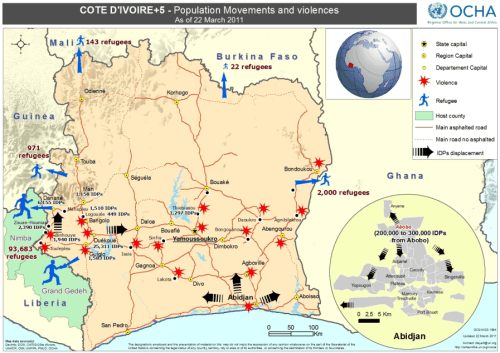
From the Internal Displacement Monitoring Center, March 22

The organization where I work has been present on the border between Cote d’Ivoire and Liberia for awhile now, supporting Ivorians who are escaping the conflict as well as the Liberian communities that are receiving people from Cote d’Ivoire.  (See another good map here.)

What is it like for those who are fleeing Cote d’Ivoire? An account came in by email this morning from our disaster specialist who just returned from Nimba County, located on the border. He told of a woman he had met who arrived in Liberia completely naked, with three children under the age of 6.  She had fled the violence in Abidjan on a Red Cross truck. Then she’d walked, carrying her baby, from the Western town of Daloa to the town of Giglo, passing near Duekoue (where a massacre is said to have taken place). She then continued on to the Liberia border; about 250 km. She had been travelling with her sister and her sister’s 2 children but her sister didn’t make it to Liberia.  She’s buried in the forest. My colleague described the woman’s children as so distressed they can barely speak.

My colleague went on saying that ‘Some people told me that armed men came to their villages and attacked them.  They saw neighbors killed by gunfire, just metres away from them.  Other people told me they fled to small houses in the bush, for fear their villages might be attacked.  But it didn’t make any difference.  When armed men came to the village and found no one there, they’d simply come into the bush, find people and kill them. The people I talked with told me the clashes were the result of ethnic problems.  Their ethnic group was being persecuted by others.’

He describes mostly women and children crossing the border from Ivory Coast and only a few men.  ‘I don’t know what happened to the men and boys.  Some young people told me their brothers and fathers were fighting for one of the sides in the conflict in Ivory Coast.  But no one seems sure of what is happening back in their home countryMany people who have fled Ivory Coast are staying with relatives just over the Liberia border.  Along the border area, many people are of the same ethnic group so there is no trouble with the newcomers.  However, every day, as the fighting grows more intense, more and more people arrive in Liberia.’

The term ‘endgame’ has been all over the headlines for the past 3 or 4 days now, but the ‘end’ of Gbagbo doesn’t mean that things will go back to normal for most people any time soon. Last I heard there are a million people displaced internally and 200,000 externally. I rather doubt it’s the ‘end’ of the crisis for them.

There was a saying people used a lot in El Salvador, though I hear it originates in Africa:  When the elephants fight, it’s the ants who suffer.

Read Full Post »

On a flight home from Kenya last summer, I sat next to a young man from Burundi. His country was just holding elections, and we got to talking about them. I’d heard people calling the elections a sham because the opposition boycotted them, and there was only one candidate (from the ruling party) to even vote for. I asked what he thought about that situation and the current president. He said ‘Well, you know, we Africans…. sometimes these guys have their own style of doing things which others may not understand.’ We got to talking about politics in countries near Burundi and African big men who don’t want to step down. He kept joking, with each subsequent leader: ‘Hey… well, you know, I guess he has his own style too.’  Seems there is a lot of personal style to be reckoned with.

Consider Laurent Gbagbo in Cote d’Ivoire who’s refused to step down as president and whose conflict with internationally recognized president-elect Ouattara is bringing (has brought?) the country to civil war. I’m about as far from a Cote d’Ivoire expert as you can get, never having visited the country and not having a great handle on the history or much knowledge about the current situation. So I went digging for some news articles and opinion pieces so I could understand things better.

Alex Thurston gives a good round-up on Sahel Blog and John James describes the day-to-day in his article Ivory Coast’s Descent into Madness (heard through @scarlettlion). This sobering article, West Africa lurches towards war, from March 11, explains how the Cote d’Ivoire conflict could impact the whole region. The International Crisis Group sums up the situation like this:

‘The election was part of a peace process that began after the September 2002 rebellion and was endorsed by several accords, the latest the 2007 Ouagadougou Political Agreement that all candidates, including Gbagbo, accepted and that set out compromises on organisation and security for the balloting. Ouattara won the run-off with a margin of more than 350,000 votes over Gbagbo.

The UN certified that result, but Gbagbo used the country’s highest court to throw out votes arbitrarily so he could stage a constitutional coup. Since then, he has relied on violence and ultra-nationalist rhetoric to cling to power. Over 300 people have been killed, dozens raped and many more abducted and disappeared by security forces. ECOWAS and the African Union (AU) have recognised Ouattara as president-elect and asked Gbagbo to step down, but he is apparently prepared to resist to the end, even if it means throwing Côte d’Ivoire into anarchy, war and economic disaster with terrible consequences for the entire region.’

Aaron Bady of ZunguZungu goes deeper and analyzes the historical roots of the conflict in his post Our deafening silence on the Coast of Africa: Cote d’Ivoire and our Myth of Continents, which I’d encourage you to read in full.

‘This is, in other words, about the political power structure working to limit who gets to politically represent and be represented in this “African” nation, precisely by drawing a line to separating “North Africa” from “West Africa,” in politically interested ways, to maintain political control for the ‘real’ Ivoirians in the south. Without denying that there might be other bad guys in this story, the fact remains — virtually unspoken — that ten years ago, Ouattara’s ethnic origin as Burkinabé — his parents were from Burkina Faso — was used by politicians from the predominantly Christian southern part of the country to disqualify him from running for the presidency; a political campaign of “Ivorité” worked to distinguish between “indigenous Ivorians” and “Ivorians of immigrant ancestry,” as a thoroughly programmatic effort to dis-enfranchise the (largely Muslim) north by lumping them all together with the (many) immigrants in the north who originated Burkina Faso. The current violence started with a disturbingly analogous move: after Ouattara was declared to have won the presidential election — by the UN, ECOWAS, the AU, and all international observers — the Gbagbo controlled Constitutional Council threw out 660,000 votes from the north and gave the election to Gbagbo.

It’s all very complicated. But for now, my point is simply to note that these geographical categories are not only part of the problem in Côte d’Ivoire itself. In this case, they are part of the reason why we find it so difficult to even talk coherently about the problem.’

*****

The organization where I work operates in Liberia, and so I’ve been getting updates about the situation on the Cote d’Ivoire-Liberia border, where we’re providing some support to the large number of refugees streaming into Liberia. These updates describe a deteriorating situation. Ghana, Guinea, Mali and Burkina Faso haven’t received as many refugees but are still starting to feel the effects of the conflict heating up. The past week saw a spill-over of violence onto the Liberian side of the border as armed Ivorians entered the Liberian territory and attacked Liberian and Ivorian nationals who were found along the North Eastern Liberia-Cote d’Ivoire border.  UN security troops were deployed to put an end to the fighting and gain control. Serious shooting has also been reported along the South East Liberia-Cote d’Ivoire border, accelerating the influx of refugees into the counties of Maryland and Grand Gedeh. One report says that in Cote d’Ivoire, rapes, abductions and killings are being committed by people supporting both sides and influential leaders appear to be deliberately stimulating attacks against political opponents, other ethnic groups, nationals from other West African countries, as well as UN staff and operations.

I was Skyping Wednesday with my boss, who lives in Burkina. She oversees our programs in the West Africa region, including emergency and humanitarian crises. She said there are over 80,000 refugees who’ve come into Liberia already, ‘and it’s only going to get worse.’

On top of those who have fled into Liberia, there are at least 300,000 internally displaced. ‘The area where the refugees are in Liberia is totally undeveloped,’ she said. ‘It’s 26 villages with no infrastructure which now have to cope with the influx of people. People don’t want to go to a camp. They prefer to stay in the villages. There are security worries as there is fighting very close to the border and armed men from Cote d’Ivoire are crossing the border to Liberia and started firing on the Liberian side of the border. They were shut down by UN troops, but it’s worrying.’

Since she and I talked the situation has gotten worse still. Foreign Policy Blog reports:

‘This is the real thing. In a message on state television last night, Gbagbo — who has refused to step down after losing an internationally certified election in November — asked civilians to get involved in the fight to “neutralize” his opponents. That’s about as close as you get to saying pick up your machetes and join me. Or forget machetes; Ivory Coast is still heavily armed from its civil war last decade. Gbagbo certainly hasn’t been shy about using military force lately; his forces are thought to have been behind a mortar attack on a market yesterday that left 40 people injured. Earlier this week there were reports of his using helicopters and tanks to mow down suspected opposition supporters.’

My boss also worries there will be a cholera outbreak. The rains started early and the hygiene conditions are bad. Ghana has a cholera outbreak right now, and it’s likely that with much people movement, rains and inadequate sanitary conditions, there will be an epidemic. ‘And people from Cote d’Ivoire are hungry,’ she said. They haven’t had access to cash for weeks as all the banks are closed and food stocks are used up. We are feeling this even here in Burkina as food coming from Cote d’Ivoire starts to get short and prices increase…. And many of the refugees are adolescents. We are worried about them being hired into armed forces, so we are looking into options to try to organize the youth to simply give them something to do.’

On March 3, the International Crisis Group issued the steps that they see as necessary to avoid a civil war and conflict that will shake the whole region:

‘The requirements to avoid a disastrous new conflict include Gbagbo stepping down; Ouattara offering to negotiate, with civil society help, an agreement for unity, national reconciliation and an interim transitional government with him at its head (but without the irreconcilable former president); the UN peace-keeping mission standing firm to carry out its civilian protection mandate; and the international community unequivocally supporting any decisions of the Economic Community of West African States (ECOWAS), including deployment of a military mission.’

I wonder if these actions will actually be taken, or if the escalating situation will allow for them to be taken, as each passing day seems to throw the country further towards a seemingly impossible-to-resolve situation.  It’s tempting to think that people are not paying attention to this crisis because of other crises happening right now in Japan, Egypt and Libya. I’m not convinced. Aaron Bady’s post, referred to above, spells out other possible reasons for the lack of attention to the situation, including the common narratives about Africa, ‘the dark continent’, that color our perceptions and reactions. Again, I’d really encourage you to read the whole piece, but here’s a bit of it:

‘It isn’t that “we” don’t want to understand; it’s that we don’t know how to see beyond the initial same-old-story-ness of this story, when we hear it. Which is why, I would suggest, we end up where we started: a sense that, because there is violence, we should pay attention to what is happening, followed by the discovery that there is no news there; just the same “turmoil in Africa” narratives we sort of quietly presume to be going on across the continent all the time, and nothing we can think anything new about.’

I’m someone who rants quite a bit about the negative images we associate so often with Africa and Africans. But looking at the information available about the current situation, I’m having a hard time finding any hope there. I wonder what solutions there really are, where they come from, and if and when these cycles will end. Is it because I haven’t visited Cote d’Ivoire myself that it’s hard to see beyond the negative narratives? Is it because I don’t personally know the day-to-day ‘place of friendly people, amazing fresh fruit, long and unspoilt tropical beaches ‘ that John James describes? In my mind, I keep coming back to the narrative about Africa’s ‘big men’ and their ‘personal styles’.

Seems I’m also caught in the thinking trap that Aaron laid out.

Read Full Post »

This is a post by Jo-Ann Garnier-Lafontante. Jo-Ann and I go back a long way. We worked together on a few youth media and participation programs in the past and became friends. She and the youth that I met through her were the first people I thought of when I heard about the earthquakes in Haiti last January. It’s people like Jo-Ann and the youth she works with who are bringing Haiti back to its feet.

On January 12th at 4h53pm I was in my third-floor office at Plan Haiti, meeting with Guerdy the Human Resources Manager and talking about staff issues and projects for the New Year. Suddenly the ground seemed furious with us. I can still hear the sound of heavy concrete collapsing and people screaming. After I saw the toilet literally explode in front of us, I told Guerdy “We’re going to die.” I saw images of my family before me. I tried to call them, but I could not get through. I was terrified. My husband worked in a 6-story building and I could not reach him…

Between three violent aftershocks Guerdy and I managed to get out of the building and into the parking lot. I remember seeing several shoes my colleagues had lost in the stairs while running out of the office. I saw my other colleagues horrified, crying and trying desperately to communicate with their loved ones on their cell phones. I saw this little girl, maybe she was 12, who had come to hide in our parking lot. I had never seen her before… she smiled at me. She told me she lived in the neighborhood, that she escaped from her house and the rest of her family was still missing. She was wounded, the features of her face hidden behind dust.

Four hours later, my husband miraculously appeared in our parking lot, sweating and breathless. I had tears in my eyes when I saw him.  He told me about the things he saw on his way to Plan’s office and we started the journey home together. It was awful. We saw people either walking like zombies, screaming, crying, carrying injured people or dead bodies—or desperately looking for loved ones. When we got home, my mother, my 1-year-old daughter and 7-year-old son were in the street in front of our house…stunned and speechless. I grabbed them and held them so tight. I heard that my father and nieces were stuck downtown but they were okay. Now… what about the rest of the family, friends … we could only wonder.

I remember the funerals of my aunt and my grandmother. My father had to remove his own mother from the rubble that had been her home, after six days of digging. We had gotten my aunt out of her collapsed home after two days of digging but she died on the way to the hospital—and then her body was lost among the other bodies and we never found her again.

I remember seeing so many people around Port-au-Prince queuing for burial ceremonies for their loved ones. I thought Haiti had died.

On the last day of 2010, I sat at a meeting at Plan’s new office in Port-au-Prince. It was for the children’s and youth event we are planning for the anniversary of the earthquake. I was amazed at the change since last January. At the meeting we talked about celebrating life. We talked about a new beginning for Haiti and how the engagement of children and youth is essential to its success. I felt our excitement. I feel so proud to be a part of this.

According to what I have witnessed over the past year, Haiti’s promising future is guaranteed because of the potential inside its children and youth. After the earthquake, I saw how young people were so keen and motivated to support their peers. Now I see them mobilizing again to raise awareness about cholera and saving lives.

The earthquake devastated Haiti, but it also provided a chance for this country to be reborn. Children and youth immediately understood their role in this reshaping—they played a key part in the emergency response and they have told us from the beginning that they are ready to do whatever it takes to help reconstruct their country. We adults—and especially the decision makers among us—should listen to their insights and follow in their footsteps and do whatever it takes to fulfill our responsibilities to this country. In the near future, I think there should be a group of young advisors standing behind the President and each Minister.

Today I weep for my aunt, Gagaye (this is how we called her), and my grandmother, Nini, and so many other family members and friends whom I am missing, and also for those I did not know and who left us too soon. But today I also celebrate life. I celebrate the strength I see in the communities where Plan works. I understand the wise person who said “a country never dies…” I now know this is true more than ever because a country like Haiti can count on its children and youth to keep it alive.

Jo-Ann narrates the video below about the work she’s been involved in over the past year. It’s worth a look.

Related posts on Wait… What?

Haiti through our eyes – an uplifting series of photos by Haitian youth

Children and young people’s vision for a new Haiti – 1000 youth input into Haiti’s reconstruction plan

Children in Emergencies: Applying what we already know to the crisis in Haiti – lessons learned from past disasters

Read Full Post »

When people tell their own stories and take photos of themselves, the results are quite different from when outsiders bring in their stereotypes and their agendas.

I love love love this photo series by youth in Croix des Bouquets and Jacmel.

In October, 2010, Plan commissioned Natasha Fillion, a Canadian photojournalist based in Port-au-Prince, to train and work with 22 teenagers to document their own lives in their own home, neighborhoods and schools. The youth, ages 14-19, got a crash course in photography and were given a digital camera and sent out ‘on assignment’ in their communities. Their brief was to cover topics such as home life, education, leisure, friends, everyday Haiti, and anything about which they were passionate. The photos were taken over a period of 2 weeks.

Fillion commented ‘I go out and I’m covering demonstrations, violence and destruction but there’s a whole side of Haiti that the media, the whole world doesn’t get to see, and I told the students — this is your opportunity to show people what Haiti is really like. These are photos that tell the story of Haiti as a whole, not just news.’

February 3, 2011, update:

Interview with 2 of the youth photographers and Natasha Fillion.

Related posts on Wait… What?

Read Full Post »

« Newer Posts - Older Posts »