Feeds:
Posts
Comments

Archive for the ‘girls’ Category

As I mentioned in an earlier post, I spent last week at the 55th meeting of the Commission on the Status of Women. The organization where I work supported 12 girls from various countries to attend and speak at different panels and side events during the week.

Why is it important for girls’ voices to be heard at global events like the CSW? Why should they be allowed to sit at tables with adult decision makers? Is this a wise investment when we could have spent that money to bring an adult staff member instead? Well, from a strictly rights-based perspective, it’s because girls have a right to participate in decisions that impact on their own lives.

But there are so many other reasons that girls need to be present at these events. They bring perspective that is otherwise missing. Before women are women, they are girls. It’s well known and well documented that investing in girls’ education and other areas has impacts that go far beyond schooling. At these big meetings, issues that impact girls and women are being addressed and discussed – so there needs to be space for girls and women who feel these issues directly to speak for themselves, especially girls and women who are typically left out of these processes. Girls bring a reality check. They offer ideas and solutions from their own contexts. They bring points home that can otherwise be missed. They are often amazing speakers and have incredible wisdom and insight to share. We can all learn from them. And bringing girls and their opinions and voices to a huge event like the CSW can really have a positive impact both on the event, the event participants, the decisions made there, and on the girls themselves, as they return home with a mandate to live their leadership in their own communities and countries.

Early in the week, I shared a panel with Fabiola, one of the girl delegates from Cameroon, and she truly stole the show. Here’s how:

Fabiola participates in the Youth Empowerment through Technology, Arts and Media (YETAM) project, and was selected by her peers to represent her group and Cameroon at the CSW. More information about Fabiola and Shira, the other girl delegate from Cameroon are in this post: Girls in rural Cameroon talk about ICTs. Shira also spoke at high level panels, as did the girls from Sierra Leone, Indonesia and Finland.

The girls also planned and managed their own side event where they talked about girls and new communications technologies.  In preparation for the event, they brought with them videos from their home countries, and Kirby, one of the girls from the US, edited them together into one piece. The video was shared at a few different events, and the girls were even asked to show it at the general assembly (at the last minute they weren’t allowed to for one reason or another). In any case, you can see it here:

On the last day that the girls were in New York, 3 of them sat on a panel in front of hundreds of high level decision-makers: UN officials, Ministers and government representatives. They talked about the challenges girls face in terms of accessing ICTs and raised the issue of violence against girls and how violence in schools impacts heavily on girls’ education.

My Cameroonian colleague, Judith, who works on the YETAM project with the girls, told me afterwards that she felt unbearably proud, seeing them there in front of the whole room, with everybody hanging on their every word. “I was floating,” she said. “As if my feet were not even touching the ground.” She was proud that Shira didn’t only present the issues that girls are facing in accessing ICTs or in terms of violence or early marriage, but Shira went further and talked about what they are doing in the community and how they are working with ICTs and conducting advocacy with decision makers and traditional councils to resolve the issues, and what impacts they have already had.

Josephine, one of the girls from Sierra Leone, said afterwards: “When I was there, speaking, I felt like I was on top of the world because people were listening to my voice.”

There needs to be more of this!

But if you are still not convinced, my fabulous colleague Keshet Bachan, coordinator of this year’s Because I am a Girl Report and the previous 3 reports, gives a convincing overview here about why girls and why now. Worth watching.

Read Full Post »

The 55th Session of the Commission on the Status of Women is taking place this week in New York City, with the core theme of: “Access and participation of women and girls to education, training, science and technology, including for the promotion of women’s equal access to full employment and decent work.”

Some of the girls that we’re working with in our programs are participating, including Fabiola and Shira from Cameroon. I met them both last July when we worked together on the Youth Empowerment through Technology, Arts and Media (YETAM) project. The YETAM coordinator in Cameroon, Judith Nkie, is also attending the CSW as the girls’ chaperone. She certainly also has a lot to contribute on girls, women and ICTs. Judith once said to me “This project is a catalyst in my body.” Judith is awesome.

Girls from the YETAM project worked to prepare the interviews, film and videos below. Each girl interviews another girl from the community about the role of ICTs in their lives. The videos are worth watching as the questions and the responses of the girls are very insightful.

The interviewee in the first video says ICTs help you find out what is happening around the world. She comments that she found out about what just happened in Egypt (the February revolution) because of ICTs. Some of the other things I found most interesting in the videos are:

  • The girls’ recognition of the importance of information for making good decisions
  • The technologies that girls have most access to (mobile phone!)
  • The first time the girls encountered a mobile phone (a few years ago, at a local call box for one, and via an uncle who brought one back from travels for the other)
  • Why it is hard for girls to use ICTs in the community (lack of ICT devices, cost, parents don’t allow girls to learn about ICTs, at school the computers are few – you will see at least 20 persons per computer – and half are broken, the boys are very powerful and they fight us to occupy the computers, girls’ illiteracy, girls don’t continue in school)
  • How often the girls use ICTs (mobiles are used every day, there is only one place to access Internet in the community)
  • What they like most about ICTs (ICTs help me to know what is happening in other countries, I came to know about what happened 2 days ago in Egypt via communication technologies, many youth have been able to be employed through their mobile phones)
  • What they like the least about mobile phones and Internet (scamming, its easy to tell lies by mobile)
  • How can ICTs be helpful to girls (in my community a girl was able to borrow a phone from a friend to report that she was to be married at the age of 12, and the marriage was stopped)
  • Can ICTs be used to hurt girls? (yes, the girls who can afford their own mobile phones are those who are wealthy, when the poor girls see the wealthy girls with their phones, they go into competition, they can go into prostitution to have money to get a phone; but on the other side, girls are also self-employed through the phones, so the mobile phone hurts but it also helps girls)
  • How the communities use the Internet to sell their products (most people in the community use ICTs to communicate to find buyers for their products)
  • What girls would like parents, community leaders and government to do regarding ICTs (improve our access to ICTs, bring in programs and projects that can support youths to use ICTs and learn to use them better, educate parents to help them to see that girls also should be allowed to access this type of training and technology)
  • What hurts most about this ICT thing (when those who are really privileged and who can use the Internet don’t put their talents and privileges to good use, they go there to scam, to do robbery, not to do good; if these youth have the time and this privilege they should not do harm but they should do good.)
Kirby, one of the girls from the US, edited together portions of the videos above with video footage from the rest of the girls in the group, and they used the video to kick off their ‘Girl Led Side Event’ today. The turnout was great. They will continue throughout the rest of the week getting their ideas and messages across in different events and panels. You can follow their thoughts and impressions on the Plan Youth Tumblr or by following @plan_youth on Twitter. My colleague @KeshetBachan is also blogging from the CSW at the Girls Report blog.

Read Full Post »

The 55th Commission on the Status of Women (CSW) happens in New York City Feb 21-25, 2011. For me, the most exciting thing about the event is that several girls from some of the countries where we are working (Canada, US, Finland, Cameroon, Sierra Leone and Indonesia) will be participating and speaking. This aspect of our work – helping to bring young people’s voices into these large influential forums – (when done properly) can be very effective at bringing a reality check to the ivory tower and helping influence decision makers at the very highest levels.

This year’s CSW is especially interesting to me since I work in the area of ICTs, and the theme of the CSW is:

“Access and participation of women and girls to education, training, science and technology, including for the promotion of women’s equal access to full employment and decent work.”

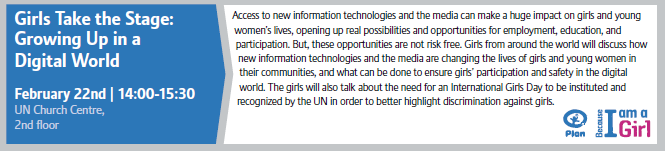
The girls will be presenting at the Girls Take the Stage: Growing up in a Digital World on Feb 22nd:

I’ll be presenting with Fabiola from Cameroon at the Empowering Girls: Education and Technology” session on February 23.

I’ll also talk at a panel-workshop hosted by the Buddhist Tzu Chi Foundation on Tuesday Feb 22, from 10-11.30, called “Breaking the Cycle of Poverty of Women and Girls through Education and Training,” on the 2nd floor room of the CCUN (Church Center of the UN).

Update: Ika one of the girls from Indonesia, will speak at a panel on Commercial Sexual Exploitation and the Girl Child: A Human Rights Approach at the Main Auditorium, Salvation Army Social Justice Center, 221 East 52nd St between 2nd and 3rd Ave, on Feb 24th from 2-3.30 pm.

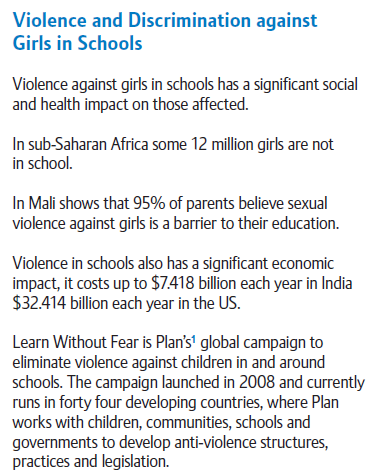
Update: Lil Shira from Cameroon will present on Violence and Discrimination against Girls in School, along with Marta Santos Pais (UN Special Representative to the Secretary General on Violence against Children) and others on Feb 22, from 16-17.30 at UN Church Center, 777 United Nations Plaza, Drew Room, Ground Floor.

Join us at the some of the sessions or come for an evening with the 21+ crowd at #ICT4Drinks Feb 23rd at 6 pm at Me Bar.

We’re trying to interest the girls in tweeting during the CSW on the @plan_youth account and to blog at  http://plan_youth.tumblr.com, so check it out as of this Monday. (We’ll see if they are willing or not!)

You can follow the events on Twitter at the hashtag #CSW55.

Read Full Post »

I spent the past week in New York City attending the UN Digital Media Lounge and Mobile Active’s mWomen Technology Salon. These 2 events happened alongside the Millennium Development Goals (MDG) Summit and the Clinton Global Initiative (CGI), where world leaders, corporations, movie stars/rock stars, innovators, and heads of big development organizations gather. There was a lot of talk about Technology and Innovation, Women and Girls, and Public-Private Partnerships, and, well, a lot of talk in general according to some, but I am not going to go there. Saundra put together a great compilation of MDG and CGI and UN Week posts over at Good Intents where you can read all about it.

My learning highlights for the week were in the area of m4D (mobiles for development) and ICT4D (information and communications technology for development):

  • World Bank Open Data. The Bank is really moving towards opening up their data. They currently have over 2000 websites and they are trying to consolidate them and make it easier for users to access the World Bank’s Data for their own purposes. The Bank has put more than 1,200 indicators, including the full World Development Indicators dataset, on the site. In addition, there are a variety of maps, dynamic graphs where you can compare data sets, and widgets for you to add information to your own website. Check the World Bank Open Data site for more.
  • UN Global Pulse. Over at Global Pulse the team is looking at existing indicators from UN agencies and others and trying to figure out how they can tap into human behavior patterns for early detection of crisis and as a way of quickly investigating and responding to such crises. In this age of real-time information, it’s somewhat bizarre that large development organizations are working based on extrapolations of data that are 2-3 years old.  Global Pulse hopes to change that by identifying and tracking a series of pulse points, such as satellite data, mobile phone and SMS trends, internet and search word trends, increase and decrease of doctor visits and medication sales, and other human behaviors; that can serve as early warning system for crises. Think Flu Trends but pulling in all kinds of data at the global level.  The UN plans to use their own data and the data of others, as well as “data exhaust” from a variety of sources to come up with a new way to predict, mitigate and manage global crises, such as the current food-fuel-finance crisis, and their impact on communities.
  • Civil Society 2.0 Initiative. The US State Department’s Civil Society 2.0 Initiative is working to address the chasm between what NGOs and local organizations need and what the tech community can provide. The idea is to bring the two sectors together and bridge the gap between them. The initiative would work to identify the local needs and local context, and then help with tools to meet the needs using the available technologies. They are also building toolkits for organizations on how to blog, set up SMS systems, and other common social media activities. The aim is to improve disaster response efforts by balancing between communication and ethical standards, operating procedures, alert systems, and technical capabilities and working in advance of disaster and emergencies so that civil society groups are prepared.
  • GSMA. I’m not sure where I’ve been hiding but I hadn’t heard about GSM Association before. GSMA represents the interests of the worldwide mobile operators. They have around 800 members from 219 countries. GSMA engages in policy debate with governments and regulators and advises mobile operators on ways to move their core business forward. GSMA has done a lot of research on women and how to market sales of mobile phones to women, especially in those countries where women are lagging behind in mobile phone ownership. They were part of the Women and Mobile: a Global Opportunity study.  GSMA is working with mobile operators on mobile banking in some 147 countries, which I find a bit mind-boggling, since I hadn’t heard of them before!
  • Pesinet. For just about $1/month, Pesinet provides families in Mali with a micro-insurance service. Healthcare agents visit the homes of children enrolled in the program to  check height and weight and for any signs of illness. If illness is detected, they arrange for a visit to a clinic. Pesinet covers half the price of medication if needed. Using the Pesinet mobile application, the healthcare agents record information about the patient and send it to a central data base at the clinic. By using mobiles and encouraging preventative healthcare, Pesinet is reaching more children and improving healthcare.
  • Souktel.  In developing countries, finding a job can be extremely difficult, and job boards are not prevalent. Using simple SMS, Souktel has created the JobMatch application which allows a person to create a mini-CV which is uploaded into a data base. Employers can also send out job notices which people can receive by text message, in order to connect to those jobs that match their skills.
  • Priyanka Matanhelia’s research on mobiles in Mumbai and Kanpur, India showed that young people in both the cities used cell phones for a variety of communication, news and entertainment needs. They used cell phones to negotiate independence from parents and to maintain friendships and create friendships with members of opposite sex. The young people in the two cities used mobiles differently due to the differences in their lifestyles and socio-cultural factors, however there were only a few gender differences in the use of cell phones.

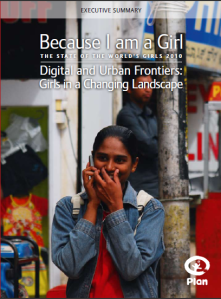
I also had the opportunity to present some of the work that I’m involved in. You can see the live stream of the ICT4D, Innovations and the MDGs panel on Mashable TV, or check out my Ignite talk from Mobile Active’s mWomen event (download the power point if you want to see the notes). You can also download the new Because I am a Girl 2010 Report on Girls in a Changing Landscape: Digital and Urban Frontiers.

The best part of the week was meeting up with old friends, and tweeting up with people I have been conversing with for months, even years, on Twitter and through emails and blogs.  New York is like a real-life Twitter. There is always something happening, you meet brilliant, intelligent, creative and energized people from all fields and walks of life, and you learn and discuss and constantly broaden your horizons.

That 20 minute Friday afternoon nap in the sun at Sheep’s Meadow in Central Park wasn’t so bad either. I really do love New York….

Related posts on Wait… What?

On girls and ICTs

Revisiting the topic of girls and ICTS: Tech Salon Discussions

Being a girl in Cumbana

MDGs through a child rights lens

3 ways to integrate ICTs into development work

5 ways ICTs can support the MDGs

Read Full Post »

Because I am a Girl 2010

The urban and digital environments are the 21st century’s fastest-growing spheres. Both offer enormous potential for girls around the world, but prejudice and poverty exclude millions of girls from taking advantages of the transformative possibilities that cities and information and communication technologies (ICTs) can offer.  Exploitation and the threat of violence exist in both urban spaces and in cyberspace, especially for the most marginalized and vulnerable girls.

Since 2007, Plan has published annual reports on the state of the world’s girls. The 2010 ‘Because I am a Girl report’ is called Digital and Urban Frontiers: Girls in a Changing Landscape. It focuses on girls in these two rapidly expanding spaces: the urban and the digital.

The piece that I’m most interested is the segment on Girls and ICTs, since that’s the main area I currently work on. (Disclosure: I contributed to the development of the chapter). To give you a taste of what’s in the report, here’s a summary of Chapter 4: Adolescent girls and communications technologies – opportunity or exploitation. You can download the full report here.

Chapter 4’s introduction explains that online behaviors mimic offline behaviors.  Empowerment and abuse of girls reveals itself through technology as it does in other areas of girls’ lives.  Through girls own voices, expert opinion and original research, the report highlights the positive and negative consequences of ICTs, in particular mobile phones and the Internet. The authors talk about the positive ideas and new ways of thinking that ICTs open up for girls in terms of learning, networking, campaigning and personal development. They then discuss the darker side of technology  — how cyberspace makes it easier for sexual predators to operate with impunity, where girls are prime targets for abuse, and where girls are sometimes perpetrators themselves.

Section Two offers girl-related statistics on the digital revolution and the digital divide and highlights the enormous variation between and within countries in terms of digital access, and the gaps between rich and poor, male and female, urban and rural.  The report cautions that excluding girls from the digital revolution will have consequences on their growth and development. For additional global ICT statistics (1998-2009) see this post at ICT4D blog. Another resource on mobiles and women is the Cherie Blair study.

Section Three describes and provides statistics around 7 important reasons that ICTs are important to adolescent girls:

  1. To keep in touch with others and reduce isolation in countries where this is an issue
  2. To further their education and acquire new skills
  3. To take an active part in their communities and countries
  4. In order to have the skills to find work
  5. To build specific skills and knowledge on subjects they might otherwise not know about, such as HIV and AIDS
  6. Because evidence has shown that learning to use these technologies can build self-esteem
  7. In order to keep safe

Section Four goes in depth around ways that adolescent girls compete with adolescent boys for the most use of communications technologies such as mobiles and the Internet, but that often they are using them for different reasons and different purposes. Most of the available research for this chapter is from the ‘North’, yet the studies indicate that girls tend to use ICTs for communication and boys tend toward a focus on the technology itself. Studies on this from the ‘South’ are unavailable to date.

When girls are treated as real partners....

Section Five discusses the barriers that keep adolescent girls from accessing ICTs. In other words, if the importance of ICTs has been established, girls are willing and able and keen to use ICTs, then what prevents them from having equal access to ICTs? Some of the issues that the chapter discusses are those of power and control.

‘I can immediately call the wholesale market to inquire about prices and place direct orders. I am now recognized as a businesswoman, growing and selling sesame seeds, not just as somebody’s wife or sister,’ said a woman in India.

‘You’re a girl – a mobile can cause many problems, and so you don’t need it,’ said the father of a Palestinian girl.

Girls’ access to technology is limited by their societies, communities and families. In patriarchal societies where men control technology, girls and women simply have less access, because ICT’s confer power on the user. Even in educational settings, a study found that boys tend to hog available ICTs. Teachers have distinct expectations from boys vs. girls. Girls also don’t tend to go into the field of ICTs or want to have ICT careers, since the field is typically a male field. ‘Technology appears to be marketed by men for men. It’s time we started switching bright and talented girls on to science and technology,’ comments a British government official.
Women and girls in developing countries however are not receiving the basic education and training that they need to be ready technology adopters. They are seen as users and receivers of technology, not as innovators involved in technology design and development. Once they are computer literate, however, many young women see the computer industry as a route to independence. The report offers statistics on the numbers of young women in countries like South Africa, India, Malaysia and Brazil who are working in the ICT related industries and professions.

What stops girls from using technology?

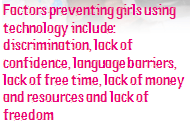
There are seven key factors that prevent girls from taking advantage of technology:

  1. Discrimination – girls are still viewed as second-class citizens in many societies.
  2. Numbers – boys both outnumber girls and tend to dominate access to computers.
  3. Confidence – because they don’t have equal access at school, girls may be less confident than boys when it comes to going into IT jobs because they don’t feel they have the same skills and knowledge as the young men competing for the jobs.
  4. Language – in order to use these technologies, English is usually a requirement, and for girls with only basic literacy in their own language, this is a major barrier.
  5. Time – girls’ domestic roles, even at a young age, mean they have less free time than boys to explore and experiment with new technologies.
  6. Money – girls are less likely than their brothers to have the financial resources to pay for, say, a mobile phone and its running costs, or access to the web in an internet café.
  7. Freedom – boys are also more likely to be allowed to use internet cafés because parents are concerned about their daughters going out on their own.

Section Six digs into the dark side of cyberspace and the risks that adolescent are exposed to at a time of their lives when they are beginning to develop sexually. One in 5 women report having been sexually abused before the age of 15, according to the authors. The Internet by and large is simply a new medium for old kinds of bad behavior, however; and new technologies simply extend the possibility of abuse to new arenas. Girls who are not even using the Internet are still vulnerable, given that a photo of them can be taken and posted by someone else even if they have no computer access. Cyberbullying and cyberharrassment are other risks that girls face.

Many young people and youth organizations are active in facing these risks and protecting themselves, and various campaigns exist to help adolescent girls be more aware of how to protect themselves while using ICTs. New technology can itself also be a tool to help with counter-trafficking efforts. The chapter outlines some of the different efforts being made to protect girls online, and emphasizes the role of parents and schools in discussing on-line use and being supportive as girls begin exploring cyberspace.

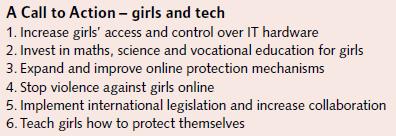
There is a quite broad set of recommendations for a wide array of actors at the end of Chapter 4 that could be taken up, contextualized and fleshed out by different parties or stakeholders into specific calls to action:
Brazilian girls in a digital world. As an annex to Chapter 4 on ICTs, new research with 49 boys and 44 girls, aged 10-14 examines adolescent girls’ rights and protection in Brazil within the context of ICTs. ICT use is growing exponentially in Brazil, particularly among 15-17 year olds, where between 2005 and 2008, ICT usage went from 33.7 to 62.9 percent. The study covers use pattern, links between on-line and off-line behavior, and on-line safety.

Conclusions. The report concludes by calling for greater knowledge about ICT-related sexual exploitation and violence against girls, more emphasis on prevention and stronger international standards. It also points out that girls need to be empowered to use new communications technologies safely, on their own terms, and in ways that promote their development and build their futures.

Call to action for September 22: As part of the launch of the Because I am a Girl Report, Plan is calling for International Day of the Girl to be established on September 22. You can sign the petition here.

Resources

Download the full report here: Digital and Urban Frontiers: Girls in a Changing Landscape

Download the Girl’s Cohort Study: Real Choices, Real Lives. Plan researchers follow 142 girls lives over a 9-year period.

Download past Because I am a Girl Reports (since 2007)

Related posts on Wait… What?

On girls and ICTs

Revisiting the topic of girls and ICTS: Tech Salon Discussions

Being a girl in Cumbana

MDGs through a child rights lens

3 ways to integrate ICTs into development work

5 ways ICTs can support the MDGs


Read Full Post »
I have a daughter. She was born at home with a traditional midwife in a poor barrio in San Salvador. Her father had a 9th grade education when we got married. She had severe diarrhea at least 3 times as a baby and we worried that she might not make it. My mother-in-law took her to a traditional healer because the doctors didn’t seem to be getting it right. She had pneumonia twice as a baby, probably due to allergies, air pollution and the chickens my mother-in-law kept in the small house. She had dengue once. The water didn’t always run and people stored water in open barrels, so there were a lot of mosquitoes.

Luckily her father returned to school to finish his education. Luckily her mother and her mother’s mother were well educated. Luckily both of her parents worked, so there was enough money to feed and clothe her. Luckily we had a bit of savings that we invested in a small cement block house. Luckily we lived in a city, near a primary school. Luckily we were able to get a telephone installed around the time she was born. Luckily our barrio had electricity and we could afford to pay for it. Luckily we believed that she was just as worthy as her brother. Luckily today she is alive and thriving and in school, with a myriad of possibilities ahead of her.

Girls all over the world should be so lucky.

I’m reading the ‘Real Choices, Real Lives‘ cohort study that Plan just put out as part of the annual Because I am a Girl report (which launches Sept 22). It tells the stories of 142 girls in 9 countries (Brazil, El Salvador, Dominican Republic, Benin, Togo, Uganda, Cambodia, Philippines and Vietnam) that researchers have been following since they were born. The girls will all turn 5 this year, except for the 5  girls whose lives have already been claimed by preventable diseases. 7 of the girls have dropped out of the study due to family migration or other reasons.

As powerful world leaders gather in New York this week to discuss accelerating progress towards the Millennium Development Goals, this report is a sobering and intimate reminder of the real inequalities girls, especially the poorest girls, face, and the struggles their family go through to keep them alive and help them to thrive.  The cohort study tells us that primary school enrollment rates in Sub Saharan Africa are up from 58% in 1990 to 76% in 2008, but in the poorest 20% of households, 39% of girls don’t attend school. The cohort study shows us, through the stories of the 130 girls who are still part of the cohort group, the very real impact on very real lives that failure to reach the MDGs has. The reality is that the poorest girls do not have what they need to survive, develop and participate fully.

What will happen this week in New York to change that?

Related posts on Wait… What?

MDGs through a child rights lens

5 ways ICTs can support the MDGs

On girls and ICTs

On trust and disempowerment

Being a Girl in Cumbana

Read Full Post »

I recently had the honor of leading a group of tech, development and gender folks in a discussion around Girls and ICTs at the Technology Salon.  The conversation revolved around 5 aspects I wrote about in an earlier blog post On Girls and ICTs:

  • Tension between participation and protection
  • Online behavior is an extension of, and a potential amplifier of offline behavior
  • Qualifying the digital divide
  • Girls’ involvement in developing and designing ICT solutions for their own needs
  • Research on Girls and ICTs

Check out the Technology Salon’s page for a round-up of our discussions!

Photo:  Informal evening one-on-one ICT time at a Youth Empowerment through Arts and Media (YETAM) project workshop in Cameroon.

——————-
Related post on Wait… What?
On Girls and ICTs

Putting Cumbana on the Map:  with Ethics
Being a Girl in Cumbana

Girl Power and the CGI

Read Full Post »

At the Technology Salon hosted by the UN Foundation’s Technology Partnership with Vodafone Foundation on Jan 28, 2010, some folks from the DC area (and beyond) will gather to share experiences around girls and ICTs.

This conversation is an important one, given that gaps exist around discussion, practice and research.  The information and ideas shared at the Technology Salon will feed into the contents of the Girls and ICTs chapter for Plan’s upcoming 2010 “Because I am a Girl” Report (currently in the works).

There are a few points that I hope will be considered in the Technology Salon discussion:

Tension between participation and protection.

There are many examples of ICTs being used for increased participation and connection:  mobile phones for citizen journalism;  Twitter revolution in Iran; girls using mobiles to ask questions about sexuality and to get information to help them improve their sexual and reproductive health; girls married off early or those living in protective societies using mobile phones to maintain contact with friends; new media tools opening up possibilities for youth engagement in important conversations that normally they would be shut out of.

However, due to the very real problems of on-line child pornography, child trafficking, child harassment, and cyber bullying, there is also a strong push for more control, more restrictions on on-line use in the name of protecting children.  The tension between child participation and child protection is a very real one.

As we look at how technology and international development communities can support girls’ development, I hope it’s kept in mind that the more knowledge that girls have about the internet and ICTs in general, the more practical use they are allowed, the more coaching to help them understand implications of their actions, then the better prepared they will be to navigate these realms and to keep themselves safe.  Increasing their knowledge, abilities and desire to protect themselves may be more effective than setting strict external limitations.

Actively engaging girls in this as part of an educational process can be better than restricting their use – and being open to young people’s own ideas and ways of using ICTs is critical.  Adult involvement in this area is important, but it is probably more worthwhile to coach than to control.  Good communication and trust between children, youth and their adult mentors and guides is critical in this process. (Excellent resources on Child Online Protection (COP) for children, youth, educators and parents came out on October 2009 and are well worth the read.)

Online behavior mirrors offline behavior.

I remember getting an obscene phone call when I was around 8 years old.  My mother did not blame the telephone, however. She blamed the pervert that was calling.  She made sure to teach me how to be prepared in case it happened again. She emphasized not giving out information on the phone and hanging up immediately if I felt uncomfortable or didn’t know who was calling.  She did not prohibit me from ever touching the phone again or blame me, but she was vigilant for awhile.

In the same way, new ICTs themselves cannot be blamed for negative and twisted behaviors.  ICTs are tools that exacerbate and extend already existing human behaviors, and the blame lies with those who are using ICTs for child trafficking, cyber bullying and the other evils associated with the internet. It’s important to address underlying behaviors. Research shows that kids who are bullied offline are often also bullied online.  Girls who are vulnerable offline are likely also vulnerable online.  Online is a manifestation of offline, and the root causes of girls’ vulnerabilities online cannot be blamed only on the ICT tools themselves.

I have my own daughter now, and have discussed with her many times how to keep herself safe online and on the phone.  It’s important for her to know this before something happens, not during or after.  She will probably be using the internet and the phone for the rest of her life, so prohibiting them is not an option, and the benefits of using these tools obviously outweigh the risks.  My own involvement and use of social networking sites, texting, etc. is an excellent way for me to know how these sites are used and what security holes there are for my children on the sites. How can parents and teachers in areas with limited use of ICTs be involved and engaged to serve as coaches and leaders in on-line protection together with children?  How can communities help identify existing vulnerabilities in girls (or young people in general) that might manifest themselves online and offer support to prevent exploitation?

Digital gender divide.

There are some amazing examples of ICTs helping women and girls to improve their livelihoods; for example, women selling mobile telephone services; birth attendance being improved by using mobile phones to connect women to midwives, ambulances and other medical services; educational content being  expanded using internet; youth media and youth radio programs bringing girls voices and gender topics into the mix for community discussion and dialogue.

However, in places where boys and men dominate women and girls, boys and men likely also dominate the use of available ICTs.  Men may control the family’s mobile phone and take it with them, or monitor women’s calls. In places where boys are more favored, their confidence to try new things is higher meaning they may rush in to use mobiles, cameras, radio equipment in projects while girls shy back.  In some cases girls report that boys hog and monopolize the computers and equipment, and access is denied.  I’ve seen boys criticize, scorn and ridicule girls who are using equipment for the first time, and girls become too timid to try again.  In many developing countries, just getting girls to attend school is difficult.  If girls are assumed to be less intelligent or less worthy than boys, and their secondary school attendance (where ICT training might be offered) is not a priority, girls will have a very difficult time ever accessing and using ICTs.

Underlying issues surrounding girls’ participation in general need to be addressed.  We need to think about how ICTs can be used to help girls’ inclusion, participation and self esteem increase in general.

Girls involvement in developing and designing ICT solutions for their own needs.

Studies in several countries have shown that girls and boys use technology in different ways and for different things.  What specific ICT needs do underprivileged girls in ‘developing’ countries have? Is anyone asking? What processes or solutions already exist that take girls’ ICT needs into account?  What environments are necessary for girls to engage in defining, deciding and creating ICT solutions? Where are they already engaging, and how can communities, schools, organizations and businesses support and recreate those environments?  How can processes and products be designed together with girls?

Tech is still a field heavily dominated by males.  In the US, for example, some women in tech have pulled together to question this and to advocate for more opportunities for women to break into the male dominated worlds of publication owners, conference speakers, businesses, well known innovators, and “best of” lists.  There have been protests against prominent companies for promoting “Booth Babes” and in one case last year, strippers, at tech conferences.  This brings the question – in places without female tech role models and respectful environments, how can girls see themselves as leaders in this field?

Specific research on girls and ICTs.

There is not a lot of information on the impact of ICTs on the lives of girls in ‘developing’ countries, especially studies that go beyond establishment of computer centers.  There is  anecdotal evidence of positive impact of mobile phones on women. There are studies on the digital gender divide for women; on child trafficking and other negative aspects of the internet; and on use of internet and technology among youth in the US, UK, Australia, etc.  It’s been difficult to find a lot of information on the use of ICTs by girls in the “South.”  It would be interesting for more research to be done on girls and ICTs in the “South” and for some good practices to be shared. Hopefully someone at the Technology Salon will be able to share some insight on this.

Read Full Post »

« Newer Posts