Feeds:
Posts
Comments

Archive for the ‘ICT4D’ Category

This is a guest post from Lil Shira, one of the girl delegates who attended the 55th Session of the Commission on the Status of Women in February, 2011. Lil Shira was part of a Plan led Girl Delegation which took part in high level panels, side events and caucuses. This post appears complete in its original format. You can read a post by Fabiola, another of the girl delegates from Cameroon, here.

Lil Shira in the community

My name is Lil Shira, a high school student and a Cameroonian.  I am the second child out of five children in my family, three girls and two boys, and we live in a rural area. Because I am a girl I was selected by my school authority to be part of the journalism club in the school. This paved my way into YETAM (Youth Empowerment through Technology, Arts and Media) project sponsored by Plan Finland since the Journalism club was chosen for this project.

Because I am a girl I had to use the skills I have acquired in YETAM on music, media and ICTs to indentify issues like the problem of early and forced marriage, high rate of school dropout and violence against the girl child. Because I am a girl, I had to mobilize other youth (girls and boys) victims, so as to speak out as a unique voice, to raise awareness to the general public using music, drawings, drama, poems, videos, computers and overhead projector as tools. This led to many local advocacy actions spearheaded by us.

I was also very happy to celebrate the 21st anniversary, in Yaoundé in Cameroon, of the ratification of the Convention on the Rights of the Child within the framework of YETAM project. These created a big impact in my life, the lives of my friends, youth, school, family and my country. All these activities took me to a higher level because I was again selected, this time to be one of the girl delegates to represent Cameroon in the 55th session of the UN Commission on the Status of women (CSW) in New York City.
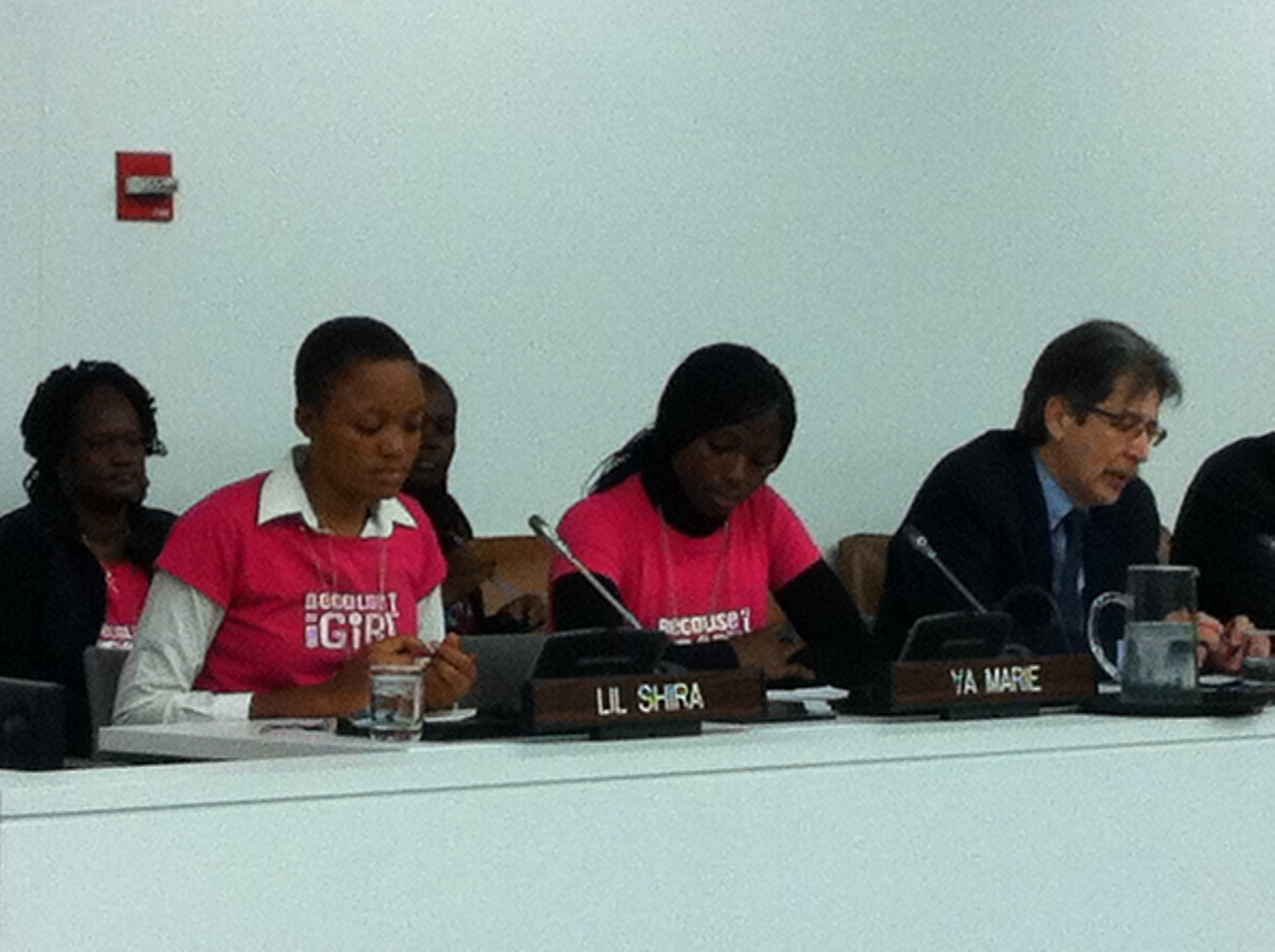
Lil Shira presenting at the CSW.

I was very happy, excited together with my friends and family members and I was planning and preparing on the role I was going to play while in New York. My expectation was to work with other youth from different region and country but did not really expect I was going to talk to Ministers from all the members’ state of the UN. I did my first presentation with the Canadian Minister on a panel about the importance of commemoration days and the importance of setting up an International day for the girls.  Another thing which made me feel so opportune was the panel with UN women Ministers in the UN building.

I was very impressed seeing ministers from over two hundred countries and above listening to me and in effect giving a positive response to the issues I presented. In fact their reaction made me feel at home and so happy. I was equally happy to listen to other girls raise issues like gender based violence and discrimination in their various countries and what they have been doing to combat it.

Coming in contact with girls from Sierra Leone, Finland, United States, Indonesia, Canada and others, not mention to share our ideas, was so wonderful and exciting.  This was a forum for me to dialogue with them to know more about them and some of the issues affecting them in their own country which was contrasting with mine. Though I was nervous during my first presentation, meeting new faces it all passes away like a breeze and I did not have any complex because everything was cute.

Life in the US to me was very enjoyable and meaningful, but I could not stop complaining of the cold and snow. In addition, I tried eating food not familiar to that of my home country. All these contributed greatly to the wonderful experiences I had on the weather condition and the food.  I have learned to adapt to situations wherever I find myself. I hope to continue sharing this experience so that others may learn from it.

This is the time for girls to take up the challenge. I know my rights and have claim them, and no one can take them from me because I am a girl.

Thanks to Plan International, Judith Nkie our Chaperone, Kate Ezzes and Lia de Pauw.

Girls, claim your rights!

Related posts and videos about YETAM and the CSW:

Girls voices in global forums

Girls in rural Cameroon talk about ICTs

55th CSW: Women, girls, education and technology

A catalyst for positive change

On the map: Ndop, Okola and Pitoa

Read Full Post »

The 55th Session of the Commission on the Status of Women is taking place this week in New York City, with the core theme of: “Access and participation of women and girls to education, training, science and technology, including for the promotion of women’s equal access to full employment and decent work.”

Some of the girls that we’re working with in our programs are participating, including Fabiola and Shira from Cameroon. I met them both last July when we worked together on the Youth Empowerment through Technology, Arts and Media (YETAM) project. The YETAM coordinator in Cameroon, Judith Nkie, is also attending the CSW as the girls’ chaperone. She certainly also has a lot to contribute on girls, women and ICTs. Judith once said to me “This project is a catalyst in my body.” Judith is awesome.

Girls from the YETAM project worked to prepare the interviews, film and videos below. Each girl interviews another girl from the community about the role of ICTs in their lives. The videos are worth watching as the questions and the responses of the girls are very insightful.

The interviewee in the first video says ICTs help you find out what is happening around the world. She comments that she found out about what just happened in Egypt (the February revolution) because of ICTs. Some of the other things I found most interesting in the videos are:

  • The girls’ recognition of the importance of information for making good decisions
  • The technologies that girls have most access to (mobile phone!)
  • The first time the girls encountered a mobile phone (a few years ago, at a local call box for one, and via an uncle who brought one back from travels for the other)
  • Why it is hard for girls to use ICTs in the community (lack of ICT devices, cost, parents don’t allow girls to learn about ICTs, at school the computers are few – you will see at least 20 persons per computer – and half are broken, the boys are very powerful and they fight us to occupy the computers, girls’ illiteracy, girls don’t continue in school)
  • How often the girls use ICTs (mobiles are used every day, there is only one place to access Internet in the community)
  • What they like most about ICTs (ICTs help me to know what is happening in other countries, I came to know about what happened 2 days ago in Egypt via communication technologies, many youth have been able to be employed through their mobile phones)
  • What they like the least about mobile phones and Internet (scamming, its easy to tell lies by mobile)
  • How can ICTs be helpful to girls (in my community a girl was able to borrow a phone from a friend to report that she was to be married at the age of 12, and the marriage was stopped)
  • Can ICTs be used to hurt girls? (yes, the girls who can afford their own mobile phones are those who are wealthy, when the poor girls see the wealthy girls with their phones, they go into competition, they can go into prostitution to have money to get a phone; but on the other side, girls are also self-employed through the phones, so the mobile phone hurts but it also helps girls)
  • How the communities use the Internet to sell their products (most people in the community use ICTs to communicate to find buyers for their products)
  • What girls would like parents, community leaders and government to do regarding ICTs (improve our access to ICTs, bring in programs and projects that can support youths to use ICTs and learn to use them better, educate parents to help them to see that girls also should be allowed to access this type of training and technology)
  • What hurts most about this ICT thing (when those who are really privileged and who can use the Internet don’t put their talents and privileges to good use, they go there to scam, to do robbery, not to do good; if these youth have the time and this privilege they should not do harm but they should do good.)
Kirby, one of the girls from the US, edited together portions of the videos above with video footage from the rest of the girls in the group, and they used the video to kick off their ‘Girl Led Side Event’ today. The turnout was great. They will continue throughout the rest of the week getting their ideas and messages across in different events and panels. You can follow their thoughts and impressions on the Plan Youth Tumblr or by following @plan_youth on Twitter. My colleague @KeshetBachan is also blogging from the CSW at the Girls Report blog.

Read Full Post »

The 55th Commission on the Status of Women (CSW) happens in New York City Feb 21-25, 2011. For me, the most exciting thing about the event is that several girls from some of the countries where we are working (Canada, US, Finland, Cameroon, Sierra Leone and Indonesia) will be participating and speaking. This aspect of our work – helping to bring young people’s voices into these large influential forums – (when done properly) can be very effective at bringing a reality check to the ivory tower and helping influence decision makers at the very highest levels.

This year’s CSW is especially interesting to me since I work in the area of ICTs, and the theme of the CSW is:

“Access and participation of women and girls to education, training, science and technology, including for the promotion of women’s equal access to full employment and decent work.”

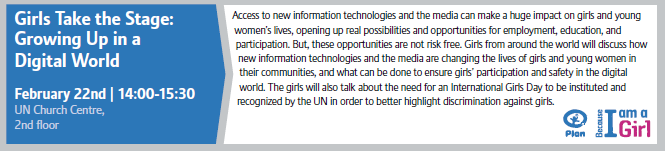
The girls will be presenting at the Girls Take the Stage: Growing up in a Digital World on Feb 22nd:

I’ll be presenting with Fabiola from Cameroon at the Empowering Girls: Education and Technology” session on February 23.

I’ll also talk at a panel-workshop hosted by the Buddhist Tzu Chi Foundation on Tuesday Feb 22, from 10-11.30, called “Breaking the Cycle of Poverty of Women and Girls through Education and Training,” on the 2nd floor room of the CCUN (Church Center of the UN).

Update: Ika one of the girls from Indonesia, will speak at a panel on Commercial Sexual Exploitation and the Girl Child: A Human Rights Approach at the Main Auditorium, Salvation Army Social Justice Center, 221 East 52nd St between 2nd and 3rd Ave, on Feb 24th from 2-3.30 pm.

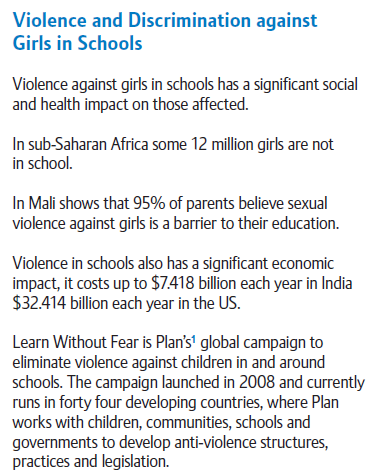
Update: Lil Shira from Cameroon will present on Violence and Discrimination against Girls in School, along with Marta Santos Pais (UN Special Representative to the Secretary General on Violence against Children) and others on Feb 22, from 16-17.30 at UN Church Center, 777 United Nations Plaza, Drew Room, Ground Floor.

Join us at the some of the sessions or come for an evening with the 21+ crowd at #ICT4Drinks Feb 23rd at 6 pm at Me Bar.

We’re trying to interest the girls in tweeting during the CSW on the @plan_youth account and to blog at  http://plan_youth.tumblr.com, so check it out as of this Monday. (We’ll see if they are willing or not!)

You can follow the events on Twitter at the hashtag #CSW55.

Read Full Post »

Forget that show “Off the Map.”  Real live on the map is way more interesting.

Last July via the Youth Empowerment through Arts and Media project, we did some GPS and Open Street Map (OSM) training with Ernest Kunbega in Bamenda, Cameroon. I left for Kenya to attend a similar training with Map Kibera, and Ernest continued working with staff, local partners and youth in Ndop, Okola and Pitoa over the next several months to make maps of the 3 areas where the project is being implemented.
I got an email this week from Ernest and I was thrilled to hear that maps of the 3 areas have been completed. They did a fab job, too. Check these out.

This is what you used to find when you looked for Ndop on Open Street Map, and what you will still find on Google Maps (eg., not much):

and this is what you’ll find now if you look for Ndop on Open Street Map (close up):

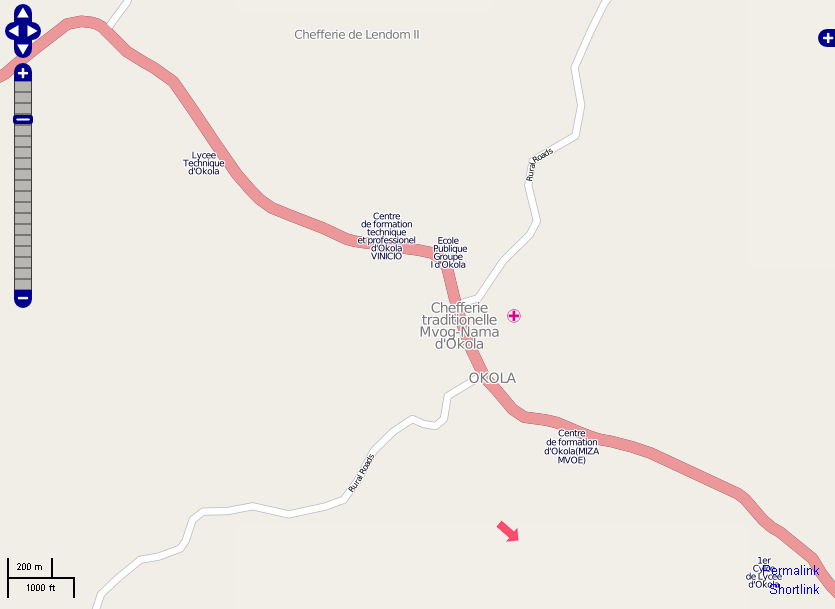
This is what Okola looked like before on OSM, and what you will currently find on Google maps:

And what Okola looks like now on OSM (close up):

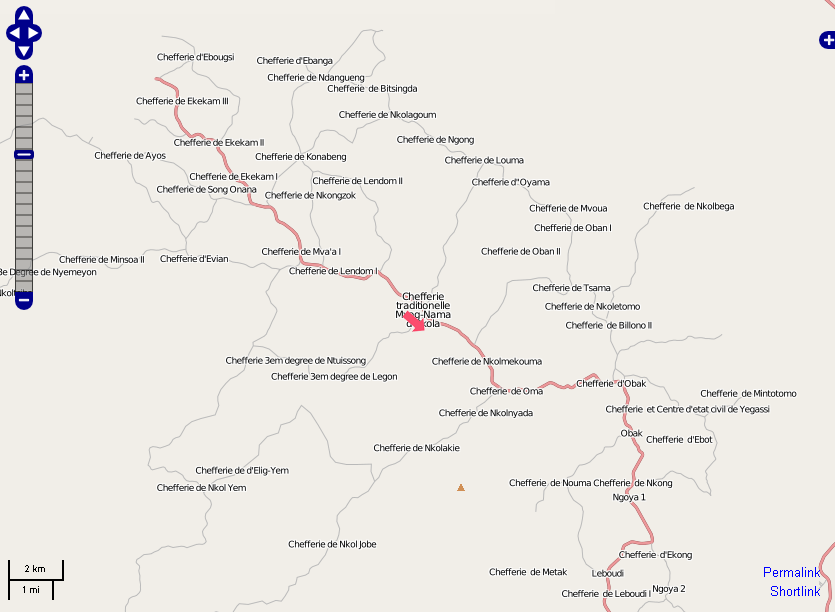
But in addition, they mapped out the chefferies in the larger Okola area:

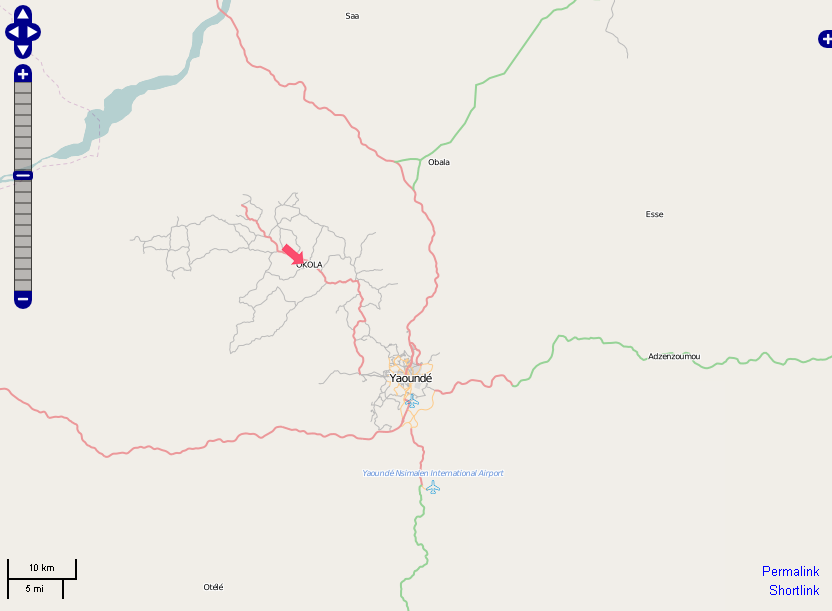
And I’m pretty sure this is the youth’s work because nothing else around is mapped in this level of detail:

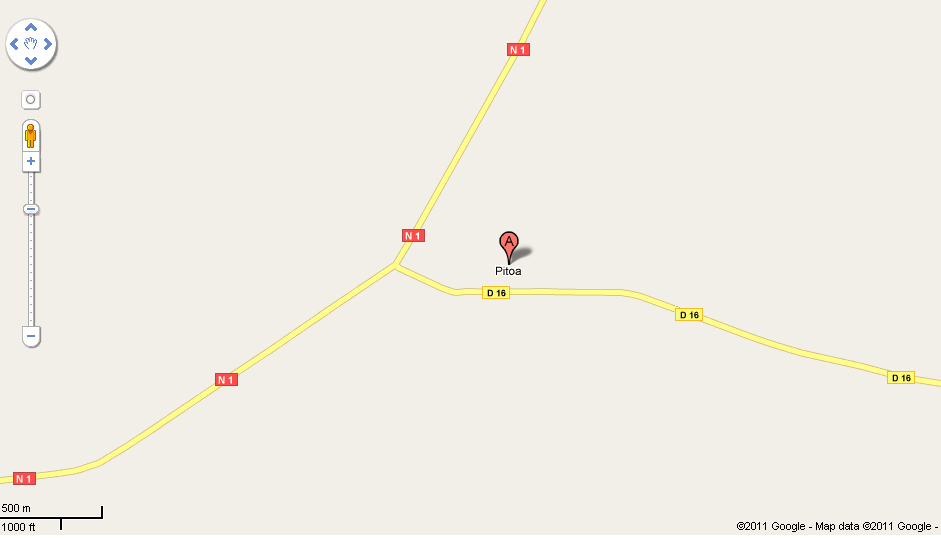
And lastly we have Pitoa as it is on Google/was on OSM:

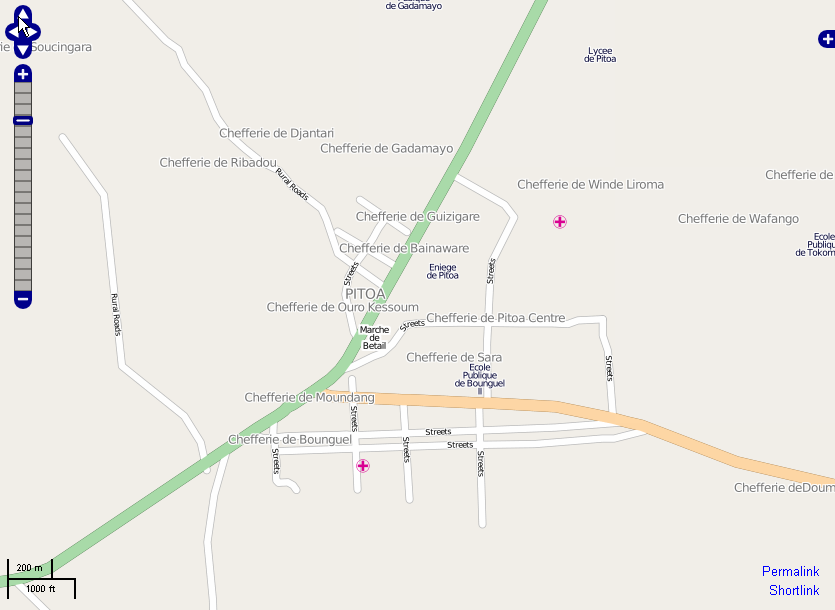
And Pitoa after Ernest and the youth mapped it on OSM (close up):

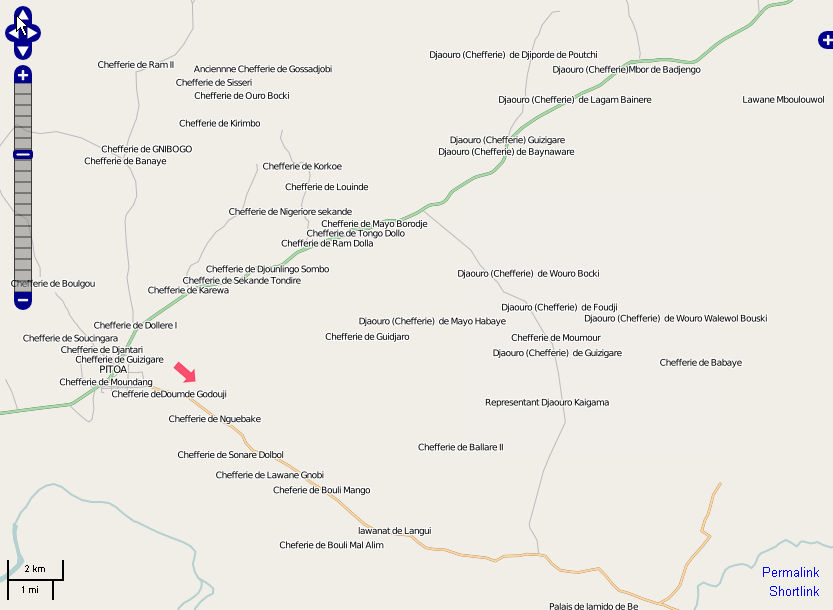
And the chefferies in the whole area of Pitoa:

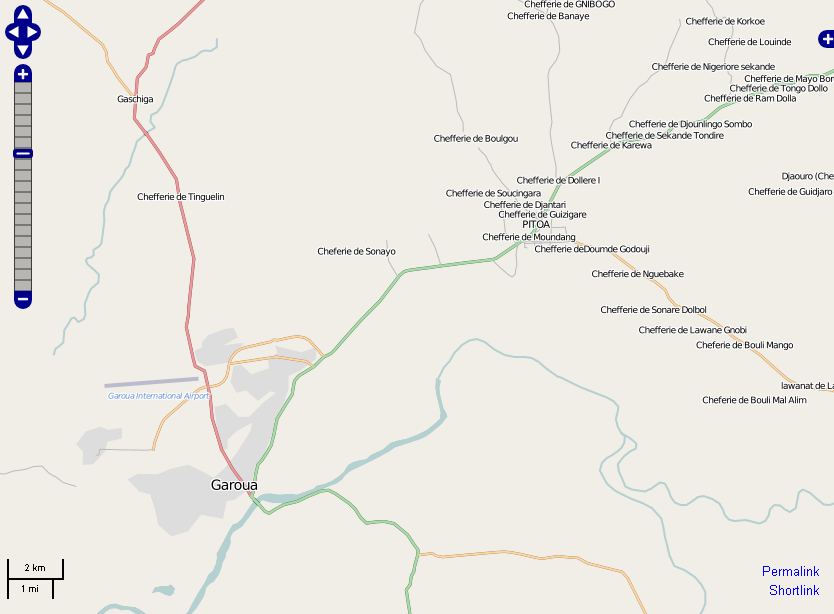
And Pitoa (on the right) compared to Garoua (lower left):

For more background on the training in Cameroon, check out this post: A catalyst for positive change.

Read Full Post »

In the past couple years, social media combined with traditional media has allowed people all over the world to feel they are supporting and participating in very visible revolutions (think Iran, Tunisia, Egypt). There is also a slow and steady revolution happening as more and more communities around the world access the tools to tell their own stories in their own words from their own perspectives.

I came across the Mathare Valley blog this weekend. It’s beautiful, artful and powerful.

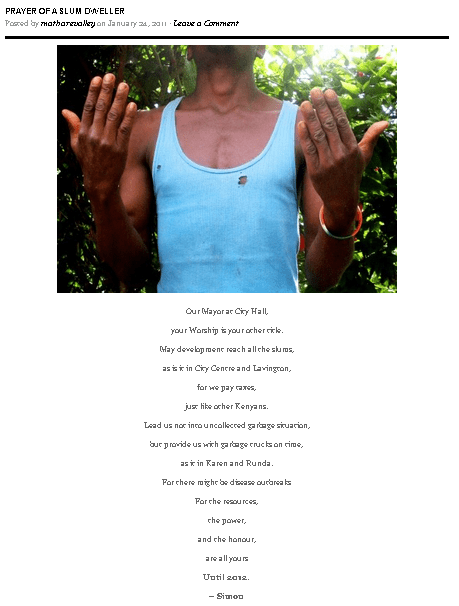
Prayer of a slum dweller from the Mathare Valley blog

According to the ‘about’ page, the authors of the blog:  Simon Kokoyo, Ivyonne Tiany and Jeff Mohamed, grew up in or around Mathare. They are now involved in community programs there, including the Map Mathare Initiative.

Jamie Lundine, who works at MapKibera and who’s supporting some community mapping in Mathare, wrote an excellent post about integrating participatory community development work and digital mapping in Mathare, showing how development and tech folks can combine their expertise and work together with communities to strengthen local development processes.

In my last post, I wrote about how communications (and ICTs) should be ‘built in, not bolted on‘ to development initiatives. The Mathare Initiative looks like a good example of that, with community members taking a strong lead.

Read Full Post »

I was in a global strategy meeting at the organization where I work last week. We had people from various disciplines present from across the organization and the goal was to chart a path to 2015 and beyond.

For the first couple days it seemed like a lot of talk and a lot more talk. We had very bright, very capable people representing different aspects of our work in the room. This can make things quite messy and tiring, and it can feel like everyone is talking in circles because there are so many perspectives and angles and factors that need to be considered in finding shared ground. Sometimes we are so participatory and complicated that we get in our own way. But by the 3rd and final day the perspectives had come together into a much clearer view of where the organization is headed, and we had the beginnings of a shared plan for how to get there.

We worked in a few main groups, and I participated in the Communications group. Much of our discussion centered around integrating better communication in all aspects of our work rather than seeing the role of Communications (and the Comms Team) as designing one-way messages out to the public. One colleague described this as ensuring ‘built in’ rather than ‘bolted on’ communications.

For me the discussions and end decisions were great, because there was a shared push in the group to move the organization towards things that I think are very important.

Some of the aspects we talked about included:

Communicating within programs

  • the critical role of Communications within programs – eg., Communications shouldn’t only happen at the end of a program (press releases, events or media work to share what was done); rather communication is a critical tool within programs to help reach program and development goals at various levels
  • the role of information and communications tools (new and old ones, high and low tech) at the community level to improve impact, efficiency, reach, engagement, decision-making, transparency and accountability
  • the need to strengthen our ability to better integrate information and communication tools into program efforts, measure the impact of different tools and efforts, and share experiences around this
Communicating with ‘the public’ (our ‘stakeholders’)
  • ensuring consistency in what we do and how we talk about what we do
  • space for children and young people to tell their own stories both behind the camera and in front of the camera, as producers of media not as objects of or consumers of media
  • reaching people through the ‘heart’ (which we are quite good at) as well as the ‘head’ (which we need to get better at)
  • communicating evidence of impact as well as anecdotal and personal stories
  • using different information and communication tools to communicate at varying levels of complexity and technicality to different ‘audiences’
  • using various kinds of media to tell a deeper and more complex story than is currently told
  • finding the sweet spot between a) talking to ourselves in boring technical language and b) over-simplifying or ‘dumbing down’ the complexity of people’s lives and the work that we’re involved in
  • having a strong and unified global goal so that each team or office can move towards that shared goal, but allowing the flexibility to take the path that makes the most sense locally
  • good communication at every level — community, district, national, global, ‘North’ and ‘South’, internal and external, networked — to involve people (including ‘beneficiaries’, ‘supporters’, ‘advocates’ and any other ‘stakeholder’) in community development work and in achieving child rights
  • opening the channels and lessening hierarchical controls on communications so that staff can feel more confident about communicating and using social media both internally and externally
  • using a combination of communication channels to reach our goals; eg., community radio enhanced by SMS; television programs enhanced by use of web and vice versa
  • new communications technology to facilitate connections among the network of people we reach (the ‘participants’ and the ‘supporters’ and all those in between)
Communicating for decision-making and accountability
  • the role of communications in knowledge sharing and knowledge management, internally and externally
  • creating better feedback and accountability loops to enable communities and the children and youth that we work with to have more of a say about the work we are doing and how we talk about it
  • using new technology to better organize, share and use the information that we already have, both internally and externally
  • using info-graphics to visualize information so that we can make better decisions about programs and to be more accountable to the public and to program participants
Even more important than ‘talking about’ the topics above, we worked on plans to actually do them…!
Note: this is not an official meeting report but rather my own take-aways from the workshop.

Read Full Post »

This is a summary of the January 20th Technology Salon. It’s cross-posted from the Technology Salon blog.

Using GPS in Kwale, Kenya

At the Technology Salon on “How to Incorporate ICT into Proposals”, we discussed some of the challenges and solutions for proposal writers when they try to incorporate information and communication technologies into future program design. (Sign up to get info on the next Salon)

Problems with Incorporating ICT into Proposals

Essentially, short time frames for preparing proposals don’t allow for participation and end-user involvement and feedback during development of technology solutions. Donors often want details about a technological solution within a proposal; however, in order to define details, more knowledge of local context, a participatory local communications assessment, end-user testing and more need to be done.

This causes proposal writers to sometimes put unrealistic goals in proposals in order to secure funding or because they don’t have information about the local context and actual feasibility of a proposed technology solution; implementors may find later that they are unable to deliver

The issue is compounded by the real lack of organizational buy-in to allow for testing and iterating, for trial and error, and even failure, in organizations and within projects to learn what works and what can be scaled up through proposals and donor funding.

Solutions to Including ICT in Proposals

Overall, organizations that want to integrate ICTs in their work need to plan ahead, strengthen their staff capacity on the ground, and have a clear understanding of the steps to follow when integrating ICTs into proposals. And rather than detailing an exact tech solution into a proposal, the proposal writer could offer a few options, say that “a solution could be” or “might look something like this”, or be clear when negotiating with the donor that an idea will be tested but may change along the way when participatory work is conducted with end users, and as it is tested and adapted to the local context.

This can help remind donors that digital technology is only one way to innovate, and technology needs to be seen as one tool in the information and communication toolbox. For example, SMS might be just one communication channel among many options that are laid out in a project or program, and the most appropriate channels (which might also include face-to-face, paper, community bulletin board, phone calls, etc.) need to be chosen based on a local situation analysis and end-user input.

For staff, integrating ICTs as smaller aspects in programs can offer opportunities for small trial and error and learning; eg., using SMS as one channel of communication in an education or health program and comparing results with a program that didn’t use SMS could allow an organization to test small ICT efforts and slowly learn, modify and integrate those that work. (See How Plan Kwale has been using ICT in their programs since 2003)

When staff experiment with and experience ICTs in one program, they may be more likely to innovate with technology in another program. As ICTs become more commonly used in communities and by local development practitioners, space for innovations grows because innovation can happen right there, closer to the ground rather than being designed in an office in DC and parachuted into communities in other places.

Experimentation with youth programs is a good place to start with tech innovations because youth tend to be more literate (if they are school going youth) and they pick up technology skills easily in many cases. Adults need not be left out, but the learning methodology may need to be different. Engaging the community in detailing potential protection and privacy risks in data collection is key to finding ways to minimize risks. (See 8 Elements for a Positively Brilliant ICT4D Workshop)

The Plan Example

Plan Finland with support from Plan USA commissioned the ICT Enabled Development guide (PDF) to better understand and document the ICT4D context in several of the countries where Plan is working in Africa. Country offices wanted to strengthen their capacities to strategically incorporate ICTs into their work and to ensure that any fund-raising efforts for ICTs were stemming from real needs and interest from the ground. Plan offices were also in the process of updating their long-term strategic plans and wanted to think through how and where they could incorporate ICTs in their work internally and with communities.

The report process included 2-day workshops with staff in 5 countries, based on a set of ICT distance learning materials and discussion questions. The idea was to combine background and situational research, learning about ICT4D, and further input from Country Office colleagues into this process to come up with a realistic guide on how and where Plan could begin integrating ICTs into its work directly, strategically and indirectly (See 3 ways to integrate ICTs into development work).

The report team worked by Skype and email with a point person in each office who planned and carried out the workshop. The report team also developed the multi-media training pack with materials that the point persons used to support the workshop, and compiled the ICT-Enabled Development guide based on the experience.

From the report and this experience, Plan produced a 10-step process for integrating ICTs into development initiatives:

  1. Context Analysis: what is happening with ICT (for development) in the country or region?
  2. Defining the need: what problems can ICT help overcome? what opportunities can it create?
  3. Choosing a strategy: what kind of ICT4D is needed? direct? internal? strategic?
  4. Undertaking a participatory communications assessment: who will benefit from this use of ICT and how?
  5. Choosing the technology: what ICTs/applications are available to meet this need or goal?
  6. Adjusting the content: can people understand and use the information provided for and by the ICTs?
  7. Building and using capacity: what kind of support will people need to use and benefit from the ICT, and to innovate around it?
  8. Monitoring progress: how do you know if the ICT is helping meet the development goal or need?
  9. Keeping it going: how can you manage risks and keep up with changes?
  10. Learning from each other: what has been done before, and what have you learned that others could use

See the 3-page “ICT-Enabled Development Checklist” for more detail on how to go about integrating ICTs into a development proposal and be sure to download the ICT Enabled Development guide (PDF).

Read Full Post »

On January 11, 2011 from 11-12am, TechChange and I co-hosted a tweet chat on ICT for Development (ICT4D) distance learning. The idea came up after Ernst Suur and I spent a few months lamenting the irony that we couldn’t find any good on-line training around ICT4D, nor did we see ourselves being able to quit our jobs or reduce our work-related travel, move to where a university offering ICT4D is located, and accumulate a huge debt by going back to get an advanced university degree the traditional way. We wrote a post asking “Where’s the ICT4D Distance Learning” and had a few conversations with the guys at TechChange and a few others who are working on developing some solutions to that issue.

During the Twitter chat, we asked a set of questions about topics, timing, accreditation, skills, and delivery models to get a sense of what might appeal to potential learners. We had almost 60 people participate in the chat, and apparently our hashtag, #ICT4DDL, was even a top trending topic in Washington DC at around 11:30. Here’s the archive.

—–

I had a chance to meet in person with Mark, Nick and Jordan from TechChange last week while I was in DC and these guys are smoking! They are seriously moving on creating visually attractive, stimulating and engaging e-learning in the area of ICT4D. I’m looking forward to collaborating more with them as they develop courses and methodologies that can help people from different backgrounds and with different needs to access ICT4D training and learning. I like their approach of involving practitioners, looking at ICT4D strategically (eg, integrating it to achieve goals, learning how to choose the right technology and decide if technology is necessary at all) and supporting on the practical side (how to use specific ICT tools) and I think this type of training, if all goes well, will be a great opportunity for us all to get trained up in those areas we feel we are still missing.

Mark wrote up the following summary of the themes and highlights from the chat [the original post is here on TechChange’s site: Recap of ICT4D Tweet Chat (#ICT4DDL)].

Course Topics: Some of the most popular ideas for courses included: social media for social change, sustainability, mobiles for development, and a course on ways to create and sustain collaboration through an online community. It was pointed out that users needs would be different based on access to and familiarity with technology. @fiona_bradley mentioned the need for strategic thinking and project planning for veteran change agents, because “tools change fast”.

Delivery: There was a desire expressed for blended learning models (face-to-face and online) and a sentiment that ICT4D face-to-face training was important. (list of existing ICT4D programs). There was also a feeling that experienced practitioners should be part of the course experience and that more needs to be done to engage them (@ICT_Works). Others stressed the fact that distance learning is the only option for those working in remote areas.

Credit vs. Certification: People generally preferred courses for credit, but some acknowledged that they had neither the time nor the funding for a full university degree course. Shorter-term certificate courses on specific topics appealed to many in the group.

The feedback we received throughout the tweet chat was quite useful, and as expected there was a wide variety of opinions expressed. As TechChange moves forward, we look forward to tailoring our courses to the needs of these and other users. We’re in the process of developing a 10-week online flagship course on Technology for Social Change. Everyone will be able access Unit 1 for free. From there we will develop more specialized courses and certification programs on subjects such as Technology for crisis response, Social media for social change, mHealth, and the Future of mobile devices for development. We are also working with individual organizations such as FrontlineSMS to create learning tools tailored specifically for their applications.

I’m really looking forward to taking some of the courses that TechChange comes up with and helping develop materials for some of them too.

Read Full Post »

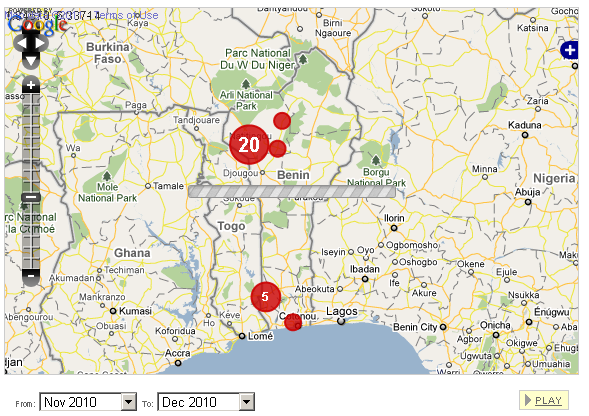
Last year, I spent some time in Benin piloting an SMS reporting system to track and respond to Violence against Children (VAC). After almost a year developing the idea and thinking it through to see if it was potentially feasible (see 7 or more questions to ask before adding ICTs), in February 2010 we conducted 2 workshops with youth, staff and local authorities in Couffo and Atacora, Benin, to design a system with their input (see Finding Some ICT answers in Benin). The main pieces of the reporting system are FrontlineSMS and Ushahidi. A few months after, staff reported back on some of the challenges with implementation (see Tweaking: SMS Violence Reporting System in Benin).

Romeo Essou, project coordinator

Since then, many of the issues have been resolved, and we’ve improved outreach so that communities are more aware of the SMS reporting system and how to use it. We’ve also been looking at the system itself, continuing testing, and seeing what improvements are needed. We didn’t have resources to dedicate someone fully to the program at first, but after seeing the potential, Plan Benin assigned Romeo (see photo) to manage the pilot project full-time in Benin. It’s been quite a pleasure working with the team there, and Romeo is no exception. Having someone dedicated full-time to working with communities and staff in the two districts has really made a difference. From November to mid-January, several additional violence cases were reported and a good number of them have been followed up on and closed.

Last week, Romeo shared what we still need to find solutions for. Some of these are issues that we’d identified last year and others are additional things that Romeo has suggested as he’s gotten down to business.

Some people still call instead of texting, or they send “call me back” texts

Cases are now coming in

  • The team is fairly certain this is due to illiteracy. Plan will involve more school-going youth in the initiative because they have higher literacy levels and can support others with reporting if needed.
  • Romeo and the team will continue doing outreach and education on how the system works both at community meetings and via radio broadcasts in French and local languages.
  • To address the calls that may continue to come in, a voice mail will be set up on the phone that links up to the FrontlineSMS laptop, with a message explaining that people have to send in a text. Romeo will do some research to determine which languages to use in the message for the best result (French and the 2 main local languages….).
  • If that doesn’t resolve the issue, Romeo and the staff will call back anyone who phones in.
  • Cost of an SMS continues to be a discouraging factor for people in terms of reporting. Often when Romeo or other staff visit a community, community members take advantage of their physical presence to report additional cases of violence.  This is not necessarily negative, considering that we want to increase the number of incidents reported and followed up on; however, if it turns out that awareness around violence is high but the cost of the SMS is a deterring factor in reporting, more inexpensive channels to report also need to be offered. We are still negotiating with the local operators to get a free SMS line.

Spam

  • Some 50 spams a day are coming in. This is an issue on all mobile phones in Benin. Much of the spam comes from the mobile service providers themselves.
  • If the spam is coming from the same number, it’s possible that a workaround script could be written up at the point where FrontlineSMS forwards to Ushahidi. The messages can also be marked on Ushahidi as spam, but they will still be arriving via FrontlineSMS, unfortunately, unless numbers can be blocked somehow.
  • Needs further thought on how it might be overcome.

The Violence Tracking Platform (Ushahidi):

Ushahidi platform

  • We need to be 100% sure that any personal or identifying information coming in via the SMS reports is scrubbed so we do not put any children or witnesses at risk or falsely accuse anyone of violence against children by publishing the reports to the Ushahidi platform.
  • Romeo will develop a Privacy and Protection Checklist and train those administering the Ushahidi system to be sure to remove identifying information thoroughly before allowing it to be published on the Ushahidi site.
  • The identifying information still needs to be stored somewhere on the system to support with follow-up on the cases that come in. We may need additional development work on the platform to allow for that.
  • We hope to integrate the Ushahidi map into the Violence against Children website, which has educational material, videos and cartoons done by youth, and a discussion forum. However if the information poses a risk to anyone, we may decide to make the Ushahidi site private and keep it as a management tool rather than a public site.

Categorizing:

  • The staff who administer the Ushahidi website are not always clear which type of violence an incident should be categorized as (physical violence? sexual violence? psychological violence?).
  • Romeo will create short guidelines to help people to categorize the incidents properly. He’d like these to be incorporated into the Ushahidi platform.
  • Often a reported  incident can fit into more than one category – eg., both physical and sexual violence. If it’s categorized in two categories, then we lose the sense of how many incidents there have been overall, and we’re unable to properly chart the data. We need to find a way to manage this on the system so that we have proper statistics.

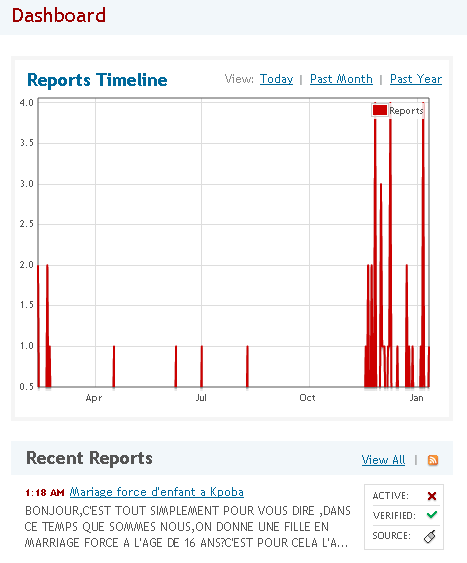
Recent reports of physical violence, sexual violence, forced marriage and exploitation

Follow up on reported cases:

  • We still want a way to track response and follow-up on cases within the Ushahidi platform, as often a report requires more than one verification visit.
  • We need someplace within the platform to store this type of information to keep records of follow-up.
  • This will require work by a developer, but it might be helpful for other institutions using Ushahidi as well. It’s also possible that FrontlineSMS Medic could be used for case management rather than Ushahidi, but it might prove confusing for staff to have to store and act on the same kind of information using two different tools.

Names of villages, hamlets, etc:

  • We would like to have a listing on the map of the various hamlets, villages, etc. They do not currently appear on the map since there is no record of them on Open Street Maps or Google Maps. Plan has this detailed information in its internal systems and we want to add it to the base maps so that it’s easier for administrators to locate the incident in the right community.
Coordination and outreach:
  • In addition to the technical work on the system, Romeo will continue to coordinate and share information with local partners and other organizations working on violence against children. There are similar initiatives already in place and we don’t want to duplicate efforts. Combining and sharing help line numbers and taking reports by both phone and SMS is one option.
Related posts on Wait… What?

Read Full Post »

A little more than a month ago, I wrote a post asking ‘Where is the ICT4D distance learning.’ Ernst Suur and I had been trying to figure that out since last July.

A bunch of ideas and information came in via the comments section that helped us to figure out what is happening in the space, including info about ICT4D advanced degrees options, short courses, related courses, etc.

In addition to following up with a couple established universities to see if (and when) they might be offering Masters level ICT4D programs, Ernst and I had a skype meeting with Mark Weingarten and Nick Martin, the folks over at TechChange (the Institute for Technology and Social Change).

TechChange is a new organization dedicated to training practitioners and students to effectively leverage emerging technologies for social change. They are building tools and courses for ICT4D and have already partnered with a number of universities — eg., American University, George Washington University, the UN University for Peace — to deliver face-to-face courses in topics like ‘technology for crisis response’ and ‘social media for social change.’ They also have upcoming projects planned with U4UshahidiSouktel, and FrontlineSMS. In addition to in-person trainings, TechChange is designing learning tools for use in online courses and degree programs.

As Mark commented, ‘We are developing curricula for practitioners (including those working in the field), and recognizing that needs and schedules vary. Some people and organizations might want to quickly learn how to use specific ICT tools, but others may want a more in-depth understanding of the entire ICT4D ecosystem, its successes, its failures, and where things are headed in the future. We want to better understand this range of needs and tailor our courses. We’re also interested in knowing more about what else is being done in this space and what other examples we can learn from.’

In order to get some wider input, we invite you to join us for a twitter chat on ICT4D Distance Learning on Friday, January 14th at 11 am EST. The hashtag will be #ICT4DDL.

We will cover 5 questions:

  1. Topics: What sorts of courses would interest you most? What topics are most relevant?
  2. Timing: What timeframe for distance learning courses would best suit your schedule and needs? Short-term courses on specific topics (or tools) vs. more in-depth courses?  3 hr modules or ten week facilitated trainings?
  3. Credit: How important are things like credit or degree programs? Are certifications enough?
  4. Skills: What skills would you like to gain as a participant – considering 1) university students just entering the field and 2) practitioners taking professional development courses.
  5. Delivery: How does connectivity affect your ability to take courses? What about in the case of others who might be interested in this type of training but are not on Twitter/online as often? Is a mobile option a good idea?

Tips for a good Twitter Chat:

  • Login 5 mins ahead of time and be ready with a short introduction (eg, Cathy here, I manage maternal health pgms at XYZ in Malawi, we’re just getting started with ICT4D).
  • Tools like TweetChat which automatically add the hashtag and refresh often are helpful to keep up with the conversation.

We look forward to chatting on Friday, January 14th at 11 am EST and welcome any questions or comments before then!

Related posts on Wait… What?

Where is the ICT4D Distance Learning?

3 ways to incorporate ICTs into development work

Demystifying Internet

ICT4D in Uganda: ICT does not equal computers

It’s all part of the ICT4D jigsaw: Plan Mozambique ICT4D workshop

Read Full Post »

« Newer Posts - Older Posts »