I’m thrilled to write that we have 4 masters level students (or recent grads) who have been prepping for the past few months for 8-10 weeks of ICT4D, child participation, and child protection work with our teams at Plan Benin and Plan Cameroon.
My last post here on Wait… What? was an excellent guest post by Paul Goodman (@pdgoodman) who has been working with Plan Benin for most of May to help optimize the Frontline SMS / Ushahidi-based violence against children (VAC) reporting system that we initiated a little over a year ago. Paul is a Masters Level student at the School of Information Management and Systems at the University of California, Berkeley. In addition to on-the-ground ICT4D experience in Haiti, Pakistan and Bangladesh with DAI, he has worked on several USAID funded projects including the Cuba Development project and the Global Development Commons. Paul has also worked in business development and as a press assistant, multi-media editor and freelance photographer.
Jacqueline Deelstra has just completed her Masters at the Fletcher School at Tufts University. She’s worked overseas in the past with Twaweza in Tanzania and Kenya, World Teach in Ecuador and Tostan in Senegal. While at Twaweza, she focused on citizen reporting, village mobile phone surveys, and the use of mobile phones in development and governance programs. Jacqui will be spending her time in Atacora and Couffo, Benin, learning more about the social context and social challenges surrounding the implementation of the above-mentioned Violence against Children Reporting system in Benin, and looking at its contribution to good governance.
In Cameroon, we will be working with Joe Pavey and Rebecca Tapscott.
Joe (@joepavey) is a Master of Communications student in the Digital Media program at the University of Washington, where the program has an emphasis on storytelling and technology. Joe also spent 7 years at Microsoft, where he specialized on new standards of practice for processing and encoding video content. His undergraduate degree is in documentary film production. Joe will support the Youth Empowerment through Arts and Media (YETAM) Project on the technical side, helping youth and local partners in Cameroon to improve video production quality and to streamline the process from editing to uploading. He’ll also work closely with the well-skilled Cameroonian ICT team that is setting up a violence reporting system using Frontline SMS and CrowdMap, based on our learnings from the system in Benin.
Rebecca is a first-year Masters degree student at the Fletcher School at Tufts University, with experience in both development and journalism. She has also worked as an assistant researcher on a story about the Daniel Pearl case, a legal assistant and a production assistant at NPR. She previously completed a 6-month internship with Tostan in Senegal, where she worked closely with staff and program participants to support program implementation and evaluation. She also wrote stories for the Tostan website and blog. Rebecca will support the local partners and youth who participate in the YETAM project, especially with uploading content to the web and growing more accustomed to social media and ICTs in development. She will also be doing research on the traditional practice of breast ironing as an independent side project.
Joe and Rebecca will spend 8-10 weeks in Cameroon with the Plan team. I’m super excited to have Paul, Rebecca, Jacqui and Joe on board, as are the teams in Benin and Cameroon.
Look for some posts from the team on the Plan USA Blog and relevant cross posts here at Wait… What!
I was chatting with a friend of mine yesterday evening on Facebook. She contacted me because she was very interested in participating in the TechChange courses that I wrote about in my last blog post.
Her first question – ‘Are the courses only available in English.’ ‘Yes,’ I said, ‘but TechChange is just getting started. It’s quite possible that in the future they could offer courses in other languages.’
‘OK,’ said my friend, ‘that’s great. We’ll be waiting for that.’
Now, my friend speaks enough English that she could get something out of these courses, but there are other factors that seemed to her even more difficult to surmount. And the sad thing is that these other factors are internal factors.
1) On-line purchasing
‘Our problem with registering for the courses,’ said my friend, ‘is that they cost $250/$350….’
Hm, I thought, ‘So the cost is too high?’
‘No,’ she said, ‘the cost is fine. But here [at our organization] we are not allowed to purchase anything online. Purchasing on-line is considered EXTREME POSSIBILITY FOR FRAUD.’ Then she laughed ‘jajajaja.’ I imagine it was a bitter and frustrated laugh.
So here my friend has a budget and great interest in being trained, but can’t sign up because at her organization, they are not allowed to make on-line purchases.
‘Wow,’ I said. ‘Do you want me to send an email or something to vet the organization?’
‘Nope,’ she said. ‘It’s just their policy. You can’t purchase on-line. Not even if it’s much cheaper, it’s exactly what you want and need, and it’s not available in your country.’
2) Management buy-in
‘Oh,’ I continued. ‘Can you use your own credit card and then get the organization to reimburse you?’
‘Ay,’ my friend said. ‘No one will support us with that, especially an on-line course of this type of thing that they have never heard about and they don’t understand. These courses would be just what we need for some of our staff who are very interested in getting trained up to use some of these new tools. But it’s so hard to get management to see the utility of this.’
Then my friend wrote in all capitals ‘LINDA, YOU KNOW THIS. PLEASE FIND A WAY TO COME AND HELP US WITH ICTS! We need to know this and no one in our management believes it’s useful to our work.’
She continued, ‘We’re only at the beginning of this. We (staff) know only the very basics. We have funds for training but we can’t get anyone to see that this [ICTs] is a priority. Ay, it’s all very complex.’
3) Blocking social media sites
We kept chatting. She said ‘oh, ja ja, and please write your blog in other languages so we can share it around. We need to be updated on these things. At least we are allowed to access blogs.’
‘I will try…’ I said.
‘Do you know,’ she said ‘We can’t access any social media sites from the office. They are all blocked. We have a YouTube channel but none of us can watch it at the office. Someone created a Twitter account but all staff are blocked from Twitter and Facebook at the office. Not even our managers can access it. If we want to see anything we have to go to an Internet cafe or to have Internet at home.’
Argh.
I understand that there are risks to purchasing on-line, and I understand that some staff might abuse social media if they are free to use at work, and I understand that there are bandwidth issues in some countries, but this conversation made me very sad.
My friend works at a decent-sized organization and I assume this must be the policy across the organization. I wonder if the organization has considered that its policies are cutting into its own ability to advance its own cause and its own development work in today’s world.
Almost a year ago, I met Ernst Suur (@ernstsuur) for the first time. We bonded in frustration over the irony of not being able to find any on-line courses to study ICT4D. We each did some research and didn’t come up with much, so we agreed I should write a blog post (See: Where’s the ICT4D distance learning?) to see if we could crowd source anything to help us out. We got some great comments with some good resources for the few courses that do exist or the ones that are in design.
We also discovered TechChange, a newish organization looking to develop some on-line ICT4D courses. We all chatted a couple of times and decided to co-host a ICT4D chat on Twitter to see if we could come up with some additional ideas on what kinds of courses people were interested in. (See the chat summary here). I also had a chance to meet with Nick, Mark and Jordan in their DC office to discuss ideas.
‘This course will explore how new communication and mapping technologies are being used to respond to disasters, create early warning mechanisms, improve coordination efforts and much more. It will also consider some of the key challenges related to access, implementation, scale, and verification that working with new platforms present. The course is designed to assist professionals in developing concrete strategies and technological skills to work amid this rapidly evolving landscape. Participants can expect a dynamic and interactive learning environment with a variety of real world examples from organizations working in the field including those involved in the humanitarian response to the Haitian earthquake’
Course topics include: Crisis mapping, human rights violations and elections monitoring, citizen journalism and crowd sourcing, and information overload and decision-making in real-time.
ICT tools covered include: Ushahidi, Quantum GIS, FrontlineSMS, Open Street Map, Managing News.
‘New platforms of communication are revolutionizing social dynamics by democratizing access to and production of media. From Barack Obama’s youth mobilization efforts to the ongoing uprisings across the Middle East and North Africa, this course will examine how new channels of communication are being utilized and to what extent these efforts and techniques are successful or unsuccessful in a given context. It will also provide participants with strategies for maximizing the impact of new media and train them in the effective use of a range of security and privacy tools.’
Course topics include: the new media landscape, offline organization and change through online mobilization, data and metrics, censorship, privacy and security.
‘The mobile phone is rapidly bringing communication to the most remote areas of the world. NGOs, governments and companies alike are beginning to realize the potential of this ubiquitous tool to address social challenges. This course will explore successful applications that facilitate economic transactions, support public health campaigns and connect learners to educational content. It will also critically engage with issues of equity, privacy and access.’
Course topics include: mobile money systems, mHealth and mobile diagnostics, data management for monitoring and evaluation, many-to-many communications integrating mobiles and radio, and mobile learning.
ICT tools covered include: mPesa, RapidSMS/Souktel, Sana Mobile, Medic Mobile, TxtEagle and FreedomFone.
Modalities:
Each course costs $350 (or $250 early bird price) and runs for 3 weeks. The courses require a time commitment of at least 6 hours per week in order to earn the certificate. There are also plenty of opportunities for those that want to spend more time to engage with additional materials and students can access content up to 6 months after course is over. The entire course will be delivered on-line ‘involving a variety of innovative online teaching approaches, including presentations, discussions, case studies, group exercises, simulations and will make extensive use of multimedia.’
I’ll be attending the 3rd course gratis in exchange for helping TechChange continue to shape the content and curriculum and providing feedback on the features and content. (Thank you, social media. Thank you, barter system!)
This is a summary of the January 20th Technology Salon. It’s cross-posted from the Technology Salon blog.
Using GPS in Kwale, Kenya
At the Technology Salon on “How to Incorporate ICT into Proposals”, we discussed some of the challenges and solutions for proposal writers when they try to incorporate information and communication technologies into future program design. (Sign up to get info on the next Salon)
Problems with Incorporating ICT into Proposals
Essentially, short time frames for preparing proposals don’t allow for participation and end-user involvement and feedback during development of technology solutions. Donors often want details about a technological solution within a proposal; however, in order to define details, more knowledge of local context, a participatory local communications assessment, end-user testing and more need to be done.
This causes proposal writers to sometimes put unrealistic goals in proposals in order to secure funding or because they don’t have information about the local context and actual feasibility of a proposed technology solution; implementors may find later that they are unable to deliver
The issue is compounded by the real lack of organizational buy-in to allow for testing and iterating, for trial and error, and even failure, in organizations and within projects to learn what works and what can be scaled up through proposals and donor funding.
Solutions to Including ICT in Proposals
Overall, organizations that want to integrate ICTs in their work need to plan ahead, strengthen their staff capacity on the ground, and have a clear understanding of the steps to follow when integrating ICTs into proposals. And rather than detailing an exact tech solution into a proposal, the proposal writer could offer a few options, say that “a solution could be” or “might look something like this”, or be clear when negotiating with the donor that an idea will be tested but may change along the way when participatory work is conducted with end users, and as it is tested and adapted to the local context.
This can help remind donors that digital technology is only one way to innovate, and technology needs to be seen as one tool in the information and communication toolbox. For example, SMS might be just one communication channel among many options that are laid out in a project or program, and the most appropriate channels (which might also include face-to-face, paper, community bulletin board, phone calls, etc.) need to be chosen based on a local situation analysis and end-user input.
For staff, integrating ICTs as smaller aspects in programs can offer opportunities for small trial and error and learning; eg., using SMS as one channel of communication in an education or health program and comparing results with a program that didn’t use SMS could allow an organization to test small ICT efforts and slowly learn, modify and integrate those that work. (See How Plan Kwale has been using ICT in their programs since 2003)
When staff experiment with and experience ICTs in one program, they may be more likely to innovate with technology in another program. As ICTs become more commonly used in communities and by local development practitioners, space for innovations grows because innovation can happen right there, closer to the ground rather than being designed in an office in DC and parachuted into communities in other places.
Experimentation with youth programs is a good place to start with tech innovations because youth tend to be more literate (if they are school going youth) and they pick up technology skills easily in many cases. Adults need not be left out, but the learning methodology may need to be different. Engaging the community in detailing potential protection and privacy risks in data collection is key to finding ways to minimize risks. (See 8 Elements for a Positively Brilliant ICT4D Workshop)
The Plan Example
Plan Finland with support from Plan USA commissioned the ICT Enabled Development guide (PDF) to better understand and document the ICT4D context in several of the countries where Plan is working in Africa. Country offices wanted to strengthen their capacities to strategically incorporate ICTs into their work and to ensure that any fund-raising efforts for ICTs were stemming from real needs and interest from the ground. Plan offices were also in the process of updating their long-term strategic plans and wanted to think through how and where they could incorporate ICTs in their work internally and with communities.
The report process included 2-day workshops with staff in 5 countries, based on a set of ICT distance learning materials and discussion questions. The idea was to combine background and situational research, learning about ICT4D, and further input from Country Office colleagues into this process to come up with a realistic guide on how and where Plan could begin integrating ICTs into its work directly, strategically and indirectly (See 3 ways to integrate ICTs into development work).
The report team worked by Skype and email with a point person in each office who planned and carried out the workshop. The report team also developed the multi-media training pack with materials that the point persons used to support the workshop, and compiled the ICT-Enabled Development guide based on the experience.
From the report and this experience, Plan produced a 10-step process for integrating ICTs into development initiatives:
Context Analysis: what is happening with ICT (for development) in the country or region?
Defining the need: what problems can ICT help overcome? what opportunities can it create?
Choosing a strategy: what kind of ICT4D is needed? direct? internal? strategic?
Undertaking a participatory communications assessment: who will benefit from this use of ICT and how?
Choosing the technology: what ICTs/applications are available to meet this need or goal?
Adjusting the content: can people understand and use the information provided for and by the ICTs?
Building and using capacity: what kind of support will people need to use and benefit from the ICT, and to innovate around it?
Monitoring progress: how do you know if the ICT is helping meet the development goal or need?
Keeping it going: how can you manage risks and keep up with changes?
Learning from each other: what has been done before, and what have you learned that others could use
On January 11, 2011 from 11-12am, TechChange and I co-hosted a tweet chat on ICT for Development (ICT4D) distance learning. The idea came up after Ernst Suur and I spent a few months lamenting the irony that we couldn’t find any good on-line training around ICT4D, nor did we see ourselves being able to quit our jobs or reduce our work-related travel, move to where a university offering ICT4D is located, and accumulate a huge debt by going back to get an advanced university degree the traditional way. We wrote a post asking “Where’s the ICT4D Distance Learning” and had a few conversations with the guys at TechChange and a few others who are working on developing some solutions to that issue.
During the Twitter chat, we asked a set of questions about topics, timing, accreditation, skills, and delivery models to get a sense of what might appeal to potential learners. We had almost 60 people participate in the chat, and apparently our hashtag, #ICT4DDL, was even a top trending topic in Washington DC at around 11:30. Here’s the archive.
—–
I had a chance to meet in person with Mark, Nick and Jordan from TechChange last week while I was in DC and these guys are smoking! They are seriously moving on creating visually attractive, stimulating and engaging e-learning in the area of ICT4D. I’m looking forward to collaborating more with them as they develop courses and methodologies that can help people from different backgrounds and with different needs to access ICT4D training and learning. I like their approach of involving practitioners, looking at ICT4D strategically (eg, integrating it to achieve goals, learning how to choose the right technology and decide if technology is necessary at all) and supporting on the practical side (how to use specific ICT tools) and I think this type of training, if all goes well, will be a great opportunity for us all to get trained up in those areas we feel we are still missing.
Mark wrote up the following summary of the themes and highlights from the chat [the original post is here on TechChange’s site: Recap of ICT4D Tweet Chat (#ICT4DDL)].
Course Topics: Some of the most popular ideas for courses included: social media for social change, sustainability, mobiles for development, and a course on ways to create and sustain collaboration through an online community. It was pointed out that users needs would be different based on access to and familiarity with technology. @fiona_bradley mentioned the need for strategic thinking and project planning for veteran change agents, because “tools change fast”.
Delivery: There was a desire expressed for blended learning models (face-to-face and online) and a sentiment that ICT4D face-to-face training was important. (list of existing ICT4D programs). There was also a feeling that experienced practitioners should be part of the course experience and that more needs to be done to engage them (@ICT_Works). Others stressed the fact that distance learning is the only option for those working in remote areas.
Credit vs. Certification: People generally preferred courses for credit, but some acknowledged that they had neither the time nor the funding for a full university degree course. Shorter-term certificate courses on specific topics appealed to many in the group.
The feedback we received throughout the tweet chat was quite useful, and as expected there was a wide variety of opinions expressed. As TechChange moves forward, we look forward to tailoring our courses to the needs of these and other users. We’re in the process of developing a 10-week online flagship course on Technology for Social Change. Everyone will be able access Unit 1 for free. From there we will develop more specialized courses and certification programs on subjects such as Technology for crisis response, Social media for social change, mHealth, and the Future of mobile devices for development. We are also working with individual organizations such as FrontlineSMS to create learning tools tailored specifically for their applications.
I’m really looking forward to taking some of the courses that TechChange comes up with and helping develop materials for some of them too.
A bunch of ideas and information came in via the comments section that helped us to figure out what is happening in the space, including info about ICT4D advanced degrees options, short courses, related courses, etc.
In addition to following up with a couple established universities to see if (and when) they might be offering Masters level ICT4D programs, Ernst and I had a skype meeting with Mark Weingarten and Nick Martin, the folks over at TechChange (the Institute for Technology and Social Change).
TechChange is a new organization dedicated to training practitioners and students to effectively leverage emerging technologies for social change. They are building tools and courses for ICT4D and have already partnered with a number of universities — eg., American University, George Washington University, the UN University for Peace — to deliver face-to-face courses in topics like ‘technology for crisis response’ and ‘social media for social change.’ They also have upcoming projects planned with U4Ushahidi, Souktel, and FrontlineSMS. In addition to in-person trainings, TechChange is designing learning tools for use in online courses and degree programs.
As Mark commented, ‘We are developing curricula for practitioners (including those working in the field), and recognizing that needs and schedules vary. Some people and organizations might want to quickly learn how to use specific ICT tools, but others may want a more in-depth understanding of the entire ICT4D ecosystem, its successes, its failures, and where things are headed in the future. We want to better understand this range of needs and tailor our courses. We’re also interested in knowing more about what else is being done in this space and what other examples we can learn from.’
In order to get some wider input, we invite you to join us for a twitter chat on ICT4D Distance Learning on Friday, January 14that11 am EST. The hashtag will be #ICT4DDL.
We will cover 5 questions:
Topics:What sorts of courses would interest you most? What topics are most relevant?
Timing:What timeframe for distance learning courses would best suit your schedule and needs? Short-term courses on specific topics (or tools) vs. more in-depth courses? 3 hr modules or ten week facilitated trainings?
Credit: How important are things like credit or degree programs? Are certifications enough?
Skills:What skills would you like to gain as a participant – considering 1) university students just entering the field and 2) practitioners taking professional development courses.
Delivery: How does connectivity affect your ability to take courses? What about in the case of others who might be interested in this type of training but are not on Twitter/online as often? Is a mobile option a good idea?
Tips for a good Twitter Chat:
Login 5 mins ahead of time and be ready with a short introduction (eg, Cathy here, I manage maternal health pgms at XYZ in Malawi, we’re just getting started with ICT4D).
Tools like TweetChat which automatically add the hashtag and refresh often are helpful to keep up with the conversation.
We look forward to chatting on Friday, January 14th at 11 am EST and welcome any questions or comments before then!
I spent a few days in Nairobi early last week with our education and our ICT staff from Ghana, Uganda, Senegal, Mozambique, Kenya, Egypt and a few other folks, including the brilliant Mika Valitalo from our Finnish office and people from regional and headquarters levels. We were looking at goals and challenges in our education programs and thinking about where ICTs might play a role.
The process was really interesting. Starting a few months back, each country shared their education context analysis onto a wiki. In a second round they narrowed down to a specific area in education, looked at the information and communication flow and gaps, and identified areas where there might be an ICT solution. They focused mostly on mobiles, but in many cases mobiles were supported by computers, servers and laptops as well as non-digital information and communication tools and also solar technologies. Each country team met by Skype with Mika and an external consultant to discuss the concepts and get ICT advice and support. Then they updated their concepts and got additional feedback. For the third round, they added rich pictures to show what the specific ICT solutions might look like. Everyone had an opportunity to give input into everyone else’s ideas via the wiki.
At the meeting in Nairobi, we spent a day sharing the concepts with each other for clarification and focused input. Colleagues shared the broader education context in their countries and specifically in the communities where they are working. Then they illustrated the specific education issues and the ICT solutions that they were suggesting and/or the places they felt ICTs could help. Some of the ICT solutions focused on a very specific technology or device. Others showed how different types of ICTs could be integrated at different points in the process. Others required development of a totally new ‘solution’.
Some of the areas where colleagues thought ICTs could support education included: teacher training for those working in remote communities, adult literacy (especially literacy retention post literacy training), improving exam scores, livening up and improving in-class curriculum, and transparency and accountability in education. We spent 2 days then working in different small groups on the concepts, cross-pollinating ideas and deciding which of the concepts were most relevant to all 6 countries (in order to make it more possible to scale them) and which were most feasible and do-able.
The ideas were all a good fit with our global education strategy (see page 9) which focuses on service delivery (in partnership with local governments and communities); organizing and empowering rights holders; and grassroots participatory advocacy to influence education policies, financing and practice. The strategy prioritizes actions around equal access to education, quality of education, and education governance (see page 10).
Accountability and transparency in education
One of the concepts that captured the most interest from the whole group was that of using ICTs to improve accountability and transparency in education. Education is one of the areas where “Quiet Corruption” is often found. ‘Quiet corruption, which can take the form of absenteeism among teachers or doctors, the distribution of fake drugs, or the sale of diluted fertilizers to poor farmers, is having a damaging effect on people in Africa, according to the African Development Indicators report released by the World Bank….’ (March 18, 2010 article)
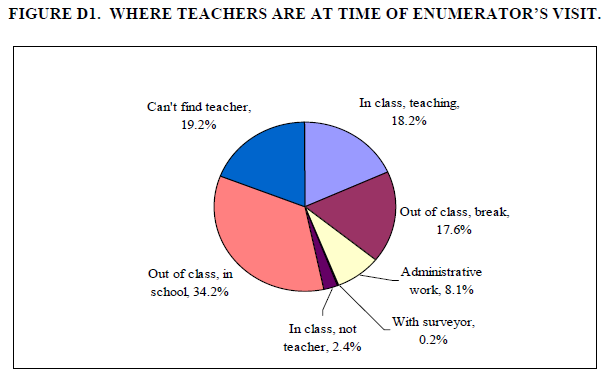
It's time for class.... where is the teacher to be found?
Edison, Charles and Erik, our colleagues from Uganda, did a short skit illustrating the different points in the primary education system where corruption happens. Their points correlated well with this summary of quiet corruption in education from a July 5, 2010 article in the Independent:
‘Early this year, the Transparency International (TI) Africa Education Watch Programme report: Africa Education Watch: good governance lessons for primary education showed that the government’s perception that massive enrollment is a sign of success of the UPE [universal primary education] programme must be revised to address the problem of overcrowding in classrooms, studying under trees, poor financial management, illegal fees, and lack of school inspection. The report exposes irritating embezzlement of UPE funds and abuse of authority by head-teachers who charge illegal fees, make students offer labour on teachers’ projects, sexual harassment, and systematic teacher absenteeism. The report noted that 85% of schools surveyed had either deficient accounting systems or none at all. In most cases, financial records were either unavailable or incomplete. The survey found limited financial documentation at district education offices and at schools. Most people who handle school grants had no training in basic finance management.
Another survey titled, The Efficiency of Public Education in Uganda, conducted in 2007 by the Ministry of Education to determine efficiency in provision of education services found an average rate of teacher absenteeism of 27% in Uganda, compared to other countries like Zambia (17%), and Papa New Guinea (15%). The aggregate loss caused by this absenteeism constituted 19% which translates into Shs 53 billion out of the Shs276 billion of the Education ministry’s wage bill.
In a swift headcount at the beginning of this year, the Education ministry established that the number of pupils listed in primary school registers was 25% higher than those actually studying. Similarly, the report established that the number of students in lower secondary schools had been exaggerated by 12%. For instance at Amaji Primary School last year, the school register had 816 pupils. But when the headcount was conducted the school administration could not account for 302 pupils.
It is reported that many districts’ chief administrative officers have failed to show proper accountability for the UPE and USE funds.’
The Uganda team also explained that:
Parental interest in education is very low because since Universal Primary Education launched, parents feel it’s the government’s responsibility. Some youth we were working with in Kenya last year made a short film about poor performance in primary schools covering the same issue (see below).
Teachers’ salaries are paid directly to their bank accounts, and there is no way to punish them if they don’t show up.
There are mechanisms to ensure that donor funds go from the national level to the district level and then on to the school, but no accountability mechanisms to ensure that they get from the school to the classroom and are translated into quality education for children.
District level government authority and accountability ends when they transfer funds to the schools; school directors can report to them that they have received funding and that everything is going fine when it’s really not.
Local school committees are often made up of people who are not neutral and who do not have the best interest of the children in mind. In some cases, school committee positions are used for personal gain and to launch individual political careers and political campaigns.
Lack of parental and community involvement in the education process and in school governance means that no one is demanding accountability from teachers and schools.
Sexual and physical violence in schools is very common and underreported. When it is reported, often nothing is done about it.
(Start playing the video, then click the small ‘cc’ button to turn on captions in English)
Colleagues from the other countries face the same challenges in their work and in their own children’s education.
Can ICTs play a role?
What is the solution then? Colleagues suggest that motivating parents and the community to get more involved in school governance and demanding transparency and accountability can begin to change the situation. This obviously requires a lot more than ICTs. So several different actions would be taken to engage and motivate parents and the community to take a bigger role in their children’s education. Then ICTs can be integrated into and support the process for sharing education information with parents, such as student absenteeism, grades, parent-school meetings, exam dates and scores, etc. Parents and students would also be able to report when teachers do not show up or suspected corruption. Students could also report abusive teachers, absent teachers, and other issues they are not happy with at the school. A neutral party would manage and hold the information that flows in and out to protect students from reprisal and to protect teachers from any abuse of the system in case fraudulent or incorrect information is reported. Commitment from those responsible for overseeing education to respond to the issues raised and take serious action is also needed, and this may be the biggest challenge overall. Plan can play a role there, leveraging existing relationships with local and national governments and Ministries.
The idea needs quite a bit of further work, a closer look at feasibility, and more research and input from local communities and parents. As mentioned, the ICTs are actually a small, but potentially very important, part of a much larger initiative to get parents and communities involved in school governance to demand transparent, accountable and quality education and budget spending.
Challenges in the process
Some of the challenges that we had to manage well during this initial piece of the longer process included:
We needed to ensure that we were starting with the context and the need for better information and communications, not starting with the technology and devices and building initiatives around them. Yet we also had to avoid getting lost in the overall context and missing the opportunity to pinpoint potential ICT solutions at specific places within the context. Role play and flip chart illustrations of the ‘problem’ and the ‘solutions’ were very useful for getting more concrete (“So, Kofi is here in his community and he wants to …. So he uses xxx to do this, and then this happens and then….).
Though we wanted to specifically look at places that mobiles and other ICTs could support, it was important to list out all the factors that needed to be in place in order for the ICTs to work and to think clearly about the constraints we might face during implementation. One good question to help with that was, after seeing an idea or ICT solution presented, to ask “What needs to be in place in order for that to happen?” Then you start to remember critical things like community motivation, government interest to actually resolve a problem, electricity, someone to set up and manage a server, a strong enough network to download multimedia content, mobile versions of websites, educational content re-design for mobiles, teacher training on how to integrate ICTs in the classroom, limitations of SMS for doing something other than rote learning, higher versions of a mobile operating system, a smart phone, etc.
We had input from a potential corporate partner during the process. We learned that corporations are thinking several years ahead to what will be coming down the line; however non-profit are normally working within existing constraints and trying to find solutions that work here and now in the resource poor places where we work or ways to get around those constraints. Multi-level solutions seemed to be a good possibility; eg., ideas that can rely on SMS today, but have potential to expand as networks expand and data enabled mobiles become more available.
A corporation tends to think in terms of vendors, results, timelines, launch dates, price points, return on investment whereas a non-profit (at least ours) tends to think in terms of community members, organizations, process, participation, local context. Our facilitator even told us that a corporation normally does a presentation by starting with the solution, and then spending the rest of the presentation showing why that is the right solution. A non-profit usually starts a presentation by sharing all the context and background, and showing the process that led to eventually reaching the potential solution, including every step along the way, how ownership was achieved in the process, why different decisions were made and who participated in them. So keeping corporate vs non-profit cultures and languages in mind is also important when working on joint initiatives.
We need to remember to establish measurable indicators of success so that we can tell if this new type of intervention has a different/ better/ greater / lesser impact than carrying out a similar process without ICTs or with a different set of ICTs. This is something we will address once the full idea is developed. Impact measurement is very important to both corporate partners and development organizations.
This was the first time many were involved a process of this kind, so keeping the balance between technology and development goals was a constant challenge. We sometimes veered too far towards focusing on all the details of the context and then back to focusing too much on that piece of the context where a potential technology solution was seen. I think we were moving toward a pretty healthy mix of both. The process is nowhere near complete, and as we continue to work on the ideas and look at feasibility and actual implementation, we should find the sweet spot.
The work above was guided by Plan Finland’s recent publication ICT Enabled Development – Using ICT strategically to support Plan’s work. On the whole, it was a great learning process for everyone involved, and we came up with some good ideas that we will flesh out in the coming months. Having the opportunity to patiently and carefully think through areas and ways that ICTs can support program goals around education and discussing the ideas at length with colleagues was a capacity strengthening exercise for all involved and will mean that we will be more prone in general to thinking about incorporating ICTs in our work going forward.
Last summer I had the chance to meet with War Child in Holland to talk about our shared excitement and common challenges in using social media and ICTs in program work (eg., to further program goals and as enablers in community level work with children and youth). I met Ernst Suur there, and over the past several months we’ve been trying to find an on-line Masters Degree in ICT4D. There are a couple places that are considering this type of course in the future, but we were not able to lay our fingers on anything concrete at this point. As Ernst says: Isn’t it funny that you can learn online how to knit, but ICT4D isn’t taught much online yet?
The constraints that both Ernst and I have are that we work full-time (and then some) at jobs that require a lot of travel so it’s impossible to attend a normal schedule of university classes. We also live on salaries that don’t leave extra for furthering our education and we don’t want to spend the rest of our lives in debt. We would like a program that is not completely focused on the technology, but that instead really goes into depth on how ICTs can enable better processes, results and outcomes in development work. We are both working on program initiatives that would benefit from focused ICT4D research and deeper thinking that a guided process of shared learning and discussion could provide. We work with colleagues across our organizations who, like us, are interested in and would benefit from more systematic learning and focused ICT4D capacity strengthening but who are also not in a position to attend traditional university courses (or these courses are simply not offered where we live).
We are assuming that there are others out there from other organizations in similar conditions with similar interests. For example, at the October 2010 International Conference on Crisis Mapping (ICCM) in Boston there was mention of the need for further education opportunities on ICTs in Crisis Situations.
After doing some on-line research to find options and contacting some individuals, Ernst and I thought a next step would be to do a bit of crowd sourcing to find out if there is something that already exists that we are missing. As Ernst said: Better well stolen than badly invented.
If anyone has any thoughts, please share them in the comments section or contact me at lindaraftree at gmail.
For example:
Are there existing on-line masters level courses that we have missed out on in our desktop research?
If you could design an on-line ICT4D masters program that would fit your needs, what would it look like – eg, would there be face-to-face meetings? How often and for how long? Where?
What are the key topics/areas/disciplines that would be covered in an on-line ICT4D course?
What would some of the required courses be and who could teach us?
What would a reasonable cost be?
Who might be willing to offer scholarships for this type of study course? Eg., in whose interest is it to strengthen these capacities?
Please share your thoughts and ideas so we can build a strong case, because we believe that ICT4D should walk the talk and talk the walk and make online higher education and distance learning available for everyone.
Plan just released a new report called ICT Enabled Development: Using ICT strategically to support Plan’s work. The report is part of an on-going process by Plan Finland (kudos to Mika Valitalo for leading the process) in collaboration with Plan USA to support Plan’s country offices in Africa to use ICTs strategically and effectively in their development work. It was written by Hannah Beardon and builds on the Mobiles for Development Guide that Plan Finland produced (also written by Hannah) in 2009.
The idea for the report came out of our work with staff and communities, and the sense that we needed to better understand and document the ICT4D context in the different countries where we are working. Country offices wanted to strengthen their capacities to strategically incorporate ICTs into their work and to ensure that any fund-raising efforts for ICTs were stemming from real needs and interest from the ground. Plan offices were also in the process of updating their long-term strategic plans and wanted to think through how and where they could incorporate ICTs in their work internally and with communities.
The process for creating the report included 2-day workshops with staff in 5 countries, using a methodology that Mika, Hannah and I put together. We created a set of ICT training materials and discussion questions and used a ‘distance-learning’ process, working with a point person in each office who planned and carried out the workshop. Mika and I supported via Skype and email.
Hannah researched existing reports and initiatives by participating offices to find evidence and examples of ICT use. She also held phone or skype conversations with key staff at the country and regional levels around their ICT use, needs and challenges, and pulled together information on the national ICT context for each country.
The first section of the report explains the concept of ‘ICT enabled development’ and why it is important for Plan and other development organizations to take on board. “With so many ICT tools and applications now available, the job of a development organization is no longer to compensate for lack of access but to find innovative and effective ways of putting the tools to development ends. This means not only developing separate projects to install ICTs in under-served communities, but looking at key development challenges and needs with an ICT eye, asking ‘how could ICTs help to overcome this problem’?”
Drawing on the research, conversations, workshop input and feedback from staff, and documented experience using ICTs in Plan’s work, Hannah created a checklist with 10 key areas to think about when planning ICT-enabled development efforts.
Context Analysis: what is happening with ICT (for development) in the country or region?
Defining the need: what problems can ICT help overcome? what opportunities can it create?
Choosing a strategy: what kind of ICT4D is needed? direct? internal? strategic?
Undertaking a participatory communications assessment: who will benefit from this use of ICT and how?
Choosing the technology: what ICTs/applications are available to meet this need or goal?
Adjusting the content: can people understand and use the information provided for and by the ICTs?
Building and using capacity: what kind of support will people need to use and benefit from the ICT, and to innovate around it?
Monitoring progress: how do you know if the ICT is helping meet the development goal or need?
Keeping it going: how can you manage risks and keep up with changes?
Learning from each other: what has been done before, and what have you learned that others could use?
The checklist helps to ensure that ICT use is linked to real development needs and priorities and appropriate for those who are participating in an initiative or a project. The report elaborates on the 10 key areas with detailed observations, learning and examples to illustrate them and to help orient others who are working on similar initiatives. It places the checklist into a 4-stage process for ICT integration.
Understanding the context for ICT work: includes external context and internal experience and capacity
Finding a match between priorities and possibilities: rooting the system in local needs and priorities and finding good uses for tools and applications
Planning and implementing concrete initiatives: carrying out participatory assessments, linking to other development processes and addressing technical issues and concerns
Building a culture of systematic, sustained and strategic use of ICTs: linking ICTs with program work, transforming the role of ‘the ICT guy’, and building expertise on the cultural and social aspects of ICT use
Additional material and case studies, ICT country briefings, and an overview of Plan’s current work with ICT4D in Africa are offered at the end of the report.
The report includes input from Plan staff in Ghana, Mali, Mozambique, Senegal and Uganda who participated in the ICT4D workshops. It also draws heavily on some of the work that Mika has been doing in Finland and Kenya, and work that I’ve been involved in and have written about in Mali, Cameroon, Mozambique, Ghana, Benin and Kenya involving staff, community members and community youth. You can contact Mika to get the workshop methodology in French or English or to comment on the report (ict4d [at] plan [dot] fi).
There’s so much rich material in the report that I almost want to summarize the whole thing here on my blog, section by section, so that people will take the time to read it… I think this is a really important and useful piece of work and we’re very excited that it’s now available! Download it here.
Coming from the viewpoint that accountability and transparency, citizen engagement and public debate are critical for good development, I posted yesterday on 5 ways that ICTs can support the MDGs. I got to thinking I would be remiss not to also post something on ways that ICTs (information and communication technologies) and poor or questionable use of ICTs and social media can hinder development.
It’s not really the fault of the technology. ICTs are tools, and the real issues lie behind the tools — they lie with people who create, market and use the tools. People cannot be separated from cultures and societies and power and money and politics. And those are the things that tend to hinder development, not really the ICTs themselves. However the combination of human tendencies and the possibilities ICTs and social media offer can can sometimes lead us down a shaky path to development or actually cause harm to the people that we are working with.
When do I start getting nervous about ICTs and social media for social good?
1) When the hype wins out over the real benefits of the technology. Sometimes the very idea of a cool and innovative technology wins out over an actual and realistic analysis of its impact and success. Here I pose the cases of the so-called Iran Twitter Revolution and One Laptop per Child (and I’ll throw in Play Pumps for good measure, though it’s not an ICT project, it’s an acknowledged hype and failure case). There are certainly other excellent examples. So many examples in fact that there are events called Fail Faires being organized to discuss these failures openly and learn how to avoid them in the future.
2) When it’s about the technology, not the information and communications needs. When you hear someone say “We want to do an mHealth project” or “We need to have a Facebook page” or “We have a donor who wants to give us a bunch of mobile phones–do you know of something we can do with them?” you can be pretty sure that you have things backwards and are going to run into trouble down the road, wasting resources and energy on programs that are resting on weak foundations. Again, we can cite the One Laptop per Child (OLPC) initiative, where you have a tool, but the context for using it isn’t there (connectivity, power, teacher training and content). There is debate whether OLPC was a total failure or whether it paved the way for netbooks, cheap computers and other technologies that we use today. I’ll still say that the grand plan of OLPC: a low-cost laptop for every child leading to development advances; had issues from the start because it was technology led.
3) When technology is designed from afar and parachuted in. If you don’t regularly involve people who will use your new technology, in the context where you’re planning for it to be used, you’re probably going to find yourself in a bind. True for ICTs and for a lot of other types of innovations out there. There’s a great conversation on Humanitarian Design vs. Design Imperialism that says it all. ICTs are no different. Designing information and communication systems in one place and imposing them on people in another place can hinder their uptake and/or waste time and money that could be spent in other ways that would better contribute to achieving development goals.
4) When the technology is part of a larger hidden agenda. I came across two very thought-provoking posts this week: one on the US Government’s Internet Freedom agenda and another from youth activists in the Middle East and North Africa region who criticize foundations and other donors for censoring their work when it doesn’t comply with US foreign policy messages. Clearly there are hidden political agendas at work which can derail the use of ICTs for human rights work and build mistrust instead of democracy. Another example of a potential hidden agenda is donation of proprietary hardware and software by large technology companies to NGOs and NGO consortia in order to lock in business (for example mHealth or eHealth) and prevent free and open source tools from being used, and which end up being costly to maintain, upgrade and license in the long-term.
5) When tech innovations put people and lives at risk. I’d encourage you to read this story about Haystack, a software hyped as a way to circumvent government censorship of social media tools that activists use to organize. After the US government fast-tracked it for use in Iran, huge security holes were found that could put activists in great danger. In our desire to see things as cool, cutting edge, and perhaps to be seen as cool and cutting edge ourselves, those of us suggesting and promoting ICTs for reporting human rights abuses or in other sensitive areas of work can cause more harm than we might imagine. It’s dangerous to push new technologies that haven’t been properly piloted and evaluated. It’s very easy to get caught up in coolness and forget the nuts and bolts and the time it takes to develop and test something new.
6) When technologists and humanitarians work in silos. A clear example of this might be the Crisis Camps that sprung up immediately after the Haiti Earthquakes in 2010. The outpouring of good will was phenomenal, and there were some positive results. The tech community got together to see how to help, which is a good thing. However the communication between the tech community and those working on the ground was not always conducive to developing tech solutions that were actually helpful. Here is an interesting overview by Ethan Zuckerman of some of the challenges the Crisis Commons faced. I remember attending a Crisis Camp and feeling confused about why one guy was building an iPhone application for local communities to gather data. Cool application for sure, but from what people I knew on the ground were saying, most people in local communities in Haiti don’t have iPhones. With better coordination among the sectors, people could put their talents and expertise to real use rather than busy work that makes them feel good.
7) When short attention spans give rise to vigilante development interventions. Because most of us in the West no longer have a full attention span (self included here), we want bite sized bits of information. But the reality of development is complicated, complex and deep. Social media has been heralded as a way to engage donors, supporters and youth; as a way to get people to help and to care. However the story being told has not gotten any deeper or more realistic in most cases than the 30 second television commercials or LiveAid concerts that shaped perceptions of the developing world 25 years ago. The myth of the simple story and simple solution propagates perhaps even further because of how quickly the message spreads. This gives rise to public perception that aid organizations are just giant bureaucracies (kind of true) and that a simple person with a simple idea could just go in and fix things without so much hullabaloo (not the case most of the time). The quick fix culture, supported and enhanced by social media, can be detrimental to the public’s patience with development, giving rise to apathy or what I might call vigilante development interventions — whereby people in the West (cough, cough, Sean Penn) parachute into a developing country or disaster scene to take development into their own hands because they can’t understand why it’s not happening as fast as the media tells them it should.
8 ) When DIY disregards proven practice. In line with the above, there are serious concerns in the aid and development community about the ‘amateurization’ of humanitarian and development work. The Internet allows people to link and communicate globally very easily. Anyone can throw up a website or a Facebook page and start a non-profit that way, regardless of their understanding of the local dynamics or good development practices built through years of experience in this line of work. Many see criticism from development workers as a form of elitism rather than a call for caution when messing around in other people’s lives or trying to do work that you may not be prepared for or have enough understanding about. The greater awareness and desire to use ‘social media for social good’ may be a positive thing, but it may also lead to good intentions gone awry and again, a waste of time and resources for people in communities, or even harm. There’s probably no better example of this phenomenon than #1millionshirts, originally promoted by Mashable, and really a terrible idea. See Good Intents for discussion around this phenomenon and tools to help donors educate themselves.
9) When the goal is not development but brand building through social media.Cause campaigns have been all the rage for the past several years. They are seen as a way for for-profit companies and non-profits to join together for the greater good. Social media and new ICTs have helped this along by making cause campaigns cheap and easy to do. However many ‘social media for social good’ efforts are simply bad development and can end up actually doing ‘social harm’. Perhaps a main reason for some of the bad ideas is that most social media cause campaigns are not actually designed to do social good. As Mashable says, through this type of campaign, ‘small businesses can gain exposure without breaking the bank, and large companies can reach millions of consumers in a matter of hours.’ When ‘social good’ goals are secondary to the ‘exposure for my brand’ goals, I really question the benefits and contribution to development.
10) When new media increases voyeurism, sensationalism or risk. In their rush to be the most innovative or hard-hitting in the competition for scarce donor dollars, organizations sometimes expose communities to child protection risks or come up with cutesy or edgy social media ideas that invade and interrupt people’s lives; for example, ideas like putting a live web camera in a community so that donors can log on 24/7 and see what’s happening in a ‘real live community.’ (This reminds me a bit of the Procrastination Pit’s 8 Cutest and Weirdest Live Animal Cams). Or when opportunities for donors to chat with people in communities become gimmicks and interrupt people in communities from their daily lives and work. Even professional journalists sometimes engage in questionable new media practices that can endanger their sources or trivialize their stories. With the Internet, stories stick around a lot longer and travel a lot farther and reach their fingers back to where they started a lot more easily than they used to. Here I will suggest two cases: Nick Kristof’s naming and fully identifying a 9-year-old victim of rape in the DRC and @MacClelland’s ‘live tweeting’ for Mother Jones of a rape survivor’s visit to the doctor in Haiti.
Update: Feb 22, 2011 – adding a 10a!
10a) When new media and new technologies put human rights activists at risk of identification and persecution. New privacy and anonymity issues are coming up due to the increasing ubiquity of video for human rights documenting. This was clearly seen in the February 2011 uprisings in Egypt, Tunisia, Libya, Bahrain and elsewhere. From Sam Gregory’s excellent piece on privacy and anonymity in the digital age: “In the case of video (or photos), a largely unaddressed question arises. What about the rights to anonymity and privacy for those people who appear, intentionally or not, in visual recordings originating in sites of individual or mass human rights violations? Consider the persecution later faced by bystanders and people who stepped in to film or assist Neda Agha-Soltan as she lay dying during the election protests in Iran in 2009. People in video can be identified by old-fashioned investigative techniques, by crowd-sourcing (as with the Iran example noted above…) or by face detection/recognition software. The latter is now even built into consumer products like the Facebook Photos, thus exposing activists using Facebook to a layer of risk largely beyond their control.”
11) When ICTs and new media turn activism to slacktivism. Quoting from Evgeny Morozov, “slacktivism” is the ideal type of activism for a lazy generation: why bother with sit-ins and the risk of arrest, police brutality, or torture if one can be as loud campaigning in the virtual space? Given the media’s fixation on all things digital — from blogging to social networking to Twitter — every click of your mouse is almost guaranteed to receive immediate media attention, as long as it’s geared towards the noble causes. That media attention doesn’t always translate into campaign effectiveness is only of secondary importance.” Nuff said.
I’ll leave you with this kick-ass Le Tigre Video: Get off the Internet.… knowing full well that I’m probably the first one who needs to take that advice.
‘It feels so 80s… or early 90s… to be political… where are my friends? GET OFF THE INTERNET, I’ll meet you in the streets….’
I work on digital development research, strategy and evaluation with an emphasis on responsible data use, inclusion, gender, and children and young people. I support organizations to develop, implement, and engage staff and partners in responsible data policy and practice. I enjoy facilitating and moderating convenings, workshops and learning-focused events.
I’m affiliated with:
The MERL Tech Initiative: I founded The MERL Tech Initiative, which sits at the intersection of digital technology and the social sector. We support thoughtful tech-enabled program design, implementation, and monitoring, evaluation, research and learning (MERL). We convene communities to share good practice and improve programmatic outcomes. We advocate for responsible, ethical, realistic approaches that center people, communities and societies. My consulting practice is under The MERL Tech Initiative umbrella.
Technology Salon:Technology Salon is an intimate, informal, and in person, discussion among information and communication technology experts and international development professionals. Technology Salons happen in various cities. I convene the NYC Technology Salon. Technology Salon is the non-profit arm of The MERL Tech Initiative, enabling The MERL Tech Initiative to accept 501c3 funding.
This is a personal blog that does not represent official views of my current, past or future employers, affiliates or other organizations with whom I engage. Any opinions expressed herein are my own, and I take responsibility for them.
 My last post here on Wait… What? was an excellent guest post by Paul Goodman (@pdgoodman) who has been working with Plan Benin for most of May to help optimize the Frontline SMS / Ushahidi-based violence against children (VAC) reporting system that we initiated a little over a year ago. Paul is a Masters Level student at the School of Information Management and Systems at the University of California, Berkeley. In addition to on-the-ground ICT4D experience in Haiti, Pakistan and Bangladesh with DAI, he has worked on several USAID funded projects including the Cuba Development project and the Global Development Commons. Paul has also worked in business development and as a press assistant, multi-media editor and freelance photographer.
 Jacqueline Deelstra has just completed her Masters at the Fletcher School at Tufts University. She’s worked overseas in the past with Twaweza in Tanzania and Kenya, World Teach in Ecuador and Tostan in Senegal. While at Twaweza, she focused on citizen reporting, village mobile phone surveys, and the use of mobile phones in development and governance programs. Jacqui will be spending her time in Atacora and Couffo, Benin, learning more about the social context and social challenges surrounding the implementation of the above-mentioned Violence against Children Reporting system in Benin, and looking at its contribution to good governance.
 Joe (@joepavey) is a Master of Communications student in the Digital Media program at the University of Washington, where the program has an emphasis on storytelling and technology. Joe also spent 7 years at Microsoft, where he specialized on new standards of practice for processing and encoding video content. His undergraduate degree is in documentary film production. Joe will support the Youth Empowerment through Arts and Media (YETAM) Project on the technical side, helping youth and local partners in Cameroon to improve video production quality and to streamline the process from editing to uploading. He’ll also work closely with the well-skilled Cameroonian ICT team that is setting up a violence reporting system using Frontline SMS and CrowdMap, based on our learnings from the system in Benin.
 Rebecca is a first-year Masters degree student at the Fletcher School at Tufts University, with experience in both development and journalism. She has also worked as an assistant researcher on a story about the Daniel Pearl case, a legal assistant and a production assistant at NPR. She previously completed a 6-month internship with Tostan in Senegal, where she worked closely with staff and program participants to support program implementation and evaluation. She also wrote stories for the Tostan website and blog. Rebecca will support the local partners and youth who participate in the YETAM project, especially with uploading content to the web and growing more accustomed to social media and ICTs in development. She will also be doing research on the traditional practice of breast ironing as an independent side project.



 Wait... What?