Feeds:
Posts
Comments

Posts Tagged ‘Kenya’

Childline Kenya is about child protection. “We run at 24 hour children’s helpline which is both an emergency response service for abused children who need someone to help and an information line where children who have difficulties or questions that are bothering them can call us, we can talk to them, have a chat, do counseling on line, deal with abuse.” Irene Nyamu is the Deputy Director of Childline Kenya. She also worked at Plan for about 3 years before moving to her new post. Photo: Irene during a community visit in Kwale.

At Childline, Irene is constantly looking at new issues and situations because the field of child rights and child protection is vast. Childine works with everything from adoption issues to drug addiction to child abuse within the family and juvenile justice. “I wasn’t too versed in legislation, laws that relate to children and I’ve had to learn so much,” she says.

Before Childline, there was a government line, but it wasn’t a 24-hour line and it wasn’t free. If a child wanted help they had to have money to call. “What we’ve done as Childline is try very much to leverage support from the government’s Dept. of Children’s services.” For the last 3 years children have known that they can call to get the service. But Childline has involved government of Kenya along the way. “We’ve helped build government capacity and have proven that it’s possible to have a child helpline without a heavy cost. We’ve demonstrated its usefulness.”

When Childline first started, they had a fixed line with a free call number and got around 600 calls per month. “Since we’ve moved to mobiles, we get about 20,000 calls per month and we are still not meeting the needs of the population.” Childline Kenya’s has 9 counselors during the day and about 6 at night. To optimally operate, Irene estimates needing around 15 during day and 10 at night or more. “When we were on a landline, we had a long phone number that was difficult to remember, and most people don’t have access to fixed line. So now with the 116 short code, it’s quite easy to remember and very accessible on mobile.”

As for concerns that children cannot access a phone to report in, people should not assume children do not have access to phones. Childline confronted this and has proven that if the information is out there, children will find someone that is willing to help them make a call. “Many children now call us even without a fixed line. They have a teacher, an auntie, a big sister who will allow them to borrow the phone. I’ve seen that almost everybody in the community has a SIM card. They do not have a handset, but when they need to make a call they just borrow a handset for a few minutes and somehow they do it. We can’t make the argument that children can’t use technology. There are innovative ways of using the technology so let’s put the technology out there and stop assuming that people can’t access it.”

What about credit? This is a very important issue. “If organizations or institutions want to use SMS, then there is an investment cost unless you are able to acquire a short code.

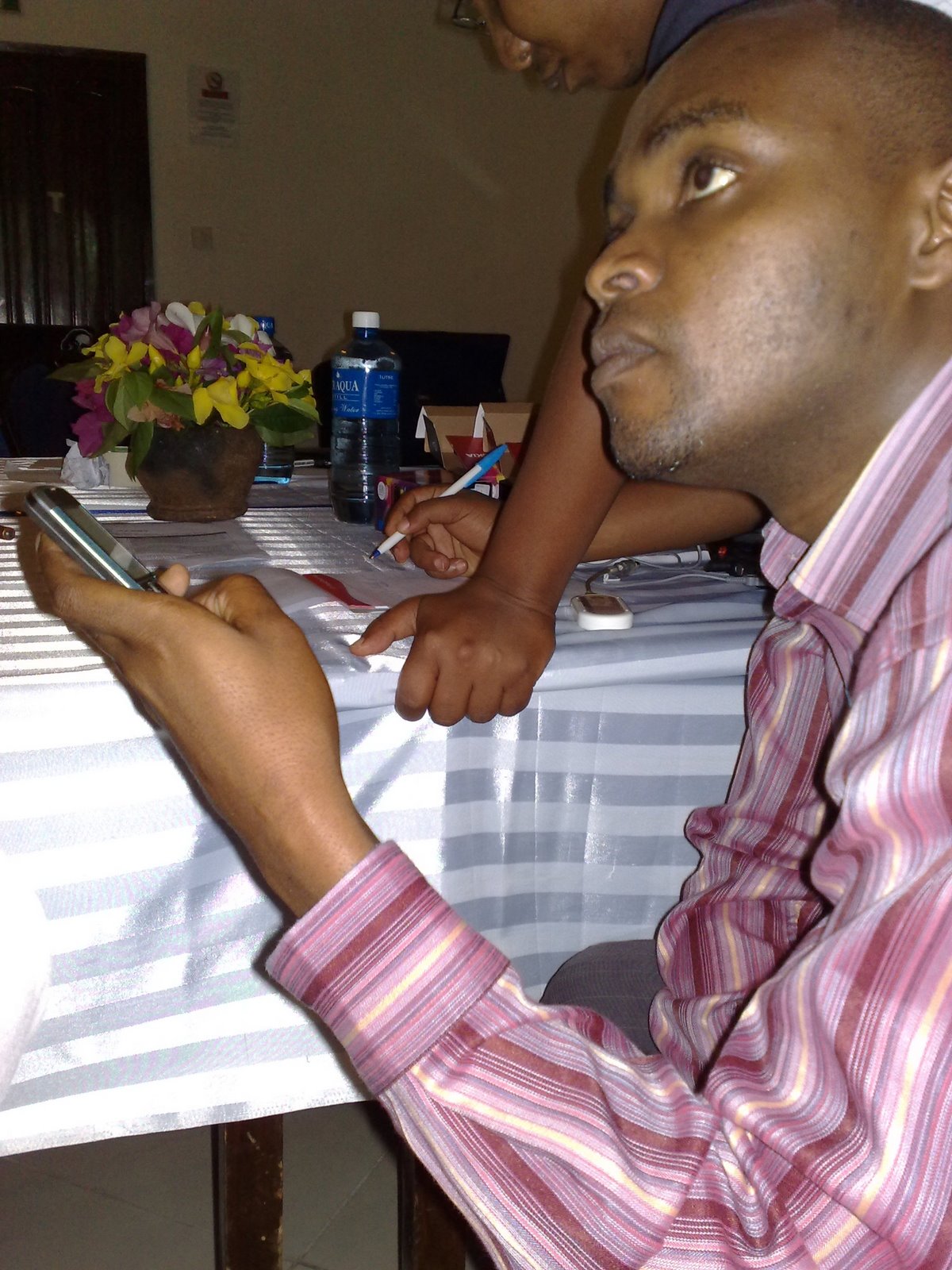
Childline tracks how many people have dialed in and how many calls they actually receive, and they currently receive many more calls than they are able to manage. Irene thinks that one way of extending the service out to more children might be an increased use of SMS, which is extremely common and accessible in Kenya. “To meet the needs of our population, I think this FrontlineSMS training was really useful. We can now go in to explore how to use SMS for child helpline work in order to offer more alternatives to children. If you can’t call, can you SMS? And how do those numbers compare?” Photo: Learning to set up Frontline SMS for mobile data gathering, SMS outreach and auto-responses.

“I love working at Childline because every new day is different. Every new call that comes in, you can anticipate a new challenge.” One way to meet some of these challenges is via new technologies such as mobile outreach and mobile data gathering.
Read Full Post »

Jonathan Mativo, whom I first met in Kenya in December at our Social Media for Social Change workshop was one of our core FrontlineSMS trainers last month. In January, Mativo left Plan to found his own organization called ICT4D Kenya which operates in the Kilifi and Machakos districts in the Southern Coast of Kenya. He was motivated to move beyond the commercial ICT sector to ICT4 community development by his 4 years of work at Plan. “Previously I didn’t have any background on ICT4D. I only looked at ICT from the operational point of view but Plan really inspired me to work with children to see them realize their full potential.” ICT4D Kenya envisions young children confident in participatory media, children that see ICTs as enablers for development rather than just tools to perform work. “We also foresee a changed community – people who are socially together.”
Photo: Mativo is the founder of ICT4D.

ICT4D Kenya targets communities and schools, with the aim of building the capacity of youth, men and women through community ICT resource centers to introduce them to new ways of learning. ICT4D Kenya is also experimenting with interactive learning. “Normally students learn by rote. They basically take notes extracted from text books.” In their free time children expected to study, but “they are just revising materials from textbooks that have been copied into their notebooks…. They are hardly concentrating on what they are doing.” Mativo wants to introduce interactive learning materials in schools so children will be more attentive in class. He’s also planning some school linking projects where students in different districts can communicate to share culture and motive each other to improve school performance. Photo: Wajuhi and Mativo at Plan’s training on mobile data gathering in Kwale, Kenya

We’re not talking old, slow computers though. “One thing about Africa is that we are used to free things. That’s why we are congesting our country with refurbished things.” Mativo believes that to take ICT ahead in Africa, schools need access to the technology that they would get in the real market. “Often we get old computers, slow, hard to maintain and without proper e-waste solutions. We should be looking at affordable technology and ways to get ICTs to Africa rather than just dumping refurbished equipment.” So what about refurbished/donated phones? “Small gadgets are a different story. If you look at the features of a mobile, as long as it can send an SMS, it’s fine. SMS is one thing we are really looking at for social change.”

Mativo has worked with one school to install FrontlineSMS (http://www.frontlinesms.com/) in order to communicate with parents. This year there was a teachers strike. Most schools sent their children home. But this school got all the parent/caretaker contact information. “Within 2 days we had all the mobile numbers.” They keyed them into FrontlineSMS and the head teacher used the software to send an SMS to all the parents and asked if they should send the children home or not. “We got 237 out of around 400 messages back from parents on the first day saying ‘don’t send our children home’ and the rest said to send them home.’” So the head teacher kept the children at school, and when a parent questioned the decision at a parents’ meeting later in the year, he used the SMS he had saved to explain the reasons.

Now the school is using the software for all kinds of things. On annual Prize Day instead of the normal low turn-out, they had 75% turnout for the first time this year. “Parents said you communicated with us in due time by SMS and kept communicating with us over time to remind us.” Normally students are given newsletters during holiday times and parents don’t remember key dates when they finally roll around.

Mativo sees his role as demystifying ICTs and finding the best way possible to ensure people understand ICTs from a non technical point of view. “When I have to explain what a computer is, I always refer it as ‘that box there’ so that people don’t look at it as too delicate. In most cases I open the CPU for people to understand that it’s just an empty box that they shouldn’t be too afraid of.” Mativo says that many people believe it’s not possible to change their communities’ way of thinking, especially people who are working in commercial ICTs. “They need to internalize what community development is all about and that ICT can be downgraded to reach out to people in communities regardless of their skills, their background and their exposure. ICT and community development is real.”

Photo: Simplifying ICTs for people.

Related posts on Wait… What?

7 (or more) questions to ask before adding ICTs

Read Full Post »

Building on the last post, I wanted to share also some of the discussion at last week’s Kenya workshop about incorporating mobiles into our work. People in general were pretty excited. Even those people who were skeptical seemed to see mobiles as tools that could improve work we are already doing if well incorporated and done from ‘the bottom up’ in sustainable ways, based on program information and communication needs. Some great discussions came up and participants shared some potential solutions and good practices.

Issue: Access

We are working with children. How many children have phones? How do we get information from children? We work with communities who are the “poorest of the poor” – so how do we get info from them using FLSMS – do we expect them to have phones? Or people may have phones but no credit? How do you handle such circumstances?

Use a short code if you can get one

Credit is a very important issue. If organizations or institutions want to use SMS, then there is an investment cost unless you can acquire a short code. If you have a short code you deposit money to make this free or much lower cost for people.

Don’t assume that children don’t have access to mobiles

We should not assume children do not have access to phones. If the information is out there, children will find someone that is willing to help them make a call or text. Many children now call us (at the Child Help Line) even without a fixed line. They have a teacher, an auntie, a big sister who will allow them to borrow the phone. I’ve seen that almost everybody in the community has a SIM card. They do not have a handset, but when they need to make a call they borrow the handset for a few minutes and somehow they do it. We can’t make the argument that children can’t use technology. There are innovative ways of using the technology so let’s put the technology out there and stop assuming that people can’t access it. The issue is how can we make the technology reach as many as possible?

Give out SIM cards with a few minutes on them to protect privacy and confidentiality

We had a similar situation with a reproductive health project that was offering out information that most girls wanted to remain confidential. What we did was gave out 10 bo SIM cards. We passed them out in little boxes. Many of the girls had phones but wanted to send in anonymous questions so they used the SIM cards to send the SMS in, and then removed the card from the phone, put it in their pockets, and replaced their original SIM. It only costs 1 shilling via Orange. We found that normally the SMS conversation lasts for around 6 shillings. They can maintain anonymity this way. It’s cheap and they can just keep these SIMs in their pockets.

Issue: If mobiles begin to replace face-to-face contact and relationships with partner communities.

Using Frontline SMS for community outreach and communications has many advantages, particularly in terms of the information that we constantly need to gather. However, we should be careful though that it doesn’t substitute field visits. If people get used to getting information quickly they are likely to avoid going out and getting in touch with communities to see what is happening. If you just sit and wait for an SMS you will lose this face-to-face contact with the community.

Mobiles can be a tool, but must be integrated with other communication means

This point reminds us that we should not totally substitute it but use it as an additional tool in the toolbox to improve, cut costs, reduce, etc.

Issue: A text does not give enough space for full and clear information in health or other cases

We talked about using Frontline SMS for radio. In our participatory youth media programs, children bring out issues in video, in radio, etc. We are not always able to respond immediately to their concerns and issues. FLSMS could be a way to respond to these issues. Are there examples of how to pass on this type of technical information? If I’m a midwife and am too far from hospital, I need very clear information. How could this be done with SMS via an auto reply and only a short amount of text?

Use SMS to bring face to face help more quickly and to track/record incidents

SMS isn’t a solution for everything, but I know of an example of how that can work. There is another program called Ushahidi that is about crisis mapping. It’s a digitized map. Sometimes when a situation becomes extreme people are asked to share their locations using GPS and then you can send local people to these places on bicycles or through other means to help. This allows the professional help to arrive more quickly. Maybe SMS can’t solve it but it can bring help more quickly.

Use SMS as a supplement, not a replacement for human contact and long-term work

In the case of trying to change harmful practices and traditions, we need time and eye contact. If we are working with trying to make cultural changes, such as in the case of infanticide or something, you can’t just send a text that says “this is a bad practice”. You need to come close to people. I believe FLSMS can offer a secondary way or a supplement to a given community meeting, to strengthen a rapport with the community, but it’s not a replacement for our long term work and ongoing relationships with people.

Read Full Post »

I spent last week in Kwale, Kenya in the company of several colleagues learning about and discussing the use of mobiles in community development, both for outreach and communications and for mobile data gathering. There was a variety of people — from frontline staff to members of Community Based Organizations (CBO) in Kwale, to monitoring and evaluation (M&E) staff from Plan Kenya’s districts and central offices and Plan’s West Africa Regional office, to IT staff, to youth and those working with youth media, to partner organizations working on child help lines and social media outreach.

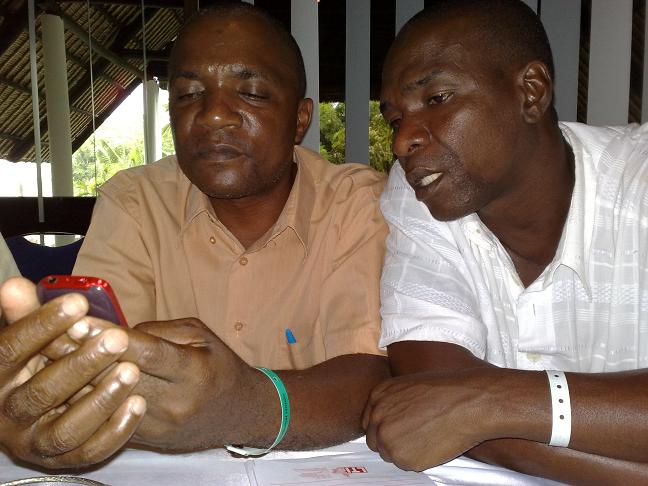
Photo: Anthony from Plan along with Mativo, a former Plan colleague, trained us on FLSMS

We looked closely at Frontline SMS (FLSMS) and Nokia’s new Data Gathering Software (NDGS) and brainstormed on ways that this type of tool might support the work that people are already doing. Really an interesting week!

In addition to the more common ideas of using mobiles for health campaigns, disaster/crisis situations and general communications and monitoring, people mentioned:

For youth media programs:

-Organizing weekly radio contests via Frontline SMS and allowing many more youth to participate in the radio program that way. Now for contests, they have to write a letter with their answer and bring it to radio station by foot. Using SMS many more could participate, increasing listeners and engagement.

-Assessing the radio show right after the recording. The youth and children could go in the audience and gather the data they normally do by hand using mobile data gathering software, thus easing the processing time and analysis of the information.

-Monitoring progress and changes made in relation to the show at a broader level — the participating youth could use mobile data gathering to monitor change related to the issues they are targeting in the radio shows and to see if youth organization and awareness building is impacting on the community over time.

Photo: people got really excited when their first forms appeared on their phones to be filled in!

For Child/Human Rights work and Global Child Rights Campaigns:

-Assessing the knowledge/awareness of the communities about rights issues and/or our global campaigns

-Receiving reports and sharing information about violations of rights (gathering info on whether children are being registered at birth, the incidence of school violence, girl’s or women’s rights violations, cases of child abuse) and offer short information on where to go for help.

-Monitoring child abuse cases, e.g. community members could text in key words such as ABUSE or MARRIAGE to report and track child abuse cases and early marriages happening in the community:

Birth Registration (UBR) implementation

-Tracking birth registration certificates and sharing information on the steps of the registration process. With auto SMS replies we could enhance information accessibility 24/7. We could provide instant feedback to people on the status of their birth registration. It would be a very quick way of sending information to many.

-Using mobile data gathering software, the birth registration process could be made paperless and computerized, thus saving time and effort for the population and increasing the number of children who are registered at birth.

Photo: Jackson and 3 other colleagues from Brazil trained us on the NDGS.

Monitor services

-Running a mobile survey or a rapid assessment to find out whether a service like Childline is reaching people and whether the service is known and being utilized in the field.

Communicating among Plan staff, CBOs, Communities

-Passing along information such as training dates, schedules, meetings, etc., to avoid making a trip out to the community to get information

-Surveying on health, school attendance, and school enrollment through a network of teachers

Communities communicating amongst themselves

-Communities have a lot of information they want to share among themselves, among the Community Health Workers (CHWs), with the other communities and other leaders – they could do this with FLSMS.

Managing Meetings and Decisions

-Inviting participants, confirming attendance, updating on the absentees when you’ve reached a decision they could be contacted this way. You could even involve those who are absent in voting by SMS if you don’t have quorum; eg., text in 1 for this candidate, 2 for this other one, or vote yes/no on something.

Photo: SMS was seen as a great way for communities and CBOs to communicate and organize.

Read Full Post »

The main thing that we did today was to go back to the map to see what the different issues in the community are, and what kind of stories could be told about the issues. How can we tell stories that touch the heart? That move people to action? That are real and relevant and educational? The personal examples that went behind the stories were super interesting. I hope the youth will capture a lot of these stories in their videos… I also hope that we’re able to produce videos that work to stimulate dialogue in the community, and that also are interesting to an external audience. That is one of the big challenges in this project.

Some stories that came out:

“There is a story about old men that go to the farms w/their tools but they don’t actually have to work, the spirits come to do the work for them; so a woman wanted to see the ghosts and she came up with a scheme to watch. When the spirits discovered the woman had seen them they stopped working and the men were angry and made women work tilling the fields ever since.”

“There is the story of witchcraft in the community. If people see someone progressing they perform some witchcraft rituals that make them go crazy or take them down.”

“Girls are being targeted for harassment; it’s a real story. It happens often. Even beyond this harassment there are threats of physical harm and sometimes charms/witchcraft. But the community is responding and these people are being arrested now.”

“A story about the way girls are married. They are married very early and marriage is an obligation. They stop attending school. Because girls are not allowed to inherit anything, they don’t see a purpose in education or in community development because they never have any decision making power. Bride price contributes to harassment. If you get married and get 12 cows as a dowry, then the family just equates you to that – 12 cows.”

“Sometimes girls come to school on opening day for boarding school, parents say that school is supposed to be free, so they haven’t even provided the girls with anything. The matatu (public transportation minibuses) drivers take advantage of them and then deny that they’ve had anything to do with them.”

“There is a belief that only basic education is important and that anything beyond is not necessary. So even if a girl/boy qualify for university, parents won’t support them. Some parents don’t believe in white collar jobs, if you aren’t a soldier or watchman which is something they can understand, if you don’t have a practical skill like carpentry, the parents don’t feel it’s a job. They are only willing to pay for an education for a skill that they can understand.”

“There is a belief the disabled children should not be allowed to live. Sometimes they are killed or they are kept out of sight and in bad conditions. Sometimes if someone has a disabled child, it’s seen to be related to the fact that they have some wealth and they’ve traded their family for wealth.”

Read Full Post »

Today we worked out the whole rest of the media training plan and who would facilitate what parts. Everyone is taking on different roles according to their strengths and knowledge, and we’ll facilitate in pairs or teams. We spent the afternoon trying out the cameras, testing mics, etc., and then Anthony took us through the editing process in the evening.

Mercy told us that there will be an induction ceremony in Kwale Town for a man who will become an elder. There are both cultural and political connotations to his induction and the whole area will turn out for the celebration and ceremony. Wajuhi suggested that we film it as practice, so we took the afternoon to plan out how we would do that, what stories we would catch from which perspectives, and who would interview and film whom/what. We worked together on the interview questions for men, women, youth, children. It should be pretty interesting.

The manager from the center where we’re staying stopped in and hooked up the internet so that is great!

Read Full Post »

The first day of training went by pretty smoothly. We had present Mwendar, the Community Based Organization (CBO) Chairman of Mwangaza, the community we’ll be working in, Ali a local artist and CBO secretary from Msambweni, Mercy the district information officer who’s also studied participatory video, Rama a university student from the area who’s studying media and communications, Madzo, who is involved with a youth environmental organization, and Anthony, Wajuhi and me from Plan. In the evening, Ali K, another youth also joined us.

It’s been really interesting seeing how Anthony and the Plan Kenya team have worked hard to ensure that the project is really fully integrated and tied into the existing work and programs so that it’s not seen as a parallel project. It is being integrated into the community planning process, and grounded by the recent child rights based situation analysis that was done in all the Plan Kenya work areas. It’s also linked in with the community radio project and informed by the existing community ICT programs.

We spent the morning getting set up and trying to get a generator since Thursday’s is “no power” day in Kwale. The generator came but it didn’t work, so we had to manage without electricity. It wasn’t too big of a deal since both laptops we are using have good battery life. The main things we covered were introductions, expectations, a project overview, and child protection and ethics. Merci also gave an explanation of participatory video.

We discussed with the community chairman how to manage/handle any issues of potential conflict if they came up. Having the CBO chairman is really valuable because working together, youth and CBO, will limit potential conflicts around topics that might be addressed. Wajuhi and Anthony are really stressing the importance of community ownership, the ways that video and photos and art can be used to catalyze discussions in the community, and the importance of the follow up and documentation process. We discussed ethics, and the use of the community’s name in case possible difficult subjects, and child protection in terms of possible implications of discussion particular topics. The chairman said that it would be fine to use the community name, but that in the case of sensitive or taboo topics, it would not be right to identify certain persons. He suggested that those types of issues be dealt with using drama instead so that the topics would still be raised by in a less conflictive way. In the end, he also said, this is a joint project with the youth and the community, so the topics would be agreed upon by all, even if they were addressed from the youth’s own perspective.

Wajuhi told today about a video project she had worked on in the past where one of the participating children was orphaned and had been mistreated in the community, stigmatized, called names, etc. The youth did a drama film based on her story. It was shown to several CBOs at once. The CBOs from other communities began asking, “is that how you treat orphans in your community?” And the discussion led to “What about us? Do we treat orphans any differently?” On that came the question “Why are there orphans in our communities” and the answer: because of HIV/AIDS. So the community began planning efforts to deal with HIV as well as the situation of orphans.

The first step in the project process is mapping the community. Since Ali had experience doing community mapping, he led us through a practice mapping exercise at the end of the day to get a concrete idea of how community mapping can be a tool for identifying resources and assets, talking about community history and the community’s uniqueness, bringing up child rights issues (both where rights are being realized and where not), and making plans for what to film and photograph. Ali, the artist, is also a CBO member in his own community. It was great to hear him really focus in on ownership of the community’s challenges and not expecting others to come in to resolve things.

Someone mentioned that there was a dye factory that used to provide jobs, but that had closed. Ali asked if it was in the community, and said that if not, then we shouldn’t be putting it on the map. That we should deal with things in the community. Wajuhi added that because this project is about empowerment and advocacy, that when the youth had built up all the skills that we hope to strengthen within the project, that they could then look at issues that had causes outside the community, and get the support of the community as a whole to address them with anyone outside the community with power to make change on a particular issue.

Read Full Post »

YETAM Kenya

So I’m off to Kenya tonight – just about ready to head to the airport…. We’ll be training in the Kwale Program Unit district with about 20 high school aged youth from one of the nearby communities. They have to go back to school on May 3, and we weren’t able to negotiate any additional time with them, so we will have to fit the 2 week training into just about 9 days — we’ll see how that goes. I’m pretty stressed right now about it actually… but normally it all works out.

I’ll fly from Boston to Nairobi and then take a short flight to Mombasa, stay over night there, and then will be picked up in the morning to go to the training center. I’ll meet with the Plan Kenya staff to prepare, and then Thurs-Sat we’ll have the facilitator’s training and work out all the details for the following week with the youth. We have a basic outline that just needs fleshing out. We’ll also check over all the equipment, etc. and be sure we’re ready. We’ll start the training with the youth on Sunday Apr 26 and run through May 3, and then I’ll stay a few extra days to finish up.

I’m going to try tweeting from there to see how that goes…. could be interesting to use the YETAM twitter account for the youth to post what is going on during the training and the project, but we’ll see if they are interested and if we have a good enough connection….

Read Full Post »

« Newer Posts