Feeds:
Posts
Comments

Posts Tagged ‘media’

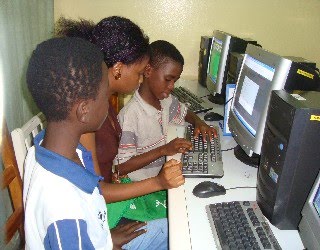
We’ve completed our first week of arts and media training with around 55 youth in Cumbana, a coastal community some 450 kms north of Maputo, the capital of Mozambique.  If you ever tried to Google Cumbana, you’d find information about a photographer with the same last name or links to tourist hotels at the nearby beaches in Maxixe or Inhambane, and not much else.  We actually did this as part of our Tuesday session on Internet with the youth.  Googling New York was another story.  But why?

We turned it around to the youth. Why is there no information on Cumbana?  The conclusion was you only find things on internet that someone puts there, and  no one had bothered, no one had ever really uploaded anything about Cumbana.  And that meant that this group of youth has a big responsibility, because they are going to be the ones to put Cumbana on the map. Photo:  After Cumbana, the top Google search among our small population was, of course, Michael Jackson.

What does that mean?  Aside from producing arts and media to raise issues that affect them and engage their communities in jointly finding solutions, the youth will be the ones to define Cumbana.  As Lauren (the Peace Corps volunteer who’s been teaching at the school for the past 2 years) said:  “Did we find anything about you all in Cumbana now on the internet?  No.  When will there be something about Cumbana?  When you make the effort to put it there.”  Photo: Mobile phone connections are much more likely than computers in the near future, so we trained on internet also using mobiles.

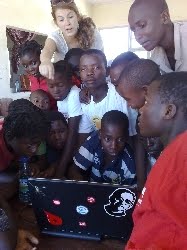
Access to internet whether by laptop using mobile internet or directly on a phone is a huge hit with the kids, 75% of whom had never been online before.  Our 2 hour session could have gone on all day for all they cared. The idea of putting yourself on the map seems to have appeal in the same way that having a Facebook page does.  It’s about self publishing and creating an identity. Photo left: Anthony the local Peace Corps Volunteer supported with the internet and is working with the theater group.  Photo below: Lauren, Peace Corps Volunteer, is working with the multimedia group.
But as we are seeing more and more, citizen journalism has its downfalls (think Fort Hood).  So it was great to see the debates about ethics in journalism that also happened last week.  Jeremias from Radio Mozambique facilitated a great session. He was excited to be part of the workshop because, as he said, “I’m a journalist.  I want to groom more young people from right here in the community where I came from to follow in my profession, and this is a great chance for all of us.”

During Jeremias’ session on ethics, the kids hotly debated the question of whether you should show the face of someone caught stealing.  Many felt that this would punish the thief as well as protect the community. Jeremias countered, “In Mozambique, whose job is it to determine guilt or punishment? Eh?  It’s not the role of the journalist. It’s the role of the judicial system. Like it or not, that’s how it is.”  He talked about the basic rules in journalism to protect people, about divulging information and objectivity. “When you leave here, to do work out there in the community, you need to be sure to hear all sides.  You need to protect the good name of people.  This is our responsibility.  This is ethics.  You cannot condemn someone until the judicial system has determined that they are guilty.”

I sat there wishing every self-appointed citizen journalist followed those rules, and self-examining whether I always do.  But it also got me thinking about how when you are not in a free state, your judicial system is totally non functional, or there is corruption within the journalism profession or media houses, things are not nearly so clear.  Sometimes things need to be filmed to get something to happen, whether they’ve been proven or not.  What are the rules and ethics then?  (I’m sure I can Google this and find a debate!)
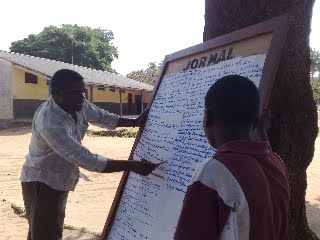
The youth were cautioned to leave aside sensationalism.  “Often wanting to be the first to get the news out makes us less careful as journalists” Jeremias said.  If we drop the bomb, we’re likely to see the next day that we are the ones being processed, accused of not being ethical.” Photo: Jeremias and a youth participant share ideas.

“The ethics of a journalist come from within us,” he said.  Sometimes even a journalist’s own employers may ask him do things that are not ethical.  Or others want a certain story to come out and they try to bribe a journalist.  This makes it really difficult to be a journalist. A journalist needs to have high and strong ethics and maintain objectivity,” he told the kids.

“So you see, journalist is under constant pressure. It’s REALLY easy to get a recorder, to make a story.  It’s more difficult to think through what the consequences of publishing that story might be.  As a journalist, your goal is not to get famous; it’s to transmit information, so get the idea of fame right out of your head.”

Jeremias is a wise man and we are really lucky to have him training our group of journalists.

Cumbana is the only secondary school (it covers to 10th grade) in the entire district, with 3 sessions a day, serving some 4000 students (if the teacher I asked is correct). The opportunity to participate in a program like YETAM is huge for students and teachers alike.  In addition to the journalist group, there is theater, music and dance, multimedia, and painting.  For the kids, it’s like a 2 week summer camp where they strengthen leadership skills, improve their studies, get organized to address community challenges facing youth, and think about careers outside of the norm.  For the teachers, it’s an opportunity to engage with students in a different way, to strengthen their teaching methodologies and improve their ICT skills.  For the partners, it’s an opportunity to give back to the community and, of course, to discover new talent for their professions.

Related posts:
On Girls and ICTs
Being a Girl in Cumbana
Is this map better than that map?
Read Full Post »

I got into Maputo (capital of Mozambique) around 3 on Friday and stopped by the Plan Mozambique office to meet the staff on the way to my hotel. The office here is small. Plan’s only been working in Mozambique since 2007 and in one province only so far. Maputo is absolutely gorgeous.  It’s calm, not at all crowded, and on the coast.

I’ll be here for about 3 weeks working on the Youth Empowerment through Arts and Media (YETAM) project in a community near Maxixe, which is a 50 minute plane trip north. The coordinator for the project in Mozambique is Pedro, the IT Director, and we had a nice discussion today over lunch.

Pedro is from the IT sector and used to work for a government ministry and came to Plan right when we opened here.  He’s convinced that “Plan is not in the IT business.  We’re in the business of community development, so our IT has to be in service of community development, not just the office.”  So ICT4D is high up on his list of interests, and he’s hoping that over the next few weeks we can share lots of ideas.  We discussed how just like media, ICTs are becoming more easily accessible for people, so a good ICT person should know how to support and train other people, to take the mystery out of ICT.  He or she also has to know how to see the trends coming down the line to stay ahead of the game.

Aside from lunch, we spent most of the day installing software on the computers that we’ll be using in the media project.  We got the anti-virus going on all of them – a lesson learned and never forgotten on my part.  We also got the Nokia phones and laptops synced so we can use them for mobile internet while in the community.  Pedro said that mobile internet is a huge eye opener.  “If it works there, communities will know that if they can get the phone, they don’t need to go all the way to the city to access the internet.”  I’m crossing my fingers that the signal will be strong enough to make this a reality.  We shall see….  That social media session I have planned will not make much of an impact if we can’t get online.  Which reminds me how great it always is to get your feet back on the ground and adjust ideas to reality.

Related posts:

It’s all part of the ICT jigsaw: Plan Mozambique ICT4D workshops
Inhambane: land of palm trees and cellular networks


Read Full Post »

How do you break down a high level UN study and connect children and youth with the information so that they can use it for their own purposes, engage others and push for a change?  Through participatory arts and media, of course!

My colleague Anastasie (in the photo above) in Plan’s West Africa office is working on a project to stop Violence Against Children (VAC). “We want to make the content and follow up mechanisms of the United Nation’s VAC study widely known among children, youth and their caretakers in West Africa and mobilize a wide representation of children and youth in the region to prevent and respond to violence against children.” Anastasie told me.

“People need to know about the VAC study and its outcomes.  Children and youth especially need to know so that they can participate in finding solutions.  We are working to strengthen the capacities of existing children and youth organizations to play their full role in civil society.  We’re helping develop their capacities to communicate efficiently and effectively about this issue so that they can influence decision making processes.”

What does that actually mean, and what does the project look like?

“We work with the participating youth and children’s organizations and the adults that work with them to build their capacities through producing comic books, cartoons, information booklets, and radio and television programs that inform about the topic of violence against children,” Anastasie told me. “We have a website with a blog to give room to children, youth and adults to share opinions on violence.”  The participating groups have also formed a network and an action plan to focus them as they go forward.

For me, it’s clear that child/youth participatory media is again (disclaimer – I’m obviously passionate about this) an ideal method for both building individual level skills and capacities in children and youth, generating discussion, research and reflection among children and youth on the topic, and identifying real stories and messages that can have a strong impact on viewers and which can be used to share ideas, opinions and generate dialogue.  Social media tools open the project up even further to additional audiences and allow space for those not directly participating to also join in on the discussion. Photo: Youth in Ghana filming opinions about the topic of violence.

The cartoons (go about halfway down on the page click on ‘dessins animes’) and comics (click on ‘BD’) are drawn by the children and youth themselves with the support of partner organization Pictoons (amazing short feature video about Pictoons on Africa Open for Business!).  They are based on real life stories that the children and youth bring to the workshops. Once drawn and animated, adults do professional voiceovers. Currently the materials are only available in French, but they will be dubbed in additional languages to spread their impact further.  The website itself has a wealth of information about violence against children, including statistics, radio discussions, videos, comic books, and the cartoons mentioned above.

In the next phase of the project, additional tools will be incorporated.  “We plan to use SMS, blog and mobile reporting, and maybe Ushahidi and Frontline SMS,” said Anastasie.  “I heard about these tools in a workshop last December at Plan.  I thought these tools would be good for mobilization and monitoring/evaluating the project.”

The idea would be for the youth groups to collect and report on incidences of violence in their communities using SMS.  They would refer people who report violence to institutions that can provide support.  The incident reports would be visualized on maps to show the extent of the problem, and these maps would be used to advocate, along with the other communication materials, to local, district and national decision makers.  “We plan to begin this next phase of incorporating more social media and new technologies starting in January,” said Anastasie. Photo: youth learning to use the computer to share opinions on the VAC blog.

Check out some of the materials made by the youth at the Violence against Children site.  Really nice work!

The Violence Against Children project takes place in 7 countries: Benin, Ghana, Mali, Togo, Guinea Conakry, Cote d’Ivoire and Gambia in partnership with Save the ChildrenCurious Minds (Ghana), Child Protection Alliance of Gambia, youth and children’s clubs in all these countries, the African Movement for Working Children and Youth, and Planet Jeunes (a popular magazine for youth in West Africa).  The United Nations Violence against Children (UNVAC) studywas released in 2006.  It identified 5 specific places where children face violence: home, school, work, community and institutions. Recently a Special Representative on Violence Against Children (Marta Santos Pais) was appointed by the UN Secretary General to look specifically into this issues.

————

Related posts on Wait… What?

Fostering a new political consciousness on violence against children

Being a girl in Cumbana

Read Full Post »

Next week I’ll have the honor of (wo)manning the expo table for Plan at the Clinton Global Initiative (CGI) Exchange [the networking event after the actual CGI meeting]. It’s Plan’s first year at the CGI, which is exciting for us as an organization. The project that we’ve committed to is a convergence of many of the things that Plan has been getting deeper and deeper into in the past few years – youth engagement, youth employment, participatory media, social media, ICTs, youth voice, youth-led advocacy, and last but not least, girl power. I’ll be supporting the project with some training around social media and ICTs based on experiences in past projects such as the Youth Empowerment through Arts and Media project.

Our commitment, Vocational Skills and Media Training for Adolescent Girls in Ghana, is a three-year project that combines job skills training for girls with media production by girls.  The combination of these two elements will give girls key skill sets for employment opportunities while also creating public platforms for girls to raise awareness and advocate on issues affecting them. Through the project 140 adolescent girls will participate in training on media production and journalism, including citizen journalism/social media.  Of those, some will go on to participate in an internship program to do hands-on work in media.  The girls will be trained on how to use diverse types of media, including traditional as well as new media, to advocate against gender discrimination.  Adult journalists will participate in Plan’s training program on child rights and gender respect in media.  In the process, the project will engage the public through radio, television and web communication around the challenges that adolescent girls face in West Africa at the community, national, and regional levels. Participating girls will also have opportunities to meet and share experiences with each other and their female Ghanaian journalist mentors.

I really like this project because it brings so many critical elements into one initiative.  More and more Plan is supporting this type of work in Africa, and it really makes a difference in the youth themselves in terms of skills, self confidence, team work, and learning how to communicate issues of importance in a confident and respectful way.  It helps them access information and new skills that help them find employment. It also has an impact on communities who see their youth in a new light and who become more open to dialogue with youth around issues that youth want to discuss but may not be able to bring up in existing forums.  The media produced by children and youth can raise awareness and encourage dialogue at the national level, and it can be presented in global meetings to bring youth voices and a dose of reality into high level discussions. It can be shared on the internet to engage and involve people in other parts of the world, and to break down stereotypes about Africans. I also think one outcome will be that the participating girls and women will contribute to modernizing the field of journalism in Ghana because they will be trained on new media tools and they will likely think seriously about how girls are portrayed by the media in the future.

Plan’s research “Because I am a Girl: The State of the World’s Girls” came out in 2007, highlighting the urgency for us to focus more programs on girls as key players.  Out of this report, a decision was made to make girls Plan’s key focus over the next several years, and the Because I am a Girl Campaign was launched.  Since then, two in depth studies have highlighted specific issues: Because I am a Girl: In the Shadow of War (2008), and Girl’s Economic Empowerment (coming out later this month).

Come by our table to say hi if you happen to be at CGI exchange!

Related posts:

On Girls and ICTs

Being a girl in Cumbana

An example of youth-led community change in Mali

Read Full Post »

Mid week the first week of the community youth training, the youth chose what they wanted to do: arts or video/photos, and they split into groups for more focused training. The media group further split into 6 small groups of 4-5 people (one for each set of equipment) to then develop their interviews and ideas for their short films, based on the list of topics that had been created earlier by the youth and community members. The arts group chose topics from the list also to develop out. Photo: Some of the arts group.

The first Saturday (after 4 days of theory and practice) we did a community field visit to get a better sense of what to film and to make appointments with resource people for interviews. The arts groups did rough sketches of the things they wanted to draw. On Sunday the groups started filming and working more closely on their chosen drawings. We filmed for about 3 days in small groups, and by the 2nd day had some groups stay back to learn editing, then switching and going to film in the afternoons while another group stayed back to edit. The arts group worked in watercolor and gauche to finalize their works. By the end of the week we had 15 films and about 12 really nice drawings! Photo: Filming on Birth Registration

The films that we finished included:

· Meeting Places/Community Resources

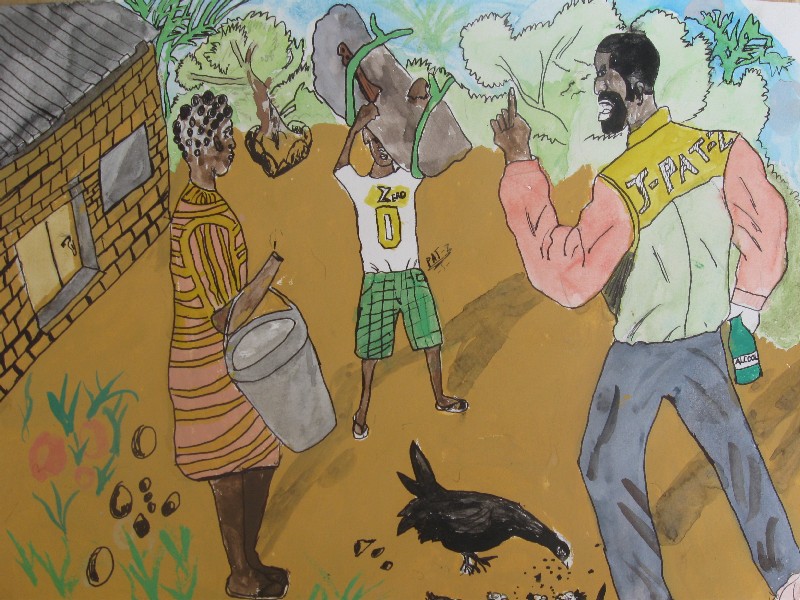
· Alcohol Abuse

· A quick trip around the rural areas

· Forest resources

· Universal Birth Registration (and issue of not declaring births)

· History of Mva’a

· Installation of the church in Mva’a

· Water

· How mud houses are constructed

· The market

· Raising pigs

· The long walk to school

· Relationships between parents and children

· Agriculture

The drawings were really powerful, touching on themes that went deeper than the films, due to the nature of the two media. Drawing topics included Alcohol Abuse, A family losing their home to high winds/storms, Church, Long walk to school, Education, Hunting, Distance to health centers, People working on Sundays instead of attending church, Water, People not using latrines, Dangers of transport means, Recreation, Well/water sources, and Child abuse/Child labor

We closed out with a community film showing where the Mayor and community members and parents were invited to see the work of the youth. The youth, teachers and community members worked on an action plan to determine how they will follow up via concrete activities in the coming 6 months. Plan Cameroon is hoping to expand the program to additional communities, so it was important that the Mayor’s office attended as maybe they would have funds to support project expansion….

Read Full Post »

We started the YETAM training with the youth on Tuesday morning, after an official launch. The mayor of Okola attended as well as some of the Plan staff from the Country Office in Yaounde.

Since the youth had already had training via Plan and IRONDEL on the Rights of the Child, and some had worked with Plan’s Kids Waves radio show, they were really well equipped for moving onto video and arts work. They started with their community map where they had detailed, along with the community organization members, everything in their community.

The youth presented the map and everyone worked in groups to organize and flesh out the information from the map in 4 categories: community history, community description, community resources, and the situation of child rights and protection. Photo: youth presenting the map.

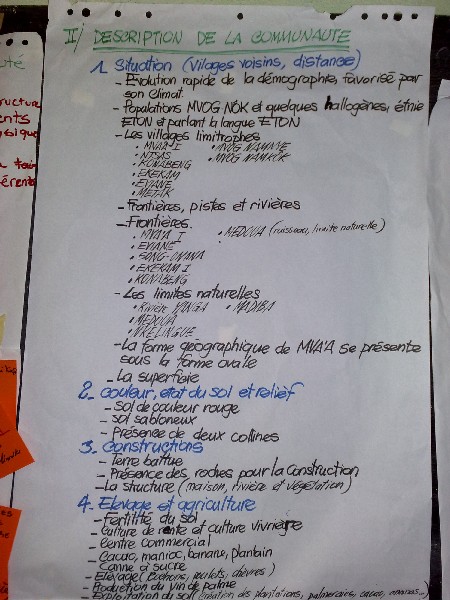
They wrote their ideas on note cards which were posted on flipcharts and then sorted to come up with final categories. These formed the basis for all the upcoming work. Photos: flipcharts with the different topics for filming and arts work.

After the map work, we went into introductions to the different things that we’d be doing: photography, film and drawing/painting. We had a bit of a struggle within the team getting facilitators to move from too much theory onto practical work. They kept going back to presentations and lots of long flipcharts and technical descriptions. Photo: The arts group re-drew a nicer version of the community map later in the week.

We realized later in the week that we didn’t all have the same understanding of the project methodology. Some thought that we were doing 1 week of theory, and 1 week of practice, and then afterwards would start making some videos, when in reality the idea is that we would not focus too much on theory because the media equipment is very simple to use, and we can use practical, hands-on exercises to build the technical skills.

The idea is to quickly get hands on during the first week, and then start making a first round of arts and videos near the end of the first week, continuing through the second week, and then getting into editing by the middle of the 2nd week. In the evenings we’d look at the footage as a whole group, and participants would talk about what looked good, what didn’t and how to improve. Once that got cleared up things moved on splendidly. Photo: Practice and group reflection is the best teacher.

Read Full Post »

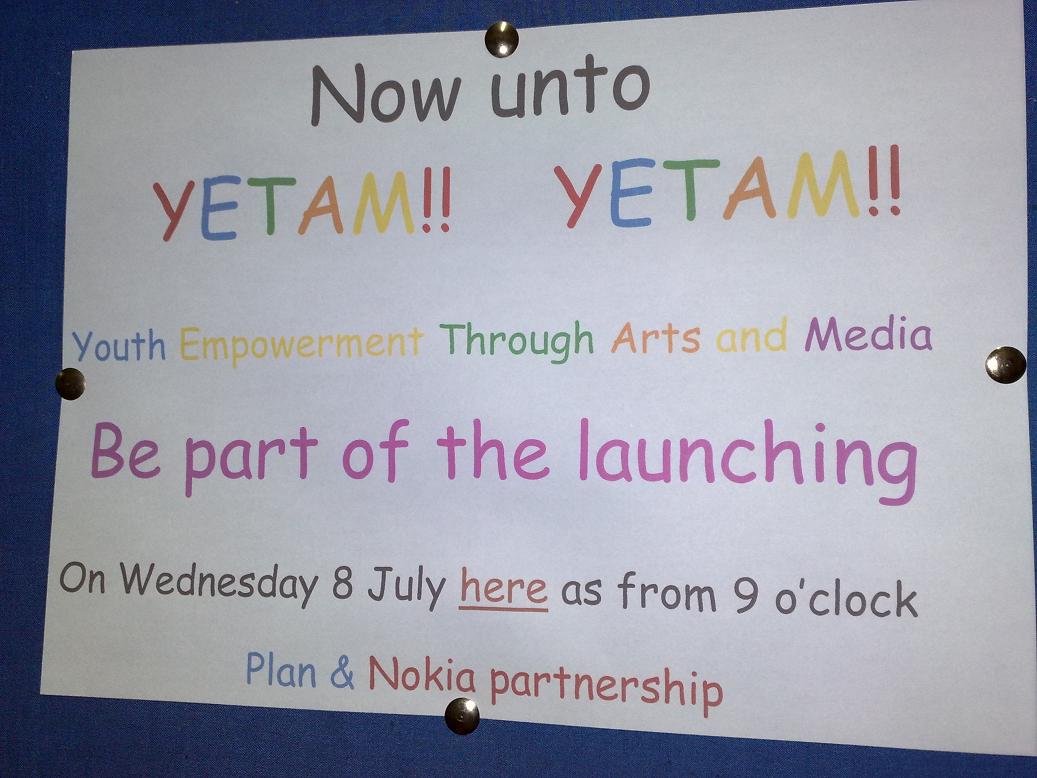
The Youth Empowerment through Arts and Media project (YETAM) kicked off on Wednesday with a press event, and then a training of trainers until Friday. At the press launch, I had to give an overview of social media and the YETAM project. The focus was on how social media can serve as a tool for community development, social change and augmenting participation, because it is based on some of the same principles and approaches as good community development work: partnership, ownership, collaboration, sharing, openness, communication, voice, power sharing, accountability, transparency, and democratic processes. I was bit afraid to use any examples of human rights/election monitoring or mention how social media is forcing the media business to change and impacting on social ‘revolutions’, not knowing if it could be threatening to the government and media attending, so it seemed better not to bring it up! Photo: YETAM launch announcement hanging in the lobby at Plan Cameroon.

For me the most interesting part of the 3-day workshop was listening to the participants debate about whether arts/media are tools or products. People said that they really learned something from the debate, that it really sparked their thinking about what is art and what is media and what both are for. They concluded (as I had hoped) that arts and media can be tools that help youth (in our case) research and deepen their understanding of themselves and their communities during the creation process. Yet arts and media are also products that are ‘consumed’ afterwards, catalyzing more debate and dialogue (sometimes via more arts and media) and if successful, eventually lead to some kind of positive social change. And the cycle goes around and around. Photo: Press event for the closing of the training of trainers.

The idea of tool vs product can be a struggle sometimes when we start work on YETAM and the concept of participatory video or social media for social change and working with rural communities. Sometimes people think that we want fancy commercials or television spots or 30 minute professional documentaries or fiction films, or they don’t believe children/youth will have the capacity to make their own videos or edit their own films, or that people from rural communities can learn to use the equipment. It can be hard to explain that we don’t need to write long scripts and set up scenes with lights and big media teams with large expensive cameras, and that if we bring the technology down to simple language and hand over the camera, it’s very doable. We don’t need a week of theory before we allow the kids to touch the cameras or to paint something, that the media and the art are the means for having the discussions and theorizing about the issues as well as the end for continuing on with the discussions. And we don’t need to disrupt the community and or have ‘outsiders’ doing it for the media or art to matter. Local people can make their own media and it can be even more meaningful that way. Photo: Plan and partner staff working on the agenda for the youth training that starts on Monday.

Read Full Post »

We’ve been thinking and discussing the best way to follow up on the Social Media for Social Change workshop that we had in December in Kenya. Ideas have been going back and forth about the best way to really find out what the Information and Communication needs are in the countries where we are working, and then how to support the different offices and staff to find the best and most appropriate Technology solutions.

We ended up with a chicken and egg situation in a way…. if ICT4D is not your top priority, and you don’t spend your life trying to figure out what is happening with ICT4D, you may not know what all is out there. (Ha, even if you do spend your life doing it, you don’t know what all is out there). So it can be hard to imagine tools and solutions if you’ve not seen them in action, used them yourself, or heard about how others are using them. At the same time, each local situation is different, so one size doesn’t fit all, so in order to find a tool or a solution, the situation analysis must come from those who would use that ‘solution.’ So what do you do first — learn about different tools and potential solutions so that the lightbulb goes off on ways to incorporate/adapt the existing tools to your needs, or discuss your ‘needs’ and design something that works — sometimes re-inventing the wheel. We thought that the best way we could manage the situation was to try to do both at once.

What we want to do is to activate our knowledge and study more about the concrete information and communications needs at the community level as well as in Plan’s program work that could be supported by ICTs. So we are hoping that we can produce a document which offers specific recommendations about utilizing ICTs in our work in the participating countries in Africa. And we then hope that we can identify areas to be developed further including successful initiatives currently being implemented by Plan itself and also those areas where we can build on existing synergy with governmental strategies. We are also hoping to better understand the capacity building needs among Plan and its partners.

It should be interesting research/training and hopefully will take us one step further towards incorporating appropriate technology to improve our communications and management of information so that we can have greater impact in our existing programs or even develop new programs that we didn’t think were possible before….

Read Full Post »

The main thing that we did today was to go back to the map to see what the different issues in the community are, and what kind of stories could be told about the issues. How can we tell stories that touch the heart? That move people to action? That are real and relevant and educational? The personal examples that went behind the stories were super interesting. I hope the youth will capture a lot of these stories in their videos… I also hope that we’re able to produce videos that work to stimulate dialogue in the community, and that also are interesting to an external audience. That is one of the big challenges in this project.

Some stories that came out:

“There is a story about old men that go to the farms w/their tools but they don’t actually have to work, the spirits come to do the work for them; so a woman wanted to see the ghosts and she came up with a scheme to watch. When the spirits discovered the woman had seen them they stopped working and the men were angry and made women work tilling the fields ever since.”

“There is the story of witchcraft in the community. If people see someone progressing they perform some witchcraft rituals that make them go crazy or take them down.”

“Girls are being targeted for harassment; it’s a real story. It happens often. Even beyond this harassment there are threats of physical harm and sometimes charms/witchcraft. But the community is responding and these people are being arrested now.”

“A story about the way girls are married. They are married very early and marriage is an obligation. They stop attending school. Because girls are not allowed to inherit anything, they don’t see a purpose in education or in community development because they never have any decision making power. Bride price contributes to harassment. If you get married and get 12 cows as a dowry, then the family just equates you to that – 12 cows.”

“Sometimes girls come to school on opening day for boarding school, parents say that school is supposed to be free, so they haven’t even provided the girls with anything. The matatu (public transportation minibuses) drivers take advantage of them and then deny that they’ve had anything to do with them.”

“There is a belief that only basic education is important and that anything beyond is not necessary. So even if a girl/boy qualify for university, parents won’t support them. Some parents don’t believe in white collar jobs, if you aren’t a soldier or watchman which is something they can understand, if you don’t have a practical skill like carpentry, the parents don’t feel it’s a job. They are only willing to pay for an education for a skill that they can understand.”

“There is a belief the disabled children should not be allowed to live. Sometimes they are killed or they are kept out of sight and in bad conditions. Sometimes if someone has a disabled child, it’s seen to be related to the fact that they have some wealth and they’ve traded their family for wealth.”

Read Full Post »

« Newer Posts