Feeds:
Posts
Comments

Archive for the ‘education’ Category

‘Breast flattening,’ also known as ‘breast ironing’ or ‘breast massage,’ is a practice whereby a young girl’s developing breasts are massaged, pounded, pressed, or patted with an object, usually heated in a wooden fire, to make them stop developing, grow more slowly or disappear completely.

Rebecca Tapscott* spent last August in the area of Bafut, in the Northwest, Anglophone region of Cameroon, where a 2006 study by the German Society for International Cooperation (GIZ) found an 18% prevalence rate of breast flattening. The practice has been known as breast ‘ironing,’ however, Rebecca opts to use the term ‘flattening’ to decrease stigma and encourage open conversation about a practice that remains largely hidden.** Rebecca wanted to understand the role of breast flattening in the broader context of adolescence in Cameroon, including past and present motivations for breast flattening; cultural foundations; relation to other forms of gender-based violence such as female genital mutilation or cutting (FGM/C); how and where it is practiced; the psychological and the physical implications of the practice on individual girls.

Rebecca published her findings via the Feinstein International Center in May 2012, in a paper titled: Understanding Breast “Ironing”: A Study of the Methods, Motivations, and Outcomes of Breast Flattening Practices in Cameroon.

She visited our office late last year to share the results of her work with staff at the Plan USA office, explaining that there is currently very little research or documentation of breast flattening. The GIZ study is the only quantitative study on the practice, and there do not seem to be any medical studies on breast flattening. It’s a practice that is believed to affect 1 out of 4 girls in Cameroon, more commonly in some regions than in others. Of note is that research on breast flattening has thus far only been conducted in Cameroon, thus creating the impression that the practice is uniquely Cameroonian, when in reality, it may be a regional phenomenon.

Organizations working to end breast flattening do so with the aim of protecting girls. However, the question of protection is an interesting one depending on who you talk with. Rebecca found that those who practice breast flattening also believe they are protecting girls. “Many mothers believe that unattended, a girl’s breasts will attract advances of men who believe physically developed girls are ‘ripe’ for sex. Breast flattening is seen as a way to keep girls safe from men so that they are able to stay in school and avoid pregnancy.”

According to Rebecca, breast flattening is practiced out of a desire to delay a girl’s physical development and reduce the risk of promiscuous behavior. Proponents of the practice consider that “men will pursue ‘developed’ girls and that girl children are not able to cope with or deter men’s attention. They see that promiscuity can result in early pregnancy, which limits educational, career, and marriage opportunities, shames the family, increases costs to family (newborn, loss of bride price, health complications from early childbirth or unsafe abortion).” In addition, there is the belief that girls are not sufficiently intellectually developed to learn about puberty, and therefore should not yet develop breasts. Another reason given for the practice is the belief that girls who develop before their classmates will be the target of teasing and become social outcasts. There is also, for some, the belief that large breasts are unattractive or not fashionable.

Rebecca cites a poor understanding of human biology as one reason that the practice persists. Some of the beliefs around it include: “Belief that sensitivity and pain during breast development indicates that the growth is too early and must be artificially delayed until the girl is older. Belief that when a girl develops breasts she will stop growing taller. Belief that puberty can be delayed by delaying breast development. Belief that for breasts to grow properly, the first growth should always be repressed (like baby teeth). Belief that if breasts begin growing at a young age, they will grow too large or be misshapen, resulting in a displeasing or disproportionate female form. Belief that breasts and other outward signs of sexuality develop in accordance with a girl’s interest in sex, and therefore a developed girl is soliciting sexual advances or is a ‘bad’ girl. Belief that when a girl develops breasts, she believes she has matured and subsequently, she becomes less obedient. Belief that it will improve breast feeding at a later age.”

“…For mothers there is the perception that we should delay the development of girls as much as possible, believing that physical development shows maturity. Men look at girls and talk amongst themselves and say, “she’s ripe for sex.” They are not looking for marriage prospects…Men are aggressive. In pidgin, they say “she got get done big,” meaning, she’s matured and ready for sex. I can go after her now. Women, on the other hand, know that their daughters are just kids.” ~ journalist that Rebecca interviewed.

Rebecca also heard explanations such as “A girl will stop growing taller because the weight of her breasts will hold her down. One can delay puberty by delaying breast growth. If the breasts hurt during puberty, they are developing too early.” There are also many beliefs related to a girl’s development and her sexual reputation. Some of these beliefs include that a girl with large breasts is a ‘bad girl’. This stems from the belief that breasts start to develop when a man touches them or if a girl is thinking about sex, going to night clubs or watching pornography. Rebecca found that many of these beliefs were held across all segments of society, from the very well educated to those with no formal education.

“The body responds to psychological ideas. If a girl looks for a “friend,” her breasts will grow faster. If she is interested in boys or watches pornography, her body will develop faster.” ~ Interviewee at the Ministry of Social Affairs

“If a girl is interested in sex and thinks about it a lot, she will develop faster. I saw two girls of 12 years, one of whom was very developed physically and the other was not. The one who was developed could speak very frankly about sex, showing that she was knowledgeable from some experience, while the other girl was very naive and shy.” ~ Teacher

Because of potential stigma or harm to girls who talked about undergoing breast flattening, Rebecca only interviewed a few teenaged girls directly during this phase of her research. Instead, she mainly interviewed older women, as well as a few boys and men. She found that most women who had experienced breast flattening didn’t seem to remember the experience as extremely traumatic; however, she commented, “most are remembering from back in the day. Most at first said didn’t really hurt but then after a while into the interview, they’d remember, well, yes it hurt.” Rebecca was surprised at the number of people who said that heated leaves were used, because the media normally reports that a grinding stone or pestle is used for breast flattening.

“When I was 11 years old, my grandmother did a form of breast flattening to me. This was in 1984. I was walking around with her shoulders hunched forward to hide my developing chest, so my grandmother called me to the kitchen. She warmed some fresh leaves on the fire and said something in the dialect, like a pleading to the ancestors or spirits. Then she applied the leaves to my chest, and used them to rub and pat my breasts flat. She would also rub and pat my back, so as to make the chest flat and even on the front and the back. It hurts because the chest is so sensitive then—but they are not pressing too hard.” ~ 38 year old woman from the community

“To do the practice, I warmed the pestle in the fire, and used it in a circular motion to press the breasts flat. I did it once per day for over a week—maybe 8 or 9 days. I massaged them well, and they went back for seven years.” ~ 53-year-old woman attending a maternal health clinic in Bafut, attending with a different daughter whose breasts she did not flatten

“Until about a year ago, I believed that when a girl is interested in sex, watches porn, or lets boys touch their breasts, her breasts will grow larger. I think my mother must believe this. My ideas changed when I saw my own friends—I knew they were virgins, but they had large breasts. Also when my own breasts got bigger, and it was not because a man was touching them.” ~ Journalist in Bamenda

There is currently no consensus on whether the practice is effective at reducing the size of a girl’s breasts or if it has long-term effects on breast size. “People told me completely different things gave the same result, or people cited the very same practices as yielding different results,” said Rebecca.

Rebecca’s findings indicate that the practice of breast flattening is not a longstanding ‘traditional’ practice. Many people reported that it became more popular with urbanization. “People [who immigrated to cities] didn’t know their neighbors and they were worried about the safety of their daughters. It seems that an old practice that was used for ‘shaping’ was repurposed and adapted. Breast flattening is a very intimate and personal thing between mother and daughter. It doesn’t happen to all daughters. It’s very difficult to track, and there is no association with ethnic groups, education, socioeconomic levels, religion, etc.,” she explained.

“Most men don’t know about it. One boy said he thought it was good to protect girls.” When she talked holistically with men about what they look for in a woman, Rebecca said, “an interest in chastity and virginity came out very clearly. In Cameroon the average age for girls to lose virginity is 13-17, and it’s the same for boys. According to studies, for most, the first sexual experience is unwilling.”

Most doctors that Rebecca talked to had never heard of the practice. One doctor in Yaoundé said he had seen first and second degree burns as a result. Some cite that edemia may be a result. Development organizations like GIZ say it can cause cysts, cancer, and other difficulties but also cited that only 8% of women report suffering negative side effects, while 18% report that their breasts “fell” or sagged at an early age.

Many women who Rebecca interviewed considered the practice a very low concern compared to other problems that impact on their development, such as illiteracy, sexual exploitation, poverty and unemployment. “The women that I talked to,” said Rebecca, “often asked me, ‘Why are you asking me about this? It’s such a small thing compared to other things we have to face.’”

Given that there is not much research or consensus around breast flattening in Cameroon and the broader region, Rebecca’s work may be of use to local and international organizations that are working to promote women’s and children’s rights. Rebecca emphasizes that most people who engage in what are commonly referred to as ‘harmful traditional practices’ including female genital cutting (FGC) and breast flattening, actually do so with their child’s best interest in mind, as a means of protecting and promoting the child within the community and following social norms. Therefore, frightening or berating people may not be the best approach to discourage the practice of breast flattening. Community input will be needed to identify the root causes of the practice for it to become obsolete. Better sex education and a reduction in stigma around talking about sexual reproductive health may also help. Men will need to be part of the solution, and so will mothers who currently feel the need to take protection of their daughters into their own hands. Like many similar practices, it’s not likely that breast flattening will end until other systems and environments that set the stage for it also change.

*Rebecca worked with Plan Cameroon for several weeks on the Youth Empowerment through Technology, Arts and Media (YETAM) Project last June and July. She traveled to Bafut following her internship to conduct independent research.

**This distinction is similar to the difference between the terms female genital ‘mutilation’ and female genital ‘cutting.’

Read the full report.

Contact Rebecca for more information: rebecca.tapscott [at] gmail.com
Read Full Post »

I went to a great meeting hosted by NetHope and Plan International in Cairo, Egypt during the last week of February. The idea was to get several of the NetHope partners together — both IT companies and INGOs — to discuss ways of working together in the area of ICTs and Education.

I took advantage of the meeting to make some more “Reality Videos”, similar to the mHealth Reality Videos that James Bon Tempo and I did during the mHealth Summit.

1) My Finnish colleague Mika Valitalo asks ‘Really, what’s all the fuss? We just got some equipment and dropped it off in the community and it all worked fine….’

2) Nzila shares what was learned at the workshop and focuses on Grapho Game, a tool to improve literacy in local language.

3) Marcha Neeling says throwing devices at people will not solve any development issues.

4) Mohamed Hussein talks about how ICT4D needs to be led by programs and supported by ICT staff, not the other way around.

5) Maria Berenguer notes that teachers need computer training first if they are to use computers with their students.

6) Chris Bane reminds us that we don’t always need super sophisticated tools. Sometimes very simple ICTs can make all the difference.

7) Edison Nsubega explains that it’s important to base your selection of ICT tools and platforms on the local context and situation that you are trying to resolve.

Read Full Post »

As you may have read in my previous posts, I participated in Making Cents International’s Global Youth Economic Opportunities Conference from September 7-9. Some of the most interesting points for me were the emphases on seeing youth as assets, specialized and focused efforts with girls, and the gaps and bridges that technology can create and span for girls.

A last point I want to bring up is the need for ‘soft skills’ and ‘enabling environments’ in addition to the specific ‘hard skills’ like vocational training, specific job skills, computer training, etc. The importance of ‘soft skills’ and ‘enabling environments’ was  mentioned in pretty much every session that I attended.

Soft skills. It seems obvious, but in addition to knowing how to cut hair, fix a car, run a small business, develop computer software, repair mobile phones, do construction, or work at a store, an office, a factory or whatever, young people need to learn ‘soft skills.’  Soft skills include good attitudes towards work and learning, good interpersonal relationships, self-esteem and confidence, decision-making and all kinds of skills that don’t only help youth succeed at generating income, but that help them negotiate a variety of situations in their lives. Sometimes these are called ‘life skills’, and they are critical elements of holistic youth focused programs.

Most youth development approach programs, whether aimed at economic empowerment or striving for other goals, are about helping youth strengthen these types of skills. At the personal level, most of the work I’ve been involved in over the past several years is along these lines, but via the use of technology, arts and media and involvement in youth-led advocacy or youth-led community development activities. The results are similar however —  youth learn to have self-confidence and they feel valued, they have a sense of group belonging and safety, they learn to speak in public, interact confidently with each other and with adults, they find a space where they can say what they think without being shy, boys and girls learn to work together and better understand each other, and youth learn to negotiate and broker with those who have power. Combined with financial literacy, specific job training and skills related to work and business, these skills are what make young people more successful when trying to earn a living, whether it’s in the formal or informal sector. They also help youth to navigate and overcome some of the challenges and barriers that they encounter. In addition, having trusted adult mentors who they can turn to for support can help ease their way.

Enabling environment. Youth can learn all the soft skills and vocations they want, but if the environment that surrounds them is not conducive to their well-being, if adults do not respect and value them, if there are no broader supportive systems and opportunities for youth to link into, they will be primed for success, but they may not reach it, and this can lead to frustration and apathy. For this reason, the ‘enabling environment’ is a critical piece of these programs.

Manjula Pradeep from Navsarjan Trust talked about the variety of skills and aspects that they focus on with adolescent girls and young women, and their communities, including:

  • Sense of self
  • Identity
  • Solidarity
  • Sense of place
  • Finding self and others who can be supportive
  • Changing and bringing women up to another level in the family and the community
  • Vocational skills
  • Leadership skills
  • Focus on rights and protection
  • Support and acknowledgment to the other elements of their lives
Youth Build and Catholic Relief Services shared their short document called Rebuilding Lives and Livelihoods, which gives a clear set of promising practices for working with gang-involved youth. Each organization present at Making Cents had its own way of looking at or describing soft skills and enabling environments, but every successful program approach seemed to emphasize the need for both.

The development of soft skills goes hand in hand with seeing youth as assets and people in their own right, and with understanding that mere vocational training, or simply owning a mobile phone will not be enough for many adolescents and young people to achieve success. The focus on enabling environments shows an awareness that the context in which young people grow up is complex and needs to be seen as such, and that all levels and sectors need to be working together to support healthy, thriving and successful young people — from the individual youth, to the family, community, district, national and global levels, and from the cultural to the educational to private enterprise and government and religious and civil society.

Read Full Post »

One of the great panels at last week’s Making Cents International’s Global Youth Economic Opportunities Conference was on technology and youth economic opportunities. (See my previous posts on seeing youth as assets and barriers girls face to economic opportunities, and my next post on soft skills and enabling environments).

In addition to the specific panel, I paid special attention throughout the conference for any mention of technology, and I asked some questions in panels that were not related to technology to see if people thought technology was an enabler for adolescent  girls or if my perception is biased because it’s my area of focus.

What I heard is that in regard to girls and technology, there are large gaps as well as areas where technology can serve as a bridge for girls to achieve economic opportunities. As Wayan Vota from Inveneo noted, globally, women are 20% less likely to have a mobile phone than men and in Asia, that number rises to 37%. How can we address the ‘girl gap’ especially in terms of the poor and disadvantaged 10% of adolescent girls who are the most marginalized of all? How can we help bring economic opportunities to this group?

Girl-focused programs. In terms of helping girls feel more comfortable accessing and learning about technology, Peter Broffman from Intel brought up the importance of safe spaces. Intel’s Learn program creates spaces that are ‘girls only, where they are not competing with boys,’ he said. ‘It takes a concerted effort to construct comfortable environments where girls can explore technology.’ We have special days for girls and girls only projects. Girls tend to be more comfortable creating and using technology in that kind of environment,’ he said. Vota agreed, saying that one simple way of making spaces more amenable to girls is by having all the computer screens in a computer lab or cafe facing the public, so that it’s easy to monitor what is being done on them (eg., so that accessing ‘adult’ content is impossible to hide). Katherine Lucey from Solar Sister, in a separate panel, also referred to the need for programs that are specifically designed for girls and women. She described a microfinance program operating in one of the same communities as Solar Sister where 90% of the participants are male. ‘Solar Sister is a program aimed at women because the existing programs are biased towards men.’

Girls and women in rural areas. David Mukaru from Kenya’s Equity Bank said that the bank reaches more women and girls simply because  the majority of rural population in Kenya is made up of women. Many men have migrated to urban areas. ‘Through the financial education which the bank embarked on 3 years ago, we addressed technology fears. We were able to train the women, create awareness on bank services, train them how to use technology, how to interact with bank officials. We also introduced technology to the rural agency. The agency uses a mobile. The agency in the rural area is the normal shop keeper and he has become an agent of training and penetrating in the rural areas. This guy is in the rural shop and he trains the woman how to use these technologies to do banking.’

Mobility.  Mobile tech can really be the great leveler, according to Jacob Korenblum from Souktel. It can really help to close gender gap.  ‘Many of the young women who use our services come from traditional families that would not allow them to go door to door to find employment. They are not allowed to go around town to find job opportunities. So their ability to find jobs is limited. But since many young women have mobile phones, within the household, as a young woman via Souktel you can start looking for work and even secure a job interview from home. Your family is comfortable with how you are doing this but you are still asserting yourself, you are taking that step to get a job.’

Another program that Souktel offers is support for women entrepreneurs via mobile phone groups. ‘Through a closed mobile phone peer network, women can ask questions to each other. In Iraq for example, women cannot travel, but they want to consult with other women on a business they are starting – they can send a question out to peers who can respond with advice. It’s like a list-serve via mobile phone. For female business owners, being able to consult peers via mobile is tremendous. It’s safe for them, it’s empowering. Our studies have shown this. We’ve been able to help women play catch up and access the same resources that men have, just through a different channel.’

Access is not enough. Raquel Barros from Lua Nova, a program that trains marginalized girls in Brasil to do construction work, said that in Brazil mobile phones are very expensive and they are a high status asset for the girls she works with. But ‘access is not sufficient for the phone to be used for something good or useful,’ she said. ‘It’s important to access the mobile phone but also important to do more education about how you can use the mobile phone. All our girls have Orkut but they don’t know their email. They have computers that they can use and we started to take some photos and that kind of thing, but the girls don’t always access and use mobiles and Internet in a good way. Access and education are both important.’ [Plan did some interesting research on girls use of technology in Brazil that confirms this also – see the Annex to Chapter 4.]

Technology as an economic enabler. Technology is everywhere according to Manjula Pradeep from Navsarjan, a trust that works with low-caste girls in India, “In Gujarat we have maximum mobile owners. The mobile is a status symbol, yes. In a family you can have 3-4 people owning a phone. And it does mean a lot when young women have mobiles, you can do your marketing, you have access to people, people can reach you on your mobile, you can put it on your shop board so people can reach you on mobile.’ In addition, computer training can allow girls to replicate and train others on computer skills. ‘A lot of girls have done computers; they are running classes for the children because children are not taught computers in schools. So the girls can teach this.’ However, as David Mukaru from Equity Bank in Kenya had noted earlier during the technology panel, ‘the challenge is access to a power supply.’ Not to mention other infrastructure. ‘When we work with the tribal populations, they have no access to transport, so how can you ever get a computer repaired?’ Some young people who Pradeep works with have started their own studios. ‘They start by buying a camera — it’s not cheap but they save and buy it. We have a lot of wedding ceremonies and rituals that happen that people can do a lot of video projects.’

Wearing pants. But as Pradeep said, technology can also bring about other personal changes. ‘Ultimately, your entire outlook changes with tech. Women with computers or cameras tend to wear trousers and shirts. I’ve seen women — if you get married you only have to wear saris, you can’t get out of a sari, you struggle with that identity — but these women are wearing trousers and using a camera. Sometimes they even cut their hair! Even just using a camera or cell phone,  you will see women changing. Technology really changes their role. To bring change, mobilizing the community is important but technology itself can also change the role of women.”

Interesting indeed!

Read Full Post »

(See this post in English here.)

Estaba hablando con una amiga en el Facebook. Me había contactado porque estaba interesada en participar en el curso sobre las TICs (Tecnologías para la Información y la Comunicación) que había mencionado en mi último post.

Su primera pregunta fue – Y los cursos, los ofrecen solamente en Inglés?

Por ahora, sí, le dije. Pero TechChange está iniciando con los cursos ahorita. Es posible que a futuro ofrezcan cursos en otros idiomas.

OK, dijo mi amiga. Genial. Vamos a esperar esto….

Bueno. Mi amiga habla el suficiente ingles para sacar mucho provecho de estos cursos, pero para poder asistir al curso, hay otros factores que le parecían hasta más difíciles a superar. Y lo triste es que estos factores son internos.

1) Los Pagos OnLine

Ahora, ¿sabes el problema? decía mi amiga, Acá vemos que el costo es de 250 o 300 dólares.

Ah, pensaba yo. El costo es muy alto.

No, decía ella. No es el costo. Es que acá en [su organización] los pagos online están prohibidos. Se consideran una POSIBILIDAD EXTREMA DE FRAUDE.

Ella se reía. Jajajajajaja. Yo imaginé que su risa era de frustración y un poco de amargura.

Pues, mi amiga tiene presupuesto y mucho interés en participar en la capacitación, pero no puede inscribirse porque en su organización, no está permitido hacer pagos online.

Wau, le respondí. ¿Ayuda si yo mando un correo o algo?

No, me dijo ella. Es la política de la organización. No se pueden hacer pagos online, aunque sea mucho más barato y sea lo específico que necesites y no esté disponible en tu país.

2) Apoyo de la gerencia

Bueno y si usas tu propia tarjeta de crédito y pedís que te reembolsen? le pregunté.

Ay no, dijo mi amiga. Nadie nos apoya con esto, especialmente con este tipo de cosas que no conocen y no entienden. Necesitamos este tipo de cursos para el personal nuevo y joven que tiene mucho interés en estas herramientas. Pero es difícil hacer que la gerencia entienda.

De allí mi amiga escribió en letra mayúscula: LINDAAAAAAA TIENES QUE VER COMO PODRIAS APOYARNOS CON ESTO DE LAS TICS! Somos pocos en la organización los que manejamos esto y no nos creen de su efectividad.

Ella continuó. Estamos empezando con esto. Tenemos lo básico y tenemos fondos para capacitarnos, pero nadie ve que es una prioridad. Ay, es muy complejo.

3) El bloqueo de los sitios de medios sociales

Seguíamos hablando. Ella decía o, jaja, y por favor escribir tu blog en otra idioma para que podemos compartirlo. Es importante que nos actualicemos. Por lo menos nos permiten acceso a los blogs.

Lo intentaré, le dije.

Mira, agregó, No tenemos acceso a redes sociales. Tenemos un canal de YouTube que nadie puede ver en la oficina. Alguien hizo un Twitter pero todo el personal esta bloqueado del Twitter. Lo mismo con el Facebook. Ni los gerentes tienen acceso! Tenemos que ir a un Internet café o verlo en la casa.

Ay ay ay.

Yo entiendo que hay riesgos con los pagos online, entiendo que hay personas que podrían abusar de las redes sociales si no tienen restricción en las oficinas, y entiendo que en algunos países hay dificultades con el ancho de banda, pero esta plática me puso triste.

La organización donde trabaja mi amiga es de un tamaño regular, e imagino que ésta es la política en toda la organización. Me pregunto si la organización ha considerado que sus políticas están afectando su habilidad de avanzar en su propia causa y su propio trabajo.

Read Full Post »

Almost a year ago, I met Ernst Suur (@ernstsuur) for the first time. We bonded in frustration over the irony of not being able to find any on-line courses to study ICT4D. We each did some research and didn’t come up with much, so we agreed I should write a blog post (See: Where’s the ICT4D distance learning?) to see if we could crowd source anything to help us out. We got some great comments with some good resources for the few courses that do exist or the ones that are in design.

We also discovered TechChange, a newish organization looking to develop some on-line ICT4D courses. We all chatted a couple of times and decided to co-host a ICT4D chat on Twitter to see if we could come up with some additional ideas on what kinds of courses people were interested in. (See the chat summary here). I also had a chance to meet with Nick, Mark and Jordan in their DC office to discuss ideas.

So I’m really excited to see that now TechChange has 3 new on-line courses happening this year:

1) Tech Tools and Skills for Emergency Management from September 5-23.

‘This course will explore how new communication and mapping technologies are being used to respond to disasters, create early warning mechanisms, improve coordination efforts and much more. It will also consider some of the key challenges related to access, implementation, scale, and verification that working with new platforms present. The course is designed to assist professionals in developing concrete strategies and technological skills to work amid this rapidly evolving landscape.  Participants can expect a dynamic and interactive learning environment with a variety of real world examples from organizations working in the field including those involved in the humanitarian response to the Haitian earthquake’

Course topics include: Crisis mapping, human rights violations and elections monitoring, citizen journalism and crowd sourcing, and information overload and decision-making in real-time.

ICT tools covered include: Ushahidi, Quantum GIS, FrontlineSMS, Open Street Map, Managing News.

2) Global Innovations for Digital Organizing: New Media Tactics for Democratic Change from September 26-October 4.

‘New platforms of communication are revolutionizing social dynamics by democratizing access to and production of media. From Barack Obama’s youth mobilization efforts to the ongoing uprisings across the Middle East and North Africa, this course will examine how new channels of communication are being utilized and to what extent these efforts and techniques are successful or unsuccessful in a given context.  It will also provide participants with strategies for maximizing the impact of new media and train them in the effective use of a range of security and privacy tools.’

Course topics include: the new media landscape, offline organization and change through online mobilization, data and metrics, censorship, privacy and security.

3) Mobiles for International Development: New Platforms for Health, Finance and Education from October 16-November4.

‘The mobile phone is rapidly bringing communication to the most remote areas of the world. NGOs, governments and companies alike are beginning to realize the potential of this ubiquitous tool to address social challenges. This course will explore successful applications that facilitate economic transactions, support public health campaigns and connect learners to educational content. It will also critically engage with issues of equity, privacy and access.’

Course topics include: mobile money systems, mHealth and mobile diagnostics, data management for monitoring and evaluation, many-to-many communications integrating mobiles and radio, and mobile learning.

ICT tools covered include: mPesa, RapidSMS/Souktel, Sana Mobile, Medic Mobile, TxtEagle and FreedomFone.

Modalities:

Each course costs $350 (or $250 early bird price) and runs for 3 weeks. The courses require a time commitment of at least 6 hours per week in order to earn the certificate. There are also plenty of opportunities for those that want to spend more time to engage with additional materials and students can access content up to 6 months after course is over. The entire course will be delivered on-line ‘involving a variety of innovative online teaching approaches, including presentations, discussions, case studies, group exercises, simulations and will make extensive use of multimedia.’

I’ll be attending the 3rd course gratis in exchange for helping TechChange continue to shape the content and curriculum and providing feedback on the features and content. (Thank you, social media. Thank you, barter system!)

Register for any of the 3 courses here.

Read Full Post »

Last week’s Tech Salon, hosted by ICT Works and the UN Foundation Technology Partnership, asked “Can youth find economic empowerment via apps, m-payments and social media?” I did a bit of reality checking and wrote in my last post about some of the ways that youth in African countries are harnessing ICTs to generate income. And it’s not really through apps, Facebook and mPayments.

So if developing apps isn’t the key to unlocking youth’s economic potential, is there another way that ICTs can support youth economic empowerment? At the Tech Salon we discussed a few other options.

Microtasking

Samasource’s work with “microtasking’ looks pretty interesting. TxtEagle, another microtasking initiative, just raised 8.5 million in start-up funding.

Txteagle is a commercial corporation that enables people to earn small amounts of money on their mobile phones by completing simple tasks for our corporate clients.

The types of tasks Txteagle’s African workers have done are:

  • enter details of local road signs for creating satellite navigation systems
  • translate mobile-phone menu functions into the 62 African dialects (for Nokia)
  • collect address data for business directories
  • fill out surveys for international agencies

Txteagle seems similar to Amazon’s Mechanical Turk, except that workers only need a simple mobile phone – no computer or Internet access is needed.’

I hadn’t been paying attention to the microtasking phenomenon, so I did a little digging after the Tech Salon. Microsoft Research did an interesting study called Evaluating and Improving the Usability of Mechanical Turk for Low-Income Workers in India. They found some issues with the interface and make up of Mechanical Turk that made it difficult for low-income workers to benefit and provided some suggestions to improve micro tasking and make it accessible for low-income workers or those with lower education levels. When they improved the interface and instructions (in local language), test subjects’ ability to complete a task rose dramatically. “The most striking result of our study is that there exist tasks on MTurk for which the primary barrier to low-income workers is not the cognitive load of the work itself;  rather, workers are unable to understand and navigate the tasks due to shortcomings in the user interface, the task instructions, and the language utilized.”

I’m sure we’ll be hearing lots more about microtasking (and I’m probably really late to the party here). It seems more reasonable that rural youth could access microtasking work than that they would develop their own apps.

De-skilling

Others at the Technology Salon talked about de-skilling and the job potential that can open up for youth when technology or better access to information allows them to take on roles formerly reserved for more skilled professionals. It seems this is going on quite a bit in the health sector, for example. The de-skilling phenomenon has been around for awhile but I hadn’t seen it as a way for youth in rural areas to access jobs and income, so I thought this was quite interesting.

I’m not sure how much de-skilling is being seriously looked at as a way to connect youth to jobs, or how many youth it’s employing in the rural areas, but it is something I’ll be keeping an eye on and learning more about. I’m thinking that many of us have been looking at de-skilling as a way to engage community volunteers in improving other aspects of community development, eg., allowing community health workers to do their volunteer work more efficiently; but not so much as an income generator for youth.

Job matching and mobile marketplaces

My Finnish colleagues sent me some other examples of mobile (SMS) initiatives that could support economic empowerment and that are good for pushing thinking on how rural youth could tap into opportunities. I think the key is that for now, anything aimed at rural populations needs to be SMS based, as mobile internet is still very uncommon in most rural areas. There’s no harm in planning for the day when most people have Internet-enabled phones, but for now, we’ll probably want to work with what people have, not what we wish they had….

  • Google SMS Applications allow you to use some Google services via SMS text message.
  • Esoko consists of mobile updates for farmers and traders delivered by SMS that include market prices and buy/sell offers, bulk SMS functionality, websites for small businesses and associations, and SMS polling technology. Their blog (which I spent some time on today) is great for sharing how they are going about getting Esoko to function well. Again it’s clear that the technology is the tip of the iceberg….
  • Tradenet is a fully mobile integrated buy and sell portal in Sri Lanka. It has agricultural prices as well.
  • Babajob is a job matching service from India that is fully mobile integrated.
  • Cellbazaar is an SMS marketplace in Bangladesh.
  • Tagattitude is a service that allows international mobile money transfers and purchases; eg., remittances.
  • Souktel’s JobMatch uses SMS to connect employers with youth looking for jobs.

What else?

In addition to micro tasking and mobile applications, there are some more formal technology education programs such as the CISCO Networking Academies, not to mention plenty of locally created computer and technology academies and schools that formally train youth on ICTs with the aim of generating employment. I wonder though how many of the local training academies are focused on more traditional aspects of technology (eg., if you walk into one of these, do you see a room of oldish desktop computers?) and how many are also combining computer education with mobile, and advancing their education and training curricula as technology advances? Colleagues in Egypt told me that some initiatives exist that train up young people to repair cell phones. I’m wondering if this is widespread in other places as well. In any case, formal training opportunities are still difficult for youth in rural areas, and especially girls, to access.

In Kenya the government is promoting community digital centers through an initiative called the Pasha Centers. These centers are linked to youth structures in the constituency areas. Colleagues of mine reported that youth are accessing loans from the government youth fund and starting cyber kiosks, and mPesa centers that are promoting mobile banking.

On top of the government or NGO programs, the mobile phone industry itself opens a job market for young men and women who know how to set up phones, register SIM cards, etc., and there is a whole side industry, obviously, around mobile phones. But again, the more formal opportunities are in the capital or in secondary cities which can still be quite distant from where rural youth live.

Though use of apps, mPayments and Facebook may not be so widespread at the moment in the places I’ve traveled and where my colleagues are working, as outlined in post 1 of this series, and it’s not at all common for rural youth to develop applications themselves, there do seem to be some other possibilities for ‘youth economic empowerment’ that have a mobile or ICT component. I’m sure there are things I’ve missed out as well, that could be quite inspiring.

The question is how to connect these new opportunities with the young people who are typically excluded: youth in rural areas, especially girls. How to scale up the opportunities while ensuring that they are adapted to local contexts, which can vary significantly. Do youth in rural communities have the education levels and skills to access microtasking and to take advantage of ‘de-skilling’ opportunities on a broad scale? Do they know how and where to access microtasking jobs. How are the connections being made with these opportunities? Who has access to these kinds of jobs? How can rural youth find out about these opportunities?

In my next post, I’ll cover some of the other considerations for youth economic empowerment that we discussed at the Tech Salon.

Read Full Post »

Last week’s Tech Salon, hosted by ICT Works and the UN Foundation Technology Partnership, was on the topic ‘Can youth find economic empowerment via apps, m-payments and social media?’ Fiona Macaulay from Making Cents and I gave some of the opening remarks to get the conversation started (and Wayan Vota kept things lively as usual).

The premise of the Salon was that ‘today’s youth population is the largest in the history of the world, and 90% of these young people live in developing countries. The global youth unemployment rate is the highest on record, and we’re seeing discontent and disenfranchisement play out on the news each day. In fact, the revolution in Tunisia started with an under-employed youth committing self-immolation in frustration…. Technology-based models hold great promise for increasing and improving economic opportunities for young people: low barriers to entry for youth-built apps, the widespread use of Facebook and its promise as a marketing platform, the ubiquity and ease of m-Payment systems like MPESA – these should be a recipe for youth economic empowerment.

During the Salon we explored 3 key questions:

1) How are youth starting businesses or getting jobs in growth-oriented ICT sectors around the world?

2) How are organizations and programs utilizing technology to reach and engage young people?

3) Where should we be cautious or enthusiastic with technology with respect to youth economic empowerment?

This is the first of 3 posts on those questions, starting with Question 1:

How are youth starting businesses or getting jobs in growth-oriented ICT sectors around the world?

I was pretty skeptical about the potential for apps, Facebook and m-payments to resolve the youth employment/income crisis, at least in the context of the rural communities in Africa where I’ve worked over the past several years. So leading into the Salon, I did an informal survey among some colleagues working in Africa to find out how they observed youth making money using technology, and to see whether the idea above had any legs. My thoughts were pretty much confirmed – in the places we are working, some youth are using technology to generate income, but not so much apps, mPayments and Facebook.

In Egypt, colleagues said that youth are repairing cell phones, serving as DJs at wedding parties, setting up photocopy shops and internet cafes, selling phone calls and airtime, running shops that provide children and young people with the opportunity to play games, and using computers to make flyers and posters for certain producers and products in the communities. They also provide satellite connections for poor families to access national and international TV channels – this service is not legal but generates good income for young people.

In Kenya you’ll find youth managing Mobile Phone Kiosks popularly known as ‘Simu Ya jamii’ (community phones). These double up as phone charging points. Pirated music is big business for some youth and phone unlocking services are increasing. One colleague noted that youth are not really creating applications, but in some of our programs, they are involved in piloting new applications, and thus influencing their development. In Zambia, you don’t see much of this type of activity in rural areas, according to a colleague there. But there are village telcos being operated by youth groups and some village groups are setting up banks of solar chargers to support solar lighting. (Cool result: When they set them up at a schools, encouraging women to come each day to charge their lights, they found that school attendance increased).

In Burkina Faso it’s common to see youth selling telephone scratch cards, renting out their phones, offering video services to film at private events, charging up phones for a price. In Senegal, some take phones from one area to another to charge them up for a fee. All over Africa you see video pirating and movie houses, video game houses, video downloading to mobile phones, music on flash drives and flash drives that plug into radios in cars and in collective transportation vans and busses.

There is ‘negative’ business also

Some would place ‘pirating’ and stolen satellite connections here. There is also transactional sex by girls to obtain mobile phones, which are a status symbol. We hear in some communities that adolescents with mobile phones are ‘bad.’ In Cameroon girls said that some boys only use phones to scam people and to steal. Mobiles can also facilitate prostitution. One colleague commented that in Ouagadougou (Burkina Faso) she has seen girls on motorbikes offering themselves by presenting their phone number on their back. We heard from youth in Cameroon that mobiles are commonly stolen and traded. Some parents in various countries do not like movie and game houses, associating them with porn and western culture.

Are youth in rural areas creating ‘apps,’ using ‘apps’ or tapping into ICT development or programming opportunities?

Not really, from what I have seen and what colleagues tell me. There are some shining stars here and there, but this isn’t very widespread yet, and the youth who are developing apps and such tend to be well-educated urban youth. This 2009 study on how the African Movement of Working Children and Youth (MAEJT) uses ICTs is quite interesting in this regard.

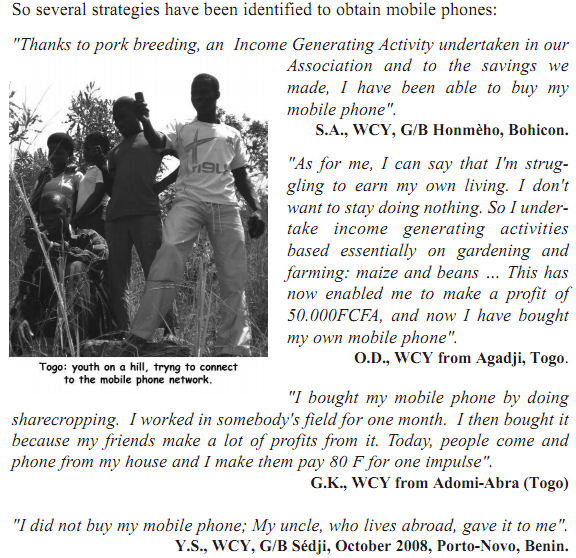
How do youth obtain and use mobiles? (MAEJT study, 2009)

In Egypt, colleagues said Facebook and Twitter groups around specific issues are common among young people in communities. But using ICT specifically for generating income is not. There is inadequate awareness among poor communities on how to make this happen. Although many youth have access to cell phones, ICT is still expensive and non-affordable for many others. Most of the families who have phones in their houses do not have a direct line, which means that they cannot get access to internet through cheap lines. Internet is still very expensive. Getting jobs through the internet is only common among advantaged, well- educated youth, not disadvantaged youth.

In Nairobi, Kenya, iHub and NAiLab have a big pool of developers and there is a lot of action. In rural Kenya, however, access is limited. There is a lot of interest from the youth who have started to catch on though, so colleagues felt it was possible that there could be some type of rural-urban mentoring or connections to help rural youth get on board. In rural Zambia, according to colleagues, sheer poverty means that very few additional resources and capital are available to take on new ideas. There is still very poor mobile phone coverage in some areas, and many young people have already left for urban areas. My colleagues in West Africa did not report seeing any youth developing apps or using Facebook combined with mPayments to generate income. In Kenya, Cameroon, Uganda and some other places, innovation hubs and labs are generating opportunities, but these again seem to be available to secondary- or even more often university-educated youth from urban areas and capital cities or large cities outside the capital.

So, is this bit about apps, mPayments and social media all hype? I’ll explore that a bit more in post 2 of the series. In post 3, I’ll cover the longer term considerations for ICTs and youth economic empowerment and some broader aspects that need to be kept in mind.

Read Full Post »

As I mentioned in an earlier post, I spent last week at the 55th meeting of the Commission on the Status of Women. The organization where I work supported 12 girls from various countries to attend and speak at different panels and side events during the week.

Why is it important for girls’ voices to be heard at global events like the CSW? Why should they be allowed to sit at tables with adult decision makers? Is this a wise investment when we could have spent that money to bring an adult staff member instead? Well, from a strictly rights-based perspective, it’s because girls have a right to participate in decisions that impact on their own lives.

But there are so many other reasons that girls need to be present at these events. They bring perspective that is otherwise missing. Before women are women, they are girls. It’s well known and well documented that investing in girls’ education and other areas has impacts that go far beyond schooling. At these big meetings, issues that impact girls and women are being addressed and discussed – so there needs to be space for girls and women who feel these issues directly to speak for themselves, especially girls and women who are typically left out of these processes. Girls bring a reality check. They offer ideas and solutions from their own contexts. They bring points home that can otherwise be missed. They are often amazing speakers and have incredible wisdom and insight to share. We can all learn from them. And bringing girls and their opinions and voices to a huge event like the CSW can really have a positive impact both on the event, the event participants, the decisions made there, and on the girls themselves, as they return home with a mandate to live their leadership in their own communities and countries.

Early in the week, I shared a panel with Fabiola, one of the girl delegates from Cameroon, and she truly stole the show. Here’s how:

Fabiola participates in the Youth Empowerment through Technology, Arts and Media (YETAM) project, and was selected by her peers to represent her group and Cameroon at the CSW. More information about Fabiola and Shira, the other girl delegate from Cameroon are in this post: Girls in rural Cameroon talk about ICTs. Shira also spoke at high level panels, as did the girls from Sierra Leone, Indonesia and Finland.

The girls also planned and managed their own side event where they talked about girls and new communications technologies.  In preparation for the event, they brought with them videos from their home countries, and Kirby, one of the girls from the US, edited them together into one piece. The video was shared at a few different events, and the girls were even asked to show it at the general assembly (at the last minute they weren’t allowed to for one reason or another). In any case, you can see it here:

On the last day that the girls were in New York, 3 of them sat on a panel in front of hundreds of high level decision-makers: UN officials, Ministers and government representatives. They talked about the challenges girls face in terms of accessing ICTs and raised the issue of violence against girls and how violence in schools impacts heavily on girls’ education.

My Cameroonian colleague, Judith, who works on the YETAM project with the girls, told me afterwards that she felt unbearably proud, seeing them there in front of the whole room, with everybody hanging on their every word. “I was floating,” she said. “As if my feet were not even touching the ground.” She was proud that Shira didn’t only present the issues that girls are facing in accessing ICTs or in terms of violence or early marriage, but Shira went further and talked about what they are doing in the community and how they are working with ICTs and conducting advocacy with decision makers and traditional councils to resolve the issues, and what impacts they have already had.

Josephine, one of the girls from Sierra Leone, said afterwards: “When I was there, speaking, I felt like I was on top of the world because people were listening to my voice.”

There needs to be more of this!

But if you are still not convinced, my fabulous colleague Keshet Bachan, coordinator of this year’s Because I am a Girl Report and the previous 3 reports, gives a convincing overview here about why girls and why now. Worth watching.

Read Full Post »

A little more than a month ago, I wrote a post asking ‘Where is the ICT4D distance learning.’ Ernst Suur and I had been trying to figure that out since last July.

A bunch of ideas and information came in via the comments section that helped us to figure out what is happening in the space, including info about ICT4D advanced degrees options, short courses, related courses, etc.

In addition to following up with a couple established universities to see if (and when) they might be offering Masters level ICT4D programs, Ernst and I had a skype meeting with Mark Weingarten and Nick Martin, the folks over at TechChange (the Institute for Technology and Social Change).

TechChange is a new organization dedicated to training practitioners and students to effectively leverage emerging technologies for social change. They are building tools and courses for ICT4D and have already partnered with a number of universities — eg., American University, George Washington University, the UN University for Peace — to deliver face-to-face courses in topics like ‘technology for crisis response’ and ‘social media for social change.’ They also have upcoming projects planned with U4UshahidiSouktel, and FrontlineSMS. In addition to in-person trainings, TechChange is designing learning tools for use in online courses and degree programs.

As Mark commented, ‘We are developing curricula for practitioners (including those working in the field), and recognizing that needs and schedules vary. Some people and organizations might want to quickly learn how to use specific ICT tools, but others may want a more in-depth understanding of the entire ICT4D ecosystem, its successes, its failures, and where things are headed in the future. We want to better understand this range of needs and tailor our courses. We’re also interested in knowing more about what else is being done in this space and what other examples we can learn from.’

In order to get some wider input, we invite you to join us for a twitter chat on ICT4D Distance Learning on Friday, January 14th at 11 am EST. The hashtag will be #ICT4DDL.

We will cover 5 questions:

  1. Topics: What sorts of courses would interest you most? What topics are most relevant?
  2. Timing: What timeframe for distance learning courses would best suit your schedule and needs? Short-term courses on specific topics (or tools) vs. more in-depth courses?  3 hr modules or ten week facilitated trainings?
  3. Credit: How important are things like credit or degree programs? Are certifications enough?
  4. Skills: What skills would you like to gain as a participant – considering 1) university students just entering the field and 2) practitioners taking professional development courses.
  5. Delivery: How does connectivity affect your ability to take courses? What about in the case of others who might be interested in this type of training but are not on Twitter/online as often? Is a mobile option a good idea?

Tips for a good Twitter Chat:

  • Login 5 mins ahead of time and be ready with a short introduction (eg, Cathy here, I manage maternal health pgms at XYZ in Malawi, we’re just getting started with ICT4D).
  • Tools like TweetChat which automatically add the hashtag and refresh often are helpful to keep up with the conversation.

We look forward to chatting on Friday, January 14th at 11 am EST and welcome any questions or comments before then!

Related posts on Wait… What?

Where is the ICT4D Distance Learning?

3 ways to incorporate ICTs into development work

Demystifying Internet

ICT4D in Uganda: ICT does not equal computers

It’s all part of the ICT4D jigsaw: Plan Mozambique ICT4D workshop

Read Full Post »

« Newer Posts - Older Posts »