Feeds:
Posts
Comments

Archive for the ‘m4D’ Category

I come up against a nagging question when I’m thinking about mapping, when I’m talking about the projects I’m involved in, or when I’m working directly with staff and youth in rural communities using participatory mapping methodologies….

Why is this kind of map:

(source:  MapKibera, on Wikipedia)

better than this kind of map?

(Source:  Plan project in Kwale, Kenya)

Well… is it actually better?  And if it is better, when is it better, for whom and why?

I understand how useful mapping information is for big picture decision making, trend spotting and knowledge sharing at different levels.  Mapping in various forms is incredibly useful for program and advocacy work, and there are many examples of how crowd sourcing, digital mapping, and information geo-visualization can be done successfully (mapping stockouts, elections monitoring, human rights incident reporting, crisis management, public health). The potential is huge and exciting.

But when I’m sitting around with a group of people in a rural community without many services, it can be pretty hard to remember or to explain the benefits of digital mapping over low tech map making. Why should people make a digital map if they only have sporadic electricity and internet access (if at all) and not many smart phones.  How will they access that digital map on a regular basis once they make it?  Does the fact that they could make a digital map, necessarily mean that they should?

I guess my key concern is around how digital mapping is directly useful for the folks who are inputting the information, building the map.  The “what’s in it for them” question.

As I was pondering this nagging question, @NiJeL_mapping posted something on Twitter that caught my eye and helped spur along the idea of working through these thoughts.  He was at the Mobile Data for Social Action in the MidEast conference, hosted by UNICEF Innovations and MobileActive.  He tweeted:  “what data are we going to collect, how will we collect it, and from whom?” Then he tweeted:  “Again, the push for technology w/o any knowledge of the intended outcome is frustrating” And a last tweet “overhearing whispers about how we need to focus on the technology, but impossible w/o knowing info to collect”.  This really reminded me that you need to have clear objectives and reasons for collecting data before you decide what cool new technology will be used to do it.  A few days ago I read JD’s blog post giving an overview of the whole conference. The key point for me was that the ‘target’ population delegation “felt overwhelmed by the host of tools and projects presented to them and were unsure how any of this could benefit them”. Luckily, he said, the conference organizers realized this and quickly altered the course of the event.

——————–
Well, if you have ever asked yourself a question, it’s pretty likely that someone else has asked it too, and you can find some answers online. So I went digging around for thoughts from 4 initiatives that I’ve been following over the past year or so: Ushahidi, MapKibera, Wikimapa, and now NiJeL too.

In very quick summary, Ushahidi is often (but not exclusively) used as a crisis mapping tool for rapid crowd sourced information, decision making, and trend analysis. Map Kibera and Wikimapa both use mapping and user-generated media for social inclusion, community voice, community media and community planning. NiJeL works with participatory mapping, bringing it to the web for a variety of geo-visualization uses such as planning, resource allocation, impact visualization and advocacy.

Mine must be not be a unique query, because I found that Erica from Map Kibera answered it pretty directly a couple weeks ago in a blog post called Maps and the Media “…the question about benefit to those who aren’t online misses the point. The digital divide is a fact and needs to be addressed, but when it comes to community information there is also a need for expression outward and collaboration within Kibera. Something like the Kibera Journal or Pamoja FM allows Kibera to talk to itself, while putting facts and stories online allows it to speak to the rest of the world (including wired Nairobi, politicians, national press).”

The objectives of Map Kibera seem similar to those of the
YETAM project, the initiative that has taken up most of my work hours over the past couple years. YETAM’s  main goals are engaging youth in the local development process and helping them develop the skills and tools to communicate and advocate for their rights and their ideas with local, national and global audiences.  The project starts off with map making to visualize community profile, community history, community resources, and risks to child rights and protection. Group discussions ensue, issues are prioritized by the youth, and they then create art and media around those issues.
The arts and media materials that youth produce throughout the project are shared with community members, district officials and national authorities to generate dialogue. They’re also plotted onto a digital version of their map and uploaded to the web for the global audience.

Since the local audience is the main one for the media and arts that youth produce during YETAM project activities, followed by district, national and global audiences, it would seem then that the same is true for the map. It must first speak to the local audience, to the community.  It should be first useful to users and producers of the information, as a learning/discussion tool and as a decision making tool, and secondly be useful to a national and then a global audience. Perhaps this will be the case for many of the initiatives that Plan supports and facilitates, given Plan’s child-centered community develop approach and the fact that we use participatory mapping methodologies in our community work all the time. So we need to find a way for the hand-drawn map to be transformed into a digital map (this is what we’ve been doing up to now in the YETAM project), or find a way to make a digital map attractive and useful to local people. Or we could also keep doing both the low-tech and the digital versions.

[Update:  “Paper rocks!”  Mikel from Map Kibera (read his comment below) shared some additional tools that Map Kibera uses to ensure that information collected is available in the community.  One is called Walking Papers.  It is a paper based GPS where you print the map, re-draw it or add details, scan the new version and it automatically geo-rectifies the paper.  They will also be printing and distributing paper maps, and considering forums around the paper maps to increase participation from people who don’t use computers.  Also Mikel commented that drawn maps like the one in the image above can be stored and/or made available to the community using Map Warper.  Here you scan and upload a map, set control points, and then get a geo-rectified version for use online.  Excellent.  This gets better all the time.  :-)]

The Wikimapa Brazil project (paraphrasing from their website) aims to promote social inclusion using virtual and mobile mapping in low-income areas and slums, since available mapping services have not offered information from these marginalized areas.  The project aims to democratize access to information and raise low-income youth’s social participation from simple consumers of information to providers of information and change agents promoting local development and broadening perspectives and creating new cultural and geographical reference points.  In this case, the project goals are similar to YETAM and Map Kibera, but the project is primarily aimed at reducing marginalization and exclusion within available mapping services.  Therefore it seems relevant that on-line mapping is chosen as the mapping methodology.  It may also be the case that residents in the project area have easy access to internet, meaning they would be able to continually use and benefit from the on-line maps.

Patrick Meier from Ushahidi and the Harvard Humanitarian Institute talks specifically about the concepts of participatory mapping, social mapping and crowd feeding during this 30 min video. He comments that the information that’s collected via “crowd sourcing” needs to go right back to ‘the crowd’ who provided it (crowd feeding).  One way that Ushahidi is doing this in communities that do not have regular access to internet is by allowing people to subscribe to SMS alerts when a crisis event hits a particular area where they have a special interest.  Another way to ensure that map makers have information returned to them, he says, is to use transparencies in a manual approach to GIS where information is made more compelling by laying thematic transparent layers over a base map to show dynamic changes and trends.

Patrick points to Tactical Technology Collective’s Maps for Advocacy booklet which documents a number of different mapping techniques and mapping projects and how they have been used for advocacy.  So, I would conclude that in the case of Ushahidi and crisis mapping to see trends in time and space, to have immediate and up to date information, and to manage a broad set of information for crisis decision making, it also is logical that an online map is the primary mapping methodology.  In this case, the information is crowd sourced, so it comes from many, and it’s processed and aggregated on Ushahidi to go back to many.  Because the information in a crisis situation is changing rapidly, it would be difficult to use a static map, a hand drawn map or one that is updated less frequently.

In the case of Plan, as part of the Violence Against Children (VAC) project we are planning to pilot incident reporting by SMS of violence against children and subsequent mapping of the situation in order to raise awareness among families and community members, and to advocate to local, national and global authorities to uphold their responsibilities and promises in this aspect.  The question here will be how to make both crowd sourcing and crowd feeding something that is easily accessible by the participating youth and communities as well as to the other audiences in order to have the desired impact and reach the desired outcomes. The participating youth have already been trained on violence against children (VAC), its causes and effects, and ways to advocate around it.  Now the key will be training them on the technology so that they can discover and design ways to use it  to meet their goals.  A key point will be evaluating whether the outcome is a reduction in VAC.

So in conclusion I would have to say that one map is not better than the other map.  They are both amazing  tools and need to be selected depending on the situation. There is no one size fits all. It goes back to the point of having defined objectives and outcomes for the initiative, knowing what information will be collected, why, with whom, by whom, and for whom first, analyzing the local context as part of that process, knowing about what tools exist and finding the right tool/technology/information management process for the goals that people want to reach based on the context. It’s also about keeping the end-user in mind, and ensuring that those who are producing information have access to that information. I think I will have to keep my question in mind at all times, actually.
——————
Related post on Wait… What:
Read Full Post »

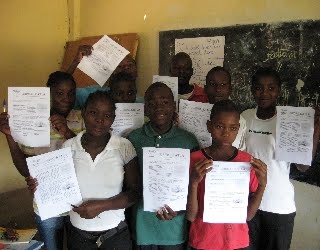
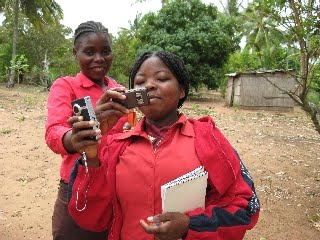
Saturday, was the last day of the 2-week Youth Empowerment through Arts and Media (YETAM) workshop with the youth.  Each of the sub-groups had the task of prioritizing 2-3 areas that they wanted to focus on over the next 6 months and developing a basic plan. The plans included their focus issues, analysis of the causes of the issue, what they would do about it using their reinforced media and arts skills, when they would do it, and how they would know that they had achieved their short term goals (indicators). Photo: members of one of the media teams.

Nathalia, age 18, presented for the theater group. “We are going to work more on the issue of devaluation of girls by their parents.  This is caused by the belief that men were made to dominate and women to serve, the idea that girls don’t bring any benefit to their parents, but bring only trouble, and the idea that girls are physically and mentally weak.”

The other 4 groups’ topics are:

· Music/Dance group: children’s rights in general, education as the key to a successful future, the value of local culture and traditions.

· Media group:  disaster risk reduction and risks to youth in the community such as the discotheque, alcohol and drugs, and violence.

· Painting group: child rights in general, drug abuse and protecting children from violence/risk.

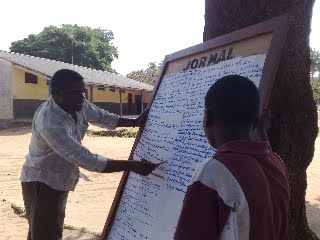
· Journalism group: sanitation and hygiene, education.

Mobile data gathering?

The groups will prepare work on these topics and extend their messages out to the school community and the surrounding villages.  To track their progress, they plan to survey audiences that have seen their work (eg., their films, paintings, songs, theater, newsletters, etc).  This made us think about the idea of using mobile phones to do the surveys (Nokia Data Gathering or Frontline SMS Forms, depending on which is more feasible and cost effective).

The youth could create surveys on a few devices, and then go around to survey people who have attended their events or viewed their work and heard their messages.  The youth could then have immediate results by exporting the survey results into excel for analysis.  In the process, the youth can learn about statistics, charts and graphs.  Eventually they could also take surveying to another level, such as looking at behaviors and practices, and use the information to inform the outreach work that they are doing.  Photo:  Thinking about mobiles for more than calls and SMS.

“The kids see charts and graphs sometimes in their books, but they never have a chance to learn what actually goes into making a chart or graph, or to cover anything about statistics.  This would be a fabulous hand-on way to see how data is collected and used for decision making and to measure results,” said Lauren, the Peace Corps volunteer teacher at the school. “It would be great for them to get to see immediate feedback on their own work!”

Feedback from youth

Photo: journalism group shows their newsletter.

At the closing ceremony the youth were sad to go. “This is an opportunity that we had to participate in something that has never happened here at Cumbana,” said one girl.  “I encourage my fellow students here to show through their behavior, actions and their studies this coming year that they are now different.  That they are changed.”  (theater group)

“I never imagined that I could be a painter, but now I have the dream that I can do it.  I am happy because I showed what I’m capable of and I expressed my feelings through art.” (painting group)

“My favorite thing was making the big mural. I feel very proud and I can show my friends what I’m capable of.” (painting group)

“This initiative allowed us to show light on our reality. I also know now that I have talent in my mind and in my hands to express myself now and to build my future.” (journalism group)

“I really thank Plan and Nokia because with this workshop I saw myself transforming my life. I will become an artist and I will make something out of my life” (painting group)

“I liked helping to raise awareness in people and to change things in our community and in ourselves.  I want to share the success we’ve had in this project and our work, and to involve more people. There are many things we can achieve.” (media group)

“The best thing about the workshop was the way that they listened to us, they gave us courage to believe in ourselves. They reminded us that nothing comes from nothing and that only through education can we prepare for our futures.” (theater group)

“I liked working with equipment that I had never seen.  Now I know how to use it. I feel able to learn without fear.” (media group)

And facilitators?

“It was great to see the youth increase their knowledge about their culture, history, rights and the role they can play in their community as agents of change.  I loved seeing the youth apply the things that they learned and then do the work by themselves.  I would like to see more adults in the community participating in a workshop like this. There are many things that we can benefit from as well.” (Facilitator)

“I thought the workshop was fantastic.  The kids gained so much experience and confidence and really took advantage of these new opportunities.” (Facilitator)

Related posts:
On Girls and ICTs
Putting Cumbana on the Map

Read Full Post »

We’ve completed our first week of arts and media training with around 55 youth in Cumbana, a coastal community some 450 kms north of Maputo, the capital of Mozambique.  If you ever tried to Google Cumbana, you’d find information about a photographer with the same last name or links to tourist hotels at the nearby beaches in Maxixe or Inhambane, and not much else.  We actually did this as part of our Tuesday session on Internet with the youth.  Googling New York was another story.  But why?

We turned it around to the youth. Why is there no information on Cumbana?  The conclusion was you only find things on internet that someone puts there, and  no one had bothered, no one had ever really uploaded anything about Cumbana.  And that meant that this group of youth has a big responsibility, because they are going to be the ones to put Cumbana on the map. Photo:  After Cumbana, the top Google search among our small population was, of course, Michael Jackson.

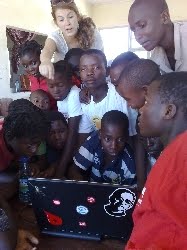
What does that mean?  Aside from producing arts and media to raise issues that affect them and engage their communities in jointly finding solutions, the youth will be the ones to define Cumbana.  As Lauren (the Peace Corps volunteer who’s been teaching at the school for the past 2 years) said:  “Did we find anything about you all in Cumbana now on the internet?  No.  When will there be something about Cumbana?  When you make the effort to put it there.”  Photo: Mobile phone connections are much more likely than computers in the near future, so we trained on internet also using mobiles.

Access to internet whether by laptop using mobile internet or directly on a phone is a huge hit with the kids, 75% of whom had never been online before.  Our 2 hour session could have gone on all day for all they cared. The idea of putting yourself on the map seems to have appeal in the same way that having a Facebook page does.  It’s about self publishing and creating an identity. Photo left: Anthony the local Peace Corps Volunteer supported with the internet and is working with the theater group.  Photo below: Lauren, Peace Corps Volunteer, is working with the multimedia group.

But as we are seeing more and more, citizen journalism has its downfalls (think Fort Hood).  So it was great to see the debates about ethics in journalism that also happened last week.  Jeremias from Radio Mozambique facilitated a great session. He was excited to be part of the workshop because, as he said, “I’m a journalist.  I want to groom more young people from right here in the community where I came from to follow in my profession, and this is a great chance for all of us.”

During Jeremias’ session on ethics, the kids hotly debated the question of whether you should show the face of someone caught stealing.  Many felt that this would punish the thief as well as protect the community. Jeremias countered, “In Mozambique, whose job is it to determine guilt or punishment? Eh?  It’s not the role of the journalist. It’s the role of the judicial system. Like it or not, that’s how it is.”  He talked about the basic rules in journalism to protect people, about divulging information and objectivity. “When you leave here, to do work out there in the community, you need to be sure to hear all sides.  You need to protect the good name of people.  This is our responsibility.  This is ethics.  You cannot condemn someone until the judicial system has determined that they are guilty.”

I sat there wishing every self-appointed citizen journalist followed those rules, and self-examining whether I always do.  But it also got me thinking about how when you are not in a free state, your judicial system is totally non functional, or there is corruption within the journalism profession or media houses, things are not nearly so clear.  Sometimes things need to be filmed to get something to happen, whether they’ve been proven or not.  What are the rules and ethics then?  (I’m sure I can Google this and find a debate!)

The youth were cautioned to leave aside sensationalism.  “Often wanting to be the first to get the news out makes us less careful as journalists” Jeremias said.  If we drop the bomb, we’re likely to see the next day that we are the ones being processed, accused of not being ethical.” Photo: Jeremias and a youth participant share ideas.

“The ethics of a journalist come from within us,” he said.  Sometimes even a journalist’s own employers may ask him do things that are not ethical.  Or others want a certain story to come out and they try to bribe a journalist.  This makes it really difficult to be a journalist. A journalist needs to have high and strong ethics and maintain objectivity,” he told the kids.

“So you see, journalist is under constant pressure. It’s REALLY easy to get a recorder, to make a story.  It’s more difficult to think through what the consequences of publishing that story might be.  As a journalist, your goal is not to get famous; it’s to transmit information, so get the idea of fame right out of your head.”

Jeremias is a wise man and we are really lucky to have him training our group of journalists.

Cumbana is the only secondary school (it covers to 10th grade) in the entire district, with 3 sessions a day, serving some 4000 students (if the teacher I asked is correct). The opportunity to participate in a program like YETAM is huge for students and teachers alike.  In addition to the journalist group, there is theater, music and dance, multimedia, and painting.  For the kids, it’s like a 2 week summer camp where they strengthen leadership skills, improve their studies, get organized to address community challenges facing youth, and think about careers outside of the norm.  For the teachers, it’s an opportunity to engage with students in a different way, to strengthen their teaching methodologies and improve their ICT skills.  For the partners, it’s an opportunity to give back to the community and, of course, to discover new talent for their professions.

Related posts:
On Girls and ICTs
Being a Girl in Cumbana
Is this map better than that map?

Read Full Post »

Plan Mozambique’s team has been discussing ICTs in their work using the distance learning packet that my colleague Mika (at Plan Finland) and I put together with lots of support from Hannah Beardon. This is part of our ICT4D research and training initiative in 8 countries (Senegal, Togo, Mali, Cameroon, Ghana, Mozambique, Kenya, Uganda) that will conclude near the end of the year.

This initiative is two-fold —

1) to consolidate some information/research on what’s currently happening in each country (in Plan programs, by other organizations, general ICT landscape, government policies) that staff and managers can use for making decisions around ICT in their programs and other work; and

2) to offer a methodology whereby local staff can identify existing information and communication needs, means, mechanisms and flows on the one hand, and learn about new technology on the other hand to see if any of the new tech is a fit (in its current state or in an adapted state) to meet the existing needs.  One really important aspect is offering ways for local staff to look at the context in which they work every day and see what tools would be useful or even usable (here I like to think of those 4 C’s of successful ICT deployment -connectivity, cost, capacity, and culture).

The end goal is to improve program impact on the ground by strengthening staff capacity to look at their programs with an ICT lens.

Our distance workshop materials (which are pretty amateur — power points with accompanying home-made videos, downloaded videos from other sources, skype calls to expand the discussions) got good feedback from staff.  (This is likely due to my colleague Mika’s great sense of humor more than anything!) We’re thinking of making a few new modules to cover new tech that we’ve heard is being used in Africa or elsewhere, or that we find out about (at workshops, via Twitter, via staff in other countries, from blogs and other sources) so that interested countries could program additional ICT4D days to continue discussions and learning about new tools.

Today we got feedback from Plan Mozambique staff. The main learning/points that came out of the workshop were:

  • Demystifying ICT. “For some of us who are only NGO workers without formal training in ICT, we get scared, we think of megabytes, how info flies, all those things.  But we found that all of us use ICT – our cell phones, our gadgets, the things we use daily, internet, intranet — it’s all part of the ICT jigsaw.”
  • ICT is not stand-alone. “It was quite a useful exercise to see how we can incorporate ICTs in our programmatic interventions.  Again- we realized that all this is now linking up with the rights based approach, with our child centered development approach.  So today and yesterday we’ve seen how ICT can serve in this perspective. Especially today it was very directly apparent how ICT integrates into these approaches. ICT is not a straight alone aspect.”
  • Learning how to map communications networks, identify local communications needs, see what added value Plan can give by improving it directly, strategically or indirectly. “This was a good way for discussing ways to address information and communication needs and ways to bring about better impact in development programs using our current rights based approach,” as one staff put it.
  • Opening windows of opportunities and identifying existing challenges. “We need to map available ICT tools and see what is appropriate in our context to apply.  Some of the common ICT tools in the Africa context are still a challenge. We don’t have electricity in most of our rural communities.  During the mapping exercises on ICTs we need to take that into account. To find the means to identify the tools that are most appropriate. Mobile phones still need to be charged. We can solar charge, but I’ve yet to see this myself.  We can use other ICTs in our programs, but mostly things like radio, TV, particular videos. These tools are already available in the community, everyone in the community has a radio. TV is a challenge. Mobile phones are challenge still.  Mobile phone could add costs to the community leaders, and later would not be sustainable. This needs to be looked into to see what kind of solutions we can find to overcome it.”
  • Gaining insight into ICT4D, its dynamics and uses in communities. “It’s important to understand that we are still a very primitive country.  Different colleagues have raised the question of infrastructure. Yet there is a huge opportunity for us to create space for growth. It’s difficult for us see – we want to really engage community members but wonder if they would feel out of place due to their levels of understanding. We feel they can deal with technologies like mobile phones but when it comes to computers it would be much more difficult. But this workshop was an eye opener. Technology is not so mysterious.  We need to try our best to make technology something simple that can be used by anyone, just like mobile phones, small children can use them. If all other technologies could be that simple it would be great.”
  • Balancing possible/feasible and creative/innovative. “We’ve seen some tools that can help us with new ideas as well as with existing programs. One thing we need to address clearly is guidelines on social media to set up a basis for those who are trying things out. Also thoughts around content management and delivery.  How can countries capture information and communicate it out in a way that gets the message across best. We can also do more learning from others about ICT4D programs, especially about their context and what is the process leading into these projects, what conditions were in place.”
  • Greening our ICT4D.  “Another thing we need to really consider is equipment which with time becomes obsolete – how can we recycle equipment and put it to better use?  Green equipment – how to stop generating trash in communities. Renewable energy sources – solar was mentioned, tapping wind energy also – how can we look at that and enter into that as well.  And what about other appropriate technologies that are not IT.  There are innovative irrigation pumps that are very effective and cheap.  Magnetic torches that don’t use batteries which come in very handy.  There are many things we could adopt and incorporate.”

Related Posts:
I and C then T
ICT ideas from Plan Cameroon
ICT4D Kenya: ICT and community development is real
Modernizing birth registration with mobile technology
In Kenya brainstorming on mobiles
Chickens and eggs and ICTs

Read Full Post »

Next week I’ll have the honor of (wo)manning the expo table for Plan at the Clinton Global Initiative (CGI) Exchange [the networking event after the actual CGI meeting]. It’s Plan’s first year at the CGI, which is exciting for us as an organization. The project that we’ve committed to is a convergence of many of the things that Plan has been getting deeper and deeper into in the past few years – youth engagement, youth employment, participatory media, social media, ICTs, youth voice, youth-led advocacy, and last but not least, girl power. I’ll be supporting the project with some training around social media and ICTs based on experiences in past projects such as the Youth Empowerment through Arts and Media project.

Our commitment, Vocational Skills and Media Training for Adolescent Girls in Ghana, is a three-year project that combines job skills training for girls with media production by girls.  The combination of these two elements will give girls key skill sets for employment opportunities while also creating public platforms for girls to raise awareness and advocate on issues affecting them. Through the project 140 adolescent girls will participate in training on media production and journalism, including citizen journalism/social media.  Of those, some will go on to participate in an internship program to do hands-on work in media.  The girls will be trained on how to use diverse types of media, including traditional as well as new media, to advocate against gender discrimination.  Adult journalists will participate in Plan’s training program on child rights and gender respect in media.  In the process, the project will engage the public through radio, television and web communication around the challenges that adolescent girls face in West Africa at the community, national, and regional levels. Participating girls will also have opportunities to meet and share experiences with each other and their female Ghanaian journalist mentors.

I really like this project because it brings so many critical elements into one initiative.  More and more Plan is supporting this type of work in Africa, and it really makes a difference in the youth themselves in terms of skills, self confidence, team work, and learning how to communicate issues of importance in a confident and respectful way.  It helps them access information and new skills that help them find employment. It also has an impact on communities who see their youth in a new light and who become more open to dialogue with youth around issues that youth want to discuss but may not be able to bring up in existing forums.  The media produced by children and youth can raise awareness and encourage dialogue at the national level, and it can be presented in global meetings to bring youth voices and a dose of reality into high level discussions. It can be shared on the internet to engage and involve people in other parts of the world, and to break down stereotypes about Africans. I also think one outcome will be that the participating girls and women will contribute to modernizing the field of journalism in Ghana because they will be trained on new media tools and they will likely think seriously about how girls are portrayed by the media in the future.

Plan’s research “Because I am a Girl: The State of the World’s Girls” came out in 2007, highlighting the urgency for us to focus more programs on girls as key players.  Out of this report, a decision was made to make girls Plan’s key focus over the next several years, and the Because I am a Girl Campaign was launched.  Since then, two in depth studies have highlighted specific issues: Because I am a Girl: In the Shadow of War (2008), and Girl’s Economic Empowerment (coming out later this month).

Come by our table to say hi if you happen to be at CGI exchange!

Related posts:

On Girls and ICTs

Being a girl in Cumbana

An example of youth-led community change in Mali

Read Full Post »

I had a chance to meet with Plan Cameroon’s Program Technical Team today (including those that look at Monitoring and Evaluation, Health, Education, Sponsorship, Child Protection, Water and Sanitation, Gender and the overall Program Support Manager) to give a quick brief on the ICT4D research and training that Plan Finland is supporting with Plan offices in 8 countries in Africa (Mali, Senegal, Cameroon, Ghana, Togo, Mozambique, Kenya and Uganda).

We are working with Hannah Beardon, who wrote Plan’s Mobiles for Development guide (available in both English and French) and building on that towards some more focused and concrete ideas for ICT use in these 8 countries. We’ll share the research with staff during 2-day workshops to brainstorm and gather ideas on information and communications needs, as well as available tools that could be used or adapted to local situations.

The 2-day workshops are planned for Aug and Sept. Hannah, Mika (Plan Finland) and I are developing the methodology and will make a training DVD to send ahead of time to each country (apparently complete with our selves doing presentations!) since we don’t have funding to do face-to-face training. We’ll have a staff person in each country as the main facilitator, and 10-12 key staff, from management to frontline, will attend. Mika or I will beam in by skype to support if needed. We’ll use the Frontline SMS demo video that Mika and crew did also, (see my earlier post about this from a few months ago), show how Nokia Data Gathering Software works, share the Common Craft Social Media videos, among other things. Hannah’s methodology will also come in for thinking about how ICTs could enhance existing efforts.

The idea is to both learn about new tools as well as look at current programs and see if there are ways to use ICTs to improve impact, and how to begin tailoring them to the programs and local settings. We’re also doing research on government policies and how Plan’s work links there. I hope that we can also look at partnering with local developers and ICT4D innovators in each country….

The idea of ICT4D was a bit new to some of the Plan Cameroon staff and not at all new to others. One interesting idea they shared was using SMS in anti-malaria programs to periodically remind people to retreat their bednets. There was some concern about literacy rates if one relies on SMS, and interest in using voice response, but given the number of languages in Cameroon, voice could also be a bit of a challenge. I’ll have to try to find out if/how that’s overcome in other places. Another concern was ‘scamming’ and how to avoid that happening. But it seemed that the issue of scamming is not something that Plan alone would face, but something in general that is faced with mobile phones.

The program support manager was really keen on using mobiles for program monitoring as that is something that can always improve and be more efficient with ICT, he said, and wants to test some ideas. The ICT manager also said he wanted to write something up. The sponsorship manager suggested trying out some data collection or quicker communications tools for linking with community volunteers. And as mentioned earlier, child media and child protection are areas that can be greatly enhanced and supported via ICTs (help lines, SMS incident reporting, social media and mobile reporting).

After the 2-day workshop, we should have something really nice to go forward with.

Read Full Post »

Childline Kenya is about child protection. “We run at 24 hour children’s helpline which is both an emergency response service for abused children who need someone to help and an information line where children who have difficulties or questions that are bothering them can call us, we can talk to them, have a chat, do counseling on line, deal with abuse.” Irene Nyamu is the Deputy Director of Childline Kenya. She also worked at Plan for about 3 years before moving to her new post. Photo: Irene during a community visit in Kwale.

At Childline, Irene is constantly looking at new issues and situations because the field of child rights and child protection is vast. Childine works with everything from adoption issues to drug addiction to child abuse within the family and juvenile justice. “I wasn’t too versed in legislation, laws that relate to children and I’ve had to learn so much,” she says.

Before Childline, there was a government line, but it wasn’t a 24-hour line and it wasn’t free. If a child wanted help they had to have money to call. “What we’ve done as Childline is try very much to leverage support from the government’s Dept. of Children’s services.” For the last 3 years children have known that they can call to get the service. But Childline has involved government of Kenya along the way. “We’ve helped build government capacity and have proven that it’s possible to have a child helpline without a heavy cost. We’ve demonstrated its usefulness.”

When Childline first started, they had a fixed line with a free call number and got around 600 calls per month. “Since we’ve moved to mobiles, we get about 20,000 calls per month and we are still not meeting the needs of the population.” Childline Kenya’s has 9 counselors during the day and about 6 at night. To optimally operate, Irene estimates needing around 15 during day and 10 at night or more. “When we were on a landline, we had a long phone number that was difficult to remember, and most people don’t have access to fixed line. So now with the 116 short code, it’s quite easy to remember and very accessible on mobile.”

As for concerns that children cannot access a phone to report in, people should not assume children do not have access to phones. Childline confronted this and has proven that if the information is out there, children will find someone that is willing to help them make a call. “Many children now call us even without a fixed line. They have a teacher, an auntie, a big sister who will allow them to borrow the phone. I’ve seen that almost everybody in the community has a SIM card. They do not have a handset, but when they need to make a call they just borrow a handset for a few minutes and somehow they do it. We can’t make the argument that children can’t use technology. There are innovative ways of using the technology so let’s put the technology out there and stop assuming that people can’t access it.”

What about credit? This is a very important issue. “If organizations or institutions want to use SMS, then there is an investment cost unless you are able to acquire a short code.

Childline tracks how many people have dialed in and how many calls they actually receive, and they currently receive many more calls than they are able to manage. Irene thinks that one way of extending the service out to more children might be an increased use of SMS, which is extremely common and accessible in Kenya. “To meet the needs of our population, I think this FrontlineSMS training was really useful. We can now go in to explore how to use SMS for child helpline work in order to offer more alternatives to children. If you can’t call, can you SMS? And how do those numbers compare?” Photo: Learning to set up Frontline SMS for mobile data gathering, SMS outreach and auto-responses.

“I love working at Childline because every new day is different. Every new call that comes in, you can anticipate a new challenge.” One way to meet some of these challenges is via new technologies such as mobile outreach and mobile data gathering.

Read Full Post »

Jonathan Mativo, whom I first met in Kenya in December at our Social Media for Social Change workshop was one of our core FrontlineSMS trainers last month. In January, Mativo left Plan to found his own organization called ICT4D Kenya which operates in the Kilifi and Machakos districts in the Southern Coast of Kenya. He was motivated to move beyond the commercial ICT sector to ICT4 community development by his 4 years of work at Plan. “Previously I didn’t have any background on ICT4D. I only looked at ICT from the operational point of view but Plan really inspired me to work with children to see them realize their full potential.” ICT4D Kenya envisions young children confident in participatory media, children that see ICTs as enablers for development rather than just tools to perform work. “We also foresee a changed community – people who are socially together.”
Photo: Mativo is the founder of ICT4D.

ICT4D Kenya targets communities and schools, with the aim of building the capacity of youth, men and women through community ICT resource centers to introduce them to new ways of learning. ICT4D Kenya is also experimenting with interactive learning. “Normally students learn by rote. They basically take notes extracted from text books.” In their free time children expected to study, but “they are just revising materials from textbooks that have been copied into their notebooks…. They are hardly concentrating on what they are doing.” Mativo wants to introduce interactive learning materials in schools so children will be more attentive in class. He’s also planning some school linking projects where students in different districts can communicate to share culture and motive each other to improve school performance. Photo: Wajuhi and Mativo at Plan’s training on mobile data gathering in Kwale, Kenya

We’re not talking old, slow computers though. “One thing about Africa is that we are used to free things. That’s why we are congesting our country with refurbished things.” Mativo believes that to take ICT ahead in Africa, schools need access to the technology that they would get in the real market. “Often we get old computers, slow, hard to maintain and without proper e-waste solutions. We should be looking at affordable technology and ways to get ICTs to Africa rather than just dumping refurbished equipment.” So what about refurbished/donated phones? “Small gadgets are a different story. If you look at the features of a mobile, as long as it can send an SMS, it’s fine. SMS is one thing we are really looking at for social change.”

Mativo has worked with one school to install FrontlineSMS (http://www.frontlinesms.com/) in order to communicate with parents. This year there was a teachers strike. Most schools sent their children home. But this school got all the parent/caretaker contact information. “Within 2 days we had all the mobile numbers.” They keyed them into FrontlineSMS and the head teacher used the software to send an SMS to all the parents and asked if they should send the children home or not. “We got 237 out of around 400 messages back from parents on the first day saying ‘don’t send our children home’ and the rest said to send them home.’” So the head teacher kept the children at school, and when a parent questioned the decision at a parents’ meeting later in the year, he used the SMS he had saved to explain the reasons.

Now the school is using the software for all kinds of things. On annual Prize Day instead of the normal low turn-out, they had 75% turnout for the first time this year. “Parents said you communicated with us in due time by SMS and kept communicating with us over time to remind us.” Normally students are given newsletters during holiday times and parents don’t remember key dates when they finally roll around.

Mativo sees his role as demystifying ICTs and finding the best way possible to ensure people understand ICTs from a non technical point of view. “When I have to explain what a computer is, I always refer it as ‘that box there’ so that people don’t look at it as too delicate. In most cases I open the CPU for people to understand that it’s just an empty box that they shouldn’t be too afraid of.” Mativo says that many people believe it’s not possible to change their communities’ way of thinking, especially people who are working in commercial ICTs. “They need to internalize what community development is all about and that ICT can be downgraded to reach out to people in communities regardless of their skills, their background and their exposure. ICT and community development is real.”

Photo: Simplifying ICTs for people.

Related posts on Wait… What?

7 (or more) questions to ask before adding ICTs

Read Full Post »

As part of our mobiles for outreach and data gathering training last week, we went out to a community about 20 minutes away from the hotel today to hear Silla, the district civil registrar, talk about a project that Plan Kenya is supporting that aims to modernize the birth registration process. Plan Kenya is looking incorporating mobile data gathering and outreach into the project, so it was a good opportunity to test data gathering. We tested the Nokia Data Gathering Software using a form that the team had created earlier in the week based on the paper forms that the District Registrars office uses. It all worked just fine. Photo: Silas from Kwale District, and Petri, Director of the Nokia Research Center in Manaus, Brazil.

Silla is really an expert on birth registration and anything that has to do with it. He can quote you just about any law related to the subject in great detail. Currently, for registering births, people have to go to the sub-registrar/assistant chief’s office which can be quite far. Once there, sometimes there are not enough actual registration forms and they just give the registration information to someone who writes it in a school notebook. Later when they have more forms, the information is transposed to the official form, and sent along for processing. It can take awhile for processing, and people have to return to the sub-registrar’s office personally if they want to find out if it’s ready. The district is quite large, so they may have to travel up to 100 kms sometimes to go into check, and the certificate may not even be ready yet. Photo: Silla schools us on civil registration and explains why the district wants to modernize the process.

I talked to Ali M and Ali K (‘the Ali’s’ as we call them, since they are pretty much inseparable) who both work with Community Based Organizations (CBOs) that are participating in the birth registration project. (They were both at the video training with me last month here also). They explained some of the main reasons that not having a birth certificate makes life difficult:

If children don’t have birth certificates, they cannot get passports obviously, but that is the least of the issues. They cannot attend secondary school without one, nor can they benefit from any type of social service or insurance. Kwale district has a very high incidence of child marriages, yet if there is no birth certificate there is no way to prove in court that a girl is too young to be married. Other kinds of abuse also cannot be proved as child abuse. Without proper registration, the district does not get its fair share of the national budget because it’s not clear how many people are actually there. Photo: Ali K and Ali M – real leaders and innovators in community development.

As the Ali’s explained, if Kwale District is successful in incorporating SMS’s, mobile data gathering, and mobile outreach into the birth registration process, not only will they be the first district in Kenya to do it, but Kwale will be the first to even computerize the birth registration process. A couple ways they want to use mobiles are to provide a phone number that people could SMS their registration number to and find out if their certificates are ready or not, thus avoiding a long trip into the district office for nothing. They are also thinking of shifting the actual data gathering from hand written (carbon paper with several copies) to mobile data gathering and computerized data storage. In any case, a full project is being developed and piloted that will automate much of the current time consuming processes.

I remember when I lived in El Salvador and the municipality changed from hand written logs to computers. You used to have to go really early in the morning and wait in a huge line to get a number. Then you waited again till they called your number, went up and gave someone your information. That person would give your information to someone else who would look up the name/date, etc. and after an hour or 2, they’d call you and give you a little piece of paper with your record number on it. From there you would go wait in the cashier line to pay a fee for the copy of the certificate. Then you would go to another line at another window and give that number to someone else and sit down again for another few hours while that person would go into the archives books (bound books of hundreds of records) and find your certificate for you (birth, death, marriage, etc.). They’d make a copy and then it had to go to an official somewhere to authorize the copy before they’d give it to you. So basically you had to get there around 7 a.m. if you wanted to get it the same day, and it was a whole day affair.

Around 2000, they got a computer system in and modernized the process. I went in to get a copy of a document, and I clearly remember the security guard laughing at me because I looked at the certificate twice in shock when I paid my fee and was handed the actual certificate after about 30 minutes.

If the Ali’s and the Kwale District are able to get the equipment and set the project up, it could mean huge time savings for people and translate into greatly increased numbers of parents getting birth certificates for their children. The Ali’s have already taken the idea to a national level meeting and have other districts interested in their idea. Hopefully Kwale pulls it off and the model can be nationalized once any kinks are worked out! Photo: Mwenda and Ali, Kwale district CBO members.

Read Full Post »

Building on the last post, I wanted to share also some of the discussion at last week’s Kenya workshop about incorporating mobiles into our work. People in general were pretty excited. Even those people who were skeptical seemed to see mobiles as tools that could improve work we are already doing if well incorporated and done from ‘the bottom up’ in sustainable ways, based on program information and communication needs. Some great discussions came up and participants shared some potential solutions and good practices.

Issue: Access

We are working with children. How many children have phones? How do we get information from children? We work with communities who are the “poorest of the poor” – so how do we get info from them using FLSMS – do we expect them to have phones? Or people may have phones but no credit? How do you handle such circumstances?

Use a short code if you can get one

Credit is a very important issue. If organizations or institutions want to use SMS, then there is an investment cost unless you can acquire a short code. If you have a short code you deposit money to make this free or much lower cost for people.

Don’t assume that children don’t have access to mobiles

We should not assume children do not have access to phones. If the information is out there, children will find someone that is willing to help them make a call or text. Many children now call us (at the Child Help Line) even without a fixed line. They have a teacher, an auntie, a big sister who will allow them to borrow the phone. I’ve seen that almost everybody in the community has a SIM card. They do not have a handset, but when they need to make a call they borrow the handset for a few minutes and somehow they do it. We can’t make the argument that children can’t use technology. There are innovative ways of using the technology so let’s put the technology out there and stop assuming that people can’t access it. The issue is how can we make the technology reach as many as possible?

Give out SIM cards with a few minutes on them to protect privacy and confidentiality

We had a similar situation with a reproductive health project that was offering out information that most girls wanted to remain confidential. What we did was gave out 10 bo SIM cards. We passed them out in little boxes. Many of the girls had phones but wanted to send in anonymous questions so they used the SIM cards to send the SMS in, and then removed the card from the phone, put it in their pockets, and replaced their original SIM. It only costs 1 shilling via Orange. We found that normally the SMS conversation lasts for around 6 shillings. They can maintain anonymity this way. It’s cheap and they can just keep these SIMs in their pockets.

Issue: If mobiles begin to replace face-to-face contact and relationships with partner communities.

Using Frontline SMS for community outreach and communications has many advantages, particularly in terms of the information that we constantly need to gather. However, we should be careful though that it doesn’t substitute field visits. If people get used to getting information quickly they are likely to avoid going out and getting in touch with communities to see what is happening. If you just sit and wait for an SMS you will lose this face-to-face contact with the community.

Mobiles can be a tool, but must be integrated with other communication means

This point reminds us that we should not totally substitute it but use it as an additional tool in the toolbox to improve, cut costs, reduce, etc.

Issue: A text does not give enough space for full and clear information in health or other cases

We talked about using Frontline SMS for radio. In our participatory youth media programs, children bring out issues in video, in radio, etc. We are not always able to respond immediately to their concerns and issues. FLSMS could be a way to respond to these issues. Are there examples of how to pass on this type of technical information? If I’m a midwife and am too far from hospital, I need very clear information. How could this be done with SMS via an auto reply and only a short amount of text?

Use SMS to bring face to face help more quickly and to track/record incidents

SMS isn’t a solution for everything, but I know of an example of how that can work. There is another program called Ushahidi that is about crisis mapping. It’s a digitized map. Sometimes when a situation becomes extreme people are asked to share their locations using GPS and then you can send local people to these places on bicycles or through other means to help. This allows the professional help to arrive more quickly. Maybe SMS can’t solve it but it can bring help more quickly.

Use SMS as a supplement, not a replacement for human contact and long-term work

In the case of trying to change harmful practices and traditions, we need time and eye contact. If we are working with trying to make cultural changes, such as in the case of infanticide or something, you can’t just send a text that says “this is a bad practice”. You need to come close to people. I believe FLSMS can offer a secondary way or a supplement to a given community meeting, to strengthen a rapport with the community, but it’s not a replacement for our long term work and ongoing relationships with people.

Read Full Post »

« Newer Posts - Older Posts »