Feeds:
Posts
Comments

Archive for the ‘technology’ Category

Screen Shot 2015-09-02 at 7.38.45 PMBack in 2010, I wrote a post called “Where’s the ICT4D distance learning?” which lead to some interesting discussions, including with the folks over at TechChange, who were just getting started out. We ended up co-hosting a Twitter chat (summarized here) and having some great discussions on the lack of opportunities for humanitarian and development practitioners to professionalize their understanding of ICTs in their work.

It’s pretty cool today, then, to see that in addition to having run a bunch of on-line short courses focused on technology and various aspects of development and social change work, TechChange is kicking off their first Diploma program focusing on using ICT for monitoring and evaluation — an area that has become increasingly critical over the past few years.

I’ve participated in a couple of these short courses, and what I like about them is that they are not boring one-way lectures. Though you are studying at a distance, you don’t feel like you’re alone. There are variations on the type and length of the educational materials including short and long readings, videos, live chats and discussions with fellow students and experts, and smaller working groups. The team and platform do a good job of providing varied pedagogical approaches for different learning styles.

The new Diploma in ICT and M&E program has tracks for working professionals (launching in September of 2015) and prospective Graduate Students (launching in January 2016). Both offer a combination of in-person workshops, weekly office hours, a library of interactive on-demand courses, access to an annual conference, and more. (Disclaimer – you might see some of my blog posts and publications there).

The graduate student track will also have a capstone project, portfolio development support, one-on-one mentorship, live simulations, and a job placement component. Both courses take 16 weeks of study, but these can be spread out over a whole year to provide maximum flexibility.

For many of us working in the humanitarian and development sectors, work schedules and frequent travel make it difficult to access formal higher-level schooling. Not to mention, few universities offer courses related to ICTs and development. The idea of incurring a huge debt is also off-putting for a lot of folks (including me!). I’m really happy to see good quality, flexible options for on-line learning that can improve how we do our work and that also provides the additional motivation of a diploma certificate.

You can find out more about the Diploma program on the TechChange website  (note: registration for the fall course ends September 11th).


Read Full Post »

I had the privilege (no pun intended) of participating in the Art-a-Hack program via ThoughtWorks this past couple of months. Art-a-Hack is a creative space for artists and hackers to get together for 4 Mondays in June and work together on projects that involve art, tech and hacking. There’s no funding involved, just encouragement, support, and a physical place to help you carve out some time out for discovery and exploration.

I was paired up by the organizers with two others (Dmytri and Juan), and we embarked on a project. I had earlier submitted an idea of the core issues that I wanted to explore, and we mind-melded really well to come up with a plan to create something around them.

Here is our press release with links to the final product – WhiteSave.me. You can read our Artist Statement here and follow us on Twitter @whitesave.me. Feedback welcome, and please share if you think it’s worth sharing. Needless to say full responsibility for the project falls with the team, and it does not represent the views of any past, present or future employers or colleagues.

*****

Announcing WhiteSave.me

WhiteSave.me is a revolutionary new platform that enables White Saviors to deliver privilege to non-Whites whenever and wherever they need it with the simple tap of a finger.

Today’s White guy is increasingly told “check your privilege.” He often asks himself “What am I supposed to do about my privilege? It’s not my fault I was born white! And really, I’m not a bad person!”

Until now, there has been no simple way for a White guy to be proactive in addressing the issue of his privilege. He’s been told that he benefits from biased institutions and that his privilege is related to historically entrenched power structures. He’s told to be an ally but advised to take a back seat and follow the lead from people of color. Unfortunately this is all complex and time consuming, and addressing privilege in this way is hard work.

We need to address the issue of White privilege now however – we can’t wait. Changing attitudes, institutions, policies and structures takes too damn long! What’s more, we can’t expect White men or our current systems to go through deep changes in order to address privilege and inequality at the roots. What we can do is leapfrog over what would normally require decades of grassroots social organizing, education, policy work, and behavior change and put the solution to White privilege directly into White men’s hands so that everyone can get back to enjoying the American dream.

Screen Shot 2015-07-24 at 5.31.10 PM

WhiteSave.me – an innovative solution that enables White men to quickly and easily deliver privilege to the underprivileged, requiring only a few minutes of downtime, at their discretion and convenience.

Though not everyone realizes it, White privilege affects a large number of White people, regardless of their age or political persuasion. White liberals generally agree that they are privileged, but most are simply tired of hearing about it and having to deal with it. Conservative White men believe their privilege is all earned, but most also consider it possible to teach people of color about deep-seated American values and traditions and the notion of personal responsibility. All told, what most White people want is a simple, direct way to address their privilege once and for all. Our research has confirmed that most White people would be willing to spend a few minutes every now and then sharing their privilege, as long as it does not require too much effort.

WhiteSave.me is a revolutionary and innovative way of addressing this issue. (Read Our Story here to learn more about our discovery moments!) We’ve designed a simple web and mobile platform that enables White men to quickly and easily deliver a little bit of their excess privilege to non-Whites, all through a simple and streamlined digital interface. Liberal Whites can assuage guilt and concern about their own privilege with the tap of a finger. Conservatives can feel satisfied that they have passed along good values to non-Whites. Libertarians can prove through direct digital action that tech can resolve complex issues without government intervention and via the free market. And non-White people of any economic status, all over the world, will benefit from immediate access to White privilege directly through their devices. Everyone wins – with no messy disruption of the status quo!

How it Works

Visit our “how it works” page for more information, or simply “try it now” and your first privilege delivery session is on us! Our patented Facial Color Recognition Algorithm (™) will determine whether you qualify as a White Savior, based on your skin color. (Alternatively it will classify you as a non-White ‘Savee’). Once we determine your Whiteness, you’ll be automatically connected via live video with a Savee who is lacking in White privilege so that you can share some of your good sense and privileged counsel with him or her, or periodically alleviate your guilt by offering advice and a one-off session of helping someone who is less privileged.

Our smart business model guarantees WhiteSave.me will be around for as long as it’s needed, and that we can continue innovating with technology to iterate new solutions as technology advances. WhiteSave.me is free for White Saviors to deliver privilege, and non-Whites can choose from our Third World Freemium Model (free), our Basic Model ($9/month), or our Premium Model ($29/month). To generate additional revenue, our scientific analysis of non-White user data will enable us to place targeted advertisements that allow investors and partners to extract value from the Base of the Pyramid. Non-Profit partners are encouraged to engage WhiteSave.me as their tech partner for funding proposals, thereby appearing innovative and guaranteeing successful grant revenue.

See our FAQs for additional information and check out our Success Stories for more on how WhiteSave.me, in just its first few months, has helped thousands to deliver privilege all over the world.

Try It Now and you’ll be immediately on your way to delivering privilege through our quick and easy digital solution!

Contact help@whitesave.me for more information. And please help us spread the word. Addressing the issue of White privilege has never been so easy!


Read Full Post »

Screen Shot 2015-04-23 at 8.59.45 PMBy Mala Kumar and Linda Raftree

Our April 21st NYC Technology Salon focused on issues related to the LGBT ICT4D community, including how LGBTQI issues are addressed in the context of stakeholders and ICT4D staff. We examined specific concerns that ICT4D practitioners who identify as LGBTQI have, as well as how LGBTQI stakeholders are (or are not) incorporated into ICT4D projects, programs and policies. Among the many issues covered in the Salon, the role of the Internet and mobile devices for both community building and surveillance/security concerns played a central part in much of the discussion.

To frame the discussion, participants were asked to think about how LGBTQI issues within ICT4D (and more broadly, development) are akin to gender. Mainstreaming gender in development starts with how organizations treat their own staff. Implementing programs, projects and policies with a focus on gender cannot happen if the implementers do not first understand how to treat staff, colleagues and those closest to them (i.e. family, friends). Likewise, without a proper understanding of LGBTQI colleagues and staff, programs that address LGBTQI stakeholders will be ineffective.

The lead discussants of the Salon were Mala Kumar, writer and former UN ICT4D staff, Tania Lee, current IRC ICT4D Program Officer, and Robert Valadéz, current UN ICT4D staff. Linda Raftree moderated the discussion.

Unpacking LGBTQI

The first discussant pointed out how we as ICT4D/development practitioners think of the acronym LGBTQI, particularly the T and I – transgender and intersex. Often, development work focuses on the sexual identity portion of the acronym (the LGBQ), and not what is considered in Western countries as transgenderism.

As one participant said, the very label of “transgender” is hard to convey in many countries where “third gender” and “two-spirit gender” exist. These disagreements in terminology have – in Bangladesh and Nepal for example – resulted in creating conflict and division of interest within LGBTQI communities. In other countries, such as Thailand and parts of the Middle East, “transgenderism” can be considered more “normal” or societally acceptable than homosexuality. Across Africa, Latin America, North America and Europe, homosexuality is a better understood – albeit sometimes severely criminalized and socially rejected – concept than transgenderism.

One participant cited that in her previous first-hand work on services for lesbian, gay and bisexual people; often in North America, transgender communities are prioritized less in LGBTQI services. In many cases she saw in San Francisco, homeless youth would identify as anything in order to gain access to needed services. Only after the services were provided did the beneficiaries realize the consequences of self-reporting or incorrectly self-reporting.

Security concerns within Unpacking LGBTQI

For many people, the very notion of self-identifying as LGBTQI poses severe security risks. From a data collection standpoint, this results in large problems in accurate representation of populations. It also results in privacy concerns. As one discussant mentioned, development and ICT4D teams often do not have the technical capacity (i.e. statisticians, software engineers) to properly anonymize data and/or keep data on servers safe from hackers. On the other hand, the biggest threat to security may just be “your dad finding your phone and reading a text message,” as one person noted.

Being an LGBTQI staff in ICT4D

 Our second lead discussant spoke about being (and being perceived as) an LGBTQI staff member in ICT4D. She noted that many of the ICT4D hubs, labs, centers, etc. are in countries that are notoriously homophobic. Examples include Uganda (Kampala), Kenya (Nairobi), Nigeria (Abuja, Lagos), Kosovo and Ethiopia (Addis). This puts people who are interested in technology for development and are queer at a distinct disadvantage.

Some of the challenges she highlighted include that ICT4D attracts colleagues from around the world who are the most likely to be adept at computers and Internet usage, and therefore more likely to seek out and find information about other staff/colleagues online. If those who are searching are homophobic, finding “evidence” against colleagues can be both easy and easy to disseminate. Along those lines, ICT4D practitioners are encouraged (and sometimes necessitated) to blog, use social media, and keep an online presence. In fact, many people in ICT4D find posts and contracts this way. However, keeping online professional and personal presences completely separate is incredibly challenging. Since ICT4D practitioners are working with colleagues most likely to actually find colleagues online, queer ICT4D practitioners are presented with a unique dilemma.

ICT4D practitioners are arguably the set of people within development that are the best fitted to utilize technology and programmatic knowledge to self-advocate as LGBT staff and for LGBT stakeholder inclusion. However, how are queer ICT4D staff supposed to balance safety concerns and professional advancement limitations when dealing with homophobic staff? This issue is further compounded (especially in the UN, as one participant noted) by being awarded the commonly used project-based contracts, which give staff little to no job security, bargaining power or general protection when working overseas.

Security concerns within being an LGBTQI staff in ICT4D

A participant who works in North America for a Kenyan-based company said that none of her colleagues ever mentioned her orientation, even though they must have found her publicly viewable blog on gender and she is not able to easily disguise her orientation. She talked about always finding and connecting to the local queer community wherever she goes, often through the Internet, and tries to support local organizations working on LGBT issues. Still, she and several other participants and discussants emphasized their need to segment online personal and professional lives to remain safe.

Another participant mentioned his time working in Ethiopia. The staff from the center he worked with made openly hostile remarks about gays, which reinforced his need to stay closeted. He noticed that the ICT staff of the organization made a concerted effort to research people online, and that Facebook made it difficult, if not impossible, to keep personal and private lives separate.

Another person reiterated this point by saying that as a gay Latino man, and the first person in his family to go to university, grad school and work in a professional job, he is a role model to many people in his community. He wants to offer guidance and support, and used to do so with a public online presence. However, at his current internationally-focused job he feels the need to self-censor and has effectively limited talking about his public online presence, because he often interacts with high level officials who are hostile towards the LGBTQI community.

One discussant also echoed this idea, saying that she is becoming a voice for the queer South Asian community, which is important because much of LGBT media is very white. The tradeoff for becoming this voice is compromising her career in the field because she cannot accept a lot of posts because they do not offer adequate support and security.

Intersectionality

Several participants and discussants offered their own experiences on the various levels of hostility and danger involved with even being suspected as gay. One (female) participant began a relationship with a woman while working in a very conservative country, and recalled being terrified at being killed over the relationship. Local colleagues began to suspect, and eventually physically intervened by showing up at her house. This participant cited her “light skinned privilege” as one reason that she did not suffer serious consequences from her actions.

Another participant recounted his time with the US Peace Corps. After a year, he started coming out and dating people in host country. When one relationship went awry and he was turned into the police for being gay, nothing came of the charges. Meanwhile, he saw local gay men being thrown into – and sometimes dying in – jail for the same charges. He and some other participants noted their relative privilege in these situations because they are white. This participant said he felt that as a white male, he felt a sense of invincibility.

In contrast, a participant from an African country described his experience growing up and using ICTs as an escape because any physical indication he was gay would have landed him in jail, or worse. He had to learn how to change his mannerisms to be more masculine, had to learn how to disengage from social situations in real life, and live in the shadows.

One of the discussants echoed these concerns, saying that as a queer woman of color, everything is compounded. She was recruited for a position at a UN Agency in Kenya, but turned the post down because of the hostility towards gays and lesbians there. However, she noted that some queer people she has met – all white men from the States or Europe – have had overall positive experiences being gay with the UN.

Perceived as predators

One person brought up the “predator” stereotype often associated with gay men. He and his partner have had to turn down media opportunities where they could have served as role models for the gay community, especially poor, gay queer men of color, (who are one of the most difficult socioeconomic classes to reach) out of fear that this stereotype may impact on their being hired to work in organizations that serve children.

Monitoring and baiting by the government

One participant who grew up in Cameroon mentioned that queer communities in his country use the Internet cautiously, even though it’s the best resource to find other queer people. The reason for the caution is that government officials have been known to pose as queer people to bait real users for illegal gay activity.

Several other participants cited this same phenomenon in different forms. A recent article talked about Egypt using new online surveillance tactics to find LGBTQI people. Some believe that this type of surveillance will also happen in Nigeria, a notoriously hostile country towards LGBTQI persons and other places.

There was also discussion about what IP or technology is the safest for LGBTQI people. While the Internet can be monitored and traced back to a specific user, being able to connect from multiple access points and with varying levels of security creates a sense of anonymity that phones cannot provide. A person also generally carries phones, so if the government intercepts a message on either the originating or receiving device, implications of existing messages are immediate unless a user can convince the government the device was stolen or used by someone else. In contrast, phones are more easily disposable and in several countries do not require registration (or a registered SIM card) to a specific person.

In Ethiopia, the government has control over the phone networks and can in theory monitor these messages for LGBTQI activity. This poses a particular threat since there is already legal precedent for convictions of illegal activity based on text messages. In some countries, major telecom carriers are owned by a national government. In others, major telecom carries are national subsidiaries of an international company.

Another major concern raised relates back to privacy. Many major international development organizations do not have the capacity or ability to retain necessary software engineers, ICT architects and system operators, statisticians and other technology people to properly prevent Internet hacks and surveillance. In some cases, this work is illegal by national government policy, and thus also requires legal advocacy. The mere collection of data and information can therefore pose a security threat to staff and stakeholders – LGBTQI and allies, alike.

The “queer divide”

One discussant asked the group for data or anecdotal information related to the “queer divide.” A commonly understood problem in ICT4D work are divides – between genders, urban and rural, rich and poor, socially accepted and socially marginalized. There have also been studies to clearly demonstrate that people who are naturally extroverted and not shy benefit more from any given program or project. As such, is there any data to support a “queer divide” between those who are LGBTQI and those who are not, he wondered. As demonstrated in the above sections, many queer people are forced to disengage socially and retreat from “normal” society to stay safe.

Success stories, key organizations and resources

Participants mentioned organizations and examples of more progressive policies for LGBTQI staff and stakeholders (this list is not comprehensive, nor does it suggest these organizations’ policies are foolproof), including:

We also compiled a much more extensive list of resources on the topic here as background reading, including organizations, articles and research. (Feel free to add to it!)

What can we do moving forward?

  • Engage relevant organizations, such as Out in Tech and Lesbians who Tech, with specific solutions, such as coding privacy protocols for online communities and helping grassroots organizations target ads to relevant stakeholders.
  • Lobby smartphone manufacturers to increase privacy protections on mobile devices.
  • Lobby US and other national governments to introduce “Right to be forgotten” law, which allows Internet users to wipe all records of themselves and personal activity.
  • Support organizations and services that offer legal council to those in need.
  • Demand better and more comprehensive protection for LGBTQI staff, consultants and interns in international organizations.

Key questions to work on…

  • In some countries, a government owns telecom companies. In others, telecom companies are national subsidiaries of international corporations. In countries in which the government is actively or planning on actively surveying networks for LGBTQI activity, how does the type of telecom company factor in?
  • What datasets do we need on LGBTQI people for better programming?
  • How do we properly anonymize data collected? What are the standards of best practices?
  • What policies need to be in place to better protect LGBTQI staff, consultants and interns? What kind of sensitizing activities, trainings and programming need to be done for local staff and less LGBTQI sensitive international staff in ICT4D organizations?
  • How much capacity have ICT4D/international organizations lost as a result of their policies for LGBTQI staff and stakeholders?
  • What are the roles and obligations of ICT4D/international organizations to their LGBTQI staff, now and in the future?
  • What are the ICT4D and international development programmatic links with LGBT stakeholders and staff? How does LGBT stakeholders intersect with water? Public health? Nutrition? Food security? Governance and transparency? Human rights? Humanitarian crises? How does LGBT staff intersect with capacity? Trainings? Programming?
  • How do we safely and responsibility increase visibility of LGBTQI people around the world?
  • How do we engage tech companies that are pro-LGBTQI, including Google, to do more for those who cannot or do not engage with their services?
  • What are the economic costs of homophobia, and does this provide a compelling enough case for countries to stop systemic LGBTQI-phobic behavior?
  • How do we mainstream LGBTQI issues in bigger development conferences and discussions?

Thanks to the great folks at ThoughtWorks for hosting and providing a lovely breakfast to us! Technology Salons are carried out under Chatham House Rule, so no attribution has been made. If you’d like to join us for Technology Salons in future, sign up here!

Read Full Post »

by Hila Mehr and Linda Raftree

On March 31, 2015, nearly 40 participants, joined by lead discussants Robert Fabricant, Dalberg Design Team; Despina Papadopoulos, Principled Design; and Roop Pal, PicoSatellite eXploration Lab; came together for Technology Salon New York City where we discussed the future of wearables in international development. As follows is a summary of our discussion.

While the future of wearables is uncertain, major international development stakeholders are already incorporating wearables into their programs. UNICEF Kid Power is introducing wearables into the fight against malnutrition, and is launching a Global Wearables Challenge. The MUAC (mid-upper arm circumference) band already exists in international health. Other participants present were working on startups using wearables to tackle global health and climate change.

As Kentaro Toyama often says “technology is an amplifier of human intent” and the Tech Salon discussion certainly resonated with that sentiment. The future of wearables in international development is one that we–the stakeholders as consumers, makers, and planners–will create. It’s important to recognize the history of technology interventions in international development, and that while wearables enable a new future, technology interventions are not new; there is a documented history of failures and successes to learn from. Key takeaways from the Salon, described below, include reframing our concept of wearables, envisioning what’s possible, tackling behavior change, designing for context, and recognizing the tension between data and privacy.

Reframing our Concept of Wearables

Our first discussant shared historical and current examples of wearables, some from as far back as the middle ages, and encouraged participants to rethink the concept of wearables by moving beyond the Apple Watch and existing, primarily health-related, use cases. While Intel, Arm, and Apple want to put chips on and in our bodies, and we think these are the first cases of wearables, glasses have always been wearable, and watches are wearables that change our notions of time and space. In short, technology has always been wearable. If we stay focused on existing, primarily luxury, use cases like FitBit and Apple Watch, we lose our creativity in new use cases for varying scenarios, he said.

In many cases of technology introduction into a ‘developing world’ context, the technology adds a burden rather than contributing ease. We should be thinking about how wearables can capture data without requiring input, for example. There is also an intimacy with wearables that could eliminate or reframe some of the ingrained paradigms with existing technologies, he noted.

In the most common use cases of wearables and other technology in international development, data is gathered and sent up the chain. Participants should rethink this model and use of wearables and ensure that any data collected benefits people in the moment. This, said the discussant, can help justify the act of wearing something on the body. The information gathered must be better incorporated into a personal-level feedback loop. “The more intimate technology becomes, the greater responsibility you have for how you use it,” he concluded. 

In the discussion of reframing our notion of wearables, our second discussant offered a suggestion as to why people are so fascinated with wearables. “It’s about the human body connected to the human mind,” she explained. “What is it to be human? That’s why we’re so fascinated with wearables. They enlarge the notion of technology, and the relationship between machine, human, and animal.”

Envisioning What’s Possible

In discussing the prominent use of wearables for data collection, one participant asked, “What is possible to collect from the body? Are we tracking steps because that is what we want to track or because that is what’s possible? What are those indicators that we’ve chosen and why?”

We need to approach problems by thinking about both our priorities and what’s possible with wearable technology, was one reply. “As consumers, designers, and strategists, we need to push more on what we want to see happen. We have a 7-year window to create technology that we want to take root,” noted our lead discussant.

She then shared Google Glass as an example of makers forgetting what it is to be human. While Google Glass is a great use case for doctors in remote areas or operators of complex machinery, Google Glass at dinner parties and in other social interactions quickly became problematic, requiring Google to publish guidelines for social uses cases. “It’s great that it’s out there as a blatant failure to teach other designers to take care of this space,” she said. 

Another discussant felt that the greatest opportunity is the hybrid space between specialized and the generalized. The specialized use cases for wearables are with high medical value. And then there are the generalized cases. With expensive and new technology, it becomes cheaper and more accessible as it meets those hybrid use cases in-between specialized and generalized to justify the cost and sophistication of technology. Developing far out and futuristic ideas, such as one lead discussant’s idea for a mind-controlled satellite, can also offer opportunities for those working with and studying technology to unpack and ‘de-scaffold’ the layers between the wearable technology itself and the data and future it may bring with it.

Tackling Behavior Change

One of the common assumptions with wearables is that our brains work in a mechanical way, and that if we see a trend in our data, we will change our behavior. But wearables have proven that is not the case. 

The challenge with wearables in the international development context is making sure that the data collected serves a market and consumer need — what people want to know about themselves — and that wearables are not only focused on what development organizations and researchers want to know. Additionally, the data needs to be valuable and useful to individuals. For example, if a wearable tracks iron levels but the individual doesn’t understand the intricacies of nutrition, their fluctuations in iron levels will be of no use.

Nike Plus and its FuelBand has been one of the most successful activity trackers to date, argued one discussant, because of the online community created around the device. “It wasn’t the wearable device that created behavior change, but the community sharing that went with it.” One participant trained in behavioral economics noted the huge potential for academic research and behavioral economists with the data collected from wearables. A program she had worked on looked closely at test-taking behaviors of boys versus those of girls, and wearables were able to track and detect specific behaviors that were later analyzed and compared.

Designing for Context

Mainstream wearables are currently tailored for the consumer profile of the 35-year-old male fitness buff. But how do we think about the broader population, on the individual and community level? How might wearables serve the needs of those in emergency, low resource, or conflict settings? And what are some of the concerns with wearables?

One participant urged the group to think more creatively. “I’m having trouble envisioning this in the humanitarian space. 5-10 years out, what are concrete examples of someone in Mali, Chad, or Syria with a wearable. How is it valuable? And is there an opportunity to leapfrog with this technology?”

Humanitarian disaster contexts often face massive chaos, low literacy rates, and unreliable Internet connectivity, if Internet exists at all. How can wearables be useful in these cases? One participant suggested they could be used for better ways of coordinating and organizing — such as a warning siren signal wearable for individuals in warzones, or water delivery signal wearable for when water arrives — while keeping in mind real restrictions. For example, there are fears today about vaccines and other development agency interventions. This may escalate with wearable devices or edible tracking devices.

No amount of creativity, however, replaces the realistic and sustainable value of developing technology that addresses real needs in local contexts. That’s where human-centered design and participatory processes play a vital role. Wearable products cannot be built in isolation without users, as various participants highlighted.

As one lead discussant said, we too often look at technology as a magic bullet and we need to avoid doing this again when it comes to wearables. We can only know if wearable technology is an appropriate use case by analyzing the environment and understanding the human body. In Afghanistan, she noted, everyone has an iPhone now, and that’s powerful. But not everyone will have a FitBit, because there is no compelling use case.

Appropriate use cases can be discovered by involving the community of practice from day one, making no assumptions, and showing and sharing methodology and processes. Makers and planners should also be wary of importing resources and materials, creating an entire new ecosystem. If a foreign product breaks with no access to materials and training, it won’t be fixed or sustainable. Designing for context also means designing with local resources and tailored to what the community currently has access to. At the same time, international development efforts and wearable technology should be about empowering people, and not infantilizing them.

The value of interdisciplinary teams and systems maps cannot be overlooked, participants added. Wearables highlight our individual-centric nature, while systems thinking and mapping shows how we relate with ourselves, our community, and the world. Thinking about all of these levels will be important if wearables are to contribute to development in a positive way.

Tensions around Privacy, Data, and Unethical Uses

Wearables exist in tension with identity, intimacy, and privacy. As consumers, users, makers, and planners of wearables, we have to think critically and deeply about how we want our data to be shared. One discussant emphasized that we need to involve VCs, industry, and politicians in discussion around the ethical implications of wearable technology products. The political implications and erosion of trust may be even more complex in developing world contexts, making a consortia and standards even more necessary. 

One participant noted the risks of medical wearable technology and the lack of HIPAA privacy requirements in other countries. The lack of HIPAA should not mean that privacy concerns are glossed over. The ethics of testing apply no matter the environment, and testing completely inappropriate technology in a developing context just for the captive audience is ethically questionable.

Likewise, other participants raised the issue of wearables and other types of technology being used for torture, mind control and other nefarious purposes, especially as the science of ‘mind hacking’ and the development of wearables and devices inserted under the skin becomes more sophisticated.

Participants noted the value in projects like the EU’s Ethics Inside and the pressure for a UN Representative on privacy rights. But there is still much headway to be made as data privacy and ethical concerns only grow.

The Future We Wear

The rapid evolution of technology urges us to think about how technology affects our relationships with our body, family, community, and society. What do we want those relationships to look like in the future? We have an opportunity, as consumers, makers and planners of wearables for the international context to view ourselves as stakeholders in building the future opportunities of this space. Wearables today are where the Internet was during its first five mainstream years. Now is the perfect time to put our stake in the ground and create the future we wish to exist in.

***

Our Wearables and Development background reading list is available here. Please add articles or other relevant resources or links.

Other posts about the Salon, from Eugenia Lee and Hila Mehr.

Many thanks to our lead discussants and participants for joining us, and a special thank you to ThoughtWorks for hosting us and providing breakfast!

Technology Salons run under Chatham House Rule, therefore no attribution has been made in this summary post. If you’d like to join future Salons to discuss these and related issues at the intersection of technology and development, sign up at Technology Salon.

Read Full Post »

Cameroon - realizing phone takes videoI had the chance to share some thoughts at UNESCO’s recent Mobile Learning Week. My presentation explored some myths about girls empowerment and mobile learning and offered suggestions of things to think about when designing and implementing programs. Ideas for the presentation were drawn from research and practitioner experiences (mine and those of others that I’ve talked with and worked with over the past few years). Here’s what I talked about below. Since realities are subjective and complex, and contexts differ immensely around the world, I’m putting these out mainly as discussion starters. Some seem super obvious and some contradict each other (which may speak to the point that there is no universal truth!), so I’m curious to know what other people think…

Myth 1: Mobile as a stand-alone solution.

Reality: The mobile phone is just one part of the informational and cultural ecosystem. There is a lot of hype about mobile. I think as a sector we are mostly past the idea of mobile as a stand-alone solution, but in case not, it’s the first myth I’d challenge. There is not a lot that a mobile phone can do as a stand-alone tool to empower girls or improve their education and learning. 

Things to consider: The mobile phone is the device that is most likely to already be in the hands of your target user — but the possibilities and channels don’t start and end with mobile phones. It’s important to think of the mobile phone as just one part of a much wider informational, social, cultural and educational ecosystem and see where it might fit in to support girls’ learning. It’s likely that mobile phones will be used more outside of the classroom than in – in my experience, I’ve found that schools often don’t allow mobiles to be brought into class. So, it’s more about integrating mobiles as a tool that supports rather than as the sole channel for learning and information sharing.

Myth 2: It’s the technology that’s mobile.

Reality: In most cases, the learner is mobile, too. This is one of the exciting things about technology and learning. It’s something I heard John Traxler say a few years ago, and I thought it was really smart. John said we should really be thinking about mobile learners, not just mobile technology. Learners access and share information in all kinds of ways, at different locations, using different devices or not using devices at all.

Things to consider: Rather than starting with the mobile phone, think about design based on a clear understanding of ’digital repertoires’ – in other words, user behaviors or patterns that span places and devices based on factors like data capacity, cost, purpose. These repertoires will differ according to culture, sex, economic status, and availability of information points and sources. For example, maybe some girls use Google search to do homework at an Internet café but use their own phone or a borrowed phone for quick, short text reminders or questions to friends about schoolwork. Maybe other girls are not allowed to go to Internet cafés or they feel uncomfortable doing so, and they rely more on their mobile phone and their friends. This was the case in one community near Jakarta that I was in last month. One of the girls talked about her 15-year-old friend:


“She’s too shy to go to the Internet shop…. Boys are always sitting out, calling you to ask ‘where are you going?’ or whistling. She feels too embarrassed to go into the shop because everyone will look at her.”

In a consultation conducted by Plan in 2011, girls in some countries said it was too dangerous to travel to the Internet café, especially at night. When men and boys watch porn and play video games in Internet cafes, girls tend to feel quite uncomfortable. Libraries, if available, may be places where girls go to access Internet because they feel safer. Girls may face reputation risk if they go too often to the Internet café. So in this case, girls may rely on phones. In some parts of East and West Africa, however, girls with mobile phones may be accused of having ‘sugar daddies’ or selling sex for airtime or nice phones, so the phone also carries reputation risk. All of these situations impact on girls’ communication repertoires, and program designers need to take them into consideration. And perhaps most importantly, ‘girls’ are not a homogeneous group so we always need to unpack which girls, where, when, what, at what age, living where, with what kinds of social or cultural restrictions, etc.

Myth 3: Vulnerable girls don’t have access to mobiles.

Reality: Many girls with phones are more vulnerable than we think, and more girls that we consider vulnerable are accessing mobiles. This is something that Colman Chamberlain from the Girl Effect’s mobile initiative pointed out. “We often hear that the most vulnerable girls don’t have access to mobile phones,” he says, “but this depends on how we understand and define vulnerability. Many girls with phones are vulnerable, and many vulnerable girls are starting to access mobile. This means we have a real chance to reach and engage with them.”

Things to consider: Age does normally play a role in access to mobiles. Younger girls from lower income families in most countries do not have their own mobile phones. Upper class children may, however, have phones. It really varies. Recent research (unpublished) found that it was common for 14-15 yr olds in Indonesia to have their own phones. In India and Bangladesh, that age was closer to 18. Girls who were no longer in school often had a mobile — some had even dropped out to get jobs in order to purchase a mobile. Sometimes married girls’ husbands purchase them a phone, yet it may be primarily to control and monitor their whereabouts.

When designing programs, it’s really important to take the time to learn whether the girls you’d like to work with own or borrow mobile phones and whether their access is controlled by someone else or if they are free to use a mobile however they’d like. Design for different scenarios and ‘user repertoires’ based on girls’ access and use habits. Don’t make assumptions on which girls access mobiles for what and how based on perceived vulnerability, do the research and you may be surprised when you get into the weeds.

Myth 4: Cost is the biggest barrier to girls’ mobile phone access and use. 

Reality: Cost is a barrier, but perhaps not the biggest one. Clearly cost is still a big barrier for the poorest girls. But the unwillingness to invest in a girl’s access to mobile or to information and learning is linked to other aspects like a girl’s position in her family or society. Mobiles are also becoming cheaper, so the cost barrier has been reduced in some ways. Overall, compared to landlines, as Katie Ramsay at Plan Australia notes, mobile is cheaper and that opens up access to information for even the poorest families.

Research conducted this past year in India, Bangladesh and Indonesia, found that in some communities girls have much greater access than assumed, and cost was a lower barrier than originally thought. Parents and gatekeepers were actually a bigger barrier in some countries. For many of us this is a total no-brainer, but I still think it’s worth bringing up.

Things to consider: As already mentioned, the key when developing programs is to dig deep and talk with girls directly to understand and help them to overcome different barriers, whether those are personal, familiar, economic, societal or institutional.

In order to help get past these barriers, mobile-enabled programming or product/service offerings need to have real value to girls as well as their gatekeepers, so that girls’ participation in programs and use of mobiles is seen by gatekeepers as positive. This was shown clearly in a UNESCO girls’ literacy program in Pakistan, where 87% of parents changed from a negative opinion about girls using a mobile phone to a positive perspective by the end of the program, because they saw the utility of the phone for girls’ literacy.

It’s important to do work on educating and changing behaviors of parents. Katie Ramsay also notes that in places where men own the tech, there is a huge opportunity for targeting them to gain their support for girls’ education. So it’s worth re-thinking the role of mobiles in girl-focused programs, especially where girls’ access to mobile is low or controlled. The best use of mobiles for learning may not be ‘delivering content’ to girls via a mobile device. Instead it might be using mobile and other media to target gatekeepers to change their behavior and beliefs around girls’ education and girls’ empowerment.

Myth 5: Girls share their phones.

Reality: Phone sharing brings with it a challenging social power dynamic. Many people in ‘the West’ hold the romantic notion that people in ‘developing countries’ like to share everything and live communally. Now, I’m not saying that girls are not generous, but when it comes to girls and phones, we have not really seen a great desire to share.

In some of the unpublished research conducted in Asia (and previously referenced in this post), girls without phones said that they do borrow phones, often from family members or friends, but they don’t necessarily like doing so. They said that borrowing here and there just isn’t enough to do anything substantial on a phone. Girls described girls who do not have mobile phones as sad and unpopular. They drew girls with phones as happy, popular, and successful. Some girls also described girls with phones as stuck up and selfish and said that girls who have phones don’t share them with girls that don’t have phones.


“A girl with a phone would look down on me, and show off what her phone does. She would let me hold it, but only because she would like to take it back from me again.” —Girl, 18, Dhaka

I was at a school in Cameroon last year, when a big fight broke out because one girl had taken another girl’s phone and thrown it in the toilet. The professor said that fighting over mobile phones was common among students. Phones had been prohibited at school in part to reduce conflicts, and sometimes students ratted each other out for having phones at school. This is not specifically a “mobile phone” problem, it’s a wealth or class or equity issue, but it manifests itself with phones because they are an asset that defines haves and have-nots. 

Things to consider: Don’t assume it’s easy for girls to borrow phones. If you find that many of your targeted users for a mobile-enabled initiative are borrowers, then it’s important to design short, to-the-point options for them, because they may have only a few minutes at a time with a mobile. Girls may not share their phones unless there is some kind of incentive for doing so. If you are designing for borrowers, think about rapid communication in bursts, and don’t communicate about anything that would put a girl at social or reputation risk if the person she borrows the phone from should see it.

Myth 6: All girls (& all youth) are tech savvy.

Reality: Many girls are indeed tech savvy, but some are still behind the curve. In many places, girls with phones are way more tech savvy than their parents. And most young people around the world are pretty quick to pick up on technology. But girls’ level of savvy will obviously depend on what they have access to.

Girls I talked with in the urban slums areas of Jakarta were quite tech-adept and had Internet-ready phones, but they still only used Facebook and Google. They also mixed up ‘Facebook’ and ‘Google’ with ‘The Internet’ and did not use email. They were unfamiliar with the concept of an “app”. Girls knew how to search for jobs online (via Google), but they said they had trouble understanding how to fill out online forms to apply for those jobs. So regardless of a girl’s level of tech savvy, in this case, she was still missing certain skills and relevant online content that would have helped her get to the next level of job-seeking.

Things to consider: It’s really important to do your research to understand what technologies and platforms girls are familiar with and be sure to plan for how to engage girls with those that they are unfamiliar with. Basic literacy might also still be a huge issue among adolescent girls in some places.

Basically, the message here again is to avoid making assumptions, to do your research, and to remember that girls are not a homogeneous group. Market research techniques can be helpful to really start understanding nuances regarding which girls do what, where and how on a mobile device.

Myth 7: Girls don’t have time to use mobile phones.

Reality: You might be surprised by which girls find time to spend on a mobile phone. This again really depends on which girls, and where! Girls find the time to use mobile, even if it’s not at the always on-line levels that we find in places like the US and Europe, notes Colman from Girl Effect. Spending time in the communities you’re working with can allow you to find times that girls have free and uncontrolled access. Jessica Heinzelman from DAI told us that in one project she was working on, they had assumed that girls in more traditional communities and rural geographies would have less access to mobiles. In reality, it was common for girls to be sent on errands with mobiles to places where there was connectivity to contact relatives on behalf of the family, leaving the girls with at least some alone time with the mobile.

Schoolgirls in the slum area of Jakarta that I worked in earlier this year said they checked their Facebook every day. Out of school urban girls checked at least a few times per week, and rural out of school girls also usually managed to borrow a phone to check Facebook quickly now and then.

Things to consider: I’m beating the drum again here about the importance of on-the-ground research and user testing to find out what is happening in a particular context. Alexandra Tyers from GSMA points out that user testing is really a critical piece of any girls and mobile learning effort, and that it can actually be done for a reasonable price. She notes that in her case, “Bangladesh user testing cost $5,000 USD for fifty tests in five different locations around the country. And yet the return on investment by making those necessary changes is likely to be large because making sure the product is right will ensure easy adoption and maximum uptake.”

Myth 8: Mobile phones can’t address girls’ real needs.

Reality: Mobile phones can help address girls’ real needs, but probably not as stand-alone devices, and maybe not as ‘content delivery’ channels. There is a lot of hype around mobile learning and mEducation, and as some presenters talked about at Mobile Learning Week, there is little evidence to help us know how to integrate mobiles in ways that could scale (where appropriate) and offer real results. I sometimes think this is because we are expecting mobile and ICTs in general to do more than they feasibly can.

Depending on the context and situation, where I have seen the greatest opportunity for mobiles is:

  • enabling girls to connect with peers and information
  • allowing girls more opportunities for voicing their opinions
  • linking girls to online support and services
  • linking girls with offline support and services.
  • helping organizations to track and monitor their programs (and hopefully then do a better job of adapting them to girls’ real needs).

Things to consider: It’s really important to think through what the best role for mobile is (if any role at all). Here is where you can (and should) be super creative. You may not get the biggest impact by involving girls as the end user. Rather, the best place might be aiming your mobile component at behavior change with gatekeepers. Or sending text messages that link a girl to a service or opportunity that lives offline. It might be getting feedback on the school system or using mobile to remind parents about school meetings.

Myth 9: Mobile phones are dangerous.

Reality: Many girls and women say a mobile helps them feel safer, more independent, and more successful. The 2011 Cherie Blair/GSMA study on women and mobiles noted that 93% of women said a mobile made them feel safer and 84% felt more independent. Tech can also offer a certain level of anonymity for girls that can be beneficial in some cases. “Tech is good for girls because they can be anonymous. If you go to the bank, everyone can see you’re a girl. But if you start a business online, they don’t know that you’re a girl, so you don’t have to deal with the stereotypes,” according to Tuulia Virha, formerly of Plan Finland. Parents may also see mobiles as a tool to help them keep their children safe.

Things to consider: Mobiles can help with an increased sense of security, safety and autonomy, depending on context and situation. However, and this is what I’ll say next, mobiles also bring risk with them, and most girls we talked to for our research were aware of obvious risks – meeting strangers, exposure to pornography, pedophiles and trafficking – but not so aware of other risks like privacy. They were also not very aware of how to reduce their risk levels. So in order to really reap the safety and empowerment rewards that mobiles can bring, initiatives need to find ways to improve girls’ digital literacy and digital safety. Data security is another issue, and organizations should develop responsible data policies so that they are not contributing to putting girls at risk.

And that brings us to the other side of the coin – the myth that mobiles make girls safer.

Myth 10: Mobiles make girls safer.

Reality: Mobiles can put girls at risk. That sense of being safer with a mobile in hand can be a false one, as I noted above. Dirk Slater, from Tactical Technology Collective noted, “A big issue of working with adolescent girls is their lack of awareness of how the information they share can be stored and used. It’s important to educate girls. Look at how much information you find out about a person through social media, and what does that mean about how much information someone else can find about them.”

Things to consider: Institutions should aim to mitigate risks and help to improve girls’ digital security and safety.

Girls face safety risks on mobile at a number of levels, including:

  • Content
  • Contact
  • Data privacy and security
  • Legal and political risk (in some places they may face backlash simply for seeking out an education)
  • Financial risk (spam, hacking, spending money they don’t have on airtime)
  • Reputation risk (if they participate on social networks or speak out)

It’s also key for organizations working with girls and mobile to develop ethical policies and procedures to mitigate risks at various levels.

And that’s that for the top 10 myths! Curious to know what you think about those, and if there are other myths you find in your work with girls, mobile and learning….


Read Full Post »

AnthropologyThere’s a popular saying amongst the tech and development crowd that 10% of an ICT4D initiative is the tech and the rest is…. well, the rest. I’ve recently heard a modified version that says 5% is the idea and 10% is the business model, and the other 85% is…. well, the rest. The ‘rest’ is mostly made up of people, culture, context and the stuff of anthropologists.
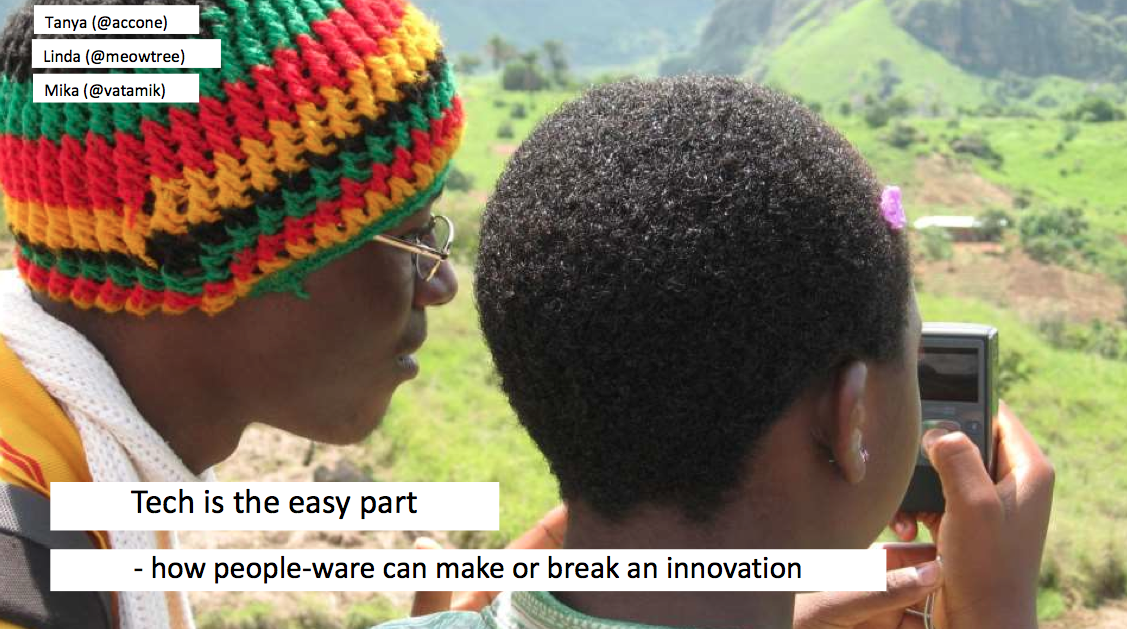
At the Slush conference in Helsinki in November, I joined a short ‘Fireside Chat’ with Tanya Accone (UNICEF) and Mika Valitalo (Plan Finland) about the importance of that other 85-90%, which Tanya referred to as ‘peopleware’.

Tanya kicked off the panel by asking people to think about how much time they’d dedicated to the technology of their start-up idea or their tech solution – the hardware and the software – and to then ask themselves how much time they’d spent on the people component. “People are what will make or break your idea,” she said. When it comes to mobile adoption, for example, we are seeing an exponential adoption pattern all over the world, and people are driving that. “I bet every single one of you at SLUSH hopes to see that curve in your future.”

She went on to note that conventional wisdom is that ‘content is king,’ however a key takeaway from her work in the mobile and social entrepreneurship space is that content been deposed by context. For example, when working with the U-Report project in Liberia, lessons from other countries where it had been rolled out were incorporated, but they had to be contextualized to make them work in Liberia. This involved talking and working directly with youth to ensure that the programming could be adapted properly.

Screen Shot 2014-11-29 at 4.34.47 PMMika agreed that ‘peopleware’ is a critical consideration. “I’ve witnessed this 10:90% ratio several times when co-designing and supporting projects using technology for social impact in African countries,” he said, and told the story of working on enhancing birth registration in Kenya, where the slow and manual flow of information between people and the government seemed to be a key challenge that could be tackled with use of mobiles and computers and applications.

“However, the deeper we dug the more varied the challenges seemed to be. We realized that people might be reluctant to register children when local practices were not in sync with the existing legislation. For example, if men are marrying girls under the age of 18, they might not like the idea of birth registration as it would prove a girl’s age. People living near the Kenya-Tanzania border might not want to be identified as being from one or the other country, because being unregistered may allow them to move back and forth across the border more easily and receive some type of benefit or commerce opportunity.

Even with a functioning mobile phone and app in their hand, people will weigh multiple aspects based on their personal situation before taking action. So, spending enough time with end-users and trying to see the world through their eyes as much as possible is crucial, especially when working in places that are not familiar to you. This may sound self-evident, but I’d encourage everyone keep this top on the list.”

Screen Shot 2014-11-29 at 4.28.39 PMI shared two of the key points from the Technology Salon earlier in the week on the topic of start-ups and social impact: a) the importance of partnership and collaboration (eg, people), and b) knowing the local context — not just the technical landscape, but people and culture.

These two aspects were really highlighted for me when I was working on a project in Cameroon that trained youth to use mobile phones to make short videos that they used to organize and advocate for change in their communities and more broadly. The donor was a large mobile phone manufacturer who assumed youth would use their higher-end phones to create the videos. The youth, however, were much more familiar with simple phones like the Nokia 1100. The phones we purchased in order to get good video quality had too many layers and folders and features. So we ended up getting some Flip cameras, because what we really needed was a push and shoot video camera, and this design was a better fit for low-income rural youth who had limited experience with technology.

We also realized that though the training was set up for youth, community adults were really interested in learning to make videos too. So we had to find ways to engage them so that they would not feel left out and so that we could ensure their continued support for the youth’s efforts. This meant we had to spread our resources out a little further than we had imagined, but we saw it as necessary. In all these processes we had to balance the context and reality on the ground, the expectations of the youth and community, expectations of our local partners, and those of the donor.

Tanya added that achieving success with social impact sometimes means rethinking your business model, because you’re in pursuit of the double dividend of financial return and social impact. She gave an example in Burundi where only 3% of the population has access to the electricity grid. “You would think it’s a market ripe for alternative energy solutions. But many businesses avoided it because their existing retail and distribution models simply would not work in that context. It took deconstructing and reconstructing business models to create something that does work — a network of microfinanced microfranchises operated by village-level entrepreneurs.” Now the families use robust, fast-charging LED lights recharged through a pedal-powered generator, a system that also recharges mobile phones. 

Another aspect is understanding the value proposition, she said. It would seem to be basic business, but all too often well-intended initiatives forget this and rush in with a cheaply-made solution. “In the process, they trample over the basic human dignity of their target consumer or beneficiary.” She suggested keeping in mind that people with limited resources are among the most discerning consumers because they don’t have disposable income. They are cost conscious, and equally, they are looking at value for money and return on investment in the durability, feature sets and total cost of ownership of everything they buy and value. This means that more energy-efficient chips, better battery technology, and robust handsets are important to economically challenged users.

Tanya also noted that ‘base of the pyramid’ users are no less style-conscious or aspirational than consumers in general, so “don’t disrespect them by skimping on the design and delivery of your solution. And like you and me, consumers in marginalized communities seek enjoyment and entertainment and fun too. Music has huge pull and potential… and don’t forget that pay-as-you-go comes with data!”

Screen Shot 2014-11-29 at 4.29.41 PMMika shared an example where the technology that was introduced carried almost too much power with it. In this project, a mobile phone was loaded with videos and connected to a portable projector. Daycare workers and parents were able to watch good childcare practices from model early childhood care and development centers. “What we found out was that using new technology not seen before sometimes amplified the message so much that caregivers wanted to discard what they already knew and replace it with what they saw on the screen from the model daycare centers.” Though the project showed the power of tech, unintended consequences may come up at the intersection of software, hardware and ‘peopleware’.

Mika talked about another project in Uganda that supported parents’ involvement into school activities. Plan realized that men were more willing to come to parent-teacher meetings once they introduced a mobile SMS service through which they sent invitations. The technology lowered the threshold for men to participate in issues they might have previously considered ‘women’s issues’. These subtle dynamics in the local context can have a big influence on how an innovation works, he noted.

Mika’s takeaways for startups and innovators were that civil society organizations might offer good synergy for co-designing, testing out and distributing products and services. “I’ve seen startups getting needs and ideas from the ground through NGOs, and then innovating products and services together. For example we produced a start-up mobile data gathering tool called Poimapper based on the needs coming from our frontline staff. We did on the ground pilots and product development in Kenya with actual end users who gave crucial feedback to make the service work well. Peopleware matters and partnering with NGOs can help startups to get it right,” he said.  “INGOs often have a wide presence around the world, and they are on the ground in communities and the surrounding society. They know quite a lot about peopleware, participatory methods, and community engagement. Then again, they don’t necessary have the same agility and fast innovation processes combined with new business models that startups are often good at.  So, my advice to NGOs is to go and meet startups and visa versa.”

I added that it’s important to understand who has access to and control of devices, and to ensure that a product or service is valuable to people in the long-term. So first — Who owns the phone? Who controls it? Often the story is that everyone has a phone but you may find that some people own 2 phones, some don’t have any. You may find that the people you least expect to have phones have them or can access them, and those you’d think would have a phone don’t. This is critical especially when working with girls and women who typically have lower access and control – and of course you should be sure the project is including girls and women!

Screen Shot 2014-11-29 at 4.31.42 PMAlso, you may be working with people who have very little disposable cash – but if your application or idea saves time and money and meets a real need, they may be willing to move their resources from one thing to another. For example, using solar for light and charging up phones can save money and time as well as eliminate the health risks of kerosene lamps. However, you need to make sure that what you offer is a long-term and sustainable change. When people have limited resources, they’ll be hesitant to invest in something new if they are not assured that it will be available, sustainable and cheaper in the long term.

Lastly, as Mika said, partnering with non-profits can offer start-ups a way to reach communities, because some non-profits are quite well-known and respected by the community (though of course, some are not too!). But ethical non-profits will not risk their reputations on ideas that they do not believe in, that are unconvincing, or that seem to take advantage of the poor. Start-ups will need to have clear ideas and evidence that a proposition is solid, because most non-profits have a low tolerance for risk and failure and (one hopes) a higher ethical standard than a basic money-making operation.

Tanya closed us out by summing up the key points:

  1. People are your critical success factor. “People” include your end-user as well as those that you may be partnering with.
  2. Context is king! Understand the social dynamics, know who owns and controls the device, know what people spend money on.
  3. Build a better business model.
  4. Understand the value proposition — Figure out how your application/tool/innovation can help save precious $ and time.
  5. Understand your partners — Remember that brand and reputation are very important to non-profits, and they don’t like risk.

Thanks to Tanya and Mika for co-collaboration on the Fireside Chat and this blog post!

Read Full Post »

It’s been two weeks since we closed out the M&E Tech Conference in DC and the Deep Dive in NYC. For those of you who missed it or who want to see a quick summary of what happened, here are some of the best tweets from the sessions.

We’re compiling blog posts and related documentation and will be sharing more detailed summaries soon. In the meantime, enjoy a snapshot!

https://twitter.com/neuguy/status/515134807672909826

https://twitter.com/dalgoso/status/515136050793291776

https://twitter.com/neuguy/status/515166952378343425

https://twitter.com/neuguy/status/515184242595487744

https://twitter.com/schmutzie/status/515215243388014592

https://twitter.com/prefontaine/status/515222154670252032

https://twitter.com/richmanmax/status/515576201084411904

https://twitter.com/sandhya_c_rao/status/516343304448131072

https://twitter.com/dalgoso/status/519879358370955264

Read Full Post »

Today as we jump into the M&E Tech conference in DC (we’ll also have a Deep Dive on the same topic in NYC next week), I’m excited to share a report I’ve been working on for the past year or so with Michael Bamberger: Emerging Opportunities in a Tech-Enabled World.

The past few years have seen dramatic advances in the use of hand-held devices (phones and tablets) for program monitoring and for survey data collection. Progress has been slower with respect to the application of ICT-enabled devices for program evaluation, but this is clearly the next frontier.

In the paper, we review how ICT-enabled technologies are already being applied in program monitoring and in survey research. We also review areas where ICTs are starting to be applied in program evaluation and identify new areas in which new technologies can potentially be applied. The technologies discussed include hand-held devices for quantitative and qualitative data collection and analysis, data quality control, GPS and mapping devices, environmental monitoring, satellite imaging and big data.

While the technological advances and the rapidly falling costs of data collection and analysis are opening up exciting new opportunities for monitoring and evaluation, the paper also cautions that more attention should be paid to basic quality control questions that evaluators normally ask about representativity of data and selection bias, data quality and construct validity. The ability to use techniques such as crowd sourcing to generate information and feedback from tens of thousands of respondents has so fascinated researchers that concerns about the representativity or quality of the responses have received less attention than is the case with conventional instruments for data collection and analysis.

Some of the challenges include the potential for: selectivity bias and sample design, M&E processes being driven by the requirements of the technology and over-reliance on simple quantitative data, as well as low institutional capacity to introduce ICT and resistance to change, and issues of privacy.

None of this is intended to discourage the introduction of these technologies, as the authors fully recognize their huge potential. One of the most exciting areas concerns the promotion of a more equitable society through simple and cost-effective monitoring and evaluation systems that give voice to previously excluded sectors of the target populations; and that offer opportunities for promoting gender equality in access to information. The application of these technologies however needs to be on a sound methodological footing.

The last section of the paper offers some tips and ideas on how to integrate ICTs into M&E practice and potential pitfalls to avoid. Many of these were drawn from Salons and discussions with practitioners, given that there is little solid documentation or evidence related to the use of ICTs for M&E.

Download the full paper here! 

Read Full Post »

« Newer Posts