Feeds:
Posts
Comments

Archive for the ‘activism’ Category

This is a guest post by Joe Pavey who, along with Rebecca Tapscott, interned with us in Cameroon on the Youth Empowerment through Technology, Arts and Media (YETAM) project during July and August. Reading Joe’s post I couldn’t help but think about how positive the contributions of youth can be, and about the attitudes that adults and elected officials need to have in order to encourage youth to engage in actions to make their communities better, and how important it is for communities to show young people that they are valued for the contributions that they make and respected for the role that they play.  

The original post appears on Joe’s blog Yakcast 2.0, titled Youth Led Action in Bamessing.
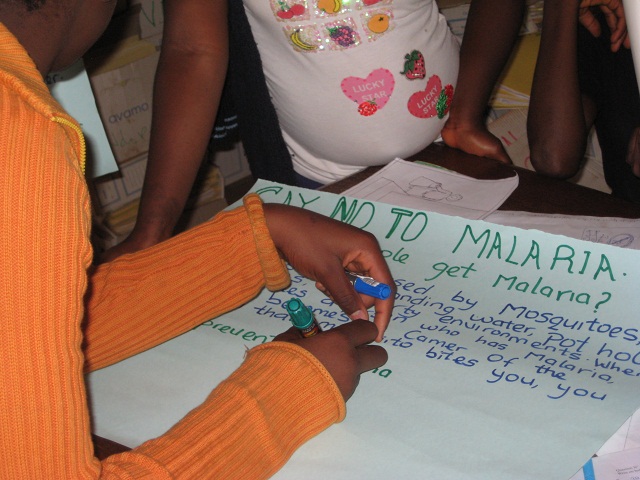
Following the conclusion of the refresher course at GBHS Bamessing, the YETAM youth began work on their first advocacy campaign of the summer. After much discussion the youth decided that the first topic they would take on would be the high prevalence of malaria in their community.

Malaria is one of the biggest killers of children under the age of six in Africa, but lack of health education means many people here still are not aware of how the disease is contracted, and how it can be avoided. Additionally, the direct relationship between cleanliness and the spread of this disease runs counter to many of the choices the environment here encourages. The long periods that often come between availability of running water, forces villagers to store water in containers, and collect it from the frequent rains. This water is frequently left sitting in open containers. Mosquitos will lay their eggs in this water, leading to an increase in the insect population. More mosquitos, means more carriers for the disease, which in turn leads to more people contracting the illness. Additionally, mosquitos tend to thrive in places with tall grass. Lack of funds to clean communal areas often means that shrubbery in public places such as the market square, aren’t cleared regularly. Ignorance of this cycle is what the youth intended to combat. Not an easy thing since explaining these correlations requires the understanding of multiple stages of cause and effect.

In order to get the attention of the village, the youth decided to hold a series of clean-up and sensitization campaigns, intended to illustrate the sort of changes they felt the village needed to make. The first stage was a clean-up at three of the local health centers. The youth divided themselves into three separate groups, and spent several hours clearing brush, dirt, and standing water, from outside these centers. They posted sensitization signs outlining the causes of malaria and what can be done to minimize it. Despite the fact that many of the youth had left town for holiday, there was excellent youth turnout at all three health centers. After the morning of the clean-up these centers were models of how the village should maintain their environment.
Next a major cleanup campaign was performed at the BamessingTown Square, the day before Market Day. Market day here is a huge event, so the time and location of this clean-up had been chosen for maximum exposure. Twenty-four youth and two facilitators (myself included) spent nearly seven hours cleaning brush, shoveling dirt, and picking up trash to make the campaign a success. The youth took turns documenting this work with both video and still cameras. When the clean-up was completed they hung signs in main areas of the market urging the community not to dump dirt and trash in the market square. Another sign was created instructing people to a landfill pit where waste could be properly disposed.

The next morning, when Market Day was in full swing, the youth headed down in their bright yellow YETAM t-shirts to explain to market sellers and patrons what they had done and why they had done it. Their message was well received. Community members were thankful for the hard work the youth had performed, and therefore open to hearing their advice. At the end of the day there was a marked increase in people disposing of their trash appropriately.

Finally, the youth invited members of the village community and high-ranking officials to a workshop to discuss the causes of malaria and what could be done about it. My colleague Rebecca had arranged for a Peace Corps volunteer working on health education to come to the event to give a brief presentation. Unfortunately, only one community member apart from YETAM youth and facilitators attended the workshop. Thankfully this attendee was a member of the Sanitary Committee, so all was not lost. She arrived to the workshop quite late (just as we were finishing), so a short recap was given for her benefit.

The woman from the Sanitary Committee requested that the youth express their concerns to the village council, which they did two days later. The council was happy to receive the youth’s concerns and invited them to sing the national anthem at a special ceremony celebrating the arrival of the District Officer later in the week.

This ceremony turned out to be the closest thing to a festival I experienced during my time in Bamessing. Well over 1000 villagers attended the event. There was dancing and singing. There were masked characters called Ndobo, who shook fistfuls of brush at passers-by. (Check out this link for a great post on Ndobo by Plan USA’s Linda Raftree.) There were Muslim men in full regalia riding bucking, wild horses. There were flute players, and drummers, and dignitaries. Everyone arrived dressed in their finest traditional outfits. The Fon of Bamessing (the village ruler), a proud mountain of a man, oversaw the ceremony from the perch of his throne. If his hulking stature weren’t enough to separate him from the massive crowd outside the palace, he was seated on top of an authentic (and I’m sure locally made) animal skin rug to emphasize his authority.

YETAM was represented at the event in two ways: First, several of the youth led the singing of the national anthem. Second, the President of YETAM Bamessing, Martin, gave a short speech informing the District Officer about the activities of YETAM. His was the only speech not given by a high-ranking dignitary. Martin presented the District Officer with a copy of a Small-Grant Project Proposal To Increase School Attendance in the Bamessing Community which the youth had written for an upcoming advocacy project.

It cannot be over-emphasized how big an event this was for the community, and how impressive it was that the Village Council chose to make the YETAM youth such an integral part of the proceedings. Whether the youth’s efforts will lead to lasting behavioral change in the community is unknown, but it was a fascinating thing to see this project escalate over the course of the month. I couldn’t have had an experience like this without investing the length of time I did here this summer. And for me at least, that made the experience worthwhile.

Read Full Post »

Youth learning to use GPS in Pitoa, Cameroon (photo: Ernest Kunbega)

Last Monday I attended Africa Gathering London. The topic was ‘Social Media Revolutionizing Africa: How is new media changing Africa, giving voices to the voiceless, improving governance and transparency, and changing narratives?’

The event stimulated thinking and brought up some hot discussions around technology, traditional and social media, aid and development, participation and governance. (Big congratulations to Marieme Jamme  for curating a great line up that brought in an interesting and engaged group of participants and to William Perrin of Indigo Trust for keeping things on track and generating good debate!) See the program, the speaker bios and some short video interviews.

Some quotes, thoughts and debates from the day:

  • If your purpose is to bring more people into discussions, remember that radio, Facebook, and Twitter audiences are distinct and be sure you are thinking differently about how to engage them all. Remember that many people in Africa prefer to talk not write.  (from BBC’s Africa Have Your Say – @bbcafricahys‘s presentation)
  • You can’t resolve all of Africa’s issues with one approach. The countries are very different and local context really matters. But you also can’t design something for every tiny demographic. Where is the sweet spot between localized and scale? (discussion after the morning workshop)
  • People should not sit in the UK deciding and develop things for Africans. Develop things with Africans, or support Africans to develop things themselves. This idea got retweeted a lot, with lots of agreement. But H Taylor – @HFTaylor88 also commented via Twitter that this rhetoric has been around for ages within NGOs…. (discussion after morning workshop)
  • It’s great that the market has been able to bring mobile phones to so many people in Africa, but the market can’t do it on its own as many are still left out. There needs to be more incentive to reach remote areas. There needs to be education, cash transfers, government regulation if we want to really realize the potential of mobiles. Mika Valitalo – @vatamik commented that in many African countries, mobiles are still taxed as luxury items, making them more expensive than they should be. (Clare Melamed -ODI – @claremelamed‘s “Is the Mobile Phone Revolution Really for Everyone”.)
  • Any big story today on CNN has a social media component, yet there is still the idea that social media only breaks news and ‘it won’t make the history books until CNN or BBC report on it’. If CNN is not planning to do a story but sees everyone is talking about it on Facebook and Twitter, they will cover may rethink covering it. CNN finds good opinions and stories on social media, but their primary news source will continue to be their correspondents. Emrys Schoemaker – @emrys_s however questioned whether mass media use of citizen journalism is a broadening of voices or if it’s cheap content for big media – or both. (Faith Karimi/CNN/@faithCNN’s presentation and resulting discussions.)
  • Social media gives African youth an uncensored worldwide platform, letting them feel included in shaping Africa’s image, but the youth using social media in Africa are still the middle class and the rich. We need to find ways to include other youth. (Faith Karimi – @faithCNN’s presentation and resulting discussions.)
  • The Guardian’s Global Development Site and Poverty Matters blog are trying to get away from the vision of ‘poor Africa’ and have only been accused of ‘poverty porn’ once in 9 months (which Liz said irritated her to no end as they really try to avoid it). (I remember the case…) They stay away from the typical ‘flies in the eyes’ photos, but sometimes there really is starvation in Africa, and in those cases, a photo of a starving child might actually represent reality. (Someone countered that African newspapers should use photos of drunk, vomiting Brits to illustrate stories about parliament).  (Liz Ford/deputy editor/@lizford‘s talk and discussion)
  • Is the Guardian’s Global Development site one-sided, taking the view that aid is good rather than other ideas on how to best achieve development? Development is much larger than ‘aid’ and when talking about development we need to remember the bigger picture and the alternative views that maybe aid is not the best (or only) way to ‘do development’. The Guardian is quite open to new thoughts and ideas and invites anyone with ideas for blogs or stories to be in touch with them. They consider their site a ‘work in progress’. (Note: I like the Guardian’s site very much as it is one of the few media sources that discusses and seems to really promote and engage in the ‘#smartaid / @smart_aid‘ discussion). (Liz Ford’s talk and discussion)
  • Many African leaders, not to mention the public and the media, will listen when high level people call their attention to something, but problems can’t be solved by the same people who created them, especially if those people are considered morally bankrupt. Karen Attiah – @karennattiah  commented in from Twitter that a big part of development work should focus on rebuilding the broken social contract between governments and citizens in Africa. So how can we connect policy makers with ordinary Africans? How to bridge the gap between policy makers and grassroots approaches and implementation. (Panel with Alex Reid/@alreidy and Carolina Rodriguez /@caro_silborn – media heads at Gates Foundation and at Africa Progress Panel)
  • Not all sources are created equal – this is true for traditional and for social media. Social media is not about the technology, it’s about the human need to communicate. You can make traditional media more social also. Even those without access to social media will get around harsh barriers to tell their stories because of the urge to communicate. So the best thing is to create a social experience, not to worry so much about getting ‘jiggy’ with the technology. (from Kevin Anderson/@KevGlobal‘s presentation. See Putting the social in media.)
  • New technologies can impact on public debate, people’s political capabilities, citizen-state relations, relationships with other government actors. Frontline SMS Radio, for example, could be a very useful tool for this because radio is still the main way to communicate with the majority of Africa. Using Frontline SMS Radio, stations can sort through messages they get, understand them better, and use the information to orient their radio programs as well as other things. Radio can play a very strong and useful role in governance. (from Sharath Srinivasan/ @sharath_sri‘s presentation. See FrontlineSMS at Africa Gathering.)
  • Youth can have a big impact on community development if given space to influence. There is money (eg., in Cameroon, at local government level) but it needs to be better spent. Informed and involved youth can hold government accountable for spending it better. Local level advocacy has a greater impact on youths’ lives than global level initiatives because you can make as many laws as you like, but unless people are putting them into place and practice at a local level they don’t matter. Organizations should listen to young people but not make them dependent on NGOs because the real duty-bearers are family, community, government. NGOs need to be models of their own methodologies; eg., if an NGO is encouraging people to criticize the government, the NGO should be ready to receive the same scrutiny around its own work and behaviors. Social media can play a role in this process by showing what is happening at the local level to a global audience. (from my presentation and the resulting discussions. See Youth Empowerment through Technology, Arts and Media)
Julia Chandler (@juliac2) did a great round-up of the day’s presentations and discussions on her blog: Part 1 and Part 2. The Guardian continues the discussion here and of course the Africa Gathering website is a great place for more information.
.
Update – more posts about Africa Gathering:
Great perspective from Tony Burkson – @tonyballu – who I really enjoyed talking with at the post-event drinks: A Day at Africa Gathering.

Read Full Post »

If you are from an outside group that wants to work with a community, you need to know the community. You need to spend time there, sleep there, live there, before trying to help or come in with recommendations. Until you have lived together with the community, you cannot really give any savvy advice or support because you won’t know or understand the community’s reality. You won’t have ‘mastered’ the community.’

Kenneth Nyah from Partner Vision (PAVIS), the organization we are partnering with in Bamenda, Cameroon, on the Youth Empowerment through Arts and Media (YETAM) Project, gave us some great tips last week on how to do community-based, youth-led advocacy and support local action and change.

Timothy and Kenneth from Partner Vision (PAVIS)

Know the steps for good advocacy

  • Identify the issue that needs to be addressed.
  • Master the community by spending time there.
  • Identify the principle actions to take in the community, together with all the stakeholders.
  • Gather information and statistics that will support the case and help to shape the suggested solutions.
  • Synthesize information and statistics to make them easier for people to get a handle on and understand.

Model good advocate behaviors

  • Participation. All the stakeholders need to be included and the discussions need to be open.
  • Legitimacy. An advocate should be someone who practices what he or she preaches and lives the values that he or she is working for.
  • Accountability. An advocate has to be transparent and open and accountable for his or her actions and to the community.
  • Acting peacefully. An advocate should always look for ways to resolve issues in a peaceful way.
  • Representing the affected group. An advocate should be sure to understand the affected groups’ issues and viewpoints and to represent them, not his own opinions or agenda.

Be clear about your role as an outside organization

Kenneth described the main roles of an advocate or organization supporting local advocacy work as:

  • helping to empower the community to speak for itself
  • mediating and facilitating communication between people
  • ensuring that communication and dialogue happen
  • modeling behavior to people and policy makers
  • helping build coalitions so that local people can raise their issues and get resolutions.

Know what advocacy is not

  • An information campaign. Hanging up posters is not advocacy. You have to go deep into things, to take actions, to actually do something, not just ‘raise awareness’ or share information.
  • A public relations action. Advocacy is not an opportunity for you to create fame for yourself or your organization or political agenda. It’s about the community.
  • A strike or mob action. Advocacy should be strategic.
  • A pressure group. Advocacy does not mean ‘we want something and we are coming in to take it whether you like it or not.’

Remember who this is about:

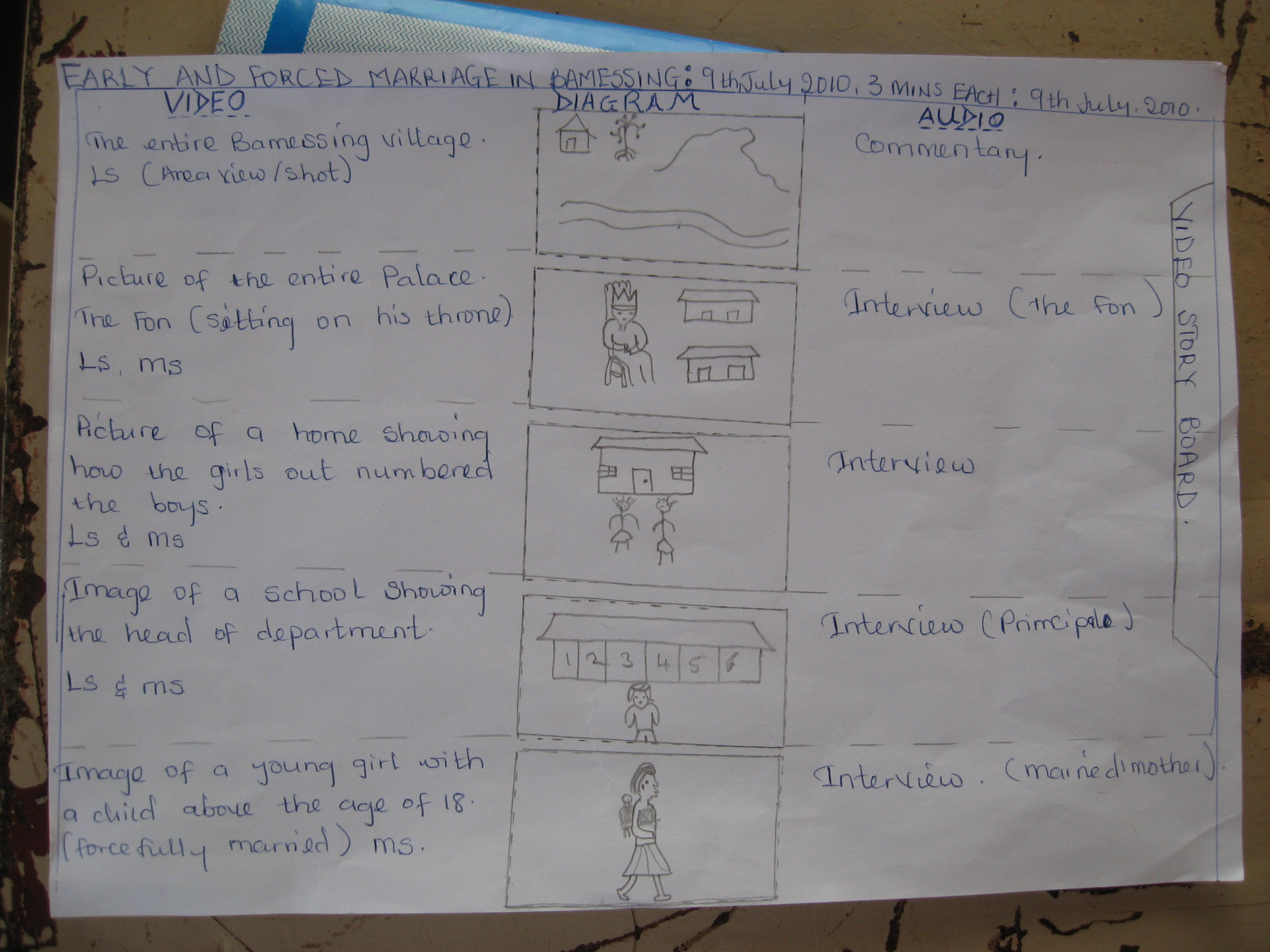
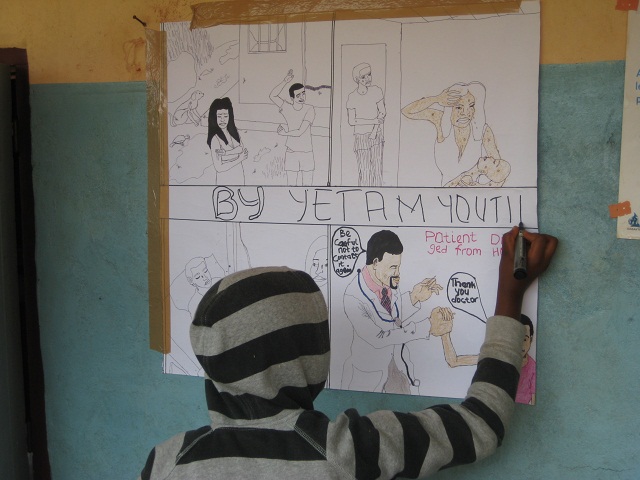
First half of a storyboard by youth in Bamessing for video on early marriage.

You shouldn’t do advocacy without proposing a solution, said Kenneth, and the solution should come from the community itself, not from you. In community-led advocacy, the outside agency should not be bringing in its own agenda. It should not be manipulating people.

When working with youth, the agenda needs to come from the youth themselves. If the youth don’t have their own agenda, it’s very easy for people to manipulate them. Once you work with the youth to help them discover their community more, and to determine their own agenda for change, they will work on that and it can be very positive.

Youth-led and community-led advocacy is different than global advocacy campaigns which tend to be top-down. When people raise their own issues at local level, do their own research, identify their own solutions, discover the bottlenecks that get in the way of those solutions, and determine who to target with their advocacy actions, advocacy can be very effective.

One participant emphasized that even in global campaigns, local stakeholders need to be involved, because they are the ones who will give the stories, the statistics, and the effective solutions.

Find the information that already exists in the community

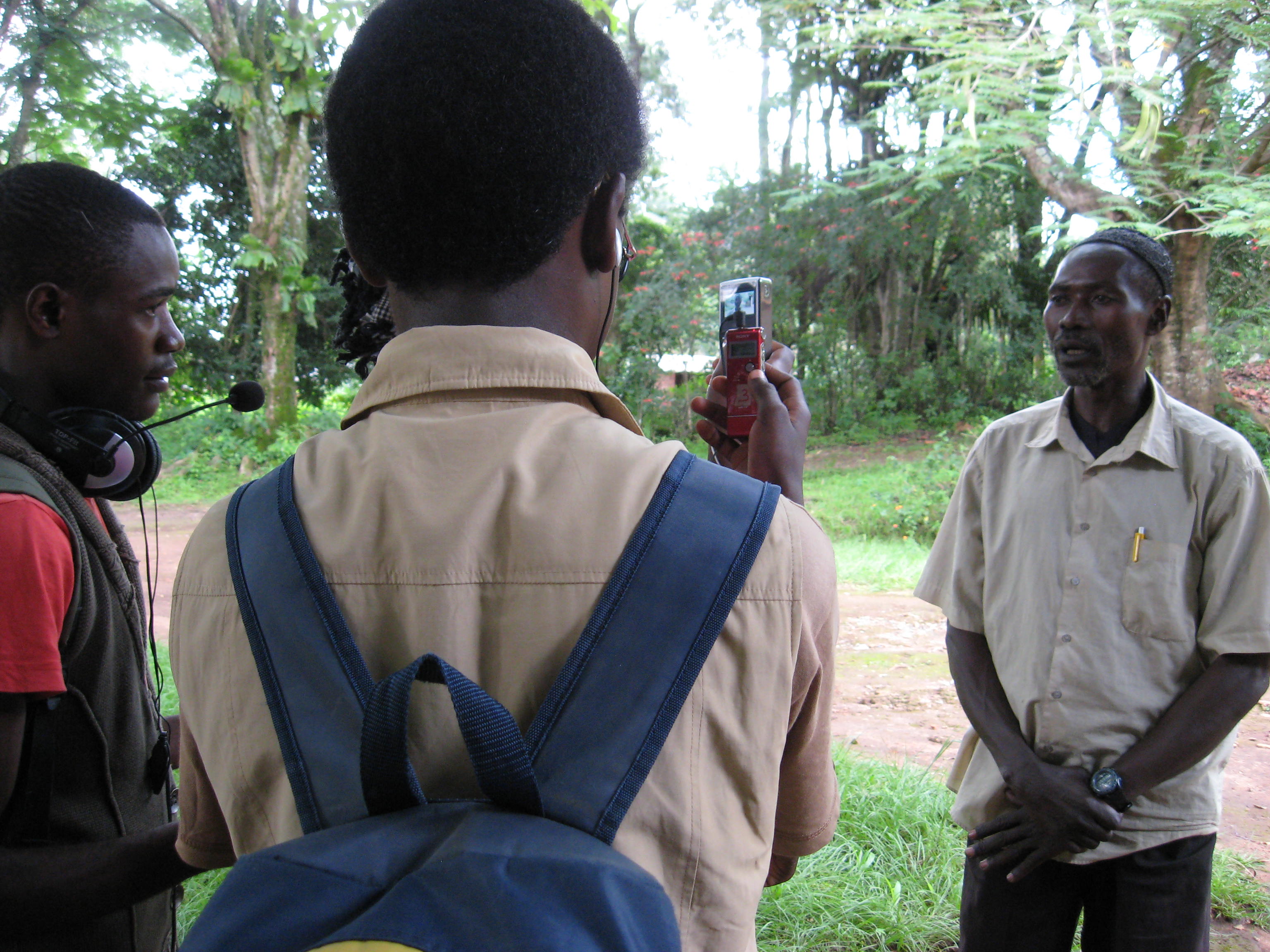
Collecting information.

Advocacy goes with facts and figures. You cannot do advocacy without figures, said Kenneth. And you cannot have figures without research. But there is much information that is already there, right in the community. ‘As outsiders,’ commented one person, ‘it’s easy to imagine that a community doesn’t have any information, but this is not true. We found so much information in the community.’

‘All the facts that youth needed to advocate for the water project* were given by the people in the community. The youth know who the key people are in the community. They know who has the information and the statistics. For example, there is a person who manages the local water system and who knows what the problems are with it. There is the chairman of the water board. These are people in the community who manage information! They have reports, they have meetings, they know these things. There is no need to come from the outside to do a big expensive data gathering campaign. You can go into the records that the community is already keeping. Working with the youth and community it’s very possible to find this information to support local advocacy.’

A role for ICTs

Another person shared the case of youth in Pitoa who identified malnutrition in the community. ‘The parents didn’t  identify malnutrition as a problem, they said it was not an issue. Maybe they were embarrassed that they were unable to give their children enough food. But the youth went with cameras, they filmed malnourished children, they went to the hospital to check the numbers. There is a whole ward there with malnourished children; they filmed there.  They made a video and showed it to the parents and the council and were able to get them to see that this is a problem in the community.’

The digital mapping that we are doing with the YETAM project (watch for a new post coming soon on this), said other participants, can provide the youth with an additional tool for local advocacy. ‘Youth went out to map their area. They saw the road network, they created a database about their schools, they saw the conditions of the hospitals and everything. Through mapping they were able to master their environment because they were there, collecting the data, tracing and making waypoints of everything. This fed very well into their advocacy work.’

*In this water project example, youth used their research, videos, interviews, focus group discussions and role play to advocate to community leaders, the village development union and the Ndop Rural Council around the water issue. The Ndop Council acknowledged the issue and Bamessing and its neighbouring communities succeeded in securing funding from FEICOM for the first phase of the Ndop water supply project for 214 million CFAs (around $450,000). Feasibility studies were done by the Ministry of Water Resources and Energy in collaboration with SNV and submitted to the Ndop Council. The project is expected to provide potable water in Bamessing, Bamali, Bamuanka rural and Bambalang communities.

Other successes of youth-led advocacy in the YETAM Cameroon project include that the Municipal Councils of Pitoa and Ndop approved financial support to youth micro-projects.  The Mayor of Pitoa municipal council approved 400,000 CFA (around $850) for the youth to spearhead actions to curb the high incidence of cholera in the council area. The Mayor of Ndop Municipal Council approved 500,000 CFA (around $1070) as council support for the youth to fight against the high rate of school dropouts in the Ndop council area. This support came in response to youth participation in the council budgetary sessions.

Read Full Post »

This is a guest post from Lil Shira, one of the girl delegates who attended the 55th Session of the Commission on the Status of Women in February, 2011. Lil Shira was part of a Plan led Girl Delegation which took part in high level panels, side events and caucuses. This post appears complete in its original format. You can read a post by Fabiola, another of the girl delegates from Cameroon, here.

Lil Shira in the community

My name is Lil Shira, a high school student and a Cameroonian.  I am the second child out of five children in my family, three girls and two boys, and we live in a rural area. Because I am a girl I was selected by my school authority to be part of the journalism club in the school. This paved my way into YETAM (Youth Empowerment through Technology, Arts and Media) project sponsored by Plan Finland since the Journalism club was chosen for this project.

Because I am a girl I had to use the skills I have acquired in YETAM on music, media and ICTs to indentify issues like the problem of early and forced marriage, high rate of school dropout and violence against the girl child. Because I am a girl, I had to mobilize other youth (girls and boys) victims, so as to speak out as a unique voice, to raise awareness to the general public using music, drawings, drama, poems, videos, computers and overhead projector as tools. This led to many local advocacy actions spearheaded by us.

I was also very happy to celebrate the 21st anniversary, in Yaoundé in Cameroon, of the ratification of the Convention on the Rights of the Child within the framework of YETAM project. These created a big impact in my life, the lives of my friends, youth, school, family and my country. All these activities took me to a higher level because I was again selected, this time to be one of the girl delegates to represent Cameroon in the 55th session of the UN Commission on the Status of women (CSW) in New York City.

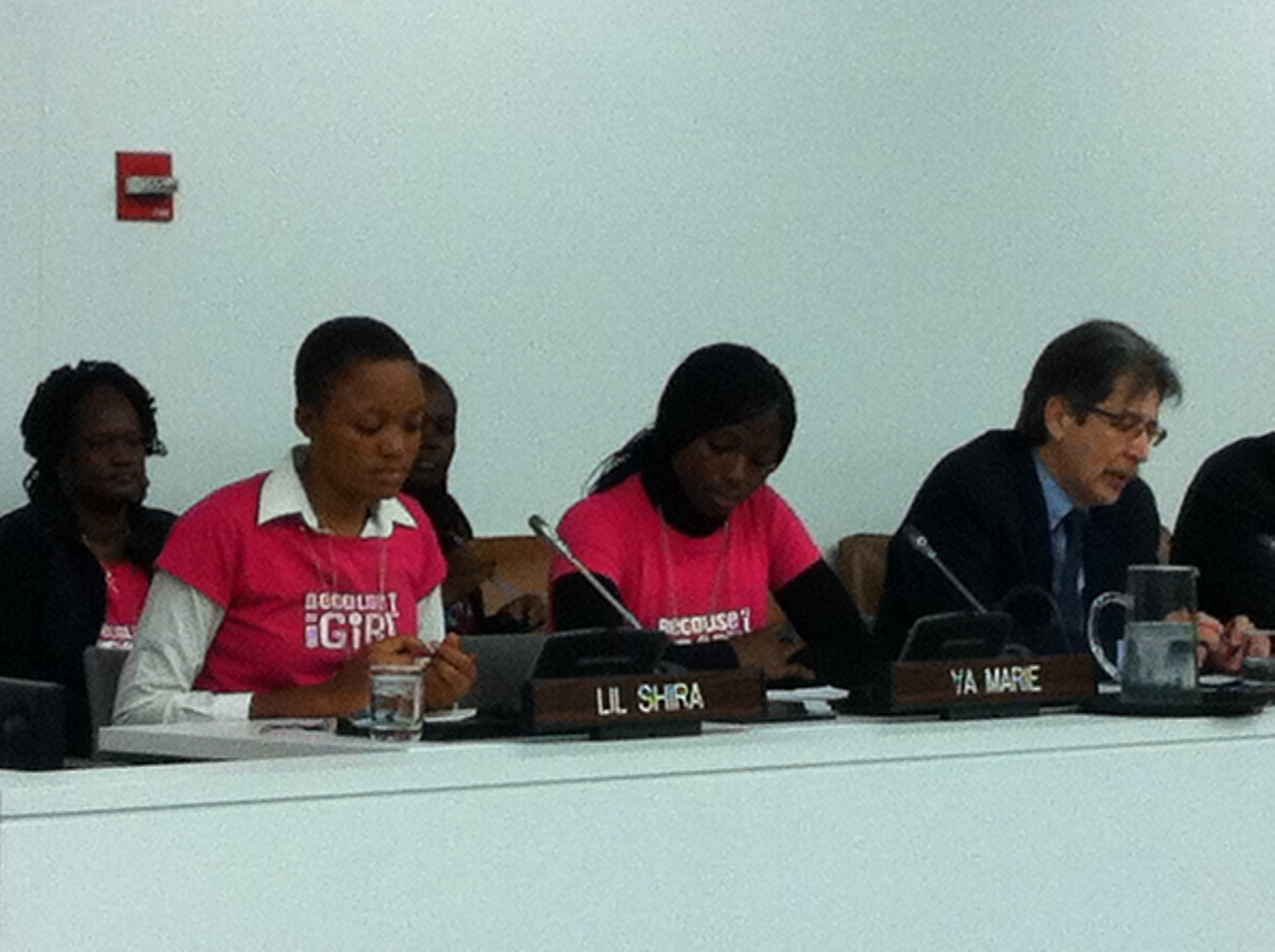
Lil Shira presenting at the CSW.

I was very happy, excited together with my friends and family members and I was planning and preparing on the role I was going to play while in New York. My expectation was to work with other youth from different region and country but did not really expect I was going to talk to Ministers from all the members’ state of the UN. I did my first presentation with the Canadian Minister on a panel about the importance of commemoration days and the importance of setting up an International day for the girls.  Another thing which made me feel so opportune was the panel with UN women Ministers in the UN building.

I was very impressed seeing ministers from over two hundred countries and above listening to me and in effect giving a positive response to the issues I presented. In fact their reaction made me feel at home and so happy. I was equally happy to listen to other girls raise issues like gender based violence and discrimination in their various countries and what they have been doing to combat it.

Coming in contact with girls from Sierra Leone, Finland, United States, Indonesia, Canada and others, not mention to share our ideas, was so wonderful and exciting.  This was a forum for me to dialogue with them to know more about them and some of the issues affecting them in their own country which was contrasting with mine. Though I was nervous during my first presentation, meeting new faces it all passes away like a breeze and I did not have any complex because everything was cute.

Life in the US to me was very enjoyable and meaningful, but I could not stop complaining of the cold and snow. In addition, I tried eating food not familiar to that of my home country. All these contributed greatly to the wonderful experiences I had on the weather condition and the food.  I have learned to adapt to situations wherever I find myself. I hope to continue sharing this experience so that others may learn from it.

This is the time for girls to take up the challenge. I know my rights and have claim them, and no one can take them from me because I am a girl.

Thanks to Plan International, Judith Nkie our Chaperone, Kate Ezzes and Lia de Pauw.

Girls, claim your rights!

Related posts and videos about YETAM and the CSW:

Girls voices in global forums

Girls in rural Cameroon talk about ICTs

55th CSW: Women, girls, education and technology

A catalyst for positive change

On the map: Ndop, Okola and Pitoa


Read Full Post »

As I mentioned in an earlier post, I spent last week at the 55th meeting of the Commission on the Status of Women. The organization where I work supported 12 girls from various countries to attend and speak at different panels and side events during the week.

Why is it important for girls’ voices to be heard at global events like the CSW? Why should they be allowed to sit at tables with adult decision makers? Is this a wise investment when we could have spent that money to bring an adult staff member instead? Well, from a strictly rights-based perspective, it’s because girls have a right to participate in decisions that impact on their own lives.

But there are so many other reasons that girls need to be present at these events. They bring perspective that is otherwise missing. Before women are women, they are girls. It’s well known and well documented that investing in girls’ education and other areas has impacts that go far beyond schooling. At these big meetings, issues that impact girls and women are being addressed and discussed – so there needs to be space for girls and women who feel these issues directly to speak for themselves, especially girls and women who are typically left out of these processes. Girls bring a reality check. They offer ideas and solutions from their own contexts. They bring points home that can otherwise be missed. They are often amazing speakers and have incredible wisdom and insight to share. We can all learn from them. And bringing girls and their opinions and voices to a huge event like the CSW can really have a positive impact both on the event, the event participants, the decisions made there, and on the girls themselves, as they return home with a mandate to live their leadership in their own communities and countries.

Early in the week, I shared a panel with Fabiola, one of the girl delegates from Cameroon, and she truly stole the show. Here’s how:

Fabiola participates in the Youth Empowerment through Technology, Arts and Media (YETAM) project, and was selected by her peers to represent her group and Cameroon at the CSW. More information about Fabiola and Shira, the other girl delegate from Cameroon are in this post: Girls in rural Cameroon talk about ICTs. Shira also spoke at high level panels, as did the girls from Sierra Leone, Indonesia and Finland.

The girls also planned and managed their own side event where they talked about girls and new communications technologies.  In preparation for the event, they brought with them videos from their home countries, and Kirby, one of the girls from the US, edited them together into one piece. The video was shared at a few different events, and the girls were even asked to show it at the general assembly (at the last minute they weren’t allowed to for one reason or another). In any case, you can see it here:

On the last day that the girls were in New York, 3 of them sat on a panel in front of hundreds of high level decision-makers: UN officials, Ministers and government representatives. They talked about the challenges girls face in terms of accessing ICTs and raised the issue of violence against girls and how violence in schools impacts heavily on girls’ education.

My Cameroonian colleague, Judith, who works on the YETAM project with the girls, told me afterwards that she felt unbearably proud, seeing them there in front of the whole room, with everybody hanging on their every word. “I was floating,” she said. “As if my feet were not even touching the ground.” She was proud that Shira didn’t only present the issues that girls are facing in accessing ICTs or in terms of violence or early marriage, but Shira went further and talked about what they are doing in the community and how they are working with ICTs and conducting advocacy with decision makers and traditional councils to resolve the issues, and what impacts they have already had.

Josephine, one of the girls from Sierra Leone, said afterwards: “When I was there, speaking, I felt like I was on top of the world because people were listening to my voice.”

There needs to be more of this!

But if you are still not convinced, my fabulous colleague Keshet Bachan, coordinator of this year’s Because I am a Girl Report and the previous 3 reports, gives a convincing overview here about why girls and why now. Worth watching.

Read Full Post »

In the past couple years, social media combined with traditional media has allowed people all over the world to feel they are supporting and participating in very visible revolutions (think Iran, Tunisia, Egypt). There is also a slow and steady revolution happening as more and more communities around the world access the tools to tell their own stories in their own words from their own perspectives.

I came across the Mathare Valley blog this weekend. It’s beautiful, artful and powerful.

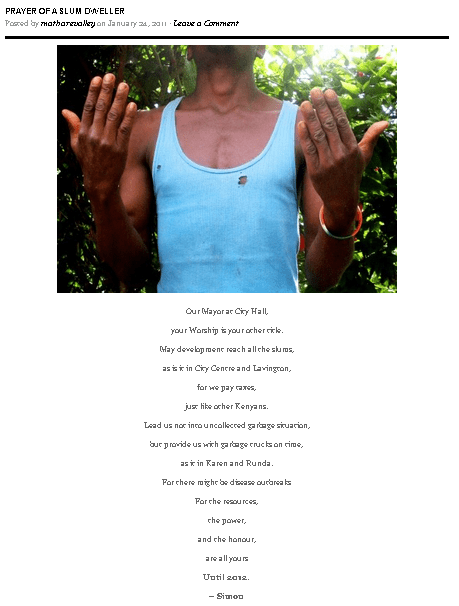
Prayer of a slum dweller from the Mathare Valley blog

According to the ‘about’ page, the authors of the blog:  Simon Kokoyo, Ivyonne Tiany and Jeff Mohamed, grew up in or around Mathare. They are now involved in community programs there, including the Map Mathare Initiative.

Jamie Lundine, who works at MapKibera and who’s supporting some community mapping in Mathare, wrote an excellent post about integrating participatory community development work and digital mapping in Mathare, showing how development and tech folks can combine their expertise and work together with communities to strengthen local development processes.

In my last post, I wrote about how communications (and ICTs) should be ‘built in, not bolted on‘ to development initiatives. The Mathare Initiative looks like a good example of that, with community members taking a strong lead.

Read Full Post »

I spent a few days in Nairobi early last week with our education and our ICT staff from Ghana, Uganda, Senegal, Mozambique, Kenya, Egypt and a few other folks, including the brilliant Mika Valitalo from our Finnish office and people from regional and headquarters levels. We were looking at goals and challenges in our education programs and thinking about where ICTs might play a role.

The process was really interesting. Starting a few months back, each country shared their education context analysis onto a wiki. In a second round they narrowed down to a specific area in education, looked at the information and communication flow and gaps, and identified areas where there might be an ICT solution. They focused mostly on mobiles, but in many cases mobiles were supported by computers, servers and laptops as well as non-digital information and communication tools and also solar technologies. Each country team met by Skype with Mika and an external consultant to discuss the concepts and get ICT advice and support. Then they updated their concepts and got additional feedback. For the third round, they added rich pictures to show what the specific ICT solutions might look like. Everyone had an opportunity to give input into everyone else’s ideas via the wiki.

At the meeting in Nairobi, we spent a day sharing the concepts with each other for clarification and focused input. Colleagues shared the broader education context in their countries and specifically in the communities where they are working. Then they illustrated the specific education issues and the ICT solutions that they were suggesting and/or the places they felt ICTs could help. Some of the ICT solutions focused on a very specific technology or device. Others showed how different types of ICTs could be integrated at different points in the process. Others required development of a totally new ‘solution’.

Some of the areas where colleagues thought ICTs could support education included: teacher training for those working in remote communities, adult literacy (especially literacy retention post literacy training), improving exam scores, livening up and improving in-class curriculum, and transparency and accountability in education. We spent 2 days then working in different small groups on the concepts, cross-pollinating ideas and deciding which of the concepts were most relevant to all 6 countries (in order to make it more possible to scale them) and which were most feasible and do-able.

The ideas were all a good fit with our global education strategy (see page 9) which focuses on service delivery (in partnership with local governments and communities); organizing and empowering rights holders; and grassroots participatory advocacy to influence education policies, financing and practice. The strategy prioritizes actions around equal access to education, quality of education, and education governance (see page 10).

Accountability and transparency in education

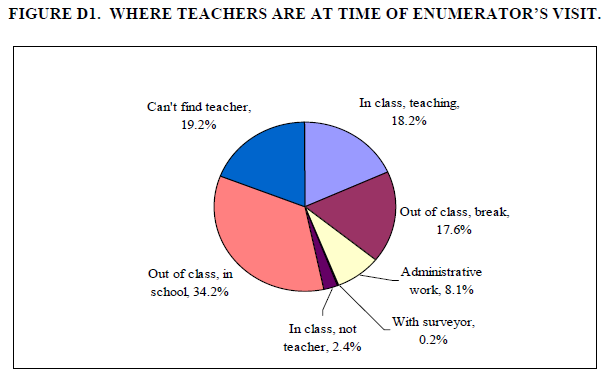
One of the concepts that captured the most interest from the whole group was that of using ICTs to improve accountability and transparency in education. Education is one of the areas where “Quiet Corruption” is often found. ‘Quiet corruption, which can take the form of absenteeism among teachers or doctors, the distribution of fake drugs, or the sale of diluted fertilizers to poor farmers, is having a damaging effect on people in Africa, according to the African Development Indicators report released by the World Bank….’ (March 18, 2010 article)

It's time for class.... where is the teacher to be found?

Edison, Charles and Erik, our colleagues from Uganda, did a short skit illustrating the different points in the primary education system where corruption happens. Their points correlated well with this summary of quiet corruption in education from a July 5, 2010 article in the Independent:

‘Early this year, the Transparency International (TI) Africa Education Watch Programme report: Africa Education Watch: good governance lessons for primary education showed that the government’s perception that massive enrollment is a sign of success of the UPE [universal primary education] programme must be revised to address the problem of overcrowding in classrooms, studying under trees, poor financial management, illegal fees, and lack of school inspection. The report exposes irritating embezzlement of UPE funds and abuse of authority by head-teachers who charge illegal fees, make students offer labour on teachers’ projects, sexual harassment, and systematic teacher absenteeism. The report noted that 85% of schools surveyed had either deficient accounting systems or none at all. In most cases, financial records were either unavailable or incomplete. The survey found limited financial documentation at district education offices and at schools. Most people who handle school grants had no training in basic finance management.

Another survey titled, The Efficiency of Public Education in Uganda, conducted in 2007 by the Ministry of Education to determine efficiency in provision of education services found an average rate of teacher absenteeism of 27% in Uganda, compared to other countries like Zambia (17%), and Papa New Guinea (15%). The aggregate loss caused by this absenteeism constituted 19% which translates into Shs 53 billion out of the Shs276 billion of the Education ministry’s wage bill.

In a swift headcount at the beginning of this year, the Education ministry established that the number of pupils listed in primary school registers was 25% higher than those actually studying. Similarly, the report established that the number of students in lower secondary schools had been exaggerated by 12%. For instance at Amaji Primary School last year, the school register had 816 pupils. But when the headcount was conducted the school administration could not account for 302 pupils.

It is reported that many districts’ chief administrative officers have failed to show proper accountability for the UPE and USE funds.’

The Uganda team also explained that:

  • Parental interest in education is very low because since Universal Primary Education launched, parents feel it’s the government’s responsibility. Some youth we were working with in Kenya last year made a short film about poor performance in primary schools covering the same issue  (see below).
  • Teachers’ salaries are paid directly to their bank accounts, and there is no way to punish them if they don’t show up.
  • There are mechanisms to ensure that donor funds go from the national level to the district level and then on to the school, but no accountability mechanisms to ensure that they get from the school to the classroom and are translated into quality education for children.
  • District level government authority and accountability ends when they transfer funds to the schools; school directors can report to them that they have received funding and that everything is going fine when it’s really not.
  • Local school committees are often made up of people who are not neutral and who do not have the best interest of the children in mind. In some cases, school committee positions are used for personal gain and to launch individual political careers and political campaigns.
  • Lack of parental and community involvement in the education process and in school governance means that no one is demanding accountability from teachers and schools.
  • Sexual and physical violence in schools is very common and underreported. When it is reported, often nothing is done about it.
(Start playing the video, then click the small ‘cc’ button to turn on captions in English)

Colleagues from the other countries face the same challenges in their work and in their own children’s education.

Can ICTs play a role?

What is the solution then? Colleagues suggest that motivating parents and the community to get more involved in school governance and demanding transparency and accountability can begin to change the situation. This obviously requires a lot more than ICTs. So several different actions would be taken to engage and motivate parents and the community to take a bigger role in their children’s education. Then ICTs can be integrated into and support the process for sharing education information with parents, such as student absenteeism, grades, parent-school meetings, exam dates and scores, etc. Parents and students would also be able to report when teachers do not show up or suspected corruption. Students could also report abusive teachers, absent teachers, and other issues they are not happy with at the school. A neutral party would manage and hold the information that flows in and out to protect students from reprisal and to protect teachers from any abuse of the system in case fraudulent or incorrect information is reported. Commitment from those responsible for overseeing education to respond to the issues raised and take serious action is also needed, and this may be the biggest challenge overall. Plan can play a role there, leveraging existing relationships with local and national governments and Ministries.

The idea needs quite a bit of further work, a closer look at feasibility, and more research and input from local communities and parents. As mentioned, the ICTs are actually a small, but potentially very important, part of a much larger initiative to get parents and communities involved in school governance to demand transparent, accountable and quality education and budget spending.

Challenges in the process

Some of the challenges that we had to manage well during this initial piece of the longer process included:

  • We needed to ensure that we were starting with the context and the need for better information and communications, not starting with the technology and devices and building initiatives around them. Yet we also had to avoid getting lost in the overall context and missing the opportunity to pinpoint potential ICT solutions at specific places within the context. Role play and flip chart illustrations of the  ‘problem’ and the ‘solutions’ were very useful for getting more concrete (“So, Kofi is here in his community and he wants to …. So he uses xxx to do this, and then this happens and then….).
  • Though we wanted to specifically look at places that mobiles and other ICTs could support, it was important to list out all the factors that needed to be in place in order for the ICTs to work and to think clearly about the constraints we might face during implementation. One good question to help with that was, after seeing an idea or ICT solution presented, to ask “What needs to be in place in order for that to happen?” Then you start to remember critical things like community motivation, government interest to actually resolve a problem, electricity, someone to set up and manage a server, a strong enough network to download multimedia content, mobile versions of websites, educational content re-design for mobiles, teacher training on how to integrate ICTs in the classroom, limitations of SMS for doing something other than rote learning, higher versions of a mobile operating system, a smart phone, etc.
  • We had input from a potential corporate partner during the process. We learned that corporations are thinking several years ahead to what will be coming down the line; however non-profit are normally working within existing constraints and trying to find solutions that work here and now in the resource poor places where we work or ways to get around those constraints. Multi-level solutions seemed to be a good possibility; eg., ideas that can rely on SMS today, but have potential to expand as networks expand and data enabled mobiles become more available.
  • A corporation tends to think in terms of vendors, results, timelines, launch dates, price points, return on investment whereas a non-profit (at least ours) tends to think in terms of community members, organizations, process, participation, local context. Our facilitator even told us that a corporation normally does a presentation by starting with the solution, and then spending the rest of the presentation showing why that is the right solution. A non-profit usually starts a presentation by sharing all the context and background, and showing the process that led to eventually reaching the potential solution, including every step along the way, how ownership was achieved in the process, why different decisions were made and who participated in them. So keeping corporate vs non-profit cultures and languages in mind is also important when working on joint initiatives.
  • We need to remember to establish measurable indicators of success so that we can tell if this new type of intervention has a different/ better/ greater / lesser impact than carrying out a similar process without ICTs or with a different set of ICTs. This is something we will address once the full idea is developed. Impact measurement is very important to both corporate partners and development organizations.
  • This was the first time many were involved a process of this kind, so keeping the balance between technology and development goals was a constant challenge. We sometimes veered too far towards focusing on all the details of the context and then back to focusing too much on that piece of the context where a potential technology solution was seen. I think we were moving toward a pretty healthy mix of both. The process is nowhere near complete, and as we continue to work on the ideas and look at feasibility and actual implementation, we should find the sweet spot.
The work above was guided by Plan Finland’s recent publication ICT Enabled Development – Using ICT strategically to support Plan’s work.  On the whole, it was a great learning process for everyone involved, and we came up with some good ideas that we will flesh out in the coming months. Having the opportunity to patiently and carefully think through areas and ways that ICTs can support program goals around education and discussing the ideas at length with colleagues was a capacity strengthening exercise for all involved and will mean that we will be more prone in general to thinking about incorporating ICTs in our work going forward.

Resources

ICT-Enabled Development

Plan’s Education Strategy 2010-2013

African Development Indicators Report by the World Bank

Africa Education Watch: Good Governance Lessons for Primary Education by Transparency International

The Efficiency of Public Education in Uganda by the World Bank

Learn without Fear Report on School Violence by Plan. Summary and Full Report (also available in French and Spanish).

Painful lessons: the politics of preventing sexual violence and bullying at school by the Overseas Development Institute

Expel violence! A systematic review of interventions to prevent corporal punishment, sexual violence and bullying in schools by the International Observatory on Violence in Schools

School violence in OECD countries by Karen Moore, Nicola Jones and Emma Broadbent

Update: Owen Barder published an interesting post called Development 3.0 – is social accountability the answer, which refers to social accountability in education in Uganda and links to 2 other quite interesting papers: Fighting corruption to improve schooling: evidence from a newspaper campaign in Uganda; and a 2007 paper by the Center for Global Development challenging the findings of that paper: Putting the Power of Transparency in Context: Information’s Role in Reducing Corruption in Uganda’s Education Sector

Related posts on Wait… What?

Community-based child protection

New Plan report on ICT-enabled development


Read Full Post »

I spent the first 2 weeks of November in Mozambique working on the continuation of the Youth Empowerment through Arts and Media project. This year, we are piloting digital mapping in addition to the other ICT tools that we’ve been integrating into the project. We weren’t able to find anyone locally in Mozambique who could train on Open Street Map but luckily were able to link up with Portuguese-speaking Iván Sánchez Ortega from OSM in Spain. (In case you didn’t catch the link – the official language in Mozambique is Portuguese…)

Iván was a great trainer and the youth from the two associations (Vuneka and Litanga) that we are working with really took to the idea of digital mapping and learning some new skills in the area of painting, theater, print journalism, radio, video and blogging. See some of Ivan’s thoughts on this Maps for Mozambique post.

Here are some photos of the work we did while in Mozambique….


Read Full Post »

In her post ‘Prostitutes of God:’ Film Mocks, Belittles Sex Workers, Bebe Loff, explains that:

‘Last week,  four episodes of a film entitled Prostitutes of God were posted on VBS.TV, which is owned by Vice Magazine. Prostitutes of God producer Sarah Harris, spent time with members of Veshya Anyay Mukti Parishad (meaning ‘Prostitutes’ Freedom from Injustice’) or “VAMP,” [who] let her into their lives, their families and their workplace.  The result?  Films that are inaccurate and misrepresentative, and insulting to the people who agreed to participate and to the Hindu culture.’

The ‘Prostitutes of God’ film is part of the Vice Guide to Travel where ‘correspondents from VBS and Vice magazine are dispatched around the world to visit the planet’s most dangerous and weird destinations.’

This afternoon I didn’t have 30 minutes to watch the film that was being criticized in the post above. I did have 3 and a half minutes to watch the video response (below) from some of the sex workers and their family members who were part of the documentary.

Their reaction is one of anger and feelings of betrayal. They denounce the filmmaker (Sarah Harris) for laughing at them, making fun of them, disrespecting them, misinterpreting their stories and making public judgment calls on their religious practices.

They say ‘… Your analysis is wrong and we do not agree with it. Who is Sarah Harris? What is the research that informs her story?’‘ They ask ‘Who gave you the right to laugh?‘ They wonder ‘If I had come to your town and insulted your gods would you have liked it?

Tonight I watched the 30 minute film. To be honest, it doesn’t strike me as any worse than a lot of other stories told about people from developing communities or exotic or marginalized groups. We see these kinds of stories all the time, where people are held up to view with sensationalism, superiority and for purposeful shock value.

What is interesting about this case is that the community saw it and reacted publicly. It made me wonder, what is the back story? What steps were taken by the filmmaker to secure informed consent? What were members of the different communities expecting the film to be about? What about the local organization, what were they expecting? Where was the communication breakdown and what steps were taken to try to avoid it? What ownership of the content of the film and the storyline did the community members have? Did they expect to be paid? Were they put at high risk or otherwise threatened when the filmmaker released her film? Did the filmmaker think about the ramifications that her film would carry for the communities where she had filmed? What was the filmmaker’s purpose for telling this story?

I think we are going to see more and more of this type of scenario. I hope it will force media practices and ethics to be updated, more respectful and more legal when filming marginalized or disenfranchised groups in ‘developing countries’.

A third film about the Devadasi

I know of a third film about the Devadasi. I saw this one several years ago, and it was made by a group of Indian child journalists as part of a child media project. In that case, the children successfully used the film at the community level to press for compliance with established laws against the Devadasi practice and to discuss culturally appropriate alternatives.

I’m a big fan of local activists using media tools to push for social change on their own terms.

Here’s Insight Share’s great rights-based approach to participatory video guidebook.

Related posts on Wait… What

Good Job

Child protection, the media and youth media programs

Read Full Post »

I read Malcolm Gladwell’s piece on new media digital activism in the New Yorker and it made some sense to me at first. I’m as skeptical as the next person, and very tired of the ‘slacktivist’ social media campaigns that I come across in the US. However, I think it’s important to note that the problem isn’t in the tools being used by activists/’slacktivists’. The issue goes deeper, and it’s more about context and culture.

A few things that I’m mulling over are:

1) In a repressive environment, using social media tools to organize is just as dangerous and subversive as using ‘traditional’ ways of organizing. Organizers, activists and sympathizers use a combination of tools to participate and to reach specific goals. It doesn’t matter if the tools are digital or not. What matters is whether or not they are effective in the context where they are being employed. Lina over at Context, Culture and Collaboration has a good post on the use of tools to fit the goals.

2) The level of commitment to a cause is in direct proportion to the level of personal risk. i.e., the more committed you are, the higher the personal risk you are willing to take; the higher the personal risk, the more committed activists likely become. In the US context, unless perhaps you are gay or Muslim [update Aug 2014 — “or Black”], there is not a lot of personal risk in uniting or fighting for a cause, and most of the causes that are social media driven do not create any major personal risk to those who join them. I find a lot of US campaigns to be meaningless or misdirected compared to activism in many other places. US-based ‘activism’ campaigns are often more about cause marketing or branding an organization or collecting emails than they are about changing a serious social issue at home or abroad. This is not the fault of the social media tools or of ‘digital activism’, it’s a reflection of US culture, our current values, the organizers behind the causes, and the sociopolitical moment we are living in.

3) Some of the digital media evangelists in the US and in the US media don’t understand enough about grassroots organizing or the sociopolitical contexts in other places to see beneath the social media tools to the networks of engaged, involved people and the broader movements happening off-line. They see social media use and think it’s the core of a movement when in fact it is probably just the only piece of it that they have access to at the global level; it’s the shark’s fin. This comment from Esra’a really got me thinking about that.

When a t-shirt can get you in trouble

When I lived in El Salvador in the early 1990’s, (eg., before social media) political oppression was heavy. During the war, you could get arrested, tortured, or disappeared for something as simple as wearing a political t-shirt; criticizing someone from the ruling political party (ARENA); owning a cassette of Mercedes Sosa, Los Guaraguao, or Silvio Rodriguez; reading a book of poetry by Roque Dalton; or merely gathering in a group or having a meeting. That didn’t stop people from organizing though, both in hierarchical ways and loose networked ways.

In 1994, El Salvador held its first elections since the signing of the Peace Accords. It was the first time that the guerrilla group, the Frente Farabundo Martí para la Liberación Nacional (FMLN) was allowed to participate as a political party. It was a hopeful yet dangerous time. Only the bravest came out publicly to show their support for the FMLN, the past 14 years of repression still fresh in everyone’s minds. There were political assassinations of opposition candidates taking place, fears of widespread fraud, concerns from voters that their votes would not really be secret. ARENA had used every media channel it owned (all of them) to warn foreigners that any ‘interference’ in local political issues would get them deported.

I was working with an international organization that was hosting a group of Ecumenical Elections Observers.  One day, as part of the orientation program, I took a delegation of the observers to the office of the FMLN to meet with the head of the party, Facundo Guardado. (We had met with leaders from ARENA earlier in the week.) Facundo gave us all FLMN t-shirts.

That afternoon, coming home from work, I was walking down the alley way a couple blocks from my house, the t-shirt in my bag. I heard a couple of motorcycles come up behind me and the familiar ‘ch ch, sssss ssssss, mamacita‘. I was alone in the alleyway, so I quickened my pace to reach the little open area where the Barrio women would sit for a minute to catch their breath when coming back from the market with their heavy baskets and the older men would gather to play checkers under the trees in the afternoons. Before I could get there, one of the men pulled his motorcycle up in front of me and the other came up on my left side, cornering me. I saw that these were not just men harassing me, they were in military police uniforms and I got nervous.

They asked for my passport.

‘I don’t have my passport with me. I don’t carry it because I’m afraid it will get stolen.’

They didn’t like that answer. ‘Do you think we can go to your country and walk around without papers? No, we can’t, we’d be deported. Why do you think you can do that here?’

‘Let me look for my driver’s license. I’m sure it must be in my bag. Is that OK?’ They continued to scold me angrily.

I started digging around in my bag to try to find my local driver’s license but failed because my bag was so full of stuff. I was afraid that they were going to see the t-shirt which would lead to a lot of questions and make it look like I was getting involved in internal politics.

My neighbors started popping their heads out of their doorways and windows and watching as the military police questioned the gringa who lived in the Barrio. Just as I was going to be observing and standing witness to their upcoming elections, so they were observing and standing witness for me while I was being questioned by the authorities. Cautiously, one of them said in a respectful voice loud enough to reach the policemen ‘Ella es de aqui.’ She’s from here. Another one agreed. ‘Sí, ella vive aquí.’ The police ignored them and continued to question me. More and more people began standing around to watch from a distance.

My heart was beating loud and fast. The afternoon sun was hot. I started carefully removing things from my bag and placing them on the dirt road… the soda I was bringing home for my husband… my notebook… my sweater… hoping to make some space in my bag to find the driver’s license without the t-shirt coming out. I had no idea what was going to happen if I didn’t find my license. What if they took my bag and searched it and found that t-shirt? Would they seriously arrest me? Would I be deported?

After what seemed like hours, I saw my mother-in-law running towards us, carrying my son. Someone had alerted her that I was in trouble. Her eyes flashed like they did when she was worried, upset or angry. She was on fire. ‘Buenas tardes, oficiales. What’s the problem? What’s happening? Uh hunh, she is my daughter. My daughter-in-law. This is her son. She lives here with us, here in the Barrio.’

‘Sí, es verdad,’ it’s true, several of the neighbors called out. While they were speaking, I finally found my license. It had gotten caught up between the pages of my notebook. I showed the police and they lectured us all about the importance of carrying papers, got on their motorcycles and rode off. For a few days after the incident I felt nervous that they would follow me in the alleyway again, or find me someplace else and continue their questions, out of sight of the neighbors and far from my brave mother-in-law.

So what does that have to do with activism and ‘slacktivism’?

The simplest of things can get you in serious trouble in a repressive environment. Not carrying your identification. Listening to revolutionary songs. Discussing politics. Reading a book by someone who critiques the government. Wearing a political t-shirt. Standing on a street corner to watch a protest.

Would any of that be seen as subversive in the US? As deeply significant and meaningful? No. Most of us don’t have to carry identification. Teenagers listen to Bob Marley without even knowing what the songs are about. We critique politics openly all the time. Our kids read Marx in school. We make fun of our political leaders on TV and billboards and t-shirts. We join political campaigns and publicly demonstrate who we are voting for. These activities are all very low risk at this time in the US cultural and sociopolitical environment. Engaging in activism in the US, wearing t-shirts, joining on-line groups and the like is often seen as slacktivism because these are very easy things to do, don’t require a lot of effort or personal risk. We are not doing a great job of engaging people in real debates in the US, and I worry about some of the changes happening now in the US (think: Tea Party), but it’s hard to deny that we do enjoy an amount of freedom of expression that’s difficult to come by in many other places.

In 1994 in El Salvador, people were not using social media to organize. But if they had been, it would have been every bit as risky as wearing or owning an FMLN t-shirt and just as meaningful. Simply identifying with a cause was subversive, much more so if you actually spoke out or identified yourself publicly. Wearing a political t-shirt in that type of environment is not ‘slacktivism’. If social media had been around then, engaging in the movement digitally would have been dangerous and probably very effective considering both the hierarchical structure of the armed opposition and the networked structure of sympathizers across the country, the region, and the world. Activism is not about the tools, it’s about the movement, the cause, the social change, the level of commitment and the potential danger and risk that people place themselves in when publicly identifying with a cause and fighting for what they believe in. That is what gets people heart and soul into a movement, regardless of the tools that they are using.

I think there is a risk of a US-centric critique of all digital activism as ‘slacktivism’, when that is not always the case. Should we call out the US media and those people who are hyping up social media as the key factor in social and opposition movements such as recent ones in Iran or Moldova? Yes. Should we in the US take a closer look at and question what’s behind our shallowness and cultural propensity towards ‘slacktivism?’ Definitely.

But we should also be careful about projecting our weaknesses and cultural frameworks on all uses of social media tools in activism.

—–

Related posts on Wait… What?

11 concerns about ICTs and ‘social media for social good’

On Glenn Beck and ‘rooting out liberation theology’

It’s not a black and white photo

Read Full Post »

« Newer Posts