Feeds:
Posts
Comments

Archive for the ‘children’ Category

No Child Left Behind?

Per paragraph 3, ‘each local education agency receiving assistance under the No Child Left Behind Act shall provide military recruiters the same access to secondary school students as is provided generally to post-secondary educational institutions or to prospective employers of those students.’

This bothers me.

Every year, since my children started 6th grade, I’ve written a note to the school to ask them NOT to provide my children’s information to military recruiters. Why do military recruiters need access to my children when they start middle school, eg., when they are 12?

Read Full Post »

Group work at a regional consultation

Children and adolescent’s participation in decisions that affect them is key. More and more, decision makers are realizing that they need to consult with children when they are making decisions about children, meaning that children have more opportunities to weigh in on issues that impact on their lives.

Not knowing how to manage a good participation process or not listening to past lessons learned, however, can make it difficult for children and adolescents to take advantage of opportunities offered them to input into these decisions.

Children’s rights to participate

A child is anyone under the age of 18.  According to the UN Convention on the Rights of the Child (UN CRC), in addition to survival, development and protection rights, children also have participation rights.

  • Children have rights to be listened to, to freely express their views on all matters that affect them, and to freedom of expression, thought, association and access to information.
  • Participation should promote the best interest of the child and enhance the personal development of each child.
  • All children have equal rights to participation without discrimination.
  • All children have the right to be protected from manipulation, violence, abuse and exploitation

from the “Minimum Standards for Children’s Participation 10th draft”, written by Helen Veitch,*drawing on Articles 2, 3, 12, 13, 17, 19, 34 and 36 in the UN Convention on the Rights of the Child

What are the principles of participation? (Summarized from the above document)

An ethical approach: transparency, honesty and accountability

Adults involved need to follow ethical and participatory practices and put children’s best interests first. Because there are power and status imbalances between adults and children.  An ethical approach is needed in order for children’s participation to be genuine and meaningful.

A child friendly environment

The atmosphere should be safe, welcoming and encouraging.  Because in order for children to feel comfortable participating they need to feel safe and supported.

Equality of opportunity

Space should be ensured for those groups of children who typically suffer discrimination and are often excluded from activities. Because children, like adults, are not a homogeneous group and participation should be open to all.

Participation promotes the safety and protection of children

Child protection policies and procedures are an essential part of participatory work with children. Because organisations have a duty of care to children with whom they work and everything should be done to minimize the risk to children of abuse and exploitation or other potentially negative consequences of their participation.

Child participation in national, regional and global consultations

Children’s right to participate is key. However in practice, a safe and open environment for child participation at national, regional and global events can be difficult to ensure. It requires resources as well as a great deal of preparation.

Over the past several years, I’ve participated in some disappointing events where:

  • lessons learned about effective child participation and child protection were ignored
  • those tasked with ensuring child participation and protection were powerless to influence event organizers to ensure quality and safe participation
  • those organizing the event or sending children to it simply had no idea that there are standards and protocols and plenty of lessons learned that they should have taken into consideration.

Minimum standards for child participation

For example, back in 2005, several organizations in East Asia and the Pacific* collaborated to produce minimum standards for child participation in national and regional consultation events. These were initially developed for the UN Study on Violence against Children.

They offer a comprehensive overview of how to manage child participation and can be used as a guide for other national, regional or global events where children participate.  They should be considered whenever organizing, hosting or participating in an event where children are being consulted or their participation is desired.

You can have the most amazing and wonderful children present and the very best intentions, but fall very short of your goals of quality child participation because logistics and organization are poor and/or child participation and protection protocols are not followed.

What often goes wrong?

Child participation holds tremendous value, but when it’s not properly facilitated or supported; results can be negative on many levels, including:

  • Children are tokenized or used
  • Poor organization gets in the way of participation
  • Important opportunities are missed
  • Children become frustrated
  • Children are put at risk
  • Money and time are wasted

Oh, the things I’ve seen…

Mistakes those new to organizing events or supporting child participation in events often make:

  • Having singing and dancing in traditional costumes be the main role for children
  • Setting up totally new groups to participate in an event rather than working with existing groups
  • Not understanding the concept of ‘representativity’ and not ensuring democratic and fair selection processes of those children who participate
  • Not realizing (for global events) that the visa application process takes a very long time, and requires visa invitation letters and appointments in advance
  • Forgetting to get children their required vaccines
  • Not realizing that children may not have birth certificates or passports, meaning the visa process takes even longer
  • Not preparing children well for visa interviews, including the possibility that their visa request will be denied
  • Not allocating time and budget for travel necessary to obtain visas, permission from parents who do not live with the child (child trafficking laws often require this now) and other documentation
  • Not obtaining permission slips, medical histories, media releases from parents and/or not obtaining travel insurance for children
  • Not getting the above materials translated into a language parents can understand
  • Not having child protection policies in place and adhering to them
  • Not doing background checks on people who will be working with children
  • Thinking it’s OK to send children overseas without a chaperone, not budgeting for chaperones
  • Forgetting that not all children speak a major language like English, Spanish, Portuguese or French and will require translation of all materials before the event as well as constant translation during the event, and support following the event if they will continue to participate in event follow up

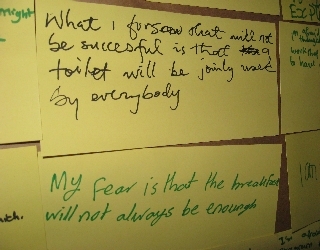
Children's responses on what they feared at an event.

Mistakes that even experienced child participation facilitators make:

  • Influencing too much on what children will say
  • Using children to promote the sponsoring organization or INGO’s agenda
  • Having children represent an NGO or INGO rather than representing themselves, their own groups or their communities
  • Having children wear NGO/ INGO t-shirts, caps and other branded items
  • Asking children from some countries (usually those from countries deemed ‘exotic’) to bring traditional costumes and share their culture, but not asking the same from other countries
  • Creating/building up ‘professional’ child participants and creating child star speakers
  • Relying on the same children all the time to represent because they have passports or visas or prior experience
  • Only bringing children who speak a major language or live in the capital to events
  • During sessions, not organizing group work in ways that facilitate communication across different languages
  • Sending any adult as a chaperone, rather than sending the best or the right adult as a chaperone
  • Not planning ahead on how children will be supported when they get back home to continue inputting into global networks and processes
  • Not ensuring a space for children to share their experiences with home offices and groups
  • Making children work long hours to fit everything in
  • Not giving children pocket money so that those with less means can also purchase small things for themselves or for family members
  • Housing children in fancy hotels with fancy food that they may not be used to; (not cooking enough good quality rice at lunch and dinner!)
  • Not realizing children may need to be shown how to use things like hotel showers, air conditioning, toilets
  • Not realizing that children may not want to sleep alone in a room
  • Not providing additional warm clothing for children if the conference climate is colder than their own
  • Not realizing that a trip overseas creates culture shock, children may feel lonely for their families
  • Not ensuring that children have the means to call home as soon as they arrive to an event and periodically during their stay
  • Not realizing that those facilitating child participation or working on child protection may not have the power to influence event organizers, especially if events are being organized in hierarchical ways with governments and high level committees involved
  • Not establishing at what point enough is enough, and children shouldn’t participate because conference organizers simply haven’t created favorable conditions, and children are put at risk or their participation will not be of good quality or have any real impact

Mistakes I’ve seen conference and event organizers repeat over and over:

  • Focusing on number of children participants rather than quality of participation
  • Not providing information with enough lead time for it to be translated and shared with children, or for good planning and selection processes to be done
  • Segregating children in parallel events where they don’t interact with adults
  • Not giving children space to lead sessions or engage with adults; offering them the last spot in the opening /closing speeches, and giving them a small percentage of the time that the adult speakers are given; or reducing children’s participation time because adults have gone over their allotted time
  • Patronizing children by clapping every time a child says something, or saying “oh that’s such a great idea!” not treating children respectfully as equals
  • Encouraging adults to get their photos taken with ‘exotic looking’ children in costumes
  • Not balancing the number of local participants and global participants
  • Not understanding that they need certain conditions to be available to fulfill child protection protocols (eg., children and adults need separate rooms; boys and girls as well as older/younger youth need to have separate rooms; the venue selection needs to have a measure of safety/security to prevent outsiders from taking advantage of any of the participating children, etc.)
  • Packing too many activities into the day and leaving children no time to rest
  • Not allowing any time for sight-seeing or recreation
  • Thinking all children have access to internet and computers to fill out registration forms, etc. and to participate in networks post conference
  • Not realizing that they need to listen to child participation and protection committees and adjust their ideas for their event so that children can effectively participate and are not put at risk
  • Thinking they can hire just anybody to manage child participation at the event
  • Not including a child participation/child protection point person in the organizing committee

So, what then?

I do honestly believe that children should participate and have a say in these issues, and that only by listening to children can decision-makers ensure that they are coming to the best decisions that benefit, resonate with, or have the best impact on children’s lives.

However unless proper organization, logistics, preparation and care are taken, these opportunities can be frustrating or a waste of an opportunity for everyone involved, and the validity of the efforts can easily be questioned.

Child participation needs to be taken seriously, not as an add-on or nice to have or cute to have. Unless and until regional and global events can ensure that this is happening, it might be a better investment to work with children at local and national levels.

Event organizers and child participation facilitators need to look at existing protocols, documentation, minimum standards and lessons learned and use them. Organizations shouldn’t be coming up with the same ‘lessons learned’ after every event and repeating the same mistakes at the next one. Surely we can do better than that.

What guidelines does your organization have? What mistakes have you made and learned from? What recommendations can you give? How can we get it right? Please share your thoughts in the comments section…

Download

Minimum Standards on Child Participation

Protocols and documents to use to help ensure good quality participation

*The following organizations participated on the steering committee that elaborated the Minimum Standards: UNICEF East Asia Pacific Regional Office, World Health Organisation, Office for the High Commissioner for Human Rights, ILO IPEC Asia and the Pacific, NGO Advisory Panel on the UN Study on Violence Against Children, Save the Children Alliance, Child Workers in Asia, ECPAT International, World Vision International APRO, Plan International, Terre des Hommes Germany, ASEAN Foundation.

Related posts on Wait… What?

Child protection, the media and youth media programs

Children and young people’s vision for a new Haiti

Read Full Post »

Of what value is a computer if you don’t have regular access to it? If you don’t have an operating system, some programs, virus protection, electricity, and increasingly, internet? Of what value is a school building without caring and qualified teachers, a relevant curriculum, engaged parents, students who desire an education, families that see the value in education for their children, and a community that is willing to take a lead in ensuring that the above happens?

Hardware without software is pretty much a waste of resources.

Child protection systems follow the same logic.  For example, a legal framework or a free, national helpline or an SMS-based system for child abuse reporting can be set up, and the government can express great support for it. But if there are no resources to manage it, no one answers the phone, operators or administrators are not trained, there is no response after reporting an incident, laws protecting children are not operationalized or enforced, there is corruption within the governmental systems, authorities are the actual abusers, the population is unaware that the laws or helpline exist or has had negative experiences with them, or people do not think violence is worth reporting or ending, it is like having a computer without any software, an old impractical machine that eats up resources with slow or nil results, or a device with a virus or corrupted files.

One of the areas where I’m currently supporting colleagues with ICTs (information and communication technology) is prevention of violence against children. In many cases, we are working in countries with weak government support and systems, making it very difficult to rely on government child protection services. Even in places where there is a reasonably strong national system, child protection services cannot rely only on official channels and systems managed by government duty bearers.  Communities, traditional leaders and authorities, families and children themselves need to be involved and active in their own protection.

In the organization where I work, we’ve had a lot of internal discussion, taking a strong look at our interventions and programs, talking with children, youth, communities, civil society, local and national authorities, and really challenging ourselves to find the best way to work with and strengthen local, district and national child protection efforts.

I was really happy when my colleague in Ghana shared with me a review titled “What Are We Learning about Protecting Children in the Community: An Interagency Review of Evidence on Community-Based Child Protection Mechanismswritten by Mike Wessells, and commissioned by several agencies. I might be coming late to the party, as it was published in 2009, but better late than never.

Community-based child protection mechanisms, the report explains, “are at the forefront of efforts to address child protection in emergency, transitional, and development contexts worldwide. The mobilization of such grassroots groups has become a common programming response in many settings, particularly in areas affected by armed conflict or displacement. For international agencies, they are a favoured approach in places where local and national government is unable or unwilling to fulfill children’s rights to care and protection.”

Community-based child protection groups “are a vital means of mobilizing communities around children’s protection and wellbeing. Organised with care and in a contextually appropriate manner, they make it possible to:  identify, prevent and respond to significant child protection risks; mobilise communities around child protection issues; and provide a base of local support and action that can be taken to scale through links with other community groups and with national child protection systems.

According to the report, not enough is known about how these groups operate, how effective they are, and how they could be strengthened, so this review was commissioned to pull together existing learning and evidence. A stated limitation of the report is that it is highly focused on initiatives started or supported by external agencies.  I’m looking forward to the second phase of the review which will focus on groups initiated and run by local communities without external support. It should offer up even more interesting information.

Another stated limitation of the review is the absence of a strong evidence base on community-based child protection groups. Not having sufficient evidence of what works and what doesn’t means that potential remains high for unintended harm caused by child protection efforts. Potential risks have been identified when agencies excessively target particular categories of children, impose external concepts which can create community backlash, and disregard existing local practices that protect children.  This will also be addressed in Phase 2.

7 things that make child protection groups more effective

The review was able to identify 7 factors that influence the effectiveness of a community-based child protection group (I encourage you to check out the full report here):

1)      Community Ownership: as in most situations, the higher the community ownership, the more effective.

2)      Building on existing resources: a concerning tendency was for external agencies to start new groups without finding out what child protection mechanisms already exist in the community; some programs seemed to disrespect and marginalize local culture and didn’t do enough to build on positive existing practices.

3)      Support from leaders: engaging traditional leaders is tricky and necessary, especially when child rights and child protection run counter to traditional practices.

4)      Child participation: in most cases child participation in community based protection groups was not high quality; when it was present it improved quality and impact.

5)      Management of issues of power, diversity and inclusivity: the more effective groups were the more diverse and inclusive ones that invested great time and effort in ensuring power issues were managed.

6)      Resources: to be effective, groups needed both human and material resources; however, external agencies should carefully think through how much and what they resource to avoid creating parallel systems or undermining existing systems and community ownership.

7)      Linkages: links to both formal and non-formal systems and structures were beneficial.

The document goes on to look at scale and sustainability, concluding that community-based child protection groups are a scalable model of benefiting significant numbers of at-risk children. It lists 3 different models for scale that have worked especially for HIV and AIDS related work.  Sustainability of both outcomes and processes were a challenge for most of the initiatives studied for the review, and community ownership was the most important enabler in terms of sustainability. Unpaid local volunteer groups, which drew on existing community organizations and which worked in partnership with local traditional and religious leadership seemed to be the most sustainable.

Six significant challenges were identified for agencies supporting community-based child protection systems: strengthening the evidence base; better enabling community groups; improving sustainability by looking at long-term outcomes rather than short-term funding efforts and avoiding parallel systems created by external agencies; having more respect for community values, processes and capacities; facilitating community ownership even in emergency situations; changing donor and agency practices around community-led child protection groups, including the tendency for short-term injections of high amounts of funding, and stigmatizing certain ‘categories’ of children by excessive targeting.

A series of recommendations for practitioners and donors is listed in the review based on the above challenges and gaps.

This is already quite a useful document for practitioners, agencies and donors working in the area of child protection or other types of community-based protection and support groups. Phase 2 should shed even more light on what makes for successful community-led and community-based protection services.

The author of the review is Mike Wessells. Agencies participating in the review include USAID Displaced Orphans and Children’s Fund, Oak Foundation, Save the Children, UNICEF and World Vision International.  The review summary is available at this link, and the full report (.pdf) is available here.

Related posts on Wait… What?

Fostering a new political consciousness on violence against children

7 (or more) questions to ask before adding ICTs

Finding some ICT answers in Benin

Tweaking: SMS violence reporting system in Benin

Child Protection: from emergency support to a sustainable mechanism

Child protection, the media and youth media programs

An example of youth-led community change in Mali


Read Full Post »

The basic premise of the Convention on the Rights of the Child (referred to as the ‘CRC’) is that children are born with fundamental freedoms and the inherent rights of all human beings.

According to the CRC, the 4 main categories of rights that children have are survival, development, participation and protection. The CRC’s guiding principles help further shape the way that child rights should be interpreted. These are non-discrimination, the best interest of the child, right to life, survival and development, and respect for the views of the child.

Child protection concerns a child’s right not to be harmed and to protection from violence, abuse, neglect and exploitation.  It involves the duty of care placed on those that work with children or that come into contact with children.  It encompasses the responsibilities, measures, and activities that must be undertaken to safeguard children from both intentional and unintentional harm.

Child protection encompasses many different areas, such as juvenile justice systems and a child’s right not to be tried as an adult or incarcerated with adults; special care needed by unaccompanied children; protection from sexual exploitation and dangerous forms of child labor; prevention of trafficking and harmful traditional practices such as female genital cutting; support for children in emergency and conflict situations; prevention of exploitation by the media; the right not to be abused or taken advantage of by family, caregivers or institutions; and so on.  This link gives an explanation of a protective environment, and this one offers an excellent broad overview of child protection.

Child protection policies and strategies create mechanisms to prevent any type of harm to a child.

Child protection in youth media programs

The organization where I work frames its efforts within the CRC.  Most of the programs that I focus on are related to child participation and child protection.  These two areas go hand in hand, because good participation initiatives need to take child protection into consideration, and good protection initiatives are only successful when children participate in designing them and in protecting themselves.  Children should both know what their rights are and take an active part in achieving them and in protecting themselves.

This week, for example, I’m at a workshop with a small group of colleagues, teachers and local partners from the Upper West Region of Ghana. We’re preparing for a youth arts and media project that they will implement in June. By the end of this facilitator workshop, we will have a localized training plan that fits the context of the community and the youth participants, and the facilitators will have learned some new media skills that they will train the youth on when the project starts.

As part of the facilitators’ training, we cover the CRC, going in depth on child participation and child protection.  There is always a certain tension between these two areas. We want to encourage children to participate to their fullest, yet both children and adults need to be aware of potential risks that participation can bring with it, and know how to mitigate and manage them.

Three child protection risks that we are focusing on with facilitators at this week’s workshop are:

  • Intentional or unintentional abuse by staff or local partners
  • Retaliation or harm to a child who appears in a media story or art piece on a sensitive issue
  • Retaliation or harm to a child who authors or creates media or arts on a sensitive issue

Internal child protection policies

To begin our sessions on child protection, my colleague Joyce covered our organizational Child Protection Policy, which clearly states our intention to protect children from harm and advises that we will take positive action to prevent child abusers from becoming involved with the organization.

Joyce explained that child abuse is never acceptable:

  • Child abuse in our case is defined as:  All forms of physical abuse, emotional ill-treatment, sexual abuse and exploitation, neglect or negligent treatment, commercial or other exploitation of a child and includes any actions that result in actual or potential harm to a child.
  • Our child protection policy applies to staff at all levels, including board members, volunteers, community volunteers, supporters, consultants, contractors; partner organizations, local government people who have been brought into contact with children via our organization, visitors, donors, journalists, researchers and any other type of person or institution associated with us.
  • We recognize that child abuse may be a deliberate act or it may be failing to act to prevent harm. Child abuse consists of anything which individuals, institutions or processes do or fail to do, intentionally or unintentionally which harms a child or damages their prospect of safe and healthy development into adulthood.
  • We follow through on cases of child abuse to the fullest extent of the law.

Point three, unintentional abuse, refers to situations where someone has good intentions but their lack of planning, knowledge, foresight, or their recklessness puts children in harm’s way.  As Joyce explained, “It’s  like an excursion that is not well planned.”  The good intention is to take children out so that they could have some fun.  But if proper care is not taken to plan the trip and ensure children’s safety during the trip, then unintentional harm could be done. A child could be lost, a vehicle could be unsafe, a child could drown.  Though the good intention of the person planning this event is not in question — they wanted the children to have fun and enjoy themselves — if proper planning is not done and something happens that causes harm to a child, it is still considered child abuse.  Good intentions are not enough.

Here are some resources on institutional child protection standards and an excellent overview on minimum participation and protection standards when working with children and residential events.

Use of children’s images in the media

Since this is a youth arts and media project, we need to think about the use of children’s images and identities in the media: print, broadcast, radio, internet or visual arts. The CRC asserts that every child has the right to privacy, and this extends to the right not to have their image used for any purpose for which they have not given consent.

Key points related to the use of children’s images and working with children’s stories include:

  • If the person is below 18, you must seek the consent of the parents/guardians
  • Consent forms must be kept securely for future audit or proof purposes
  • A child’s real name should not be used in publication or broadcast unless they would benefit from increased self-esteem by seeing their name in print
  • The information given about the child should not allow their precise location to be identified (either directly or indirectly)
  • A story should not be published, with or without names or identities altered, if it could put a child, siblings or peers at risk
  • The best interest of the child comes above all else

Helping people see the implications

Expanding on the aspects above, Joyce offered ideas on how to discuss and ensure that children and adults that might portray others, or be portrayed in media, are aware of all the implications and potential risks:

  • Today’s media is global and can be accessed anywhere in the world through the internet.
  • When you talk to the media nowadays, you are talking to the world. The story may not reach everybody in every country, but you can be sure that it will reach further than you can imagine.
  • Ask yourself the following:
    • How would friends and family react if they saw the story, or found out that it had been published?
    • Think through who might be harmed.  Would the subject of the article, artwork or video be at risk of any harm if someone saw it?  Could this story or artwork put anyone in danger?
    • This story can stay documented for years. How would the person feel if their children were to read the story in a few years?
    • There is no guarantee that this story cannot be seen by people whom you do not want to know about it.  Help people thoroughly understand the implications of sharing their stories. This protects not only the subject of the story, but the person who is authoring the story.
    • Are there people we need to protect when telling our story? Friends that we need to protect?  What needs to be edited out so that nobody is implicated in the presentation of the work?

Here is an excellent resource on use of children’s images in the media, and a guide for journalists reporting on children, and guidelines for reporting on children in the context of HIV/AIDS.

Stories that cause unintentional harm

To illustrate some of the points above, we used 2 examples.  A New York Times/Nick Kristof article that identifies a child from the Democratic Republic of the Congo who was raped and his opinion piece on why he believes that was OK, and a scenario where a film is made of a girl who reports that her mother beats her and doesn’t allow her to attend school.

General consensus from the group in our workshop on the New York Times case was that child protection and media guidelines were not followed, and that Kristof was reckless and unintentionally put the girl at risk.  Workshop participants felt that appropriate respect for the child was not shown. “The journalist would never be able to do that in the US”.  One participant exclaimed “So, he didn’t feel that any Congolese would ever be enlightened enough to access the story?”  It was recognized that “his intention was good, that people should know about these terrible crimes, but there is no need to share all the specifics.” Participants wondered whether this was in the best interest of the girl, and how she would feel in the future if someone she knew found the article.  “In our culture, this type of thing can be very stigmatizing.”  Participants asked why technology wasn’t used to cover the girls’ face and disguise her voice, or why she wasn’t filmed from behind to conceal her identity.  The conclusion was that this story could have been told in a way that protected the child and had equal impact on readers.  [Update: Laura over at Texas in Africa has a great post on Connectivity and Child Protection which comes to the same conclusions.  You can also find related posts from awhile back on Wronging Rights.]

In the second scenario, consensus was that the story could create difficulties for everyone involved.  One participant commented that the mother might get angry and beat the child even more.  Another said that it the whole village might feel betrayed by the child exposing the story. “When a child does something, people ask – from which village are you? From which house?  From which family?  Whatever you do to a member of the village you do to the whole village. This can cause a threat to the child by the whole village.  Those who give out the story, if they are known by the village, will also be at risk.”  Another issue was that the community might say that the children are given too much power. “They will wonder who is behind it and may not wish to work any longer with the organization that is supporting the project.”  It was suggested that if a story like this were filmed, it should show a resolution, a happy ending, so that it could be used as an example. “That way you can favor all who are involved.”  The group concluded that when topics are quite sensitive or individuals are implicated, the story should be altered to protect identity and the same situation could be brought out using simulations, song, theater or drawings.

As we are training children as citizen journalists in this project, case studies that highlight the potential risks and impact of a story are critical learning tools.

In conclusion….

Child protection needs to be considered whenever children are involved.  Adults and children need to be aware of potential risks and thoroughly discuss how to mitigate them. Mechanisms need to be in place to address any intentional or unintentional harm that could be caused to a child or children.  There are plenty of good resources around on how to do this, so there is really no excuse not to.

————————–

The Child Rights Information Network provides excellent all around resources on child protection and child rights, and a list of over 1000 global resources on child rights

Keeping Children Safe offers a toolkit for developing your organization’s internal child protection policies

The International Federation of Journalists has created Guidelines and Principles for Reporting on Issues Involving Children

Related posts on Wait… What?

Child protection, from emergency response to a sustainable mechanism

Children in emergencies: applying what we already know to the crisis in Haiti

Read Full Post »

Henri from Plan Benin training on SMS reporting.

In February I was in Benin to support staff to pilot the idea of using SMS reporting (FrontlineSMS) and digital mapping (Ushahidi) to strengthen local and national systems for reporting, tracking and responding to violence against children.  We conducted 2 workshops in mid-February with youth leaders, frontline staff, community members, local authorities from the Center for Social Protection (CPS) and representatives from the Ministry of the Family to get things started.

For some more background, check out my previous posts on the Violence against Children (VAC) project, the questions we asked ourselves before getting started on the SMS and mapping initiative, and the February workshops in Benin and what we learned there.

Since February, staff in Benin have been following up with workshop participants and with local authorities and institutions, including: the Prefect, the Mayors, community supervisors, animators of the children’s/youth media clubs, headmasters and other school authorities and the CPS.  The youth in one community did a radio program about violence against children and talked about SMS reporting. They also designed an information sheet that’s been hung up all over the town to encourage the population to report cases of violence.

Henri, Plan Benin’s ICT Director who facilitated at the Benin workshops, went to Togo to replicate the training with staff and youth there.  He and Carmen, who manages the overall VAC project in Benin, have also been observing and collecting feedback on the system to see where it needs tweaking.  They have put a project plan together for the next 6 months or so.

Carmen the VAC project coordinator in Benin.

Observations that Henri and Carmen shared and some thoughts we have about resolving them:

Issue:

  • Most people call instead of sending SMS

Hmmm….

  • Why?  Habit?  Literacy?  Unclear indications of what to do or unclear expectations of what the system is for?  We need to find out more about this.  It would be good to know exactly what kind of volume we are talking about total in terms of SMS vs calls. (I will update this post when I find out.)
  • Should we start taking calls too then? And are there resources and capacity to manage calls in addition to FrontlineSMS (which is automated)? How are we linking with the Child Help Line in Benin?
  • Could both calls and SMS be administered in the Ushahidi system?  Eg., Just as an administrator needs to review any SMS’s that come into Ushahidi  before approving them, someone could be tasked with inputting information from a phone call into the Ushahidi back end to then trigger the rest of the process (verification, response, etc). And how would that impact on pulling data out of the system for decision making?  (See this post for more information on how the system is currently conceived)

Issue:

  • Some people are sending a re-call SMS (asking us to return the call)

Hmmm….

  • We need to find out why people are sending re-call messages instead of SMS’s.  Because in the current set-up, text messages are not free?  Literacy issues? Because our system looks like something else they’ve done where re-call was the norm?  Something else?
  • If it’s due to low literacy or language issues, how can we open the system to those who cannot read/write or who do not use French?
  • Plan Benin is discussing with the GSM provider to find a way to send back an automatic reply SMS informing people not to call but to send a message, and to take this opportunity to indicate in the message what is expected as information.  But if literacy/language is the issue, we will not have solved anything by doing this…. Sounds like we really need to make sure calling is an option, and that good integration with the national Child Help Line is a real priority.
  • Plan Benin is also negotiating getting a “green line” or free short code, so that might resolve part of this.

Issue:

  • Many people are not using the key word ‘HALTE’ (stop) at the beginning of the message, meaning that the commands don’t trigger the messages to automatically send the information to Ushahidi.  (In the current system, each SMS should include the key word ‘HALTE’.  This key word triggers a “thanks for your message” automatic response from FrontlineSMS, and the forwarding of the message to the Ushahidi back end for subsequent management and follow up by local authorities.)

Hmmm….

  • Staff noticed that most (but not all) of the messages without the key word ‘’HALTE’’ contained the word ‘enfant’ (child). Henri has added ‘enfant’ as a key word in addition to ‘HALTE’ — and says it is working fine.  So we will assess if this helps.
  • Another alternative would be to not use any keywords – we will need to look into whether we can set FrontlineSMS up so that any SMS that goes to that number gets auto forwarded to Ushahidi.

Early draft of a poster promoting violence reporting by SMS

Issue:

  • Most of the messages are too vague to find the place and the victim for responding (and people do not have GPS enabled phones).  We have suggested that an SMS report should contain certain information [HALTE+type of violence+where it’s happening (eg., school, home, etc)+village name+district+age+sex+name of child if known], but people don’t follow the suggested format.

Hmmm….

  • How can we simplify it or better explain the type of information that’s needed?  Something we need to dig deeper into and consult with users to figure out.  Carmen’s take is that we are at the beginning of the process and we need to be patient and sensitize a lot so that people get used to the idea and understand how things work.

Issue:

  • Compatible FLSMS phones and modems are very difficult to find.  We were only able to find one phone that was compatible in Benin (a used one) because newer phone models are not compatible and the modems we found refused to connect.

Hmmm….

  • We really need to get this resolved since the entire system in Benin rests on one phone. What if it stops working?  It’s really difficult to expand the project without a larger set of phone/modem options.  We’ll work with the FrontlineSMS forum or staff (both are always super helpful on this kind of thing) in the next couple weeks to figure out how to resolve the compatibility issues, because there are modems available in West Africa that should be compatible, but that we couldn’t get to function.

Issue:

  • We planned for community response teams to be able to subscribe to alerts on Ushahidi, so that when there is an incident reported in the zone where they work, they would be alerted by SMS and could set the follow up process in motion.  But we haven’t been able to get the alerts working on Ushahidi or set up email reporting there.

Hmmm….

  • We discussed with the Ushahidi team and the problem was that not all the strings of code in Ushahidi had been translated into French yet.  Thanks to @theresac and @penelopeinparis, who volunteered to translate a load of strings, we are getting everything into French, and Henry at Ushahidi is helping get alerts working.  We still need to finalize all the elements on our Ushahidi page however and get everything working.  We’d also like to customize our Ushahidi page to make it our own, similar to the customizing that Voices of Kibera has done with their Ushahidi instance.

Any additional thoughts or help on the above issues are most welcome!


As for next steps, Henri and Carmen shared their plans:

  • Present the system to political and administrative authorities, including: head of the Brigade for the Protection of Minors, juvenile judges, Ministry of the Family’s Director for Children and Adolescents, Director of Family Programs, Minister of ICTs, cabinet and authorities who regulate telecommunications, Ministry of the Interior and Public Security, National Assembly, mayors and prefects, schools and teacher-parent committees, community authorities, media
  • Train staff, government partners, school and parent committees, and local NGOs on the reporting system, including a 1-day workshop with all Plan staff and a 1 day workshop with local NGO partners, schools and government staff
  • Accompany child protection committees and organized youth groups to use the system.  This will be done by holding sessions with organized children and youth groups at village level to reinforce and raise awareness on the reporting system; training child protection committees to use the new reporting system; holding one day sessions each month with the village level child protection system staff to discuss follow up on reports that have come in, and installing FrontlineSMS in each local site and adding local focal points as Ushahidi administrators
  • Strengthen awareness in the public and with leaders to support violence reporting by developing a communications plan to generate awareness on the issue of violence, the importance of reporting, and the mechanisms to report via SMS; supporting youth to use arts and theater to raise awareness on the issue of violence against children; talking with religious leaders and village chiefs; creating television, radio, newspaper and web advertisements to reach the general public and decision makers
  • Secure a free short code (target:  by May)
  • Conduct a national level evaluation workshop with involved local and national actors (in 6 months)

As we move forward, more questions will surely come up and we’ll need to continually tweak things. But I feel that we’re off to a good start. The fact that people are calling in and SMS’ing in is a good sign already that the program has some potential, and that people are willing to report violence against children.

—————-

Related posts on Wait… What?

Breaking it down: violence against children

Fostering a new political consciousness on violence against children

Seven (or more) questions to ask before adding ICTs

Finding some ICT answers in Benin

Meeting in the middle

Read Full Post »

Report released March 29, 2010

Often adults think that children and youth don’t have the capacity to express themselves or make good decisions.  I’ve been working with kids for a long time and I wholeheartedly disagree.  It makes me cringe when I hear adults making a big fuss out of something intelligent that a child or a young person says.

I’m not amazed anymore when kids say something profound or brilliant – I’ve come to expect it.  When trusted and given a comfortable space to say what they think, children and young people tend to bring critical insights to a situation, especially when it’s one that directly impacts on them and their lives.

So when adults are designing and implementing programs, instead of assuming that they know what is best for children and youth, it’s a good idea to actually ask them and involve them.

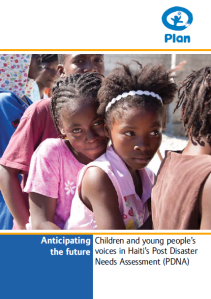
The “Children’s Voices in the PDNA” project (implemented by Plan with support from UNICEF) did exactly that:  experienced Haitian facilitators developed a child friendly methodology to consult with 54 groups of children and youth – almost 1000 kids in total – in 9 departments in Haiti to find out what they wanted to see in the new Haiti.  The resulting document in full can be found here, and is well worth a look-through.

The consultations focused on a few broad areas:

  • the impact of the January 2010 earthquake on children’s and youth’s lives and that of their communities
  • their visions for the reconstruction and long-term development of their country
  • their views regarding their present situations and future risks they may face
  • their ideas on how they would like to participate the future development of their country.

The project aimed at not only gathering opinions and ideas from the participating children and youth to feed into the PDNA, but to help them understand the PDNA process and how it would link into the long-term reconstruction in Haiti and impact on their own lives. Children and youth were also given the space to share ideas for accountability, monitoring and evaluation mechanisms.

Participants were divided into age-based groups (5-10, 11-16 and 17-24 year olds) for the consultations, and their responses were recorded according to sex in order to ensure that gender-based information was available for future program planning.  The 4 main categories of the PDNA were included as well: social sectors, infrastructure, production sectors, and governance/security. In order to ensure a holistic approach when coming up with solutions, the root causes of vulnerability and risk were discussed.  Environmental hazards such as earthquakes, floods, landslides, and social risks like child trafficking, child protection, violence and abuse were addressed.  A summary of the children and youths priorities by age and sex is found on page 19 of the document.

Children and youth certainly had something to say.

——————–

I want a different Haiti where we, the youth, have a chance to participate with the government; we can be part of the government and of all activities in the country. In the past, youth had been completely excluded; we need a new strategy or approach to achieve this end.” Boy in age group 11-16, Croix des Bouquets

I’m sure we’ll have a better Haiti with the participation of youth and children. Then, Haiti would become a beautiful country. Haiti cannot be rebuilt without the participation of children and youth, we are Haiti’s present, we will be Haiti’s future.” Girl in age group 11-16yrs, Croix des Bouquets

After the earthquake, I have seen a deprived youth. The country had assumed a thinking mind on behalf of Haitian youth. Because in my vision, I saw there was no future for the youth. We need to make men act consciously to facilitate equal distribution of things and to help every citizen according to his needs. My advice would be to decentralize the country, think of the whole country and rebuild the country consciously. Awareness is crucial to achieve a better distribution of international aid so it can benefit those most in need.” 22 year old male, Cyvadier / South-East

First, the focus group was a very good activity; everyone was involved and conscientious. Everyone had the opportunity to express their ideas and opinions freely. About January 12, I think everyone has his or her own way to live, understand and explain this event. But, there is still confusion and fear among people. They are traumatized and desperate. Now, we must reconsider, give room for everyone, listen to every person with positive ideas in the context of the reconstruction.” 18 year old female, Department of the West

——————–

Permission for two of the participating youth to attend a March 30th Side Event called “A Haiti Fit for Children” and to participate in the March 31st Donors Conference (both held in New York City), was granted. Ironically, the youth were denied visas to enter the US.  In my last post about Haiti I asked “Will Haitian youth go missing again?” The answer is “yes.”  But at least we can hope that their voices in written form will reach the eyes and ears of decision makers and donors. I hope that they will listen.  Children under 18 make up around 50% of the population in Haiti… if they go unheard, that is a lot of missing voices.

If you are reading this blog post and you plan to launch an initiative in Haiti, I hope you also will take 15 minutes to read through the “Children and Young People’s Voices in Haiti’s Post Disaster Needs Assessment” to hear what these 1000 children and youth in Haiti have to say.

But not only that.  I hope that before doing anything on the ground in Haiti, you or someone that you are working with will directly talk with and listen to Haitian children and young people, as well as with their parents, teachers, community leaders, and others in the communities that you are hoping to help or support.

Related posts on Wait… What?

Will Haitian youth go missing again?

Children in Emergencies: Applying what we already know to the crisis in Haiti

Read Full Post »

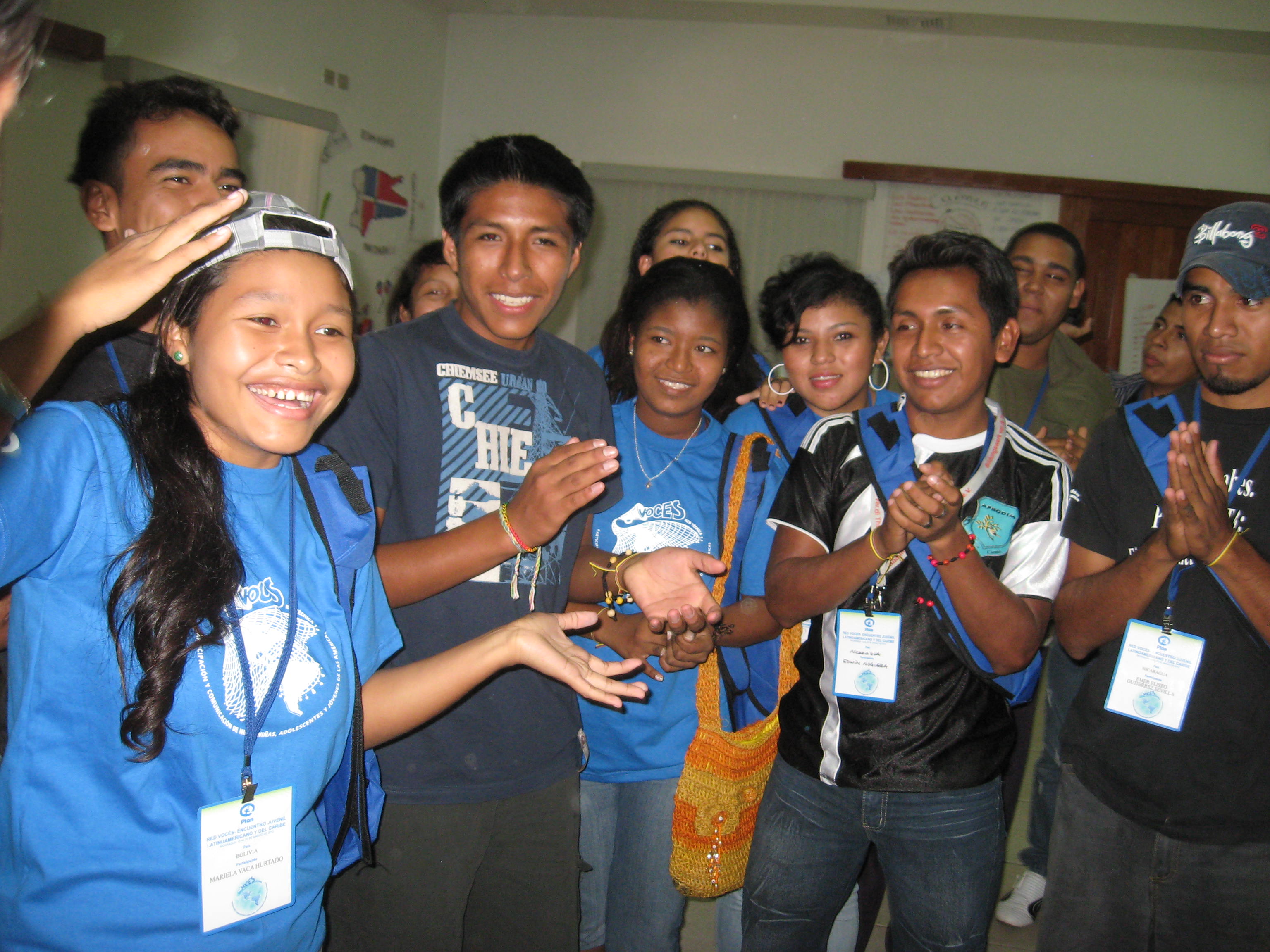
Members of the "Voces" Latin American youth media network.

I’m in Nicaragua this week for a regional meeting of youth leaders from 12 Latin American countries where the organization where I work (Plan) operates.  Well, actually only 11 countries are present, since our 5 person Haitian delegation (2 adults and 3 youth) was deported immediately upon arrival. What I understand is that they were missing a special type of visa permit required by Haitians that the Consulate in the Dominican Republic should have issued and didn’t, and the Haitian youth paid the price by having their hopes dashed.

To me it feels like adding insult to injury, but I guess no one cuts anyone any slack these days.  After 3 days running around, staff at our office in Nicaragua were unable to arrange for the team to enter the country.

I’m really disappointed that the Haitian team is not here this week because it would have meant a chance to hear first hand from the youth and my Haitian colleagues about their experiences over the past few months and to learn about how they have been participating in the Post Disaster Needs Assessment (PDNA) process in Haiti.  The youth from the Latin American youth media network, “Voces” (“Voices”) here are extremely bummed as well.  One aspect of their strategy for the next few years involves working in solidarity their Haitian peers to ensure that their voices and opinions are heard in the building and negotiating of the PDNA as well as in the post-PDNA process when promises and commitments will be monitored.

Around half of the population in Haiti is under 18, yet young people were not initially given a space to input into the PDNA process, even though it will decide the framework and funding for reconstruction of their country.  In order to bring those voices into the process, Plan worked in partnership with UNICEF to consult with 54 groups of children and youth (around 1000 kids in total) across the country (West, North East, South East, Artibonite, Nippes, South, North West, Grand Anse and Central Plateau) to find out about their current situation and their plans and ideas for the future. Issues of gender, disability, vulnerability, access to services, disaster risk reduction, participation in decision making, and accountability mechanisms for the PDNA were considered in the consultations. Plan has been working in Haiti for several years and has an active local network on the ground. These consultations were a lot of work, but not impossible.  (Read more about the process here.)

But the effort to fully involve children and youth does not stop at the consultation stage.  Plan and UNICEF are currently working to ensure that the input from the children and youth will be incorporated into the upcoming donor conference in New York on March 31, 2010 where representatives from the Haitian government, international organizations and representatives from the World Bank will decide Haiti’s future.  My colleague in the US office is working right now to try to secure visas for 2 youth to attend the March 31 meeting.

Interestingly enough, much of the input from the youth consultations fits right into the categories that will be discussed in these meetings:  education, housing, telecommunications, transport, energy, boosting the effectiveness of government and macro economic recovery.  If you ask me, it would be vital for decision makers to hear it.  The most common point made by children and youth during the consultations was education and getting back to school.

Here in Nicaragua, the 40 or so youth from the “Voces” network who did make it through immigration to participate in our meeting this week have been following the Haiti situation since it began, offering solidarity and support from afar.  The group is composed of young media veterans, all part of youth networks and media groups in their home countries. They have been doing local, national and global level advocacy work for years; some for 10 years, since they were pre-teens.  They write blogs, host television and radio shows, publish newsletters, make videos, produce music, and are generally involved and powerful voices for their generation.

I really like their vision for supporting their Haitian peers’ primary efforts in getting a seat at the table and being heard by decision makers around the PDNA and post-PDNA reconstruction process in Haiti. They are planning to use their contacts in their own governments and ministries and their existing media platforms to bring the opinions and voices of their Haitian peers in “through the back door” so to speak. They want to advocate with their own country governments, youth commissions, Ministries, etc., to influence their positions so that when they interact with the Government of Haiti, they are doing it with opinions and positions of Haitian youth in mind. In this way they want to help the voices of their peers to be heard directly and indirectly on various fronts and from all sides.

On the ground in Haiti, Plan is working to find and revive all the youth media groups that were its active partners before the earthquake.  These groups have been working in their communities and at the national level through various media around themes of importance to youth.  In fact Caroline and Fritz, 2 of the youth that I have met in the past at other youth encounters are at the forefront of the children and youth participation in the PDNA process right now.  These and other groups of  young people can play a vital role in the post-disaster reconstruction process in many ways, including monitoring the gap between commitments made and commitments fulfilled.

The knowledge, motivation and spirit of the youth here at this regional encounter, are a real inspiration. I can only imagine how disappointed their peers are, back in Haiti, after all the preparation that they did to attend this week. But our regional media encounter is of  much less significance than the March 31 meeting.  How will the youth who are planning to attend that meeting feel if they are not allowed in.  Why is their voice less important in that context, less of a priority than other voices?  I’ve been in this world long enough to know the answer to that question, but it will never cease to upset me.

So here’s hoping that the 2 Haitian youth who are slated to participate in the PDNA Meeting in NYC are given a seat at the table and permission to attend the donor meeting and to enter the US.  Here’s hoping that Haitian youth and their voices will not go missing again.

Related Posts on Wait… What?

Children and young people’s vision for a new Haiti

Children in Emergencies:  Applying what we already know to the crisis in Haiti

An example of youth-led community change in Mali

Read Full Post »

Ending violence is not as simple as some people (and some famous-journalists-from-the-New-York-Times) might think. It’s not as easy as telling some personal stories of child victims of violence and getting people in the “West” to pay attention and care.  Ending violence against children will involve some very deep and profound cultural shifts that need to be owned by local communities who have decided that they want to end violence. Violence needs to be addressed on multiple fronts over time, taking into consideration very localized contexts that frame violence against children as an accepted norm, and that allow those who commit violent acts against children to continue with impunity.  Violence is not something in isolation of other currents running through a society, and much (most? all?) violence is rooted in unequal power relationships.

Next Sunday, I’m heading to Benin for a couple weeks to work on a project aimed at ending violence against children.  I’ll be training colleagues from Benin and Togo on setting up an SMS based system of collecting incident reports on violence against children and mapping the incidents out. This information should allow for better tracking and understanding of what kind of violence is taking place, and for more informed thinking about sustainable solutions/responses to the violence.

My colleagues and I will then train youth in 2 communities in Benin to use the system.  We’ll also train youth to do some basic audio and video testimonies. Our Togo colleagues will return to Togo to replicate the training with some youth groups there.  This is all part of a larger Violence against Children (VAC) project that has been ongoing since 2008.

One thing that I like about this VAC project is that it trains and engages children and youth themselves as advocates and agents of change to end violence, together with adult community allies.  As those who are experiencing this violence, it’s vital that children and youth are prepared and able to take part in stopping the cycle – it’s in their own best interest.  They also need a critical mass of people locally who are aware of the negative impacts of violence, and a system that can apprehend and mete out consequences for those who commit acts of violence.

After its 4 year running period, the VAC project will have trained some 200 children and youth on the causes, manifestations and consequences of violence; ways to communicate effectively with different audiences to get the message of stopping violence across; the use of cartoons, comics, social media, radio and television to talk about issues of violence; and how to respectfully yet confidently lead intergenerational dialogue around the issue.  After my 2 weeks in Benin, the youth, project staff and other participating community adults will (I hope!) be able to use mobile phones to collect information, pictures, videos and audio testimonies about violence in their communities to share locally, nationally and globally to speak to publics and decision makers.

As part of the preparation for the upcoming workshop, I’ve been reading through some reports and documentation about the project.  One report stated that all children participating thus far in the project have said that there has been a concrete reduction of violence in their lives. They have consciously broken the cycle of violence themselves and have been able to talk to their families and peers, who now exercise less violence against them.  Most of the youth in the participating groups have themselves been victims of violence, sometimes severe, at home on a regular basis.

The pain, the marks on my skin, swelling and wounds are the consequences of violence against me…I lose my composure and all ability to complete a task. Then there’s also the doubt, fear, stress, not wanting to talk about it and shyness. –  female participant, Togo

They in turn they were often also violent towards their siblings and their peers.  Participating in the project has strengthened their “be the change you want to see” mentality around violence.

“The knowledge I have gained from the project has helped me put an end to the violence that I used to carry out against my sisters, brothers, and sometimes other children. My parents have also changed – they are no longer violent towards me.” female participant, Togo

In addition to the personal changes at the level of the participants, the VAC project has built a civil society of youth who engage politically with their peers, families, schools and communities around issues of violence.  The youth have also made violence against children part of the public agenda by partnering with media sources who feed their media into mainstream channels.

Participants are fostering a new political consciousness on violence against children by educating other children and youth about the UNVAC study and how violence compromises their rights. They’ve been able to create alliances between youth and adults to advance their cause and youth have been able to share their experiences and opinions with high-level policy makers, including government officials and the UN Special Representative on Violence against Children.

This project is a great example of how engaging with young people can begin to offer solutions to very complex problems, and how looking at youth, and at people in general, as participants and stakeholders and subjects of rights rather than victims, or beneficiaries, or objects of pity can have much better and more sustainable results.

The United Nations Violence against Children Study examined the violence that children around the world experience on a daily basis and documented children’s own experiences of violence in their homes, school, communities, workplace and institutions. A Child Friendly Version of the report is also available.

The VAC project is co-implemented by Plan and Save the Children in West Africa and takes place over 4 years (2008-2011) in seven countries: Togo, Ghana, Benin, Guinea, Mali, Côte d’Ivoire and Gambia in partnership with Curious Minds (Ghana), Child Protection Alliance of Gambia, youth and children’s clubs in all these countries, the African Movement for Working Children and Youth, and Planet Jeunes (a popular magazine for youth in West Africa).   Through the project’s work with children, youth, parents and communities, the achievements of the VAC project to combat violence against children are directly helping to realize the UN VAC Study’s recommendations. Several action plans developed by children and youth seek the support and commitment of the UN Special Representative on Violence against Children to continue lobbying governments for change. Young people engaged in the West African VAC project are a valuable resource for the UN Special Representative, ready to support her work in Africa and beyond.

——————–
Related Posts:

Read Full Post »

I recently had the honor of leading a group of tech, development and gender folks in a discussion around Girls and ICTs at the Technology Salon.  The conversation revolved around 5 aspects I wrote about in an earlier blog post On Girls and ICTs:

  • Tension between participation and protection
  • Online behavior is an extension of, and a potential amplifier of offline behavior
  • Qualifying the digital divide
  • Girls’ involvement in developing and designing ICT solutions for their own needs
  • Research on Girls and ICTs

Check out the Technology Salon’s page for a round-up of our discussions!

Photo:  Informal evening one-on-one ICT time at a Youth Empowerment through Arts and Media (YETAM) project workshop in Cameroon.

——————-
Related post on Wait… What?
On Girls and ICTs

Putting Cumbana on the Map:  with Ethics
Being a Girl in Cumbana

Girl Power and the CGI

Read Full Post »

There is a lot of talk about “Child Protection” these days and an increased awareness of the vulnerability of children who are separated from their parents or who have lost them due to the Haiti earthquake   But what exactly does “Child Protection” mean?  What does a child protection system look like on the ground?  How can child protection mechanisms be set up during an emergency phase, and how can they be turned into a sustainable mechanism post-crisis?

Jose Francisco de Sousa (“Quico”), a co-worker of mine at Plan Timor-Leste, sent me written information on Plan’s child protection work in the 2006 crisis response there and talked me through some of details below. Photo:  Quico.

Plan was active in the broader emergency response in Timor-Leste following the political crisis of April 2006 through work in over 40 camps for Internally Displaced Persons (IDPs). (For some deeper insight into Timor-Leste, check out this post by my twitter pal @giantpandinha).

In Timor-Leste, Plan was one of the first agencies to respond as Site Liaison Support (SLS), responsible for the coordination, operation and management of camp activities within days of the crisis. Plan’s specific focus was on addressing the needs of children in the camps, covering service provision such as the delivery of potable water to 15,000 IDPs, addressing hygiene and sanitation issues to improve health, and training youth in conflict resolution skills to aid the nation’s peace building process, and child protection.

Plan’s child protection approach included identifying, monitoring and protecting children at risk, setting up referral systems, training communities in child rights and child protection strategies and mechanisms, and ‘seconding’ Quico as an advisor to the government to strengthen its child protection systems.

Quico was “loaned out” to the Ministry of Social Solidarity (MSS) to build upon existing capacities in the Ministry of Social Solidarity (Child Protection Department) and to ensure a strongly coordinated sectoral, systems-building approach to the child protection response. Through this process, the government came to see child protection as a priority in the long term and eventually established a Child Protection Department under the MSS. So, in other words, the emergency child protection mechanisms established during the crisis were successfully built into a sustainable child protection system in the long term, and services are now available in the district and sub-district levels across the country.

“When the crisis began in Timor Leste, it was very difficult for us to get any resources on how best we could assist internally displaced people. During the emergency, there were many NGOs and other organizations trying to support the internally displaced through different approaches. The focus was mainly to provide the basic needs. There was no proper coordination strategy/mechanism that included broader child protection issues.

I would say that if we look at the nature of the disasters in Timor-Leste and what is happening in Haiti right now, It’s different,  but I imagine (correct me if I’m wrong) that the impact of the disasters might be same, where instability is created in different sectors leading to broader child protection issues.

Plan responded to the emergency in Dili (the Capital of Timor-Leste) with immediate practical child protection measures focusing on the prevention of family separation, and the promotion of safety, and health and hygiene in camps. We also prioritised co-ordination of child protection actors by initiating a Child Protection Working Group. This filled a leadership vacuum whilst building the capacity of the Government  to gradually take over leadership responsibility.”

Keep reading for an overview of the Toolkit…..or download it here.

————————————————–

Plan Timor-Leste’s Child Protection Emergency Toolkit is divided into 7 parts:

1. Overview of Framework & Standards Related to an Emergency Response in Timor-Leste
This section aims to give an overview of the international, national and organizational laws, policies, standards and approaches to child protection in emergencies in order have clear guidance on how to create an appropriate framework for a potential response that is in line with global, national and internal organizational laws and policies on Child Protection in Emergencies. (If replicating the toolkit, these documents would need to be adapted to the country context).  Users of the toolkit should read this section before they go on to use the other sections in the toolkit.   These overviews are important to integrate into Child Protection in Emergency trainings and orientation for new staff recruited in the event of an emergency.

Some of the legal instruments and Humanitarian Principles Applicable to Child Protection in Emergencies in Timor-Leste included:
  • Overview of Approaches and Guidelines in Child Protection in Emergency
  • Timor-Leste Structural Framework of the Current System for Child Protection
  • Timor-Leste Legal Framework for Child Protection
  • Plan’s Approach to Emergency
  • Summary of Learning and Recommendations from 2006 Emergency Child Protection Response

2. Emergency preparedness
The section includes an overview of steps that should be taken to ensure that Plan offices are prepared for an emergency. It’s divided into two areas – programmatic preparedness and administrative preparedness.  It also includes the practical internal financial codes for general emergency preparedness activities so that these are compiled and readily available to support and inform activities and rapid proposal writing in the event of an emergency. These are also useful for Country Offices to be prepared for emergency in the long term.

Programmatically, the tools include government and Child Protection Working Group contingency planning, risk analysis and scenario planning, child protection activity mapping and definition of roles and responsibilities.  They also include tools developed specifically for the geographical areas where a child protection response might potentially be needed, such as contact lists for child protection actors at the municipal level, and community-based hazard, risk and capacity maps developed by children and their communities as part of Plan’s on-going mitigation activities.

The administrative tools cover generic job responsibilities, a general child protection in emergencies orientation session for newly recruited staff or those who are new to emergency response.  The human resource structure of a response is defined and responsibilities are allocated within the current staff organigram.  Advocacy and media standards and a stock list of necessary items for the first phase of an emergency response are also included.

3. Initial emergency response
This section contains the basic tools relevant to an initial emergency response.  The emergency planning tools included in the previous section are also relevant to ensuring the most efficient response possible, in line with Plan’s community-based approach.  The shape of the response will depend largely on the type, scale and location of the emergency, and any tools need to be adapted according to this context.

“One of the tools here is a child protection message to Camp Managers.  During the emergency period, Plan was assigned to be responsible for a certain number of IDPs. One of our focuses was to establish and ensure that the structure in the IDP was functioning to assist the IDP’s and that we established the camp. But we also wanted to make sure that child protection was understood and prioritized in displaced persons camps. This meant that we discussed children and child centered programming with camp managers, and they worked to ensure that there would be no discrimination towards children and their families during the emergency.”

This was difficult for us to introduce in the beginning of the crisis, as people tended to have different thoughts and priorities, and it gave additional works to the IDPs.  In addition to that, some organizations did not have a mandate for “child centeredness.” So we started facilitating child protection focused workshops for camp managers and other NGOs, and getting their commitment to be involved in process.  Aside from that we also guided the camp manager on using the checklists as well as we assigned Plan, government and other NGO staff  (who were also in IDPs) to support throughout the process, and it worked.

One of the problems that we encountered was related to volunteers.  Since we were establishing a new system, we needed people to take responsibility at different levels. Camp managers already had additional child protection tasks for the whole camp, so they were supported by child protection focal points and child protection teams in each block of IDPs.  I wouldn’t say it all worked perfectly.  There were issues among volunteers that were brought to the Child Protection Working Group to discuss. Some NGOs who were also assigned in the IDP camps had a policy of paying camp managers and teams, which created jealously and conflict between them and the volunteers. But in the end, we developed guidelines for volunteers, establishing from the start that we would not give them cash but rather give them recognition and reward such as:

· identification cards recognizing them as volunteers
· training and continuing refresher courses
· certificates for every completed training course
· promotional t-shirts, hats, umbrellas & bags, whenever available
· public acknowledgment
· certificate of community service for every 3 months of services rendered
· access to information about suitable job vacancies in NGOs”

4. Child protection assessment
This section contains tools for use in assessing child protection-related needs.  It draws heavily from the Inter Agency First Phase Child Protection Resource Kit developed by the IASC Child Protection Working Group. The assessment contains generic questions relevant to a range of child protection issues common to emergencies.  They are adapted and modified according to the context of the emergency and the child protection issues that are identified as emerging. Training on ethical considerations and assessment methodologies should be conducted as necessary.

“There are 8 main focus questions in the Questionnaire for Children, for example.  To find out about children’s psycho-social well being, we ask the questions:

· What are the things/activities that you like the most?
· What kind of things makes you happy or comfortable?
· What are the things/activities that you dislike?
· What kind of things makes you angry or sad?
· What kind of activities would you like to have here?
· What are the main problems that you face now?
· What would help you solve these problems?
· What are your biggest concerns or worries about the future? What do you think would help?
· Which people make you happy in the community?  Why?
· Which people make you unhappy in the community?  Why?”

5.      Building a Child Protection System in an Emergency
The section looks first at developing child protection systems in the context of displacement.  It then looks at supporting district, sub-district and village child protection systems to respond to the needs of displaced people living in host communities and other disaster-affected communities.   It goes on to look at the implementation of the Child Protection Policy and ensuring the effective management of individual child protection cases.  This sub-section contains guidelines on monitoring and reporting grave violations of children’s rights.

6. Key issues for children in emergency
This section looks at some of the issues that children commonly face in emergencies and appropriate child protection responses in line with international standards and according to Plan’s mandate and experience.  The three key issues covered in detail are: Family Separation, Sexual Violence against Children, Psychosocial Support for Children. Each of these three issues has a sub-section containing a summary of standards and guidelines, process for prevention and response, necessary tools, and a training module for staff.

7. Monitoring and Evaluation
This section contains the tools used to monitor and evaluate child protection in emergencies interventions.   These are based on tools already used by the Plan Timor-Leste Office.  They are adjusted according to the needs of an emergency context and are supplemented with additional tools in line with good practice.

“In Haiti, I would say that children separated from their parents will need to be especially considered, while people will also need to be alert for the effects that the crisis may have, for example, increased violence.  This will be a special concern if there were any political issues before the crisis. Psychosocial activities are very, very important too, the other key areas are likely to be water and sanitation, heath problems and education.  Coordination mechanisms between aid organizations must be considered, as each organization will have their own approach but in this situation each organization needs to think about the wellbeing of children and the community.”

More resources:
The Child Protection Working Group in Haiti has created the following Guiding Principles for Unaccompanied and Separated Children Following the Haiti Earthquake, 2010.

These principles represent the views of the following agencies: the International Committee of the Red Cross (ICRC), the International Rescue Committee (IRC), Save the Children, Terre des Hommes (TdH), the United Nations Children’s Fund (UNICEF), World Vision International (WVI), Plan International, War Child UK.  Organizations wishing to work on behalf of separated children are strongly encouraged to endorse these principles.


Plan International: Children and the Tsunami


—————
Related posts on Wait… What?:

Read Full Post »
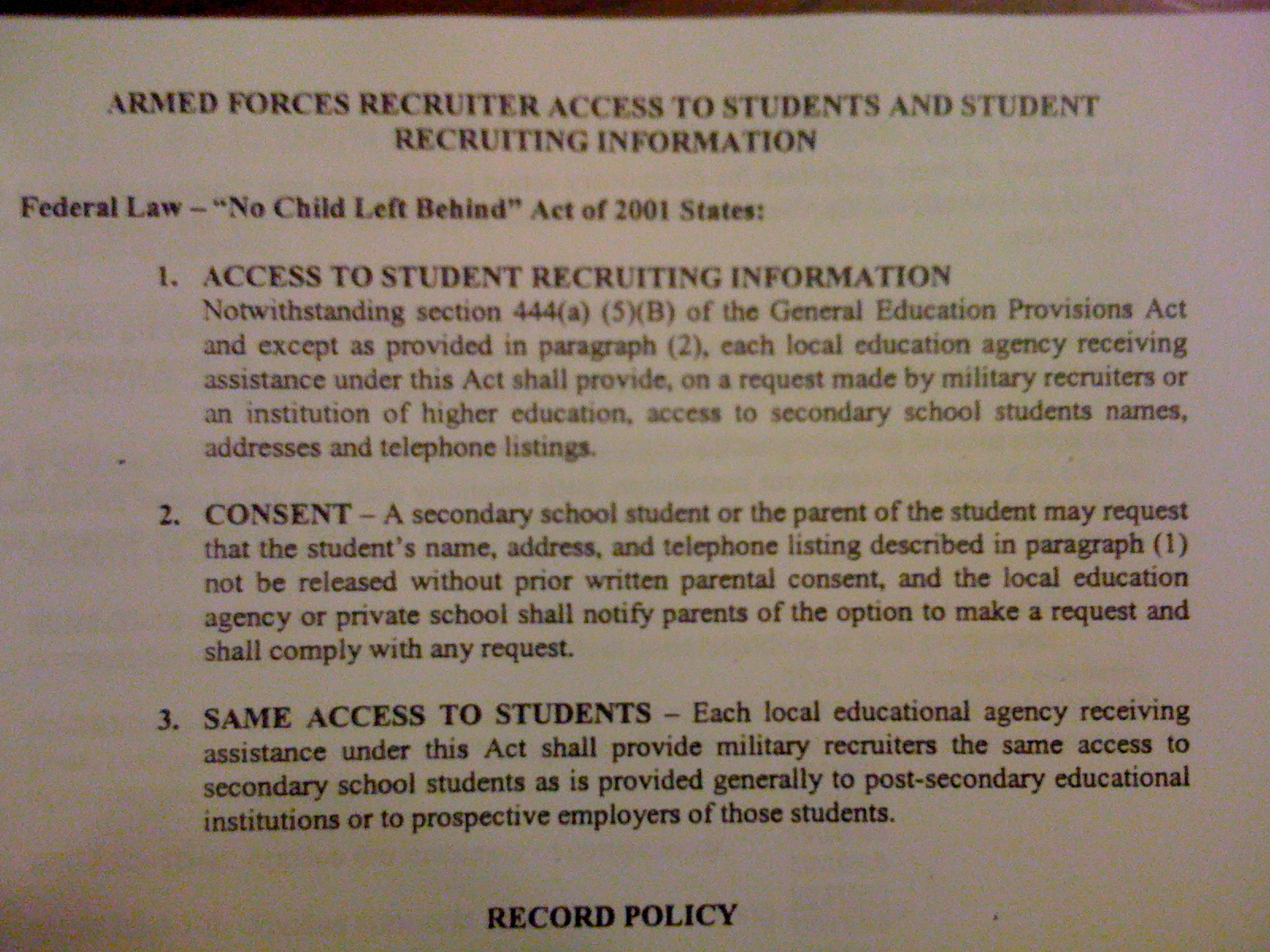
« Newer Posts - Older Posts »