Feeds:
Posts
Comments

Archive for the ‘communication for development’ Category

This is a guest post by Daniella Ben-Attar (@dbenattar) who consults for international development agencies, NGOs and corporations on areas relating to youth participation, governance, municipal capacity building, ICT4D and peace building.

by Daniella Ben-Attar
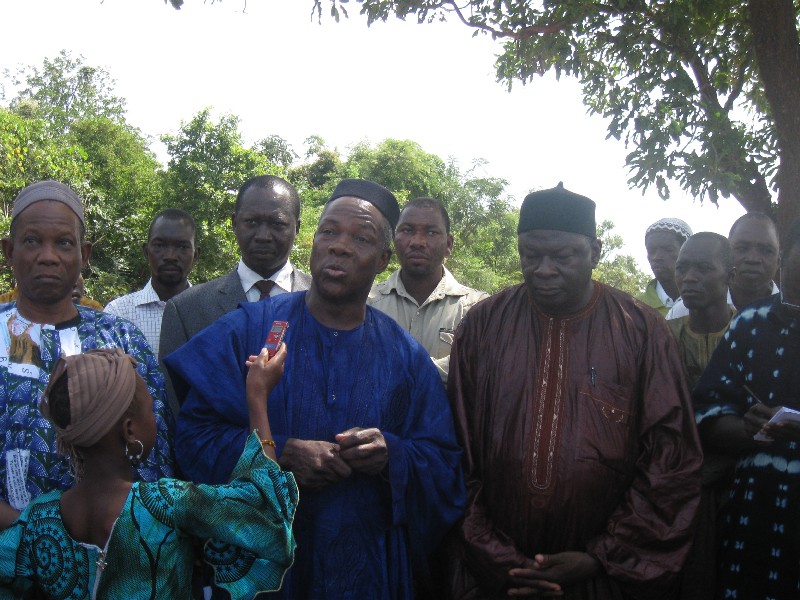
Youth in Mali with local authorities.

Youth in Mali with local authorities.

ICTs are increasingly being looked to as holding great promise for improving participatory governance and citizen engagement. Mobile phones have been a game-changer in this sphere, with nearly seven billion mobile-cellular subscriptions worldwide, including 89% penetration in the developing world. Youth are at the center of these developments, both as drivers and consumers of technological innovation.  This is particularly true in developing countries where the young generation is leading the way in the usage of technology to overcome social, political and economic exclusion to begin driving positive change in their communities. The largest cohort in history, youth aged 15-24 number more than 1.2 billion worldwide, with an estimated 87% living in developing countries.  They are almost twice as networked as the global population as a whole, with the ICT age gap more pronounced in least developed countries where young people are often three times more likely to be online than the general population.

The combination of the “youth bulge” and “mobile miracle” has great potential to enable new responses to the longstanding challenge of youth engagement in governance across the developing world. Young citizens are utilizing simple mobile technology to innovate new platforms, tools and mechanisms aiming to amplify their voices and influence government. Youth are being proactive to play a greater role in governance through mobile-based communication avenues, user-generated information, tools tracking government accountability, anti-corruption platforms, crowd-sourcing and more. This is a dramatic shift from the days when the only way to gain the attention of a government official was through slow and cumbersome bureaucratic processes and official meetings in government offices.

A Growing Youth-Local Government Disconnect

Ironically, the impact of these efforts appears to be more pronounced at the national level than at the local level of government. Indeed, ICTs seem to be strengthening communications between youth and central government instead of enhancing connections with the closest level of governance where young citizens can be resources for community development. Applications and innovations in cooperation with government that address local issues have largely been the product of national government bodies. Most youth-led initiatives have not been successful in securing local government partnership, limiting impact. A communications gap has widened between young citizens and their local governments, which are often staffed by individuals with far less digital experience than their youthful constituents. As a result, youth and their local leaders often seem to be speaking in different languages through different media.  Local government deficits in capacity and resources continue to exist as barriers, as well as the need for sensitization to youth engagement as a priority outcome of adopting and shaping ICT-enabled practices.

Most young people using technology as a way to influence governance will tell you a similar story. When expressing themselves through social media outlets and ICT-enabled mechanisms, it is usually the national political figures that are more attuned and responsive. Local leaders are far behind their national counterparts in ICT capacity and usage. National ministers and officials often use Twitter accounts, blogs, SMS and websites to engage with their citizens, who by default are largely young. While this is a positive development, it also elicits frustration from young people who feel that their voices are ignored or unheard by elder leaders at the local level where chances are greatest for tangible impact in their day-to-day lives.

President Kagame of Rwanda is a stark example.  Youth have described how the president directly interacted with young citizens via Twitter and addressed concerns relating to many issues, from police violence towards youth to business ideas for urban tourism.  No such possibilities existed for these same youth to approach the local authority with these locally-based needs.  Even more significant, Kagame merged the national ministries of Youth and ICT in 2012 and appointed a Minister of Youth and ICT.  This is a groundbreaking move both in terms of ICT and youth, with youth ministries commonly grouped with sports or culture. However, these extraordinary national developments are not reflected in the policy and practice of local government in Rwanda.

Digital mapping initiatives have been in the spotlight as a new youth-driven tool drawing attention to local issues often overlooked by government officials.  While communities are benefitting from these processes, youth leaders report that these maps often do not gain the attention of city hall. For example, Kenyan NGO Map Kibera has seen its maps utilized by national ministry committees, better equipped with the capacity and mindset to absorb digital data, while city council has not been responsive to ICT-based approaches. Young leaders in Kandy City, Sri Lanka are working to bridge the “youth-local government ICT gap” which they have identified as a major barrier in engaging youth in local development. These young leaders are training municipal officials in computer skills and creating new ICT platforms for citizen-local government interaction as part of a UN-HABITAT supported youth-led training and education program run by YES – City of Youth.

Building Local Government Capacity for ICT & Youth Engagement

Partnership with local government is viewed by stakeholders as a key missing ingredient in enabling governance technology applications to have tangible results at the community level. The importance of “closing the engagement loop” and early local government buy-in is emphasized time and again by stakeholders in the field as a vital lesson learned through pilot programs. Youth organizations like Youth Agenda and Sisi ni Amani have achieved successful governance results by engaging local leaders as partners from the preliminary stages, highlighting the benefits they can gain through mobile solutions that increase civic engagement, enhance service delivery, fight corruption and bridge between local government and citizens.

Bridging the youth-local government gap will require sensitizing local officials and encouraging them to see the advantages of “listening” to youth ICT platforms, to bring them to where the majority of youth are voicing their opinions, and enable them to take responsive actions. National governments should be encouraged to help local governments be better equipped to address youthful concerns at the local level through capacity building for both youth engagement and ICT4G.  This can be supported by integrating local ICT components in national ICT plans, or increased “decentralization” and integration of both youth and ICT strategies, bolstered by budgetary allocations and devolution of authority. When seeking to utilize ICT to deliver positive governance outcomes for young people, “local gov” must be part of the “ICT4Gov” equation.

This blog post draws on findings from a UN-HABITAT Report entitled “ICT, Urban Governance and Youth” co-authored by Daniella Ben-Attar and Tim Campbell.


Read Full Post »

This is a cross post from Heather Leson, Community Engagement Director at the Open Knowledge Foundation. The original post appeared here on the School of Data site.

by Heather Leson

What is the currency of change? What can coders (consumers) do with IATI data? How can suppliers deliver the data sets? Last week I had the honour of participating in the Open Data for Development Codeathon and the International Aid Transparency Initiative Technical Advisory Group meetings. IATI’s goal is to make information about aid spending easier to access, use, and understand. It was great that these events were back-to-back to push a big picture view.

My big takeaways included similar themes that I have learned on my open source journey:

You can talk about open data [insert tech or OS project] all you want, but if you don’t have an interactive community (including mentorship programmes), an education strategy, engagement/feedback loops plan, translation/localization plan and a process for people to learn how to contribute, then you build a double-edged barrier: barrier to entry and barrier for impact/contributor outputs.

Currency

About the Open Data in Development Codeathon

At the Codathon close, Mark Surman, Executive Director of Mozilla Foundation, gave us a call to action to make the web. Well, in order to create a world of data makers, I think we should run aid and development processes through this mindset. What is the currency of change? I hear many people talking about theory of change and impact, but I’d like to add ‘currency’. This is not only about money, this is about using the best brainpower and best energy sources to solve real world problems in smart ways. I think if we heed Mark’s call to action with a “yes, and”, then we can rethink how we approach complex change. Every single industry is suffering from the same issue: how to deal with the influx of supply and demand in information. We need to change how we approach the problem. Combined events like these give a window into tackling problems in a new format. It is not about the next greatest app, but more about asking: how can we learn from the Webmakers and build with each other in our respective fields and networks?

Ease of Delivery

The IATI community / network is very passionate about moving the ball forward on releasing data. During the sessions, it was clear that the attendees see some gaps and are already working to fill them. The new IATI website is set up to grow with a Community component. The feedback from each of the sessions was distilled by the IATI – TAG and Civil Society Guidance groups to share with the IATI Secretariat.

In the Open Data in Development, Impact of Open Data in Developing Countries, and CSO Guidance sessions, we discussed some key items about sharing, learning, and using IATI data. Farai Matsika, with International HIV/Aids Alliance, was particularly poignant reminding us of IATI’s CSO purpose – we need to share data with those we serve.

Country edits IATI

One of the biggest themes was data ethics. As we rush to ask NGOs and CSOs to release data, what are some of the data pitfalls? Anahi Ayala Iaccuci of Internews and Linda Raftree of Plan International USA both reminded participants that data needs to be anonymized to protect those at risk. Ms. Iaccuci asked that we consider the complex nature of sharing both sides of the open data story – successes and failures. As well, she advised: don’t create trust, but think about who people are trusting. Turning this model around is key to rethinking assumptions. I would add to her point: trust and sharing are currency and will add to the success measures of IATI. If people don’t trust the IATI data, they won’t share and use it.

Anne Crowe of Privacy International frequently asked attendees to consider the ramifications of opening data. It is clear that the IATI TAG does not curate the data that NGOS and CSOs share. Thus it falls on each of these organizations to learn how to be data makers in order to contribute data to IATI. Perhaps organizations need a lead educator and curator to ensure the future success of the IATI process, including quality data.

I think that School of Data and the Partnership for Open Data have a huge part to play with IATI. My colleague Zara Rahman is collecting user feedback for the Open Development Toolkit, and Katelyn Rogers is leading the Open Development mailing list. We collectively want to help people become data makers and consumers to effectively achieve their development goals using open data. This also means also tackling the ongoing questions about data quality and data ethics.


Here are some additional resources shared during the IATI meetings.

Read Full Post »

Migration is central to the current political debate as well as to the development discussion, especially in conversations about the “post 2015” agenda, the ‘youth bulge’, and youth employment. Prevention work is not likely to end migration, regardless of the organizations and governments working to improve the well-being of children and youth in their home communities. In fact, improved economic capacity may actually enhance people’s capacity to migrate.

Our Technology Salon on January 16, 2014, discussed the role of ICTs in child and youth migration, ways ICTs are influencing migration, how ICTs could make migration safer and more productive, and ideas for mobile applications that would be useful for child and youth migrants. We welcomed Ravi Karkara, United Nations Inter-agency Network on Youth Development; Lucas Codognolla, Lead Coordinator, Connecticut Students for a DREAM; and Michael Boampong, Migration and Development Consultant, UNDP, as our lead discussants.

Some areas on where and how ICTs are playing or could play a role:

  • Sending money / remittances / mobile money. Costs to transfer money need to be reduced. Some studies have shown that the African diaspora pays up to 20% for money transfers. More needs to be done to extend mobile money services, especially in rural areas.
  • Finding a job. Many youth use ICTs from the very start of the migration process to look for work. They may also use ICTs to find work in their home countries if they return.
  • Getting a visa to migrate legally. Most legal immigration processes require making appointments with Embassies via the Internet and the ability to communicate via email.
  • Identifying migration routes. Often, youth who migrate irregularly investigate routes online before their departure. GPS can also help during transit. One program in Mexico is developing a “safe migration map” that provides crowd-sourced, near real-time information to migrants on which areas are experiencing high crime or other dangers so that they can migrate more safely.
  • Reporting abuse. Child help lines are expanding their services across many countries and providing support, advice and help to children in case of emergency or abuse, including during migration. Many help lines are experimenting with text messaging.
  • Connecting with other youth in similar situations.  Youth who have an irregular migration status are able to find others in the same circumstances and feel less alone. They can also connect with peers and organizations who can provide support, help and advice.
  • Keeping in touch with parents/family. ICT are useful for children and youth keep families informed of how they are doing, and to ask for support and help. The African Movement for Working Children and Youth works with telecoms operators to provide a free number to children and youth who migrate in West Africa. Parents and children can remain in touch that way while children are moving from one town to the next.
  • Sharing information on migration rights. Organizations like Connecticut Students for a DREAM use ICTs and social media to reach out to youth who have an irregular migration status to provide support and to engage them in organized advocacy activities. The organization encourages sharing of stories and a safe space to discuss migration difficulties. The “Pocket DACA” application helps young migrants understand the deferred action law and apply for it.
  • Engaging, organizing, and influencing government. Youth in the US are organizing via Facebook and other social media platforms. In some cases, government officials have reached out to these groups for advice on legislation.

Participants pointed out that:

Children/youth are not always victims. Often the discourse around children’s movement/migration is centered on trafficking, protection and vulnerability rather than rights, power and choices. More needs to be done to empower children and youth and to provide opportunities and participation avenues. At the same time, more needs to be done to create opportunities at home so that children and youth do not feel like their home situation is hopeless and that migration is the only option.

Children and youth are not a homogeneous population. When thinking about ICTs and children/youth, it’s important to know the context and design programs that are relevant to specific children and young people. Age, wealth, sex, literacy and other aspects need to be considered so that ICT applications are useful. Both traditional communication and ICTs need to be used depending on the population.

ICTs can widen generation gaps. In some cases, ICTs increase the communication divide among generations. Older people may feel that youth are working in a medium that they are not skilled at using, and that youth are not considering their input and advice. This can create conflict and reduce levels of support that might otherwise be provided from community leaders, elders and government officials.

The role of the State needs more thought. Often irregular migration happens because legal channels are difficult to navigate or they are prohibitive. The role of ICTs in influencing or facilitating legal migration needs more thought, as does the potential role of ICTs in advocating for change. The State may not always be friendly to migration, however, so the topic is controversial. States may also use ICTs for surveillance of youth or migrating populations, especially in places where there is political or ethnic conflict, so ICTs may put people in extreme danger.

Risks need to be considered. There are serious risks associated with using ICTs in general, and especially with vulnerable populations. These include everything from online grooming and risks of being lured into trafficking or sex work, to scamming sites that take advantage of youth, to political aspects such as surveillance and targeting of certain populations of youth by the State or other armed groups. ICTs could be a way to help break conspiracies of silence and to report and speak out about human rights abuses, but care needs to be taken that people are not put at risk when they do so.

ICTs need to fit local contexts. Rural areas are less connected and so other forms of information and communication are often more common. Both online and offline means need to be used when working with children and youth. In addition, different social media tools and platforms are used in different places. For example, though the end of Facebook is heralded by some in the US, because youth are reportedly fleeing as older people join the site, Facebook is taking off in Latin America, where many organizations use it for engaging youth and helping them to organize and get informed about their rights.

Not much is known about children, youth, ICTs and migration.  The area of child migration is relatively weak in terms of research. The upcoming World Youth Report centers on child and youth migration and has been a highly controversial process. Migration needs to be considered from an evolving age perspective, with focus on aspects that impact on children, adolescents and youth differentially. A gender perspective needs to be included. There is also a difference between children and youth who migrate for employment and those who move due to conflict or who are seeking asylum, and deeper knowledge is needed in all of these different areas.

Recommendations for future efforts included:

  • More youth voice and support for youth movements in the area of migration
  • More involvement of youth in the debate/dialogue on migration and ICTs
  • Micro-grants for youth who want to work on migration initiatives, including those that use ICTs
  • More nuanced research and understanding of the role of ICTs in child and youth migration with specific lenses on age, sex, ethnicity, and other factors

Resources on ICTs and child/youth migration:

Salons are held under Chatham House Rule, therefore no attribution has been made in this post. Many thanks to our lead discussants and to ThoughtWorks for hosting and providing breakfast.

If you’d like to attend future Salons, sign up here!

Read Full Post »

Screen Shot 2013-11-23 at 6.14.40 PM

Migration has been a part of the human experience since the dawn of time, and populations have always moved in search of resources and better conditions. Today, unaccompanied children and youth are an integral part of national and global migration patterns, often leaving their place of origin due to violence, conflict, abuse, or other rights violations, or simply to seek better opportunities for themselves.

It is estimated that 33 million (or some 16 percent) of the total migrant population today is younger than age 
20. Child and adolescent migrants make up a significant proportion of the total population of migrants in Africa (28 percent), Asia (21 percent), Oceania (11 percent), Europe (11 percent), and the Americas (10 percent).

The issue of migration is central to the current political debate as well as to the development discussion, especially in conversations about the “post 2015” agenda. Though many organizations are working to improve children’s well-being in their home communities, prevention work with children and youth is not likely to end migration. Civil society organizations, together with children and youth, government, community members, and other stakeholders can help make migration safer and more productive for those young people who do end up on the move.

As the debate around migration rages, access to and use of ICTs is expanding exponentially around the globe. For this reason Plan International USA and the Oak Foundation felt it was an opportune time to take stock of the ways that ICTs are being used in the child and youth migration process.

Our new report, “Modern Mobility: the role of ICTs in child and youth migration” takes a look at:

  • how children and youth are using ICTs to prepare for migration; to guide and facilitate their journey; to keep in touch with families; to connect with opportunities for support and work; and to cope with integration, forced repatriation or continued movement; and
  • how civil society organizations are using ICTs to facilitate and manage their work; to support children and youth on the move; and to communicate and advocate for the rights of child and youth migrants.

In the Modern Mobility paper, we identify and provide examples of three core ways that child and youth migrants are using new ICTs during the different phases of the migration process:

  1. for communicating and connecting with families and friends
  2. for accessing information
  3. for accessing services

We then outline seven areas where we found CSOs are using ICTs in their work with child and youth migrants, and we offer some examples:

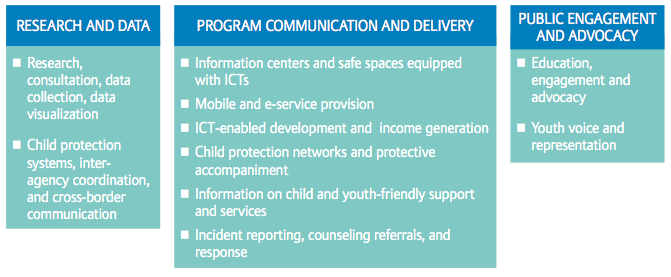
Ways that CSOs are using ICTs in their work with child and youth migrants.

Ways that CSOs are using ICTs in their work with child and youth migrants.

Though we were able to identify some major trends in how children and youth themselves use ICTs and how organizations are experimenting with ICTs in programming, we found little information on the impact that ICTs and ICT-enabled programs and services have on migrating children and youth, whether positive or negative. Most CSO practitioners that we talked with said that they had very little awareness of how other organizations or initiatives similar to their own were using ICTs. Most also said they did not know where to find orientation or guidance on good practice in the use of ICTs in child-centered programming, ICTs in protection work (aside from protecting children from online risks), or use of ICTs in work with children and young people at various stages of migration. Most CSO practitioners we spoke with were interested in learning more, sharing experiences, and improving their capacities to use ICTs in their work.

Based on Plan Finland’s “ICT-Enabled Development Guide” (authored by Hannah Beardon), the Modern Mobility report provides CSOs with a checklist to support thinking around the strategic use of ICTs in general.

ICT-enabled development checklist developed by Hannah Beardon for Plan International.

ICT-enabled development checklist developed by Hannah Beardon for Plan International.

We also offer a list of key considerations for practitioners who wish to incorporate new technologies into their work, including core questions to ask about access, age, capacity, conflict, connectivity, cost, disability, economic status, electricity, existing information ecosystems, gender, information literacy, language, literacy, power, protection, privacy, sustainability, and user-involvement.

Our recommendation for taking this area forward is to develop greater awareness and capacity among CSOs regarding the potential uses and risks of ICTs in work with children and youth on the move by:

  1. Establishing an active community of practice on ICTs and children and youth on the move.
  2. Mapping and sharing existing projects and programs.
  3. Creating a guide or toolbox on good practice for ICTs in work with children and youth on the move.
  4. Further providing guidance on how ICTs can help “normal” programs to reach out to and include children and youth on the move.
  5. Further documentation and development of an evidence base.
  6. Sharing and distributing this report for discussion and action.

Download the Modern Mobility report here.

We’d love comments and feedback, and information about examples or documentation/evidence that we did not come across while writing the report!

Read Full Post »

At the November 8th Technology Salon in New York City, we looked at the role of ICTs in communication for development (C4D) initiatives with marginalized adolescent girls. Lead discussants Kerida McDonald and Katarzyna Pawelczyk discussed recent UNICEF reports related to the topic, and John Zoltner spoke about FHI360’s C4D work in practice.

To begin, it was pointed out that C4D is not donor communications or marketing. It is the use of communication approaches and methodologies to achieve influence at various levels —  e.g., family, institutional and policy —  to change behavior and social norms. C4D is one approach that is being used to address the root causes of gender inequality and exclusion.

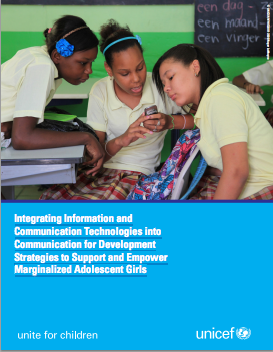
Screen Shot 2013-10-11 at 7.24.48 AMAs the UNICEF report on ICTs and C4D* notes, girls may face a number of situations that contribute to and/or are caused by their marginalization: early pregnancy, female genital cutting, early marriage, high rates of HIV/AIDS, low levels of education, lack of control over resources. ICTs alone cannot resolve these, because there is a deep and broad set of root causes. However, ICTs can be integrated systematically into the set of C4D tools and approaches that contribute to positive change.

Issues like bandwidth, censorship and electricity need to be considered when integrating ICTs into C4D work, and approaches that fit the context need to be developed. Practitioners should use tools that are in the hands of girls and their communities now, yet be aware of advances in access and new technologies, as these change rapidly.

Key points:

Interactivity is more empowering than one-way messaging:  Many of the ICT solutions being promoted today focus on sending messages out via mobile phones. However C4D approaches aim for interactivity and multi-channel, multi-directional communication, which has proven more empowering.

Content: Traditional media normally goes through a rigorous editorial process and it is possible to infuse it with a gender balance. Social media does not have the same type of filters, and it can easily be used to reinforce stereotypes about girls. This is something to watch and be aware of.

Purpose: It’s common with ICT-related approaches to start with the technology rather than starting with the goals. As one Salon participant asked “What are the results we want to see for ourselves? What are the results that girls want to see? What are the root causes of discrimination and how are we trying to address them? What does success look like for girls? For organizations? Is there a role for ICTs in helping achieve success? If so, what is it?” These questions need to be the starting point, rather than the technology.

Participation: One Salon participant mentioned a 2-year project that is working together with girls to define their needs and their vision of success. The process is one co-design, and it is aimed at understanding what girls want. Many girls expressed a feeling of isolation and desire for connection, and so the project is looking at how ICTs can help them connect. As the process developed, the diversity of needs became very clear and plans have changed dramatically based on input from a range of girls from different contexts. Implementors need to be prepared to change, adapt and respond to what girls say they want and to local realities.

****

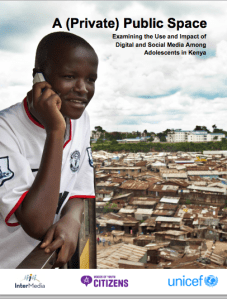
Screen Shot 2013-11-23 at 10.41.22 PMA second study commissioned by UNICEF explores how young people use social media. The researchers encountered some challenges in terms of a strong gender approach for the study. Though a gender lens was used for analysis, there is little available data disaggregated by sex. The study does not focus on the most marginalized, because it looks at the use of social media, which normally requires a data connection or Internet access, which the most marginalized youth usually do not have.

The authors of the report found that youth most commonly used the Internet and social media for socializing and communicating with friends. Youth connected less often for schoolwork. One reason for this may be that in the countries/contexts where the research took place, there is no real integration of ICTs into the school system. It was emphasized that the  findings in the report are not comparable or nationally representative, and blanket statements such as “this means x for the whole developing world” should be avoided.

Key points:

Self-reporting biases. Boys tend to have higher levels of confidence and self-report greater ICT proficiency than girls do. This may skew results and make it seem that boys have higher skill levels.

Do girls really have less access? We often hear that girls have less access than boys. The evidence gathered for this particular report found that “yes and no.” In some places, when researchers asked “Do you have access to a mobile,” there was not a huge difference between urban and rural or between boys and girls. When they dug deeper, however, it became more complex. In the case of Zambia, access and ownership were similar for boys and girls, but fewer girls were connecting at all to the Internet as compared to boys. Understanding connectivity and use was quite complicated.

What are girls vs. boys doing online? This is an important factor when thinking about what solutions are applicable to which situation(s). Differences came up here in the study. In Argentina, girls were doing certain activities more frequently, such as chatting and looking for information, but they were not gaming. In Zambia, girls were doing some things less often than boys; for example, fewer girls than boys were looking for health information, although the number was still significant. A notable finding was that both girls and boys were accessing general health information more often than they were accessing sensitive information, such as sexual health or mental health.

What are the risks in the online world? A qualitative portion of the study in Kenya used focus groups with girls and boys, and asked about their uses of social media and experience of risk. Many out-of-school girls aged 15-17 reported that they used social media as a way to meet a potential partner to help them out of their financial situation. They reported riskier behavior, contact with older men, and relationships more often than girls who were in school. Girls in general were more likely to report unpleasant online encounters than boys, for example, request for self-exposure photos.

Hiding social media use. Most of the young people that researchers spoke with in Kenya were hiding social media use from their parents, who disapproved of it. This is an important point to note in C4D efforts that plan on using social media, and program designers will want to take parental attitudes about different media and communication channels into consideration as they design C4D programs.

****

When implementing programs, it is noteworthy how boys and girls tend to use ICT and media tools. Gender issues often manifest themselves right away. “The boys grab the cameras, the boys sit down first at the computers.” If practitioners don’t create special rules and a safe space for girls to participate, girls may be marginalized. In practical ICT and media work, it’s common for boys and girls to take on certain roles. “Some girls like to go on camera, but more often they tend to facilitate what is being done rather than star in it.” The gender gap in ICT access and use, where it exists, is a reflection of the power gaps of society in general.

In the most rural areas, even when people have access, they usually don’t have the resources and skills to use ICTs.  Very simple challenges can affect girls’ ability to participate in projects, for example, oftentimes a project will hold training at times when it’s difficult for girls to attend. Unless someone systematically goes through and applies a gender lens to a program, organizations often don’t notice the challenges girls may face in participating. It’s not enough to do gender training or measure gender once a year; gendered approaches needs to be built into program design.

Long-terms interventions are needed if the goal is to emancipate girls, help them learn better, graduate, postpone pregnancy, and get a job. This cannot be done in a year with a simple project that has only one focus, because girls are dealing with education, healthcare, and a whole series of very entrenched social issues. What’s needed is to follow a cohort of girls and to provide information and support across all these sectors over the long-term.

Key points:

Engaging boys and men: Negative reactions from men are a concern if and when girls and women start to feel more empowered or to access resources. For example, some mobile money and cash transfer programs direct funds to girls and women, and some studies have found that violence against women increases when women start to have more money and more freedom. Another study, however, of a small-scale effort that provides unconditional cash transfers to girls ages 18-19 in rural Kenya, is demonstrating just the opposite: girls have been able to say where money is spent and the gender dynamics have improved. This raises the question of whether program methodologies need to be oriented towards engaging boys and men and involving them in changing gender dynamics, and whether engaging boys and men can help avoid an increase in violence. Working with boys to become “girl champions” was cited as a way to help to bring boys into the process as advocates and role models.

Girls as producers, not just consumers. ICTs are not only tools for sending content to girls. Some programs are working to help girls produce content and create digital stories in their own languages. Sometimes these stories are used to advocate to decision makers for change in favor of girls and their agendas. Digital stories are being used as part of research processes and to support monitoring, evaluation and accountability work through ‘real-time’ data.

ICTs and social accountability. Digital tools are helping young people address accountability issues and inform local and national development processes. In some cases, youth are able to use simple, narrow bandwidth tools to keep up to date on actions of government officials or to respond to surveys to voice their priorities. Online tools can also lead to offline, face-to-face engagement. One issue, however, is that in some countries, youth are able to establish communication with national government ministers (because there is national-level capacity and infrastructure) but at local level there is very little chance or capability for engagement with elected officials, who are unprepared to respond and engage with youth or via social media. Youth therefore tend to bypass local government and communicate with national government. There is a need for capacity building at local level and decentralized policies and practices so that response capacity is strengthened.

Do ICTs marginalize girls? Some Salon participants worried that as conversations and information increasingly move to a digital environment, ICTs are magnifying the information and communication divide and further marginalizing some girls. Others felt that the fact that we are able to reach the majority of the world’s population now is very significant, and the inability to reach absolutely everyone doesn’t mean we should stop using ICTs. For this very reason – because sharing of information is increasingly digital – we should continue working to get more girls online and strengthen their confidence and abilities to use ICTs.

Many thanks to UNICEF for hosting the Salon!

(Salons operate under Chatham House Rule, thus no attribution has been given in the above summary. Sign up here if you’d like to attend Salons in the future!)

*Disclosure: I co-authored this report with Keshet Bachan.

Read Full Post »

Screen Shot 2013-11-24 at 7.42.24 AM

America Meet World – a contest to source the best comedy the world has to offer.

I met Trina Das Gupta when she headed up the GSMA’s mWomen program. We bonded at the personal level over a shared frustration with old-school aid and development approaches and an urge to change the way the US public understands the rest of the world.

Trina is always one step ahead of everyone, and she has the know-how and connections to make her visions happen. It’s no surprise then, that she’s moving full steam ahead with a cool new idea that aims to bring people together through comedy: America Meet World.

Rather than get preachy about race and stereotyping, America Meet World will take Americans around the world through laughter and entertainment. The premise is that there is more that makes us the same than that makes us different.

To curate content, Trina’s production company Single Palm Tree has launched a global video contest designed to find the best comedy the world has to offer. The contest’s winner (the video with the most votes) will win a sit-down meeting with executives from The Daily Show with Jon Stewart, and have a chance to ask for advice on building an entertainment career in the US.

Videos will also be reviewed by an all-star panel of judges, including Rebecca Paoletti, former head of video at Yahoo! North American and CEO of CakeWorks; Tim Rosta, senior VP of Integrated Marketing at E! Entertainment Networks; Baratunde Thurston, CEO and Co-Founder of Cultivated Wit and former digital director of The Onion; and John Vorhaus, best-selling author of The Comic Toolbox: How to be Funny Even if You’re Not.

Finalist videos will be featured on AmericaMeetWorld.com and across syndicated channels. The videos submitted, along with other content that Single Palm Tree produces and curates, will feed into a digital video portal that connects US audiences with global comedians. The portal will go live in 2014.

Categories include: stand-up, sketch, reality, satire. Video submissions must be from Africa, Asia, Latin America or the Middle East, and they must not exceed 3 minutes. They must be in English or have accurate English subtitles. See contest rules and tips on how to create a successful entry here.

All you comedians, now’s your chance!

Read Full Post »

This is a cross-post by Duncan Edwards from the Institute of Development Studies. Duncan and I collaborated on some sessions for the Open Development stream at September’s Open Knowledge Conference, and we are working on a few posts to sum up what we discussed there and highlight some lingering thoughts on open development and open data. This post was originally published on the Open Knowledge Foundation blog on October 21, 2013

by Duncan Edwards

I’ve had a lingering feeling of unease that things were not quite right in the world of open development and ICT4D (Information and communication technology for development), so at September’s Open Knowledge Conference in Geneva I took advantage of the presence of some of the world’s top practitioners in these two areas to explore the question: How does “openness” really effect change within development?

Inspiration for the session came from a number of conversations I’ve had over the last few years. My co-conspirator/co-organiser of the OKCon side event “Reality check: Ethics and Risk in Open Development,” Linda Raftree, had also been feeling uncomfortable with the framing of many open development projects, assumptions being made about how “openness + ICTs = development outcomes,” and a concern that risks and privacy were not being adequately considered. We had been wondering whether the claims made by Open Development enthusiasts were substantiated by any demonstrable impact. For some reason, as soon as you introduce the words “open data” and “ICT,” good practice in development gets thrown out the window in the excitement to reach “the solution”.

A common narrative in many “open” development projects goes along the lines of “provide access to data/information –> some magic occurs –> we see positive change.” In essence, because of the newness of this field, we only know what we THINK happens, we don’t know what REALLY happens because there is a paucity of documentation and evidence.

It’s problematic that we often use the terms data, information, and knowledge interchangeably, because:
Data is NOT knowledge.
Data is NOT information.
Information is NOT knowledge.
Knowledge IS what you know. It’s the result of information you’ve consumed, your education, your culture, beliefs, religion, experience – it’s intertwined with the society within which you live.

Data cake metaphor developed by Mark Johnstone.

Understanding and thinking through how we get from the “openness” of data, to how this affects how and what people think, and consequently how they MIGHT act, is critical in whether “open” actually has any additional impact.

At Wednesday’s session, panellist Matthew Smith from the International Development Research Centre (IDRC) talked about the commonalities across various open initiatives. Matthew argued that a larger Theory of Change (ToC) around how ‘open’ leads to change on a number of levels could allow practitioners to draw out common points. The basic theory we see in open initiatives is “put information out, get a feedback loop going, see change happen.” But open development can be sliced in many ways, and we tend to work in silos when talking about openness. We have open educational resources, open data, open government, open science, etc. We apply ideas and theories of openness in a number of domains but we are not learning across these domains.

We explored the theories of change underpinning two active programmes that incorporate a certain amount of “openness” in their logic. Simon Colmer from the Knowledge Services department at the Institute of Development Studies outlined his department’s theory of change of how research evidence can help support decision-making in development policy-making and practice. Erik Nijland from HIVOS presented elements of the theory of change that underpins the Making All Voices Count programme, which looks to increase the links between citizens and governments to improve public services and deepen democracy. Both of these ToCs assume that because data/information is accessible, people will use it within their decision-making processes.

They also both assume that intermediaries play a critical role in analysis, translation, interpretation, and contextualisation of data and information to ensure that decision makers (whether citizens, policy actors, or development practitioners) are able to make use of it. Although access is theoretically open, in practice even mediated access is not equal – so how might this play out in respect to marginalised communities and individuals?

What neither ToC really does is unpack who these intermediaries are. What are their politics? What are their drivers for mediating data and information? What is the effect of this? A common assumption is that intermediaries are somehow neutral and unbiased – does this assumption really hold true?

What many open data initiatives do not consider is what happens after people are able to access and internalise open data and information. How do people act once they know something? As Vanessa Herringshaw from the Transparency and Accountability Initiative said in the “Raising the Bar for ambition and quality in OGP” session, “We know what transparency should look like but things are a lot less clear on the accountability end of things”.

There are a lot of unanswered questions. Do citizens have the agency to take action? Who holds power? What kind of action is appropriate or desirable? Who is listening? And if they are listening, do they care?

Linda finished up the panel by raising some questions around the assumptions that people make decisions based on information rather than on emotion, and that there is a homogeneous “public” or “community” that is waiting for data/information upon which to base their opinions and actions.

So as a final thought, here’s my (perhaps clumsy) 2013 update on Gil Scott Heron’s 1970 song “The Revolution will not be televised”:

“The revolution will NOT be in Open data,
It will NOT be in hackathons, data dives, and mobile apps,
It will NOT be broadcast on Facebook, Twitter, and YouTube,
It will NOT be live-streamed, podcast, and available on catch-up
The revolution will not be televised”

Heron’s point, which holds true today, was that “the revolution” or change, starts in the head. We need to think carefully about how we get far beyond access to data.

Look out for a second post coming soon on Theories of Change in Open, and a third post on ethics and risk in open data and open development.

And if you’re interested in joining the conversation, \sign up to our Open Development mailing list.

Read Full Post »

Screen Shot 2013-10-11 at 7.24.48 AMA paper that Keshet Bachan and I authored for Unicef is now available for your reading pleasure!

Here’s a  summary of what we talk about in the paper:

Social, cultural, economic and political traditions and systems that prevent girls, especially the most marginalized, from fully achieving their rights present a formidable challenge to development organizations. The integration of new Information and Communication Technologies (ICTs) to the Communication for Development (C4D) toolbox offers an additional means for challenging unequal power relations and increasing participation of marginalized girls in social
transformation.

We examine ways that ICTs can strengthen C4D programming by:

  • enhancing girls’ connections, engagement and agency;
  • helping girls access knowledge; and
  • supporting improved governance and service delivery efforts.

We reflect and build on the views of adolescent girls from 13 developing countries who participated in a unique discussion for this paper, and we then provide recommendations to support the integration of ICTs in C4D work with marginalized adolescent girls, including:

  • Girls as active participants in program design. Practitioners should understand local context and ensure that programs use communication channels that are accessible to girls. This will often require multi-channel and multiple platform approaches that reach more marginalized girls who may not have access to or use of ICTs. Programs should be community driven, and real-time feedback from girls should be incorporated to adjust programs to their needs and preferences. Mentoring is a key component of programming with girls, and holistic programs designed together with girls tend towards being more successful.
  • Privacy and protection. Every program should conduct a thorough risk analysis of proposed approaches to ensure that girls are not placed at risk by participating, sharing and consuming information, or publicly holding others to account. Girls should also be supported to make their own informed choices about their online presence and use of ICT devices and platforms. A broader set of stakeholders should be engaged and influenced to help mitigate systemic and structural risks to girls.
  • Research and documentation. The evidence base for use of ICTs in C4D programming with marginalized adolescent girls is quite scarce. Better documentation would improve understanding of what programs are the most effective, and what the real added value of ICTs are in these efforts.
  • Capacity building. Because the integration of ICTs into C4D work is a relatively new area that lacks a consistent methodological framework, organizations should support a comprehensive training process for staff to cover areas such as program design, effective use of new ICT tools in combination with existing tools and methods, and close attention to privacy and risk mitigation.
  • Policy. Programs should use free and open source software. In addition, child protection policies, measures and guidelines should be updated to reflect changes in technology, platforms and information sharing.

The paper was first shared at the 12th Inter-Agency Roundtable on Communication for Development in November 2011. It was then reviewed and updated in August 2012, and released in August 2013 under the title “Integrating Information and Communication Technologies into Communication for Development Strategies to Support and Empower Marginalized Adolescent Girls.”

Download it here!

Read Full Post »

Last Friday I had the opportunity to share a panel discussion on “Designing New Narratives: from poverty porn to agency” with Leah Chung, Maharam Fellow and RISD student, and Victor Dzidzienyo, Associate Dean of the College of Engineering Architecture and Computer Sciences at Howard University. The panel was part of the “A Better World by Design” Conference planned and run by a committee of students from Brown University and the Rhode Island School of Design, here in Providence.

Photo from http://www.affenstunde.com article on One Laptop Per Child.

I was responsible for setting the stage and moderating, wearing my Regarding Humanity hat. I showed a number of images and narratives that I find questionable – from aid agency fundraising campaigns to children receiving free shoes to famous musicians visiting Ethiopia to models posing in front of poor children to photos of them with imported technological “solutions”. The theme of the conference was “Pause and Effect.” My point was that we should pause and think about the long-term effects of these kinds of images and narratives on people we say we are helping, supporting or partnering with. Beyond fundraising, advocacy and branding for our organizations, what is the impact of these narratives? What long-term effects do they have when there is no strong competing narrative or variety of narratives that enable a more complex, nuanced and varied story?

Some of the ways that we can help change the narrative include:

Leah followed, sharing highlights from research she conducted this summer in Uganda on what Ugandans think about how they and Africans in general are represented in the Western media. With support from Hive Co-Lab, Leah and her research partner, Joseph Wanda, researched how people working in local NGOs and living in rural communities and informal settlement areas view ads like these:

People were asked which of these images they would prefer in a fundraising campaign. (Image courtesy of Leah Chung)

Image courtesy of Leah Chung

Perhaps not surprisingly, a large percentage of the adults interviewed said they preferred the sad photo, because it would be more effective at showing a story of need and raising funds. Interestingly, however, 66% of the children and adolescents interviewed preferred the happy one. Leah said  that a good number of people used the opportunity of her presence to include a story of their own needs and a personal appeal for funding or help during the interview process

Adults selected the sad image more often, whereas children and adolescents selected the happy one. (Image courtesy of Leah Chung)

Which of these images would you prefer for a fund-raising campaign? Image courtesy of Leah Chung

Overall, 76% of people Leah and Joseph interviewed said that they were not happy with the way that Africa is represented in the Western world.

The majority of people who participated in the study were unhappy with how Africa is represented in the "Western" world. (Image courtesy of Leah Chung)

Image courtesy of Leah Chung

Leah noted that through her research, she grew to understand that images are only the symptom of deeper dysfunction within the aid industry and its colonial legacy. She also noted that people all over the world hold stereotypes about others. She was viewed as someone bringing in resources to help, and called “Chinese,” although she is actually Korean.

Victor continued the topic by sharing his own story of living in DC as a child, and being one of the people that others wanted to come in to help. “For you as the outsider who comes in to save me, I have some questions,” he said. “For the folks who want to go on a ‘free trip’ to help, my question is: you are going there for what? What are the skill sets that you have that can make a difference? If you don’t have a skill set to offer, you should just stay home.” He recommended hiring local people for the various jobs needed during reconstruction after a disaster rather than sending over students with limited understanding of the local context and limited skills to work in it.

Victor emphasized the similarities in architectural design and designing programs aimed at helping after a flood or an earthquake. For both, a good understanding of the environment, the cultural context, the complexity of social structures, and the local beliefs and norms is required. He questioned whether academic institutions are doing enough to prepare students for working in these environments.

The ensuing comments and discussions made their way across a variety of related topics, with active participation from the room:

  • What can media and development professionals do to support agency? How can we move beyond satire and critique? The bullet points above are a start but what else can be done? We need to change our language, for one thing, and stop using phrases like “we are empowering people, giving them a voice, giving them agency.” We also need to remember that using poverty porn takes away agency from those who donate. The entire cycle is disempowering.
  • Local people are not passive in this: Communities and individuals can be very adept at manipulating this system. Local NGOs also have their own agendas and the aid industry also ties them in knots and makes it difficult for them to function, to be effective and to have a real impact.
  • How issues are framed and by whom matters. There is a great deal of exposure to the Western world and its viewpoints, and often the issues and narrative are framed by outsiders. Local work does not get the spotlight and credit, it’s normally sexy graphic design and social media campaigns like Kony 2012.
  • Should we help locally or internationally? The issues and problems in the world are global problems and they are interlinked at the global level, so where a person helps is not the issue. Location matters less than the underlying motives and levels of respect for people’s own agency, and level of ownership that local people have in the process. Going in to help a community in your own neighborhood or country that you do not understand or that you view as ‘lesser’ is not much different than doing that in a community abroad.
  • Poverty porn is a symptom of much larger issues in the international aid and development industry. The causes go much deeper and require a major shift in a number of areas.
  • Is it possible to change things or do we need to start over? Do we need a new model? It’s likely that international aid and development organizations will be disrupted and disintermediated by a number of forces and changes happening right now, from social entrepreneurs to global economic and power changes to technology to changes in “developing” country economies and attitudes. The problems are not going to go away and the market is not working for everyone, but the nature of how we address these issues will most likely change.
  • Poverty porn is profitable, how can we change this? How can we make the idea of agency and elevating other voices as profitable as poverty porn? How can we take a more comprehensive look at the system and where it’s not working? How can we change what the general public responds to and switch the general consciousness of people who care to a new way of looking at things? How can we re:see, re:listen and re:frame the narrative and get people excited about stories from people who know and live these issues? As intermediaries, our job is to provide platforms and to work to make these voices visible, not to tell other people’s stories. Can we engage people better by showing impact and change rather than miserable situations that victimize and provoke feelings of guilt?
  • Sharing and dialogue is one way that people can learn from each other and build strength in numbers to change things. Supporting “south-south” discussion and learning is key, as is discussion and dialogue between policy makers and practitioners.
  • People (we) need to be aware of their (our) own privilege. People give out of guilt. Until they (we) understand their (our) own power and privilege and step out of it, we will never move forward. Educational institutions confirm and allow people to benefit from their privilege. Going on a semester abroad to “help” people ends up looking good on a student’s resume and helping them, in the end, get a job, not really helping those they went to “help.” So the volunteer ends up getting wealthy from these situations, in a way.
  • Empathy matters, but how do we take it a step further than sleeping outside for a night to understand homelessness? Do these small efforts towards empathy add up to a larger awareness and behavior change, or are they meager attempts to experience life as “the other” without a real examination of power and privilege? How do we take this conversation a step wider also and look at how the West perpetrates and causes poverty by our own policies and consumption patterns?

Read Full Post »

Screen Shot 2013-07-14 at 2.40.51 PMLast week, 600 exceptional youth activists from 80 countries arrived to New York City for a UN Takeover, where they called for urgent action by member states to meet Millennium Development Goal 2 on education by 2015. The youth’s inputs will feed into setting the agenda for global education priorities post-2015. One of the highlights of the week was this inspiring talk by Malala Yousafzai, who made her first public address to the UN on June 12th, her 16th birthday.

Seven of the youth participating in the UN Takeover with the support of Plan joined us as lead discussants for our July 10th Technology Salon. Agung, Dina, and Nurul from Indonesia; Kamanda and Fatmata from Sierra Leone; Tova from Sweden; and Frank from Uganda told us about ICT access and use in their communities and countries. We also heard about their work as youth activists on issues of child marriage, school violence, good governance, and education, and whether ICTs are effective outreach tools for campaigning in their contexts.

The realities of access

In both Sierra Leone and Uganda Internet access is quite difficult. Traveling to Internet cafés in urban areas is too expensive for rural youth to do regularly, and it is unsafe for young women to travel in the evenings. There is not enough equipment in schools and universities, and youth have trouble affording and finding regular access. The majority of primary and secondary schools do not have ICTs, and non-governmental organizations are unable to reach everyone with their programs to supply equipment and training. Although there are often funds given to governments to build computer labs, these tend to benefit urban areas. In some cases projects and funds are used for political gain and personal favors. Even at university level, student access might be limited to 1-2 hours per week at a computer lab, meaning they end up doing almost everything on paper.

Lack of ICT access impacts on job prospects for youth, because jobs exist but employers are seeking people who know how to operate a computer. Many of these job applications have to be submitted online. This puts jobs out of reach of youth in rural areas. Basic infrastructure remains a problem in rural areas. Although telecommunication lines have been laid, electricity for charging mobile phones is still a problem and often electricity is dependent on a solar panel or a generator, making it difficult to run a computer lab or Telecenter.

ICTs are heightening the development divide, noted one Salon participant. In schools near urban areas, parents pay more in tuition and school fees and their children have better ICT access than rural children. This creates inequality. “Students going to these schools have access and they will even study computer science. But when you go to a rural village you might only see one small room where children can access a computer, if anything at all. Teachers themselves don’t know how to use computers.” In cities, parents know ICTs are important. In the rural villages, however, many people are skeptical of technologies. This inequality of access and education means that youth in rural areas and the poor are not able to meet requirements for jobs that use ICTs.

One discussant noted, “It is possible to access Internet through mobile phones. You can use some phones to access Internet, Facebook, etc. In the villages, however, you find that you can only receive calls and make calls. There is no Internet. When I went to Nairobi and saw everyone with smart phones, I wondered, ‘What is wrong with Uganda?’ We don’t have many smart phones.” Another discussant commented that her university has a wide area network, but it is only available to lecturers, not to students.

Most of the youth discussants considered that, among their peer groups, more girls than boys had mobile phones, and more girls were active on the Internet and Facebook.

Access brings concerns

In Indonesia, it was noted, Internet is very available, except for the more remote islands. In Java, commented one discussant, “every young person has a smart phone. They use Facebook and Twitter and can get all kinds of information, and those without smart phones can use Internet cafés.” Internet access, however, is creating new problems. “Parents are proud that their kids are going to the Internet shop to get information, but they also worry about increased access to pornography.” Internet is believed to contribute to an increase in child marriages. The youth discussants said they would like more guidance on how to filter information, know what is true and what is not, use Internet safely, and avoid exposure to offensive content. One discussant from Indonesia mentioned that parents in her community worried that if girls went to Internet cafes or browsed online, they would be exposed to inappropriate materials or prostitution through Facebook.

In Sweden, access to Internet and smart phones is universal. However, parents may buy children a smart phone even if they cannot really afford it. Although many children learn English early because they can easily access Internet, many also do not learn how to write properly because they only use computers.

When phones are available but there is no capacity to purchase them, additional problems also arise. According to one discussant, “Some girls want to have big things before their time.” This can lead to young women offering sex to older men in return for money, fancy phones and airtime.

ICTs in formal education

Youth discussants all said that they are increasingly expected to have access to the Internet and computers in order to complete their school assignments, and they felt this was not a realistic expectation. In one of the youth’s schools in Indonesia, computer class is offered for 4 hours per week and a computer lab is available with 30 desktop computers. In another school in Jakarta, however, every child is expected to have their own laptop. “Our problem is different than in the remote areas. Every teacher in Jakarta thinks that a smart phone or computer is ‘the world in our hands.’ They think we don’t need education about the computer itself. They think we can learn from the Internet how to use computers, and so we have to search and learn this all by ourselves with little guidance.” In Sweden, “if you don’t have Internet access, it will be very difficult to pass a course.”

Effective ways to reach and engage youth in campaigns

Discussants were asked about the communication channels that are most effective for campaigning or engaging youth and communities. In rural Sierra Leone and Uganda, face-to-face was considered the most effective outreach channel for reaching youth and communities, given low levels of access to computers, radios and mobile phones. “Most times our campaigns are face-to-face. We move to communities, we use local language to be sure everyone gets the message,” said one youth discussant. In Jakarta, however, “it’s easy to use online means, it never sleeps. Young people in Jakarta are too lazy to attend workshops. They don’t like to listen to speakers. So we share by social media, like Facebook and Twitter.”

Digital media is only useful in urban areas, said one youth discussant from Sierra Leone. “We mostly use radio to do advocacy and sensitization campaigns. We also do it face-to-face. For secondary schools, we do talks. We tell them about documents signed by government or NGOs, what is in place, what is not in place. We give advice. We talk straight about health, about sex education. You just wait for the light in their eyeball to see if they are understanding. We also do dramas, and we paste up wall bills. We do all of this in our local languages.” Youth groups and youth networks are also useful channels for passing along messages and building support.

Radio is effective in theory, but one discussant noted that in his district, there are only two radio stations. “You take your information or announcement there, and they say they will pass it, but you stay waiting… it’s a challenge.”

Campaigns must also involve engaging local decision makers, a participant noted. Often chiefs do not understand, and they may be the very ones who violate the rights of girls. Youth noted the need to be diplomatic however, or they risk being seen as impolite or trouble-makers. “You have to really risk yourself to do rights work in the community,” noted one discussant. Another commented that having support and buy-in from local leaders is critical in order to be taken seriously. “You need a ‘big voice’ to back you and to convince people to listen to you.”

INGO staff can help legitimize youth work in some cases, but there are also issues. “Local leaders always ask for money,” noted one discussant. “When they hear Plan, UNICEF, Care, Save the Children, they think these organizations gave us money and we’ve taken it for ourselves.” Youth often resort to using external INGO staff as their legitimizing force because “we don’t have other role models, everybody wants money. The politicians say they will help us but then they are always too busy. We have to take the lead ourselves.”

Conflicting information and messages can also be a problem, commented a Salon participant. “One year, it’s the ABC Campaign for HIV prevention, the next it’s condoms, and then it’s prevention. Sometimes youth don’t know who to believe. The NGO says something, the government says something, and local leaders say something else. We need consistency.” In addition, he noted, “INGOs come in with their big range rovers, so of course local leaders and communities think that there is money involved. INGOs need to think more carefully and avoid these conflicting messages.”

What would youth like to see?

Going forward, the youth would like more access, more ICT education, more transparency and accountability in terms of how governments spend funds directed to ICT programs, and more guidance on filtering information and ensuring it’s veracity so that children will not be taken advantage of.

*****

Thanks to the Population Council for hosting us for the Salon! Join us for our next Salon on July 25th: How can we scale Mobiles for Development initiatives? 

The Technology Salon methodology was used for the session, including Chatham House Rule, therefore no attribution has been made in this summary post. Sign up here to receive notifications about upcoming Salons in New York, Nairobi, San Francisco, London and Washington, DC. 

Read Full Post »

« Newer Posts - Older Posts »