Feeds:
Posts
Comments

Archive for the ‘development’ Category

If you happen to be in New York City and have a couple of hours to spare, come on by to this panel today from 12-2 at UNICEF’s Danny Kaye Center. I’ll be doing an overview of some research that Keshet Bachan and I worked on late last year for UNICEF.

There will be some fantastic examples from Tostan, Equal Access, New School and UNICEF on creative ways that new technologies can be used when working directly with marginalized adolescent girls. We’ll also discuss how ICTs and communication for development (C4D) can be used in broader outreach aimed at changing mindsets and behaviors to look more favorably on girls and their capacities and improve their access to new technologies.

Update:  Here’s an article and short video about the panel.

Read Full Post »

This is a guest post from Jamie Lundine, who has been collaborating with Plan Kenya to support digital mapping and governance programming in Kwale and Mathare. The original was published on Jamie’s blog, titled Information with an Impact. See part 1 of this series here: Digital Mapping and Governance: the Stories behind the Maps.

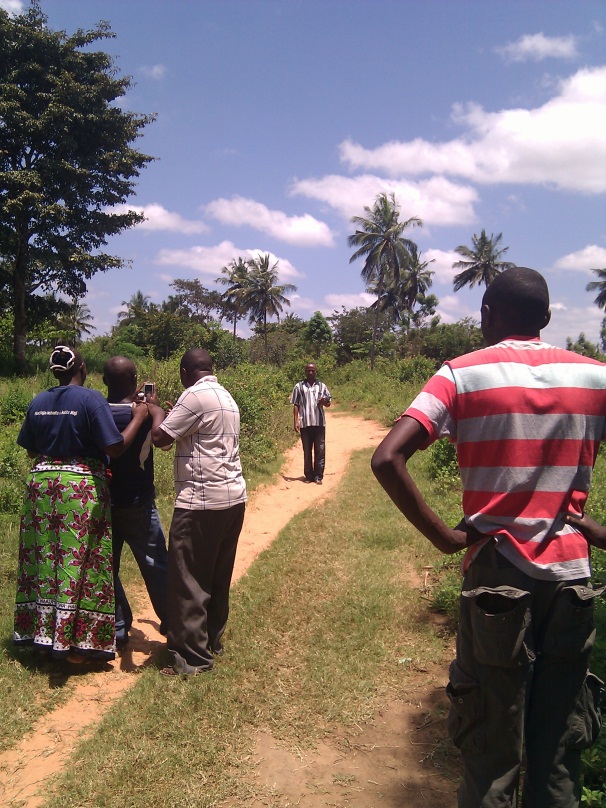
Mapping a school near Ukunda, Kwale County

Creating information is easy. Through mobile phones, GPS devices, computers (and countless other gadgets) we are all leaving our digital footprints on the world (and the World Wide Web). Through the open data movement, we can begin to access more and more information on the health and wellbeing of the societies in which we live. We can create a myriad of information and display it using open source software such as Ushahidi, OpenStreetMap, WordPress, and countless other online platforms. But what is the value of this digital information? And what impact can it have on the world?

Youth Empowerment Through Arts and Media (YETAM) is project of Plan International which aims to create information that encourages positive transformation in communities. The project recognizes young people as important change agents who, despite their energy and ability to learn, are often marginalized and denied opportunities.  Within the YETAM project, Plan Kenya works with young people in Kwale County (on the Coast of Kenya) to inspire constructive action through arts and media – two important channels for engaging and motivating young people.

Information in Kwale County

Kwale County is considered by Plan International to be a “hardship” area. Despite the presence of 5-star resorts, a private airport and high-end tourist destinations on Diani beach, the local communities in Kwale County lack access to basic services such as schools, health facilities and economic opportunities. Young people in the area are taking initiative and investigating the uneven distribution of resources and the inequities apparent within the public and private systems in Kwale County.

As one component of their work in Kwale, Plan Kenya is working with the three youth-led organizations to create space for young people to participate in their communities in a meaningful, productive way. There are different types of participation in local governance – often times government or other agencies invites youth to participate (“invited space”) as “youth representatives” but they are simply acting to fill a required place and are not considered  within the wider governance and community structures.

Youth representation can also be misleading as the Kwale Youth and Governance Coalition (KYGC) reports that “youth representatives” aren’t necessarily youth themselves – government legislation simply stipulates that there must be someone representing the youth – but there is no regulation that states that this person must be a youth themselves (they must only act on behalf of the youth). This leaves the system open to abuse (the same holds true for “women’s representative” – you can find a man acting on behalf of women in the position of women’s representative).  Plan Kenya and the young people we met are instead working to “create space” (as opposed to “a place”) for young people in community activism in Kwale County.

The 5 weeks we spent in Kwale were,the beginning of a process to support this on-going work in the broad area of “accountability” – this encompasses child rights, social accountability and eco-tourism. The process that began during the 5 weeks was the integration of digital mapping and social media to amplify voices of young people working on pressing concerns in the region.

To create the relevant stakeholders and solicit valuable feedback during the process of the YETAM work on digital mapping and new media, our last 3 days in Kwale were spent reviewing the work with the teams. On Thursday November 10th, we invited advisors from Plan Kwale, Plan Kenya Country Office, the Ministry of Youth Affairs and officers from the Constituency Development Fund to participate in a half-day of presentations and feedback on the work the young people had undertaken.

By far the work that generated the most debate in the room was the governance tracking by the KYGC. The team presented the Nuru ya Kwale blog which showcased 28 of the 100 + projects the youth had mapped during the field work. They classified the 28 projects according to various indicators – and for example documented that 23 of the projects had been completed, 1 was “in bad progress”, 2 were “in good progress” and 1 “stalled.”

The CDF officers (the Chairman, Secretary and Treasurer of the Matuga CDF committee in Kwale County) were concerned with the findings and questioned the methodology and outcome of the work.  They scrutinized some of the reports on the Nuru ya Kwale site and questioned for example, why Mkongani Secondary School was reported as a “bad” quality project. The officials wanted to know the methodology and indicators the team had used to reach their conclusions because according to the representatives of the CDF committee, the auditors gave the Mkongani Secondary School project a clean bill of health.

One important message for the youth based on feedback on their work was the need to clearly communicate the methodology used to undertake the documentation of projects (i.e. what are the indicators of a project in “bad” progress? how many people did you interview? Whose views did they represent?).

There is significant value in presenting balanced feedback that challenges the internal government (or NGO) audits – for example the data on Kenya Open Data documents that 100% of CDF money has been spent on the Jorori Water Project mentioned above, but a field visit, documented through photos and interviews with community members reveals that the project is stalled and left in disrepair. This is an important finding – the youth have now presented this to the relevant CDF committee. The committee members were responsive to the feedback and, despite turning the youth away from their offices the previous month, invited them to the CDF to get the relevant files to supplement some of the unknown or missing information (i.e. information that people on the ground at the project did not have access to, such as for example, who was the contractor on a specific project, and what was the project period).

Kwale youth with staff from Plan Kenya, officers from the CDFC and the local Youth Officer

Samuel Musyoki, Strategic Director of Plan Kenya who joined the presentations and reflections on November 10th and 11th, reported that:

“The good thing about this engagement is that it opened doors for the youth to get additional data which they needed to fill gaps in their entries. Interestingly, they had experienced challenges getting such data from the CDF. I sought to know form the CDFC and the County Youth Officer if they saw value in the data the youth were collecting and how they could use it.

The County Youth Officer was the most excited and has invited the youth to submit a business proposal to map Youth Groups in the entire county. The mapping would include capturing groups that have received the Youth Enterprise Fund; their location; how much they have received; enterprises they are engaged in; how much they have repaid; groups that have not paid back; etc. He said it will be an important tool to ensure accountability through naming and shaming defaulters.

The 5 weeks were of great value — talking to quite a number of the youth I could tell — they really appreciate the skill sets they have received-GIS mapping; blogging; video making and using the data to engage in evidence based advocacy. As I leave this morning they are developing action plans to move the work forward. I sought assurance from them that this will not end after the workshop. They had very clear vision and drive where they want to go and how they will work towards ensuring sustained engagement beyond the workshop.”

The impact of digital mapping and new media on social accountability is still an open question. Whether the social accountability work would have provoked similar feedback from duty bearers if presented in an offline platform (for example in a power point presentation) instead of as a dynamic-online platform is unknown.

The Matuga CDF officers were rather alarmed that the data were already online and exposed their work in an unfavourable light (in fairness, there were some well-executed projects as well). There is a definite need to question the use of new technology in governance work, and develop innovative methods for teasing out impact of open, online information channels in decision-making processes and how this is or isn’t amplifying existing accountability work.  There is definite potential in the work the young people are undertaking and the government officers consulted, from the Ministry of Youth Affairs and local CDF Committee (CDFC) stated that they were “impressed by the work of the youth”.

Within the community development systems and particularly the structure of devolved funding, there is a gap in terms of monitoring and evaluation (M&E) that the CDF committee to date has not been able to play effectively. As Samuel Musyoki stated the youth “could watch to ensure that public resources are well utilized to benefit the communities.” The Youth Officer even invited the youth to submit proposals for assistance in buying GPS gadgets and computers to strengthen this work.

Continuing the on and offline integration

As discussed, the work in Kwale on various issues is dynamic and evolving. The 5 weeks we spent with the teams were meant to provide initial trainings and support and to catalyse action that would be continued by the youth in the area, with support from Plan Kenya. Not only did we provide training to the young people, but Plan Kwale staff were also involved in the process and started documenting their work through the tools and techniques introduced by our team. With these skills, the Plan Kwale staff will support the on-going field mapping and new media work. We are also available to provide remote assistance with questions about strategies and technical challenges.

Some of the future activities include:

  • Holding a “leaders forum” during which the youth interact with a wider cross-section of stakeholders and share their work.
  • Continuing work on their various websites – updating the sites with results from social auditing work to be carried out throughout the last weeks of November, as well as digitizing previous information collected during historical social auditing.
  • Validating the data by revisiting some project sites and documenting projects that haven’t been done yet, gathering stories from some of the Project Management Committees, taking more photos, and potentially conducting surveys within the communities to get more representative views on project evaluations.
  • Each group also needs to develop a more structured advocacy strategy to direct their activities in these areas.
  • All teams expressed interest in developing proposals to submit to the Ministry of Youth Affairs, through the Youth Enterprise Fund and CDF Committee, based on the suggestion of potential funding for this process. Plan Kwale staff, as well as some of the Country Office advisers offered to support the youth in developing these proposals.
  • Most importantly, the teams want to consult the wider community in their respective areas to demonstrate the relevance of YETAM, including the skills they have gained, to the community stakeholders (beyond the relevant government authorities

The potential of new technologies, including digital mapping to promote accountability, is only as powerful as the offline systems into which it is integrated. Without offline engagement, existing community systems of trust and recognition will be threatened and thus undermine any online work. The youth must remain grounded within their existing work and use new technology to amplify their voices, build their network, share their stories and lessons and learn from and engage with others.

Read Full Post »

Whydev and Development Crossroads, are launching a peer coaching matching service. The idea is that young professionals, graduate students, and others starting out in international development could benefit from peer coaching. So the two organizations are collaborating to develop a matching service.

Why peer coaching? According to whydev, “If you have worked in international development, you have probably experienced isolation. It seems to be a fact of life in this industry. Field-based expat staff may be the only person at their level in their local office, or the only expat on the team (or one of very few), separated from their local staff counterparts by cultural, language, and organisational barriers. Even people working in the home office may feel isolated. Perhaps they don’t feel comfortable sharing their struggles with their boss.  Or maybe the boss him/herself is the problem.”

When you’re having work issues, you tend to unload them on those closest to you, and this can cause additional stress. Peer coaching offers a way to discuss and vent about these issues, taking some strain off of your close relationships.

“While not trained as a coach, [a peer coach] is willing to coach you according to a simple (yet effective) peer coaching model. This involves actively listening without judgment, reflecting back what he/she is hearing, asking probing questions, and helping you generate concrete action steps to move you forward.”

In order to design a peer coaching service that meets people’s needs, whydev and Development Crossroads are looking for some input.

“Would you want a peer coach? What would you like to get out of such a relationship? How often would you keep in touch? How much input and oversight would you want from us? These are the type of questions we would love to get your thoughts on.”

Head on over to whydev’s site to learn more about peer coaching and give your input through a quick survey!

Read Full Post »

This is a guest post from Jamie Lundine, who has been collaborating with Plan Kenya to support digital mapping and governance programming in Kwale and Mathare.

Throughout October and November 2011, Plan Kwale worked through Map Kibera Trust with Jamie Lundine and Primoz Kovacic, and 4 young people from Kibera and Mathare, to conduct digital mapping exercises to support ongoing youth-led development processes in Kwale county. One of the important lessons learned through the Trust’s work in Kibera and Mathare is that the stories behind the mapping work are important for understanding the processes that contribute to a situation as represented on a map. To tell these stories and to complement the data collection and mapping work done by the youth in Kwale, the Map Kibera Trust team worked with the Kwale youth to set up platforms to share this information nationally and internationally. Sharing the important work being done in Kwale will hopefully bring greater visibility to the issues which may in the longer term lead to greater impact.

Sharing stories of local governance

To support their work on social accountability, the Kwale Youth and Governance Consortium (KYGC) mapped over 100 publicly and privately funded community-based projects. The projects were supported by the Constituency Development Fund (CDF), Local Area Development Fund (LATF), NGOs and private donors. As one channel of sharing this information, the Consortium set up a blog called Nuru ya Kwale (Light of Kwale). According to KYGC the blog “features and addresses issues concerning promotion of demystified participatory community involvement in the governance processes towards sustainable development. We therefore expect interactivity on issues accruing around social accountability.” This involves sharing evidence about various projects and stories from the community.

One example is the documentation of the Jorori Water project in Kwale; through the mapping work, the Governance team collected details of the constituency development fund (CDF) project. The funding allocated to upgrade the water supply for the community was 6,182,960 ksh (approximately 73,000.00 USD). From their research the KYGC identified that the Kenya Open Data site reported that the full funding amount has been spent.

A field visit to the site however revealed that project was incomplete and the community is still without a stable water supply, despite the fact that the funding has been “spent.”

Jorori Water Project, built using approximately 6.2 million shillings (73, 000.00 USD)

Read more about the questions the team raised in terms of the governance of CDF projects, including the detailed the project implementation process and some reflections on why the project stalled. This is information on community experiences (tacit information) that is well-known in a localized context but has not been documented and shared widely. New media tools, a blog in this case, provide free (if you have access to a computer and the internet) platforms for sharing this information with national and international audiences.

Addressing violence against children and child protection

Another blog was set up by the Kwale Young Journalists. The Young Journalists, registered in 2009, have been working with Plan Kwale on various projects, including Violence against Children campaigns. The group has been working to set up a community radio station in Kwale to report on children’s issues. Thus far, their application for a community radio frequency has encountered several challenges. New media provides an interim solution and will allow the team to share their stories and network with partners on a national and internal stage.

The Kwale Young Journalists worked with Jeff Mohammed, a young award-winning filmmaker from Mathare Valley. The YETAM project not only equips young people with skills, but through peer-learning establishes connections between young people working on community issues throughout Kenya. The programme also provides young people with life skills through experiential learning – Jeff reflects on his experience in Kwale and says:

Jeff and the Kwale Young Journalists shooting a scene from “The Enemy Within”

“My knowledge didn’t come from books and lecturers it came from interest, determination and persistence to know about filmmaking and this is what I was seeing in these Kwale youths. They numbered 12 and they were me. They are all in their twenties and all looking very energetic, they had the same spirit as mine and it was like looking at a mirror. I had to do the best I could to make sure that they grasp whatever I taught.”

Jeff worked with the Young Journalists on a short film called “the Enemy Within.” The film, shot with flip-cameras, tells the story of 12-year-old girl who is sold into indentured labour by her parents to earn money for her family. During the time she spends working, the young girl “falls prey of her employer (Mr.Mtie) who impregnates her when she is only 12 years old.” Jeff reflects that “early pregnancies are a norm in the rural Kwale area and what the young filmmakers wanted to do is to raise awareness to the people that its morally unacceptable to impregnate a very young girl, in Enemy Within the case didn’t go as far because the village chairman was bribed into silence and didn’t report the matter to higher authorities.” This is a common scenario in Kwale, and the young journalists plan to use the film in public screenings and debates as part of their advocacy work in the coming months.

Jeff and the Kwale Young Journalists shot the film in four days – they travelled to Penzamwenye, Kikoneni and also to Shimba Hills national park to shoot 7 scenes for the movie. Read more about Jeff’s reflections on working with the Kwale Young Journalists on his blog.

Sharing ecotourism resources

The Dzilaz ecotourism team – a group that encourages eco-cultural tourism in Samburu region of Kwale county — also integrated social media into their work. During the last week (November 8th-12th) the group set up a blog to market the community resources, services and products. They also plan to document eco-culture sites and the impact that eco-tourism can have on the community. As of November 10th, 2011 the Dzilaz team had already directed potential clients to their website and thus secured a booking through the information they had posted.

The importance of telling the stories behind the maps

One important component to mapping work is to tell the stories behind the map. The three groups in Kwale are working to build platforms to amplify their grassroots level work in order to share stories and lessons learned. The information documented on the various platforms will develop over time and contribute to a greater understanding of the processes at a local level where youth as young leaders can intervene to begin to change the dynamics of community development.

Read Full Post »

Last October, UNICEF West Africa wrote up a nice briefing note on mobile tech and its relevance in child protection programming. You can download it here.

According to the document, pulled together by Mirkka Mattila, ‘This is an area of rapid innovation and new applications are being developed all the time. Telecommunications is one of the fastest growing sectors in Africa and the relevance and reach of mobile technologies for development and humanitarian work is only going to increase over the coming years. Many technical, legal and security aspects of these new technologies remain to be fully addressed and worked out. The dependence on technology, network coverage and electricity supply also mean that mobile technologies cannot be used everywhere.’

The paper includes examples on the use of mobile technologies for:

  • gathering and transmitting data by child protection service providers; including surveys, rapid assessments, case management, family tracing and reunification of separated children, and birth registration
  • self-protection and complaints mechanisms; such as child helplines, violence reporting and community mapping for violence prevention
  • transmitting information and money via mobile; eg, SMS campaigns and cash transfers.
Some of the examples and tools highlighted include: RapidSMS, RapidFTR, Nokia Data Gathering, Child HelpLines, FrontlineSMS, Ushahidi, OSM and Map Kibera, and M-PESA.

It pulls out challenges and advantages of the different use cases and offers some guiding questions to assist in the selection of the most appropriate applications, such as:

  • Is there a need to create new applications or can existing solutions be used?
  • What are the characteristics of the user group and the environment (urban – rural, existing networks and coverage etc.)?
  • What technical expertise is required for installing and maintaining the system?
  • How well will investments in equipment and capacity meet the needs, expected impact, benefits and outcomes in terms of results delivery?
  • What are the potential partnerships for sustainable capacity-building and service delivery? What are the roles of public and private service providers?
  • What are the financial resources needed in the short, medium and long-term to establish and maintain the system?

The document ends with some arguments and counter arguments around the use of mobiles in child protection work. It’s nice to see this paper as there is not a whole lot of research and/or documentation on use of mobiles and ICTs specifically in child protection work.

Download it here.

****

Other child protection resources/posts on Wait… What?:

Child Protection: From emergency response to a sustainable mechanism

Community Based Child Protection

Child Protection, the media and youth media programs

Children in Emergencies: Applying what we already know to the crisis in Haiti

Read Full Post »

Original published on the Guardian’s Poverty Matters site as part of a series of year-end reflection pieces.

An Egyptian anti-government protester holds a flag in Cairo's Tahrir Square earlier this year. Photograph: Miguel Medina/AFP/Getty Images

Waking one lazy Sunday morning and checking my Twitter feed, the first link I clicked on was a video of the Egyptian military beating unarmed protesters. The second was a series of Lego reconstructions of key moments in 2011, including the now-famous campus policeman pepper spraying unarmed student protesters in the face. It’s impossible to look back on 2011 without recalling the massive number of people who joined in worldwide protests to push for openness and inclusion – financial, political and social. No less memorable is the violence with which those protests were met.

As 2012 approaches, protesters across the world continue to occupy public spaces and fight for a voice in how things are run. They seek greater transparency, and new means of participating in social, financial and political life.

Many of 2011’s more horrifying and memorable images – captured on mobile phones, and generating global outrage and solidarity – involved systemic repression by the powers-that-be. Progress has been made in some countries, but sadly it’s not clear what the end result of the world’s uprisings will be.

Inclusion was not only a theme of large-scale world events, it was also key in aid and development. Organisations continued to push for adolescent girls’ inclusion in development initiatives and to emphasise that the most excluded and marginalised populations need to be reached in order to advance towards shared development objectives such as the millennium development goals. In June 2011, in a clear move forward on inclusion, the UN endorsed the rights of gay, lesbian and transgender people, yet the world still has a very long way to go.

Another central themein 2011 was openness. Whether it was the World Bank’s open data site, the Open Government Partnership (OGP), theInternational Aid Transparency Initiative (IATI), the Busan high level forum on aid effectiveness, the increase in “fail faires“, or grassroots initiatives pushing for more transparency – in aid and government funding as well as political decision making – “open” was everywhere.

As yet, however, the trend hasn’t reached quite far enough, and it would be good if it expanded in 2012 to encompass banks and other private sector entities. Hopefully, openness can help to advance inclusion and itself become more inclusive. All this amazing, open data needs to be re-used and it needs to connect back with people who might not be technology or data experts, have an internet connection or speak one of the major languages.

I hope 2012 sees greater effort to support communities and local organisations to access and use open data. I also hope there will be more effort to understand what information communities and local groups need to improve their own situations and exact more accountability and better governance from aid agencies, governments, service providers and the private sector.

Along with inclusion and openness, authenticity was a key concept in 2011. I enjoyed seeing critiques of simplistic media pieces about “the poor” and “the excluded”. Lakota youth, for instance, responded in a video to a Forbes [should be ABC] piece about poverty and hardship on reservations, emphasising: “We’re more than that.”. The Forbes piece, headlined “If I was a poor black kid“, caused a huge stir and response. One close reading of simplistic mainstream journalism called out the author for habitually ignoring the complex, systemic causes of poverty and exclusion.

I look forward to hearing more voices in these debates in 2012, continued questioning of simplistic messages, and more authentic reporting. New media can help previously excluded people tell their own, unspun stories and comment on simplistic reporting about them elsewhere. I hope aid and development agencies will increasingly support this, not as a gimmick or marketing ploy, but as a core element of their work and a way to better understand and share the issues and opinions of the people they aim to support through their programmes.

My wish for 2012 is that the world makes serious gains in reducing social, political and financial exclusion, in advancing participatory and accountable governance, and in achieving a better distribution of power and resources. Hopefully, aid and development organisations will continue to make progress in understanding what inclusion, openness, and authenticity in the global landscape mean for the kinds of programmes they fund and support.


Read Full Post »

Civil society has been working for years on participation, transparency, accountability and governance issues. Plenty of newer initiatives (small and large) look at new technologies as a core tool in this work. But are these groups talking and learning from each other? What good practices exist for using new technologies to improve transparency, accountability and governance? What are some considerations and frameworks for thinking about the role of new technologies in this area of work? What needs consideration under this broad theme of good governance?

Tuesday’s Technology Salon* in New York City focused on those issues, kicked off by our two discussants, Hapee de Groot from Hivos and Katrin Verclas from Mobile Active. Discussion ensued around the nuances of how, with whom, when, why, and  in conjunction with what do new technologies play a role in transparency, accountability and good governance.

Some of the key points brought up during the Salon**:

What is “good governance?”  The overall term could be divided into a number of core aspects, and so the discussion is a big one and it’s complicated. Aid transparency is only one small part of the overall topic of good governance.

The World Bank definition includes aspects of:

  • Participation of citizens in political processes, freedom of expression and  association, free media
  • Political stability and absence of violence
  • Government effectiveness in the delivery of services
  • Regulatory quality, rule of law
  • Control of corruption

There’s a need to look at governments and aid, but also to look at the private sector. Some commented that aid transparency is in vogue because donors can drive it but it’s perhaps not as important as some of the other aspects and it’s currently being overemphasized. There are plenty of projects using ICTs and mobiles in other areas of governance work.

More data doesn’t equal more accountability. Data does not equal participation. Can mobile phones and other ICTs or social media reduce corruption? Can they drive new forms of participation? Can they hold power accountable in some ways? Yes, but there is no conclusive evidence that the use of new technology to deliver data down from governments to people or up from people to governments improves governance or accountability. The field of tech and governance suffers from ‘pilotitis’ just like the field of ICT4D. Some participants felt that of course open data doesn’t automatically equal accountability and it was never the idea to stop there. But at the same time, you can’t have accountability without open data and transparency. Opening the data is just the first step in a long road of reaching accountability and better governance.

Efficient vs transformational. Transactional efficiency within a system is one thing. Transformation is another. You can enhance an existing process from, say, writing on paper to calling on a landline to texting in information, thereby improving accuracy and speed. But there is something more which is the transformational side. What’s most interesting perhaps are those ways that ICTs can completely alter processes and systems. Again, there are a lot of promising examples but there is not much evidence of their impact at this point. One participant noted that current evidence seems to point toward the integration of mobiles (and other ICTs) into existing process as having a greater impact and quicker uptake within large, bureaucratic systems than disruptive use of new technologies. But the question remains – Are the systems good systems or should/could ICTs transform them to something totally different and better or can ICTs help do away with poorly working systems entirely, replacing them with something completely new?

Is open data just a big show? Some alluded to opaque transparency, where a government or another entity throws up a bunch of data and says “we are being open” but there is no realistic way to make sense of the data. Some felt that governments are signing onto open data pacts and partnerships as a fake show of transparency. These governments may say, “The data base is available. Go ahead and look at it.” But it costs a lot of money and high level skills to actually use the data. In addition, there is a need for regulatory frameworks and legislation around openness. Brazil was given as an example of a country that has joined the open government partnership, but as yet has no regulatory framework or freedom of information act, even though the country has a beautiful open government website. “Checks and balances are not inherent in the mobile phone. They need to be established in the legislation and then can be enhanced by mobile or other technology.” Open Data Hackathons can help turn data into information. The question of “what does open data actually mean?” came up also and the “cake test” was recommended as one way of defining “open”.

Is open data an extractive process?  Some at the Salon cautioned that the buzz around Open Data could be a bit false in some ways, and may be hyped up by private companies who want to make money off of nice data visualizations that they can sell to big donors or governments. The question was raised about how much data actually gets back to those people who provide it so that they can use it for their own purposes? The sense was that there’s nothing wrong with private companies helping make sense of data per se, but one could ask what the community who provided the data actually gets out of this process. Is it an extractive data mining process? And how much are communities benefiting from the process? How much are they involved? Mikel Maron wrote a great post yesterday on the link between open data and community empowerment – I highly recommend reading it for more on this.

Whose data? A related issue that wasn’t fully discussed at the Salon is: who does the information that is being “opened” actually belong to (in the case of household surveys, for example)? The government? The International NGO or multilateral agency who funds a project or research? The community? And what if a community doesn’t want its data to be open to the world – is anyone asking? What kind of consent is being granted? What are the privacy issues? And what if the government doesn’t want anyone to know the number of X people living in X place who fit X description? Whose decision is it to open data? What are the competing politics?

For example, what if an organization is working on an issue like HIV, cholera, violence or human trafficking. What if they want to crowd source information and publicly display it to work towards better transparency and improved service delivery, but the host government country denies the existence of the issue or situation? In one case I heard recently, the NGO wanted to work with government on better tracking and reporting so that treatment/resources could be allocated and services provided, but when the government found out about the project, they wanted control over the information and approval rights. Government went so far in another case as to pressure the mobile service provider who was partnering with the organization, and the mobile service provider dropped out of the project. These are good reminders that information is power and openness can be a big issue even in cases not initially identified as politically charged.

Privacy and security risks. The ubiquity of data can pose huge privacy and security concerns for activists, civil society and emerging democracies and some at the Salon felt this aspect is not being effectively addressed. Can there really be anonymous mobile data? Does the push/drive for more data jeopardize the political ambitions of certain groups (civil society that may be disliked by certain governments)? This can also be an issue for external donors supporting organizations in places like Syria or Iraq. Being open about local organizations that are receiving funding for democracy or governance work can cause problems (eg., they get shut down or people can be arrested or killed).

Can new ICTs weaken helpful traditional structures or systems?  Is new tech removing some middlemen who were an important part of culture or societal structure? Does it weaken some traditional structures that may actually be useful? The example of the US was given where a huge surge of people now engage directly with their congressperson via Twitter rather than via aggregation channels or other representatives. Can this actually paralyze political systems and make them less functional? Some countered, saying that Twitter is somewhat of a fad and over time this massive number of interactions will settle down, and in addition, not everyone gets involved on every issue all the time. Things will sort themselves out. Some asked if politicians would become afraid (someone – help!! there is a study on this issue that I can’t seem to locate) to make some of the secret deals that helped move agendas forward because they will be caught and so openness and transparency can actually paralyze them? In other words is it possible that transparency is not always a good thing in terms of government effectiveness? The example of paying Afghan police directly by mobile phone was given. This initiative apparently ended up failing because it cut decision makers who benefited from bribes out of the loop. Decoupling payments from power is potentially transformational, but how to actually implement these projects when they disrupt so much?

Does new technology create parallel structures? Are parallel structures good or bad? In an effort to bypass inefficient and/or unaccountable systems, in one case, private business owners started their own crime reporting and 911 system to respond and accompany victims to report to the police and follow up on incidents. Questions were raised whether this privatization of government roles was taking justice into ones’ own hands, forcing the government to be accountable, allowing it to shirk responsibilities, or providing a way for government to see an innovation and eventually take on a new and more effective system that had been tried and tested with private funds. This same issue can be seen with parallel emergency reporting systems and other similar uses of ICTs. It may be too early in the game to know what the eventual outcomes of these efforts will be and what the long term impact will be on governance. Or it may be that parallel systems work in some contexts and not in others.

***

The Salon could have gone for much longer but alas, we had to end. Dave Algoso covers some of the other ideas from the Salon in his post Technology for Transparency, Accountability and Governance, including how to approach and define the topic (top down vs bottom up? efficiency vs transformation?) and the importance of measuring impact.

Thanks to UNICEF and Chris Fabian for hosting the Salon. Thanks to Martin Tisne from the Transparency and Accountability Initiative for sparking the idea to choose this topic for the first Technology Salon in NYC, and thanks to Wayan Vota for inviting me to coordinate the series.

Contact me if you’d like to be on the invitation list for future Salons.

*The Technology Salon is sponsored by the UN Foundation’s Technology Partnership with the Vodafone Foundation as a way to increase the discussion and dissemination of information and communication technology’s role in expanding solutions to long-standing international development challenges. Technology Salons currently run in Washington DC (coordinated by@wayan_vota) and San Francisco, with New York City as the latest addition, coordinated by yours truly.

**The Salon runs by Chatham House Rules, so no attribution has been made in the above post.

Read Full Post »

A recipient signs for a cash transfer (Photo: http://www.plan-international.org)

The popularity of cash transfer programs in the academic and aid blogosphere over the past few years, got me wondering what the difference is between the kind of cash hand-out programs that sponsorship organizations were doing in the early days and today’s cash transfer and conditional cash transfer programs.

What prompted the shift in thinking from ‘line up and get your cash’, to ‘cash handouts are paternalistic, ineffective, unsustainable and create dependency,’ to ‘cash transfers are innovative ways of achieving development gains’ and/or ‘cash transfers empower local people to purchase what they really need?’ How are cash transfers different today from 40+ years ago?

I happen to work for an organization that raises a good percentage of its funding through child sponsorship. From what I’ve heard, for the first few decades of our existence, cash handouts were simply how the organization worked. Along with most other development agencies, we moved away from direct handouts in the 80s. Like some other organizations, by the end of the 1990s we had adopted a rights-based approach. We are also now doing cash grants again in some cases such as this program in Vietnam. I’ve asked around a bit internally and haven’t found anyone able to point me to documentation on what in particular prompted the move from cash handouts to community-based development in the 80s. Obviously it was a change happening most everywhere, not just in the organization where I work. I assume there was a process and a lot of discussion around this like there is with any change in approach, but it’s most likely on paper and not on-line. I do wonder what has been or could be learned about cash transfers from that process of discussion and change in methods.

There is certainly a lot of debate today about cash transfers. When I’ve asked people outside my organization what the difference is between today’s cash transfers and those of 40 years ago, most pro-cash transfer folks say that today’s approach to cash transfers is different or that cash transfers are included as part of broader programs, or that cash transfer programs that succeed are done by governments and not INGOs.

The anti-cash transfer folks tend to feel that cash transfers are not sustainable development, encourage dependency, and cause community conflict, and that they do nothing to improve systems or infrastructure in the long run; eg., what good is having cash if there is no health system? no food to purchase?  no school to attend? Or they consider cash transfers to be individualistic rather than a way to support an entire community or district’s development or worry that conditioning cash transfers can cause unintended consequences. (Here’s a fun piece that talks about what the cash transfer debate says about the international humanitarian community.)

There are tons of studies (mostly by economists it seems) showing that cash transfer and conditional cash transfer programs have improved health, nutrition and education enrollment. Some caution that cash transfer programs such as Brazil’s Bolsa Familia are not a panacea and need to be complemented with other types of programs.

I liked this recent paper ‘Richer but resented: What do cash transfers do to social relations and does it matter‘ by MacAusland and Riemenschneider (HT @rovingbandit). It questions the impact of cash transfers on less visible, more contextualized local and national relationships and power dynamics and suggests a need to go beyond material analysis during design, implementation and impact evaluations of cash transfer programs.

Especially helpful for someone like me who is trying to better understand the discussion around cash transfer programs is the paper’s reference to Copestake’s (2006) aspects of well-being (material, relational and symbolic) and three views on social protection as applied to cash transfers.

I’m pasting in the paragraphs I found especially useful to tempt you into reading the whole paper. I liked the excerpt below because it provides good insight into how different development theories color the objectives set in cash transfer programs and the way that success and impact are measured.

‘…An „income-first view of social protection focuses on the consequences of cash transfers for recipients’ incomes and on their costs, including fiscal costs and perverse incentives to stop working or to seek rents. Second, a needs-first view starts from a more multidimensional view of poverty and focuses on the states role in guaranteeing access to basic needs, including livelihoods, assets, and public action. This would criticise the income-first view for being too narrow. Third, a rights-first view identifies injustice as a key cause of poverty, and criticises the „needs-first approach for being paternalistic.

Very broadly, these views can be identified with philosophical approaches to development. The income-first view is most closely identified with a  modernisation theory and Washington Consensus approach, which is rationalist, individualist and utilitarian in nature, measuring utility primarily in terms of income. The appeal of this view in part lies in the measurability and equivalence of outcomes and costs – so that outcomes measured in dollars can be compared to costs measured in dollars. This possibility is very attractive for planners, since it enables an unambiguous (on this single metric) judgement of whether an intervention should proceed. In terms of approaches to social protection, the income-based view is reflected most clearly in the safety nets approaches of the early 1990s (World Bank 1990).

The needs-first view starts from a similarly utilitarian and individualist standpoint but broadens this by introducing other dimensions of well-being, largely adding material dimensions (such as education, health, and livelihoods) but in some cases relational aspects (such as a capacity for social action). This draws in part from Sens capability perspective (Sen 1985) and is currently being operationalised through the Millennium Development Goals and now multidimensional poverty indices (see e.g. Alkire and Foster 2009). In the social protection literature, this view is closest to the transformative social protection approach (Devereux and Sabates-Wheeler 2004) that emphasises the role of social protection in overcoming not only material shortcomings but in enhancing self-esteem and social status.

The rights-first view has developed rather differently, in part from Latin American traditions of dependency theory and structuralism, which place more emphasis on relational and symbolic aspects of well-being. One application of this tradition can be found in Figueroa (2001) who argues that persistent inequality in Latin America can be explained by processes of social exclusion (based on cultural difference) leading to political exclusion from social protection programmes and education, and resulting economic exclusion. As Copestake (2006b: 4) summarises, this interpretation highlights: “the extent to which economic growth and inequality reduction are dependent upon cultural and political mobilisation, not least through advocacy of human rights. This is in stark opposition to the more common assumption of economists that improved human rights are more likely to follow economic development than to be a precondition for it.”

The consequences of these different views for assessments and planning of cash transfers are quite profound. For instance, the different views will put quite different weights on the negative consequences of excluding members of the community from controlling payments or targeting as opposed to the problems associated with additional costs of targeting. The decision whether to pay for additional community participation will look very different depending on which view is held. Similarly, the different views will imply quite different judgements on whether cash transfer programmes should be replicated, given different material, relational and symbolic outcomes.’

I still don’t really know what I think about cash transfers, (I suppose “it depends’ is always a good answer) but at least I have a bit of a better framework for thinking about them and analyzing what I read about them. Copestake’s three areas (material, relational and symbolic) also give a good framework for analyzing other types of aid and development programs, beyond cash transfers (such as Gift In Kind, as @cynan_sez points out).

I also still haven’t figured out how the old style sponsorship cash handouts were different from today’s ‘innovative’ models. Any old timers out there with insight to share on that?

Read Full Post »

The funny thing about ICTs and Development (and mostly everything else in this world) is that just when you think things are plugging along, you get the rug pulled out from under you and have to re-think everything.

A couple of weeks ago, I was heading off to the ICT for Rural Development (ICT4RD) Conference in Johannesburg. Before I left, I got an invitation from Ken Banks to participate in an ”ICT4D Postcard” project, which I thought was a nice idea. I took a moment to find a photo and pen a few lines and went on my merry way to Joburg.

Little did I know that several of the key thinkers and writers in the ”ICT4D” space were going to deconstruct the concept over the next fortnight in a flurry of sometimes harsh and pointed, always thoughtful posts.

The day the ICT4RD conference started, Steve Song posts his Three reasons why M4D may be bad for development rant wherein he makes some pretty strong (and relevant) points, such as:

“…the future is going to be a surprise and tying the notion of development to a particular mode of technology [eg., the mobile phone] is as bad an idea now as it was in 1999” and “Mobile operators have entrenched themselves with development agencies as the saviours of access … what the mobile operators have achieved through this embrace is the effective sidetracking of debates about competition and affordability.”

Then Ken’s ICT4D Postcards post goes up, and no more do I look at it and have a think about the photos and captions, then Erik Hersman (White African) throws up his rant on The Subtle Condescension of ICT4D, which gets the whole ICT4D-slash-anti-ICT4D world in a tizzy and which has a lot of good, strong points, like:

”I was recently discussing this term with one of my Kenyan tech friends, where he stated, ’I always picture a team from the UN putting up toilets in Uganda when I hear of ICT4D’” and ”It also feels like [ICT4D] is how international NGOs are trying to stay relevant, by creating a new department and new initiatives that the big funders will buy into and support (themselves to stay relevant). Ask yourself, how many ICT4D projects in Africa are more than pilot projects? How many are just Westerner organizations parachuting in, which have no hope of staying alive beyond the time and funds put in by their organization? Sounds like the same old ’aid story’ to me.”

Erik closes with “We have to thinking less of ICT as something that’s about development, and more of it as a commercial venture. We need more focus on ICT4$ than ICT4D.”

And I am left thinking, well very much yes! …and also, sort of no…. But I can’t get straight in my mind what makes me hesitate. Maybe it’s that in my experience, not all ’development’ initiatives are the stereotypical foreigners parachuting in with new gadgets? Or maybe it’s because I am super wary of the trickle-down economic growth model and I think that the world needs something different?

I don’t have to wait long before Jonathan Donner drops some good points into the debate in his post More letters, more problems, concluding:

”I don’t think we’re going to move off ICT4D as the default compound term, at least for a while. But I like these discussions and think it is important for the community to have them from time to time…probably quite frequently since the field/ community of practice is increasingly methodologically diverse, and growing. The conversations are not easy as some might like them to be, but that is because they are about a “compound” community. Regular bouts of reflection are not just navel gazing – they should help us remain reflective, careful, and precise in the use of the terms we use to describe what we do and why we do it.”

Followed by Wayan Vota who pops in with the Challenge of Defining ICT4D or Why Erik Hersman is ICT4$, whereby he defines ICT4D and ICT4$ as two wholly different industries. Projects can be ICT4D and ICT4$, neither approach is perfect and there is plenty of failure in both, and the 2 should be symbiotic, he says.

“Let us not confuse two whole different uses of ICT. In the tech start up world, ICT is a means to make money. Software developers code products like MXit or M-PESA and hope to sell them at a profit to to venture capital funders and people that are currently under served by the market place. The focus is on $. This is ICT4$ and they should be proud of their efforts.

In the international development world, ICT is used to deliver education, healthcare, etc more efficiently. We have great products like FrontlineSMS, ChildCount+, and Ushahidi, and sell them to donor funders so we can deliver them free or subsidized to those under served by government or in market failure situations. The focus is on impact versus $. This is ICT4D, and I am proud to use the term.

Notice the different focus. In no way should a tech startup and its funders seeking to maximize profit seek to work in ICT4D, just like it would be laughable for a development organization (funder or implementer) to run a tech startup to be the next Facebook.”

Not to be left out, one of the top critics of ICT4D, the ICT4D Jester, pipes in on the stupidity of any acronym that sounds like a Prince Song [I wholeheartedly agree!]. He gets to the political heart of the discussion about ICT4D and ICT4$ in his post ICT *or* Development, Part 3: The Jester Meets the White African:

”The underlying issue is a deep one that goes straight to the heart of economic development. To compress the last century of economic history into a nutshell,* countries that attempted centralized socialism lost to capitalist countries in the contest to make as much money as possible as quickly as possible.…

In the last few decades, however, countries like the United States have been running the experiment of rampant free-market capitalism. Among other things, this led to the dramatic financial crash of 2007-2008, a population unable to wean itself off of resource consumption, and increased inequality, not only economically but also in terms of health, education, and well-being. If that’s what happens under what could be argued is the closest thing to a “pure” free-market capitalism, any reasonable person should be reconsidering the lesson of the Cold War victory.”

The Jester goes on to explain that ”progressive activity” is necessary to counterbalance capitalism and mitigate the inequality caused by capitalism and that ICT4D in practice tends to embrace this progressive side of things.

ICT4$ is needed, but someone also needs to focus on D. (The Jester, of course, does not necessarily say that D should proceed via ICT4D!)”

He sums up with, “Yes, ICT4D is a four-letter word (with a number), but wear it proudly in your progressive technology activities, and cast it off – way,way off – for your for-profit ones. Meanwhile, don’t forget that the world needs both types of activity. Of course, the one thing you can’t do is split yourself in two.  And, that, perhaps, is another reason why it’s so difficult to make a profit and serve a poor population simultaneously.”

David Kobia continues in his post ICT4D Cont (first acknowledging that he’s ’whipping a dead horse’) that ”ICT4D and indeed then [sic] term ICT in general in this breakneck environment has come to symbolize access to technology at the lowest rung – basically a booster seat at the table with the adults. He asks, ”Is there a very remote chance that the role of technology in development has been slightly overemphasized?”

And Tony Roberts chimes in with his own Rant In Defense of ICT4D, where he joins the Jester in pointing out that the ’free’ market hasn’t done anyone [eg., the 99%] any favors in the ”developed” or the “developing” world.

”The problem with relying on commerce is that the ‘free’ market is fundamentally flawed; for 300 years it has abjectly failed to meet the needs of millions of people at the periphery. Whilst elites in capital cities enjoy relative opulence, marginalised communities are unable to secure adequate nutrition, basic healthcare or human rights. These divides continue to widen. In response people form not-for-profit organisations to have their voices heard and their community development needs addressed; sometimes employing ICT for these Developmental ends. Not-for-profits exist because of the failure of markets.

ICT4$ alone is not capable of fixing this problem….

When communities refuse to accept injustice and deprivation and form associations of solidarity with those at risk we should give them our respect. If they seek practical assistance in applying ICT for Development we should offer whatever assistance we are able. There will often be a positive role for ICT in community development.

ICT4D alone, of course, is not capable of fixing the system.”

In addition to all the blog posts that Erik’s provocative post spawned, there are some great points made in the comments section:

For example, Paul comments (and I summarize)

”Left to its own devices, ’ICT4$’ will mostly chase the same set of rich urban market users, just as the bulk of SV consumer startups chase the same demographics…. So, yeah, make these things follow commercial logic and thereby sustainable, but the answer is not to deprecate the ’D’ in favor of the ’$’. Both need to be kept in mind because a rising tide raises all Gini coefficients…. Local capacity, sure, but that isn’t always the cheapest/fastest way to do it (which is what commercial logic would dictate). Again, to care about advanced capacity building, you have to care about the ’D’.”

(@hapeeHapee says ”To me the container ICT4D is useful as a hashtag for twitter, as a common ground for research and practitioners, social movements and ngos still play a role as do active citizens, open source is still an alternative used to prevent closed source standards and the market is still something to be very careful about because the driving force of profit is not the same as creating change.”

So. Much. To. Think. About.

It’s a really messy world out there and the field [formerly known as?] ”ICT4D” is no exception.  The issues being wrestled with are much broader than ICT and D. I’ve picked out points and angles that resonated with me from the various posts. I can’t say that any one of the authors is 100% right (nor, probably, would any of them claim to be). Or maybe they are 100% right in certain situations, but not all.

Should International NGOs stop creating dependencies and killing local initiatives? Yes.

Does the ’free’ market allow for dignity and well-being for all? No.

Maybe that is the heart of the question – how to operate in a way that does not create dependency or stifle economic growth but that also does not exclude or marginalize a large part of the population. Maybe it always comes down to that ’capitalist’ vs ’some other kind of inclusive and sustainable growth model’ discussion… And maybe a clearer divide between ICT as a growth sector and ICT-enabled development programs that aim to reach the most marginalized (where the market does not reach) is needed. Or maybe not, if you believe ethical business models can achieve both. (I’m still waiting for those models to become the widespread norm and don’t see it happening any time soon, anywhere).

And what about ICTs as tools to improve civic participation, voice, access to information, transparency, accountability and good governance so that [ideally] exclusion is reduced and resources generated by economic growth (and/or resources allocated to fill the gap where the market fails to reach, or resources designated toward improving services that are/should be provided by government) are better and more honestly allocated… And what about new technologies that support more transparent political and decision making processes? (What is the acronym for those kinds of ICT uses?) Oh, so messy….

In any case, I think the discussion is helpful in raising issues and making us all think more about the terms we use, and the processes and products we support, drive and promote.

If there is one thing the field [formerly know as?] ’ICT4D’ does do, it’s bring together good people who think deeply and who honestly care about how they are contributing to making the world a better place.

Take some time to visit the links and read the full posts if you haven’t yet, they are very much worth it!

*****

Updates:

16 Nov 2011:

RT @kiwanja: Check out the #BBCClickRadio podcast for a slightly extended debate on the merits of ”#ICT4D” terminology. http://is.gd/HUK37e

RT @hapeeg: More ICT4D Please! – My take on the ICT4D debate by @david_barnard http://tinyurl.com/c55tpg4 #ICT4d #ICT4RD #Tech4Dev #Africa.

David Barnard notes that “there is also more than one real “White African” serious about making a contribution to the future of this continent.” 

“These two issues represent different sides to the same coin – but often require very different approaches, and different roleplayers, to achieve the desirable objectives…. Whatever you prefer to call technology is irrelevant – IT / ICT / ICT4D / ICT4RD / M4D/ Tech4Dev, etc. What really matters is the intent, the objectives and the motivation for using it.

But, technology for technology’s stake is downright stupid. Too many technology for development projects and interventions fail because of the emphasis on the technology without understanding the development issue/s and/or what it would take to ensure the implementation of the technology will ultimately achieve success and impact. Too many technology competitions, awards and challenges place too much focus on the development of “more new tools” rather on what has been achieved.”

17 Nov 2011:

RT @mtotowajirani: New blog post: #OccupyTech: Take the money out of tech…and put the impact back in! http://bit.ly/tTAogC #occupy (Wherein Simeon Oriko takes on #ICT4$ with a new slogan – suggested by @noniemg – Take the SH out of IT… ” He says:

“Here’s the bottom line….Unless you are directly making an impact in someone’s life with you apps and all the hustle around them, you’re really doing nothing meaningful. …  Money is driving people in totally wrong directions!  Sober up and think about it for a second. What’s more meaningful and worth your hustle? Money or impact?”

And I missed Niall Winters original thoughts, including ideas from @katypearce, on this post The 4 in ICT4D.

“The ‘4’ places an emphasis on “giving it to you”, and all the issues that brings up regarding donation. I hadn’t really thought about it in that way before, coming from the perspective nicely described by Kleine and Unwin (2009):

Our preferred terminology is ICT4D, in part because it is the most widespread term, but also especially because it places explicit attention on the ‘4’, or what kind of development is being addressed. Rather than the ‘and’ of ICTD, the ‘for’ of ICT4D forces users of the term to confront the moral and political agendas associated with ‘development’. By focusing on the ‘4’ we are forced to make explicit what we mean by ‘development’. The interplay between ‘information’, ‘communication’ and ‘technologies’ for ‘development’ is one that offers considerable intellectual and practical challenges, and it is these that this paper seeks to explore.

 Hence, the ‘4’ for me is a challenge to think about the nature of inclusivity in my work, the power relations embedded within any intervention and the appropriateness of the technologies used or being developed.”

22 Nov, 2011

kdiga’s reply on ICTDJester’s blog: says we need to ask 4 questions and agree on some principles when invoking ICT4D:

1) Are we attempting to see the reduction of poverty (in all its multiple dimensions?) from the use of ICTD?
2) Are we attempting to see the reduction of inequality?
3) Are we seeing lower numbers in child mortality, an improvement through healthier families, or more student graduating Grade 12 as a result of ICT usage, less environmental degradation – how are we measuring?
4) Are we able to see less lives lost?

23 Nov, 2011

Ian Thorpe’s post “ICT4What” says part of the issue here is that ICT4D is a huge field (and a subset of “technology” which is an even bigger field, and which has absolutely everything to do with “development” – eg, read Jared Diamond’s book Guns, Germs and Steel) and people are talking at cross-purposes and using all different definitions.  ‘The development, spread and use of technology is a huge field with lots of actors each playing their part, with plenty of room for different motives and philosophical or empirical approaches – even contradictory ones  – since in the end they will all contribute to the change that takes place through collaboration, competition and even contradiction. In short it’s a complex adaptive system. Past technological spread has always resulted from the actions of multiple actors often with very different motives and philosophies: Inventors, entrepreneurs, governments, consumers, academics, not for profits and others have all helped shape the way technology is currently used both consciously and unconsciously. Using technology to make money is a key component of spreading technology that improves lives, but it’s only part of the story.”

Ian concludes that “it doesn’t matter that we don’t agree, in fact it’s a good thing. A diverse approach involving multiple actors and friction between them is in the best interests of the field because it allows different models to co-exist, compete and learn from each other, and it allows then to be judged in the market and the marketplace of ideas.”


Read Full Post »

A few weeks ago, Iulian Circo, who’s working at Population Services International (PSI) in Mozambique, asked if I’d look at some slides about an idea called ‘Movercado’. I checked it out and it seems pretty cool.

Movercado is described as “an  interpersonal communication experiment” with the goal of supporting behavior change communication (BCC) in large countries with poor infrastructure.

The problem that Movercado would address?

‘Taking behavioral messages above the line (TV, Radio, Mass media)  doesn’t really work beyond the all important effect of creating awareness. Organizations such as PSI know that very well and focus a lot on inter-personal communication. That means we need a critical mass of trained “agents” placed throughout the country that conduct standardized information, education and communication sessions in their communities.  Obviously, supervising, training and deploying such an army of “agents” is difficult, slow and very costly. Additionally, efforts to ensure quality and keeping the training materials up to date adds to the costs. Finally, reaching the critical mass required to have an impact with this traditional model in a large country is very difficult.’

Enter Movercado, which aims to facilitate this process through a series of face-to-face training, SMS, calls, incentives, data collection and personalized messaging with agents and the target population.

There is a step-by-step detailed description on the Movercado blog, but since I don’t know the context well, it was confusing at first. So Iulian created a quick user  scenario and had a friend draw up the visual below to help with understanding the process and flow of the application:

How would Movercado work?

‘Manuel lives in Beira, Sofala Province. He sells airtime and cigarettes nearby the port and is always looking for more business opportunities. He also goes to school at night. One day he sees an announcement in the papers about an inter-personal communication training offered by PSI, that will allow him to supplement his income. He registers for the training.

The training is about inter-personal communication in the area of Malaria Prevention. Upon successful completion of the training, he receives a training kit that contains training materials, training aids, information sheets as well as a stack of cards containing unique codes. He leaves his telephone number and some other personal details with the trainer and three days later he receives a SMS informing him that his registration with Movercado is completed and he can start delivering IPC sessions.
.
Now, Movercado links his details to the range of codes in his kits, which means that every code in that range represents a session in Malaria prevention conducted by Manuel.
.
Emelita works at the market nearby the port selling cashew nuts and tangerines. She often buys airtime from Manuel. One day Manuel asks her if she knows anything about malaria prevention and proceeds to go through the standardized session as learned in the training. Upon completion, he hands her a card and tells her that she should text the code on the card to such and such number – the message is free and she will receive an additional 5MTN in cash (6 cents US). 
.
After arriving home, Emelita texts the code to the given number. A few minute later she receives a message congratulating her for having undergone a very important prevention session along with a voucher for 5 MTN in airtime. 
.
Shortly after, Manuel receives an SMS  informing him that the session with Emelita has bene validated and he receives an incentive in Airtime or M-Kesh, whichever he prefers.
.
A few months later, due to the rainy season, malaria becomes more prevalent in Beira. Manuel receives an SMS informing him that during this period his incentives for every session delivered will be higher. 
.
A month later Emelita receives a call from a trained PSI quality control agent who goes through the session with her, reinforces the message and provides more specific information on Malaria, including health centers where nets are available for free.
.
Less than six months later, Manuel finishes all his cards. He calls PSI on a toll-free number and is informed that in order to receive new cards he needs to attend a refresher training – he is given specific details about the regular refresher trainings implemented by Nova, a partner in Beira.  
.
In another scenario, Manuel works for Viva, a local community NGO. In this case Manuel’s incentives may be slightly different, as per the agreement between PSI and Viva. Viva themselves receive a payment for every session that Manuel conducts (or they receive points that are then converted in financing), and they may be trained and certified to deliver either the initial training and/ or the refreshers themselves.

I think the idea has merit. My main concern is the still low mobile phone penetration rate and skill levels in Mozambique. The ITU reports only 31 mobile phone subscriptions per 100 inhabitants (likely lower in rural areas), an adult literacy rate of 55%, and the country has low network coverage. It is currently ranked 141st out of 152 in terms of ICT access, 135th in terms of use and 147th in terms of ICT skills by the ITU. So the idea would need to be supplemented by other approaches to reach the majority of the population (something Movercado aware of too, of course).

Iulian  has written up some other potential risks to the idea, such as quality assurance control and the possibility that people would try to game the system.

I think it’s a really interesting model. What do others think?

Read Full Post »

« Newer Posts - Older Posts »