Feeds:
Posts
Comments

Archive for the ‘disaster and emergencies’ Category

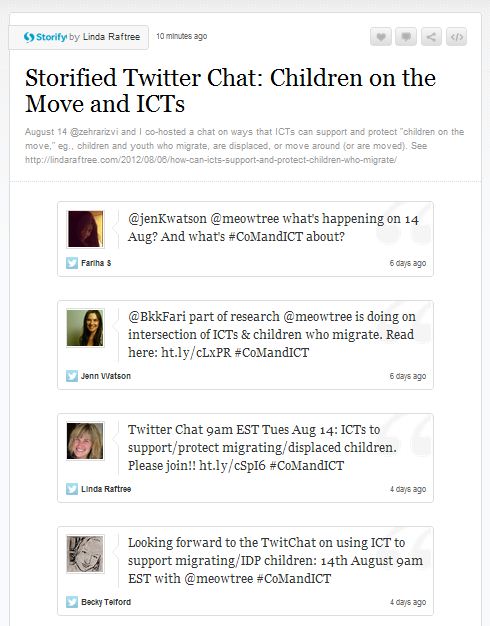
On August 14, @zehrarizvi and I co-hosted a Twitter chat on ways that ICTs can support and protect “children on the move,” eg., children and youth who migrate, are displaced, or move around (or are moved). Background information on the issue and the research.

We discovered some new angles on the topic and some resources and studies that are out or will be coming out soon, for example an upcoming Girls Count study on Girls on the Move by Population Council, a UNHCR paper on ICTs and urban refugee protection in Cairo, and Amnesty’s Technology, People and Solutions work.

Thanks to everyone who participated – whether you were actively tweeting or just observing. We hope it was as useful to you all as it was to us! If you think of anything new to add, please tweet it using #CoMandICT or email me at linda.raftree [at] planusa.org.

Read the Storify version here (with a bonus picture of @chrisalbon holding up a ‘burner’ phone). Don’t know what a ‘burner’ phone is? Click and take a look.

Read Full Post »

On Tuesday, August 14@zehrarizvi and I will be hosting a Twitter Chat on the topic of new technologies and ‘children on the move.’

As I wrote in an earlier post, I’m working on some research at Plan International USA, funded by Oak Foundation. The research aims to compile a ‘State of the Practice’ report that will include examples and case studies of current ICT use by, with, among and for ‘children on the move’; applicable cases and lessons learned from other sectors; gaps, challenges, areas where ICTs may pose new or additional risk; and remaining questions and challenges for future exploration and collaboration.

In talking about this research with Zehra (who is working at the Women’s Refugee Commission on a project related to the empowerment and protection of displaced adolescent girls, also supported by Oak) we realized we are both quite interested in exploring the role of new ICTs in supporting and protecting children who are migrating, displaced or otherwise ‘on the move’. So we decided to collaborate on the Twitter chat.

We’re hoping to gather ideas and perspectives from people working in the areas of migration, working children, displacement, child protection, conflict settings, environmental migration, diaspora communities, ICTs and other related areas.

Please join us on Tuesday, August 14 from 9-10.30 EST. The hashtag will be #CoMandICT.

We will cover 4 key questions in this first chat:

  • Which organizations are working in the area of child migration or ‘children on the move’ and what are they doing?
  • Are new technologies involved? If so, how? If not, why not?
  • Are there existing youth networks that could provide insight into how new technologies are used by children/youth on the move?
  • What else should we know about? What are we missing in our thinking about this project? Who should we talk with?

Tips for a good Twitter Chat:

  • Login 5 mins ahead of time and be ready with a short introduction (eg, “Joe Garcia here, child protection at XYZ in Malawi, managing cross-border project w working children” or “Cathy Kramer, ICT specialist working on mobile data privacy issues at TechTechTechieFirm”).
  • Tools like TweetChat which automatically add the hashtag and refresh often are helpful to keep up with the conversation.

We look forward to chatting on Tuesday August 14th at 9 am EST and welcome any questions or comments before then!

Read Full Post »

The use of social media and new technologies in disaster and crisis situations will likely be framed forevermore as ‘Before Haiti’ (BH) and ‘After Haiti’ (AH). The terrible earthquakes that devastated the country and the resulting flood of humanitarian interventions that followed mark the moment that the world woke up to the role that new technology and new media can and do play in the immediate local response to a crisis as well as the ongoing emergency response once international volunteers and aid organizations arrive to the scene.

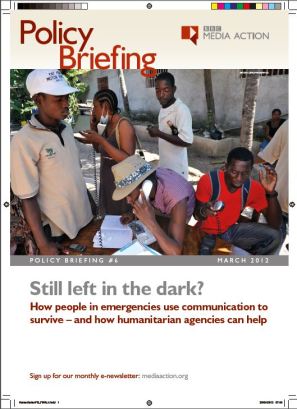
Still left in the dark? How people in emergencies use communication to survive — and how humanitarian agencies can help,’ is a new policy briefing by BBC Media Action. It does a fantastic job of highlighting the ways that new media is changing disaster response and the fact that the humanitarian industry is not doing enough to keep pace.

The briefing asks: ‘Are humanitarian agencies prepared to respond to, help and engage with those who are communicating with them and who demand better information?’ As the report shows, the answer is ‘not really’.

Many humanitarian agencies continue to see ‘communication’ as something done to raise money or boost the profile of their own efforts, says the report. Yet the sector increasingly needs a clear, strategic focus that responds to the information and communication needs of disaster-affected populations. ‘While responders tend to see communication as a process either of delivering information (‘messaging’) or extracting it, disaster survivors seem to see the ability to communicate and the process of communication itself as every bit as important as the information delivered.’ Communicating with affected populations can improve programming and response, not to mention, as highlighted in the Listening Project and referred to in the BBC report, ‘Listening is seen as an act of respect.’

The briefing is not one-sided, however, and it does a good job of understanding some of the common perceptions around the use of new technologies. There is ICT and social media hype on the one hand (often the position of international ICT specialists, based on very little hard evidence). And there is strong questioning of the value of these tools at all on the other hand (often the position of aid workers who are turned off by the hype and want to see proven practice if they are to consider investing time and resources in new ICTs). The briefing paper provides examples that may serve to convince those who are still unconvinced or uninterested.

Many of us see the reality that social media tools are still quite out of reach of the poorest members of a community or country. But writing new media and technologies off entirely is ‘too crude an analysis,’ says the briefing paper, ‘and one that is being challenged by data from the field.’ In Thailand, for example, use of social media increased by 20 percent in both metropolitan and rural areas when the 2010 floods began. ‘Communities now expect — and demand — interaction,’ the paper emphasizes.

Throughout the paper there are good examples of ways that in the immediate aftermath of a disaster local individuals and companies are quickly creating and rolling out communication platforms that are more relevant, feasible and sustainable than some of the initiatives that have been led by international agencies.

An important point that the report makes is that the most successful use of new media in disaster response combines multiple communication channels — new and old — allowing information to flow in and out, to and from different populations with different media habits and levels of access. For example, local journalists and radio stations may pull information from Twitter and Facebook and broadcast it via the radio. They may also be broadcasting online, meaning that they not only reach their local population, but they also reach the diaspora community. ‘Good communication work,’ the paper notes, ‘is, by definition, multi-platform. It is about integrating media, non mass media and technology tools in a manner that is rooted firmly in an understanding of how communities approach information issues.’

So ‘while aid agencies hesitate, local communities are using communications technology to reshape the way they prepare for and respond to emergencies.’ This hesitation remains in the face of growing evidence, according to the paper, that agencies who invest in meaningful communication with disaster-affected communities garner a range of benefits. ‘The communication process becomes central to effective relationships, mitigating conflict and identifying and preventing rumours and misunderstandings.’ Doing it right, however requires good program design, which in turn, requires aid agencies to focus time and expertise on improving communications with affected populations, which, of course, requires budget allocated to these kinds of activities.

For those agencies that want to look more closely at integrating some of these tools and approaches, the report gives several great examples. The recommendations section is also very useful.

One of the recommendations I think it is especially good to highlight is ‘analyse the communications landscape’ (see InfoAsAid’s materials). I would, however, have liked to see mention of involving members of local communities in a participatory analysis of that landscape. In addition to the technical analysis, it’s important to know who trusts which information sources, and why. For example, the information sources trusted by men may be different than those that women trust. The same goes for children, youth and adolescents. Access is also a critical issue here, especially in terms of reaching more marginalized groups, as the population affected by a disaster is not homogeneous and there will be hierarchies and nuances that should be considered in order to avoid leaving certain people or groups out. I would have liked more mention of the need to take a specialized approach and make a focused effort regarding communication with children and adolescents, with women, with certain ethnic groups or persons with disability, as they may be left out if care is not taken to include them.

Another recommendation I found very useful was ‘think of the whole population, not just beneficiaries.’ The paper cautions that working only with the population that directly benefits from an individual agencies’ funding is a positive angle for transparency and accountability, but it ‘seems to have a profoundly limiting effect in practice.’ Beneficiaries need information about more than just one aid agency, and those who are not benefiting from a particular agency’s programs also have information needs.

The report mentions that sometimes in the aftermath of a disaster, when people use new media to communicate, confidentiality and privacy risks are not fully considered. I’d like to see this aspect addressed a bit more in the future as there is a lack of documented good practice around privacy and protection. (Note: I’ll be involved in some research on ICTs, migration and child protection over the next year, so watch this space if it’s a topic of interest.) Humanitarian agencies may have strong policies here, but this is an area that others may not consider in their rush to offer support following a disaster.

Overall the report is extremely useful for those considering how to improve two-way (or multi-way) communication in a post-disaster situation and I very much enjoyed reading it as it sparked learning and fresh ideas, and documented some good work being done by local as well as international groups.

I don’t have a lot of pity or patience for aid agencies who are ‘left behind’ because they refuse to move with the changing times or because their approaches are not effective or relevant. There are several forces that are ‘disrupting’ humanitarian work these days, and  the report does a great job of identifying some of them. It also highlights the importance of local actors, local private sector and diaspora communities who have always played an important role in aid and development but have only recently been given more recognition.

International agencies still play a critical role in the humanitarian space, but they need to understand and adapt to the changes happening around them. This report can serve as a discussion piece and offer guidance for those agencies who want to use new media and technology to enable them to do a better job of listening to, working with and being accountable to disaster affected populations.

In summary, highly recommended reading!

Read Full Post »

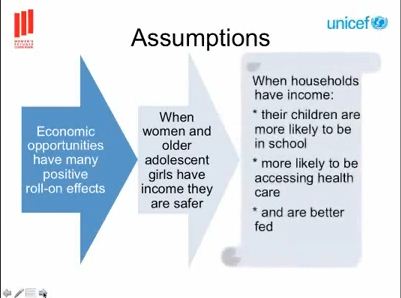
When working with women and girls in conflict or displacement situations (actually, when working with anyone, in any situation), we often make assumptions. In this case, the assumption is that “economic opportunities for women and adolescent girls have positive roll-on effects”, according to Mendy Marsh, UNICEF’s Gender Based Violence (GBV) Specialist in Emergencies.

Slide from Marsh’s presentation.

We assume that when women and older adolescent girls have income, they are safer. We assume that when households have income, children are more likely to be in school, that they are accessing healthcare, and that they are better fed, says Marsh.

But do we know whether that is true or not? What does the evidence say?

I took an hour today to listen to Marsh along with Dale Buscher, Senior Director for Programs at the Women’s Refugee Commission (WRC), talk about WRC’s “Peril or Protection: Making Work Safe” Campaign (watch the recording here).

GBV happens in all communities, including stable ones. But when situations become unstable, Marsh noted, a number of additional factors combine to make women and adolescent girls in conflict or displacement settings vulnerable to violence.

Slide from Marsh’s presentation.

These factors include:

  • Inadequate legal frameworks –eg., impunity for those committing GBV and a lack of awareness of rights
  • Lack of basic survival needs  — eg., food, non-food items, fuel, water, safe shelter
  • Lack of opportunities – eg., women’s and girls’ financial dependence, potential for exploitative work
  • Sociocultural aspects – eg., harmful practices, domestic violence, early and forced marriage
  • Insecurity – eg., flight and displacement, no lighting, no safe shelter, non-separate latrines or hygiene facilities for men, women, boys and girls, or facilities that don’t lock or are insecure; dependency on males for information

Emphasis during conflict situations tends to focus on response not prevention, said Marsh. Different agencies and sectors often work in isolation, but no single agency or sector can address GBV. It needs to be addressed across all sectors with strong community participation, including that of men and boys.

Often, she noted, livelihoods programs are brought in as a response to women’s needs and based on the assumptions above. There can be unintended negative effects from these programs and we need to be aware of them so that they can be mitigated.

Following Marsh’s introduction, Busher explained that because WRC wanted to better understand any potential unintended consequences from livelihoods programs aimed at women in conflict or displacement situations, in 2009 they conducted research and produced “Peril or Protection: The Link between Livelihoods and Gender-Baed Violence in Displacement Settings.

There is a very weak evidence base in terms of the links between gender based violence and livelihoods programming, he said.

WRC found that in some cases livelihood programs implemented by NGOs actually increased women’s and adolescent girls’ risks of GBV because of factors such as their entering the public sphere, going to market, using unsafe transportation and domestic conflict. The economic opportunities heightened the risks that women and girls faced. Providing them with income generation opportunities did not necessarily make women and girls safer or give them more control over resources.

Slide from Buscher’s presentation.

The answer is not to stop creating economic opportunities, however. Rather it is to design and implement these kinds of programs in responsible ways that do no harm and that are based on in-depth consultations with women, girls and their communities, livelihoods practitioners and GBV specialists.

Based on their research and with input from different stakeholders, WRC designed a toolkit to help those creating livelihoods programs for and with women and adolescent girls to do so in a way that lessens the risk of GBV.

The process outlined in the toolkit includes secondary research, safety mapping, a safety tool, and a decision chart.

Based on the secondary research, practitioners work with adolescent girls, women and the wider community to map the places that are important for livelihoods, explained Buscher. For example, the bus, a taxi stand, a supply shop, the fields.

Community members discuss where women and girls are safe and where they are not. They describe the kinds of violence and abuse that girls and women experience in these different places.

They identify strategies for protection based on when GBV takes place in the different locations. For example, does it happen year-round? At certain times of year? Only at night? Only on weekends?

They identify and discuss the most risky situations. Is a girl or woman most at risk when she is selling by the side of the road? Alone in a shop?

They also discuss which relationships are the most prone to GBV. Bosses? Suppliers? Buyers? Intimate Partners? Together the women and girls share and discuss the strategies that they use to protect themselves.

An additional tool identifies the social safety net that a women or adolescent girl has, considering that social networks are important both for livelihoods as well as for protection. Ways to strengthen them are discussed.

Finally, a decision chart is created with a list of livelihood activities and the information from the previous charts and discussions to determine the levels of risk in the different kinds of livelihood activities and the potential strategies for mitigating GBV.

Decisions are also made by the adolescent girls and women regarding which risks they are willing to take for which levels of livelihoods.

Marsh and Buscher concluded that safe, dignified work may be the most effective form of protection because it can help mitigate negative coping strategies such as transactional sex, child labor, pulling children out of school, and selling rations.

Livelihoods, however, should not be thought of as a little bit of money to supplement daily rations. They should be sustainable and help meet basic needs in an ongoing way; and they should lead to dignified work. The amount earned and the risks involved for women and girls need to be worth it for them, considering all the other domestic chores that they are required to do. NGOs need to consult with and listen to girls and women to better understand their needs, coping strategies.

If you’d like to learn more about the research, and the toolkit, WRC offers a free e-learning tool on how to make work safe.

You can also follow the #safelivelihoods conversation on twitter.

Read Full Post »

This is a guest post by Roland Berehoudougou, disaster risk manager for Plan International’s West Africa Region. He explains the numerous factors that came together and conspired against the people of the Sahel, transforming the lean season into an emergency. 
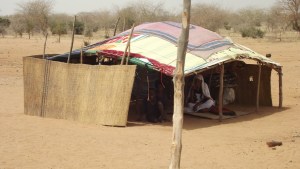
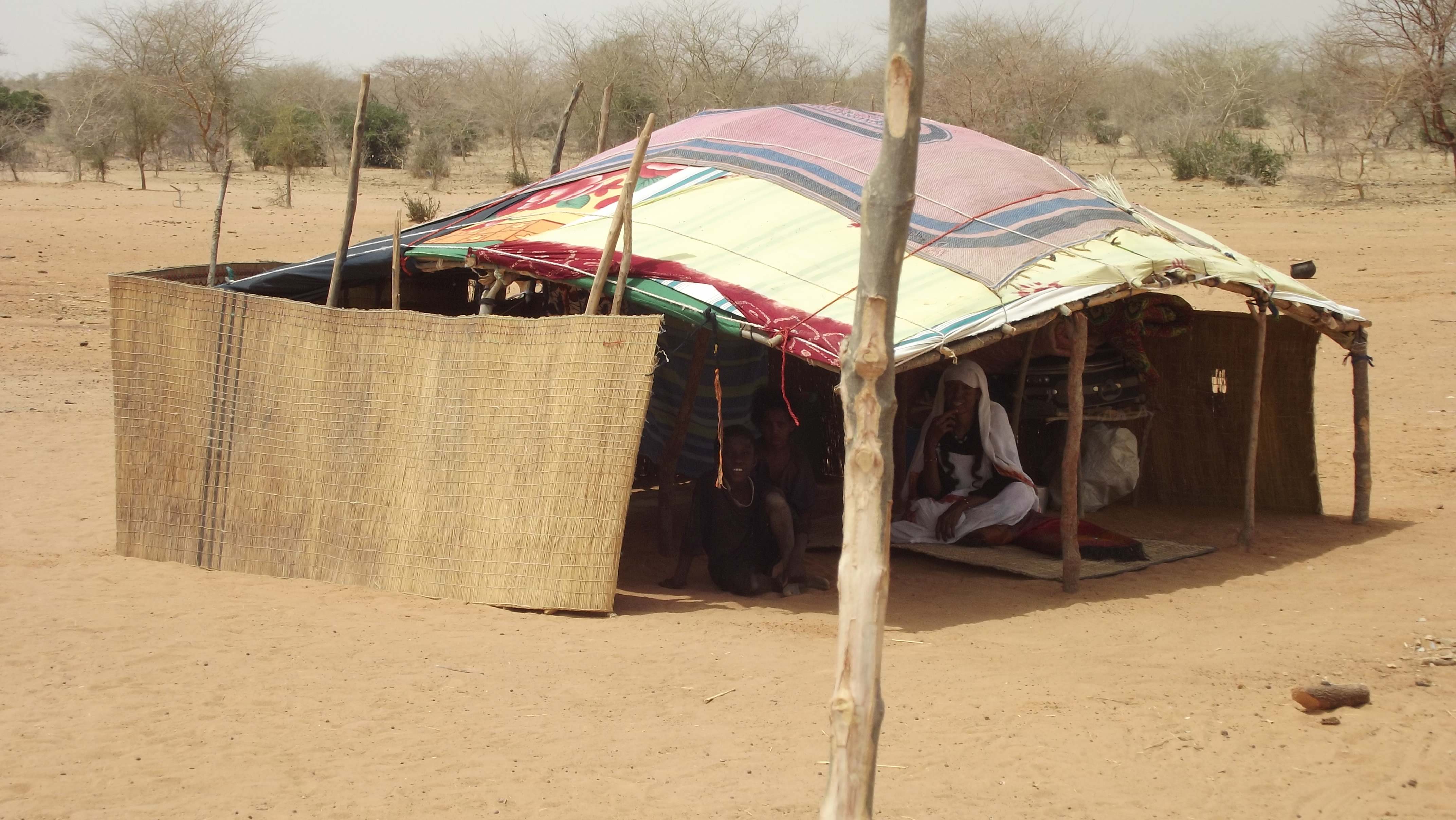
Photo: Roland Berehoudougou.

When Plan International and other aid agencies sounded the alarm bells and appealed for public assistance to finance an emergency response to the Sahel Food Crisis, there were those sceptics who saw this crisis as an annual chronic food shortage which was being exploited by aid agencies to raise money.

Those skeptics were wrong.

So what is an emergency? What is a food crisis? What is involved in declaring an emergency or pronouncing a situation to be a “food crisis”? A number of issues are taken into consideration including forecast about the availability, cost of food, environmental factors and other internal and external factors which are discussed below.

The Sahel Food Crisis is the result of a complex emergency in which these factors have come together to create this food and nutritional crisis. In fact, had these not occurred then there would be no food crisis, no emergency, and no fundraising appeals.

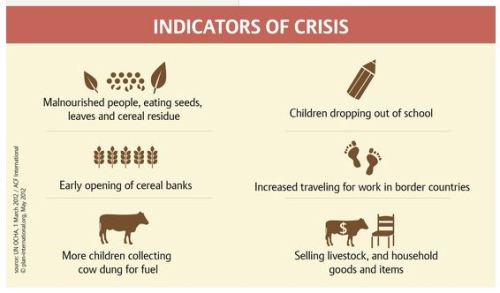
Captured from Plan International’s Pinterest. http://pinterest.com/pin/64809682107912974/

Drought causes conflict
In the last three to five years, the people in the Sahel have been confronted with either lower than average rain, normal rainfall or excessive rainfall causing floods. As a result harvest levels have been good in some places and poor in others.

In countries of poor harvests, farmers and their families have been coping using straightforward approaches of cutting back on their expenses. In the Sahel, families sold their livestock; others sold their furniture and other possessions. After three consecutive years, their assets have been depleted and men, women and children have been looking for work to supplement household incomes.

The conflicts in Cote d’Ivoire, the Maghreb, and Libya meant that more than 200,000 migrant workers from the Sahel had to flee those countries and return home. Given the average size of families in the Sahel, about 7-12 members per family, two million people suddenly became affected and had reduced incomes.

In addition, the Malian refugees which poured over the borders into neighbouring countries are an additional stress on food insecure areas. For every one refugee, there are five animals. So if you consider 375,000 animals coming over with 75,000 refugees, for example, those animals can dry up a water-scarce irrigation dam in just few days. Yet, cattle are a lifeline and in a food crisis, they cannot be forgotten.

In addition to depriving people of a considerable source of income, the drought in the Sahel is a source of conflict. Shepherds, for example, who are forced to take their animals southward in search of pasture, come into conflict with farmers.

Cultural differences
People in the Sahel eat a different staple to what is grown outside the region and this has implications during a food crisis. Let’s take a scenario where countries on the west coast, such as Liberia or Cote d’Ivoire, may have enough food to export. However, it is not the type of food that people in the Sahel eat and they therefore won’t import it. Instead they import from one another at prevailing market rates which has a knock-on effect on availability and cost.

Market forces – influenced by global factors – dictate price. There is a common market across West Africa where traders move and sell freely. When Nigeria is buying, WFP is buying, other NGOs are buying the price increases. If you look at food prices you will see that prices this year compared to the same period last year is more than 100% in Mali, more than 70% in Burkina 42% in Niger.

So, as an NGO, Plan International had to change its strategy and approach our donors for permission to do cash-for-work or food-for-work programmes rather than waiting to do food distribution programmes after the food stock is totally depleted.

A food crisis may, therefore, not necessarily mean a shortage of food but rather the inability of a people to afford to buy the food.

Arab Spring
In addition to the complications of prolonged inconsistent harvest levels, market forces, and inflow of refugees and their livestock, the situation has become complicated by the rise of desert locusts this year.

The breeding grounds of locusts are in the border areas of Libya and Algeria. When the Gadaffi government was in office, they provided a lot of money for insect control in locust breeding grounds but since the Arab Spring and events following it the finance for the pest control has dried up. The continuing insecurity on these borders also prevents pest control activities. We are now seeing a different impact of the Arab Spring spilling into the Sahel in the form of locust swarms.

The UN Food and Agricultural Organisation (FAO) which monitors locust movement say that swarms have been sighted in northern Niger. If these swarms come southward through the agricultural belt farmers will experience yet another problem. When these clouds of locusts descend on newly planted fields, they can devour acres of crops and trees in just 30 minutes. The locust swarms have also been sighted in northern Mali but because of the insecurity, no one can go there to control the pests.

NGOs do not do pest control as it is a very costly exercise involving planes and other equipment which we do not have. This role falls to specialised agencies such as FAO and governments. This is a looming disaster.

Road to hell
To cope with the food crisis, children have left school and have taken to the road to find work to help their parents. Some girls are working as domestic help in homes, other are begging on the streets, and boys are finding work in traditional gold mining in Burkina and Niger. A number of serious hazards face these children including respiratory problems from inhalation of dust and exposure to mercury, arsenic and other chemicals used in the process.

Many children who go to work on plantations, in cotton fields and other types of farming also face risks of exploitation and potential trafficking.

Finding solutions
At Plan we are trying to address the food insecurity, in the areas we work, in a holistic way.

We are providing drought-resistant seeds, supporting the government to train farmers in drought-season activities and supporting the 3N programme (“Niger Nourish Nigeriens”). One of its principal objectives is reducing dependence on climate through irrigation and rain water collection projects.

Plan, whose core work is Child Centred Community Development (CCCD), is also empowering communities to get involved in the cereal market and beat speculators at their own game by creating community-managed cereal banks. After a harvest the price of cereal drops and farmers are forced to sell their crops at low prices to meet the schooling cost for their children and other social costs. Speculators buy the cereal and store it until food shortages kick-in around mid-year and then release the cereal at high market prices.

Plan-supported communities are doing the same thing – except that they sell at a lower price to members of their village. The income generated is used to increase the storage capacity of the cereal bank and support social infrastructures in the village such as building facilities like medical centres and schools.

We are also implementing micro-finance project for women and youth using the VSLA strategy (www.vsla.net). We have discovered that if we provide economic empowerment for women then there is a trickle down effecting benefiting children who will receive balance meals, medical care and an education. We are seeing improvements in the quality of life for families in our programme areas.

Using this approach, many villages are now being lifted out of poverty and Plan is replicating this in other areas in which we are working.

No handouts
When Plan appealed to developing nations for assistance for the Sahel Food Crisis, it was not to address an annual chronic food shortage. It was to address a complex emergency that has stretched an already stressed situation to its breaking point which in turn has put four million children at risk of malnutrition.

No one is ever happy about being in a situation to ask for help to feed their families.

Plan is using aid money in such a way so as to prevent dependency on long-term aid. The United Nations agencies of OCHA and UNDP have demonstrated that for a dollar of foreign aid spent on preventing disasters saves an average of seven dollars in humanitarian disaster response.

At Plan we are seeking to empower and support the people living the Sahel to get out of the situation themselves. We are in it for the long haul. We are working hard to make ourselves and our work redundant and build resilience in the Sahel and hope. None of this is possible without the support of governments and people from the rest of the world.

Read Full Post »
In the INGO sector, we often discuss ways that development organizations can better bridge development and ICTs. If you ask me, this video shows one of the best ways to achieve it: Hire people like David.

Hire young, local folks who have spent time in communities, who understand local realities, who are passionate about helping make things better, and who are hungry to do new things that make sense. Hire people who are humble; people who listen and who ask questions when they don’t know the answer.

Hire people who are curious, who seek out information, who are self starters, and who are not afraid to work hard, to try, to take risks and to fail. Hire people with creative fire who know how to work in a team, how to collaborate with others and how to learn from those around them. Hire young people who use and understand new technologies and who spend enough time out of the office to know how they can realistically be applied to development issues in difficult settings.

Hire people like David.

But don’t only hire them.

Once you hire them, make sure that they have the conditions to thrive and achieve to their fullest.

Make sure people like David have access to opportunities. Make sure that they get to attend regional and global internal and external meetings to share what they know, to learn, and to make contacts and connections.

Notice people like David. Reward them, honor them, and congratulate them regularly, even if they are too busy getting the job done to spend lots of time on self-promotion or office politics.

Make sure people like David have mentors and managers who can take roadblocks out of their way. Listen to them. Respect them. Question them, yes, but do so with the honest belief that they have the capacity to come up with ideas that can work even if they are not the ideas you would have come up with. Don’t feel threatened by people like David when they know more than you do about something. We can all learn from each other if the space for dialogue is open and sincere.

People like David are the present and future of development efforts.

People like David are the reason I have a hard time giving career advice to folks in the US who are looking for jobs overseas. I’d rather see people like David in these positions.

David recently won the “Most Promising Newcomer” award for the Americas region during Plan International’s Global Awards. Follow David at @2drodriguez and learn more about what he’s up to at the website Mis Derechos Ante Desastres (My Rights in the Face of a Disaster), the project Facebook page, or at @deantede.

**Version Español

Read Full Post »

Image captured from page 19 of the Polis report.

Who cares? Challenges and opportunities in communicating distant suffering: a view from the development and humanitarian sector, a study conducted by Polis, (the journalism think-tank within the Department of Media and Communications at the London School of Economics- LSE) with Plan UKlaunched yesterday in London.
.
The study complements several pieces of research released over the past year or two on the UK public’s perception of foreign aid, development, giving, and the NGO sector; including Intermedia’s Building Support for International Development, the UK Public Opinion Monitor/Institute of Development Studies’ What Does the Public Think, Know and Do about Aid and Development? report, the Oxfam/Bond/DfID Finding Frames report and the Overseas Development Institute’s Understanding Public Attitudes to Aid and Development.

Whereas the other reports focus on various aspects of how the public sees charity, development and foreign aid, the Polis report gives a window into the debates and challenges of those working in advocacy, marketing, campaigning, fundraising and communication departments at INGOs. As my Plan UK colleague, Leigh Daynes, writes in the introduction:

‘…Our work to inform, to educate, to campaign for change and to recruit long-term supporters to fund change is valid. Often it is life-saving. Yet the least understood area of our work often is the impact of our communications on public understanding of and support for aid and development. The public are telling us they are saturated with suffering, that we are charming or disarming them into acts of compassion, and that we are abusing their emotions….

…Understanding the impact of the “lingua franca” of our industry matters because it has fuelled a template approach to the media reporting of suffering. It matters because the exponential growth in access to mobile and social media technology and platforms means we are no longer the de facto guardians we once were. And it matters because it speaks to the power between us and them, and you and me.’

As more and more research is done, the ways that the sector is shifting become clearer and I hope we will start to see some positive changes in the aid and development industry and the way it communicates with the general public.

Some angles and voices that could help round out the discussion are still missing, however. I would like to see research on the opinions of local and international staff managing programs on the ground. Most organizations have fierce internal discussions on how marketing and fundraising is done, as program staff often feel that some marketing and fundraising approaches are demeaning, disrespectful and undignified in their portrayal of program participants.  (For more on this, ask Talesfromthhood to share some of his blog posts with you, join some of the discussions on AidSource, or follow the #smartaid hash tag on Twitter). Some program staff worry that the long-term impact of media and fundraising shock tactics and overly simplistic messaging ‘cancels out’ the short-term gains achieved through program or emergency aid funding – a point that is raised in some of the research above – and that this contributes to two-dimensional views on aid and development and to the negative stereotypes about certain countries in Africa, Latin America and Asia that deter longer-term development and self-determination. It would be interesting to know more from this perspective.

What do donors want? Image captured from page 9 of the report.

At the same time, INGOs are hard-pressed to come up with different and viable ways of funding their work, so this type of campaigning and fundraising continues. Although I’m familiar with some of the challenges my marketing colleagues face, I was struck seeing the kinds of donor demands that INGOs are expected to meet listed in the report. I was reminded of something a marketing colleague once said: ‘Poverty porn. That’s a good term. It is a lot like real porn. People don’t like to publicly admit to watching and responding to it, but in private it’s another story. People say they don’t like poverty porn and sad, desperate stories, but when you look at the numbers, it’s what makes them reach into their pockets and give.’

I would also like to see some research with the subjects (unfortunately often presented as ‘objects’) of INGO aid and marketing materials.  How do program participants feel about how they are portrayed? What impact does it have on them and their own perspectives and self-determination, if any? Strong voices on this come from diaspora communities and from blogs such as Africa is a Country, Uganda 2012: Trending Our Own Stories, and great projects like My Africa Is; but I’d also like to see some in-depth research and objective focus groups that talk with those who are most often shown in INGO marketing. Are people aware of how they are being represented? Do they care? Many of us speculate about this when we bash ‘poverty porn’ but I’ve yet to see published research that involves actual ‘beneficiaries’ of INGO programs or people and communities appearing in INGO marketing and fundraising pieces in this discussion. (Maybe I’ve missed it – if you know of  any, please share!)

The ‘Who Cares’ report notes in the conclusion that:

  • transparency, accountability, ‘value for money,’ and impact are becoming more important to the donor public
  • public trust is a central concern for NGOs in their work and their communications
  • the sector needs to assume more collective responsibility for ethically appropriate portrayal of disaster victims (eg, in compliance with Article 10 of the Red Cross Red Crescent Code of Conduct)
  • new technologies and competition mean that fundraisers are seeking supporters outside of their traditional constituencies
  • traditional gatekeepers of aid are being challenged by new media’s ability to put donors and ‘beneficiaries’ in more direct contact

As INGO institutional leadership space opens up to more people from ‘the global South’, diaspora communities grow, social media allows for commercials and fundraising appeals to reach global audiences (including people in the countries where INGOs implement their programs), attention is paid to the ‘new bottom billion‘ and new fundraising mechanisms arise (for example, INGOs raising funds within countries where they are implementing programs), it will be interesting to see how the conversations and approaches shift and change — or if they remain the same with new actors taking on the same challenges.

Stay tuned for further research and reporting over the next couple of years from Polis and download the report here.

Read Full Post »

The Technology Salon* hosted at IREX on Thursday, June 6, focused on what the International Aid Transparency Initiative (IATI) would mean for international development, especially for US-based NGOs and government contractors.

Tony Pipa, Deputy Assistant Administrator, Policy, Planning and Learning at USAID, started the Salon off by noting that IATI is an inter-agency US government commitment, not only a USAID commitment. USAID is the lead agency for developing the IATI implementation plan, building on existing agreements on transparency, enhancing the US Government’s commitments to transparency, openness and accountability. A key element of these efforts is the Foreign Assistance Dashboard which places the data into the public realm in a user friendly way, making it easier to understand visually and also more accessible and easy to find. The goal is not only transparency, but greater accountability. The US Government hopes to streamline reporting requirements, meeting multiple requirements for a range of international and national reporting standards. The goal for USAID is making aid more useful for development.

Steve Davenport from AidData followed, giving some background on IATI itself. IATI was initially sponsored largely by DFID, but has since grown as a partnership. Over 75% of development assistance is represented by signatories to IATI now. Eight donors are now publishing and twenty-three developing countries have signed on (involving partner countries at the local level as well). Different groups are conducting pilots to see how to implement as IATI gains more traction. For this reason, it would be a good move for US INGOs and contractors to get in front of the transparency and accountability curve rather than get hit by the wave. Better transparency allows organizations to better show their results. The IATI standard can lead to better coordination among the different actors, making it easier to broaden our collective impact. This is especially important now given that aid budgets are being reduced. IATI can be thought of as a group of people, a set of commitments, and an XML standard for moving data from point a to point b. Application developers are beginning to pick this up and develop tools that allow for new ways of visualizing the data, making it actionable and improving accessibility, which can lead to better accountability.

Larry Nowels (Consultant at Hewlett, ONE campaignspoke about Hewlett experience with IATI. Hewlett has made a large investment in transparency and accountability, supporting US and European organizations as well as startups in Africa and Asia over the past 10 years. Transparency is a key building block, so that governments and their citizens know what is being spent, where and on what, and how to make better decisions about resources and reducing waste. It also allows citizens to hold their governments accountable. Hewlett was one of the original signatories and the second publisher to the IATI standard. A key question remains: What’s in it for an organization that publishes according to the standard? For some teams, IATI makes all the sense in the world, but for others it seems to be a waste of resources. The Obama Administration (Open Government Directive, Open Government Partnership, Foreign Assistance Dashboard), all show a strong commitment to transparency. The tough part is implementation of IATI standards and details are still being worked out to find an ideal way.

Larry considers a central repository ideal, but there are issues with quality control and the Foreign Assistance Dashboard does not add data that was not already publicly available. In addition, many US Government agencies have not been added to the Dashboard yet, and getting them on board will be difficult if they are less dedicated than USAID or State. It’s critical to institutionalize IATI and related initiatives and internalize them, given that we cannot assume Obama’s will be a multi-term presidency. In the past 3 years, a number of bills around the theme of accountability and transparency have been introduced by both parties. The Poe-Berman Bill (HR 3159) provides a law to entrench the use of tools like the Dashboard. The Administration, especially the State Department, however, has not engaged Congress enough on these issues, and this has led to some roadblocks. White House pressure could help strengthen support for this initiative; however, there may be pushback by Republicans who generally oppose the US subscribing to international standards.

Discussion**

What is the overlap between the Open Government Partnership (OGP) and IATI?

What is the practical, on-the-ground use or application of IATI data? What does it look like when it is working how it should? What would it ideally look like 5 years from now?

  • There is enormous need for data sharing in a crisis – it is essential for coordinating and understanding the unfolding situations in real-time in order to save lives. There is much more scrutiny as well as a need for rapid coordination and response during a humanitarian crisis, so it requires a higher level of transparency than development work. One way that has been suggested for getting more organizations on board is to start sharing more information during crises and draw the lessons over to development.
  • A project in Mexico City has run investigative campaigns on spending. This has led to the prosecution and resignations of political figures and even some threats against staff, which demonstrates how unsettling this open information can be to the powers that be. It is not about transparency for transparency’s sake. It’s about having a tool that can be used to inform, interpret situations and hold governments and donors accountable. It opens the system up for sharing information.
  • Currently this type of information isn’t available to Country Governments for coordination. Countries need to plan their fiscal year budgets, but rely heavily on donors, and both run on a different fiscal calendar. If donor information were more readily available, countries could plan better.
  • On a 5-year horizon, we would ideally see aid tracking down to the beneficiary level. Tools like IATI can help collect data in more automated ways. Open data can help us track both where funding is allocated and also what is actually being implemented. Additional work is needed on this side; for example, training journalists to understand how to use this data, how to access it – handing them a data file isn’t a very useful thing in and of itself.

That’s great, but great for whom? What does it mean? Does this lead to better aid? Better spending? And what if it creates unrealistic timelines, where development becomes more like a for-profit company that must demonstrate impact within a fiscal quarter? We all know that development initiatives and impact take much longer than three months. Will IATI mean that we will stop doing things that take longer? Things that cannot be checked off on a checkbox? Will we actually lower the quality of our programs by doing this?

  • IATI, like any form of transparency, is only one element of a whole stream of things. The new USAID monitoring and evaluation system is a breakthrough for actually learning from evaluations and data. It’s a longer-term investment than Congress is used to, so it’s a matter of convincing Congress that it is worth the value. There is a better chance of USAID admitting failure in the future if the systems are in place to demonstrate these failures in hard data and learn from them. It’s about discovering why we failed – if we spend money and it doesn’t work, we can at least then identify weaknesses and build on them. Showing failures also demonstrates credibility and a willingness to move forward positively.
  • We can err on the side of openness and transparency and engage congress and the public, making a distinction between performance management and the long-term impact of development projects. There is no way of holding back on publishing information until it is in a format that will be readily understandable to congress and the public. This is a reality that we are going to have to live with; we have to put the data out and build on it. This can help to start important conversations. IATI is important for closing the loop, not just on public resources but also private resources (which is why Hewlett’s commitment is important). As private development resources increase, USAID becomes less dominant in the development landscape. Making sure data from many sources comes in a common format will make it easy to compare, and bring this data together to help understand what it going on. The way to visualize and think of it now is different because we are still in early days. IATI will begin to change the approach for how you evaluate impact.
  • IATI data itself does not tell the whole story, so it’s important to look at additional sources of information beyond it. IATI is only one part of the monitoring and evaluation effort, only one part of the transparency and accountability effort.

How do you overcome conflicts of interest? If development outcomes or data that is opened are not in the interest of the country government, how do we know the data can be trusted, or how does it feed back to the public in each country?

  • China’s investment in Africa, for example, may make it more difficult to understand aid flows in some ways. It will take a while to enforce the standards, particularly if it is done quickly, but we can draw the BRICs into the conversation and we are working with them on these topics.

The hard part is the implementation. So what are the time lines? How soon do we think we will see the US publish data to IATI?

  • At this time, the US Government hasn’t created an implementation timeline, so the first order of business is to get IATI institutionalized, and not to rush on this. It’s a larger issue than just USAID, so it must be done carefully and tactfully so it stays in place over the long term. USAID is working on getting data on the Dashboard to get the Obligation of Spending data up and project level data up. USAID is trying to balance this with consistency and quality control. How do you produce quality data when you are publishing regularly? These issues must be addressed while the systems are being developed. Once USAID puts data on the Dashboard, it will begin being converted to IATI data

IATI is still a donor-led initiative. NGOs involvement opens this data up to use by communities. Training individuals to use this information is not necessarily sufficient. Are there plans to build institutions or civil society organizations to support the data to be useful for communities and the general public?

  • The data can assist with the development of watchdog organizations who provide a platform for citizens to act together for accountability. Examples of organizations that are currently receiving funding to do this are Sodnet and Twaweza. There has also been support to think tanks throughout Africa to build the capacity of objective, independent policy analysts who write critiques of government initiatives.
  • There is a definite need to mainstream IATI and bring everyone together into one single conversation instead of setting up parallel structures.

So how do you build these institutions, watchdogs, etc? Will USAID really put out RFPs that offer funding to train people to criticize them?

  • This is where Hewlett and other organizations come in. They can run these trainings and build capacities. The Knight News Challenge is doing a lot of work around data-driven journalism, for example.

This is going to put a lot of pressure on people to be more efficient and might drive down resources in these spheres. There is a limited amount of incentive for organizations to involve themselves. Is there a way to incentivize it?

  • It will also drive some internal efficiencies, creating greater internal coherence within development organizations. It’s very hard to pinpoint impact within organizations because there isn’t an easy way to draw comparisons between projects, implementation strategies, etc. People always worry: What if we find something that makes us look bad? So IATI is just one part of a bigger effort to push for commitment to transparency across the board. Committing to IATI can lead to a mindset which focuses organizations on efficiency, transparency and accountability.
  • Filling out the Dashboard will be helpful in many respects, and it will make information more accessible to the general public, as well as congressional staffers, etc. It can serve multiple constituencies while making data more usable and transparent. USAID is going to be as aggressive as possible to get information on the dashboard into IATI format. There has not been a conversation about requiring implementing partners to meet IATI standards, but USAID itself is committed.

***

Thanks to IREX for hosting the Salon, our fantastic lead discussants and participants for stimulating discussion, Wayan Vota for inviting me to coordinate the Salon and Anna Shaw for sharing her Salon notes which were the basis for this blog post.

Sign up here if you’d like to be on the invitation list for future Salons.

*The Technology Salon is sponsored Inveneo in collaboration with IREX, Plan International USA, Jhpiego and ARM.

**The Salon runs by Chatham House Rule, so no attribution has been made for the discussion portion of the Salon.

Read Full Post »

On the off chance you don’t have time to read the 594-page Special Report on Managing the Risks of Extreme Events and Disasters to Advance Climate Change Adaptation (SREX), check out this simplified (and nicely designed, easy-to-skim) 28-page report called ‘Climate Extreme.’

Climate Extreme: How young people can respond to disasters in a changing world shares ways to prepare and reduce risks children and young people can face when disasters impact their communities and presents examples of crucial roles children have played in disaster preparedness, community education, hazard identification and in evacuation and first aid during disasters.

The report was authored by Amalia Fawcett from Plan Australia who says “Children and young people have the right to information that is tailored to them. Even complex scientific reports should be converted to child and youth appropriate versions, if the information is likely to affect them.”

Examples of young people having a real impact include:

  • Young people lobbied their government to get their school moved out of the path of potential landslides in the Philippines.
  • Girls and boys in Bangladesh have carried out household visits and community assemblies to share their skills and knowledge on early warning and household preparedness with others.
  • A school safety program in India involves children in conducting risk and vulnerability assessments in over 2,000 schools.
  • In Thailand youth are actively engaged in revising community based disaster risk management plans in flood affected areas.
  • In Vietnam, children are training their peers on how climate change could affect their communities.

Climate Extreme is based on the report prepared by the Intergovernmental Panel on Climate Change (IPCC), featuring the extent to which climate change is affecting the number and severity of weather related disasters, investigating the current and predicted changes in our climate, how these affect disasters and what communities, governments and the international community can do to reduce risks people face.

Along with the IPCC report, Climate Extreme is being launched in New Delhi on May 3 and Bangkok on May 4.

*****

The Intergovernmental Panel on Climate Change (IPCC) is a scientific body first established in 1988 by two United Nations organisations, the World Meteorological Organization (WMO) and the United Nations Environment Programme (UNEP), and later endorsed by the United Nations General Assembly. Its mission is to provide comprehensive scientific assessments of current scientific, technical and socio-economic information worldwide about the risk of climate change caused by human activity, its potential environmental and socio-economic consequences, and possible options for adapting to these consequences or mitigating the effects. As such it produces regular reports, the latest of which, the ‘Special Report on Managing the Risks of Extreme Events and Disasters to Advance Climate Change Adaptation.’

Children in a Changing Climate is a coalition of leading child-focused research, development and humanitarian organisations each with a commitment to share knowledge, coordinate activities and work with children as agents of change. Members of the coalition include UNICEF, World Vision, Plan International, Save the Children and Institute for Development Studies.

Australian Aid (the disaster response arm of AusAID) funded the production of the child-friendly version.

Download the full version of IPCC report.
Download the child-friendly version.

Read Full Post »

A version of this post originally appears on the World Bank’s Connect4Climate site.

Twenty years ago, at the Rio Earth Summit, 178 governments committed to a series of legally non-binding principles designed to commit governments to balance development and environment in a way that would bring a more sustainable future. Principle 10, the first international declaration that recognizes the rights of people to hold governments accountable for their policies regarding the environment, was one key result of the summit. It provides a means for people to engage in the decisions made by political leaders and government agencies about environmental issues that affect livelihoods and long-term wellbeing.

“Environmental issues are best handled with participation of all concerned citizens, at the relevant level. At the national level, each individual shall have appropriate access to information concerning the environment that is held by public authorities, including information on hazardous materials and activities in their communities, and the opportunity to participate in decision-making processes. States shall facilitate and encourage public awareness and participation by making information widely available. Effective access to judicial and administrative proceedings, including redress and remedy, shall be provided.” – Principle 10 of the Rio Declaration

Video by Article 19

Zero Draft 2012: participation, transparency, accountability and aid effectiveness

Since 2011, key stakeholders have been submitting ideas for the Zero Draft of the Rio+20 outcome document, to be discussed at the Rio+20 Conference in June 2012.

Like Principle 10, the Zero Draft recognizes the need for broad public participation in decision-making, linked to a strengthened right to access information and to better civil society capacity to exercise that right. It notes that technology can make it easier for governments “to share information with the public and for the public to hold decision makers accountable” and that it is critical to work towards universal access to information and communications technologies. (Clauses 17 and 18). A recent analysis showed that participation, accountability, transparency, Principle 10/access to information and social inclusion/ equity are among the terms that share an ‘excellent’ level of interest among governments, UN agencies, civil society groups and other stakeholders.

Along with public participation, the Zero Draft also calls for “increased aid effectiveness, taking into account the Paris Declaration, the Accra Action Agenda and the Busan Partnership for Effective Development Cooperation in ensuring that aid is effective, accountable and responsive to the needs and priorities of developing countries.” Greater coherence at international and national levels is urged, including “effective oversight of resources to ensure that developing countries have steady and predictable access to adequate financing, including by the private sector, to promote sustainable development.’

A role for Communications and ICT tools

ICTs can play a role in supporting Principle 10 and Zero Draft, and pushing for appropriate mechanisms for response and redress.

Mass media campaigns and communication for development (C4D) approaches have long been used to disseminate information and encourage environmental awareness and behavior change. New media has improved access to information and allows multi-channel communication rather than one-way broadcasts. Greater access to mobile phones and to new media channels mean that a broader population than ever before can be engaged in and/or participate proactively in defining and acting on Rio+20 and its outcomes.

In addition to information sharing and behavior change, ICTs have the potential to play a strong role in helping civil society organize and push for greater transparency, openness and accountability around Rio+20. As Chantal Line Carpintier suggests, “Rio+20 should also agree on an effective accountability process for all actors  – governments, business and industry, local authorities, NGOs and other major groups and stakeholders.  Accountability and ownership by all actors would favour implementation. There is growing support, for instance, for public reporting on sustainability performance.  A registry of commitments is one of the tools that have been suggested to follow up on commitments made at Rio+20 to avoid previous lack of implementation.”

An effort similar to the open government partnership and the International Aid Transparency Initiative or the integration of sustainable development goals and Rio+20 commitments into these two efforts could be something to consider, along with a mandate for corporations to also open their activities to public scrutiny.

On-line organizing combined with both online and offline actions (in places that have ready access to social media) can help the world prepare for Rio and to push for its outcomes to be implemented.

Access, capacity and the communication cycle

Despite the great potential for ICTs in communication, change and accountability efforts, however; lack of access to ICTs and potentially low capacity to interpret data that might be presented on-line in such a registry is of concern in less accessible rural communities and among some marginalized groups.

Education levels, literacy, and other excluding factors such as poverty and gender discrimination can severely limit ICT and social media access for a large number of people.  In addition, information produced in dominant cultures or languages can exclude or override those with less power. As Angelica Ospina notes in her post Knowledge Brokers, ICTs, and Climate Change: Hybrid Approaches to Reach the Vulnerable, “There are many misconceptions about what ‘reaching out’ implies, as in practice it requires much more than making climate change information and knowledge publicly available through Internet-based tools such as Web portals and online databases.”

Therefore, there needs to be, “a more holistic understanding of the information cycle, including the creation, acquisition, assimilation, management, dissemination and ultimately the USE of climate change information, particularly within vulnerable contexts. Beyond the provision of climate change information, it’s necessary to consider if/how the information is being integrated -or not- into decision-making processes at the local, regional or national levels,” she says.

The Children in a Changing Climate project uses a variety of participatory development and media tools for children and adolescents to explore and document climate change in their communities, and to share their findings and suggestions to adults and other decision makers.

From information and knowledge to practice

There is also a need “to identify, adapt and adopt innovative approaches for the effective delivery and the local appropriation of climate change messages, and most importantly, for the translation of information and knowledge -both new and traditional- into climate change practice.” This will require strong efforts as well as resources to create an inclusive environment that fosters greater participation, as mandated by Principle 10, and local ownership of sustainable practices.

“Working with knowledge brokers, also called “human infomediaries” who can help bring people together, identify local needs and transfer information and knowledge more effectively is one such approach to improve information and communication flows,” Ospina advises. “Human infomediaries support an active process that involves exchanges between people, facilitating the development of climate change strategies, adoption of adaptation and mitigation practices, and processes of local change and innovation.”

(More here on ICTs and the role of knowledge brokers).

Building on Ospina’s observations on how to bring information to the “last mile,” meaningful ways to bring community knowledge and information into higher level discussions need to be found. Local communities have vast knowledge on resilience, climate patterns, local environments and local situations and histories that can be documented and shared using ICTs both to benefit themselves and to share at broader levels, improving South-South cooperation and innovation. Multi-media curricula such as the Children in a Changing Climate website bring together young people’s voices and opinions around climate change and environment.

Post Rio+20, digital tools are one of many information and communication mechanisms that local communities and their citizens can use to confirm, validate, contest and dispute information related to compliance with commitments being put forward by those responsible for upholding them. Participatory media approaches can be effective in bringing community members as well as duty bearers at local, district, national and global levels into discussions about climate change and sustainable development.

Why are you killing me? Girls in Kenya use poetry to engage adults in discussion on climate change.

Summing up

In summary, ICTs can play a strong role in education, participation and accountability processes if their integration is well thought through, appropriate to the context, and taking into consideration good participatory practices. Hybrid approaches that use a variety of online and offline tools can be effective for reaching populations and decisions-makers at different levels of responsibility, for ensuring that ICTs are not widening existing information and participation gaps and for upholding the goals set forth in Principle 10. Children and youth can and should play an instrumental role in bringing about awareness and accountability, especially since they will be the ones who reap the long-term results of the agreements sown at Rio+20.

The Notes on ICTs, Climate Change and Development blog provides a wide range of research, commentary, and research on these areas.

Read Full Post »

« Newer Posts - Older Posts »