Feeds:
Posts
Comments

Archive for the ‘ICT4D’ Category

This is a guest post by Bertil van Vugt, who works as the content director at Africa Interactive.  Bertil and I met for the first time about a year ago at a tweet up in Amsterdam, though I had known about Africa Interactive’s fantastic work with African media professionals for much longer. I was thrilled to hear from Bertil last week that they’ve been working with Plan in West Africa, and have made 4 videos about the Girls Making Media project that I had written about earlier this month. 

Girls Making Media in Ghana

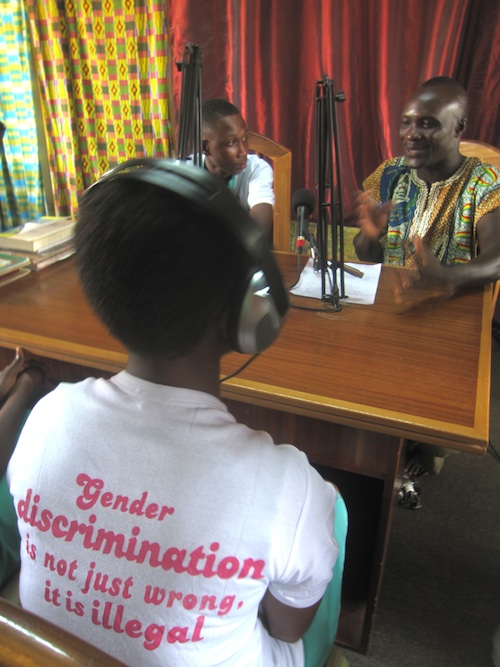
Men dominate the African media sector. Looking at our own database of over 2000 media-professionals in 50 African countries we see predominantly males. Fortunately we are also working with many talented women throughout the continent. When we were asked to produce videos and case studies about Plan’s Girls Making Media Project we got really exited about the initiative that is preparing young girls for a career in the media sector.

I work for Africa Interactive, a social venture delivering media and communication services with offices in Amsterdam, Nairobi and Accra. As I mentioned earlier we are working with local reporters, camera-crews and photographers throughout Africa to document activities of NGOs, multinationals and governments. While these organizations previously worked with Western crews who travelled to Africa, we work with African media-professionals and guarantee the quality of the productions.

Local film-crews

There are many advantages of working with local crews. They know their way around; they speak the languages and understand the culture since it is theirs. These people can be fixer, translator and journalist at the same time. And not unimportant: the costs are lower compared to flying people in. For this Plan assignment we worked with experienced crews (male AND female) in Lomé (Togo), Bomi (Liberia), Makeni (Sierra Leone) and Sogakope (Ghana). Our, by the way female, employees in Accra and Nairobi did the video editing and we finalized the videos in our Amsterdam office.

GMM

The Girls Making Media project’s goal is to contribute to the elimination of gender discrimination and benefits at least 140 adolescent girls and 30 adult journalists in the most marginalized areas in each country. With this project, girls and adult journalists are trained on various topics aiming at increasing their capacity to produce quality information concerning girls’ rights. It is also empowering girls to advocate on issues concerning their well-being.

In the four videos we focus on the three-year program (which started one year ago) and show the development, achievements and challenges so far. We hear about the effect the project has on the girls and their communities. Also, the girls explain how they see themselves after learning media skills and talking about gender related issues on the radio and TV.

Liberia

Ghana

Sierra Leone

Togo

Girls interact with journalists

Together with the Plan West Africa office in Ouagadougou we developed the idea that the video-shoot should also be an opportunity for the girls to interact with our crews and learn from them. During the filming days there was room for questions and sharing of experiences. We received positive feedback from the crews and the Plan offices about the cooperation with the girls. I would like to use this space to thank the camera-crews who did a great job to create the videos:  Comfort + Yudawhere (Liberia), Wotay + Idriss (Sierra Leone), Paul + Gary (Ghana) and Rodrique + Anselme (Togo).

Let me conclude by saying that I hope to welcome the girls to our network after they have finalized the GMM project!

If you are looking for any content on your activities in Africa, just contact me via e-mail: bertil [at] africanews.com or Twitter: @brutuz.

Read Full Post »

Charles Suglo, Bestway Zottor and Francis Diamenu from Radio Tongu

Sometimes among all the ICT4D hype, we forget about one of the biggest and oldest ICTs there is:  radio.

Last month while in Ghana, I visited Radio Tongu in Sogakofe. The compound where this community radio station sits also serves as a community center, with computer training, a press center and Internet access for a discounted rate.

Plan Ghana staff was meeting with the radio director, Bestway Zottor, and two of the managers, Francis Diamenu and Charles Suglo, to discuss the idea of offering internships for 6-8 youth from the nearby school-based Girls Making Media (GMM) program Plan Ghana and Plan US are supporting.

Charles explained to us that the station gets some 70% of its news from the Internet. The other 30% is sourced from local communities, and recorded on the ground wherever the news is happening. ‘The voice is reality,’ he said. ‘It’s what promises that the news is real. It’s what makes people believe.’ The station broadcasts in 3 languages: Ewe, English and French.

If the youth in the GMM program want to be radio hosts, according to Charles, they need to be well trained and professional, especially since the topics that the youth are bringing up — violence against children and bullying — are sensitive. ‘We have our credibility as a radio station,’ he said. ‘So they need to be well-trained on radio program hosting, know how to manage on air, be skilled on how to ask good questions and follow-up questions.’

There are all kinds of jobs that the youth can do at the radio station, including news, marketing, voice, or running the cafe. Having job skills such as these can begin to give the youth some experiences that will serve them later in life. The training and work they’ve done through the GMM project over the past year give them a foundation for the internship positions at Radio Tongu.

Following the visit to the radio station, we went to the school to meet with the media club. It’s called the  ‘Eye Media Network.’ The group’s slogan is ‘Our eyes are always watching.’

The GMM program began last year with a workshop for 20 of the students on media skills and gender. Following that the Club received a small media kit consisting of digital cameras, voice recorders, a radio, a notice board and Flip cameras. The girls work with 2 advisers and now several boys have also joined the Club. The club plans its own programs and actions, and does a school-wide newscast every Wednesday during the school assembly.

A student reads us the news they've posted on the Notice Board

As part of the program, the Club meets and interviews local and national figures, with a focus on women journalists, government officials and businesswomen. The group has covered school elections and put into place a ‘Walk your Talk’ Accountability initiative.

They conducted a bullying campaign with the goal of reducing the incidence of bullying by 30%. After the campaign, which included posters, educational sessions and other outreach, the Senior Housemaster claimed that bullying had been reduced by 90% compared to the year before. They will begin a campaign against sexual harassment in the coming year.

Some of the challenges that the group faces include posters being ripped down, friends trying to discourage them, boys suffering discrimination for belonging to the “Girls Making Media” club, and not having enough equipment. The club hopes to obtain their own modem, computer, printer and more cameras.

The first week of August, select students from the GMM group participated  in social media training, where they learned how to shoot video, subtitle, access different social networking sites to post their content, and stay safe while online.

The girls in the club said the project has helped them to build confidence and take up leadership positions. ‘We learn how to find information and to bring out problems and get solutions,’ said one girl.

Another said ‘We took bullying as a normal thing. Now we know that bullying is not normal. Now when we see something, we are alert.’

‘I used to walk around without seeing,’ added another ‘but now I see everything because I am looking for news. My mind has been opened.’

The Girls Making Media program covers 7 schools in Ghana. Several other groups in Togo, Liberia, and Sierra Leone also participate in the GMM program.

Read Full Post »

This week I came across the “Feedback Mechanisms in International Assistance Organizations” report by CDA Collaborative Learning Projects, based on research undertaken by the Listening Project and funded by the Gates Foundation.

The findings and recommendations are very intuitive and it’s nice to have them gathered in one place. The report can serve as a starting point or a pause-and-reflect moment for organizations working specifically on humanitarian accountability as well as those who are looking to integrate better ‘downward’ or beneficiary feedback into development or humanitarian work overall. It also offers good food for thought for those interested in crowd sourcing and the use of new technology for citizen engagement and input.

The report is not too long, and it’s easily laid out for a quick read, so I’d recommend downloading the .pdf and digesting it fully.

To whet your appetite, here are some points I found interesting:

Why do agencies seek recipient feedback?

Four reasons were identified in the report: to improve accountability, to improve effectiveness, to respond to donor requirements or media pressure, and to increase security for staff. Feedback from recipients* was seen to give staff the fuel needed to pressure higher-ups for necessary changes in programming; beneficiary feedback often improved program quality and recipient satisfaction, and seeking dialogue and communication with communities tended to reduce threats of violence. When accountability was a donor requirement but wasn’t part of a larger organizational buy-in or value, unsurprisingly, initiatives were less successful.

To many reading this post or who may read the CDA report, the benefits of participation and feedback and accountability are already obvious, nonetheless it’s  good to see them captured and documented in a report as a support to those who are trying to establish accountability and transparency mechanisms in less-friendly or convinced atmospheres.

Other key points (any quotes come directly from the report):

  • All practitioners interviewed for the study “expressed their unequivocal commitment to participatory and inclusive approaches to humanitarian and development work, and placed significant emphasis on accountability mechanisms.” In addition, many organizations have signed different charters and standards including SPHERE  Guidelines, the Humanitarian Accountability Partnership (HAP) Standard in Accountability and Quality Management and the INGO Accountability Charter. This rather contradicts the impression the media often likes to give about aid agencies as being totally unaccountable to anyone. Or maybe certain parts of aid agencies are more interested and prone to seek accountability and transparency than others.
  • The report says, however, that there are still issues with continuous feedback loops and information doesn’t always return from whence it came. “Typically information gathered from primary stakeholders flows through different parts of organizations, but decisions are rarely communicated back to communities.” One could also ask how often this feedback (or similarly, any information, or data) is returned to communities in accessible formats so that they can use it as well for their own purposes.
  • Good accountability mechanisms are not possible without management buy-in or staff competency. Managers play a critical role in “creating incentives and requirements for field staff to regularly solicit and utilize feedback.” Organizations need to invest in the skills necessary to ensure honest feedback can happen at community level, and/or among the various people and organizations involved (community members, CBOs, local partners, local staff, management staff, headquarters, government, etc).
  • Different agencies are working to develop frameworks to improve feedback and accountability mechanisms. “Some of these new approaches have built-in mechanisms for integrating recipient voices into program strategies and operations.” Some organizations have been collecting primary stakeholder feedback and sharing information with recipients for years as part of participatory development processes. However, the report says, often the exercises are very focused on individual projects or towards particular practical results and the richness of the feedback is not fully appreciated or systematically fed into broader decision-making processes.  “The practices of systematically listening to, gathering and analyzing people’s perspectives, recommendations and complaints have not become routine in many agencies.”
  • Feedback mechanisms need to be designed together with recipients. “Mechanisms must also be appropriate to the specific contexts where they are intended to operate, and agencies have to consider the most appropriate name for the [system], channels, and methods for raising complaints, and culturally appropriate ways of responding.” This is especially important in tense environments or with people who are not accustomed to voicing their opinions.
  • Trust is important, and according to the report is “the first step in getting meaningful feedback. Providing information about the goals and expectations of the organization is the first step in building trust…. Organizations need to establish systematic procedures for reviewing, investigating and responding to feedback or complaints. All this needs to occur in a consistent, timely manner for people to believe in the system and use it.” My own experience with children and youth participation initiatives, has taught me it’s also critical to discuss and agree on clear and honest expectations about what can and will be done with the feedback, and the degree to which feedback will actually be able to change a situation. This goes back to the report’s point on management buy-in and institutional systems. Unless your organization really wants to hear the feedback, is willing to change itself or its actions or viewpoints to respond to the feedback, and has the internal capacity to respond and modify how it’s doing things, asking people what they think can be really tricky and potentially demoralizing for all involved. It’s never nice to hear people say “why did you ask us if you didn’t want to know” or “what is the point of knowing what we think if you’re not going to change?”
  • New and emerging approaches are being tested, including those that use innovative tools and technologies such as SMS and social media. However, the same principles apply to these new technologies as to any other type of feedback loop, and it’s clear that there are still challenges with new technologies.  As mentioned earlier in the report “Most organizations that were successful in gathering feedback… and distributing information back… found it necessary to have more than one mechanism in place…in order to provide options for all of the different groups within the local community to provide feedback and to get information.” This is especially true with new technologies, given the large numbers of people left out of feedback loops due to cost, literacy, age, gender, and access if only SMS or social media are used. Specific challenges with new technologies are highlighted in the report, such as the case of Haiti where an SMS service was set up and people were very willing to use it, “but the agencies had not incorporated a way to monitor the replies and feedback. This resulted in some frustrations and a lost opportunity for a feedback loop between recipient and aid agencies.”

Page 17 of the report offers some good examples of what effective feedback loops look like, page 20 lists several areas that need investment and incentive to ensure effective feedback mechanisms and to guarantee that information is properly gathered and well-utilized, and page 23 offers a list of recommendations for effective and comprehensive feedback loops.

Read the full report here.

*I’m not a big fan of the terms ‘recipient’ and ‘beneficiary’ but have used them here because they are the terms used in the report.

Related Posts:

Ian Thorpe does a good job of commenting some of the portions of the report I didn’t expand on:  “Listening to the people we work for

Read Full Post »

This is a guest post by Jamie Lundine. Jamie is a health geographer who works with Map Kibera in Kenya. We first met about a year ago when Plan began thinking about using digital mapping as an element of the Youth Empowerment through Technology, Arts and Media (YETAM) project and we started discussing how we could work together. Since then it’s been exciting to see how Plan Kenya and Map Kibera are collaborating to bring together child-centered community development work and ICTs in programs such as YETAM, youth and governance work, and community led total sanitation (CLTS) programs. Globally Plan is committed to building its capacity to use ICTs where appropriate in its work and to support youth, communities and local governments to use ICTs where useful for their goals. Plan Kenya is one of the offices that is leading the way in ICT4D at Plan, and there is much that the rest of us can learn from their approach and experiences.

Jamie’s original post appears on her blog Health Geography as ‘Documenting a participatory digital mapping workshop with Plan Kenya‘ and on the Map Kibera blog. Michael Warui, Plan Kenya’s ICT director, sent me the workshop report and I was planning to write about it here, but Jamie’s already done all the work, so I’m re-posting.

Map Kibera Trust recently facilitated a 3 day training to introduce participatory digital mapping to target staff at Plan Kenya. The participants in the workshop included programme staff and ICT staff from the Kenya Country office and regional offices around the country. Participants came from Homabay, Kisumu, Kilifi, Kwale, Tharaka, Machachos, Bondo, the Kenya Country Office and the Urban Programme (Nairobi). Their backgrounds ranged from ICT support staff, to Child Rights & Gender Advisor, to M&E Coordinator, to programme staff in 4 of Plan’s 5 focus areas (Protection and Inclusion, Health, Education and Governance).

The training was planned at the beginning of the implementation of the new Kenya country strategic plan (CSP) 2011-2015 for Plan Kenya. Building on the success of Plan Kenya’s work in Kwale on universal birth registration and also from digital mapping work with POIMapper and Map Kibera Trust, the new CSP highlights the importance of ICT in the improved efficacy of Plan’s work. Plan Kenya has chosen to place an explicit focus on participatory ICT in its work. This is in line with Plan International’s focus and leadership in ICT4D globally.

In this context, the workshop aimed to:

  • Introduce participatory digital mapping theories, techniques and tools that Map Kibera Trust employs in its work
  • Provide hands on experience in GPS data collection and data editing using Open Street Map
  • Learn more about how Plan Kenya programmes use information and communicate
  • Brainstorm ideas about how to integrate ICT into programme work

We began with an introduction to Information Communication Technology for Development (ICT4D) by exploring some questions to consider before introducing ICT into programme work. The questions were (and are) meant to stimulate discussion and encourage participants to think systematically about the integration of ICT into new and existing programmes. The questions identify the reasons why you would use ICT, assess what constraints and opportunities exist in the framework you are working in, and explore how people are communicating in order to design appropriate and sustainable systems to build upon existing channels of communication. The questions are modified from Linda Raftree’s post “7 or more questions to ask before adding ICTs,” so thanks to Linda for the inspiration!

  1. Why are you considering the use of ICT?

The Plan Kenya staff identified that using ICT, particularly mobile phones and the internet, has become a desired lifestyle choice that the majority of Kenyans around the country have embraced. This was an important point that the participants wished to build upon and capture in their use of ICT in various communities. The group generally agreed that ICTs are available and can be accessed by many Kenyans. The staff also mentioned that ICTs could improve communication and be used to easily mobilize communities (for example sending one SMS to many people to attend a meeting). ICTs are flexible and can improve accuracy and consistency in information, which can then be easily stored and shared. There was also mention of improved efficiency in programme work through the collection and processing of real-time information.

  1. What are the programme goals or programme framework you are working within?

Most of the participants identified the new country strategic plan for the organization as the overarching framework that Plan Kenya staff are working with. The country strategic plan identifies 5 areas of focus: Health, Livelihoods, Education, Protection & Inclusion and Governance.

  1. What are your specific information and communication needs?

The information needs of Plan Kenya staff members were largely related to programme work. The needs included collecting accurate data for baseline surveys for Monitoring and Evaluation and thus to assess programme impact. There were some suggestions of improving communication through digitizing information that can more easily be shared to large numbers of people. The group suggested that this could improve accountability to other staff members, donors and to beneficiaries in communities. ICT can also improve the ability of Plan Kenya staff to analyze information and make decisions.

  1. How are you already using information and communicating?

In order to integrate ICT into existing programmes within communities, it is important to know how staff members are already using information and communicating in their daily lives. The group came up with a long list of communication tools: email, internet, intranet, websites and social netoworks – namely Twitter, Facebook, Flickr, MySpace), applications (Skype, Yahoo Messenger), SMS and telephone calls, radio, and television. The group is using information during baseline data collection. Some are involved in a project that integrates SMS applications into the birth registration process in Kwale District.

  1. Who are the actors involved in the particular issue you are seeking to address with ICT?

 The Plan Kenya staff won’t be (and aren’t) using ICT in isolation. There are important stakeholders they work with on particular issues, programmes and projects. These include the general community – with a particular focus on youth and children. Important sub-sections of the community include teachers, school administration, Government of Kenya, civil society organizations, Plan Kenya partners (such as Childline Kenya, Community Cleaning Services), the media and private sector actors. Different groups of people use technology differently, and depending on the answer to question 1) and question 6 (below) the staff may need an ICT strategy that is diverse enough to reach the various stakeholders.

  1. How do people use ICT already?

This list of the ways in which Kenyans are already using ICT is a testament to the idea that the group tapped into when answering question 1. The use of ICT in Kenya, specifically mobile phone applications, has become a lifestyle choice. Kenyans use phones for mobile money transfer, SMS, calling, accessing the internet, paying their bills, paying for goods, calling toll-free lines (e.g. Childline call centre, police hot lines) and for data collection and dissemination. Kenyans also listen to the radio, use computers, blog, email, chat, shop online, bank online, join online discussions and news groups and use various forms of social media. They do this for work, but also for pleasure. These were the means identified by the group, however this is not an exhaustive list.

  1. How do people access technology already?

This was a sub-section of question 6 and the group answered: mobile phones (including GPS enabled and internet enabled phones), street phones, computer, internet connection in office and homes, internet modems, cyber cafés, radios, TVs, toll free lines, and resource centres.

  1. How will you close the feedback loop and manage expectations?

How do you make sure the information you are generating, no matter the medium or tool you are using, gets back to the community? How do you promote the use of technology without seemingly presenting a silver bullet solution (even if you don’t intend to do so)?

These questions were answered in several ways. One idea about both closing the feedback loop and managing expectation was to network  with other organizations and partners in the community to share information and raise awareness about the use of ICT and the opportunities and limitations of ICT4D projects.

Another option for closing the feedback loop was to both collect and disseminate information on popular social media sites such as Facebook and Twitter.

A third suggestion was to close the feedback loop and manage expectations through an informed resource person and/or resource centers and staff having sessions with the community.

Finally, there was the suggestion to start the integration of ICT in development work by outlining and communicating clear expectations and at the end have feedback sessions to monitor the whole process.

  1. What is your sustainability plan?

The final question, and likely the most difficult (we only had a one hour brainstorming session and did not expect participants to come up with final answers to this question but simply consider it as an important component to any project with an ICT component).

One idea was to equip community members, and particularly youth, with skills that will be applicable beyond the program (or project) timeline. The YETAM project (youth empowerment thorough arts and media) was designed in this way and the group agreed that this design was beneficial to the young people involved in the program.

Another suggestion was to involve the beneficiaries/community in the entire process of choosing/customizing appropriate ICT tools that suit their needs and for further development so that it is community owned process and will in theory continue beyond the project/program lifecycle. Other ideas included:

  •  Build partnership with Government and NGOs.
  • Integrate fund raising or income generating activities into the project.
  • Use affordable technology (free and open source)
  • Ensure follow-up mechanisms are built into the project

We discussed the use of mapping, open information and ICTs for development. We also used two of the three training days to focus on hands-on training and skills building. We facilitated training in handling the GPS devices, collecting data and using Java Open Street Map (JOSM) and Potlatch to record open spatial information into the OpenStreetMap databases. As we’ve found in the past, the hands on training is exciting and motivating. The theorietical discussions, combined with the practical field work inspired discussion and debate on ideas on how to integrate participatory digital mapping andICTs into programme work.

The following are ideas generated by the Plan Kenya staff:

  • Ushahidi could be useful for referral partners mapping and identifying the hot spots of child abuse
  • Use of SMS for communication with hearing and speech impaired within the community
  • Using reports and sharing the same information to various media channels. E.g. PPM, a in-house system that is used to track and monitor information and projects progress
  • In governance as a tool for enhancing social accountability, where ICT can be used to track projects
  • Digitization of data collection e.g. in sponsorship (especially photography), child abuse hotspots
  • Involving children in participatory community mapping by mapping schools using walking papers
  • Using blogging as a tool for youth to document governance issues in the new good governance project for the Urban Programme
  • In Kilifi the team is doing a 2 year study on Open Defecation Free villages and health outcomes. They could use mapping and spatial statistics to document findings.
  • Mapping and other ICT4D tools could be used to document and share participatory activities that Plan already undertakes, such  as transect walks and participatory situational analyses

The training ended with a note of caution – the team recognized the potential tension between the processes that are needed for ownership of a community map (and any other ICT4D project) and the haste of development partners to use the budget and report progress to donors. In this case, many projects (ICT4D, mapping and any other project) may “leave the community behind.”

It is thus important to ask the following questions and consider the answers carefully when designing projects:

  • For whom are we doing the mapping (or any project really)? And whose map is it?
  • Of what use is the (spatial) information, what will it compliment?

After another successful workshop with Plan Kenya, we look forward to building on the excitement and enthusiasm generated during the training! Let’s see some of the great ideas turned into reality!

Read Full Post »
This is a guest post by Rebecca Tapscott who, along with Joe Paveyis interning with us in Cameroon for the next couple months. Rebecca wrote a first post about the what and the why of setting up an Ushahidi system in Cameroon to track violence against children and Joe goes more into depth about the technical side of setting the actual system up in his post Digitizing violence reporting. Sounds complicated… because it is!.

Here Rebecca writes about how she and Joe are better understanding mobile phone use and community context by living in the community. She also goes into how the team is training youth on how the system works and getting youth’s input into the design and use of this type of system in their community

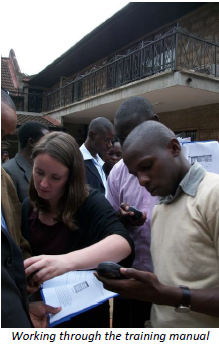
Learning what information to include when sending SMS reports on child abuse.

One component of our ICT4D internship with Plan is working “in the field” with the community to help implement the Ushahidi reporting system for violence against children (“VAC”).  To this end, Joe and I are living in Bamessing community, a village in the North West Region of Cameroon, also one of the three program units (“PUs”) hosting the YETAM program.

Bamessing has no running water, limited network coverage, and sporadic electricity.  The region is also known for high rates of child/forced marriage, domestic violence and school dropouts.  If a VAC Ushahidi system can work here, it can work anywhere.

Piloting the site in Bamessing has several benefits as well.  First, we are working with a group of motivated youth who have received extensive training on the four categories of  child abuse and violence against children (physical, psychological / emotional, sexual, and neglect or negligent treatment), as well as their legal rights under the UN Convention on the Rights of the Child and other international and national protocol.

Second, the Bamessing community is saturated with cell phones, and most of the youth in the YETAM group have their own personal cell phones.  Joe and I had a discussion with Odelia, our “land lady” and the 30-year-old widow of the late pastor, who told us that she first noticed cell phones in Bamessing in 2010 (though some say they’ve been around since 2004).  Since then, she has owned five cell phones, although she never uses one to text, and makes only one or two calls a week.  Instead, cell phones seem to serve as a sort of portable doorbell.  Neighbors, friends, and acquaintances “beep” each other (give a missed call, which does not cost any credit) to relay a predetermined message.  Credit is expensive relative to other daily costs and, as previously mentioned, the network here is tenuous.  Texting requires literacy, dexterity, and decent vision, which are limiting factors for many of the adults in the community.

Finally, Cameroon seems to have the advantage of a functioning (albeit imperfect) offline system for reporting and responding to VAC.  I spoke with a delegate from the Ministry of Social Affairs (“MINAS”), who explained some of the system’s weaknesses to me, namely that the ministry is highly underfunded and understaffed.  He also lamented that reporting is lacking, due to inadequate knowledge of civil law (instead, most people are familiar with customary law, which often reinforces certain rights violations), and inability to report violations.  While knowledge of civil law must come from human led sensitization and education projects, the Ushahidi platform can enhance reporting ability in Cameroon.  Through our discussions with Plan staff in Yaoundé, we came to the optimistic conclusion that the government might increase investment in staff, resources, and educative programs in direct response to the number and severity of reports that come through the Ushahidi system.

Given these caveated benefits, our current challenge is to introduce the concept of reporting through Ushahidi to the YETAM youth group, teach the youth how to report incidents, integrate their feedback into the system, get the online system up and running, pilot it, and present it to MINAS.

Our first opportunity to present Ushahidi to the youth was during the YETAM refresher training, held June 22 – June 27, 2011 at a local high school in Bamessing.  Joe and I worked with Georges (Plan Cameroon’s ICT coordinator for the area) and Judith (the YETAM coordinator in Cameroon) to design a module to introduce Ushahidi and our particularized reporting system.  First, Georges and Joe explained Ushahidi and answered questions on a theoretical level.  We then described our intention to use Ushahidi for reporting VAC, what information must be included in reports of VAC, and what information will be displayed on the Ushahidi site.

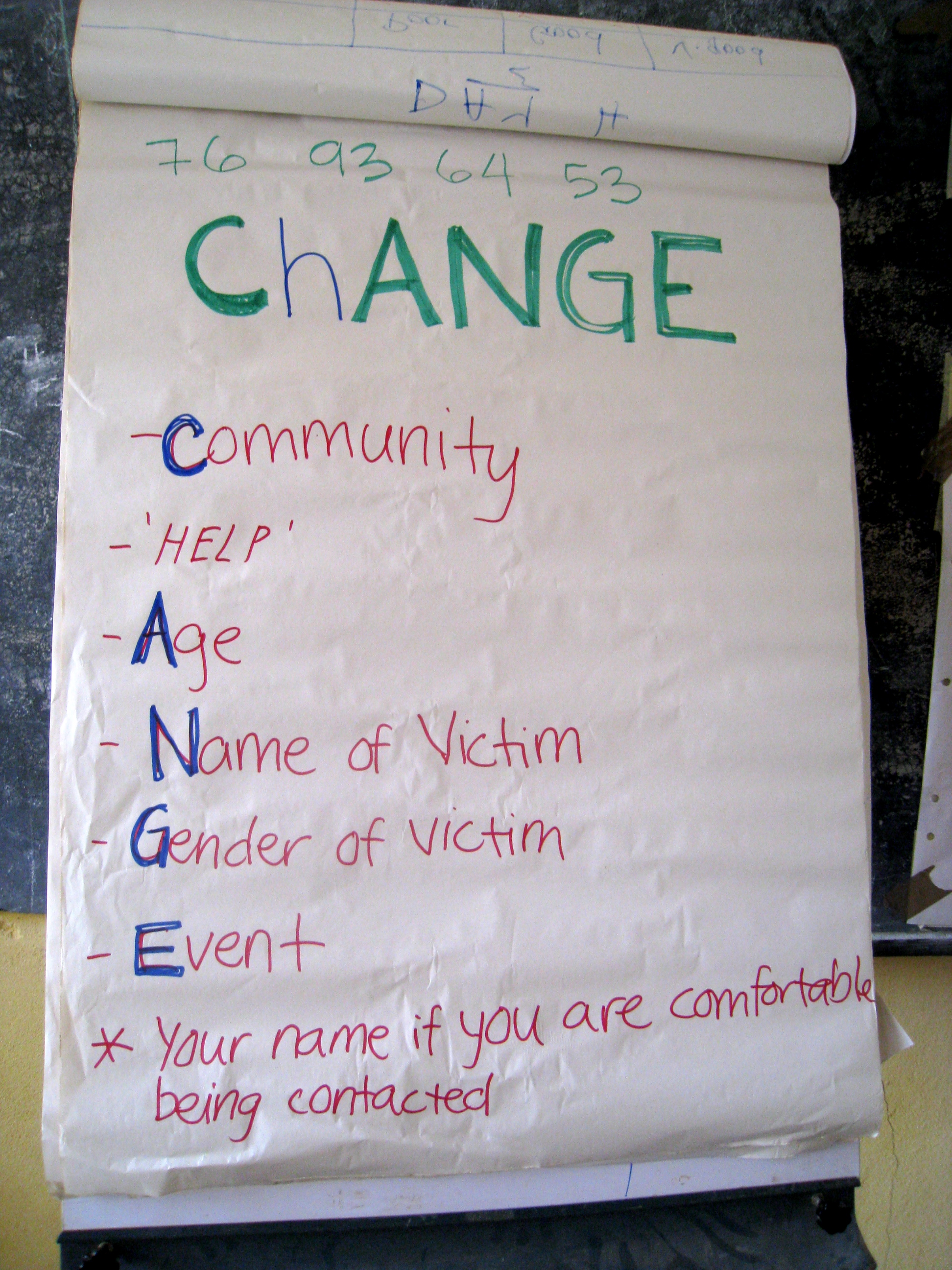
We created an acronym (ChANGE) to help the youth remember what information to include in text message reports. (C: Community; h: False letter– we said “help” so people can remember, but really nothing should be reported there, A: Age, N: Name of victim, and your own if you are comfortable reporting it, G: Gender, E: Event.)  Then we gave a practice scenario and asked five participants in the class to show how they would report the message. We reviewed each message for number of characters, noting that a single text message is limited to 140 characters, and also checked to make sure that all the necessary components were included.  All five messages were similar, reading something like:

My name is Judith. I beg of you for my friend Mary who is 14 years old and whose father is taking her from school to give to a 60 year old man for marriage in Bamessing community.

Most of the messages ran long, but did include the five required components.  One area of confusion was what level of geographic specificity to include.  We explained that while the report must be as specific as possible to facilitate a response, the Ushahidi site will present a more general geographic location so as to preserve anonymity for victims and reporters.

We asked the youth for feedback on the system, which resulted in more questions clarifying what is appropriate to report, and the level of confidentiality of reporting.  One concern was that often the phone network is down, making it impossible to send text messages.  We clarified that all the old methods of reporting still exist, and that community animators and Plan staff can be sought out to report either by text message or the other ways.  By the end of the training, the youth agreed that this would be a useful system, and some commented that they particularly appreciate the unique level of anonymity associated with SMS reporting.

This month, Joe and Georges will finalize the Ushahidi system, Joe will create brief manuals for system users, and Joe and I will provide additional training on using the system.  We hope to have the youth send sample text messages to the site in the next month to test the system, to train the youth, and to provide sample data to present the site to potential government partners. Our colleague Nathalia (the Child Protection Advisor in Plan Cameroon) also suggested that we create a ‘child and youth friendly’ guide to how Ushahidi works that can be used for training, so we’ll get going on that also.

Read Full Post »

This is a first guest post by Jacqueline Deelstra, who is working for about 2 months to support Plan Benin to solidify their SMS Reporting and Tracking of Violence against Children (VAC) project.

The VAC Benin project started as a pilot in February 2010. Plan Benin welcomed Paul Goodman (see earlier posts) for the month of May to support refining and optimizing the actual SMS and mapping system, and Jacqui is now spending 10 weeks looking further at the non-technological aspects that underlie the initiative, including staff training, links with government duty bearers, and community input around the idea and practice of SMS-based reporting.

During the initial workshops with staff, government representatives and youth in February 2010, we identified the need to map out and better understand what information should be collected in order to 1) allow Plan staff and government to understand the nature of violence against children in Benin, respond to VAC reports, and to avoid creating parallel information systems and 2) the need to provide clear guidance and training to ensure consistent categorization of reported cases. Jacqui writes about this below. (More on the overall project and process via the links at the end of this post.)

In coming to Benin for two months as a consultant to work with Plan staff on a project using FrontlineSMS and Ushahidi to collect and map citizen reports of violence against children (explained previously in this blog) I knew part of my work would be training staff in the technology and answering their questions about how it works and what it’s good for.  In other words, that this work would fall under the often discussed buzz phrase “capacity building” for local staff. And certainly, many questions have come to me about aspects of the technology.

For example, how data from Ushahidi can be downloaded for analysis and to make graphs for reports and how staff without access to Ushahidi as administrators can use the public site to submit cases of violence that are reported to them in person as opposed to being submitted directly from the reporter to our Ushahidi platform via our SMS helpline.

During the recent trainings I carried out in Cotonou on Tuesday and Wednesday I was able to demonstrate to staff members the features of Ushahidi, but just as important was the chance to field a lot of interesting comments and questions. As this was the first time many staff members had seen the vacbenin.ushahidi.com site, it was a process of discovery. There was resulting curiosity about things I had just taken as given in the system.

Comments were made about how we are currently processing reports of violence received by SMS by classifying them into certain categories and specifically why we chose the categories we did for the type of violence and location. The categories we have are listed below.

Current categories on the Violence Against Children (VAC) Ushahidi site in Benin

From French to English they translate to:

Type of Violence– death, sexual violence, psychological violence, physical violence, negligence, exploitation and kidnapping

Location– At home, at school, at work, in the community and in institutions.

You will see next to categories right now there is the statement: “Select as many as needed.” Everyone knows it is difficult to classify many things into just one box. Thus, with cases of violence such a forced marriage it was initially decided that multiple boxes should be checked because it certainly entails sexual and physiological violence and potentially physical violence, and we wanted to cover all our bases.

However, comments from the standpoint of the country office staff pointed to a different conclusion: you have to categorize each report in just one category or else it will be difficult to do a good analysis of the data. They see instead that there is one category which the case belongs to above all, (for forced marriage this would be sexual violence) and that is how it should be categorized. As it was explained to me they look at the categories and say, “just because only one box is checked does not mean the case does not belong to other categories, and selecting one box ensures there is not double counting of cases in the analysis.”

Finally, in our discussion of the choice of locations when processing a report, questions come up about why “at work” was chosen, when other locations more specifically of interest to staff, such as the market, were not included. (Note: the original categories were taken from the UN Study on Violence Against Children, which provides the framework for the overall program.) Staff explained that markets are known to be dangerous places for children who work in them and thus they would like to see if reports come in specifically about that. They also discussed their feeling that “at home,” is too vague. Violence at home could be committed by parents against their own children. Or it may be violence committed against domestic workers or other children living in the household, which they have the impression happens frequently. But the category “at home” does not provide any insight into that question.

The clear value of this discussion of categories and what information would be of most use to the local staff points to another buzz phrase in development, “participatory methods for program design, monitoring an evaluation.” Without consulting various staff members and getting that local knowledge about what issues a project should be tracking and addressing, it is likely the project will not be as useful and impactful as it could be. Especially with a project like as this one that is gathering data for the sake of advocacy, awareness raising and informing future programming, the way data is collected and classified has to fit the local needs and context.

Thus in my trainings this week it was certainly not only the Cotonou-based staff that learned something. I learned more about what types of violence are of interest to staff and how we can make this project work better for them by better meeting their information needs.

Related posts:

Future proofing the VAC Benin project (by Paul Goodman)

Update from Benin: charting a course forward (by Paul Goodman)

Revisiting the SMS violence reporting project in Benin

Tracking violence against children in Benin video

Community-based child protection

Tweaking: SMS violence reporting system in Benin

Finding some ICT answers in Benin

7 (or more) questions to ask before adding ICTs

Fostering a New Political Consciousness on Violence against Children

Related links:

Text messages to help protect children against violence

Plan International case study: Helping children report abuse in Benin

Read Full Post »

Youth learning to use GPS in Pitoa, Cameroon (photo: Ernest Kunbega)

Last Monday I attended Africa Gathering London. The topic was ‘Social Media Revolutionizing Africa: How is new media changing Africa, giving voices to the voiceless, improving governance and transparency, and changing narratives?’

The event stimulated thinking and brought up some hot discussions around technology, traditional and social media, aid and development, participation and governance. (Big congratulations to Marieme Jamme  for curating a great line up that brought in an interesting and engaged group of participants and to William Perrin of Indigo Trust for keeping things on track and generating good debate!) See the program, the speaker bios and some short video interviews.

Some quotes, thoughts and debates from the day:

  • If your purpose is to bring more people into discussions, remember that radio, Facebook, and Twitter audiences are distinct and be sure you are thinking differently about how to engage them all. Remember that many people in Africa prefer to talk not write.  (from BBC’s Africa Have Your Say – @bbcafricahys‘s presentation)
  • You can’t resolve all of Africa’s issues with one approach. The countries are very different and local context really matters. But you also can’t design something for every tiny demographic. Where is the sweet spot between localized and scale? (discussion after the morning workshop)
  • People should not sit in the UK deciding and develop things for Africans. Develop things with Africans, or support Africans to develop things themselves. This idea got retweeted a lot, with lots of agreement. But H Taylor – @HFTaylor88 also commented via Twitter that this rhetoric has been around for ages within NGOs…. (discussion after morning workshop)
  • It’s great that the market has been able to bring mobile phones to so many people in Africa, but the market can’t do it on its own as many are still left out. There needs to be more incentive to reach remote areas. There needs to be education, cash transfers, government regulation if we want to really realize the potential of mobiles. Mika Valitalo – @vatamik commented that in many African countries, mobiles are still taxed as luxury items, making them more expensive than they should be. (Clare Melamed -ODI – @claremelamed‘s “Is the Mobile Phone Revolution Really for Everyone”.)
  • Any big story today on CNN has a social media component, yet there is still the idea that social media only breaks news and ‘it won’t make the history books until CNN or BBC report on it’. If CNN is not planning to do a story but sees everyone is talking about it on Facebook and Twitter, they will cover may rethink covering it. CNN finds good opinions and stories on social media, but their primary news source will continue to be their correspondents. Emrys Schoemaker – @emrys_s however questioned whether mass media use of citizen journalism is a broadening of voices or if it’s cheap content for big media – or both. (Faith Karimi/CNN/@faithCNN’s presentation and resulting discussions.)
  • Social media gives African youth an uncensored worldwide platform, letting them feel included in shaping Africa’s image, but the youth using social media in Africa are still the middle class and the rich. We need to find ways to include other youth. (Faith Karimi – @faithCNN’s presentation and resulting discussions.)
  • The Guardian’s Global Development Site and Poverty Matters blog are trying to get away from the vision of ‘poor Africa’ and have only been accused of ‘poverty porn’ once in 9 months (which Liz said irritated her to no end as they really try to avoid it). (I remember the case…) They stay away from the typical ‘flies in the eyes’ photos, but sometimes there really is starvation in Africa, and in those cases, a photo of a starving child might actually represent reality. (Someone countered that African newspapers should use photos of drunk, vomiting Brits to illustrate stories about parliament).  (Liz Ford/deputy editor/@lizford‘s talk and discussion)
  • Is the Guardian’s Global Development site one-sided, taking the view that aid is good rather than other ideas on how to best achieve development? Development is much larger than ‘aid’ and when talking about development we need to remember the bigger picture and the alternative views that maybe aid is not the best (or only) way to ‘do development’. The Guardian is quite open to new thoughts and ideas and invites anyone with ideas for blogs or stories to be in touch with them. They consider their site a ‘work in progress’. (Note: I like the Guardian’s site very much as it is one of the few media sources that discusses and seems to really promote and engage in the ‘#smartaid / @smart_aid‘ discussion). (Liz Ford’s talk and discussion)
  • Many African leaders, not to mention the public and the media, will listen when high level people call their attention to something, but problems can’t be solved by the same people who created them, especially if those people are considered morally bankrupt. Karen Attiah – @karennattiah  commented in from Twitter that a big part of development work should focus on rebuilding the broken social contract between governments and citizens in Africa. So how can we connect policy makers with ordinary Africans? How to bridge the gap between policy makers and grassroots approaches and implementation. (Panel with Alex Reid/@alreidy and Carolina Rodriguez /@caro_silborn – media heads at Gates Foundation and at Africa Progress Panel)
  • Not all sources are created equal – this is true for traditional and for social media. Social media is not about the technology, it’s about the human need to communicate. You can make traditional media more social also. Even those without access to social media will get around harsh barriers to tell their stories because of the urge to communicate. So the best thing is to create a social experience, not to worry so much about getting ‘jiggy’ with the technology. (from Kevin Anderson/@KevGlobal‘s presentation. See Putting the social in media.)
  • New technologies can impact on public debate, people’s political capabilities, citizen-state relations, relationships with other government actors. Frontline SMS Radio, for example, could be a very useful tool for this because radio is still the main way to communicate with the majority of Africa. Using Frontline SMS Radio, stations can sort through messages they get, understand them better, and use the information to orient their radio programs as well as other things. Radio can play a very strong and useful role in governance. (from Sharath Srinivasan/ @sharath_sri‘s presentation. See FrontlineSMS at Africa Gathering.)
  • Youth can have a big impact on community development if given space to influence. There is money (eg., in Cameroon, at local government level) but it needs to be better spent. Informed and involved youth can hold government accountable for spending it better. Local level advocacy has a greater impact on youths’ lives than global level initiatives because you can make as many laws as you like, but unless people are putting them into place and practice at a local level they don’t matter. Organizations should listen to young people but not make them dependent on NGOs because the real duty-bearers are family, community, government. NGOs need to be models of their own methodologies; eg., if an NGO is encouraging people to criticize the government, the NGO should be ready to receive the same scrutiny around its own work and behaviors. Social media can play a role in this process by showing what is happening at the local level to a global audience. (from my presentation and the resulting discussions. See Youth Empowerment through Technology, Arts and Media)
Julia Chandler (@juliac2) did a great round-up of the day’s presentations and discussions on her blog: Part 1 and Part 2. The Guardian continues the discussion here and of course the Africa Gathering website is a great place for more information.
.
Update – more posts about Africa Gathering:
Great perspective from Tony Burkson – @tonyballu – who I really enjoyed talking with at the post-event drinks: A Day at Africa Gathering.

Read Full Post »

This is a guest post by Joe Pavey who, along with Rebecca Tapscott, is interning with us in Cameroon for the next couple months. Rebecca wrote a first post about the what and the why of setting up an Ushahidi system in Cameroon to track violence against children. Here Joe goes more into depth about the technical side of setting the actual system up.

Our first major discussion about the VAC Cameroon site was in regards to how reports should pass through the system. For obvious reasons the information contained within these reports is extremely sensitive, so each step of the workflow process needs to be determined with the best interests of the children involved in mind.

The existing offline system for reporting violence against children was agreed upon through an exhaustive deliberation process with government, community, and local council members. In short, a lot of hard work has gone into making the existing offline system something that all parties agree on and it would not only be negligent, but counterproductive not to use this as a blueprint. For this reason the online system we are working on should respect, support and ultimately serve to expedite the current process, not replace it.

Under this current system Plan serves in the capacity of witness in cases of child abuse. Plan Cameroon has partnered with several governmental agencies to investigate and respond to reports they receive. Which agency this is depends upon the circumstances of the abuse.  Age, gender, and location are all factors in determining which agency will be responsible. For example, abuses taking place in the home are currently handled by the Ministry of Social Affairs, but cases involving female children are handled by the Ministry of Child and Women’s Empowerment.

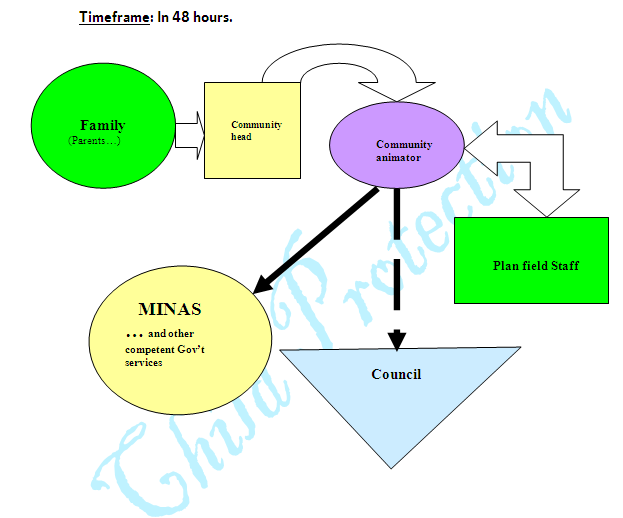
The current policy also requires that all reports of violence against children received by Plan staff be forwarded to the sector office within 48 hours.

Existing community-level reporting flow

Following this, the report has 24 hours to reach the country office in Yaounde. This one of the processes we are hoping to expedite with the implementation of the digitized system.

Existing flow of next-level reporting - at Program Unit and Plan Country Office

If this sounds complicated, that’s because it is. As outsiders who are new not only to the culture, but also to the peculiarities of local bureaucracy, much of Rebecca’s and my first session was taken up with trying to understand the rules and regulations already in place. Thankfully we have Cameroonian colleagues in the local office to help us navigate and understand all of this.

The Ushahidi System

Ushahidi allows three methods for submitting reports: (1) Text Message, via Frontline SMS or another text messaging tool, (2) Email, and (3) Submitting a report directly through the site. These actions can be taken by individuals in the community or by Plan Staff if they are alerted of a particular incident. A fourth means of submitting reports to Ushahidi, via voice messaging, was previously available through a plug-in called Cloudvox. Unfortunately the company that created the Cloudvox plug-in was recently acquired and has suspended this product for the immediate future, and we haven’t identified an alternative voice messaging system. This is unfortunate as we were hoping to be able to offer voice messaging as a reporting method for non-literate youth — although bandwidth limitations may have rendered this impossible anyway.

Information workflow for Plan Cameroon VAC Crowdmap site (updated; this is version 2.)

Based on the information that needs to be tracked and reported on, our current plan is to separate reports into four categories, each with several subcategories as follows:

  1. Form of Violence
  • Physical
  • Sexual
  • Emotional/Psychological
  • Negligence
  1. Gender of Victim
  • Male
  • Female
  1. Age of Victim
  • 0-5
  • 6-12
  • 13-18
  1. Location of Incident
  • Home
  • Work
  • School
  • Community

Current Crowd Map set up with 4 main categories.

Creating these reporting categories (and each of their subsequent subcategories) will allow this information to be tracked separately, or to be looked at in terms of how categories overlap with each other. Since the Ushahidi platform allows users to choose more than one category or sub-category when submitting an incident report, no data need be lost in the effort to isolate and contextualize information.

For example, by tracking Gender and Location of Incident separately we will be able to more easily visualize how many incidents of abuse are taking place at schools in a certain community, how many of the victims are girls versus boys, and how each of those categories relates to reports from other regions. This will be especially important information to the government who has different agencies in place for tracking violence against children and youth depending on the circumstances. It will also be useful for Plan staff who can then tailor programs and awareness campaigns in a specific community towards the issues that are most prevalent there.

Plan Cameroon staff, partners and youth have create a detailed online map of each council area in which this project will take place, however, mapping of reports will be restricted to a less precise level described to us as the ‘community level’. It’s hard for Rebecca and me to conceptualize just how specific of an indicator this is, though once we are living in the community – a transition taking place this week – it should become easier to measure. The reason for mapping the location of incidents at the community level is privacy. If reports were mapped too precisely they could compromise the identity and safety of a child — a result that would be entirely unacceptable.

On the Ushahidi ‘back end’, each report of an incident will also contain a Description section that will allow information outside categorical parameters to be included in reports. This could be the body of a text message, a summary of a voicemail, or any other details that are deemed to fall outside the determined privacy boundaries (eg., this will allow us to keep identifying information and other details in the system, yet keep it from going public).

Over the course of our week in Yaounde, we engaged in many discussions regarding how we could make the online information workflow match that of the offline system. The conclusion seemed to be that involving community members and Plan staff in initial approval of reports might be possible, but that expecting all six of the varying government agencies that currently respond to such reports to use this digital system would be problematic. At this point we are hoping that the official agreement can be reworked slightly so that only MINAS, the Ministry of Social Affairs would need to be involved in the system.

By week’s end we had drafted an initial proposal for what the workflow for the system could be. It is by no means final and will likely go through numerous revisions over the course of our work here, but it will provide us a good base to build from in the future.

Unfortunately our progress on setting up the site itself has been handicapped by technical issues with the Crowdmap website that cause the site to crash when trying to create subcategories. We have engaged with members of the Ushahidi staff and they are currently working to fix the bug, but we don’t have a timeline as to when they will have the issue resolved.

We have now left Yaounde for Bamessing where we will be initiating our field work on the YETAM project, working with youth on creating short films, performing more community mapping, and we hope that the mobile Internet connection will allow us to continue to work remotely on the Crowdmap site.

Read Full Post »

Guest post by Rebecca Tapscott who, along with Joe Pavey, is interning with us in Cameroon.

Joe Pavey and I are here in Yaoundé working as ICT4D interns for Plan Cameroon to help develop an Ushahidi/Frontline SMS system to report violence against children (VAC) and gender-based discrimination.  The project is conceptually the same as the Ushahidi site set up for Plan-Benin that another colleague of ours, Paul Goodman, worked on last month, although we have not completed the planning stages or started to implement.  At the outset, it is apparent that there are certain logistical and systematic differences between the projects, particularly in terms of the role of government partners.

Our team consists of Joe and me, Judith Nkie (the National Coordinator of the YETAM project), Nathalia Ngende (the Child Rights Advisor), Georges Niatchak (South Sector ICT Coordinator) and Charles Chiappi (ICT Manager).  We met for a few hours this past week to clarify some details of the project. (Note: This discussion built on training conducted in late May with staff and partners working on the YETAM project. In that training, the goals of an Ushahidi component to the project were generally agreed on among all. In addition, the information flow was discussed, a role play was done to help clarify roles and responsibilities of different stakeholders, challenges and bottlenecks to work through were identified along with the need for alternative reporting channels for those without SMS access or those are not literate, need to establish a baseline and indicators for success was discussed, protection risks were raised, and sustainability and ways to promote the system and the idea of violence reporting were considered.) 

This post discusses the purpose of the project and how it might be useful in the short and long-term.  Joe will follow up in a second post with some information about the logistics of setting up the Ushahidi site, and some remaining questions and next steps*.

Why YETAM, why Bamenda?

YETAM (Youth Empowerment through Technology, Arts and Media) is a Plan project established in 2008 that has been implemented with youth between 12 and 21 in eight African countries (Benin, Cameroon, Ghana, Kenya, Mali, Mozambique, Rwanda, and Senegal).  Plan Cameroon has three YETAM sites, one in the Northwest region (Bamenda), one in the North region (Garoua), and one in the Center region (Yaoundé).  The Plan team has chosen to pilot the VAC-Cameroon Ushahidi project with YETAM for two reasons.  First, VAC is of utmost relevance to youth, so it makes sense to place this new project within a youth-based project.  Second, YETAM participants have shown enthusiasm and passion for the YETAM project, and Plan believes that this energy and dedication can make the Ushahidi reporting system a success as well.

In preparation for this pilot project, the YETAM participants have mapped the towns of Ndop (in the Bamenda PU), Okola (in the Yaoundé PU), and Pitoa (in the Garoua PU), which can be viewed on OpenStreetMap.com.  The Ushahidi component will be new to the project but the team has been thinking about using new tool since last year and learning from the project in Benin.

How can Ushahidi combat VAC and gender-based discrimination?

The VAC-Cameroon Ushahidi site will be used for reporting violence against children and gender-based discrimination.  The idea is to establish a partnership with government ministries, in particular the Ministry of Social Affairs (MINAS) to respond to reports with the necessary legal and social support.  The Ushahidi system provides certain tools that will help make reports actionable for both a government response to individual reports, and a youth-led response to VAC and gender-based discrimination at the community level.

In particular, the ability to map the location of the report and categorize each report by the victim’s age, gender, and the location of the incident (home, work, school, or community) will allow YETAM participants and Plan Cameroon staff to use the information to identify what types of violence are occurring in which communities.  This information can help Plan staff target awareness trainings to serve the needs of specific communities.  YETAM participants can use the information to develop social advocacy campaigns, which are already a part of the YETAM project.

Plan Cameroon also has a broader psychosocial program that works to build resilience and help victimized children reintegrate into their communities.  The psychosocial program can use information from the VAC-Cameroon Ushahidi site to better understand where different kinds of violence are prevalent and hold corresponding trainings for social workers and community-based organizations.

Additionally, MINAS recently drafted a child protection code that has yet to be finalized or ratified.  There is resistance to finalizing the code because Cameroon already has a Family and People’s Code, and some people believe that since children are a part of the family, a separate code would be redundant.  However, children face unique challenges and threats that are not addressed in the Family and People’s code.  We hope that the data gathered by the VAC-Cameroon Ushahidi site can demonstrate some of these unique problems and serve as special and innovative tool to facilitate reporting of child abuse and gender-based discrimination.

Challenges:

No initiative would be complete without its challenges, and there are some hurdles that still need to be overcome, including

  • Empowering government partners to ensure that perpetrators of VAC are pursued, that justice is served, and that children are protected.
  • Building government capacity to ensure a smooth handover of site management and long-term sustainability for the project.
  • Ensuring that there is a point person in the government (MENAS) who will approve and verify reports in a timely manner.
  • Securing long-term funding for the project.
  • Involving police so that perpetrators will not be released and with the hopes of reducing the child abuse cases.

Note: Joe and I are prioritizing the VAC-Cameroon Ushahidi project for our work over the next ten weeks.  However, we are quickly realizing that the Plan Cameroon team has a strong work ethic, passion, and deep capability.  It is already apparent that establishing this Ushahidi site, training YETAM participants and communities to use it, establishing a strong government partnership for the project, and launching the site will take more than our allotted time.  We will do our best during our time here to support the planning, development, and implementation of the project as it progresses.

Read Full Post »

This is a third guest post by Paul Goodman who is supporting Plan Benin to solidify their SMS Reporting and Tracking of Violence against Children (VAC) project. More on the overall project and process via the links at the end of this post.

Plan Benin uses Ushahidi to map reports of violence against children in Benin. The platform is powerful right off the shelf (or right out of GitHub, as it were) and the latest version offers enough features to get the majority of deployments up and running without issue.

One benefit to working with Ushahidi — there are other options for gathering and mapping reports, of course — is that the global Ushahidi team works hard to cultivate a community of software developers hell bent on improving the software and innovating around new use cases. During my month in Benin I took advantage of a number of resources available to individuals and groups using Ushahidi. A few resources I consulted when working on solutions to technical problems:

In addition to making use of Ushahidi’s standard functionality, in Benin we’ve made some small customizations, configurations, and tweaks to that extend the functionality of the system, making it easier and faster to use.

A few tweaks:

FrontlineSMS – after upgrading to the latest version of Ushahidi, we made use of the new Plugin architecture and activated the FrontlineSMS plugin, which facilitates a seamless connection between FrontlineSMS and Ushahidi.

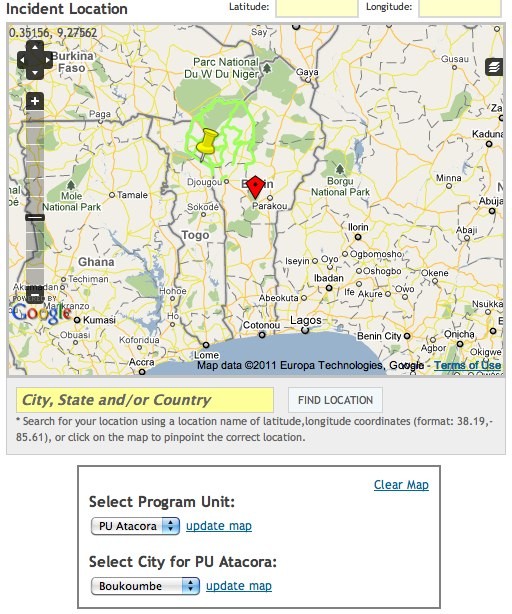
Location highlight – developed by John Etherton, this plugin improves the experience of mapping locations in areas that are not well-mapped. Instead of staring at a blank map, users creating reports can select the program area and nearby city from a drop down menu. Administrators can add as many points or areas as they’d like to aid the mapping process. Furthermore, the relatively slow internet connection in Benin makes loading map tiles and labels a painful process. In many cases, Location Highlight allows users to avoid having to load new zoom levels.

Nested Categories – a visual improvement more than anything, this functionality is supported out of the box. Rather than loading the Ushahidi landing page and seeing 20+ categories, we now see the major categories and users have the ability to drill down on the various categories to filter results.

Custom forms – the use of custom report forms with private fields allows Plan Benin to track information related to cases alongside the public report, allowing Plan staff in disparate geographies to track the reporting and resolution of incidents.

Related posts:

Future-proofing the VAC Benin project (also by Paul)

Update from Benin: charting a course forward (also by Paul)

Revisiting the SMS violence reporting project in Benin

Tracking violence against children in Benin video

Community-based child protection

Tweaking: SMS violence reporting system in Benin

Finding some ICT answers in Benin

7 (or more) questions to ask before adding ICTs

Fostering a New Political Consciousness on Violence against Children

Related links:

Text messages to help protect children against violence

Plan International case study: Helping children report abuse in Benin


Read Full Post »

« Newer Posts - Older Posts »