Feeds:
Posts
Comments

Archive for the ‘participation’ Category

Civil society has been working for years on participation, transparency, accountability and governance issues. Plenty of newer initiatives (small and large) look at new technologies as a core tool in this work. But are these groups talking and learning from each other? What good practices exist for using new technologies to improve transparency, accountability and governance? What are some considerations and frameworks for thinking about the role of new technologies in this area of work? What needs consideration under this broad theme of good governance?

Tuesday’s Technology Salon* in New York City focused on those issues, kicked off by our two discussants, Hapee de Groot from Hivos and Katrin Verclas from Mobile Active. Discussion ensued around the nuances of how, with whom, when, why, and  in conjunction with what do new technologies play a role in transparency, accountability and good governance.

Some of the key points brought up during the Salon**:

What is “good governance?”  The overall term could be divided into a number of core aspects, and so the discussion is a big one and it’s complicated. Aid transparency is only one small part of the overall topic of good governance.

The World Bank definition includes aspects of:

  • Participation of citizens in political processes, freedom of expression and  association, free media
  • Political stability and absence of violence
  • Government effectiveness in the delivery of services
  • Regulatory quality, rule of law
  • Control of corruption

There’s a need to look at governments and aid, but also to look at the private sector. Some commented that aid transparency is in vogue because donors can drive it but it’s perhaps not as important as some of the other aspects and it’s currently being overemphasized. There are plenty of projects using ICTs and mobiles in other areas of governance work.

More data doesn’t equal more accountability. Data does not equal participation. Can mobile phones and other ICTs or social media reduce corruption? Can they drive new forms of participation? Can they hold power accountable in some ways? Yes, but there is no conclusive evidence that the use of new technology to deliver data down from governments to people or up from people to governments improves governance or accountability. The field of tech and governance suffers from ‘pilotitis’ just like the field of ICT4D. Some participants felt that of course open data doesn’t automatically equal accountability and it was never the idea to stop there. But at the same time, you can’t have accountability without open data and transparency. Opening the data is just the first step in a long road of reaching accountability and better governance.

Efficient vs transformational. Transactional efficiency within a system is one thing. Transformation is another. You can enhance an existing process from, say, writing on paper to calling on a landline to texting in information, thereby improving accuracy and speed. But there is something more which is the transformational side. What’s most interesting perhaps are those ways that ICTs can completely alter processes and systems. Again, there are a lot of promising examples but there is not much evidence of their impact at this point. One participant noted that current evidence seems to point toward the integration of mobiles (and other ICTs) into existing process as having a greater impact and quicker uptake within large, bureaucratic systems than disruptive use of new technologies. But the question remains – Are the systems good systems or should/could ICTs transform them to something totally different and better or can ICTs help do away with poorly working systems entirely, replacing them with something completely new?

Is open data just a big show? Some alluded to opaque transparency, where a government or another entity throws up a bunch of data and says “we are being open” but there is no realistic way to make sense of the data. Some felt that governments are signing onto open data pacts and partnerships as a fake show of transparency. These governments may say, “The data base is available. Go ahead and look at it.” But it costs a lot of money and high level skills to actually use the data. In addition, there is a need for regulatory frameworks and legislation around openness. Brazil was given as an example of a country that has joined the open government partnership, but as yet has no regulatory framework or freedom of information act, even though the country has a beautiful open government website. “Checks and balances are not inherent in the mobile phone. They need to be established in the legislation and then can be enhanced by mobile or other technology.” Open Data Hackathons can help turn data into information. The question of “what does open data actually mean?” came up also and the “cake test” was recommended as one way of defining “open”.

Is open data an extractive process?  Some at the Salon cautioned that the buzz around Open Data could be a bit false in some ways, and may be hyped up by private companies who want to make money off of nice data visualizations that they can sell to big donors or governments. The question was raised about how much data actually gets back to those people who provide it so that they can use it for their own purposes? The sense was that there’s nothing wrong with private companies helping make sense of data per se, but one could ask what the community who provided the data actually gets out of this process. Is it an extractive data mining process? And how much are communities benefiting from the process? How much are they involved? Mikel Maron wrote a great post yesterday on the link between open data and community empowerment – I highly recommend reading it for more on this.

Whose data? A related issue that wasn’t fully discussed at the Salon is: who does the information that is being “opened” actually belong to (in the case of household surveys, for example)? The government? The International NGO or multilateral agency who funds a project or research? The community? And what if a community doesn’t want its data to be open to the world – is anyone asking? What kind of consent is being granted? What are the privacy issues? And what if the government doesn’t want anyone to know the number of X people living in X place who fit X description? Whose decision is it to open data? What are the competing politics?

For example, what if an organization is working on an issue like HIV, cholera, violence or human trafficking. What if they want to crowd source information and publicly display it to work towards better transparency and improved service delivery, but the host government country denies the existence of the issue or situation? In one case I heard recently, the NGO wanted to work with government on better tracking and reporting so that treatment/resources could be allocated and services provided, but when the government found out about the project, they wanted control over the information and approval rights. Government went so far in another case as to pressure the mobile service provider who was partnering with the organization, and the mobile service provider dropped out of the project. These are good reminders that information is power and openness can be a big issue even in cases not initially identified as politically charged.

Privacy and security risks. The ubiquity of data can pose huge privacy and security concerns for activists, civil society and emerging democracies and some at the Salon felt this aspect is not being effectively addressed. Can there really be anonymous mobile data? Does the push/drive for more data jeopardize the political ambitions of certain groups (civil society that may be disliked by certain governments)? This can also be an issue for external donors supporting organizations in places like Syria or Iraq. Being open about local organizations that are receiving funding for democracy or governance work can cause problems (eg., they get shut down or people can be arrested or killed).

Can new ICTs weaken helpful traditional structures or systems?  Is new tech removing some middlemen who were an important part of culture or societal structure? Does it weaken some traditional structures that may actually be useful? The example of the US was given where a huge surge of people now engage directly with their congressperson via Twitter rather than via aggregation channels or other representatives. Can this actually paralyze political systems and make them less functional? Some countered, saying that Twitter is somewhat of a fad and over time this massive number of interactions will settle down, and in addition, not everyone gets involved on every issue all the time. Things will sort themselves out. Some asked if politicians would become afraid (someone – help!! there is a study on this issue that I can’t seem to locate) to make some of the secret deals that helped move agendas forward because they will be caught and so openness and transparency can actually paralyze them? In other words is it possible that transparency is not always a good thing in terms of government effectiveness? The example of paying Afghan police directly by mobile phone was given. This initiative apparently ended up failing because it cut decision makers who benefited from bribes out of the loop. Decoupling payments from power is potentially transformational, but how to actually implement these projects when they disrupt so much?

Does new technology create parallel structures? Are parallel structures good or bad? In an effort to bypass inefficient and/or unaccountable systems, in one case, private business owners started their own crime reporting and 911 system to respond and accompany victims to report to the police and follow up on incidents. Questions were raised whether this privatization of government roles was taking justice into ones’ own hands, forcing the government to be accountable, allowing it to shirk responsibilities, or providing a way for government to see an innovation and eventually take on a new and more effective system that had been tried and tested with private funds. This same issue can be seen with parallel emergency reporting systems and other similar uses of ICTs. It may be too early in the game to know what the eventual outcomes of these efforts will be and what the long term impact will be on governance. Or it may be that parallel systems work in some contexts and not in others.

***

The Salon could have gone for much longer but alas, we had to end. Dave Algoso covers some of the other ideas from the Salon in his post Technology for Transparency, Accountability and Governance, including how to approach and define the topic (top down vs bottom up? efficiency vs transformation?) and the importance of measuring impact.

Thanks to UNICEF and Chris Fabian for hosting the Salon. Thanks to Martin Tisne from the Transparency and Accountability Initiative for sparking the idea to choose this topic for the first Technology Salon in NYC, and thanks to Wayan Vota for inviting me to coordinate the series.

Contact me if you’d like to be on the invitation list for future Salons.

*The Technology Salon is sponsored by the UN Foundation’s Technology Partnership with the Vodafone Foundation as a way to increase the discussion and dissemination of information and communication technology’s role in expanding solutions to long-standing international development challenges. Technology Salons currently run in Washington DC (coordinated by@wayan_vota) and San Francisco, with New York City as the latest addition, coordinated by yours truly.

**The Salon runs by Chatham House Rules, so no attribution has been made in the above post.

Read Full Post »

This is a guest post/cross post from Jamie Lundine who works with Map Kibera. The original is posted on Jamie’s blog Health Geography.

The Youth Empowerment through Technology Arts and Media (YETAM)  project is a joint initiative of Plan International and local partners in 6 African countries (Cameroon, Kenya, Mali, Mozambique, Rwanda and Senegal). The project was initially funded by Nokia but is now supported by the Finnish Ministry of Foreign Affairs via Plan Finland. In Kenya, YETAM is being implemented in Kwale County, with youth from 3 districts receiving training in digital media, including audio recording, visual arts, and various new technologies.

In Kwale County, the YETAM project has thus far empowered young people to employ video, audio recording and radio programmes to explore issues of child protection and child rights. Youth have also used information communication technology (ICTs) including Facebook to connect and explore governance issues and discuss accountability within local and national institutions.

Through the YETAM methodology, technology, arts and media are used to “start the conversation” about community issues – a strategy that has also been employed by our teams– through work that started first in Kibera and expanded and evolved in Mathare Valley with the support and mentorship of Plan Kenya.

Our team was first approached by Plan Kenya in July 2010 to support a 3 day mapping and new media training which were components of a week-long training and reflection for the YETAM project.

On October 3rd, Primoz Kovacic, Jamie Lundine, Zacharia Wambua and Maureen Omino joined Plan staff, members of Plan Kenya’s partner youth groups, and District Youth officers from Kwale County to begin a process of youth-led community mapping.  The purpose of the mapping is to support the on-going YETAM project and feed into youth-led advocacy work in the 3 districts. We were very conscious that we did not want to do “mapping for the sake of mapping” but rather hoped to add value to existing projects and programmes through supporting the collection of issue-specific information that could be used together with other information

The first step in the process was a “feasibility assessment.” Our work in Mathare, Kibera, Mukuru and some rural areas (Taita Hills, Mt Elgon) had given us the technical skills and understanding of the opportunities and challenges of digital media, particularly in relation to the type of youth-led advocacy work that Plan Kenya supports, however we were not familiar with the particular environment in Kwale. The first week we spent in Kwale, 30-some youth and Plan Kenya staff convened together at the Kaskazi Beach Hotel in Ukunda (south of Mombasa).

The mapping process involves young people from three of Plan Kwale’s partner organizations. The groups are:

  • Kwale Youth and Governance Consortium – with representations from the National Youth Councils from the 3 districts in Kwale
  • Kwale Young Journalists – a coalition of 14 organizations in Kwale distrct who have been trained to produce audio clips and are working on licensing for a radio station to deal with children’s issues.
  • Dzilza eco-tourism group – a community based organization based in Samburu along the Nairobi-Mombasa highway

We spent the first day of the feasibility assessment going over expectations and exploring the concept of mapping, with practical examples of our work in Kibera, Mathare and Primoz’s work in Taita Hills. The expectations from the youth included “meet new friends” & “exchange ideas”, “know more about mapping”, gain “more skills on ICT and mapping”, understand “the impact of mapping to the community” and “how to contextualize mapping and social life.”  It was clear from the expectations that the youth were excited about and interested in the process we were about to embark on and had come prepared to embrace mapping and digital technology as part of their toolset for advocacy and action within their communities – it is up to us to impart our knowledge to further empower them in their work.

After a morning of discussions, we needed to start to understand the geographic environment and social issues facing the young people in their communities.

This would help us facilitate the mapping process and organize the 3-5 weeks of data collection and field work.

First we asked each group to prepare a presentation of their group including, who they are, where they work, the main issues they deal with and activities they undertake. We also wanted to know the stakeholders they engage with on the various issues and during activities they carry out.

The youth were asked to draw a map of Kwale county. They divided into the three groups – Kwale Young Journalists, Kwale Youth and Governance Constorium and Dzilza. The exercise took longer than expected but the teams had interesting and thoughtful discussions of what features to include on the map and how to represent the entire county – which proved to be more challenging than anticipated.

Realizing the challenges of mapping the entire county and that each group needed to narrow down a smaller geographic region and specific issue to map – on Day 2 we asked the youth to break out into groups and draw the 3 districts that make up Kwale County. Interestingly, they divided themselves into groups based on who lived in what district instead of going into teams based on the region in which their group worked.

The smaller geographic region and the previous days experience made the paper-mapping much easier. The maps were more specific and clear than on Day 1!

Kinango District Paper Map

The youth also identified a wide ranging list of approximately 10 issues for each District. In Msambweni for example, the youth discussed child abuse, sexual exploitation and child trafficking (in relation to the tourism industry in and around Ukunda), drug abuse, disasters such as floods and drought, poor academic performance in schools, early marriages and pregnancy, deforestation, lack of birth registration and ID cards, environmental pollution and squatters. This wide range of issues are important to note and discuss – however for focused advocacy work and 3-5 weeks of data collection it would be unmanageable.

Kwale District Paper Map

So at the risk of discussion fatigue, we took the youth on an afternoon of setting up GPS devices to prepare for field work – to introduce GPS data collection and start to understand the scope of the issues we could focus on.

On the third day we focused on the major issues within each group. We asked the young people to come up with the main issue or challenge their work was trying to tackle, their proposed solution, the action steps required (including relevant stakeholder engagement) and the data required to work toward the proposed solution.

Kwale Youth and Governance Council

The main challenge/issue identified by KYGC was social accountability (or lack of accountability due to poor governance and leadership). Their proposed solution involves “empowering society” through community forums, sensitization of the community on social accountability and “participation and inclusion [of community members] in decision-making process.” This will include activities such as stakeholders meetings, participatory planning & implementation of government projects, community involvement in monitoring and evaluation of projects, involvement of the community in the mapping, making recommendations and impact assessment. The team wants to focus on devolved government funds, including the Constituency Development Funds (CDF).

The data the team requires to support their work in social accountability are the following:

  1. Number of projects (aggregated from the data collection process)
  2. Budget allocation for each project
  3. Community participation (identification, place, project, proposals , capacity project committee)
  4. Relevance
  5. Impact (no of beneficiaries, workmanship, quality)
  6. Observations
  7. Project Categories
  8. Recommendations

Kwale Young Journalists

The Kwale Young Journalists chose to focus on two issues related to child protection: child labour & early pregnancy. The tean proposed that these issues can be tackled mainly through increased awareness of children and parents about the importance of education.

The action steps or activities for this proposed solution include 1) reporting cases of child labour and early pregnancy to the administration and the voluntary children officers 2) guidance and counselling of children and parents 3) holding barazas with the community through the administration 4) introducing life skills clubs in schools and villages (for example music, accounts, and journalisms clubs, etc)

Data required

  1. Reasons and vulnerability to child labour
  2. Forms of child labour
  3. The number of children involved in child labour
  4. The number of parents not taking care of the children
  5. The number of people
  6. The number of orphans
  7. The most vulnerable areas
  8. Family status
  9. Blended families
  10. Number of pregnant girls
  11. Reasons of vulnerability to early sex
  12. Number of schools most affected
  13. Number of girls who have gone back to school after giving birth
  14. Data on the number of reported cases
  15. Data of the effects of early pregnancy

When mapping child protection issues, we are aware that some of this data may be extremely sensitive and has the potential to result in further victimization of children and families if publicized. We suggested to the team to focus on publicly available information, such as information on schools, cases, cases of school-drop out, qualitative and quantitative information on the reasons for school drop-out and safe places for vulnerable children.

Eco-tourism in Samburu

The major issue that the Dzilaz group in Samburu will focus on is eco-cultural tourism and human-wildlife conflict. The causes of tension between tourism and culture, as well as wildlife conservation is exacerbated by the conditions in the semi-arid area, where the Dzilaz group operates. Poor government policy, animal migration and poaching and killing of animals are related issues the group is concerned about. The solutions proposed by the group include a combination of advocacy, participation in policy and livelihood activities. They suggested the community work on afforestation and reforestation, installing proper fencing eg electrical fence along animal migratory routes, enforce good governance policy through community participation with other stakeholders, liaise with the relevant authorities for technical support, for example lobby with KWS to permit us to introduce watching, animal hunting of antelope. Actions toward these solutions include door to door campaigns, awareness meetings, seminars/trainings, empowering communities on policy development, identifying resources for exploitation and meeting stakeholders.

Data required

  1. Points of human-wildlife conflict
  2. Number of people affected by the human wildlife conflict
  3. Distance of one school to another
  4. How many have been compensated for human-wildlife conflict
  5. Degree of damage to people, crops, properties

The brainstorming of data/information that the 3 groups hope to collect is a great start, however several concerns arose – including issues of privacy and child protection. Our on-going work focuses primarily on public datasets so we encouraged the youth to think about public assets rather than private data. We also realized that the type of information the teams are interested in is a combination of qualitative and quantitative information – GPS data collection will be only part of the information solution for this work. This week, Primoz, Zach and Maureen are working with each team to create data collection forms to concretize this information and decide on the strategy for further documentation to support GPS data collection and mapping.

Field work – Mapping Ukunda

The final two days of the feasibility assessment involved data collection and practical field work with the GPS devices. This was to begin to build skills, excitement and a better understanding of the practicalities of mapping.

The team of 30 youth split up into the three teams and divided the area to be mapped among them. Some walked along the main strip along Ukunda beach – from Kaskazi hotel to Congo Mosque – including the small village of Gombado, others mapped the area between the beach front and Ukunda town and the last team mapped Ukunda town itself.  Three hours of walking through the area and collecting data in the hot sun proved to be quite tiring for everyone. In two afternoons of field work the teams collected over 350 points of interest and mapped several roads and paths that were not previously mapped. The youth also learned how to digitize over the GPS points and tracks they had collected in the field to contribute data to OpenStreetMap and begin making a map!

Mapping Ukunda

Read Full Post »

Youth map toilets in Mathare. (From Map Kibera's Blog)

I first heard about Map Kibera quite awhile ago. Looking through old blog posts, I’m thinking it’s been about 2 years. Somehow, probably through blogs and Twitter, we connected and made plans to work together on the Youth Empowerment through Technology, Arts and Media (YETAM) project that I was coordinating and where we (Plan) had been wanting to use digital mapping but didn’t have a clear understanding of how to do it technically.

Around the same time, Plan’s program team in Kenya was connecting with Map Kibera through the Institute for Development Studies (IDS), where Robert Chambers (the guru/godfather/grandfather of participatory rural development approaches) and co. were also thinking about how digital mapping fits into participatory development. Sammy Musyoki, Plan Kenya’s program support manager who is also affiliated with IDS, was already engaged in some work around the use of mobiles in community led total sanitation (CLTS) work. In November 2010, Map Kibera became part of a research project, where Sammy and Evangelia Berdou (also from IDS) began looking at “the challenges faced when applying the methodologies of participatory technologies to participatory development and aid.”

Importantly, the research is not ‘extractive,’ research, eg, the researchers are not coming into Kibera to pull information out and leave, publishing their work for academic circles and never bringing the insights back to the community for discussion and interpretation.

As Map Kibera Trust co-founder Mikel Maron wrote, “With IDS, all of the interviews and meetings were facilitated by Sammy, leading up to a gathering of everyone to reflect on the results. This was incredibly valuable for everyone to share their perspectives and understand others. We thought of it as Group Therapy.” (Note: the posts written during the research are collected here – more good reading.)

He continues, “Additionally, we organized an amazing inquiry led learning session with Aptivate, which contributes to creating a guide-book for future trainings.” (Note: I was following the Twitter stream during the sessions that Aptivate conducted, and I highly suggest checking this organization out.)

While the research was taking off, Plan Kenya and Map Kibera also started working together on both the YETAM project as well as on a Community-Led Total Sanitation (CLTS) program in Mathare.

The learning from the IDS research, together with Plan and Aptivate’s input around facilitating participatory development approaches meant that the Mathare project started off differently than the Kibera project did. The approach was a bit slower, and started by really engaging the community. As Jamie Lundine (current director of Map Kibera Trust) writes in her post Whose Map, “Map Kibera did not begin as a participatory development project. The initial project was an attempt to introduce open source technology – namely, OpenStreetMap – into a community that had previously not had a publicly accessible map (for all intents and purposes it was “unmapped”). Initial mapping of Kibera was done quickly (in 3 weeks) and local leaders, including administration were consulted but not necessarily engaged in the process.” The quick growth of the project was partly fueled by interest and support from the international community due to the innovative nature of the project, rather than by demand from the community for a rapid implementation.

She continues in the post to describe the participatory process that was used in Mathare – eg., lots of meetings, discussions and participation and offline activity before any mapping even started. The approach in Mathare was to really engage the community and local organizations and structures from the outset, and to “lead from behind”. One of the neat results from this approach is the fantastic Mathare Valley Blog, set up and maintained by the youth, and a great place to go to hear about what’s happening in Mathere directly from residents.

From Jamie’s post New Media in Mathare:

“To provide the participants with some ideas about other options in terms of new media, some basic training on the use of the Ushahidi Voice of Mathare platform was provided to some of the Map Mathare project participants. The Voice of Kibera team conducted a number of hands-on trainings with 8-10 Mathare participants. The participants were interested in the platform and learning from the experience of the Voice of Kibera members, but did not take-up the software as we saw in Kibera. We therefore agreed to provide technical support for the blogging platform as a central online information focal point for the Map Mathare initiative. We were careful not to impose the original ideas of New Media in Mathare and have adhered to the original methodology agreed upon by the team with support from Plan Kenya and CCS. This was a community driven approach from which the technical and coordination team “leads from behind”. We are and continue to be flexible when it comes to programming in Mathare.”

Map Kibera has worked with a broader group of Plan Kenya staff also to build capacity around participatory mapping so that various on-line and off-line mapping tools could be considered in Plan Kenya’s future efforts, for example, these suggestions by the Plan Kenya staff: mapping and identifying the hot spots of child abuse, use of SMS for communication with hearing and speech impaired within the community, using reports and sharing the same information to various media channels, program monitoring, a governance tool for enhancing social accountability as well as tracking projects, involving children in participatory community mapping, using blogging as a tool for youth to document governance issues, and to document and share participatory activities that Plan already undertakes, such  as transect walks and participatory situational analyses.

Map of toilets, water points and open defecation areas in Mathare. (from Map Kibera's blog)

Today, almost 2 years after our “first contact”, Jamie wrote a motivating post that highlights how things can work when development, technology, academia, communities and local partners work together openly.

“Mapping the sanitation in situation in Mathare has been a process of continual learning. When we began the Map Mathare pilot project in December 2010, we employed a dynamic methodology to engage young people and the community issues in the approximately 20 villages in Mathare. My colleague Primoz and I worked closely with the Plan Kenya team to design a training programme and over the past 8 months, have learned a great deal about working with youth and communities to “make the invisible visible” that is – to document tacit knowledge and turn the experience of communities and young people into information that translates across social and geographic boundaries.”

Through these collaborations, everyone benefits and learns. Plan is learning how to support communities to use new technologies in community development work. Plan staff is also developing capacity to innovate in Plan’s work by becoming more familiar with different technology tools and ways of working. Through blogging and sharing and face-to-face meetings, this learning is making its way through the organization, touching on a variety of levels, sparking slow and steady changes in how a huge organization operates. The Map Kibera team is learning more about participatory methodologies in development, which carries into their work and how they talk about their work also. IDS is learning how the two mix, and offering an academic overview within theoretical frameworks and advancing the field of knowledge around participation technology and participatory development. The community benefits by being fully engaged in a process that has positive and lasting impact.

Jamie writes:

“The team of mappers, videographers and bloggers– now about 15 in number – who have stuck with us since December of last year, can really tell you what empowerment means to them. Not only have they put themselves and their community on the map – a process that evokes a great sense of pride and responsibility. Some of the young people did not know how to read a map before…. 

Putting yourself on the map is the first step toward demanding recognition and everything that comes along with it – including basic human rights (the right to a clean living environment, the right to health) and by extension – the right to access services provided to the rest of Nairobi. Through our programme, young people are given the chance to represent their community through the medium of a map. Standard GIS symbols break down the barriers that separate youth and elders – rich and poor – and allow these young people to express themselves on a level playing field. Looking at the maps,  who would know they were generated by youth from the informal settlements?”

This is a good example of various disciplines and sectors working together with youth and community members to take an initiative forward in a very positive way.

It’s proof that coordination, cooperation and bridging across all these areas is not only possible, it is vital if efforts are to be of any real and sustained impact.

Read Full Post »

Last week’s conference: “The Power of Information: New Technologies for Philanthropy and Development” hosted by the Indigo TrustThe Institute for Philanthropy and The Omidyar Network was somewhat of a ‘who’s who in ICT4D’. It provided an incredible opportunity to hear and discuss what some of the best minds are up to with regard to technology and innovation in development. (Check the conference videos here for more.)

The purpose of the conference was to bring innovators and donors together. In addition to the panelists, many other leaders in the field of social media, ICT4D and innovation as well as a variety of donors and funders were around to chat with during breaks, lunch, dinner and drinks. Conference topics included transparency, accountability and democracy; health; finance and rural development; youth empowerment and education; human rights; and fostering innovation and enterprise.

I got a lot out of the conference, but want to focus on two areas of specific interest:

  1. Balancing innovation (inspiration) and process (sustainability)
  2. Building bridges between new technologies and existing initiatives

Balancing innovation (inspiration) and process (sustainability)

Philip Thigo from SODNET started the day off with an introduction and a great set of questions* to explore around ICTs and development.  I found myself nodding and frantically typing and tweeting to catch and share as many of them as I could:

  • Are technologies just tools or are they the engine of transformation?
  • Are they universal? Can we cut and paste them from one context/culture to another?
  • Is it about connecting old and new tech for use by marginalized people and groups? Should we be creating interfaces between new and old tech?
  • What about power hierarchies with relation to access? Will disempowered communities automatically adopt technology and turn its use and information into action?
  • What about the challenge of laws and limitations on technologies and the selective enforcement of these laws by the state with regard to access, ownership, and control of information and knowledge?
  • What are the accountability, ethics and responsibilities of technology activists and developers? How are we evaluating our actions and decisions and their impact on people lives?
  • Is it worth taking the risk?

Philip emphasized the need to fail fast, learn fast, and move fast when working in this area. “We need to think about people first, not technology first,” he said. “We should strike a balance between supporting innovators (inspiration) while at the same time strengthening process (sustainability).”

I couldn’t agree more.

Though there is a sense (and a couple panelists, including Philip, commented) that anyone can use social media, that people don’t need training, and that ideally you should just hand over the tools and let people get to work, I do think that ‘striking a balance’ is critical, especially when talking about funding and implementing particular initiatives that are seeking specific outcomes related to development. This isn’t to say that we need an over orchestrated process, but I do think it’s important to remember that not everyone can pick up technology as easily as those who are immersed and surrounded by it 24/7.

Yes, technology needs to be ‘demystified’ and tech is getting simpler and simpler, but based on experience working with staff, community leaders, local organizations, youth and teachers in rural Benin, Kenya, Mozambique, Senegal, Mali, Cameroon, Rwanda and Ghana, it’s clear to me that not everyone can just jump in and go. Not everyone speaks English, not everyone knows about coding, not everyone has used technology before, not everyone feels confident even if they are very curious, and some people want additional support to get going.

In addition, ICT4D-type projects need good overall design, beyond the technology piece. They need a good think-through in terms of sustainability (for programs that are meant to endure), local context, unintended effects, privacy and protection (especially if they are human rights related, work with vulnerable people or could put users in any kind of risk).

As many would agree, the tech is only 10% of it. There is a trend toward developing more detailed user manuals and guidance on what to think about when designing initiatives using new tools like Ushahidi because of demand for this from users. I do think that donors, implementers and innovators need to keep that in mind, and be sure that they are planning for and funding that other 90% [eg, all the ‘boring’ stuff that makes the 10% of the ‘cool and -exciting’ stuff work – like good planning, core staff, logistics, monitoring and evaluation or as the link I mentioned above says, outreach, branding, translation, verification, documentation, integration with other systems….]. I also think donors should be supporting the local strengthening of people and organizations’ skills, capacities and strategic thinking via funding to innovation and tech hubs and support to universities and other kinds of opportunities for further education, training and experimentation in the area of technology for people in ‘developing’ countries, starting from local context and local realities.

Building bridges between new technologies and existing initiatives

Some major transparency initiatives are gaining more and more traction at the moment, for example the recently-launched open government program led by the US and Brazil (and rejected by India) and the International Aid Transparency Initiative (IATI). In addition, there are some really interesting locally led transparency initiatives happening all over the place. The panel on Transparency, Accountability and Democracy highlighted a number of tech tools and platforms that are being used to enhance this area of work (including  Frontline SMSMy Society, and Huduma) and some broad thinking around the topic by Owen Barder, who highlighted various aspects of aid transparency and the giant disconnect in terms of what the general public, governments receiving aid, and donors want to know about aid efforts.

Following the panel, a great question came up from Martin Tisne from the Transparency and Accountability Initiative (TAI).  He said that the transparency and accountability field has been around and funded for many years but it is atomized. He wondered how the different initiatives represented on the panel all fit into the broader picture. Owen agreed that atomization is a very serious concern. “The answer to it is open standards that enable people to take information from all these sources and mash it up and make it available to everyone. This is ‘unsexy’ and doesn’t photograph well but it’s potentially revolutionary in the way that the web has revolutionized our lives.” Owen emphasized the need for donors to invest in areas that maybe don’t seem so innovative and exciting, but that are critical to moving the field forward. (This goes back to the first point – the need to balance innovation and process, and funding for the other 90%).

Stephan King from the Omidyar Network continued during the donor panel to talk about transparency and accountability. He added that “tech tools are not a panacea,” and asked how technology can supplement and complement the work that many organizations are already doing. “Many charities and non-profits don’t know how to use technology,” Stephan said, commenting that there is a role for Omidyar and others to help organizations realize the benefits and utilities of technology to help reach scale, innovative solutions, and to provide feedback loops. “Technology is important in the area of transparency and accountability because it can engage citizens,” he said. “It allows people to access information in a way like never before.”

Martin (from the Transparency and Accountability Initiative) followed, saying that TAI is a collaborative of major funders who are looking at the whole field of transparency and accountability. The field as a whole is about 20-25 yrs old, he said, and is currently very atomized. “We need, as funders overall, to ensure that this growing and exciting community of practice [technology in transparency and accountability] isn’t just another atom within the overall transparency and accountability movement,” he said. “How can technology feed and nurture this overall community of practice? Technology has potential to do something really exciting in our field, to solve problems we’re really poor at, such as scale.” He also talked about the potential for tech to help engage citizens. “This field is and has been monopolized by policy wonks in the cities, in the capitals, but we have an opportunity to reach citizens and that’s really exciting.”

“The vast majority of technology and accountability groups — 95% — however, don’t harness the potential of mobile technologies really strategically, yet the potential is exciting if they did.” Martin asked how we can link organizations with fantastic grassroots networks and/or that really know how to use media with those that are using technology. “If we can crack this complex bridging issue of how to bring the transparency world and the tech world together we will have achieved a huge amount.” It’s not enough to bring government groups and tech groups to the table and think it will happen overnight, he said. “What we are trying to do is to focus on people, on entrepreneurs, on individuals who really understand the problems and the solutions that tech can provide as well as focus on organizations. We find a lot of program officers who know what tech can do or a CEO who has a vision of what tech can do but it doesn’t percolate throughout the organization.” TIA wants to bring together the people who understand the problems together with those who may have the technology solutions. Martin’s idea to bring technology folks together with transparency and accountability folks together to make “tech babies” was a big hit….

These points also resonated strongly with me as someone working in a large development organization that is looking at how to integrate new technologies into its work, and being one of few people within the organization with the specific responsibility of bridging programs and new technologies. It’s  simultaneously comforting and frustrating to know that organizations typically struggle with this and also good to know that some donors are aware of the challenge and willing to support it to be overcome.

Philanthropy and social media

In closing this too-long post, I just want to mention that as background material, Indigo Trust and the Institute for Philanthropy produced an impressive paper called Philanthropy and Social Media, which gives an overview of social media, how it’s being used for communication and social impact, and why social media is important (with separate sections on communication messages, knowledge sharing and reporting, overcoming barriers to inclusion, connecting people, improving service delivery, scaling fast, fundraising, transparency and accountability). The paper also summarizes some conversations with investors in social media. Two charts I find extremely on target are the “tips and advice on investing in social media” and the “roadmap for engaging with social media.” They are both simple and well laid out, and would be useful not only for donors but for anyone who is engaging with social media in development work.

Many thanks to Will and Fran at Indigo Trust for the invitation to participate in the conference!

*See also Charlie Beckett’s great overview of the conference and the key questions he pulled out from the day.

Read Full Post »

As you may have read in my previous posts, I participated in Making Cents International’s Global Youth Economic Opportunities Conference from September 7-9. Some of the most interesting points for me were the emphases on seeing youth as assets, specialized and focused efforts with girls, and the gaps and bridges that technology can create and span for girls.

A last point I want to bring up is the need for ‘soft skills’ and ‘enabling environments’ in addition to the specific ‘hard skills’ like vocational training, specific job skills, computer training, etc. The importance of ‘soft skills’ and ‘enabling environments’ was  mentioned in pretty much every session that I attended.

Soft skills. It seems obvious, but in addition to knowing how to cut hair, fix a car, run a small business, develop computer software, repair mobile phones, do construction, or work at a store, an office, a factory or whatever, young people need to learn ‘soft skills.’  Soft skills include good attitudes towards work and learning, good interpersonal relationships, self-esteem and confidence, decision-making and all kinds of skills that don’t only help youth succeed at generating income, but that help them negotiate a variety of situations in their lives. Sometimes these are called ‘life skills’, and they are critical elements of holistic youth focused programs.

Most youth development approach programs, whether aimed at economic empowerment or striving for other goals, are about helping youth strengthen these types of skills. At the personal level, most of the work I’ve been involved in over the past several years is along these lines, but via the use of technology, arts and media and involvement in youth-led advocacy or youth-led community development activities. The results are similar however —  youth learn to have self-confidence and they feel valued, they have a sense of group belonging and safety, they learn to speak in public, interact confidently with each other and with adults, they find a space where they can say what they think without being shy, boys and girls learn to work together and better understand each other, and youth learn to negotiate and broker with those who have power. Combined with financial literacy, specific job training and skills related to work and business, these skills are what make young people more successful when trying to earn a living, whether it’s in the formal or informal sector. They also help youth to navigate and overcome some of the challenges and barriers that they encounter. In addition, having trusted adult mentors who they can turn to for support can help ease their way.

Enabling environment. Youth can learn all the soft skills and vocations they want, but if the environment that surrounds them is not conducive to their well-being, if adults do not respect and value them, if there are no broader supportive systems and opportunities for youth to link into, they will be primed for success, but they may not reach it, and this can lead to frustration and apathy. For this reason, the ‘enabling environment’ is a critical piece of these programs.

Manjula Pradeep from Navsarjan Trust talked about the variety of skills and aspects that they focus on with adolescent girls and young women, and their communities, including:

  • Sense of self
  • Identity
  • Solidarity
  • Sense of place
  • Finding self and others who can be supportive
  • Changing and bringing women up to another level in the family and the community
  • Vocational skills
  • Leadership skills
  • Focus on rights and protection
  • Support and acknowledgment to the other elements of their lives
Youth Build and Catholic Relief Services shared their short document called Rebuilding Lives and Livelihoods, which gives a clear set of promising practices for working with gang-involved youth. Each organization present at Making Cents had its own way of looking at or describing soft skills and enabling environments, but every successful program approach seemed to emphasize the need for both.

The development of soft skills goes hand in hand with seeing youth as assets and people in their own right, and with understanding that mere vocational training, or simply owning a mobile phone will not be enough for many adolescents and young people to achieve success. The focus on enabling environments shows an awareness that the context in which young people grow up is complex and needs to be seen as such, and that all levels and sectors need to be working together to support healthy, thriving and successful young people — from the individual youth, to the family, community, district, national and global levels, and from the cultural to the educational to private enterprise and government and religious and civil society.

Read Full Post »

Assets, contributors, thinkers and doers, not problems to be solved.

Making Cents International’s Global Youth Economic Opportunities Conference happened last week (September 7-9). The focus of the conference was ‘Breakthroughs in Youth Enterprise, Workforce Development, Financial Services and Livelihoods.’ I attended most of the plenary sessions and followed the Adolescent Girls and Young Women track.

The main messages I took away from the 2 and a half day conference included:

Seeing youth as assets

The youth development approach has been around for quite a while, and some of the organizations and people I respect the most and have learned a lot from are those that use this approach with young people (shout out to one of my youth development approach mentors, Jeremy Phillips).  Still, it’s encouraging to hear big agencies like USAID talking about the youth development approach, emphasizing the importance of youth participation, seeing potential in the youth population, and working with youth as assets and valuable people in their own right with something to offer rather than fearing the ‘youth bulge’ and using a heavy-handed approach to control, contain and suppress young people, their voices, their needs and their rights.

Ambassador Donald Steinberg, deputy director of USAID, spoke on Wednesday morning, saying ‘If you stop looking at people as a development challenge or a threat, and instead see people’s potential to be something great, your perspective totally changes.’ USAID is doing their first ever youth in development policy and is working on integrating youth concerns into their 6 focus areas.

According to Clare Ignatowski, USAID’s Senior Advisor on Workforce Development and Youth, the agency’s positive youth development approach includes youth engagement and valuing youth as assets, ensuring multi-stakeholder participation, offering second chance opportunities for youth, and ‘engendering’ youth work. The idea is that by empowering youth and helping them have basic skills and opportunities; a sense of safety, structure, belonging and membership; self-worth and valuable opportunities to contribute; independence and control over own lives; a sense that they are competent and able to do something with their lives; and solid and supportive relationships – we can help young people make something out of their lives.

What role can technology play?

The youth and ICTs panel mentioned a few of the many areas where new technologies can be integrated in youth development work. To begin with, as moderator Wayan Vota from Inveneo mentioned, technology is one area where youth are viewed as experts over adults. They are often seen as thought leaders in ICTs. Via mobile phones, youth are starting to open bank accounts, according  to David Mukaru from Equity Bank in Kenya, and this is demystifying aspects of finances and banking, even in rural and slum areas.

There are challenges though, as Lia Gardner from TakingITGlobal reminded. ‘ICT is not a self-fulfilling circle; you can share great ideas but what about taking online connections into the offline world?’ Jacob Korenblum from Souktel  considered adults to be the biggest barrier. ‘Adults don’t see how tech can be leveraged and utilized for serious purposes. Older people really need to come on board and take youth seriously. Tech is a good way for youth to express views.’ Peter Broffman from Intel Learn Program recommended showcases with parents, teachers and community leaders to allow adults to see how youth and technology can be harnessed to address things that matter and to resolve problems in the community.

ICTs can also be used to engage youth and hear their voices and opinions. Korenblum commented that Souktel’s JobMatch idea was adapted and used to get feedback on 2 large-scale radio broadcast projects in Sudan and Somalia. The program implementers didn’t know what the audiences thought about the programs. Souktel developed a way for people to text in for free to give feedback. Some of the comments were selected and read out on the air. The texts began to inform the content of the radio programs. “We saw hundreds, even thousands of SMS coming in. In one case we had thousands of messages coming in from Orphans and Vulnerable Children [after we did a radio show on the topic]. They were saying ‘No one has ever asked me about my concerns, thanks for this radio show.’” In another case, thousands of people texted in saying they were not aware of the potential dangers of skin lightening creams. “We also had very frank and candid feedback like ‘you don’t represent enough Sudanese on your program.’ In Gaza we asked several thousand youth about the potential for a ceasefire. Youth wrote back their thoughts and said ‘this is the first time anyone has asked or cared about what I have to say.’” The feedback was shared with the television and radio stations so they could improve their programs, and in some cases it was played along the ticker tape on the bottom of Al Jazeera.

Mukaru commented that Equity Bank is known to be the ‘listening and caring financial partner’ in Kenya. ‘We listen to youth and clients. We have gone out to do focus group discussions to get to understand what youth are asking us to change, to do better, what they want to see in our services. We also use technology, SMS feedback. Our mobile phone number is displayed in our lobby where youth can interact with us and give their feedback. We’ve changed a number of things….They didn’t like our website – they said it’s too old, that it wasn’t talking to the youth. So we redesigned it to speak to the youth better. They said they want to bank small amounts of money and it costs them a lot to go into town, so this is why we started local agencies,’ he said.

It was encouraging to hear so many people highlighting the importance of the youth development approach and the fact that youth need to be listened to, respected and seen as valued partners in their own development as well as in the development of their communities and nations.

I’ll cover some of the other key take aways in my next few posts here on Wait… What?!

Read Full Post »

FMLN guerrilla with rifle poised in town of Chalatenango, El Salvador, 1988. This photo is from the article referred to below. Original at http://www.ontheissuesmagazine.com, Winter 1994.

A version of this post was originally published on the Peace Dividend Trust blog.

I lived in El Salvador for about 6 months during the civil war and over 9 years post-conflict.  So I was quite interested in the Society for International Development (SID) Congress July 30th panel on the “Nexus of Conflict and Development.”

The panel was composed of a high-powered, high level group of men*, presided over with humor and grace by a woman of the same caliber, Tessie San Martin, President and CEO of Plan International USA, SID Board Member (and my boss!).

Arthur Keys, President and CEO of International Relief and Development introduced the panel, asking questions like:  Can development be done in a conflictive environment. Is settlement of conflict needed before development can take place? Can development assistance be used as a tool for peacemaking?

Keys noted the changing, fluid environments in conflict zones and their inherent complexities – the interconnectedness of many variables that cannot be addressed in isolation.

Within that context the panelists discussed a variety of issues, from the changing nature of conflict and violence, to the pillars of post-conflict reconstruction, to local ownership and local government credibility and legitimacy to the role of the military in ‘delivering’ development to front loading funds in conflict areas to USAID branding in conflict zones. Listening to the discussion, I realized many of the questions that we were asking ourselves 20 years ago in post-conflict El Salvador are still unresolved today.

One of the most interesting conversations of the panel was catalyzed by San Martin’s question on local ownership and legitimacy. “We’re talking about ownership and local voices, but one question is whose local voice? There are a number of vulnerable groups,” she said. “How do you deal with the question of ‘whose voice’?”

Donald Steinberg, Deputy Administrator of USAID, answered by telling the story of his experiences negotiating a peace agreement in Angola under Bill Clinton.

“When I was asked how this agreement benefits women, I answered that not a single part of this agreement discriminates against women,” he said. “But what I learned is that a peace agreement that calls itself gender neutral is actually working against women.”

The Angola agreement was based on 13 separate amnesties, he said.

I learned that ‘amnesty’ means ‘men with guns forgive other men with guns for crimes committed against women.’”

Steinberg went on to comment that the closest woman to the peace process in Angola was a female interpreter, who would “raise her eyebrows when we men did something stupid.”

He described the peace agreement as being “come and hand in your weapons and you get benefits.” But most women involved in the conflict were not bearing arms, they were playing other roles. So when demobilization came, they got no benefits. On top of that, “we sent men back to communities where women had become very empowered in their absence,” he said. “The men returned and there was no role for them. Many drank off all their benefits. They started beating their wives. The incidence of sexual aggression rose. So you saw that the end of the one conflict brought about a new insidious form of violence against women.”

Another area where the peace agreements forgot about women was in de-mining activities. “We cleared the roads of mines,” said Steinberg. “But we didn’t clear the fields. The water points. Places where women gathered wood. As communities returned home, and women went back to collecting water and firewood, they were blowing their legs off with remarkable regularity.”

The peace process started to fall apart a couple of years later, he said, but by then it was too late to bring women’s organizations into the process. “We tried to work with women’s groups but they would say, ‘This isn’t about us, it was about the men with guns. It hasn’t involved us at all.’” The country erupted into war again.

Steinberg said he was happy that USAID is addressing these issues now. “The first thing I put into place was support to women’s participation in peace processes and to provide them with protection to do so, as it’s dangerous for women to be involved in this work. Nothing about them without them – this is our phrase,” he said, and cited UN Security Council Resolution 1325 as a strong influence on him:

“The Security Council adopted resolution (S/RES/1325) on women and peace and security on 31 October 2000. The resolution reaffirms the important role of women in the prevention and resolution of conflicts, peace negotiations, peace-building, peacekeeping, humanitarian response and in post-conflict reconstruction and stresses the importance of their equal participation and full involvement in all efforts for the maintenance and promotion of peace and security. Resolution 1325 urges all actors to increase the participation of women and incorporate gender perspectives in all United Nations peace and security efforts. It also calls on all parties to conflict to take special measures to protect women and girls from gender-based violence, particularly rape and other forms of sexual abuse, in situations of armed conflict. The resolution provides a number of important operational mandates, with implications for Member States and the entities of the United Nations system.”

Ambassador Rick Barton, US Representative to the Economic and Social Council of the UN, agreed that the role of women is critical, and “it starts with who’s negotiating the peace process.” Barton noted that the percentage of women in peace negotiations is 5-7%, and that it’s a recurring concern. “If you are not there at the start of the race, it will be designed in a certain way and you will be disadvantaged. I’m hopeful that the UN Women’s Commission, led by Michelle Bachelet will bring attention and focus to this issue.”

“What about men and boys?” a woman in the audience asked. “It’s great to empower women, but what are you doing to change the attitudes and beliefs that men have? How can we get them to realize we are equal?”

Barton agreed that getting men’s attention is critical. “These are not women’s issues, they are society’s issues. Men and boys need to come a long way.”

“It’s easy to work on gender with this administration,” commented Steinberg, noting that USAID is trying to institutionalize it through the position of Senior Coordinator for Gender Equality and Women’s Empowerment. “It’s not only about protecting women or about victimization,” he said. “It’s about changing attitudes and instilling into our DNA the notion that women are key to building stable societies, ensuring sustainable growth and recovering from conflict situations. We need to focus on gender in addition to women.”

Sitting, there, listening to the panel discussions, I kept thinking about a Salvadoran friend from some 20 years ago. She was from a ‘conflict zone’ but would have never called herself an ex-combatant. For several years, she had moved around with the guerrilla, cooking and supporting the cause, but didn’t carry a weapon. Post conflict, she had lingering health problems stemming from that period, when she had been chronically malnourished. During her time with the guerrilla, she had contracted glandular TB, a condition that embarrassed her. At 34 years of age then, she had the ruddy, freckled and fresh face of a young girl, but she wore dentures as she had lost all of her teeth. She worked cleaning an office and always struggled financially. I’m not sure she ever got any benefits from demobilization.

I’m also reminded of a rather large post-conflict program that I was responsible for monitoring at the time, together with a few other privately funded donor agencies. Aimed at providing community-based psycho-social support to returning ex-combatants in several zones formerly held by the guerrilla, the program ended up mostly supporting women and children who were suffering domestic violence at the hands of the demobilizing men. The male ex-combatants either didn’t feel they needed psycho-social support or didn’t want to face the stigma of seeking it out, but the women took advantage of it. Community psycho-social support agents fully recognized that they were treating a secondary effect and not addressing the real causes of the violence.

According to a 1994 article by Betsy Morgan in On the Issues Magazine, ”Nearly one third of the FMLN guerrilla forces, who fought for 12 harrowing years in the mountains, were women. But neither of the restructuring plans [that of the government or that of the rebels] directly addressed women’s issues: equality in education, health care, job opportunities, and legal justice in instances of rape and domestic abuse…. Two female commandantes from the FMLN were on the negotiating team. However, when the peace accords were signed on January 16, 1992, all the signatories were male. The subsequent reconstruction plans called for demilitarization, but neither the government nor the FMLN addressed the hidden violence – domestic abuse, rape and incest – that invariably accompanies a military climate of violence, and neither side made provisions for the fair treatment of female ex-combatants, particularly in terms of land tenure. It can only be concluded that for all of the women’s influence during the war, at the point of peace, the women’s movement was still seen as a thing apart from the arena where real decisions were made.”

There were women involved in all aspects of the war, including negotiating the Peace Accords in El Salvador, but it didn’t guarantee that women’s needs were addressed during the negotiations.  It didn’t ensure that the post-conflict programs agreed to in the Accords were fully funded or that programs were designed and planned with participation of those they were meant to benefit or that women got fair treatment. It did not guarantee that the different efforts were non-politicized or that they were well-implemented. As Keys pointed out when introducing the panel: the nexus of conflict and development is a complex place, with every element impacting on every other, and as Steinberg and Barton pointed out, it’s not only about women, it’s about gender.

I’m glad to see the discussions taking place, and I hope that experiences, failures and successes from places like Angola, El Salvador, Colombia, Iraq, Afghanistan and so many others are fully examined and shared to see what more can be done to create environments where women are in decision-making roles before, during and after conflict; where the broader implications of gender and gender roles are considered; and where both women and men who achieve positions of power are really reaching out to, listening to and representing those who don’t have a seat at the table.

*Members of the panel:

Tessie San Martin, President and CEO, Plan International USA and SID Board Member (moderator)

Ambassador Rick Barton, US Representative to the Economic and Social Council of the United Nations

Alonzo L Fulgham, Vice President, IRD

Donald Steinberg, Deputy Administrator, USAID

Tom Wheelock, Vice President and Sr Director, Communities in Transition, Creative Associates

Read Full Post »

This is a guest post by Bertil van Vugt, who works as the content director at Africa Interactive.  Bertil and I met for the first time about a year ago at a tweet up in Amsterdam, though I had known about Africa Interactive’s fantastic work with African media professionals for much longer. I was thrilled to hear from Bertil last week that they’ve been working with Plan in West Africa, and have made 4 videos about the Girls Making Media project that I had written about earlier this month. 

Girls Making Media in Ghana

Men dominate the African media sector. Looking at our own database of over 2000 media-professionals in 50 African countries we see predominantly males. Fortunately we are also working with many talented women throughout the continent. When we were asked to produce videos and case studies about Plan’s Girls Making Media Project we got really exited about the initiative that is preparing young girls for a career in the media sector.

I work for Africa Interactive, a social venture delivering media and communication services with offices in Amsterdam, Nairobi and Accra. As I mentioned earlier we are working with local reporters, camera-crews and photographers throughout Africa to document activities of NGOs, multinationals and governments. While these organizations previously worked with Western crews who travelled to Africa, we work with African media-professionals and guarantee the quality of the productions.

Local film-crews

There are many advantages of working with local crews. They know their way around; they speak the languages and understand the culture since it is theirs. These people can be fixer, translator and journalist at the same time. And not unimportant: the costs are lower compared to flying people in. For this Plan assignment we worked with experienced crews (male AND female) in Lomé (Togo), Bomi (Liberia), Makeni (Sierra Leone) and Sogakope (Ghana). Our, by the way female, employees in Accra and Nairobi did the video editing and we finalized the videos in our Amsterdam office.

GMM

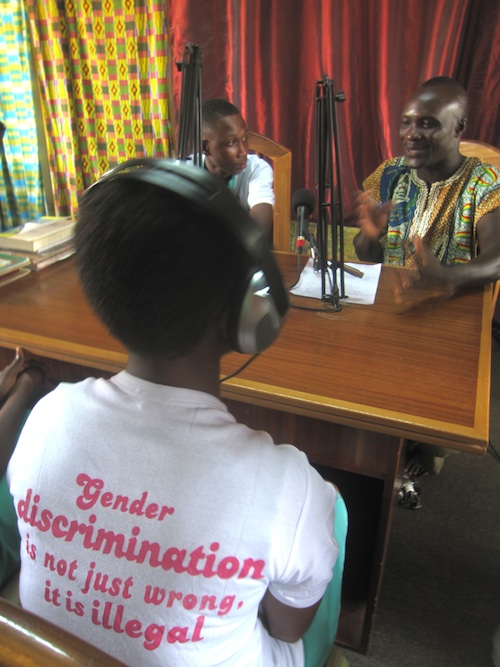
The Girls Making Media project’s goal is to contribute to the elimination of gender discrimination and benefits at least 140 adolescent girls and 30 adult journalists in the most marginalized areas in each country. With this project, girls and adult journalists are trained on various topics aiming at increasing their capacity to produce quality information concerning girls’ rights. It is also empowering girls to advocate on issues concerning their well-being.

In the four videos we focus on the three-year program (which started one year ago) and show the development, achievements and challenges so far. We hear about the effect the project has on the girls and their communities. Also, the girls explain how they see themselves after learning media skills and talking about gender related issues on the radio and TV.

Liberia

Ghana

Sierra Leone

Togo

Girls interact with journalists

Together with the Plan West Africa office in Ouagadougou we developed the idea that the video-shoot should also be an opportunity for the girls to interact with our crews and learn from them. During the filming days there was room for questions and sharing of experiences. We received positive feedback from the crews and the Plan offices about the cooperation with the girls. I would like to use this space to thank the camera-crews who did a great job to create the videos:  Comfort + Yudawhere (Liberia), Wotay + Idriss (Sierra Leone), Paul + Gary (Ghana) and Rodrique + Anselme (Togo).

Let me conclude by saying that I hope to welcome the girls to our network after they have finalized the GMM project!

If you are looking for any content on your activities in Africa, just contact me via e-mail: bertil [at] africanews.com or Twitter: @brutuz.

Read Full Post »

This is a guest post by Joe Pavey who, along with Rebecca Tapscott, interned with us in Cameroon on the Youth Empowerment through Technology, Arts and Media (YETAM) project during July and August. Reading Joe’s post I couldn’t help but think about how positive the contributions of youth can be, and about the attitudes that adults and elected officials need to have in order to encourage youth to engage in actions to make their communities better, and how important it is for communities to show young people that they are valued for the contributions that they make and respected for the role that they play.  

The original post appears on Joe’s blog Yakcast 2.0, titled Youth Led Action in Bamessing.

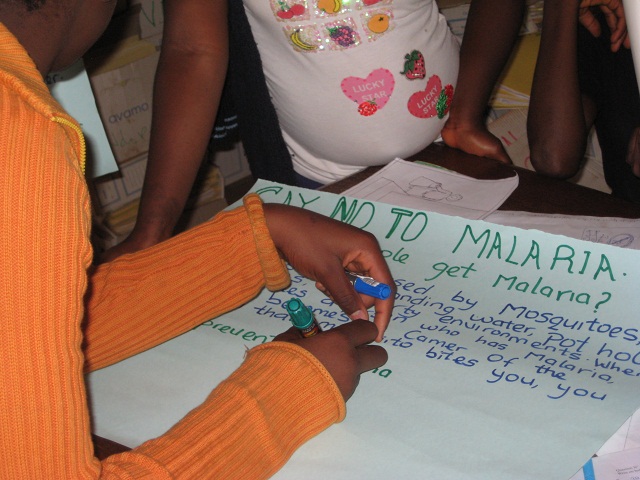
Following the conclusion of the refresher course at GBHS Bamessing, the YETAM youth began work on their first advocacy campaign of the summer. After much discussion the youth decided that the first topic they would take on would be the high prevalence of malaria in their community.

Malaria is one of the biggest killers of children under the age of six in Africa, but lack of health education means many people here still are not aware of how the disease is contracted, and how it can be avoided. Additionally, the direct relationship between cleanliness and the spread of this disease runs counter to many of the choices the environment here encourages. The long periods that often come between availability of running water, forces villagers to store water in containers, and collect it from the frequent rains. This water is frequently left sitting in open containers. Mosquitos will lay their eggs in this water, leading to an increase in the insect population. More mosquitos, means more carriers for the disease, which in turn leads to more people contracting the illness. Additionally, mosquitos tend to thrive in places with tall grass. Lack of funds to clean communal areas often means that shrubbery in public places such as the market square, aren’t cleared regularly. Ignorance of this cycle is what the youth intended to combat. Not an easy thing since explaining these correlations requires the understanding of multiple stages of cause and effect.

In order to get the attention of the village, the youth decided to hold a series of clean-up and sensitization campaigns, intended to illustrate the sort of changes they felt the village needed to make. The first stage was a clean-up at three of the local health centers. The youth divided themselves into three separate groups, and spent several hours clearing brush, dirt, and standing water, from outside these centers. They posted sensitization signs outlining the causes of malaria and what can be done to minimize it. Despite the fact that many of the youth had left town for holiday, there was excellent youth turnout at all three health centers. After the morning of the clean-up these centers were models of how the village should maintain their environment.

Next a major cleanup campaign was performed at the BamessingTown Square, the day before Market Day. Market day here is a huge event, so the time and location of this clean-up had been chosen for maximum exposure. Twenty-four youth and two facilitators (myself included) spent nearly seven hours cleaning brush, shoveling dirt, and picking up trash to make the campaign a success. The youth took turns documenting this work with both video and still cameras. When the clean-up was completed they hung signs in main areas of the market urging the community not to dump dirt and trash in the market square. Another sign was created instructing people to a landfill pit where waste could be properly disposed.

The next morning, when Market Day was in full swing, the youth headed down in their bright yellow YETAM t-shirts to explain to market sellers and patrons what they had done and why they had done it. Their message was well received. Community members were thankful for the hard work the youth had performed, and therefore open to hearing their advice. At the end of the day there was a marked increase in people disposing of their trash appropriately.

Finally, the youth invited members of the village community and high-ranking officials to a workshop to discuss the causes of malaria and what could be done about it. My colleague Rebecca had arranged for a Peace Corps volunteer working on health education to come to the event to give a brief presentation. Unfortunately, only one community member apart from YETAM youth and facilitators attended the workshop. Thankfully this attendee was a member of the Sanitary Committee, so all was not lost. She arrived to the workshop quite late (just as we were finishing), so a short recap was given for her benefit.

The woman from the Sanitary Committee requested that the youth express their concerns to the village council, which they did two days later. The council was happy to receive the youth’s concerns and invited them to sing the national anthem at a special ceremony celebrating the arrival of the District Officer later in the week.

This ceremony turned out to be the closest thing to a festival I experienced during my time in Bamessing. Well over 1000 villagers attended the event. There was dancing and singing. There were masked characters called Ndobo, who shook fistfuls of brush at passers-by. (Check out this link for a great post on Ndobo by Plan USA’s Linda Raftree.) There were Muslim men in full regalia riding bucking, wild horses. There were flute players, and drummers, and dignitaries. Everyone arrived dressed in their finest traditional outfits. The Fon of Bamessing (the village ruler), a proud mountain of a man, oversaw the ceremony from the perch of his throne. If his hulking stature weren’t enough to separate him from the massive crowd outside the palace, he was seated on top of an authentic (and I’m sure locally made) animal skin rug to emphasize his authority.

YETAM was represented at the event in two ways: First, several of the youth led the singing of the national anthem. Second, the President of YETAM Bamessing, Martin, gave a short speech informing the District Officer about the activities of YETAM. His was the only speech not given by a high-ranking dignitary. Martin presented the District Officer with a copy of a Small-Grant Project Proposal To Increase School Attendance in the Bamessing Community which the youth had written for an upcoming advocacy project.

It cannot be over-emphasized how big an event this was for the community, and how impressive it was that the Village Council chose to make the YETAM youth such an integral part of the proceedings. Whether the youth’s efforts will lead to lasting behavioral change in the community is unknown, but it was a fascinating thing to see this project escalate over the course of the month. I couldn’t have had an experience like this without investing the length of time I did here this summer. And for me at least, that made the experience worthwhile.

Read Full Post »

Charles Suglo, Bestway Zottor and Francis Diamenu from Radio Tongu

Sometimes among all the ICT4D hype, we forget about one of the biggest and oldest ICTs there is:  radio.

Last month while in Ghana, I visited Radio Tongu in Sogakofe. The compound where this community radio station sits also serves as a community center, with computer training, a press center and Internet access for a discounted rate.

Plan Ghana staff was meeting with the radio director, Bestway Zottor, and two of the managers, Francis Diamenu and Charles Suglo, to discuss the idea of offering internships for 6-8 youth from the nearby school-based Girls Making Media (GMM) program Plan Ghana and Plan US are supporting.

Charles explained to us that the station gets some 70% of its news from the Internet. The other 30% is sourced from local communities, and recorded on the ground wherever the news is happening. ‘The voice is reality,’ he said. ‘It’s what promises that the news is real. It’s what makes people believe.’ The station broadcasts in 3 languages: Ewe, English and French.

If the youth in the GMM program want to be radio hosts, according to Charles, they need to be well trained and professional, especially since the topics that the youth are bringing up — violence against children and bullying — are sensitive. ‘We have our credibility as a radio station,’ he said. ‘So they need to be well-trained on radio program hosting, know how to manage on air, be skilled on how to ask good questions and follow-up questions.’

There are all kinds of jobs that the youth can do at the radio station, including news, marketing, voice, or running the cafe. Having job skills such as these can begin to give the youth some experiences that will serve them later in life. The training and work they’ve done through the GMM project over the past year give them a foundation for the internship positions at Radio Tongu.

Following the visit to the radio station, we went to the school to meet with the media club. It’s called the  ‘Eye Media Network.’ The group’s slogan is ‘Our eyes are always watching.’

The GMM program began last year with a workshop for 20 of the students on media skills and gender. Following that the Club received a small media kit consisting of digital cameras, voice recorders, a radio, a notice board and Flip cameras. The girls work with 2 advisers and now several boys have also joined the Club. The club plans its own programs and actions, and does a school-wide newscast every Wednesday during the school assembly.

A student reads us the news they've posted on the Notice Board

As part of the program, the Club meets and interviews local and national figures, with a focus on women journalists, government officials and businesswomen. The group has covered school elections and put into place a ‘Walk your Talk’ Accountability initiative.

They conducted a bullying campaign with the goal of reducing the incidence of bullying by 30%. After the campaign, which included posters, educational sessions and other outreach, the Senior Housemaster claimed that bullying had been reduced by 90% compared to the year before. They will begin a campaign against sexual harassment in the coming year.

Some of the challenges that the group faces include posters being ripped down, friends trying to discourage them, boys suffering discrimination for belonging to the “Girls Making Media” club, and not having enough equipment. The club hopes to obtain their own modem, computer, printer and more cameras.

The first week of August, select students from the GMM group participated  in social media training, where they learned how to shoot video, subtitle, access different social networking sites to post their content, and stay safe while online.

The girls in the club said the project has helped them to build confidence and take up leadership positions. ‘We learn how to find information and to bring out problems and get solutions,’ said one girl.

Another said ‘We took bullying as a normal thing. Now we know that bullying is not normal. Now when we see something, we are alert.’

‘I used to walk around without seeing,’ added another ‘but now I see everything because I am looking for news. My mind has been opened.’

The Girls Making Media program covers 7 schools in Ghana. Several other groups in Togo, Liberia, and Sierra Leone also participate in the GMM program.

Read Full Post »

« Newer Posts - Older Posts »