Feeds:
Posts
Comments

Archive for the ‘politics’ Category

FMLN guerrilla with rifle poised in town of Chalatenango, El Salvador, 1988. This photo is from the article referred to below. Original at http://www.ontheissuesmagazine.com, Winter 1994.

A version of this post was originally published on the Peace Dividend Trust blog.

I lived in El Salvador for about 6 months during the civil war and over 9 years post-conflict.  So I was quite interested in the Society for International Development (SID) Congress July 30th panel on the “Nexus of Conflict and Development.”

The panel was composed of a high-powered, high level group of men*, presided over with humor and grace by a woman of the same caliber, Tessie San Martin, President and CEO of Plan International USA, SID Board Member (and my boss!).

Arthur Keys, President and CEO of International Relief and Development introduced the panel, asking questions like:  Can development be done in a conflictive environment. Is settlement of conflict needed before development can take place? Can development assistance be used as a tool for peacemaking?

Keys noted the changing, fluid environments in conflict zones and their inherent complexities – the interconnectedness of many variables that cannot be addressed in isolation.

Within that context the panelists discussed a variety of issues, from the changing nature of conflict and violence, to the pillars of post-conflict reconstruction, to local ownership and local government credibility and legitimacy to the role of the military in ‘delivering’ development to front loading funds in conflict areas to USAID branding in conflict zones. Listening to the discussion, I realized many of the questions that we were asking ourselves 20 years ago in post-conflict El Salvador are still unresolved today.

One of the most interesting conversations of the panel was catalyzed by San Martin’s question on local ownership and legitimacy. “We’re talking about ownership and local voices, but one question is whose local voice? There are a number of vulnerable groups,” she said. “How do you deal with the question of ‘whose voice’?”

Donald Steinberg, Deputy Administrator of USAID, answered by telling the story of his experiences negotiating a peace agreement in Angola under Bill Clinton.

“When I was asked how this agreement benefits women, I answered that not a single part of this agreement discriminates against women,” he said. “But what I learned is that a peace agreement that calls itself gender neutral is actually working against women.”

The Angola agreement was based on 13 separate amnesties, he said.

I learned that ‘amnesty’ means ‘men with guns forgive other men with guns for crimes committed against women.’”

Steinberg went on to comment that the closest woman to the peace process in Angola was a female interpreter, who would “raise her eyebrows when we men did something stupid.”

He described the peace agreement as being “come and hand in your weapons and you get benefits.” But most women involved in the conflict were not bearing arms, they were playing other roles. So when demobilization came, they got no benefits. On top of that, “we sent men back to communities where women had become very empowered in their absence,” he said. “The men returned and there was no role for them. Many drank off all their benefits. They started beating their wives. The incidence of sexual aggression rose. So you saw that the end of the one conflict brought about a new insidious form of violence against women.”

Another area where the peace agreements forgot about women was in de-mining activities. “We cleared the roads of mines,” said Steinberg. “But we didn’t clear the fields. The water points. Places where women gathered wood. As communities returned home, and women went back to collecting water and firewood, they were blowing their legs off with remarkable regularity.”

The peace process started to fall apart a couple of years later, he said, but by then it was too late to bring women’s organizations into the process. “We tried to work with women’s groups but they would say, ‘This isn’t about us, it was about the men with guns. It hasn’t involved us at all.’” The country erupted into war again.

Steinberg said he was happy that USAID is addressing these issues now. “The first thing I put into place was support to women’s participation in peace processes and to provide them with protection to do so, as it’s dangerous for women to be involved in this work. Nothing about them without them – this is our phrase,” he said, and cited UN Security Council Resolution 1325 as a strong influence on him:

“The Security Council adopted resolution (S/RES/1325) on women and peace and security on 31 October 2000. The resolution reaffirms the important role of women in the prevention and resolution of conflicts, peace negotiations, peace-building, peacekeeping, humanitarian response and in post-conflict reconstruction and stresses the importance of their equal participation and full involvement in all efforts for the maintenance and promotion of peace and security. Resolution 1325 urges all actors to increase the participation of women and incorporate gender perspectives in all United Nations peace and security efforts. It also calls on all parties to conflict to take special measures to protect women and girls from gender-based violence, particularly rape and other forms of sexual abuse, in situations of armed conflict. The resolution provides a number of important operational mandates, with implications for Member States and the entities of the United Nations system.”

Ambassador Rick Barton, US Representative to the Economic and Social Council of the UN, agreed that the role of women is critical, and “it starts with who’s negotiating the peace process.” Barton noted that the percentage of women in peace negotiations is 5-7%, and that it’s a recurring concern. “If you are not there at the start of the race, it will be designed in a certain way and you will be disadvantaged. I’m hopeful that the UN Women’s Commission, led by Michelle Bachelet will bring attention and focus to this issue.”

“What about men and boys?” a woman in the audience asked. “It’s great to empower women, but what are you doing to change the attitudes and beliefs that men have? How can we get them to realize we are equal?”

Barton agreed that getting men’s attention is critical. “These are not women’s issues, they are society’s issues. Men and boys need to come a long way.”

“It’s easy to work on gender with this administration,” commented Steinberg, noting that USAID is trying to institutionalize it through the position of Senior Coordinator for Gender Equality and Women’s Empowerment. “It’s not only about protecting women or about victimization,” he said. “It’s about changing attitudes and instilling into our DNA the notion that women are key to building stable societies, ensuring sustainable growth and recovering from conflict situations. We need to focus on gender in addition to women.”

Sitting, there, listening to the panel discussions, I kept thinking about a Salvadoran friend from some 20 years ago. She was from a ‘conflict zone’ but would have never called herself an ex-combatant. For several years, she had moved around with the guerrilla, cooking and supporting the cause, but didn’t carry a weapon. Post conflict, she had lingering health problems stemming from that period, when she had been chronically malnourished. During her time with the guerrilla, she had contracted glandular TB, a condition that embarrassed her. At 34 years of age then, she had the ruddy, freckled and fresh face of a young girl, but she wore dentures as she had lost all of her teeth. She worked cleaning an office and always struggled financially. I’m not sure she ever got any benefits from demobilization.

I’m also reminded of a rather large post-conflict program that I was responsible for monitoring at the time, together with a few other privately funded donor agencies. Aimed at providing community-based psycho-social support to returning ex-combatants in several zones formerly held by the guerrilla, the program ended up mostly supporting women and children who were suffering domestic violence at the hands of the demobilizing men. The male ex-combatants either didn’t feel they needed psycho-social support or didn’t want to face the stigma of seeking it out, but the women took advantage of it. Community psycho-social support agents fully recognized that they were treating a secondary effect and not addressing the real causes of the violence.

According to a 1994 article by Betsy Morgan in On the Issues Magazine, ”Nearly one third of the FMLN guerrilla forces, who fought for 12 harrowing years in the mountains, were women. But neither of the restructuring plans [that of the government or that of the rebels] directly addressed women’s issues: equality in education, health care, job opportunities, and legal justice in instances of rape and domestic abuse…. Two female commandantes from the FMLN were on the negotiating team. However, when the peace accords were signed on January 16, 1992, all the signatories were male. The subsequent reconstruction plans called for demilitarization, but neither the government nor the FMLN addressed the hidden violence – domestic abuse, rape and incest – that invariably accompanies a military climate of violence, and neither side made provisions for the fair treatment of female ex-combatants, particularly in terms of land tenure. It can only be concluded that for all of the women’s influence during the war, at the point of peace, the women’s movement was still seen as a thing apart from the arena where real decisions were made.”

There were women involved in all aspects of the war, including negotiating the Peace Accords in El Salvador, but it didn’t guarantee that women’s needs were addressed during the negotiations.  It didn’t ensure that the post-conflict programs agreed to in the Accords were fully funded or that programs were designed and planned with participation of those they were meant to benefit or that women got fair treatment. It did not guarantee that the different efforts were non-politicized or that they were well-implemented. As Keys pointed out when introducing the panel: the nexus of conflict and development is a complex place, with every element impacting on every other, and as Steinberg and Barton pointed out, it’s not only about women, it’s about gender.

I’m glad to see the discussions taking place, and I hope that experiences, failures and successes from places like Angola, El Salvador, Colombia, Iraq, Afghanistan and so many others are fully examined and shared to see what more can be done to create environments where women are in decision-making roles before, during and after conflict; where the broader implications of gender and gender roles are considered; and where both women and men who achieve positions of power are really reaching out to, listening to and representing those who don’t have a seat at the table.

*Members of the panel:

Tessie San Martin, President and CEO, Plan International USA and SID Board Member (moderator)

Ambassador Rick Barton, US Representative to the Economic and Social Council of the United Nations

Alonzo L Fulgham, Vice President, IRD

Donald Steinberg, Deputy Administrator, USAID

Tom Wheelock, Vice President and Sr Director, Communities in Transition, Creative Associates

Read Full Post »


Ernest training youth in Okola.


In  Garoua, Cameroon last week at a Training of Trainers meeting for the Youth Empowerment through Arts and Media (YETAM) Project, Ernest Kunbega Gwanvoma from GIMAC (Geographic Information and Management Center) took us through the youth digital mapping process that he and Plan staff and other partners facilitated this past year.

Ernest’s presentation is posted below (with his permission), along with some comments from the rest of the group.


Why Digital Mapping?

In line with YETAM’s emphasis on use of new technology in youth and community development work, Plan introduced the use of GPS and digital mapping. Training the youths in the use of GPS and digital mapping permitted them to map out their council areas and create an information system, including the road network and other socio-economic infrastructure of their area. This exercise exposed the youths to the realities of their environment, for it took them to all the nooks and corners of their area. This way they could easily identify the problems of their communities and share with their peers all over the world. And what better way than to indicate all this than on a map? Eventually the digital maps produced will be used to track cases of violence, gender discrimination and community development planning issues. They will be used locally and shared on Open Street Map to a wider world community.

Mapping in Ndop Council Area

Objectives

The general objective of the exercise was to produce digital maps for 3 council areas; Ndop, Pitoa and Okola, where YETAM projects are being implemented. To accomplish this, participating youth were trained on the use of GPS for field data collection. They created way points of socio-economic infrastructures for their areas. A data base on all the socioeconomic infrastructures mentioned above was created. The youth also tracked the road network of their council and put it on the digital maps. This information was all uploaded into Open Street Map.

Methodology

We used the following working methodology:


  • Training of students /community youths in the use of GPS for field data collection, its potential uses and practical sessions
  • Elaboration of data codification sheets and production of waypoint forms/tracking sheets and data collection sheets for schools and health centers
  • Collection of field data
  • Analysis of data and production of digital maps
  • Uploading of digital map into Open Street Map


Data codification sheet, way point forms and data sheets


Training youth to use way point forms.

During the theoretical sessions, the youth worked in small groups to brainstorm the data that they wanted to collect about their communities. Community members and Plan staff with experience in data collection, advocacy, research and development programs gave input as well. A final set of data to collect was agreed upon, including schools and health centres in all 3 council areas.  Each group (from Ndop, Pitoa and Okola) also had its own particular aspects that it wanted to map out, based on local context.

To enable the youths collect field data in an organised manner field documents were created and made available to them, including:

  • General codification sheet
  • Waypoint form
  • School data information sheets
  • Nursery school information sheet
  • Primary school information sheet
  • Secondary school information sheet-General Education
  • Secondary school information sheet-Technical Education
  • High school information sheet
  • Health centre information sheets
  • Tracking sheet


GPS practice in Pitoa

Collection of field data

In each locality, the start off was at the District officer’s office where a cover letter or letter of introduction explaining the rationale for the field exercise was collected. This letter was presented in the communities as the need arose to avoid any form of embarrassment from the community.

The data collection exercise in was carried out by community youths, students, resource persons and the consultant’s team. In Ndop and Okola, the Partner Vision (PAVIS) and IRONDEL staff (respectively) and all resource persons were involved in the data collection. The student youth population was not available due to classes, so the out-of-school community youth who were involved in the training did the data collection. In Pitoa the staff of Solutions Technologiques Alternatives (STA) and all the resource persons were involved in the data collection. The community youths and the student population participated intensely in the exercise for they had just finished with their examinations and their principal gave them permission to participate in the field exercise during school period.

Formation of Groups

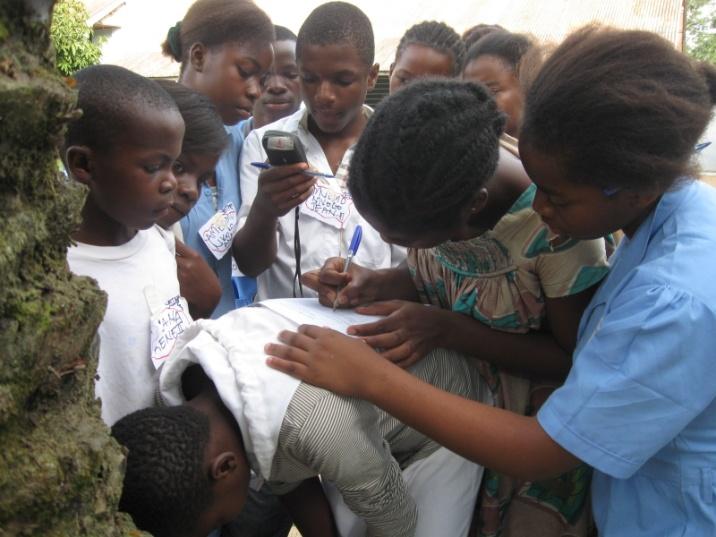
Youth filling out way point forms in Okola

To facilitate field data collection in each of the council areas, field groups were created, headed by a resource person or a staff of the consultant. The groups were allocated an area of work. One group was in-charge of tracking all the road networks and the rest of the groups collected waypoints and data on socio-economic infrastructures.

In places where the information sheet (data collecting forms) could not be filled instantly, the forms were dropped off to be filled by the competent authorities and to be collected later, this was the case especially with schools. Cars and motor bikes were hired to transport data collectors to the field in each locality.

At the end of each day, a review of the day was done; problems, lapses and wrongly collected information were pointed to the different groups for corrective measures to be taken.

Downloading /converting  GPS  Data

To be able to analyze the GPS data the waypoints and tracks were downloaded and saved in appropriate formats that could be visualized in JOSM. (Waypoints-GPX and text format, Tracklogs-GPX and DXF formats)

Attributing waypoint types

Students collected data to link with the way points, for example at this school in Pitoa

Based on the field data collected attribute tables were built for schools and hospitals etc. The data collected on schools and other aspects were triangulated for accuracy (when possible) with data previously collected by Plan or available from local government offices.


Production of digital maps

To produce the digital maps of the three council areas the JOSM offline editor was used. The waypoints and tracks were loaded into JOSM. The waypoints were digitized and appropriate attribute information assigned to them as tags. The tracks representing the road network were also digitized using JOSM.

Uploading and visualization of the digital maps

The produced maps were uploaded using JOSM to the Open Street Map site with online connection as soon as they were finished. The maps can be seen at the Open Street Map site.

Challenges and constraints

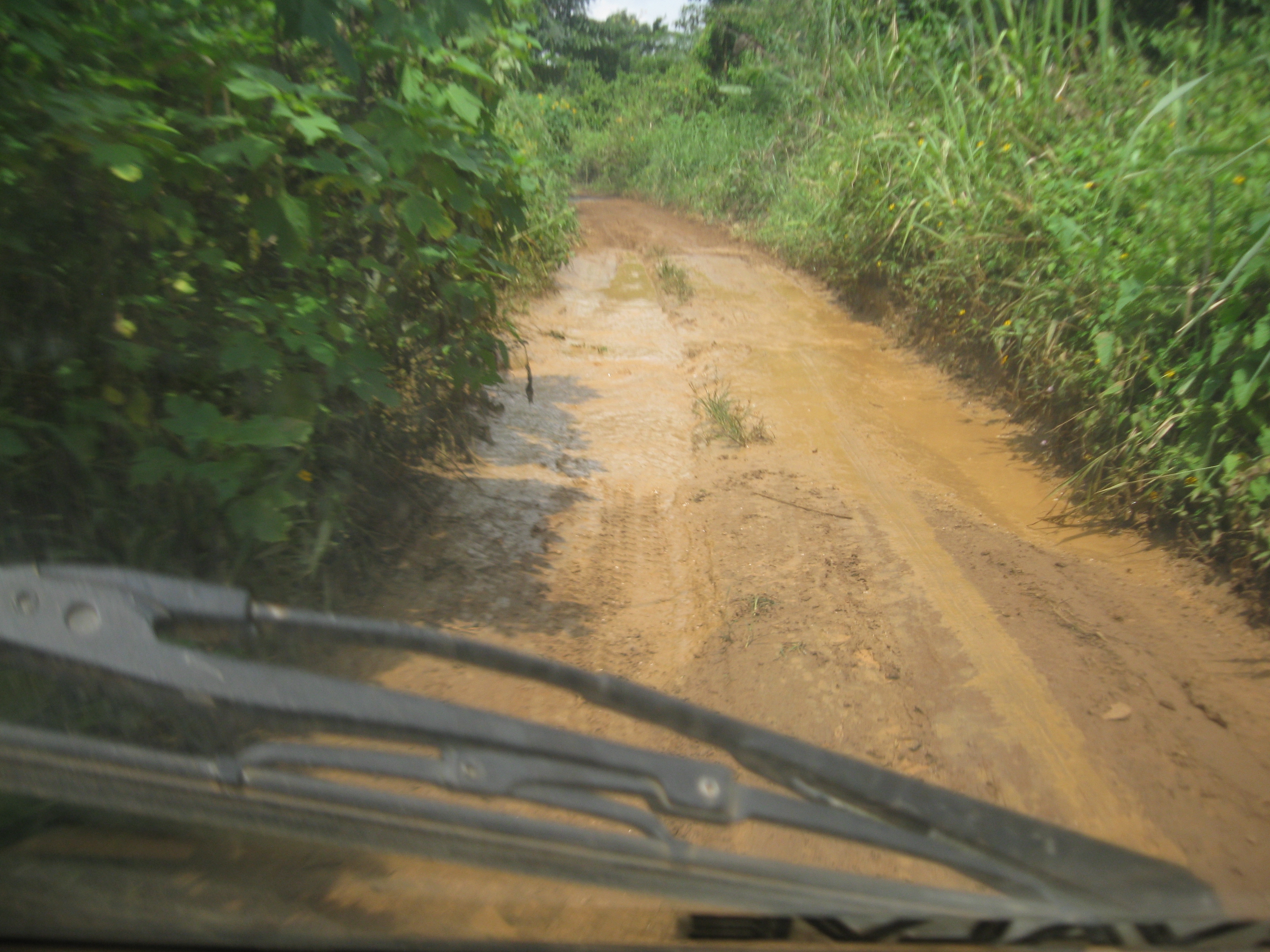
Bad roads made the mapping difficult in areas where vehicles and motorbikes couldn't pass after a certain point.

  • The student population was not fully involved in the actual field data collection in some communities because they had to be in class, so we worked only with the out-of-school youth population.
  • In Ndop and Okola, rain disrupted field activities and work had to slow down given the bad nature of the roads, which became very impracticable to vehicles and bikes, making the whole exercise difficult, strenous and time-consuming.
  • It was not always easy to arrange for transportation.
  • Most of the students and drivers did not know their full community areas well, so local community guides were recruited to take teams around.
  • In some of the areas the data sheets of schools could not be filled because the head teachers were not available.
  • In one particular area, a head teacher deliberately refused to fill the forms demanding bribe from the youths.
  • In some of the schools the head teachers had no information about the student enrolment and as such the youths had to go to each class and count the students themselves which was time-consuming.
  • Youths had to trek long distances in some of the inaccessible villages by vehicles because roads were very narrow.

Discussion

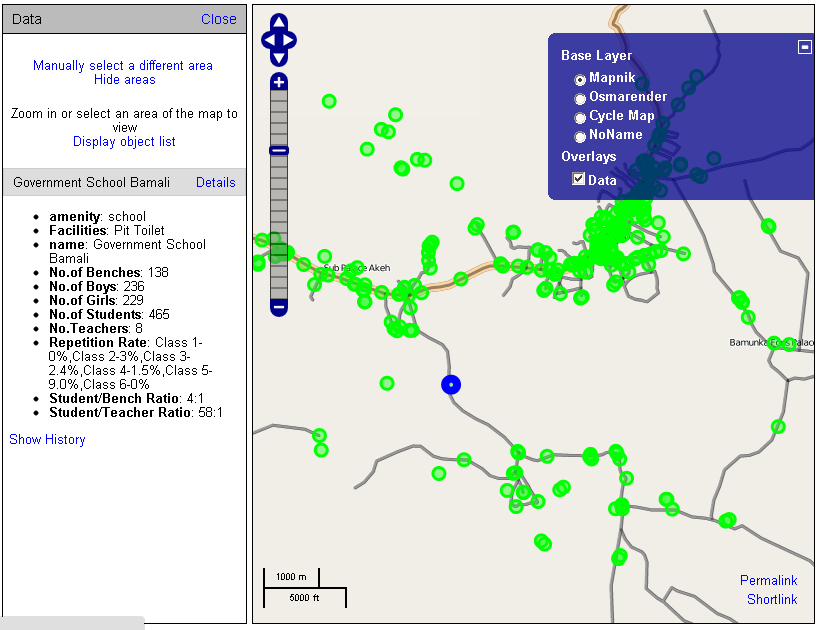
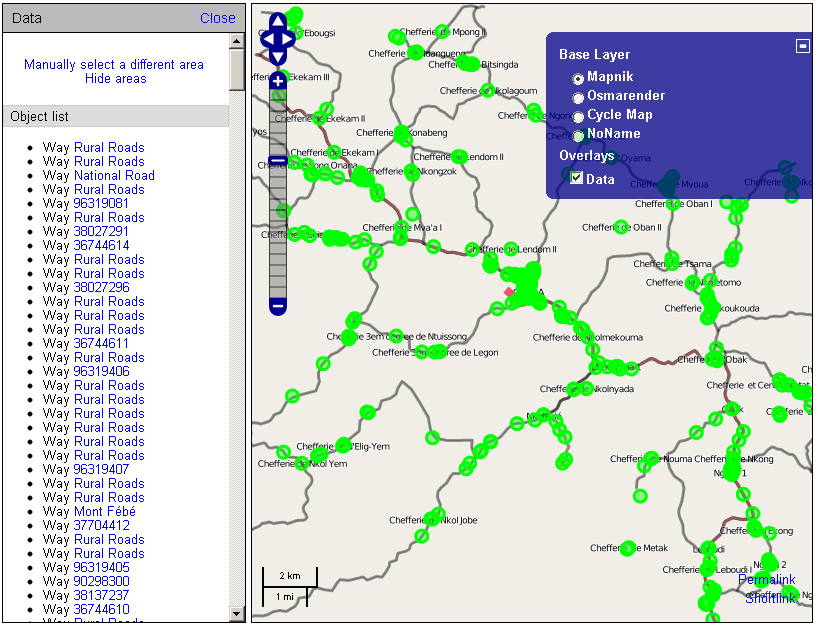
Despite the challenges faced during the field data collection the mapping exercise was quite successful. Having the digital maps is a real achievement. Having a solid data base attached to geographic location will be a powerful tool to support the youth’s local advocacy work. (Live version of the map is here. To see data, turn on the data layer as shown in the image below by clicking on the blue tab on the right side of the map.)

Open Street Map image of Ndop with data layer turned on. Data to the left belongs to the blue dot near the center of the map.

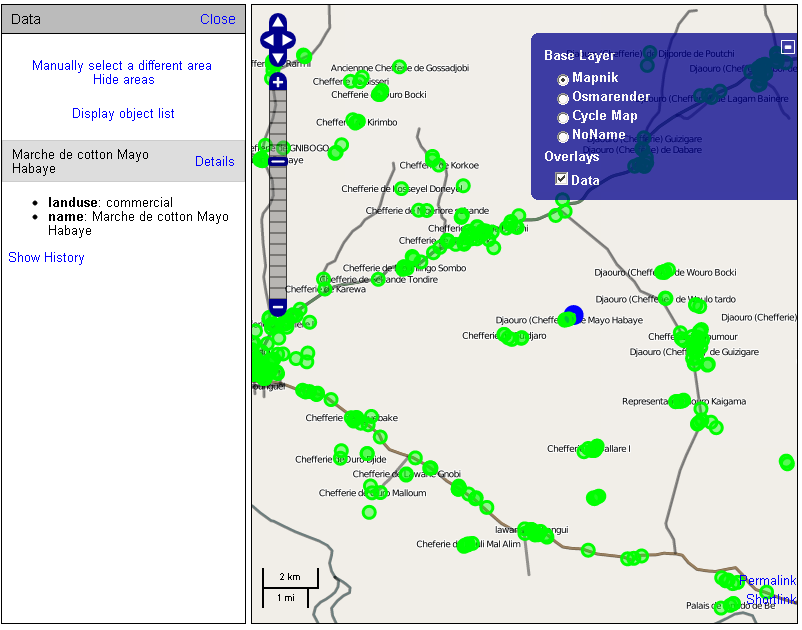
Pitoa Council Area with data layer. (Visit Open Street Map for interactive view).

Okola Council Area with data points. (See Open Street Map for interactive map).

The group at the workshop (PAVIS, IRONDEL and STA partners, Plan staff and Ernest himself) concluded that digital mapping was a good exercise. One participant commented that the heads of the school hadn’t been aware of the importance of collecting data about their own schools, and the mapping exercise motivated the youth and the head teachers to begin to collect and track data, to look at the status of their building structures and to count their students.

Others commented that the mapping exercise is a tool that really takes the youth around to their environment. Many of the youth only knew specific parts of their communities, but the digital mapping exercise brought them around to the entire expanse of their community. It gave them a reason and an opportunity to get to know the realities of their environment.

The group agreed that in the future, it would be advisable for hand-drawn mapping followed by digital mapping to take place as the very first step of the project, before other project activities (arts, media and advocacy efforts) happen, because the mapping provides the youth with a deeper awareness of their communities and the main issues therein. It also allows them to collect solid data as well as a visual tool that they can use to then carry out their advocacy activities with local councils. (Note: This year, hand drawn mapping was done as a first step, then the arts and media activities followed. Because it was a new activity requiring additional training and preparation for staff and partners, the digital mapping was done in as third step).

One question the group will explore is how to train and support the local councils (who have responsibility for decentralized community development in Cameroon) with IT equipment so that they can keep the maps updated and/or create new digital maps on their own.

These same maps will serve as a base for an additional phase of the project that will involve tracking and mapping cases of violence against children and gender based violence and working with local communities and local government social services to raise awareness about violence and to prevent and respond to cases of abuse. (Similar to the VAC Benin project).

Read Full Post »

If you are from an outside group that wants to work with a community, you need to know the community. You need to spend time there, sleep there, live there, before trying to help or come in with recommendations. Until you have lived together with the community, you cannot really give any savvy advice or support because you won’t know or understand the community’s reality. You won’t have ‘mastered’ the community.’

Kenneth Nyah from Partner Vision (PAVIS), the organization we are partnering with in Bamenda, Cameroon, on the Youth Empowerment through Arts and Media (YETAM) Project, gave us some great tips last week on how to do community-based, youth-led advocacy and support local action and change.

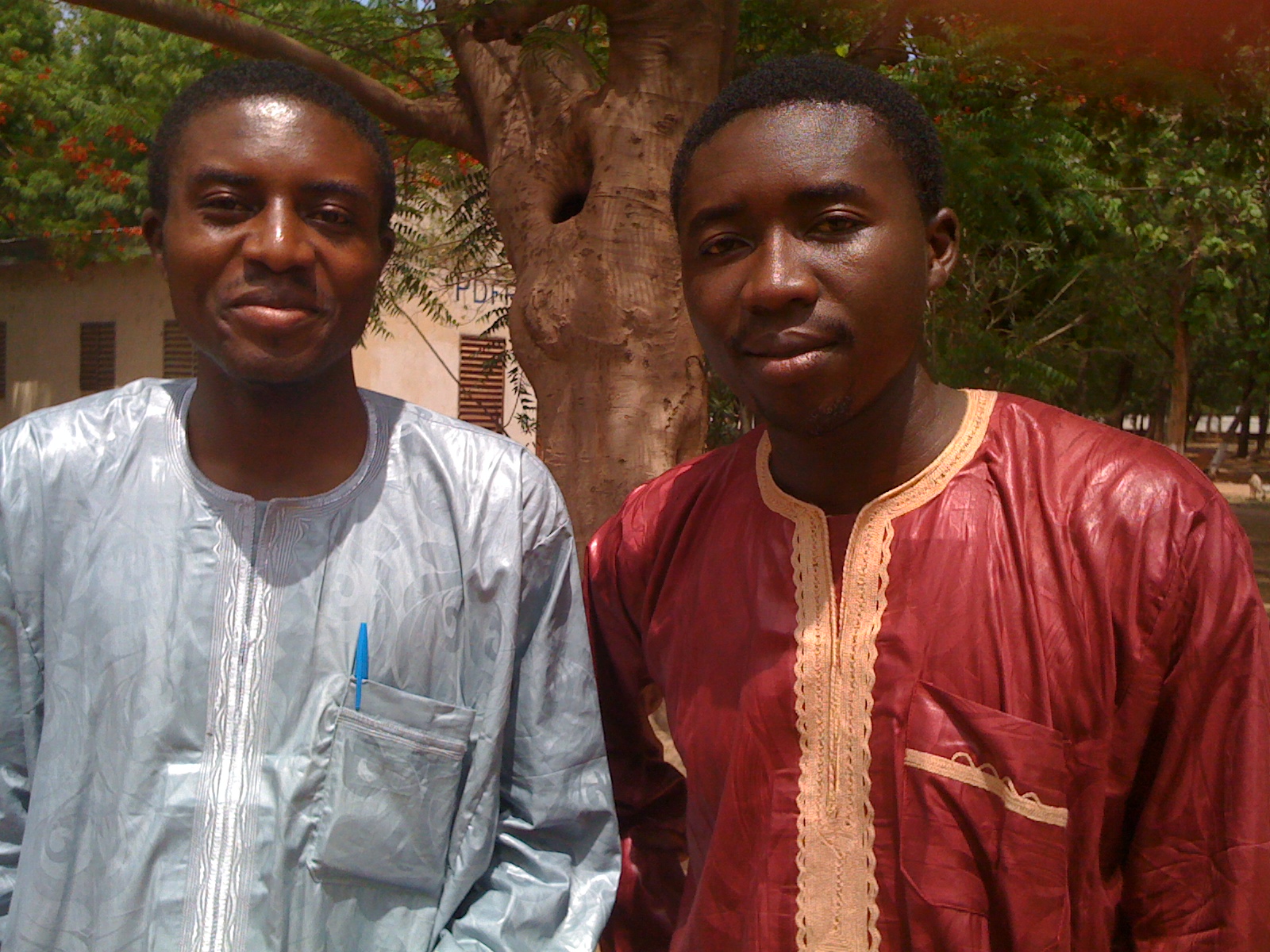
Timothy and Kenneth from Partner Vision (PAVIS)

Know the steps for good advocacy

  • Identify the issue that needs to be addressed.
  • Master the community by spending time there.
  • Identify the principle actions to take in the community, together with all the stakeholders.
  • Gather information and statistics that will support the case and help to shape the suggested solutions.
  • Synthesize information and statistics to make them easier for people to get a handle on and understand.

Model good advocate behaviors

  • Participation. All the stakeholders need to be included and the discussions need to be open.
  • Legitimacy. An advocate should be someone who practices what he or she preaches and lives the values that he or she is working for.
  • Accountability. An advocate has to be transparent and open and accountable for his or her actions and to the community.
  • Acting peacefully. An advocate should always look for ways to resolve issues in a peaceful way.
  • Representing the affected group. An advocate should be sure to understand the affected groups’ issues and viewpoints and to represent them, not his own opinions or agenda.

Be clear about your role as an outside organization

Kenneth described the main roles of an advocate or organization supporting local advocacy work as:

  • helping to empower the community to speak for itself
  • mediating and facilitating communication between people
  • ensuring that communication and dialogue happen
  • modeling behavior to people and policy makers
  • helping build coalitions so that local people can raise their issues and get resolutions.

Know what advocacy is not

  • An information campaign. Hanging up posters is not advocacy. You have to go deep into things, to take actions, to actually do something, not just ‘raise awareness’ or share information.
  • A public relations action. Advocacy is not an opportunity for you to create fame for yourself or your organization or political agenda. It’s about the community.
  • A strike or mob action. Advocacy should be strategic.
  • A pressure group. Advocacy does not mean ‘we want something and we are coming in to take it whether you like it or not.’

Remember who this is about:

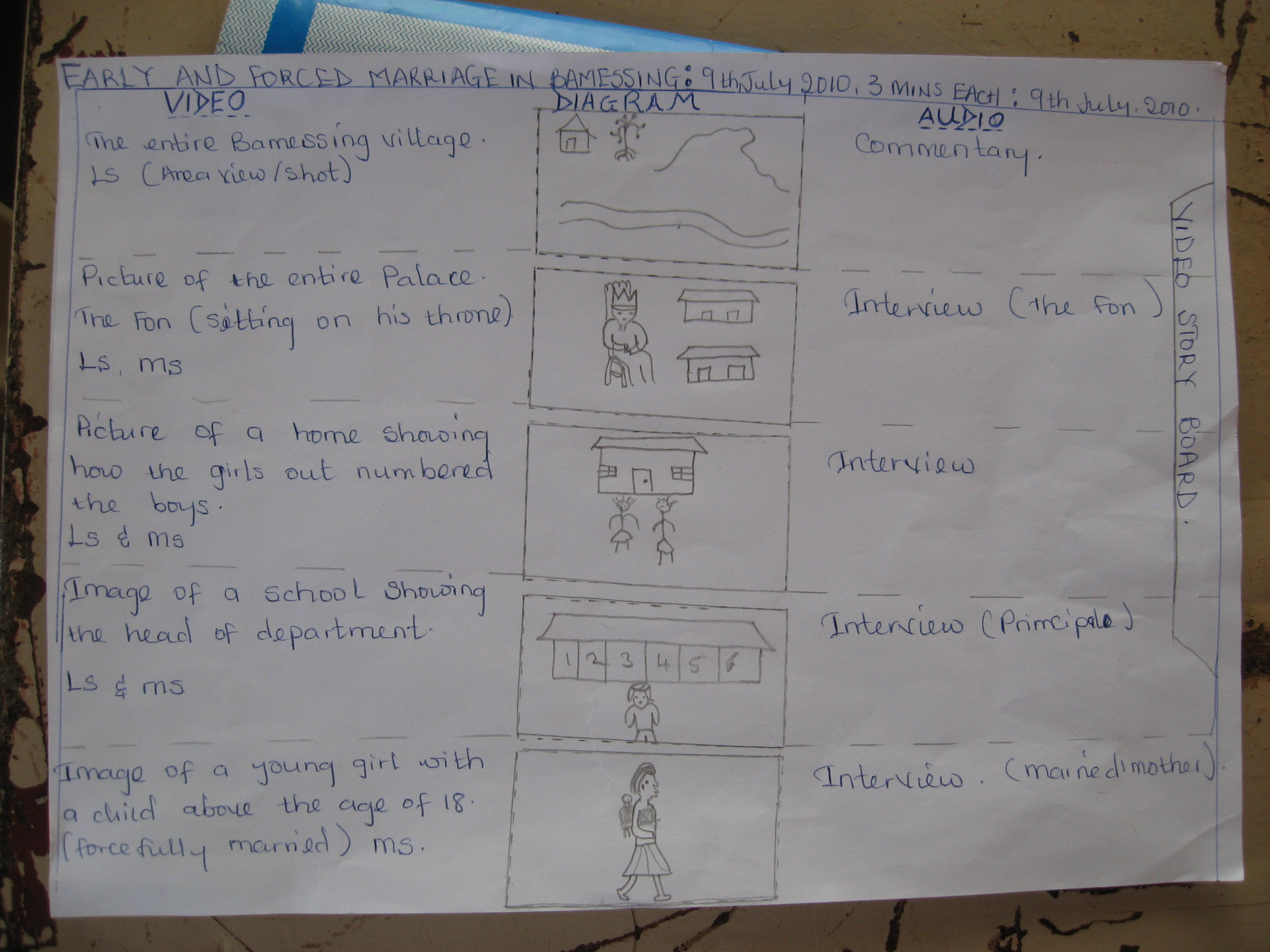
First half of a storyboard by youth in Bamessing for video on early marriage.

You shouldn’t do advocacy without proposing a solution, said Kenneth, and the solution should come from the community itself, not from you. In community-led advocacy, the outside agency should not be bringing in its own agenda. It should not be manipulating people.

When working with youth, the agenda needs to come from the youth themselves. If the youth don’t have their own agenda, it’s very easy for people to manipulate them. Once you work with the youth to help them discover their community more, and to determine their own agenda for change, they will work on that and it can be very positive.

Youth-led and community-led advocacy is different than global advocacy campaigns which tend to be top-down. When people raise their own issues at local level, do their own research, identify their own solutions, discover the bottlenecks that get in the way of those solutions, and determine who to target with their advocacy actions, advocacy can be very effective.

One participant emphasized that even in global campaigns, local stakeholders need to be involved, because they are the ones who will give the stories, the statistics, and the effective solutions.

Find the information that already exists in the community

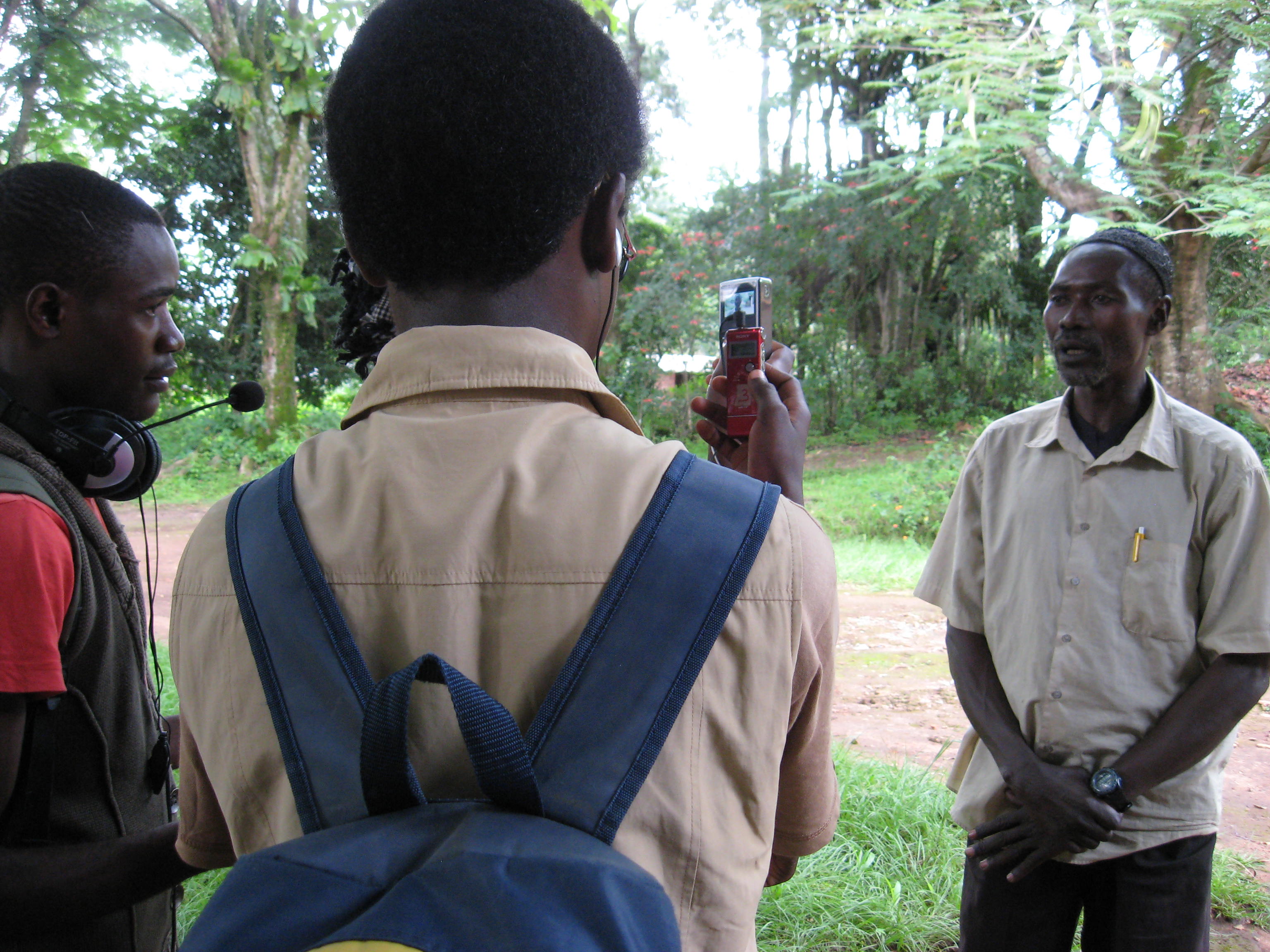
Collecting information.

Advocacy goes with facts and figures. You cannot do advocacy without figures, said Kenneth. And you cannot have figures without research. But there is much information that is already there, right in the community. ‘As outsiders,’ commented one person, ‘it’s easy to imagine that a community doesn’t have any information, but this is not true. We found so much information in the community.’

‘All the facts that youth needed to advocate for the water project* were given by the people in the community. The youth know who the key people are in the community. They know who has the information and the statistics. For example, there is a person who manages the local water system and who knows what the problems are with it. There is the chairman of the water board. These are people in the community who manage information! They have reports, they have meetings, they know these things. There is no need to come from the outside to do a big expensive data gathering campaign. You can go into the records that the community is already keeping. Working with the youth and community it’s very possible to find this information to support local advocacy.’

A role for ICTs

Another person shared the case of youth in Pitoa who identified malnutrition in the community. ‘The parents didn’t  identify malnutrition as a problem, they said it was not an issue. Maybe they were embarrassed that they were unable to give their children enough food. But the youth went with cameras, they filmed malnourished children, they went to the hospital to check the numbers. There is a whole ward there with malnourished children; they filmed there.  They made a video and showed it to the parents and the council and were able to get them to see that this is a problem in the community.’

The digital mapping that we are doing with the YETAM project (watch for a new post coming soon on this), said other participants, can provide the youth with an additional tool for local advocacy. ‘Youth went out to map their area. They saw the road network, they created a database about their schools, they saw the conditions of the hospitals and everything. Through mapping they were able to master their environment because they were there, collecting the data, tracing and making waypoints of everything. This fed very well into their advocacy work.’

*In this water project example, youth used their research, videos, interviews, focus group discussions and role play to advocate to community leaders, the village development union and the Ndop Rural Council around the water issue. The Ndop Council acknowledged the issue and Bamessing and its neighbouring communities succeeded in securing funding from FEICOM for the first phase of the Ndop water supply project for 214 million CFAs (around $450,000). Feasibility studies were done by the Ministry of Water Resources and Energy in collaboration with SNV and submitted to the Ndop Council. The project is expected to provide potable water in Bamessing, Bamali, Bamuanka rural and Bambalang communities.

Other successes of youth-led advocacy in the YETAM Cameroon project include that the Municipal Councils of Pitoa and Ndop approved financial support to youth micro-projects.  The Mayor of Pitoa municipal council approved 400,000 CFA (around $850) for the youth to spearhead actions to curb the high incidence of cholera in the council area. The Mayor of Ndop Municipal Council approved 500,000 CFA (around $1070) as council support for the youth to fight against the high rate of school dropouts in the Ndop council area. This support came in response to youth participation in the council budgetary sessions.

Read Full Post »

Where are the spaces for youth participatory governance?

‘People no longer rely on governments alone to improve governance. All over the world we are seeing experiments in ‘participatory governance’. People and organisations are grasping the opportunities offered by decentralisation and other reform processes to demand more of a say in the public policy and budget processes that affect them. These ways of holding the state to account are often called ‘social accountability’. Examples include participatory budgeting, monitoring electoral processes, using online and mobile technology, and citizen evaluation of public services. These forms of citizen engagement and social accountability are particularly promising for young people, who often face challenges in getting their voices heard in formal policy and governance processes.’

The ‘youth bulge‘ is impacting or will impact hugely in many countries in Africa, but there is limited documentation on youth involvement in social accountability processes in Sub-Saharan African countries. Youth and governance efforts have been ‘largely unsystematic and often constrained by the vague and paternalistic parameters of the UN Convention on the Rights of the Child (McGee, forthcoming 2010). However this is changing and there are calls for new models, tools and approaches that enable young people to take a more meaningful role in decision-making.’ (call for submissions for the upcoming Participatory Learning and Action Journal (PLA) special issue on Youth and Participatory Governance).

****

In March I attended a “writeshop” put on by Plan UK, the Institute of Development Studies (IDS), and the International Institute for Environment and Development (IIED) to share different youth participatory governance initiatives, reflect on challenges and successes therein, learn how to write better, and finalize articles on the above topic for a PLA Special Issue in December 2011. The special issue will highlight some of the different ways young people are engaging with government to participate in public policy, planning and budgeting processes at local, national, regional, and international levels. Practitioners, youth and government officials from Kenya, Zimbabwe, Sierra Leone, Nigeria, Mali, Senegal, Lesotho, the US, the UK, Ghana, Germany and Liberia attended the writeshop. (The PLA will also have articles from Cameroon and Somalia).

The first day we did a cool exercise revolving around 4 statements on voice, youth, participation, and governance. I learned a lot from the discussion and I wanted to share it here.

So, what do you think? and why?

Statement 1. The author’s voice will always be louder than the voices of the people he/she is writing about.

Strongly agree ___

Agree ___

Disagree ___

Strongly Disagree ___

Statement 2. Increased transparency leads to increased accountability.

Strongly agree ___

Agree ___

Disagree ___

Strongly disagree ___

Statement 3. It is possible to do governance work without engaging in politics.

Strongly agree ___

Agree ___

Disagree ___

Strongly disagree ___

Statement 4. Citizen led/social accountability processes offer more potential for youth than traditional accountability processes.

Strongly agree ___

Agree ___

Disagree ___

Strongly disagree ___

****

Here’s what we discussed at the writeshop. I’d be interested in what you think about the statements too…

Statement 1. The author’s voice will always be louder than the voices of the people he/she is writing about:

Discussion: The group mostly concluded that it’s difficult for the author’s voice to stay in the background – it will inevitably jump out and become stronger than the voice of those he or she is writing about.

‘Regardless of that, the author has been given an opportunity to project the voices of those that don’t have a platform to speak for themselves, so he or she should take advantage of the opportunity.’

‘Just by choosing what goes into the piece, the writer is already showing some type of bias. One or the other idea or opinion will be louder than the others because it serves the author’s own purpose.’

‘Writers need to think carefully about their approaches as authors and be self-aware of what biases are coming through in their pieces. This is an issue of credibility.’

‘One thing to aim for in our work with youth is finding more opportunities for them to author their own stories, because they can speak louder and stay true to their own agendas.’

‘How many of us here sat down and wrote our submissions together with youth? What are some methodologies that we can use to ensure that youth are writing about their own work, rather than always being written about?’

Note: Some methods for involving youth in the writing process will be covered in the upcoming Special Issue, based on experiences from the group attending the writeshop.

Statement 2. Increased transparency leads to increased accountability.

Discussion: Most everyone disagreed with this statement, saying that there is no causal relationship between transparency and accountability.

‘Many civil society and faith-based organizations really engage citizens, but if you look deeply, that engagement hasn’t translated into accountability.’

‘Including people in governance and keeping them informed about what is happening can lead to accountability. People will start to take responsibility, report about actions. If they are involved, included and informed they will start to question things.’

‘There is not always a causal link between transparency and accountability.’

‘Having transparent information is one thing, but accountability is what you actually do with the information. Having the habit of discussion, questioning is one thing, but ensuring that feedback is actually taken into consideration is another.’

‘Often those in power say “we’ve heard” but they don’t do anything to change. Accountability isn’t only about voice, you need to have opportunities for redress.’

‘Without transparency there is no accountability. This can mean access to information. We need legislation to make access to information possible. It’s a pre-requisite for increased accountability.’

‘There are NGO and donor accountability issues also. Just because NGOs or donors put information on-line doesn’t mean that they are being accountable. There is the issue of literacy, of whether people seek out information, of access to the information in a variety of languages, of what format the information is shared in and the sheer quantity of information. Who really has access to the information they are sharing? Can those who are supposed to be benefiting from NGOs and donors programs access the information?’

‘Another thing is making people and institutions understand why they should be held to account, why they need to be accountable, changing mindsets about why leaders and power holders need to be accountable.’

‘Flooding people with information so that people don’t know where to look for what is relevant to them or posting the information on-line, in a language that isn’t useful to them, is not really being transparent. Often calls for transparency don’t really go far enough. Transparency is about making the information usable and about information demand.’

One of our facilitators (Rosemary McGee from IDS) pointed us to Jonathan Fox at UCLA who says:

‘Transparency can be ‘opaque’ (the dissemination of information that does not reveal how institutions actually behave) or ‘clear’ (access to reliable information about institutional behaviour). Accountability can be ‘soft’ (‘answerability’ – demanding answers from duty-bearers) or ‘hard’ (answers plus consequences). Information dissemination does not automatically lead to answerability, nor answerability to the possibility of sanctions. If access to information is to guarantee the sanctions that hard accountability requires, public sector as well as civil society actors must intervene.’

Statement 3. It is possible to do governance work without engaging in politics.

Discussion: The group was pretty evenly divided between strongly agree, agree, disagree and strongly disagree, so the discussion was really interesting.

‘I strongly disagree because government is about service delivery and politics is about the opinions of the people. Everyone is a political animal. There is a difference between politics and partisan politics, though.’

‘Every action has a vision and a political orientation. You can’t change a situation without being involved in politics.’

‘Governance has nothing to do with politics; the government can be left or right; but governance means the same thing. It’s being transparent and accountable to the people; and it’s also about including other stakeholders, NGOs, private sector and responding to the citizens needs. Governance is impartial and non political.’

‘Governance is about how power is exercised. It’s about certain practices and systems – in state, family, community, etc. If you are challenging power, whether policy change or change in practice, whether it’s gender or whatever, you want to address unjust power relations, so at some point you need to confront the polity of those structures. However being engaged in governance is not about partisan politics. There’s a difference between a political party and the issue of politics. If I say I’m in solidarity with children, I’ve taken a political position. Political parties are about obtaining power. But governance is about challenging power relationships.’

‘We need to distinguish “governance and politics” and “party politics.” It’s difficult to say that things will naturally happen based on a structure. But the structures will adjust, they will be used differently according to who is in power. You need to know politics and the opinions of political leaders in order to effectively get your agenda through. You need to understand the political dynamics in terms of what happens in the country, what is the ideology, what is their strategy and what are their plans. If you don’t understand that, you can’t address the issues that you are trying to resolve via governance.’

‘It’s not possible to work on governance and not engage in politics. I work in government. Our mandate ends after 5 yrs. We must go back to elections and the people must give us the mandate again to exercise power on their behalf. This is the only clear mechanism whereby the people can engage in politics. Politics is about opinions and perceptions. People have diverging opinions, those opinions will create debate and that leads to political actions. Whenever there is a debate involved about something, that is politics. It’s not easy to exercise power without debate. To give services to people, to exercise power on their behalf, it’s not easy if you don’t take into consideration the opinions coming from them, they need to debate and the debate then needs to be translated into policies.’

‘The people who are most engaged in governance should not be politically engaged. When you work from civil society on governance issues, you should not have a party affiliation. Because then you will carry a bias. To do good governance work you need to be impartial and unaffiliated with a party, or people will consider you to be biased.’

‘If we look at governance and politics, politics is just a subset of governance. There are actually lots of issues under governance. In governance we expect everyone to take part in how things are governed. We see different political actors. Governance encompasses more than politics, it’s above politics.’

Statement 4. Citizen led / social accountability processes offer more potential for youth than traditional accountability processes.

Discussion: Everyone sat on the strongly agree or agree side of this debate.

‘Citizen led processes offer much more openness to youth.’

‘We need to define citizen-led and traditional accountability processes. Citizen led, social accountability processes are where those spaces are claimed by citizens themselves. Secondly the citizen-led social accountability process tends to be less vertical. There is collectivization of the aspirations of the people who are supposed to benefit from a service or a process. The power relationships are much fairer in that situation. Traditional accountability is like something done within government, something led by World Bank or the IMF. In that case, the state creates space for citizens to participate, information is shared but there is actually not much action taking and questioning because it is the state itself running the accountability initiative on its own behalf. But with social accountability, it’s driven and led by people, by civil society, and there is more questioning and participation.’

‘I was being ethnocentric and thinking as a Westerner about “traditional” as meaning “government and voting,” but I’m realizing that there is a range of understandings of “traditional accountability” processes.’

‘If there is a mainstream more traditional accountability process vs a parallel citizen led process it can be confusing. Often youth are not clear how to link the parallel transparency and accountability that they are creating up to the official structures. There is a lack of connection there. Youth get a lot out of the processes individually, but are they also increasing state accountability?  There is also the concept of traditional accountability. Traditionally led accountability comes from many sides.’

‘There are formal and informal politics. What does it all mean? Based on all of your submissions, we would like to be able to start giving some definitions and an “OK” on all these terms and interpretations. There is a gap in understanding on social accountability, citizen-led accountability and the role of young people in these processes. That is why we wanted to do this PLA Journal.’

****

Look for the PLA Special Edition coming out on paper and on-line in December 2011. In the meantime, check out the current editions here, including PLA 59: Change at Hand – Web 2.0 for Development and PLA 54: Mapping for Change – Practice, Technologies and Communication.

Read Full Post »

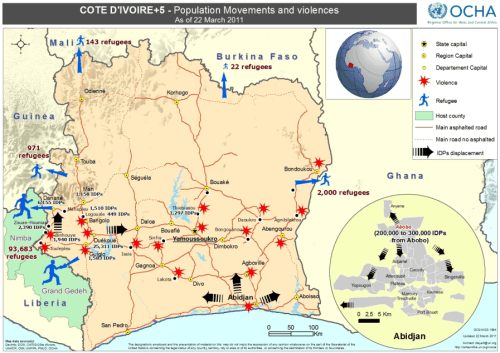
From the Internal Displacement Monitoring Center, March 22

The organization where I work has been present on the border between Cote d’Ivoire and Liberia for awhile now, supporting Ivorians who are escaping the conflict as well as the Liberian communities that are receiving people from Cote d’Ivoire.  (See another good map here.)

What is it like for those who are fleeing Cote d’Ivoire? An account came in by email this morning from our disaster specialist who just returned from Nimba County, located on the border. He told of a woman he had met who arrived in Liberia completely naked, with three children under the age of 6.  She had fled the violence in Abidjan on a Red Cross truck. Then she’d walked, carrying her baby, from the Western town of Daloa to the town of Giglo, passing near Duekoue (where a massacre is said to have taken place). She then continued on to the Liberia border; about 250 km. She had been travelling with her sister and her sister’s 2 children but her sister didn’t make it to Liberia.  She’s buried in the forest. My colleague described the woman’s children as so distressed they can barely speak.

My colleague went on saying that ‘Some people told me that armed men came to their villages and attacked them.  They saw neighbors killed by gunfire, just metres away from them.  Other people told me they fled to small houses in the bush, for fear their villages might be attacked.  But it didn’t make any difference.  When armed men came to the village and found no one there, they’d simply come into the bush, find people and kill them. The people I talked with told me the clashes were the result of ethnic problems.  Their ethnic group was being persecuted by others.’

He describes mostly women and children crossing the border from Ivory Coast and only a few men.  ‘I don’t know what happened to the men and boys.  Some young people told me their brothers and fathers were fighting for one of the sides in the conflict in Ivory Coast.  But no one seems sure of what is happening back in their home countryMany people who have fled Ivory Coast are staying with relatives just over the Liberia border.  Along the border area, many people are of the same ethnic group so there is no trouble with the newcomers.  However, every day, as the fighting grows more intense, more and more people arrive in Liberia.’

The term ‘endgame’ has been all over the headlines for the past 3 or 4 days now, but the ‘end’ of Gbagbo doesn’t mean that things will go back to normal for most people any time soon. Last I heard there are a million people displaced internally and 200,000 externally. I rather doubt it’s the ‘end’ of the crisis for them.

There was a saying people used a lot in El Salvador, though I hear it originates in Africa:  When the elephants fight, it’s the ants who suffer.

Read Full Post »

I received a random email last night from F+W Media asking me to advertise their fundraising campaign for Japan on my blog. I wondered if they had ever read my blog. But that’s beside the point.

Their pitch?

I wanted to alert you to a special announcement from David Nussbaum, Chairman & CEO of F+W Media, Inc.  Find his letter below, please feel free to share this with your (readers, constituents, fans) via the link on our website: http://fwmedia.com/japan

Best,
Kristin Nehls
Publicist | F+W Media, Inc
@KristinNehls

Their initiative?

“Much like in your own community, school, or place of work, the employees at F+W Media wanted to do something ­ anything ­ to help. While the people of Japan are relocated to temporary housing, as supplying food and potable water becomes critical, the need for support in the coming weeks is even greater. Wednesday March 30th we will join with the American Red Cross to lend our support. And, we hope you will too. F+W Media will donate 50% of all profits received Wednesday from the sale of products and services via all of our 23 eCommerce stores. By choosing to make a purchase on this day, you will directly contribute to the ongoing efforts to provide medical care and relief assistance to the people of Japan.”

Well, OK…

I’ll commend F+W for raising funds and having the good sense to not try sending volunteers and goods in kind to Japan, and for working through a known organization with emergency capacity like the Red Cross.

But…

I’d also call F+W’s attention to this article from Good Intents March 28th post “Japan is limiting international assistance“:

“Following the OCHA team’s visit to Miyagi Prefecture on 23 March and after discussion with Government of Japan counterparts, OCHA notes: (1) that even though the scale of the damage following the earthquake and tsunami was significant and resulting humanitarian needs remain considerable, (2) Japan is a highly developed country and has, in principle, enough resources as well as the ability to respond to existing humanitarian needs. The country can both produce and procure relief supplies domestically and has the capacity to deliver those supplies to the affected population. Japan has a consolidated disaster management system for disaster response although coordination and logistical challenges have yet to be fully overcome.

Nothing against Japan and its people. I was probably as shocked and stunned by the earthquake and tsunami there as anyone else who watched it from afar and who has some close Japanese friends who desperately wondered how their families were faring.

But since Japan doesn’t seem to need more funds, I wonder if F+W Media would consider another crisis in their awareness raising and fundraising efforts.

See, there is this country in West Africa called Cote d’Ivoire…

That country is entering into a civil war that has the potential to shake all of West Africa. Some 1 million people are fleeing the violence. Mercenaries from Liberia (the country next door) are already fighting in Cote d’Ivoire. According to a friend of a friend who’s in Cote d’Ivoire, Ivorian National TV is broadcasting xenophobic messages stirring aggressions against neighboring countries and their citizens in Ivorian territory. This explosive mix could throw the whole sub-region into war. For an overview on the Cote d’Ivoire crisis check my previous post “Cote d’Ivoire and the thinking trap” or Blog for Cote d’Ivoire, which lists a number of resources on the crisis.

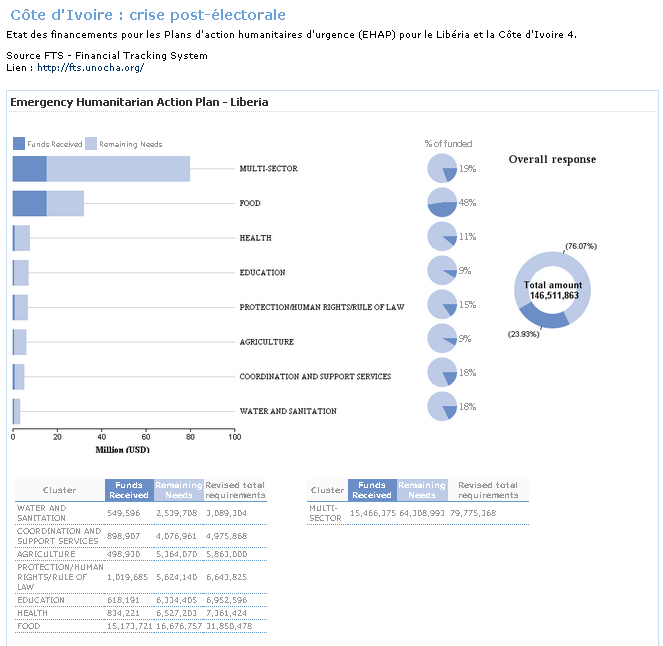
Funds raised for Japan? As of March 28, OCHA reports $442,264,078 (including $261,292,921 in uncommitted funds)

Funds raised for Cote d’Ivoire and Liberia? As of March 28, OCHA reports a 10th of that: $44,924,193.

OCHA's chart on Cote d'Ivoire appeal (March 28)

EHAP for Liberia from OCHA (March 28)

(Charts: UN OCHA’s West and Central Africa Region)

Maybe we should be happy that the donations that Japan doesn’t need might go the unfolding and critical situation in Cote d’Ivoire, which no one seems to care about…. We should be thankful for the Asterisk, as Cynan says.

Japan Earthquake and Pacific Tsunami

Your gift to the American Red Cross will support our disaster relief efforts to help those affected by the earthquake in Japan and tsunami throughout the Pacific. On those rare occasions when donations exceed American Red Cross expenses for a specific disaster, contributions are used to prepare for and serve victims of other disasters.”

And then there is the military intervention in Libya, which I’m not sure how I feel about. I’m following the situation there and in several countries in North Africa and it’s gruesome. But it’s hard to understand how choices are made. A friend of mine living and working in West Africa wrote to me today, and I can understand how he is feeling. It must be terrible to be there, watching “never again” happening again and being powerless to stop it.

“It seems incomprehensible why the international community does not intervene in Cote d’Ivoire whereas they are happily bombing Libya in the name of Human Rights. Strictly speaking in the case of Libya there is a revolution going on against a Head of State in power (I am not commenting here on the type of leader he is!). In Cote d’Ivoire the elected head of state cannot gain power for reasons known, and the population is persecuted and terrorized by his contestor. Wouldn’t it seem logical that the international community intervenes in Cote d’Ivoire instead? They refuse saying that Africa has the AU who should deal with this and that they were not on crusade to liberate the continent from its problems.

Why this differential treatment? Well, the answer is fairly simple: Libya has oil, Cote d’Ivoire not. In the case of Libya the AU stood still and did not comment – not surprisingly as Khaddafi pays for most of half of all country memberships in the AU and has been a tremendous support for development in individual countries. In the case of Cote d’Ivoire they mobilized themselves to act but their negotiation missions all failed. It’s a crazy world. There is no interest from the international community in Human Rights. There is only interest in access and control over resources.”

Read Full Post »

the giant and unsinkable ship....

It seems like so long ago that the aid and development blogosphere was up in arms about Jason Sadler’s One Million Shirts initiative. Unfortunately the 60-year-old aid and development giant, World Vision USA, is engaged in a similar effort – the donation of 100,000 NFL t-shirts to 4 countries. This is something World Vision USA has been doing for the past 15 years, even though the benefits of this type of program are very questionable in terms of whether they actually contribute effectively to World Vision’s overall vision and mission. Several aid workers have called them out on this; you can see the list of posts here. Talesfromthehood has given some recommendations on what would need to happen to move things forward and stop this kind of ‘bad aid.’

A day or so after the peak of the 1 million shirts outrage last May, I wrote the post below, titled “The elephant in the room“. Most of it is still valid, so I’m re-posting it. Maybe next year, around this time, I could post something that indicates that NGOs and the aid and development community in general are moving forward on some of these items.

Though there are some pretty interesting things happening in the aid and development world (for example, the “Smart Aid” initiative) and some circles that are focusing on aid transparency and related aid practice improvements (some of the folks leading these efforts are listed in the post below), it still feels like we are in much the same place we were last year. Shifting the course of the giant aid machine is very slow work.

The elephant in the room, from May 2, 2010

One of the best things about the Great Tshirt Debate has been the variety of voices and perspectives that are weighing in.  This one potentially misguided project was able to catalyze a huge discussion on the nature of ‘aid’.  Once again the power of social media to engage people in debate and dialogue was demonstrated.

There are a lot of angles to follow up on from last week’s blow up. There’s a lot to unpack and it goes much deeper than a conversation about t-shirts.  One thread I find particularly interesting is the use of social media and ICTs (information and communication technologies) for bringing greater accountability and generating input and dialogue around ideas for aid and development.

Christopher FabianOwen Barder and @Morealtitude wrote about this specifically in relation to the Tshirt Debate; and Duncan GreeneOwen BarderAidwatch,  Tim Ogden, and others in a broader debate about accountability, aid and development. Certainly there are many posts and discussions out there on this topic.

Some things that stand out for me in the aftermath of the tshirt discussion:

Broadening perspectives.

It’s easy to forget that we all mean something different when we use the terms ‘aid’ and ‘development.’ There is a big difference between emergency aid and longer-term development.  And there are countless theories and approaches and understandings of both of those terms  (Alanna Shaikh and Talesfromthehood have both written on that).  This was really apparent throughout the discussion last week and in the on-going commentary.

I’m still trying to sort out in my own mind the difference between the various aid and development theories, the perspectives of the ‘aid bloggers’ that I follow, and the frameworks of other people who were involved in the Tshirt Debate. People’s views are intimately linked with cultural, political, economic and religious worldviews, and varying levels of snark (which I have to say can be very intimidating) making it even more interesting.  Before Twitter and the blogosphere, I certainly didn’t have daily exposure and access to such an array of thoughts.  Score one for social media.

The elephant in the room.

All this access to all these perspectives and on-line debate and open participation is great for me. And for you. Because we read English and have access to the internet.

But there is a really big elephant in the room.  One that was lurking on the global conference call hosted by Mobile Active on April 30 and that is still standing around quietly as the discussions continue.  I’m talking about the voices and perspectives of the people that the 1millionshirts project was aimed at helping.

I would bet money that some of those voices would have said “I want a tshirt.”

There are a lot of possible outcomes when ‘beneficiaries’ and ‘donors’ actually talk to each other.  Like donors wanting to give t-shirts and people wanting to receive them.  Then what?  Most of those involved in aid and development and work with local economies can and have listed a myriad of reasons why handouts are not a good idea, but most also believe in listening to voices of ‘beneficiaries.’   It seems paternalistic to say that NGOs or businesspeople know best what people need.  What will happen when more donors and beneficiaries are using social media to talk to one another?  And what if NGOs or governments or business people trying to improve ‘developing country’ economies don’t agree?  Then what?  That’s going to be pretty interesting. For a taste of this can of worms, read this post and related comments.

Development education.

This brings me to thinking about the educational processes that contribute to good development results.  Around the world, people have been presented with hand-out and silver bullet ideas around development and aid for a long time. Donors need to be educated about effective aid and development, but communities do also.  People have been trained to gravitate towards one-off donations and charity mentalities, and need to learn why that isn’t actually very helpful in the long term. They’ve been taught that there is a silver bullet we just need to find. People have also been trained to take hand outs and see themselves as victims and need to re-learn how to take the reins and do for themselves.  This is true everywhere – people look for the easy way out. Consider how many people in the US for example prefer to get plastic surgery or take miracle diet pills and medications over adopting healthier lifestyles involving a good diet and exercise.  Complicated situations require integrated approaches and often need cultural shifts and behavior changes.  Those take time and effort and are hard to explain.  How does social media impact on or shift this in terms of aid and development, and in which direction is it shifting?

Barriers to social media participation.

Both #1millionshirts and Kiva were held up to a huge amount of scrutiny online via social media.  But again, who was scrutinizing, and who had access to the tools and means to participate in these widespread discussions?  It was not the people getting loans from Kiva or the eventual t-shirt wearers.  It was donors and ‘experts’.  I would hope that there are plenty of discussions happening about Kiva programs at local levels, in person, in meetings and in local media or newspapers. But these don’t normally make their way to the internet.

I don’t know Kiva’s programs well, but I would also hope that Kiva staff and/or partners, for example, are listening to that local input and using it to improve their programs on the ground to make them more useful to participants.  And I would hope that those discussions take place within a longer term education, training and relationship building process as with many NGOs.  This kind of input from and dialogue with program participants is every bit as important for adapting and improving programs and initiatives, and maybe more important, than all the public discussions on the internet…. as long as it’s being listened to and responded to, and as long as local offices are taking these messages up the chain within the organization, and as long as local offices also are being listened to and carry weight within the organization. What might be the role of social media there to move those offline discussions further within organizations and to educate, inform and engage the broader public and ensure that responses and changes are forthcoming and everyone learns from it?

There are still huge barriers to social media participation for many people in communities all over the world… not having electricity, computers, smart phones and internet, to start with. There are also barriers like language, literacy, age and gender based discrimination, hierarchies and cultural norms that limit participation in general by particular groups in discussions and decision making.  When working face-to-face, good organizations are in tune with the barriers and find ways to gather input from those typically left out of the discussion.  How can organizations use what they know about engaging more marginalized populations and apply it to a more creative use of social media to ensure that all voices are heard?  What resources and ICT tools would be needed to do that effectively?

Offline to Online to Offline

And how could more of the discussions that happen on the ground with communities, when programs are being designed, implemented, evaluated and re-designed; be shared in the open by those who are involved – whether participants, local bloggers, citizen journalists, NGO workers or others?  And how can the debates happening online make their way back to communities that are not connected? It would be amazing if more program staff and community workers were blogging and sharing their work and their challenges and accomplishments.  And if more organizational decision makers were listening to what their community workers or other staff who are blogging and tweeting are saying. And if more people participating in programs could share their viewpoints via the internet.  This would be useful to the global commons and would also help the fields of aid and development to improve.

How can we support more communities to have access to social media and ICTs as tools to participate more broadly? And how can community members be the owners and drivers of this discussion and input. How can we help bring voices from the grassroots to a broader public and also bring these broader public debates back to communities.  How can the access, language, literacy and cultural barriers be addressed?  There are some programs out there doing this, for example Global Voices RisingMIT’s Department of Play at the Center for Future Civic Media, and the Manenoplatform, but we really need more of it.

Youth.

I think as connectivity becomes less of a challenge, we will see the younger generation claiming spaces in this way. More organizations should be working to engage more young people in the development process and supporting them to access ICTs and social media.  When a consultation with children and youth was done after the Haiti earthquakes, for example, young people did not say that they wanted hand outs.  They said that they wanted to participate. They wanted to play a stronger role in the recovery and the reconstruction.  They said they wanted education, a voice in how things were to be done, decentralization.

Staff that I’ve worked with on youth and ICT programs in several countries have said that ICTs and community media are excellent tools for engaging youth in the development process and maintaining their interest, for supporting youth-led research and collecting opinions about community processes.  With advances in technology, these voices can reach a much broader and public audience and can be pulled into donor communications as well as used as input in the resource and problem analysis, program design,  program monitoring and evaluation processes.  Youth can access information previously unavailable to them which broadens their own views and helps in their education processes. They can also contribute information and images of themselves and their communities to the online pool of resources so that they are portraying themselves to the world in their own image as opposed to being shown by and through the eyes of outsiders.

In addition to the Tshirt Debate stirring up questions about good donorship, I really hope it stirs up the debate about the value of more local ‘beneficiary’ voices in aid and development discussions, and that it fuels more efforts to use, adapt, and develop social media tools and ICTs to support these voices to join the debate.

What about you?  What do you think?

Related posts on Wait… What?

Children and young people’s vision for a new Haiti

It’s not a black and white photo

Meeting in the Middle

Mind the gap

Putting Cumbana on the map: with ethics

Read Full Post »

Dave Algoso, a grad student at NYU, just published a great post called A Grad Student’s Guide to the International Development Blogosphere wherein he explains why grad students should be reading blogs. It struck me that many of the reasons he recommends students read blogs are similar to why I recommend that you, my dear colleagues and friends who are development or aid practitioners or who sit in headquarters or fundraising or regional offices, or who make policy decisions, read blogs.

I’m a bit hesitant to share these tips because then you will realize that I’m not really all that smart, I just read a lot of blogs and discuss them a lot on Twitter…. On the other hand, I’m fairly confident that no matter how much I recommend blogs and Twitter, most of you will say you don’t have time, and I’ll still come out looking like a genius for knowing what’s going to hit the New York Times 2-3 days ahead of when you read it and forward it to me asking me if I’ve seen it!

You can read Dave’s post here and I encourage you to do so – so that he will get additional hits to his site and because he deserves the credit for writing the original post.

Below, I’ve taken Dave’s post (note: with permission) and substituted “development and aid workers” for “grad student” and switched it up just a bit to make it fit that context.

Here’s Dave’s post with my changes in italics:

Several friends have recently asked me which blogs I read and how I manage my reading. This post is targeted at my fellow aid and development practitioners, but those of you who work on policy, advocacy, customer service, grant writing and technical support, communications, marketing, and anyone who wants to know what’s happening in aid and development should find it useful as well. Let’s start with why to read blogs, then move on to the how, and finally the what.

1. Why should I read blogs? I do plenty of reading for work already…

I’m a fan of reading blogs. No big surprise there. Reading blogs should be part of how you get smart about your field. You read the news, right? New York Times or the Economist or People Magazine (you know who you are!) or whatever? Well newspapers write for general audiences. They won’t get very far into the complexity and nuance. You read a bunch of internal reports for work too? Well most reports are written for donors. They generally won’t tell you about what the theories and the practical work have to do with the larger picture of development. They also won’t critique the way you do business or offer you a cross cutting picture of where development and aid are headed across sectors and across organizations.

Blogs cover many of the same issues as both newspapers and journals and project reports, but with an eye toward what they mean for practitioners and policy makers. You’ll get stories from the field, scathing critiques of the latest development fads, and heated debates on everything from microfinance to conflict minerals. The blogosphere is the one place where geography is no barrier to the conversation. Academics, journalists, donors, Washington think tank-ers, UN or NGO staff — they all bounce ideas around here.

For a development worker, blogs also provide a check on what the experts, your bosses, top government officials, donors, advocates, marketers, policy-makers and celebrity spokespersons say. You’ll find out pretty quickly which issues are actually top-of-mind for practitioners and which issues only matter to the Ivory Tower types, those sitting in offices making policies, and those making things up. And if work, work meetings, conferences and discussions around the water cooler don’t allow you to delve far enough into an issue you care about, blogs can make up for that.

2. Blogs can be overwhelming. How do I manage the information flow?

First and foremost: You do not need to visit every blog’s website to check for new posts. In fact, you shouldn’t. You can subscribe by email if you like (most blogs have a button on the right hand side where you can subscribe by email) but even that can be overwhelming as blog posts mix with your normal emails.

There’s an easier way to read blogs. Instead of subscribing by email, you subscribe to the blog’s RSS feed. RSS means “really simple syndication.” You just subscribe to the RSS feed using a feed aggregator, and you’ll get all of your blogs in one place.

Some email programs (e.g. Outlook) can act as feed aggregators. I prefer to use Google Reader; if you have a Google Mail account, then you already have a Google Reader account. If you are on the road someplace with spotty internet connections, you can use a free program called FeedDemon; it’s a little clunkier than Google Reader, but it can download posts for viewing when you’re offline. On your iPhone, you can use another free program called MobileRSS. Both FeedDemon and MobileRSS sync with Google Reader, so your RSS subscriptions or starred items will always be the same in all three. (There are also many other options for feed aggregators.)

Once you have a feed aggregator, start subscribing. Most sites with feeds will have a link that looks like this orange square. Click on it to subscribe. Often you can just type the site’s URL into the feed aggregator, and it will figure out the rest.

The practical upshot of this feed aggregator stuff is that you can go to one place and see all of the new posts from all the blogs you follow. You can also “follow” your normal news (more on this below). This keeps you from being overwhelmed, so you’re more likely to keep up with them.

3. Okay, I’m sold. What should I be reading?

In my opinion, there are seven must-read blogs for any one working in the field of aid and development.

Following these seven will keep you up to speed with the debates of the day, and you’ll get links to the most interesting posts from other blogs. Seriously, if you read nothing else, at least subscribe to these seven.

4. C’mon. Only seven? I can handle a few more.

I hoped you’d say that. Here are some others that I highly recommend.

Most of the blogs above are pretty general, though everyone brings different perspectives and interests. There are also many issue/region-specific blogs you may want to check out. Here are a few that I recommend.

(Note from Linda here: I also have a list of blogs I read regularly – you can see it here on the right hand side bar under the title ‘blogroll’. Check some of them out when you have a chance. Or if you have a particular area of development or aid that you are interested in, let me know and I’m happy to give you some recommendations on specific blogs on that topic to get you started.)

I generally steer away from the blogs of NGOs and donor agencies. The content tends to be fluff. Of course, if you work for (or want to work for) a particular organization, it might be worth following them. There are two that I would recommend as generally thoughtful and interesting:

Finally, there’s news. Almost every news website does RSS feeds, so you can subscribe to them through Google Reader. I get the Economist, the New York Times Africa feed, the East AfricanForeign Policy, and others bundled together with my blogs. I also subscribe to TED talksxkcdGallup World polls, and more. If a site publishes regular content, it probably has an RSS feed. I barely even go to websites anymore.

5. But hey, you forgot about…

Am I missing anything? Feel free to fill the comments section here and on Dave’s post with suggestions.

Please don’t be offended if I failed to include you or your favorite blog above. This isn’t meant as a definitive list. Here are some more blogs I think are worthwhile. The full list of what I follow is longer still. The above is simply meant to get people started — and I don’t want to scare off the newcomers.

*****

Thanks to Dave for the great post, and hopefully some of you colleagues who haven’t caught the blog bug yet will get motivated!

Hopefully some more of you will start writing blogs too…. here are a couple links that talk about some of the reasons that blogging and other kinds of social media can be helpful in thinking about our program work:

Working and living out loud

Social media and humanitarian response

Read Full Post »

Ivan and Massilau working on some mapping in Inhambane, Mozambique.

I had the pleasure of working with Iván Sánchez Ortega in Mozambique earlier this month, and I learned a ton about the broader world of GIS, GPS, FOSS, Ubuntu and Open Street Maps from him. We also shared a few beers, not to mention a harrowing plane ride complete with people screaming and everyone imagining we were going to die! But I suppose it’s all in a day’s work.

Below is a cross-post by Iván about Maps for Mozambique. You can find the original post here, and a version in Spanish here. Note: the opinions expressed below belong to Iván and not to his former, current or future employeers…..

*****

Last week was a small adventure. I went to Mozambique to make maps, as part of the Youth Empowerment through Arts and Media program. The main goal was to train youngsters in order for them to make a basic cartography of the surrounding rural communities.

This travel is part of the Humanitarian OpenStreetMap Team activities. After the successes of Kibera and Haiti, we want to check how much we can help by providing cartography.

Cartography in developing areas provides a great amount of situational awareness – in order to help, one needs to know where the help is needed. In the case of Mozambique rural communities, we’re talking about knowing who has a water well and access to healthcare and education, and who doesn’t.

The problem with rural Mozambique is that the population is very disperse. Each family unit lives in an isolated set of huts, away from the other families in the community. There is so much land available that the majority of the land is neither used or managed.

Which leads to think that, maybe, the successes at Kibera and Haiti are, in part, due to them being dense urban areas, where a kilometer square of information is very useful.

It has been repeated ad nauseam that geographic information is the infrastructure of infrastructures. Large-scale humanitarian problems can’t be tackled without cartographic support – without it, there isn’t situational awareness, nor will coordinating efforts be possible, something very important in an era when aid can get in the way of helping. However, even with agile surveying techniques and massively crowdsourced work, the cost of surveying large areas is still big. And, as in all the other problems, technology isn’t the silver bullet.

—-

That said, the way one has to go to reach the rural communities doesn’t have anything to do with the occidentalized stereotypical image of rural sub-Saharan Africa. There are no lions, nor children with inflated bellies due to starvation.

There is, however, the image of a developed country but in which the public agencies work at half throttle. Mass transit, garbage collection, urbanism, civil protection, environment, job market, education, social security. Everything’s there, but everything works at a much lower level than one could expect. To give out an example, the Administraçao Nacional de Estradas (national roads administration) plans switching of one-way lanes over hand-drawn sketches.

The reasons that explain the situation of the country are not simple, not by far, but in general terms they can be resumed in two: the war of independence of 1964-1975 and the civil war of 1977-1992. Living is not bad, but also not good, and part of the population is expecting international humanitarian aid to magically solve all of their problems.

When one stops to think, the situation eerily reminds of the Spanish movie Welcome, Mr. Marshall. Only that everyone’s black, they don’t dance sevillanas, and instead of railroads they expect healthcare and education.

Wait a moment. A reconstruction 20 years after a civil war, external aid, and the need of cartography for a full country. This reminds me to the 1956-57 Spain general flight, popularly known among cartographers as the American flight.

These aerial photographs, made in collaboration with the U.S. Army Map Service, had a great influence in the topographic maps of that period, and even today they are an invaluable resource to study changes in land use.

—–

Which is, then, the best solution? To inject geospatial technology may be a short-term gain, long-term pain in the form of 9000€/seat software licenses. Mr. Marshall won’t come with a grand orthophotogrameric flight. Military mapping agencies won’t implement SDIs (spatial data infrastructures) overnight. Training aid workers and locals into surveying is possible, but slow and expensive, although it might be the only doable thing.

Related posts on Wait… What?

Mapping Magaiça and other photos from Mozambique

Being a girl in Cumbana

Putting Cumbana on the map — with ethics

Inhambane: land of palm trees and cellular networks

It’s all part of the ICT jigsaw — Plan Mozambique ICT4D workshops

Read Full Post »

There’s a new Youth and Participatory Governance initiative that I’m going to be supporting from the social media and ICT side, and I’m really excited about.

My colleague Jess in our UK Office gives an overview:

Plan UK is working with the Institute of Development Studies (IDS) and the International Institute for Environment and Development (IIED) to produce a Special Issue of the journal Participatory Learning Action (PLA) focusing on Youth and Participatory Governance in Africa. The Special Issue will capture and share experiences of the different ways young people in African countries are engaging with government to participate in public policy, planning and budgeting processes at local, national, regional, and international levels.

Key details about the Special Issue:

  • What is the theme? Contributions should capture practical experiences of governance work involving youth. Contributions should include: the processes young people have been engaged in; innovations, achievements and challenges; lessons and ways forward. Each article should be around 2,500 words. (Note: this includes innovative ways that youth are engaging with support of ICTs.)
  • Who can contribute? We are seeking submissions from adults and young people working in the field of youth and governance who would like to contribute an article to this Special Issue. You might be a youth activist, a practitioner from an NGO or international agency, or a member of government, for example.
  • How will contributors be supported? Support will be provided to contributors throughout the drafting process, including a writing workshop (a ‘writeshop’) in Nairobi in March next year during which contributors will receive one-to-one support and meet with others working on participatory governance to discuss and share their experiences
  • When do articles need to be written? Anybody interested in contributing needs to submit a 500 word summary by December 5th. Articles will be selected in December. Authors will submit a first draft of their article in February 2011 and, after further drafting, a final draft in June/July 2011.

Download further information on the Special Issue and the PLA journal here. Download the Call for Proposals here if you think you’d like to submit something or to support youth you are working with to submit.

Why I’m excited about being involved…

I had the chance to talk with Jess (the project coordinator) at Plan UK about my role last week. I’ll be supporting with dissemination (starting here with this post) to help get as many good submissions as possible. I’ll also be reviewing submissions that have ICT components to them; supporting participating youth with writing drafts and at the writeshop in Nairobi this March; and looking at how we can use social media to support the initiative throughout.

I’m really happy to be involved because this is something I want to dig into into and the process will offer a chance to learn about methodological innovations in this area that can be replicated and shared within some of the other programs I’m supporting. I also love that young people are encouraged to submit ideas for the journal and that they will be involved in writing and documenting their experiences. Sometimes their voices are really missing in these debates because they are not in the habit or don’t have time to write and document their work, or because of other factors like language or access. (And we all know that if it’s not on the Internet, to many of us it ‘doesn’t exist’).

To be honest, I’m also excited because it will give me a ton of new stuff to share here, and maybe during the process we’ll be successful in getting some more young people and practitioners blogging.

Another reason I’m keen to participate was this bit in the concept note: Youth and governance efforts have been ‘largely unsystematic and often constrained by the vague and paternalistic parameters of the UN Convention on the Rights of the Child (McGee, forthcoming 2010). However this is changing and there are calls for new models, tools and approaches that enable young people to take a more meaningful role in decision-making.’ Looking forward to the discussions around that.

Submit a concept!

If you are working on programs around youth and governance, youth and transparency, youth and accountability and related areas or know of young people or young people’s organizations who are, please check out this link on how to submit a concept or contact me (lindaraftree at gmail) or Jess (Jessica.Greenhalf at Plan-International dot org). If the youth you’re working with are more comfortable in a language other than English or French, please let us know so that we could see how to support them to engage.

Please share this call for submissions through your own networks – we are hoping for a real variety of contributions to what should be a great Special Issue!

Read Full Post »

« Newer Posts - Older Posts »