Feeds:
Posts
Comments

Archive for the ‘protection’ Category

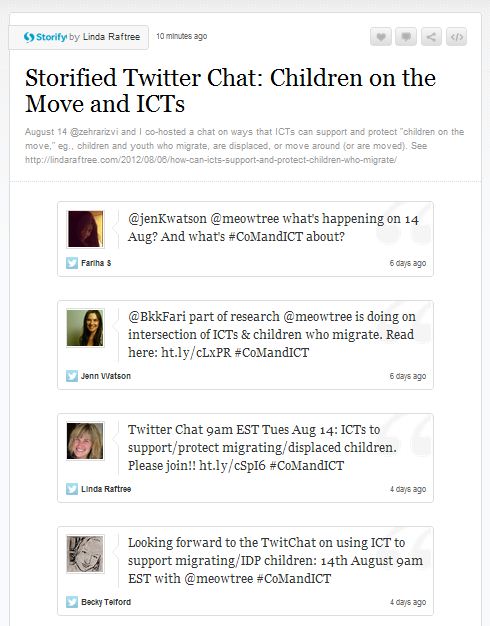
On August 14, @zehrarizvi and I co-hosted a Twitter chat on ways that ICTs can support and protect “children on the move,” eg., children and youth who migrate, are displaced, or move around (or are moved). Background information on the issue and the research.

We discovered some new angles on the topic and some resources and studies that are out or will be coming out soon, for example an upcoming Girls Count study on Girls on the Move by Population Council, a UNHCR paper on ICTs and urban refugee protection in Cairo, and Amnesty’s Technology, People and Solutions work.

Thanks to everyone who participated – whether you were actively tweeting or just observing. We hope it was as useful to you all as it was to us! If you think of anything new to add, please tweet it using #CoMandICT or email me at linda.raftree [at] planusa.org.

Read the Storify version here (with a bonus picture of @chrisalbon holding up a ‘burner’ phone). Don’t know what a ‘burner’ phone is? Click and take a look.

Read Full Post »

On Tuesday, August 14@zehrarizvi and I will be hosting a Twitter Chat on the topic of new technologies and ‘children on the move.’

As I wrote in an earlier post, I’m working on some research at Plan International USA, funded by Oak Foundation. The research aims to compile a ‘State of the Practice’ report that will include examples and case studies of current ICT use by, with, among and for ‘children on the move’; applicable cases and lessons learned from other sectors; gaps, challenges, areas where ICTs may pose new or additional risk; and remaining questions and challenges for future exploration and collaboration.

In talking about this research with Zehra (who is working at the Women’s Refugee Commission on a project related to the empowerment and protection of displaced adolescent girls, also supported by Oak) we realized we are both quite interested in exploring the role of new ICTs in supporting and protecting children who are migrating, displaced or otherwise ‘on the move’. So we decided to collaborate on the Twitter chat.

We’re hoping to gather ideas and perspectives from people working in the areas of migration, working children, displacement, child protection, conflict settings, environmental migration, diaspora communities, ICTs and other related areas.

Please join us on Tuesday, August 14 from 9-10.30 EST. The hashtag will be #CoMandICT.

We will cover 4 key questions in this first chat:

  • Which organizations are working in the area of child migration or ‘children on the move’ and what are they doing?
  • Are new technologies involved? If so, how? If not, why not?
  • Are there existing youth networks that could provide insight into how new technologies are used by children/youth on the move?
  • What else should we know about? What are we missing in our thinking about this project? Who should we talk with?

Tips for a good Twitter Chat:

  • Login 5 mins ahead of time and be ready with a short introduction (eg, “Joe Garcia here, child protection at XYZ in Malawi, managing cross-border project w working children” or “Cathy Kramer, ICT specialist working on mobile data privacy issues at TechTechTechieFirm”).
  • Tools like TweetChat which automatically add the hashtag and refresh often are helpful to keep up with the conversation.

We look forward to chatting on Tuesday August 14th at 9 am EST and welcome any questions or comments before then!

Read Full Post »

Over the next year, I’ll be working on some research supported by Oak Foundation* that will look at the intersection of ICTs and children who migrate, a.k.a. ‘Children on the Move.’ As part of the research, we will be conducting a Twitter chat on Tuesday, August 14, at 9h EST and an ongoing online discussion hosted by New Tactics from October 17 through 23.

I hope interested folks will join to share experiences, good practice, challenges, thoughts and ideas on the intersection of ICTs and Children on the Move.

Background

Globally, some 214 million persons are international migrants. In addition, there are an estimated 740 million internal migrants according to the Global Movement for Children. Youth make up a large share of migrants from and in developing countries. Shifts in demographic factors, economic disparity, violent conflict and state failure, natural disasters, resource and environmental pressures, especially climate change, and lack of opportunities for education or employment mean that this number is likely to increase. About one-third of migrants from developing countries are between the ages of 12 and 25, including millions of children under the age of 18. (Stats from here.) “Yet, in debates on both child protection and migration, children who move are largely invisible. As a result, policy responses to support these vulnerable children are fragmented and inconsistent.”

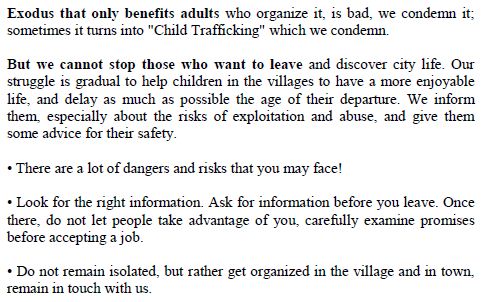
Drawing from the African Movement of Working Children and Youth’s report “Early Exodus and Child Trafficking in West Africa: What progress have working children and youth made?” Sept 2008

‘Children on the Move’

Children migrate and move for a host of reasons. They may move on their own will to seek improved opportunities. They may be escaping violence and abuse in the home or at school or running away from an arranged marriage or other cultural practice. They may move due to a lack of opportunity, reduced resources, conflict, or disaster. They may want to get away from life in a refugee camp, or flee other kinds of hardship. They might migrate together with parents or other adults, or they may go alone or with others their age. The migration decision may be made by children themselves, or they may be encouraged by their parents.

In the past, the phenomenon of child mobility has not been seen in its full scope. Children who migrated were often automatically lumped in with those who were trafficked against their will. Programs to support children on the move have not always addressed the variety of motivations and situations. This lack of understanding of the myriad of reasons for children’s mobility has hindered efforts to support and protect them in their different scenarios. More recently efforts have been made to better understand children’s mobility, for example this fascinating 2008-2010 regional study project, supported by a broad platform of child protection agencies, documented and analyzed the many forms taken by the mobility of children and youths in West and Central Africa.

The term ‘Children on the Move‘ has been suggested to describe this group of children under the age of 18 who have aims, motivations and different life circumstances. This is a group which transcends categories. These children may be in a ‘pre-mobility, mobility or post-mobility’ situation (either having arrived to a destination or having returned home). They may also be ‘children left behind’ by their parents or guardians, who, without abandoning them, have emigrated for work within their country of residence or abroad. They may be stateless children, who also suffer the risks and vulnerabilities of mobility.

Risks Children on the Move face

When children move against their will, and /or in absence of protection services and actors, they become highly vulnerable to the worst forms of child labor, exploitation and other abuses. This vulnerability is present before they move, during their trip, once they reach a new destination or even after they return home, and therefore support and protection need to be considered from the time they are thinking about moving (or others are thinking about moving them), through the actual migration or ‘move’, upon their arrival, and in the case of their return. In addition, some children may be involved in a series of migrations or they may migrate seasonally. “During movement, a child can float from one sub category to the other. For example, an internally displaced child can be recruited by armed forces or moved across borders for the purpose of exploitation. The risks and opportunities differ per trajectory and conditions of movement,” according to the CoM website.

Captured from “Best practices in the fight against early exodus and child trafficking” as printed in the African Movement of Working Children and Youth’s “Early Exodus and Child Trafficking in West Africa: What progress have working children and youth made?” report, Sept 2008.

Children who migrate often face discrimination and marginalization due to beliefs and policies that treat migration as a problem and children who migrate as criminals, and therefore a great deal of work needs to be done to change perceptions and increase societal awareness around the situation of children on the move. Protecting children and reducing their risk of exploitation is a mandate, regardless of the reasons for which they move or migrate.

A systemic approach to protection

In order to improve support for and protection of children on the move, it’s important to look at the situation holistically and systemically and to include the aforementioned different phases of mobility. In addition, several areas need consideration, including children’s own needs and rights; children’s self-protection; community-based protection; government responsibilities and social services; advocacy and public policy and so on. Duty bearers and donors need to improve coordination across silos and borders in order to get better at information exchange, research and data analysis; the creation of prevention and awareness strategies and programs; monitoring actions during all stages; and feedback mechanisms and accountability. (See the proceedings from the CoM Conference for more details.)

How can ICTs help?

Alongside the growth in children’s mobility, access to new technologies, specifically the mobile phone, has exploded. Yet most often, when child protection and ICTs are mentioned in the same sentence, it is with regard to cyber security and protecting children from the Internet or potential on-line predators.

ICTs are playing a huge role in connecting diaspora with those ‘back home.’  The question arises: How are or how could ICTs be enhancing child protection initiatives and supporting children on the move.

The positive and empowering role of ICTs to support children’s self-protection, improve information and communication via new technology tools and enhance systemic approaches to risk reduction has not been fully developed with regard to child protection in its broader sense, or with regard to child mobility and child protection.

The research 

The research will aim to compile a ‘State of the Practice’ report that will include examples and case studies of current ICT use by, with, among and for CoM; applicable cases and lessons learned from other sectors; gaps, challenges, areas where ICTs may pose new or additional risk; and remaining questions and challenges for future exploration and collaboration.

Certainly new questions, frameworks and areas to explore will arise along the way, but at present, questions include:

  • What needs do children have in different categories and stages of mobility and how are these being (or how could they be) enhanced via better use of new ICTs?
  • Which new technologies are already accessible and being used by various stakeholders (e.g. children, parents and caretakers, intermediaries, broader communities, local child protection committees and ‘safe houses’, local institutions, social workers, experts, civil servants, governments, national and international NGOs, local and national law enforcement agencies), especially children, adolescents and youth; during pre-mobility, mobility and post-mobility, and upon return, endogenous or institutional, and for what purpose or to what end?
  • What information and communication systems are currently in use at child and family, community, district, national, transnational /regional and global levels for supporting or protecting children on the move and can these systems be improved, promoted or better accessed using new ICTs such as mobile phones?
  • Are there existing scalable, replicable or adaptable examples of the use of ICTs in this area we can learn from? What were the successes, challenges, failures and lessons/good practices?
  • Can new ICTs support communication for development (C4D) approaches and models to help children on the move protect themselves, inform them of available support, and/or change broader societal attitudes toward migrating children to more positive and supportive ones?
  • What can we learn from how ICTs are being used in other areas (health, human rights monitoring, data gathering / tracking, early warning systems, disasters and emergencies)? Which of these might lend themselves to use with, for, among and by children on the move? Are there relevant evaluations or case studies we can look at and learn from?
  • What are the specific challenges and risks in terms of children on the move that need special attention and exploration when designing programs or eco-systems that integrate ICTs? Security? Privacy? Connectivity? Cost? Context? Sustainability? Feasibility?
  • Where do we take it from here (what needs to happen next)?

Please join us for the Twitter chat on August 14 at 9 a.m. EST.  We’ll be using the hashtag #CoMandICT for the discussion and to keep track of future Twitter conversations on this topic. Stay tuned here at Wait… What? or contact me @meowtree or by email for more information.

Please also consider joining the broader discussion on “Empowering Communities with Technology Tools to Protect Children” the week of October 17-23 hosted by our friends over at New Tactics.

Some related resources:

The excellent 2008 report by the African Movement of Working Children and Youth: Early Exodus and Child Trafficking in West Africa: What progress have working children and youth made? 

The AMWCY’s 2009 report “From the gong gong to ICTs

The fascinating study by a consortium of child protection groups on Child Mobility in West and Central Africa.

****

*This work is supported through a grant from Oak Foundation to Plan International USA.

Read Full Post »

The use of social media and new technologies in disaster and crisis situations will likely be framed forevermore as ‘Before Haiti’ (BH) and ‘After Haiti’ (AH). The terrible earthquakes that devastated the country and the resulting flood of humanitarian interventions that followed mark the moment that the world woke up to the role that new technology and new media can and do play in the immediate local response to a crisis as well as the ongoing emergency response once international volunteers and aid organizations arrive to the scene.

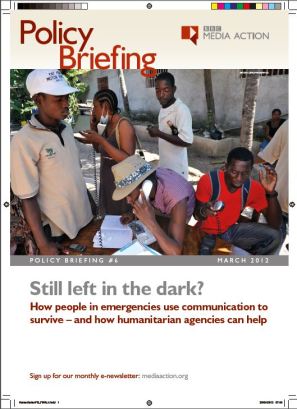
Still left in the dark? How people in emergencies use communication to survive — and how humanitarian agencies can help,’ is a new policy briefing by BBC Media Action. It does a fantastic job of highlighting the ways that new media is changing disaster response and the fact that the humanitarian industry is not doing enough to keep pace.

The briefing asks: ‘Are humanitarian agencies prepared to respond to, help and engage with those who are communicating with them and who demand better information?’ As the report shows, the answer is ‘not really’.

Many humanitarian agencies continue to see ‘communication’ as something done to raise money or boost the profile of their own efforts, says the report. Yet the sector increasingly needs a clear, strategic focus that responds to the information and communication needs of disaster-affected populations. ‘While responders tend to see communication as a process either of delivering information (‘messaging’) or extracting it, disaster survivors seem to see the ability to communicate and the process of communication itself as every bit as important as the information delivered.’ Communicating with affected populations can improve programming and response, not to mention, as highlighted in the Listening Project and referred to in the BBC report, ‘Listening is seen as an act of respect.’

The briefing is not one-sided, however, and it does a good job of understanding some of the common perceptions around the use of new technologies. There is ICT and social media hype on the one hand (often the position of international ICT specialists, based on very little hard evidence). And there is strong questioning of the value of these tools at all on the other hand (often the position of aid workers who are turned off by the hype and want to see proven practice if they are to consider investing time and resources in new ICTs). The briefing paper provides examples that may serve to convince those who are still unconvinced or uninterested.

Many of us see the reality that social media tools are still quite out of reach of the poorest members of a community or country. But writing new media and technologies off entirely is ‘too crude an analysis,’ says the briefing paper, ‘and one that is being challenged by data from the field.’ In Thailand, for example, use of social media increased by 20 percent in both metropolitan and rural areas when the 2010 floods began. ‘Communities now expect — and demand — interaction,’ the paper emphasizes.

Throughout the paper there are good examples of ways that in the immediate aftermath of a disaster local individuals and companies are quickly creating and rolling out communication platforms that are more relevant, feasible and sustainable than some of the initiatives that have been led by international agencies.

An important point that the report makes is that the most successful use of new media in disaster response combines multiple communication channels — new and old — allowing information to flow in and out, to and from different populations with different media habits and levels of access. For example, local journalists and radio stations may pull information from Twitter and Facebook and broadcast it via the radio. They may also be broadcasting online, meaning that they not only reach their local population, but they also reach the diaspora community. ‘Good communication work,’ the paper notes, ‘is, by definition, multi-platform. It is about integrating media, non mass media and technology tools in a manner that is rooted firmly in an understanding of how communities approach information issues.’

So ‘while aid agencies hesitate, local communities are using communications technology to reshape the way they prepare for and respond to emergencies.’ This hesitation remains in the face of growing evidence, according to the paper, that agencies who invest in meaningful communication with disaster-affected communities garner a range of benefits. ‘The communication process becomes central to effective relationships, mitigating conflict and identifying and preventing rumours and misunderstandings.’ Doing it right, however requires good program design, which in turn, requires aid agencies to focus time and expertise on improving communications with affected populations, which, of course, requires budget allocated to these kinds of activities.

For those agencies that want to look more closely at integrating some of these tools and approaches, the report gives several great examples. The recommendations section is also very useful.

One of the recommendations I think it is especially good to highlight is ‘analyse the communications landscape’ (see InfoAsAid’s materials). I would, however, have liked to see mention of involving members of local communities in a participatory analysis of that landscape. In addition to the technical analysis, it’s important to know who trusts which information sources, and why. For example, the information sources trusted by men may be different than those that women trust. The same goes for children, youth and adolescents. Access is also a critical issue here, especially in terms of reaching more marginalized groups, as the population affected by a disaster is not homogeneous and there will be hierarchies and nuances that should be considered in order to avoid leaving certain people or groups out. I would have liked more mention of the need to take a specialized approach and make a focused effort regarding communication with children and adolescents, with women, with certain ethnic groups or persons with disability, as they may be left out if care is not taken to include them.

Another recommendation I found very useful was ‘think of the whole population, not just beneficiaries.’ The paper cautions that working only with the population that directly benefits from an individual agencies’ funding is a positive angle for transparency and accountability, but it ‘seems to have a profoundly limiting effect in practice.’ Beneficiaries need information about more than just one aid agency, and those who are not benefiting from a particular agency’s programs also have information needs.

The report mentions that sometimes in the aftermath of a disaster, when people use new media to communicate, confidentiality and privacy risks are not fully considered. I’d like to see this aspect addressed a bit more in the future as there is a lack of documented good practice around privacy and protection. (Note: I’ll be involved in some research on ICTs, migration and child protection over the next year, so watch this space if it’s a topic of interest.) Humanitarian agencies may have strong policies here, but this is an area that others may not consider in their rush to offer support following a disaster.

Overall the report is extremely useful for those considering how to improve two-way (or multi-way) communication in a post-disaster situation and I very much enjoyed reading it as it sparked learning and fresh ideas, and documented some good work being done by local as well as international groups.

I don’t have a lot of pity or patience for aid agencies who are ‘left behind’ because they refuse to move with the changing times or because their approaches are not effective or relevant. There are several forces that are ‘disrupting’ humanitarian work these days, and  the report does a great job of identifying some of them. It also highlights the importance of local actors, local private sector and diaspora communities who have always played an important role in aid and development but have only recently been given more recognition.

International agencies still play a critical role in the humanitarian space, but they need to understand and adapt to the changes happening around them. This report can serve as a discussion piece and offer guidance for those agencies who want to use new media and technology to enable them to do a better job of listening to, working with and being accountable to disaster affected populations.

In summary, highly recommended reading!

Read Full Post »

This is a guest post by Roland Berehoudougou, disaster risk manager for Plan International’s West Africa Region. He explains the numerous factors that came together and conspired against the people of the Sahel, transforming the lean season into an emergency. 

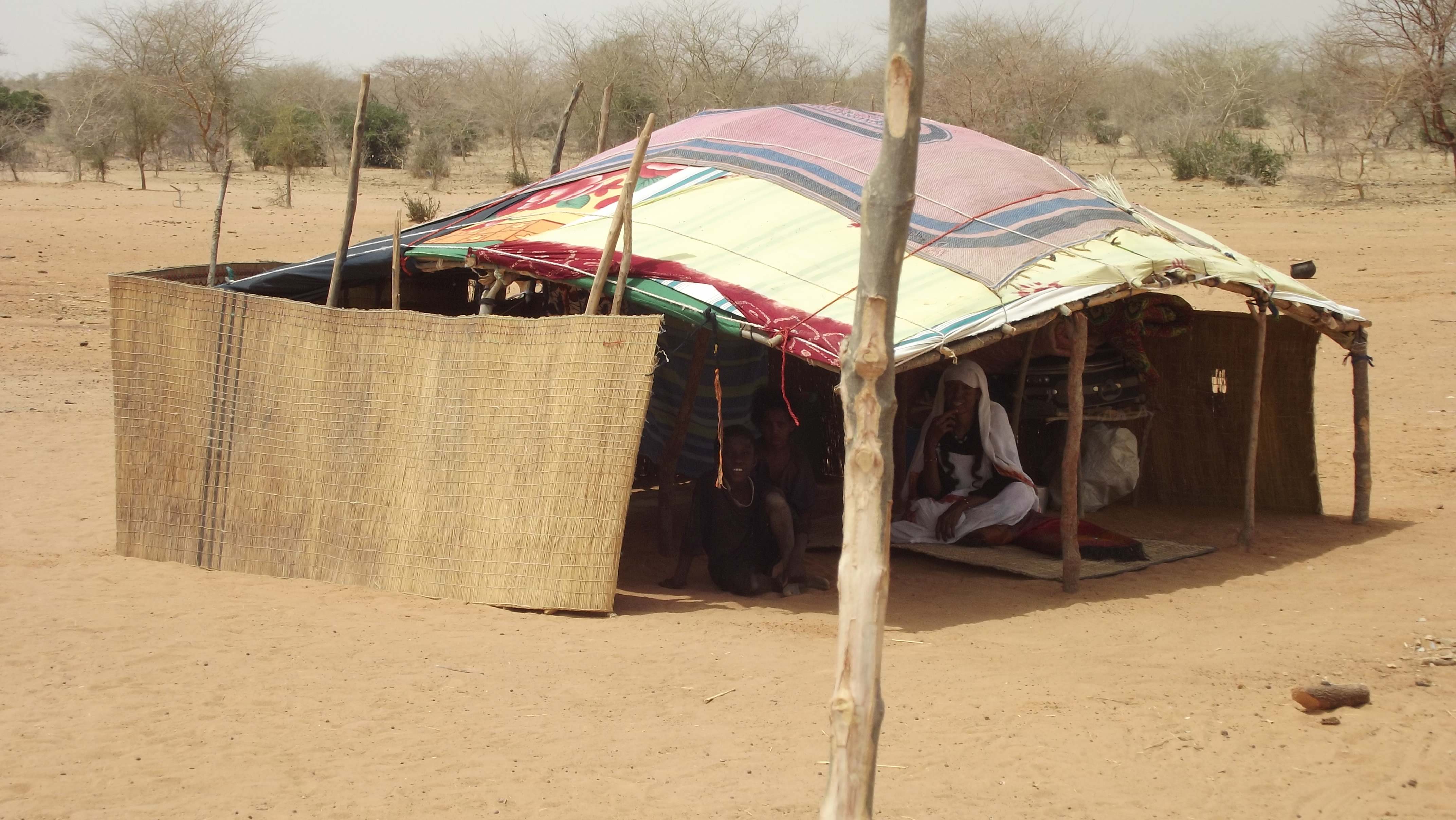
Photo: Roland Berehoudougou.

When Plan International and other aid agencies sounded the alarm bells and appealed for public assistance to finance an emergency response to the Sahel Food Crisis, there were those sceptics who saw this crisis as an annual chronic food shortage which was being exploited by aid agencies to raise money.

Those skeptics were wrong.

So what is an emergency? What is a food crisis? What is involved in declaring an emergency or pronouncing a situation to be a “food crisis”? A number of issues are taken into consideration including forecast about the availability, cost of food, environmental factors and other internal and external factors which are discussed below.

The Sahel Food Crisis is the result of a complex emergency in which these factors have come together to create this food and nutritional crisis. In fact, had these not occurred then there would be no food crisis, no emergency, and no fundraising appeals.

Captured from Plan International’s Pinterest. http://pinterest.com/pin/64809682107912974/

Drought causes conflict
In the last three to five years, the people in the Sahel have been confronted with either lower than average rain, normal rainfall or excessive rainfall causing floods. As a result harvest levels have been good in some places and poor in others.

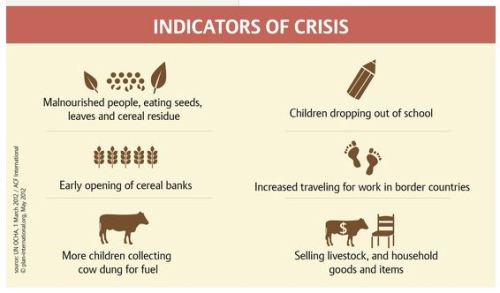
In countries of poor harvests, farmers and their families have been coping using straightforward approaches of cutting back on their expenses. In the Sahel, families sold their livestock; others sold their furniture and other possessions. After three consecutive years, their assets have been depleted and men, women and children have been looking for work to supplement household incomes.

The conflicts in Cote d’Ivoire, the Maghreb, and Libya meant that more than 200,000 migrant workers from the Sahel had to flee those countries and return home. Given the average size of families in the Sahel, about 7-12 members per family, two million people suddenly became affected and had reduced incomes.

In addition, the Malian refugees which poured over the borders into neighbouring countries are an additional stress on food insecure areas. For every one refugee, there are five animals. So if you consider 375,000 animals coming over with 75,000 refugees, for example, those animals can dry up a water-scarce irrigation dam in just few days. Yet, cattle are a lifeline and in a food crisis, they cannot be forgotten.

In addition to depriving people of a considerable source of income, the drought in the Sahel is a source of conflict. Shepherds, for example, who are forced to take their animals southward in search of pasture, come into conflict with farmers.

Cultural differences
People in the Sahel eat a different staple to what is grown outside the region and this has implications during a food crisis. Let’s take a scenario where countries on the west coast, such as Liberia or Cote d’Ivoire, may have enough food to export. However, it is not the type of food that people in the Sahel eat and they therefore won’t import it. Instead they import from one another at prevailing market rates which has a knock-on effect on availability and cost.

Market forces – influenced by global factors – dictate price. There is a common market across West Africa where traders move and sell freely. When Nigeria is buying, WFP is buying, other NGOs are buying the price increases. If you look at food prices you will see that prices this year compared to the same period last year is more than 100% in Mali, more than 70% in Burkina 42% in Niger.

So, as an NGO, Plan International had to change its strategy and approach our donors for permission to do cash-for-work or food-for-work programmes rather than waiting to do food distribution programmes after the food stock is totally depleted.

A food crisis may, therefore, not necessarily mean a shortage of food but rather the inability of a people to afford to buy the food.

Arab Spring
In addition to the complications of prolonged inconsistent harvest levels, market forces, and inflow of refugees and their livestock, the situation has become complicated by the rise of desert locusts this year.

The breeding grounds of locusts are in the border areas of Libya and Algeria. When the Gadaffi government was in office, they provided a lot of money for insect control in locust breeding grounds but since the Arab Spring and events following it the finance for the pest control has dried up. The continuing insecurity on these borders also prevents pest control activities. We are now seeing a different impact of the Arab Spring spilling into the Sahel in the form of locust swarms.

The UN Food and Agricultural Organisation (FAO) which monitors locust movement say that swarms have been sighted in northern Niger. If these swarms come southward through the agricultural belt farmers will experience yet another problem. When these clouds of locusts descend on newly planted fields, they can devour acres of crops and trees in just 30 minutes. The locust swarms have also been sighted in northern Mali but because of the insecurity, no one can go there to control the pests.

NGOs do not do pest control as it is a very costly exercise involving planes and other equipment which we do not have. This role falls to specialised agencies such as FAO and governments. This is a looming disaster.

Road to hell
To cope with the food crisis, children have left school and have taken to the road to find work to help their parents. Some girls are working as domestic help in homes, other are begging on the streets, and boys are finding work in traditional gold mining in Burkina and Niger. A number of serious hazards face these children including respiratory problems from inhalation of dust and exposure to mercury, arsenic and other chemicals used in the process.

Many children who go to work on plantations, in cotton fields and other types of farming also face risks of exploitation and potential trafficking.

Finding solutions
At Plan we are trying to address the food insecurity, in the areas we work, in a holistic way.

We are providing drought-resistant seeds, supporting the government to train farmers in drought-season activities and supporting the 3N programme (“Niger Nourish Nigeriens”). One of its principal objectives is reducing dependence on climate through irrigation and rain water collection projects.

Plan, whose core work is Child Centred Community Development (CCCD), is also empowering communities to get involved in the cereal market and beat speculators at their own game by creating community-managed cereal banks. After a harvest the price of cereal drops and farmers are forced to sell their crops at low prices to meet the schooling cost for their children and other social costs. Speculators buy the cereal and store it until food shortages kick-in around mid-year and then release the cereal at high market prices.

Plan-supported communities are doing the same thing – except that they sell at a lower price to members of their village. The income generated is used to increase the storage capacity of the cereal bank and support social infrastructures in the village such as building facilities like medical centres and schools.

We are also implementing micro-finance project for women and youth using the VSLA strategy (www.vsla.net). We have discovered that if we provide economic empowerment for women then there is a trickle down effecting benefiting children who will receive balance meals, medical care and an education. We are seeing improvements in the quality of life for families in our programme areas.

Using this approach, many villages are now being lifted out of poverty and Plan is replicating this in other areas in which we are working.

No handouts
When Plan appealed to developing nations for assistance for the Sahel Food Crisis, it was not to address an annual chronic food shortage. It was to address a complex emergency that has stretched an already stressed situation to its breaking point which in turn has put four million children at risk of malnutrition.

No one is ever happy about being in a situation to ask for help to feed their families.

Plan is using aid money in such a way so as to prevent dependency on long-term aid. The United Nations agencies of OCHA and UNDP have demonstrated that for a dollar of foreign aid spent on preventing disasters saves an average of seven dollars in humanitarian disaster response.

At Plan we are seeking to empower and support the people living the Sahel to get out of the situation themselves. We are in it for the long haul. We are working hard to make ourselves and our work redundant and build resilience in the Sahel and hope. None of this is possible without the support of governments and people from the rest of the world.

Read Full Post »

Continue reading on Storify…

Amanda’s workshop was educational, thought-provoking, well-researched and participatory. The youth who participated in the workshop were from Bangladesh, Liberia, Haiti and across the US. They were incredibly savvy and insightful in their thoughts, analysis and comments. I learned a lot about ethical advocacy as well as about what makes a campaign or initiative interesting for well-informed, globally engaged young activists.

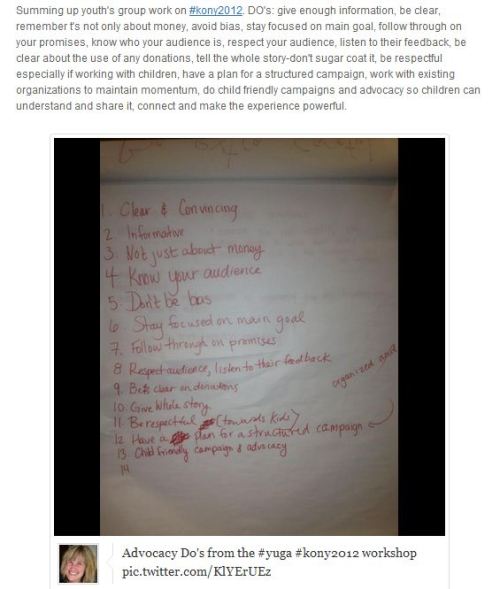
The rest of the workshop is captured here, including my favorite part:

The advocacy Do’s and Don’ts that participants generated during group work:

And a key take-away:

Summary of the full workshop.

Amanda’s ebook “Beyond Kony2012: Atrocity, Awareness and Activism in the Internet Age.

Read Full Post »

I’ve been told that mention of the term ‘governance’ makes people want to immediately roll over and fall asleep, and that I’m a big weirdo for being interested in it. But I promise you governance is *so* not boring! (I’m also fairly sure that whatever my teacher droned on about as I slept through my ‘Government’ class senior year of high school was not ‘governance’.)

If you get excited about the concepts of ‘open’ or ‘transparent’ or ‘accountable’ or ‘sustainable’ or ‘human rights’ or ‘politics’ then you need to also get pumped about ‘governance’ because it includes elements of all of the above.

I am just back from a week-long workshop where, based on our different practical and strategic and thematic experiences, internal and external evaluations and reviews of good practice, videos and documents from other organizations, input from children and youth in several countries (and with the support of a fantastic facilitator), several of us from different Plan offices worked to define the basic elements for a global program strategy on Youth, Citizenship and Governance (to be completed over the next several months).

At the workshop, we got a copy of A Governance Learning Guide, which I’m finding very useful and am summarizing below.

Why is governance important?

Our focus is on children and youth, but many of the reasons that governance is important for them extend to governance overall.

From Plan UK’s Governance Learning Guide, chapter 1.

So what exactly do we mean by the term “governance”? 

In our case, we link governance work with our child-centered community approach (a rights-based approach) and in this particular strategy, we will be focusing on the processes by which the state exercises power, and the relationships between the state and citizens. We have separate yet related strands of work around child and youth participation in our internal governance structures (here’s one example), effectiveness of our institutional governance overall (see this discussion on International CSO governance, for example), and the participation of children and youth in high level decision-making fora.

Our concept of governance for the youth, citizenship and governance strategy is based on the following governance concepts*:

Accountability and responsiveness.  This includes formal government accountability as well as citizen-led accountability. Opportunities for children and youth to participate in formal accountability processes are often limited due to their age — they cannot participate in elections, for example. Citizen-led accountability can open new opportunities for children, youth and other more marginalized groups to hold those in power more accountable.

‘People no longer rely on governments alone to improve governance. All over the world we are seeing experiments in ‘participatory governance’. People and organisations are grasping the opportunities offered by decentralisation and other reform processes to demand more of a say in the public policy and budget processes that affect them. These ways of holding the state to account are often called ‘social accountability’. Examples include participatory budgeting, monitoring electoral processes, using online and mobile technology, and citizen evaluation of public services. These forms of citizen engagement and social accountability are particularly promising for young people, who often face challenges in getting their voices heard in formal policy and governance processes.’ (from the call for submissions for the Participatory Learning and Action Journal (PLA) special issue on Young Citizens: youth and participatory governance in Africa, published in December, 2011)

Accountability is also linked with openness and sharing of information such as local government budgets and plans (this is also referred to as ‘transparency’). Responsiveness, in our case, refers to ‘the extent to which service providers and decision makers listen, meet and respond to the needs and concerns of young people.’ Responsiveness includes the willingness of those in power to engage seriously with young people and a government’s commitment to ‘be responsive’ to the issues raised by citizens, including children and young people. Responsiveness entails also the administrative and financial capacity to respond concretely to a population’s needs, rights and input.

Voice and participation.  This refers to the capacity of young people to speak, be heard and connect to others. Voice is one of the most important means for young people to participate. Within the concept of ‘voice’ we also consider voice strategies for raising and amplifying voices, capacity to use voice in a variety of ways to bring about change, space to exercise the raising of voices, and voice as a means to participate and exercise citizenship rights. (We consider that every child has citizenship rights, not only those who hold citizenship in a particular country). It’s also important to qualify the use of the term participation. In the case of young people’s participation in governance, we are not referring to the participatory methods that we commonly use in program planning or evaluation (we are also not discounting these at all – these are critical for good development processes!). In governance work, we are rather taking it further to refer to the meaningful inclusion of children and young people in decision-making processes.  

Power and politics. These are key in governance work. It is essential to be aware of and understand politics and power dynamics so that children and young people (and other oft-excluded groups) are not overlooked, manipulated, intimidated or disempowered.

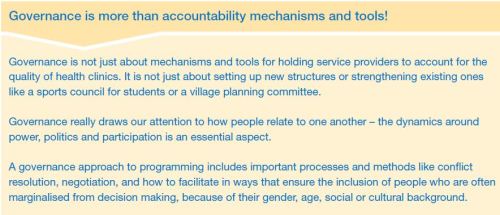
Image captured from Plan UK’s Governance Learning Guide, chapter 2 page 14.

A key question here is what children and young people are participating in, and what for. Another important question is where are children and young people participating? Is it in special events or spaces designated just for them or are they participating in adult spaces? How does the place and space where children and young people are participating impact on their ability to influence decisions?

It’s important to note the 4 types of power that are typically considered in power analyses (from VeneKlasen, 2007): power over (domination or control), power within (self-worth), power to (individual ability to act, agency) and power with (collective action, working together). These need to be analyzed and understood, including their social, cultural and historical factors that create and sustain different power dynamics in different situations and spaces.

Capacity. We refer here to the capacity of both decision-makers and young people. Decision makers need to have the ability to perform their duties and ensure services are delivered. This, in our case, includes the abilities of decision makers to interact, engage and listen to children and young people and to take them seriously and to be responsive (see above) to their views, needs and rights. Young people also need to have the capacity to hold decision makers to account and to express their concerns and their views, including the views of other children and young people who may be excluded and marginalized from the decision making process or from participating fully. Information literacy and the capacity to access, interpret and analyze information is a critical skill for children and young people.

Interactions between children and young people and decision makers. These spaces encompass critical aspects of participation, power and politics. An example of a space for interaction would be where children and young people, local government and school leaders come together to discuss budget plans and available resources for school infrastructure. These spaces are shaped by a number of factors, including social, economic, cultural ones. They are also not free of personal agendas, desires, intentions and prejudices. It’s critical to remember this in governance work — ‘tools’ and ‘mechanisms’ are not enough. (ICT4Governance and Tech for Transparency friends, I’m looking at you! Though I think most of us see this point as ‘beating a dead horse’ by now.)

From Chapter 2 of the Governance Learning Guide by Plan UK

*Summarized from Chapter 1 and Chapter 2 of Plan UK’s extremely useful and easily downloadable A Governance Learning Guide. The guide also has a number of practical use cases on different governance initiatives as well as an extensive section on additional resources.

Here’s a follow-up post (since governance is so clearly *not* boring and I’m sure there is high demand for more!) called 15 thoughts on good governance programming with youth.


Read Full Post »

This is a cross-post by Laura Pohl who works at the Bread for the World. The post is a summary of the latest Humanitarian Photography group meeting. The meetings are part of a series of meetings about photography in humanitarian work organized by CORE Group. (The original is posted here)

An employee at the Yemi Hanbok factory near Yanji, China, examines a traditional Korean skirt she is dyeing.The factory’s unique geographic position in China, near North Korea, means it can have work done cheaply in both countries and then sell to customers in South Korea. Photo © Laura Elizabeth Pohl

One of the most common questions I get asked at work is, “Can I use this picture?”

Oh, there are so many answers — and we talked about most of them at our latest Humanitarian Photography Group meeting this past Tuesday. Jim Stipe of Catholic Relief Services, Ann Hendrix-Jenkins of CORE Group and I organized the meeting. I led it, starting off with a talk on figuring out whether a photograph is yours or not. Sounds easy, right?

Well, if someone on your staff shot the picture then yes, the answer is easy: you can use it. But should you use it? (More on that later.) If your organization hired a freelancer to shoot pictures for you, then yes, you can use the pictures but possibly with restrictions. It depends on the type of contract between you and the photographer. The main point here is that the photographer usually still retains copyright to the picture and your organization is licensing the pictures. If this all sounds complicated and legalistic, don’t worry; we’ll be delving into copyright, contracts and licensing in a future meeting. Finally, if you don’t know who shot the photograph, where it came from or who owns the copyright, it’s best not to use the picture.

Next I talked a bit about Creative Commons licenses, which photographers use when they want to let the public publish their pictures without paying a licensing fee. CC-licensed photos abound on Flickr, a frequent source of pictures for nonprofit organizations. Just be sure the picture editor at your organization (or the person in this role) understands all six CC licenses and when a picture is fully copyrighted, all rights reserved. When I was a freelance photographer, an NGO once published my copyrighted photographs from Flickr without my permission. I found the copyright violation and sent the organization a stern letter and invoice for the pictures. The organization paid up. They never apologized, though. The organization had tasked their intern with finding pictures. It turns out he didn’t understand copyright.

Finally, I talked about content and technical criteria for publishing pictures, showing about 20 “bad” photos that Jim and I found. There are many reasons photographs shouldn’t see the light of day but I think the best way to summarize the photo usage criteria listed below is, “Do unto others as you would have them do unto you.” That out-of-focus photograph of 10 bored-looking people sitting in a meeting? You don’t have to use it. That portrait of a person with a strange expression on his face? Just don’t publish it. As Jim often says, “It’s better not to use a photograph than to use a bad photograph.”

  • Dignity – No emaciated children, flies in eyes, violence or stereotypical images.
  • Safety – Could the picture put the photo subjects in danger, even if they agreed to be photographed?
  • Context – No pretending photos of one thing are of something else. Sometimes photos published as a collection make sense together but one photo on its own from the collection doesn’t make sense.
  • Caption – Who’s in the picture? Where was it taken? Why is this picture important? Even if you can’t publish this information because of safety concerns, it’s important to have the information for your internal records.
  • Credit – Who took the picture? It’s just like attributing a quote.
  • Third effect – Two pictures paired together can take on a new meaning.
  • Focus – Is the picture sharp or blurry?
  • Framing – Is the photo framed well?
  • Exposure – Is the picture properly exposed?
  • Color – Does it look natural?

People had great comments and questions at the end. (By the way, Jim did a nice job tweeting the meeting at #NGOphoto.) A woman named Aubrey said her organization works on a lot of construction projects, roads, latrines, etc. They often shoot before and after photographs to show the impact of their projects. Another person asked about setting up or staging shots. Some people wanted to know more about contracts and how to work with country programs to set up photo shoots. These are all meaty topics. I can’t wait to get into them more in future meetings. We’re taking a break for the summer but we’ll meet again in September, so get in touch if you’d like to join us.

You can find summaries of other meetings here:

April: On the ethics of photos in aid and development work

May: Aid, ethics, photography and informed consent

Read Full Post »

‘Breast flattening,’ also known as ‘breast ironing’ or ‘breast massage,’ is a practice whereby a young girl’s developing breasts are massaged, pounded, pressed, or patted with an object, usually heated in a wooden fire, to make them stop developing, grow more slowly or disappear completely.

Rebecca Tapscott* spent last August in the area of Bafut, in the Northwest, Anglophone region of Cameroon, where a 2006 study by the German Society for International Cooperation (GIZ) found an 18% prevalence rate of breast flattening. The practice has been known as breast ‘ironing,’ however, Rebecca opts to use the term ‘flattening’ to decrease stigma and encourage open conversation about a practice that remains largely hidden.** Rebecca wanted to understand the role of breast flattening in the broader context of adolescence in Cameroon, including past and present motivations for breast flattening; cultural foundations; relation to other forms of gender-based violence such as female genital mutilation or cutting (FGM/C); how and where it is practiced; the psychological and the physical implications of the practice on individual girls.

Rebecca published her findings via the Feinstein International Center in May 2012, in a paper titled: Understanding Breast “Ironing”: A Study of the Methods, Motivations, and Outcomes of Breast Flattening Practices in Cameroon.

She visited our office late last year to share the results of her work with staff at the Plan USA office, explaining that there is currently very little research or documentation of breast flattening. The GIZ study is the only quantitative study on the practice, and there do not seem to be any medical studies on breast flattening. It’s a practice that is believed to affect 1 out of 4 girls in Cameroon, more commonly in some regions than in others. Of note is that research on breast flattening has thus far only been conducted in Cameroon, thus creating the impression that the practice is uniquely Cameroonian, when in reality, it may be a regional phenomenon.

Organizations working to end breast flattening do so with the aim of protecting girls. However, the question of protection is an interesting one depending on who you talk with. Rebecca found that those who practice breast flattening also believe they are protecting girls. “Many mothers believe that unattended, a girl’s breasts will attract advances of men who believe physically developed girls are ‘ripe’ for sex. Breast flattening is seen as a way to keep girls safe from men so that they are able to stay in school and avoid pregnancy.”

According to Rebecca, breast flattening is practiced out of a desire to delay a girl’s physical development and reduce the risk of promiscuous behavior. Proponents of the practice consider that “men will pursue ‘developed’ girls and that girl children are not able to cope with or deter men’s attention. They see that promiscuity can result in early pregnancy, which limits educational, career, and marriage opportunities, shames the family, increases costs to family (newborn, loss of bride price, health complications from early childbirth or unsafe abortion).” In addition, there is the belief that girls are not sufficiently intellectually developed to learn about puberty, and therefore should not yet develop breasts. Another reason given for the practice is the belief that girls who develop before their classmates will be the target of teasing and become social outcasts. There is also, for some, the belief that large breasts are unattractive or not fashionable.

Rebecca cites a poor understanding of human biology as one reason that the practice persists. Some of the beliefs around it include: “Belief that sensitivity and pain during breast development indicates that the growth is too early and must be artificially delayed until the girl is older. Belief that when a girl develops breasts she will stop growing taller. Belief that puberty can be delayed by delaying breast development. Belief that for breasts to grow properly, the first growth should always be repressed (like baby teeth). Belief that if breasts begin growing at a young age, they will grow too large or be misshapen, resulting in a displeasing or disproportionate female form. Belief that breasts and other outward signs of sexuality develop in accordance with a girl’s interest in sex, and therefore a developed girl is soliciting sexual advances or is a ‘bad’ girl. Belief that when a girl develops breasts, she believes she has matured and subsequently, she becomes less obedient. Belief that it will improve breast feeding at a later age.”

“…For mothers there is the perception that we should delay the development of girls as much as possible, believing that physical development shows maturity. Men look at girls and talk amongst themselves and say, “she’s ripe for sex.” They are not looking for marriage prospects…Men are aggressive. In pidgin, they say “she got get done big,” meaning, she’s matured and ready for sex. I can go after her now. Women, on the other hand, know that their daughters are just kids.” ~ journalist that Rebecca interviewed.

Rebecca also heard explanations such as “A girl will stop growing taller because the weight of her breasts will hold her down. One can delay puberty by delaying breast growth. If the breasts hurt during puberty, they are developing too early.” There are also many beliefs related to a girl’s development and her sexual reputation. Some of these beliefs include that a girl with large breasts is a ‘bad girl’. This stems from the belief that breasts start to develop when a man touches them or if a girl is thinking about sex, going to night clubs or watching pornography. Rebecca found that many of these beliefs were held across all segments of society, from the very well educated to those with no formal education.

“The body responds to psychological ideas. If a girl looks for a “friend,” her breasts will grow faster. If she is interested in boys or watches pornography, her body will develop faster.” ~ Interviewee at the Ministry of Social Affairs

“If a girl is interested in sex and thinks about it a lot, she will develop faster. I saw two girls of 12 years, one of whom was very developed physically and the other was not. The one who was developed could speak very frankly about sex, showing that she was knowledgeable from some experience, while the other girl was very naive and shy.” ~ Teacher

Because of potential stigma or harm to girls who talked about undergoing breast flattening, Rebecca only interviewed a few teenaged girls directly during this phase of her research. Instead, she mainly interviewed older women, as well as a few boys and men. She found that most women who had experienced breast flattening didn’t seem to remember the experience as extremely traumatic; however, she commented, “most are remembering from back in the day. Most at first said didn’t really hurt but then after a while into the interview, they’d remember, well, yes it hurt.” Rebecca was surprised at the number of people who said that heated leaves were used, because the media normally reports that a grinding stone or pestle is used for breast flattening.

“When I was 11 years old, my grandmother did a form of breast flattening to me. This was in 1984. I was walking around with her shoulders hunched forward to hide my developing chest, so my grandmother called me to the kitchen. She warmed some fresh leaves on the fire and said something in the dialect, like a pleading to the ancestors or spirits. Then she applied the leaves to my chest, and used them to rub and pat my breasts flat. She would also rub and pat my back, so as to make the chest flat and even on the front and the back. It hurts because the chest is so sensitive then—but they are not pressing too hard.” ~ 38 year old woman from the community

“To do the practice, I warmed the pestle in the fire, and used it in a circular motion to press the breasts flat. I did it once per day for over a week—maybe 8 or 9 days. I massaged them well, and they went back for seven years.” ~ 53-year-old woman attending a maternal health clinic in Bafut, attending with a different daughter whose breasts she did not flatten

“Until about a year ago, I believed that when a girl is interested in sex, watches porn, or lets boys touch their breasts, her breasts will grow larger. I think my mother must believe this. My ideas changed when I saw my own friends—I knew they were virgins, but they had large breasts. Also when my own breasts got bigger, and it was not because a man was touching them.” ~ Journalist in Bamenda

There is currently no consensus on whether the practice is effective at reducing the size of a girl’s breasts or if it has long-term effects on breast size. “People told me completely different things gave the same result, or people cited the very same practices as yielding different results,” said Rebecca.

Rebecca’s findings indicate that the practice of breast flattening is not a longstanding ‘traditional’ practice. Many people reported that it became more popular with urbanization. “People [who immigrated to cities] didn’t know their neighbors and they were worried about the safety of their daughters. It seems that an old practice that was used for ‘shaping’ was repurposed and adapted. Breast flattening is a very intimate and personal thing between mother and daughter. It doesn’t happen to all daughters. It’s very difficult to track, and there is no association with ethnic groups, education, socioeconomic levels, religion, etc.,” she explained.

“Most men don’t know about it. One boy said he thought it was good to protect girls.” When she talked holistically with men about what they look for in a woman, Rebecca said, “an interest in chastity and virginity came out very clearly. In Cameroon the average age for girls to lose virginity is 13-17, and it’s the same for boys. According to studies, for most, the first sexual experience is unwilling.”

Most doctors that Rebecca talked to had never heard of the practice. One doctor in Yaoundé said he had seen first and second degree burns as a result. Some cite that edemia may be a result. Development organizations like GIZ say it can cause cysts, cancer, and other difficulties but also cited that only 8% of women report suffering negative side effects, while 18% report that their breasts “fell” or sagged at an early age.

Many women who Rebecca interviewed considered the practice a very low concern compared to other problems that impact on their development, such as illiteracy, sexual exploitation, poverty and unemployment. “The women that I talked to,” said Rebecca, “often asked me, ‘Why are you asking me about this? It’s such a small thing compared to other things we have to face.’”

Given that there is not much research or consensus around breast flattening in Cameroon and the broader region, Rebecca’s work may be of use to local and international organizations that are working to promote women’s and children’s rights. Rebecca emphasizes that most people who engage in what are commonly referred to as ‘harmful traditional practices’ including female genital cutting (FGC) and breast flattening, actually do so with their child’s best interest in mind, as a means of protecting and promoting the child within the community and following social norms. Therefore, frightening or berating people may not be the best approach to discourage the practice of breast flattening. Community input will be needed to identify the root causes of the practice for it to become obsolete. Better sex education and a reduction in stigma around talking about sexual reproductive health may also help. Men will need to be part of the solution, and so will mothers who currently feel the need to take protection of their daughters into their own hands. Like many similar practices, it’s not likely that breast flattening will end until other systems and environments that set the stage for it also change.

*Rebecca worked with Plan Cameroon for several weeks on the Youth Empowerment through Technology, Arts and Media (YETAM) Project last June and July. She traveled to Bafut following her internship to conduct independent research.

**This distinction is similar to the difference between the terms female genital ‘mutilation’ and female genital ‘cutting.’

Read the full report.

Contact Rebecca for more information: rebecca.tapscott [at] gmail.com

Read Full Post »
There’s a great, ongoing discussion happening around aid and development and the ethics of using photographs and other media and stories about people INGOs and NGOs are working with (a.k.a beneficiaries, clients, participants). The discussions are organized by CORE Group in DC. I also participated in the first meeting of the group in April (see this post: On the ethics of photos in aid and development work).

Today’s meeting focused on consent and informed consent for photographs.
Jim Stipe was the key speaker. He shared Catholic Relief Services‘ experiences with developing a process that allows for informed consent in a variety of situations.
.

Future discussions will cover related topics such as what happens with social media sites and consent and copyright? What about fair use of images and stories? I’m quite looking forward to continuing the discussions and learning!

Check out the compilation of tweets here on Storify – be sure to read from bottom to top!

Also see this old post: Child protection, the media and youth media programs.

Read Full Post »

« Newer Posts - Older Posts »