Feeds:
Posts
Comments

Archive for the ‘social media’ Category

I’ll be speaking on a panel called ICT4D, Innovations and the MDGs next week during UN Week in New York and another on Girls and Mobiles hosted by Mobile Active. So, I’ve been putting together my thoughts around girls, child rights, ICTs and the MDGs.  The angle I’m taking is not from the large donor, top down, huge institutional program side, but instead, looking at examples from the work I’ve been closest to over the past few years at the community and district level, mostly focused on child and youth participation in the development process. Check my MDGs through a child rights lens post for more background.

My last post (3 ways to integrate ICTs into your development organization) uses Hannah Beardon’s framework to discuss how organizations can integrate ICTs into their work. Hannah suggests that ICTs can be integrated directly(providing access to ICTs), strategically (using ICTs as tools to support development processes) and indirectly (using ICTs to improve efficiency and communication within the organization).

To complete that post, I’m listing below 5 ways that ICTs can facilitate accountability and transparency, citizen engagement, and public debate, all of which are necessary to bring about development improvements and achieve the MDGs. Obviously these are not the only ways ICTs can support the MDGs, but this post would have been miles long if I’d listed all the initiatives that are out there.
1) Engaging children and youth in the development process

An engaged and active population is a key ingredient for good development programs. Children and youth have much to offer, are directly targeted in the MDGs and many other development initiatives, offer valuable ideas and energy, and make up around half the population in many of the countries that are lagging in reaching the MDGs. ICTs can help children and youth engage in the development process and bring their ideas, opinions and voices alive at the community, district, national and global level. ‘Using new technology, new media, children and youth can claim a space that they didn’t have before. They can influence certain things, advocate on particular issues that are important to them, take ownership in communities and in leadership. ICTs excite them and encourage them to be more involved and engaged.’ Anthony Njoroge, Plan Kenya Community ICT Manager.

ICTs empower young people with skills that make them more confident and more involved at the community level.‘Using ICTs, children and youth have become more responsible because they are not waiting for adults to come in with something. Now they are designing it themselves, they are creating space for themselves and bringing their agenda to adult meetings instead of waiting to be invited in or having to work within the agenda of the adults. It used to be that you’d start working with 20 youth, you’d invite them into a community meeting. You’d see the number go down to 10, to 4, to 3, because they didn’t see any relation to themselves in the topics and the goings on. With integration of technology and the arts however, youth have a high level of interest. It’s really bringing in their opinions, their thoughts and ideas to join their voices with parents. Now they use arts and media to promote communication, dialogue on their issues and look for ways to resolve them. Before they were totally missing from the discussion, but now they are here.’ Judith Nkie, Plan Cameroon Youth Empowerment through Arts and Media Project Coordinator.

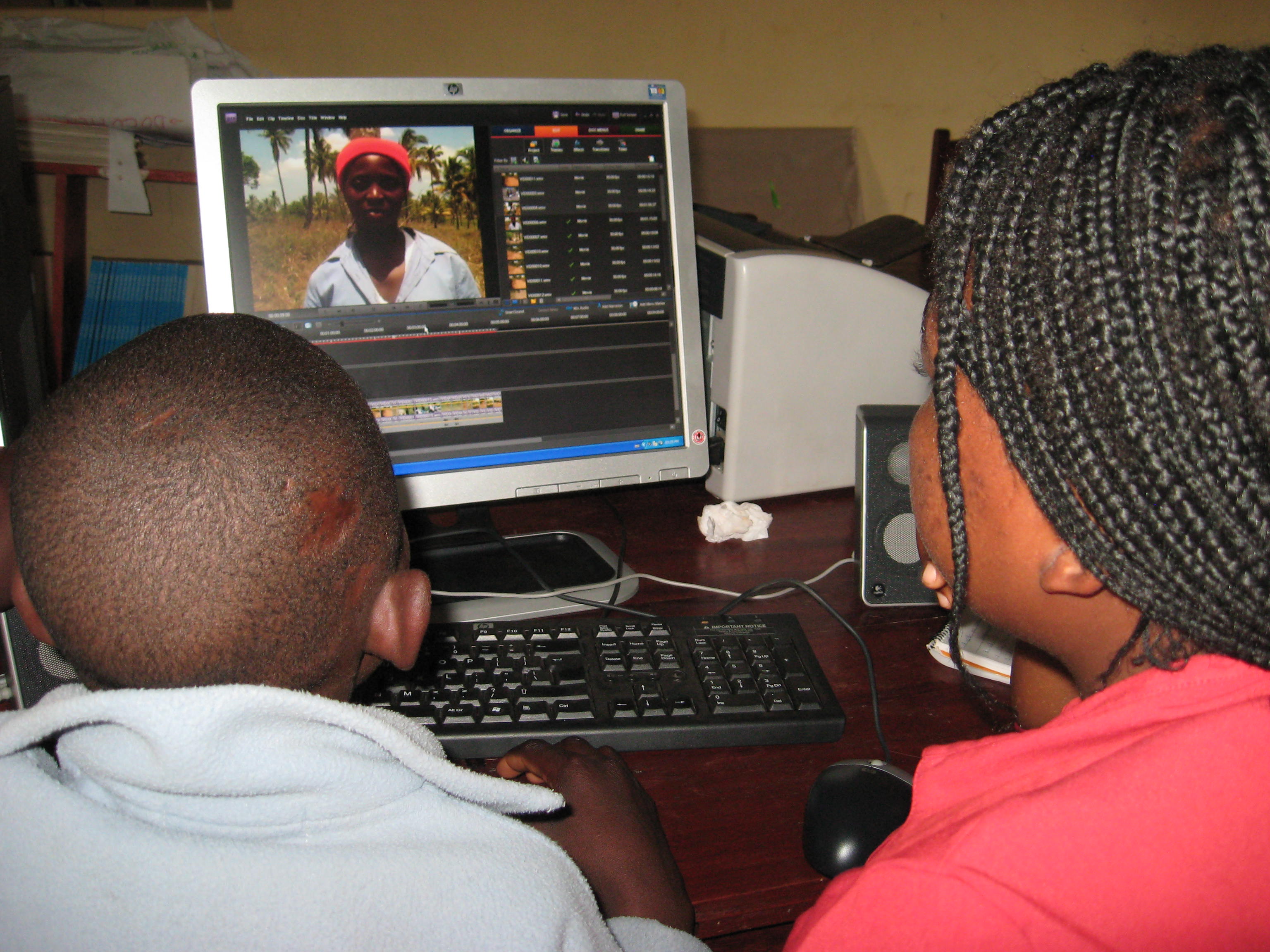
Arts and ICTs were used in the above-mentioned project as tools for youth engagement, mapping and prioritizing, research and community dialog. The media produced with the ICT tools was shared first within the community and then outside at the district, national and global levels as a way of engaging decision makers and the public in the youths’ agenda.  For more on how arts and ICTs are being used in the above-mentioned project, see this post. Watch 100 videos made by youth in 6 African countries on topics they are passionate about.

GPS work in Kwale, Kenya

2) Identifying resources and mapping patterns for better decision-making

Tracking and visualizing information is an excellent way to improve decision-making capacity. The advent of simpler and open source participatory digital mapping tools allows community members to map their communities digitally and to have more ownership of the information. Mapping helps identify patterns that may not have been visible before. Local maps shared on-line allow local people to provide their own information from their own perspective, and that information serves multiple purposes at the local level and beyond.

Digital mapping can be helpful when governments decentralize. Municipalities are mapping resources as well as projects and interventions. District authorities can track their own initiatives and those by local and international organizations to avoid duplication of efforts and wasted resources. When maps are public, the population can better demand answers about where resources are being allocated and why. Maps can help with disaster risk reduction and tools such as Ushahidi can help during emergency response. Mapping information is also useful for holding up a mirror to the population to ask them questions about themselves and their behaviors and for showing the direct consequences of actions; for example in a Community Total Led Sanitation mapping project, the community faces its realities about where their own waste is entering food and water sources.

Map Kibera is a good example of participatory digital mapping. mGEOS is a mobile mapping tool developed to help Plan Kenya staff to gather and share data needed for their daily work. Map Kibera and Plan Kenya are collaborating in Kwale on youth and governance work, and in Mathare to work on Community Total Led Sanitation using digital mapping tools (see July 27th entry). In this video, a district youth officer in Kenya talks about why digital mapping is useful for his community.
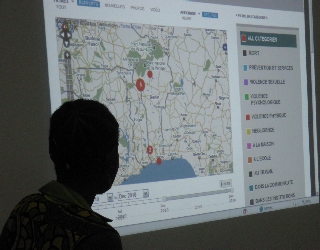
Mapping Violence against Children in Benin

3) Pulling in quick information to guide further investigation, response, or advocacy; pushing out information for targeted actions

ICTs can be used to gather quick information from a broad population. This can be useful in a variety of situations and themes, including those outlined in the MDGs. For example, SMS are being used to report on whether teachers are showing up at school, where violence against children and women is happening, where help is needed in the aftermath of a disaster, and for tracking endangered wildlife. Crowd sourced information can help governments and agencies get preliminary information so that further investigation and support can be provided in a particular area. Another example is the use of mobiles in different health initiatives, including:  child-birth care; HIV and AIDS prevention and treatment programs; support for volunteer community healthcare workers; and bed net treatment reminders. Most of the ICT and development world is also already familiar with the work of two organizations:  Ushahidi and FrontlineSMS who have been combining SMS with digital mapping.

A program that I’m closely involved with is SMS reporting of violence against children in Benin, where local communities, government agencies and NGOs are collaborating to improve the child protection system. This type of program shows promise if heed is paid to the pros and cons of collecting information by SMS, and if those implementing are clear about the type of information that will be gathered, privacy implications, and how the system will complement existing systems. (Here is one document that outlines some considerations). Increasing controls by governments and mobile phone companies, including SIM card registry and Mozambique’s recent government shut down of SMS services during the bread riots are good examples of how quickly the ICT landscape can change, and how flexible and agile those working in the area of ICTs need to be.

Checking info on constituency development fund

4) Supporting accountability and transparency

ICTs are useful to support accountability and transparency, necessary for attempts to track and ensure good use of funding for different efforts, including those related to the MDGs and other aid and development programs. Making information more available to the public by mobile is one such way.  SODNET’s budget tracking tool, for example, informs Kenyans of how much funding is allocated by the Constituency Development Fund to different municipalities in different categories. Combined with mapping, as outlined in this post, the budget information can help constituents to track where their funds are actually being spent.  Other interesting examples of how ICTs can be used for transparency and accountability can be found at TacticalTech’s Info Activism site and at Technology for Transparency.
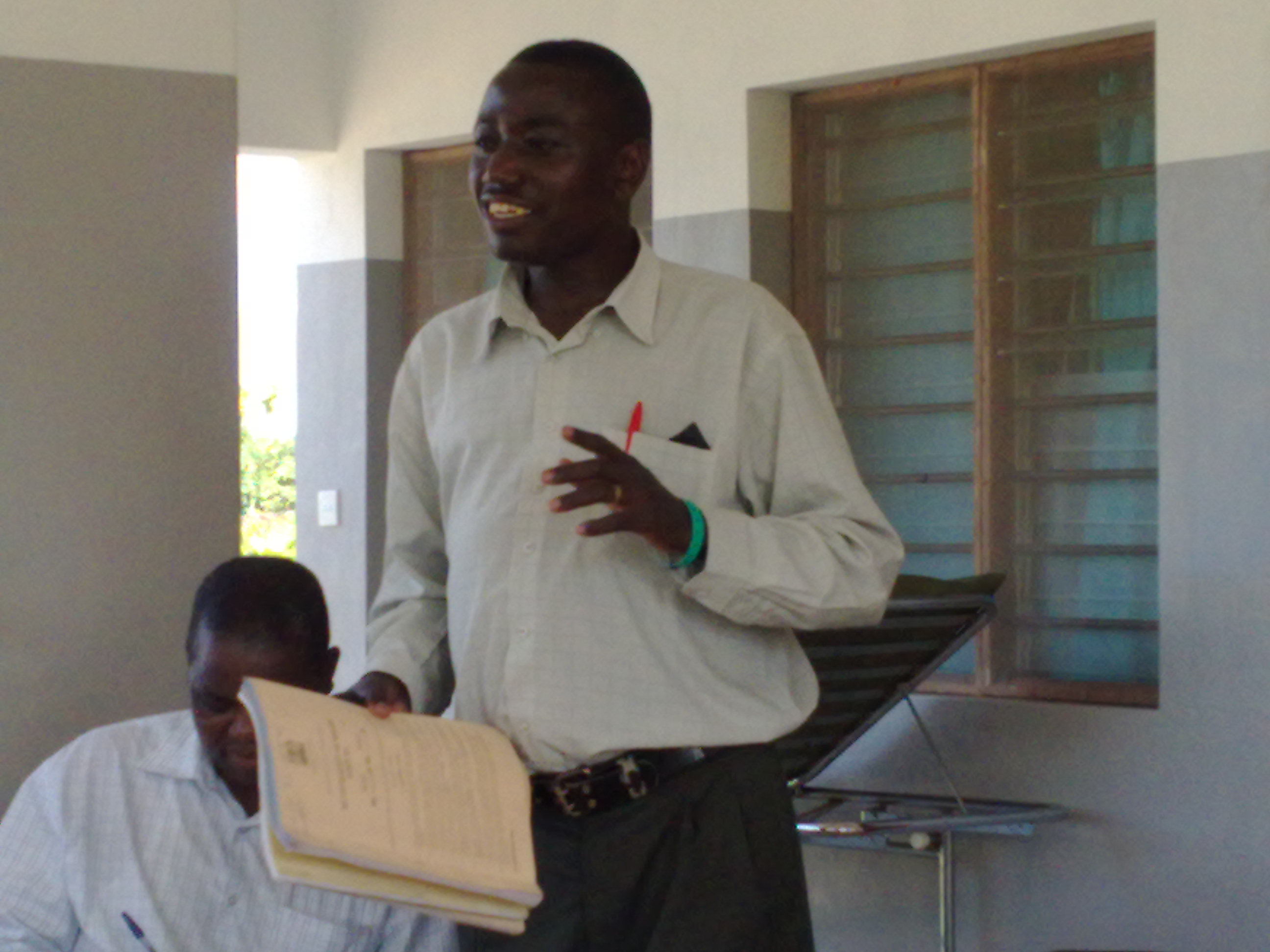
Paper forms will soon be digitized….

5) Improving municipal services and information management

Civil registration documents, especially a birth certificate, are a precursor to demanding any number of rights or accessing a wide array of services. Without a birth certificate a child may not be able to sit for school exams, receive immunizations or free health care or claim rights to inheritance or legal protection in courts of law. Proof of age is critical in successfully prosecuting perpetrators of crimes against children such as child trafficking, sexual offenses, early recruitment into the armed forces, child marriage and child labor. ICTs are being used to digitize civil registry in Kenya, for example. Not only are records being digitized, but mobile phones are used to make it more convenient for the population to know when their documents are ready. This saves people time and money and means that more parents will register their children.

But wait, there’s more!

These are only a few examples of ways that ICTs are being used at the grassroots level to improve participation, transparency, accountability, debate and ownership of the development process.  The MDGs are lofty, but informed local community participation and ownership is key in efforts to reach them and in ensuring that marginalized populations can also be included.

Please add your examples of ways that ICTs can support development and ICTs in the comments section!

Related posts on Wait… What?

3 ways to integrate ICTs into development work

11 concerns about ICTs and ‘social media for social good’

I and C, then T

MDGs through a child rights lens

7 (or more) questions to ask before adding ICTs

A positively brilliant ICT4D workshop in Kwale, Kenya

The road to Wa is paved

Read Full Post »

Angelica Valeria Ospina recently wrote about the role of social memory and ICTs in building climate change resilience.  She refers to Carl Folke’s definition of social memory as “captured experience with change and successful adaptations embedded in a deeper level of values, and actualized through community debate and decision-making processes into appropriate strategies for dealing with ongoing change.

Ospina suggests that social memory is “key for linking past experience with present and future adaptation actions, and in turn allows for novelty and innovation.” She comments that “Although the role of memory tends to be overshadowed by that of innovation, the two are in fact important foundations for change, and are equally relevant within contexts that are struggling to adapt to uncertainty….”

I really like this idea of balancing memory and innovation, and it’s not only valid within the framework of resilience and climate change.  Social memory is also useful for those of us working in ICT4D and m4D because we find ourselves at the intersection of development and technology, where methodologies and mindsets can be in opposition at times and where change is happening at a rapid frequency.

A quick characterization of the mindsets

Development Organization Mindset: How can we work with our existing resources and work around our challenges to reach our goals? How can we build on experience?

Those who work with grassroots community development are schooled to look at assets, to help communities and local organizations look at what exists already, what is within their reach, and how to identify their existing resources before looking outside for support or help. This helps a program to be more locally owned and sustainable.  Those in this field are trained to look for potential obstacles and limitations and see how to go around them or to work within them. There is a sense that lives and livelihoods are on the line, this is nothing to play around with and failure carries a high price both for community members and for organizations. This mindset can be really frustrating for for-profit or marketing consultants who come in to get people to do ‘blue sky thinking’ and to forget about limitations.

This is the group that people would describe using that Henry Ford quote:  ‘If I had asked people what they wanted, they would have asked for a faster horse.’ But this kind of thinking does have its place – local context, perceived limitations, and local experience, eg. social memory, are important in design and sustainability and impact. In addition, innovations don’t only happen in terms of ‘products’, there are process, position and paradigm innovations also which happen all the time in non-profit organizations and communities.

(Note: Certainly some will say that in aid work, no one does evaluations, and no one learns and it’s all a waste of time and resources, but that’s not been my personal experience at this point, and the work I’ve been involved in has been community development focused, not top down delivery of services and goods.)

Design Student/Technology Innovator Mindset: What can we make? What can we build that’s like nothing that’s come before? What solutions can we offer?

Innovation thinking pushes for a different kind of visioning. For throwing aside conventions and ignoring limitations so that the chains are completely off. It urges people to move quickly, to try and fail fast and often. A lot of innovation and tech thinking is product focused – What can we make? What can we build? What solution do we have that people might need? What tech can we invent and then let people figure out uses for? Those in this group are trained to move forward without thinking so much about the challenges and limitations, to move at a quick pace, and without engaging a thousand people in the process. This enables new ideas to flourish unfettered by endless rounds of consultations and participation by too many people bringing you to the fabled and unfortunate “a camel is a horse designed by a committee” result.  It allows totally new ideas and processes as well as products to spring up. Lots of trying might equal lots of failing, but it also brings about those few amazing and game changing innovations that allow huge leaps forward. Many within this field are amazingly bright and creative. At this point few have long-term experience living in poor communities in developing countries, and there are few opportunities for gaining enough of that experience.

The middle ground

Both of these mindsets have advantages and limitations and seem to have a very hard time coming to a middle ground to work together effectively, though some initiatives are overcoming this challenge. Potential collaboration can be compromised when people address each other in snarky or accusatory ways, without sufficient knowledge of the other’s work and experience. For example, this series of blog posts around crowdsourcing and humanitarian aid between Patrick Meier (here, here and here) and Paul Currion (here and here). Unfortunately I don’t have a audio recording to post of the conversation where someone told me that Paul is quite well-known for innovations in the field of humanitarian aid and technology, and would be an excellent person to collaborate with on innovations in humanitarian aid — I really hope people like Patrick and Paul will work together, as the results could be fantastic.

Ken Banks has also raised this issue of m(obile) vs d(evelopment); most recently in his post Dissecting m4d: back to basics, where he asks: Do the majority of people working in “mobiles for development” work in mobile, or development? It may seem like an odd question, but how people approach “m4d” may have more of an impact on success or failure than we think.

An example of collaboration

There are some good examples of collaboration however. One I saw most recently is MIT’s Department of Play’s Summer Institute in early August, where a team of incredible innovators and students from MIT working on community youth engagement tools spent 2 days in discussions with folks with years of experience working on child participation and youth engagement, including UNICEFCUNY Children’s Environments Research GroupProject Vision Design and Research Collective at Srishti School of Art Design and Technology Bangalore; and the Program in Education, Afterschool & Resiliency (and me :-D)

I think eventually these gaps will smooth out as the younger generation moves in and up the chain at development organizations and some of the newer technology becomes ubiquitous within organizations. It’s quite possible also that the current and new generations of design and tech students will spend more time ‘in the field’. And I am not only talking about ‘Western’ folks here, I’m also talking about young people and design students from the so-called ‘underdeveloped countries’, many of whom use technology at a dizzying pace and who are already re-shaping how development is viewed and carried out in their countries.

By lowering the fences that we are all working behind, and finding ways to combine our different skills, ICT4D and m4d can come up with even better solutions and achieve better impact in areas like accountability, health, education, livelihood, governance, emergency response and disaster preparedness.  We can build teams that capitalize on the different kinds of knowledge, skills and mindsets. We can harness social memory and strive for a balance between experience and innovation.

Related posts on Wait… What?

Salim’s ICT4D advice: innovate but keep it real

Mind the gap

mGESA: Mobile GEographical Services for Africa

Amateurs, professionals, innovations and smartaid

On trust and disempowerment

Read Full Post »

Praia Vermelha, Rio de Janeiro, Brasil

I’m on vacation for a week. In Rio de Janeiro. On a supposed social media break. But I’m on-line right now instead of on-thebeach; in stealth mode, secretly reading Tweets and Google Reader over morning coffee while my fellow vacationers sleep on and sun pours in the huge open window in the apartment we’re sharing in Copacabana.

I was supposed to quit social media and email for the week, but I’m at that point where I question whether I really wanted to go offline at all, and why…. being addicted to Twitter isn’t really a bad thing, is it? If you’ve ever tried to quit smoking or go on a diet and failed, you’ve been here.

I’m sneaking peaks, but not conversing and sharing. Pretending I’m not online, because supposedly I need a social media break (and because being addicted is somewhat embarrassing). But the truth is that my vacation is awesome and I enjoy being online, probably similar to how some people enjoy reading the Sunday paper.

Some highlights I discovered and didn’t share during last week’s feigned Twitter hiatus…

Aid and development

Loved @lrakoto’s great piece on some of the current big dilemmas/discussions in aid…. Aid is about the people, right?

Read @morealtitude’s intense and harrowing World Humanitarian Day series part 1part 2, and part 3. Wow. Watched OCHA’s beautifully done world humanitarian day video (and couldn’t help but wonder how much it cost to make it). Felt sad that humanitarian aid needs so much marketing lately to be seen as good. Went back and forth as usual, reading this week’s pros and cons of how humanitarian/international aid work needs a total overhaul and how it’s vital work in many places.

Saw Pakistan continue to get less attention than Haiti even as the situation gets worse and worse. Read an interesting piece from a colleague on how women and girls and culture are being impacted by the floods. Saw another colleague, @warisara, (experienced communicator who worked on the ground during the Asian tsunami and who’s now arrived to Pakistan) questioning why aid organizations have to keep showing graphic, horrifying visual images in order to draw any attention to a crisis, and wondering if each disaster has to be worse than the last in order to get the public to care. What an unfortunate dilemma — how to avoid undignified, disrespectful images and still manage to raise any funds.

Saw a sad exchange after my employer posted an appeal for Pakistan… Someone argued that we should not help Pakistanis because ‘they wish to see us dead’. They based their reasoning on ‘Christian principles’. What was heartening at least were all the other comments arguing against that view, arguing for helping Pakistan after the devastating floods, and seeing past religions and hatred and fundamentalist behavior.

Was flattered to get listed in the Activist Writer’s top 10 blogs along with aid bloggers I really admire. Discovered @aaronausland’s blog Staying for Tea.

ICT4D and m4D

Enjoyed the debate started by @Kiwanja on the need for an active mobile community for addressing fundamental, deep questions and thinking, and bridging the gap between development folks and technology folks. (Something I encounter and write about often, such as here and here). Liked this Venn Diagram on the intersection of m4D, apps4D and ICT4D.

Noticed that @mambenanje got himself a copy of an article about him in Brussels Airlines in-flight mag (also incuded Erik Hersman, Ethan Zuckerman). Remembered how cool it was being on that flight to Kenya, opening up the in-flight magazine, and seeing names of people I know.

Saw that @wayan_vota has a beautiful new baby girl.  And that miraculously he’s been able to re-follow me on Twitter after months of his account auto-unfollowing me time and time again (though he’s explained it also happens when he tries to follow @billeasterly…. weird – and really not sure what I have in common with the esteemed Professor that makes Wayan’s account consistently unfollow us both….).

Pakistan and the ‘Ground Zero mosque’

Due to my self-imposed Twitter ban and bet with @ernstsuur that I could really stay off Twitter for a week, I reverted to posting on Facebook and managed to upset the good folks back home in the heartland (Indiana) when I posted a link about the so-called ‘Ground Zero Mosque’. Normally I don’t post political stuff on FB because of the variety of people that I’m connected to there — it’s hard to not offend at least someone. Facebook has become everything and nothing, pretty much.  I also re-posted an article on the ‘mosque’ and elitism (and thought it would be pretty fun to see Palin and @talesfromthhood debating elitism) and a link to the Daily Show giving it to Fox News. This provoked pretty emotional and strong comments (see below) from someone I was very good friends with in high school, but who’s gone down quite a different path than I have… eg, the military:

“So lets encourage all of our moderate Muslim friends to fulfill their religious duty. If they beleive (sic) that the extremist versions of Jihad and Sharia are incongruent with the teachings of Mohammed, then it is their responsibility to wage Jihad (lets let them pick the definition) against the extremists. When have created a predominantly tolerant Islam, I will finance a Catholic church in Saudi Arabia and will bless the establishment of a mosque anywhere in the U.S.

Until then, me and others like me will continue to spread AND DEFEND the basic rights that everyone in America, including the Muslim Americans who want to build this Mosque, enjoy. I invite all do-gooders everywhere to stand shoulder to should with me and my Soldiers in those countries where Muslims are not tolerant under Sharia……Saudi Arabi, Sudan, Iran, Pakistan, Nigeria (Muslim areas), Egypt, Buhrain, Azerbaijan, Yemen, Oman, UAE, Algeria, Mauritania, Somalia, etc., etc. “

Rather than get into a debate, I went with that whole “let’s agree to disagree” thing.  But seriously.  I can’t wait to get back to Twitter.

Pao de Azucar, Rio de Janeiro, Brasil

Rio de Janeiro

Luckily I’m not actually spending all my time in front of my computer. I’m mixing in a lot of other good stuff, like deep philosophical conversations with my 18 year old son, capoeira with him at Grupo Capoeira Senzala Cultural Center in Bairro Botafogo, naps, beach, pictures from the top of Pao de Azucar, and late night samba and caipirinhas at Rio Scenarium and other great places with good friends, old and new….

Read Full Post »

mGESA mobile mapping application

I wrote about a mobile mapping tool called mGEOS a few months ago, mentioning that I’d probably get a chance to try it myself in late July. Well that is just what happened.

I was at a workshop on ICT4D, including digital mapping, in Kwale, Kenya, and Peter Njuguna from Plan Kilifi’s District office came to share mGESA (aka Mobile Geographical Services for Africa) with us.

As far as I can tell, the difference between mGEOS and mGESA is that mGESA is a tailored application of mGEOS, designed together with Plan’s community based front-line staff for their specific information collecting and geo-visualization needs in Kenya.

Update: mGESA was the name for the pilot project. The final application is called PoiMapper (see www.pajatman.com). You can give it a try by downloading it and installing it on your mobile!

According to Njuguna, “the application is designed to run on simple mobile phones that have GPS capability and on which you can run applications.” It’s installed on the phone in the picture (update: the phone is a Nokia 6700 classic).

Njuguna explained “In Kilifi, we diverted from the route of going for applications that are there on the shelf or buying an application over the counter. We went the route of developing an application from scratch. We are working with various partners. We have Plan in Finland, we have Plan in Kenya, we have the University of Nairobi and we have the company Pajat in Finland. Plan Kilifi is the implementing office. So that is where we are coming from.”

The project has been on-going for 7 months. The first thing to define, according to Njuguna, was “Why do we need mapping? Why do we need GIS in the first place? Well, we need GIS to enhance the work we are doing and to try to answer some of the questions we are asking on a day to day basis. So that’s why we wanted to incorporate GIS into our work. Everything we’ve developed is towards helping us answer questions and make decisions in our program and sponsorship work. We wanted to build something that would suit our needs.”

The end users of mGESA are front-line staff in Plan Kilifi District office, and eventually in all of Plan Kenya’s district offices. “Kilifi front-line staff have all been involved in developing the application. The first step was developing a list of points of interest, for example, schools, hospitals and health centers, interest groups, water sources, trading centers, and the like; and outlining the kind of information that staff regularly collect about the points of interest for use in their work.

mGESA points of interest

“Developing the points of interest was a challenge,” said Njuguna. “It might look like we just sat down and listed them. But it has been a process. We had to go over and over it. We had to be sure the questions made sense, that the questions that we were asking were the right ones and made sense to people in the field.”

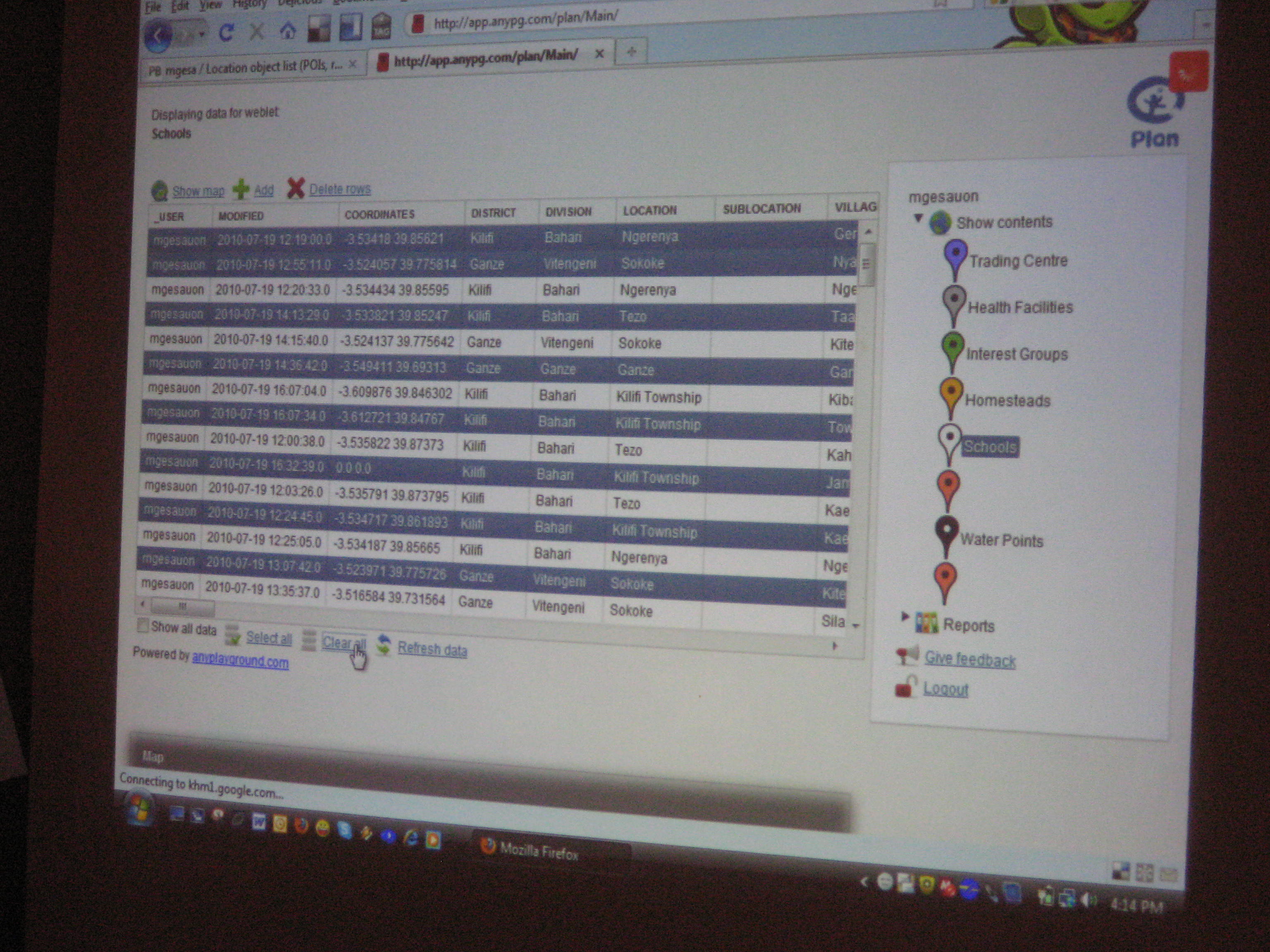
mGESA was tested in the field for the first time in mid-July. Njuguna and the team are hoping to kick off in another 3-4 weeks and start collecting the actual data. When the points are mapped out using the mobile application, then they are uploaded to a server that links with Google (or other) maps. The team is exploring the possibility of getting Kenya maps with administrative boundaries to use as the mapping platform. The data collected in mGESA can be exported into excel and .pdf files.

Peter let me try out mGESA while we were doing some GPS mapping in Kinango. He was using the opportunity to test accuracy, and whether mGESA was pulling in the same coordinates as the Garmin GPS units that we were using (it was). I found the data collection process to be quite simple. You basically arrive to your point of interest, take the point on the phone, and scroll through a menu to select pre-existing information (such as name of the district, type of point, etc.) or fill it in yourself. You can take a photo of the POI if your phone has photo capabilities (which most GPS enabled phones should have). I didn’t get a chance to upload data to the server or the web to see how easy that process is.

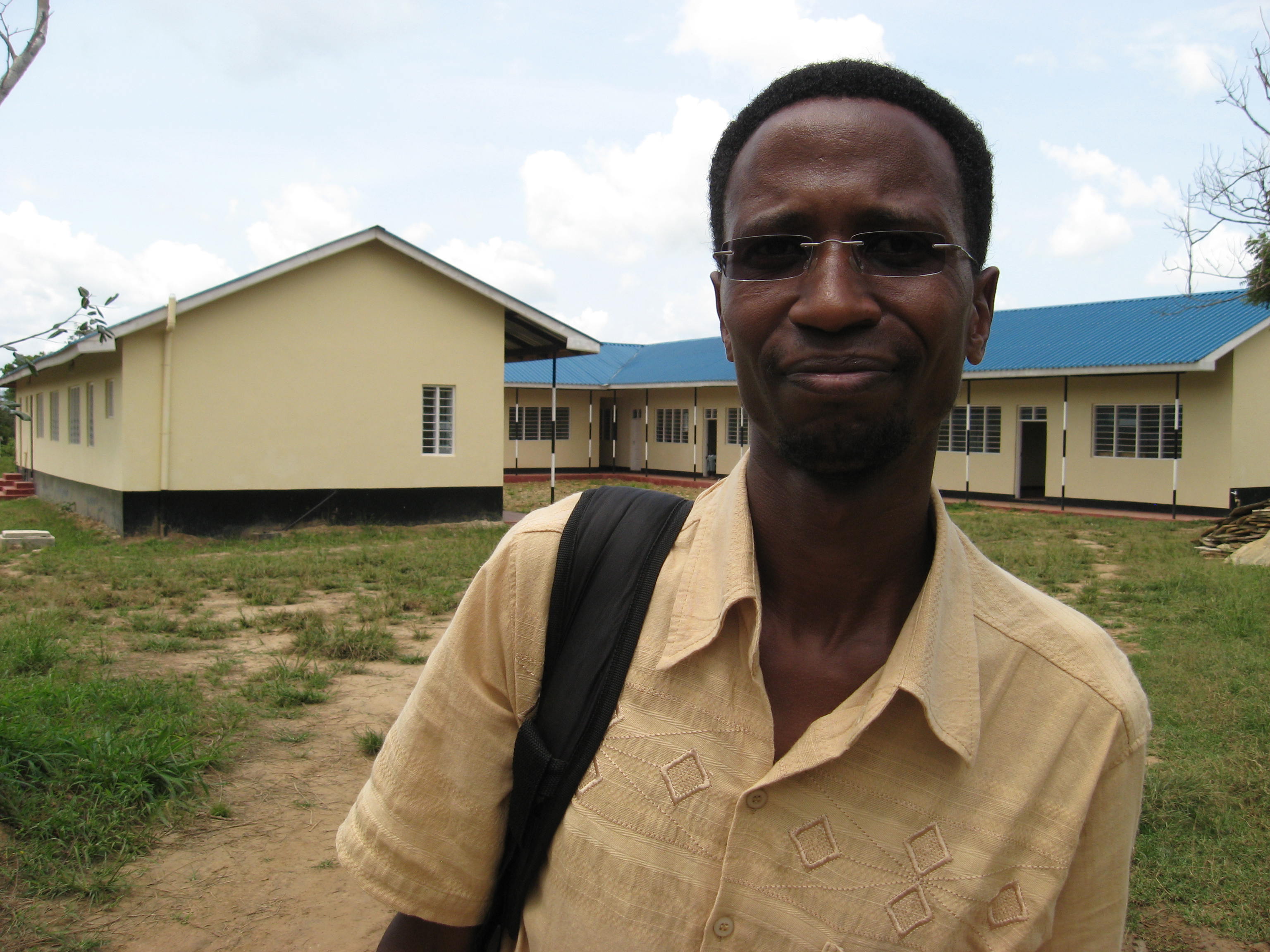
Peter Njuguna, ICT coordinator at Plan's Kilifi District Office

The group at the workshop had just been trained on several ICT different tools, so they had a lot of questions about mGESA for Njuguna:

What phones does it work on?
Any phone with GPS and capability to download an application will work.

Does it use up your airtime?

mGESA will work on the phone even without any airtime, but during testing, it seemed to work faster with about 10 shillings of credit (equivalent to about $.13).

Is mGESA free?

No. The application is in development and will eventually end up on the commercial market, via Pajat Management in Finland.

Can the application produce a base map or only points?

It can map points of interest only.  Later on it should be able to map out lines (roads) and areas.

mGESA data points on the web interface

Where do the points of interest go?

The points of interest that are collected on the phone are downloaded via a USB cable onto a computer, in the same way that you would download photographs from a camera. Then the points are uploaded to the on-line platform, and also then they will be visible on top of a Google map or other kind of map.

Is mGESA compatible with Open Street Maps?

Now that we know about OSM, this is something we shall look into, as it could be quite useful.

Will the information that you collect be public or private?

At this point the information will be closed, because the application is still in development.  Also for privacy reasons, some information will be shared and other information not shared. For example, if we are collecting personal information on individuals, or data that could put someone at risk, this will not be shared on the map.

What types of uses will the application be suitable for?

Plan can use mGESA when determining plans for phasing out of one area and moving into another area, for example. Instead of collecting data and indicators on paper, staff and managers can see this information on a map and the information that is collected can help us to know where to work.  Having the points of interest mapped out and linked with development information, and being able to select out different information layers on the map (on the internet) should make these decisions easier and more sound.

Will communities be involved and able to use mGESA for their own purposes?

Yes, communities will be able to use the information collected to make their own decisions. Communities can also purchase mGESA for their own use. We might also say to them, come and bring your phone and we will install this application so that you can use it for your own purposes.

Why are you developing a software from scratch and that costs money to the end user if there are existing tools available?

We know that GPS gadgets are expensive and so we thought – why not look into a mobile option. We also had very specific ideas and needs, and we had people willing to develop the idea from scratch. It’s a customized application based on our existing information needs and systems, and we can collect it by mobile rather than trying to find and purchase GPS units here in Kenya.

Update: see this post on Mobile Active for more information on the continued piloting of PoiMapper.

Related posts on Wait… What?

mGEOS: a mobile mapping tool

A positively brilliant ICT4D workshop in Kwale, Kenya

Youth mappers: from Kibera to Kinango

Salim’s ICT4D Advice Part 1: consider both process and passion

Salim’s ICT4D Advice Part 2: innovate but keep it real

Modernizing birth registration with mobile technology

Read Full Post »

Nothing to do with the topic of this post, but the Kwale coast is gorgeous.

Last week I was in Kwale, at a Plan Kenya hosted workshop as part of the Youth Empowerment through Technology, Arts and Media program. The team at Plan Kwale has been pointedly using ICTs in their community development programs since 2003 (not counting email and Internet of course) when they began working with radio and video as tools for raising awareness about children’s rights.

It’s really impressive to see how they’ve moved forward with very strategic ideas for integrating ICTs to help reach programmatic and development goals, especially in the areas of youth and governance, universal birth registration, and child/youth-led advocacy around rights and protection issues.

Over the 6 day workshop, the main things we wanted to do were:

  • look at the development context in Kwale, Kinango and Msambweni Districts (South Coast areas where Plan operates via the Kwale Office)
  • better understand the perspective of youth in the 3 districts
  • remind ourselves of rights-based approaches to community development
  • discuss youth issues, governance, advocacy, violence against children and gender within the local context
  • look at the ICTs currently being used by youth, communities and Plan in the Kwale Development Area
  • share and discuss new social media and ICT tools and ways they can be used
  • practice using new social media and ICT tools and see if they can be useful and sustainable in the 3 districts
  • determine next steps for integrating social media and new ICTs in specific local initiatives and plan for how to build on them in Plan Kenya’s overall work

Some elements that made the week positively brilliant:

workshop participants

Engaged and committed stakeholders

We were a group about 20, including staff and university student interns from Plan’s Kwale and Kilifi District Offices and Plan’s Country Office in Nairobi; Government District Youth Officers (‘DYOs’) from the Ministry of Youth, Sports and Culture; Youth Council members from Kwale, Kinango and Msambweni; 2 staff from Map Kibera and 2 youth mappers from Kibera.

This mix meant that we had a variety of perspectives and opinions, including those of youth from local communities, partner organizations, local government, frontline staff, protection and governance technical advisors, ICT managers, and senior level program managers. This helped to ensure that we were grounded in reality, technically and thematically sound, able to cross-pollinate and integrate new ideas with solid experience and practice, and take decisions immediately forward to a higher level.

Local partners and youth-youth networking

Peer-peer learning and exchange among all the participants was a big plus. Plan and Map Kibera have very similar visions and values, yet each has its own area of specialized technical expertise and experience.  The youth participants from local councils from the 3 South Coast districts and the youth mappers from Kibera brought different perspectives into the workshop which enriched the discussions.  We all learned a lot from each other. Combining expertise as partners brought the workshop to a whole new level, and will help to ensure that the efforts are sustainable and can be built on and expanded. The youth in Kwale can now extend their skills to more youth in their communities, the youth mappers from Kibera can take home new ideas to improve their work, the university-level interns gained practical experience, and the buy-in from the local government’s District Youth Officers (who manage government funds) in the 3 participating districts can help provide the necessary support to broaden the efforts.

Flexible workshop methodology

We had certain goals that we wanted to achieve and we were clear on that, but we let the agenda flow. We started by taking a deep look at the local context and resources. We heard from local experts in the areas that we wanted to focus on (youth and governance, child protection) as well as community youth and local authorities. We spent time getting to know some new tools and discussing the pros and cons of using them.

Hands-on with FrontlineSMS

Hands On Work

We had practical sessions and hands-on work on blogging, FrontlineSMS, Ushahidi, Map Kibera, and mGESA (a local application of the mGEOS mobile platform co-developed by Plan Kenya, Plan Finland, University of Nairobi and Pajat Management and being piloted in Kilifi).

This was important for helping participants feel confident about doing some of the work once the training team was gone. I imagine however that more practice will be needed during some follow up sessions, as most of the participants don’t have regular computer and Internet access for enhancing their skills on a daily basis with additional practice and exploration.

We spent one day mapping our Hotel on Open Street Maps, and another day in Kinango, mapping specific points in 4 teams.  Lessons learned during hands-on work included the importance of engaging and involving the community ahead of time, so that rumors about why people are mapping the community don’t fly. In my group, for example, we were moving around with George the District Youth Officer from Kinango. Someone that he ran into joked to him “Oh, now Kinango is going up for sale!”  A joke, but nonetheless if people don’t know why we were mapping, this or other rumours can quickly spread. (See the video about mapping in Kinango at this link and the background blog post here.)

End goals + new tools + back again

By starting with people’s expectations for the workshop, analysis of the local context, and an understanding of the goals that youth and staff wanted to achieve together, we could be sure that we stayed true to where we wanted to end up. At the same time, by learning about new tools, things that weren’t possible before became imaginable and people started to innovate and mix their existing knowledge and experience with some new ideas.

Combining the two, and having a good variety of perspectives in the room and a lot of space for discussion and practice means that next steps will be more achievable and sustainable, because people are clear and agree about where they want to go, and they feel capable of incorporating some new tools and ideas to get there.

The tools

We explored a number of new(ish) tools at the workshop. They had been identified over the past couple years due to their use by Plan or other organizations in areas such as: community development work, violence tracking, advocacy, governance and social auditing.  We talked about mobile phones, email, Internet, Facebook, Hi5, Google search and Google maps. We did a quick overview of Voice of Kibera, use of GPS, Open Street Maps, FrontlineSMS, Ushahidi, the YETAM project, the PlanYouth website, and a Plan pilot project in Benin using SMS to track violence against children.

The first day, the context analysis was very focused on youth and governance, transparency and social auditing, so we pulled out the 10 Tactics video by Tactical Technology Collective (which @hapeeg had given to me a couple days earlier). This video series talks about 10 tactics for turning information into action. It really sparked ideas among the participants for how they could use social media and ICTs in social accountability work and human rights/child rights work.  Map Kibera partners also shared a tool developed by SODNET (SMS for social auditing of the Constituency Development Fund).

We talked about the use of mapping and SMS in child protection work. One of the main child protection issues in the south coast area is the distance that a child, girl, family has to travel in order to report an abuse. Women’s lack of economic power, inability to own property and the importance of marriageability also mean that often women and girls feel unable to speak out or protest abuse when it’s happening. It’s still not certain what role ICTs can play in this context given the risks involved to those who report, but Plan’s child protection point person, Mohammad, is planning to host a series of meetings with local child protection authorities to discuss possible ways forward.

Digital mapping was immediately cataloged as an important tool for identifying resources, advocating for services and holding government accountable through social auditing. It was also recognized as a potential income generator once areas, shops and local businesses could be added to an on-line map, or if youth could purchase GPS units with funding from the District Youth Office and charge for their GPS services. George, the District Youth Officer for Kinango talks in this video about how mapping can be useful to the Kinango community, even if most members don’t have access to computers and broad band. (Click the link or watch below)

Information and communication gap analysis –> ICT integration plans

ICT integration for youth and governance program

Early on in the workshop, we worked in 2 groups to analyze the goals for the Youth and Governance and the Child Protection programs that Plan is supporting in Kwale. The groups discussed the information and communication gaps that needed to be filled in order to move towards the goals of the 2 initiatives. We looked at what ICT tools might best help reduce the gaps, from existing traditional tools (like meetings, face-to-face advocacy, drama, town criers, radio) to those new(ish) tools that we had discovered (see above paragraph) that might be useful to try out given the goals in the 2 key areas. The groups revisited this gap analysis on the last day after having had more hands-on use of the different tools and turned the gap analysis into an action plan.

ICT integration for child protection programs

Management buy-in and leadership

While the 2 groups worked on local action plans for integrating ICTs into their work, senior management from Plan’s Kenya office created their own action plan for how to build on the workshop experience, engage mid-level managers and other key staff in ICT integration, further develop partnerships and solidify cross-cutting incorporation of ICTs into Plan’s work in Kenya. The Kwale and Kilifi program units have been innovators within Plan for several years. Learning from, supporting and building on concrete work that they are doing on the ground allows for a solid and feasible country strategy based on reality. Having a strategy built from the ground up and with solid support and buy-in from national management means that there is less risk of donor led ICT funding, and more probability that new resources mobilized for ICT work go towards real needs and have better results.

Related posts on Wait… What?

Youth mappers: from Kibera to Kinango

Salim’s ICT4D advice part 1: consider both process and passion

Salim’s ICT4D advice part 2: innovate, but keep it real

Is this map better than that map?

ICT4D in Uganda: ICT does not equal computers

Read Full Post »

I’ve been following the debates surrounding professionalism, amateurism, innovation and good practice in aid and development work on the blogosphere and Twitter for awhile now.  In their most extreme and exaggerated form, they go something like this:

Extreme side 1: Amateurs are evil

Aid is about the poor.  Amateurs and would-be overseas volunteers should stay home, give money to experienced international organizations, volunteer locally, and stop getting in the way of professionals who are trying to get some serious work done. Aid and development are complicated and there is no silver bullet. They require experience and expertise. Amateurs, voluntourists and unskilled volunteers do more harm than good — they are clueless, showing up with no experience or concept of good aid or development processes. They bypass coordination structures, create confusion and duplication, repeat mistakes and don’t follow known best practices or proven ethical and industry guidelines. You may be a brilliant designer, marketer, manager or engineer but if you don’t have experience in aid and development, please use your skills elsewhere.

Amateurs make major mistakes and get themselves into trouble, and then professionals have to waste their time dealing with them instead of on the people in most need of help.  They parachute in ideas and technologies designed from afar that have no basis in reality because they don’t have any experience in aid, development or the developing world and they don’t listen to past experiences or lessons learned. They come up with stupid ideas, take away paid jobs from local people, create hand-out schemes and other unsustainable and inappropriate models of helping, and then leave. In no other field are amateurs allowed to go in and muck around in other people’s lives with no preparation or experience just because they have good intentions, so why are they allowed to barge into poor communities and bumble around just because they feel guilty about their own wealth and privilege or think it’s their right to help? The poor deserve better than that. Aid should be left to professionals who know what they are doing.

Extreme side 2: Aid and aid workers are evil

There’s no point in talking about professionalism because aid workers and aid and development in their totality have been an utter failure, regardless of how professional aid workers think they are.  Aid is aid, how hard can it be? We need to get things done! Everyone can and should get involved in helping, because it’s everyone’s right and responsibility to help. How will things advance if new ideas and innovations aren’t tested? And by the way, my latest product/ invention/ idea would easily solve that issue that aid workers have been struggling with for centuries…. I just need a place to test it out, got any communities? Volunteers and people with good intentions can do just as good a job as professional aid workers, who have made a total mess of everything anyway with their outdated models and bureaucratic, slow, top down procedures.

New ways of doing things and ideas brought in by youth, volunteers, design students and for-profit innovators from different sectors are beneficial to aid, which is currently stagnated and ineffective and needs an overhaul, or better yet, total annihilation. Aid workers drive around in giant SUVs and don’t have any commitment to local people because they live in fancy ex-pat houses with servants, getting rich off of the backs of the poor they profess to help. It’s just a big business that is perpetuating itself and preventing the poor from developing.  On top of that, the only way you can get into it is to start as a volunteer, but volunteering is discredited by those same aid workers. The dying field of aid and development is a closed and exclusive club. Aid should be abolished, and/or bypassed by small groups of dedicated, good-hearted, every-day individuals and/or social entrepreneurs and capitalists with good intentions who really care about people in the developing world, and can bring in new ways of working and innovations.

Hmmmm.

I’m finding the arguments really interesting.  A little mixed up and too generalized sometimes, but both sides resonate with me because I’ve seen concrete examples of a lot of the above.  (By the way, I hope no one takes offense at how I’ve portrayed the sides – this is just an exercise here – I love you all).  So I was trying to step back and look at the discussion.

It struck me that the arguments sound a lot like the old media – new media arguments.  New media is less professional, less rigorous, and sometimes unethical and low quality. But it often it brings innovations and truths that old media misses. It’s quick, accessible, open, less controlled and often pretty freaking amazing and right on.  Old media is solid and has a long history of quality and impact, but it’s also slow, unresponsive and conservative at times. Old media that’s not finding a way to integrate and learn from new media is dying.

So how might old aid, old development and new aid, new development work together? What can traditional non-profits learn from traditional media outlets that have embraced new media or morphed their old models into something that is still solid and proven, yet offers a space for participation and innovation by the public?

What general standards and knowledge need to be out in the public to help amateurs or people from non-aid and non-development backgrounds who want to engage avoid pitfalls and known errors, and avoid breaking laws or forging forward unethically or foolishly, and doing damage? Can old and new come to terms and work together? What examples are there of this already happening in a way that both old and new agree is working?  Or are these two sides totally incompatible and doomed to work against each other?

[Update] See Deconstructing volunteerism and overseas exchanges for a Part 2 to this post.

For more background….

Update:  Penelope has written a great post called “On Entrepreneurship and NGOs

Saundra over at Good Intentions are not Enough does a great job of sharing standards, practices and educating on how to select good charities/organizations, and has published a “Smart Aid Wish List” you can add to.

Check out this excellent chapter (.pdf) by ALNAP on Innovations in International Humanitarian Action (thanks to @talesfromthhood for sharing).

[update] Michael Keizer at A Humorless Lot wrote a great response post here:  The professional volunteer (impossible in aid?) and how about the salaried amateur?

Check out the #smartaid and the #1millionshirts hashtags on Twitter.

Follow some of the bloggers on my blogroll — they pretty much span the different sides of the issue in less extreme and more nuanced ways than I’ve done in my exaggerations above.

Related posts on Wait… What?

Deconstructing volunteerism and overseas exchanges

Mind the gap

The elephant in the room

Read Full Post »

Four years ago, I was working on a youth participatory video project in Togo. Charlie, a videographer from the US, was with us, supporting with the training. We would split into small groups each day and film in the community, according to topics and priorities that the youth had identified. The kids were secondary school students from rural communities, living with relatives in the district capital. They were between 12 and 18 years old, and most spoke their native Kabye, French, and a bit of formal English.

One night at dinner, Charlie confessed that he’d made a small blunder and was trying to delicately remedy it. There were about 4-5 kids in the group that he was accompanying. He’d noticed a bit of friction between them and was mulling it over. He suddenly realized that after each bit of video work, he had been gathering the group together and saying ‘good job!’ or ‘great job!’ or ‘you did a really nice job,’ and giving them a thumbs up.

It dawned on him that one of the kids in the group’s name was ‘Job’ and that the whole group, including Job himself, thought that after each shoot, Charlie was singling out Job to praise him, and him alone for the good work. The mentoring relationship between Charlie and Job was incredible, perhaps due to this misunderstanding, and Job eventually went on to pursue journalism. Charlie began using other congratulatory language with the group to try to make up for his unintentional error. I wonder what other kinds of blunders happen every day in our work that create this kind of unanticipated response and impact?

One day, about a year after the Togo video training, a colleague working in our donor relations department forwarded me an email.  It was from Job and he was answering a direct email appeal he had received from our marketing department, asking him to please give a monthly donation to support a needy child. Somehow Job had gotten onto our email list for potential donors.

Job responded, in very good English, directly to our Executive Director (whose signature was on the email) that he would really like to be able to help children to improve their lives, but that he was still a youth himself, and he didn’t have any spare money to help others at the moment. He went on to say how he himself had benefited from our organization’s support. He had been able to complete secondary school, had learned to become a journalist and was writing articles, and had access to internet via a multimedia center that our organization had started for youth. He attached some samples of his writing, and said he hoped more children would be supported as he had been.

I was a bit mortified by this situation, thinking about what a direct appeal and the kind of language normally used in this kind of mailing might sound like to Job. I wondered how he’d gotten onto our email list. And what would communities in general think if they saw the kinds of marketing appeals that go out in their names. As the mother of 2 ‘brown’ children who were born and raised in a ‘developing’ country, I’m bothered by these kinds of appeals, imagining a photo of my own children plastered on a ‘needy children’ billboard or direct mail piece somewhere, thinking about what that might do to their self-image or my image of myself as a capable parent. As internet usage continues to grow, organizations are really going to have to think hard about how they portray the people they work with.

I am pretty sure that Job didn’t realize that email wasn’t supposed to be for him, it was supposed to be about kids like him. But he didn’t identify as a poor needy child, and I love that. The more I think about it, the more I second Charlie: Good Job!

Related posts on Wait… What?

It’s not a black and white photo

The elephant in the room

Child protection, the media and youth media programs

Read Full Post »

So, a few weeks ago I came across this fabulous article by Jay Rosen called “How the backchannel has changed the game for conference panelists“.  It was perfect timing because I had just been discussing how much I had enjoyed the public/private tweeting and live commenting happening during a live stream event I was watching, and how Twitter allows for a totally different and very engaging experience at these things than we used to have before.

I had no idea that there was actually a name for this phenomenon:  the backchannel; coined by Victor Yngve in 1970 and made famous in 2002 at the PC Forum conference (thank you Wikipedia!).

Rosen notes that “The popularity of the backchannel… has empowered those in the audience to compare notes and pool their dissatisfaction during a performance that misfires…. Especially at risk are ‘big name’ speakers whose online or offline status is such that they may complacently assume their presence alone completes the assignment and guarantees success.”

He goes on to give 10 tips for how to avoid getting killed in the backchannel. These tips are a good read for famous types who speak at conferences or panels. But they are also a good read for the rest of us, as a lot of it is still relevant. For example, I liked the idea of “blog it first” to get early reactions to what you are going to present so that you can tweak it before your actual presentation.

Now, I’m obviously the non-famous type, and I doubt the ‘audience’ will be harsh, but in mid-June, I’ll be in Karlstad, Sweden presenting at the 6th World Summit on Media for Children. My presentation is on one of the projects that I’ve been involved in over the past couple years: Youth Empowerment through Arts and Media (YETAM). I actually refer to it a lot in this blog, though I haven’t really written a summary post on it.  I normally refer people to this nice overview posted on the Communication Initiative website or to this post on the project’s overall methodology.

So, I thought I’d post my presentation here for the 99.9% of people I’m acquainted with who won’t be at the 6th World Summit, and of course as part of my plan to avoid any negative backchannel tweeting while I’m presenting!  Enjoy, and would love to have any comments to, you know, tweak it before it goes super live, just in case there are any hardcore backchannellers there….

Note: if you are reading on Google Reader, it seems the presentation doesn’t appear, so try clicking through to slideshare here…. or [NEW!] watch or download the file with notes here (if watching with notes, resize the .pdf document so that you can see the notes underneath the slides).

Related posts on Wait… What?

Hands on, hands on, hands on

Putting Cumbana on the map, with ethics

Being a girl in Cumbana

Demystifying Internet


Read Full Post »

courtesy of bioweb.uwlax.edu

One of the best things about the Great Tshirt Debate has been the variety of voices and perspectives that are weighing in.  This one potentially misguided project was able to catalyze a huge discussion on the nature of ‘aid’.  Once again the power of social media to engage people in debate and dialogue was demonstrated.

There are a lot of angles to follow up on from last week’s blow up. There’s a lot to unpack and it goes much deeper than a conversation about t-shirts.  One thread I find particularly interesting is the use of social media and ICTs (information and communication technologies) for bringing greater accountability and generating input and dialogue around ideas for aid and development.

Christopher FabianOwen Barder and @Morealtitude wrote about this specifically in relation to the Tshirt Debate; and Duncan GreeneOwen Barder, Aidwatch,  Tim Ogden, and others in a broader debate about accountability, aid and development. Certainly there are many posts and discussions out there on this topic.

Some things that stand out for me in the aftermath of the tshirt discussion:

Broadening perspectives.

It’s easy to forget that we all mean something different when we use the terms ‘aid’ and ‘development.’ There is a big difference between emergency aid and longer-term development.  And there are countless theories and approaches and understandings of both of those terms  (Alanna Shaikh and Talesfromthehood have both written on that).  This was really apparent throughout the discussion last week and in the on-going commentary.

I’m still trying to sort out in my own mind the difference between the various aid and development theories, the perspectives of the ‘aid bloggers’ that I follow, and the frameworks of other people who were involved in the Tshirt Debate. People’s views are intimately linked with cultural, political, economic and religious worldviews, and varying levels of snark (which I have to say can be very intimidating) making it even more interesting.  Before Twitter and the blogosphere, I certainly didn’t have daily exposure and access to such an array of thoughts.  Score one for social media.

The elephant in the room.

All this access to all these perspectives and on-line debate and open participation is great for me. And for you. Because we read English and have access to the internet.

But there is a really big elephant in the room.  One that was lurking on the global conference call hosted by Mobile Active on April 30 and that is still standing around quietly as the discussions continue.  I’m talking about the voices and perspectives of the people that the 1millionshirts project was aimed at helping.

I would bet money that some of those voices would have said “I want a tshirt.”

There are a lot of possible outcomes when ‘beneficiaries’ and ‘donors’ actually talk to each other.  Like donors wanting to give t-shirts and people wanting to receive them.  Then what?  Most of those involved in aid and development and work with local economies can and have listed a myriad of reasons why handouts are not a good idea, but most also believe in listening to voices of ‘beneficiaries.’   It seems paternalistic to say that NGOs or businesspeople know best what people need.  What will happen when more donors and beneficiaries are using social media to talk to one another?  And what if NGOs or governments or business people trying to improve ‘developing country’ economies don’t agree?  Then what?  That’s going to be pretty interesting. For a taste of this can of worms, read this post and related comments.

Development education.

This brings me to thinking about the educational processes that contribute to good development results.  Around the world, people have been presented with hand-out and silver bullet ideas around development and aid for a long time. Donors need to be educated about effective aid and development, but communities do also.  People have been trained to gravitate towards one-off donations and charity mentalities, and need to learn why that isn’t actually very helpful in the long term. They’ve been taught that there is a silver bullet we just need to find. People have also been trained to take hand outs and see themselves as victims and need to re-learn how to take the reins and do for themselves.  This is true everywhere – people look for the easy way out. Consider how many people in the US for example prefer to get plastic surgery or take miracle diet pills and medications over adopting healthier lifestyles involving a good diet and exercise.  Complicated situations require integrated approaches and often need cultural shifts and behavior changes.  Those take time and effort and are hard to explain.  How does social media impact on or shift this in terms of aid and development, and in which direction is it shifting?

Barriers to social media participation.

Both #1millionshirts and Kiva were held up to a huge amount of scrutiny online via social media.  But again, who was scrutinizing, and who had access to the tools and means to participate in these widespread discussions?  It was not the people getting loans from Kiva or the eventual t-shirt wearers.  It was donors and ‘experts’.  I would hope that there are plenty of discussions happening about Kiva programs at local levels, in person, in meetings and in local media or newspapers. But these don’t normally make their way to the internet.

I don’t know Kiva’s programs well, but I would also hope that Kiva staff and/or partners, for example, are listening to that local input and using it to improve their programs on the ground to make them more useful to participants.  And I would hope that those discussions take place within a longer term education, training and relationship building process as with many NGOs.  This kind of input from and dialogue with program participants is every bit as important for adapting and improving programs and initiatives, and maybe more important, than all the public discussions on the internet…. as long as it’s being listened to and responded to, and as long as local offices are taking these messages up the chain within the organization, and as long as local offices also are being listened to and carry weight within the organization. What might be the role of social media there to move those offline discussions further within organizations and to educate, inform and engage the broader public and ensure that responses and changes are forthcoming and everyone learns from it?

There are still huge barriers to social media participation for many people in communities all over the world… not having electricity, computers, smart phones and internet, to start with. There are also barriers like language, literacy, age and gender based discrimination, hierarchies and cultural norms that limit participation in general by particular groups in discussions and decision making.  When working face-to-face, good organizations are in tune with the barriers and find ways to gather input from those typically left out of the discussion.  How can organizations use what they know about engaging more marginalized populations and apply it to a more creative use of social media to ensure that all voices are heard?  What resources and ICT tools would be needed to do that effectively?

Offline to Online to Offline

And how could more of the discussions that happen on the ground with communities, when programs are being designed, implemented, evaluated and re-designed; be shared in the open by those who are involved – whether participants, local bloggers, citizen journalists, NGO workers or others?  And how can the debates happening online make their way back to communities that are not connected? It would be amazing if more program staff and community workers were blogging and sharing their work and their challenges and accomplishments.  And if more organizational decision makers were listening to what their community workers or other staff who are blogging and tweeting are saying. And if more people participating in programs could share their viewpoints via the internet.  This would be useful to the global commons and would also help the fields of aid and development to improve.

How can we support more communities to have access to social media and ICTs as tools to participate more broadly? And how can community members be the owners and drivers of this discussion and input. How can we help bring voices from the grassroots to a broader public and also bring these broader public debates back to communities.  How can the access, language, literacy and cultural barriers be addressed?  There are some programs out there doing this, for example Global Voices Rising, MIT’s Department of Play at the Center for Future Civic Media, and the Maneno platform, but we really need more of it.

Youth.

I think as connectivity becomes less of a challenge, we will see the younger generation claiming spaces in this way. More organizations should be working to engage more young people in the development process and supporting them to access ICTs and social media.  When a consultation with children and youth was done after the Haiti earthquakes, for example, young people did not say that they wanted hand outs.  They said that they wanted to participate. They wanted to play a stronger role in the recovery and the reconstruction.  They said they wanted education, a voice in how things were to be done, decentralization.

Staff that I’ve worked with on youth and ICT programs in several countries have said that ICTs and community media are excellent tools for engaging youth in the development process and maintaining their interest, for supporting youth-led research and collecting opinions about community processes.  With advances in technology, these voices can reach a much broader and public audience and can be pulled into donor communications as well as used as input in the resource and problem analysis, program design,  program monitoring and evaluation processes.  Youth can access information previously unavailable to them which broadens their own views and helps in their education processes. They can also contribute information and images of themselves and their communities to the online pool of resources so that they are portraying themselves to the world in their own image as opposed to being shown by and through the eyes of outsiders.

In addition to the Tshirt Debate stirring up questions about good donorship, I really hope it stirs up the debate about the value of more local ‘beneficiary’ voices in aid and development discussions, and that it fuels more efforts to use, adapt, and develop social media tools and ICTs to support these voices to join the debate.

What about you?  What do you think?

Related posts on Wait… What?

Children and young people’s vision for a new Haiti

It’s not a black and white photo

Meeting in the Middle

Mind the gap

Putting Cumbana on the map: with ethics


Read Full Post »

At the Technology Salon hosted by the UN Foundation’s Technology Partnership with Vodafone Foundation on Jan 28, 2010, some folks from the DC area (and beyond) will gather to share experiences around girls and ICTs.

This conversation is an important one, given that gaps exist around discussion, practice and research.  The information and ideas shared at the Technology Salon will feed into the contents of the Girls and ICTs chapter for Plan’s upcoming 2010 “Because I am a Girl” Report (currently in the works).

There are a few points that I hope will be considered in the Technology Salon discussion:

Tension between participation and protection.

There are many examples of ICTs being used for increased participation and connection:  mobile phones for citizen journalism;  Twitter revolution in Iran; girls using mobiles to ask questions about sexuality and to get information to help them improve their sexual and reproductive health; girls married off early or those living in protective societies using mobile phones to maintain contact with friends; new media tools opening up possibilities for youth engagement in important conversations that normally they would be shut out of.

However, due to the very real problems of on-line child pornography, child trafficking, child harassment, and cyber bullying, there is also a strong push for more control, more restrictions on on-line use in the name of protecting children.  The tension between child participation and child protection is a very real one.

As we look at how technology and international development communities can support girls’ development, I hope it’s kept in mind that the more knowledge that girls have about the internet and ICTs in general, the more practical use they are allowed, the more coaching to help them understand implications of their actions, then the better prepared they will be to navigate these realms and to keep themselves safe.  Increasing their knowledge, abilities and desire to protect themselves may be more effective than setting strict external limitations.

Actively engaging girls in this as part of an educational process can be better than restricting their use – and being open to young people’s own ideas and ways of using ICTs is critical.  Adult involvement in this area is important, but it is probably more worthwhile to coach than to control.  Good communication and trust between children, youth and their adult mentors and guides is critical in this process. (Excellent resources on Child Online Protection (COP) for children, youth, educators and parents came out on October 2009 and are well worth the read.)

Online behavior mirrors offline behavior.

I remember getting an obscene phone call when I was around 8 years old.  My mother did not blame the telephone, however. She blamed the pervert that was calling.  She made sure to teach me how to be prepared in case it happened again. She emphasized not giving out information on the phone and hanging up immediately if I felt uncomfortable or didn’t know who was calling.  She did not prohibit me from ever touching the phone again or blame me, but she was vigilant for awhile.

In the same way, new ICTs themselves cannot be blamed for negative and twisted behaviors.  ICTs are tools that exacerbate and extend already existing human behaviors, and the blame lies with those who are using ICTs for child trafficking, cyber bullying and the other evils associated with the internet. It’s important to address underlying behaviors. Research shows that kids who are bullied offline are often also bullied online.  Girls who are vulnerable offline are likely also vulnerable online.  Online is a manifestation of offline, and the root causes of girls’ vulnerabilities online cannot be blamed only on the ICT tools themselves.

I have my own daughter now, and have discussed with her many times how to keep herself safe online and on the phone.  It’s important for her to know this before something happens, not during or after.  She will probably be using the internet and the phone for the rest of her life, so prohibiting them is not an option, and the benefits of using these tools obviously outweigh the risks.  My own involvement and use of social networking sites, texting, etc. is an excellent way for me to know how these sites are used and what security holes there are for my children on the sites. How can parents and teachers in areas with limited use of ICTs be involved and engaged to serve as coaches and leaders in on-line protection together with children?  How can communities help identify existing vulnerabilities in girls (or young people in general) that might manifest themselves online and offer support to prevent exploitation?

Digital gender divide.

There are some amazing examples of ICTs helping women and girls to improve their livelihoods; for example, women selling mobile telephone services; birth attendance being improved by using mobile phones to connect women to midwives, ambulances and other medical services; educational content being  expanded using internet; youth media and youth radio programs bringing girls voices and gender topics into the mix for community discussion and dialogue.

However, in places where boys and men dominate women and girls, boys and men likely also dominate the use of available ICTs.  Men may control the family’s mobile phone and take it with them, or monitor women’s calls. In places where boys are more favored, their confidence to try new things is higher meaning they may rush in to use mobiles, cameras, radio equipment in projects while girls shy back.  In some cases girls report that boys hog and monopolize the computers and equipment, and access is denied.  I’ve seen boys criticize, scorn and ridicule girls who are using equipment for the first time, and girls become too timid to try again.  In many developing countries, just getting girls to attend school is difficult.  If girls are assumed to be less intelligent or less worthy than boys, and their secondary school attendance (where ICT training might be offered) is not a priority, girls will have a very difficult time ever accessing and using ICTs.

Underlying issues surrounding girls’ participation in general need to be addressed.  We need to think about how ICTs can be used to help girls’ inclusion, participation and self esteem increase in general.

Girls involvement in developing and designing ICT solutions for their own needs.

Studies in several countries have shown that girls and boys use technology in different ways and for different things.  What specific ICT needs do underprivileged girls in ‘developing’ countries have? Is anyone asking? What processes or solutions already exist that take girls’ ICT needs into account?  What environments are necessary for girls to engage in defining, deciding and creating ICT solutions? Where are they already engaging, and how can communities, schools, organizations and businesses support and recreate those environments?  How can processes and products be designed together with girls?

Tech is still a field heavily dominated by males.  In the US, for example, some women in tech have pulled together to question this and to advocate for more opportunities for women to break into the male dominated worlds of publication owners, conference speakers, businesses, well known innovators, and “best of” lists.  There have been protests against prominent companies for promoting “Booth Babes” and in one case last year, strippers, at tech conferences.  This brings the question – in places without female tech role models and respectful environments, how can girls see themselves as leaders in this field?

Specific research on girls and ICTs.

There is not a lot of information on the impact of ICTs on the lives of girls in ‘developing’ countries, especially studies that go beyond establishment of computer centers.  There is  anecdotal evidence of positive impact of mobile phones on women. There are studies on the digital gender divide for women; on child trafficking and other negative aspects of the internet; and on use of internet and technology among youth in the US, UK, Australia, etc.  It’s been difficult to find a lot of information on the use of ICTs by girls in the “South.”  It would be interesting for more research to be done on girls and ICTs in the “South” and for some good practices to be shared. Hopefully someone at the Technology Salon will be able to share some insight on this.

Read Full Post »

« Newer Posts - Older Posts »