Feeds:
Posts
Comments

Archive for the ‘youth media’ Category

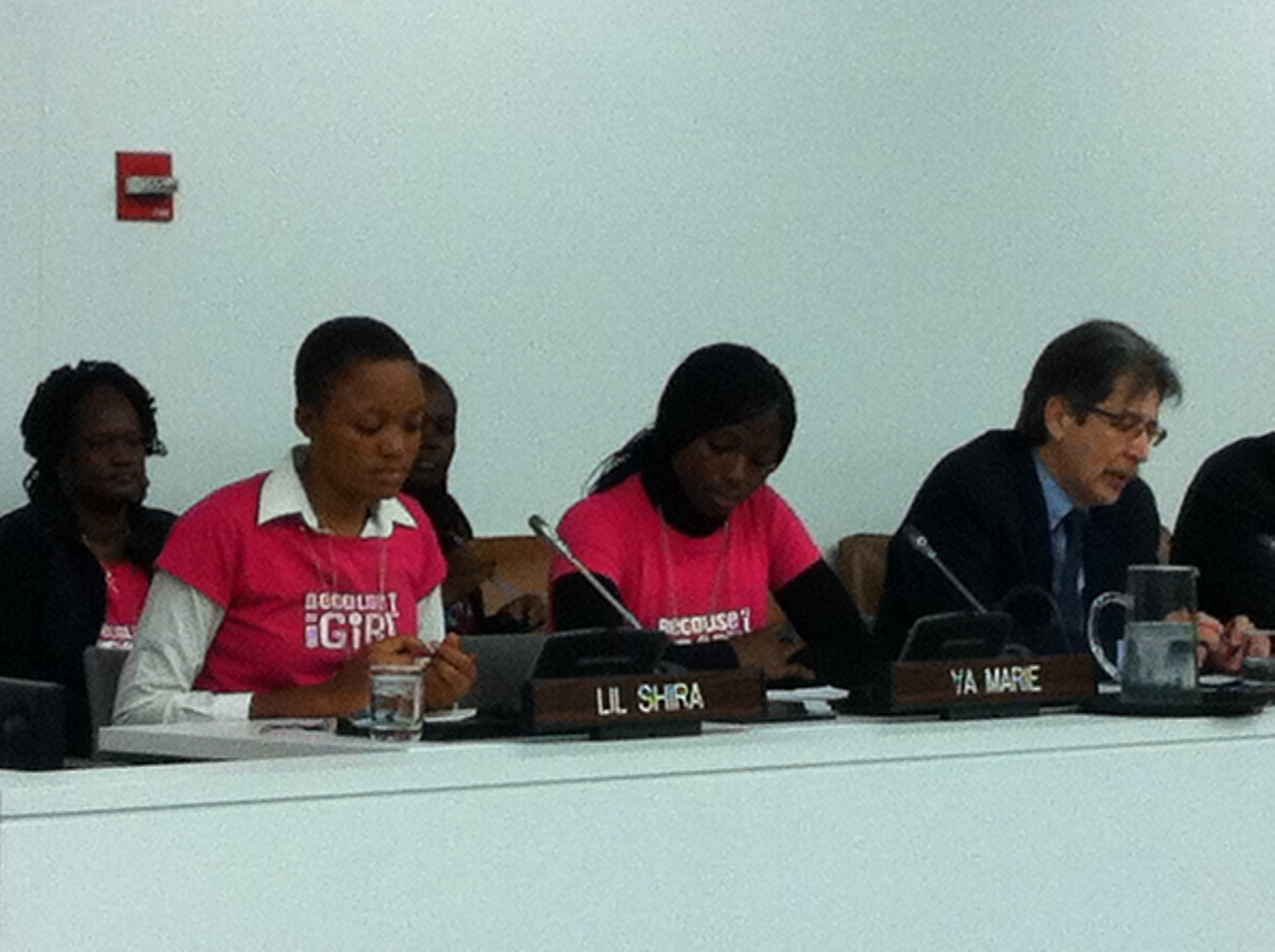
This is a guest post from Lil Shira, one of the girl delegates who attended the 55th Session of the Commission on the Status of Women in February, 2011. Lil Shira was part of a Plan led Girl Delegation which took part in high level panels, side events and caucuses. This post appears complete in its original format. You can read a post by Fabiola, another of the girl delegates from Cameroon, here.

Lil Shira in the community

My name is Lil Shira, a high school student and a Cameroonian.  I am the second child out of five children in my family, three girls and two boys, and we live in a rural area. Because I am a girl I was selected by my school authority to be part of the journalism club in the school. This paved my way into YETAM (Youth Empowerment through Technology, Arts and Media) project sponsored by Plan Finland since the Journalism club was chosen for this project.

Because I am a girl I had to use the skills I have acquired in YETAM on music, media and ICTs to indentify issues like the problem of early and forced marriage, high rate of school dropout and violence against the girl child. Because I am a girl, I had to mobilize other youth (girls and boys) victims, so as to speak out as a unique voice, to raise awareness to the general public using music, drawings, drama, poems, videos, computers and overhead projector as tools. This led to many local advocacy actions spearheaded by us.

I was also very happy to celebrate the 21st anniversary, in Yaoundé in Cameroon, of the ratification of the Convention on the Rights of the Child within the framework of YETAM project. These created a big impact in my life, the lives of my friends, youth, school, family and my country. All these activities took me to a higher level because I was again selected, this time to be one of the girl delegates to represent Cameroon in the 55th session of the UN Commission on the Status of women (CSW) in New York City.

Lil Shira presenting at the CSW.

I was very happy, excited together with my friends and family members and I was planning and preparing on the role I was going to play while in New York. My expectation was to work with other youth from different region and country but did not really expect I was going to talk to Ministers from all the members’ state of the UN. I did my first presentation with the Canadian Minister on a panel about the importance of commemoration days and the importance of setting up an International day for the girls.  Another thing which made me feel so opportune was the panel with UN women Ministers in the UN building.

I was very impressed seeing ministers from over two hundred countries and above listening to me and in effect giving a positive response to the issues I presented. In fact their reaction made me feel at home and so happy. I was equally happy to listen to other girls raise issues like gender based violence and discrimination in their various countries and what they have been doing to combat it.

Coming in contact with girls from Sierra Leone, Finland, United States, Indonesia, Canada and others, not mention to share our ideas, was so wonderful and exciting.  This was a forum for me to dialogue with them to know more about them and some of the issues affecting them in their own country which was contrasting with mine. Though I was nervous during my first presentation, meeting new faces it all passes away like a breeze and I did not have any complex because everything was cute.

Life in the US to me was very enjoyable and meaningful, but I could not stop complaining of the cold and snow. In addition, I tried eating food not familiar to that of my home country. All these contributed greatly to the wonderful experiences I had on the weather condition and the food.  I have learned to adapt to situations wherever I find myself. I hope to continue sharing this experience so that others may learn from it.

This is the time for girls to take up the challenge. I know my rights and have claim them, and no one can take them from me because I am a girl.

Thanks to Plan International, Judith Nkie our Chaperone, Kate Ezzes and Lia de Pauw.

Girls, claim your rights!

Related posts and videos about YETAM and the CSW:

Girls voices in global forums

Girls in rural Cameroon talk about ICTs

55th CSW: Women, girls, education and technology

A catalyst for positive change

On the map: Ndop, Okola and Pitoa


Read Full Post »

As I mentioned in an earlier post, I spent last week at the 55th meeting of the Commission on the Status of Women. The organization where I work supported 12 girls from various countries to attend and speak at different panels and side events during the week.

Why is it important for girls’ voices to be heard at global events like the CSW? Why should they be allowed to sit at tables with adult decision makers? Is this a wise investment when we could have spent that money to bring an adult staff member instead? Well, from a strictly rights-based perspective, it’s because girls have a right to participate in decisions that impact on their own lives.

But there are so many other reasons that girls need to be present at these events. They bring perspective that is otherwise missing. Before women are women, they are girls. It’s well known and well documented that investing in girls’ education and other areas has impacts that go far beyond schooling. At these big meetings, issues that impact girls and women are being addressed and discussed – so there needs to be space for girls and women who feel these issues directly to speak for themselves, especially girls and women who are typically left out of these processes. Girls bring a reality check. They offer ideas and solutions from their own contexts. They bring points home that can otherwise be missed. They are often amazing speakers and have incredible wisdom and insight to share. We can all learn from them. And bringing girls and their opinions and voices to a huge event like the CSW can really have a positive impact both on the event, the event participants, the decisions made there, and on the girls themselves, as they return home with a mandate to live their leadership in their own communities and countries.

Early in the week, I shared a panel with Fabiola, one of the girl delegates from Cameroon, and she truly stole the show. Here’s how:

Fabiola participates in the Youth Empowerment through Technology, Arts and Media (YETAM) project, and was selected by her peers to represent her group and Cameroon at the CSW. More information about Fabiola and Shira, the other girl delegate from Cameroon are in this post: Girls in rural Cameroon talk about ICTs. Shira also spoke at high level panels, as did the girls from Sierra Leone, Indonesia and Finland.

The girls also planned and managed their own side event where they talked about girls and new communications technologies.  In preparation for the event, they brought with them videos from their home countries, and Kirby, one of the girls from the US, edited them together into one piece. The video was shared at a few different events, and the girls were even asked to show it at the general assembly (at the last minute they weren’t allowed to for one reason or another). In any case, you can see it here:

On the last day that the girls were in New York, 3 of them sat on a panel in front of hundreds of high level decision-makers: UN officials, Ministers and government representatives. They talked about the challenges girls face in terms of accessing ICTs and raised the issue of violence against girls and how violence in schools impacts heavily on girls’ education.

My Cameroonian colleague, Judith, who works on the YETAM project with the girls, told me afterwards that she felt unbearably proud, seeing them there in front of the whole room, with everybody hanging on their every word. “I was floating,” she said. “As if my feet were not even touching the ground.” She was proud that Shira didn’t only present the issues that girls are facing in accessing ICTs or in terms of violence or early marriage, but Shira went further and talked about what they are doing in the community and how they are working with ICTs and conducting advocacy with decision makers and traditional councils to resolve the issues, and what impacts they have already had.

Josephine, one of the girls from Sierra Leone, said afterwards: “When I was there, speaking, I felt like I was on top of the world because people were listening to my voice.”

There needs to be more of this!

But if you are still not convinced, my fabulous colleague Keshet Bachan, coordinator of this year’s Because I am a Girl Report and the previous 3 reports, gives a convincing overview here about why girls and why now. Worth watching.

Read Full Post »

The 55th Session of the Commission on the Status of Women is taking place this week in New York City, with the core theme of: “Access and participation of women and girls to education, training, science and technology, including for the promotion of women’s equal access to full employment and decent work.”

Some of the girls that we’re working with in our programs are participating, including Fabiola and Shira from Cameroon. I met them both last July when we worked together on the Youth Empowerment through Technology, Arts and Media (YETAM) project. The YETAM coordinator in Cameroon, Judith Nkie, is also attending the CSW as the girls’ chaperone. She certainly also has a lot to contribute on girls, women and ICTs. Judith once said to me “This project is a catalyst in my body.” Judith is awesome.

Girls from the YETAM project worked to prepare the interviews, film and videos below. Each girl interviews another girl from the community about the role of ICTs in their lives. The videos are worth watching as the questions and the responses of the girls are very insightful.

The interviewee in the first video says ICTs help you find out what is happening around the world. She comments that she found out about what just happened in Egypt (the February revolution) because of ICTs. Some of the other things I found most interesting in the videos are:

  • The girls’ recognition of the importance of information for making good decisions
  • The technologies that girls have most access to (mobile phone!)
  • The first time the girls encountered a mobile phone (a few years ago, at a local call box for one, and via an uncle who brought one back from travels for the other)
  • Why it is hard for girls to use ICTs in the community (lack of ICT devices, cost, parents don’t allow girls to learn about ICTs, at school the computers are few – you will see at least 20 persons per computer – and half are broken, the boys are very powerful and they fight us to occupy the computers, girls’ illiteracy, girls don’t continue in school)
  • How often the girls use ICTs (mobiles are used every day, there is only one place to access Internet in the community)
  • What they like most about ICTs (ICTs help me to know what is happening in other countries, I came to know about what happened 2 days ago in Egypt via communication technologies, many youth have been able to be employed through their mobile phones)
  • What they like the least about mobile phones and Internet (scamming, its easy to tell lies by mobile)
  • How can ICTs be helpful to girls (in my community a girl was able to borrow a phone from a friend to report that she was to be married at the age of 12, and the marriage was stopped)
  • Can ICTs be used to hurt girls? (yes, the girls who can afford their own mobile phones are those who are wealthy, when the poor girls see the wealthy girls with their phones, they go into competition, they can go into prostitution to have money to get a phone; but on the other side, girls are also self-employed through the phones, so the mobile phone hurts but it also helps girls)
  • How the communities use the Internet to sell their products (most people in the community use ICTs to communicate to find buyers for their products)
  • What girls would like parents, community leaders and government to do regarding ICTs (improve our access to ICTs, bring in programs and projects that can support youths to use ICTs and learn to use them better, educate parents to help them to see that girls also should be allowed to access this type of training and technology)
  • What hurts most about this ICT thing (when those who are really privileged and who can use the Internet don’t put their talents and privileges to good use, they go there to scam, to do robbery, not to do good; if these youth have the time and this privilege they should not do harm but they should do good.)
Kirby, one of the girls from the US, edited together portions of the videos above with video footage from the rest of the girls in the group, and they used the video to kick off their ‘Girl Led Side Event’ today. The turnout was great. They will continue throughout the rest of the week getting their ideas and messages across in different events and panels. You can follow their thoughts and impressions on the Plan Youth Tumblr or by following @plan_youth on Twitter. My colleague @KeshetBachan is also blogging from the CSW at the Girls Report blog.

Read Full Post »

The 55th Commission on the Status of Women (CSW) happens in New York City Feb 21-25, 2011. For me, the most exciting thing about the event is that several girls from some of the countries where we are working (Canada, US, Finland, Cameroon, Sierra Leone and Indonesia) will be participating and speaking. This aspect of our work – helping to bring young people’s voices into these large influential forums – (when done properly) can be very effective at bringing a reality check to the ivory tower and helping influence decision makers at the very highest levels.

This year’s CSW is especially interesting to me since I work in the area of ICTs, and the theme of the CSW is:

“Access and participation of women and girls to education, training, science and technology, including for the promotion of women’s equal access to full employment and decent work.”

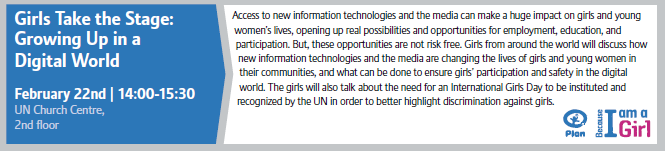
The girls will be presenting at the Girls Take the Stage: Growing up in a Digital World on Feb 22nd:

I’ll be presenting with Fabiola from Cameroon at the Empowering Girls: Education and Technology” session on February 23.

I’ll also talk at a panel-workshop hosted by the Buddhist Tzu Chi Foundation on Tuesday Feb 22, from 10-11.30, called “Breaking the Cycle of Poverty of Women and Girls through Education and Training,” on the 2nd floor room of the CCUN (Church Center of the UN).

Update: Ika one of the girls from Indonesia, will speak at a panel on Commercial Sexual Exploitation and the Girl Child: A Human Rights Approach at the Main Auditorium, Salvation Army Social Justice Center, 221 East 52nd St between 2nd and 3rd Ave, on Feb 24th from 2-3.30 pm.

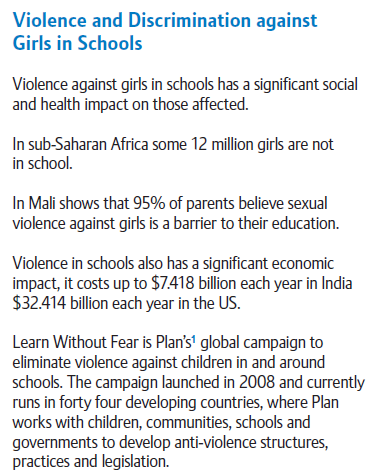
Update: Lil Shira from Cameroon will present on Violence and Discrimination against Girls in School, along with Marta Santos Pais (UN Special Representative to the Secretary General on Violence against Children) and others on Feb 22, from 16-17.30 at UN Church Center, 777 United Nations Plaza, Drew Room, Ground Floor.

Join us at the some of the sessions or come for an evening with the 21+ crowd at #ICT4Drinks Feb 23rd at 6 pm at Me Bar.

We’re trying to interest the girls in tweeting during the CSW on the @plan_youth account and to blog at  http://plan_youth.tumblr.com, so check it out as of this Monday. (We’ll see if they are willing or not!)

You can follow the events on Twitter at the hashtag #CSW55.

Read Full Post »

In the past couple years, social media combined with traditional media has allowed people all over the world to feel they are supporting and participating in very visible revolutions (think Iran, Tunisia, Egypt). There is also a slow and steady revolution happening as more and more communities around the world access the tools to tell their own stories in their own words from their own perspectives.

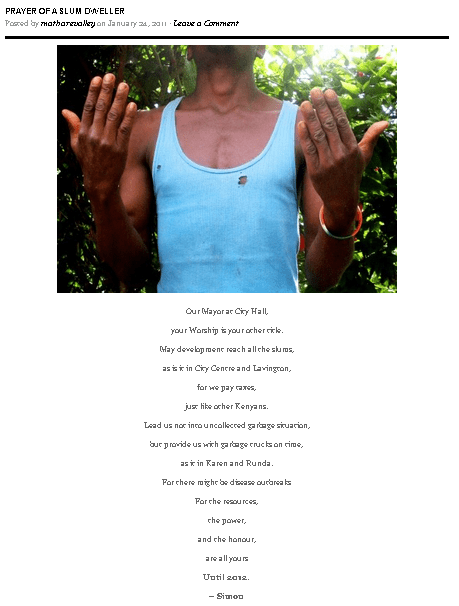
I came across the Mathare Valley blog this weekend. It’s beautiful, artful and powerful.

Prayer of a slum dweller from the Mathare Valley blog

According to the ‘about’ page, the authors of the blog:  Simon Kokoyo, Ivyonne Tiany and Jeff Mohamed, grew up in or around Mathare. They are now involved in community programs there, including the Map Mathare Initiative.

Jamie Lundine, who works at MapKibera and who’s supporting some community mapping in Mathare, wrote an excellent post about integrating participatory community development work and digital mapping in Mathare, showing how development and tech folks can combine their expertise and work together with communities to strengthen local development processes.

In my last post, I wrote about how communications (and ICTs) should be ‘built in, not bolted on‘ to development initiatives. The Mathare Initiative looks like a good example of that, with community members taking a strong lead.

Read Full Post »

When people tell their own stories and take photos of themselves, the results are quite different from when outsiders bring in their stereotypes and their agendas.

I love love love this photo series by youth in Croix des Bouquets and Jacmel.

In October, 2010, Plan commissioned Natasha Fillion, a Canadian photojournalist based in Port-au-Prince, to train and work with 22 teenagers to document their own lives in their own home, neighborhoods and schools. The youth, ages 14-19, got a crash course in photography and were given a digital camera and sent out ‘on assignment’ in their communities. Their brief was to cover topics such as home life, education, leisure, friends, everyday Haiti, and anything about which they were passionate. The photos were taken over a period of 2 weeks.

Fillion commented ‘I go out and I’m covering demonstrations, violence and destruction but there’s a whole side of Haiti that the media, the whole world doesn’t get to see, and I told the students — this is your opportunity to show people what Haiti is really like. These are photos that tell the story of Haiti as a whole, not just news.’

February 3, 2011, update:

Interview with 2 of the youth photographers and Natasha Fillion.

Related posts on Wait… What?

Read Full Post »

Our Tracking Violence Against Children in Benin project won first prize for Most Innovative Use of Technology or Social Media in Plan’s internal Global Awards contest. The competition was fierce and we were up against some really great projects.

Here’s a nice video overview of the project and where we hope to take the initiative as we go forward.

We still have some kinks to work out and we are still in pilot phase, but we are pretty happy about the award in any case. It helps motivate us even further to improve on the idea until it’s fully functioning and sustainable and we know that it’s resulting in more reporting of violence, helping to track trends and cases of violence, and being used by local and national authorities for responding and following up on those cases that occur.

Many many thanks to everyone who has helped the project get where it is, including:  Henri da Silva, Carmen Johnson, Bell’Aube Houinato, Amelie Soukossi, Eleonore Soglohoun, Morel Azanhoue, Victoire Tidjani, Alfred Santos, Jean Sewanou, Michel Kanhonou, Paul Fagnon, Camille Ogounssan, Anastasie Koudoh, Mika Valitalo, Ken Banks, Josh Nesbit, Patrick Meier, Juliana Rodich, Henry Addo, David Kobia, James Bon Tempo, Stefanie Conrad, Theresa Carpenter, Penelope Chester, Shona Hamilton, and community leaders, parents, school directors, local authorities, children and youth in the 2 participating communities.

Related posts on Wait… What?

Fostering a new political consciousness on violence against children

7 (or more) questions to ask before adding ICTs

Finding some ICT answers in Benin

Tweaking SMS based violence reporting system in Benin

Community based child protection

New Plan report on ICT-enabled development

Read Full Post »

In her post ‘Prostitutes of God:’ Film Mocks, Belittles Sex Workers, Bebe Loff, explains that:

‘Last week,  four episodes of a film entitled Prostitutes of God were posted on VBS.TV, which is owned by Vice Magazine. Prostitutes of God producer Sarah Harris, spent time with members of Veshya Anyay Mukti Parishad (meaning ‘Prostitutes’ Freedom from Injustice’) or “VAMP,” [who] let her into their lives, their families and their workplace.  The result?  Films that are inaccurate and misrepresentative, and insulting to the people who agreed to participate and to the Hindu culture.’

The ‘Prostitutes of God’ film is part of the Vice Guide to Travel where ‘correspondents from VBS and Vice magazine are dispatched around the world to visit the planet’s most dangerous and weird destinations.’

This afternoon I didn’t have 30 minutes to watch the film that was being criticized in the post above. I did have 3 and a half minutes to watch the video response (below) from some of the sex workers and their family members who were part of the documentary.

Their reaction is one of anger and feelings of betrayal. They denounce the filmmaker (Sarah Harris) for laughing at them, making fun of them, disrespecting them, misinterpreting their stories and making public judgment calls on their religious practices.

They say ‘… Your analysis is wrong and we do not agree with it. Who is Sarah Harris? What is the research that informs her story?’‘ They ask ‘Who gave you the right to laugh?‘ They wonder ‘If I had come to your town and insulted your gods would you have liked it?

Tonight I watched the 30 minute film. To be honest, it doesn’t strike me as any worse than a lot of other stories told about people from developing communities or exotic or marginalized groups. We see these kinds of stories all the time, where people are held up to view with sensationalism, superiority and for purposeful shock value.

What is interesting about this case is that the community saw it and reacted publicly. It made me wonder, what is the back story? What steps were taken by the filmmaker to secure informed consent? What were members of the different communities expecting the film to be about? What about the local organization, what were they expecting? Where was the communication breakdown and what steps were taken to try to avoid it? What ownership of the content of the film and the storyline did the community members have? Did they expect to be paid? Were they put at high risk or otherwise threatened when the filmmaker released her film? Did the filmmaker think about the ramifications that her film would carry for the communities where she had filmed? What was the filmmaker’s purpose for telling this story?

I think we are going to see more and more of this type of scenario. I hope it will force media practices and ethics to be updated, more respectful and more legal when filming marginalized or disenfranchised groups in ‘developing countries’.

A third film about the Devadasi

I know of a third film about the Devadasi. I saw this one several years ago, and it was made by a group of Indian child journalists as part of a child media project. In that case, the children successfully used the film at the community level to press for compliance with established laws against the Devadasi practice and to discuss culturally appropriate alternatives.

I’m a big fan of local activists using media tools to push for social change on their own terms.

Here’s Insight Share’s great rights-based approach to participatory video guidebook.

Related posts on Wait… What

Good Job

Child protection, the media and youth media programs

Read Full Post »

I’ll be speaking on a panel called ICT4D, Innovations and the MDGs next week during UN Week in New York and another on Girls and Mobiles hosted by Mobile Active. So, I’ve been putting together my thoughts around girls, child rights, ICTs and the MDGs.  The angle I’m taking is not from the large donor, top down, huge institutional program side, but instead, looking at examples from the work I’ve been closest to over the past few years at the community and district level, mostly focused on child and youth participation in the development process. Check my MDGs through a child rights lens post for more background.

My last post (3 ways to integrate ICTs into your development organization) uses Hannah Beardon’s framework to discuss how organizations can integrate ICTs into their work. Hannah suggests that ICTs can be integrated directly(providing access to ICTs), strategically (using ICTs as tools to support development processes) and indirectly (using ICTs to improve efficiency and communication within the organization).

To complete that post, I’m listing below 5 ways that ICTs can facilitate accountability and transparency, citizen engagement, and public debate, all of which are necessary to bring about development improvements and achieve the MDGs. Obviously these are not the only ways ICTs can support the MDGs, but this post would have been miles long if I’d listed all the initiatives that are out there.

1) Engaging children and youth in the development process

An engaged and active population is a key ingredient for good development programs. Children and youth have much to offer, are directly targeted in the MDGs and many other development initiatives, offer valuable ideas and energy, and make up around half the population in many of the countries that are lagging in reaching the MDGs. ICTs can help children and youth engage in the development process and bring their ideas, opinions and voices alive at the community, district, national and global level. ‘Using new technology, new media, children and youth can claim a space that they didn’t have before. They can influence certain things, advocate on particular issues that are important to them, take ownership in communities and in leadership. ICTs excite them and encourage them to be more involved and engaged.’ Anthony Njoroge, Plan Kenya Community ICT Manager.

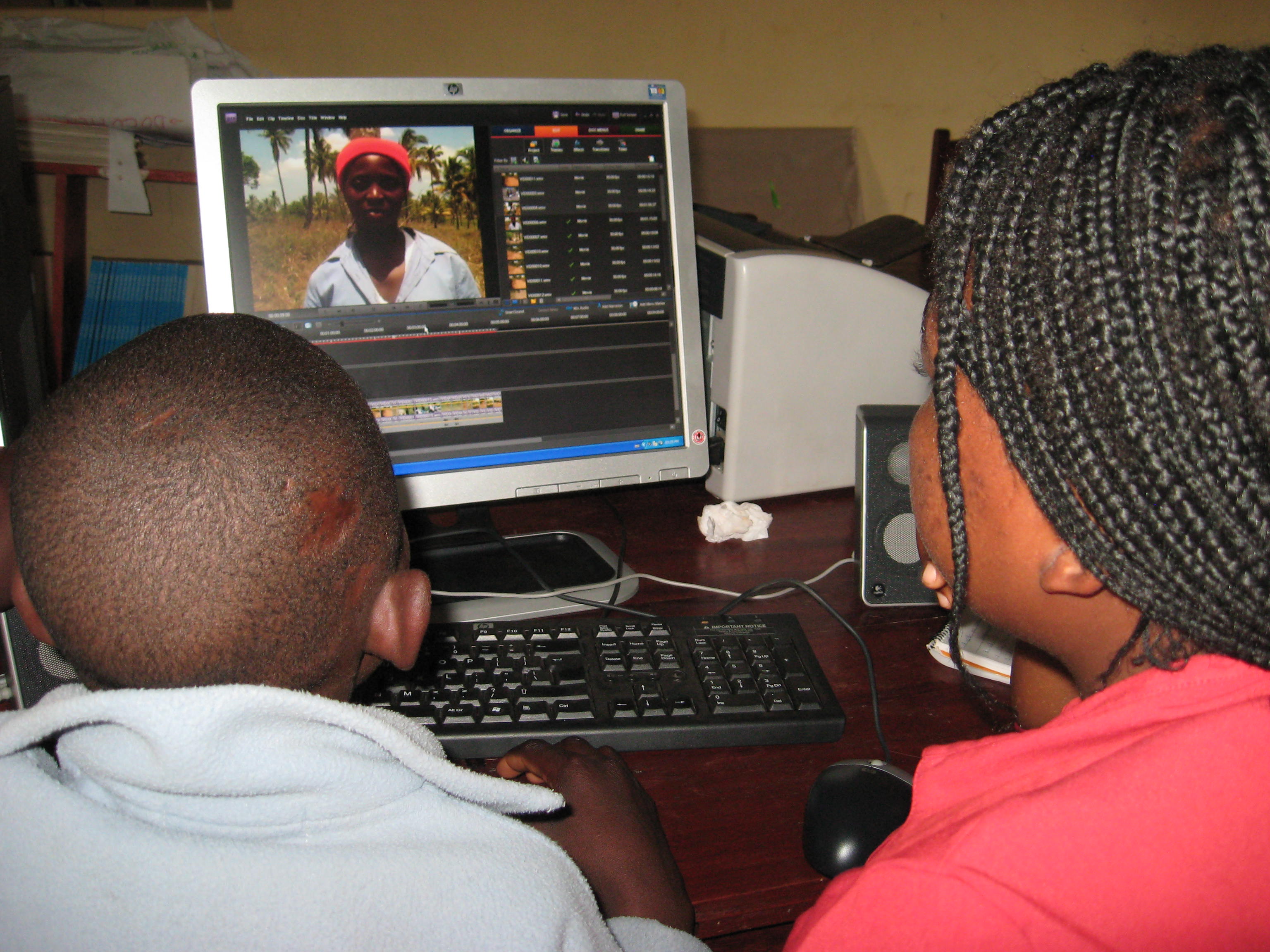
ICTs empower young people with skills that make them more confident and more involved at the community level.‘Using ICTs, children and youth have become more responsible because they are not waiting for adults to come in with something. Now they are designing it themselves, they are creating space for themselves and bringing their agenda to adult meetings instead of waiting to be invited in or having to work within the agenda of the adults. It used to be that you’d start working with 20 youth, you’d invite them into a community meeting. You’d see the number go down to 10, to 4, to 3, because they didn’t see any relation to themselves in the topics and the goings on. With integration of technology and the arts however, youth have a high level of interest. It’s really bringing in their opinions, their thoughts and ideas to join their voices with parents. Now they use arts and media to promote communication, dialogue on their issues and look for ways to resolve them. Before they were totally missing from the discussion, but now they are here.’ Judith Nkie, Plan Cameroon Youth Empowerment through Arts and Media Project Coordinator.

Arts and ICTs were used in the above-mentioned project as tools for youth engagement, mapping and prioritizing, research and community dialog. The media produced with the ICT tools was shared first within the community and then outside at the district, national and global levels as a way of engaging decision makers and the public in the youths’ agenda.  For more on how arts and ICTs are being used in the above-mentioned project, see this post. Watch 100 videos made by youth in 6 African countries on topics they are passionate about.

GPS work in Kwale, Kenya

2) Identifying resources and mapping patterns for better decision-making

Tracking and visualizing information is an excellent way to improve decision-making capacity. The advent of simpler and open source participatory digital mapping tools allows community members to map their communities digitally and to have more ownership of the information. Mapping helps identify patterns that may not have been visible before. Local maps shared on-line allow local people to provide their own information from their own perspective, and that information serves multiple purposes at the local level and beyond.

Digital mapping can be helpful when governments decentralize. Municipalities are mapping resources as well as projects and interventions. District authorities can track their own initiatives and those by local and international organizations to avoid duplication of efforts and wasted resources. When maps are public, the population can better demand answers about where resources are being allocated and why. Maps can help with disaster risk reduction and tools such as Ushahidi can help during emergency response. Mapping information is also useful for holding up a mirror to the population to ask them questions about themselves and their behaviors and for showing the direct consequences of actions; for example in a Community Total Led Sanitation mapping project, the community faces its realities about where their own waste is entering food and water sources.

Map Kibera is a good example of participatory digital mapping. mGEOS is a mobile mapping tool developed to help Plan Kenya staff to gather and share data needed for their daily work. Map Kibera and Plan Kenya are collaborating in Kwale on youth and governance work, and in Mathare to work on Community Total Led Sanitation using digital mapping tools (see July 27th entry). In this video, a district youth officer in Kenya talks about why digital mapping is useful for his community.
Mapping Violence against Children in Benin

3) Pulling in quick information to guide further investigation, response, or advocacy; pushing out information for targeted actions

ICTs can be used to gather quick information from a broad population. This can be useful in a variety of situations and themes, including those outlined in the MDGs. For example, SMS are being used to report on whether teachers are showing up at school, where violence against children and women is happening, where help is needed in the aftermath of a disaster, and for tracking endangered wildlife. Crowd sourced information can help governments and agencies get preliminary information so that further investigation and support can be provided in a particular area. Another example is the use of mobiles in different health initiatives, including:  child-birth care; HIV and AIDS prevention and treatment programs; support for volunteer community healthcare workers; and bed net treatment reminders. Most of the ICT and development world is also already familiar with the work of two organizations:  Ushahidi and FrontlineSMS who have been combining SMS with digital mapping.

A program that I’m closely involved with is SMS reporting of violence against children in Benin, where local communities, government agencies and NGOs are collaborating to improve the child protection system. This type of program shows promise if heed is paid to the pros and cons of collecting information by SMS, and if those implementing are clear about the type of information that will be gathered, privacy implications, and how the system will complement existing systems. (Here is one document that outlines some considerations). Increasing controls by governments and mobile phone companies, including SIM card registry and Mozambique’s recent government shut down of SMS services during the bread riots are good examples of how quickly the ICT landscape can change, and how flexible and agile those working in the area of ICTs need to be.

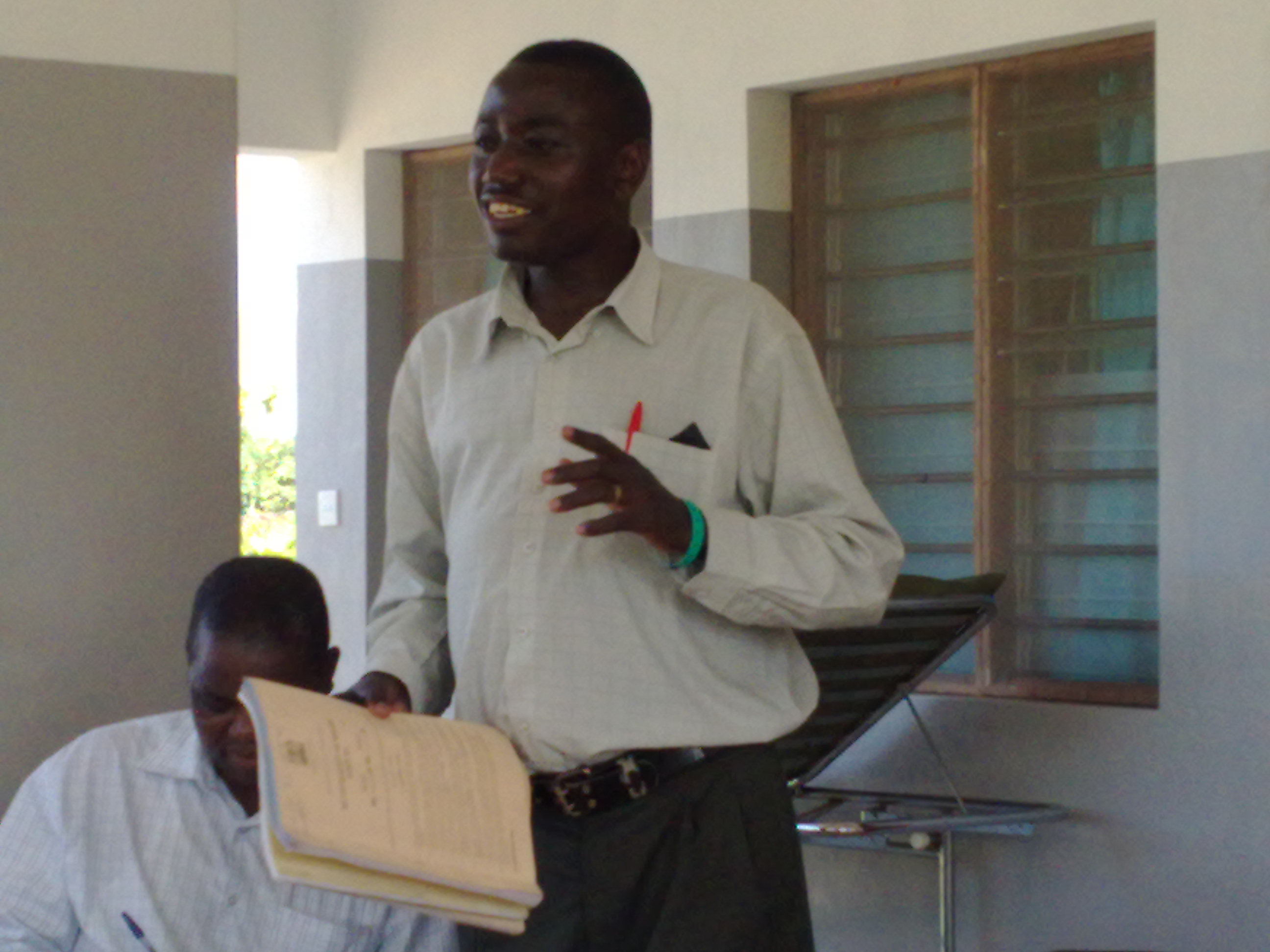
Checking info on constituency development fund

4) Supporting accountability and transparency

ICTs are useful to support accountability and transparency, necessary for attempts to track and ensure good use of funding for different efforts, including those related to the MDGs and other aid and development programs. Making information more available to the public by mobile is one such way.  SODNET’s budget tracking tool, for example, informs Kenyans of how much funding is allocated by the Constituency Development Fund to different municipalities in different categories. Combined with mapping, as outlined in this post, the budget information can help constituents to track where their funds are actually being spent.  Other interesting examples of how ICTs can be used for transparency and accountability can be found at TacticalTech’s Info Activism site and at Technology for Transparency.

Paper forms will soon be digitized….

5) Improving municipal services and information management

Civil registration documents, especially a birth certificate, are a precursor to demanding any number of rights or accessing a wide array of services. Without a birth certificate a child may not be able to sit for school exams, receive immunizations or free health care or claim rights to inheritance or legal protection in courts of law. Proof of age is critical in successfully prosecuting perpetrators of crimes against children such as child trafficking, sexual offenses, early recruitment into the armed forces, child marriage and child labor. ICTs are being used to digitize civil registry in Kenya, for example. Not only are records being digitized, but mobile phones are used to make it more convenient for the population to know when their documents are ready. This saves people time and money and means that more parents will register their children.

But wait, there’s more!

These are only a few examples of ways that ICTs are being used at the grassroots level to improve participation, transparency, accountability, debate and ownership of the development process.  The MDGs are lofty, but informed local community participation and ownership is key in efforts to reach them and in ensuring that marginalized populations can also be included.

Please add your examples of ways that ICTs can support development and ICTs in the comments section!

Related posts on Wait… What?

3 ways to integrate ICTs into development work

11 concerns about ICTs and ‘social media for social good’

I and C, then T

MDGs through a child rights lens

7 (or more) questions to ask before adding ICTs

A positively brilliant ICT4D workshop in Kwale, Kenya

The road to Wa is paved

Read Full Post »

Angelica Valeria Ospina recently wrote about the role of social memory and ICTs in building climate change resilience.  She refers to Carl Folke’s definition of social memory as “captured experience with change and successful adaptations embedded in a deeper level of values, and actualized through community debate and decision-making processes into appropriate strategies for dealing with ongoing change.

Ospina suggests that social memory is “key for linking past experience with present and future adaptation actions, and in turn allows for novelty and innovation.” She comments that “Although the role of memory tends to be overshadowed by that of innovation, the two are in fact important foundations for change, and are equally relevant within contexts that are struggling to adapt to uncertainty….”

I really like this idea of balancing memory and innovation, and it’s not only valid within the framework of resilience and climate change.  Social memory is also useful for those of us working in ICT4D and m4D because we find ourselves at the intersection of development and technology, where methodologies and mindsets can be in opposition at times and where change is happening at a rapid frequency.

A quick characterization of the mindsets

Development Organization Mindset: How can we work with our existing resources and work around our challenges to reach our goals? How can we build on experience?

Those who work with grassroots community development are schooled to look at assets, to help communities and local organizations look at what exists already, what is within their reach, and how to identify their existing resources before looking outside for support or help. This helps a program to be more locally owned and sustainable.  Those in this field are trained to look for potential obstacles and limitations and see how to go around them or to work within them. There is a sense that lives and livelihoods are on the line, this is nothing to play around with and failure carries a high price both for community members and for organizations. This mindset can be really frustrating for for-profit or marketing consultants who come in to get people to do ‘blue sky thinking’ and to forget about limitations.

This is the group that people would describe using that Henry Ford quote:  ‘If I had asked people what they wanted, they would have asked for a faster horse.’ But this kind of thinking does have its place – local context, perceived limitations, and local experience, eg. social memory, are important in design and sustainability and impact. In addition, innovations don’t only happen in terms of ‘products’, there are process, position and paradigm innovations also which happen all the time in non-profit organizations and communities.

(Note: Certainly some will say that in aid work, no one does evaluations, and no one learns and it’s all a waste of time and resources, but that’s not been my personal experience at this point, and the work I’ve been involved in has been community development focused, not top down delivery of services and goods.)

Design Student/Technology Innovator Mindset: What can we make? What can we build that’s like nothing that’s come before? What solutions can we offer?

Innovation thinking pushes for a different kind of visioning. For throwing aside conventions and ignoring limitations so that the chains are completely off. It urges people to move quickly, to try and fail fast and often. A lot of innovation and tech thinking is product focused – What can we make? What can we build? What solution do we have that people might need? What tech can we invent and then let people figure out uses for? Those in this group are trained to move forward without thinking so much about the challenges and limitations, to move at a quick pace, and without engaging a thousand people in the process. This enables new ideas to flourish unfettered by endless rounds of consultations and participation by too many people bringing you to the fabled and unfortunate “a camel is a horse designed by a committee” result.  It allows totally new ideas and processes as well as products to spring up. Lots of trying might equal lots of failing, but it also brings about those few amazing and game changing innovations that allow huge leaps forward. Many within this field are amazingly bright and creative. At this point few have long-term experience living in poor communities in developing countries, and there are few opportunities for gaining enough of that experience.

The middle ground

Both of these mindsets have advantages and limitations and seem to have a very hard time coming to a middle ground to work together effectively, though some initiatives are overcoming this challenge. Potential collaboration can be compromised when people address each other in snarky or accusatory ways, without sufficient knowledge of the other’s work and experience. For example, this series of blog posts around crowdsourcing and humanitarian aid between Patrick Meier (here, here and here) and Paul Currion (here and here). Unfortunately I don’t have a audio recording to post of the conversation where someone told me that Paul is quite well-known for innovations in the field of humanitarian aid and technology, and would be an excellent person to collaborate with on innovations in humanitarian aid — I really hope people like Patrick and Paul will work together, as the results could be fantastic.

Ken Banks has also raised this issue of m(obile) vs d(evelopment); most recently in his post Dissecting m4d: back to basics, where he asks: Do the majority of people working in “mobiles for development” work in mobile, or development? It may seem like an odd question, but how people approach “m4d” may have more of an impact on success or failure than we think.

An example of collaboration

There are some good examples of collaboration however. One I saw most recently is MIT’s Department of Play’s Summer Institute in early August, where a team of incredible innovators and students from MIT working on community youth engagement tools spent 2 days in discussions with folks with years of experience working on child participation and youth engagement, including UNICEFCUNY Children’s Environments Research GroupProject Vision Design and Research Collective at Srishti School of Art Design and Technology Bangalore; and the Program in Education, Afterschool & Resiliency (and me :-D)

I think eventually these gaps will smooth out as the younger generation moves in and up the chain at development organizations and some of the newer technology becomes ubiquitous within organizations. It’s quite possible also that the current and new generations of design and tech students will spend more time ‘in the field’. And I am not only talking about ‘Western’ folks here, I’m also talking about young people and design students from the so-called ‘underdeveloped countries’, many of whom use technology at a dizzying pace and who are already re-shaping how development is viewed and carried out in their countries.

By lowering the fences that we are all working behind, and finding ways to combine our different skills, ICT4D and m4d can come up with even better solutions and achieve better impact in areas like accountability, health, education, livelihood, governance, emergency response and disaster preparedness.  We can build teams that capitalize on the different kinds of knowledge, skills and mindsets. We can harness social memory and strive for a balance between experience and innovation.

Related posts on Wait… What?

Salim’s ICT4D advice: innovate but keep it real

Mind the gap

mGESA: Mobile GEographical Services for Africa

Amateurs, professionals, innovations and smartaid

On trust and disempowerment

Read Full Post »

« Newer Posts - Older Posts »