In this guest post, Keshet Bachan, gender equality activist and blogger at The XX Factor, questions whether mobile phone applications addressing street violence are an effective way to prevent violence against women. What do you think?
Can mobile ‘apps’ really prevent or discourage instances of violence against women? This question has been on my mind since a colleague shared this video from Voice of America about a mobile app called ‘Fight Back’, marketed as ‘India’s first mobile app for women’s safety’.
The video sparked an email discussion that raised some interesting questions that deserve a closer examination.
The VOA story provides a holistic view of violence against women and the developers of the mobile phone application admit that they are but one element in a broader system that needs to respond to instances of violence. They discuss the involvement of police and other duty bearers, such as municipal bodies, which need to address reports women make and do more to reduce their risks. I applaud this approach and the way in which the developers acknowledge the limitations of their application, which I find refreshing.
At the same time I feel this application distracts attention away from more prevalent (and deadly) issues. According to the World Health Organization 10-69% of women stated that they had been physically assaulted by an intimate partner at some point in their lives. The WHO also reports that 40-70% of female murder victims were killed by an intimate partner. A recent survey in the UK showed that one in three girls aged 13 – 17 reported sexual abuse from a partner and one in four had experienced some form of physical partner violence. The UK police receive a call for help regarding relationship abuse every minute.
The degree to which this mobile phone application promotes the notion of ‘stranger danger’ distracts attention from the urgent and more prevalent issue of family and intimate partner violence. Moreover, the fact that the application has a GPS tracker to trace a woman’s route home could inadvertently contribute to both increasing women’s fear of violence in public spaces as well as playing into the hands of those who seek to control women’s mobility by pleading the need to ‘protect’ them by knowing their whereabouts at all times.
In this context a colleague commented that a GPS enabled function could allow ‘even a moderately tech-savvy user to trace the woman in question’ – which could serve to increase traditional control over women who dare to step outside the confines of convention (and the home) even further.
There’s a disparity between the actual risk of being molested or assaulted in the street, and the level to which women fear it. One thing this mobile app could help with is mapping the actual instances of violence. This could in fact serve to reduce women’s fear, proving that violence outside the home is not as common or as severe as people might believe. At the same time the app could also shed light on the places where women are more prone to abuse (dark alleys or well lit train stations?) and call for concrete actions like streetlights to improve safety.
The application (as always) leaves it up to women to try protect themselves and does little to tackle the root causes of violence. For instance, research from India (where this application was developed) found that almost all police officers interviewed agreed that ‘a husband is allowed to rape his wife’, while 68% of judges felt that ‘provocative attire was an invitation to rape’ (Khan and Battacharya, 2010). The application would do well to connect its users to a platform for social mobilization and consciousness raising work that could create a critical mass of people who will work together to challenge traditional attitudes around gender.
Some of the other questions raised by this application, and others of its ilk, concern the development of such applications and the development of technology itself.
Does the sex of the person developing the application have an impact on the relevance of the application for persons of the opposite sex (i.e. can men develop useful applications for women)? Is technology itself biased in favor of one gender over the other (i.e. is technology inherently male)? As these questions assume rigid gender binaries the answer must inevitably be ‘no’. At the same time, research has shown that women use technology differently and that they are not well represented amongst technology developers.
Technology can be useful to both sexes and really it is a question of how one applies it that counts. In the same vein, it shouldn’t matter who’s behind developing the application but whether or not the application is answering a real need. (Let us recall that simply being a woman, doesn’t mean you’re more in touch with other women — the CEO of playboy is Hugh Hefner’s daughter).
I’m not convinced that women need a mobile phone application to protect them from strangers on a dark street. If I were asked ‘what do you think would make the streets of Delhi safer for women’, an app is not the first thing that would spring to my mind.
Last October, UNICEF West Africa wrote up a nice briefing note on mobile tech and its relevance in child protection programming. You can download it here.
According to the document, pulled together by Mirkka Mattila, ‘This is an area of rapid innovation and new applications are being developed all the time. Telecommunications is one of the fastest growing sectors in Africa and the relevance and reach of mobile technologies for development and humanitarian work is only going to increase over the coming years. Many technical, legal and security aspects of these new technologies remain to be fully addressed and worked out. The dependence on technology, network coverage and electricity supply also mean that mobile technologies cannot be used everywhere.’
The paper includes examples on the use of mobile technologies for:
gathering and transmitting data by child protection service providers; including surveys, rapid assessments, case management, family tracing and reunification of separated children, and birth registration
self-protection and complaints mechanisms; such as child helplines, violence reporting and community mapping for violence prevention
transmitting information and money via mobile; eg, SMS campaigns and cash transfers.
It pulls out challenges and advantages of the different use cases and offers some guiding questions to assist in the selection of the most appropriate applications, such as:
Is there a need to create new applications or can existing solutions be used?
What are the characteristics of the user group and the environment (urban – rural, existing networks and coverage etc.)?
What technical expertise is required for installing and maintaining the system?
How well will investments in equipment and capacity meet the needs, expected impact, benefits and outcomes in terms of results delivery?
What are the potential partnerships for sustainable capacity-building and service delivery? What are the roles of public and private service providers?
What are the financial resources needed in the short, medium and long-term to establish and maintain the system?
The document ends with some arguments and counter arguments around the use of mobiles in child protection work. It’s nice to see this paper as there is not a whole lot of research and/or documentation on use of mobiles and ICTs specifically in child protection work.
One of the signature pieces of architecture in downtown San Salvador is the Municipal Cathedral located in front of Plaza Barrios (popularly known as la Plaza Civica). The Cathedral, along with the Plaza are perceived by most Salvadorans as public space. Both the cathedral and the plaza hold a million memories of destruction and rebuilding.
La Armonia de mi Pueblo is the title of the work that Salvadoran artist Fernando Llort created in 1997 to adorn the front of San Salvador’s Cathedral. Armonia is easy to translate into English – it means harmony. Pueblo is a bit more difficult. It’s a term in Spanish that includes the notion of both place and people. It comes from the Latin populus and can refer to a) inhabitants of a nation, country or region who share a similar culture; b) a population that farms in a particular zone (eg., a village or community); or c) the peasant or working class.
So in essence, the title of the work is “the Harmony of my People”.
The cathedral in the 1950s
Rather than a history of harmony, the cathedral itself has a history of destruction and reconstruction. It was erected in 1888 and destroyed by a fire in 1951. Reconstruction began again in 1956. Archibishop Oscar Romero became the Archbishop in 1977, inheriting the partially restored cathedral. He reportedly deferred work on reconstruction, preferring to spend the church’s funds on projects to benefit the poor. The earthquake of 1986 damaged the structure further. In 1990 reconstruction began once again. The mosaic gracing the front was completed by Llort in 1997 and the current cathedral was inaugurated in 1999.
Aside from earthquakes and fire, other tragedies have marked the cathedral and the plaza.
1979. A massacre took place on the cathedral steps on May 9, 1979, as recounted here by journalist Ken Hawkins in a BBC article called “Witness to a Massacre“. Video footage in this accompanying article 1979: El Salvador Cathedral Bloodbath is eerily similar to the kinds of videos coming out on YouTube lately from Egypt and Syria, with armed troops shooting live ammunition into the backs of protesters. Towards the end of the 1979 video, people clamber up the steps of the cathedral in an attempt to find shelter inside. The military contends that protesters fired first, but witnesses have said the gunfire began on the side of National Guard.
A close friend of mine was present during the May 9th massacre. She took me to a photo exhibit about it last year at The Museo de la Cuidad de Santa Tecla, telling me her personal story as we wandered through. She was 15 years old at the time and had gone to the protest in her school uniform, thinking she would be there just a few hours. She ended up trapped in the church for much longer, fearing what might happen next and helping others tend to those wounded who were still alive.
The museum where we saw the exhibit was originally the Santa Tecla Municipal jail. After the civil war began, it housed political prisoners. My friend used to visit her husband there. He had been captured while participating in activities with the teachers’ union. The Santa Tecla museum is a remarkable feat in taking a painful history and reclaiming it for the public good. Among other things, it has served as a place for people with similar histories, those former families of political prisoners and the former prisoners themselves, and families of the disappeared and dead, to reunite, share their memories and losses, and build community.
My friend told of going to the steps of the cathedral on a recent May 9, the anniversary of the massacre. She found a few other survivors there, standing on the steps, remembering. One of those people was the journalist who had photographed events that day. ‘It was so strange,’ she said, ‘after so many years, we were somehow drawn to each other, there on the steps.’ In addition to the journalist she met a rural man in a straw hat, who had also been there in 1979, and who showed her his gunshot scars. A couple of other women who had lost a relative were also there, sitting on the steps, paying their respects.
1980. Archbishop Oscar Romero, a friend of the pueblo and considered a martyr by many, was assassinated on March 24, 1980, while giving mass at a private chapel. On the 31st, his funeral was held at the cathedral and people traveled in from across the country to pay their respects, packing the Plaza Civica with an estimated 50,000 people, many old women and children.
People filled the square during Monseñor's funeral
A bomb exploded somewhere in the plaza setting off panic and gunfire. Some say it was a ‘propaganda bomb’ designed to blow leaflets out to the crowd. Others say it was some other type of bomb. A journalist recounts his experience here. Dozens were killed in the resulting crush. My Salvadoran mother-in-law tells the story of one of our neighbors’ brothers being trampled to death that day, and how in hindsight, she is glad she wasn’t able to attend the funeral given what happened. The dead and wounded were carried up the stairs into the cathedral and many people hid inside until the dust cleared. Members of the leftist guerrillas were also stationed in and around the cathedral, guns loaded.
Monseñor’s funeral, captured on film here, is usually cited as the official beginning of the civil war in El Salvador.
1992. On January 16, 1992, the Peace Accords were signed and I remember the resulting celebrations. My husband and I were afraid to openly participate in the street fest as you still couldn’t be too sure of what might happen. There were separate celebrations for the opposing sides: Arena and the FMLN; a couple of blocks from each other. Arena celebrated in Parque Libertad, right up the street from our apartment in Barrio Candelaria. The FMLN celebrated in the Plaza Civica, adorning the Cathedral with banners. We wandered through both celebrations, not stopping for long in either place out of fear, but feeling a tremendous joy all around us, especially in the Plaza Civica.
Celebrating the Peace Accords in 1992. Image from the Museo de la Palabra y la Imagen in San Salvador; photographer Francisco Campos.
1997. One thing that I always loved about Catholicism in El Salvador was the way that people made it their own, merging local culture and belief systems into it, and celebrating their spirituality in their own unique style. So when the front of the Cathedral was decorated in 1997 by Fernando Llort, whose art resembles a folk art style popular in La Palma, Chalatenango, it seemed fitting. Given the history of the cathedral, the history of the country, and the events that had happened in the square, to me, the cathedral always seemed to belong to ‘the pueblo.’
2011. I discovered this past weekend, however, that Llort’s tiles and his work, which he considered his greatest achievement of all time, dedicated to ‘God and Monsenor Romero,’ were being removed from the face of the cathedral. Some consider Llort’s work to be commonplace, saying it belongs ‘on a tourist’s towel, not on a church.’ Others feel that his work represents something truly Salvadoran. The latter are outraged that the mosaic was removed with no warning, and they are asking why. They are questioning the legality of the destruction of the mural, and wondering where is the respect given to art and culture in El Salvador.
Photo of the tiles, on the ground in front of the cathedral.
Church leaders have since apologized to the Llort family and to those who are upset by the surprise removal of the tiles. They contend that they consulted with the congregation of the cathedral, and got their approval to remove the tiles. But the Secretary of Culture has called the Catholic church out for their actions, condemning ‘the destruction of the face of the Cathedral,’ and accusing the church of violating the ‘Special Law on Protection of Cultural Patrimony’ which states that ‘although the mural on the Cathedral of San Salvador was not declared a Cultural Site, it was in process of being declared, meaning that under no circumstances should any interventions have been made.’ Any actions should have followed procedures according to the law, and these were not considered, according to an article in La Pagina.
A group has formed on Facebook called Indignados por el Mural (Angry about the Mural) where debate is happening around the value of art and culture in El Salvador. It was originally rumored that the tiles were being removed so that they would not clash with a ‘more elegant and timeless’ sculpture that was being donated. Details about this statue were never obtained, and the reason given officially by the church for the removal of the tiles is that they were damaged and irreparable. Many have questioned this, asking why the tiles couldn’t have been restored as with other works of art.
Tiles being dumped. Photo via Indignados por el Mural, @AnaCanizalez
The cathedral means so much to so many that it’s not surprising to see people upset by the sudden change in its facade. Given the cathedral’s history, one might wonder if the ownership and path of the Salvadoran Catholic church is again being debated, as it has been throughout history. Does it belong to the rich or the poor? Why would such an important piece of art be removed in such an undignified way? Does the cathedral belong to the congregation that attends church there? To the church leaders? To the Vatican? Or is it a public good, belonging to the pueblo?
In the wake of the destruction of the mural, one idea that has been suggested is to gather the smashed tiles and use them to create a new work of art in homage to Fernando Llort and Salvadoran art and culture in La Palma, Chalatenango. Given the cathedral’s history of ruin and rebuilding, and the notable ability of Salvadorans themselves to rise and rebuild from the ruins after earthquakes, floods and civil war, perhaps that is a fitting use for the remains of La Armonia de mi Pueblo. It still makes me sad, though.
…..
(“los mejores artisanos del mundo….”)
Note: updated on Jan 4 to correct errors in the dates related to the construction of the original cathedral.
Updated: In this video, Fernando Llort reacts to the situation in a press conference on Jan 3, 2012.
An Egyptian anti-government protester holds a flag in Cairo's Tahrir Square earlier this year. Photograph: Miguel Medina/AFP/Getty Images
Waking one lazy Sunday morning and checking my Twitter feed, the first link I clicked on was a video of the Egyptian military beating unarmed protesters. The second was a series of Lego reconstructions of key moments in 2011, including the now-famous campus policeman pepper spraying unarmed student protesters in the face. It’s impossible to look back on 2011 without recalling the massive number of people who joined in worldwide protests to push for openness and inclusion – financial, political and social. No less memorable is the violence with which those protests were met.
As 2012 approaches, protesters across the world continue to occupy public spaces and fight for a voice in how things are run. They seek greater transparency, and new means of participating in social, financial and political life.
Many of 2011’s more horrifying and memorable images – captured on mobile phones, and generating global outrage and solidarity – involved systemic repression by the powers-that-be. Progress has been made in some countries, but sadly it’s not clear what the end result of the world’s uprisings will be.
Inclusion was not only a theme of large-scale world events, it was also key in aid and development. Organisations continued to push for adolescent girls’ inclusion in development initiatives and to emphasise that the most excluded and marginalised populations need to be reached in order to advance towards shared development objectives such as the millennium development goals. In June 2011, in a clear move forward on inclusion, the UN endorsed the rights of gay, lesbian and transgender people, yet the world still has a very long way to go.
As yet, however, the trend hasn’t reached quite far enough, and it would be good if it expanded in 2012 to encompass banks and other private sector entities. Hopefully, openness can help to advance inclusion and itself become more inclusive. All this amazing, open data needs to be re-used and it needs to connect back with people who might not be technology or data experts, have an internet connection or speak one of the major languages.
I hope 2012 sees greater effort to support communities and local organisations to access and use open data. I also hope there will be more effort to understand what information communities and local groups need to improve their own situations and exact more accountability and better governance from aid agencies, governments, service providers and the private sector.
Along with inclusion and openness, authenticity was a key concept in 2011. I enjoyed seeing critiques of simplistic media pieces about “the poor” and “the excluded”. Lakota youth, for instance, responded in a video to a Forbes [should be ABC] piece about poverty and hardship on reservations, emphasising: “We’re more than that.”. The Forbes piece, headlined “If I was a poor black kid“, caused a huge stir and response. One close reading of simplistic mainstream journalism called out the author for habitually ignoring the complex, systemic causes of poverty and exclusion.
I look forward to hearing more voices in these debates in 2012, continued questioning of simplistic messages, and more authentic reporting. New media can help previously excluded people tell their own, unspun stories and comment on simplistic reporting about them elsewhere. I hope aid and development agencies will increasingly support this, not as a gimmick or marketing ploy, but as a core element of their work and a way to better understand and share the issues and opinions of the people they aim to support through their programmes.
My wish for 2012 is that the world makes serious gains in reducing social, political and financial exclusion, in advancing participatory and accountable governance, and in achieving a better distribution of power and resources. Hopefully, aid and development organisations will continue to make progress in understanding what inclusion, openness, and authenticity in the global landscape mean for the kinds of programmes they fund and support.
I spent the past few days at the mHealth Summit where James BonTempo and I (supported by Plan International USA and MCHIP via USAID) co-hosted the “mHealth Reality Booth,” which we hoped would bring some mHealth practitioner reality to the Summit and offer an opportunity to capture some learning from folks working on the ground and implementing mHealth programs in some of the less cushy environments.
As people came by the booth, we asked them if they’d be willing to do a short video that completed the idea:
“We thought that…. but in reality….” or “Most people think…. but in reality….”
We ended up with some great advice on mHealth design and implementation. Watch below or on YouTube! If you have an mHealth Reality you want to add in the comments or as a ‘video response’ please do!
Here’s our talk-show host intro (why does self-filming always make me look so weird?) and our list of mHealth Realities underneath. Enjoy!
1) Phones do get stolen, so you should involve health workers in determining what the consequences are when it happens.
2) When hospitals are gutted, cell towers are gone and there’s no electricity, for example during the Great Floods in Pakistan, you have to go back to the basics.
3) The technology should be the last thing to think about in the design process. You need to know the what first, and then think about the how.
4) Mobile operators are very interested in exclusivity. This is a challenge if you want your project to reach the entire population.
5) Even if your macro level research tells you that 80% of households have mobile phone access, it doesn’t mean that 80% of women have mobile phone access.
6) There’s literacy, and then there’s ‘mobile phone literacy’. Both are important.
7) If your paper form is crap, your mobile data collection form will also be crap.
8 ) You need policies on lost, damaged, stolen phones, and emergency mobile phone resuscitation training.
9) You will be beholden to traditional funding cycles regardless of how innovative you are, or how sustainable your own business plan is.
10) NGOs just want to come in and do one year pilots, pack up and leave, and come back to do another one year pilot. This is not sustainable. Governments need to be involved. (in French translation pending…)
11) You really need someone who’s available locally to provide technology support and someone who’s good at helping others use and be comfortable with tech.
12) Power is always a consideration. Having it figured out in one place doesn’t mean you have it solved for another place.
13) Things take a really long time. Much longer than you initially think.
14) You might love designing for iPhones and Androids, but if your users don’t have iPhones and Androids, well, that’s not very useful, is it?
15) There are very talented software development firms in places outside of the US and Europe.
16) Every assumption you have about an area or a population is probably wrong.
17) Every country has a different set of mHealth issues and there’s no way of anticipating until you have hands on the ground there.
18) User testing will help you understand what users really want. And NGOs need to ask themselves the hard question: why do we really want to use new technologies?
19) People in low resource settings and with no previous experience really can learn to use smart phones and like it.
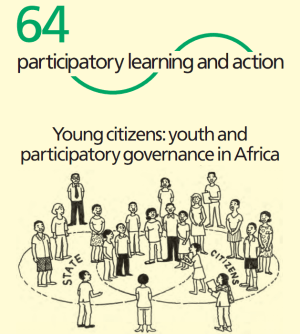
PLA 64 goes in depth on the involvement of youth in governance, the particular challenges that youth face in this area and ways young people are overcoming marginalization to participate and make change. It talks through key theories related to good governance, social accountability and social audits and shows concrete examples of putting them into action.
‘Social accountability can be defined as an approach towards building accountability that relies on civic engagement, i.e. in which it is ordinary citizens and/or civil society organisations who participate directly or indirectly in exacting accountability. Mechanisms of social accountability can be initiated and supported by the state, citizens or both, but very often they are demand-driven and operate from the bottom-up. Source: Malena et al. (2004).’
Scenes were acted out during the write shop to express how young people might feel about participation and governance initiatives.
PLA 64 aims to share practices that avoid instrumentalizing children and youth or using them as puppets or tools in achieving organizational or political aims. The idea of ‘seeing like a young citizen’ was critical during the writing process, as were authentic examples of youth participation and leadership in good governance and social accountability processes.
‘…Young people in Africa are challenging the norms and structures that exclude them, engaging with the state and demanding accountability. This special issue describes how young people are exercising their right to participate and developing the knowledge, skills and confidence to affect to [sic] change. It explores methods of communication, appraisal, monitoring and research which are involving young people in decision-making spaces. It asks how can we re-shape how young people perceive and exercise citizenship? How can we redefine and deepen the links between young citizens and the state?
This issue demonstrates the persistence, passion and enthusiasm that youth bring to governance processes – and how they are driving change in creative and unexpected ways. It highlights how young Africans are addressing the documentation gap that surrounds youth and governance in Africa and enabling other participatory practitioners – young and old – to learn from their experiences.’
Topics covered in the edition include: youth as young citizens; digital mapping and governance; participatory video; youth poverty forums; youth capturing pastoralist knowledge for policy processes; youth and HIV/AIDS laws; children’s shadow parliaments; mentoring and role modeling to encourage girls’ participation; youth-led violence prevention; local governance work; and budget advocacy.
In addition to the articles by practitioners, researchers, and youth themselves, PLA 64 provides tips for trainers on how to carry out specific activities and programs, exploring expressions and forms of power in youth governance work, conducting a social audit, using a community scorecard as an alternative form of budget tracking when governments lack openness, games to play to engage children in budget monitoring, and conducting youth participatory situation analyses.
PLA 64 offers an opportunity to broaden thinking and learn from youth and practitioners who are involved directly in good governance initiatives in East, West and Southern Africa. It is also a good reminder that although new technologies can enable, enhance or even transform accountability and governance efforts, there are many ways to work on accountability and good governance, and technology is not always the driving force behind this work.
*****
Background: A call for submissions to the PLA journal went out about a year ago. Submissions were then reviewed and ranked by an editorial team. Final authors selected were from Kenya, Zimbabwe, Sierra Leone, Nigeria, Mali, Senegal, Lesotho, the US, the UK, Ghana, Germany, Cameroon, Somalia and Liberia. Authors attended a “write shop” organized by Plan UK, the Institute of Development Studies (IDS), and the International Institute for Environment and Development (IIED) in March to share different youth participatory governance initiatives, reflect on challenges and successes therein, gather tips on better writing, and write up final articles. I attended the write shop and a colleague and I have an article included on digital mapping and local governance work.
Some of the top organizations and corporations working in the mobile technology and health space will gather December 5–7 at the mHealth Summit near Washington, D.C. The summit program offers several tracks and a wide range of sessions and exhibits for just about anyone interested in mobile technology and health.
A few months back, James Bon Tempo and I came up with the idea to co-host a “Reality Booth” at the Summit.
Innovative business models are great. New behavior change communication technologies open huge opportunities. Mobile tools to help health professionals build capacity to improve healthcare systems sound like a dream come true. But what happens during implementation? What are the real life barriers and challenges that practitioners face when implementing programs with an mHealth component? Where can you get some honest answers?
The Reality Booth is a place for practitioners working in rural settings or implementing programs in ‘developing’ countries to connect with others working in similar situations and facing comparable challenges. It offers a space to share and learn from peers who implement mHealth programs on the ground and to get advice on resolving the kinds of difficulties that probably won’t be highlighted during the official presentations.
We’ve invited some of the most respected mHealth practitioners to attend the booth for an hour or 2, and are pleased to mention that we’ll have some fantastic folks joining us. (We’re filling our last few remaining slots, so stop by booth number 131 for the full schedule on Monday!)
Come and share your mHealth reality stories, ask your implementation questions and get some practical or strategic advice from:
In addition to the Reality Booth, we’re hosting ICT4Drinks atThai Pavilionfrom 5.30-7.30 on Tuesday, December 6. Meet and mingle with your fellow mHealth practitioners! Free drinks for the first folks in the door and fantastic Thai munchies for everyone!
Civil society has been working for years on participation, transparency, accountability and governance issues. Plenty of newer initiatives (small and large) look at new technologies as a core tool in this work. But are these groups talking and learning from each other? What good practices exist for using new technologies to improve transparency, accountability and governance? What are some considerations and frameworks for thinking about the role of new technologies in this area of work? What needs consideration under this broad theme of good governance?
Tuesday’s Technology Salon* in New York City focused on those issues, kicked off by our two discussants, Hapee de Groot from Hivos and Katrin Verclas from Mobile Active. Discussion ensued around the nuances of how, with whom, when, why, and in conjunction with what do new technologies play a role in transparency, accountability and good governance.
Some of the key points brought up during the Salon**:
What is “good governance?” The overall term could be divided into a number of core aspects, and so the discussion is a big one and it’s complicated. Aid transparency is only one small part of the overall topic of good governance.
Participation of citizens in political processes, freedom of expression and association, free media
Political stability and absence of violence
Government effectiveness in the delivery of services
Regulatory quality, rule of law
Control of corruption
There’s a need to look at governments and aid, but also to look at the private sector. Some commented that aid transparency is in vogue because donors can drive it but it’s perhaps not as important as some of the other aspects and it’s currently being overemphasized. There are plenty of projects using ICTs and mobiles in other areas of governance work.
More data doesn’t equal more accountability. Data does not equal participation. Can mobile phones and other ICTs or social media reduce corruption? Can they drive new forms of participation? Can they hold power accountable in some ways? Yes, but there is no conclusive evidence that the use of new technology to deliver data down from governments to people or up from people to governments improves governance or accountability. The field of tech and governance suffers from ‘pilotitis’ just like the field of ICT4D. Some participants felt that of course open data doesn’t automatically equal accountability and it was never the idea to stop there. But at the same time, you can’t have accountability without open data and transparency. Opening the data is just the first step in a long road of reaching accountability and better governance.
Efficient vs transformational. Transactional efficiency within a system is one thing. Transformation is another. You can enhance an existing process from, say, writing on paper to calling on a landline to texting in information, thereby improving accuracy and speed. But there is something more which is the transformational side. What’s most interesting perhaps are those ways that ICTs can completely alter processes and systems. Again, there are a lot of promising examples but there is not much evidence of their impact at this point. One participant noted that current evidence seems to point toward the integration of mobiles (and other ICTs) into existing process as having a greater impact and quicker uptake within large, bureaucratic systems than disruptive use of new technologies. But the question remains – Are the systems good systems or should/could ICTs transform them to something totally different and better or can ICTs help do away with poorly working systems entirely, replacing them with something completely new?
Is open data just a big show? Some alluded to opaque transparency, where a government or another entity throws up a bunch of data and says “we are being open” but there is no realistic way to make sense of the data. Some felt that governments are signing onto open data pacts and partnerships as a fake show of transparency. These governments may say, “The data base is available. Go ahead and look at it.” But it costs a lot of money and high level skills to actually use the data. In addition, there is a need for regulatory frameworks and legislation around openness. Brazil was given as an example of a country that has joined the open government partnership, but as yet has no regulatory framework or freedom of information act, even though the country has a beautiful open government website. “Checks and balances are not inherent in the mobile phone. They need to be established in the legislation and then can be enhanced by mobile or other technology.” Open Data Hackathons can help turn data into information. The question of “what does open data actually mean?” came up also and the “cake test” was recommended as one way of defining “open”.
Is open data an extractive process? Some at the Salon cautioned that the buzz around Open Data could be a bit false in some ways, and may be hyped up by private companies who want to make money off of nice data visualizations that they can sell to big donors or governments. The question was raised about how much data actually gets back to those people who provide it so that they can use it for their own purposes? The sense was that there’s nothing wrong with private companies helping make sense of data per se, but one could ask what the community who provided the data actually gets out of this process. Is it an extractive data mining process? And how much are communities benefiting from the process? How much are they involved? Mikel Maron wrote a great post yesterday on the link between open data and community empowerment – I highly recommend reading it for more on this.
Whose data? A related issue that wasn’t fully discussed at the Salon is: who does the information that is being “opened” actually belong to (in the case of household surveys, for example)? The government? The International NGO or multilateral agency who funds a project or research? The community? And what if a community doesn’t want its data to be open to the world – is anyone asking? What kind of consent is being granted? What are the privacy issues? And what if the government doesn’t want anyone to know the number of X people living in X place who fit X description? Whose decision is it to open data? What are the competing politics?
For example, what if an organization is working on an issue like HIV, cholera, violence or human trafficking. What if they want to crowd source information and publicly display it to work towards better transparency and improved service delivery, but the host government country denies the existence of the issue or situation? In one case I heard recently, the NGO wanted to work with government on better tracking and reporting so that treatment/resources could be allocated and services provided, but when the government found out about the project, they wanted control over the information and approval rights. Government went so far in another case as to pressure the mobile service provider who was partnering with the organization, and the mobile service provider dropped out of the project. These are good reminders that information is power and openness can be a big issue even in cases not initially identified as politically charged.
Privacy and security risks. The ubiquity of data can pose huge privacy and security concerns for activists, civil society and emerging democracies and some at the Salon felt this aspect is not being effectively addressed. Can there really be anonymous mobile data? Does the push/drive for more data jeopardize the political ambitions of certain groups (civil society that may be disliked by certain governments)? This can also be an issue for external donors supporting organizations in places like Syria or Iraq. Being open about local organizations that are receiving funding for democracy or governance work can cause problems (eg., they get shut down or people can be arrested or killed).
Can new ICTs weaken helpful traditional structures or systems? Is new tech removing some middlemen who were an important part of culture or societal structure? Does it weaken some traditional structures that may actually be useful? The example of the US was given where a huge surge of people now engage directly with their congressperson via Twitter rather than via aggregation channels or other representatives. Can this actually paralyze political systems and make them less functional? Some countered, saying that Twitter is somewhat of a fad and over time this massive number of interactions will settle down, and in addition, not everyone gets involved on every issue all the time. Things will sort themselves out. Some asked if politicians would become afraid (someone – help!! there is a study on this issue that I can’t seem to locate) to make some of the secret deals that helped move agendas forward because they will be caught and so openness and transparency can actually paralyze them? In other words is it possible that transparency is not always a good thing in terms of government effectiveness? The example of paying Afghan police directly by mobile phone was given. This initiative apparently ended up failing because it cut decision makers who benefited from bribes out of the loop. Decoupling payments from power is potentially transformational, but how to actually implement these projects when they disrupt so much?
Does new technology create parallel structures? Are parallel structures good or bad? In an effort to bypass inefficient and/or unaccountable systems, in one case, private business owners started their own crime reporting and 911 system to respond and accompany victims to report to the police and follow up on incidents. Questions were raised whether this privatization of government roles was taking justice into ones’ own hands, forcing the government to be accountable, allowing it to shirk responsibilities, or providing a way for government to see an innovation and eventually take on a new and more effective system that had been tried and tested with private funds. This same issue can be seen with parallel emergency reporting systems and other similar uses of ICTs. It may be too early in the game to know what the eventual outcomes of these efforts will be and what the long term impact will be on governance. Or it may be that parallel systems work in some contexts and not in others.
***
The Salon could have gone for much longer but alas, we had to end. Dave Algoso covers some of the other ideas from the Salon in his post Technology for Transparency, Accountability and Governance, including how to approach and define the topic (top down vs bottom up? efficiency vs transformation?) and the importance of measuring impact.
Contact me if you’d like to be on the invitation list for future Salons.
*The Technology Salon is sponsored by the UN Foundation’s Technology Partnership with the Vodafone Foundation as a way to increase the discussion and dissemination of information and communication technology’s role in expanding solutions to long-standing international development challenges. Technology Salons currently run in Washington DC (coordinated by@wayan_vota) and San Francisco, with New York City as the latest addition, coordinated by yours truly.
**The Salon runs by Chatham House Rules, so no attribution has been made in the above post.
The popularity of cash transfer programs in the academic and aid blogosphere over the past few years, got me wondering what the difference is between the kind of cash hand-out programs that sponsorship organizations were doing in the early days and today’s cash transfer and conditional cash transfer programs.
What prompted the shift in thinking from ‘line up and get your cash’, to ‘cash handouts are paternalistic, ineffective, unsustainable and create dependency,’ to ‘cash transfers are innovative ways of achieving development gains’ and/or ‘cash transfers empower local people to purchase what they really need?’ How are cash transfers different today from 40+ years ago?
I happen to work for an organization that raises a good percentage of its funding through child sponsorship. From what I’ve heard, for the first few decades of our existence, cash handouts were simply how the organization worked. Along with most other development agencies, we moved away from direct handouts in the 80s. Like some other organizations, by the end of the 1990s we had adopted a rights-based approach. We are also now doing cash grants again in some cases such as this program in Vietnam. I’ve asked around a bit internally and haven’t found anyone able to point me to documentation on what in particular prompted the move from cash handouts to community-based development in the 80s. Obviously it was a change happening most everywhere, not just in the organization where I work. I assume there was a process and a lot of discussion around this like there is with any change in approach, but it’s most likely on paper and not on-line. I do wonder what has been or could be learned about cash transfers from that process of discussion and change in methods.
There is certainly a lot of debate today about cash transfers. When I’ve asked people outside my organization what the difference is between today’s cash transfers and those of 40 years ago, most pro-cash transfer folks say that today’s approach to cash transfers is different or that cash transfers are included as part of broader programs, or that cash transfer programs that succeed are done by governments and not INGOs.
The anti-cash transfer folks tend to feel that cash transfers are not sustainable development, encourage dependency, and cause community conflict, and that they do nothing to improve systems or infrastructure in the long run; eg., what good is having cash if there is no health system? no food to purchase? no school to attend? Or they consider cash transfers to be individualistic rather than a way to support an entire community or district’s development or worry that conditioning cash transfers can cause unintended consequences. (Here’s a fun piece that talks about what the cash transfer debate says about the international humanitarian community.)
I liked this recent paper ‘Richer but resented: What do cash transfers do to social relations and does it matter‘ by MacAusland and Riemenschneider (HT @rovingbandit). It questions the impact of cash transfers on less visible, more contextualized local and national relationships and power dynamics and suggests a need to go beyond material analysis during design, implementation and impact evaluations of cash transfer programs.
Especially helpful for someone like me who is trying to better understand the discussion around cash transfer programs is the paper’s reference to Copestake’s (2006) aspects of well-being (material, relational and symbolic) and three views on social protection as applied to cash transfers.
I’m pasting in the paragraphs I found especially useful to tempt you into reading the whole paper. I liked the excerpt below because it provides good insight into how different development theories color the objectives set in cash transfer programs and the way that success and impact are measured.
‘…An „income-first‟ view of social protection focuses on theconsequences of cash transfers for recipients’ incomes and on their costs, including fiscalcosts and perverse incentives to stop working or to seek rents. Second, a „needs-first‟ viewstarts from a more multidimensional view of poverty and focuses on the state‟s role inguaranteeing access to basic needs, including livelihoods, assets, and public action. Thiswould criticise the income-first view for being too narrow. Third, a „rights-first‟ view identifies injustice as a key cause of poverty, and criticises the „needs-first‟ approach for beingpaternalistic.
Very broadly, these views can be identified with philosophical approaches to development. The income-first view is most closely identified with a modernisation theory and Washington Consensus approach, which is rationalist, individualist and utilitarian in nature, measuring utility primarily in terms of income. The appeal of this view in part lies in the measurability and equivalence of outcomes and costs – so that outcomes measured in dollars can be compared to costs measured in dollars. This possibility is very attractive for planners, sinceit enables an unambiguous (on this single metric) judgement of whether an intervention should proceed. In terms of approaches to social protection, the income-based view is reflected most clearly in the safety nets approaches of the early 1990s (World Bank 1990).
The needs-first view starts from a similarly utilitarian and individualist standpoint but broadens this by introducing other dimensions of well-being, largely adding material dimensions (such as education, health, and livelihoods) but in some cases relational aspects (such as a capacity for social action). This draws in part from Sen‟s capability perspective (Sen 1985) and is currently being operationalised through the Millennium Development Goals and now multidimensional poverty indices (see e.g. Alkire and Foster 2009). In the social protection literature, this view is closest to the transformative social protection approach (Devereux and Sabates-Wheeler 2004) that emphasises the role of social protection in overcoming not only material shortcomings but in enhancing self-esteem and social status.
The rights-first view has developed rather differently, in part from Latin American traditions of dependency theory and structuralism, which place more emphasis on relational and symbolic aspects of well-being. One application of this tradition can be found in Figueroa (2001) who argues that persistent inequality in Latin America can be explained by processes of social exclusion (based on cultural difference) leading to political exclusion from social protection programmes and education, and resulting economic exclusion. As Copestake (2006b: 4) summarises, this interpretation highlights: “the extent to which economic growth and inequality reduction are dependent upon cultural and political mobilisation, not least through advocacy of human rights. This is in stark opposition to the more common assumption of economists that improved human rights are more likely to follow economic development than to be a precondition for it.”
…
The consequences of these different views for assessments and planning of cash transfers are quite profound. For instance, the different views will put quite different weights on the negative consequences of excluding members of the community from controlling payments or targeting as opposed to the problems associated with additional costs of targeting. The decision whether to pay for additional community participation will look very different depending on which view is held. Similarly, the different views will imply quite different judgements on whether cash transfer programmes should be replicated, given differentmaterial, relational and symbolic outcomes.’
I still don’t really know what I think about cash transfers, (I suppose “it depends’ is always a good answer) but at least I have a bit of a better framework for thinking about them and analyzing what I read about them. Copestake’s three areas (material, relational and symbolic) also give a good framework for analyzing other types of aid and development programs, beyond cash transfers (such as Gift In Kind, as @cynan_sez points out).
I also still haven’t figured out how the old style sponsorship cash handouts were different from today’s ‘innovative’ models. Any old timers out there with insight to share on that?
I had the great pleasure of participating and serving as a moderator* for TechChange’sMobiles for International Development course from October 15-November 4, 2011, along with a great group of people interested in how mobile phones can support development processes.
Course topics included mMoney; mHealth; mobiles for monitoring, evaluation and data collection; mobiles and radio; and mobiles in education.
The first week of the course went both broad and deep via a compilation of blogs, videos and longer documents from a range of thinkers and doers in the mobile space.
The second week introduced participants to a number of mobile tools, including MPesa (Mobile Money Transfer Platform), InSTEDD GeoChat and Riff (Mobile Collaboration and Data Stream Analysis Software), RapidSMS/Souktel (Mass Texting Software Interface), Sana Mobile (Mobile Diagnostics Platform), Medic Mobile, TxtEagle, FreedomFone.
The third week offered a number of chats with well-known practitioners and thinkers in the above mentioned areas or developers of particular tools that had been covered in week 2.
Things I liked about the course:
Platform. The TechChange platform is really nice. It’s engaging and well-designed. Things are easy to find making participation smooth. It took me a day or so to learn where to find things, but after that, it was easy to join in and access the course materials.
Format. This was my first ever on-line course and I found it very energizing and thought-provoking. I loved that the first week was an in depth overview on ICTs and development in general. We were exposed to a huge range of thinking from very positive to very wary and critical of the use mobiles and ICTs in development work. Long and short videos, blogs, guides and research were made available and these really stimulated a lot of discussion around development models and frameworks, the role of NGOs and corporations, e-waste, top down vs bottom up, innovation and local capacities, and all kinds of issues. The second week dove deeper into particular areas and many of these discussions continued, but now with different groups as people began self-selecting according to their particular interests (health, education, etc.) Unfortunately I missed most of the 3rd week because I was out at another conference, but the roster of experts who came onto the platform to chat with the group was stellar and according to participant feedback, quite stimulating as well.
Discussions. The format was conducive to great discussions, from small group Skype discussions (each participant was assigned to a small group at the beginning, and these groups held a few discussions over the course period), to random chats, to forums and sometimes Twitter. These discussions were very useful to generate new ideas and dig into topics and tricky issues.
Participants. On the one hand it might be nice to have courses aimed at levels of experience, but on the other hand I liked that there were all levels of expertise chatting and discussing, and people from a wide range of backgrounds. This enriched the group discussions and the variety of inputs.
Organizers. The organizers did a stellar job of engaging and encouraging the group and being responsive to any technical difficulties encountered.
Things I would like to see in future courses:
Less hours per week. It was hard for me to clear my schedule to participate in everything as I would have liked. Dispersing the activities over 4 rather than 3 weeks (as the organizers are planning for the future) might help with that. Of course this might be an issue with me, not with everyone. The good thing is that course materials are available for a few months after the course has closed.
Short sessions on setting up specific tools. I was really glad that Tech Change took the full first week to look at the big picture before focusing in on tools and I was super impressed with the wide range of materials they pulled together to get people thinking and discussing all the different aspects that need considering before deciding on a technology tool or “solution.” I think it would be really helpful, following the big picture thinking, to offer some short courses or sessions focusing on the actual technical use of particular tools so that participants can get hands-on experience also.
General courses as well as in-depth courses. This course was fantastic for getting a general overview, and good for both people with little experience with mobiles in development and for those who already have technical or practical experiences with programs with a mobile or ICT element. It would be great to also have courses that focus an entire 2-3 weeks on one aspect such as ICTs in Education, mHealth or mMoney. I certainly could have spent 2-3 weeks learning about and discussing a single aspect of “m” something. I’m sure TechChange has their hands full with new course offerings, but as they expand, this would be great to see.
Overall, I really enjoyed the course and hope to participate in another one in the future. I’d definitely recommend these courses to others interested in ICTs and development.
.
*Note – I attended the course gratis in exchange for helping TechChange shape the content and curriculum and serving as a moderator during the course. (Thank you, social media. Thank you, barter system!)
.
A few other posts related to development of the course:
I work on digital development research, strategy and evaluation with an emphasis on responsible data use, inclusion, gender, and children and young people. I support organizations to develop, implement, and engage staff and partners in responsible data policy and practice. I enjoy facilitating and moderating convenings, workshops and learning-focused events.
I’m affiliated with:
The MERL Tech Initiative: I founded The MERL Tech Initiative, which sits at the intersection of digital technology and the social sector. We support thoughtful tech-enabled program design, implementation, and monitoring, evaluation, research and learning (MERL). We convene communities to share good practice and improve programmatic outcomes. We advocate for responsible, ethical, realistic approaches that center people, communities and societies. My consulting practice is under The MERL Tech Initiative umbrella.
Technology Salon:Technology Salon is an intimate, informal, and in person, discussion among information and communication technology experts and international development professionals. Technology Salons happen in various cities. I convene the NYC Technology Salon. Technology Salon is the non-profit arm of The MERL Tech Initiative, enabling The MERL Tech Initiative to accept 501c3 funding.
This is a personal blog that does not represent official views of my current, past or future employers, affiliates or other organizations with whom I engage. Any opinions expressed herein are my own, and I take responsibility for them.





 Some of the top organizations and corporations working in the mobile technology and health space will gather December 5–7 at the
  The Reality Booth is a place for practitioners working in rural settings or implementing programs in ‘developing’ countries to connect with others working in similar situations and facing comparable challenges. It offers a space to share and learn from peers who implement mHealth programs on the ground and to get advice on resolving the kinds of difficulties that probably won’t be highlighted during the official presentations.


 Wait... What?