Feeds:
Posts
Comments

This is a guest post by Paul Goodman, who is spending the month of May supporting Plan Benin’s Violence against Children (VAC) prevention and response project. The post appears on Paul’s own blog and also on Plan USA’s blog.

Elsie, the VAC - Ushahidi Project Coordinator in Benin

I’m working with Plan Benin to support the Violence Against Children project. The team here has established a system whereby victims of violence and observers of violence can send text messages to Plan to report violence in their communities. Plan then processes and maps the messages and works with the government of Benin to investigate the cases. In about a year of operation the system has received more than 80 reports of violence against children. The reports include physical violence, sexual violence, psychological violence, and other abuses including kidnapping, negligence, and so on.

At the beginning of the year the team identified a number of technical challenges that they’re facing using the system, which rests on the foundation of two stellar open source technologies  FrontlineSMS and Ushahidi. Those technologies are the focus of my time here in Benin though along with everything else in life, nothing is black and white.

“Technical” issues are often social, social issues often have no technical remedies, and things become confused. Beyond the division of technical and social, there are many other factors to consider. Thorough problem definition and planning for the short, mid, and long term are necessary to help define expectations, support project evaluation, and improve the chances of sustainability. These themes should be revisited periodically and updated as necessary.

In recent months Plan Benin lost two staff that were key to the day-to-day management of the system. Their departure temporarily disrupted the flow of information through the system but also created an opportunity: with a renewed organizational focus on the system we have an excellent opportunity to revisit the purpose of the initiative, consider the day-to-day functionality of the system, and ask (and hopefully answer) questions about the initiative’s future.

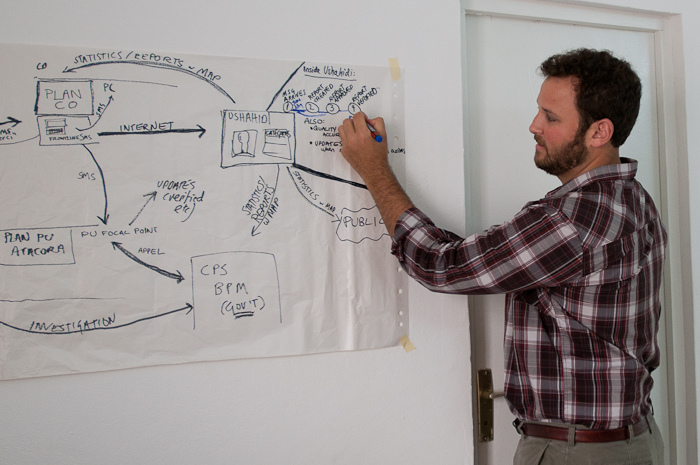
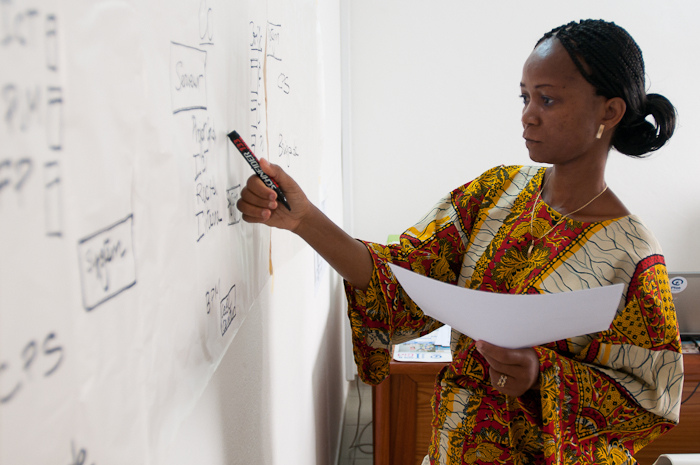
Today I worked with Elsie S., Plan Benin’s Project Coordinator, to chart out the operation of the system. The purpose of the exercise was to clarify the day-to-day operation of the system and revisit the roles and responsibilities of the many actors that interact with this project. Getting a firm grip on all of this information and documenting it for others will make it easier to train staff and partners and build further support inside Plan and within the government of Benin.

Elsie sketching her version of the workflow

A few of the questions we asked and answered today:

— How long should it take for incoming messages to be processed (stripped of personally identifying information, mapped, and so on)?

— What model is best for managing this process? Should the responsibility be centralized at the Plan Benin Country Office? Or should it be distributed to the Plan Benin Program Units (PUs) where the majority of the reports originate?

— How can we modify Ushahidi to support a distributed model, where focal points in the PUs take responsibility and have agency?

— How can we create a shared vocabulary around the various actions within the Ushahidi system? What does “approve” mean? What does “verify” mean?

Me describing my version of the workflow and discussing realistic timelines for different actions within Ushahidi.

In the coming weeks we’ll work with Plan Benin staff to ground truth any revisions to the workflow and modify the system as necessary. We’ll also spend quite a bit of time creating the documentation that will ensure the continuity of operations in the future: reference guides for Plan staff, guidelines for maintaining the privacy of victims, and documentation of the relevant technical aspects of the system.

In parallel, I’ll continue working on some necessary tweaks to Ushahidi including establishing security protocols, enhancing the system’s mapping capabilities (thanks John Etherton for your location highlight plugin and support), and more. In ten days we’ll be joined by Jacqueline Deelstra, a recent graduate of the Fletcher School at Tufts, who will continue these activities and dig deeper on the relevant social issues.

More from Benin soon.

Note: For background and additional posts on child protection, child participation and the VAC Benin project, click here.

(See this post in English here.)

Estaba hablando con una amiga en el Facebook. Me había contactado porque estaba interesada en participar en el curso sobre las TICs (Tecnologías para la Información y la Comunicación) que había mencionado en mi último post.

Su primera pregunta fue – Y los cursos, los ofrecen solamente en Inglés?

Por ahora, sí, le dije. Pero TechChange está iniciando con los cursos ahorita. Es posible que a futuro ofrezcan cursos en otros idiomas.

OK, dijo mi amiga. Genial. Vamos a esperar esto….

Bueno. Mi amiga habla el suficiente ingles para sacar mucho provecho de estos cursos, pero para poder asistir al curso, hay otros factores que le parecían hasta más difíciles a superar. Y lo triste es que estos factores son internos.

1) Los Pagos OnLine

Ahora, ¿sabes el problema? decía mi amiga, Acá vemos que el costo es de 250 o 300 dólares.

Ah, pensaba yo. El costo es muy alto.

No, decía ella. No es el costo. Es que acá en [su organización] los pagos online están prohibidos. Se consideran una POSIBILIDAD EXTREMA DE FRAUDE.

Ella se reía. Jajajajajaja. Yo imaginé que su risa era de frustración y un poco de amargura.

Pues, mi amiga tiene presupuesto y mucho interés en participar en la capacitación, pero no puede inscribirse porque en su organización, no está permitido hacer pagos online.

Wau, le respondí. ¿Ayuda si yo mando un correo o algo?

No, me dijo ella. Es la política de la organización. No se pueden hacer pagos online, aunque sea mucho más barato y sea lo específico que necesites y no esté disponible en tu país.

2) Apoyo de la gerencia

Bueno y si usas tu propia tarjeta de crédito y pedís que te reembolsen? le pregunté.

Ay no, dijo mi amiga. Nadie nos apoya con esto, especialmente con este tipo de cosas que no conocen y no entienden. Necesitamos este tipo de cursos para el personal nuevo y joven que tiene mucho interés en estas herramientas. Pero es difícil hacer que la gerencia entienda.

De allí mi amiga escribió en letra mayúscula: LINDAAAAAAA TIENES QUE VER COMO PODRIAS APOYARNOS CON ESTO DE LAS TICS! Somos pocos en la organización los que manejamos esto y no nos creen de su efectividad.

Ella continuó. Estamos empezando con esto. Tenemos lo básico y tenemos fondos para capacitarnos, pero nadie ve que es una prioridad. Ay, es muy complejo.

3) El bloqueo de los sitios de medios sociales

Seguíamos hablando. Ella decía o, jaja, y por favor escribir tu blog en otra idioma para que podemos compartirlo. Es importante que nos actualicemos. Por lo menos nos permiten acceso a los blogs.

Lo intentaré, le dije.

Mira, agregó, No tenemos acceso a redes sociales. Tenemos un canal de YouTube que nadie puede ver en la oficina. Alguien hizo un Twitter pero todo el personal esta bloqueado del Twitter. Lo mismo con el Facebook. Ni los gerentes tienen acceso! Tenemos que ir a un Internet café o verlo en la casa.

Ay ay ay.

Yo entiendo que hay riesgos con los pagos online, entiendo que hay personas que podrían abusar de las redes sociales si no tienen restricción en las oficinas, y entiendo que en algunos países hay dificultades con el ancho de banda, pero esta plática me puso triste.

La organización donde trabaja mi amiga es de un tamaño regular, e imagino que ésta es la política en toda la organización. Me pregunto si la organización ha considerado que sus políticas están afectando su habilidad de avanzar en su propia causa y su propio trabajo.

I was chatting with a friend of mine yesterday evening on Facebook. She contacted me because she was very interested in participating in the TechChange courses that I wrote about in my last blog post.

Her first question – ‘Are the courses only available in English.’ ‘Yes,’ I said, ‘but TechChange is just getting started. It’s quite possible that in the future they could offer courses in other languages.’

‘OK,’ said my friend, ‘that’s great. We’ll be waiting for that.’

Now, my friend speaks enough English that she could get something out of these courses, but there are other factors that seemed to her even more difficult to surmount. And the sad thing is that these other factors are internal factors.

1) On-line purchasing

‘Our problem with registering for the courses,’ said my friend, ‘is that they cost $250/$350….’

Hm, I thought, ‘So the cost is too high?’

‘No,’ she said, ‘the cost is fine. But here [at our organization] we are not allowed to purchase anything online. Purchasing on-line is considered EXTREME POSSIBILITY FOR FRAUD.’ Then she laughed ‘jajajaja.’ I imagine it was a bitter and frustrated laugh.

So here my friend has a budget and great interest in being trained, but can’t sign up because at her organization, they are not allowed to make on-line purchases.

‘Wow,’ I said. ‘Do you want me to send an email or something to vet the organization?’

‘Nope,’ she said. ‘It’s just their policy. You can’t purchase on-line. Not even if it’s much cheaper, it’s exactly what you want and need, and it’s not available in your country.’

2) Management buy-in

‘Oh,’ I continued. ‘Can you use your own credit card and then get the organization to reimburse you?’

‘Ay,’ my friend said. ‘No one will support us with that, especially an on-line course of this type of thing that they have never heard about and they don’t understand. These courses would be just what we need for some of our staff who are very interested in getting trained up to use some of these new tools. But it’s so hard to get management to see the utility of this.’

Then my friend wrote in all capitals ‘LINDA, YOU KNOW THIS. PLEASE FIND A WAY TO COME AND HELP US WITH ICTS! We need to know this and no one in our management believes it’s useful to our work.’

She continued, ‘We’re only at the beginning of this. We (staff) know only the very basics. We have funds for training but we can’t get anyone to see that this [ICTs] is a priority. Ay, it’s all very complex.’

3) Blocking social media sites

We kept chatting. She said ‘oh, ja ja, and please write your blog in other languages so we can share it around. We need to be updated on these things. At least we are allowed to access blogs.’

‘I will try…’ I said.

‘Do you know,’ she said ‘We can’t access any social media sites from the office. They are all blocked. We have a YouTube channel but none of us can watch it at the office. Someone created a Twitter account but all staff are blocked from Twitter and Facebook at the office. Not even our managers can access it. If we want to see anything we have to go to an Internet cafe or to have Internet at home.’

Argh.

I understand that there are risks to purchasing on-line, and I understand that some staff might abuse social media if they are free to use at work, and I understand that there are bandwidth issues in some countries, but this conversation made me very sad.

My friend works at a decent-sized organization and I assume this must be the policy across the organization. I wonder if the organization has considered that its policies are cutting into its own ability to advance its own cause and its own development work in today’s world.

Ver este post en español!

Almost a year ago, I met Ernst Suur (@ernstsuur) for the first time. We bonded in frustration over the irony of not being able to find any on-line courses to study ICT4D. We each did some research and didn’t come up with much, so we agreed I should write a blog post (See: Where’s the ICT4D distance learning?) to see if we could crowd source anything to help us out. We got some great comments with some good resources for the few courses that do exist or the ones that are in design.

We also discovered TechChange, a newish organization looking to develop some on-line ICT4D courses. We all chatted a couple of times and decided to co-host a ICT4D chat on Twitter to see if we could come up with some additional ideas on what kinds of courses people were interested in. (See the chat summary here). I also had a chance to meet with Nick, Mark and Jordan in their DC office to discuss ideas.

So I’m really excited to see that now TechChange has 3 new on-line courses happening this year:

1) Tech Tools and Skills for Emergency Management from September 5-23.

‘This course will explore how new communication and mapping technologies are being used to respond to disasters, create early warning mechanisms, improve coordination efforts and much more. It will also consider some of the key challenges related to access, implementation, scale, and verification that working with new platforms present. The course is designed to assist professionals in developing concrete strategies and technological skills to work amid this rapidly evolving landscape.  Participants can expect a dynamic and interactive learning environment with a variety of real world examples from organizations working in the field including those involved in the humanitarian response to the Haitian earthquake’

Course topics include: Crisis mapping, human rights violations and elections monitoring, citizen journalism and crowd sourcing, and information overload and decision-making in real-time.

ICT tools covered include: Ushahidi, Quantum GIS, FrontlineSMS, Open Street Map, Managing News.

2) Global Innovations for Digital Organizing: New Media Tactics for Democratic Change from September 26-October 4.

‘New platforms of communication are revolutionizing social dynamics by democratizing access to and production of media. From Barack Obama’s youth mobilization efforts to the ongoing uprisings across the Middle East and North Africa, this course will examine how new channels of communication are being utilized and to what extent these efforts and techniques are successful or unsuccessful in a given context.  It will also provide participants with strategies for maximizing the impact of new media and train them in the effective use of a range of security and privacy tools.’

Course topics include: the new media landscape, offline organization and change through online mobilization, data and metrics, censorship, privacy and security.

3) Mobiles for International Development: New Platforms for Health, Finance and Education from October 16-November4.

‘The mobile phone is rapidly bringing communication to the most remote areas of the world. NGOs, governments and companies alike are beginning to realize the potential of this ubiquitous tool to address social challenges. This course will explore successful applications that facilitate economic transactions, support public health campaigns and connect learners to educational content. It will also critically engage with issues of equity, privacy and access.’

Course topics include: mobile money systems, mHealth and mobile diagnostics, data management for monitoring and evaluation, many-to-many communications integrating mobiles and radio, and mobile learning.

ICT tools covered include: mPesa, RapidSMS/Souktel, Sana Mobile, Medic Mobile, TxtEagle and FreedomFone.

Modalities:

Each course costs $350 (or $250 early bird price) and runs for 3 weeks. The courses require a time commitment of at least 6 hours per week in order to earn the certificate. There are also plenty of opportunities for those that want to spend more time to engage with additional materials and students can access content up to 6 months after course is over. The entire course will be delivered on-line ‘involving a variety of innovative online teaching approaches, including presentations, discussions, case studies, group exercises, simulations and will make extensive use of multimedia.’

I’ll be attending the 3rd course gratis in exchange for helping TechChange continue to shape the content and curriculum and providing feedback on the features and content. (Thank you, social media. Thank you, barter system!)

Register for any of the 3 courses here.

Where are the spaces for youth participatory governance?

‘People no longer rely on governments alone to improve governance. All over the world we are seeing experiments in ‘participatory governance’. People and organisations are grasping the opportunities offered by decentralisation and other reform processes to demand more of a say in the public policy and budget processes that affect them. These ways of holding the state to account are often called ‘social accountability’. Examples include participatory budgeting, monitoring electoral processes, using online and mobile technology, and citizen evaluation of public services. These forms of citizen engagement and social accountability are particularly promising for young people, who often face challenges in getting their voices heard in formal policy and governance processes.’

The ‘youth bulge‘ is impacting or will impact hugely in many countries in Africa, but there is limited documentation on youth involvement in social accountability processes in Sub-Saharan African countries. Youth and governance efforts have been ‘largely unsystematic and often constrained by the vague and paternalistic parameters of the UN Convention on the Rights of the Child (McGee, forthcoming 2010). However this is changing and there are calls for new models, tools and approaches that enable young people to take a more meaningful role in decision-making.’ (call for submissions for the upcoming Participatory Learning and Action Journal (PLA) special issue on Youth and Participatory Governance).

****

In March I attended a “writeshop” put on by Plan UK, the Institute of Development Studies (IDS), and the International Institute for Environment and Development (IIED) to share different youth participatory governance initiatives, reflect on challenges and successes therein, learn how to write better, and finalize articles on the above topic for a PLA Special Issue in December 2011. The special issue will highlight some of the different ways young people are engaging with government to participate in public policy, planning and budgeting processes at local, national, regional, and international levels. Practitioners, youth and government officials from Kenya, Zimbabwe, Sierra Leone, Nigeria, Mali, Senegal, Lesotho, the US, the UK, Ghana, Germany and Liberia attended the writeshop. (The PLA will also have articles from Cameroon and Somalia).

The first day we did a cool exercise revolving around 4 statements on voice, youth, participation, and governance. I learned a lot from the discussion and I wanted to share it here.

So, what do you think? and why?

Statement 1. The author’s voice will always be louder than the voices of the people he/she is writing about.

Strongly agree ___

Agree ___

Disagree ___

Strongly Disagree ___

Statement 2. Increased transparency leads to increased accountability.

Strongly agree ___

Agree ___

Disagree ___

Strongly disagree ___

Statement 3. It is possible to do governance work without engaging in politics.

Strongly agree ___

Agree ___

Disagree ___

Strongly disagree ___

Statement 4. Citizen led/social accountability processes offer more potential for youth than traditional accountability processes.

Strongly agree ___

Agree ___

Disagree ___

Strongly disagree ___

****

Here’s what we discussed at the writeshop. I’d be interested in what you think about the statements too…

Statement 1. The author’s voice will always be louder than the voices of the people he/she is writing about:

Discussion: The group mostly concluded that it’s difficult for the author’s voice to stay in the background – it will inevitably jump out and become stronger than the voice of those he or she is writing about.

‘Regardless of that, the author has been given an opportunity to project the voices of those that don’t have a platform to speak for themselves, so he or she should take advantage of the opportunity.’

‘Just by choosing what goes into the piece, the writer is already showing some type of bias. One or the other idea or opinion will be louder than the others because it serves the author’s own purpose.’

‘Writers need to think carefully about their approaches as authors and be self-aware of what biases are coming through in their pieces. This is an issue of credibility.’

‘One thing to aim for in our work with youth is finding more opportunities for them to author their own stories, because they can speak louder and stay true to their own agendas.’

‘How many of us here sat down and wrote our submissions together with youth? What are some methodologies that we can use to ensure that youth are writing about their own work, rather than always being written about?’

Note: Some methods for involving youth in the writing process will be covered in the upcoming Special Issue, based on experiences from the group attending the writeshop.

Statement 2. Increased transparency leads to increased accountability.

Discussion: Most everyone disagreed with this statement, saying that there is no causal relationship between transparency and accountability.

‘Many civil society and faith-based organizations really engage citizens, but if you look deeply, that engagement hasn’t translated into accountability.’

‘Including people in governance and keeping them informed about what is happening can lead to accountability. People will start to take responsibility, report about actions. If they are involved, included and informed they will start to question things.’

‘There is not always a causal link between transparency and accountability.’

‘Having transparent information is one thing, but accountability is what you actually do with the information. Having the habit of discussion, questioning is one thing, but ensuring that feedback is actually taken into consideration is another.’

‘Often those in power say “we’ve heard” but they don’t do anything to change. Accountability isn’t only about voice, you need to have opportunities for redress.’

‘Without transparency there is no accountability. This can mean access to information. We need legislation to make access to information possible. It’s a pre-requisite for increased accountability.’

‘There are NGO and donor accountability issues also. Just because NGOs or donors put information on-line doesn’t mean that they are being accountable. There is the issue of literacy, of whether people seek out information, of access to the information in a variety of languages, of what format the information is shared in and the sheer quantity of information. Who really has access to the information they are sharing? Can those who are supposed to be benefiting from NGOs and donors programs access the information?’

‘Another thing is making people and institutions understand why they should be held to account, why they need to be accountable, changing mindsets about why leaders and power holders need to be accountable.’

‘Flooding people with information so that people don’t know where to look for what is relevant to them or posting the information on-line, in a language that isn’t useful to them, is not really being transparent. Often calls for transparency don’t really go far enough. Transparency is about making the information usable and about information demand.’

One of our facilitators (Rosemary McGee from IDS) pointed us to Jonathan Fox at UCLA who says:

‘Transparency can be ‘opaque’ (the dissemination of information that does not reveal how institutions actually behave) or ‘clear’ (access to reliable information about institutional behaviour). Accountability can be ‘soft’ (‘answerability’ – demanding answers from duty-bearers) or ‘hard’ (answers plus consequences). Information dissemination does not automatically lead to answerability, nor answerability to the possibility of sanctions. If access to information is to guarantee the sanctions that hard accountability requires, public sector as well as civil society actors must intervene.’

Statement 3. It is possible to do governance work without engaging in politics.

Discussion: The group was pretty evenly divided between strongly agree, agree, disagree and strongly disagree, so the discussion was really interesting.

‘I strongly disagree because government is about service delivery and politics is about the opinions of the people. Everyone is a political animal. There is a difference between politics and partisan politics, though.’

‘Every action has a vision and a political orientation. You can’t change a situation without being involved in politics.’

‘Governance has nothing to do with politics; the government can be left or right; but governance means the same thing. It’s being transparent and accountable to the people; and it’s also about including other stakeholders, NGOs, private sector and responding to the citizens needs. Governance is impartial and non political.’

‘Governance is about how power is exercised. It’s about certain practices and systems – in state, family, community, etc. If you are challenging power, whether policy change or change in practice, whether it’s gender or whatever, you want to address unjust power relations, so at some point you need to confront the polity of those structures. However being engaged in governance is not about partisan politics. There’s a difference between a political party and the issue of politics. If I say I’m in solidarity with children, I’ve taken a political position. Political parties are about obtaining power. But governance is about challenging power relationships.’

‘We need to distinguish “governance and politics” and “party politics.” It’s difficult to say that things will naturally happen based on a structure. But the structures will adjust, they will be used differently according to who is in power. You need to know politics and the opinions of political leaders in order to effectively get your agenda through. You need to understand the political dynamics in terms of what happens in the country, what is the ideology, what is their strategy and what are their plans. If you don’t understand that, you can’t address the issues that you are trying to resolve via governance.’

‘It’s not possible to work on governance and not engage in politics. I work in government. Our mandate ends after 5 yrs. We must go back to elections and the people must give us the mandate again to exercise power on their behalf. This is the only clear mechanism whereby the people can engage in politics. Politics is about opinions and perceptions. People have diverging opinions, those opinions will create debate and that leads to political actions. Whenever there is a debate involved about something, that is politics. It’s not easy to exercise power without debate. To give services to people, to exercise power on their behalf, it’s not easy if you don’t take into consideration the opinions coming from them, they need to debate and the debate then needs to be translated into policies.’

‘The people who are most engaged in governance should not be politically engaged. When you work from civil society on governance issues, you should not have a party affiliation. Because then you will carry a bias. To do good governance work you need to be impartial and unaffiliated with a party, or people will consider you to be biased.’

‘If we look at governance and politics, politics is just a subset of governance. There are actually lots of issues under governance. In governance we expect everyone to take part in how things are governed. We see different political actors. Governance encompasses more than politics, it’s above politics.’

Statement 4. Citizen led / social accountability processes offer more potential for youth than traditional accountability processes.

Discussion: Everyone sat on the strongly agree or agree side of this debate.

‘Citizen led processes offer much more openness to youth.’

‘We need to define citizen-led and traditional accountability processes. Citizen led, social accountability processes are where those spaces are claimed by citizens themselves. Secondly the citizen-led social accountability process tends to be less vertical. There is collectivization of the aspirations of the people who are supposed to benefit from a service or a process. The power relationships are much fairer in that situation. Traditional accountability is like something done within government, something led by World Bank or the IMF. In that case, the state creates space for citizens to participate, information is shared but there is actually not much action taking and questioning because it is the state itself running the accountability initiative on its own behalf. But with social accountability, it’s driven and led by people, by civil society, and there is more questioning and participation.’

‘I was being ethnocentric and thinking as a Westerner about “traditional” as meaning “government and voting,” but I’m realizing that there is a range of understandings of “traditional accountability” processes.’

‘If there is a mainstream more traditional accountability process vs a parallel citizen led process it can be confusing. Often youth are not clear how to link the parallel transparency and accountability that they are creating up to the official structures. There is a lack of connection there. Youth get a lot out of the processes individually, but are they also increasing state accountability?  There is also the concept of traditional accountability. Traditionally led accountability comes from many sides.’

‘There are formal and informal politics. What does it all mean? Based on all of your submissions, we would like to be able to start giving some definitions and an “OK” on all these terms and interpretations. There is a gap in understanding on social accountability, citizen-led accountability and the role of young people in these processes. That is why we wanted to do this PLA Journal.’

****

Look for the PLA Special Edition coming out on paper and on-line in December 2011. In the meantime, check out the current editions here, including PLA 59: Change at Hand – Web 2.0 for Development and PLA 54: Mapping for Change – Practice, Technologies and Communication.

In my last 2 posts, I wrote about reality (how rural youth in Africa are currently harnessing ICTs to generate income), and possibilitysome new technology uses and concepts that I learned about at the “Can youth find economic empowerment via apps, m-payments and social media?” Tech Salon, hosted by ICT Works and the UN Foundation Technology Partnership.

This third and last post of the series explores some of the broader aspects that need to be in place or considered when looking at youth economic empowerment and the role of ICTs.

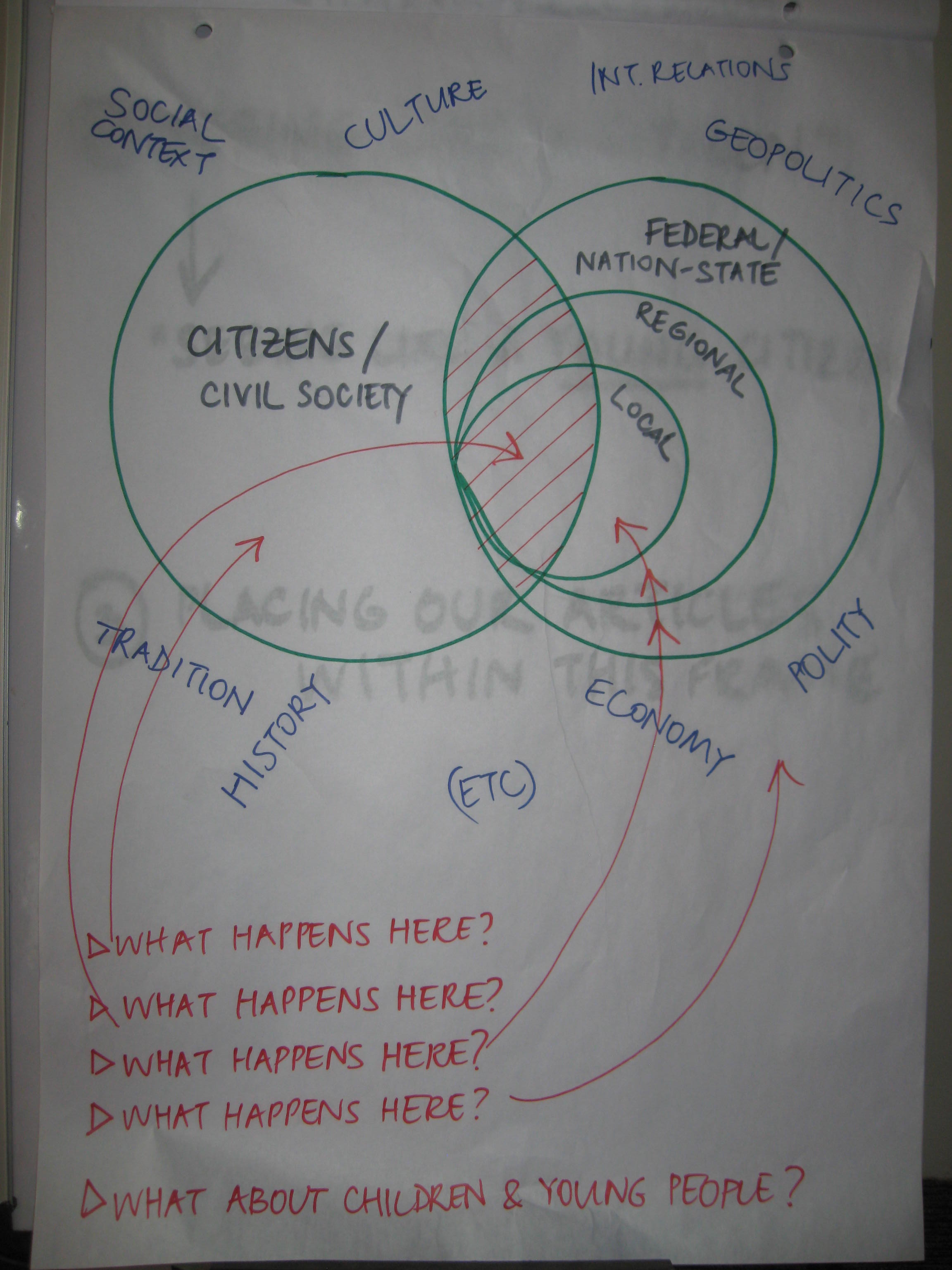
During our Tech Salon conversations, someone reminded the room that a large population of well-educated youth with no prospective jobs (think Tunisia or Egypt) is one thing. A large population of (rural) youth with low education levels is another.

Francis Fukuyama kind of sums this up based on Samuel Huntington’s ‘Political Order in Changing Societies,’ written some 40 years ago: ‘increasing levels of economic and social development often led to coups, revolutions and military takeovers rather than a smooth transition to modern liberal democracy. The reason, he pointed out, was the gap that appeared between the hopes and expectations of newly mobilized, educated and economically empowered people on the one hand, and the existing political system, which did not offer them an institutionalized mechanism for political participation, on the other. He might have added that such poorly institutionalized regimes are also often subject to crony capitalism, which fails to provide jobs and incomes to the newly educated middle class. Attacks against the existing political order, he noted, are seldom driven by the poorest of the poor; they instead tend to be led by rising middle classes who are frustrated by the lack of political and economic opportunity….’

So if the behaviors of these two basic groups (for simplicity’s sake let’s assume there are only 2 basic groups) are quite different, also the approaches to supporting the two groups are quite different, and their views of and reactions to economic crises also tend to be quite different. The first group (the newly educated middle class) is in a better position to access ICT-fueled economic opportunities, whereas the second group likely needs to strengthen its knowledge of things like savings, basic skills, and assets. Context, as always, is critical, and there will not be one single recipe that addresses the economic and development needs of the ‘youth bulge’.

Youth bulge. Image courtesy of Wikipedia.

Some would say that economic opportunities created for the newly educated middle class will mean eventual trickle down opportunity to the rural poor — in which scenario app development, Facebook, microtasking and such might be seen as key enablers for economic empowerment for certain youth. But how can we more immediately support those who are not part of this newly educated middle class. And what about the countries that don’t have a large population of well-educated middle class tech-savvy youth? What are some key things for supporting economically disadvantaged rural youth?

Financial Literacy

Financial literacy for both children and adolescents is one key element. Financial literacy helps drive reasoning, conceptual skills, and leads to better engagement later with formal and informal sectors.  At an early age, say around 8 years, financial literacy should include basic skills like counting, math, logical reasoning, value. Later on, financial literacy needs to move into understanding loans, down payments, interest rates, credit. In terms of ICTs, yes, mobiles could offer tools for youth to save and to build assets, but youth need to know the importance of building assets in the first place. Aflatoun is one example of programs that focus on financial literacy and the importance of saving. The educational children’s program Sesame Street also does its part. As background, this very interesting mPesa report says that around 21% of mPesa customers use the service for saving/storing money.

Life skills

A colleague at the Tech Salon noted that financial literacy and financial education need to be wrapped up into youth life skills education, also covering aspects like reproductive health, hygiene, emotional health. Youth need financial literacy but they also need basic literacy and increasingly media literacy. They need to know more about career development and to get help making good career choices; help understanding: What is real? What are their realistic expectations for a career? What does the current labor market look like? What do they need to do to prepare for a particular career or job? What are their real options? ICTs could be educational tools here, and not necessarily new ICTs. Television or radio can be just as, or more, effective.

Local Context

It’s also critical that program designers and implementers who want to improve the economic outlook for youth ensure that their program designs and interventions fit with the reality on the ground. Eg, what are the language, literacy, connectivity and gender considerations? What tools are readily accessible to the population they are working with? Who is left out? What tools and information channels do people trust? (Radio is still probably the most widespread ICT for educational purposes in rural areas). We need front-end research, participatory user input, and contextual analysis. We need to talk to actual rural youth where we are planning programs, and incorporate their thoughts, aspirations, realities and suggestions into program design.  We need to consider long-term sustainability and local partnerships. We need to think about how the different approaches support the building up of sustainable local economies. All this hard work up front is the most important in program design. And, as several people noted, often agencies only have 30 days or so to design a good proposal for funding.

Opportunities

Preparing up individual youth is still only one side of the coin, as another colleague added. At the end of the day youth need jobs to go into. So yes, there need to be programs that help youth develop (skills, assets, access) but there also needs to be economic development at a broader scale that allows youth to either become entrepreneurs or to work for others, formally or informally. What are the broader job markets or the financial systems and services that youth can access?

There is also the question of whether youth want to be self-employed. A Tech Salon participant commented that informal employment and entrepreneurship are not always the most desirable future for youth. Many youth would prefer a steady job with benefits and security — this is still the measure for success and prestige in many countries. The issue however, as another participant pointed out, is that there are simply not enough steady jobs for youth, so they are forced to be entrepreneurs.

Forbes refers to this with reference to Haiti: ‘In countries with high structural unemployment, entrepreneurship has less of an impact on growth than development economists previously thought. In Haiti, where 75% of the population is unemployed, people turn to entrepreneurship as a last resort. In Port-au-Prince and throughout the country, the term “entrepreneur” has a different meaning than it does in the developed world. Entrepreneurship is borne out of necessity, not the desire to act on business opportunities.

In the absence of a formal economy, Haitians become “necessity” entrepreneurs and must take to the streets and markets to earn their living. The road outside of Port-au-Prince’s Toussaint Louverture airport is lined with salesmen pushing a variety of products, from loaves of bread to toiletries. Children sell sugar cane, produce, and potable water while women walk from market to market selling products along the way. According to the Global Entrepreneurship Monitor, a non-profit research organization, economic growth is not driven by these “necessity” entrepreneurs, who decrease in number as the economy develops. The key to fostering growth is to support “opportunity” entrepreneurs, who choose to start new enterprises in response to market needs.

Barriers

Urban and rural conditions and access to technology and employment in the two contexts are drastically different; this needs to be remembered in the ICT and youth economic empowerment discussion. It often gets overlooked amidst all the tech hype and tech incubator excitement. The difference between the fast-paced urban tech scene and a more remote rural community is vast. And not all countries possess a fast-paced urban tech scene. In addition, it can’t be assumed that just because a developer is from Nairobi, he or she knows the context well enough to develop applications or create opportunities that are fitting for youth in, say, Kilifi. Co-design and participant input are still critical. Urban developers could better understand rural contexts by spending time there.

Girls’ access to opportunities. We know that girls have less access to technology and typically less access to education. How can we support STEM (Science, Technology, Engineering and Math Education) and other opportunities for girls? How can we convince parents to allow girls to participate in programs and access technologies and other opportunities? How do we find more women role models for girls, both in technology and in work and other areas that take girls outside of the home and allow them access to income, which will also allow them to have more power? How do we create safe spaces for women and girls to access technologies? Often they do not feel safe in Internet cafés or are not permitted to frequent them. In addition, less girls and women own their own mobile phones than men. How can we work to help overcome all the barriers that girls face?

Access to information about existing opportunities. In some countries, Kenya for example, there are government-supported initiatives for youth employment and entrepreneurship, but many youth don’t know about them or how to access them. ICTs can play a role in connecting youth to information about opportunities for jobs, financial services and further education. Different media (radio, television, print, SMS and other) can be used for public education and financial literacy. In addition, media can help inform the population of what governments have promised by way of programs and opportunities for youth employment, and in this way support governance and accountability around youth employment.

4 basic ways…

By the end of our hour-long conversation at the Tech Salon, we mostly agreed that there are 4 basic ways to think about the intersection of youth, technology and economic empowerment:

  1. Technology as a job unto itself
  2. Technology to facilitate asset building
  3. Technology for learning and skill building
  4. Technology to access info about employment opportunities
We agreed that if they are to support youth economic empowerment, ICTs need to be contextualized and they need to be one part of a broader, holistic, and sustainable system. And I think that about sums it up. In case you missed them, check post 1 on ways that rural youth are currently generating income through ICTs and post 2 on some of the newer ways that ICTs could enable economic empowerment. If this topic is of interest, check out the Making Cents conference this September.
.

Last week’s Tech Salon, hosted by ICT Works and the UN Foundation Technology Partnership, asked “Can youth find economic empowerment via apps, m-payments and social media?” I did a bit of reality checking and wrote in my last post about some of the ways that youth in African countries are harnessing ICTs to generate income. And it’s not really through apps, Facebook and mPayments.

So if developing apps isn’t the key to unlocking youth’s economic potential, is there another way that ICTs can support youth economic empowerment? At the Tech Salon we discussed a few other options.

Microtasking

Samasource’s work with “microtasking’ looks pretty interesting. TxtEagle, another microtasking initiative, just raised 8.5 million in start-up funding.

Txteagle is a commercial corporation that enables people to earn small amounts of money on their mobile phones by completing simple tasks for our corporate clients.

The types of tasks Txteagle’s African workers have done are:

  • enter details of local road signs for creating satellite navigation systems
  • translate mobile-phone menu functions into the 62 African dialects (for Nokia)
  • collect address data for business directories
  • fill out surveys for international agencies

Txteagle seems similar to Amazon’s Mechanical Turk, except that workers only need a simple mobile phone – no computer or Internet access is needed.’

I hadn’t been paying attention to the microtasking phenomenon, so I did a little digging after the Tech Salon. Microsoft Research did an interesting study called Evaluating and Improving the Usability of Mechanical Turk for Low-Income Workers in India. They found some issues with the interface and make up of Mechanical Turk that made it difficult for low-income workers to benefit and provided some suggestions to improve micro tasking and make it accessible for low-income workers or those with lower education levels. When they improved the interface and instructions (in local language), test subjects’ ability to complete a task rose dramatically. “The most striking result of our study is that there exist tasks on MTurk for which the primary barrier to low-income workers is not the cognitive load of the work itself;  rather, workers are unable to understand and navigate the tasks due to shortcomings in the user interface, the task instructions, and the language utilized.”

I’m sure we’ll be hearing lots more about microtasking (and I’m probably really late to the party here). It seems more reasonable that rural youth could access microtasking work than that they would develop their own apps.

De-skilling

Others at the Technology Salon talked about de-skilling and the job potential that can open up for youth when technology or better access to information allows them to take on roles formerly reserved for more skilled professionals. It seems this is going on quite a bit in the health sector, for example. The de-skilling phenomenon has been around for awhile but I hadn’t seen it as a way for youth in rural areas to access jobs and income, so I thought this was quite interesting.

I’m not sure how much de-skilling is being seriously looked at as a way to connect youth to jobs, or how many youth it’s employing in the rural areas, but it is something I’ll be keeping an eye on and learning more about. I’m thinking that many of us have been looking at de-skilling as a way to engage community volunteers in improving other aspects of community development, eg., allowing community health workers to do their volunteer work more efficiently; but not so much as an income generator for youth.

Job matching and mobile marketplaces

My Finnish colleagues sent me some other examples of mobile (SMS) initiatives that could support economic empowerment and that are good for pushing thinking on how rural youth could tap into opportunities. I think the key is that for now, anything aimed at rural populations needs to be SMS based, as mobile internet is still very uncommon in most rural areas. There’s no harm in planning for the day when most people have Internet-enabled phones, but for now, we’ll probably want to work with what people have, not what we wish they had….

  • Google SMS Applications allow you to use some Google services via SMS text message.
  • Esoko consists of mobile updates for farmers and traders delivered by SMS that include market prices and buy/sell offers, bulk SMS functionality, websites for small businesses and associations, and SMS polling technology. Their blog (which I spent some time on today) is great for sharing how they are going about getting Esoko to function well. Again it’s clear that the technology is the tip of the iceberg….
  • Tradenet is a fully mobile integrated buy and sell portal in Sri Lanka. It has agricultural prices as well.
  • Babajob is a job matching service from India that is fully mobile integrated.
  • Cellbazaar is an SMS marketplace in Bangladesh.
  • Tagattitude is a service that allows international mobile money transfers and purchases; eg., remittances.
  • Souktel’s JobMatch uses SMS to connect employers with youth looking for jobs.

What else?

In addition to micro tasking and mobile applications, there are some more formal technology education programs such as the CISCO Networking Academies, not to mention plenty of locally created computer and technology academies and schools that formally train youth on ICTs with the aim of generating employment. I wonder though how many of the local training academies are focused on more traditional aspects of technology (eg., if you walk into one of these, do you see a room of oldish desktop computers?) and how many are also combining computer education with mobile, and advancing their education and training curricula as technology advances? Colleagues in Egypt told me that some initiatives exist that train up young people to repair cell phones. I’m wondering if this is widespread in other places as well. In any case, formal training opportunities are still difficult for youth in rural areas, and especially girls, to access.

In Kenya the government is promoting community digital centers through an initiative called the Pasha Centers. These centers are linked to youth structures in the constituency areas. Colleagues of mine reported that youth are accessing loans from the government youth fund and starting cyber kiosks, and mPesa centers that are promoting mobile banking.

On top of the government or NGO programs, the mobile phone industry itself opens a job market for young men and women who know how to set up phones, register SIM cards, etc., and there is a whole side industry, obviously, around mobile phones. But again, the more formal opportunities are in the capital or in secondary cities which can still be quite distant from where rural youth live.

Though use of apps, mPayments and Facebook may not be so widespread at the moment in the places I’ve traveled and where my colleagues are working, as outlined in post 1 of this series, and it’s not at all common for rural youth to develop applications themselves, there do seem to be some other possibilities for ‘youth economic empowerment’ that have a mobile or ICT component. I’m sure there are things I’ve missed out as well, that could be quite inspiring.

The question is how to connect these new opportunities with the young people who are typically excluded: youth in rural areas, especially girls. How to scale up the opportunities while ensuring that they are adapted to local contexts, which can vary significantly. Do youth in rural communities have the education levels and skills to access microtasking and to take advantage of ‘de-skilling’ opportunities on a broad scale? Do they know how and where to access microtasking jobs. How are the connections being made with these opportunities? Who has access to these kinds of jobs? How can rural youth find out about these opportunities?

In my next post, I’ll cover some of the other considerations for youth economic empowerment that we discussed at the Tech Salon.

Last week’s Tech Salon, hosted by ICT Works and the UN Foundation Technology Partnership, was on the topic ‘Can youth find economic empowerment via apps, m-payments and social media?’ Fiona Macaulay from Making Cents and I gave some of the opening remarks to get the conversation started (and Wayan Vota kept things lively as usual).

The premise of the Salon was that ‘today’s youth population is the largest in the history of the world, and 90% of these young people live in developing countries. The global youth unemployment rate is the highest on record, and we’re seeing discontent and disenfranchisement play out on the news each day. In fact, the revolution in Tunisia started with an under-employed youth committing self-immolation in frustration…. Technology-based models hold great promise for increasing and improving economic opportunities for young people: low barriers to entry for youth-built apps, the widespread use of Facebook and its promise as a marketing platform, the ubiquity and ease of m-Payment systems like MPESA – these should be a recipe for youth economic empowerment.

During the Salon we explored 3 key questions:

1) How are youth starting businesses or getting jobs in growth-oriented ICT sectors around the world?

2) How are organizations and programs utilizing technology to reach and engage young people?

3) Where should we be cautious or enthusiastic with technology with respect to youth economic empowerment?

This is the first of 3 posts on those questions, starting with Question 1:

How are youth starting businesses or getting jobs in growth-oriented ICT sectors around the world?

I was pretty skeptical about the potential for apps, Facebook and m-payments to resolve the youth employment/income crisis, at least in the context of the rural communities in Africa where I’ve worked over the past several years. So leading into the Salon, I did an informal survey among some colleagues working in Africa to find out how they observed youth making money using technology, and to see whether the idea above had any legs. My thoughts were pretty much confirmed – in the places we are working, some youth are using technology to generate income, but not so much apps, mPayments and Facebook.

In Egypt, colleagues said that youth are repairing cell phones, serving as DJs at wedding parties, setting up photocopy shops and internet cafes, selling phone calls and airtime, running shops that provide children and young people with the opportunity to play games, and using computers to make flyers and posters for certain producers and products in the communities. They also provide satellite connections for poor families to access national and international TV channels – this service is not legal but generates good income for young people.

In Kenya you’ll find youth managing Mobile Phone Kiosks popularly known as ‘Simu Ya jamii’ (community phones). These double up as phone charging points. Pirated music is big business for some youth and phone unlocking services are increasing. One colleague noted that youth are not really creating applications, but in some of our programs, they are involved in piloting new applications, and thus influencing their development. In Zambia, you don’t see much of this type of activity in rural areas, according to a colleague there. But there are village telcos being operated by youth groups and some village groups are setting up banks of solar chargers to support solar lighting. (Cool result: When they set them up at a schools, encouraging women to come each day to charge their lights, they found that school attendance increased).

In Burkina Faso it’s common to see youth selling telephone scratch cards, renting out their phones, offering video services to film at private events, charging up phones for a price. In Senegal, some take phones from one area to another to charge them up for a fee. All over Africa you see video pirating and movie houses, video game houses, video downloading to mobile phones, music on flash drives and flash drives that plug into radios in cars and in collective transportation vans and busses.

There is ‘negative’ business also

Some would place ‘pirating’ and stolen satellite connections here. There is also transactional sex by girls to obtain mobile phones, which are a status symbol. We hear in some communities that adolescents with mobile phones are ‘bad.’ In Cameroon girls said that some boys only use phones to scam people and to steal. Mobiles can also facilitate prostitution. One colleague commented that in Ouagadougou (Burkina Faso) she has seen girls on motorbikes offering themselves by presenting their phone number on their back. We heard from youth in Cameroon that mobiles are commonly stolen and traded. Some parents in various countries do not like movie and game houses, associating them with porn and western culture.

Are youth in rural areas creating ‘apps,’ using ‘apps’ or tapping into ICT development or programming opportunities?

Not really, from what I have seen and what colleagues tell me. There are some shining stars here and there, but this isn’t very widespread yet, and the youth who are developing apps and such tend to be well-educated urban youth. This 2009 study on how the African Movement of Working Children and Youth (MAEJT) uses ICTs is quite interesting in this regard.

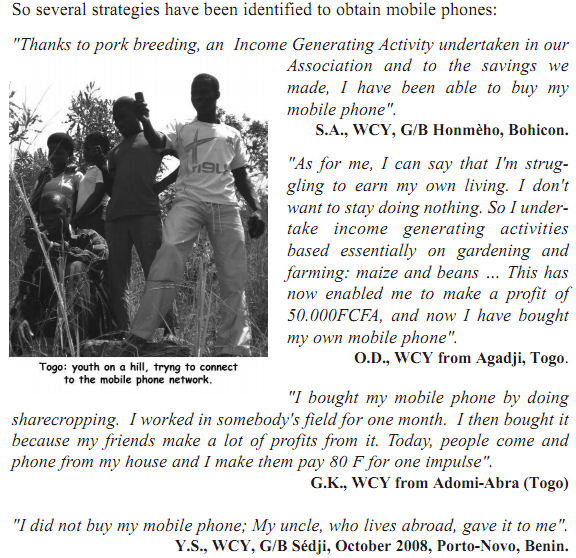
How do youth obtain and use mobiles? (MAEJT study, 2009)

In Egypt, colleagues said Facebook and Twitter groups around specific issues are common among young people in communities. But using ICT specifically for generating income is not. There is inadequate awareness among poor communities on how to make this happen. Although many youth have access to cell phones, ICT is still expensive and non-affordable for many others. Most of the families who have phones in their houses do not have a direct line, which means that they cannot get access to internet through cheap lines. Internet is still very expensive. Getting jobs through the internet is only common among advantaged, well- educated youth, not disadvantaged youth.

In Nairobi, Kenya, iHub and NAiLab have a big pool of developers and there is a lot of action. In rural Kenya, however, access is limited. There is a lot of interest from the youth who have started to catch on though, so colleagues felt it was possible that there could be some type of rural-urban mentoring or connections to help rural youth get on board. In rural Zambia, according to colleagues, sheer poverty means that very few additional resources and capital are available to take on new ideas. There is still very poor mobile phone coverage in some areas, and many young people have already left for urban areas. My colleagues in West Africa did not report seeing any youth developing apps or using Facebook combined with mPayments to generate income. In Kenya, Cameroon, Uganda and some other places, innovation hubs and labs are generating opportunities, but these again seem to be available to secondary- or even more often university-educated youth from urban areas and capital cities or large cities outside the capital.

So, is this bit about apps, mPayments and social media all hype? I’ll explore that a bit more in post 2 of the series. In post 3, I’ll cover the longer term considerations for ICTs and youth economic empowerment and some broader aspects that need to be kept in mind.

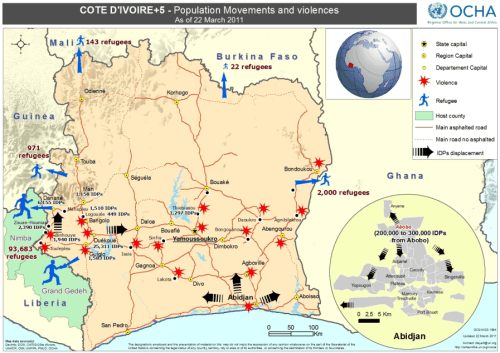
From the Internal Displacement Monitoring Center, March 22

The organization where I work has been present on the border between Cote d’Ivoire and Liberia for awhile now, supporting Ivorians who are escaping the conflict as well as the Liberian communities that are receiving people from Cote d’Ivoire.  (See another good map here.)

What is it like for those who are fleeing Cote d’Ivoire? An account came in by email this morning from our disaster specialist who just returned from Nimba County, located on the border. He told of a woman he had met who arrived in Liberia completely naked, with three children under the age of 6.  She had fled the violence in Abidjan on a Red Cross truck. Then she’d walked, carrying her baby, from the Western town of Daloa to the town of Giglo, passing near Duekoue (where a massacre is said to have taken place). She then continued on to the Liberia border; about 250 km. She had been travelling with her sister and her sister’s 2 children but her sister didn’t make it to Liberia.  She’s buried in the forest. My colleague described the woman’s children as so distressed they can barely speak.

My colleague went on saying that ‘Some people told me that armed men came to their villages and attacked them.  They saw neighbors killed by gunfire, just metres away from them.  Other people told me they fled to small houses in the bush, for fear their villages might be attacked.  But it didn’t make any difference.  When armed men came to the village and found no one there, they’d simply come into the bush, find people and kill them. The people I talked with told me the clashes were the result of ethnic problems.  Their ethnic group was being persecuted by others.’

He describes mostly women and children crossing the border from Ivory Coast and only a few men.  ‘I don’t know what happened to the men and boys.  Some young people told me their brothers and fathers were fighting for one of the sides in the conflict in Ivory Coast.  But no one seems sure of what is happening back in their home countryMany people who have fled Ivory Coast are staying with relatives just over the Liberia border.  Along the border area, many people are of the same ethnic group so there is no trouble with the newcomers.  However, every day, as the fighting grows more intense, more and more people arrive in Liberia.’

The term ‘endgame’ has been all over the headlines for the past 3 or 4 days now, but the ‘end’ of Gbagbo doesn’t mean that things will go back to normal for most people any time soon. Last I heard there are a million people displaced internally and 200,000 externally. I rather doubt it’s the ‘end’ of the crisis for them.

There was a saying people used a lot in El Salvador, though I hear it originates in Africa:  When the elephants fight, it’s the ants who suffer.

I received a random email last night from F+W Media asking me to advertise their fundraising campaign for Japan on my blog. I wondered if they had ever read my blog. But that’s beside the point.

Their pitch?

I wanted to alert you to a special announcement from David Nussbaum, Chairman & CEO of F+W Media, Inc.  Find his letter below, please feel free to share this with your (readers, constituents, fans) via the link on our website: http://fwmedia.com/japan

Best,
Kristin Nehls
Publicist | F+W Media, Inc
@KristinNehls

Their initiative?

“Much like in your own community, school, or place of work, the employees at F+W Media wanted to do something ­ anything ­ to help. While the people of Japan are relocated to temporary housing, as supplying food and potable water becomes critical, the need for support in the coming weeks is even greater. Wednesday March 30th we will join with the American Red Cross to lend our support. And, we hope you will too. F+W Media will donate 50% of all profits received Wednesday from the sale of products and services via all of our 23 eCommerce stores. By choosing to make a purchase on this day, you will directly contribute to the ongoing efforts to provide medical care and relief assistance to the people of Japan.”

Well, OK…

I’ll commend F+W for raising funds and having the good sense to not try sending volunteers and goods in kind to Japan, and for working through a known organization with emergency capacity like the Red Cross.

But…

I’d also call F+W’s attention to this article from Good Intents March 28th post “Japan is limiting international assistance“:

“Following the OCHA team’s visit to Miyagi Prefecture on 23 March and after discussion with Government of Japan counterparts, OCHA notes: (1) that even though the scale of the damage following the earthquake and tsunami was significant and resulting humanitarian needs remain considerable, (2) Japan is a highly developed country and has, in principle, enough resources as well as the ability to respond to existing humanitarian needs. The country can both produce and procure relief supplies domestically and has the capacity to deliver those supplies to the affected population. Japan has a consolidated disaster management system for disaster response although coordination and logistical challenges have yet to be fully overcome.

Nothing against Japan and its people. I was probably as shocked and stunned by the earthquake and tsunami there as anyone else who watched it from afar and who has some close Japanese friends who desperately wondered how their families were faring.

But since Japan doesn’t seem to need more funds, I wonder if F+W Media would consider another crisis in their awareness raising and fundraising efforts.

See, there is this country in West Africa called Cote d’Ivoire…

That country is entering into a civil war that has the potential to shake all of West Africa. Some 1 million people are fleeing the violence. Mercenaries from Liberia (the country next door) are already fighting in Cote d’Ivoire. According to a friend of a friend who’s in Cote d’Ivoire, Ivorian National TV is broadcasting xenophobic messages stirring aggressions against neighboring countries and their citizens in Ivorian territory. This explosive mix could throw the whole sub-region into war. For an overview on the Cote d’Ivoire crisis check my previous post “Cote d’Ivoire and the thinking trap” or Blog for Cote d’Ivoire, which lists a number of resources on the crisis.

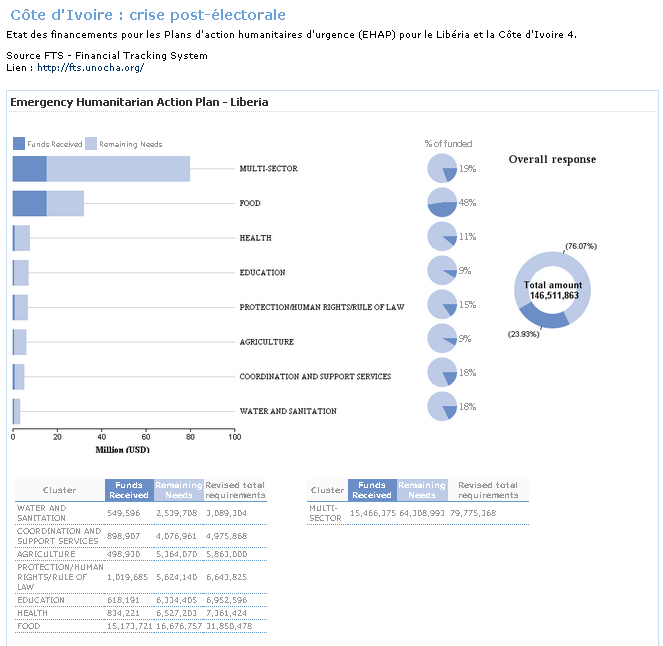
Funds raised for Japan? As of March 28, OCHA reports $442,264,078 (including $261,292,921 in uncommitted funds)

Funds raised for Cote d’Ivoire and Liberia? As of March 28, OCHA reports a 10th of that: $44,924,193.

OCHA's chart on Cote d'Ivoire appeal (March 28)

EHAP for Liberia from OCHA (March 28)

(Charts: UN OCHA’s West and Central Africa Region)

Maybe we should be happy that the donations that Japan doesn’t need might go the unfolding and critical situation in Cote d’Ivoire, which no one seems to care about…. We should be thankful for the Asterisk, as Cynan says.

Japan Earthquake and Pacific Tsunami

Your gift to the American Red Cross will support our disaster relief efforts to help those affected by the earthquake in Japan and tsunami throughout the Pacific. On those rare occasions when donations exceed American Red Cross expenses for a specific disaster, contributions are used to prepare for and serve victims of other disasters.”

And then there is the military intervention in Libya, which I’m not sure how I feel about. I’m following the situation there and in several countries in North Africa and it’s gruesome. But it’s hard to understand how choices are made. A friend of mine living and working in West Africa wrote to me today, and I can understand how he is feeling. It must be terrible to be there, watching “never again” happening again and being powerless to stop it.

“It seems incomprehensible why the international community does not intervene in Cote d’Ivoire whereas they are happily bombing Libya in the name of Human Rights. Strictly speaking in the case of Libya there is a revolution going on against a Head of State in power (I am not commenting here on the type of leader he is!). In Cote d’Ivoire the elected head of state cannot gain power for reasons known, and the population is persecuted and terrorized by his contestor. Wouldn’t it seem logical that the international community intervenes in Cote d’Ivoire instead? They refuse saying that Africa has the AU who should deal with this and that they were not on crusade to liberate the continent from its problems.

Why this differential treatment? Well, the answer is fairly simple: Libya has oil, Cote d’Ivoire not. In the case of Libya the AU stood still and did not comment – not surprisingly as Khaddafi pays for most of half of all country memberships in the AU and has been a tremendous support for development in individual countries. In the case of Cote d’Ivoire they mobilized themselves to act but their negotiation missions all failed. It’s a crazy world. There is no interest from the international community in Human Rights. There is only interest in access and control over resources.”