Feeds:
Posts
Comments

Archive for the ‘accountability’ Category

This is a guest post/cross post from Jamie Lundine who works with Map Kibera. The original is posted on Jamie’s blog Health Geography.

The Youth Empowerment through Technology Arts and Media (YETAM)  project is a joint initiative of Plan International and local partners in 6 African countries (Cameroon, Kenya, Mali, Mozambique, Rwanda and Senegal). The project was initially funded by Nokia but is now supported by the Finnish Ministry of Foreign Affairs via Plan Finland. In Kenya, YETAM is being implemented in Kwale County, with youth from 3 districts receiving training in digital media, including audio recording, visual arts, and various new technologies.

In Kwale County, the YETAM project has thus far empowered young people to employ video, audio recording and radio programmes to explore issues of child protection and child rights. Youth have also used information communication technology (ICTs) including Facebook to connect and explore governance issues and discuss accountability within local and national institutions.

Through the YETAM methodology, technology, arts and media are used to “start the conversation” about community issues – a strategy that has also been employed by our teams– through work that started first in Kibera and expanded and evolved in Mathare Valley with the support and mentorship of Plan Kenya.

Our team was first approached by Plan Kenya in July 2010 to support a 3 day mapping and new media training which were components of a week-long training and reflection for the YETAM project.

On October 3rd, Primoz Kovacic, Jamie Lundine, Zacharia Wambua and Maureen Omino joined Plan staff, members of Plan Kenya’s partner youth groups, and District Youth officers from Kwale County to begin a process of youth-led community mapping.  The purpose of the mapping is to support the on-going YETAM project and feed into youth-led advocacy work in the 3 districts. We were very conscious that we did not want to do “mapping for the sake of mapping” but rather hoped to add value to existing projects and programmes through supporting the collection of issue-specific information that could be used together with other information

The first step in the process was a “feasibility assessment.” Our work in Mathare, Kibera, Mukuru and some rural areas (Taita Hills, Mt Elgon) had given us the technical skills and understanding of the opportunities and challenges of digital media, particularly in relation to the type of youth-led advocacy work that Plan Kenya supports, however we were not familiar with the particular environment in Kwale. The first week we spent in Kwale, 30-some youth and Plan Kenya staff convened together at the Kaskazi Beach Hotel in Ukunda (south of Mombasa).

The mapping process involves young people from three of Plan Kwale’s partner organizations. The groups are:

  • Kwale Youth and Governance Consortium – with representations from the National Youth Councils from the 3 districts in Kwale
  • Kwale Young Journalists – a coalition of 14 organizations in Kwale distrct who have been trained to produce audio clips and are working on licensing for a radio station to deal with children’s issues.
  • Dzilza eco-tourism group – a community based organization based in Samburu along the Nairobi-Mombasa highway

We spent the first day of the feasibility assessment going over expectations and exploring the concept of mapping, with practical examples of our work in Kibera, Mathare and Primoz’s work in Taita Hills. The expectations from the youth included “meet new friends” & “exchange ideas”, “know more about mapping”, gain “more skills on ICT and mapping”, understand “the impact of mapping to the community” and “how to contextualize mapping and social life.”  It was clear from the expectations that the youth were excited about and interested in the process we were about to embark on and had come prepared to embrace mapping and digital technology as part of their toolset for advocacy and action within their communities – it is up to us to impart our knowledge to further empower them in their work.

After a morning of discussions, we needed to start to understand the geographic environment and social issues facing the young people in their communities.

This would help us facilitate the mapping process and organize the 3-5 weeks of data collection and field work.

First we asked each group to prepare a presentation of their group including, who they are, where they work, the main issues they deal with and activities they undertake. We also wanted to know the stakeholders they engage with on the various issues and during activities they carry out.

The youth were asked to draw a map of Kwale county. They divided into the three groups – Kwale Young Journalists, Kwale Youth and Governance Constorium and Dzilza. The exercise took longer than expected but the teams had interesting and thoughtful discussions of what features to include on the map and how to represent the entire county – which proved to be more challenging than anticipated.

Realizing the challenges of mapping the entire county and that each group needed to narrow down a smaller geographic region and specific issue to map – on Day 2 we asked the youth to break out into groups and draw the 3 districts that make up Kwale County. Interestingly, they divided themselves into groups based on who lived in what district instead of going into teams based on the region in which their group worked.

The smaller geographic region and the previous days experience made the paper-mapping much easier. The maps were more specific and clear than on Day 1!

Kinango District Paper Map

The youth also identified a wide ranging list of approximately 10 issues for each District. In Msambweni for example, the youth discussed child abuse, sexual exploitation and child trafficking (in relation to the tourism industry in and around Ukunda), drug abuse, disasters such as floods and drought, poor academic performance in schools, early marriages and pregnancy, deforestation, lack of birth registration and ID cards, environmental pollution and squatters. This wide range of issues are important to note and discuss – however for focused advocacy work and 3-5 weeks of data collection it would be unmanageable.

Kwale District Paper Map

So at the risk of discussion fatigue, we took the youth on an afternoon of setting up GPS devices to prepare for field work – to introduce GPS data collection and start to understand the scope of the issues we could focus on.

On the third day we focused on the major issues within each group. We asked the young people to come up with the main issue or challenge their work was trying to tackle, their proposed solution, the action steps required (including relevant stakeholder engagement) and the data required to work toward the proposed solution.

Kwale Youth and Governance Council

The main challenge/issue identified by KYGC was social accountability (or lack of accountability due to poor governance and leadership). Their proposed solution involves “empowering society” through community forums, sensitization of the community on social accountability and “participation and inclusion [of community members] in decision-making process.” This will include activities such as stakeholders meetings, participatory planning & implementation of government projects, community involvement in monitoring and evaluation of projects, involvement of the community in the mapping, making recommendations and impact assessment. The team wants to focus on devolved government funds, including the Constituency Development Funds (CDF).

The data the team requires to support their work in social accountability are the following:

  1. Number of projects (aggregated from the data collection process)
  2. Budget allocation for each project
  3. Community participation (identification, place, project, proposals , capacity project committee)
  4. Relevance
  5. Impact (no of beneficiaries, workmanship, quality)
  6. Observations
  7. Project Categories
  8. Recommendations

Kwale Young Journalists

The Kwale Young Journalists chose to focus on two issues related to child protection: child labour & early pregnancy. The tean proposed that these issues can be tackled mainly through increased awareness of children and parents about the importance of education.

The action steps or activities for this proposed solution include 1) reporting cases of child labour and early pregnancy to the administration and the voluntary children officers 2) guidance and counselling of children and parents 3) holding barazas with the community through the administration 4) introducing life skills clubs in schools and villages (for example music, accounts, and journalisms clubs, etc)

Data required

  1. Reasons and vulnerability to child labour
  2. Forms of child labour
  3. The number of children involved in child labour
  4. The number of parents not taking care of the children
  5. The number of people
  6. The number of orphans
  7. The most vulnerable areas
  8. Family status
  9. Blended families
  10. Number of pregnant girls
  11. Reasons of vulnerability to early sex
  12. Number of schools most affected
  13. Number of girls who have gone back to school after giving birth
  14. Data on the number of reported cases
  15. Data of the effects of early pregnancy

When mapping child protection issues, we are aware that some of this data may be extremely sensitive and has the potential to result in further victimization of children and families if publicized. We suggested to the team to focus on publicly available information, such as information on schools, cases, cases of school-drop out, qualitative and quantitative information on the reasons for school drop-out and safe places for vulnerable children.

Eco-tourism in Samburu

The major issue that the Dzilaz group in Samburu will focus on is eco-cultural tourism and human-wildlife conflict. The causes of tension between tourism and culture, as well as wildlife conservation is exacerbated by the conditions in the semi-arid area, where the Dzilaz group operates. Poor government policy, animal migration and poaching and killing of animals are related issues the group is concerned about. The solutions proposed by the group include a combination of advocacy, participation in policy and livelihood activities. They suggested the community work on afforestation and reforestation, installing proper fencing eg electrical fence along animal migratory routes, enforce good governance policy through community participation with other stakeholders, liaise with the relevant authorities for technical support, for example lobby with KWS to permit us to introduce watching, animal hunting of antelope. Actions toward these solutions include door to door campaigns, awareness meetings, seminars/trainings, empowering communities on policy development, identifying resources for exploitation and meeting stakeholders.

Data required

  1. Points of human-wildlife conflict
  2. Number of people affected by the human wildlife conflict
  3. Distance of one school to another
  4. How many have been compensated for human-wildlife conflict
  5. Degree of damage to people, crops, properties

The brainstorming of data/information that the 3 groups hope to collect is a great start, however several concerns arose – including issues of privacy and child protection. Our on-going work focuses primarily on public datasets so we encouraged the youth to think about public assets rather than private data. We also realized that the type of information the teams are interested in is a combination of qualitative and quantitative information – GPS data collection will be only part of the information solution for this work. This week, Primoz, Zach and Maureen are working with each team to create data collection forms to concretize this information and decide on the strategy for further documentation to support GPS data collection and mapping.

Field work – Mapping Ukunda

The final two days of the feasibility assessment involved data collection and practical field work with the GPS devices. This was to begin to build skills, excitement and a better understanding of the practicalities of mapping.

The team of 30 youth split up into the three teams and divided the area to be mapped among them. Some walked along the main strip along Ukunda beach – from Kaskazi hotel to Congo Mosque – including the small village of Gombado, others mapped the area between the beach front and Ukunda town and the last team mapped Ukunda town itself.  Three hours of walking through the area and collecting data in the hot sun proved to be quite tiring for everyone. In two afternoons of field work the teams collected over 350 points of interest and mapped several roads and paths that were not previously mapped. The youth also learned how to digitize over the GPS points and tracks they had collected in the field to contribute data to OpenStreetMap and begin making a map!

Mapping Ukunda

Read Full Post »

This is a guest post by (my boss) Tessie San Martin, CEO of Plan International USA. Tessie presented at Fail Faire DC last night. These are her thoughts on the event, and about failure in general.

I attended the most extraordinary event, hosted by the World Bank and organized and sponsored by a variety of organizations including Development Gateway, Inveneo, Jhpiego, and Facilitating Change.

The objective of the event was to share our failures using technology in a development context, and to be bold, forthright, honest, and (this is very important when talking about one’s shortcomings!) humorous. There were 10 presenters (including me).   We all agreed to be on the record.   The event, and the fact that I agreed to be on the record did make my IT and Communications teams a wee bit anxious.  But I was keen to take on this opportunity.

We do not celebrate failure often enough.  But we should.  As Tim Harford has said in his very entertaining book, Adapt, “Few company bosses would care to admit it, but the market fumbles its way to success, as successful ideas take off and unsuccessful ones die.  When we see the survivors of this process – such as…General Electric and Procter and Gamble – we shouldn’t merely see success.  We should also see the long, tangled history of failure…”

In my presentation I spoke about what I call organizational kryptonite (all the geeky readers out there like me will know that kryptonite is matter that weakens – and slowly kills with extended exposure – Superman):  being silent about your failures.  If we do not share – and learn from – failures, we will never learn what works.  If we do not take risks, and encourage experimentation, we will never advance.  The successful organizations are those that motivate risk taking. As well as transparency and openness, about what is working and what is not.

So I attended this Fail Fair, and happily shared with the audience our various challenges (a nice euphemism don’t you think?) with the application of technology for not just what I could learn (and I learned a lot) but also for what attending and presenting says about Plan.  We are failing.  And in that failure we are learning, adapting and advancing, and therefore improving our ability to improve the lives of children around the world.

Read Full Post »

Youth map toilets in Mathare. (From Map Kibera's Blog)

I first heard about Map Kibera quite awhile ago. Looking through old blog posts, I’m thinking it’s been about 2 years. Somehow, probably through blogs and Twitter, we connected and made plans to work together on the Youth Empowerment through Technology, Arts and Media (YETAM) project that I was coordinating and where we (Plan) had been wanting to use digital mapping but didn’t have a clear understanding of how to do it technically.

Around the same time, Plan’s program team in Kenya was connecting with Map Kibera through the Institute for Development Studies (IDS), where Robert Chambers (the guru/godfather/grandfather of participatory rural development approaches) and co. were also thinking about how digital mapping fits into participatory development. Sammy Musyoki, Plan Kenya’s program support manager who is also affiliated with IDS, was already engaged in some work around the use of mobiles in community led total sanitation (CLTS) work. In November 2010, Map Kibera became part of a research project, where Sammy and Evangelia Berdou (also from IDS) began looking at “the challenges faced when applying the methodologies of participatory technologies to participatory development and aid.”

Importantly, the research is not ‘extractive,’ research, eg, the researchers are not coming into Kibera to pull information out and leave, publishing their work for academic circles and never bringing the insights back to the community for discussion and interpretation.

As Map Kibera Trust co-founder Mikel Maron wrote, “With IDS, all of the interviews and meetings were facilitated by Sammy, leading up to a gathering of everyone to reflect on the results. This was incredibly valuable for everyone to share their perspectives and understand others. We thought of it as Group Therapy.” (Note: the posts written during the research are collected here – more good reading.)

He continues, “Additionally, we organized an amazing inquiry led learning session with Aptivate, which contributes to creating a guide-book for future trainings.” (Note: I was following the Twitter stream during the sessions that Aptivate conducted, and I highly suggest checking this organization out.)

While the research was taking off, Plan Kenya and Map Kibera also started working together on both the YETAM project as well as on a Community-Led Total Sanitation (CLTS) program in Mathare.

The learning from the IDS research, together with Plan and Aptivate’s input around facilitating participatory development approaches meant that the Mathare project started off differently than the Kibera project did. The approach was a bit slower, and started by really engaging the community. As Jamie Lundine (current director of Map Kibera Trust) writes in her post Whose Map, “Map Kibera did not begin as a participatory development project. The initial project was an attempt to introduce open source technology – namely, OpenStreetMap – into a community that had previously not had a publicly accessible map (for all intents and purposes it was “unmapped”). Initial mapping of Kibera was done quickly (in 3 weeks) and local leaders, including administration were consulted but not necessarily engaged in the process.” The quick growth of the project was partly fueled by interest and support from the international community due to the innovative nature of the project, rather than by demand from the community for a rapid implementation.

She continues in the post to describe the participatory process that was used in Mathare – eg., lots of meetings, discussions and participation and offline activity before any mapping even started. The approach in Mathare was to really engage the community and local organizations and structures from the outset, and to “lead from behind”. One of the neat results from this approach is the fantastic Mathare Valley Blog, set up and maintained by the youth, and a great place to go to hear about what’s happening in Mathere directly from residents.

From Jamie’s post New Media in Mathare:

“To provide the participants with some ideas about other options in terms of new media, some basic training on the use of the Ushahidi Voice of Mathare platform was provided to some of the Map Mathare project participants. The Voice of Kibera team conducted a number of hands-on trainings with 8-10 Mathare participants. The participants were interested in the platform and learning from the experience of the Voice of Kibera members, but did not take-up the software as we saw in Kibera. We therefore agreed to provide technical support for the blogging platform as a central online information focal point for the Map Mathare initiative. We were careful not to impose the original ideas of New Media in Mathare and have adhered to the original methodology agreed upon by the team with support from Plan Kenya and CCS. This was a community driven approach from which the technical and coordination team “leads from behind”. We are and continue to be flexible when it comes to programming in Mathare.”

Map Kibera has worked with a broader group of Plan Kenya staff also to build capacity around participatory mapping so that various on-line and off-line mapping tools could be considered in Plan Kenya’s future efforts, for example, these suggestions by the Plan Kenya staff: mapping and identifying the hot spots of child abuse, use of SMS for communication with hearing and speech impaired within the community, using reports and sharing the same information to various media channels, program monitoring, a governance tool for enhancing social accountability as well as tracking projects, involving children in participatory community mapping, using blogging as a tool for youth to document governance issues, and to document and share participatory activities that Plan already undertakes, such  as transect walks and participatory situational analyses.

Map of toilets, water points and open defecation areas in Mathare. (from Map Kibera's blog)

Today, almost 2 years after our “first contact”, Jamie wrote a motivating post that highlights how things can work when development, technology, academia, communities and local partners work together openly.

“Mapping the sanitation in situation in Mathare has been a process of continual learning. When we began the Map Mathare pilot project in December 2010, we employed a dynamic methodology to engage young people and the community issues in the approximately 20 villages in Mathare. My colleague Primoz and I worked closely with the Plan Kenya team to design a training programme and over the past 8 months, have learned a great deal about working with youth and communities to “make the invisible visible” that is – to document tacit knowledge and turn the experience of communities and young people into information that translates across social and geographic boundaries.”

Through these collaborations, everyone benefits and learns. Plan is learning how to support communities to use new technologies in community development work. Plan staff is also developing capacity to innovate in Plan’s work by becoming more familiar with different technology tools and ways of working. Through blogging and sharing and face-to-face meetings, this learning is making its way through the organization, touching on a variety of levels, sparking slow and steady changes in how a huge organization operates. The Map Kibera team is learning more about participatory methodologies in development, which carries into their work and how they talk about their work also. IDS is learning how the two mix, and offering an academic overview within theoretical frameworks and advancing the field of knowledge around participation technology and participatory development. The community benefits by being fully engaged in a process that has positive and lasting impact.

Jamie writes:

“The team of mappers, videographers and bloggers– now about 15 in number – who have stuck with us since December of last year, can really tell you what empowerment means to them. Not only have they put themselves and their community on the map – a process that evokes a great sense of pride and responsibility. Some of the young people did not know how to read a map before…. 

Putting yourself on the map is the first step toward demanding recognition and everything that comes along with it – including basic human rights (the right to a clean living environment, the right to health) and by extension – the right to access services provided to the rest of Nairobi. Through our programme, young people are given the chance to represent their community through the medium of a map. Standard GIS symbols break down the barriers that separate youth and elders – rich and poor – and allow these young people to express themselves on a level playing field. Looking at the maps,  who would know they were generated by youth from the informal settlements?”

This is a good example of various disciplines and sectors working together with youth and community members to take an initiative forward in a very positive way.

It’s proof that coordination, cooperation and bridging across all these areas is not only possible, it is vital if efforts are to be of any real and sustained impact.

Read Full Post »

Last week’s conference: “The Power of Information: New Technologies for Philanthropy and Development” hosted by the Indigo TrustThe Institute for Philanthropy and The Omidyar Network was somewhat of a ‘who’s who in ICT4D’. It provided an incredible opportunity to hear and discuss what some of the best minds are up to with regard to technology and innovation in development. (Check the conference videos here for more.)

The purpose of the conference was to bring innovators and donors together. In addition to the panelists, many other leaders in the field of social media, ICT4D and innovation as well as a variety of donors and funders were around to chat with during breaks, lunch, dinner and drinks. Conference topics included transparency, accountability and democracy; health; finance and rural development; youth empowerment and education; human rights; and fostering innovation and enterprise.

I got a lot out of the conference, but want to focus on two areas of specific interest:

  1. Balancing innovation (inspiration) and process (sustainability)
  2. Building bridges between new technologies and existing initiatives

Balancing innovation (inspiration) and process (sustainability)

Philip Thigo from SODNET started the day off with an introduction and a great set of questions* to explore around ICTs and development.  I found myself nodding and frantically typing and tweeting to catch and share as many of them as I could:

  • Are technologies just tools or are they the engine of transformation?
  • Are they universal? Can we cut and paste them from one context/culture to another?
  • Is it about connecting old and new tech for use by marginalized people and groups? Should we be creating interfaces between new and old tech?
  • What about power hierarchies with relation to access? Will disempowered communities automatically adopt technology and turn its use and information into action?
  • What about the challenge of laws and limitations on technologies and the selective enforcement of these laws by the state with regard to access, ownership, and control of information and knowledge?
  • What are the accountability, ethics and responsibilities of technology activists and developers? How are we evaluating our actions and decisions and their impact on people lives?
  • Is it worth taking the risk?

Philip emphasized the need to fail fast, learn fast, and move fast when working in this area. “We need to think about people first, not technology first,” he said. “We should strike a balance between supporting innovators (inspiration) while at the same time strengthening process (sustainability).”

I couldn’t agree more.

Though there is a sense (and a couple panelists, including Philip, commented) that anyone can use social media, that people don’t need training, and that ideally you should just hand over the tools and let people get to work, I do think that ‘striking a balance’ is critical, especially when talking about funding and implementing particular initiatives that are seeking specific outcomes related to development. This isn’t to say that we need an over orchestrated process, but I do think it’s important to remember that not everyone can pick up technology as easily as those who are immersed and surrounded by it 24/7.

Yes, technology needs to be ‘demystified’ and tech is getting simpler and simpler, but based on experience working with staff, community leaders, local organizations, youth and teachers in rural Benin, Kenya, Mozambique, Senegal, Mali, Cameroon, Rwanda and Ghana, it’s clear to me that not everyone can just jump in and go. Not everyone speaks English, not everyone knows about coding, not everyone has used technology before, not everyone feels confident even if they are very curious, and some people want additional support to get going.

In addition, ICT4D-type projects need good overall design, beyond the technology piece. They need a good think-through in terms of sustainability (for programs that are meant to endure), local context, unintended effects, privacy and protection (especially if they are human rights related, work with vulnerable people or could put users in any kind of risk).

As many would agree, the tech is only 10% of it. There is a trend toward developing more detailed user manuals and guidance on what to think about when designing initiatives using new tools like Ushahidi because of demand for this from users. I do think that donors, implementers and innovators need to keep that in mind, and be sure that they are planning for and funding that other 90% [eg, all the ‘boring’ stuff that makes the 10% of the ‘cool and -exciting’ stuff work – like good planning, core staff, logistics, monitoring and evaluation or as the link I mentioned above says, outreach, branding, translation, verification, documentation, integration with other systems….]. I also think donors should be supporting the local strengthening of people and organizations’ skills, capacities and strategic thinking via funding to innovation and tech hubs and support to universities and other kinds of opportunities for further education, training and experimentation in the area of technology for people in ‘developing’ countries, starting from local context and local realities.

Building bridges between new technologies and existing initiatives

Some major transparency initiatives are gaining more and more traction at the moment, for example the recently-launched open government program led by the US and Brazil (and rejected by India) and the International Aid Transparency Initiative (IATI). In addition, there are some really interesting locally led transparency initiatives happening all over the place. The panel on Transparency, Accountability and Democracy highlighted a number of tech tools and platforms that are being used to enhance this area of work (including  Frontline SMSMy Society, and Huduma) and some broad thinking around the topic by Owen Barder, who highlighted various aspects of aid transparency and the giant disconnect in terms of what the general public, governments receiving aid, and donors want to know about aid efforts.

Following the panel, a great question came up from Martin Tisne from the Transparency and Accountability Initiative (TAI).  He said that the transparency and accountability field has been around and funded for many years but it is atomized. He wondered how the different initiatives represented on the panel all fit into the broader picture. Owen agreed that atomization is a very serious concern. “The answer to it is open standards that enable people to take information from all these sources and mash it up and make it available to everyone. This is ‘unsexy’ and doesn’t photograph well but it’s potentially revolutionary in the way that the web has revolutionized our lives.” Owen emphasized the need for donors to invest in areas that maybe don’t seem so innovative and exciting, but that are critical to moving the field forward. (This goes back to the first point – the need to balance innovation and process, and funding for the other 90%).

Stephan King from the Omidyar Network continued during the donor panel to talk about transparency and accountability. He added that “tech tools are not a panacea,” and asked how technology can supplement and complement the work that many organizations are already doing. “Many charities and non-profits don’t know how to use technology,” Stephan said, commenting that there is a role for Omidyar and others to help organizations realize the benefits and utilities of technology to help reach scale, innovative solutions, and to provide feedback loops. “Technology is important in the area of transparency and accountability because it can engage citizens,” he said. “It allows people to access information in a way like never before.”

Martin (from the Transparency and Accountability Initiative) followed, saying that TAI is a collaborative of major funders who are looking at the whole field of transparency and accountability. The field as a whole is about 20-25 yrs old, he said, and is currently very atomized. “We need, as funders overall, to ensure that this growing and exciting community of practice [technology in transparency and accountability] isn’t just another atom within the overall transparency and accountability movement,” he said. “How can technology feed and nurture this overall community of practice? Technology has potential to do something really exciting in our field, to solve problems we’re really poor at, such as scale.” He also talked about the potential for tech to help engage citizens. “This field is and has been monopolized by policy wonks in the cities, in the capitals, but we have an opportunity to reach citizens and that’s really exciting.”

“The vast majority of technology and accountability groups — 95% — however, don’t harness the potential of mobile technologies really strategically, yet the potential is exciting if they did.” Martin asked how we can link organizations with fantastic grassroots networks and/or that really know how to use media with those that are using technology. “If we can crack this complex bridging issue of how to bring the transparency world and the tech world together we will have achieved a huge amount.” It’s not enough to bring government groups and tech groups to the table and think it will happen overnight, he said. “What we are trying to do is to focus on people, on entrepreneurs, on individuals who really understand the problems and the solutions that tech can provide as well as focus on organizations. We find a lot of program officers who know what tech can do or a CEO who has a vision of what tech can do but it doesn’t percolate throughout the organization.” TIA wants to bring together the people who understand the problems together with those who may have the technology solutions. Martin’s idea to bring technology folks together with transparency and accountability folks together to make “tech babies” was a big hit….

These points also resonated strongly with me as someone working in a large development organization that is looking at how to integrate new technologies into its work, and being one of few people within the organization with the specific responsibility of bridging programs and new technologies. It’s  simultaneously comforting and frustrating to know that organizations typically struggle with this and also good to know that some donors are aware of the challenge and willing to support it to be overcome.

Philanthropy and social media

In closing this too-long post, I just want to mention that as background material, Indigo Trust and the Institute for Philanthropy produced an impressive paper called Philanthropy and Social Media, which gives an overview of social media, how it’s being used for communication and social impact, and why social media is important (with separate sections on communication messages, knowledge sharing and reporting, overcoming barriers to inclusion, connecting people, improving service delivery, scaling fast, fundraising, transparency and accountability). The paper also summarizes some conversations with investors in social media. Two charts I find extremely on target are the “tips and advice on investing in social media” and the “roadmap for engaging with social media.” They are both simple and well laid out, and would be useful not only for donors but for anyone who is engaging with social media in development work.

Many thanks to Will and Fran at Indigo Trust for the invitation to participate in the conference!

*See also Charlie Beckett’s great overview of the conference and the key questions he pulled out from the day.

Read Full Post »

The number of international aid and development blogs has expanded rapidly in the past few years, and the number of people reading them has also grown. But aside from retweets, comments, and  ‘hits’ to our blog sites, those of us who blog about aid and development really haven’t got a very good idea of who reads our blogs, what interests our readers, if our posts have any kind of impact, and what our readers do with the information they find on our blogs (if anything!).

To get a sense of that, several aid and development bloggers have joined together to do a small survey of our readers to see what we could find out.

I’d be quite pleased if you, dear reader, would take 5 minutes to take the survey (click here). All responses are anonymous.

If you also have an aid or development focused blog, please share the link on your blog too.

Thanks very much!

Read Full Post »

Charles Suglo, Bestway Zottor and Francis Diamenu from Radio Tongu

Sometimes among all the ICT4D hype, we forget about one of the biggest and oldest ICTs there is:  radio.

Last month while in Ghana, I visited Radio Tongu in Sogakofe. The compound where this community radio station sits also serves as a community center, with computer training, a press center and Internet access for a discounted rate.

Plan Ghana staff was meeting with the radio director, Bestway Zottor, and two of the managers, Francis Diamenu and Charles Suglo, to discuss the idea of offering internships for 6-8 youth from the nearby school-based Girls Making Media (GMM) program Plan Ghana and Plan US are supporting.

Charles explained to us that the station gets some 70% of its news from the Internet. The other 30% is sourced from local communities, and recorded on the ground wherever the news is happening. ‘The voice is reality,’ he said. ‘It’s what promises that the news is real. It’s what makes people believe.’ The station broadcasts in 3 languages: Ewe, English and French.

If the youth in the GMM program want to be radio hosts, according to Charles, they need to be well trained and professional, especially since the topics that the youth are bringing up — violence against children and bullying — are sensitive. ‘We have our credibility as a radio station,’ he said. ‘So they need to be well-trained on radio program hosting, know how to manage on air, be skilled on how to ask good questions and follow-up questions.’

There are all kinds of jobs that the youth can do at the radio station, including news, marketing, voice, or running the cafe. Having job skills such as these can begin to give the youth some experiences that will serve them later in life. The training and work they’ve done through the GMM project over the past year give them a foundation for the internship positions at Radio Tongu.

Following the visit to the radio station, we went to the school to meet with the media club. It’s called the  ‘Eye Media Network.’ The group’s slogan is ‘Our eyes are always watching.’

The GMM program began last year with a workshop for 20 of the students on media skills and gender. Following that the Club received a small media kit consisting of digital cameras, voice recorders, a radio, a notice board and Flip cameras. The girls work with 2 advisers and now several boys have also joined the Club. The club plans its own programs and actions, and does a school-wide newscast every Wednesday during the school assembly.

A student reads us the news they've posted on the Notice Board

As part of the program, the Club meets and interviews local and national figures, with a focus on women journalists, government officials and businesswomen. The group has covered school elections and put into place a ‘Walk your Talk’ Accountability initiative.

They conducted a bullying campaign with the goal of reducing the incidence of bullying by 30%. After the campaign, which included posters, educational sessions and other outreach, the Senior Housemaster claimed that bullying had been reduced by 90% compared to the year before. They will begin a campaign against sexual harassment in the coming year.

Some of the challenges that the group faces include posters being ripped down, friends trying to discourage them, boys suffering discrimination for belonging to the “Girls Making Media” club, and not having enough equipment. The club hopes to obtain their own modem, computer, printer and more cameras.

The first week of August, select students from the GMM group participated  in social media training, where they learned how to shoot video, subtitle, access different social networking sites to post their content, and stay safe while online.

The girls in the club said the project has helped them to build confidence and take up leadership positions. ‘We learn how to find information and to bring out problems and get solutions,’ said one girl.

Another said ‘We took bullying as a normal thing. Now we know that bullying is not normal. Now when we see something, we are alert.’

‘I used to walk around without seeing,’ added another ‘but now I see everything because I am looking for news. My mind has been opened.’

The Girls Making Media program covers 7 schools in Ghana. Several other groups in Togo, Liberia, and Sierra Leone also participate in the GMM program.

Read Full Post »

This week I came across the “Feedback Mechanisms in International Assistance Organizations” report by CDA Collaborative Learning Projects, based on research undertaken by the Listening Project and funded by the Gates Foundation.

The findings and recommendations are very intuitive and it’s nice to have them gathered in one place. The report can serve as a starting point or a pause-and-reflect moment for organizations working specifically on humanitarian accountability as well as those who are looking to integrate better ‘downward’ or beneficiary feedback into development or humanitarian work overall. It also offers good food for thought for those interested in crowd sourcing and the use of new technology for citizen engagement and input.

The report is not too long, and it’s easily laid out for a quick read, so I’d recommend downloading the .pdf and digesting it fully.

To whet your appetite, here are some points I found interesting:

Why do agencies seek recipient feedback?

Four reasons were identified in the report: to improve accountability, to improve effectiveness, to respond to donor requirements or media pressure, and to increase security for staff. Feedback from recipients* was seen to give staff the fuel needed to pressure higher-ups for necessary changes in programming; beneficiary feedback often improved program quality and recipient satisfaction, and seeking dialogue and communication with communities tended to reduce threats of violence. When accountability was a donor requirement but wasn’t part of a larger organizational buy-in or value, unsurprisingly, initiatives were less successful.

To many reading this post or who may read the CDA report, the benefits of participation and feedback and accountability are already obvious, nonetheless it’s  good to see them captured and documented in a report as a support to those who are trying to establish accountability and transparency mechanisms in less-friendly or convinced atmospheres.

Other key points (any quotes come directly from the report):

  • All practitioners interviewed for the study “expressed their unequivocal commitment to participatory and inclusive approaches to humanitarian and development work, and placed significant emphasis on accountability mechanisms.” In addition, many organizations have signed different charters and standards including SPHERE  Guidelines, the Humanitarian Accountability Partnership (HAP) Standard in Accountability and Quality Management and the INGO Accountability Charter. This rather contradicts the impression the media often likes to give about aid agencies as being totally unaccountable to anyone. Or maybe certain parts of aid agencies are more interested and prone to seek accountability and transparency than others.
  • The report says, however, that there are still issues with continuous feedback loops and information doesn’t always return from whence it came. “Typically information gathered from primary stakeholders flows through different parts of organizations, but decisions are rarely communicated back to communities.” One could also ask how often this feedback (or similarly, any information, or data) is returned to communities in accessible formats so that they can use it as well for their own purposes.
  • Good accountability mechanisms are not possible without management buy-in or staff competency. Managers play a critical role in “creating incentives and requirements for field staff to regularly solicit and utilize feedback.” Organizations need to invest in the skills necessary to ensure honest feedback can happen at community level, and/or among the various people and organizations involved (community members, CBOs, local partners, local staff, management staff, headquarters, government, etc).
  • Different agencies are working to develop frameworks to improve feedback and accountability mechanisms. “Some of these new approaches have built-in mechanisms for integrating recipient voices into program strategies and operations.” Some organizations have been collecting primary stakeholder feedback and sharing information with recipients for years as part of participatory development processes. However, the report says, often the exercises are very focused on individual projects or towards particular practical results and the richness of the feedback is not fully appreciated or systematically fed into broader decision-making processes.  “The practices of systematically listening to, gathering and analyzing people’s perspectives, recommendations and complaints have not become routine in many agencies.”
  • Feedback mechanisms need to be designed together with recipients. “Mechanisms must also be appropriate to the specific contexts where they are intended to operate, and agencies have to consider the most appropriate name for the [system], channels, and methods for raising complaints, and culturally appropriate ways of responding.” This is especially important in tense environments or with people who are not accustomed to voicing their opinions.
  • Trust is important, and according to the report is “the first step in getting meaningful feedback. Providing information about the goals and expectations of the organization is the first step in building trust…. Organizations need to establish systematic procedures for reviewing, investigating and responding to feedback or complaints. All this needs to occur in a consistent, timely manner for people to believe in the system and use it.” My own experience with children and youth participation initiatives, has taught me it’s also critical to discuss and agree on clear and honest expectations about what can and will be done with the feedback, and the degree to which feedback will actually be able to change a situation. This goes back to the report’s point on management buy-in and institutional systems. Unless your organization really wants to hear the feedback, is willing to change itself or its actions or viewpoints to respond to the feedback, and has the internal capacity to respond and modify how it’s doing things, asking people what they think can be really tricky and potentially demoralizing for all involved. It’s never nice to hear people say “why did you ask us if you didn’t want to know” or “what is the point of knowing what we think if you’re not going to change?”
  • New and emerging approaches are being tested, including those that use innovative tools and technologies such as SMS and social media. However, the same principles apply to these new technologies as to any other type of feedback loop, and it’s clear that there are still challenges with new technologies.  As mentioned earlier in the report “Most organizations that were successful in gathering feedback… and distributing information back… found it necessary to have more than one mechanism in place…in order to provide options for all of the different groups within the local community to provide feedback and to get information.” This is especially true with new technologies, given the large numbers of people left out of feedback loops due to cost, literacy, age, gender, and access if only SMS or social media are used. Specific challenges with new technologies are highlighted in the report, such as the case of Haiti where an SMS service was set up and people were very willing to use it, “but the agencies had not incorporated a way to monitor the replies and feedback. This resulted in some frustrations and a lost opportunity for a feedback loop between recipient and aid agencies.”

Page 17 of the report offers some good examples of what effective feedback loops look like, page 20 lists several areas that need investment and incentive to ensure effective feedback mechanisms and to guarantee that information is properly gathered and well-utilized, and page 23 offers a list of recommendations for effective and comprehensive feedback loops.

Read the full report here.

*I’m not a big fan of the terms ‘recipient’ and ‘beneficiary’ but have used them here because they are the terms used in the report.

Related Posts:

Ian Thorpe does a good job of commenting some of the portions of the report I didn’t expand on:  “Listening to the people we work for

Read Full Post »

This is a guest post by Rebecca Tapscott who, along with Joe Paveyis interning with us in Cameroon for the next couple months. Rebecca wrote a first post about the what and the why of setting up an Ushahidi system in Cameroon to track violence against children and Joe goes more into depth about the technical side of setting the actual system up in his post Digitizing violence reporting. Sounds complicated… because it is!.

Here Rebecca writes about how she and Joe are better understanding mobile phone use and community context by living in the community. She also goes into how the team is training youth on how the system works and getting youth’s input into the design and use of this type of system in their community

Learning what information to include when sending SMS reports on child abuse.

One component of our ICT4D internship with Plan is working “in the field” with the community to help implement the Ushahidi reporting system for violence against children (“VAC”).  To this end, Joe and I are living in Bamessing community, a village in the North West Region of Cameroon, also one of the three program units (“PUs”) hosting the YETAM program.

Bamessing has no running water, limited network coverage, and sporadic electricity.  The region is also known for high rates of child/forced marriage, domestic violence and school dropouts.  If a VAC Ushahidi system can work here, it can work anywhere.

Piloting the site in Bamessing has several benefits as well.  First, we are working with a group of motivated youth who have received extensive training on the four categories of  child abuse and violence against children (physical, psychological / emotional, sexual, and neglect or negligent treatment), as well as their legal rights under the UN Convention on the Rights of the Child and other international and national protocol.

Second, the Bamessing community is saturated with cell phones, and most of the youth in the YETAM group have their own personal cell phones.  Joe and I had a discussion with Odelia, our “land lady” and the 30-year-old widow of the late pastor, who told us that she first noticed cell phones in Bamessing in 2010 (though some say they’ve been around since 2004).  Since then, she has owned five cell phones, although she never uses one to text, and makes only one or two calls a week.  Instead, cell phones seem to serve as a sort of portable doorbell.  Neighbors, friends, and acquaintances “beep” each other (give a missed call, which does not cost any credit) to relay a predetermined message.  Credit is expensive relative to other daily costs and, as previously mentioned, the network here is tenuous.  Texting requires literacy, dexterity, and decent vision, which are limiting factors for many of the adults in the community.

Finally, Cameroon seems to have the advantage of a functioning (albeit imperfect) offline system for reporting and responding to VAC.  I spoke with a delegate from the Ministry of Social Affairs (“MINAS”), who explained some of the system’s weaknesses to me, namely that the ministry is highly underfunded and understaffed.  He also lamented that reporting is lacking, due to inadequate knowledge of civil law (instead, most people are familiar with customary law, which often reinforces certain rights violations), and inability to report violations.  While knowledge of civil law must come from human led sensitization and education projects, the Ushahidi platform can enhance reporting ability in Cameroon.  Through our discussions with Plan staff in Yaoundé, we came to the optimistic conclusion that the government might increase investment in staff, resources, and educative programs in direct response to the number and severity of reports that come through the Ushahidi system.

Given these caveated benefits, our current challenge is to introduce the concept of reporting through Ushahidi to the YETAM youth group, teach the youth how to report incidents, integrate their feedback into the system, get the online system up and running, pilot it, and present it to MINAS.

Our first opportunity to present Ushahidi to the youth was during the YETAM refresher training, held June 22 – June 27, 2011 at a local high school in Bamessing.  Joe and I worked with Georges (Plan Cameroon’s ICT coordinator for the area) and Judith (the YETAM coordinator in Cameroon) to design a module to introduce Ushahidi and our particularized reporting system.  First, Georges and Joe explained Ushahidi and answered questions on a theoretical level.  We then described our intention to use Ushahidi for reporting VAC, what information must be included in reports of VAC, and what information will be displayed on the Ushahidi site.

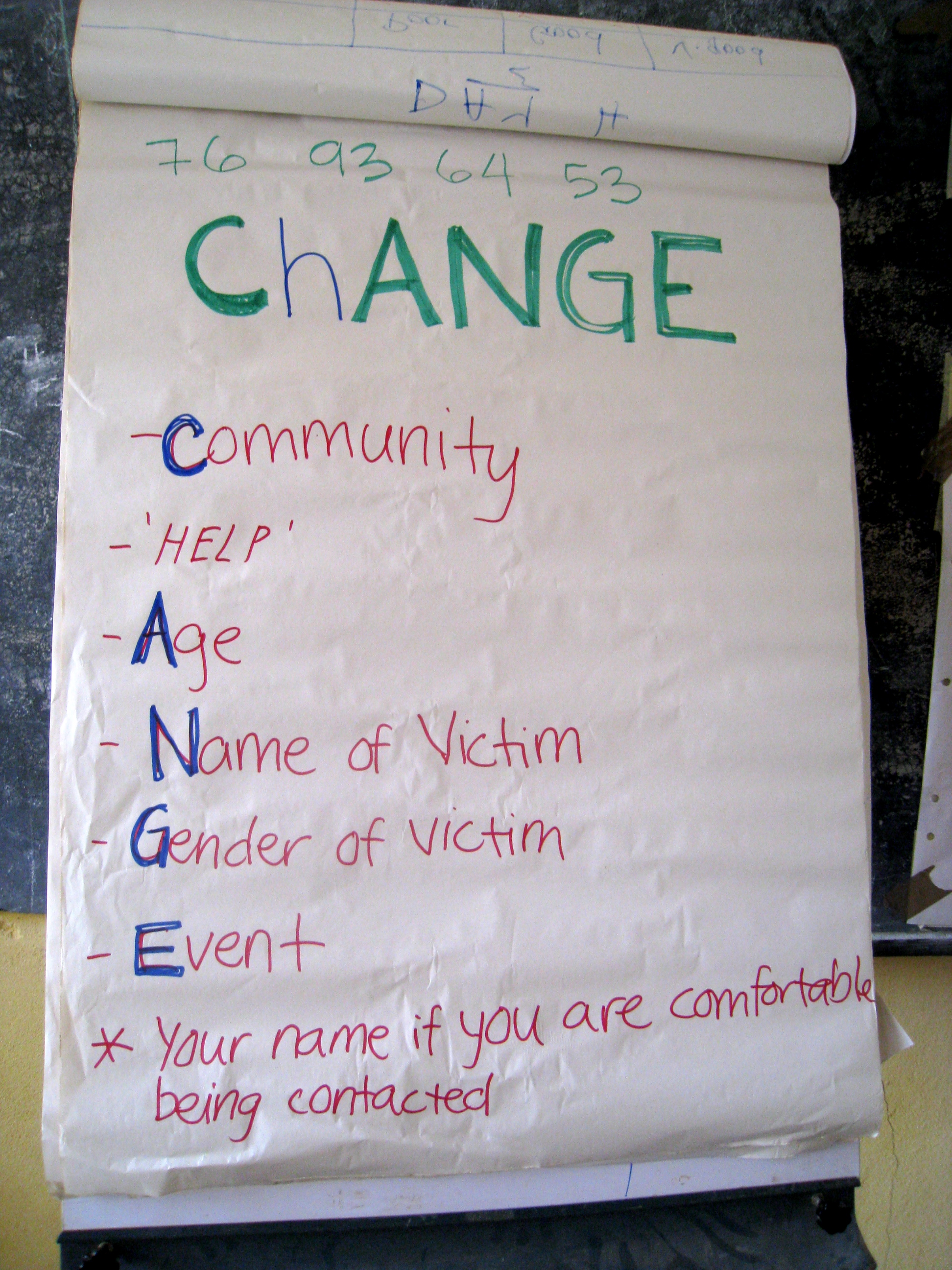
We created an acronym (ChANGE) to help the youth remember what information to include in text message reports. (C: Community; h: False letter– we said “help” so people can remember, but really nothing should be reported there, A: Age, N: Name of victim, and your own if you are comfortable reporting it, G: Gender, E: Event.)  Then we gave a practice scenario and asked five participants in the class to show how they would report the message. We reviewed each message for number of characters, noting that a single text message is limited to 140 characters, and also checked to make sure that all the necessary components were included.  All five messages were similar, reading something like:

My name is Judith. I beg of you for my friend Mary who is 14 years old and whose father is taking her from school to give to a 60 year old man for marriage in Bamessing community.

Most of the messages ran long, but did include the five required components.  One area of confusion was what level of geographic specificity to include.  We explained that while the report must be as specific as possible to facilitate a response, the Ushahidi site will present a more general geographic location so as to preserve anonymity for victims and reporters.

We asked the youth for feedback on the system, which resulted in more questions clarifying what is appropriate to report, and the level of confidentiality of reporting.  One concern was that often the phone network is down, making it impossible to send text messages.  We clarified that all the old methods of reporting still exist, and that community animators and Plan staff can be sought out to report either by text message or the other ways.  By the end of the training, the youth agreed that this would be a useful system, and some commented that they particularly appreciate the unique level of anonymity associated with SMS reporting.

This month, Joe and Georges will finalize the Ushahidi system, Joe will create brief manuals for system users, and Joe and I will provide additional training on using the system.  We hope to have the youth send sample text messages to the site in the next month to test the system, to train the youth, and to provide sample data to present the site to potential government partners. Our colleague Nathalia (the Child Protection Advisor in Plan Cameroon) also suggested that we create a ‘child and youth friendly’ guide to how Ushahidi works that can be used for training, so we’ll get going on that also.

Read Full Post »

This is a second guest post by Paul Goodman who is supporting Plan Benin to solidify their SMS Reporting and Tracking of Violence against Children (VAC) project. More on the overall project and process via the links at the end of this post.

Future proofing? Wishful thinking! There is of course no way to “future proof” an ICTD project. There are ways, however, to ensure that an ICT project has a fighting chance at sustainability. Here in Benin we’re revisiting the entire VAC Benin workflow in an effort to document the non-technical aspects of the project so that each person that touches this system fully understands the way that information moves through it. In addition to supporting training, this small but critical step will help drive consensus around how the project should and can work well into the future.

A succinct overview of this project:

The beginning of any development initiative is often marked by energetic optimism. At the onset, when a project enjoys the attention and enthusiasm of its creators and supporters, it is easy to forget that over time this attention will wane, priorities will shift, and critical personnel will undoubtedly take on new responsibilities or even different jobs. Purposeful problem definition and documentation can minimize the impact of these eventualities and only with a thorough understanding of the problem is it possible to discuss appropriate technology-enabled responses. And yes, in the real world, the problem often shifts over time as the situation changes or new information comes to light. But with a well-defined problem you have clarity around your intent and can face new challenges head-on.

Once defined, the problem and corresponding solution must be documented so that others may benefit from the insight gained during this process and apply that insight systematically. This seems elementary, of course, but in years of ICTD work I’ve found that the documentation of both technical systems and non-technical processes is often neglected in the rush to deploy or as a result of over-reliance on a few knowledgable individuals. Furthermore, in international development, documentation sometimes plays second fiddle to the production of reports and case studies.

Now I’ll happily get off my soap box and get back to business in Benin.

After sketching out the various aspects of the information flow with my colleague Elsie, I documented the workflow in a way that can be used to inform, train, and guide others as they interact with this project. I’m working on reference materials of different shapes and sizes including a number of graphics. Several of the graphics appear below; these are drafts and will be revised with Elsie, translated, distributed to the team, and revised again. These graphics represent the way we would like the system to work and are intended to be living documents.

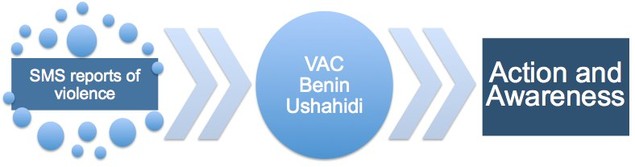
In this graphic I included all the critical actors and their key responsibilities:


In this flow chart, I illustrated the way that messages should be processed:

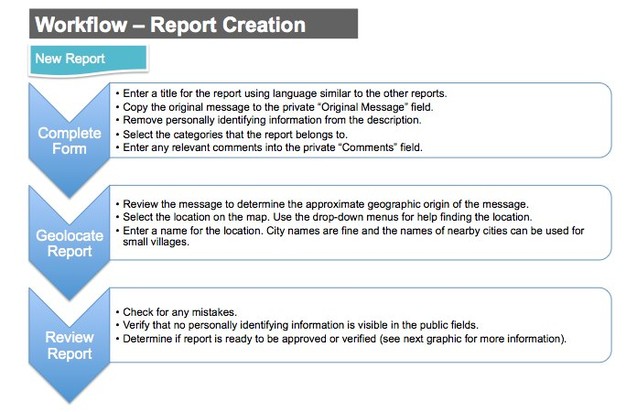
In this graphic, I illustrated the way that reports should be created:

Finally, this flow chart will support report approval and verification:

Related posts:

Update from Benin: charting a course forward (also by Paul)

Revisiting the SMS violence reporting project in Benin

Tracking violence against children in Benin video

Community-based child protection

Tweaking: SMS violence reporting system in Benin

Finding some ICT answers in Benin

7 (or more) questions to ask before adding ICTs

Fostering a New Political Consciousness on Violence against Children

Related links:

Text messages to help protect children against violence

Plan International case study: Helping children report abuse in Benin

Read Full Post »

Where are the spaces for youth participatory governance?

‘People no longer rely on governments alone to improve governance. All over the world we are seeing experiments in ‘participatory governance’. People and organisations are grasping the opportunities offered by decentralisation and other reform processes to demand more of a say in the public policy and budget processes that affect them. These ways of holding the state to account are often called ‘social accountability’. Examples include participatory budgeting, monitoring electoral processes, using online and mobile technology, and citizen evaluation of public services. These forms of citizen engagement and social accountability are particularly promising for young people, who often face challenges in getting their voices heard in formal policy and governance processes.’

The ‘youth bulge‘ is impacting or will impact hugely in many countries in Africa, but there is limited documentation on youth involvement in social accountability processes in Sub-Saharan African countries. Youth and governance efforts have been ‘largely unsystematic and often constrained by the vague and paternalistic parameters of the UN Convention on the Rights of the Child (McGee, forthcoming 2010). However this is changing and there are calls for new models, tools and approaches that enable young people to take a more meaningful role in decision-making.’ (call for submissions for the upcoming Participatory Learning and Action Journal (PLA) special issue on Youth and Participatory Governance).

****

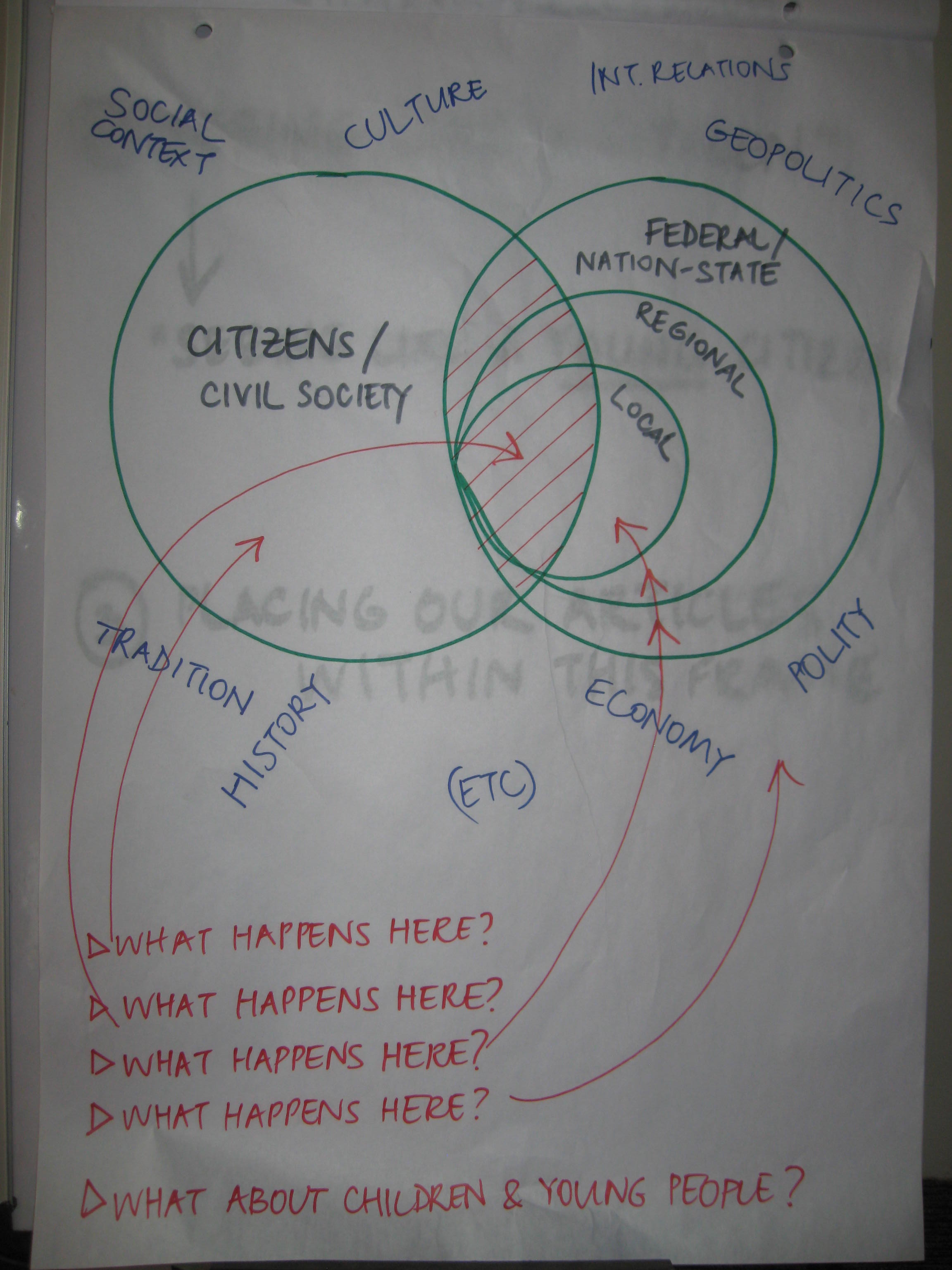
In March I attended a “writeshop” put on by Plan UK, the Institute of Development Studies (IDS), and the International Institute for Environment and Development (IIED) to share different youth participatory governance initiatives, reflect on challenges and successes therein, learn how to write better, and finalize articles on the above topic for a PLA Special Issue in December 2011. The special issue will highlight some of the different ways young people are engaging with government to participate in public policy, planning and budgeting processes at local, national, regional, and international levels. Practitioners, youth and government officials from Kenya, Zimbabwe, Sierra Leone, Nigeria, Mali, Senegal, Lesotho, the US, the UK, Ghana, Germany and Liberia attended the writeshop. (The PLA will also have articles from Cameroon and Somalia).

The first day we did a cool exercise revolving around 4 statements on voice, youth, participation, and governance. I learned a lot from the discussion and I wanted to share it here.

So, what do you think? and why?

Statement 1. The author’s voice will always be louder than the voices of the people he/she is writing about.

Strongly agree ___

Agree ___

Disagree ___

Strongly Disagree ___

Statement 2. Increased transparency leads to increased accountability.

Strongly agree ___

Agree ___

Disagree ___

Strongly disagree ___

Statement 3. It is possible to do governance work without engaging in politics.

Strongly agree ___

Agree ___

Disagree ___

Strongly disagree ___

Statement 4. Citizen led/social accountability processes offer more potential for youth than traditional accountability processes.

Strongly agree ___

Agree ___

Disagree ___

Strongly disagree ___

****

Here’s what we discussed at the writeshop. I’d be interested in what you think about the statements too…

Statement 1. The author’s voice will always be louder than the voices of the people he/she is writing about:

Discussion: The group mostly concluded that it’s difficult for the author’s voice to stay in the background – it will inevitably jump out and become stronger than the voice of those he or she is writing about.

‘Regardless of that, the author has been given an opportunity to project the voices of those that don’t have a platform to speak for themselves, so he or she should take advantage of the opportunity.’

‘Just by choosing what goes into the piece, the writer is already showing some type of bias. One or the other idea or opinion will be louder than the others because it serves the author’s own purpose.’

‘Writers need to think carefully about their approaches as authors and be self-aware of what biases are coming through in their pieces. This is an issue of credibility.’

‘One thing to aim for in our work with youth is finding more opportunities for them to author their own stories, because they can speak louder and stay true to their own agendas.’

‘How many of us here sat down and wrote our submissions together with youth? What are some methodologies that we can use to ensure that youth are writing about their own work, rather than always being written about?’

Note: Some methods for involving youth in the writing process will be covered in the upcoming Special Issue, based on experiences from the group attending the writeshop.

Statement 2. Increased transparency leads to increased accountability.

Discussion: Most everyone disagreed with this statement, saying that there is no causal relationship between transparency and accountability.

‘Many civil society and faith-based organizations really engage citizens, but if you look deeply, that engagement hasn’t translated into accountability.’

‘Including people in governance and keeping them informed about what is happening can lead to accountability. People will start to take responsibility, report about actions. If they are involved, included and informed they will start to question things.’

‘There is not always a causal link between transparency and accountability.’

‘Having transparent information is one thing, but accountability is what you actually do with the information. Having the habit of discussion, questioning is one thing, but ensuring that feedback is actually taken into consideration is another.’

‘Often those in power say “we’ve heard” but they don’t do anything to change. Accountability isn’t only about voice, you need to have opportunities for redress.’

‘Without transparency there is no accountability. This can mean access to information. We need legislation to make access to information possible. It’s a pre-requisite for increased accountability.’

‘There are NGO and donor accountability issues also. Just because NGOs or donors put information on-line doesn’t mean that they are being accountable. There is the issue of literacy, of whether people seek out information, of access to the information in a variety of languages, of what format the information is shared in and the sheer quantity of information. Who really has access to the information they are sharing? Can those who are supposed to be benefiting from NGOs and donors programs access the information?’

‘Another thing is making people and institutions understand why they should be held to account, why they need to be accountable, changing mindsets about why leaders and power holders need to be accountable.’

‘Flooding people with information so that people don’t know where to look for what is relevant to them or posting the information on-line, in a language that isn’t useful to them, is not really being transparent. Often calls for transparency don’t really go far enough. Transparency is about making the information usable and about information demand.’

One of our facilitators (Rosemary McGee from IDS) pointed us to Jonathan Fox at UCLA who says:

‘Transparency can be ‘opaque’ (the dissemination of information that does not reveal how institutions actually behave) or ‘clear’ (access to reliable information about institutional behaviour). Accountability can be ‘soft’ (‘answerability’ – demanding answers from duty-bearers) or ‘hard’ (answers plus consequences). Information dissemination does not automatically lead to answerability, nor answerability to the possibility of sanctions. If access to information is to guarantee the sanctions that hard accountability requires, public sector as well as civil society actors must intervene.’

Statement 3. It is possible to do governance work without engaging in politics.

Discussion: The group was pretty evenly divided between strongly agree, agree, disagree and strongly disagree, so the discussion was really interesting.

‘I strongly disagree because government is about service delivery and politics is about the opinions of the people. Everyone is a political animal. There is a difference between politics and partisan politics, though.’

‘Every action has a vision and a political orientation. You can’t change a situation without being involved in politics.’

‘Governance has nothing to do with politics; the government can be left or right; but governance means the same thing. It’s being transparent and accountable to the people; and it’s also about including other stakeholders, NGOs, private sector and responding to the citizens needs. Governance is impartial and non political.’

‘Governance is about how power is exercised. It’s about certain practices and systems – in state, family, community, etc. If you are challenging power, whether policy change or change in practice, whether it’s gender or whatever, you want to address unjust power relations, so at some point you need to confront the polity of those structures. However being engaged in governance is not about partisan politics. There’s a difference between a political party and the issue of politics. If I say I’m in solidarity with children, I’ve taken a political position. Political parties are about obtaining power. But governance is about challenging power relationships.’

‘We need to distinguish “governance and politics” and “party politics.” It’s difficult to say that things will naturally happen based on a structure. But the structures will adjust, they will be used differently according to who is in power. You need to know politics and the opinions of political leaders in order to effectively get your agenda through. You need to understand the political dynamics in terms of what happens in the country, what is the ideology, what is their strategy and what are their plans. If you don’t understand that, you can’t address the issues that you are trying to resolve via governance.’

‘It’s not possible to work on governance and not engage in politics. I work in government. Our mandate ends after 5 yrs. We must go back to elections and the people must give us the mandate again to exercise power on their behalf. This is the only clear mechanism whereby the people can engage in politics. Politics is about opinions and perceptions. People have diverging opinions, those opinions will create debate and that leads to political actions. Whenever there is a debate involved about something, that is politics. It’s not easy to exercise power without debate. To give services to people, to exercise power on their behalf, it’s not easy if you don’t take into consideration the opinions coming from them, they need to debate and the debate then needs to be translated into policies.’

‘The people who are most engaged in governance should not be politically engaged. When you work from civil society on governance issues, you should not have a party affiliation. Because then you will carry a bias. To do good governance work you need to be impartial and unaffiliated with a party, or people will consider you to be biased.’

‘If we look at governance and politics, politics is just a subset of governance. There are actually lots of issues under governance. In governance we expect everyone to take part in how things are governed. We see different political actors. Governance encompasses more than politics, it’s above politics.’

Statement 4. Citizen led / social accountability processes offer more potential for youth than traditional accountability processes.

Discussion: Everyone sat on the strongly agree or agree side of this debate.

‘Citizen led processes offer much more openness to youth.’

‘We need to define citizen-led and traditional accountability processes. Citizen led, social accountability processes are where those spaces are claimed by citizens themselves. Secondly the citizen-led social accountability process tends to be less vertical. There is collectivization of the aspirations of the people who are supposed to benefit from a service or a process. The power relationships are much fairer in that situation. Traditional accountability is like something done within government, something led by World Bank or the IMF. In that case, the state creates space for citizens to participate, information is shared but there is actually not much action taking and questioning because it is the state itself running the accountability initiative on its own behalf. But with social accountability, it’s driven and led by people, by civil society, and there is more questioning and participation.’

‘I was being ethnocentric and thinking as a Westerner about “traditional” as meaning “government and voting,” but I’m realizing that there is a range of understandings of “traditional accountability” processes.’

‘If there is a mainstream more traditional accountability process vs a parallel citizen led process it can be confusing. Often youth are not clear how to link the parallel transparency and accountability that they are creating up to the official structures. There is a lack of connection there. Youth get a lot out of the processes individually, but are they also increasing state accountability?  There is also the concept of traditional accountability. Traditionally led accountability comes from many sides.’

‘There are formal and informal politics. What does it all mean? Based on all of your submissions, we would like to be able to start giving some definitions and an “OK” on all these terms and interpretations. There is a gap in understanding on social accountability, citizen-led accountability and the role of young people in these processes. That is why we wanted to do this PLA Journal.’

****

Look for the PLA Special Edition coming out on paper and on-line in December 2011. In the meantime, check out the current editions here, including PLA 59: Change at Hand – Web 2.0 for Development and PLA 54: Mapping for Change – Practice, Technologies and Communication.

Read Full Post »

« Newer Posts - Older Posts »