Feeds:
Posts
Comments

Archive for the ‘children’ Category

Bamboo Shoots training manual

I like to share good training guides when I come across them, so here is a quick summary and a link to Bamboo Shoots. It was originally created by Plan in Cambodia.

Bamboo Shoots is a training manual on child rights, child centered community development and child-led community actions for facilitators working with children and youth groups. You can download it here.

Bamboo Shoots was developed to: Increase children’s understanding of their rights as defined by the United Nations Convention on the Rights of the Child (UNCRC); raise children’s awareness of their rights and build their capacities to claim them; create opportunities for children to recognize, identify and prioritize issues and problems or gaps in relation to child rights violations; and provide opportunities for children to influence agendas and action regarding identified and prioritized child rights violations.

Bamboo Shoots takes complicated concepts and breaks them down into easy language and engaging, interactive sessions. It also offers good resources and background material for facilitators so that they can manage the sessions well.

Part One:

I like this manual because it starts off right in the first chapter with the importance of setting the tone and the context for good child and youth participation. It provides ideas on selecting participants and facilitators, and gives a description of a good facilitator. It provides recommendations on the setting and practical considerations for managing a workshop with children, as well as good paragraph to help think through when and when not to include other adults in the training.

The guideline goes through the 6 principles for making child participation a reality:

  1. Non-discrimination and inclusiveness
  2. Democracy and equality of opportunity
  3. Physical, emotional and psychological safety of participants
  4. Adult responsibility
  5. Voluntarism, informed consent and transparency
  6. Participation as an enjoyable and stimulating experience for children

It shares Plan’s code of ethics on child participation and important steps to follow in working with children, as well as tips on how to establish a good working relationship with children, how to help children learn and develop their potential, how to help children build self-confidence and self-esteem, and how to encourage children to develop a responsible attitude towards others and a sense of community. There is a section on how to keep children safe also and an explanation of a facilitator’s ‘duty of care’.

A last section of part one lists common facilitation techniques and tools, such as: role-play, working in pairs and groups, idea storming, whole group discussion, questioning, projects, buzz sessions, drawing, photographs, video, word association, recreating information and more; and gives ideas on when they are most useful.

Part Two:

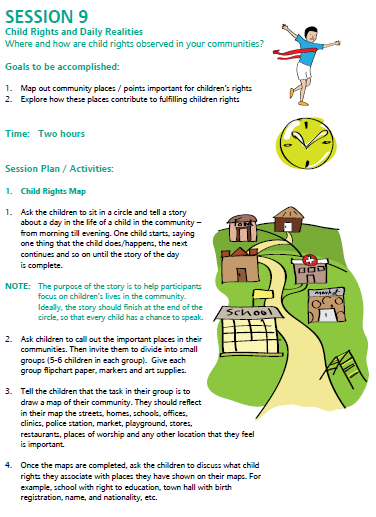
Section 9 on community mapping

The next section has very complete sessions on:

  • the concept of rights
  • the history of human rights, and international treaties on rights
  • children’s rights as human rights
  • duties and responsibilities in relation to child rights
  • making sure children are involved
  • child rights and daily realities and making a child rights map
  • gaps in fulfilling child rights
  • setting priority problems and violations of child rights
  • creating an action agenda and proposed solutions to the gaps identified

Each session comes complete with a pre-training assessment, reading material for facilitators and handouts for participants.

Part Three:

The last section of the manual helps facilitators take children through the steps to child-led community action, including children’s participation in all the program and project cycles: assessment, planning, implementation, monitoring and evaluation.

Needs-based vs. Rights-based

It also explains Plan’s rights-based child-centered community development approach, the foundations of that approach, and the difference between needs-based approaches and rights-based approaches. It goes on to cover planning and supporting child-led community action.

The last section of the guide offers a list of resources and references.

For anyone working with children, or even anyone looking for an excellent comprehensive community training package on rights and community-led action, I really recommend checking out Bamboo Shoots. Whether you are working through media and ICTs or using more traditional means for engaging children, this is a great guide on how to do it well from start to finish. I’ll be referring to it often.

Additional Resources:

Minimum standards for child participation in national and regional consultation events

Protocols and documents to help ensure good quality child participation

United Nations Convention on the Rights of the Child

Insight Share’s rights-based approach to participatory video toolkit

Related posts on Wait… What?

Child participation at events: getting it right

Community based child protection

Child protection, the media and youth media programs

Read Full Post »

This is a cross-post of an article written by Shawn Hayward, who interns with Journalists for Human Rights (JHR) via the International Youth Internship Program (IYIP). You can read Shawn’s original post here.

It’s easy to get jaded seeing sign after sign in the streets of Accra pointing the way to one NGO or another. Despite the slew of development organizations here, people continue to live with poor drinking water, low incomes and lack of decent health care.

One NGO (besides jhr, of course) seems to be taking a step in the right direction. Plan Ghana has been working with children in the country since 1992. The goals, according to their website, are to provide quality education and teacher training, create awareness of children’s rights and ensure food security for children.

Anyone can state goals on a website. It’s much harder to find effective ways to achieve them. Plan Ghana held a forum this week as part of a week-long workshop on the status of children in the country. They flew in 80 youth delegates from all over West Africa. It had real results.

This wasn’t an event where adults tell kids what they should think. The young delegates posed questions to the forum guests, including the United Nations Representative for Violence Against Children, Marta Santos Pais, and the Ghanaian Minister of Sports and Youth, Akua Sena Dansua.

Most importantly, the kids got a chance to tell their stories to a wide audience, and the media and representatives from various NGOs had a rare opportunity to hear well-spoken, motivated youth describe their experiences with children’s rights abuses.

One girl from Cote D’Ivoire told us in her native French how girls in her country are beaten by child traffickers when they refuse to prostitute themselves, and how a three-year-old girl was sexually abused by a neighbour. Police jailed the man for 72 hours and released him.

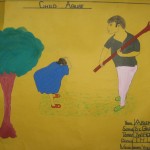
Outside the auditorium, Plan Ghana displayed pictures made by West African children that illustrate the abuses they’ve seen during their young lives. There were images of people being beaten, stabbed, raped and murdered.

I remember drawing snowball fights and monster trucks when I was their age, maybe the occasional army tank. No one being murdered though, or raped—I was lucky enough to grow up far away from that.

The forum was effective because the kids were active participants, not mere objects to be educated. We learned as much as they did during the forum, if not more. These kids came away with the pride of knowing they played a role in shaping their future, and Plan Ghana distinguished itself as more than just another NGO with a bunch of goals posted on its website.

Related posts on Wait… What?

Tracking violence against children in Benin video

Breaking it down: violence against children

Fostering a new political consciousness on violence against children

7 (or more) questions to ask before adding ICTs

Finding some ICT answers in Benin

Tweaking SMS based violence reporting system in Benin

Community based child protection

Read Full Post »

Our Tracking Violence Against Children in Benin project won first prize for Most Innovative Use of Technology or Social Media in Plan’s internal Global Awards contest. The competition was fierce and we were up against some really great projects.

Here’s a nice video overview of the project and where we hope to take the initiative as we go forward.

We still have some kinks to work out and we are still in pilot phase, but we are pretty happy about the award in any case. It helps motivate us even further to improve on the idea until it’s fully functioning and sustainable and we know that it’s resulting in more reporting of violence, helping to track trends and cases of violence, and being used by local and national authorities for responding and following up on those cases that occur.

Many many thanks to everyone who has helped the project get where it is, including:  Henri da Silva, Carmen Johnson, Bell’Aube Houinato, Amelie Soukossi, Eleonore Soglohoun, Morel Azanhoue, Victoire Tidjani, Alfred Santos, Jean Sewanou, Michel Kanhonou, Paul Fagnon, Camille Ogounssan, Anastasie Koudoh, Mika Valitalo, Ken Banks, Josh Nesbit, Patrick Meier, Juliana Rodich, Henry Addo, David Kobia, James Bon Tempo, Stefanie Conrad, Theresa Carpenter, Penelope Chester, Shona Hamilton, and community leaders, parents, school directors, local authorities, children and youth in the 2 participating communities.

Related posts on Wait… What?

Fostering a new political consciousness on violence against children

7 (or more) questions to ask before adding ICTs

Finding some ICT answers in Benin

Tweaking SMS based violence reporting system in Benin

Community based child protection

New Plan report on ICT-enabled development

Read Full Post »

In her post ‘Prostitutes of God:’ Film Mocks, Belittles Sex Workers, Bebe Loff, explains that:

‘Last week,  four episodes of a film entitled Prostitutes of God were posted on VBS.TV, which is owned by Vice Magazine. Prostitutes of God producer Sarah Harris, spent time with members of Veshya Anyay Mukti Parishad (meaning ‘Prostitutes’ Freedom from Injustice’) or “VAMP,” [who] let her into their lives, their families and their workplace.  The result?  Films that are inaccurate and misrepresentative, and insulting to the people who agreed to participate and to the Hindu culture.’

The ‘Prostitutes of God’ film is part of the Vice Guide to Travel where ‘correspondents from VBS and Vice magazine are dispatched around the world to visit the planet’s most dangerous and weird destinations.’

This afternoon I didn’t have 30 minutes to watch the film that was being criticized in the post above. I did have 3 and a half minutes to watch the video response (below) from some of the sex workers and their family members who were part of the documentary.

Their reaction is one of anger and feelings of betrayal. They denounce the filmmaker (Sarah Harris) for laughing at them, making fun of them, disrespecting them, misinterpreting their stories and making public judgment calls on their religious practices.

They say ‘… Your analysis is wrong and we do not agree with it. Who is Sarah Harris? What is the research that informs her story?’‘ They ask ‘Who gave you the right to laugh?‘ They wonder ‘If I had come to your town and insulted your gods would you have liked it?

Tonight I watched the 30 minute film. To be honest, it doesn’t strike me as any worse than a lot of other stories told about people from developing communities or exotic or marginalized groups. We see these kinds of stories all the time, where people are held up to view with sensationalism, superiority and for purposeful shock value.

What is interesting about this case is that the community saw it and reacted publicly. It made me wonder, what is the back story? What steps were taken by the filmmaker to secure informed consent? What were members of the different communities expecting the film to be about? What about the local organization, what were they expecting? Where was the communication breakdown and what steps were taken to try to avoid it? What ownership of the content of the film and the storyline did the community members have? Did they expect to be paid? Were they put at high risk or otherwise threatened when the filmmaker released her film? Did the filmmaker think about the ramifications that her film would carry for the communities where she had filmed? What was the filmmaker’s purpose for telling this story?

I think we are going to see more and more of this type of scenario. I hope it will force media practices and ethics to be updated, more respectful and more legal when filming marginalized or disenfranchised groups in ‘developing countries’.

A third film about the Devadasi

I know of a third film about the Devadasi. I saw this one several years ago, and it was made by a group of Indian child journalists as part of a child media project. In that case, the children successfully used the film at the community level to press for compliance with established laws against the Devadasi practice and to discuss culturally appropriate alternatives.

I’m a big fan of local activists using media tools to push for social change on their own terms.

Here’s Insight Share’s great rights-based approach to participatory video guidebook.

Related posts on Wait… What

Good Job

Child protection, the media and youth media programs

Read Full Post »

I spent the past week in New York City attending the UN Digital Media Lounge and Mobile Active’s mWomen Technology Salon. These 2 events happened alongside the Millennium Development Goals (MDG) Summit and the Clinton Global Initiative (CGI), where world leaders, corporations, movie stars/rock stars, innovators, and heads of big development organizations gather. There was a lot of talk about Technology and Innovation, Women and Girls, and Public-Private Partnerships, and, well, a lot of talk in general according to some, but I am not going to go there. Saundra put together a great compilation of MDG and CGI and UN Week posts over at Good Intents where you can read all about it.

My learning highlights for the week were in the area of m4D (mobiles for development) and ICT4D (information and communications technology for development):

  • World Bank Open Data. The Bank is really moving towards opening up their data. They currently have over 2000 websites and they are trying to consolidate them and make it easier for users to access the World Bank’s Data for their own purposes. The Bank has put more than 1,200 indicators, including the full World Development Indicators dataset, on the site. In addition, there are a variety of maps, dynamic graphs where you can compare data sets, and widgets for you to add information to your own website. Check the World Bank Open Data site for more.
  • UN Global Pulse. Over at Global Pulse the team is looking at existing indicators from UN agencies and others and trying to figure out how they can tap into human behavior patterns for early detection of crisis and as a way of quickly investigating and responding to such crises. In this age of real-time information, it’s somewhat bizarre that large development organizations are working based on extrapolations of data that are 2-3 years old.  Global Pulse hopes to change that by identifying and tracking a series of pulse points, such as satellite data, mobile phone and SMS trends, internet and search word trends, increase and decrease of doctor visits and medication sales, and other human behaviors; that can serve as early warning system for crises. Think Flu Trends but pulling in all kinds of data at the global level.  The UN plans to use their own data and the data of others, as well as “data exhaust” from a variety of sources to come up with a new way to predict, mitigate and manage global crises, such as the current food-fuel-finance crisis, and their impact on communities.
  • Civil Society 2.0 Initiative. The US State Department’s Civil Society 2.0 Initiative is working to address the chasm between what NGOs and local organizations need and what the tech community can provide. The idea is to bring the two sectors together and bridge the gap between them. The initiative would work to identify the local needs and local context, and then help with tools to meet the needs using the available technologies. They are also building toolkits for organizations on how to blog, set up SMS systems, and other common social media activities. The aim is to improve disaster response efforts by balancing between communication and ethical standards, operating procedures, alert systems, and technical capabilities and working in advance of disaster and emergencies so that civil society groups are prepared.
  • GSMA. I’m not sure where I’ve been hiding but I hadn’t heard about GSM Association before. GSMA represents the interests of the worldwide mobile operators. They have around 800 members from 219 countries. GSMA engages in policy debate with governments and regulators and advises mobile operators on ways to move their core business forward. GSMA has done a lot of research on women and how to market sales of mobile phones to women, especially in those countries where women are lagging behind in mobile phone ownership. They were part of the Women and Mobile: a Global Opportunity study.  GSMA is working with mobile operators on mobile banking in some 147 countries, which I find a bit mind-boggling, since I hadn’t heard of them before!
  • Pesinet. For just about $1/month, Pesinet provides families in Mali with a micro-insurance service. Healthcare agents visit the homes of children enrolled in the program to  check height and weight and for any signs of illness. If illness is detected, they arrange for a visit to a clinic. Pesinet covers half the price of medication if needed. Using the Pesinet mobile application, the healthcare agents record information about the patient and send it to a central data base at the clinic. By using mobiles and encouraging preventative healthcare, Pesinet is reaching more children and improving healthcare.
  • Souktel.  In developing countries, finding a job can be extremely difficult, and job boards are not prevalent. Using simple SMS, Souktel has created the JobMatch application which allows a person to create a mini-CV which is uploaded into a data base. Employers can also send out job notices which people can receive by text message, in order to connect to those jobs that match their skills.
  • Priyanka Matanhelia’s research on mobiles in Mumbai and Kanpur, India showed that young people in both the cities used cell phones for a variety of communication, news and entertainment needs. They used cell phones to negotiate independence from parents and to maintain friendships and create friendships with members of opposite sex. The young people in the two cities used mobiles differently due to the differences in their lifestyles and socio-cultural factors, however there were only a few gender differences in the use of cell phones.

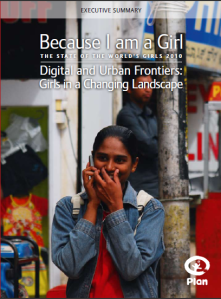
I also had the opportunity to present some of the work that I’m involved in. You can see the live stream of the ICT4D, Innovations and the MDGs panel on Mashable TV, or check out my Ignite talk from Mobile Active’s mWomen event (download the power point if you want to see the notes). You can also download the new Because I am a Girl 2010 Report on Girls in a Changing Landscape: Digital and Urban Frontiers.

The best part of the week was meeting up with old friends, and tweeting up with people I have been conversing with for months, even years, on Twitter and through emails and blogs.  New York is like a real-life Twitter. There is always something happening, you meet brilliant, intelligent, creative and energized people from all fields and walks of life, and you learn and discuss and constantly broaden your horizons.

That 20 minute Friday afternoon nap in the sun at Sheep’s Meadow in Central Park wasn’t so bad either. I really do love New York….

Related posts on Wait… What?

On girls and ICTs

Revisiting the topic of girls and ICTS: Tech Salon Discussions

Being a girl in Cumbana

MDGs through a child rights lens

3 ways to integrate ICTs into development work

5 ways ICTs can support the MDGs

Read Full Post »

Because I am a Girl 2010

The urban and digital environments are the 21st century’s fastest-growing spheres. Both offer enormous potential for girls around the world, but prejudice and poverty exclude millions of girls from taking advantages of the transformative possibilities that cities and information and communication technologies (ICTs) can offer.  Exploitation and the threat of violence exist in both urban spaces and in cyberspace, especially for the most marginalized and vulnerable girls.

Since 2007, Plan has published annual reports on the state of the world’s girls. The 2010 ‘Because I am a Girl report’ is called Digital and Urban Frontiers: Girls in a Changing Landscape. It focuses on girls in these two rapidly expanding spaces: the urban and the digital.

The piece that I’m most interested is the segment on Girls and ICTs, since that’s the main area I currently work on. (Disclosure: I contributed to the development of the chapter). To give you a taste of what’s in the report, here’s a summary of Chapter 4: Adolescent girls and communications technologies – opportunity or exploitation. You can download the full report here.

Chapter 4’s introduction explains that online behaviors mimic offline behaviors.  Empowerment and abuse of girls reveals itself through technology as it does in other areas of girls’ lives.  Through girls own voices, expert opinion and original research, the report highlights the positive and negative consequences of ICTs, in particular mobile phones and the Internet. The authors talk about the positive ideas and new ways of thinking that ICTs open up for girls in terms of learning, networking, campaigning and personal development. They then discuss the darker side of technology  — how cyberspace makes it easier for sexual predators to operate with impunity, where girls are prime targets for abuse, and where girls are sometimes perpetrators themselves.

Section Two offers girl-related statistics on the digital revolution and the digital divide and highlights the enormous variation between and within countries in terms of digital access, and the gaps between rich and poor, male and female, urban and rural.  The report cautions that excluding girls from the digital revolution will have consequences on their growth and development. For additional global ICT statistics (1998-2009) see this post at ICT4D blog. Another resource on mobiles and women is the Cherie Blair study.

Section Three describes and provides statistics around 7 important reasons that ICTs are important to adolescent girls:

  1. To keep in touch with others and reduce isolation in countries where this is an issue
  2. To further their education and acquire new skills
  3. To take an active part in their communities and countries
  4. In order to have the skills to find work
  5. To build specific skills and knowledge on subjects they might otherwise not know about, such as HIV and AIDS
  6. Because evidence has shown that learning to use these technologies can build self-esteem
  7. In order to keep safe

Section Four goes in depth around ways that adolescent girls compete with adolescent boys for the most use of communications technologies such as mobiles and the Internet, but that often they are using them for different reasons and different purposes. Most of the available research for this chapter is from the ‘North’, yet the studies indicate that girls tend to use ICTs for communication and boys tend toward a focus on the technology itself. Studies on this from the ‘South’ are unavailable to date.

When girls are treated as real partners....

Section Five discusses the barriers that keep adolescent girls from accessing ICTs. In other words, if the importance of ICTs has been established, girls are willing and able and keen to use ICTs, then what prevents them from having equal access to ICTs? Some of the issues that the chapter discusses are those of power and control.

‘I can immediately call the wholesale market to inquire about prices and place direct orders. I am now recognized as a businesswoman, growing and selling sesame seeds, not just as somebody’s wife or sister,’ said a woman in India.

‘You’re a girl – a mobile can cause many problems, and so you don’t need it,’ said the father of a Palestinian girl.

Girls’ access to technology is limited by their societies, communities and families. In patriarchal societies where men control technology, girls and women simply have less access, because ICT’s confer power on the user. Even in educational settings, a study found that boys tend to hog available ICTs. Teachers have distinct expectations from boys vs. girls. Girls also don’t tend to go into the field of ICTs or want to have ICT careers, since the field is typically a male field. ‘Technology appears to be marketed by men for men. It’s time we started switching bright and talented girls on to science and technology,’ comments a British government official.

Women and girls in developing countries however are not receiving the basic education and training that they need to be ready technology adopters. They are seen as users and receivers of technology, not as innovators involved in technology design and development. Once they are computer literate, however, many young women see the computer industry as a route to independence. The report offers statistics on the numbers of young women in countries like South Africa, India, Malaysia and Brazil who are working in the ICT related industries and professions.

What stops girls from using technology?

There are seven key factors that prevent girls from taking advantage of technology:

  1. Discrimination – girls are still viewed as second-class citizens in many societies.
  2. Numbers – boys both outnumber girls and tend to dominate access to computers.
  3. Confidence – because they don’t have equal access at school, girls may be less confident than boys when it comes to going into IT jobs because they don’t feel they have the same skills and knowledge as the young men competing for the jobs.
  4. Language – in order to use these technologies, English is usually a requirement, and for girls with only basic literacy in their own language, this is a major barrier.
  5. Time – girls’ domestic roles, even at a young age, mean they have less free time than boys to explore and experiment with new technologies.
  6. Money – girls are less likely than their brothers to have the financial resources to pay for, say, a mobile phone and its running costs, or access to the web in an internet café.
  7. Freedom – boys are also more likely to be allowed to use internet cafés because parents are concerned about their daughters going out on their own.

Section Six digs into the dark side of cyberspace and the risks that adolescent are exposed to at a time of their lives when they are beginning to develop sexually. One in 5 women report having been sexually abused before the age of 15, according to the authors. The Internet by and large is simply a new medium for old kinds of bad behavior, however; and new technologies simply extend the possibility of abuse to new arenas. Girls who are not even using the Internet are still vulnerable, given that a photo of them can be taken and posted by someone else even if they have no computer access. Cyberbullying and cyberharrassment are other risks that girls face.

Many young people and youth organizations are active in facing these risks and protecting themselves, and various campaigns exist to help adolescent girls be more aware of how to protect themselves while using ICTs. New technology can itself also be a tool to help with counter-trafficking efforts. The chapter outlines some of the different efforts being made to protect girls online, and emphasizes the role of parents and schools in discussing on-line use and being supportive as girls begin exploring cyberspace.

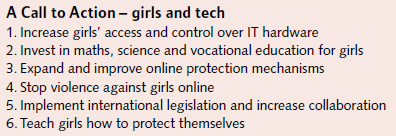
There is a quite broad set of recommendations for a wide array of actors at the end of Chapter 4 that could be taken up, contextualized and fleshed out by different parties or stakeholders into specific calls to action:

Brazilian girls in a digital world. As an annex to Chapter 4 on ICTs, new research with 49 boys and 44 girls, aged 10-14 examines adolescent girls’ rights and protection in Brazil within the context of ICTs. ICT use is growing exponentially in Brazil, particularly among 15-17 year olds, where between 2005 and 2008, ICT usage went from 33.7 to 62.9 percent. The study covers use pattern, links between on-line and off-line behavior, and on-line safety.

Conclusions. The report concludes by calling for greater knowledge about ICT-related sexual exploitation and violence against girls, more emphasis on prevention and stronger international standards. It also points out that girls need to be empowered to use new communications technologies safely, on their own terms, and in ways that promote their development and build their futures.

Call to action for September 22: As part of the launch of the Because I am a Girl Report, Plan is calling for International Day of the Girl to be established on September 22. You can sign the petition here.

Resources

Download the full report here: Digital and Urban Frontiers: Girls in a Changing Landscape

Download the Girl’s Cohort Study: Real Choices, Real Lives. Plan researchers follow 142 girls lives over a 9-year period.

Download past Because I am a Girl Reports (since 2007)

Related posts on Wait… What?

On girls and ICTs

Revisiting the topic of girls and ICTS: Tech Salon Discussions

Being a girl in Cumbana

MDGs through a child rights lens

3 ways to integrate ICTs into development work

5 ways ICTs can support the MDGs


Read Full Post »

I have a daughter. She was born at home with a traditional midwife in a poor barrio in San Salvador. Her father had a 9th grade education when we got married. She had severe diarrhea at least 3 times as a baby and we worried that she might not make it. My mother-in-law took her to a traditional healer because the doctors didn’t seem to be getting it right. She had pneumonia twice as a baby, probably due to allergies, air pollution and the chickens my mother-in-law kept in the small house. She had dengue once. The water didn’t always run and people stored water in open barrels, so there were a lot of mosquitoes.

Luckily her father returned to school to finish his education. Luckily her mother and her mother’s mother were well educated. Luckily both of her parents worked, so there was enough money to feed and clothe her. Luckily we had a bit of savings that we invested in a small cement block house. Luckily we lived in a city, near a primary school. Luckily we were able to get a telephone installed around the time she was born. Luckily our barrio had electricity and we could afford to pay for it. Luckily we believed that she was just as worthy as her brother. Luckily today she is alive and thriving and in school, with a myriad of possibilities ahead of her.

Girls all over the world should be so lucky.

I’m reading the ‘Real Choices, Real Lives‘ cohort study that Plan just put out as part of the annual Because I am a Girl report (which launches Sept 22). It tells the stories of 142 girls in 9 countries (Brazil, El Salvador, Dominican Republic, Benin, Togo, Uganda, Cambodia, Philippines and Vietnam) that researchers have been following since they were born. The girls will all turn 5 this year, except for the 5  girls whose lives have already been claimed by preventable diseases. 7 of the girls have dropped out of the study due to family migration or other reasons.

As powerful world leaders gather in New York this week to discuss accelerating progress towards the Millennium Development Goals, this report is a sobering and intimate reminder of the real inequalities girls, especially the poorest girls, face, and the struggles their family go through to keep them alive and help them to thrive.  The cohort study tells us that primary school enrollment rates in Sub Saharan Africa are up from 58% in 1990 to 76% in 2008, but in the poorest 20% of households, 39% of girls don’t attend school. The cohort study shows us, through the stories of the 130 girls who are still part of the cohort group, the very real impact on very real lives that failure to reach the MDGs has. The reality is that the poorest girls do not have what they need to survive, develop and participate fully.

What will happen this week in New York to change that?

Related posts on Wait… What?

MDGs through a child rights lens

5 ways ICTs can support the MDGs

On girls and ICTs

On trust and disempowerment

Being a Girl in Cumbana

Read Full Post »

I’ll be speaking on a panel called ICT4D, Innovations and the MDGs next week during UN Week in New York and another on Girls and Mobiles hosted by Mobile Active. So, I’ve been putting together my thoughts around girls, child rights, ICTs and the MDGs.  The angle I’m taking is not from the large donor, top down, huge institutional program side, but instead, looking at examples from the work I’ve been closest to over the past few years at the community and district level, mostly focused on child and youth participation in the development process. Check my MDGs through a child rights lens post for more background.

My last post (3 ways to integrate ICTs into your development organization) uses Hannah Beardon’s framework to discuss how organizations can integrate ICTs into their work. Hannah suggests that ICTs can be integrated directly(providing access to ICTs), strategically (using ICTs as tools to support development processes) and indirectly (using ICTs to improve efficiency and communication within the organization).

To complete that post, I’m listing below 5 ways that ICTs can facilitate accountability and transparency, citizen engagement, and public debate, all of which are necessary to bring about development improvements and achieve the MDGs. Obviously these are not the only ways ICTs can support the MDGs, but this post would have been miles long if I’d listed all the initiatives that are out there.

1) Engaging children and youth in the development process

An engaged and active population is a key ingredient for good development programs. Children and youth have much to offer, are directly targeted in the MDGs and many other development initiatives, offer valuable ideas and energy, and make up around half the population in many of the countries that are lagging in reaching the MDGs. ICTs can help children and youth engage in the development process and bring their ideas, opinions and voices alive at the community, district, national and global level. ‘Using new technology, new media, children and youth can claim a space that they didn’t have before. They can influence certain things, advocate on particular issues that are important to them, take ownership in communities and in leadership. ICTs excite them and encourage them to be more involved and engaged.’ Anthony Njoroge, Plan Kenya Community ICT Manager.

ICTs empower young people with skills that make them more confident and more involved at the community level.‘Using ICTs, children and youth have become more responsible because they are not waiting for adults to come in with something. Now they are designing it themselves, they are creating space for themselves and bringing their agenda to adult meetings instead of waiting to be invited in or having to work within the agenda of the adults. It used to be that you’d start working with 20 youth, you’d invite them into a community meeting. You’d see the number go down to 10, to 4, to 3, because they didn’t see any relation to themselves in the topics and the goings on. With integration of technology and the arts however, youth have a high level of interest. It’s really bringing in their opinions, their thoughts and ideas to join their voices with parents. Now they use arts and media to promote communication, dialogue on their issues and look for ways to resolve them. Before they were totally missing from the discussion, but now they are here.’ Judith Nkie, Plan Cameroon Youth Empowerment through Arts and Media Project Coordinator.

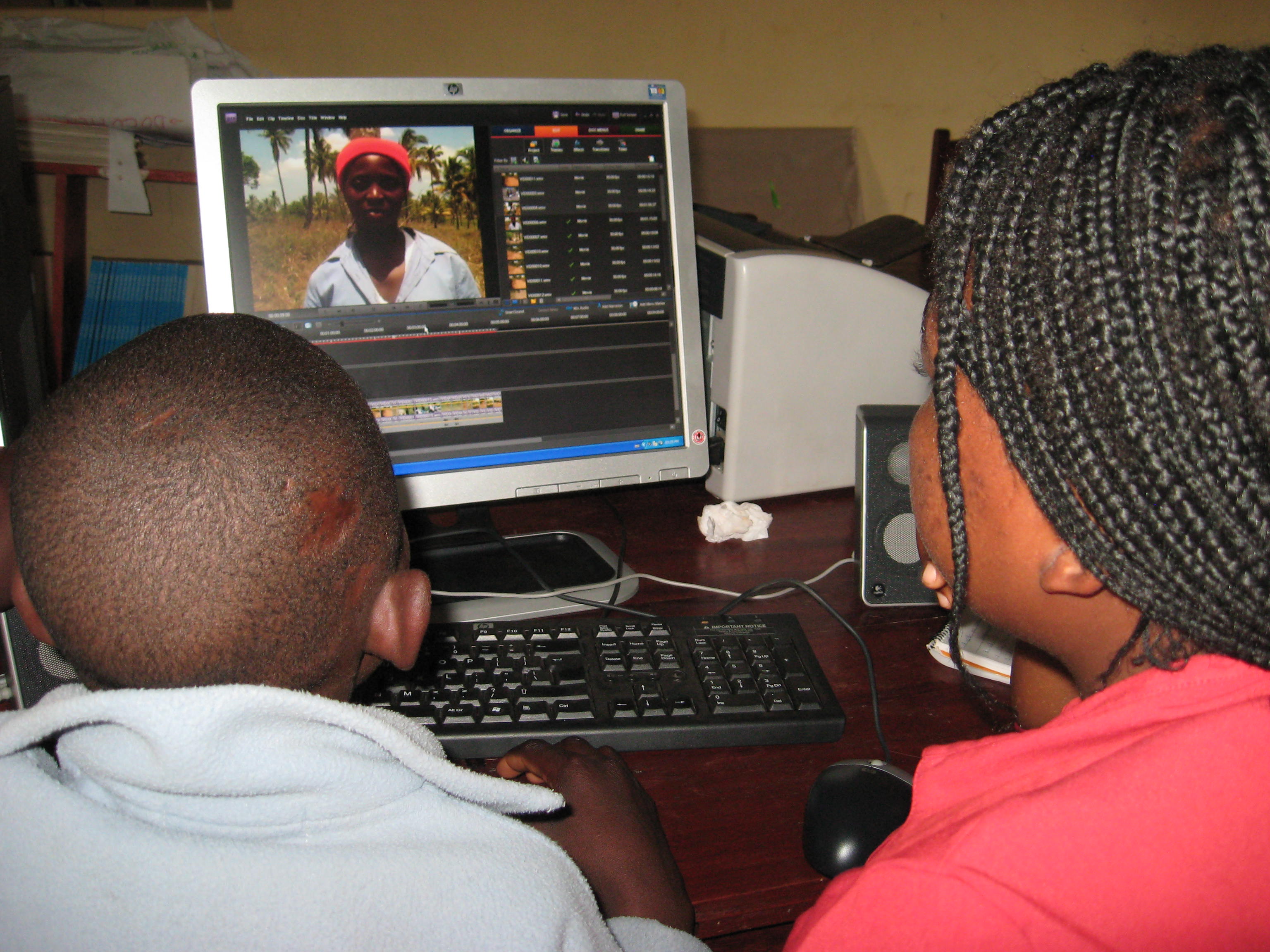
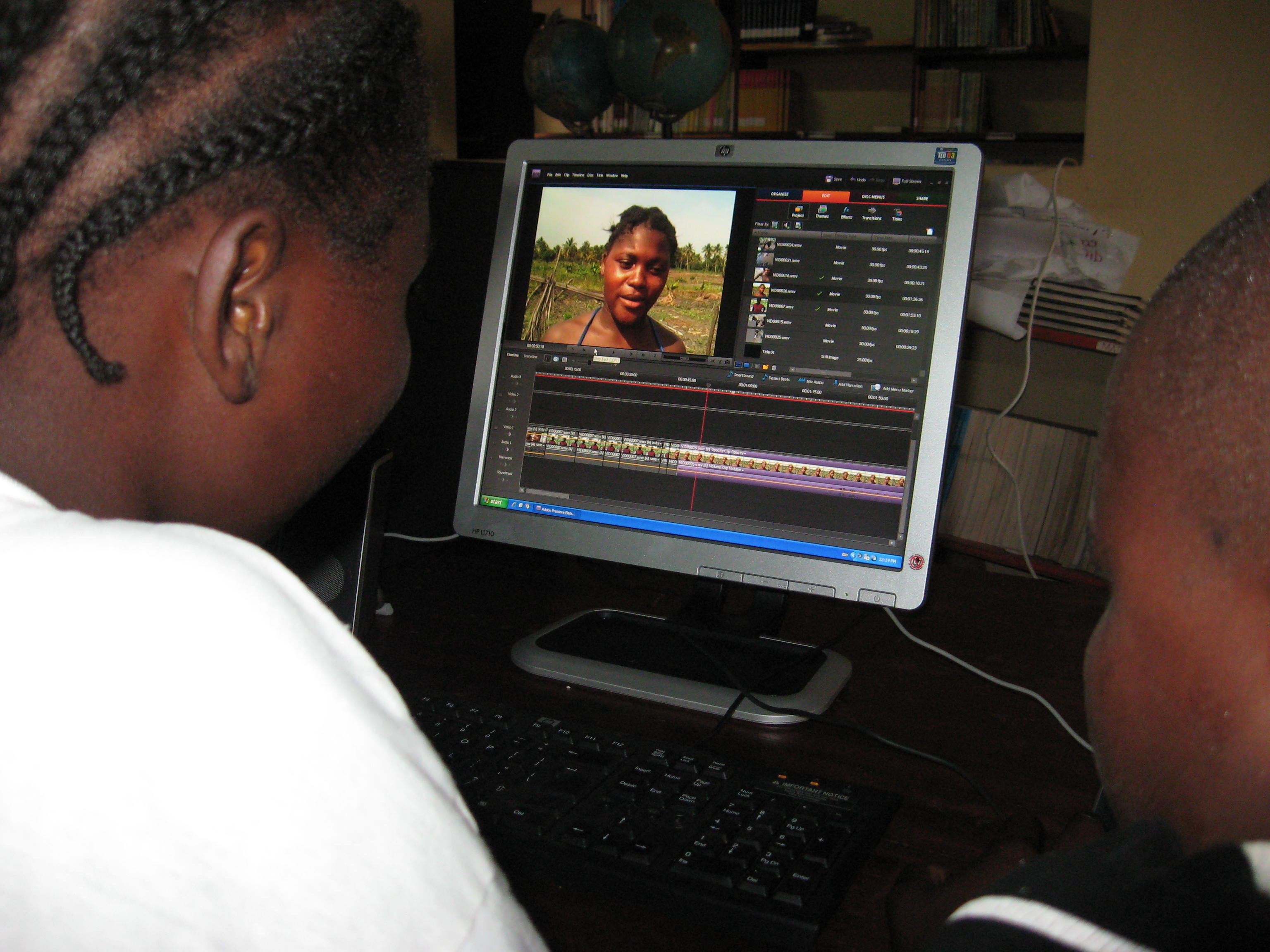
Arts and ICTs were used in the above-mentioned project as tools for youth engagement, mapping and prioritizing, research and community dialog. The media produced with the ICT tools was shared first within the community and then outside at the district, national and global levels as a way of engaging decision makers and the public in the youths’ agenda.  For more on how arts and ICTs are being used in the above-mentioned project, see this post. Watch 100 videos made by youth in 6 African countries on topics they are passionate about.

GPS work in Kwale, Kenya

2) Identifying resources and mapping patterns for better decision-making

Tracking and visualizing information is an excellent way to improve decision-making capacity. The advent of simpler and open source participatory digital mapping tools allows community members to map their communities digitally and to have more ownership of the information. Mapping helps identify patterns that may not have been visible before. Local maps shared on-line allow local people to provide their own information from their own perspective, and that information serves multiple purposes at the local level and beyond.

Digital mapping can be helpful when governments decentralize. Municipalities are mapping resources as well as projects and interventions. District authorities can track their own initiatives and those by local and international organizations to avoid duplication of efforts and wasted resources. When maps are public, the population can better demand answers about where resources are being allocated and why. Maps can help with disaster risk reduction and tools such as Ushahidi can help during emergency response. Mapping information is also useful for holding up a mirror to the population to ask them questions about themselves and their behaviors and for showing the direct consequences of actions; for example in a Community Total Led Sanitation mapping project, the community faces its realities about where their own waste is entering food and water sources.

Map Kibera is a good example of participatory digital mapping. mGEOS is a mobile mapping tool developed to help Plan Kenya staff to gather and share data needed for their daily work. Map Kibera and Plan Kenya are collaborating in Kwale on youth and governance work, and in Mathare to work on Community Total Led Sanitation using digital mapping tools (see July 27th entry). In this video, a district youth officer in Kenya talks about why digital mapping is useful for his community.

Mapping Violence against Children in Benin

3) Pulling in quick information to guide further investigation, response, or advocacy; pushing out information for targeted actions

ICTs can be used to gather quick information from a broad population. This can be useful in a variety of situations and themes, including those outlined in the MDGs. For example, SMS are being used to report on whether teachers are showing up at school, where violence against children and women is happening, where help is needed in the aftermath of a disaster, and for tracking endangered wildlife. Crowd sourced information can help governments and agencies get preliminary information so that further investigation and support can be provided in a particular area. Another example is the use of mobiles in different health initiatives, including:  child-birth care; HIV and AIDS prevention and treatment programs; support for volunteer community healthcare workers; and bed net treatment reminders. Most of the ICT and development world is also already familiar with the work of two organizations:  Ushahidi and FrontlineSMS who have been combining SMS with digital mapping.

A program that I’m closely involved with is SMS reporting of violence against children in Benin, where local communities, government agencies and NGOs are collaborating to improve the child protection system. This type of program shows promise if heed is paid to the pros and cons of collecting information by SMS, and if those implementing are clear about the type of information that will be gathered, privacy implications, and how the system will complement existing systems. (Here is one document that outlines some considerations). Increasing controls by governments and mobile phone companies, including SIM card registry and Mozambique’s recent government shut down of SMS services during the bread riots are good examples of how quickly the ICT landscape can change, and how flexible and agile those working in the area of ICTs need to be.

Checking info on constituency development fund

4) Supporting accountability and transparency

ICTs are useful to support accountability and transparency, necessary for attempts to track and ensure good use of funding for different efforts, including those related to the MDGs and other aid and development programs. Making information more available to the public by mobile is one such way.  SODNET’s budget tracking tool, for example, informs Kenyans of how much funding is allocated by the Constituency Development Fund to different municipalities in different categories. Combined with mapping, as outlined in this post, the budget information can help constituents to track where their funds are actually being spent.  Other interesting examples of how ICTs can be used for transparency and accountability can be found at TacticalTech’s Info Activism site and at Technology for Transparency.

Paper forms will soon be digitized….

5) Improving municipal services and information management

Civil registration documents, especially a birth certificate, are a precursor to demanding any number of rights or accessing a wide array of services. Without a birth certificate a child may not be able to sit for school exams, receive immunizations or free health care or claim rights to inheritance or legal protection in courts of law. Proof of age is critical in successfully prosecuting perpetrators of crimes against children such as child trafficking, sexual offenses, early recruitment into the armed forces, child marriage and child labor. ICTs are being used to digitize civil registry in Kenya, for example. Not only are records being digitized, but mobile phones are used to make it more convenient for the population to know when their documents are ready. This saves people time and money and means that more parents will register their children.

But wait, there’s more!

These are only a few examples of ways that ICTs are being used at the grassroots level to improve participation, transparency, accountability, debate and ownership of the development process.  The MDGs are lofty, but informed local community participation and ownership is key in efforts to reach them and in ensuring that marginalized populations can also be included.

Please add your examples of ways that ICTs can support development and ICTs in the comments section!

Related posts on Wait… What?

3 ways to integrate ICTs into development work

11 concerns about ICTs and ‘social media for social good’

I and C, then T

MDGs through a child rights lens

7 (or more) questions to ask before adding ICTs

A positively brilliant ICT4D workshop in Kwale, Kenya

The road to Wa is paved

Read Full Post »

Continuing on with the Millennium Development Goal (MDG) related posts…. I’ll be on a panel on Sept 21st talking about how ICTs can contribute to the MDGs. My perspective is less from a top down, big business, giant project point of view. In my work, I look at ICTs (Information and Communication Technologies) as tools that children and young people can use to create and access information and to advance their own agendas locally and beyond, and ICTs as tools that organizations (big and small, local or not) can incorporate into their work to improve their efforts to attain development goals (such as the MDGs).

ICTs can be helpful tools for enhancing accountability, transparency, citizen engagement, public debate, participation and local ownership of the development process — all of which help with achievement of the MDGs. (See my post on MDGs through a child rights lens for more reasons why). ICTs and social media can also help organizations do more efficient, effective, engaging and high quality work.

ICTs are not silver bullets or magical elements, however; and they will not solve anything on their own. They need to be well-integrated into programs, and well-contextualized.

One framework I especially like to use for thinking about how organizations can integrate ICTs into their work comes from Hannah Beardon. Hannah suggests that ICTs can be integrated directly, strategically and indirectly:

Directly (Providing Access to ICTs): Mobiles and other ICTs have an immediate and striking impact at the family and community level, connecting people for personal, business and community reasons. Mobile devices save individuals time and money and are indispensable in emergencies and for connecting people to the larger world, such as for remittances and commodity pricing. Mobiles and ICTs can help people access information, improve their education, maintain social networks, participate in governance and community, and generate income.

Providing equipment directly is one way to think about ICTs in development programs. This includes ICT tools such as computers, mobile phones, video cameras, digital cameras, radio equipment, electricity, and Internet access. Often direct ICT support is considered for education programs and efforts focused primarily on ICT training or media projects. Computer centers and classrooms are an example, as is supplying mobile phones to project participants or GPS units for mapping projects or equipment for health programs. If this equipment and the information it collects are managed at the community or local organization level, it can enable people to assess and respond to local development needs in a powerful way.

The availability of ICTs is obviously a pre-cursor to using them in different programs and projects. However I’m not much in favor of development organizations coming in and giving away mobile phones (unless it’s some type of extreme emergency or crisis, I suppose). I’m also wary of external NGOs setting up computer centers or giving large equipment donations because of sustainability and capacity concerns. Care needs to be taken that a non-profit organization is not assuming the role that local businesses or government institutions should be playing. Working in good partnerships with local and national government institutions and local businesses and keeping clear agreements on the roles of all actors, including the community, can help to reduce these risks and make programs more sustainable. Programs that directly provide equipment also need to think carefully about what other elements are required for success (purpose of the equipment, training to use it, ongoing maintenance and repair, electricity/power, a place to keep the equipment safe, local involvement in defining the type of equipment, etc). (See 10 Worst Practices in ICTs in Education).

In thinking about providing direct access to ICTs, one place for NGOs to focus energies is keeping an eye on government ICT policies and plans and strengthening civil society to pressure government to ensure that ICTs (including Internet) are accessible to the population now that more and more information is shared via ICTs. Article 17 in the Convention on the Rights of the Child outlines children’s right to information, including access to information and material from a diversity of national and international sources, especially those aimed at the promotion of a child’s social, spiritual and moral well-being and physical and mental health. States Parties are obliged to (a) Encourage the mass media to disseminate information and material of social and cultural benefit to the child and in accordance with the spirit of article 29; (b) Encourage international cooperation in the production, exchange and dissemination of such information and material from a diversity of cultural, national and international sources; (c) Encourage the production and dissemination of children’s books; (d) Encourage the mass media to have particular regard to the linguistic needs of the child who belongs to a minority group or who is indigenous; (e) Encourage the development of appropriate guidelines for the protection of the child from information and material injurious to his or her well-being, bearing in mind the provisions of articles 13 and 18. The 2005 World Summit on the Information Society’s Tunis Agenda also provides a useful platform for thinking about advocacy around rights to information and ICTs.

Making a film on birth registration, Cameroon

Strategically (Using ICTs as tools to support development processes): Beyond directly providing ICTs, new technologies can be used in a myriad of ways to support the broader development process. Starting from larger program goals, defining the roles that information and communication play, looking closely at the local context, and then researching existing tools that could be supportive is a good way to start when planning concrete initiatives. (Forthcoming is a second publication by Hannah outlining a good process for local contextualizing and ICT integration into specific programs). If there are no existing tools, a case can be made for developing or building onto a tool or an application.

Mobile phones, as tools for effective and timely dissemination of information, have real potential to strengthen the design and delivery of programs, for example in health, education, household economic security, disaster risk reduction and response, emergency and crisis management, HIV and AIDS prevention and treatment, child protection, youth-led advocacy, and water and sanitation. ICTs should be an integral part of local, country-level and broader strategic planning processes and they should be incorporated, where appropriate and relevant, into programs where they can add value, keeping a close eye during monitoring and evaluation on whether their purported benefits are real.

On-going capacity building and exchange at various levels is critical to help program staff become aware of advances in the field of ICTs and to help ICT advisors better understand programs, staff needs and community realities. Conversations across sector and silo boundaries are also critical to ensure that ICT integration is successful. ‘Bridge figures’ are helpful — those persons with good knowledge of both programs and ICTs — to help these processes along. In the absence of someone to serve as a bridge figure, well-structured teams with expertise in both areas should work closely together to take advantage of their specific expertise and to learn from one another.  ICT tools should be selected based on local needs and contexts as well as program priorities, starting with information and communication needs, rather than starting with new ‘breakthrough’ technologies. (Though other sectors often start with the cool technology and see if/how it can be useful). During strategic planning processes, program staff should be analyzing program information and communication needs and working with ICT staff to incorporate technology that may add value and help reach program goals in a higher quality and more effective way. Again, ‘bridge figures’ can be helpful in that process. Monitoring and evaluation are important along the way to check whether adding ICTs is actually helping. Sometimes things work perfectly fine without new ICTs.

Indirectly (Using ICTs to improve efficiency and communication within the organization): The wealth of knowledge and information that a development organization generates and uses needs to be documented, shared and communicated effectively in order to improve impact. Advances in knowledge management and on-line collaboration, including blogs, wikis and other social media tools and feedback mechanisms can bring immediate access to information and real-time discussion. Lower cost technology, notably in the areas of digital mapping, GPS, mobile mapping, mobile internet can help staff to carry out their daily work and improve information sharing and decision-making across departments and to engage and inform the public. Engagement with donors can also be heightened through ICT tools and social media, always taking into consideration the additional burden 24/7 demands can add to staff’s workload, and the child protection and other risks posed by more direct access to communities.

ICTs and social media can help make aid and development organizations more participatory, more agile, and able to pull in information from variety of sources and process it faster. This in turn can help pull people out of their silos and force them to consider new ideas and ways of working and thinking about challenges. Mobiles especially are helpful for better communication with community members and local organizations. Forward thinking organizations should be taking advantage of these new tools to gather direct feedback from those that they are supporting, for better dialog to improve their work, and for devolving helpful information to community members. Mobile data collection, for example, in addition to being a strategic tool for program implementation, can also be a way of improving the quality of data collection and increasing ownership by community members of their own data which support them to take back management of their own development processes from external agents. Mobiles are also a great tool for gathering data quickly from a broad subset of the population; data which can shape rapid responses and emergency interventions.

Twitter and blogging and other web-based services can serve as a springboard for deeper discussions and coordination among different development actors, government agents, institutions and the private sector. Social media is a way to share and discuss lessons learned and challenges faced, and to diffuse information about new ICTs and how they are being used by different agencies and individuals. Global partnerships can easily be initiated, developed and nurtured on-line. Organizations can provide on-line training opportunities to staff and save time and money by using new technologies such as forums, blogs for sharing and reporting, Skype and chat tools, and social networking. These same tools can be used to improve relationships with donors and with partners and staff working in disperse offices. However, in order for any of the above to happen, command and control practices that are common in large institutions and organizations need to be abolished so the tools can be most useful.  Here is an excellent post on use of social media tools in humanitarian work.

3-fold path

Using those three categories to think about ICT integration in an organization’s work can help clarify and strategize. Some initiatives may include all three categories and some may be more focused on one particular category.

In a follow-up post, I’ll share some examples of tools that I find interesting and helpful for organizations working at the grassroots level to achieve broader programmatic goals and to improve local community participation and ownership of the development process.

—–

MDG related posts on Wait… What?

MDGs through a child rights lens

5 ways ICTs can support the MDGs

ICT related posts on Wait… What?

11 concerns about ICTs and ‘social media for social good’

I and C, then T

Innovate but keep it real

ICT4D in Uganda — ‘ICT’ does not equal ‘computers’

Mind the gap

7 (or more) questions to ask before adding ICTs

It’s all part of the ICT Jigsaw: ICT workshop in Mozambique

Read Full Post »

The latest UN report on the MDGs states that progress towards the Millennium Development Goals has been made, but it’s uneven. It looks like the Goals will be missed in most regions.

I’m blaming Madonna for launching her line of MDG sunglasses and not linking them to an MDG promotion campaign (kidding!)

To discuss all this (well, except for the sunglasses part), MDG week is happening in New York from September 20-24, 2010.  I’ll be part of some of the activities, including 2 panels. The first panel is on ICTs, Innovation and the MDGs and the second is on Women/Girls and Mobiles. What better way to prepare than to write some blog posts to sort through some ideas?

This post looks at the link between child rights and the MDGs. I’ll write some additional posts and add links at the bottom of this post when they are ready. I would love feedback on which elements would be most important to highlight during the MDG panels next week.

Human rights and the MDGs

If you look at why some countries are more on track than others in achieving the MDGs, the answer often comes down to there being greater accountability and transparency at all levels, more citizen engagement, and more public debate. Human rights are instrumental in ensuring empowerment, access to social services, equality before the law, and poverty reduction. So the link between human rights and the MDGs is clear. There are a number of human rights concepts: shared responsibility, indivisibility, non-discrimination, equality, and accountability that are also necessary for achieving the MDGs.

Due to discrimination, the most marginalized are still not accessing their rights or being included in the MDGs. There are still massive inequalities between rich and poor, rural and urban, men and women, boys and girls, adults and children. Disability and ethnicity also prevent some groups from being included. Until these disparities are addressed, the achievement of the MDGs will be far off for many particular groups. The discussion around the MDGs needs to include and reflect the opinions and concerns of those who have been traditionally marginalized.

Girls and the MDGs

Children, especially girls, and especially girls in poor, rural areas and urban slums, are often the most marginalized in these processes and in general. The MDGs highlight some critical gender gaps, especially in education, but they do not reveal the power imbalances that are an underlying cause of these disparities. Girls are often subjected to harmful practices such as early marriage and sexual violence. In countries where literacy is lowest, girls’ chances of early marriage are highest. Girls spend more time working, shoulder the burden of household chores and are more often not in school. Organizations and entities working towards the MDGs need to do more to ensure that girls and other marginalized groups are not excluded.

MDGs through a child rights lens

Child rights are a set of specific rights for those under the age of 18. They are outlined in the Convention on the Rights of the Child. Much of the work that child rights organizations are doing is complementary to achieving the MDGs, and 6 of the 8 MDGs are directly related to children.

Working with children and young people to participate effectively in the development of their communities and the realization of their rights contributes directly and indirectly to the achievement of the MDGs. Ensuring that children, especially girls, and other marginalized groups are listened to and heard by decision makers at the local, district, national and global levels is critical in identifying and addressing the hidden power dynamics and the underlying issues that slow the achievement of the MDGs.

Applying a ‘child rights’ lens to the MDGs is helpful in identifying responsibilities for achievement of the different MDGs. A child rights lens can also help ensure the concepts of non-discrimination and the best interest of the child are incorporated into MDG work.

What is a child rights lens?  How can it be applied to the MDGs? In a simplified way, it means:

  1. Identifying and monitoring those persons and institutions responsible for ensuring children’s rights/achievement of the MDGs (the ‘duty bearers’).
  2. Helping children and adolescents (the ‘rights holders’ in this case), to empower themselves by knowing their rights/knowing the MDGs, and together with supportive adults and institutions, to hold duty bearers accountable for ensuring children’s rights/achievement of the MDGs.
  3. Supporting children to participate fully in the process. Children’s participation leads to better outcomes and policies, and involving children early in their lives helps them develop skills and attitudes that lead to a better society in the short and long-term. Not only do children have something to contribute to their societies now, but by engaging in community development and developing good leadership skills at a young age, they also become better leaders in the future.

A child rights approach should be central to all programs and funding that are addressing the MDGs, since the MDGs are interrelated with children’s rights to survival, development, participation and protection. In addition, the principles of non-discrimination and the best interest of the child should be paramount in all decisions taken related to the MDGs.

—–

Resources:

UNICEF’s Narrowing the Gaps to meet the Goals shows that paying attention to equity and the unreached can be a more cost-effective way of pursuing the MDGs in aggregate.

3 ways to integrate ICTs into development work

5 ways ICTs can support the MDGs

7 (or more) questions to ask before adding ICTs

Related posts on Wait… What

Child participation at events:  getting it right

Child protection, the media and youth media programs

Community based child protection


Read Full Post »

« Newer Posts - Older Posts »