Feeds:
Posts
Comments

Archive for the ‘communications’ Category

Imagery and stories used to frame issues of humanitarian development for advocacy and funding are often sensational and culturally disrespectful, representing those living in poverty as helpless victims in need, rather than as empowered and capable individuals.

Fueled by intense Twitter and blog discussions about this topic (which is often referred to as “Poverty Porn,”) a few years ago a number of us decided to work together to create a space for wider dialogue around issues of representation of the people that aid and development organizations support.

Screen Shot 2013-05-19 at 2.53.22 PM

Today we launch our multimedia platform Regarding Humanity or “Re: Hum.” The platform aims to engage practitioners, educators, and students in discussions on how to represent  communities we work with in relevant and respectful ways.

Re: Hum is a website and blog that explore how the way we see, listen and frame stories of “the poor” often strips individuals of their agency and creates a general sense of hopelessness and disempowerment. More respectful and relevant methods of seeing, listening and framing can help tell more nuanced stories that respect people and their complex realities.

The Re: Hum website will source content from a diverse set of authors and creators in order to bring a global perspective to the issue. It will serve as an educational resource and discussion forum to teach visual literacy, the importance of ethnography, and ways to maintain narrative integrity. We will be expanding to a discussion series, research, and an educational curriculum over time and as resources permit.

We invite you to take a quick look at Re: Hum (which is still a work-in-progress) and let us know your thoughts and suggestions on how to generate constructive conversation and learning on this issue!

Read Full Post »

This is a summary of the May 14th Technology Salon in New York city on “Does social media exacerbate poverty porn”.

  1. MT @nidhi_c: #povertyporn is never about the beneficiary..it’s an org’s attempt to stay relevant. #techsalon
  2. RT @nidhi_c: How do we teach orgs & journalists that #povertyporn isn’t necessary to raise $ or awareness? #techsalon
  3. Fr my notes on today’s NYC #TechSalon on #povertyporn: Ppl visit Africa like it’s the zoo. Do you know the names of ppl u took photos with?
  4. #povertyporn is disempowering both to those it portrays and to those it’s aimed at, bc you only offer one solution – yours. #techsalon
  5. Telling only “positive” stories is also not the solution. Life anywhere is not only one or the other. It’s complex. #povertyporn #techsalon
  6. Great question from @meowtree & #TechSalon on #povertyporn – Do you know the names of people you take photos with?
  7. Stop hijacking people’s stories by putting your NGO/organization at the center of it. #povertyporn #techsalon
  8. transmedia storytelling is one good way to bring in more stories fr more angles to create a diverse narrative #techsalon #povertyporn
  9. Don’t need to take the western voice out. We need all the voices. But often the most vulnerable are not included. #povertyporn #techsalon
  10. Why do donors demand impact evals for ‘regular’ devt pjcts, but to prove soc med impact they’re fine w likes/clicks? #povertyporn #techsalon
  11. Where is the accountability to small individual donors/donations garnered via social media, i.e. for Kony2012? #povertyporn #techsalon
  12. Why do ppl from US photo’d during tragedy have name/story, yet ppl from other places are unknown victims? #povertyporn #techsalon
  13. Yet also, are we respecting privacy, consent and dignity when we photograph ppl in other countries? #povertyporn #techsalon
  14. Why ppl in US portrayed as heroes after tragedy (eg., Boston, 911) but not first responders in other countries? #povertyporn #techsalon
  15. How to get influentials w lrge audience (eg N Kristof) to see that external hero narrative not helpful in long term? #povertyporn #techsalon
  16. #PovertyPorn not only problem of “white” saviors/Africa. Privileged often view “the poor” this way in their own countries #techsalon
  17. Social media does not necessarily reduce the “othering” of #povertyporn. We still create our own filter bubbles #techsalon
  18. NGOs send media teams to find pre-conceived #povertyporn stories. Eg: this post by @morealtitude ht.ly/l23yQ #techsalon
  19. Diff to change existing orgs/system. But what is being done in schools re global education and media literacy? #povertyporn #techsalon
  20. Sites like everydayafrica.tumblr.com can help to overcome the #povertyporn narrative. #techsalon
  21. Or google “tumblr” and any country a hashtag (eg., #elsalvador) to find a diverse range of images, not only #povertyporn #techsalon
  22. How can we harness social media to show this range of images/realities to overcome the #povertyporn narrative? #techsalon
  23. And I’ll stop now – here’s @viewfromthecave‘s summary of this really thought provoking #techsalon on #povertyporn ht.ly/l24sJ

Read Full Post »

policy forum

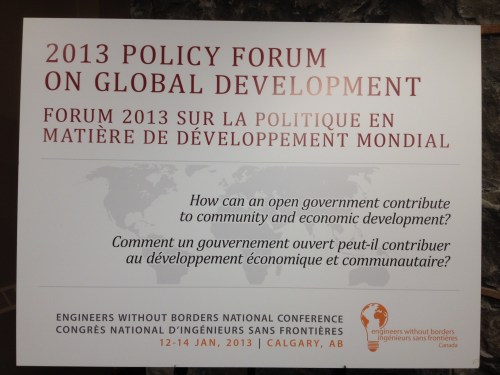
This past Monday I had the opportunity to join Engineers without Borders (EWB) in Calgary, Canada, at their Annual Policy Forum on Global Development to discuss “How can open government contribute to community and economic development?”

Morning panels covered some examples of open government initiatives from Finland, Ghana and Canada. In the afternoon we heard about some of the challenges with open data, open government and the International Aid Transparency Initiative. Table discussions followed both of the panels. The group was a mix of Canadian and African government representatives, people from organizations and groups working in different countries on open government and open data initiatives, and young people who are connected with EWB. The session was under Chatham House Rule in order to encourage frank conversation.

Drawing from such documents as the Open Government Partnership’s Open Government Declaration, Harlan Yu and David G. Robinson’s “The New Ambiguity of “Open Government,” Beth Noveck’s What’s in a Name? Open Gov and Good Gov and Nathaniel Heller, A Working Definition of ‘Open Government’, the following definition of Open Government was used to frame the discussions.

EWB Definition of Open Government

Below (in a very-much-longer-than-you-are-supposed-to-write-in-a-blogpost summary) are the highlights and points I found interesting and useful as related to Open Development, Open Data, Open Government and the International Aid Transparency Initiative (IATI)

1.  Participation thresholds need to be as low as possible for people to participate and engage in open government or open data initiatives. You need to understand well what engagement tools are most useful or comfortable for different groups. In some places, to engage the public you can use tools such as etherpad, wiki platforms, google docs, open tools and online collaboration spaces. In other places and with other populations, regardless of what country, you may be more successful with face-to-face methods or with traditional media like television and radio, but these need to be enhanced with different types of feedback methods like phone calls or surveys or going house to house so that your information is not only traveling one way. Community organizing skills are key to this work, regardless of whether the tools are digital or not.

2.  Literacy remains a huge challenge hindering access to information and citizen engagement in holding government accountable in many countries. This is why face-to-face engagement is important, as well as radio and more popular or broad-based communication channels. One participant asked “how can you make open government a rural, rather than an urban only, phenomenon?” This question resonated for participants from all countries.

3.  Language is still a critical issue. Language poses a big challenge for these kinds of initiatives, from the grassroots level to the global level, within and among countries, for citizens, governments, and anyone trying to share or collect data or information. It was noted that all the countries who have published data to IATI are publishing in English. All the IATI Standards are in English, as is the entire support system for IATI. As one participant noted, this begs the question of who the information in IATI is actually designed for and serving, and who are the expected users of it. Open data initiatives should consider the implications of language they publish in, both politically and practically.

4.  Open data can serve to empower the already empowered. As one speaker noted, “the idea that everyone has the potential to make use of open data is simply not true.” Access to digital infrastructure and educational resource may be missing, meaning that many do not have the ability to access, interpret or use data for their own purposes. Governments can also manipulate data and selectively release data that serves their own interests. Some questioned government motives, citing the example of a government that released “data” saying its unemployment rate was 10% when “everyone knew this to be false, and people grumbled but we did not feel empowered to challenge that statement.” Concern was expressed over the lack of an independent body or commission in some countries to oversee open data and open government processes. Some did not trust the government bodies who were currently in charge of collecting and opening information, saying that due to politics, they would never release any information that made their party or their government look bad.

5.  Privacy rights can be exploited if data is opened without data protection laws and effort to build capacity around how to make certain data anonymous. Citizens may also not be aware of what rights are being violated, so this should also be addressed.

6.  Too much open data discussion takes place without a power analysis, as one participant commented, making some of the ideas around open data and open government somewhat naïve. “Those who have the greatest stake will be the most determined to push their point of view and to make sure it prevails.”

7.  Open data needs to become open data 2.0. According to one participant, open data is still mostly one-way information delivery. In some cases there isn’t even any delivery – information is opened on a portal but no one knows it’s there or what it refers to or why it would be useful. When will open data, open government and open aid become more of a dialogue? When will data be released that answers questions that citizens have rather than the government deciding what it will release? The importance of working with community groups to strengthen their capacity to ask questions and build critical consciousness to question the data was emphasized. A counter point was that government is not necessarily there to start collecting information or creating data sets according to public demand. Governments collect certain data to help them function.

8.  Intermediaries working on open government should be careful of real or perceived bias. Non-profits have their own agendas, and ‘open data’ and ‘open information’ is not immune to being interpreted in non-objective ways. Those working on civic engagement initiatives need to be careful that they are not biased in their support for citizen initiatives. One presenter who works on a platform that encourages citizens to be involved in petitioning new laws for contemplation in Parliament said “Our software is open source so that anyone can set up a similar process to compete with us if they feel we are biased towards one or another type of agenda.”

9.  Technology-based engagement tools change who is participating. Whether in Finland, Canada, Ghana or Malawi, it’s critical to think about reaching those who are not active already online, those who are not the typical early adopters. To reach a broader public, one speaker noted “We are going to remote places, doing events in smaller towns and cities to see how people want to influence and take part in this. Making sure the website is accessible and understandable.”

10. Technological platforms are modifying how political parties and democratic processes operate. This may or may not be a good thing. Normally priorities arise and are discussed within political parties. Will people now bypass the party process and use ‘direct democracy’ channels if they are passionate about an issue but do not want to enter into negotiation around it? Will this weaken political processes or longer standing democratic processes? One speaker considered this change to be positive. People are not happy with being able to vote every 4 years and they want opportunities to participate in between elections cycles and direct voice in how priorities are decided. Others questioned whether bypassing official processes can lead to less participation and more apathy overall on national issues. Some questioned whether within fairly long-standing democracies, open data will have any real impact, considering existing levels of apathy and the lack of political participation.

11. Strong information, statistical, monitoring and evaluation systems are critical for open data and open government processes and to ensure more effective management of development results. This is still a challenge for some countries that need to review their mechanisms and improve their tools and processes for data collection and dissemination. If there is no data, or no current data, there is not much point in opening it. In addition, there are capacity and technical competency challenges within institutions in some countries. One participant mentioned a lack of current government geological information about gold and oil deposits that weakens government capacity to negotiate with the private sector extraction industry and ensure partnerships and earnings will contribute to national development. In addition more evidence is needed on the impact, use, and outcomes of open data. At the moment it’s quite difficult to say with any real authority what the outcomes and impact of open data and open government have been.

12. IATI (International Aid Transparency Initiative) needs more partners. Government representatives noted that they are opening their data, but they can only open the data they possess. In order for data on aid to be useful, more data is needed, especially that of NGOs who are implementing programs. Not many NGOs have published their information to the IATI standard at this point. “The really interesting thing will be when we can start mashing up and mapping out the different kinds of information,” as one speaker noted, “for example, this is the goal of the Open Aid Partnership. It will involve combining information from the donor, development indicators from the World Bank, and country information, and this will open up amazing possibilities once this is all geo-coded.” There are reporting challenges related to IATI and open government data, however, because at times countries and NGOs do not see the benefits of reporting – it feels like just one more top-down administrative burden. There are also issues with donor governments reporting their committed intentions and amounts, recipient governments reporting back, and communications with citizens on both sides (donor and recipient countries). One example that was reported to be enjoying some success was the multi-donor budget support initiative in Ghana, where development partners and government work together to establish development indicators and commitments. If the government delivers on the indicators, the development partners will then provide them with the funding. Development partners can also earmark funding to particular areas if there is government agreement.

13. We need more accountability towards ‘beneficiaries’.Currently many of these initiatives are perceived as being focused on donors and donor publics. As one participant noted, “the interesting thing is less about government and more about getting regular people involved in these processes. When you engage the public you’ll engage government leaders in thinking they will need to change to respond to what citizens are asking for.” Another noted that the essential issue is the link between transparency/accountability and citizens and their own governments. In addition, as one participant asked, “How can you strengthen capacity among citizens to ask the right questions about the data that’s being opened?” For example, citizens may ask about the number of schools being built, but not ask about the quality of education being provided. Public education was a strong focus of discussions around citizen engagement during the policy forum.

14. Should citizens be consulted on everything? however, was one big question. The public at large may not understand the ramifications of its own deep misunderstandings on particular issues and may be inputting from a viewpoint that lacks scientific evidence or fact. “It’s one thing to have an opinion about whether your child should be able to drink energy drinks before age 16, it’s another to input about technical programs like the best policy for green energy,” commented one group.

15. Can citizens really have greater participation if government is still in control of data? was another big question. An example was given of an open consultative process that became unwieldy for a local government, which then shut down the consultation process and changed the nature of the documents to ‘administrative’ and therefore no longer open. Others asked why governments pat themselves on the back over being part of the Open Government Partnership yet they do not have Freedom of Information Acts (FOIA) or they prosecute those who open data in alternative ways, such as Bradley Manning and Aaron Swartz.

16. If citizens don’t get a response from government (or if they don’t like the response, or feel it’s biased or manipulated), apathy and cynicism will increase. It’s important to make sure that ‘open government’ is not just a box that gets ticked off, but rather a long-term change in mentality of those in power and deeper expectations and efforts by citizens for openness and participation in conversations of national importance.

The conclusion was that Open Government is somewhat of a paradox, rooted in aims that are not necessarily new. Open Government strives to enable leaders in their communities to create change and transform their lives and those of people in their communities. It is a complex process that involves many actors and multiple conflicting goals and interests. It’s also something new that we are all learning about and experimenting with, but we are very impatient to know what works and what the impact is. In the room, the feeling was one of ‘radical pragmatism,’ as one participant put it. Open Government is a big idea that represents a big change. It’s something that can transform communities at the global level and there is a great deal of hope and excitement around it. At the same time, we need to acknowledge the challenges associated with it in order to address them and move things forward.

I’ll do a follow up post with the points I made during the panel as this post is clearly way too too long already. Kudos if you are still reading, and a huge thanks to the organizers and participants in the EWB policy forum.

Read Full Post »

The use of social media and new technologies in disaster and crisis situations will likely be framed forevermore as ‘Before Haiti’ (BH) and ‘After Haiti’ (AH). The terrible earthquakes that devastated the country and the resulting flood of humanitarian interventions that followed mark the moment that the world woke up to the role that new technology and new media can and do play in the immediate local response to a crisis as well as the ongoing emergency response once international volunteers and aid organizations arrive to the scene.

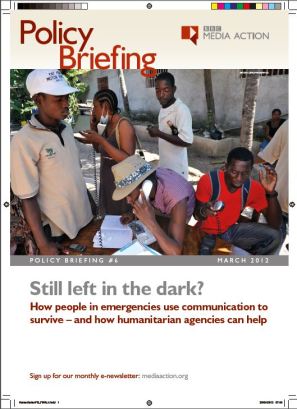
Still left in the dark? How people in emergencies use communication to survive — and how humanitarian agencies can help,’ is a new policy briefing by BBC Media Action. It does a fantastic job of highlighting the ways that new media is changing disaster response and the fact that the humanitarian industry is not doing enough to keep pace.

The briefing asks: ‘Are humanitarian agencies prepared to respond to, help and engage with those who are communicating with them and who demand better information?’ As the report shows, the answer is ‘not really’.

Many humanitarian agencies continue to see ‘communication’ as something done to raise money or boost the profile of their own efforts, says the report. Yet the sector increasingly needs a clear, strategic focus that responds to the information and communication needs of disaster-affected populations. ‘While responders tend to see communication as a process either of delivering information (‘messaging’) or extracting it, disaster survivors seem to see the ability to communicate and the process of communication itself as every bit as important as the information delivered.’ Communicating with affected populations can improve programming and response, not to mention, as highlighted in the Listening Project and referred to in the BBC report, ‘Listening is seen as an act of respect.’

The briefing is not one-sided, however, and it does a good job of understanding some of the common perceptions around the use of new technologies. There is ICT and social media hype on the one hand (often the position of international ICT specialists, based on very little hard evidence). And there is strong questioning of the value of these tools at all on the other hand (often the position of aid workers who are turned off by the hype and want to see proven practice if they are to consider investing time and resources in new ICTs). The briefing paper provides examples that may serve to convince those who are still unconvinced or uninterested.

Many of us see the reality that social media tools are still quite out of reach of the poorest members of a community or country. But writing new media and technologies off entirely is ‘too crude an analysis,’ says the briefing paper, ‘and one that is being challenged by data from the field.’ In Thailand, for example, use of social media increased by 20 percent in both metropolitan and rural areas when the 2010 floods began. ‘Communities now expect — and demand — interaction,’ the paper emphasizes.

Throughout the paper there are good examples of ways that in the immediate aftermath of a disaster local individuals and companies are quickly creating and rolling out communication platforms that are more relevant, feasible and sustainable than some of the initiatives that have been led by international agencies.

An important point that the report makes is that the most successful use of new media in disaster response combines multiple communication channels — new and old — allowing information to flow in and out, to and from different populations with different media habits and levels of access. For example, local journalists and radio stations may pull information from Twitter and Facebook and broadcast it via the radio. They may also be broadcasting online, meaning that they not only reach their local population, but they also reach the diaspora community. ‘Good communication work,’ the paper notes, ‘is, by definition, multi-platform. It is about integrating media, non mass media and technology tools in a manner that is rooted firmly in an understanding of how communities approach information issues.’

So ‘while aid agencies hesitate, local communities are using communications technology to reshape the way they prepare for and respond to emergencies.’ This hesitation remains in the face of growing evidence, according to the paper, that agencies who invest in meaningful communication with disaster-affected communities garner a range of benefits. ‘The communication process becomes central to effective relationships, mitigating conflict and identifying and preventing rumours and misunderstandings.’ Doing it right, however requires good program design, which in turn, requires aid agencies to focus time and expertise on improving communications with affected populations, which, of course, requires budget allocated to these kinds of activities.

For those agencies that want to look more closely at integrating some of these tools and approaches, the report gives several great examples. The recommendations section is also very useful.

One of the recommendations I think it is especially good to highlight is ‘analyse the communications landscape’ (see InfoAsAid’s materials). I would, however, have liked to see mention of involving members of local communities in a participatory analysis of that landscape. In addition to the technical analysis, it’s important to know who trusts which information sources, and why. For example, the information sources trusted by men may be different than those that women trust. The same goes for children, youth and adolescents. Access is also a critical issue here, especially in terms of reaching more marginalized groups, as the population affected by a disaster is not homogeneous and there will be hierarchies and nuances that should be considered in order to avoid leaving certain people or groups out. I would have liked more mention of the need to take a specialized approach and make a focused effort regarding communication with children and adolescents, with women, with certain ethnic groups or persons with disability, as they may be left out if care is not taken to include them.

Another recommendation I found very useful was ‘think of the whole population, not just beneficiaries.’ The paper cautions that working only with the population that directly benefits from an individual agencies’ funding is a positive angle for transparency and accountability, but it ‘seems to have a profoundly limiting effect in practice.’ Beneficiaries need information about more than just one aid agency, and those who are not benefiting from a particular agency’s programs also have information needs.

The report mentions that sometimes in the aftermath of a disaster, when people use new media to communicate, confidentiality and privacy risks are not fully considered. I’d like to see this aspect addressed a bit more in the future as there is a lack of documented good practice around privacy and protection. (Note: I’ll be involved in some research on ICTs, migration and child protection over the next year, so watch this space if it’s a topic of interest.) Humanitarian agencies may have strong policies here, but this is an area that others may not consider in their rush to offer support following a disaster.

Overall the report is extremely useful for those considering how to improve two-way (or multi-way) communication in a post-disaster situation and I very much enjoyed reading it as it sparked learning and fresh ideas, and documented some good work being done by local as well as international groups.

I don’t have a lot of pity or patience for aid agencies who are ‘left behind’ because they refuse to move with the changing times or because their approaches are not effective or relevant. There are several forces that are ‘disrupting’ humanitarian work these days, and  the report does a great job of identifying some of them. It also highlights the importance of local actors, local private sector and diaspora communities who have always played an important role in aid and development but have only recently been given more recognition.

International agencies still play a critical role in the humanitarian space, but they need to understand and adapt to the changes happening around them. This report can serve as a discussion piece and offer guidance for those agencies who want to use new media and technology to enable them to do a better job of listening to, working with and being accountable to disaster affected populations.

In summary, highly recommended reading!

Read Full Post »

Continue reading on Storify…

Amanda’s workshop was educational, thought-provoking, well-researched and participatory. The youth who participated in the workshop were from Bangladesh, Liberia, Haiti and across the US. They were incredibly savvy and insightful in their thoughts, analysis and comments. I learned a lot about ethical advocacy as well as about what makes a campaign or initiative interesting for well-informed, globally engaged young activists.

The rest of the workshop is captured here, including my favorite part:

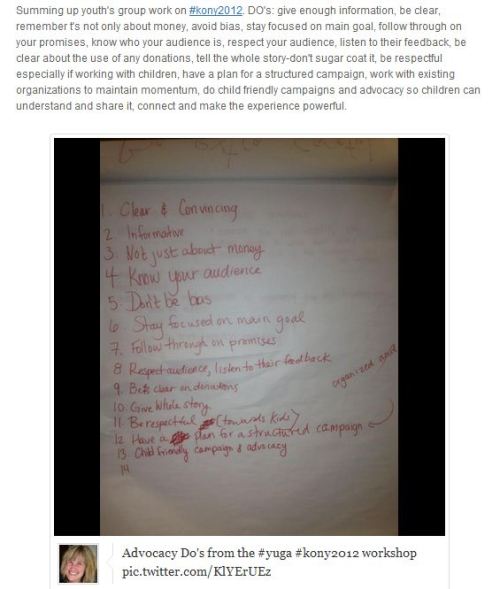
The advocacy Do’s and Don’ts that participants generated during group work:

And a key take-away:

Summary of the full workshop.

Amanda’s ebook “Beyond Kony2012: Atrocity, Awareness and Activism in the Internet Age.

Read Full Post »

Image captured from page 19 of the Polis report.

Who cares? Challenges and opportunities in communicating distant suffering: a view from the development and humanitarian sector, a study conducted by Polis, (the journalism think-tank within the Department of Media and Communications at the London School of Economics- LSE) with Plan UKlaunched yesterday in London.
.
The study complements several pieces of research released over the past year or two on the UK public’s perception of foreign aid, development, giving, and the NGO sector; including Intermedia’s Building Support for International Development, the UK Public Opinion Monitor/Institute of Development Studies’ What Does the Public Think, Know and Do about Aid and Development? report, the Oxfam/Bond/DfID Finding Frames report and the Overseas Development Institute’s Understanding Public Attitudes to Aid and Development.

Whereas the other reports focus on various aspects of how the public sees charity, development and foreign aid, the Polis report gives a window into the debates and challenges of those working in advocacy, marketing, campaigning, fundraising and communication departments at INGOs. As my Plan UK colleague, Leigh Daynes, writes in the introduction:

‘…Our work to inform, to educate, to campaign for change and to recruit long-term supporters to fund change is valid. Often it is life-saving. Yet the least understood area of our work often is the impact of our communications on public understanding of and support for aid and development. The public are telling us they are saturated with suffering, that we are charming or disarming them into acts of compassion, and that we are abusing their emotions….

…Understanding the impact of the “lingua franca” of our industry matters because it has fuelled a template approach to the media reporting of suffering. It matters because the exponential growth in access to mobile and social media technology and platforms means we are no longer the de facto guardians we once were. And it matters because it speaks to the power between us and them, and you and me.’

As more and more research is done, the ways that the sector is shifting become clearer and I hope we will start to see some positive changes in the aid and development industry and the way it communicates with the general public.

Some angles and voices that could help round out the discussion are still missing, however. I would like to see research on the opinions of local and international staff managing programs on the ground. Most organizations have fierce internal discussions on how marketing and fundraising is done, as program staff often feel that some marketing and fundraising approaches are demeaning, disrespectful and undignified in their portrayal of program participants.  (For more on this, ask Talesfromthhood to share some of his blog posts with you, join some of the discussions on AidSource, or follow the #smartaid hash tag on Twitter). Some program staff worry that the long-term impact of media and fundraising shock tactics and overly simplistic messaging ‘cancels out’ the short-term gains achieved through program or emergency aid funding – a point that is raised in some of the research above – and that this contributes to two-dimensional views on aid and development and to the negative stereotypes about certain countries in Africa, Latin America and Asia that deter longer-term development and self-determination. It would be interesting to know more from this perspective.

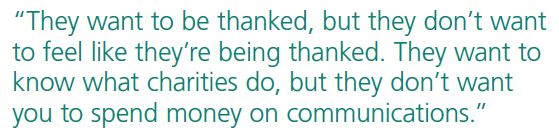
What do donors want? Image captured from page 9 of the report.

At the same time, INGOs are hard-pressed to come up with different and viable ways of funding their work, so this type of campaigning and fundraising continues. Although I’m familiar with some of the challenges my marketing colleagues face, I was struck seeing the kinds of donor demands that INGOs are expected to meet listed in the report. I was reminded of something a marketing colleague once said: ‘Poverty porn. That’s a good term. It is a lot like real porn. People don’t like to publicly admit to watching and responding to it, but in private it’s another story. People say they don’t like poverty porn and sad, desperate stories, but when you look at the numbers, it’s what makes them reach into their pockets and give.’

I would also like to see some research with the subjects (unfortunately often presented as ‘objects’) of INGO aid and marketing materials.  How do program participants feel about how they are portrayed? What impact does it have on them and their own perspectives and self-determination, if any? Strong voices on this come from diaspora communities and from blogs such as Africa is a Country, Uganda 2012: Trending Our Own Stories, and great projects like My Africa Is; but I’d also like to see some in-depth research and objective focus groups that talk with those who are most often shown in INGO marketing. Are people aware of how they are being represented? Do they care? Many of us speculate about this when we bash ‘poverty porn’ but I’ve yet to see published research that involves actual ‘beneficiaries’ of INGO programs or people and communities appearing in INGO marketing and fundraising pieces in this discussion. (Maybe I’ve missed it – if you know of  any, please share!)

The ‘Who Cares’ report notes in the conclusion that:

  • transparency, accountability, ‘value for money,’ and impact are becoming more important to the donor public
  • public trust is a central concern for NGOs in their work and their communications
  • the sector needs to assume more collective responsibility for ethically appropriate portrayal of disaster victims (eg, in compliance with Article 10 of the Red Cross Red Crescent Code of Conduct)
  • new technologies and competition mean that fundraisers are seeking supporters outside of their traditional constituencies
  • traditional gatekeepers of aid are being challenged by new media’s ability to put donors and ‘beneficiaries’ in more direct contact

As INGO institutional leadership space opens up to more people from ‘the global South’, diaspora communities grow, social media allows for commercials and fundraising appeals to reach global audiences (including people in the countries where INGOs implement their programs), attention is paid to the ‘new bottom billion‘ and new fundraising mechanisms arise (for example, INGOs raising funds within countries where they are implementing programs), it will be interesting to see how the conversations and approaches shift and change — or if they remain the same with new actors taking on the same challenges.

Stay tuned for further research and reporting over the next couple of years from Polis and download the report here.

Read Full Post »

This is a cross-post by Laura Pohl who works at the Bread for the World. The post is a summary of the latest Humanitarian Photography group meeting. The meetings are part of a series of meetings about photography in humanitarian work organized by CORE Group. (The original is posted here)

An employee at the Yemi Hanbok factory near Yanji, China, examines a traditional Korean skirt she is dyeing.The factory’s unique geographic position in China, near North Korea, means it can have work done cheaply in both countries and then sell to customers in South Korea. Photo © Laura Elizabeth Pohl

One of the most common questions I get asked at work is, “Can I use this picture?”

Oh, there are so many answers — and we talked about most of them at our latest Humanitarian Photography Group meeting this past Tuesday. Jim Stipe of Catholic Relief Services, Ann Hendrix-Jenkins of CORE Group and I organized the meeting. I led it, starting off with a talk on figuring out whether a photograph is yours or not. Sounds easy, right?

Well, if someone on your staff shot the picture then yes, the answer is easy: you can use it. But should you use it? (More on that later.) If your organization hired a freelancer to shoot pictures for you, then yes, you can use the pictures but possibly with restrictions. It depends on the type of contract between you and the photographer. The main point here is that the photographer usually still retains copyright to the picture and your organization is licensing the pictures. If this all sounds complicated and legalistic, don’t worry; we’ll be delving into copyright, contracts and licensing in a future meeting. Finally, if you don’t know who shot the photograph, where it came from or who owns the copyright, it’s best not to use the picture.

Next I talked a bit about Creative Commons licenses, which photographers use when they want to let the public publish their pictures without paying a licensing fee. CC-licensed photos abound on Flickr, a frequent source of pictures for nonprofit organizations. Just be sure the picture editor at your organization (or the person in this role) understands all six CC licenses and when a picture is fully copyrighted, all rights reserved. When I was a freelance photographer, an NGO once published my copyrighted photographs from Flickr without my permission. I found the copyright violation and sent the organization a stern letter and invoice for the pictures. The organization paid up. They never apologized, though. The organization had tasked their intern with finding pictures. It turns out he didn’t understand copyright.

Finally, I talked about content and technical criteria for publishing pictures, showing about 20 “bad” photos that Jim and I found. There are many reasons photographs shouldn’t see the light of day but I think the best way to summarize the photo usage criteria listed below is, “Do unto others as you would have them do unto you.” That out-of-focus photograph of 10 bored-looking people sitting in a meeting? You don’t have to use it. That portrait of a person with a strange expression on his face? Just don’t publish it. As Jim often says, “It’s better not to use a photograph than to use a bad photograph.”

  • Dignity – No emaciated children, flies in eyes, violence or stereotypical images.
  • Safety – Could the picture put the photo subjects in danger, even if they agreed to be photographed?
  • Context – No pretending photos of one thing are of something else. Sometimes photos published as a collection make sense together but one photo on its own from the collection doesn’t make sense.
  • Caption – Who’s in the picture? Where was it taken? Why is this picture important? Even if you can’t publish this information because of safety concerns, it’s important to have the information for your internal records.
  • Credit – Who took the picture? It’s just like attributing a quote.
  • Third effect – Two pictures paired together can take on a new meaning.
  • Focus – Is the picture sharp or blurry?
  • Framing – Is the photo framed well?
  • Exposure – Is the picture properly exposed?
  • Color – Does it look natural?

People had great comments and questions at the end. (By the way, Jim did a nice job tweeting the meeting at #NGOphoto.) A woman named Aubrey said her organization works on a lot of construction projects, roads, latrines, etc. They often shoot before and after photographs to show the impact of their projects. Another person asked about setting up or staging shots. Some people wanted to know more about contracts and how to work with country programs to set up photo shoots. These are all meaty topics. I can’t wait to get into them more in future meetings. We’re taking a break for the summer but we’ll meet again in September, so get in touch if you’d like to join us.

You can find summaries of other meetings here:

April: On the ethics of photos in aid and development work

May: Aid, ethics, photography and informed consent

Read Full Post »

There’s a great, ongoing discussion happening around aid and development and the ethics of using photographs and other media and stories about people INGOs and NGOs are working with (a.k.a beneficiaries, clients, participants). The discussions are organized by CORE Group in DC. I also participated in the first meeting of the group in April (see this post: On the ethics of photos in aid and development work).

Today’s meeting focused on consent and informed consent for photographs.
Jim Stipe was the key speaker. He shared Catholic Relief Services‘ experiences with developing a process that allows for informed consent in a variety of situations.
.

Future discussions will cover related topics such as what happens with social media sites and consent and copyright? What about fair use of images and stories? I’m quite looking forward to continuing the discussions and learning!

Check out the compilation of tweets here on Storify – be sure to read from bottom to top!

Also see this old post: Child protection, the media and youth media programs.

Read Full Post »

A version of this post originally appears on the World Bank’s Connect4Climate site.

Twenty years ago, at the Rio Earth Summit, 178 governments committed to a series of legally non-binding principles designed to commit governments to balance development and environment in a way that would bring a more sustainable future. Principle 10, the first international declaration that recognizes the rights of people to hold governments accountable for their policies regarding the environment, was one key result of the summit. It provides a means for people to engage in the decisions made by political leaders and government agencies about environmental issues that affect livelihoods and long-term wellbeing.

“Environmental issues are best handled with participation of all concerned citizens, at the relevant level. At the national level, each individual shall have appropriate access to information concerning the environment that is held by public authorities, including information on hazardous materials and activities in their communities, and the opportunity to participate in decision-making processes. States shall facilitate and encourage public awareness and participation by making information widely available. Effective access to judicial and administrative proceedings, including redress and remedy, shall be provided.” – Principle 10 of the Rio Declaration

Video by Article 19

Zero Draft 2012: participation, transparency, accountability and aid effectiveness

Since 2011, key stakeholders have been submitting ideas for the Zero Draft of the Rio+20 outcome document, to be discussed at the Rio+20 Conference in June 2012.

Like Principle 10, the Zero Draft recognizes the need for broad public participation in decision-making, linked to a strengthened right to access information and to better civil society capacity to exercise that right. It notes that technology can make it easier for governments “to share information with the public and for the public to hold decision makers accountable” and that it is critical to work towards universal access to information and communications technologies. (Clauses 17 and 18). A recent analysis showed that participation, accountability, transparency, Principle 10/access to information and social inclusion/ equity are among the terms that share an ‘excellent’ level of interest among governments, UN agencies, civil society groups and other stakeholders.

Along with public participation, the Zero Draft also calls for “increased aid effectiveness, taking into account the Paris Declaration, the Accra Action Agenda and the Busan Partnership for Effective Development Cooperation in ensuring that aid is effective, accountable and responsive to the needs and priorities of developing countries.” Greater coherence at international and national levels is urged, including “effective oversight of resources to ensure that developing countries have steady and predictable access to adequate financing, including by the private sector, to promote sustainable development.’

A role for Communications and ICT tools

ICTs can play a role in supporting Principle 10 and Zero Draft, and pushing for appropriate mechanisms for response and redress.

Mass media campaigns and communication for development (C4D) approaches have long been used to disseminate information and encourage environmental awareness and behavior change. New media has improved access to information and allows multi-channel communication rather than one-way broadcasts. Greater access to mobile phones and to new media channels mean that a broader population than ever before can be engaged in and/or participate proactively in defining and acting on Rio+20 and its outcomes.

In addition to information sharing and behavior change, ICTs have the potential to play a strong role in helping civil society organize and push for greater transparency, openness and accountability around Rio+20. As Chantal Line Carpintier suggests, “Rio+20 should also agree on an effective accountability process for all actors  – governments, business and industry, local authorities, NGOs and other major groups and stakeholders.  Accountability and ownership by all actors would favour implementation. There is growing support, for instance, for public reporting on sustainability performance.  A registry of commitments is one of the tools that have been suggested to follow up on commitments made at Rio+20 to avoid previous lack of implementation.”

An effort similar to the open government partnership and the International Aid Transparency Initiative or the integration of sustainable development goals and Rio+20 commitments into these two efforts could be something to consider, along with a mandate for corporations to also open their activities to public scrutiny.

On-line organizing combined with both online and offline actions (in places that have ready access to social media) can help the world prepare for Rio and to push for its outcomes to be implemented.

Access, capacity and the communication cycle

Despite the great potential for ICTs in communication, change and accountability efforts, however; lack of access to ICTs and potentially low capacity to interpret data that might be presented on-line in such a registry is of concern in less accessible rural communities and among some marginalized groups.

Education levels, literacy, and other excluding factors such as poverty and gender discrimination can severely limit ICT and social media access for a large number of people.  In addition, information produced in dominant cultures or languages can exclude or override those with less power. As Angelica Ospina notes in her post Knowledge Brokers, ICTs, and Climate Change: Hybrid Approaches to Reach the Vulnerable, “There are many misconceptions about what ‘reaching out’ implies, as in practice it requires much more than making climate change information and knowledge publicly available through Internet-based tools such as Web portals and online databases.”

Therefore, there needs to be, “a more holistic understanding of the information cycle, including the creation, acquisition, assimilation, management, dissemination and ultimately the USE of climate change information, particularly within vulnerable contexts. Beyond the provision of climate change information, it’s necessary to consider if/how the information is being integrated -or not- into decision-making processes at the local, regional or national levels,” she says.

The Children in a Changing Climate project uses a variety of participatory development and media tools for children and adolescents to explore and document climate change in their communities, and to share their findings and suggestions to adults and other decision makers.

From information and knowledge to practice

There is also a need “to identify, adapt and adopt innovative approaches for the effective delivery and the local appropriation of climate change messages, and most importantly, for the translation of information and knowledge -both new and traditional- into climate change practice.” This will require strong efforts as well as resources to create an inclusive environment that fosters greater participation, as mandated by Principle 10, and local ownership of sustainable practices.

“Working with knowledge brokers, also called “human infomediaries” who can help bring people together, identify local needs and transfer information and knowledge more effectively is one such approach to improve information and communication flows,” Ospina advises. “Human infomediaries support an active process that involves exchanges between people, facilitating the development of climate change strategies, adoption of adaptation and mitigation practices, and processes of local change and innovation.”

(More here on ICTs and the role of knowledge brokers).

Building on Ospina’s observations on how to bring information to the “last mile,” meaningful ways to bring community knowledge and information into higher level discussions need to be found. Local communities have vast knowledge on resilience, climate patterns, local environments and local situations and histories that can be documented and shared using ICTs both to benefit themselves and to share at broader levels, improving South-South cooperation and innovation. Multi-media curricula such as the Children in a Changing Climate website bring together young people’s voices and opinions around climate change and environment.

Post Rio+20, digital tools are one of many information and communication mechanisms that local communities and their citizens can use to confirm, validate, contest and dispute information related to compliance with commitments being put forward by those responsible for upholding them. Participatory media approaches can be effective in bringing community members as well as duty bearers at local, district, national and global levels into discussions about climate change and sustainable development.

Why are you killing me? Girls in Kenya use poetry to engage adults in discussion on climate change.

Summing up

In summary, ICTs can play a strong role in education, participation and accountability processes if their integration is well thought through, appropriate to the context, and taking into consideration good participatory practices. Hybrid approaches that use a variety of online and offline tools can be effective for reaching populations and decisions-makers at different levels of responsibility, for ensuring that ICTs are not widening existing information and participation gaps and for upholding the goals set forth in Principle 10. Children and youth can and should play an instrumental role in bringing about awareness and accountability, especially since they will be the ones who reap the long-term results of the agreements sown at Rio+20.

The Notes on ICTs, Climate Change and Development blog provides a wide range of research, commentary, and research on these areas.

Read Full Post »

  1. Share
    Looking forward to group conf call with CORE today ref: Photos, ethics, values and INGO/NGO work.
    Tue, Apr 03 2012 06:55:44
  2. This morning I participated in a massive conference call about photography in aid and development, and the ethics and values that surround photos taken and used by NGOs. The call was organized by CORE Group (@coregroupdc). Now maybe I’m exaggerating here, but the call organizer, Ann Hendrix-Jenkins, read off a list of participants that went on forever. I’m estimating that there were something like 40 or 50 people listening in from as many organizations. This topic has always been important for a strong segment of NGO staff and it seems to be gaining steam again.

    After I started tweeting about it, a couple of people asked if I’d be writing a blog post. So here it is. I’ve ‘Storified’ it since I was tweeting instead of taking notes, and because there was a nice side conversation happening with folks on Twitter too. (See the Storify here – it looks a little bit nicer there than it does here.)
  3. Share
    “Humanitarian photography is a hot button issue.Touches on dignity, how we do our jobs, & our ideas about ourselves, others & our work.”
    Tue, Apr 03 2012 11:08:52
  4. The call organizers had earlier conducted a survey about NGO images, policies, consent, and operational processes around photographers and photography and shared it with participants ahead of the call. The organizers also suggested a couple of links to check out beforehand, including an Aid Watch post (“Adorable child in NGO fund-raising photo sues for royalties“) and a link to a photo  that appeared in the New York Times. These two links and other similar “poverty porn images” had sparked the discussions that led to the decision to organize today’s call. [update: here is the original discussion thread on Linked In]
  5. Share
    Jeez – like 50 orgs on this CORE call re: photography, ethics and values. Discussing: @aidwatch post ht.ly/a3gYA & more
    Tue, Apr 03 2012 11:06:19
  6. Share
    I’m reminded that these discussions happen all the time among INGOs, even when they are not documented on Twitter or a blog.
    Tue, Apr 03 2012 11:10:46
  7. Share
    Second photo touching off this conversation is NYT image from last year re Somalia famine. ht.ly/a3i0s #povertyporn
    Tue, Apr 03 2012 11:13:32
  8. Share
    Also reminded that blogs can and do touch off broader and wider discussions that often we never know are happening….
    Tue, Apr 03 2012 11:14:45
  9. Share
    @meowtree I think too many people online forget that about a lot of issues. Not all discussions are necessarily open for outside viewing.
    Tue, Apr 03 2012 11:16:09
  10. Share
    @meowtree Shoot, I forgot about the call! Are you going to write a post about it?
    Tue, Apr 03 2012 11:28:06
  11. Share
    @meowtree Would have loved to be there but couldn’t… Will you report?
    Tue, Apr 03 2012 11:36:40
  12. Laura Pohl (@lauraepohl) from Bread for the World gave a short introduction to the topic along with some points to think about.
  13. Share
    What considerations do NGOs (and journos/freelancers) need to go through before publishing a photo? Appropriate use? Consent? What else?
    Tue, Apr 03 2012 11:16:15
  14. After this introduction, Jim Stipe from Catholic Relief Services gave a quick summary of the survey highlights, and we had a group discussion around some of the key issues detected in the survey and additional ones sourced from the participants on the call. 
  15. Heartening to know most INGOs have photo policies saying images must show dignity, & image usage is restricted/protected to some staff.
    Tue, Apr 03 2012 11:21:54
  16. Share
    Hearing: INGOs don’t seem to have policies stating photo must match/relate to/be part of story or have policies re: copyright of photos.
    Tue, Apr 03 2012 11:23:38
  17. Share
    Hearing: often pgm staff are taking photos, but many INGOs don’t train staff on policies or good techs for photos or on photo ethics.
    Tue, Apr 03 2012 11:25:47
  18. Share
    Hearing: What about consent for photos? We need to discuss this much more. It’s key to a good photo policy.
    Tue, Apr 03 2012 11:26:57
  19. Share
    @meowtree Unable to keep up today, busy. But have you asked @irinnews input? I use their photo service. Will catch up soon. Thanks for topic
    Tue, Apr 03 2012 11:28:38
  20. Share
    My question: what is ‘informed consent’? what are different ways to get it? how to ensure ppl rlly understand use of their image and story?
    Tue, Apr 03 2012 11:37:41
  21. Share
    @meowtree you can’t ensure that ppl understand use of their image unless they know context in which it will be used & understand its nuances
    Tue, Apr 03 2012 11:40:12
  22. Share
    Re: informed consent – how not to intimidate ppl with consent forms? Also – shd we be applying US consent laws to local settings? or not?
    Tue, Apr 03 2012 11:39:02
  23. Share
    @meowtree @jcdonner thanks brilliant, parallel questions for researchers being encouraged in IDRC SIRCAII programme, spread it
    Tue, Apr 03 2012 11:40:34
  24. Share
    Also: how does consent differ when children/under 18s are involved? what about difference btwn traditional and social media use of images?
    Tue, Apr 03 2012 11:40:32
  25. Share
    @meowtree What I learned from ethnography: entirely contextual and subjective. Even when you’ve succeeded, you’ve failed. But you must try
    Tue, Apr 03 2012 11:41:52
  26. Share
    @meowtree When in doubt, err on the side of caution.
    Tue, Apr 03 2012 11:42:32
  27. Share
    Someone asks: What about before and after pictures in the case of malnutrition? is it better to show the “after” picture to show progress?
    Tue, Apr 03 2012 11:42:41
  28. Share
    Another Q: what about when working with images of people in conflict settings? where use of their images may endanger them?
    Tue, Apr 03 2012 11:43:25
  29. Share
    Comment: Takes a lot more ppl, resources and planning than we think to do this right. We seldom put enough emphasis on ethical image/video.
    Tue, Apr 03 2012 11:44:51
  30. Share
    @meowtree In the West we focus on “informed consent” re: the individual–but in other cultures, the community consent is more important
    Tue, Apr 03 2012 11:40:28
  31. Share
    .@meowtree good discussion of photos in #ict4d vs journalism here is.gd/G4oGsC
    Tue, Apr 03 2012 11:20:44
  32. Share
    Comment: Need to work with US media also to help have more ethical use of images.
    Tue, Apr 03 2012 11:46:26
  33. Share
    Re. #povertyporn conversation @meowtree is tweeting: all humanitarian/devt agencies should have comms ombudspersons to defend those depicted
    Tue, Apr 03 2012 11:47:19
  34. Share
    @meowtree I’ve always found Photovoice UK’s ethical guidelines useful in regard to some the issues at your discussion photovoice.org/images/uplo…
    Tue, Apr 03 2012 11:47:47
  35. Share
    [ 1] MT @meowtree Comment: Takes a lot more ppl, resources, planning than we think… We seldom put enough emphasis on ethical image/video
    Tue, Apr 03 2012 11:48:29
  36. Share
    Interesting commentary on INGO photo policies & the ethics of humanitarian photography by @meowtree.
    Tue, Apr 03 2012 11:48:35
  37. Share
    @meowtree @giantpandinha I really like the ombudspersons idea but they would need to be local?
    Tue, Apr 03 2012 11:49:28
  38. Share
    @miskellaneous @meowtree Anybody with an empathetic impulse would be a good start. But yes, eventually, why not local?
    Tue, Apr 03 2012 11:50:32
  39. Share
    @meowtree photos and ethics such a big topic. I find the whole issue of people coming back from mission trips and volunteering with these
    Tue, Apr 03 2012 11:49:52
  40. Share
    @meowtree photos equally disturbing. Take a snap of a poor kid and then put on facebook – where’s the dignity and ethics in that? Volunteer
    Tue, Apr 03 2012 11:50:36
  41. Share
    @meowtree eduction is equally important, but so hard!! At the very least, if you wouldnt want a similar image of your mum/child/bro etc to
    Tue, Apr 03 2012 11:51:35
  42. Share
    @meowtree be shown are the world or usesd in the same way, then think twice. (this concept doesnt go down well when I mention it to people).
    Tue, Apr 03 2012 11:52:16
  43. Share
    .@meowtree One challenge – a Western audience that is eager to consume #povertyporn. Many INGOs seek to reach out to that audience.
    Tue, Apr 03 2012 11:51:08
  44. Share
    Comment: tension btwn fundraising people, program people. What is the concept of what the org is doing? Charity? solidarity?
    Tue, Apr 03 2012 11:55:08
  45. Share
    @meowtree @miskellaneous I find the “golden rule” goes a long way. Would I want my child, my niece/nephew depicted this way? Ever?
    Tue, Apr 03 2012 11:54:02
  46. Share
    @giantpandinha @meowtree yes it’s my golden rule too though there are somethings it misses like cultural understandings of modesty
    Tue, Apr 03 2012 11:57:06
  47. Share
    @miskellaneous @meowtree I remember a moment with my agency’s graphic designers when we cropped a woman’s belly peaking out from her t-shirt
    Tue, Apr 03 2012 11:58:00
  48. Share
    @miskellaneous @meowtree Again, the golden rule worked there. (But you are right @miskellaneous, might not work in every situation.)
    Tue, Apr 03 2012 11:59:46
  49. Share
    Comment: can we look at studies on the use of photos and impact on donors & learn. Also look at ethics vs what works w fundraising?
    Tue, Apr 03 2012 12:07:06
  50. Share
    Comment (mine) and what about participatory media? How often do we promote people’s own photos/videos of themselves/their communities?
    Tue, Apr 03 2012 12:07:55
To finalize the call, we heard a summary from Jim of some of the areas that the group could consider forming smaller groups to dig into and work on further, including: 
  • Issues around consent, alternative ways to obtain consent, release forms, and how to get truly informed consent.
  • Ethics of both taking photos and ethics of using photos – these are related yet separate issues.
  • What makes for a good NGO photo? What’s a good vs bad photo? What works and what doesn’t?
  • How do you grow your options for getting more high quality photos? How to train your staff on good photography? How to find and work with good freelance photographers? How to plan out a shoot and put the right amount of time into it? How to ensure photos are taken ethically?
  • Creating a photo policy, what does a good photo policy look like? what should it contain?
  • How to tell better stories? You can document your programs with photos and you can tell visual stories – these are 2 different things….
  • Getting good photo captions. If you don’t have good captions, photos are less useful.
  • Other places to source photos; eg., if you don’t have the photos you need, where can you go to get them?
  • Photo journalism vs NGO photography – similar yet different, different approaches and goals. Let’s discuss this.
  • Vocabulary for talking about photos in order to articulate to staff why one photo better than another. Turning gut sense into language and tools.
  • Looking at studies on the use of photos and their impact on donors, what can we learn from that? How to reconcile the different set of ethics that we may find in terms of ‘what works’ for fundraising and what is ethical?
  • What about participatory media and people portraying themselves and their own images
  • An Ombudsperson within INGOs who can defend the rights of those being photographed
  • The question of how people perceive you when you go from doing program work to becoming a photographer in the same afternoon. 
  • The related question about what happens when your organization makes you do both things? Who owns the photos? Do you get paid if your organization uses them? What if you are using your own equipment? How is your organization using you if that’s not your job in the first place? What are you expected to do and how much of this should you actually be doing?
  • Budgeting. We need to begin inserting budget into the conversation. How much can we pay photographers, or do we invest in training our own staff?
  1. Share
    Well pointed out by @miskellaneous: our “golden rule” re. depiction of “the Other” sometimes “misses cultural understandings of modesty”.
    Tue, Apr 03 2012 12:08:55
  2. Share
    However, I still believe some “golden rule” is better than none, and the bottom line should be: err on the side of caution.
    Tue, Apr 03 2012 12:10:15
  3. Share
    Comment: What about when you’re asked to be both a “program” person and also take comms/PR photos? How does community view you?
    Tue, Apr 03 2012 12:08:59
  4. Share
    Comment: what are the rules when your focus is pgm, but ‘photographer’ is added to your task list before you go out to ‘the field’?
    Tue, Apr 03 2012 12:10:10
  5. Share
    @meowtree @julienne_l I work with youth and struggle with this a lot. How do you keep integrity and get ppl to pay attention? #povertyporn
    Tue, Apr 03 2012 12:04:39
  6. I’m looking forward to continuing the discussions as this is an issue that constantly jumps out at me. It’s fantastic to know that there is such a strong contingent of NGO staff who are keen to address the issues around how we take and how we use photographs of the people that we work with.
  7. Share
    That’s it for tweets from @coregroupdc conversation on #povertyporn, photos, ethics and values. More later – discussions will continue.
    Tue, Apr 03 2012 12:11:55

Read Full Post »

« Newer Posts - Older Posts »