Feeds:
Posts
Comments

Archive for the ‘development’ Category

This post was originally published on the Open Knowledge Foundation blog

A core theme that the Open Development track covered at September’s Open Knowledge Conference was Ethics and Risk in Open Development. There were more questions than answers in the discussions, summarized below, and the Open Development working group plans to further examine these issues over the coming year.

Informed consent and opting in or out

Ethics around ‘opt in’ and ‘opt out’ when working with people in communities with fewer resources, lower connectivity, and/or less of an understanding about privacy and data are tricky. Yet project implementers have a responsibility to work to the best of their ability to ensure that participants understand what will happen with their data in general, and what might happen if it is shared openly.

There are some concerns around how these decisions are currently being made and by whom. Can an NGO make the decision to share or open data from/about program participants? Is it OK for an NGO to share ‘beneficiary’ data with the private sector in return for funding to help make a program ‘sustainable’? What liabilities might donors or program implementers face in the future as these issues develop?

Issues related to private vs. public good need further discussion, and there is no one right answer because concepts and definitions of ‘private’ and ‘public’ data change according to context and geography.

Informed participation, informed risk-taking

The ‘do no harm’ principle is applicable in emergency and conflict situations, but is it realistic to apply it to activism? There is concern that organizations implementing programs that rely on newer ICTs and open data are not ensuring that activists have enough information to make an informed choice about their involvement. At the same time, assuming that activists don’t know enough to decide for themselves can come across as paternalistic.

As one participant at OK Con commented, “human rights and accountability work are about changing power relations. Those threatened by power shifts are likely to respond with violence and intimidation. If you are trying to avoid all harm, you will probably not have any impact.” There is also the concept of transformative change: “things get worse before they get better. How do you include that in your prediction of what risks may be involved? There also may be a perception gap in terms of what different people consider harm to be. Whose opinion counts and are we listening? Are the right people involved in the conversations about this?”

A key point is that whomever assumes the risk needs to be involved in assessing that potential risk and deciding what the actions should be — but people also need to be fully informed. With new tools coming into play all the time, can people be truly ‘informed’ and are outsiders who come in with new technologies doing a good enough job of facilitating discussions about possible implications and risk with those who will face the consequences? Are community members and activists themselves included in risk analysis, assumption testing, threat modeling and risk mitigation work? Is there a way to predict the likelihood of harm? For example, can we determine whether releasing ‘x’ data will likely lead to ‘y’ harm happening? How can participants, practitioners and program designers get better at identifying and mitigating risks?

When things get scary…

Even when risk analysis is conducted, it is impossible to predict or foresee every possible way that a program can go wrong during implementation. Then the question becomes what to do when you are in the middle of something that is putting people at risk or leading to extremely negative unintended consequences. Who can you call for help? What do you do when there is no mitigation possible and you need to pull the plug on an effort? Who decides that you’ve reached that point? This is not an issue that exclusively affects programs that use open data, but open data may create new risks with which practitioners, participants and activists have less experience, thus the need to examine it more closely.

Participants felt that there is not enough honest discussion on this aspect. There is a pop culture of ‘admitting failure’ but admitting harm is different because there is a higher sense of liability and distress. “When I’m really scared shitless about what is happening in a project, what do I do?” asked one participant at the OK Con discussion sessions. “When I realize that opening data up has generated a huge potential risk to people who are already vulnerable, where do I go for help?” We tend to share our “cute” failures, not our really dismal ones.

Academia has done some work around research ethics, informed consent, human subject research and use of Internal Review Boards (IRBs). What aspects of this can or should be applied to mobile data gathering, crowdsourcing, open data work and the like? What about when citizens are their own source of information and they voluntarily share data without a clear understanding of what happens to the data, or what the possible implications are?

Do we need to think about updating and modernizing the concept of IRBs? A major issue is that many people who are conducting these kinds of data collection and sharing activities using new ICTs are unaware of research ethics and IRBs and don’t consider what they are doing to be ‘research’. How can we broaden this discussion and engage those who may not be aware of the need to integrate informed consent, risk analysis and privacy awareness into their approaches?

The elephant in the room

Despite our good intentions to do better planning and risk management, one big problem is donors, according to some of the OK Con participants.  Do donors require enough risk assessment and mitigation planning in their program proposal designs? Do they allow organizations enough time to develop a well-thought-out and participatory Theory of Change along with a rigorous risk assessment together with program participants? Are funding recipients required to report back on risks and how they played out? As one person put it, “talk about failure is currently more like a ‘cult of failure’ and there is no real learning from it. Systematically we have to report up the chain on money and results and all the good things happening. and no one up at the top really wants to know about the bad things. The most interesting learning doesn’t get back to the donors or permeate across practitioners. We never talk about all the work-arounds and backdoor negotiations that make development work happen. This is a serious systemic issue.”

Greater transparency can actually be a deterrent to talking about some of these complexities, because “the last thing donors want is more complexity as it raises difficult questions.”

Reporting upwards into government representatives in Parliament or Congress leads to continued aversion to any failures or ‘bad news’. Though funding recipients are urged to be innovative, they still need to hit numeric targets so that the international aid budget can be defended in government spaces. Thus, the message is mixed: “Make sure you are learning and recognizing failure, but please don’t put anything too serious in the final report.” There is awareness that rigid program planning doesn’t work and that we need to be adaptive, yet we are asked to “put it all into a log frame and make sure the government aid person can defend it to their superiors.”

Where to from here?

It was suggested that monitoring and evaluation (M&E) could be used as a tool for examining some of these issues, but M&E needs to be seen as a learning component, not only an accountability one. M&E needs to feed into the choices people are making along the way and linking it in well during program design may be one way to include a more adaptive and iterative approach. M&E should force practitioners to ask themselves the right questions as they design programs and as they assess them throughout implementation. Theory of Change might help, and an ethics-based approach could be introduced as well to raise these questions about risk and privacy and ensure that they are addressed from the start of an initiative.

Practitioners have also expressed the need for additional resources to help them predict and manage possible risk: case studies, a safe space for sharing concerns during implementation, people who can help when things go pear-shaped, a menu of methodologies, a set of principles or questions to ask during program design, or even an ICT4D Implementation Hotline or a forum for questions and discussion.

These ethical issues around privacy and risk are not exclusive to Open Development. Similar issues were raised last week at the Open Government Partnership Summit sessions on whistle blowing, privacy, and safeguarding civic space, especially in light of the Snowden case. They were also raised at last year’s Technology Salon on Participatory Mapping.

A number of groups are looking more deeply into this area, including the Capture the Ocean Project, The Engine Room, IDRC’s research network, The Open Technology InstitutePrivacy InternationalGSMA, those working on “Big Data,” those in the Internet of Things space, and others.

I’m looking forward to further discussion with the Open Development working group on all of this in the coming months, and will also be putting a little time into mapping out existing initiatives and identifying gaps when it comes to these cross-cutting ethics, power, privacy and risk issues in open development and other ICT-enabled data-heavy initiatives.

Please do share information, projects, research, opinion pieces and more if you have them!

Read Full Post »

This is a cross-post by Duncan Edwards from the Institute of Development Studies. Duncan and I collaborated on some sessions for the Open Development stream at September’s Open Knowledge Conference, and we are working on a few posts to sum up what we discussed there and highlight some lingering thoughts on open development and open data. This post was originally published on the Open Knowledge Foundation blog on October 21, 2013

by Duncan Edwards

I’ve had a lingering feeling of unease that things were not quite right in the world of open development and ICT4D (Information and communication technology for development), so at September’s Open Knowledge Conference in Geneva I took advantage of the presence of some of the world’s top practitioners in these two areas to explore the question: How does “openness” really effect change within development?

Inspiration for the session came from a number of conversations I’ve had over the last few years. My co-conspirator/co-organiser of the OKCon side event “Reality check: Ethics and Risk in Open Development,” Linda Raftree, had also been feeling uncomfortable with the framing of many open development projects, assumptions being made about how “openness + ICTs = development outcomes,” and a concern that risks and privacy were not being adequately considered. We had been wondering whether the claims made by Open Development enthusiasts were substantiated by any demonstrable impact. For some reason, as soon as you introduce the words “open data” and “ICT,” good practice in development gets thrown out the window in the excitement to reach “the solution”.

A common narrative in many “open” development projects goes along the lines of “provide access to data/information –> some magic occurs –> we see positive change.” In essence, because of the newness of this field, we only know what we THINK happens, we don’t know what REALLY happens because there is a paucity of documentation and evidence.

It’s problematic that we often use the terms data, information, and knowledge interchangeably, because:
Data is NOT knowledge.
Data is NOT information.
Information is NOT knowledge.
Knowledge IS what you know. It’s the result of information you’ve consumed, your education, your culture, beliefs, religion, experience – it’s intertwined with the society within which you live.

Data cake metaphor developed by Mark Johnstone.

Understanding and thinking through how we get from the “openness” of data, to how this affects how and what people think, and consequently how they MIGHT act, is critical in whether “open” actually has any additional impact.

At Wednesday’s session, panellist Matthew Smith from the International Development Research Centre (IDRC) talked about the commonalities across various open initiatives. Matthew argued that a larger Theory of Change (ToC) around how ‘open’ leads to change on a number of levels could allow practitioners to draw out common points. The basic theory we see in open initiatives is “put information out, get a feedback loop going, see change happen.” But open development can be sliced in many ways, and we tend to work in silos when talking about openness. We have open educational resources, open data, open government, open science, etc. We apply ideas and theories of openness in a number of domains but we are not learning across these domains.

We explored the theories of change underpinning two active programmes that incorporate a certain amount of “openness” in their logic. Simon Colmer from the Knowledge Services department at the Institute of Development Studies outlined his department’s theory of change of how research evidence can help support decision-making in development policy-making and practice. Erik Nijland from HIVOS presented elements of the theory of change that underpins the Making All Voices Count programme, which looks to increase the links between citizens and governments to improve public services and deepen democracy. Both of these ToCs assume that because data/information is accessible, people will use it within their decision-making processes.

They also both assume that intermediaries play a critical role in analysis, translation, interpretation, and contextualisation of data and information to ensure that decision makers (whether citizens, policy actors, or development practitioners) are able to make use of it. Although access is theoretically open, in practice even mediated access is not equal – so how might this play out in respect to marginalised communities and individuals?

What neither ToC really does is unpack who these intermediaries are. What are their politics? What are their drivers for mediating data and information? What is the effect of this? A common assumption is that intermediaries are somehow neutral and unbiased – does this assumption really hold true?

What many open data initiatives do not consider is what happens after people are able to access and internalise open data and information. How do people act once they know something? As Vanessa Herringshaw from the Transparency and Accountability Initiative said in the “Raising the Bar for ambition and quality in OGP” session, “We know what transparency should look like but things are a lot less clear on the accountability end of things”.

There are a lot of unanswered questions. Do citizens have the agency to take action? Who holds power? What kind of action is appropriate or desirable? Who is listening? And if they are listening, do they care?

Linda finished up the panel by raising some questions around the assumptions that people make decisions based on information rather than on emotion, and that there is a homogeneous “public” or “community” that is waiting for data/information upon which to base their opinions and actions.

So as a final thought, here’s my (perhaps clumsy) 2013 update on Gil Scott Heron’s 1970 song “The Revolution will not be televised”:

“The revolution will NOT be in Open data,
It will NOT be in hackathons, data dives, and mobile apps,
It will NOT be broadcast on Facebook, Twitter, and YouTube,
It will NOT be live-streamed, podcast, and available on catch-up
The revolution will not be televised”

Heron’s point, which holds true today, was that “the revolution” or change, starts in the head. We need to think carefully about how we get far beyond access to data.

Look out for a second post coming soon on Theories of Change in Open, and a third post on ethics and risk in open data and open development.

And if you’re interested in joining the conversation, \sign up to our Open Development mailing list.

Read Full Post »

Bruce Lee explains why many open data and technology-led initiatives go wrong.

(See minute 1.14).

Read Full Post »

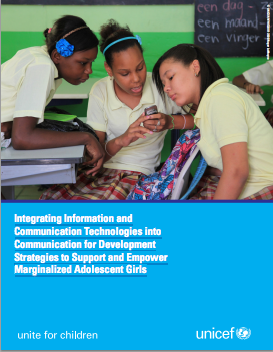
Screen Shot 2013-10-11 at 7.24.48 AMA paper that Keshet Bachan and I authored for Unicef is now available for your reading pleasure!

Here’s a  summary of what we talk about in the paper:

Social, cultural, economic and political traditions and systems that prevent girls, especially the most marginalized, from fully achieving their rights present a formidable challenge to development organizations. The integration of new Information and Communication Technologies (ICTs) to the Communication for Development (C4D) toolbox offers an additional means for challenging unequal power relations and increasing participation of marginalized girls in social
transformation.

We examine ways that ICTs can strengthen C4D programming by:

  • enhancing girls’ connections, engagement and agency;
  • helping girls access knowledge; and
  • supporting improved governance and service delivery efforts.

We reflect and build on the views of adolescent girls from 13 developing countries who participated in a unique discussion for this paper, and we then provide recommendations to support the integration of ICTs in C4D work with marginalized adolescent girls, including:

  • Girls as active participants in program design. Practitioners should understand local context and ensure that programs use communication channels that are accessible to girls. This will often require multi-channel and multiple platform approaches that reach more marginalized girls who may not have access to or use of ICTs. Programs should be community driven, and real-time feedback from girls should be incorporated to adjust programs to their needs and preferences. Mentoring is a key component of programming with girls, and holistic programs designed together with girls tend towards being more successful.
  • Privacy and protection. Every program should conduct a thorough risk analysis of proposed approaches to ensure that girls are not placed at risk by participating, sharing and consuming information, or publicly holding others to account. Girls should also be supported to make their own informed choices about their online presence and use of ICT devices and platforms. A broader set of stakeholders should be engaged and influenced to help mitigate systemic and structural risks to girls.
  • Research and documentation. The evidence base for use of ICTs in C4D programming with marginalized adolescent girls is quite scarce. Better documentation would improve understanding of what programs are the most effective, and what the real added value of ICTs are in these efforts.
  • Capacity building. Because the integration of ICTs into C4D work is a relatively new area that lacks a consistent methodological framework, organizations should support a comprehensive training process for staff to cover areas such as program design, effective use of new ICT tools in combination with existing tools and methods, and close attention to privacy and risk mitigation.
  • Policy. Programs should use free and open source software. In addition, child protection policies, measures and guidelines should be updated to reflect changes in technology, platforms and information sharing.

The paper was first shared at the 12th Inter-Agency Roundtable on Communication for Development in November 2011. It was then reviewed and updated in August 2012, and released in August 2013 under the title “Integrating Information and Communication Technologies into Communication for Development Strategies to Support and Empower Marginalized Adolescent Girls.”

Download it here!

Read Full Post »

Last Friday I had the opportunity to share a panel discussion on “Designing New Narratives: from poverty porn to agency” with Leah Chung, Maharam Fellow and RISD student, and Victor Dzidzienyo, Associate Dean of the College of Engineering Architecture and Computer Sciences at Howard University. The panel was part of the “A Better World by Design” Conference planned and run by a committee of students from Brown University and the Rhode Island School of Design, here in Providence.

Photo from http://www.affenstunde.com article on One Laptop Per Child.

I was responsible for setting the stage and moderating, wearing my Regarding Humanity hat. I showed a number of images and narratives that I find questionable – from aid agency fundraising campaigns to children receiving free shoes to famous musicians visiting Ethiopia to models posing in front of poor children to photos of them with imported technological “solutions”. The theme of the conference was “Pause and Effect.” My point was that we should pause and think about the long-term effects of these kinds of images and narratives on people we say we are helping, supporting or partnering with. Beyond fundraising, advocacy and branding for our organizations, what is the impact of these narratives? What long-term effects do they have when there is no strong competing narrative or variety of narratives that enable a more complex, nuanced and varied story?

Some of the ways that we can help change the narrative include:

Leah followed, sharing highlights from research she conducted this summer in Uganda on what Ugandans think about how they and Africans in general are represented in the Western media. With support from Hive Co-Lab, Leah and her research partner, Joseph Wanda, researched how people working in local NGOs and living in rural communities and informal settlement areas view ads like these:

People were asked which of these images they would prefer in a fundraising campaign. (Image courtesy of Leah Chung)

Image courtesy of Leah Chung

Perhaps not surprisingly, a large percentage of the adults interviewed said they preferred the sad photo, because it would be more effective at showing a story of need and raising funds. Interestingly, however, 66% of the children and adolescents interviewed preferred the happy one. Leah said  that a good number of people used the opportunity of her presence to include a story of their own needs and a personal appeal for funding or help during the interview process

Adults selected the sad image more often, whereas children and adolescents selected the happy one. (Image courtesy of Leah Chung)

Which of these images would you prefer for a fund-raising campaign? Image courtesy of Leah Chung

Overall, 76% of people Leah and Joseph interviewed said that they were not happy with the way that Africa is represented in the Western world.

The majority of people who participated in the study were unhappy with how Africa is represented in the "Western" world. (Image courtesy of Leah Chung)

Image courtesy of Leah Chung

Leah noted that through her research, she grew to understand that images are only the symptom of deeper dysfunction within the aid industry and its colonial legacy. She also noted that people all over the world hold stereotypes about others. She was viewed as someone bringing in resources to help, and called “Chinese,” although she is actually Korean.

Victor continued the topic by sharing his own story of living in DC as a child, and being one of the people that others wanted to come in to help. “For you as the outsider who comes in to save me, I have some questions,” he said. “For the folks who want to go on a ‘free trip’ to help, my question is: you are going there for what? What are the skill sets that you have that can make a difference? If you don’t have a skill set to offer, you should just stay home.” He recommended hiring local people for the various jobs needed during reconstruction after a disaster rather than sending over students with limited understanding of the local context and limited skills to work in it.

Victor emphasized the similarities in architectural design and designing programs aimed at helping after a flood or an earthquake. For both, a good understanding of the environment, the cultural context, the complexity of social structures, and the local beliefs and norms is required. He questioned whether academic institutions are doing enough to prepare students for working in these environments.

The ensuing comments and discussions made their way across a variety of related topics, with active participation from the room:

  • What can media and development professionals do to support agency? How can we move beyond satire and critique? The bullet points above are a start but what else can be done? We need to change our language, for one thing, and stop using phrases like “we are empowering people, giving them a voice, giving them agency.” We also need to remember that using poverty porn takes away agency from those who donate. The entire cycle is disempowering.
  • Local people are not passive in this: Communities and individuals can be very adept at manipulating this system. Local NGOs also have their own agendas and the aid industry also ties them in knots and makes it difficult for them to function, to be effective and to have a real impact.
  • How issues are framed and by whom matters. There is a great deal of exposure to the Western world and its viewpoints, and often the issues and narrative are framed by outsiders. Local work does not get the spotlight and credit, it’s normally sexy graphic design and social media campaigns like Kony 2012.
  • Should we help locally or internationally? The issues and problems in the world are global problems and they are interlinked at the global level, so where a person helps is not the issue. Location matters less than the underlying motives and levels of respect for people’s own agency, and level of ownership that local people have in the process. Going in to help a community in your own neighborhood or country that you do not understand or that you view as ‘lesser’ is not much different than doing that in a community abroad.
  • Poverty porn is a symptom of much larger issues in the international aid and development industry. The causes go much deeper and require a major shift in a number of areas.
  • Is it possible to change things or do we need to start over? Do we need a new model? It’s likely that international aid and development organizations will be disrupted and disintermediated by a number of forces and changes happening right now, from social entrepreneurs to global economic and power changes to technology to changes in “developing” country economies and attitudes. The problems are not going to go away and the market is not working for everyone, but the nature of how we address these issues will most likely change.
  • Poverty porn is profitable, how can we change this? How can we make the idea of agency and elevating other voices as profitable as poverty porn? How can we take a more comprehensive look at the system and where it’s not working? How can we change what the general public responds to and switch the general consciousness of people who care to a new way of looking at things? How can we re:see, re:listen and re:frame the narrative and get people excited about stories from people who know and live these issues? As intermediaries, our job is to provide platforms and to work to make these voices visible, not to tell other people’s stories. Can we engage people better by showing impact and change rather than miserable situations that victimize and provoke feelings of guilt?
  • Sharing and dialogue is one way that people can learn from each other and build strength in numbers to change things. Supporting “south-south” discussion and learning is key, as is discussion and dialogue between policy makers and practitioners.
  • People (we) need to be aware of their (our) own privilege. People give out of guilt. Until they (we) understand their (our) own power and privilege and step out of it, we will never move forward. Educational institutions confirm and allow people to benefit from their privilege. Going on a semester abroad to “help” people ends up looking good on a student’s resume and helping them, in the end, get a job, not really helping those they went to “help.” So the volunteer ends up getting wealthy from these situations, in a way.
  • Empathy matters, but how do we take it a step further than sleeping outside for a night to understand homelessness? Do these small efforts towards empathy add up to a larger awareness and behavior change, or are they meager attempts to experience life as “the other” without a real examination of power and privilege? How do we take this conversation a step wider also and look at how the West perpetrates and causes poverty by our own policies and consumption patterns?

Read Full Post »

Screen Shot 2013-09-13 at 5.09.30 PMYouth make up 17 percent of the world’s population and 40 percent of the world’s unemployed, according to the International Labor Organization. A number of factors combine to make sustainable, decent employment an enormous challenge for youth the world over, including low levels of education and technical skills, slow job growth, lack of information about available jobs, and difficulties accessing financial capital to start small enterprises. Decent jobs are especially difficult to find for rural youth, girls and women, and youth with disabilities.

In addition to the growth in youth unemployment, access to and use of mobile technologies (e.g., mobile phones, tablets, eReaders, radio, portable media players, SD cards) among youth worldwide is also expanding. This has created excitement about the potential of mobile devices to catalyze new approaches that address some of the constraints keeping youth from finding and sustaining decent livelihoods. Documentation and evidence of impact in the broad field of mobile technology and youth workforce development (mYWD) is lacking, however, meaning that it has been difficult to identify where mobile technology and youth workforce development initiatives overlap and where mobile may have the greatest added value.

After a year of hard work, last week we launched the mEducation Alliance’s Mobiles for Youth Workforce Development (mYWD) Landscape Review, an effort of the mEducation Alliance, The MasterCard Foundation, and USAID. The review maps out who is doing what and where, and to the extent possible, discusses evidence of what is working. The body of the report answers questions such as:

  • What organizations and programs are using mobiles to help overcome the barriers to employment for youth?
  • What type of programming has been implemented and how?
  • Where do prime opportunities exist for integrating mobile devices into youth workforce development programs?
  • What are relevant considerations related to gender and disability in mYWD programming?
  • What factors facilitate or hinder mYWD in specific contexts?
  • Are there any research findings that show the impact of mobiles on youth workforce development?

In addition, the annexes provide information on 80 initiatives and over 275 publicly available documents describing efforts that use mobile technology to support youth workforce development programming in five key areas:

  • Workforce education and training, including basic education, technical and vocational education and training (TVET), job skills training, apprenticeships, and life skills training (in and out of the classroom).
  • Employment services, including on-going job referral services that bring employers and workers together through job postings, job fairs, job shadowing, job placement, resume preparation, and coaching.
  • Entrepreneurship and enterprise development, including support programs for self-employment and business development, such as entrepreneurship training, mentoring, and financial services for loans and capital.
  • Demand-side policies and programs, including broad-based economic growth programs like national youth employment policies, value chain development, public works programs, wage subsidies, minimum wages, and tax breaks for employers (JBS International, 2013).
  • Addressing social norms, including programs that support effective participation of excluded groups, non-traditional skills training, safe training and employment spaces for excluded youth, and broader awareness campaigns.

There is an enormous amount of activity in mYWD, from small-scale, market-based start-up applications to mobile innovation hubs for youth entrepreneurs. The landscape review offers a summary of how mobile devices are used in the above five areas, draws out relevant lessons from the available literature and existing evidence base, offers advice from practitioners working in the field of mYWD, discusses the issue of scale and sustainability of mYWD programs, and offers a number of recommendations for furthering the field, including:

  • Creating a mYWD framework to aid in advancing the field
  • Further developing the evidence base for mYWD
  • Improving our understanding of what scale means
  • Focusing on gender and youth with disability
  • Improving knowledge sharing and collaboration
  • Building the mYWD evidence base through research and impact evaluation

Download the mYWD landscape review at this link!

If the topic is of interest, you can also join the mYWD working group by signing up here.

Read Full Post »

This is a cross post from Tessie San Martin, CEO of Plan International USA. It was originally posted on the Plan USA blog, titled Old Roads to New Directions. We’ll have Tessie, Chris Blattman and Paul Niehaus from Give Directly joining us in NYC for our November Technology Salon on Cash Transfers. More info on that soon!
.
There has been a lot of chatter in the mainstream media about unconditional cash transfers (UCTs) lately. See, for example, recent pieces in The New York Times and The Atlantic; and a much discussed segment in NPR. Most media pieces also mentioned an organization called GiveDirectly that does just this. The idea, touted as an important innovation in development, is simplicity itself: give cash directly to poor people who need it, without strings.

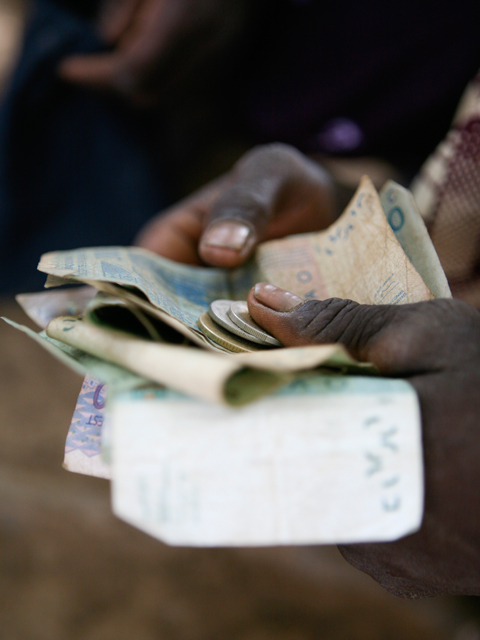
GiveDirectly leverages the low costs of mobile money to deliver cash transfers to poor households in select African countries. Initial results are encouraging. The money is not being spent on “sin goods”. On the contrary, it is being – for the most part – directed into productive investment that helps these poor families get ahead.

It is worth noting differences between UCTs and CCTs (conditional cash transfers). CCT programs provide cash payments to poor households, but they impose conditions on recipients before they get the money, mostly related to children’s health care and education (e.g. enroll the kids in school). UCTs put no such conditions. This is why there is such enthusiasm about UCTs. “No conditions” means such programs tend to be cheaper to administer. At least that is the theory. Note that UCTs and CCTs are similar in that neither has any conditions on how the money (once obtained) is spent.

This posting is focused on UCTs because of the current buzz around them. Although they are showing impressive results, let’s be realistic about the potential and limitations of UCTs. There is a lot that we do not know about the conditions under which UCT schemes lead to sustainable poverty reduction. Nor are we clear about how such programs can be scaled effectively. To the credit of organizations like GiveDirectly, they have partnered with Innovations for Poverty Action to carefully evaluate the results of their actions through rigorous randomized control trials.

It is worth noting that GiveDirectly is doing more than just sending cash to the poor; they are also spending resources carefully identifying, evaluating and selecting beneficiaries, and on monitoring and evaluation. This leads me to one of three points I think are worth making about UCTs.

First, the idea behind UCTs may be simple, but the more successful UCT schemes are complex. The “U” in UCTs does not mean that all you are doing is giving poor people money and stepping back. Research done by ODI and funded by the UK’s Department for International Development (DfID) suggests that UCTs work best when accompanied by information, education and communication efforts, careful targeting and selection of participants, and constant feedback and interaction. In other words, you need to consider who will be selected, what complementary efforts/services will enable and facilitate a good response, and you need to constantly invest in citizen feedback channels that allow you to learn and adapt as better information about program impact comes in. This is not much different than what a good INGO needs to do in order to deliver effective programming (UCT or not).

Second, the media coverage ignores how much variation exists among UCTs schemes. As the World Bank’s Berk Ozler has highlighted, there is a world of difference between “waking up one morning and finding $500 in your M-PESA account” (GiveDirectly) and the interventions being carried out in Liberia for unemployed youth, or what the DfID-funded ODI studies describe. Again, it is too early to tell what kinds of effects on poverty reduction we can expect from such schemes and we are miles away from understanding how scheme design details are related to sustainable paths out of poverty.

This leads me to a third set of questions: for whom are UCTs working? How do program results compare in urban vs. rural areas, for different income levels? We have years of data on CCTs, particularly a lot of data from Mexico, Brazil and other middle income countries where these programs have been scaled up nationally. Yes CCTs have problems (what development and social safety net programs do not?). But there is plenty of research demonstrating the conditions under which CCTs work. UCTs are much less well studied.

But the importance of these innovations, as Chris Blattman has already said, is that it forces (or should force) development organizations and donors to think about “top and bottom lines.” In other words, is what we are doing working? And even if it is working, at what cost? More importantly, we should always ask: are there other options for delivering the same (or similar) results more cost effectively?

As the CEO of a child sponsorship organization, I am drawn to the idea of UCTs. In fact, our initial child sponsorship efforts decades ago bear important similarities to today’s UCT programs. But Plan (like most other child sponsorship organizations) stepped away from such direct transfers, as concerns with sustainability and dependency grew. It is perhaps time to take a new look at the evidence around cash transfers, invest in reviewing results of past sponsorship programs and the lessons learned from that experience that may be applicable to a new generation of UCTs.

In the private sector, publicly quoted companies live and die by the share price, and the pressure to innovate and stay ahead is always present. For public charities like Plan, the rewards – and risks – of innovation are much less clear. But ignoring disruptive technologies and innovations, and failing to continuously push to experiment and learn will lead to irrelevancy. The jury may be out on UCTs, but they need to be taken seriously. GiveDirectly and others like it are pushing us all to do better.

Read Full Post »

According to the latest GSMA statistics, nearly 50% of people own a mobile phone in the developing world and almost 70% have access to mobile phones. With mobile access increasing daily, opportunities to use mobiles in development initiatives continue to grow and expand. The area of Mobiles for Development (M4D) has attracted investment from all sides, including mobile operators, entrepreneurs, investors and international development agencies – all working to generate social impact and improve wellbeing at the base of the pyramid. However, efforts to scale M4D initiatives and make them sustainable have largely failed.

Our July 25th NYC Technology Salon examined the topic of Scaling M4D. Lead discussants Corina Gardner from the GSMA’s Mobile Development Intelligence (MDI) unit and Sean McDonald from FrontlineSMS joined us to kick off the conversation, which was hosted at the Rockefeller Foundation.

Screen Shot 2013-08-14 at 10.52.13 AMThe Salon started off with key points from the MDI report “Scaling Mobile for Development: A developing world opportunity,” which highlights the issue of sustainable and scaled impact as the central challenge (and opportunity) in M4D over the next five years. Because the GSMA is commercially focused (it is made up of telecommunication industry members), business models that can achieve both revenue goals and added value to customers are a core concern. GSMA is interested in finding M4D business models that convince industry to re-invest and replicate. However not many of these examples exist.

Business models at the base of the pyramid (BOP) tend to be different than what the industry is used to. If scale is defined as the number of people reached with a service, and the population being reached has little money, then the only clear business model is via a huge customer base. Given that international development agencies also want to achieve scale with development programs, there is a good potential overlap in M4D. In order to achieve good impact, it’s critical to think through what BOP users want and need, and what offers real value to them for their limited resources.

Innovative vehicles are needed for investing in M4D. Currently, M4D financing tends to take two distinct paths: International Development funding and Venture Capital (VC) funding. Hiccups occur because the two operate very differently and do not always work well together. International development funds and processes do not move as quickly as technology-based funds. There is low tolerance for uncertainty and a desire for initial proof of potential impact, adoption and uptake. On the VC side, there is the desire for a light overhead structure modeled after Silicon Valley; however in African countries, for example, there is little existing infrastructure, meaning a heavier structure and a slower process. In addition, the exit strategy may not be clear. A worst-case scenario is when one of the two types of financing bodies is interested in investing, yet both walk away when they see the other at the table.

Though very few examples of M4D at scale exist, some elements brought up during the Salon that need to be considered include:

User-centric design. It is critical to understand the community and the end user’s needs, demands, and payment capacity. Both the private sector and international development agencies have existing approaches to developing M4D initiatives that focus on understanding local context and consultation and engagement with users, but the two sectors use different language to describe these approaches and they often talk past each other without connecting on their commonalities. According to one discussant, the best and most user friendly design is that with the lowest barrier to access, the simplest technology, the cleanest interface and configurability, so that people can build in more complexity if needed. These types of design will also tend to be the most replicable, an important element of scale. Iterative design and getting prototypes in front of users is needed to get their feedback, and this can be a challenge in M4D programs if they are being done within typical international development cycles of planning and funding.

User data. Users at the base of the pyramid are both financially poor and “data poor” and companies cannot create products for users that they know nothing about. Mobile can help gather data on user behaviors. This data can be used to inform business models, create products and services of value for BOP users, and to create revenue streams. One key question is that of how the data can be better used to benefit the BOP more broadly.

Understanding what ‘scale’ means for different parties. For mobile operators, scale is important because it is linked to numbers, volume and revenue. However this is not the element that matters for those working in international development, where impact may be a more important measure of success. Uptake of an M4D service may be due to advertising, rather than because it has a measurable impact on the life of a user. The difference needs to be understood and better analyzed and documented before success, scale, or impact is claimed. One measure of success is improved and sustained functioning of broader systems — and mobile may only be one small piece of a well-functioning development program, information ecosystem, or service delivery effort. As one discussant noted, “I don’t care if someone uses mobile banking or branch banking, so long as they are banking.” The mobile device may not be the central piece; it may be an additional access point for people who were formerly left out of these systems. In addition, “reaching” people is different than “influencing” people, and the latter will likely have more of an impact. Trust is critical in these efforts to influence, and often that takes more than a mobile connection.

Infrastructure.  The case for improved networks, coverage, and other infrastructure (electricity, for example) needs to be made to operators and government. The urban-rural divide when it comes to infrastructure is a global issue, not just one in so-called ‘developing economies.’ For example, using 4G and a credit card, someone can order a product on Amazon from the DRC, however Amazon will not be able to deliver that product. Similarly, someone can report poor government services via a mobile phone, but until infrastructure and governance improves, there may be no response. Poor infrastructure in rural areas is an issue globally.

Payment. Operators incorrectly give away free SMS to NGOs, said one discussant. Instead, having to pay a small amount (either as an NGO or an end user) means that much more care is taken in terms of what is communicated. “If it costs 5 cents to send a message, you will not spam people.” This is also critical for building in sustainability, and where the best ROI tends to be found in technology influenced programming. More thought and research is needed regarding payment and sustainable, scalable models.

Due diligence. A challenge in the M4D space is the high incidence of people seeing a problem, thinking no one has addressed it, and jumping in to build their own solution. This wastes money and time and creates churn. It is important to do research, layer, and build from other people’s ideas and existing solutions. One problem with the idea of due diligence, according to a participant, is that it means different things to different people. In technology it means “you have a problem, what is the cheapest and most robust solution,” but in the field of international development, context discovery takes a very long time and requires multidisciplinary knowledge and awareness that goes far beyond technology. There is also a need to consider whether technology (as opposed to non-digital efforts) is the most viable solution for the information and communication situation. ‘Horizontal due diligence’ (looking at partnerships) and due diligence with regard to maximizing systems are also needed.

Monitoring and Evaluation (M&E). M&E is currently sub-par on most M4D initiatives, said one participant. Organizations are often doing their own M&E rather than having a third party conduct external M&E.  There is a lack of comparative data on M4D programs also, and often M&E is attempted at the end of a project rather than built in from the start. A greater presence of academia is needed in M4D work, it was noted, and we also need more qualitative data, as currently the emphasis is on the quantitative data that are collected more easily via mobiles. One benefit in M4D programs is the ability to digitize and intelligently store data from the very start. This is the way to show scale and impact, said another participant. However data need to be well-used and refined, and available to the right person or people at the right time. Greater respect and understanding of privacy and ethical issues along with helping people to understand and steward their users’ data are also critically important and need more attention.

Salons function under Chatham House Rule, thus no attribution has been made. Sign up here to join the Technology Salon mailing list to receive invitations for future events in NYC, DC, San Francisco, London and Nairobi!

Read Full Post »

from chaos to haute couture...

from chaos to haute couture…

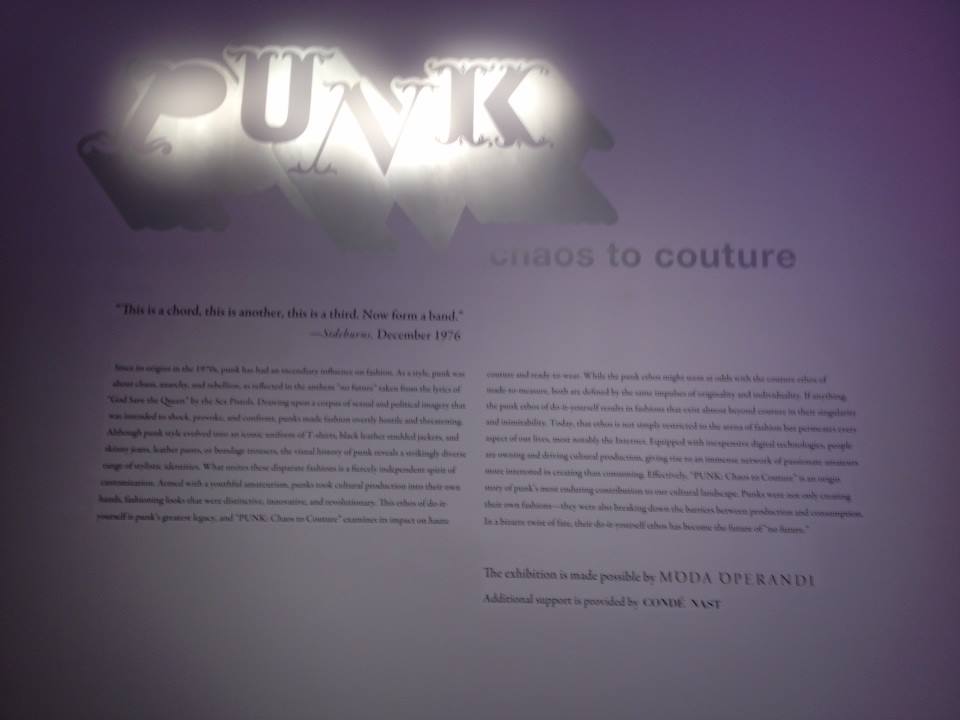
I took my 16-year-old (a huge music fan) to the Met on Saturday to see the Punk: Chaos to Couture exhibit. I was a little skeptical, having been pretty into punk rock as a teenager.

It was really bizarre to be at The Met, looking at how punk rock influenced high fashion. In fact, it was kind of ridiculous. (Hello, $100 designer “punk rock” shirts in the Museum Shop.) Everyone kept getting in trouble for photographing things (which of course only made me want to photograph them more). My daughter kept admonishing me to stop.

I would have preferred an exhibit about punk rock over one on high fashion, but it was cool that I kept overhearing mothers around my age explaining to their daughters “yes, back when I was a teenager….” or “I used to wear this kind of thing back when…” Of course they were not talking about high fashion, but about the real live stuff we used to get from the thrift shops and modify into something new. In my home town we were normally about 10 years behind the times, and we didn’t discover punk rock till the 80s, but oh well. Back then we didn’t have cable or the Internet, and punk rock was not available at the mall. We had to find inspiration wherever we could.

46909_10151752486462284_666195068_nThe background information about the Chaos to Couture exhibit explained that the difference between British punk and American punk was that Brit punk was a sociopolitical reaction of the working class and US punk was more an intellectual-artistic movement. I have to say, though, that in Indiana in the 1980s, we were rebelling against the boredom and status quo of life in general. We weren’t politically engaged, intellectual, or particularly artistic; we just felt like misfits and knew something was not quite right. We didn’t want to be like the people around us.

The Met exhibit credits the punk DIY attitude for spawning some of the current approaches in tech and social media today. (DIY is wonderfully chronicled, by the way, in the excellent book “Our Band Could Be Your Life” which covers the 80s DIY music movement in the US, including chapters on some of my favorites: The Butthole Surfers, Black Flag, The Minutemen, and Sonic Youth).

A good friend of mine and I semi-jokingly talk about wanting to do PunkICT4D. We’ve mused about starting the #ICT4Anarchy hashtag based on the definition below from Noam Chomsky. (We’ll be exploring some of this in December at ICTD2013 during a panel with a high brow, academic, not very punk sounding title: “Appropriating ICTs for Developing Critical Consciousness and Structural Social Change.”)

[Noam says] Well, anarchism is, in my view, basically a kind of tendency in human thought which shows up in different forms in different circumstances, and has some leading characteristics.  Primarily it is a tendency that is suspicious and skeptical of domination, authority, and hierarchy.  It seeks structures of hierarchy and domination in human life over the whole range, extending from, say, patriarchal families to, say, imperial systems, and it asks whether those systems are justified.  It assumes that the burden of proof for anyone in a position of power and authority lies on them.  Their authority is not self-justifying.  They have to give a reason for it, a justification.  And if they can’t justify that authority and power and control, which is the usual case, then the authority ought to be dismantled and replaced by something more free and just.  And, as I understand it, anarchy is just that tendency.  It takes different forms at different times….

In doing a little reading on the exhibit at the Met, I found this rather blind statement (my bold).

In the 1970s, Punk was so much more than a fashion statement. In Britain, it was a reaction to sky-high unemployment, to the Thatcher administration’s closing of the mines, and to the pervasive feeling of hopelessness. Andrew Bolton, the British curator of the show, talked about how that political tinderbox could never be recreated today, although the fashions could be referenced and reworked.

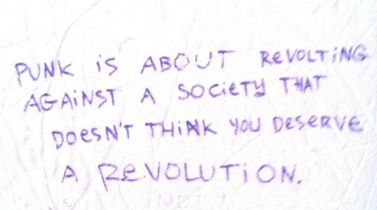
On the one hand, duh. We all know that punk became another watered down, mass-produced, corporate-sponsored commodity. On the other hand, no. Punk’s not dead. The best part of the exhibit was this, scrawled on one of the walls:

Courtesy of @umairh because I was being watched by a museum guard and couldn't get a photo.

Courtesy of @umairh’s Twitter feed because the museum guards were watching, and I couldn’t get any more photos.

Maybe I’m a throwback, but it seems punk’s still hugely relevant.
.
PD: Chomsky on Celebrity and Punk Rock, via Christopher Neu.
.

Read Full Post »

Screen Shot 2013-07-14 at 2.40.51 PMLast week, 600 exceptional youth activists from 80 countries arrived to New York City for a UN Takeover, where they called for urgent action by member states to meet Millennium Development Goal 2 on education by 2015. The youth’s inputs will feed into setting the agenda for global education priorities post-2015. One of the highlights of the week was this inspiring talk by Malala Yousafzai, who made her first public address to the UN on June 12th, her 16th birthday.

Seven of the youth participating in the UN Takeover with the support of Plan joined us as lead discussants for our July 10th Technology Salon. Agung, Dina, and Nurul from Indonesia; Kamanda and Fatmata from Sierra Leone; Tova from Sweden; and Frank from Uganda told us about ICT access and use in their communities and countries. We also heard about their work as youth activists on issues of child marriage, school violence, good governance, and education, and whether ICTs are effective outreach tools for campaigning in their contexts.

The realities of access

In both Sierra Leone and Uganda Internet access is quite difficult. Traveling to Internet cafés in urban areas is too expensive for rural youth to do regularly, and it is unsafe for young women to travel in the evenings. There is not enough equipment in schools and universities, and youth have trouble affording and finding regular access. The majority of primary and secondary schools do not have ICTs, and non-governmental organizations are unable to reach everyone with their programs to supply equipment and training. Although there are often funds given to governments to build computer labs, these tend to benefit urban areas. In some cases projects and funds are used for political gain and personal favors. Even at university level, student access might be limited to 1-2 hours per week at a computer lab, meaning they end up doing almost everything on paper.

Lack of ICT access impacts on job prospects for youth, because jobs exist but employers are seeking people who know how to operate a computer. Many of these job applications have to be submitted online. This puts jobs out of reach of youth in rural areas. Basic infrastructure remains a problem in rural areas. Although telecommunication lines have been laid, electricity for charging mobile phones is still a problem and often electricity is dependent on a solar panel or a generator, making it difficult to run a computer lab or Telecenter.

ICTs are heightening the development divide, noted one Salon participant. In schools near urban areas, parents pay more in tuition and school fees and their children have better ICT access than rural children. This creates inequality. “Students going to these schools have access and they will even study computer science. But when you go to a rural village you might only see one small room where children can access a computer, if anything at all. Teachers themselves don’t know how to use computers.” In cities, parents know ICTs are important. In the rural villages, however, many people are skeptical of technologies. This inequality of access and education means that youth in rural areas and the poor are not able to meet requirements for jobs that use ICTs.

One discussant noted, “It is possible to access Internet through mobile phones. You can use some phones to access Internet, Facebook, etc. In the villages, however, you find that you can only receive calls and make calls. There is no Internet. When I went to Nairobi and saw everyone with smart phones, I wondered, ‘What is wrong with Uganda?’ We don’t have many smart phones.” Another discussant commented that her university has a wide area network, but it is only available to lecturers, not to students.

Most of the youth discussants considered that, among their peer groups, more girls than boys had mobile phones, and more girls were active on the Internet and Facebook.

Access brings concerns

In Indonesia, it was noted, Internet is very available, except for the more remote islands. In Java, commented one discussant, “every young person has a smart phone. They use Facebook and Twitter and can get all kinds of information, and those without smart phones can use Internet cafés.” Internet access, however, is creating new problems. “Parents are proud that their kids are going to the Internet shop to get information, but they also worry about increased access to pornography.” Internet is believed to contribute to an increase in child marriages. The youth discussants said they would like more guidance on how to filter information, know what is true and what is not, use Internet safely, and avoid exposure to offensive content. One discussant from Indonesia mentioned that parents in her community worried that if girls went to Internet cafes or browsed online, they would be exposed to inappropriate materials or prostitution through Facebook.

In Sweden, access to Internet and smart phones is universal. However, parents may buy children a smart phone even if they cannot really afford it. Although many children learn English early because they can easily access Internet, many also do not learn how to write properly because they only use computers.

When phones are available but there is no capacity to purchase them, additional problems also arise. According to one discussant, “Some girls want to have big things before their time.” This can lead to young women offering sex to older men in return for money, fancy phones and airtime.

ICTs in formal education

Youth discussants all said that they are increasingly expected to have access to the Internet and computers in order to complete their school assignments, and they felt this was not a realistic expectation. In one of the youth’s schools in Indonesia, computer class is offered for 4 hours per week and a computer lab is available with 30 desktop computers. In another school in Jakarta, however, every child is expected to have their own laptop. “Our problem is different than in the remote areas. Every teacher in Jakarta thinks that a smart phone or computer is ‘the world in our hands.’ They think we don’t need education about the computer itself. They think we can learn from the Internet how to use computers, and so we have to search and learn this all by ourselves with little guidance.” In Sweden, “if you don’t have Internet access, it will be very difficult to pass a course.”

Effective ways to reach and engage youth in campaigns

Discussants were asked about the communication channels that are most effective for campaigning or engaging youth and communities. In rural Sierra Leone and Uganda, face-to-face was considered the most effective outreach channel for reaching youth and communities, given low levels of access to computers, radios and mobile phones. “Most times our campaigns are face-to-face. We move to communities, we use local language to be sure everyone gets the message,” said one youth discussant. In Jakarta, however, “it’s easy to use online means, it never sleeps. Young people in Jakarta are too lazy to attend workshops. They don’t like to listen to speakers. So we share by social media, like Facebook and Twitter.”

Digital media is only useful in urban areas, said one youth discussant from Sierra Leone. “We mostly use radio to do advocacy and sensitization campaigns. We also do it face-to-face. For secondary schools, we do talks. We tell them about documents signed by government or NGOs, what is in place, what is not in place. We give advice. We talk straight about health, about sex education. You just wait for the light in their eyeball to see if they are understanding. We also do dramas, and we paste up wall bills. We do all of this in our local languages.” Youth groups and youth networks are also useful channels for passing along messages and building support.

Radio is effective in theory, but one discussant noted that in his district, there are only two radio stations. “You take your information or announcement there, and they say they will pass it, but you stay waiting… it’s a challenge.”

Campaigns must also involve engaging local decision makers, a participant noted. Often chiefs do not understand, and they may be the very ones who violate the rights of girls. Youth noted the need to be diplomatic however, or they risk being seen as impolite or trouble-makers. “You have to really risk yourself to do rights work in the community,” noted one discussant. Another commented that having support and buy-in from local leaders is critical in order to be taken seriously. “You need a ‘big voice’ to back you and to convince people to listen to you.”

INGO staff can help legitimize youth work in some cases, but there are also issues. “Local leaders always ask for money,” noted one discussant. “When they hear Plan, UNICEF, Care, Save the Children, they think these organizations gave us money and we’ve taken it for ourselves.” Youth often resort to using external INGO staff as their legitimizing force because “we don’t have other role models, everybody wants money. The politicians say they will help us but then they are always too busy. We have to take the lead ourselves.”

Conflicting information and messages can also be a problem, commented a Salon participant. “One year, it’s the ABC Campaign for HIV prevention, the next it’s condoms, and then it’s prevention. Sometimes youth don’t know who to believe. The NGO says something, the government says something, and local leaders say something else. We need consistency.” In addition, he noted, “INGOs come in with their big range rovers, so of course local leaders and communities think that there is money involved. INGOs need to think more carefully and avoid these conflicting messages.”

What would youth like to see?

Going forward, the youth would like more access, more ICT education, more transparency and accountability in terms of how governments spend funds directed to ICT programs, and more guidance on filtering information and ensuring it’s veracity so that children will not be taken advantage of.

*****

Thanks to the Population Council for hosting us for the Salon! Join us for our next Salon on July 25th: How can we scale Mobiles for Development initiatives? 

The Technology Salon methodology was used for the session, including Chatham House Rule, therefore no attribution has been made in this summary post. Sign up here to receive notifications about upcoming Salons in New York, Nairobi, San Francisco, London and Washington, DC. 

Read Full Post »

« Newer Posts - Older Posts »