Feeds:
Posts
Comments

Archive for the ‘gender’ Category

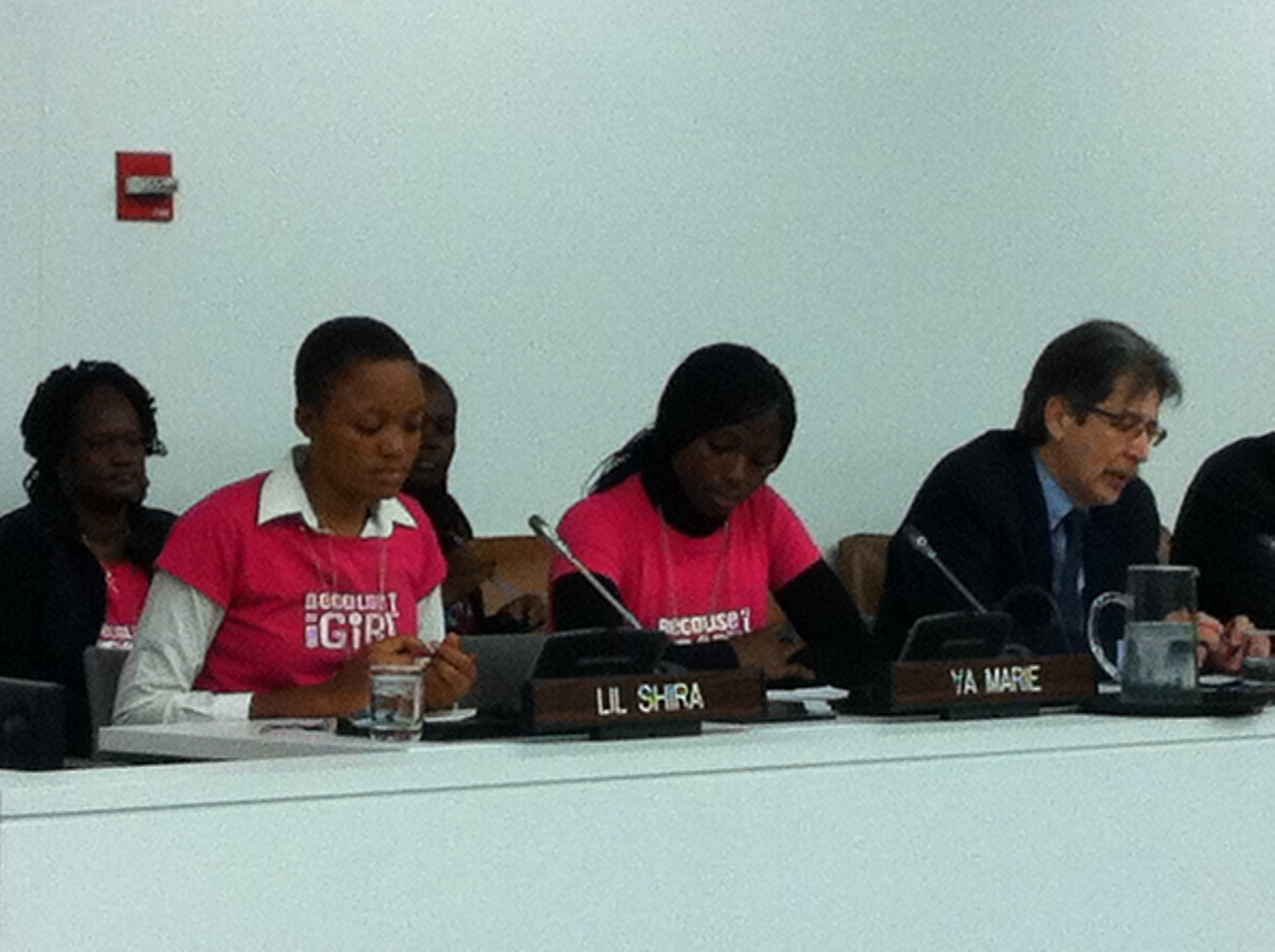
This is a guest post from Lil Shira, one of the girl delegates who attended the 55th Session of the Commission on the Status of Women in February, 2011. Lil Shira was part of a Plan led Girl Delegation which took part in high level panels, side events and caucuses. This post appears complete in its original format. You can read a post by Fabiola, another of the girl delegates from Cameroon, here.

Lil Shira in the community

My name is Lil Shira, a high school student and a Cameroonian.  I am the second child out of five children in my family, three girls and two boys, and we live in a rural area. Because I am a girl I was selected by my school authority to be part of the journalism club in the school. This paved my way into YETAM (Youth Empowerment through Technology, Arts and Media) project sponsored by Plan Finland since the Journalism club was chosen for this project.

Because I am a girl I had to use the skills I have acquired in YETAM on music, media and ICTs to indentify issues like the problem of early and forced marriage, high rate of school dropout and violence against the girl child. Because I am a girl, I had to mobilize other youth (girls and boys) victims, so as to speak out as a unique voice, to raise awareness to the general public using music, drawings, drama, poems, videos, computers and overhead projector as tools. This led to many local advocacy actions spearheaded by us.

I was also very happy to celebrate the 21st anniversary, in Yaoundé in Cameroon, of the ratification of the Convention on the Rights of the Child within the framework of YETAM project. These created a big impact in my life, the lives of my friends, youth, school, family and my country. All these activities took me to a higher level because I was again selected, this time to be one of the girl delegates to represent Cameroon in the 55th session of the UN Commission on the Status of women (CSW) in New York City.

Lil Shira presenting at the CSW.

I was very happy, excited together with my friends and family members and I was planning and preparing on the role I was going to play while in New York. My expectation was to work with other youth from different region and country but did not really expect I was going to talk to Ministers from all the members’ state of the UN. I did my first presentation with the Canadian Minister on a panel about the importance of commemoration days and the importance of setting up an International day for the girls.  Another thing which made me feel so opportune was the panel with UN women Ministers in the UN building.

I was very impressed seeing ministers from over two hundred countries and above listening to me and in effect giving a positive response to the issues I presented. In fact their reaction made me feel at home and so happy. I was equally happy to listen to other girls raise issues like gender based violence and discrimination in their various countries and what they have been doing to combat it.

Coming in contact with girls from Sierra Leone, Finland, United States, Indonesia, Canada and others, not mention to share our ideas, was so wonderful and exciting.  This was a forum for me to dialogue with them to know more about them and some of the issues affecting them in their own country which was contrasting with mine. Though I was nervous during my first presentation, meeting new faces it all passes away like a breeze and I did not have any complex because everything was cute.

Life in the US to me was very enjoyable and meaningful, but I could not stop complaining of the cold and snow. In addition, I tried eating food not familiar to that of my home country. All these contributed greatly to the wonderful experiences I had on the weather condition and the food.  I have learned to adapt to situations wherever I find myself. I hope to continue sharing this experience so that others may learn from it.

This is the time for girls to take up the challenge. I know my rights and have claim them, and no one can take them from me because I am a girl.

Thanks to Plan International, Judith Nkie our Chaperone, Kate Ezzes and Lia de Pauw.

Girls, claim your rights!

Related posts and videos about YETAM and the CSW:

Girls voices in global forums

Girls in rural Cameroon talk about ICTs

55th CSW: Women, girls, education and technology

A catalyst for positive change

On the map: Ndop, Okola and Pitoa


Read Full Post »

As I mentioned in an earlier post, I spent last week at the 55th meeting of the Commission on the Status of Women. The organization where I work supported 12 girls from various countries to attend and speak at different panels and side events during the week.

Why is it important for girls’ voices to be heard at global events like the CSW? Why should they be allowed to sit at tables with adult decision makers? Is this a wise investment when we could have spent that money to bring an adult staff member instead? Well, from a strictly rights-based perspective, it’s because girls have a right to participate in decisions that impact on their own lives.

But there are so many other reasons that girls need to be present at these events. They bring perspective that is otherwise missing. Before women are women, they are girls. It’s well known and well documented that investing in girls’ education and other areas has impacts that go far beyond schooling. At these big meetings, issues that impact girls and women are being addressed and discussed – so there needs to be space for girls and women who feel these issues directly to speak for themselves, especially girls and women who are typically left out of these processes. Girls bring a reality check. They offer ideas and solutions from their own contexts. They bring points home that can otherwise be missed. They are often amazing speakers and have incredible wisdom and insight to share. We can all learn from them. And bringing girls and their opinions and voices to a huge event like the CSW can really have a positive impact both on the event, the event participants, the decisions made there, and on the girls themselves, as they return home with a mandate to live their leadership in their own communities and countries.

Early in the week, I shared a panel with Fabiola, one of the girl delegates from Cameroon, and she truly stole the show. Here’s how:

Fabiola participates in the Youth Empowerment through Technology, Arts and Media (YETAM) project, and was selected by her peers to represent her group and Cameroon at the CSW. More information about Fabiola and Shira, the other girl delegate from Cameroon are in this post: Girls in rural Cameroon talk about ICTs. Shira also spoke at high level panels, as did the girls from Sierra Leone, Indonesia and Finland.

The girls also planned and managed their own side event where they talked about girls and new communications technologies.  In preparation for the event, they brought with them videos from their home countries, and Kirby, one of the girls from the US, edited them together into one piece. The video was shared at a few different events, and the girls were even asked to show it at the general assembly (at the last minute they weren’t allowed to for one reason or another). In any case, you can see it here:

On the last day that the girls were in New York, 3 of them sat on a panel in front of hundreds of high level decision-makers: UN officials, Ministers and government representatives. They talked about the challenges girls face in terms of accessing ICTs and raised the issue of violence against girls and how violence in schools impacts heavily on girls’ education.

My Cameroonian colleague, Judith, who works on the YETAM project with the girls, told me afterwards that she felt unbearably proud, seeing them there in front of the whole room, with everybody hanging on their every word. “I was floating,” she said. “As if my feet were not even touching the ground.” She was proud that Shira didn’t only present the issues that girls are facing in accessing ICTs or in terms of violence or early marriage, but Shira went further and talked about what they are doing in the community and how they are working with ICTs and conducting advocacy with decision makers and traditional councils to resolve the issues, and what impacts they have already had.

Josephine, one of the girls from Sierra Leone, said afterwards: “When I was there, speaking, I felt like I was on top of the world because people were listening to my voice.”

There needs to be more of this!

But if you are still not convinced, my fabulous colleague Keshet Bachan, coordinator of this year’s Because I am a Girl Report and the previous 3 reports, gives a convincing overview here about why girls and why now. Worth watching.

Read Full Post »

The 55th Commission on the Status of Women (CSW) happens in New York City Feb 21-25, 2011. For me, the most exciting thing about the event is that several girls from some of the countries where we are working (Canada, US, Finland, Cameroon, Sierra Leone and Indonesia) will be participating and speaking. This aspect of our work – helping to bring young people’s voices into these large influential forums – (when done properly) can be very effective at bringing a reality check to the ivory tower and helping influence decision makers at the very highest levels.

This year’s CSW is especially interesting to me since I work in the area of ICTs, and the theme of the CSW is:

“Access and participation of women and girls to education, training, science and technology, including for the promotion of women’s equal access to full employment and decent work.”

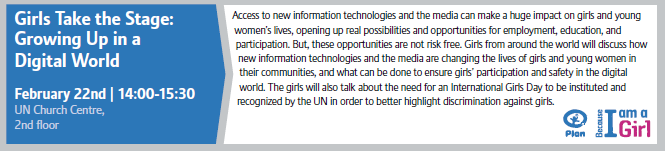
The girls will be presenting at the Girls Take the Stage: Growing up in a Digital World on Feb 22nd:

I’ll be presenting with Fabiola from Cameroon at the Empowering Girls: Education and Technology” session on February 23.

I’ll also talk at a panel-workshop hosted by the Buddhist Tzu Chi Foundation on Tuesday Feb 22, from 10-11.30, called “Breaking the Cycle of Poverty of Women and Girls through Education and Training,” on the 2nd floor room of the CCUN (Church Center of the UN).

Update: Ika one of the girls from Indonesia, will speak at a panel on Commercial Sexual Exploitation and the Girl Child: A Human Rights Approach at the Main Auditorium, Salvation Army Social Justice Center, 221 East 52nd St between 2nd and 3rd Ave, on Feb 24th from 2-3.30 pm.

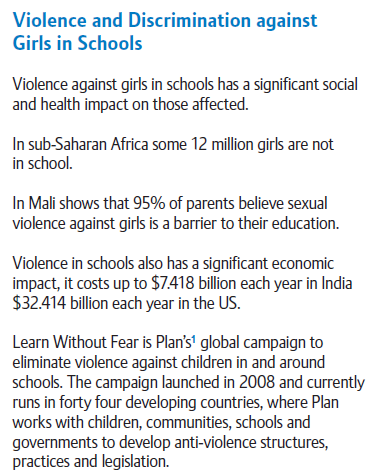
Update: Lil Shira from Cameroon will present on Violence and Discrimination against Girls in School, along with Marta Santos Pais (UN Special Representative to the Secretary General on Violence against Children) and others on Feb 22, from 16-17.30 at UN Church Center, 777 United Nations Plaza, Drew Room, Ground Floor.

Join us at the some of the sessions or come for an evening with the 21+ crowd at #ICT4Drinks Feb 23rd at 6 pm at Me Bar.

We’re trying to interest the girls in tweeting during the CSW on the @plan_youth account and to blog at  http://plan_youth.tumblr.com, so check it out as of this Monday. (We’ll see if they are willing or not!)

You can follow the events on Twitter at the hashtag #CSW55.

Read Full Post »

I spent the past week in New York City attending the UN Digital Media Lounge and Mobile Active’s mWomen Technology Salon. These 2 events happened alongside the Millennium Development Goals (MDG) Summit and the Clinton Global Initiative (CGI), where world leaders, corporations, movie stars/rock stars, innovators, and heads of big development organizations gather. There was a lot of talk about Technology and Innovation, Women and Girls, and Public-Private Partnerships, and, well, a lot of talk in general according to some, but I am not going to go there. Saundra put together a great compilation of MDG and CGI and UN Week posts over at Good Intents where you can read all about it.

My learning highlights for the week were in the area of m4D (mobiles for development) and ICT4D (information and communications technology for development):

  • World Bank Open Data. The Bank is really moving towards opening up their data. They currently have over 2000 websites and they are trying to consolidate them and make it easier for users to access the World Bank’s Data for their own purposes. The Bank has put more than 1,200 indicators, including the full World Development Indicators dataset, on the site. In addition, there are a variety of maps, dynamic graphs where you can compare data sets, and widgets for you to add information to your own website. Check the World Bank Open Data site for more.
  • UN Global Pulse. Over at Global Pulse the team is looking at existing indicators from UN agencies and others and trying to figure out how they can tap into human behavior patterns for early detection of crisis and as a way of quickly investigating and responding to such crises. In this age of real-time information, it’s somewhat bizarre that large development organizations are working based on extrapolations of data that are 2-3 years old.  Global Pulse hopes to change that by identifying and tracking a series of pulse points, such as satellite data, mobile phone and SMS trends, internet and search word trends, increase and decrease of doctor visits and medication sales, and other human behaviors; that can serve as early warning system for crises. Think Flu Trends but pulling in all kinds of data at the global level.  The UN plans to use their own data and the data of others, as well as “data exhaust” from a variety of sources to come up with a new way to predict, mitigate and manage global crises, such as the current food-fuel-finance crisis, and their impact on communities.
  • Civil Society 2.0 Initiative. The US State Department’s Civil Society 2.0 Initiative is working to address the chasm between what NGOs and local organizations need and what the tech community can provide. The idea is to bring the two sectors together and bridge the gap between them. The initiative would work to identify the local needs and local context, and then help with tools to meet the needs using the available technologies. They are also building toolkits for organizations on how to blog, set up SMS systems, and other common social media activities. The aim is to improve disaster response efforts by balancing between communication and ethical standards, operating procedures, alert systems, and technical capabilities and working in advance of disaster and emergencies so that civil society groups are prepared.
  • GSMA. I’m not sure where I’ve been hiding but I hadn’t heard about GSM Association before. GSMA represents the interests of the worldwide mobile operators. They have around 800 members from 219 countries. GSMA engages in policy debate with governments and regulators and advises mobile operators on ways to move their core business forward. GSMA has done a lot of research on women and how to market sales of mobile phones to women, especially in those countries where women are lagging behind in mobile phone ownership. They were part of the Women and Mobile: a Global Opportunity study.  GSMA is working with mobile operators on mobile banking in some 147 countries, which I find a bit mind-boggling, since I hadn’t heard of them before!
  • Pesinet. For just about $1/month, Pesinet provides families in Mali with a micro-insurance service. Healthcare agents visit the homes of children enrolled in the program to  check height and weight and for any signs of illness. If illness is detected, they arrange for a visit to a clinic. Pesinet covers half the price of medication if needed. Using the Pesinet mobile application, the healthcare agents record information about the patient and send it to a central data base at the clinic. By using mobiles and encouraging preventative healthcare, Pesinet is reaching more children and improving healthcare.
  • Souktel.  In developing countries, finding a job can be extremely difficult, and job boards are not prevalent. Using simple SMS, Souktel has created the JobMatch application which allows a person to create a mini-CV which is uploaded into a data base. Employers can also send out job notices which people can receive by text message, in order to connect to those jobs that match their skills.
  • Priyanka Matanhelia’s research on mobiles in Mumbai and Kanpur, India showed that young people in both the cities used cell phones for a variety of communication, news and entertainment needs. They used cell phones to negotiate independence from parents and to maintain friendships and create friendships with members of opposite sex. The young people in the two cities used mobiles differently due to the differences in their lifestyles and socio-cultural factors, however there were only a few gender differences in the use of cell phones.

I also had the opportunity to present some of the work that I’m involved in. You can see the live stream of the ICT4D, Innovations and the MDGs panel on Mashable TV, or check out my Ignite talk from Mobile Active’s mWomen event (download the power point if you want to see the notes). You can also download the new Because I am a Girl 2010 Report on Girls in a Changing Landscape: Digital and Urban Frontiers.

The best part of the week was meeting up with old friends, and tweeting up with people I have been conversing with for months, even years, on Twitter and through emails and blogs.  New York is like a real-life Twitter. There is always something happening, you meet brilliant, intelligent, creative and energized people from all fields and walks of life, and you learn and discuss and constantly broaden your horizons.

That 20 minute Friday afternoon nap in the sun at Sheep’s Meadow in Central Park wasn’t so bad either. I really do love New York….

Related posts on Wait… What?

On girls and ICTs

Revisiting the topic of girls and ICTS: Tech Salon Discussions

Being a girl in Cumbana

MDGs through a child rights lens

3 ways to integrate ICTs into development work

5 ways ICTs can support the MDGs

Read Full Post »

Because I am a Girl 2010

The urban and digital environments are the 21st century’s fastest-growing spheres. Both offer enormous potential for girls around the world, but prejudice and poverty exclude millions of girls from taking advantages of the transformative possibilities that cities and information and communication technologies (ICTs) can offer.  Exploitation and the threat of violence exist in both urban spaces and in cyberspace, especially for the most marginalized and vulnerable girls.

Since 2007, Plan has published annual reports on the state of the world’s girls. The 2010 ‘Because I am a Girl report’ is called Digital and Urban Frontiers: Girls in a Changing Landscape. It focuses on girls in these two rapidly expanding spaces: the urban and the digital.

The piece that I’m most interested is the segment on Girls and ICTs, since that’s the main area I currently work on. (Disclosure: I contributed to the development of the chapter). To give you a taste of what’s in the report, here’s a summary of Chapter 4: Adolescent girls and communications technologies – opportunity or exploitation. You can download the full report here.

Chapter 4’s introduction explains that online behaviors mimic offline behaviors.  Empowerment and abuse of girls reveals itself through technology as it does in other areas of girls’ lives.  Through girls own voices, expert opinion and original research, the report highlights the positive and negative consequences of ICTs, in particular mobile phones and the Internet. The authors talk about the positive ideas and new ways of thinking that ICTs open up for girls in terms of learning, networking, campaigning and personal development. They then discuss the darker side of technology  — how cyberspace makes it easier for sexual predators to operate with impunity, where girls are prime targets for abuse, and where girls are sometimes perpetrators themselves.

Section Two offers girl-related statistics on the digital revolution and the digital divide and highlights the enormous variation between and within countries in terms of digital access, and the gaps between rich and poor, male and female, urban and rural.  The report cautions that excluding girls from the digital revolution will have consequences on their growth and development. For additional global ICT statistics (1998-2009) see this post at ICT4D blog. Another resource on mobiles and women is the Cherie Blair study.

Section Three describes and provides statistics around 7 important reasons that ICTs are important to adolescent girls:

  1. To keep in touch with others and reduce isolation in countries where this is an issue
  2. To further their education and acquire new skills
  3. To take an active part in their communities and countries
  4. In order to have the skills to find work
  5. To build specific skills and knowledge on subjects they might otherwise not know about, such as HIV and AIDS
  6. Because evidence has shown that learning to use these technologies can build self-esteem
  7. In order to keep safe

Section Four goes in depth around ways that adolescent girls compete with adolescent boys for the most use of communications technologies such as mobiles and the Internet, but that often they are using them for different reasons and different purposes. Most of the available research for this chapter is from the ‘North’, yet the studies indicate that girls tend to use ICTs for communication and boys tend toward a focus on the technology itself. Studies on this from the ‘South’ are unavailable to date.

When girls are treated as real partners....

Section Five discusses the barriers that keep adolescent girls from accessing ICTs. In other words, if the importance of ICTs has been established, girls are willing and able and keen to use ICTs, then what prevents them from having equal access to ICTs? Some of the issues that the chapter discusses are those of power and control.

‘I can immediately call the wholesale market to inquire about prices and place direct orders. I am now recognized as a businesswoman, growing and selling sesame seeds, not just as somebody’s wife or sister,’ said a woman in India.

‘You’re a girl – a mobile can cause many problems, and so you don’t need it,’ said the father of a Palestinian girl.

Girls’ access to technology is limited by their societies, communities and families. In patriarchal societies where men control technology, girls and women simply have less access, because ICT’s confer power on the user. Even in educational settings, a study found that boys tend to hog available ICTs. Teachers have distinct expectations from boys vs. girls. Girls also don’t tend to go into the field of ICTs or want to have ICT careers, since the field is typically a male field. ‘Technology appears to be marketed by men for men. It’s time we started switching bright and talented girls on to science and technology,’ comments a British government official.

Women and girls in developing countries however are not receiving the basic education and training that they need to be ready technology adopters. They are seen as users and receivers of technology, not as innovators involved in technology design and development. Once they are computer literate, however, many young women see the computer industry as a route to independence. The report offers statistics on the numbers of young women in countries like South Africa, India, Malaysia and Brazil who are working in the ICT related industries and professions.

What stops girls from using technology?

There are seven key factors that prevent girls from taking advantage of technology:

  1. Discrimination – girls are still viewed as second-class citizens in many societies.
  2. Numbers – boys both outnumber girls and tend to dominate access to computers.
  3. Confidence – because they don’t have equal access at school, girls may be less confident than boys when it comes to going into IT jobs because they don’t feel they have the same skills and knowledge as the young men competing for the jobs.
  4. Language – in order to use these technologies, English is usually a requirement, and for girls with only basic literacy in their own language, this is a major barrier.
  5. Time – girls’ domestic roles, even at a young age, mean they have less free time than boys to explore and experiment with new technologies.
  6. Money – girls are less likely than their brothers to have the financial resources to pay for, say, a mobile phone and its running costs, or access to the web in an internet café.
  7. Freedom – boys are also more likely to be allowed to use internet cafés because parents are concerned about their daughters going out on their own.

Section Six digs into the dark side of cyberspace and the risks that adolescent are exposed to at a time of their lives when they are beginning to develop sexually. One in 5 women report having been sexually abused before the age of 15, according to the authors. The Internet by and large is simply a new medium for old kinds of bad behavior, however; and new technologies simply extend the possibility of abuse to new arenas. Girls who are not even using the Internet are still vulnerable, given that a photo of them can be taken and posted by someone else even if they have no computer access. Cyberbullying and cyberharrassment are other risks that girls face.

Many young people and youth organizations are active in facing these risks and protecting themselves, and various campaigns exist to help adolescent girls be more aware of how to protect themselves while using ICTs. New technology can itself also be a tool to help with counter-trafficking efforts. The chapter outlines some of the different efforts being made to protect girls online, and emphasizes the role of parents and schools in discussing on-line use and being supportive as girls begin exploring cyberspace.

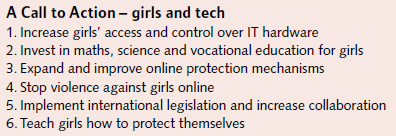
There is a quite broad set of recommendations for a wide array of actors at the end of Chapter 4 that could be taken up, contextualized and fleshed out by different parties or stakeholders into specific calls to action:

Brazilian girls in a digital world. As an annex to Chapter 4 on ICTs, new research with 49 boys and 44 girls, aged 10-14 examines adolescent girls’ rights and protection in Brazil within the context of ICTs. ICT use is growing exponentially in Brazil, particularly among 15-17 year olds, where between 2005 and 2008, ICT usage went from 33.7 to 62.9 percent. The study covers use pattern, links between on-line and off-line behavior, and on-line safety.

Conclusions. The report concludes by calling for greater knowledge about ICT-related sexual exploitation and violence against girls, more emphasis on prevention and stronger international standards. It also points out that girls need to be empowered to use new communications technologies safely, on their own terms, and in ways that promote their development and build their futures.

Call to action for September 22: As part of the launch of the Because I am a Girl Report, Plan is calling for International Day of the Girl to be established on September 22. You can sign the petition here.

Resources

Download the full report here: Digital and Urban Frontiers: Girls in a Changing Landscape

Download the Girl’s Cohort Study: Real Choices, Real Lives. Plan researchers follow 142 girls lives over a 9-year period.

Download past Because I am a Girl Reports (since 2007)

Related posts on Wait… What?

On girls and ICTs

Revisiting the topic of girls and ICTS: Tech Salon Discussions

Being a girl in Cumbana

MDGs through a child rights lens

3 ways to integrate ICTs into development work

5 ways ICTs can support the MDGs


Read Full Post »

I have a daughter. She was born at home with a traditional midwife in a poor barrio in San Salvador. Her father had a 9th grade education when we got married. She had severe diarrhea at least 3 times as a baby and we worried that she might not make it. My mother-in-law took her to a traditional healer because the doctors didn’t seem to be getting it right. She had pneumonia twice as a baby, probably due to allergies, air pollution and the chickens my mother-in-law kept in the small house. She had dengue once. The water didn’t always run and people stored water in open barrels, so there were a lot of mosquitoes.

Luckily her father returned to school to finish his education. Luckily her mother and her mother’s mother were well educated. Luckily both of her parents worked, so there was enough money to feed and clothe her. Luckily we had a bit of savings that we invested in a small cement block house. Luckily we lived in a city, near a primary school. Luckily we were able to get a telephone installed around the time she was born. Luckily our barrio had electricity and we could afford to pay for it. Luckily we believed that she was just as worthy as her brother. Luckily today she is alive and thriving and in school, with a myriad of possibilities ahead of her.

Girls all over the world should be so lucky.

I’m reading the ‘Real Choices, Real Lives‘ cohort study that Plan just put out as part of the annual Because I am a Girl report (which launches Sept 22). It tells the stories of 142 girls in 9 countries (Brazil, El Salvador, Dominican Republic, Benin, Togo, Uganda, Cambodia, Philippines and Vietnam) that researchers have been following since they were born. The girls will all turn 5 this year, except for the 5  girls whose lives have already been claimed by preventable diseases. 7 of the girls have dropped out of the study due to family migration or other reasons.

As powerful world leaders gather in New York this week to discuss accelerating progress towards the Millennium Development Goals, this report is a sobering and intimate reminder of the real inequalities girls, especially the poorest girls, face, and the struggles their family go through to keep them alive and help them to thrive.  The cohort study tells us that primary school enrollment rates in Sub Saharan Africa are up from 58% in 1990 to 76% in 2008, but in the poorest 20% of households, 39% of girls don’t attend school. The cohort study shows us, through the stories of the 130 girls who are still part of the cohort group, the very real impact on very real lives that failure to reach the MDGs has. The reality is that the poorest girls do not have what they need to survive, develop and participate fully.

What will happen this week in New York to change that?

Related posts on Wait… What?

MDGs through a child rights lens

5 ways ICTs can support the MDGs

On girls and ICTs

On trust and disempowerment

Being a Girl in Cumbana

Read Full Post »

The latest UN report on the MDGs states that progress towards the Millennium Development Goals has been made, but it’s uneven. It looks like the Goals will be missed in most regions.

I’m blaming Madonna for launching her line of MDG sunglasses and not linking them to an MDG promotion campaign (kidding!)

To discuss all this (well, except for the sunglasses part), MDG week is happening in New York from September 20-24, 2010.  I’ll be part of some of the activities, including 2 panels. The first panel is on ICTs, Innovation and the MDGs and the second is on Women/Girls and Mobiles. What better way to prepare than to write some blog posts to sort through some ideas?

This post looks at the link between child rights and the MDGs. I’ll write some additional posts and add links at the bottom of this post when they are ready. I would love feedback on which elements would be most important to highlight during the MDG panels next week.

Human rights and the MDGs

If you look at why some countries are more on track than others in achieving the MDGs, the answer often comes down to there being greater accountability and transparency at all levels, more citizen engagement, and more public debate. Human rights are instrumental in ensuring empowerment, access to social services, equality before the law, and poverty reduction. So the link between human rights and the MDGs is clear. There are a number of human rights concepts: shared responsibility, indivisibility, non-discrimination, equality, and accountability that are also necessary for achieving the MDGs.

Due to discrimination, the most marginalized are still not accessing their rights or being included in the MDGs. There are still massive inequalities between rich and poor, rural and urban, men and women, boys and girls, adults and children. Disability and ethnicity also prevent some groups from being included. Until these disparities are addressed, the achievement of the MDGs will be far off for many particular groups. The discussion around the MDGs needs to include and reflect the opinions and concerns of those who have been traditionally marginalized.

Girls and the MDGs

Children, especially girls, and especially girls in poor, rural areas and urban slums, are often the most marginalized in these processes and in general. The MDGs highlight some critical gender gaps, especially in education, but they do not reveal the power imbalances that are an underlying cause of these disparities. Girls are often subjected to harmful practices such as early marriage and sexual violence. In countries where literacy is lowest, girls’ chances of early marriage are highest. Girls spend more time working, shoulder the burden of household chores and are more often not in school. Organizations and entities working towards the MDGs need to do more to ensure that girls and other marginalized groups are not excluded.

MDGs through a child rights lens

Child rights are a set of specific rights for those under the age of 18. They are outlined in the Convention on the Rights of the Child. Much of the work that child rights organizations are doing is complementary to achieving the MDGs, and 6 of the 8 MDGs are directly related to children.

Working with children and young people to participate effectively in the development of their communities and the realization of their rights contributes directly and indirectly to the achievement of the MDGs. Ensuring that children, especially girls, and other marginalized groups are listened to and heard by decision makers at the local, district, national and global levels is critical in identifying and addressing the hidden power dynamics and the underlying issues that slow the achievement of the MDGs.

Applying a ‘child rights’ lens to the MDGs is helpful in identifying responsibilities for achievement of the different MDGs. A child rights lens can also help ensure the concepts of non-discrimination and the best interest of the child are incorporated into MDG work.

What is a child rights lens?  How can it be applied to the MDGs? In a simplified way, it means:

  1. Identifying and monitoring those persons and institutions responsible for ensuring children’s rights/achievement of the MDGs (the ‘duty bearers’).
  2. Helping children and adolescents (the ‘rights holders’ in this case), to empower themselves by knowing their rights/knowing the MDGs, and together with supportive adults and institutions, to hold duty bearers accountable for ensuring children’s rights/achievement of the MDGs.
  3. Supporting children to participate fully in the process. Children’s participation leads to better outcomes and policies, and involving children early in their lives helps them develop skills and attitudes that lead to a better society in the short and long-term. Not only do children have something to contribute to their societies now, but by engaging in community development and developing good leadership skills at a young age, they also become better leaders in the future.

A child rights approach should be central to all programs and funding that are addressing the MDGs, since the MDGs are interrelated with children’s rights to survival, development, participation and protection. In addition, the principles of non-discrimination and the best interest of the child should be paramount in all decisions taken related to the MDGs.

—–

Resources:

UNICEF’s Narrowing the Gaps to meet the Goals shows that paying attention to equity and the unreached can be a more cost-effective way of pursuing the MDGs in aggregate.

3 ways to integrate ICTs into development work

5 ways ICTs can support the MDGs

7 (or more) questions to ask before adding ICTs

Related posts on Wait… What

Child participation at events:  getting it right

Child protection, the media and youth media programs

Community based child protection


Read Full Post »

I had a doctor’s appointment a couple months ago, and my doctor asked me if it was OK for a student to do the prep work, you know, the usual: height, weight, temperature, blood pressure, the like. I said sure.

What I didn’t expect though, was that the student intern was going to read through a list of health questions to try to find out if I was menopausal. Nothing against menopause – it’s a natural thing and I think some women even look forward to it. But I just turned 42, and no, I’m not having hot flashes quite yet.

I suppose it’s some kind of mandatory thing to ask a woman who is in her 40s a series of questions like that. And to be honest, I probably wouldn’t have minded if it had been my doctor asking me. I’ve been seeing her for years now, she knows me, and she knows how to ask questions in the right way. I trust her.

But sitting up on an examination table in a sterile room, clothes off save for an oversized paper gown that keeps falling off my shoulder, with a 20-something I’ve never met sitting in front of me asking if I’m incontinent, suffer from bouts of depression, and have loss of libido was a bit off putting.

It made me want to lie to her. To not reveal any sign of potential menopausal weakness. To tell her that I never feel fatigued. That I never, ever forget anything, and that I am never ever ever distracted or unfocused. I secretly shunned all her suggestions. Calcium? nope, not taking it. Multi vitamins, pah, I feel fine. Let’s get this interview over with STAT.

It felt disempowering to have this young woman, who I don’t know and haven’t developed any trust in, asking me very personal questions about myself and my life and offering scripted solutions to something she imagined I might have, and that she’d obviously never experienced herself.  Since then, I’ve been thinking about it off and on, and related life stories come to mind.

—–

Julia*, someone I was very close to in my Barrio in El Salvador (where I lived for most of the 90s) had a long history of domestic abuse. She would talk to me about it all the time – she still lived with the man, who had tapered off a bit as he got older but who was still not entirely pleasant to her. She would get depressed sometimes and talk about leaving, but she never did. As I got to know her better, I realized my role in the relationship was not trying to find solutions, or criticizing the man, or feeling enraged. It was listening and not judging. An older woman, with a small pension. Where would she go? She believed that she would be seen by the neighbors as weak, and that people would lose respect for her. She really didn’t have a lot of options. So she’d tell me and I’d listen, and that was enough. I’d tell her my work troubles too, and she’d listen, and that was also enough for me. I realize as I write this how much I miss her.

About 15 years ago at work, while still in El Salvador, I was responsible for overseeing a study on gender violence that a partner organization was carrying out and that we were funding. It was going to be a door-to-door survey mixed with some focus group discussions. I immediately thought of Julia; of all the women in the Barrio. I thought ‘Julia would never tell anyone the truth if they came knocking on her door to interview her about domestic violence.’ She would say no, that doesn’t happen here, and close the door until they went away. I doubt any of the other women in the Barrio would have acted any differently.

I felt pretty sure that the information that was produced in that study on domestic violence was not going to be valid, even though it was being managed by a group of well-known, well-educated Salvadoran feminists.  But I felt like I couldn’t say anything, because I wasn’t a well known local feminist. And after all, they’d often imply, what did I know about El Salvador? I was a foreigner. What I did feel certain about was that no one in the Barrios where they wanted to do their study was going to tell them the truth.

—–

And somehow related to that, I started thinking about the time I went to the doctor’s office with my mother-in-law, a brilliant, strong and upright woman from the Barrio, with a 6th grade education, who would be considered ‘impoverished’ by most standards. I remember vividly a young male doctor who addressed her using the familiar form of ‘you’ (vos) instead of using the respectful form of ‘you’ (Usted). I remember being furious. I don’t even use vos with my mother-in-law, out of respect. What was this young, wealthy doctor doing using it? I hated seeing her stripped of her well-earned Barrio respect once she entered the doctor’s office, just because she was poor.

—–

What am I trying to say here? I’m not entirely sure, but I guess I’m thinking about respect and the hierarchies of information and education and offices, and the importance of developing a rapport with people before you go prying around in their personal lives and offering solutions.

I’m relating that to ‘aid’ and ‘development’ work, which in my world, is an intensely personal thing. I try to work from the heart, and I hope I’m never making people feel belittled, judged, or like they need to lie to me or conceal things from me because I haven’t taken the time to get to know them. I hope I’m not disrespecting anyone, knowingly or unknowingly, and that I’m not messing around in things that are none of my business or where I haven’t got an invitation. I hope I’m not always trying to offer solutions, but rather listening and supporting people to come to their own conclusions. I hope I don’t make people feel like they are sitting, half naked on an examination table, while someone who knows nothing about them or their life politely asks them some standard questions and comes up with some generic recommendations for how to prevent or cure something they may or may not have or may not think is an illness.

*Not her real name

Related posts on Wait… What?

The real story involves anti-social entrepreneurs and anthropology

It’s not a black and white photo

18 years

Read Full Post »

Yesterday I inadvertently clicked on a link to the first blog post by Talesfromthehood that I think I ever read. The post starts by saying ‘There is just no way around the critique that aid is ultimately about imposing change from outside….you’ve got to make your peace with that reality.’  (Not what I like to hear).  Tales goes on to say that we need to better define the term ‘bottom up‘ development and concludes that we may really not be talking about ‘bottom up‘ development at all, but more about ‘meeting in the middle‘.

The idea of imposing change from the outside is a little uncomfortable sounding when you normally think of your work as ‘bottom up‘, and you have seen the countless problems that ‘top down‘ approaches create.  But funny that Tales happened to include a link to that particular post in the more recent post that I was reading, because I was in the process of writing up some notes about a community development approach that I believe is quite good.  And looking more closely, it actually sounds a lot more like ‘meeting in the middle‘ than ‘bottom up‘….

I spent this past week in a workshop with colleagues from Cameroon, Mozambique and Kenya discussing a program we’re all working on at different levels. The initiative (Youth Empowerment through Technology, Arts and Media -YETAM) aims to build skills in youth from rural areas to claim space at community, district, national and global levels to bring forth their agendas. It looks to create an environment where peers, adults, decision makers, partners, schools, and our own organization are more open and supportive to young people’s participation and ideas.  It uses arts and ICTs (both new and traditional ones) as tools for youth to examine their lives and their communities; identify assets, strengths and challenges; build skills; share their agendas; and lead actions to bring about long term and positive change.

It is clear from listening to my colleagues that ICTs in this case have been effective catalysts, tools and motivators for youth participation and voice in their communities and beyond, but that other elements were just as critical to the program’s successes.  Throughout the meeting they kept saying things like ‘we are adopting the YETAM approach for our disaster risk reduction work’ or ‘we are incorporating the YETAM approach into our strategic plans’ and ‘we are going to use the YETAM approach with new communities’.  So I asked them if they could put into words exactly what they considered ‘the YETAM approach‘ to be so that we could document it.

I furiously typed away as they discussed how they are working, and what they consider to be the elements and benefits of the ‘YETAM approach.’ And it’s probably a pretty good example of what is normally called a ‘bottom up approach‘ but which might actually be a ‘meeting in the middle approach.’  And I’m definitely OK with that.

I like the approach because it builds on good community development practices that we’ve endorsed as an organization for quite awhile. It brings in new ideas, new tools and new ways of thinking about things at the community level, but it doesn’t do so in a top-down way.  It doesn’t encourage youth to abruptly raise controversial issues and then leave them to deal with the consequences.  It thinks about implications of actions and ownership.  It addresses the ‘what’s in it for me?’ questions but doesn’t turn the answer into unsustainable handouts.  It looks to instill a sense of accountability across the board.  On top of all that, it incorporates ICT tools in an integrated way that gets youth excited about engaging and participating and helps them take a lead role in advocating for themselves.

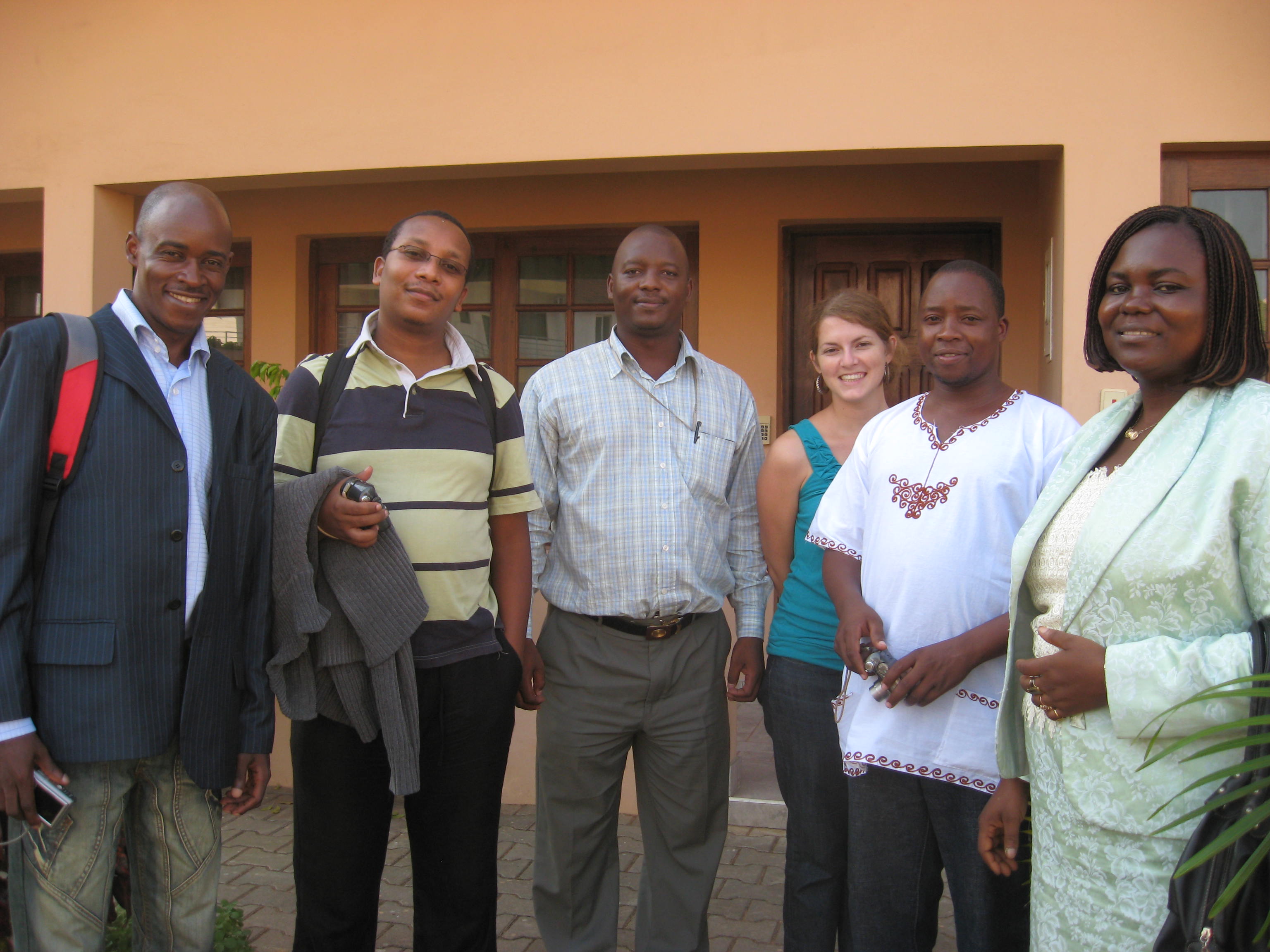
YETAM Point Persons: Mballa (Cameroon partner), Anthony (Plan Kenya), Pedro (Plan Mozambique), Lauren (Mozambique Peace Corps Volunteer teacher), Nordino (Plan Mozambique) and Judith (Plan Cameroon)

So, ‘bottom up’, or ‘meeting in the middle’ or whatever, here’s ‘the YETAM approach’:

Meetings…. Lots of them. We meet with men, with women, with children, with youth, with local authorities and district officials and relevant ministries, with partner organizations and community based organization, in short, with all those who have a stake in the initiative, to get their input.  This is an opportunity to understand what everyone wants to get out of the project, what value it adds to what they are doing or what they aspire to do, and what role everyone will play.  Then we meet with everyone all together at a community assembly. Once we pull together what everyone’s interests and contributions are, we can go forward.  This means a lot of time and a lot of meetings, which can be tiresome, but in the end it is worth doing for the long term success of the initiative.

Partnerships. Everyone brings something to the table – communities, local partners, young people, schools, teachers, local leaders, and us.  So we work to ensure that the contributions of each entity are clear and detailed, and that all sides are accountable if they don’t hold up their end of the deal. The community might contribute time or food or labor or a training space or some other resources that they have. We might contribute funds or technical advice or facilitators or the like.  Local partners might bring in technical expertise; schools or governments something else. Youth are putting in time and efforts also. To ensure that the project holds up and succeeds, we negotiate with all involved partners to see what they can contribute. If you see that people are not willing to put something into the initiative, it means that it is not of value to them.  If you push the project on people, and move it forward without it having value for them, it will be a constant struggle and a headache.  Seeing the level of commitment and interest in different community members can tell you if the initiative is a good thing for the community or not, so that you can adjust it and be sure it’s worth doing, not pursue it, or continue to work on buy in if some parts of the community are interested, but others are not.

Accountability. We set up agreements with all partners in the initiative, detailing what everyone will contribute and what they will get out of it, establishing everyone’s roles.  This is critical for accountability on all sides, and gives everyone involved a common basis for any future discussions or disputes, including if the community wants to hold us or a local partner accountable for not fulfilling our promises.

Buy-in. We don’t pay people to participate in projects or for sitting in workshops.  If you pay people to participate in a project once, you will have to pay them forever and it becomes a weak project without any real buy-in.  Our particular role in community development is not creating short term jobs, but contributing to long term sustainable improvements.  So what we do is to sit with the community and any participating partners or individuals from the very beginning and fully discuss the project with them. Then those who participate do so with a clear understanding of the set up, the longer term goals, the value to the community, and they have decided whether they want to be involved, and what is their level of commitment.

Some NGOs find that paying people to participate is an easy way to move budgets. This may help get things done in the short term, but for the type of programming that we do, it doesn’t work in the long term. It takes away people’s ownership of their community’s development if you pay them a fee to participate in their own project. So to avoid misunderstandings, everything needs to be clear before the project activities even start. We spend time with the community and all those who would be involved.  In the very first meetings with the community before concrete activities even get started, we address the issue of payment.  It’s not our project for the community and they are not working for us – it’s the community’s project.  We do negotiate with them to cover additional expenses that they may incur for participation in a workshop or event, for example, transport, food, etc.

What’s in it for me? Many NGOs have come around before, just giving hand outs, and people are used to seeing an NGO come in paternalistically to give them things.  They imagine that you have a lot of money and you’ll arrive to just start handing things out.  This is not how we want to work.  But people want to know – well, I’m not making any money from this, and I’m going above and beyond, so what do I personally get out of it? What’s in it for me? They even ask this directly, and that is normal. There’s a need to help people think beyond the immediate project. What value does this project add to people’s lives in the long term, to what they do on a daily basis?  If they are not thinking in the long-term, it may be hard for them to see value in the project. If during this discussion with them it’s clear that people don’t see any value in an initiative, then you should be aware that they are not really going to participate.  And that is also logical – if there’s really nothing in it for them, why should they do it? So you need to listen to people and be prepared to discuss and redesign and renegotiate the project so that they are really getting something of value for themselves and the community out of it.  If you come in with an idea from the outside and people don’t see value for themselves, and you go the easy route and pay people to participate in the project, you will see the whole thing fall apart and the efforts will have been for nothing, you will see no impact. So we take the time and discuss and co-design with the community to make it all work. That way it becomes a catalyst for long term positive changes.

Understanding local culture and how your government works. We work to involve local governments and ministries in this work as well as other kinds of decision makers. It’s important to understand how local culture works and what the hierarchies and protocols are in order to do this successfully. It’s critical to know what your government is like and how they work.  If you are not aware of this, it will create problems.  You need to know how to engage teachers, district officials, school directors.  We follow local protocols so that we can ensure good participation and involvement, especially when we need support from the government or ministries in order to move forward with something.  We involve people at these levels also because they are the duty bearers who have the ultimate responsibility here in our countries.  If you leave them out of the equation, you are really harming the initiative and its sustainability as well as losing out on an opportunity to make sustainable changes happen at that higher level.

Respecting community schedules. Communities are not sitting around, waiting for NGOs to show up so that they can participate in NGO activities and projects.  They have their own lives, their own other projects, their own work and their own goals that we need to harmonize with.  Projects that we are supporting are just one part of what community members are doing in their lives.  So we need to be flexible and let the community dictate the pace.  Sometimes partners, colleagues from other parts of the organization and outside donors do not understand this, which can cause conflicts and misunderstandings with the community.  In our case, for example, we are working with youth. They are in school.  We can’t interrupt their primary responsibility, which is getting their education, so we work with them during school holidays or after school.  Often parents want them to work during their school holidays. So again those meetings with parents, community leaders and so on become very important so that they see that their children are participating in a broader initiative and they see the value in it.

Gradual processes.  In this particular project, we are working with youth to have more of a voice.  This can be threatening to some adults in the community, and can go against local norms and culture, just like working with women to overcome gender discrimination can.  If youth are not used to voicing their opinions, they may be fearful of reprisals.  We don’t want to show up, give young people the tools and means to speak out, create conflict in the community, and leave.  This can be very counterproductive and even dangerous. This is where those meetings and building those relationships with different parts of the community again become very critical. We’ve adapted a methodology of intergenerational dialogue.  We sit with the elders, with the community leaders who hold elective positions, and share the project idea and what might come out of it, sit with women, sit with youth. This is like a focus group.  You don’t go in accusing people either. You ask them – what issues do you think youth are facing in the community? They will tell you, and when you’ve heard from everyone, you triangulate the information. Then you find a way to bring everyone together to find common points to start from.  The shift cannot come so strong and fast.  You need to take a slow process.

Listening to children and youth. The strongest point of reference will be what children and youth have talked about, because that is our focus. And for a child to tell you something, it’s taken a lot of work inside themselves to say something.  We had one case where a child decided to stand up and raise the issue of incest at an inter-generational dialogue meeting. A man stood up and said ‘you are lying, this doesn’t happen here’.  But there had been an on-going community process already, and there were other people in the community who were aware and were prepared to stand up and support the child.  In that case, a man stood behind the boy and said, ‘in our community we don’t talk about this, and it takes courage.  Let’s listen to the boy.’ This community process and work is really important to give confidence to the children to be able to speak.  If you are not yet at the point where children can stand up publicly and speak out, then ICTs can also be a good tool.  We’ve found that children’s radio is an excellent place to speak out anonymously about a sensitive community issue.  Children can call in to raise an issue and others can call in to confirm it if it’s happening in the community.  Theater, cartooning and other media area also good ways to raise issues.  Making a drama video on a sensitive topic and sharing it with the community can also be a way to raise an issue without directly accusing someone or implicating a child or youth for having raised it.

Expecting yourself to be held to task too. If there is a track record in the community with children speaking out but nothing happening or changing, then that will deter them from saying anything. So if you want to go down that road, of encouraging children and youth to speak out, you need to be prepared to take it through to the end, to support them. You have to be prepared to really take children and youth voices seriously, to follow things through to the end.  This is actually also true if they raise an area where your own organization has failed, that you yourself have not done something that you promised.  If we encourage them to use their voices, we have to expect that they will hold us accountable too.  We raise funds in the name of these children and communities, so we need to be accountable to them.  We need to be open to children, youth and the community also calling us out.  And have no doubt that they will. It’s happened before and will happen again. So we encourage them to challenge us as an organization, to be honest and to hold us to task.

Change and growth from within. As part of the whole community process, we do mapping, problem tree analysis, assets analysis with the youth and accompanying adults, and they learn much more about themselves. They think about where they are coming from and where they are going, and what local resources they have. This offers perpetuity, especially for the children and youth.  Because of knowing where you come from, you can know where you are going. Where you dream to be.  Using this kind of documentation and these tools actually helps a community to be open to absorbing new things, to be open to change and growth. But not external change and growth, change and growth coming from within the community.

Addressing gender discrimination. As part of the process of mapping and prioritizing issues, there is a lot of discussion.  Very often this brings up issues that are closely linked with gender discrimination.  We see this over and over again. Because we are working in a safe space and using different tools, the issues come up in a way that is not so threatening. Boys also are at a stage where they are more adaptable. They see their sisters and mothers being victims of discrimination and they are more open to hearing out their female peers.  So, we are able then to build a shared agenda that is favorable to girls, and which both boys and girls are then acting on and working to address.  Issues like child marriage, early pregnancy, girls’ schooling come up, but there is a way to look at them and do something.  We also open opportunities for youth leadership roles within the project, and we’ve seen girls start to fight to have a space there, whereas before they would not have thought that they could play an executive role.

Opening space for youth. We work to build new skills in youth to manage new technology, new media, and to do research in their communities.  Through this, youth claim a space that they didn’t have before and can influence certain things, advocate on certain issues they feel are important to them. You see them start taking ownership in communities and in leadership, they want to pick up new things for this role.  We used to invite youth to community meetings. We would start with 20 youth, then it would go down to 10, to 4, to 3 to none. They got bored with it because they didn’t see any relation to themselves. But with this integration of technology and arts, youth have a high interest. It’s really bringing in their opinions, their thoughts and ideas to join their voices with their parents. Now they use arts and media to promote communication, dialogue on their issues and look for ways to resolve them. Before they were totally missing. We tried to come in with programs for youth but they never worked before. With this new way of working, they have become more responsible because they  are not waiting for adults to come in with something and invite them in to ‘help’. Now they are designing strategies and solutions themselves and bringing these to the table.  It’s less easy for politicians and parties to manipulate them and incite them to violence.  Arts and media are effective in this way to share ideas, issues and to use in generating dialogue and solutions in their communities.

ICTs providing reach, motivation and skills. In addition to using ICTs to generate interest in young people and for them to take actions in their communities, we also use ICTs as a cost-efficient way of actually advocating at different levels. You can use video at the local level but also at the national, regional and global level. That is cost effective and has a real impact. You can use videos in invited spaces, for example, where governments, schools, other communities, or our organization itself invite children’s and youth’s voices in.  But we also support youth to use these tools to claim spaces, to fight for space and to get their voices heard there.  We give youth the tools, and you see their brains rewiring. They learn better hand-eye coordination by using a mouse and a computer, and you see then that in class, they can copy from the board without looking at their paper. They learn organizational skills by creating folders and sub folders. They learn structure from filming a video and making a time line while editing it.  They learn to speak with adults and decision makers from talking on the radio, using a recorder or a camera.  They become more motivated to complete school.  All this makes them more effective leaders and advocates for themselves and their agenda.  They also know that they’ve learnt a skill that puts them at the top of the pile in their community for jobs now. They are plugged into something that would never have existed for them before.

Related Posts on Wait… What?

7 (or more) questions to ask before adding ICTs

Is this map better than that map?

Mind the gap

An example of youth-led community change in Mali

Being a girl in Cumbana

Putting Cumbana on the map: with ethics

Read Full Post »

There are surely enough travel blogs out there, but given how much travel I do and my recent hiccups getting home from Benin (eg., 5 day total delay), I thought I’d throw together some of the things that keep me sane and somewhat prepared when I’m on the road…. I normally travel to Africa and Latin America, so these ideas may not be useful to people traveling to other places.  I have geared them towards women, though they might be useful to men also…. Ladies, add your tips to the comments section!

Breasts, shoulders, thighs, knees and ankles. Do a little internet research before you leave.  Observe what local women where you will go are wearing in pictures or on other people’s blogs. Especially notice the attitude towards breasts, shoulders, thighs, knees and ankles. In many places, for example, breasts are not a big deal, but thighs are.  Keep that in mind when you pack and in your behavior when you arrive. Don’t wear tank tops/spaghetti straps if you don’t see local women wearing them.  Same goes for shorts and capris or tight clothing.  This may be different if you are a teenager and traveling with a group, but I still recommend against a lot of thigh action if you want to be taken seriously and to be respected.  There may be different dress codes depending on urban and rural, so observe that and be respectful, be smart.  And if you are not, don’t be surprised if you get unwanted attention.  Maybe not the most feminist thing to say here, just being realistic.  People will often cut you some slack knowing that you are foreign, but when I travel, I tend to go for respecting local customs over my right to self-expression in my attire.

Sweat – Not a nice topic for many of us, but if you are someone who sweats (I always envy those people who don’t) it’s a fact of life when traveling somewhere hot. You’ll often be advised to wear clothing made out of lightweight fabric, however this kind of fabric shows every drop of sweat. Skimpy underwear does not absorb sweat and that fact will express itself on your clothing, especially when you are forced to sit in a hot car, meeting or community for several hours.  Not attractive.  Cotton boy shorts are a good alternative to the sexier variety of under things, as is clothing made out of thicker fabrics.

And speaking of undergarments – I get really annoyed when I see young women who, in the name of modesty or fitting in with local culture or just being hippy backpackers wear long flowing skirts without realizing that they are completely see through when walking in the sun! Do us all a favor and invest in a slip.

Tattoos.  You may get stared at for having visible tattoos.  You’ll want to decide how you feel about that.  I normally keep mine covered until people get to know me a bit so that any judgment comes later in the relationship. Since a lot of Americans have them these days, it’s also kind of fun to explain that tattoos are part of our coming of age ritual.

Packing – If you’re a frequent traveler, keep a second set of travel stuff right in your suitcase.  I keep a plastic Ziploc bag with less than 3 oz. quantities toiletries in it and just refill them before I leave and stash them on the top of my carry on for easy removal at security check points.  I keep all my favorite warm weather travel clothes in my suitcase. I have a checklist that I run through before I go to add anything that’s missing.  Makes for much easier packing.

Luggage – Put some identifying marks on your luggage so you can spot it when you arrive.  Assume it might be delayed by a day or so, and be prepared in case it is.  I do this by always packing any equipment, a change of clothes, and any essentials in my carry on.  This includes a small quantity of any printed materials I need if I am presenting at a workshop, just so that I won’t be left hanging.  I always take my laptop.

Travel socks – They are dorky but they keep your ankles from swelling and you from looking like you have tree trunks for calves upon arrival.  They also help prevent a potentially fatal condition (deep vein thrombosis) where blood clots form due to long flights.

Shoes – If the climate is hot your feet may swell and your shoes will be tight, especially if you are walking or standing a lot. This is most pronounced in the evenings.  Bring shoes that are a bit loose to be more comfortable.

Flip Flops – I wear them whenever I can get away with it, but sometimes they are seen as a sign of disrespect.  If you’re on any kind of trip where you need to do business or represent at any kind of function, or train a group, bring some sandals that don’t look like flip flops, at least for the first couple days. Do bring the flip flops for sketchy showers.

Sarong – Pick one up somewhere next time you see one.  They double as a scarf for freezing plane trips, and a skirt for when your luggage gets lost, you want to visit a pool or beach, or you need a cover up in a pinch, like if you have dinner in your room and want to throw something on to cover your shorts/your thighs when your meal or beer arrives.

Coffee press – If you are a coffee addict and are traveling to a country that produces wonderful coffee, rest assured that you will be served none of it.  You will get Nescafe.  I bring my own travel coffee press (pick one up for cheap at REI) and some ground coffee.  You can almost always get boiled/hot water.

Food – If you are vegetarian, pack granola bars, a jar of peanut butter, some chocolate, and some of those little cheese hunks wrapped in red wax… they last up to a week or 2 without refrigeration (if you’re not squeamish), and taste really good after a few days of full-on starch meals (eg., vegetarians often get a plate of bread, rice, pasta, potatoes and green plantains for lunch and dinner and some more bread for breakfast).  Try to make friends with your hotel or workshop venue cook and ask if they could make you some beans or cooked vegetables.  Make sure you don’t refer to yourself as a vegetarian without giving some suggestions of what you do eat, or you may get raw vegetables and salad which often lead to amoebas and giardia.  Buy some fruit when you see it. Bring a knife from home to cut it up and be sure to wash and dry it well before digging in.  Fancy hotels will often have no idea how to feed you so look forward to a lot of French fries and omelets.  Local hotels or hosts will usually make an effort using what they have available.  Don’t assume that your fancy hotel food is safer than other food.  Different bacteria is different bacteria and your system just may need to adjust.

Bottle opener – Light, easy to pack, and a life saver when you have to buy your beer in advance or want to drink it in your room on a hot evening.

Ziploc baggies –Freezer size zip lock baggies seem to always come in handy for something.

Flashlight.  A small flashlight is useful for frequent power cuts. Especially for visiting bathrooms outside your sleeping area at night.

Towel – Often small hotels will not provide towels, or will give you a non-absorbent hand towel.  If this is a problem for you, bring your own towel.

Mosquito net – You can never count on a mosquito net.  Do yourself a favor and purchase your own.  I bought my own self-standing mosquito net (a “travel tent”) which has been a life saver.  Light weight and convenient, it sets up on any single bed or even on the floor.  It means you get sleep without being woken up by mosquitoes buzzing in your ears, and you can avoid taking malaria pills (well, unless you’re working for an organization that makes them mandatory….)

Laundry soap/clothesline – I usually pack a clothes line to string up in my hotel room, and a baggie of powdered laundry soap.   You can also get these when you arrive. You can pack lighter if you wash things out in the evening. If you’re in a hot climate they will dry in less than 24 hours.  When Air France lost my bag in Togo, I made it through 9 days by washing in the evening and re-wearing in the morning.

Water – If you see a bucket in your room, it is a sign that the water goes off.  Keep it filled or you may be in for an unpleasant surprise when you go to take a shower.  There’s quite a talent in toilet flushing with buckets.  Experiment and soon you will learn how to economize on water use and keep the bathroom area clean as well. I got through each day in rural Rwanda on one jerry can by being smart about re-using my bathing water for the toilet, etc.  Get a plastic cup at the market to make it all easier.

Candles – Same as a bucket – candle in your hotel room means that the power goes off fairly often – be prepared.  Charge up all your stuff whenever there is available electricity.

Electricity adaptors – Often your room will have only 1 or 2 outlets, (if at all when you’re out somewhere really rural).  A 3-plug + an adaptor are handy for charging up 3 things at a time instead of juggling them one after the other.  Google “electricity converter” or “electricity adaptor” something like that before you leave and get some plug adaptors of your own. It gets annoying when people are always asking to borrow yours, and your hotel will not have them unless you’re traveling in high style.

Check in – Check in on-line if you can.  If not, get there early enough to get a window seat on long flights.  Don’t expect any special attention unless you are wearing a fancy suit and a big watch.

Airport pick up – Assume that no one will be there to pick you up from the airport.  Maybe this is just an issue with my organization, but it happens quite often.  Before you leave, be sure that you write down the address and phone numbers of your office, any contact persons, and your hotel.  (I once arrived in India without this information…. not wise).  This is also helpful to keep handy when filling out paperwork at the airport upon arrival.

Flight delays and ticketing – Be aware that once you purchase your ticket, Orbitz and the like won’t help you much as they transfer the ticket over to the airline systems.  I found out last week when stuck in Benin for 4 extra days that your ticket will not have a phone number on it, or it will be an 800 number, which only works in the US.  Try to get a non 800 number before you leave in case of anything.  When in a real pinch, send out pleas for help on Twitter and the community will get you the phone numbers you need.

Cash – Some places only change $20 bills or less.  Other places give a better rate for $100 bills.  Do some research.  Change money in the airport when you arrive if the agencies are still open. Assume you may not have access to an ATM when you arrive.  Assume your hotel may not have cash to change money for you when you need it.  Assume you will wait for 2 or 3 hours at a bank to change money, and will need ID to do it.  Know that every time you ask your organization’s driver to do these types of things for you, you are probably ensuring that his day is that much longer. (Drivers in my experience have the worst rap, always having to arrive before everyone and leave after everyone’s all taken care of, and they don’t get any recognition for their work).

Communications – Get an unlocked cheap phone and buy a local SIM card and some airtime on arrival.  Check before you go which network has 3G or Edge if you plan to use it for internet.  Download the software to connect your phone to 3G internet before leaving.  If you travel often, it can be worth the money to invest in a phone that connects to internet.  If you are a Twitter or Facebook freak, install Snaptu for Twitter/Facebook on your phone.  Outlook doesn’t work on all phones, so I do an out-of-office reply giving people my phone number for emergencies.  I create a rule to auto-forward my work email to my gmail.  If you use an i-phone and want to get some extra mileage out of it on the plane/before you jump into local phone/local SIM mode, Duracell makes a $17 charger that gives you an extra 3 hours.

Medications – I don’t like taking medicine.  I do however have a prescription for Ambien for sleeping on flights. That means I can sleep all night on a plane, get some coffee when I arrive, and get straight to work, and I can avoid arriving a day or so early to acclimate.  Never take a sleeping pill before your flight is in the air in case you have to deplane!  Get a prescription for Cipro before you go.  Take it if you have a bad stomach w/fever for a couple days. Then eat lots and lots of yogurt when you get back home as Cipro depletes your good stomach bacteria.  (*Note – I’m not a doctor and am not giving medical advice here, just telling it like I do it!).

Malaria – I never take malaria pills.  They make me tired and nauseous which means I can’t work, so what’s the point?  And the pills prescribed by your doctor at home may not be effective for the zone or area that you are traveling to because of how the disease evolves.  Decide for yourself, but if you are careful, you can get by without them.  (Again – I’m not taking responsibility for this if you follow my advice and you do get sick).  I prefer using my mosquito net, wearing long pants/long sleeve shirts in the evenings, and using hard core bug spray on exposed skin.  Beware that many bug sprays will eat through nail polish.  My toenails normally look like there is chewed up gum residue on them by the time I get home.  Dark clothing attracts mosquitoes so be aware of that.  Don’t be surprised if sometimes there is a cloud of them swarming over your head if you have dark hair…..  Never take Lariam.  I know of a couple cases where the side effects caused permanent psychological damage to colleagues.  I don’t really know why it’s still prescribed actually.

Marriage proposals and unwanted attention – I could write a whole book on this, but in an effort to be succinct….  Ladies, if you are under, say, 30, don’t be surprised if you get your fair share of suitors.  If you are over 30 and divorced or single, expect some attention from 20-something young men who imagine you to be desperate and lonely.  If you’re interested, by all means, go for it, but protect yourself just like you would when you’re at home. Don’t take any excuses.  Condoms are readily available just about anywhere, or better yet, always travel with some.  If you are American, you will likely have a reputation for being loose (thank you Hollywood and MTv) [note: adding “and all the ‘Western’ women who have helped confirm that stereotype“). If you are divorced, people may pity you.  If you are married or in a relationship, some men will still try to pick up on you.  (In El Salvador when I’d say I was married, men would often say “It’s ok, I’m not jealous”).   If you are not interested and the attention you are getting is not overly offensive, take it in stride.  Don’t be rude, but do be firm.  Deflect lightly when possible and move on, it’s OK to say no. Sometimes you may want to keep your phone out of sight so that you can pretend you don’t have one if you keep getting asked for your number.  If the attention is scary and threatening though, do whatever is necessary. As anyplace, be safe.

I’m sure I’ve forgotten something…. Add your comments below.

Update:  Here’s a great post by Scarlett Lion:  What to bring and not bring when traveling to Africa.

Related post on Wait… What?

Getting screwed by Orbitz.

Read Full Post »

« Newer Posts - Older Posts »