Feeds:
Posts
Comments

Archive for the ‘ICTs, mobile and technology’ Category

Josh's FLSMS Ushahidi Diagram

Drawing by Josh Nesbit (Frontline SMS: Medic) and James Bon Tempo (Jhpiego) from an amazing brainstorming session in early Feb 2010.

When looking at integrating ICTs (Information and Communication Technology) into existing programs, or making an initiative go further or work better with ICTs, there is a lot to figure out before you even get started….

Over the past few months, I’ve been supporting the development of a mobile data gathering/ crowd sourcing and mapping workshop for youth in Benin.  The training is part of a broader initiative to reduce violence against children.  We’ve decided to use Frontline SMS and Ushahidi as tools in the project because we think (and want to test whether) mobile data collection/ crowd sourcing incidents of violence will allow for a better understanding of what is happening in this area.  We also think that geo-visualizing reports of violence against children may have an impact on decision makers and might allow them to better plan prevention and treatment programs and services.

At first I was most worried about whether we could get the technology itself set up and working, but as I started digging in, it was immediately apparent that the technology was the last thing to worry about.

The first thing to consider is probably:  Why are you doing this?

Well, we all have our different reasons…..  But even in a worst case scenario where someone wants you to use ICTs because they are cool or you have funding for them (*not the case in the project I’m writing about, but I’ve seen a lot of this going around) you might be able to salvage the project if you ask the right questions and get the right people involved in finding the answers.  Many of the questions I’m asking myself and my colleagues now will be asked again next week when we are all together on the ground with local staff, youth and community members. I expect there will be more questions added to this list, and that a lot of our current assumptions will change.  But here is the starting list that we’re working from (in no particular order, as answering one may alter answers to another one):

1) What are your specific information and communication needs and goals?

  • Why are you collecting the information?
  • What will be done with it?
  • Who will it be shared with and why?
  • What change will it contribute to?

For example: In our case, we want to gather information on the amount, types and location of violence happening in communities where we are working on a Violence against Children (VAC) project.  We want to know where the violence is happening most, and what kind of violence it is. The information will be used by the youth and project participants, staff, and relevant local or national authorities. We want to generate awareness, inform programmatic efforts, and advocate for more attention and services to prevent, respond to and treat violence against children.

2) Are you working within a particular framework or project/program already?

  • Do you have existing indicators that you want to meet or track using mobiles or mapping or specific information that needs to be gathered?  Does someone else have existing indicators or initiatives or information needs or formats that you should be linking in with/ following/ supporting?  If neither, you probably need to take a step back and think through your goals, purpose, and outline what your information needs are, and why you are gathering information or setting up a project in the first place.
  • Who are the target audiences/persons/decision makers/populations that you want to impact?
  • What information do you need to gather from and/or show to these groups in order to reach your established goals?

For example:  In our case, we are framing our whole project within the UN Study on Violence against Children (UNVAC).  The study identifies types of violence and contexts in which violence happens.  Our information gathering will be set up within that framework.  If possible, we’d also like to track the age and sex of those who experience violence, because that can help in designing prevention programs and services.

3) How is the issue you are working on currently dealt with?

  • Are there local structures that are involved or engaged with your topic/theme/project/initiative already?
  • What do they look like?
  • Who is involved in them?
  • Who currently provides solutions or responses?
  • How can they be involved/engaged?
  • What is the existing information and communications flow? Can you tap into it?
  • Will ICTs improve upon it? (if not, then stop here!)

For example:  In our case, we need to know more about the current community attitude towards violence. We need to know more about local mechanisms and whether they deal with violence as a crime or if those who are violent towards children are ever prosecuted (whether via local justice or national judicial systems)  We need to know which government services intervene or treat cases of violence.  Is there a Child Helpline that we can work with?  Who are the local allies?  How does this initiative fit into larger district or national initiatives and where are the connection points?  How can this initiative  enhance and/or improve what is already existing?  We will know more about this when we are on the ground next week.

4) What are the parameters for information collecting? What is the local use of ICTs?

  • Based on the broader framework of your project or initiative, what is the geographic range for information collecting? (1 community? One district? Nation-wide?)
  • Is there detailed geographical/map information for the area you want to work in? Do you actually need it?  If it doesn’t exist, what will you do about it?
  • How do people in the community use their phones? Are they individual phones? Family phones? Community phones? Who owns phones? Who has access to them?
  • Do people in the community have internet access? Who? How?
  • What is your set-up for collecting information and who will collect it/submit it?  Eg., do you expect a broad public to use SMS to send in information? Or will you do mobile data gathering where trained individuals go around collecting information using mobile based forms such as those on Frontline SMS Forms module?
  • How will people find out about your initiative?  How will you advertise the number to send information to — by radio, television, billboards, handmade posters, word of mouth, in schools?

For example:  In our case, we’ll work in only 2 districts to start.  Because we are concerned about privacy and protection (eg., retaliation against children who report violence) it may be OK to work without extremely detailed maps that could identify particular households or persons.  We are working with youth groups who are trained on violence, but we are afraid that they could be put at risk if they are going around collecting reports from individuals as a mobile survey.  We also feel that information might not be honestly shared if it were collected in survey form.  We assume that not all children own phones, but that phones are readily available.  We assume that if families own phones, they are controlled by one or the other parent.  In a school setting, we assume that children could borrow each other’s phones if some students have phones.

We are thinking that there will be adult allies, and that local community networks can spread the word that children can use SMS to send in violence reports.  We will need to get suggestions from youth and community members on how to ensure that SMSing information in doesn’t put children at further risk if they do not own their own phone.  We’ll have to find a way to remove/reduce the risk of being found out and retaliated against.  If we can’t do that, we won’t do the project.

5) What are the privacy and protection issues that you may run into? This is especially critical if you are collecting information from and/or about children under legal adult age or with sensitive or potentially dangerous areas such as conflicts, elections, health or human rights.

  • What are the risks to those who report information?
  • How can this be managed in the project structure/information gathering set up?
  • Will you have a private Ushahidi instance or public one? (eg. available to the public, or only available to those involved in the project?)  Who can access the RSS feed and the local alerts, and does this put anyone in particular at risk? If you have a public instance, who will have access to the information, and what will your parameters be for removing identifying information that could put people at risk.
  • How can you assure that information remains private both for individuals reporting and within the FLSMS/Ushahidi system once collected and that it’s treated confidentially by those managing the system?
  • Are you prepared to address any information/privacy breaches if they should happen? How? Who will be responsible?

For example:  In our case we are still concerned about privacy and protection, and potential retaliation against children who could be caught reporting violence.  We will discuss this in depth with staff and participating children and youth to be sure that they are aware of the implications of this type of project and information gathering.

Some potential risks that we are already aware of include: a child not deleting the SMS after reporting; a child reporting and expecting immediate help which may not be available; risk to the youth group that is promoting and leading this project; community rejection of the project.

Some possible ways of reducing risk include good promotion of how the project works and of how to delete an SMS after sending; not using an easily identifiable automatic text reply to those who report (eg., an auto reply SMS that says “thanks!” might be smarter than one that says “Thanks for reporting!”); openly raising awareness about the project and getting community support for it; ensuring adult allies and engaged adult decision makers; password protection for the website at first until we’re sure that privacy and protection are well managed and ensured.  Additional mechanisms will be discussed with local staff, local youth and engaged adult community members.

6) How will you close the circle and manage expectations?

  • Will there be a response to those that submit information? What? Who will respond? How? What is the plan?
  • How will you ensure that there are not expectations around the project or information gathering system that you cannot or are not set up to meet?
  • How will you return the information to the community/local district/those who provided so that they can use it for decision making or program intervention?
  • How will on-line/offline be managed and streamlined into an information gathering, communication and feedback system that works for the different levels of access of the populations you want to collect information from and share information with?
  • In your project design, how will you take into consideration and maximize local information sharing formats, customs, and opportunities?
  • And how will you ensure that the information remains in a protected/private state in order to avoid putting anyone at risk?

For example:  In our case, we are not sure yet what the local response mechanism is currently when violence is reported.  We will find out more when we are on the ground in the communities next week with local staff, and we see how we can link the initiative in with existing local systems.  However, we will likely not be able to provide any immediate support to those who report violence unless there is already a system in place that can be enhanced by better reporting through SMS.  We will probably need to be very clear that the point of the project is to collect information for future decisions, not for providing immediate help.  This may or may not have an effect on people’s interest and willingness to actually use an SMS based system to submit information.

We will discuss and agree with the community, youth, local staff and local organizations on how and when the information will available to the community in order to close the circle to be used for decision making and program design, etc.  Determining who has constant access to the information is also a part of this discussion.

7) What other questions come up based on the context of your initiative and your experience?

March 1:  Based on feedback to the post, I’ve added a couple more categories here:

7a)  How will you ensure that your project is sustainable?

  • What will the project look like in 5 years? Where will it be?
  • What happens when you leave? Who will manage and run the initiative? Will you or someone else be needed and available later on to support? How will this be managed?
  • What equipment are you basing your ICT system on? Who will own and care for it? How will it be maintained/upgraded and sustained? What capacities exist (or will you strengthen) at what levels to do this? What future costs are implied in maintaining the system? How will they be covered?
  • Who will own/manage any equipment? How will you ensure that it’s not commandeered by those with more power in the community?
  • What costs need to be considered for sustained functioning, and how will they be met?

7b)  What about scale? Is it something you are striving for and, if so, how will you get there?

  • Can the project set up/idea/initiative be replicated? Where and how?
  • Is scale something you are striving for? If so, is it do-able? How?
  • What sort of buy-in from local and/or national actors will you need to scale?  How will you involve those actors early on and get their input into the process?
  • How are you systematizing and sharing information and lessons learned?
  • How and when will you monitor and evaluate the project to know what outcomes, results, and impact you had?
  • How will you know you had an impact at all? And how will you measure the particular impact that your ICT tools or set up had in reaching those outcomes/results/impact?

**(would still love to hear other people’s key questions too – pls comment below….)

—————————–

So, now, after all that, finally…. What will your Frontline SMS, Ushahidi set up look like?

This part is very well covered by the different toolkits that have been developed (see links at the end of this post), but so as not to leave it hanging, here are some of our technology related tasks and questions that we will address when we arrive in Benin:

  • Setting up Frontline SMS and our Ushahidi page for the project
  • Setting up an automatic link between Frontline SMS and Ushahidi so that any SMS’s that come in will go automatically to Ushahidi for uploading onto our map
  • Determining how we will verify reports that come in
  • Determining how to manage auto-replies in a way that lets the person reporting an incident know that we received it, yet doesn’t put them at risk if the wrong person finds the auto-reply message on the phone.
  • Estimating budget for incoming text messages
  • Ensuring there are no legal issues around who is holding this type of data
  • Linking in with a local Child Helpline to involve them in the pilot and  see if we could integrate with them (and use their  short code eventually if they have one)
  • Reviewing on-going system management needs – verifying incidents, managing the back-end on Ushahidi; who will act as the local point person
  • Being sure that all the technology works on the ground….
    • Do we have the right equipment/phones?
    • Is the laptop/server working?
    • Are we able to connect with the phones?
    • Is the information linking back into Ushahidi properly?
    • Are key words / automated responses working?
    • Is verification working?
    • Can we export data?
    • Other things to consider?

Useful resources:

Ushahidi’s Community Resources for Non-Techies (including the Preliminary Practical Considerations guide, which is based on the above post!)

Mobiles for Development Guide by Hannah Beardon

Changemakers and Kiwanja collaboration:  SMS How To Guide

Frontline SMS:  Ning group for asking questions and learning and Frontline SMS site

RANET:  Utilizing Mobile: Installation and Use of Frontline SMS for basic data collection or outbound messaging (there are 3 parts to this series, and you can find it in French and Portuguese also)

Mobile Active: data about mobile use, mobile data communications costs, mobile coverage and operators by country and How to Set up an SMS System.

Mobiles-in-a-Box: Tools and Tactics for Mobile Advocacy

Ushahidi:  The Ushahidi Blog

iRevolution:  for broader discussions, thoughts, questions on crowdsourcing, crisis mapping, and the works.

New Tactics in Human Rights:  for practical tools and discussions around new technology in human rights work

Related posts on Wait… What?

3 ways to integrate ICTs in development work

Finding some ICT answers in Benin

Tweaking: SMS violence reporting system in Benin

Fostering a new political consciousness on violence against children

Breaking it Down: Violence against Children

It’s all part of the ICT jigsaw

I and C then T

5 ways ICTs can support the MDGs

11 concerns about ICTs and ‘social media for social good’

Read Full Post »

I recently had the honor of leading a group of tech, development and gender folks in a discussion around Girls and ICTs at the Technology Salon.  The conversation revolved around 5 aspects I wrote about in an earlier blog post On Girls and ICTs:

  • Tension between participation and protection
  • Online behavior is an extension of, and a potential amplifier of offline behavior
  • Qualifying the digital divide
  • Girls’ involvement in developing and designing ICT solutions for their own needs
  • Research on Girls and ICTs

Check out the Technology Salon’s page for a round-up of our discussions!

Photo:  Informal evening one-on-one ICT time at a Youth Empowerment through Arts and Media (YETAM) project workshop in Cameroon.

——————-
Related post on Wait… What?
On Girls and ICTs

Putting Cumbana on the Map:  with Ethics
Being a Girl in Cumbana

Girl Power and the CGI

Read Full Post »

At the Technology Salon hosted by the UN Foundation’s Technology Partnership with Vodafone Foundation on Jan 28, 2010, some folks from the DC area (and beyond) will gather to share experiences around girls and ICTs.

This conversation is an important one, given that gaps exist around discussion, practice and research.  The information and ideas shared at the Technology Salon will feed into the contents of the Girls and ICTs chapter for Plan’s upcoming 2010 “Because I am a Girl” Report (currently in the works).

There are a few points that I hope will be considered in the Technology Salon discussion:

Tension between participation and protection.

There are many examples of ICTs being used for increased participation and connection:  mobile phones for citizen journalism;  Twitter revolution in Iran; girls using mobiles to ask questions about sexuality and to get information to help them improve their sexual and reproductive health; girls married off early or those living in protective societies using mobile phones to maintain contact with friends; new media tools opening up possibilities for youth engagement in important conversations that normally they would be shut out of.

However, due to the very real problems of on-line child pornography, child trafficking, child harassment, and cyber bullying, there is also a strong push for more control, more restrictions on on-line use in the name of protecting children.  The tension between child participation and child protection is a very real one.

As we look at how technology and international development communities can support girls’ development, I hope it’s kept in mind that the more knowledge that girls have about the internet and ICTs in general, the more practical use they are allowed, the more coaching to help them understand implications of their actions, then the better prepared they will be to navigate these realms and to keep themselves safe.  Increasing their knowledge, abilities and desire to protect themselves may be more effective than setting strict external limitations.

Actively engaging girls in this as part of an educational process can be better than restricting their use – and being open to young people’s own ideas and ways of using ICTs is critical.  Adult involvement in this area is important, but it is probably more worthwhile to coach than to control.  Good communication and trust between children, youth and their adult mentors and guides is critical in this process. (Excellent resources on Child Online Protection (COP) for children, youth, educators and parents came out on October 2009 and are well worth the read.)

Online behavior mirrors offline behavior.

I remember getting an obscene phone call when I was around 8 years old.  My mother did not blame the telephone, however. She blamed the pervert that was calling.  She made sure to teach me how to be prepared in case it happened again. She emphasized not giving out information on the phone and hanging up immediately if I felt uncomfortable or didn’t know who was calling.  She did not prohibit me from ever touching the phone again or blame me, but she was vigilant for awhile.

In the same way, new ICTs themselves cannot be blamed for negative and twisted behaviors.  ICTs are tools that exacerbate and extend already existing human behaviors, and the blame lies with those who are using ICTs for child trafficking, cyber bullying and the other evils associated with the internet. It’s important to address underlying behaviors. Research shows that kids who are bullied offline are often also bullied online.  Girls who are vulnerable offline are likely also vulnerable online.  Online is a manifestation of offline, and the root causes of girls’ vulnerabilities online cannot be blamed only on the ICT tools themselves.

I have my own daughter now, and have discussed with her many times how to keep herself safe online and on the phone.  It’s important for her to know this before something happens, not during or after.  She will probably be using the internet and the phone for the rest of her life, so prohibiting them is not an option, and the benefits of using these tools obviously outweigh the risks.  My own involvement and use of social networking sites, texting, etc. is an excellent way for me to know how these sites are used and what security holes there are for my children on the sites. How can parents and teachers in areas with limited use of ICTs be involved and engaged to serve as coaches and leaders in on-line protection together with children?  How can communities help identify existing vulnerabilities in girls (or young people in general) that might manifest themselves online and offer support to prevent exploitation?

Digital gender divide.

There are some amazing examples of ICTs helping women and girls to improve their livelihoods; for example, women selling mobile telephone services; birth attendance being improved by using mobile phones to connect women to midwives, ambulances and other medical services; educational content being  expanded using internet; youth media and youth radio programs bringing girls voices and gender topics into the mix for community discussion and dialogue.

However, in places where boys and men dominate women and girls, boys and men likely also dominate the use of available ICTs.  Men may control the family’s mobile phone and take it with them, or monitor women’s calls. In places where boys are more favored, their confidence to try new things is higher meaning they may rush in to use mobiles, cameras, radio equipment in projects while girls shy back.  In some cases girls report that boys hog and monopolize the computers and equipment, and access is denied.  I’ve seen boys criticize, scorn and ridicule girls who are using equipment for the first time, and girls become too timid to try again.  In many developing countries, just getting girls to attend school is difficult.  If girls are assumed to be less intelligent or less worthy than boys, and their secondary school attendance (where ICT training might be offered) is not a priority, girls will have a very difficult time ever accessing and using ICTs.

Underlying issues surrounding girls’ participation in general need to be addressed.  We need to think about how ICTs can be used to help girls’ inclusion, participation and self esteem increase in general.

Girls involvement in developing and designing ICT solutions for their own needs.

Studies in several countries have shown that girls and boys use technology in different ways and for different things.  What specific ICT needs do underprivileged girls in ‘developing’ countries have? Is anyone asking? What processes or solutions already exist that take girls’ ICT needs into account?  What environments are necessary for girls to engage in defining, deciding and creating ICT solutions? Where are they already engaging, and how can communities, schools, organizations and businesses support and recreate those environments?  How can processes and products be designed together with girls?

Tech is still a field heavily dominated by males.  In the US, for example, some women in tech have pulled together to question this and to advocate for more opportunities for women to break into the male dominated worlds of publication owners, conference speakers, businesses, well known innovators, and “best of” lists.  There have been protests against prominent companies for promoting “Booth Babes” and in one case last year, strippers, at tech conferences.  This brings the question – in places without female tech role models and respectful environments, how can girls see themselves as leaders in this field?

Specific research on girls and ICTs.

There is not a lot of information on the impact of ICTs on the lives of girls in ‘developing’ countries, especially studies that go beyond establishment of computer centers.  There is  anecdotal evidence of positive impact of mobile phones on women. There are studies on the digital gender divide for women; on child trafficking and other negative aspects of the internet; and on use of internet and technology among youth in the US, UK, Australia, etc.  It’s been difficult to find a lot of information on the use of ICTs by girls in the “South.”  It would be interesting for more research to be done on girls and ICTs in the “South” and for some good practices to be shared. Hopefully someone at the Technology Salon will be able to share some insight on this.

Read Full Post »

My main experience with disasters comes from working at an international development organization in El Salvador and happening to be the only senior manager who wasn’t on annual vacation when a huge earthquake struck almost exactly 9 years ago, on January 13, 2001. The rush to act was immediate, and it was a lot of learning by doing.  I got handed the responsibility by fate I suppose and didn’t do such a bad job of it, if I do say so.  At that time we were pretty unprepared; something that has certainly changed since then in the organization where I work.  We now have country level disaster plans at hand and support a lot of disaster risk reduction and preparedness work with local communities and governments.

One of the main challenges for us in responding to the Salvadoran earthquakes in 2001 was information:  lack of information, wrong information, too much information to sort through, outdated information, etc.  We spent way too much time in staff meetings and meetings with other organizations/government sharing what we had done and what we were planning to do, only to find out that everything had changed while we were sitting there, and some decisions were no longer valid.  There was no effective way to manage all the information in the constantly moving and changing circumstances.

And in 2010…?

I’m sure things have changed quite a lot in disaster work since 2001, and since 2005 when I spent about 6 weeks in India and Thailand after the Tsunami, but I would bet that information management will still be a major challenge during the relief and recovery efforts in Haiti following the January 12, 2010 earthquake, especially given the scale of the crisis and the number of agencies who are already working there or are just now arriving to set up shop.

Today’s technology should allow us a better way to manage this information.  I hope that organizations working on the ground in Haiti will take advantage of the shared and open digital information systems available to them that can be updated in various ways by various people in various locations.  The convergence of information and communication technologies (ICTs) such as digital mapping, crowd sourcing and crowd feeding of information, GPS, mobile phones and SMS,  geo-visualization for rapid decision making and trend spotting will be put to a massive test as the disaster response in Haiti unfolds.

In comes Ushahidi

The place where these ICT tools are converging right now into one ready to use platform is at www.haiti.ushahidi.com.  (I confess that I’m unaware of other options that offer the same or similar crisis management capacity – feel free to post other examples in the comments section). [update: for regularly updated detailed info on Ushahidi and other digital tools being used in the Haiti Crisis, visit the Ushahidi Situation Room].

According to the Ushahidi blog, work on the Haiti crisis map began about 2 hours after the massive quake struck, thanks to a global effort of people linked to Ushahidi, Frontline SMS/Frontline SMS: Medic, UN OCHA Colombia, the International Network of Crisis Mappers, and the US State Department (and probably others behind the scenes that haven’t been mentioned yet).  The system is now operational.  The in-country short code 4636 went live on January 16th.

What is Ushahidi and how does it work?

Ushahidi could be described as a mapping tool and also as a platform I suppose.  Each Ushahidi ‘instance’ is created based on the information needs of whoever is setting up the instance, and a map of a particular geographical area.  Via email, SMS, Twitter, or by filling in an on-line form, anyone can send in information to populate the map with information.  This information falls into specific topic areas that have been decided beforehand by whoever is setting up the site. (Ushahidi instances have been used to track drug stock outs, to monitor elections and human rights abuses, and in crisis situations, for example.)  In the case of Haiti, it’s deaths, emergencies, threats, responses, missing persons, etc.

The “incident reports” that people send in are uploaded onto the map (using geo-location tags) to give a visual representation of what is happening and where.  They are labeled as “verified” or “unverified”.  As data is triaged, the unverified reports are eventually verified.  Different layers of information can be viewed, and you can see an overview or zoom in for more detail on the map.  [Update:  These reports are being channeled now into Sahana’s system (read about it here) system, developed in Sri Lanka for the Asian Tsunami in 2004.]

To really understand how this works, the best thing is to just visit the site.

Crowdsourcing and Crowdfeeding

Two of the basic concepts behind Ushahidi are “crowd sourcing” and “crowd feeding”. Crowd sourcing means information is obtained from the “crowd”.  Crowd feeding means that the collected information is consolidated and fed back to that same “crowd” so that they are better able to make decisions.  People standing right there on the ground usually know what is happening right there on the ground better than people visiting periodically from centralized headquarters, and via Ushahidi, that information is pulled in from the sources on the ground in almost real-time.  Giving consolidated information back and/or responding to those who provided it completes the circle.

Trust the Public

With a large enough amount of information input, any bogus incident reports can be identified.  I won’t go into all the discussions around the validity of crowd-sourced information as it’s been a large debate, but seems to play out that yes, you can trust the information to the degree necessary to help make quick decisions in times of crisis or emergency — and this information is better than no information or information that comes too late.

In fact, in September, I participated in a meeting about geo-visualization at Google’s offices in Washington, DC (see my before lunch and after lunch posts) and heard presentations by both the American Red Cross (ARC) and the US Federal Environmental Management Association (FEMA). Both organizations talked about the need to trust citizens to report on what is happening right in front of them, and that these reports are every bit as reliable as reports by experts, and a whole lot quicker because people have mobile phones now.  Pulling in information from citizens and mapping out the situation visually can be a huge resource for those making decisions about response.

What’s needed now

What is needed now for Ushahidi in Haiti to work to its fullest potential is for people to share information about what is happening where they are.  The general public in Haiti can text a message into 4636 to submit a report giving their location and telling about their situation: missing persons, need for medical attention, supplies needed, help that has already arrived, changing priorities, etc. [Internationally use 44-76-280-2524, or report using the web form at the Ushahidi Haiti site].

Emergency Aid agencies too

Information sharing is not only something for the public.  In addition to input from the local population, it would be great if local organizations and international agencies would use Ushahidi to share information on what they are seeing as they work in and pass through different communities.  By being open and sharing this kind of information, maybe overall coordination can improve and precious time and resources won’t be wasted because of information challenges.  [Update:  Organizations on the ground can register at Sahana, and receive situation reports so that they can provide assistance.]

One aid agency can’t canvas the whole country alone, and Ushahidi offers a way to get real information from real people on the ground in near real-time. I think it would have much been easier in El Salvador in 2001 if we had the ICTs then that we have now.  I hope people and organizations take the best advantage of them in 2010, now that they are available.


Read Full Post »

I come up against a nagging question when I’m thinking about mapping, when I’m talking about the projects I’m involved in, or when I’m working directly with staff and youth in rural communities using participatory mapping methodologies….

Why is this kind of map:

(source:  MapKibera, on Wikipedia)

better than this kind of map?

(Source:  Plan project in Kwale, Kenya)

Well… is it actually better?  And if it is better, when is it better, for whom and why?

I understand how useful mapping information is for big picture decision making, trend spotting and knowledge sharing at different levels.  Mapping in various forms is incredibly useful for program and advocacy work, and there are many examples of how crowd sourcing, digital mapping, and information geo-visualization can be done successfully (mapping stockouts, elections monitoring, human rights incident reporting, crisis management, public health). The potential is huge and exciting.

But when I’m sitting around with a group of people in a rural community without many services, it can be pretty hard to remember or to explain the benefits of digital mapping over low tech map making. Why should people make a digital map if they only have sporadic electricity and internet access (if at all) and not many smart phones.  How will they access that digital map on a regular basis once they make it?  Does the fact that they could make a digital map, necessarily mean that they should?

I guess my key concern is around how digital mapping is directly useful for the folks who are inputting the information, building the map.  The “what’s in it for them” question.

As I was pondering this nagging question, @NiJeL_mapping posted something on Twitter that caught my eye and helped spur along the idea of working through these thoughts.  He was at the Mobile Data for Social Action in the MidEast conference, hosted by UNICEF Innovations and MobileActive.  He tweeted:  “what data are we going to collect, how will we collect it, and from whom?” Then he tweeted:  “Again, the push for technology w/o any knowledge of the intended outcome is frustrating” And a last tweet “overhearing whispers about how we need to focus on the technology, but impossible w/o knowing info to collect”.  This really reminded me that you need to have clear objectives and reasons for collecting data before you decide what cool new technology will be used to do it.  A few days ago I read JD’s blog post giving an overview of the whole conference. The key point for me was that the ‘target’ population delegation “felt overwhelmed by the host of tools and projects presented to them and were unsure how any of this could benefit them”. Luckily, he said, the conference organizers realized this and quickly altered the course of the event.

——————–
Well, if you have ever asked yourself a question, it’s pretty likely that someone else has asked it too, and you can find some answers online. So I went digging around for thoughts from 4 initiatives that I’ve been following over the past year or so: Ushahidi, MapKibera, Wikimapa, and now NiJeL too.

In very quick summary, Ushahidi is often (but not exclusively) used as a crisis mapping tool for rapid crowd sourced information, decision making, and trend analysis. Map Kibera and Wikimapa both use mapping and user-generated media for social inclusion, community voice, community media and community planning. NiJeL works with participatory mapping, bringing it to the web for a variety of geo-visualization uses such as planning, resource allocation, impact visualization and advocacy.

Mine must be not be a unique query, because I found that Erica from Map Kibera answered it pretty directly a couple weeks ago in a blog post called Maps and the Media “…the question about benefit to those who aren’t online misses the point. The digital divide is a fact and needs to be addressed, but when it comes to community information there is also a need for expression outward and collaboration within Kibera. Something like the Kibera Journal or Pamoja FM allows Kibera to talk to itself, while putting facts and stories online allows it to speak to the rest of the world (including wired Nairobi, politicians, national press).”

The objectives of Map Kibera seem similar to those of the
YETAM project, the initiative that has taken up most of my work hours over the past couple years. YETAM’s  main goals are engaging youth in the local development process and helping them develop the skills and tools to communicate and advocate for their rights and their ideas with local, national and global audiences.  The project starts off with map making to visualize community profile, community history, community resources, and risks to child rights and protection. Group discussions ensue, issues are prioritized by the youth, and they then create art and media around those issues.
The arts and media materials that youth produce throughout the project are shared with community members, district officials and national authorities to generate dialogue. They’re also plotted onto a digital version of their map and uploaded to the web for the global audience.

Since the local audience is the main one for the media and arts that youth produce during YETAM project activities, followed by district, national and global audiences, it would seem then that the same is true for the map. It must first speak to the local audience, to the community.  It should be first useful to users and producers of the information, as a learning/discussion tool and as a decision making tool, and secondly be useful to a national and then a global audience. Perhaps this will be the case for many of the initiatives that Plan supports and facilitates, given Plan’s child-centered community develop approach and the fact that we use participatory mapping methodologies in our community work all the time. So we need to find a way for the hand-drawn map to be transformed into a digital map (this is what we’ve been doing up to now in the YETAM project), or find a way to make a digital map attractive and useful to local people. Or we could also keep doing both the low-tech and the digital versions.

[Update:  “Paper rocks!”  Mikel from Map Kibera (read his comment below) shared some additional tools that Map Kibera uses to ensure that information collected is available in the community.  One is called Walking Papers.  It is a paper based GPS where you print the map, re-draw it or add details, scan the new version and it automatically geo-rectifies the paper.  They will also be printing and distributing paper maps, and considering forums around the paper maps to increase participation from people who don’t use computers.  Also Mikel commented that drawn maps like the one in the image above can be stored and/or made available to the community using Map Warper.  Here you scan and upload a map, set control points, and then get a geo-rectified version for use online.  Excellent.  This gets better all the time.  :-)]

The Wikimapa Brazil project (paraphrasing from their website) aims to promote social inclusion using virtual and mobile mapping in low-income areas and slums, since available mapping services have not offered information from these marginalized areas.  The project aims to democratize access to information and raise low-income youth’s social participation from simple consumers of information to providers of information and change agents promoting local development and broadening perspectives and creating new cultural and geographical reference points.  In this case, the project goals are similar to YETAM and Map Kibera, but the project is primarily aimed at reducing marginalization and exclusion within available mapping services.  Therefore it seems relevant that on-line mapping is chosen as the mapping methodology.  It may also be the case that residents in the project area have easy access to internet, meaning they would be able to continually use and benefit from the on-line maps.

Patrick Meier from Ushahidi and the Harvard Humanitarian Institute talks specifically about the concepts of participatory mapping, social mapping and crowd feeding during this 30 min video. He comments that the information that’s collected via “crowd sourcing” needs to go right back to ‘the crowd’ who provided it (crowd feeding).  One way that Ushahidi is doing this in communities that do not have regular access to internet is by allowing people to subscribe to SMS alerts when a crisis event hits a particular area where they have a special interest.  Another way to ensure that map makers have information returned to them, he says, is to use transparencies in a manual approach to GIS where information is made more compelling by laying thematic transparent layers over a base map to show dynamic changes and trends.

Patrick points to Tactical Technology Collective’s Maps for Advocacy booklet which documents a number of different mapping techniques and mapping projects and how they have been used for advocacy.  So, I would conclude that in the case of Ushahidi and crisis mapping to see trends in time and space, to have immediate and up to date information, and to manage a broad set of information for crisis decision making, it also is logical that an online map is the primary mapping methodology.  In this case, the information is crowd sourced, so it comes from many, and it’s processed and aggregated on Ushahidi to go back to many.  Because the information in a crisis situation is changing rapidly, it would be difficult to use a static map, a hand drawn map or one that is updated less frequently.

In the case of Plan, as part of the Violence Against Children (VAC) project we are planning to pilot incident reporting by SMS of violence against children and subsequent mapping of the situation in order to raise awareness among families and community members, and to advocate to local, national and global authorities to uphold their responsibilities and promises in this aspect.  The question here will be how to make both crowd sourcing and crowd feeding something that is easily accessible by the participating youth and communities as well as to the other audiences in order to have the desired impact and reach the desired outcomes. The participating youth have already been trained on violence against children (VAC), its causes and effects, and ways to advocate around it.  Now the key will be training them on the technology so that they can discover and design ways to use it  to meet their goals.  A key point will be evaluating whether the outcome is a reduction in VAC.

So in conclusion I would have to say that one map is not better than the other map.  They are both amazing  tools and need to be selected depending on the situation. There is no one size fits all. It goes back to the point of having defined objectives and outcomes for the initiative, knowing what information will be collected, why, with whom, by whom, and for whom first, analyzing the local context as part of that process, knowing about what tools exist and finding the right tool/technology/information management process for the goals that people want to reach based on the context. It’s also about keeping the end-user in mind, and ensuring that those who are producing information have access to that information. I think I will have to keep my question in mind at all times, actually.
——————
Related post on Wait… What:

Read Full Post »

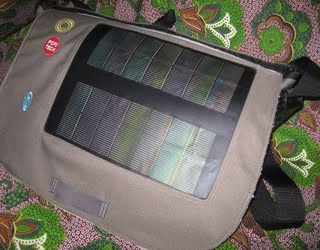
The FLAP Bag is a project that was initiated at PopTech, together with Portable Light and Timbuk2 (join the discussion on FLAP bags here)  The FLAP is a messenger bag, designed by Timbuk2, which incorporates a removable flexible solar panel made by Portable Light.  The solar panel can be left on the bag and charged on the go (i.e. while you walk around in the sun) or removed and laid out flat to absorb the sun.  Connected to the solar panel is a battery that feeds into a small light, useful for walking/riding a bike at night, and a mobile phone charger. Photo: FLAP bag.

For use at home when there is no power, the light can be hung up or set up to reflect off the silvery back side of the solar panel for increased reach of its brightness.  A day of charging gives 10 hours of light.  Phones can be plugged into the USB port on the battery.  The phone charger (I learned) is direct charge – i.e., it charges through the battery only while in the sun, not from the battery after sundown. Photo:  FLAP bag with reflective side showing.

A few weeks ago I wrote about taking the FLAP bag to Mozambique to see what people thought of it.

While there I also got a few reactions on video (3 mins long).


Note:  I didn’t embed the video here because you can’t watch it with subtitles if it’s embedded, so you’ll have to check it out via this link.  To turn on the captions/subtitles, click on the lower right hand triangle of the video player.  That will show you a “cc” box. Click on the “cc” box to turn it red, and that will turn on captions/subtitles.  To the left of the “cc” is another little triangle. Hover over it, and you’ll see the language options.  (And for something really cool – then check out how you can translate the captions! but that’s another topic…)

————

After my month in Mozambique with the bag, and based on some conversations sparked by my last blog post, my thoughts are:

How the FLAP worked for me

I charged the panels up a few times in Mozambique and at first had trouble getting the light to turn on. I emailed Portable Light and they explained that you need to keep the button pressed down for a bit for the light to come on.  Bingo, it worked fine then.  We had a week of steady rain the 3rd week I was in Mozambique and the power was out in my room at the hotel.  I was able to use the light for 4 consecutive evenings for a couple of hours and the battery held the power even though I wasn’t recharging the panel during the day.  For some reason I wasn’t able to get my i-phone to charge, so need to figure out what’s going on there.  I didn’t realize at first that phone charging has to be done via direct sunlight, not stored power, so maybe that is the problem. Will keep trying.

Purpose.

It’s a great idea and meets real needs:  light and mobile phone charging. People love the idea. It turns heads and the bag is very nice.  Everyone wants one, as you could see from the video. I liked the poetic quote that the FLAP gives you power for the fundamentals: “a telephone to communicate and a lamp to illuminate.”

Openness to testing.

I love that the FLAP folks are open to feedback and adjustments to the idea to develop something that’s localized and works for different populations/situations.

USB port.

Most people in the rural communities where I tend to travel don’t own or have access to computers and their phones come with wall plugs, not USB cables. So I think the USB port needs some kind of adaptor.   I tested the few USB cables I was able to find, and they only transferred data, not electricity (they didn’t charge up while connected to either a computer or the FLAP battery).  This includes the fancy Nokia E63 that I use when I travel.  So either I’m missing something (highly possible!), or the bag needs to come with a cheap universal electricity/USB cable, or if the system is built locally, cables for the most popular phone types could be included or manufactured as an accessory.  There are also different ways that people charge locally that could be looked at (though these are probably imported, worth a look?), for example, the universal charger in the photo above, which I’ve also seen in Senegal. You can connect a camera or phone battery directly.  Perhaps an idea to think about.  Another option might be something like this universal charger that was announced in October 2009, though it may not be compatible with existing phones that people already own.

Cost at ‘BoP’.

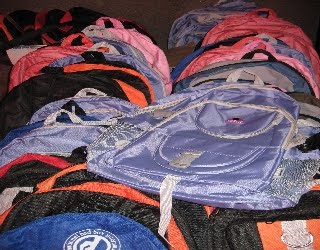
The cost is currently too high for people at the “Bottom of the Pyramid” (BoP).  It probably needs to come down to $5-$10 for the solar panel/battery/light. Research on income, similar products (if available), current phone charging costs/costs for candles/other light sources, and perceived value would help to find realistic price point.  People don’t normally carry bags where I was, except for backpacks for school, made out of very inexpensive plastic/vinyl. Some ideas that people had on where to put a solar panel included: on school backpacks, curtains, cloths, parasols, clothing, foldable panels that can be taken out and set up at the market or while doing outside work during the day, or something to set in a back window or on top of a car. Photo: Common style of school backpacks in Mozambique.

‘Cost per beneficiary’/ROI at NGOs.

One person at a large global NGO read my recent blog post and got very excited about the possibility of children having light to study by at night.  When I revealed the cost, however, even at $50, the ‘cost per beneficiary’ that many NGOs adhere to due to internal rules or donor expectations was too high.  It would be interesting for FLAP to find/do/publish some research on the benefits of light in education, learning, future income, etc., or cost saving in other areas by having solar light. This could be combined with research on economic benefits of mobile phones and the costs for charging locally (eg., in Mozambique this is about 10 MTs/day or USD $0.40) to make the case for FLAP. (Maybe this is already being done).   I’m not sure if most NGOs currently include environmental benefits as a main factor when measuring ROI, but these kinds of numbers would be helpful to inform decisions.

‘MoP’ Uses.

The bag in its current form at a mid-range price (e.g. $30-45?) could be widely used at the “Middle of the Pyramid.”  NGOs already spend on camera batteries, bags, etc. for staff as part of normal operations, and if they were manufactured locally they could generate local business.  In the case of Plan (where I work), for example, staff take lots of photos for sponsorship and program operations.  Using rechargeable digital camera batteries and FLAP, savings over time could potentially offset the costs, and could be one concrete way to start reducing negative environmental impact.  So a good entry point for FLAP could be NGO workers, university students, government workers who spend time in communities and need to keep their phones or digital cameras charged up for mobile data gathering or collecting data, surveys, etc. in ‘the field.’  Another possible link would be with the Peace Corps or other large organizations that equip their volunteers or staff with essential gear before sending them to live/work in rural communities.

Note on who I was talking with:

In order to qualify things, I did a little unscientific research.  While everyone at our workshop was together in the same room, I read 6 statements, and asked them to raise their hands if the statement was true.  We had around 45 kids in the room, roughly 75% male/25% female, between the ages of 12 and 20, attending secondary school and living in communities within a 1 hour radius (by public transportation) from the school.  The school is located along a main road, put in 3 years ago, and the communities/commerce along the road are growing.  Also in the room were 10 adult teachers/local NGO partners/folks from national radio stations living in the district.  I suppose you would consider the students “poor” by typical global standards, however the fact that they are attending secondary school means that they are not the poorest of the poor. Teacher salaries are around 3,000 MTs/month or about $100.  Photo:  The phones that were at the workshop.

The results:

· 34% had their own mobile phones (more than half of this % were adults)

· 100% of their families had mobile phones

· 25% of personal or family’s phones had a USB cable

· 25% of the phones can connect to internet

· 24% had used the internet at least once before the workshop

· 43% have electricity at home

I asked everyone in the room to put their phones on the table (photo above).  You can see that the most popular types of phones are the Nokia 1100 or 1200 (which do not come with a USB cable, though I believe they do have a 5-prong USB jack).

————

Related Posts on Wait… What?

Pop!Tech:  Oh!

It’s a Light, It’s a Bag, It’s a Charger…. It’s FLAP!

Read Full Post »

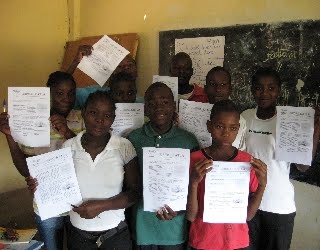
Saturday, was the last day of the 2-week Youth Empowerment through Arts and Media (YETAM) workshop with the youth.  Each of the sub-groups had the task of prioritizing 2-3 areas that they wanted to focus on over the next 6 months and developing a basic plan. The plans included their focus issues, analysis of the causes of the issue, what they would do about it using their reinforced media and arts skills, when they would do it, and how they would know that they had achieved their short term goals (indicators). Photo: members of one of the media teams.

Nathalia, age 18, presented for the theater group. “We are going to work more on the issue of devaluation of girls by their parents.  This is caused by the belief that men were made to dominate and women to serve, the idea that girls don’t bring any benefit to their parents, but bring only trouble, and the idea that girls are physically and mentally weak.”

The other 4 groups’ topics are:

· Music/Dance group: children’s rights in general, education as the key to a successful future, the value of local culture and traditions.

· Media group:  disaster risk reduction and risks to youth in the community such as the discotheque, alcohol and drugs, and violence.

· Painting group: child rights in general, drug abuse and protecting children from violence/risk.

· Journalism group: sanitation and hygiene, education.

Mobile data gathering?

The groups will prepare work on these topics and extend their messages out to the school community and the surrounding villages.  To track their progress, they plan to survey audiences that have seen their work (eg., their films, paintings, songs, theater, newsletters, etc).  This made us think about the idea of using mobile phones to do the surveys (Nokia Data Gathering or Frontline SMS Forms, depending on which is more feasible and cost effective).

The youth could create surveys on a few devices, and then go around to survey people who have attended their events or viewed their work and heard their messages.  The youth could then have immediate results by exporting the survey results into excel for analysis.  In the process, the youth can learn about statistics, charts and graphs.  Eventually they could also take surveying to another level, such as looking at behaviors and practices, and use the information to inform the outreach work that they are doing.  Photo:  Thinking about mobiles for more than calls and SMS.

“The kids see charts and graphs sometimes in their books, but they never have a chance to learn what actually goes into making a chart or graph, or to cover anything about statistics.  This would be a fabulous hand-on way to see how data is collected and used for decision making and to measure results,” said Lauren, the Peace Corps volunteer teacher at the school. “It would be great for them to get to see immediate feedback on their own work!”

Feedback from youth

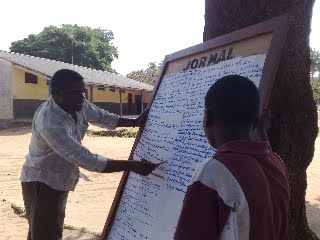
Photo: journalism group shows their newsletter.

At the closing ceremony the youth were sad to go. “This is an opportunity that we had to participate in something that has never happened here at Cumbana,” said one girl.  “I encourage my fellow students here to show through their behavior, actions and their studies this coming year that they are now different.  That they are changed.”  (theater group)

“I never imagined that I could be a painter, but now I have the dream that I can do it.  I am happy because I showed what I’m capable of and I expressed my feelings through art.” (painting group)

“My favorite thing was making the big mural. I feel very proud and I can show my friends what I’m capable of.” (painting group)

“This initiative allowed us to show light on our reality. I also know now that I have talent in my mind and in my hands to express myself now and to build my future.” (journalism group)

“I really thank Plan and Nokia because with this workshop I saw myself transforming my life. I will become an artist and I will make something out of my life” (painting group)

“I liked helping to raise awareness in people and to change things in our community and in ourselves.  I want to share the success we’ve had in this project and our work, and to involve more people. There are many things we can achieve.” (media group)

“The best thing about the workshop was the way that they listened to us, they gave us courage to believe in ourselves. They reminded us that nothing comes from nothing and that only through education can we prepare for our futures.” (theater group)

“I liked working with equipment that I had never seen.  Now I know how to use it. I feel able to learn without fear.” (media group)

And facilitators?

“It was great to see the youth increase their knowledge about their culture, history, rights and the role they can play in their community as agents of change.  I loved seeing the youth apply the things that they learned and then do the work by themselves.  I would like to see more adults in the community participating in a workshop like this. There are many things that we can benefit from as well.” (Facilitator)

“I thought the workshop was fantastic.  The kids gained so much experience and confidence and really took advantage of these new opportunities.” (Facilitator)

Related posts:
On Girls and ICTs
Putting Cumbana on the Map

Read Full Post »

We’ve completed our first week of arts and media training with around 55 youth in Cumbana, a coastal community some 450 kms north of Maputo, the capital of Mozambique.  If you ever tried to Google Cumbana, you’d find information about a photographer with the same last name or links to tourist hotels at the nearby beaches in Maxixe or Inhambane, and not much else.  We actually did this as part of our Tuesday session on Internet with the youth.  Googling New York was another story.  But why?

We turned it around to the youth. Why is there no information on Cumbana?  The conclusion was you only find things on internet that someone puts there, and  no one had bothered, no one had ever really uploaded anything about Cumbana.  And that meant that this group of youth has a big responsibility, because they are going to be the ones to put Cumbana on the map. Photo:  After Cumbana, the top Google search among our small population was, of course, Michael Jackson.

What does that mean?  Aside from producing arts and media to raise issues that affect them and engage their communities in jointly finding solutions, the youth will be the ones to define Cumbana.  As Lauren (the Peace Corps volunteer who’s been teaching at the school for the past 2 years) said:  “Did we find anything about you all in Cumbana now on the internet?  No.  When will there be something about Cumbana?  When you make the effort to put it there.”  Photo: Mobile phone connections are much more likely than computers in the near future, so we trained on internet also using mobiles.

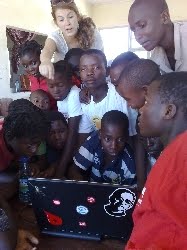
Access to internet whether by laptop using mobile internet or directly on a phone is a huge hit with the kids, 75% of whom had never been online before.  Our 2 hour session could have gone on all day for all they cared. The idea of putting yourself on the map seems to have appeal in the same way that having a Facebook page does.  It’s about self publishing and creating an identity. Photo left: Anthony the local Peace Corps Volunteer supported with the internet and is working with the theater group.  Photo below: Lauren, Peace Corps Volunteer, is working with the multimedia group.

But as we are seeing more and more, citizen journalism has its downfalls (think Fort Hood).  So it was great to see the debates about ethics in journalism that also happened last week.  Jeremias from Radio Mozambique facilitated a great session. He was excited to be part of the workshop because, as he said, “I’m a journalist.  I want to groom more young people from right here in the community where I came from to follow in my profession, and this is a great chance for all of us.”

During Jeremias’ session on ethics, the kids hotly debated the question of whether you should show the face of someone caught stealing.  Many felt that this would punish the thief as well as protect the community. Jeremias countered, “In Mozambique, whose job is it to determine guilt or punishment? Eh?  It’s not the role of the journalist. It’s the role of the judicial system. Like it or not, that’s how it is.”  He talked about the basic rules in journalism to protect people, about divulging information and objectivity. “When you leave here, to do work out there in the community, you need to be sure to hear all sides.  You need to protect the good name of people.  This is our responsibility.  This is ethics.  You cannot condemn someone until the judicial system has determined that they are guilty.”

I sat there wishing every self-appointed citizen journalist followed those rules, and self-examining whether I always do.  But it also got me thinking about how when you are not in a free state, your judicial system is totally non functional, or there is corruption within the journalism profession or media houses, things are not nearly so clear.  Sometimes things need to be filmed to get something to happen, whether they’ve been proven or not.  What are the rules and ethics then?  (I’m sure I can Google this and find a debate!)

The youth were cautioned to leave aside sensationalism.  “Often wanting to be the first to get the news out makes us less careful as journalists” Jeremias said.  If we drop the bomb, we’re likely to see the next day that we are the ones being processed, accused of not being ethical.” Photo: Jeremias and a youth participant share ideas.

“The ethics of a journalist come from within us,” he said.  Sometimes even a journalist’s own employers may ask him do things that are not ethical.  Or others want a certain story to come out and they try to bribe a journalist.  This makes it really difficult to be a journalist. A journalist needs to have high and strong ethics and maintain objectivity,” he told the kids.

“So you see, journalist is under constant pressure. It’s REALLY easy to get a recorder, to make a story.  It’s more difficult to think through what the consequences of publishing that story might be.  As a journalist, your goal is not to get famous; it’s to transmit information, so get the idea of fame right out of your head.”

Jeremias is a wise man and we are really lucky to have him training our group of journalists.

Cumbana is the only secondary school (it covers to 10th grade) in the entire district, with 3 sessions a day, serving some 4000 students (if the teacher I asked is correct). The opportunity to participate in a program like YETAM is huge for students and teachers alike.  In addition to the journalist group, there is theater, music and dance, multimedia, and painting.  For the kids, it’s like a 2 week summer camp where they strengthen leadership skills, improve their studies, get organized to address community challenges facing youth, and think about careers outside of the norm.  For the teachers, it’s an opportunity to engage with students in a different way, to strengthen their teaching methodologies and improve their ICT skills.  For the partners, it’s an opportunity to give back to the community and, of course, to discover new talent for their professions.

Related posts:
On Girls and ICTs
Being a Girl in Cumbana
Is this map better than that map?

Read Full Post »

When I was at PopTech in October, I saw the solar FLAP (Flexible Light and Power) bag, a joint project of Portable Light, Timbuk2, and PopTech.  It seemed like something that could help make mobiles in program work more feasible for staff, community volunteers, or community health workers. One of the main challenges we find in our work is lack of electricity, to charge phones among other uses. Photo: FLAP bag looks nice next to a pink tablecloth. 🙂

I already had a trip to Mozambique planned in November to facilitate a workshop with teachers, partners and youth as part of our youth empowerment through arts and social media (YETAM) project in Cumbana, a community about 30 minutes outside of Maxixe, and some 450 km north of Maputo, the capital.  So I decided to get a FLAP bag and take it for a spin to see what people thought about it. Electricity to charge phones is of course not only an issue in Mozambique.  Last year some of the kids we worked with in Senegal made a video specifically about the chore of charging their phones.

Trying it Out.

I brought the bag to the YETAM workshop one morning last week, removed the flap with the solar panels and laid it in the sun to charge. Jeremias, one of our project partners from Radio Mozambique in Maxixe, saw me setting it out in the sunniest spot and asked what it was.  I gave the 30 second explanation:  that it was a bag with solar panels, and it charges up a small light to use at night, and has a battery to charge phones. He quickly said – Oh! I can charge with my USB cable here, and showed me his phone. Then I had to rush inside to start the training.

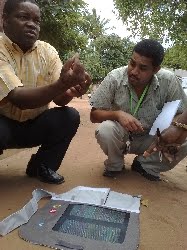
At break time, I discovered a little crowd gathered around the flap.  Jeremias was crouched down, explaining to Badru (a journalist from Radio Progresso) and Joao (a journalist from Maxixe) how it functions.  Photo: Jeremias explaining how the Flap bag works to Badru.

So Jeremias and I did a short video interview of Badru, to see what he thought of the bag, how he would improve it, and if he thought it was something that could be sold locally (and for how much).  “This is really a good idea. It would facilitate the lives of people in the communities.  It has a light and a phone charger, that’s pretty essential,” he said.  I asked what he thought people would be willing to pay for it.  He stalled a bit, because he wanted to know first how much it cost to make and what the value in the US was.  I said I didn’t really remember (true). He finally said for the bag alone, about $5.  For the bag with the solar components, about $15.

Joao stepped in and said that this kind of thing would necessarily be expensive because the technology is not available in Mozambique, where most technology like this is imported.   In any case, I asked, how much would it be worth to someone to be able to have light in the evening and to charge a phone? How much do people spend normally to charge a phone?  “Well,” Badru explained, “you have to send your phone somewhere to get it charged, or you have to go pay 10 metacais a day (around $0.30), and then sit around and wait for it to charge up.”  So you end up spending about 300 metacais a month to keep a phone charged here.

Badru thought the idea of making the bag locally and incorporating imported solar panels would be a possibility, and that a bag like the Flap bag would be helpful for university students, government staff or NGO workers who spend time out in communities and need to charge their phones up.

Today Luisa, from the Casa de Cultura (Cultural Organization), Delcia and Eucidio (teachers at Cumbana school) asked about the bag, so I showed them the light and where the phone plugs in.  I asked them what value a bag like this would have, and what they thought people would pay for it if it was available in the local market.  Their first answer was that it would depend on how good the salesperson was, and that they would need to know what other similar products cost so they could barter.  “This is something we haven’t seen before, so we have no idea what it would cost,” Eucidio explained.  “But,” he encouraged Luisa and Delcia “look, it has light, it charges your phone, it’s a bag….”  “Ooooouu, then it must be really expensive!” they concluded. Photo:  Luisa, Delcia and Eucidio discussing the suggested price for a flexible solar panel.

Delcia doesn’t have electricity at her house and said a bag would be great because she would have everything at the home, and wouldn’t need to spend on candles or charge her phone outside of the house.

I mentioned that I haven’t seen anyone here carrying a bag.  People seem to use flimsy little plastic bags from the market or local store, or burlap sacks to carry vegetables, coconuts, etc., or they carry things on their heads.  So where would it be best to actually put a solar panel? They thought a little, and suggested incorporating solar panels on backpacks for school kids, or on a hat, a shirt, back of a skirt, on a parasol, or as something that could be set on top of or in the back window of a car.  Photo: Luisa showing us where she could carry her solar panels: na bunda!

Now as I’m sitting here in my little hotel room in Maxixe at the end of the day, across from the noisy gas station, slapping mosquitoes as I write this post up, I’m wondering if maybe the FLAP folks could add some kind of solar insect repellent to the bag….  That would be perfect.

Related posts:
FLAP power for the basics: illumination and communication
Pop! Tech:  Oh!

Read Full Post »

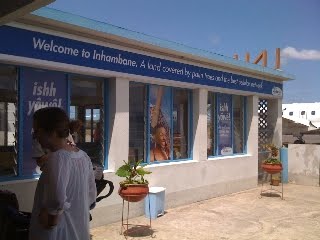
Landing in Inhambane, Mozambique, the first thing you see is the blue Vodacom sign:  ‘Welcome to Inhambane – a land covered by palm trees and the best cellular network’.  I don’t usually believe ads and this time was no exception. But I have to say, it seems to be true. My sim card is actually on mCel, not Vodacom, but the coverage is still damn good.  And the two cell phone companies are everywhere. I’m not sure which I saw more of – yellow Frelimo t-shirts (elections were last week), yellow mCel kiosks or blue Vodacom kiosks.

Which reminds me that I saw a statistic last week saying that more people have mobile phones than latrines.  And I’m not sure how I feel about that….  And then I start thinking about the hierarchy of personal needs – which perhaps needs some revising.  So does communication rank higher now than toilets?  What about food? I was certainly more worried about getting online than about eating for the past 4 days (as a vegetarian, your choice is limited unless you really make an effort).  I mean, at least I got to complain about the 4 days of fried eggs on Twitter…. but what if it were access to food in general? Where would I put my effort? hmmm. I digress….

My travel diet (in addition to the eggs) has been around 5 hours of mobile internet on my laptop a day (skype, email, blogging, Twitter, maps, google translate, and a few doses of Facebook thrown in), and several mobile internet snacks from my phone itself in between. I’ve gone through about 600 credits in 5 days, or around $4/day.  I fully recognize that is expensive for someone who is not earning a US salary, but I love that I was able to just purchase a sim card, put it in my phone, hook up my phone as a modem, and ta-dah.

Yes I’m using a ‘smart phone’ (Nokia E-63), but my point is that it’s much easier to use your phone as a modem in Mozambique than it is in the US (seems the latest i-phone update disables that so I’m afraid to download the latest update) or in the other African countries that I’ve been in over the past year.  Compared to Cameroon, Senegal and Kenya where we had to purchase a special data package and get help/permission from the phone company (or were we just not doing it right? It does get easier to figure out the more you do this stuff). In any case, internet hardly worked once we finally got connected. So in that sense, Mozambique is an internet junkie’s dream.

I asked about internet as a precursor to the social media session of the Youth Empowerment through Arts and Media (YETAM) training of trainers workshop yesterday.  We are working from a secondary school about 30 km outside of the town of Maxixe, where I expected internet would be nil (and it is, except by mobile phone modem).   Several teachers and partner organization members from the area are participating. Starting on Sunday, for two weeks they’ll work with youth to use arts and media as tools in the community development process. The same arts and media are a way for youth to put themselves, their community and their issues on the global map by uploading the photos, drawings and videos they will make to the web.

As an example during yesterday’s session, I Googled the name of the school.  All we found in the first couple of pages was Maxixe and nearby towns listed, with content related to tourist beaches. There was also a blog by Lauren, the Peace Corp Volunteer who is teaching there.  Several months back when we were planning the training, Lauren’s blog was the only information I was able to specifically find about the school and area.  Because of her blog, I was able to connect her and our local staff to work together on the whole training.  After the YETAM training, the ideas is that people will be able to find information created by the community and youth themselves, from their own perspective.

I’m really excited about the good internet, because maybe then the whole process can be done from the community – including the uploading and subtitling of the videos (usually is done from the Plan office in the US due to slow connections).  That will be huge in terms of community and youth ownership.  Im crossing my fingers that we can make this happen.  Or we’ll have to sue the land of palm trees and the best cellular network for false advertising :-).

Related posts:

It’s all part of the ICT Jigsaw: Plan Mozambique ICT4D workshops
Putting Cumbana on the Map


Read Full Post »

« Newer Posts - Older Posts »