Feeds:
Posts
Comments

Archive for the ‘m4D’ Category

I’ll be speaking on a panel called ICT4D, Innovations and the MDGs next week during UN Week in New York and another on Girls and Mobiles hosted by Mobile Active. So, I’ve been putting together my thoughts around girls, child rights, ICTs and the MDGs.  The angle I’m taking is not from the large donor, top down, huge institutional program side, but instead, looking at examples from the work I’ve been closest to over the past few years at the community and district level, mostly focused on child and youth participation in the development process. Check my MDGs through a child rights lens post for more background.

My last post (3 ways to integrate ICTs into your development organization) uses Hannah Beardon’s framework to discuss how organizations can integrate ICTs into their work. Hannah suggests that ICTs can be integrated directly(providing access to ICTs), strategically (using ICTs as tools to support development processes) and indirectly (using ICTs to improve efficiency and communication within the organization).

To complete that post, I’m listing below 5 ways that ICTs can facilitate accountability and transparency, citizen engagement, and public debate, all of which are necessary to bring about development improvements and achieve the MDGs. Obviously these are not the only ways ICTs can support the MDGs, but this post would have been miles long if I’d listed all the initiatives that are out there.
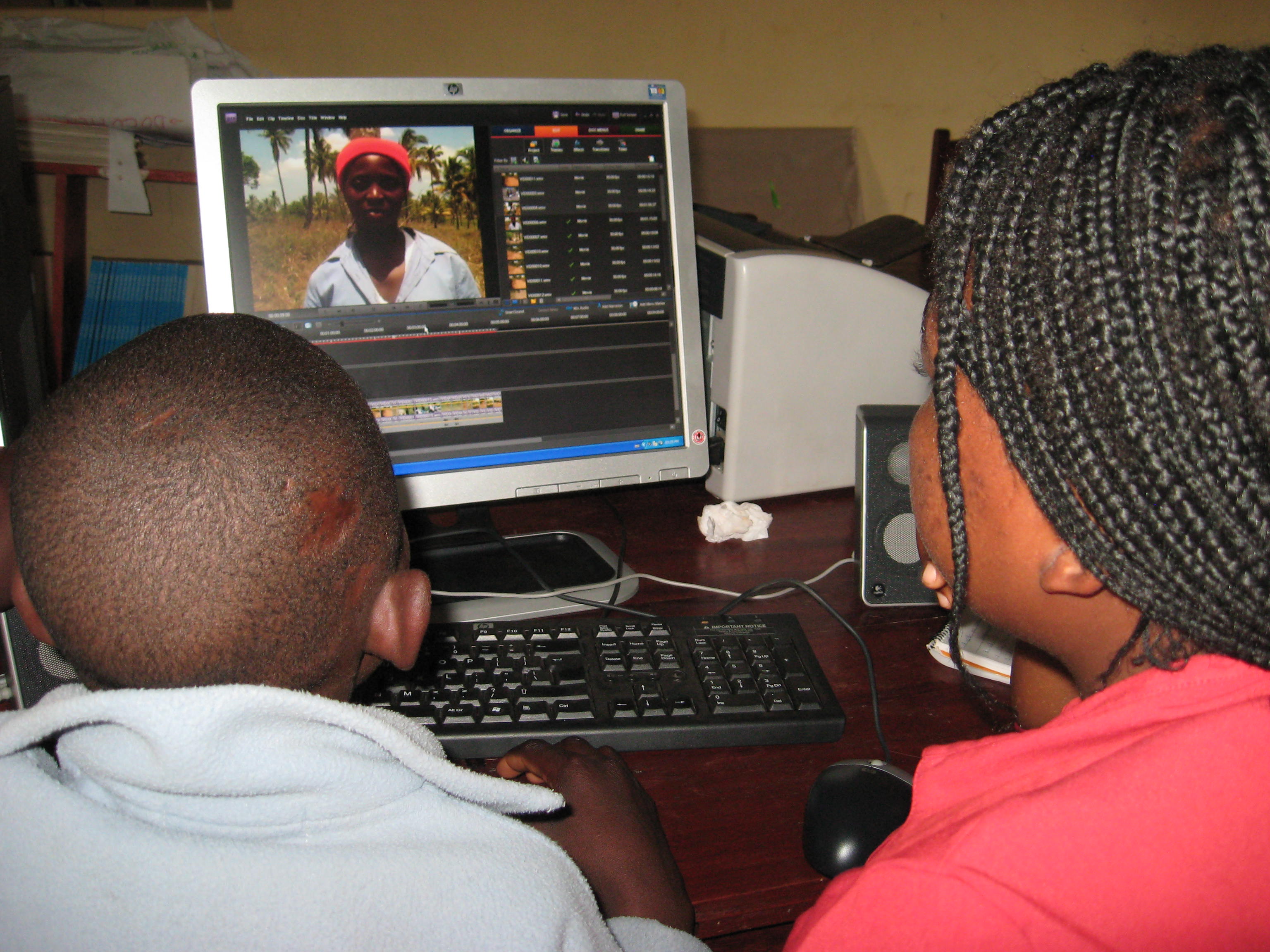
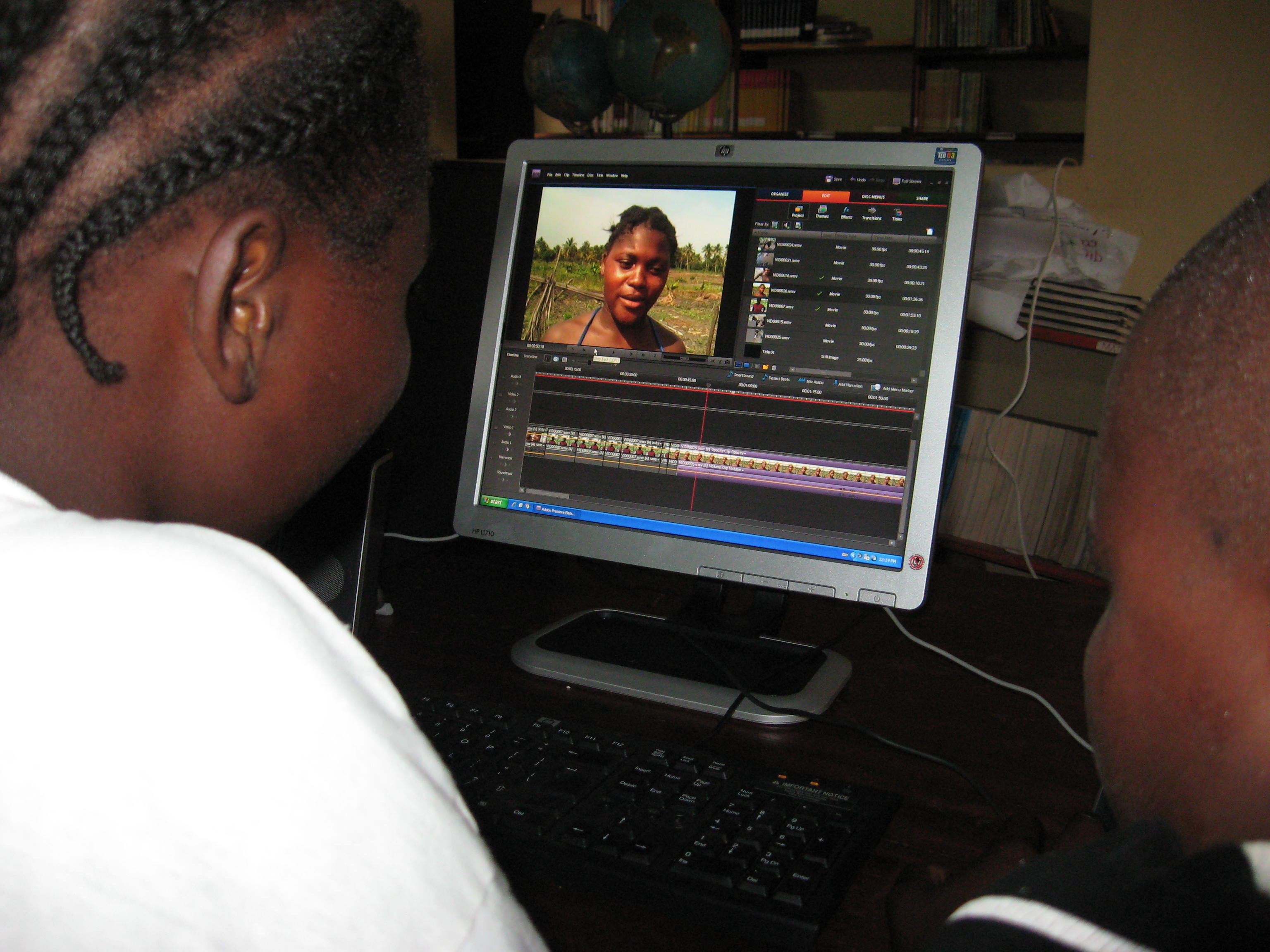
1) Engaging children and youth in the development process

An engaged and active population is a key ingredient for good development programs. Children and youth have much to offer, are directly targeted in the MDGs and many other development initiatives, offer valuable ideas and energy, and make up around half the population in many of the countries that are lagging in reaching the MDGs. ICTs can help children and youth engage in the development process and bring their ideas, opinions and voices alive at the community, district, national and global level. ‘Using new technology, new media, children and youth can claim a space that they didn’t have before. They can influence certain things, advocate on particular issues that are important to them, take ownership in communities and in leadership. ICTs excite them and encourage them to be more involved and engaged.’ Anthony Njoroge, Plan Kenya Community ICT Manager.

ICTs empower young people with skills that make them more confident and more involved at the community level.‘Using ICTs, children and youth have become more responsible because they are not waiting for adults to come in with something. Now they are designing it themselves, they are creating space for themselves and bringing their agenda to adult meetings instead of waiting to be invited in or having to work within the agenda of the adults. It used to be that you’d start working with 20 youth, you’d invite them into a community meeting. You’d see the number go down to 10, to 4, to 3, because they didn’t see any relation to themselves in the topics and the goings on. With integration of technology and the arts however, youth have a high level of interest. It’s really bringing in their opinions, their thoughts and ideas to join their voices with parents. Now they use arts and media to promote communication, dialogue on their issues and look for ways to resolve them. Before they were totally missing from the discussion, but now they are here.’ Judith Nkie, Plan Cameroon Youth Empowerment through Arts and Media Project Coordinator.

Arts and ICTs were used in the above-mentioned project as tools for youth engagement, mapping and prioritizing, research and community dialog. The media produced with the ICT tools was shared first within the community and then outside at the district, national and global levels as a way of engaging decision makers and the public in the youths’ agenda.  For more on how arts and ICTs are being used in the above-mentioned project, see this post. Watch 100 videos made by youth in 6 African countries on topics they are passionate about.

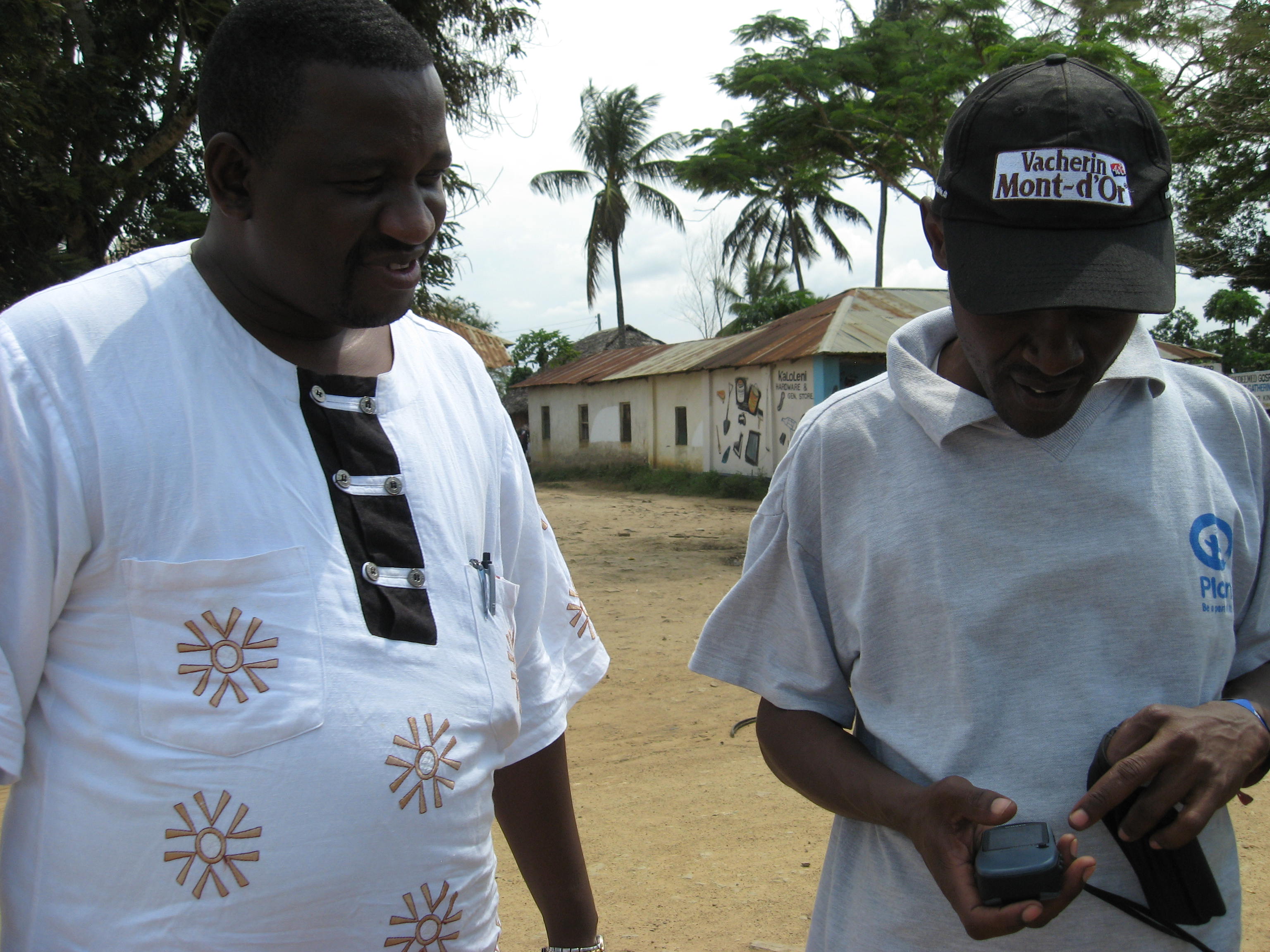
GPS work in Kwale, Kenya

2) Identifying resources and mapping patterns for better decision-making

Tracking and visualizing information is an excellent way to improve decision-making capacity. The advent of simpler and open source participatory digital mapping tools allows community members to map their communities digitally and to have more ownership of the information. Mapping helps identify patterns that may not have been visible before. Local maps shared on-line allow local people to provide their own information from their own perspective, and that information serves multiple purposes at the local level and beyond.

Digital mapping can be helpful when governments decentralize. Municipalities are mapping resources as well as projects and interventions. District authorities can track their own initiatives and those by local and international organizations to avoid duplication of efforts and wasted resources. When maps are public, the population can better demand answers about where resources are being allocated and why. Maps can help with disaster risk reduction and tools such as Ushahidi can help during emergency response. Mapping information is also useful for holding up a mirror to the population to ask them questions about themselves and their behaviors and for showing the direct consequences of actions; for example in a Community Total Led Sanitation mapping project, the community faces its realities about where their own waste is entering food and water sources.

Map Kibera is a good example of participatory digital mapping. mGEOS is a mobile mapping tool developed to help Plan Kenya staff to gather and share data needed for their daily work. Map Kibera and Plan Kenya are collaborating in Kwale on youth and governance work, and in Mathare to work on Community Total Led Sanitation using digital mapping tools (see July 27th entry). In this video, a district youth officer in Kenya talks about why digital mapping is useful for his community.
Mapping Violence against Children in Benin

3) Pulling in quick information to guide further investigation, response, or advocacy; pushing out information for targeted actions

ICTs can be used to gather quick information from a broad population. This can be useful in a variety of situations and themes, including those outlined in the MDGs. For example, SMS are being used to report on whether teachers are showing up at school, where violence against children and women is happening, where help is needed in the aftermath of a disaster, and for tracking endangered wildlife. Crowd sourced information can help governments and agencies get preliminary information so that further investigation and support can be provided in a particular area. Another example is the use of mobiles in different health initiatives, including:  child-birth care; HIV and AIDS prevention and treatment programs; support for volunteer community healthcare workers; and bed net treatment reminders. Most of the ICT and development world is also already familiar with the work of two organizations:  Ushahidi and FrontlineSMS who have been combining SMS with digital mapping.

A program that I’m closely involved with is SMS reporting of violence against children in Benin, where local communities, government agencies and NGOs are collaborating to improve the child protection system. This type of program shows promise if heed is paid to the pros and cons of collecting information by SMS, and if those implementing are clear about the type of information that will be gathered, privacy implications, and how the system will complement existing systems. (Here is one document that outlines some considerations). Increasing controls by governments and mobile phone companies, including SIM card registry and Mozambique’s recent government shut down of SMS services during the bread riots are good examples of how quickly the ICT landscape can change, and how flexible and agile those working in the area of ICTs need to be.

Checking info on constituency development fund

4) Supporting accountability and transparency

ICTs are useful to support accountability and transparency, necessary for attempts to track and ensure good use of funding for different efforts, including those related to the MDGs and other aid and development programs. Making information more available to the public by mobile is one such way.  SODNET’s budget tracking tool, for example, informs Kenyans of how much funding is allocated by the Constituency Development Fund to different municipalities in different categories. Combined with mapping, as outlined in this post, the budget information can help constituents to track where their funds are actually being spent.  Other interesting examples of how ICTs can be used for transparency and accountability can be found at TacticalTech’s Info Activism site and at Technology for Transparency.
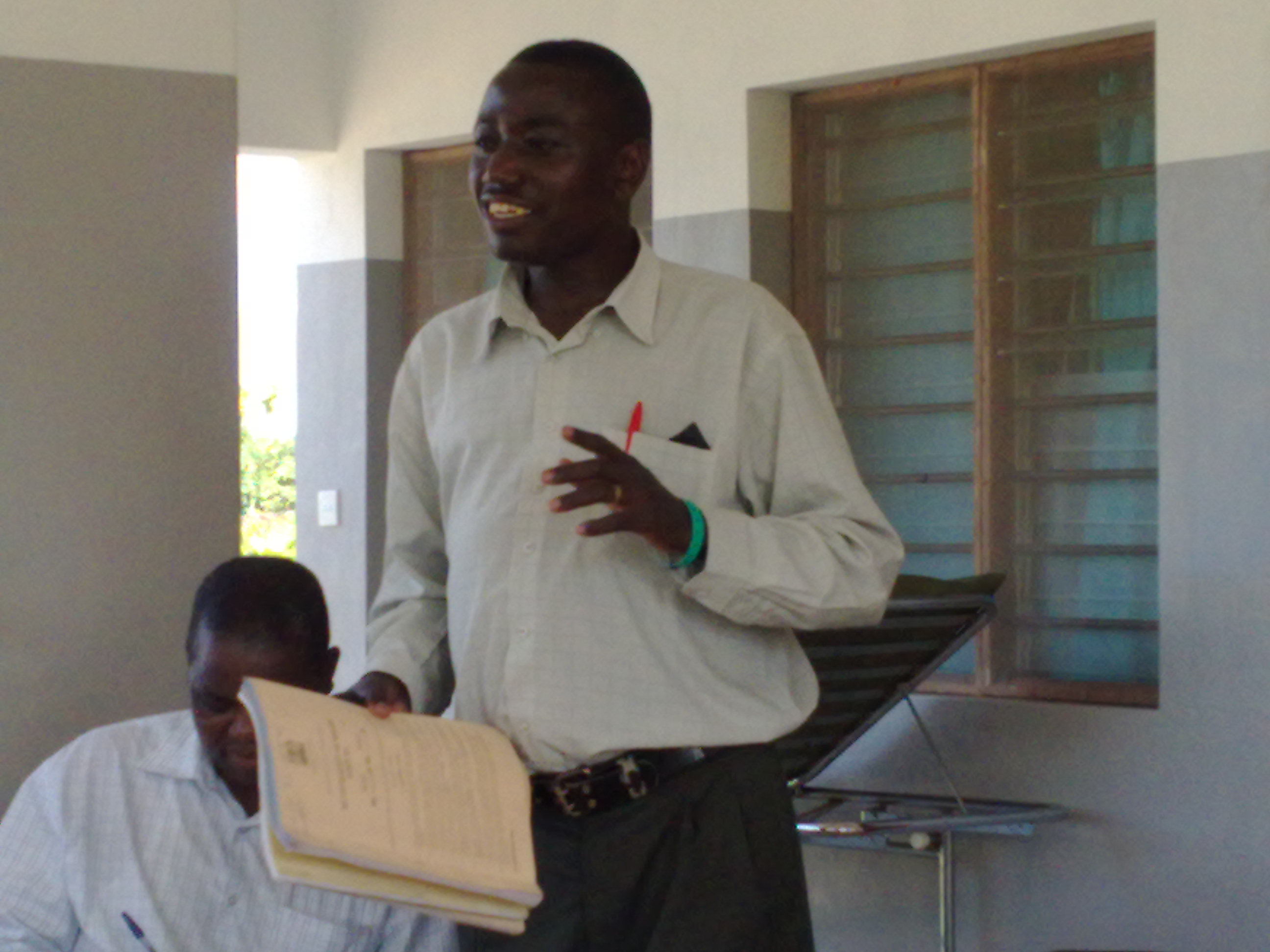
Paper forms will soon be digitized….

5) Improving municipal services and information management

Civil registration documents, especially a birth certificate, are a precursor to demanding any number of rights or accessing a wide array of services. Without a birth certificate a child may not be able to sit for school exams, receive immunizations or free health care or claim rights to inheritance or legal protection in courts of law. Proof of age is critical in successfully prosecuting perpetrators of crimes against children such as child trafficking, sexual offenses, early recruitment into the armed forces, child marriage and child labor. ICTs are being used to digitize civil registry in Kenya, for example. Not only are records being digitized, but mobile phones are used to make it more convenient for the population to know when their documents are ready. This saves people time and money and means that more parents will register their children.

But wait, there’s more!

These are only a few examples of ways that ICTs are being used at the grassroots level to improve participation, transparency, accountability, debate and ownership of the development process.  The MDGs are lofty, but informed local community participation and ownership is key in efforts to reach them and in ensuring that marginalized populations can also be included.

Please add your examples of ways that ICTs can support development and ICTs in the comments section!

Related posts on Wait… What?

3 ways to integrate ICTs into development work

11 concerns about ICTs and ‘social media for social good’

I and C, then T

MDGs through a child rights lens

7 (or more) questions to ask before adding ICTs
A positively brilliant ICT4D workshop in Kwale, Kenya

The road to Wa is paved

Read Full Post »

Continuing on with the Millennium Development Goal (MDG) related posts…. I’ll be on a panel on Sept 21st talking about how ICTs can contribute to the MDGs. My perspective is less from a top down, big business, giant project point of view. In my work, I look at ICTs (Information and Communication Technologies) as tools that children and young people can use to create and access information and to advance their own agendas locally and beyond, and ICTs as tools that organizations (big and small, local or not) can incorporate into their work to improve their efforts to attain development goals (such as the MDGs).

ICTs can be helpful tools for enhancing accountability, transparency, citizen engagement, public debate, participation and local ownership of the development process — all of which help with achievement of the MDGs. (See my post on MDGs through a child rights lens for more reasons why). ICTs and social media can also help organizations do more efficient, effective, engaging and high quality work.

ICTs are not silver bullets or magical elements, however; and they will not solve anything on their own. They need to be well-integrated into programs, and well-contextualized.

One framework I especially like to use for thinking about how organizations can integrate ICTs into their work comes from Hannah Beardon. Hannah suggests that ICTs can be integrated directly, strategically and indirectly:

Directly (Providing Access to ICTs): Mobiles and other ICTs have an immediate and striking impact at the family and community level, connecting people for personal, business and community reasons. Mobile devices save individuals time and money and are indispensable in emergencies and for connecting people to the larger world, such as for remittances and commodity pricing. Mobiles and ICTs can help people access information, improve their education, maintain social networks, participate in governance and community, and generate income.

Providing equipment directly is one way to think about ICTs in development programs. This includes ICT tools such as computers, mobile phones, video cameras, digital cameras, radio equipment, electricity, and Internet access. Often direct ICT support is considered for education programs and efforts focused primarily on ICT training or media projects. Computer centers and classrooms are an example, as is supplying mobile phones to project participants or GPS units for mapping projects or equipment for health programs. If this equipment and the information it collects are managed at the community or local organization level, it can enable people to assess and respond to local development needs in a powerful way.

The availability of ICTs is obviously a pre-cursor to using them in different programs and projects. However I’m not much in favor of development organizations coming in and giving away mobile phones (unless it’s some type of extreme emergency or crisis, I suppose). I’m also wary of external NGOs setting up computer centers or giving large equipment donations because of sustainability and capacity concerns. Care needs to be taken that a non-profit organization is not assuming the role that local businesses or government institutions should be playing. Working in good partnerships with local and national government institutions and local businesses and keeping clear agreements on the roles of all actors, including the community, can help to reduce these risks and make programs more sustainable. Programs that directly provide equipment also need to think carefully about what other elements are required for success (purpose of the equipment, training to use it, ongoing maintenance and repair, electricity/power, a place to keep the equipment safe, local involvement in defining the type of equipment, etc). (See 10 Worst Practices in ICTs in Education).

In thinking about providing direct access to ICTs, one place for NGOs to focus energies is keeping an eye on government ICT policies and plans and strengthening civil society to pressure government to ensure that ICTs (including Internet) are accessible to the population now that more and more information is shared via ICTs. Article 17 in the Convention on the Rights of the Child outlines children’s right to information, including access to information and material from a diversity of national and international sources, especially those aimed at the promotion of a child’s social, spiritual and moral well-being and physical and mental health. States Parties are obliged to (a) Encourage the mass media to disseminate information and material of social and cultural benefit to the child and in accordance with the spirit of article 29; (b) Encourage international cooperation in the production, exchange and dissemination of such information and material from a diversity of cultural, national and international sources; (c) Encourage the production and dissemination of children’s books; (d) Encourage the mass media to have particular regard to the linguistic needs of the child who belongs to a minority group or who is indigenous; (e) Encourage the development of appropriate guidelines for the protection of the child from information and material injurious to his or her well-being, bearing in mind the provisions of articles 13 and 18. The 2005 World Summit on the Information Society’s Tunis Agenda also provides a useful platform for thinking about advocacy around rights to information and ICTs.

Making a film on birth registration, Cameroon

Strategically (Using ICTs as tools to support development processes): Beyond directly providing ICTs, new technologies can be used in a myriad of ways to support the broader development process. Starting from larger program goals, defining the roles that information and communication play, looking closely at the local context, and then researching existing tools that could be supportive is a good way to start when planning concrete initiatives. (Forthcoming is a second publication by Hannah outlining a good process for local contextualizing and ICT integration into specific programs). If there are no existing tools, a case can be made for developing or building onto a tool or an application.

Mobile phones, as tools for effective and timely dissemination of information, have real potential to strengthen the design and delivery of programs, for example in health, education, household economic security, disaster risk reduction and response, emergency and crisis management, HIV and AIDS prevention and treatment, child protection, youth-led advocacy, and water and sanitation. ICTs should be an integral part of local, country-level and broader strategic planning processes and they should be incorporated, where appropriate and relevant, into programs where they can add value, keeping a close eye during monitoring and evaluation on whether their purported benefits are real.

On-going capacity building and exchange at various levels is critical to help program staff become aware of advances in the field of ICTs and to help ICT advisors better understand programs, staff needs and community realities. Conversations across sector and silo boundaries are also critical to ensure that ICT integration is successful. ‘Bridge figures’ are helpful — those persons with good knowledge of both programs and ICTs — to help these processes along. In the absence of someone to serve as a bridge figure, well-structured teams with expertise in both areas should work closely together to take advantage of their specific expertise and to learn from one another.  ICT tools should be selected based on local needs and contexts as well as program priorities, starting with information and communication needs, rather than starting with new ‘breakthrough’ technologies. (Though other sectors often start with the cool technology and see if/how it can be useful). During strategic planning processes, program staff should be analyzing program information and communication needs and working with ICT staff to incorporate technology that may add value and help reach program goals in a higher quality and more effective way. Again, ‘bridge figures’ can be helpful in that process. Monitoring and evaluation are important along the way to check whether adding ICTs is actually helping. Sometimes things work perfectly fine without new ICTs.

Indirectly (Using ICTs to improve efficiency and communication within the organization): The wealth of knowledge and information that a development organization generates and uses needs to be documented, shared and communicated effectively in order to improve impact. Advances in knowledge management and on-line collaboration, including blogs, wikis and other social media tools and feedback mechanisms can bring immediate access to information and real-time discussion. Lower cost technology, notably in the areas of digital mapping, GPS, mobile mapping, mobile internet can help staff to carry out their daily work and improve information sharing and decision-making across departments and to engage and inform the public. Engagement with donors can also be heightened through ICT tools and social media, always taking into consideration the additional burden 24/7 demands can add to staff’s workload, and the child protection and other risks posed by more direct access to communities.

ICTs and social media can help make aid and development organizations more participatory, more agile, and able to pull in information from variety of sources and process it faster. This in turn can help pull people out of their silos and force them to consider new ideas and ways of working and thinking about challenges. Mobiles especially are helpful for better communication with community members and local organizations. Forward thinking organizations should be taking advantage of these new tools to gather direct feedback from those that they are supporting, for better dialog to improve their work, and for devolving helpful information to community members. Mobile data collection, for example, in addition to being a strategic tool for program implementation, can also be a way of improving the quality of data collection and increasing ownership by community members of their own data which support them to take back management of their own development processes from external agents. Mobiles are also a great tool for gathering data quickly from a broad subset of the population; data which can shape rapid responses and emergency interventions.

Twitter and blogging and other web-based services can serve as a springboard for deeper discussions and coordination among different development actors, government agents, institutions and the private sector. Social media is a way to share and discuss lessons learned and challenges faced, and to diffuse information about new ICTs and how they are being used by different agencies and individuals. Global partnerships can easily be initiated, developed and nurtured on-line. Organizations can provide on-line training opportunities to staff and save time and money by using new technologies such as forums, blogs for sharing and reporting, Skype and chat tools, and social networking. These same tools can be used to improve relationships with donors and with partners and staff working in disperse offices. However, in order for any of the above to happen, command and control practices that are common in large institutions and organizations need to be abolished so the tools can be most useful.  Here is an excellent post on use of social media tools in humanitarian work.

3-fold path

Using those three categories to think about ICT integration in an organization’s work can help clarify and strategize. Some initiatives may include all three categories and some may be more focused on one particular category.

In a follow-up post, I’ll share some examples of tools that I find interesting and helpful for organizations working at the grassroots level to achieve broader programmatic goals and to improve local community participation and ownership of the development process.

—–

MDG related posts on Wait… What?

MDGs through a child rights lens

5 ways ICTs can support the MDGs

ICT related posts on Wait… What?

11 concerns about ICTs and ‘social media for social good’

I and C, then T

Innovate but keep it real

ICT4D in Uganda — ‘ICT’ does not equal ‘computers’

Mind the gap

7 (or more) questions to ask before adding ICTs
It’s all part of the ICT Jigsaw: ICT workshop in Mozambique

Read Full Post »

Angelica Valeria Ospina recently wrote about the role of social memory and ICTs in building climate change resilience.  She refers to Carl Folke’s definition of social memory as “captured experience with change and successful adaptations embedded in a deeper level of values, and actualized through community debate and decision-making processes into appropriate strategies for dealing with ongoing change.

Ospina suggests that social memory is “key for linking past experience with present and future adaptation actions, and in turn allows for novelty and innovation.” She comments that “Although the role of memory tends to be overshadowed by that of innovation, the two are in fact important foundations for change, and are equally relevant within contexts that are struggling to adapt to uncertainty….”

I really like this idea of balancing memory and innovation, and it’s not only valid within the framework of resilience and climate change.  Social memory is also useful for those of us working in ICT4D and m4D because we find ourselves at the intersection of development and technology, where methodologies and mindsets can be in opposition at times and where change is happening at a rapid frequency.

A quick characterization of the mindsets

Development Organization Mindset: How can we work with our existing resources and work around our challenges to reach our goals? How can we build on experience?

Those who work with grassroots community development are schooled to look at assets, to help communities and local organizations look at what exists already, what is within their reach, and how to identify their existing resources before looking outside for support or help. This helps a program to be more locally owned and sustainable.  Those in this field are trained to look for potential obstacles and limitations and see how to go around them or to work within them. There is a sense that lives and livelihoods are on the line, this is nothing to play around with and failure carries a high price both for community members and for organizations. This mindset can be really frustrating for for-profit or marketing consultants who come in to get people to do ‘blue sky thinking’ and to forget about limitations.

This is the group that people would describe using that Henry Ford quote:  ‘If I had asked people what they wanted, they would have asked for a faster horse.’ But this kind of thinking does have its place – local context, perceived limitations, and local experience, eg. social memory, are important in design and sustainability and impact. In addition, innovations don’t only happen in terms of ‘products’, there are process, position and paradigm innovations also which happen all the time in non-profit organizations and communities.

(Note: Certainly some will say that in aid work, no one does evaluations, and no one learns and it’s all a waste of time and resources, but that’s not been my personal experience at this point, and the work I’ve been involved in has been community development focused, not top down delivery of services and goods.)

Design Student/Technology Innovator Mindset: What can we make? What can we build that’s like nothing that’s come before? What solutions can we offer?

Innovation thinking pushes for a different kind of visioning. For throwing aside conventions and ignoring limitations so that the chains are completely off. It urges people to move quickly, to try and fail fast and often. A lot of innovation and tech thinking is product focused – What can we make? What can we build? What solution do we have that people might need? What tech can we invent and then let people figure out uses for? Those in this group are trained to move forward without thinking so much about the challenges and limitations, to move at a quick pace, and without engaging a thousand people in the process. This enables new ideas to flourish unfettered by endless rounds of consultations and participation by too many people bringing you to the fabled and unfortunate “a camel is a horse designed by a committee” result.  It allows totally new ideas and processes as well as products to spring up. Lots of trying might equal lots of failing, but it also brings about those few amazing and game changing innovations that allow huge leaps forward. Many within this field are amazingly bright and creative. At this point few have long-term experience living in poor communities in developing countries, and there are few opportunities for gaining enough of that experience.

The middle ground

Both of these mindsets have advantages and limitations and seem to have a very hard time coming to a middle ground to work together effectively, though some initiatives are overcoming this challenge. Potential collaboration can be compromised when people address each other in snarky or accusatory ways, without sufficient knowledge of the other’s work and experience. For example, this series of blog posts around crowdsourcing and humanitarian aid between Patrick Meier (here, here and here) and Paul Currion (here and here). Unfortunately I don’t have a audio recording to post of the conversation where someone told me that Paul is quite well-known for innovations in the field of humanitarian aid and technology, and would be an excellent person to collaborate with on innovations in humanitarian aid — I really hope people like Patrick and Paul will work together, as the results could be fantastic.

Ken Banks has also raised this issue of m(obile) vs d(evelopment); most recently in his post Dissecting m4d: back to basics, where he asks: Do the majority of people working in “mobiles for development” work in mobile, or development? It may seem like an odd question, but how people approach “m4d” may have more of an impact on success or failure than we think.

An example of collaboration

There are some good examples of collaboration however. One I saw most recently is MIT’s Department of Play’s Summer Institute in early August, where a team of incredible innovators and students from MIT working on community youth engagement tools spent 2 days in discussions with folks with years of experience working on child participation and youth engagement, including UNICEFCUNY Children’s Environments Research GroupProject Vision Design and Research Collective at Srishti School of Art Design and Technology Bangalore; and the Program in Education, Afterschool & Resiliency (and me :-D)

I think eventually these gaps will smooth out as the younger generation moves in and up the chain at development organizations and some of the newer technology becomes ubiquitous within organizations. It’s quite possible also that the current and new generations of design and tech students will spend more time ‘in the field’. And I am not only talking about ‘Western’ folks here, I’m also talking about young people and design students from the so-called ‘underdeveloped countries’, many of whom use technology at a dizzying pace and who are already re-shaping how development is viewed and carried out in their countries.

By lowering the fences that we are all working behind, and finding ways to combine our different skills, ICT4D and m4d can come up with even better solutions and achieve better impact in areas like accountability, health, education, livelihood, governance, emergency response and disaster preparedness.  We can build teams that capitalize on the different kinds of knowledge, skills and mindsets. We can harness social memory and strive for a balance between experience and innovation.

Related posts on Wait… What?

Salim’s ICT4D advice: innovate but keep it real

Mind the gap

mGESA: Mobile GEographical Services for Africa

Amateurs, professionals, innovations and smartaid

On trust and disempowerment

Read Full Post »

mGESA mobile mapping application

I wrote about a mobile mapping tool called mGEOS a few months ago, mentioning that I’d probably get a chance to try it myself in late July. Well that is just what happened.

I was at a workshop on ICT4D, including digital mapping, in Kwale, Kenya, and Peter Njuguna from Plan Kilifi’s District office came to share mGESA (aka Mobile Geographical Services for Africa) with us.

As far as I can tell, the difference between mGEOS and mGESA is that mGESA is a tailored application of mGEOS, designed together with Plan’s community based front-line staff for their specific information collecting and geo-visualization needs in Kenya.

Update: mGESA was the name for the pilot project. The final application is called PoiMapper (see www.pajatman.com). You can give it a try by downloading it and installing it on your mobile!

According to Njuguna, “the application is designed to run on simple mobile phones that have GPS capability and on which you can run applications.” It’s installed on the phone in the picture (update: the phone is a Nokia 6700 classic).

Njuguna explained “In Kilifi, we diverted from the route of going for applications that are there on the shelf or buying an application over the counter. We went the route of developing an application from scratch. We are working with various partners. We have Plan in Finland, we have Plan in Kenya, we have the University of Nairobi and we have the company Pajat in Finland. Plan Kilifi is the implementing office. So that is where we are coming from.”

The project has been on-going for 7 months. The first thing to define, according to Njuguna, was “Why do we need mapping? Why do we need GIS in the first place? Well, we need GIS to enhance the work we are doing and to try to answer some of the questions we are asking on a day to day basis. So that’s why we wanted to incorporate GIS into our work. Everything we’ve developed is towards helping us answer questions and make decisions in our program and sponsorship work. We wanted to build something that would suit our needs.”

The end users of mGESA are front-line staff in Plan Kilifi District office, and eventually in all of Plan Kenya’s district offices. “Kilifi front-line staff have all been involved in developing the application. The first step was developing a list of points of interest, for example, schools, hospitals and health centers, interest groups, water sources, trading centers, and the like; and outlining the kind of information that staff regularly collect about the points of interest for use in their work.

mGESA points of interest

“Developing the points of interest was a challenge,” said Njuguna. “It might look like we just sat down and listed them. But it has been a process. We had to go over and over it. We had to be sure the questions made sense, that the questions that we were asking were the right ones and made sense to people in the field.”

mGESA was tested in the field for the first time in mid-July. Njuguna and the team are hoping to kick off in another 3-4 weeks and start collecting the actual data. When the points are mapped out using the mobile application, then they are uploaded to a server that links with Google (or other) maps. The team is exploring the possibility of getting Kenya maps with administrative boundaries to use as the mapping platform. The data collected in mGESA can be exported into excel and .pdf files.

Peter let me try out mGESA while we were doing some GPS mapping in Kinango. He was using the opportunity to test accuracy, and whether mGESA was pulling in the same coordinates as the Garmin GPS units that we were using (it was). I found the data collection process to be quite simple. You basically arrive to your point of interest, take the point on the phone, and scroll through a menu to select pre-existing information (such as name of the district, type of point, etc.) or fill it in yourself. You can take a photo of the POI if your phone has photo capabilities (which most GPS enabled phones should have). I didn’t get a chance to upload data to the server or the web to see how easy that process is.

Peter Njuguna, ICT coordinator at Plan's Kilifi District Office

The group at the workshop had just been trained on several ICT different tools, so they had a lot of questions about mGESA for Njuguna:

What phones does it work on?
Any phone with GPS and capability to download an application will work.

Does it use up your airtime?

mGESA will work on the phone even without any airtime, but during testing, it seemed to work faster with about 10 shillings of credit (equivalent to about $.13).

Is mGESA free?

No. The application is in development and will eventually end up on the commercial market, via Pajat Management in Finland.

Can the application produce a base map or only points?

It can map points of interest only.  Later on it should be able to map out lines (roads) and areas.

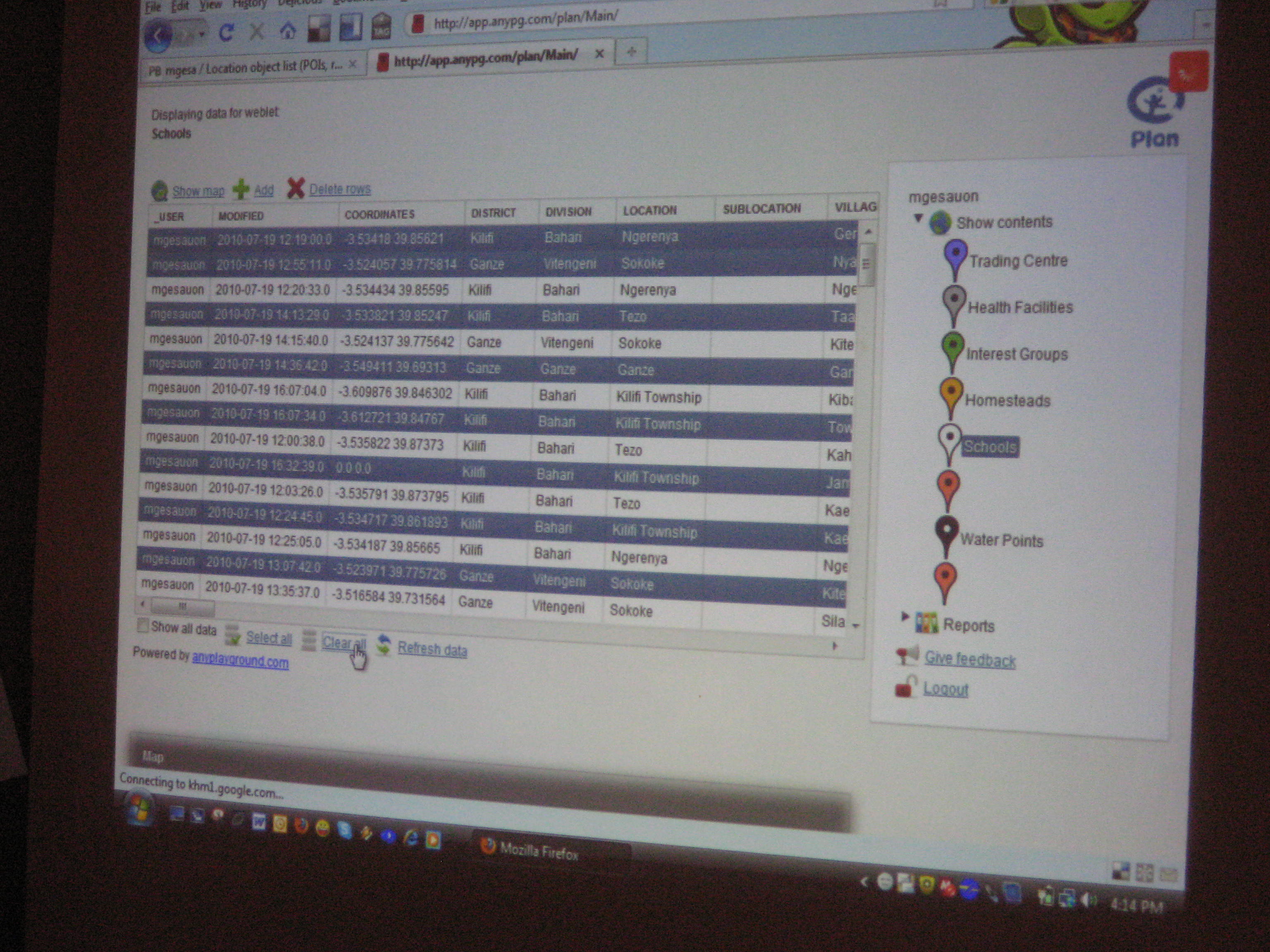
mGESA data points on the web interface

Where do the points of interest go?

The points of interest that are collected on the phone are downloaded via a USB cable onto a computer, in the same way that you would download photographs from a camera. Then the points are uploaded to the on-line platform, and also then they will be visible on top of a Google map or other kind of map.

Is mGESA compatible with Open Street Maps?

Now that we know about OSM, this is something we shall look into, as it could be quite useful.

Will the information that you collect be public or private?

At this point the information will be closed, because the application is still in development.  Also for privacy reasons, some information will be shared and other information not shared. For example, if we are collecting personal information on individuals, or data that could put someone at risk, this will not be shared on the map.

What types of uses will the application be suitable for?

Plan can use mGESA when determining plans for phasing out of one area and moving into another area, for example. Instead of collecting data and indicators on paper, staff and managers can see this information on a map and the information that is collected can help us to know where to work.  Having the points of interest mapped out and linked with development information, and being able to select out different information layers on the map (on the internet) should make these decisions easier and more sound.

Will communities be involved and able to use mGESA for their own purposes?

Yes, communities will be able to use the information collected to make their own decisions. Communities can also purchase mGESA for their own use. We might also say to them, come and bring your phone and we will install this application so that you can use it for your own purposes.

Why are you developing a software from scratch and that costs money to the end user if there are existing tools available?

We know that GPS gadgets are expensive and so we thought – why not look into a mobile option. We also had very specific ideas and needs, and we had people willing to develop the idea from scratch. It’s a customized application based on our existing information needs and systems, and we can collect it by mobile rather than trying to find and purchase GPS units here in Kenya.

Update: see this post on Mobile Active for more information on the continued piloting of PoiMapper.

Related posts on Wait… What?

mGEOS: a mobile mapping tool

A positively brilliant ICT4D workshop in Kwale, Kenya

Youth mappers: from Kibera to Kinango

Salim’s ICT4D Advice Part 1: consider both process and passion

Salim’s ICT4D Advice Part 2: innovate but keep it real

Modernizing birth registration with mobile technology

Read Full Post »

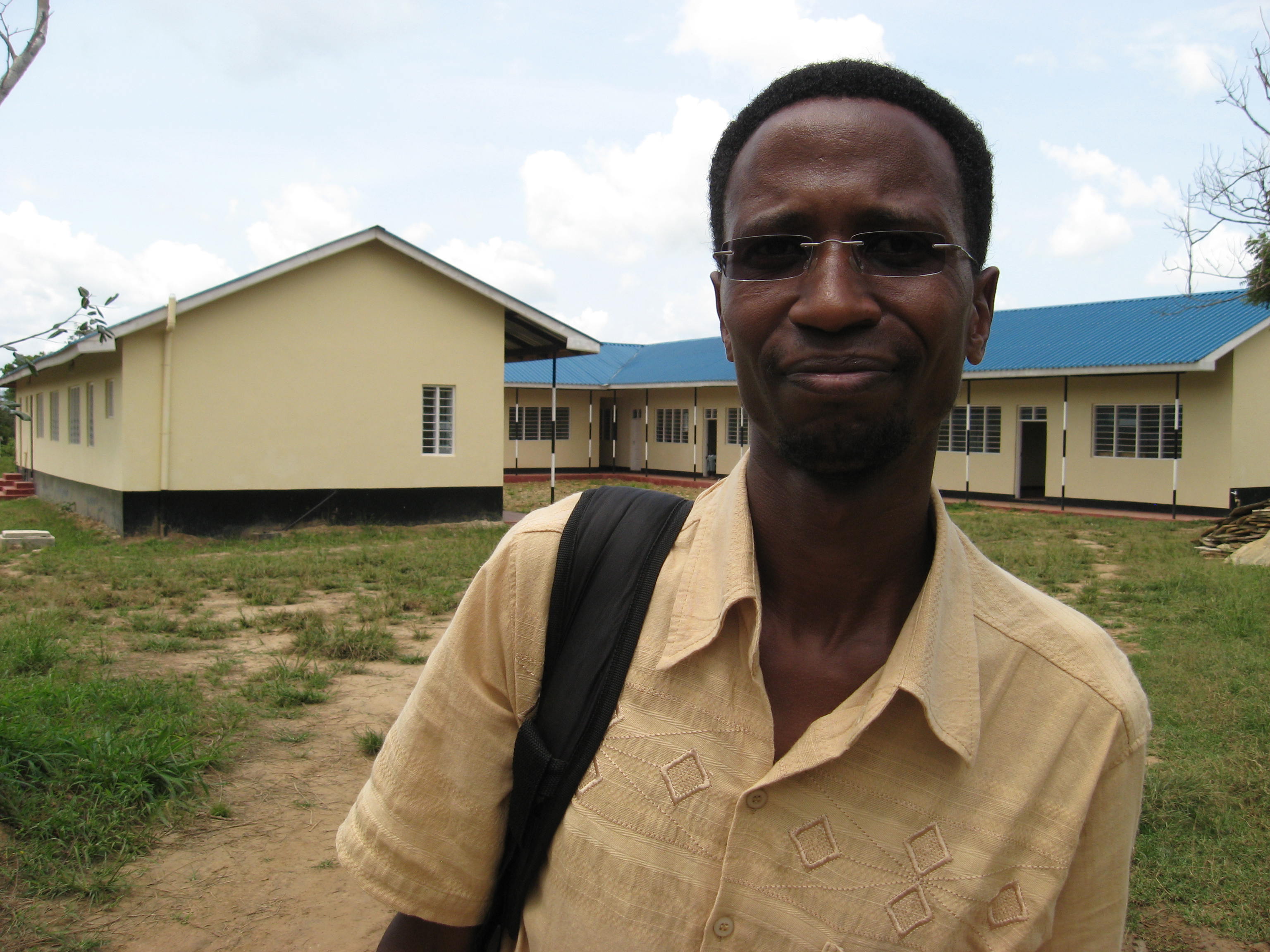
Salim (left) with Solomon in Kinango community.

As I mentioned in my previous post, Plan’s Kwale District office in Kenya has been a role model for Plan on how to integrate ICTs into community-led programming to help reach development goals and improve access to children’s rights.

I talked with Salim Mvurya, the Area Manager in Kwale, last week and asked him for advice for the tech community (0.15), corporations (1.19) and development organizations (1.57) who want to build in ICTs for moving towards development goals. He also comments on the importance of realizing that development is changing (4.43). You can watch the video below or at this link. If you’re not patient enough to watch a 6 min video (often I’m not!) or don’t have a strong connection, see the transcript below.

You can also view Part 1 of the video, where Salim gives some background on how Plan Kwale has been using ICTs in their programs since 2003 (1.11), shares ideas about the potential of new ICTs (3.42) and talks about some key lessons learned (5.03). Or you can read the Part 1 transcript here.

Transcript Part 2

ICTs and Development Part 2: advice for tech community, corporations and development organizations

My name is Salim Mvurya, I’m the Area Manager for Plan in the Kwale Development Area.

What advice can you give to outside tech people who want to develop something for a place like Kenya?

I think that to get an idea externally is a good thing, but that idea has to be blended with grassroots. It has to be contextualized, because there are very many good ideas which may not be appropriate at the community level. So I think my advice, for people who have ideas, who have never been to Kenya or Africa or in the field, is to leave the process to be home grown, so that the ideas that are coming from outside are building on existing issues, so that the ideas are also looking at what kind of skills and what can be done on the ground, and looking also at issues of sustainability. So it’s very important for somebody from outside the country to be sensitive to local conditions, local context, local skills and also looking at putting ideas that can be self-sustaining.

What is your advice for corporations who want to support the use of ICTs in development?

Corporate organizations who are interested in making a contribution to ICT for development, I think it is important that they foster and have partnerships with grassroots organizations that can really give them the issues because, OK, most corporations are very innovative, but working with grassroots NGOs and civil society that can give them the practical sense of those ideas, I think would be a good thing to do.

What is your advice for colleagues trying to successfully integrate ICTs into their programs?

One thing for organizations that are thinking of utilizing ICT is that you need local capacity. Like, if you have a field office, for example, Plan has development areas, in development areas, particularly for Plan, the ICT technical people should also have an opportunity to lead the ICT for development. What I have seen in the few years that I have been trying this is that it requires also the ICT function to be more available to communities. It requires the ICT function to also work around the program issues that the team is thinking, so it’s not just about looking at systems, looking at computers, but looking at how can all these ICT skills be able to help to develop programs. How can the ICT function be able to support innovations that are also going to enhance problem solutions at the community level. How can we use ICT to strengthen our interventions in the community?

And I must say from experience, that the ICT coordinator for Kwale has been more of a ‘program’ person, and I think that is why we are seeing all these gains.  I remember when we were designing the community-led birth registration one afternoon, we sat together and we were thinking, how can we put all these ideas together and include ICTs in it, so I think it’s about having an ICT function that is responsive to the program issues on the ground and not necessarily sitting somewhere and looking at softwares. You know, even designing a software that would be more responsive to what is happening on the ground, like looking at issues of child protection and seeing how can ICT help the response mechanism. Looking at issues of accountability and seeing how ICT can make a contribution to accountability processes in community.  So I think that is the kind of ICT that would be appropriate in the field, but also an ICT function that can learn. You know, learning from other people, but bringing the lessons closer home to see what can work, and what can’t work.

Any last advice for development organizations around integration of ICTs?

The message that I would want to give to stakeholders and development organizations is that a lot is happening in the world in terms of ICT.  Also recognizing that development is changing… ICT is providing opportunities for greater advocacy and accountability, and I think getting the interest for looking at all this and trying to say ‘what does this mean for development’ I think is very very critical. The youth constituency is emerging as very critical and they have interest in ICT. I know in Kenya youth have been trying different things, different groups, but I think ICT is providing an opportunity for them to strengthen accountability but also to be able to get skills that they can use as individuals that can also make a contribution in economic development.

Related posts on Wait… What?

Salim’s ICT4D advice part 1: consider both process and passion

Youth mappers: from Kibera to Kinango

A positively brilliant ICT4D workshop in Kwale, Kenya

Is this map better than that map?

Modernizing birth registration with mobile technology

Read Full Post »

Salim Mvurya, Plan Kwale's District Area Manager

Plan’s Kwale District office in Kenya has been very successful in building innovative community-led programming that incorporates new ICTs.  I had the opportunity to interview Salim Mvurya, the Area Manager, last week, and was really struck by his insights on how to effectively incorporate ICTs into community-led processes to reach development goals and improve on child rights, child protection and governance.

In this video, Salim gives some background on how Plan Kwale has been using ICTs in their programs since 2003 (1:11). He shares ideas about the potential of new ICTs (3.42) and some key lessons learned since 2003 (5.03).

Watch the video to get the advice straight from Salim. Or if your internet connection is slow or you’re like me and you like to skim through an article rather sit still and watch a video, the transcript is below.

In a second video, Salim gives really astute advice to the tech community (0.15), corporations (1.19), and development organizations (1.57) on how to successfully integrate ICTs to enable good development processes. He also mentions the importance of moving with the times (4.43). Read the transcript here.

Transcript for Part 1:

ICTs and development Part 1: ICT tools for child rights, child protection and social accountability

My name is Salim Mvurya, I’m the Area Manager for Plan in the Kwale District. My core responsibility as an area manager is to provide leadersip to the Kwale team in both program issues and also operational issues within the organization. This week we have been here in a workshop where we’ve been focusing mostly on issues of ICT for development and particularly what we’ve been learning here is the issue of mapping. We’ve also learned Ushahidi. We’ve also learned from our colleagues in Kilifi on mGESA (a local application of mGEOS that Plan Kenya, Plan Finland, University of Nairobi and Pajat Mgmt are developing) and basically we have been looking at this workshop as providing opportunities for using ICTs for development, but more particularly for us in Kwale is the issue of child protection and youth governance.

How has Plan Kwale been using ICTs for issues of child rights, child protection and child participation?

ICT in Kwale has a bit of a long history and it’s because of the issues on child rights. Kwale has a number of issues. Child marriages, issues of violations of child rights through sexual exploitation, and child poverty. So the efforts to do media started in Kwale in 2003 when we rolled out our first video that was done by children at the time to profile some of the issues of child marriage. But more importantly in 2005, we began to think greatly how we can bring the voices of children to duty-bearers and at time we thought of having a children’s community radio.

Because of lack of experience, we were thinking maybe at the end of that year we could launch the radio station. But then it took longer than we envisioned because we needed to roll out a participatory process. Alongside the same time, we had ideas of community-led birth registration which was being done in one community based organization. But later we also thought about looking at how ICT can help us in moving that direction.

Then we also had this idea of inter-generational dialogue, where children and youth can sit with duty-bearers and discuss critical issues affecting them, so we began using youth and video there, children and video, and showing those videos in a community meeting where then people could discuss the issues.  Alongside the same time we were partnering with various media houses and also rolling out radio programs where people could listen and also foster some discussions on children.

So it’s been a long journey but I think what we are seeing is that we need now to consolidate the gains, the experiences and efforts so that we can have a more strategic approach to ICT for Development and this workshop basically provides us with an opportunity and a platform to think much more.

What potential do you see for some of the newer ICT tools for your work in Kwale?

I see great potential in some of the tools that have been learned here this week, more particularly to get information at the click of a button from the ground. We could use the tools to map out resources out in the community, to map zones where there are a lot of issues on child protection, areas where we have issues like low birth registration… There is great potential for the tools that we’ve learned here to assist us not only in planning for projects, but in issues of social accountability. For example if you map out the areas where we have projects for Constituency Development Fund you can easily see where we have projects that have been done well but where we also have projects where maybe communities will need to discuss much more with duty-bearers to be able to, you know, foster issues of social accountability.

What are your biggest challenges? What mistakes have you made?

One thing that we’ve been learning in the process… well, you know sometimes we have ideas that we think can work in the next week, like for example the children’s community radio when we were thinking about it we were thinking that it could take off in about 2 months. But what we learned is that there are processes to be involved. Communities have to be prepared well for sustainability. Children have to be trained, there needs to be capacity building. You have also to conform to government procedures and processes.

The same also with birth registration. We thought in 6 months we could send an SMS and get your birth notification, but what we have also learned is that it takes a process. It takes awhile. You have to get the government buy in.  You also have to work on software, where the government is having a critical input. Because, although it is a pilot, we also think that if it works well then it has to be replicated, so it has to conform with the thinking in government. Also, with the issues of youth and media, one thing that has to be very clear is that you have to get youth who are committed, so you start with a bigger group, and you end up with those who are passionate

So I think it’s very critical when somebody is thinking about ICT for Development that, one, you look at the context: is it relevant to that area? What kind of skills are needed? What kind of processes for sustainability? but also getting the passion. Getting people who are passionate to lead the process is also a very critical lesson.

Related posts on Wait… What?

Salim’s ICT4D advice part 2: innovate, but keep it real

Youth mappers: from Kibera to Kinango

A positively brilliant ICT4D workshop in Kwale, Kenya

Is this map better than that map?

Modernizing birth registration with mobile technology

Read Full Post »

Nothing to do with the topic of this post, but the Kwale coast is gorgeous.

Last week I was in Kwale, at a Plan Kenya hosted workshop as part of the Youth Empowerment through Technology, Arts and Media program. The team at Plan Kwale has been pointedly using ICTs in their community development programs since 2003 (not counting email and Internet of course) when they began working with radio and video as tools for raising awareness about children’s rights.

It’s really impressive to see how they’ve moved forward with very strategic ideas for integrating ICTs to help reach programmatic and development goals, especially in the areas of youth and governance, universal birth registration, and child/youth-led advocacy around rights and protection issues.

Over the 6 day workshop, the main things we wanted to do were:

  • look at the development context in Kwale, Kinango and Msambweni Districts (South Coast areas where Plan operates via the Kwale Office)
  • better understand the perspective of youth in the 3 districts
  • remind ourselves of rights-based approaches to community development
  • discuss youth issues, governance, advocacy, violence against children and gender within the local context
  • look at the ICTs currently being used by youth, communities and Plan in the Kwale Development Area
  • share and discuss new social media and ICT tools and ways they can be used
  • practice using new social media and ICT tools and see if they can be useful and sustainable in the 3 districts
  • determine next steps for integrating social media and new ICTs in specific local initiatives and plan for how to build on them in Plan Kenya’s overall work

Some elements that made the week positively brilliant:

workshop participants

Engaged and committed stakeholders

We were a group about 20, including staff and university student interns from Plan’s Kwale and Kilifi District Offices and Plan’s Country Office in Nairobi; Government District Youth Officers (‘DYOs’) from the Ministry of Youth, Sports and Culture; Youth Council members from Kwale, Kinango and Msambweni; 2 staff from Map Kibera and 2 youth mappers from Kibera.

This mix meant that we had a variety of perspectives and opinions, including those of youth from local communities, partner organizations, local government, frontline staff, protection and governance technical advisors, ICT managers, and senior level program managers. This helped to ensure that we were grounded in reality, technically and thematically sound, able to cross-pollinate and integrate new ideas with solid experience and practice, and take decisions immediately forward to a higher level.

Local partners and youth-youth networking

Peer-peer learning and exchange among all the participants was a big plus. Plan and Map Kibera have very similar visions and values, yet each has its own area of specialized technical expertise and experience.  The youth participants from local councils from the 3 South Coast districts and the youth mappers from Kibera brought different perspectives into the workshop which enriched the discussions.  We all learned a lot from each other. Combining expertise as partners brought the workshop to a whole new level, and will help to ensure that the efforts are sustainable and can be built on and expanded. The youth in Kwale can now extend their skills to more youth in their communities, the youth mappers from Kibera can take home new ideas to improve their work, the university-level interns gained practical experience, and the buy-in from the local government’s District Youth Officers (who manage government funds) in the 3 participating districts can help provide the necessary support to broaden the efforts.

Flexible workshop methodology

We had certain goals that we wanted to achieve and we were clear on that, but we let the agenda flow. We started by taking a deep look at the local context and resources. We heard from local experts in the areas that we wanted to focus on (youth and governance, child protection) as well as community youth and local authorities. We spent time getting to know some new tools and discussing the pros and cons of using them.

Hands-on with FrontlineSMS

Hands On Work

We had practical sessions and hands-on work on blogging, FrontlineSMS, Ushahidi, Map Kibera, and mGESA (a local application of the mGEOS mobile platform co-developed by Plan Kenya, Plan Finland, University of Nairobi and Pajat Management and being piloted in Kilifi).

This was important for helping participants feel confident about doing some of the work once the training team was gone. I imagine however that more practice will be needed during some follow up sessions, as most of the participants don’t have regular computer and Internet access for enhancing their skills on a daily basis with additional practice and exploration.

We spent one day mapping our Hotel on Open Street Maps, and another day in Kinango, mapping specific points in 4 teams.  Lessons learned during hands-on work included the importance of engaging and involving the community ahead of time, so that rumors about why people are mapping the community don’t fly. In my group, for example, we were moving around with George the District Youth Officer from Kinango. Someone that he ran into joked to him “Oh, now Kinango is going up for sale!”  A joke, but nonetheless if people don’t know why we were mapping, this or other rumours can quickly spread. (See the video about mapping in Kinango at this link and the background blog post here.)

End goals + new tools + back again

By starting with people’s expectations for the workshop, analysis of the local context, and an understanding of the goals that youth and staff wanted to achieve together, we could be sure that we stayed true to where we wanted to end up. At the same time, by learning about new tools, things that weren’t possible before became imaginable and people started to innovate and mix their existing knowledge and experience with some new ideas.

Combining the two, and having a good variety of perspectives in the room and a lot of space for discussion and practice means that next steps will be more achievable and sustainable, because people are clear and agree about where they want to go, and they feel capable of incorporating some new tools and ideas to get there.

The tools

We explored a number of new(ish) tools at the workshop. They had been identified over the past couple years due to their use by Plan or other organizations in areas such as: community development work, violence tracking, advocacy, governance and social auditing.  We talked about mobile phones, email, Internet, Facebook, Hi5, Google search and Google maps. We did a quick overview of Voice of Kibera, use of GPS, Open Street Maps, FrontlineSMS, Ushahidi, the YETAM project, the PlanYouth website, and a Plan pilot project in Benin using SMS to track violence against children.

The first day, the context analysis was very focused on youth and governance, transparency and social auditing, so we pulled out the 10 Tactics video by Tactical Technology Collective (which @hapeeg had given to me a couple days earlier). This video series talks about 10 tactics for turning information into action. It really sparked ideas among the participants for how they could use social media and ICTs in social accountability work and human rights/child rights work.  Map Kibera partners also shared a tool developed by SODNET (SMS for social auditing of the Constituency Development Fund).

We talked about the use of mapping and SMS in child protection work. One of the main child protection issues in the south coast area is the distance that a child, girl, family has to travel in order to report an abuse. Women’s lack of economic power, inability to own property and the importance of marriageability also mean that often women and girls feel unable to speak out or protest abuse when it’s happening. It’s still not certain what role ICTs can play in this context given the risks involved to those who report, but Plan’s child protection point person, Mohammad, is planning to host a series of meetings with local child protection authorities to discuss possible ways forward.

Digital mapping was immediately cataloged as an important tool for identifying resources, advocating for services and holding government accountable through social auditing. It was also recognized as a potential income generator once areas, shops and local businesses could be added to an on-line map, or if youth could purchase GPS units with funding from the District Youth Office and charge for their GPS services. George, the District Youth Officer for Kinango talks in this video about how mapping can be useful to the Kinango community, even if most members don’t have access to computers and broad band. (Click the link or watch below)

Information and communication gap analysis –> ICT integration plans

ICT integration for youth and governance program

Early on in the workshop, we worked in 2 groups to analyze the goals for the Youth and Governance and the Child Protection programs that Plan is supporting in Kwale. The groups discussed the information and communication gaps that needed to be filled in order to move towards the goals of the 2 initiatives. We looked at what ICT tools might best help reduce the gaps, from existing traditional tools (like meetings, face-to-face advocacy, drama, town criers, radio) to those new(ish) tools that we had discovered (see above paragraph) that might be useful to try out given the goals in the 2 key areas. The groups revisited this gap analysis on the last day after having had more hands-on use of the different tools and turned the gap analysis into an action plan.

ICT integration for child protection programs

Management buy-in and leadership

While the 2 groups worked on local action plans for integrating ICTs into their work, senior management from Plan’s Kenya office created their own action plan for how to build on the workshop experience, engage mid-level managers and other key staff in ICT integration, further develop partnerships and solidify cross-cutting incorporation of ICTs into Plan’s work in Kenya. The Kwale and Kilifi program units have been innovators within Plan for several years. Learning from, supporting and building on concrete work that they are doing on the ground allows for a solid and feasible country strategy based on reality. Having a strategy built from the ground up and with solid support and buy-in from national management means that there is less risk of donor led ICT funding, and more probability that new resources mobilized for ICT work go towards real needs and have better results.

Related posts on Wait… What?

Youth mappers: from Kibera to Kinango

Salim’s ICT4D advice part 1: consider both process and passion

Salim’s ICT4D advice part 2: innovate, but keep it real

Is this map better than that map?

ICT4D in Uganda: ICT does not equal computers

Read Full Post »

Yesterday my colleague Mika Valitalo at Plan Finland sent some information about mGeos, a cool project that Pajat Management (a Finnish company), Plan Kenya, Plan Finland, Helsinki University of Technology and University of Nairobi have been collaborating on for the past year. Note: Mika and Pertti Lounamaa from Pajat gave me written permission to share this info.

The idea? To develop easy-to-use GPS-based mapping software that runs on low-cost mobile phones.

Detailed map information is missing from most of the 'developing' world

What needs is mGeos responding to? Being efficiently able to provide health, education and humanitarian aid or even most industrial services is critically dependent on knowing where to provide these services. Basic location information about points-of-interest (POIs), routes to them and areas to service are missing from the countries in most need of public service improvement. In ‘developing’ countries especially, critical map and location information is largely incomplete, outdated or missing. For example, in the image here, you can see small town map details available for Finland (left image) vs for those for Kenya (right image).

Earlier experiences in a few program countries as well as responses to a questionnaire conducted with Plan Kenya staff showed a desire and clear need to use location data more effectively. There is also a need to make it available on low-cost phones that are more accessible.

Stefanie Conrad (my awesome boss) for example, sees it like this:

“Geographic analysis of the distribution of social services such as wells, hospitals, telecommunication facilities, broadcast services, schools, etc. is essential for Plan’s program work in order to have a sound understanding of the best way to provide access to those services. In reality, most of our country offices work with non-geographical systems, for example, lists of communities. In many countries, the government itself does not have sufficient mapping of communities in place. Decisions on where to put something to guarantee access to populations often becomes a thing based on best guess.

Mobile phones with GPS could support more equitable and technically sound placement of basic services. Digital pictures and maps could be used with communities in order to facilitate discussions about where to best place a well, for example. This can often be a difficult process, as usually community leaders try to get these types of services to be conveniently placed as close as possible to their own homes….  Many of our offices also have difficulties producing the maps needed for corporate communications (area overviews, local area maps, etc) – this would become possible with GPS.”

The mGeos project aims to respond to these identified needs. A 3-month field pilot is planned to take place in Kilifi, Kenya, in July.  I’ll be in Kenya in July and if the pilot goes forward then, I am hoping to be able to see personally how mGeos works!

What are mGeos’ key features?

  • mGeos service platform

    Supports collection of structured data as numbers, text, exclusive and multiple choice and images; and also location data including points of interest, routes and areas

  • Multiple front ends:  standard internet browsing for laptops and large screen smart phones and mobile browsing (xHTML/WAP)
  • Dedicated application for GPS enabled mobile phones
  • Authoring tool for defining forms and corresponding database model for storing the collected data
  • Open API for accessing stored data
  • Based on a SaaS (software as services) model

What does the mGeos system consist of?

  • client software which runs on low-cost S40 GPS enabled mobile phones (eg. Nokia 2710)
  • server running a database where all the collected information is stored and accessed
  • portal i.e. webpages which show the collected Points of Interest (POIs) on Google maps (or other maps) and allow browsing, exporting and sorting of the collected data.

What would mGeos look like in action?

Say a field worker named Victoria arrives to the Kilifi District Program Unit in the morning. She’s planning to visit Kujemudo community. Before leaving for the day trip, she takes a GPS enabled mobile phone from the office and downloads the latest updated ‘Points of Interest’ (POI) list from the computer to her phone.  The POI list has been created by Victoria and her colleagues by gathering location data while visiting different communities during the past couple of months.  Today Victoria also wants to map important POIs in the communities, among many other tasks.

After arriving to Kujemudu and having a meeting with the local community based organization, Victoria rides her motorbike over to a school building in Ezamoyo village, takes her GPS enabled mobile phone in hand, and starts the mapping application.  The she chooses ‘add POI’ from the menu, selects the POI category of ‘school’ and adds the name of the school. After that she also types in the additional information such as the number of pupils and teachers, ownership of the school, etc.  Finally she takes a photo of the school, attaches it to this record and saves the information to the phone memory to be transferred later to the computer server.

Next Victoria visits Mkombe village where the location and information of the school has already been entered into the database by her colleague Peter a few weeks earlier.  Victoria uses the POI browsing feature to find the right school (browse by POI category).  When she finds the existing data record, she chooses ‘edit’ in order to update the information. Because part of the school has been reconstructed, she takes a new photo of the school and replaces the outdated one. Also, since the number of students has increased, she edits the ‘school population’ field to match the current number. Finally she saves the record.

While visiting Mabirikani village the next day, Victoria checks one of the wells, because she has heard that it has collapsed due to recent floods.  Since this is clearly the case, Victoria takes the mobile, searches the well from the data base and marks the record as deleted.

mGeos web screen shot

The next day, Victoria arrives to the Kilifi District Program Unit, connects the phone to her computer, and uploads all the new records and changes. Then she sends them to the mGeos webpage, which gets updated (i.e., now all the users can see the Ezamoyo school building, the updated information from Mkombe, and will notice that the well in Mabrikani is no longer in use).

When Victoria sees the new information in the system, she notices that she has mistyped the number of pupils in Mkombe school.  Since she is the author of the information, she can also edit the record in the mGeos webpage to correct the information. After checking that all the other information is OK, she leaves the phone in the office and continues with other work tasks.

When will it be tested? We plan to fully test the application in Kenya in July. Plan Kenya/Kilifi District Program Unit has identified a number of  POIs ( schools, health facilities, water points, trading centers etc.) they would like to map. They have also listed additional information each POI should have. For example, for schools they would collect information on: name, type (special, integrated, non-integrated), level (primary, secondary…), numbers of pupils, availability of water and sanitation services, etc. etc.  This information would be entered into mobile phones running mGeos software and later transferred to the server for sharing, analysis, editing, reporting and exporting.

Once the pilot has run, and user input is collected, the system will be adjusted and improved so that it can be fully launched.  I’ll keep following the mGeos story and post more as it’s tested and rolled out!

Update:  For more information see these later posts:

mGESA: Mobile GEographical Services for Africa

Mobile Date Collection through Points of Interest in Kenya (on Mobile Active)

The final application is called PoiMapper (see www.pajatman.com). Give it a try by downloading it and installing it on your mobile!

Read Full Post »

So, a few weeks ago I came across this fabulous article by Jay Rosen called “How the backchannel has changed the game for conference panelists“.  It was perfect timing because I had just been discussing how much I had enjoyed the public/private tweeting and live commenting happening during a live stream event I was watching, and how Twitter allows for a totally different and very engaging experience at these things than we used to have before.

I had no idea that there was actually a name for this phenomenon:  the backchannel; coined by Victor Yngve in 1970 and made famous in 2002 at the PC Forum conference (thank you Wikipedia!).

Rosen notes that “The popularity of the backchannel… has empowered those in the audience to compare notes and pool their dissatisfaction during a performance that misfires…. Especially at risk are ‘big name’ speakers whose online or offline status is such that they may complacently assume their presence alone completes the assignment and guarantees success.”

He goes on to give 10 tips for how to avoid getting killed in the backchannel. These tips are a good read for famous types who speak at conferences or panels. But they are also a good read for the rest of us, as a lot of it is still relevant. For example, I liked the idea of “blog it first” to get early reactions to what you are going to present so that you can tweak it before your actual presentation.

Now, I’m obviously the non-famous type, and I doubt the ‘audience’ will be harsh, but in mid-June, I’ll be in Karlstad, Sweden presenting at the 6th World Summit on Media for Children. My presentation is on one of the projects that I’ve been involved in over the past couple years: Youth Empowerment through Arts and Media (YETAM). I actually refer to it a lot in this blog, though I haven’t really written a summary post on it.  I normally refer people to this nice overview posted on the Communication Initiative website or to this post on the project’s overall methodology.

So, I thought I’d post my presentation here for the 99.9% of people I’m acquainted with who won’t be at the 6th World Summit, and of course as part of my plan to avoid any negative backchannel tweeting while I’m presenting!  Enjoy, and would love to have any comments to, you know, tweak it before it goes super live, just in case there are any hardcore backchannellers there….

Note: if you are reading on Google Reader, it seems the presentation doesn’t appear, so try clicking through to slideshare here…. or [NEW!] watch or download the file with notes here (if watching with notes, resize the .pdf document so that you can see the notes underneath the slides).

Related posts on Wait… What?

Hands on, hands on, hands on

Putting Cumbana on the map, with ethics

Being a girl in Cumbana

Demystifying Internet


Read Full Post »

the Ghana team: row 1: Steven, Joyce, Yaw, Samuel; row 2: Bismark, Maakusi, James, Chris, Dan

I was in a workshop in the Upper West Region of Ghana this past week.  The goal was two-fold.  1) to train a small group of staff, ICT teachers and local partners on social media and new technologies for communications; and 2) to help them prepare for a project that will support 60 students to use arts and citizen media in youth-led advocacy around issues that youth identify.

I was planning to talk about how social media is different from traditional media, focusing on how it offers an opportunity to democratize information, and how we can support youth to use social media to reduce stereotypes about them and to bring their voices and priorities into global discussions.  But all those theories about social media being the great equalizer, the Internet allowing everyone’s voices to flourish and yadaya, don’t mean a lot unless barriers like language, electricity, gender, and financial resources are lowered and people can actually access the Internet regularly.

Mobile internet access is extremely good in this part of Ghana, but when we did a quick exercise to see what the experience levels of the group were, only half had used email or the Internet before.  So I started there, rather than with my fluffy theories about democratization, voice, networks and many-to-many communications.

We got really good feedback from the participants on the workshop.  Here’s how we did it:

What is Internet?

I asked the ICT teachers to explain what the Internet is, and to then try to put it into words that the youth or someone in a community who hadn’t used a computer before would be able to understand.  We discussed ways in which radios, mobile phones, televisions are the same or different from the Internet.

How can you access Internet here?

We listed common ways to access Internet in the area: through a computer at an internet café or at home or work, through a mobile phone (“smart phone”), or via a mobile phone or flash-type modem connected to a computer (such as the ones that we were using at the workshop).  We went through how to connect a modem to a computer to access internet via the mobile network.

Exploring Internet and using search functions

Riffing off Google search

We jumped into Internet training by Googling the community’s name to see what popped up, then we followed the paths to where they led us. We found an article where the secondary school headmaster (who was participating in the workshop) had been interviewed about the needs of the school.

Everyone found it hilarious, as they didn’t know the headmaster was featured in an online article.  This lead to a good discussion on consent, permission and the fact that information does go global, but it doesn’t stay global, because more and more people are able to access that same information locally too through the Internet, so you need to think carefully about what you say.

The article about the school had a comments stream. The first comment was directly related to the article, and said that the school deserved to get some help.  But the comments quickly turned to politics, including accusations that a local politician was stealing tractors.  Again this generated a big discussion, and again the local-global point hit home.  The internet is not ‘over there’ but potentially ‘right here’.  People really need to be aware of this when publishing something online or when being interviewed, photographed or filmed by someone who will publish something.

Other times when we’ve done this exercise, we haven’t found any information online about the community. In those cases, the lack of an online presence was a good catalyst to discuss why, and to motivate the community to get the skills and training to put up their own information. That is actually one of the goals of the project we are working on.

We used a projector, but small groups would have also been fine if there was no projector and a few computers were available. We generally use what we can pull together through our local offices, the small amount of equipment purchased with the project funds, and what the local school and partners have, and organize it however makes the most sense so that people can practice.  4-5 people per computer is fine for the workshop because people tend to teach each other and take turns. There will be some people who have more experience and who can show others how to do things, so that the facilitator can step out of the picture as soon as possible, just being available for any questions or trouble shooting.

Social networks and privacy

When we Googled the name of the community, we also found a Facebook page for alums from the secondary school.  That was a nice segue into social networks.  I showed my Facebook page and a few others were familiar with Facebook. One colleague talked about how she had just signed up and was finding old school friends there who she hadn’t seen in years. People had a few questions such as ‘Is it free?  How do you do it? Can you make it yourself?  Who exactly can see it?’  So we had to enter the thorny world of privacy, hoping no one would be scared off from using Internet because of privacy issues.

One of the ICT teachers, for example, was concerned that someone could find his personal emails by Googling.  I used to feel confident when I said ‘no they can’t’ but now it seems you can never be certain who can see what (thank you Facebook).  I tried to explain privacy settings and that it’s important to understand how they work, suggesting they could try different things with low sensitivity information until they felt comfortable, and test by Googling their own name to see if anything came up.

Online truth and safety

Another question that surfaced was ‘Is the internet true?’ This provoked a great discussion about how information comes from all sides, and that anyone can put information online.  And anyone else can discuss it.  It’s truth and opinions and you can’t believe everything you read, it’s not regulated, you need to find a few sources and make some judgment calls.

A participant brought up that children and youth could use Internet to find ‘bad’ things, that adults can prey on children and youth using the Internet.  We discussed that teachers and parents really need to have some understanding of how Internet works. Children and youth need to know how to protect themselves on the Internet; for example, not posting personal information or information that can identify their exact location.  We discussed online predators and how children and youth can stay secure, and how teachers and communities should learn more about Internet to support children and youth to stay safe.

We discussed the Internet as a place of both opportunities and risks, going back to our earlier discussions on Child Protection in this project and expanding on them.  I also shared an idea I’d seen on ICT Works about how to set up the computers in a way that the teachers/instructor can see all the screens and know what kids are doing on them – this is more effective than putting filters and controls on the machines.

Speaking of controls: virus protection and flash drives

The negative impact of viruses on productivity in African countries has been covered by the media, and I enthusiastically concur. I’ve wasted many hours because someone has come in with a flash drive that infected all the computers we are using at a workshop.  Our general rule is no flash drives allowed during the workshop period.  I have no illusions, however, that the computers will remain flash drive free forever.  One good thing to do to reduce the risk of these autorun viruses is to disable autorun on the computers.  This takes about 2 minutes.  After you do that, you just have to manually access flash drives by opening My Computer from the start menu. A second trick is to create an autorun.inf file that redirects the virus and stops it from propagating on your machine. Avast is a free software that seems to catch most autorun viruses.  Trend Micro doesn’t seem to do very well in West Africa.

Hands on, hands on, hands on

I cannot stress enough the importance of hands on. We try to make sure that there is a lot of free time at this kind of workshop for people to play around online.  This usually means keeping the workshop space open for a couple hours after the official workshop day has ended and opening up early in the morning. People will skip lunch, come early, and stay late for an opportunity to get on-line. Those with more experience can use that time to help others. People often use this time to help each other open personal email accounts and share their favorite sites.

No getting too technical

People don’t want to listen to a bunch of theory or mechanical explanations on how things work. They don’t need to see the inside of a CPU, for example. They need to know how to make things work for them.  And the only way they will figure it out is practice, trial and error, playing around.  If a few people in the workshop are really curious to know the mechanics of something, they will start asking (if the facilitator is approachable and non-threatening), but most people for starters just want to know how to use the tools.

No showing off

I’ll always remember my Kenyan colleague Mativo saying that in this kind of work, a facilitator’s main role is demystifying ICTs.  So that means being patient and never making anyone feel stupid for asking a question, or showing any frustration with them.  If someone makes a mistake or goes down a path and doesn’t know how to get back and the facilitator has to step in to do some ‘magic’ fixing, it’s good to talk people through some of the ‘fix’ steps in a clear way as they are being done.

My friend DK over at Media Snackers said that he noticed something when working with youth vs adults on Internet training: youth will click on everything to see what happens. Adults will ask what happens and ask for permission to click.  [update:  Media Snackers calls this the ‘button theory‘].  Paying close attention to learning styles and tendencies of each individual when facilitating, including those related to experience, rural or urban backgrounds, age, gender, literacy, other abilities, personality, and adjusting methodologies helps everyone learn better.

Have fun!

Lightening up the environment and making it hands on lowers people’s inhibitions and helps them have the confidence to learn by doing.

**Check back soon for a second post about photography, filming, uploading and setting up a YouTube account….

Related posts on Wait… What?

Child protection, the media and youth media programs

On girls and ICTs

Revisiting the topic of girls and ICTs

Putting Cumbana on the map: with ethics


Read Full Post »

« Newer Posts - Older Posts »