Feeds:
Posts
Comments

Archive for the ‘protection’ Category

Starting yesterday (I’m late on writing about this one!) people from across the African continent are meeting at the Conference on Child Protection Systems Strengthening in Sub-Saharan Africa in Dakar, Senegal, to discuss how child protection systems work effectively in the African context. Follow the conference at the #cps12 hashtag or via @CPSystemsS and check out a day one summary on Storify.

“Dozens of African countries are engaged in strengthening child protection systems and mobilizing new sectors for child protection. For example, education and health sectors are engaged in violence prevention work, and social protection is becoming an essential part of efforts to reduce child labour and child marriage. Child justice initiatives are being embedded in broader national justice and security reforms and the health sector is supporting birth registration. Mobile technologies are being used for the reporting of violence, family reunification and rapid assessments. Donors are also increasingly supporting child protection systems….

“’Just the way a health system deals with many diseases, a child protection system addresses a broad range of violations of children’s rights. Children cannot be protected effectively unless social workers, police officers, justice servants, teachers and health workers and communities work together to prevent and respond to abuse and violence…. Investment in national child protection systems leads to better outcomes for children because of children’s improved access to protection services, new investments in frontline workers to identify and respond to children in need; and improved partnerships to mobilize and use resources for children, families and communities,’ according to Joachim Theis, Regional Child Protection Advisor, UNICEF, West and Central Africa.”

Key conference themes include:

  • Mapping and assessment of national child protection systems
  • Strategies and approaches to strengthening national child protection systems
  • Community based child protection mechanisms
  • Children as actors and partners in child protection systems
  • Social welfare workforce strengthening
  • Services delivery in Sub-Saharan Africa
  • Aligning traditional child protection agendas with child protection systems
  • Strengthening monitoring and evaluation for child protection
  • Mobilizing resources for child protection systems

Resources and a discussion forum are available at wiki.childprotectionforum.org. Some relevant background papers include:

A few webinars are recorded here on the topics of systems strengthening, budgeting for national system and core competencies for better national child protection systems.

There’s also a good paper on community-based child protection systems that I summarized awhile back.

Coming up soon, a few of us from different organizations will be looking more closely at the role new ICTs can play in child protection systems. Some examples of ICTs and child protection systems are here.

(Thanks to Joachim Theis at UNICEF West Africa for sending over the info on this one.)

Read Full Post »

On the off chance you don’t have time to read the 594-page Special Report on Managing the Risks of Extreme Events and Disasters to Advance Climate Change Adaptation (SREX), check out this simplified (and nicely designed, easy-to-skim) 28-page report called ‘Climate Extreme.’

Climate Extreme: How young people can respond to disasters in a changing world shares ways to prepare and reduce risks children and young people can face when disasters impact their communities and presents examples of crucial roles children have played in disaster preparedness, community education, hazard identification and in evacuation and first aid during disasters.

The report was authored by Amalia Fawcett from Plan Australia who says “Children and young people have the right to information that is tailored to them. Even complex scientific reports should be converted to child and youth appropriate versions, if the information is likely to affect them.”

Examples of young people having a real impact include:

  • Young people lobbied their government to get their school moved out of the path of potential landslides in the Philippines.
  • Girls and boys in Bangladesh have carried out household visits and community assemblies to share their skills and knowledge on early warning and household preparedness with others.
  • A school safety program in India involves children in conducting risk and vulnerability assessments in over 2,000 schools.
  • In Thailand youth are actively engaged in revising community based disaster risk management plans in flood affected areas.
  • In Vietnam, children are training their peers on how climate change could affect their communities.

Climate Extreme is based on the report prepared by the Intergovernmental Panel on Climate Change (IPCC), featuring the extent to which climate change is affecting the number and severity of weather related disasters, investigating the current and predicted changes in our climate, how these affect disasters and what communities, governments and the international community can do to reduce risks people face.

Along with the IPCC report, Climate Extreme is being launched in New Delhi on May 3 and Bangkok on May 4.

*****

The Intergovernmental Panel on Climate Change (IPCC) is a scientific body first established in 1988 by two United Nations organisations, the World Meteorological Organization (WMO) and the United Nations Environment Programme (UNEP), and later endorsed by the United Nations General Assembly. Its mission is to provide comprehensive scientific assessments of current scientific, technical and socio-economic information worldwide about the risk of climate change caused by human activity, its potential environmental and socio-economic consequences, and possible options for adapting to these consequences or mitigating the effects. As such it produces regular reports, the latest of which, the ‘Special Report on Managing the Risks of Extreme Events and Disasters to Advance Climate Change Adaptation.’

Children in a Changing Climate is a coalition of leading child-focused research, development and humanitarian organisations each with a commitment to share knowledge, coordinate activities and work with children as agents of change. Members of the coalition include UNICEF, World Vision, Plan International, Save the Children and Institute for Development Studies.

Australian Aid (the disaster response arm of AusAID) funded the production of the child-friendly version.

Download the full version of IPCC report.
Download the child-friendly version.

Read Full Post »

This is a guest post by Alana Kapell. Alana has recently joined the Office of the Special Representative on Violence against Children as the children’s participation expert. As part of her work to further define a child participation strategy and identify key opportunities for learning and collaboration, she is researching projects and initiatives related to the UN Study on Violence against Children (UNVAC) specifically focused on involving children in preventing violence.

Six years after the UN Secretary General’s Study on Violence against Children (2004-2006) and in preparation for the 2012 Statement to the General Assembly, the Special Representative of the Secretary-General (SRSG) on Violence against Children is currently assessing progress made since the Study recommendations were released in 2006. This is a strategic occasion to gain perspective on progress achieved and to reflect on good initiatives, factors of success and define opportunities for further advancement.

Many initiatives, projects, networks and advancements were born out of the process, including continued efforts to support children’s participation. In order to gain further insight into children’s own efforts and perspectives, partners are invited to help inform the analysis of ‘progress made’ by sharing information (reports, publications, videos, research, etc.) about children’s own efforts to end and prevent violence.

Contributions should be current (e.g. developed from 2007-2012) and focus on ‘progress made’ with children or how children themselves perceive violence in their lives and communities.

Additional areas of interest include:

  • Research: any research or data collection done with children.
  • Links to UN Study: initiatives that were started as a direct result of the UN Study process.
  • New forms of Violence: material or details where children have identified and/or addressed new, hidden or emerging forms of violence.
  • Prevention: examples of initiatives undertaken by children to raise awareness in their communities and projects aimed at preventing violence against children.
  • Evaluation: information that measures the impact or outcomes of children’s participation and efforts related to ending violence against children.

In addition, there are numerous partners and networks supporting and facilitating children’s participation to prevent and end violence. Community, national, regional and international efforts exist to ensure children’s views, opinions, realities, recommendations and actions are informing and shaping our collective efforts.

We would also like to update our contact lists and map the individuals, organizations, children’s groups, etc. who are supporting children’s participation to prevent and end violence. We want to reconnect with groups who were involved with the UN Study process, including the follow up and to also identify new partners who are doing innovative and important work.

We are looking to connect with both adult led organizations and child led organizations and initiatives working on issues related to violence against children and children’s participation.

Please be in touch with me [akapell at unicef dot org] if you have any information to share!

Read Full Post »

  1. Share
    Looking forward to group conf call with CORE today ref: Photos, ethics, values and INGO/NGO work.
    Tue, Apr 03 2012 06:55:44
  2. This morning I participated in a massive conference call about photography in aid and development, and the ethics and values that surround photos taken and used by NGOs. The call was organized by CORE Group (@coregroupdc). Now maybe I’m exaggerating here, but the call organizer, Ann Hendrix-Jenkins, read off a list of participants that went on forever. I’m estimating that there were something like 40 or 50 people listening in from as many organizations. This topic has always been important for a strong segment of NGO staff and it seems to be gaining steam again.

    After I started tweeting about it, a couple of people asked if I’d be writing a blog post. So here it is. I’ve ‘Storified’ it since I was tweeting instead of taking notes, and because there was a nice side conversation happening with folks on Twitter too. (See the Storify here – it looks a little bit nicer there than it does here.)
  3. Share
    “Humanitarian photography is a hot button issue.Touches on dignity, how we do our jobs, & our ideas about ourselves, others & our work.”
    Tue, Apr 03 2012 11:08:52
  4. The call organizers had earlier conducted a survey about NGO images, policies, consent, and operational processes around photographers and photography and shared it with participants ahead of the call. The organizers also suggested a couple of links to check out beforehand, including an Aid Watch post (“Adorable child in NGO fund-raising photo sues for royalties“) and a link to a photo  that appeared in the New York Times. These two links and other similar “poverty porn images” had sparked the discussions that led to the decision to organize today’s call. [update: here is the original discussion thread on Linked In]
  5. Share
    Jeez – like 50 orgs on this CORE call re: photography, ethics and values. Discussing: @aidwatch post ht.ly/a3gYA & more
    Tue, Apr 03 2012 11:06:19
  6. Share
    I’m reminded that these discussions happen all the time among INGOs, even when they are not documented on Twitter or a blog.
    Tue, Apr 03 2012 11:10:46
  7. Share
    Second photo touching off this conversation is NYT image from last year re Somalia famine. ht.ly/a3i0s #povertyporn
    Tue, Apr 03 2012 11:13:32
  8. Share
    Also reminded that blogs can and do touch off broader and wider discussions that often we never know are happening….
    Tue, Apr 03 2012 11:14:45
  9. Share
    @meowtree I think too many people online forget that about a lot of issues. Not all discussions are necessarily open for outside viewing.
    Tue, Apr 03 2012 11:16:09
  10. Share
    @meowtree Shoot, I forgot about the call! Are you going to write a post about it?
    Tue, Apr 03 2012 11:28:06
  11. Share
    @meowtree Would have loved to be there but couldn’t… Will you report?
    Tue, Apr 03 2012 11:36:40
  12. Laura Pohl (@lauraepohl) from Bread for the World gave a short introduction to the topic along with some points to think about.
  13. Share
    What considerations do NGOs (and journos/freelancers) need to go through before publishing a photo? Appropriate use? Consent? What else?
    Tue, Apr 03 2012 11:16:15
  14. After this introduction, Jim Stipe from Catholic Relief Services gave a quick summary of the survey highlights, and we had a group discussion around some of the key issues detected in the survey and additional ones sourced from the participants on the call. 
  15. Heartening to know most INGOs have photo policies saying images must show dignity, & image usage is restricted/protected to some staff.
    Tue, Apr 03 2012 11:21:54
  16. Share
    Hearing: INGOs don’t seem to have policies stating photo must match/relate to/be part of story or have policies re: copyright of photos.
    Tue, Apr 03 2012 11:23:38
  17. Share
    Hearing: often pgm staff are taking photos, but many INGOs don’t train staff on policies or good techs for photos or on photo ethics.
    Tue, Apr 03 2012 11:25:47
  18. Share
    Hearing: What about consent for photos? We need to discuss this much more. It’s key to a good photo policy.
    Tue, Apr 03 2012 11:26:57
  19. Share
    @meowtree Unable to keep up today, busy. But have you asked @irinnews input? I use their photo service. Will catch up soon. Thanks for topic
    Tue, Apr 03 2012 11:28:38
  20. Share
    My question: what is ‘informed consent’? what are different ways to get it? how to ensure ppl rlly understand use of their image and story?
    Tue, Apr 03 2012 11:37:41
  21. Share
    @meowtree you can’t ensure that ppl understand use of their image unless they know context in which it will be used & understand its nuances
    Tue, Apr 03 2012 11:40:12
  22. Share
    Re: informed consent – how not to intimidate ppl with consent forms? Also – shd we be applying US consent laws to local settings? or not?
    Tue, Apr 03 2012 11:39:02
  23. Share
    @meowtree @jcdonner thanks brilliant, parallel questions for researchers being encouraged in IDRC SIRCAII programme, spread it
    Tue, Apr 03 2012 11:40:34
  24. Share
    Also: how does consent differ when children/under 18s are involved? what about difference btwn traditional and social media use of images?
    Tue, Apr 03 2012 11:40:32
  25. Share
    @meowtree What I learned from ethnography: entirely contextual and subjective. Even when you’ve succeeded, you’ve failed. But you must try
    Tue, Apr 03 2012 11:41:52
  26. Share
    @meowtree When in doubt, err on the side of caution.
    Tue, Apr 03 2012 11:42:32
  27. Share
    Someone asks: What about before and after pictures in the case of malnutrition? is it better to show the “after” picture to show progress?
    Tue, Apr 03 2012 11:42:41
  28. Share
    Another Q: what about when working with images of people in conflict settings? where use of their images may endanger them?
    Tue, Apr 03 2012 11:43:25
  29. Share
    Comment: Takes a lot more ppl, resources and planning than we think to do this right. We seldom put enough emphasis on ethical image/video.
    Tue, Apr 03 2012 11:44:51
  30. Share
    @meowtree In the West we focus on “informed consent” re: the individual–but in other cultures, the community consent is more important
    Tue, Apr 03 2012 11:40:28
  31. Share
    .@meowtree good discussion of photos in #ict4d vs journalism here is.gd/G4oGsC
    Tue, Apr 03 2012 11:20:44
  32. Share
    Comment: Need to work with US media also to help have more ethical use of images.
    Tue, Apr 03 2012 11:46:26
  33. Share
    Re. #povertyporn conversation @meowtree is tweeting: all humanitarian/devt agencies should have comms ombudspersons to defend those depicted
    Tue, Apr 03 2012 11:47:19
  34. Share
    @meowtree I’ve always found Photovoice UK’s ethical guidelines useful in regard to some the issues at your discussion photovoice.org/images/uplo…
    Tue, Apr 03 2012 11:47:47
  35. Share
    [ 1] MT @meowtree Comment: Takes a lot more ppl, resources, planning than we think… We seldom put enough emphasis on ethical image/video
    Tue, Apr 03 2012 11:48:29
  36. Share
    Interesting commentary on INGO photo policies & the ethics of humanitarian photography by @meowtree.
    Tue, Apr 03 2012 11:48:35
  37. Share
    @meowtree @giantpandinha I really like the ombudspersons idea but they would need to be local?
    Tue, Apr 03 2012 11:49:28
  38. Share
    @miskellaneous @meowtree Anybody with an empathetic impulse would be a good start. But yes, eventually, why not local?
    Tue, Apr 03 2012 11:50:32
  39. Share
    @meowtree photos and ethics such a big topic. I find the whole issue of people coming back from mission trips and volunteering with these
    Tue, Apr 03 2012 11:49:52
  40. Share
    @meowtree photos equally disturbing. Take a snap of a poor kid and then put on facebook – where’s the dignity and ethics in that? Volunteer
    Tue, Apr 03 2012 11:50:36
  41. Share
    @meowtree eduction is equally important, but so hard!! At the very least, if you wouldnt want a similar image of your mum/child/bro etc to
    Tue, Apr 03 2012 11:51:35
  42. Share
    @meowtree be shown are the world or usesd in the same way, then think twice. (this concept doesnt go down well when I mention it to people).
    Tue, Apr 03 2012 11:52:16
  43. Share
    .@meowtree One challenge – a Western audience that is eager to consume #povertyporn. Many INGOs seek to reach out to that audience.
    Tue, Apr 03 2012 11:51:08
  44. Share
    Comment: tension btwn fundraising people, program people. What is the concept of what the org is doing? Charity? solidarity?
    Tue, Apr 03 2012 11:55:08
  45. Share
    @meowtree @miskellaneous I find the “golden rule” goes a long way. Would I want my child, my niece/nephew depicted this way? Ever?
    Tue, Apr 03 2012 11:54:02
  46. Share
    @giantpandinha @meowtree yes it’s my golden rule too though there are somethings it misses like cultural understandings of modesty
    Tue, Apr 03 2012 11:57:06
  47. Share
    @miskellaneous @meowtree I remember a moment with my agency’s graphic designers when we cropped a woman’s belly peaking out from her t-shirt
    Tue, Apr 03 2012 11:58:00
  48. Share
    @miskellaneous @meowtree Again, the golden rule worked there. (But you are right @miskellaneous, might not work in every situation.)
    Tue, Apr 03 2012 11:59:46
  49. Share
    Comment: can we look at studies on the use of photos and impact on donors & learn. Also look at ethics vs what works w fundraising?
    Tue, Apr 03 2012 12:07:06
  50. Share
    Comment (mine) and what about participatory media? How often do we promote people’s own photos/videos of themselves/their communities?
    Tue, Apr 03 2012 12:07:55
To finalize the call, we heard a summary from Jim of some of the areas that the group could consider forming smaller groups to dig into and work on further, including: 
  • Issues around consent, alternative ways to obtain consent, release forms, and how to get truly informed consent.
  • Ethics of both taking photos and ethics of using photos – these are related yet separate issues.
  • What makes for a good NGO photo? What’s a good vs bad photo? What works and what doesn’t?
  • How do you grow your options for getting more high quality photos? How to train your staff on good photography? How to find and work with good freelance photographers? How to plan out a shoot and put the right amount of time into it? How to ensure photos are taken ethically?
  • Creating a photo policy, what does a good photo policy look like? what should it contain?
  • How to tell better stories? You can document your programs with photos and you can tell visual stories – these are 2 different things….
  • Getting good photo captions. If you don’t have good captions, photos are less useful.
  • Other places to source photos; eg., if you don’t have the photos you need, where can you go to get them?
  • Photo journalism vs NGO photography – similar yet different, different approaches and goals. Let’s discuss this.
  • Vocabulary for talking about photos in order to articulate to staff why one photo better than another. Turning gut sense into language and tools.
  • Looking at studies on the use of photos and their impact on donors, what can we learn from that? How to reconcile the different set of ethics that we may find in terms of ‘what works’ for fundraising and what is ethical?
  • What about participatory media and people portraying themselves and their own images
  • An Ombudsperson within INGOs who can defend the rights of those being photographed
  • The question of how people perceive you when you go from doing program work to becoming a photographer in the same afternoon. 
  • The related question about what happens when your organization makes you do both things? Who owns the photos? Do you get paid if your organization uses them? What if you are using your own equipment? How is your organization using you if that’s not your job in the first place? What are you expected to do and how much of this should you actually be doing?
  • Budgeting. We need to begin inserting budget into the conversation. How much can we pay photographers, or do we invest in training our own staff?
  1. Share
    Well pointed out by @miskellaneous: our “golden rule” re. depiction of “the Other” sometimes “misses cultural understandings of modesty”.
    Tue, Apr 03 2012 12:08:55
  2. Share
    However, I still believe some “golden rule” is better than none, and the bottom line should be: err on the side of caution.
    Tue, Apr 03 2012 12:10:15
  3. Share
    Comment: What about when you’re asked to be both a “program” person and also take comms/PR photos? How does community view you?
    Tue, Apr 03 2012 12:08:59
  4. Share
    Comment: what are the rules when your focus is pgm, but ‘photographer’ is added to your task list before you go out to ‘the field’?
    Tue, Apr 03 2012 12:10:10
  5. Share
    @meowtree @julienne_l I work with youth and struggle with this a lot. How do you keep integrity and get ppl to pay attention? #povertyporn
    Tue, Apr 03 2012 12:04:39
  6. I’m looking forward to continuing the discussions as this is an issue that constantly jumps out at me. It’s fantastic to know that there is such a strong contingent of NGO staff who are keen to address the issues around how we take and how we use photographs of the people that we work with.
  7. Share
    That’s it for tweets from @coregroupdc conversation on #povertyporn, photos, ethics and values. More later – discussions will continue.
    Tue, Apr 03 2012 12:11:55

Read Full Post »

At the global level, a very small percentage of development funding goes to urban spaces, yet hard-hitting issues impact many of the urban poor: lack of tenure, lack of legality of land, informal settlements, lack of birth registration and civil registration in general, waste disposal, clean water, politicizing of local authorities and more. Can new technologies be a solution for some of these issues?

Tuesday’s Technology Salon NYC offered a space to discuss some of the key challenges and good practice related to working with children, youth, and urban communities and explored the potential role of ICTs in addressing issues related to urban poverty.

According to UNICEF, who co-organized and hosted the Salon at their offices, half of the world’s people – including over one billion children – live in cities and towns. By 2030, it is projected that the majority of the world’s children will grow up in urban areas, yet infrastructure and services are not keeping pace with this urban population growth. (See UNICEF’s 2012 State of the World’s Children or Plan’s 2010 Because I am a Girl Report: Digital and Urban Frontiers).

We welcomed 3 experienced and engaging discussants to the Salon, who commented on the intersection of children, youth, urban environments and new technologies:

  • Doris Gonzalez, Senior Program Manager Corporate Citizenship & Corporate Affairs at IBM Corporation who manages IBM’s grade 9-14 education model Pathways in Technology Early College High School (P-TECH), a program that maps work-based skills to the curriculum and provides mentors to students and teachers
  • Ron Shiffman, a city planner with close to 50 years of experience providing architectural, planning, community economic development, and sustainable and organizational development assistance to community-based groups in low- and moderate-income neighborhoods; and the co-founder of the Pratt Institute Center for Community and Environmental Development [PICCED]
  • Sheridan Bartlett, a researcher affiliated with the Children’s Environments Research Group at CUNY and the International Institute for Environment and Development in London, co-editor of the journal Environment and Urbanization, supporter of Slum Dwellers International, and researcher on the link between violence and living conditions as they affect young children.

Doris shared IBM’s experiences with technology education programs with children and youth in New York City, including the highly successful P-TECH program which prepares youth for jobs that require 21st century skills. Some of the key aims in the PTECH program are making technology accessible, engaging, relevant to children and youth, and connecting what kids are learning to the real world. Through the program, IBM and partners hope to turn out skilled employees who are on entry-level career tracks. They look at what jobs are hiring with AAS degrees, what skills are attached and how to map those skills back into curriculum. Helping children and youth acquire collaboration, communication, and problem solving skills is key to the approach, as are broad partnerships with various stakeholders including government, private sector, communities and youth themselves. The program has been lauded by President Obama and is in the process of being replicated in Chicago.

Ron highlighted that working on urban poverty is not new. His involvement began in 1963 when John F. Kennedy was elected and there was a thrust to address urban poverty. Many, including Ron, began to think about their role in abolishing (not just alleviating or reducing) poverty. ‘We thought as architects, as planners about how we could address the issues of urban poverty.’ Broader urban poverty initiatives grew from work done forming the first youth in action community based organizations (CBOs) in Bedford Sty, Harlem and the Lower East Side. Originally these programs were empowerment programs, not service delivery programs; however because they confronted power, they faced many challenges and eventually morphed into service delivery programs. Since then, this youth in action community based model has served other community based initiatives all over the world. Ron emphasized the importance of differentiating among the roles of CBOs, technical assistance providers, and intermediaries and the need to learn to better to support CBOs who are on the ground rather than supplanting their roles with NGOs and other intermediaries.

Sherry picked up where Ron left off, noting that she’d collaborated with a network of federations of the urban poor in 33 countries, looking at ways they’ve used technologies and how technology presents new challenges for communities.

A large percentage of the urban poor live illegally in non-formal settlements where they can’t vote and don’t have legal representation, she said. They want partnership with the local government and to make themselves visible. The first thing they do is to count themselves, document the land they live on, map every lane and garbage dump, every school (if schools exist), their incomes, livelihoods, and expenditures. This body of information can help them engage with local authorities. It’s an organizing tool that gives them a collective identity that can lead to a collective voice.

This process seems to be a natural fit for technology, in that it can allow for management and storing of information, she said. However, technology use can be incredibly complicated. Traditionally the process has been managed manually. The information comes in on paper, it is fed immediately back to community members, contested and corrected right there. The process is very participatory and very accurate, and includes everybody. Things that have been mapped or measured are validated. Boundaries are argued and joint agreement about the community reality and the priorities is reached right there.

Sherry noted that when technology is used to do this, participation becomes more restricted to a smaller, more technically savvy group rather than the entire community. It takes longer to get the information back to the community. Many urban poor are technology literate, but there are complexities. Sometimes youth want to go with technology and older leaders are more comfortable with the more manual, inclusive processes.

The complexity of urban environments was addressed by all three discussants. According to Sherry, many people still hold a development image of the ‘perfect village,’ contained, people sitting around a tree. But urban communities are very complex: Who owns what? There are landlords. Who represents whom? How do you create the space and the links with local authorities? Ron agreed, saying that cities and settlements  tend to be far more pluralistic. Understanding the nature and differences among them, how to weave together and work together is critical. Doris noted that one organization cannot work on this alone, but that multiple partners need to be involved.

Participants at the Technology Salon. (Photo: UNICEF)

Key points brought up during the ensuing discussion included:

Process, product and participation:

  • It’s important to work directly with community based organizations rather than surrogates (in the form of external NGOs). It’s critical to work on building the capacity of people and organizations on the ground, recognizing them as the core actors.
  • The process by which people engage is just as important as the end product. If new technologies are involved, participation needs special attention to ensure no one is being marginalized and the data is interpreted by local people, and they play a role in gathering it and learning, sharing and discussing during the process.
  • Digital data collection and fly-over mapping should not replace participatory processes of data collection and local interpretation. Bringing in more efficient processes via new technologies is possible, but it often means losing some of the richness and interpretation of the data. If you’re not including everyone in this process, you risk marginalizing people from the process.
  • Every community, village or barrio has a different personality. No one size approach or model or technology fits all.
  • It’s important to let people create solutions to their own challenges; set the right policies so that what is produced can be scaled (open/open source); and make sure things are hyper-local – yet help move the ideas and build networks of south-south collaboration so that people can connect.
  • The technologies only make sense when they are done within a participatory framework or context. People get excited about technology and the idea of really iterating and trying things out very quickly. But this only makes sense if you have a bigger plan. If you go in and start playing around, without context and a long-term plan, you lose the community’s trust. You can’t drop in tech without context, but you also can’t come and create such a huge infrastructure that it’s impossible to implement. You need balance.
Children and youth:
  • We shouldn’t forget protection and privacy issues, especially with children and with mapping. These need to be carefully built in and we need to be sure that information and maps are not misused by authorities.
  • We can’t forget the young people and adolescents that we are working with – what do we want them to gain out of this? Critical thinking, problem solving skills? This is what will serve them. Educational systems need to address the pedagogy – if children are even in schools – where do you get that critical thinking? How do you create space for innovation? What is the role of tech in helping support this innovation? What is the role of mapping? Just accounting? Just quantifying? Or are you helping youth know their communities better? Helping them understand safety? What are we mapping for? Community self-knowledge or outside advocacy?
Technology:
  • We need to always ask: Who owns and manages technology? Technology is never neutral. It can both empower and disempower people and communities, and certain groups of people within communities.
  • The technology is a tool. It’s not the technology that teaches, for example, it is teachers who teach. They use the tech to supplement what’s going on in the classroom.
  • Rather than bring in ‘really cool’ things from the outside, we should know what tech already exists, what children, youth and communities are already using and build on that.
  • The challenge always comes down to the cost. Even if an idea works in the US, will it work in other places? Can other places afford the technology that we are talking about? There are some very good projects, but they are impossible to replicate. We need to find feasible and sustainable ways that technology can help reduce costs while it improves the situation for the urban poor.
Engaging local and national governments and the private sector
  • Bottom up is important, but it is not enough. The role of local authorities is critical in these processes but national authorities tend to cut local budgets meaning local authorities cannot respond to local needs. It’s important to work at every level – national policies should enable local authorities and mandate local authorities to work with local communities.
  • Local authorities often need to be pushed to accept some of these new ideas and pulled forward. Often communities can be more technologically savvy than local authorities, which can turn the power dynamic upside down and be seen as threatening, or in some cases as an opportunity for engagement.
  • Communities may need to learn to engage with local governments. Adversarial or advocacy techniques may be useful sometimes but they are not always the right way to go about engaging with the authorities.
  • It’s useful for CBOs to work with both horizontal and vertical networks, and NGOs can play a role in helping this to happen, as long as the NGOs are not replacing or supplanting the CBOs.
  • There needs to be support from the local city government, and an interest, a need, an expressed dedication to wanting to be involved or these kinds of initiatives will fail or fizzle out.
  • There is a tendency to seek quick solutions, quick fixes, when we all know that creating change takes a long time and requires a long-term perspective and investment. The city of Medellin for example has done a good job of investing in connecting settlements to the city through infrastructure and access to technology. Long-term vision with participation from private, public and  community engagement is critical.
  • The quality of investment in poor areas needs to be as high as that in wealthier areas. Many interventions are low quality or limited when they are done in poor areas.
  • Multiple partners and collaboration among them is necessary for these initiatives to move forward and to be successful. You need to bring everyone to the table and to have an existing funding structure and commitment from local and national governments and ministries, as well as local communities and CBOs, NGOs and the private sector.
  • A role for the UN and INGOs can be to help ensure that the right channels are being opened for these projects, that the right partnerships are established, that systems and technologies are kept open and not locked into particular proprietary solutions.
Learning/sharing challenges, approaches and good practice:
  • There is much to learn from how marginalized youth in communities have been engaged without technologies. Once they have the information, no matter how it was gathered — in the sand, by SMS, on the wall — then how can marginalized young people access and address local authorities with it? How can we help enable them to feel more empowered? What can we learn from past efforts that we can apply?
  • There is a lack of exposure of those working in ICT to the urban space and vice versa. This reflects a need to break down the issues and opportunities and to think more deeply about the potential of technology as a part of the solution to urban poverty issues.
  • We need to make a distinction between wonderful projects that some are doing, but that are very costly and have a high cost per participant; and programs that can be done in developing countries. Consider that 75 million youth are now unemployed. The more we learn about what others are doing, the more information we have on how to do it, the better.
  • ICTs are a relatively new element in the urban space. It would be helpful to have a a follow-up report that focuses on how ICTs have been used to address specific issues with children, youth and communities in urban spaces and what specific challenges are posed when using ICTs in this space. What projects have been done or could be done? What are the challenges in implementing projects with refugee populations, undocumented populations, migrants, and other groups? We need to understand this better. We need a document or guide that explores these issues and suggests practical ways to move forward.
  • Social media and new technologies can be used to spread information on successful case studies, to share our learning and challenges and good practice so that we can apply the best approaches.
A huge thanks to ICT Works, UNICEF, our discussants and participants for making this 2nd Technology Salon NYC a success!

Save the date for our 3rd TSNYC, on April 13, 2-4pm at New York Law School. The topic will be the International Aid Transparency Initiative (IATI); how it can contribute to  better aid coordination and effectiveness; challenges and opportunities for CSOs in signing onto IATI; and ways that technology and open data are supporting the process. 

Read Full Post »

In this guest post, Keshet Bachan, gender equality activist and blogger at The XX Factor, questions whether mobile phone applications addressing street violence are an effective way to prevent violence against women. What do you think? 

Can mobile ‘apps’ really prevent or discourage instances of violence against women? This question has been on my mind since a colleague shared this video from Voice of America about a mobile app called ‘Fight Back’, marketed as ‘India’s first mobile app for women’s safety’.

The video sparked an email discussion that raised some interesting questions that deserve a closer examination.

The VOA story provides a holistic view of violence against women and the developers of the mobile phone application admit that they are but one element in a broader system that needs to respond to instances of violence. They discuss the involvement of police and other duty bearers, such as municipal bodies, which need to address reports women make and do more to reduce their risks. I applaud this approach and the way in which the developers acknowledge the limitations of their application, which I find refreshing.

At the same time I feel this application distracts attention away from more prevalent (and deadly) issues. According to the World Health Organization 10-69% of women stated that they had been physically assaulted by an intimate partner at some point in their lives. The WHO also reports that 40-70% of female murder victims were killed by an intimate partner. A recent survey in the UK showed that one in three girls aged 13 – 17 reported sexual abuse from a partner and one in four had experienced some form of physical partner violence. The UK police receive a call for help regarding relationship abuse every minute.

The degree to which this mobile phone application promotes the notion of ‘stranger danger’ distracts attention from the urgent and more prevalent issue of family and intimate partner violence. Moreover, the fact that the application has a GPS tracker to trace a woman’s route home could inadvertently contribute to both increasing women’s fear of violence in public spaces as well as playing into the hands of those who seek to control women’s mobility by pleading the need to ‘protect’ them by knowing their whereabouts at all times.

In this context a colleague commented that a GPS enabled function could allow ‘even a moderately tech-savvy user to trace the woman in question’ – which could serve to increase traditional control over women who dare to step outside the confines of convention (and the home) even further.

There’s a disparity between the actual risk of being molested or assaulted in the street, and the level to which women fear it. One thing this mobile app could help with is mapping the actual instances of violence. This could in fact serve to reduce women’s fear, proving that violence outside the home is not as common or as severe as people might believe. At the same time the app could also shed light on the places where women are more prone to abuse (dark alleys or well lit train stations?) and call for concrete actions like streetlights to improve safety.

The application (as always) leaves it up to women to try protect themselves and does little to tackle the root causes of violence. For instance, research from India (where this application was developed) found that almost all police officers interviewed agreed that ‘a husband is allowed to rape his wife’, while 68% of judges felt that ‘provocative attire was an invitation to rape’ (Khan and Battacharya, 2010). The application would do well to connect its users to a platform for social mobilization and consciousness raising work that could create a critical mass of people who will work together to challenge traditional attitudes around gender.

Some of the other questions raised by this application, and others of its ilk, concern the development of such applications and the development of technology itself.

Does the sex of the person developing the application have an impact on the relevance of the application for persons of the opposite sex (i.e. can men develop useful applications for women)? Is technology itself biased in favor of one gender over the other (i.e. is technology inherently male)? As these questions assume rigid gender binaries the answer must inevitably be ‘no’. At the same time, research has shown that women use technology differently and that they are not well represented amongst technology developers.

Technology can be useful to both sexes and really it is a question of how one applies it that counts. In the same vein, it shouldn’t matter who’s behind developing the application but whether or not the application is answering a real need. (Let us recall that simply being a woman, doesn’t mean you’re more in touch with other women — the CEO of playboy is Hugh Hefner’s daughter).

I’m not convinced that women need a mobile phone application to protect them from strangers on a dark street. If I were asked ‘what do you think would make the streets of Delhi safer for women’, an app is not the first thing that would spring to my mind.

Read Full Post »

Last October, UNICEF West Africa wrote up a nice briefing note on mobile tech and its relevance in child protection programming. You can download it here.

According to the document, pulled together by Mirkka Mattila, ‘This is an area of rapid innovation and new applications are being developed all the time. Telecommunications is one of the fastest growing sectors in Africa and the relevance and reach of mobile technologies for development and humanitarian work is only going to increase over the coming years. Many technical, legal and security aspects of these new technologies remain to be fully addressed and worked out. The dependence on technology, network coverage and electricity supply also mean that mobile technologies cannot be used everywhere.’

The paper includes examples on the use of mobile technologies for:

  • gathering and transmitting data by child protection service providers; including surveys, rapid assessments, case management, family tracing and reunification of separated children, and birth registration
  • self-protection and complaints mechanisms; such as child helplines, violence reporting and community mapping for violence prevention
  • transmitting information and money via mobile; eg, SMS campaigns and cash transfers.
Some of the examples and tools highlighted include: RapidSMS, RapidFTR, Nokia Data Gathering, Child HelpLines, FrontlineSMS, Ushahidi, OSM and Map Kibera, and M-PESA.

It pulls out challenges and advantages of the different use cases and offers some guiding questions to assist in the selection of the most appropriate applications, such as:

  • Is there a need to create new applications or can existing solutions be used?
  • What are the characteristics of the user group and the environment (urban – rural, existing networks and coverage etc.)?
  • What technical expertise is required for installing and maintaining the system?
  • How well will investments in equipment and capacity meet the needs, expected impact, benefits and outcomes in terms of results delivery?
  • What are the potential partnerships for sustainable capacity-building and service delivery? What are the roles of public and private service providers?
  • What are the financial resources needed in the short, medium and long-term to establish and maintain the system?

The document ends with some arguments and counter arguments around the use of mobiles in child protection work. It’s nice to see this paper as there is not a whole lot of research and/or documentation on use of mobiles and ICTs specifically in child protection work.

Download it here.

****

Other child protection resources/posts on Wait… What?:

Child Protection: From emergency response to a sustainable mechanism

Community Based Child Protection

Child Protection, the media and youth media programs

Children in Emergencies: Applying what we already know to the crisis in Haiti

Read Full Post »

Civil society has been working for years on participation, transparency, accountability and governance issues. Plenty of newer initiatives (small and large) look at new technologies as a core tool in this work. But are these groups talking and learning from each other? What good practices exist for using new technologies to improve transparency, accountability and governance? What are some considerations and frameworks for thinking about the role of new technologies in this area of work? What needs consideration under this broad theme of good governance?

Tuesday’s Technology Salon* in New York City focused on those issues, kicked off by our two discussants, Hapee de Groot from Hivos and Katrin Verclas from Mobile Active. Discussion ensued around the nuances of how, with whom, when, why, and  in conjunction with what do new technologies play a role in transparency, accountability and good governance.

Some of the key points brought up during the Salon**:

What is “good governance?”  The overall term could be divided into a number of core aspects, and so the discussion is a big one and it’s complicated. Aid transparency is only one small part of the overall topic of good governance.

The World Bank definition includes aspects of:

  • Participation of citizens in political processes, freedom of expression and  association, free media
  • Political stability and absence of violence
  • Government effectiveness in the delivery of services
  • Regulatory quality, rule of law
  • Control of corruption

There’s a need to look at governments and aid, but also to look at the private sector. Some commented that aid transparency is in vogue because donors can drive it but it’s perhaps not as important as some of the other aspects and it’s currently being overemphasized. There are plenty of projects using ICTs and mobiles in other areas of governance work.

More data doesn’t equal more accountability. Data does not equal participation. Can mobile phones and other ICTs or social media reduce corruption? Can they drive new forms of participation? Can they hold power accountable in some ways? Yes, but there is no conclusive evidence that the use of new technology to deliver data down from governments to people or up from people to governments improves governance or accountability. The field of tech and governance suffers from ‘pilotitis’ just like the field of ICT4D. Some participants felt that of course open data doesn’t automatically equal accountability and it was never the idea to stop there. But at the same time, you can’t have accountability without open data and transparency. Opening the data is just the first step in a long road of reaching accountability and better governance.

Efficient vs transformational. Transactional efficiency within a system is one thing. Transformation is another. You can enhance an existing process from, say, writing on paper to calling on a landline to texting in information, thereby improving accuracy and speed. But there is something more which is the transformational side. What’s most interesting perhaps are those ways that ICTs can completely alter processes and systems. Again, there are a lot of promising examples but there is not much evidence of their impact at this point. One participant noted that current evidence seems to point toward the integration of mobiles (and other ICTs) into existing process as having a greater impact and quicker uptake within large, bureaucratic systems than disruptive use of new technologies. But the question remains – Are the systems good systems or should/could ICTs transform them to something totally different and better or can ICTs help do away with poorly working systems entirely, replacing them with something completely new?

Is open data just a big show? Some alluded to opaque transparency, where a government or another entity throws up a bunch of data and says “we are being open” but there is no realistic way to make sense of the data. Some felt that governments are signing onto open data pacts and partnerships as a fake show of transparency. These governments may say, “The data base is available. Go ahead and look at it.” But it costs a lot of money and high level skills to actually use the data. In addition, there is a need for regulatory frameworks and legislation around openness. Brazil was given as an example of a country that has joined the open government partnership, but as yet has no regulatory framework or freedom of information act, even though the country has a beautiful open government website. “Checks and balances are not inherent in the mobile phone. They need to be established in the legislation and then can be enhanced by mobile or other technology.” Open Data Hackathons can help turn data into information. The question of “what does open data actually mean?” came up also and the “cake test” was recommended as one way of defining “open”.

Is open data an extractive process?  Some at the Salon cautioned that the buzz around Open Data could be a bit false in some ways, and may be hyped up by private companies who want to make money off of nice data visualizations that they can sell to big donors or governments. The question was raised about how much data actually gets back to those people who provide it so that they can use it for their own purposes? The sense was that there’s nothing wrong with private companies helping make sense of data per se, but one could ask what the community who provided the data actually gets out of this process. Is it an extractive data mining process? And how much are communities benefiting from the process? How much are they involved? Mikel Maron wrote a great post yesterday on the link between open data and community empowerment – I highly recommend reading it for more on this.

Whose data? A related issue that wasn’t fully discussed at the Salon is: who does the information that is being “opened” actually belong to (in the case of household surveys, for example)? The government? The International NGO or multilateral agency who funds a project or research? The community? And what if a community doesn’t want its data to be open to the world – is anyone asking? What kind of consent is being granted? What are the privacy issues? And what if the government doesn’t want anyone to know the number of X people living in X place who fit X description? Whose decision is it to open data? What are the competing politics?

For example, what if an organization is working on an issue like HIV, cholera, violence or human trafficking. What if they want to crowd source information and publicly display it to work towards better transparency and improved service delivery, but the host government country denies the existence of the issue or situation? In one case I heard recently, the NGO wanted to work with government on better tracking and reporting so that treatment/resources could be allocated and services provided, but when the government found out about the project, they wanted control over the information and approval rights. Government went so far in another case as to pressure the mobile service provider who was partnering with the organization, and the mobile service provider dropped out of the project. These are good reminders that information is power and openness can be a big issue even in cases not initially identified as politically charged.

Privacy and security risks. The ubiquity of data can pose huge privacy and security concerns for activists, civil society and emerging democracies and some at the Salon felt this aspect is not being effectively addressed. Can there really be anonymous mobile data? Does the push/drive for more data jeopardize the political ambitions of certain groups (civil society that may be disliked by certain governments)? This can also be an issue for external donors supporting organizations in places like Syria or Iraq. Being open about local organizations that are receiving funding for democracy or governance work can cause problems (eg., they get shut down or people can be arrested or killed).

Can new ICTs weaken helpful traditional structures or systems?  Is new tech removing some middlemen who were an important part of culture or societal structure? Does it weaken some traditional structures that may actually be useful? The example of the US was given where a huge surge of people now engage directly with their congressperson via Twitter rather than via aggregation channels or other representatives. Can this actually paralyze political systems and make them less functional? Some countered, saying that Twitter is somewhat of a fad and over time this massive number of interactions will settle down, and in addition, not everyone gets involved on every issue all the time. Things will sort themselves out. Some asked if politicians would become afraid (someone – help!! there is a study on this issue that I can’t seem to locate) to make some of the secret deals that helped move agendas forward because they will be caught and so openness and transparency can actually paralyze them? In other words is it possible that transparency is not always a good thing in terms of government effectiveness? The example of paying Afghan police directly by mobile phone was given. This initiative apparently ended up failing because it cut decision makers who benefited from bribes out of the loop. Decoupling payments from power is potentially transformational, but how to actually implement these projects when they disrupt so much?

Does new technology create parallel structures? Are parallel structures good or bad? In an effort to bypass inefficient and/or unaccountable systems, in one case, private business owners started their own crime reporting and 911 system to respond and accompany victims to report to the police and follow up on incidents. Questions were raised whether this privatization of government roles was taking justice into ones’ own hands, forcing the government to be accountable, allowing it to shirk responsibilities, or providing a way for government to see an innovation and eventually take on a new and more effective system that had been tried and tested with private funds. This same issue can be seen with parallel emergency reporting systems and other similar uses of ICTs. It may be too early in the game to know what the eventual outcomes of these efforts will be and what the long term impact will be on governance. Or it may be that parallel systems work in some contexts and not in others.

***

The Salon could have gone for much longer but alas, we had to end. Dave Algoso covers some of the other ideas from the Salon in his post Technology for Transparency, Accountability and Governance, including how to approach and define the topic (top down vs bottom up? efficiency vs transformation?) and the importance of measuring impact.

Thanks to UNICEF and Chris Fabian for hosting the Salon. Thanks to Martin Tisne from the Transparency and Accountability Initiative for sparking the idea to choose this topic for the first Technology Salon in NYC, and thanks to Wayan Vota for inviting me to coordinate the series.

Contact me if you’d like to be on the invitation list for future Salons.

*The Technology Salon is sponsored by the UN Foundation’s Technology Partnership with the Vodafone Foundation as a way to increase the discussion and dissemination of information and communication technology’s role in expanding solutions to long-standing international development challenges. Technology Salons currently run in Washington DC (coordinated by@wayan_vota) and San Francisco, with New York City as the latest addition, coordinated by yours truly.

**The Salon runs by Chatham House Rules, so no attribution has been made in the above post.

Read Full Post »

This is a guest post/cross post from Jamie Lundine who works with Map Kibera. The original is posted on Jamie’s blog Health Geography.

The Youth Empowerment through Technology Arts and Media (YETAM)  project is a joint initiative of Plan International and local partners in 6 African countries (Cameroon, Kenya, Mali, Mozambique, Rwanda and Senegal). The project was initially funded by Nokia but is now supported by the Finnish Ministry of Foreign Affairs via Plan Finland. In Kenya, YETAM is being implemented in Kwale County, with youth from 3 districts receiving training in digital media, including audio recording, visual arts, and various new technologies.

In Kwale County, the YETAM project has thus far empowered young people to employ video, audio recording and radio programmes to explore issues of child protection and child rights. Youth have also used information communication technology (ICTs) including Facebook to connect and explore governance issues and discuss accountability within local and national institutions.

Through the YETAM methodology, technology, arts and media are used to “start the conversation” about community issues – a strategy that has also been employed by our teams– through work that started first in Kibera and expanded and evolved in Mathare Valley with the support and mentorship of Plan Kenya.

Our team was first approached by Plan Kenya in July 2010 to support a 3 day mapping and new media training which were components of a week-long training and reflection for the YETAM project.

On October 3rd, Primoz Kovacic, Jamie Lundine, Zacharia Wambua and Maureen Omino joined Plan staff, members of Plan Kenya’s partner youth groups, and District Youth officers from Kwale County to begin a process of youth-led community mapping.  The purpose of the mapping is to support the on-going YETAM project and feed into youth-led advocacy work in the 3 districts. We were very conscious that we did not want to do “mapping for the sake of mapping” but rather hoped to add value to existing projects and programmes through supporting the collection of issue-specific information that could be used together with other information

The first step in the process was a “feasibility assessment.” Our work in Mathare, Kibera, Mukuru and some rural areas (Taita Hills, Mt Elgon) had given us the technical skills and understanding of the opportunities and challenges of digital media, particularly in relation to the type of youth-led advocacy work that Plan Kenya supports, however we were not familiar with the particular environment in Kwale. The first week we spent in Kwale, 30-some youth and Plan Kenya staff convened together at the Kaskazi Beach Hotel in Ukunda (south of Mombasa).

The mapping process involves young people from three of Plan Kwale’s partner organizations. The groups are:

  • Kwale Youth and Governance Consortium – with representations from the National Youth Councils from the 3 districts in Kwale
  • Kwale Young Journalists – a coalition of 14 organizations in Kwale distrct who have been trained to produce audio clips and are working on licensing for a radio station to deal with children’s issues.
  • Dzilza eco-tourism group – a community based organization based in Samburu along the Nairobi-Mombasa highway

We spent the first day of the feasibility assessment going over expectations and exploring the concept of mapping, with practical examples of our work in Kibera, Mathare and Primoz’s work in Taita Hills. The expectations from the youth included “meet new friends” & “exchange ideas”, “know more about mapping”, gain “more skills on ICT and mapping”, understand “the impact of mapping to the community” and “how to contextualize mapping and social life.”  It was clear from the expectations that the youth were excited about and interested in the process we were about to embark on and had come prepared to embrace mapping and digital technology as part of their toolset for advocacy and action within their communities – it is up to us to impart our knowledge to further empower them in their work.

After a morning of discussions, we needed to start to understand the geographic environment and social issues facing the young people in their communities.

This would help us facilitate the mapping process and organize the 3-5 weeks of data collection and field work.

First we asked each group to prepare a presentation of their group including, who they are, where they work, the main issues they deal with and activities they undertake. We also wanted to know the stakeholders they engage with on the various issues and during activities they carry out.

The youth were asked to draw a map of Kwale county. They divided into the three groups – Kwale Young Journalists, Kwale Youth and Governance Constorium and Dzilza. The exercise took longer than expected but the teams had interesting and thoughtful discussions of what features to include on the map and how to represent the entire county – which proved to be more challenging than anticipated.

Realizing the challenges of mapping the entire county and that each group needed to narrow down a smaller geographic region and specific issue to map – on Day 2 we asked the youth to break out into groups and draw the 3 districts that make up Kwale County. Interestingly, they divided themselves into groups based on who lived in what district instead of going into teams based on the region in which their group worked.

The smaller geographic region and the previous days experience made the paper-mapping much easier. The maps were more specific and clear than on Day 1!

Kinango District Paper Map

The youth also identified a wide ranging list of approximately 10 issues for each District. In Msambweni for example, the youth discussed child abuse, sexual exploitation and child trafficking (in relation to the tourism industry in and around Ukunda), drug abuse, disasters such as floods and drought, poor academic performance in schools, early marriages and pregnancy, deforestation, lack of birth registration and ID cards, environmental pollution and squatters. This wide range of issues are important to note and discuss – however for focused advocacy work and 3-5 weeks of data collection it would be unmanageable.

Kwale District Paper Map

So at the risk of discussion fatigue, we took the youth on an afternoon of setting up GPS devices to prepare for field work – to introduce GPS data collection and start to understand the scope of the issues we could focus on.

On the third day we focused on the major issues within each group. We asked the young people to come up with the main issue or challenge their work was trying to tackle, their proposed solution, the action steps required (including relevant stakeholder engagement) and the data required to work toward the proposed solution.

Kwale Youth and Governance Council

The main challenge/issue identified by KYGC was social accountability (or lack of accountability due to poor governance and leadership). Their proposed solution involves “empowering society” through community forums, sensitization of the community on social accountability and “participation and inclusion [of community members] in decision-making process.” This will include activities such as stakeholders meetings, participatory planning & implementation of government projects, community involvement in monitoring and evaluation of projects, involvement of the community in the mapping, making recommendations and impact assessment. The team wants to focus on devolved government funds, including the Constituency Development Funds (CDF).

The data the team requires to support their work in social accountability are the following:

  1. Number of projects (aggregated from the data collection process)
  2. Budget allocation for each project
  3. Community participation (identification, place, project, proposals , capacity project committee)
  4. Relevance
  5. Impact (no of beneficiaries, workmanship, quality)
  6. Observations
  7. Project Categories
  8. Recommendations

Kwale Young Journalists

The Kwale Young Journalists chose to focus on two issues related to child protection: child labour & early pregnancy. The tean proposed that these issues can be tackled mainly through increased awareness of children and parents about the importance of education.

The action steps or activities for this proposed solution include 1) reporting cases of child labour and early pregnancy to the administration and the voluntary children officers 2) guidance and counselling of children and parents 3) holding barazas with the community through the administration 4) introducing life skills clubs in schools and villages (for example music, accounts, and journalisms clubs, etc)

Data required

  1. Reasons and vulnerability to child labour
  2. Forms of child labour
  3. The number of children involved in child labour
  4. The number of parents not taking care of the children
  5. The number of people
  6. The number of orphans
  7. The most vulnerable areas
  8. Family status
  9. Blended families
  10. Number of pregnant girls
  11. Reasons of vulnerability to early sex
  12. Number of schools most affected
  13. Number of girls who have gone back to school after giving birth
  14. Data on the number of reported cases
  15. Data of the effects of early pregnancy

When mapping child protection issues, we are aware that some of this data may be extremely sensitive and has the potential to result in further victimization of children and families if publicized. We suggested to the team to focus on publicly available information, such as information on schools, cases, cases of school-drop out, qualitative and quantitative information on the reasons for school drop-out and safe places for vulnerable children.

Eco-tourism in Samburu

The major issue that the Dzilaz group in Samburu will focus on is eco-cultural tourism and human-wildlife conflict. The causes of tension between tourism and culture, as well as wildlife conservation is exacerbated by the conditions in the semi-arid area, where the Dzilaz group operates. Poor government policy, animal migration and poaching and killing of animals are related issues the group is concerned about. The solutions proposed by the group include a combination of advocacy, participation in policy and livelihood activities. They suggested the community work on afforestation and reforestation, installing proper fencing eg electrical fence along animal migratory routes, enforce good governance policy through community participation with other stakeholders, liaise with the relevant authorities for technical support, for example lobby with KWS to permit us to introduce watching, animal hunting of antelope. Actions toward these solutions include door to door campaigns, awareness meetings, seminars/trainings, empowering communities on policy development, identifying resources for exploitation and meeting stakeholders.

Data required

  1. Points of human-wildlife conflict
  2. Number of people affected by the human wildlife conflict
  3. Distance of one school to another
  4. How many have been compensated for human-wildlife conflict
  5. Degree of damage to people, crops, properties

The brainstorming of data/information that the 3 groups hope to collect is a great start, however several concerns arose – including issues of privacy and child protection. Our on-going work focuses primarily on public datasets so we encouraged the youth to think about public assets rather than private data. We also realized that the type of information the teams are interested in is a combination of qualitative and quantitative information – GPS data collection will be only part of the information solution for this work. This week, Primoz, Zach and Maureen are working with each team to create data collection forms to concretize this information and decide on the strategy for further documentation to support GPS data collection and mapping.

Field work – Mapping Ukunda

The final two days of the feasibility assessment involved data collection and practical field work with the GPS devices. This was to begin to build skills, excitement and a better understanding of the practicalities of mapping.

The team of 30 youth split up into the three teams and divided the area to be mapped among them. Some walked along the main strip along Ukunda beach – from Kaskazi hotel to Congo Mosque – including the small village of Gombado, others mapped the area between the beach front and Ukunda town and the last team mapped Ukunda town itself.  Three hours of walking through the area and collecting data in the hot sun proved to be quite tiring for everyone. In two afternoons of field work the teams collected over 350 points of interest and mapped several roads and paths that were not previously mapped. The youth also learned how to digitize over the GPS points and tracks they had collected in the field to contribute data to OpenStreetMap and begin making a map!

Mapping Ukunda

Read Full Post »

This is a guest post by Rebecca Tapscott who, along with Joe Paveyis interning with us in Cameroon for the next couple months. Rebecca wrote a first post about the what and the why of setting up an Ushahidi system in Cameroon to track violence against children and Joe goes more into depth about the technical side of setting the actual system up in his post Digitizing violence reporting. Sounds complicated… because it is!.

Here Rebecca writes about how she and Joe are better understanding mobile phone use and community context by living in the community. She also goes into how the team is training youth on how the system works and getting youth’s input into the design and use of this type of system in their community

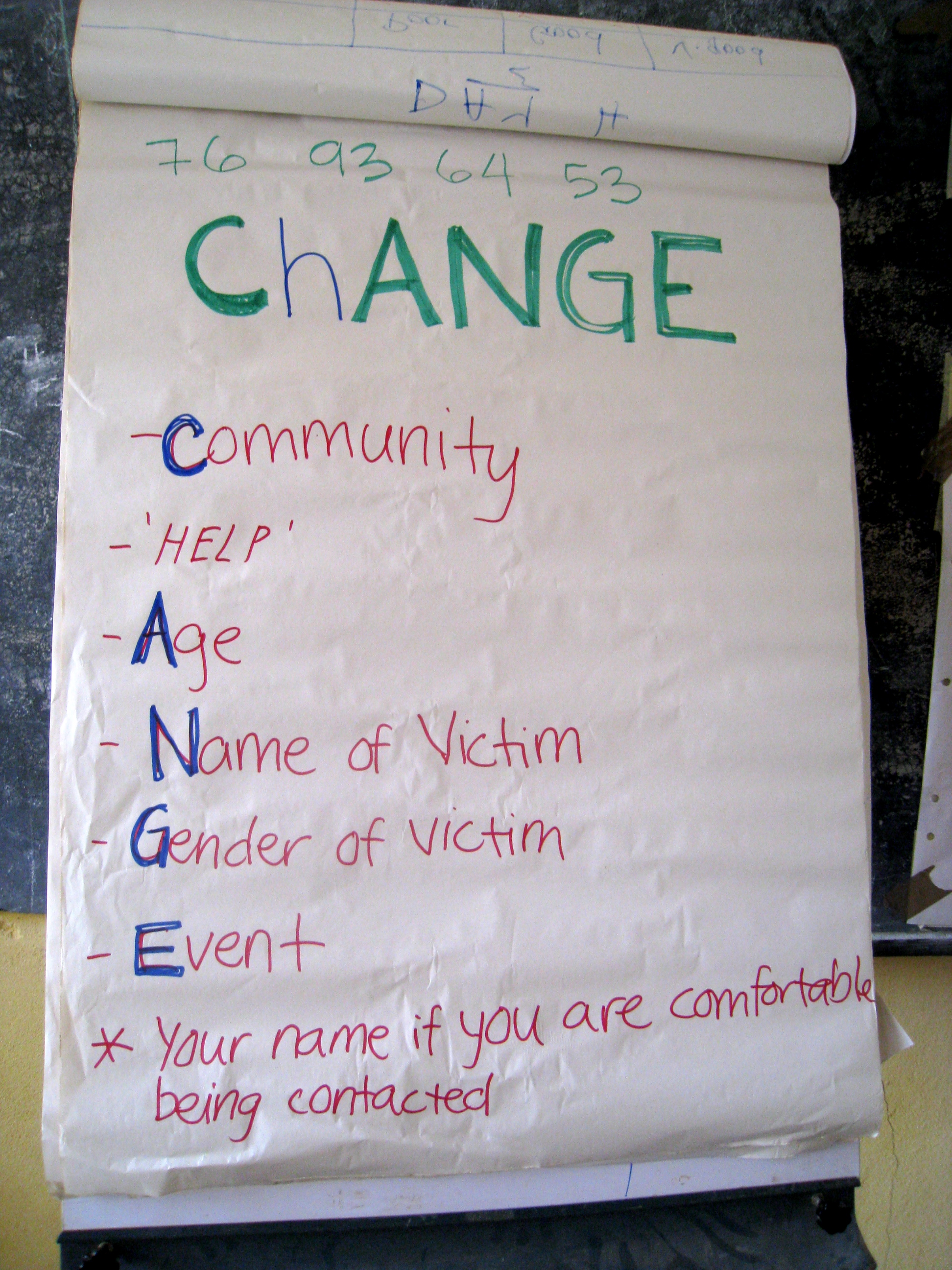
Learning what information to include when sending SMS reports on child abuse.

One component of our ICT4D internship with Plan is working “in the field” with the community to help implement the Ushahidi reporting system for violence against children (“VAC”).  To this end, Joe and I are living in Bamessing community, a village in the North West Region of Cameroon, also one of the three program units (“PUs”) hosting the YETAM program.

Bamessing has no running water, limited network coverage, and sporadic electricity.  The region is also known for high rates of child/forced marriage, domestic violence and school dropouts.  If a VAC Ushahidi system can work here, it can work anywhere.

Piloting the site in Bamessing has several benefits as well.  First, we are working with a group of motivated youth who have received extensive training on the four categories of  child abuse and violence against children (physical, psychological / emotional, sexual, and neglect or negligent treatment), as well as their legal rights under the UN Convention on the Rights of the Child and other international and national protocol.

Second, the Bamessing community is saturated with cell phones, and most of the youth in the YETAM group have their own personal cell phones.  Joe and I had a discussion with Odelia, our “land lady” and the 30-year-old widow of the late pastor, who told us that she first noticed cell phones in Bamessing in 2010 (though some say they’ve been around since 2004).  Since then, she has owned five cell phones, although she never uses one to text, and makes only one or two calls a week.  Instead, cell phones seem to serve as a sort of portable doorbell.  Neighbors, friends, and acquaintances “beep” each other (give a missed call, which does not cost any credit) to relay a predetermined message.  Credit is expensive relative to other daily costs and, as previously mentioned, the network here is tenuous.  Texting requires literacy, dexterity, and decent vision, which are limiting factors for many of the adults in the community.

Finally, Cameroon seems to have the advantage of a functioning (albeit imperfect) offline system for reporting and responding to VAC.  I spoke with a delegate from the Ministry of Social Affairs (“MINAS”), who explained some of the system’s weaknesses to me, namely that the ministry is highly underfunded and understaffed.  He also lamented that reporting is lacking, due to inadequate knowledge of civil law (instead, most people are familiar with customary law, which often reinforces certain rights violations), and inability to report violations.  While knowledge of civil law must come from human led sensitization and education projects, the Ushahidi platform can enhance reporting ability in Cameroon.  Through our discussions with Plan staff in Yaoundé, we came to the optimistic conclusion that the government might increase investment in staff, resources, and educative programs in direct response to the number and severity of reports that come through the Ushahidi system.

Given these caveated benefits, our current challenge is to introduce the concept of reporting through Ushahidi to the YETAM youth group, teach the youth how to report incidents, integrate their feedback into the system, get the online system up and running, pilot it, and present it to MINAS.

Our first opportunity to present Ushahidi to the youth was during the YETAM refresher training, held June 22 – June 27, 2011 at a local high school in Bamessing.  Joe and I worked with Georges (Plan Cameroon’s ICT coordinator for the area) and Judith (the YETAM coordinator in Cameroon) to design a module to introduce Ushahidi and our particularized reporting system.  First, Georges and Joe explained Ushahidi and answered questions on a theoretical level.  We then described our intention to use Ushahidi for reporting VAC, what information must be included in reports of VAC, and what information will be displayed on the Ushahidi site.

We created an acronym (ChANGE) to help the youth remember what information to include in text message reports. (C: Community; h: False letter– we said “help” so people can remember, but really nothing should be reported there, A: Age, N: Name of victim, and your own if you are comfortable reporting it, G: Gender, E: Event.)  Then we gave a practice scenario and asked five participants in the class to show how they would report the message. We reviewed each message for number of characters, noting that a single text message is limited to 140 characters, and also checked to make sure that all the necessary components were included.  All five messages were similar, reading something like:

My name is Judith. I beg of you for my friend Mary who is 14 years old and whose father is taking her from school to give to a 60 year old man for marriage in Bamessing community.

Most of the messages ran long, but did include the five required components.  One area of confusion was what level of geographic specificity to include.  We explained that while the report must be as specific as possible to facilitate a response, the Ushahidi site will present a more general geographic location so as to preserve anonymity for victims and reporters.

We asked the youth for feedback on the system, which resulted in more questions clarifying what is appropriate to report, and the level of confidentiality of reporting.  One concern was that often the phone network is down, making it impossible to send text messages.  We clarified that all the old methods of reporting still exist, and that community animators and Plan staff can be sought out to report either by text message or the other ways.  By the end of the training, the youth agreed that this would be a useful system, and some commented that they particularly appreciate the unique level of anonymity associated with SMS reporting.

This month, Joe and Georges will finalize the Ushahidi system, Joe will create brief manuals for system users, and Joe and I will provide additional training on using the system.  We hope to have the youth send sample text messages to the site in the next month to test the system, to train the youth, and to provide sample data to present the site to potential government partners. Our colleague Nathalia (the Child Protection Advisor in Plan Cameroon) also suggested that we create a ‘child and youth friendly’ guide to how Ushahidi works that can be used for training, so we’ll get going on that also.

Read Full Post »

« Newer Posts - Older Posts »