Feeds:
Posts
Comments

Archive for the ‘protection’ Category

Continuing on with the Millennium Development Goal (MDG) related posts…. I’ll be on a panel on Sept 21st talking about how ICTs can contribute to the MDGs. My perspective is less from a top down, big business, giant project point of view. In my work, I look at ICTs (Information and Communication Technologies) as tools that children and young people can use to create and access information and to advance their own agendas locally and beyond, and ICTs as tools that organizations (big and small, local or not) can incorporate into their work to improve their efforts to attain development goals (such as the MDGs).

ICTs can be helpful tools for enhancing accountability, transparency, citizen engagement, public debate, participation and local ownership of the development process — all of which help with achievement of the MDGs. (See my post on MDGs through a child rights lens for more reasons why). ICTs and social media can also help organizations do more efficient, effective, engaging and high quality work.

ICTs are not silver bullets or magical elements, however; and they will not solve anything on their own. They need to be well-integrated into programs, and well-contextualized.

One framework I especially like to use for thinking about how organizations can integrate ICTs into their work comes from Hannah Beardon. Hannah suggests that ICTs can be integrated directly, strategically and indirectly:

Directly (Providing Access to ICTs): Mobiles and other ICTs have an immediate and striking impact at the family and community level, connecting people for personal, business and community reasons. Mobile devices save individuals time and money and are indispensable in emergencies and for connecting people to the larger world, such as for remittances and commodity pricing. Mobiles and ICTs can help people access information, improve their education, maintain social networks, participate in governance and community, and generate income.

Providing equipment directly is one way to think about ICTs in development programs. This includes ICT tools such as computers, mobile phones, video cameras, digital cameras, radio equipment, electricity, and Internet access. Often direct ICT support is considered for education programs and efforts focused primarily on ICT training or media projects. Computer centers and classrooms are an example, as is supplying mobile phones to project participants or GPS units for mapping projects or equipment for health programs. If this equipment and the information it collects are managed at the community or local organization level, it can enable people to assess and respond to local development needs in a powerful way.

The availability of ICTs is obviously a pre-cursor to using them in different programs and projects. However I’m not much in favor of development organizations coming in and giving away mobile phones (unless it’s some type of extreme emergency or crisis, I suppose). I’m also wary of external NGOs setting up computer centers or giving large equipment donations because of sustainability and capacity concerns. Care needs to be taken that a non-profit organization is not assuming the role that local businesses or government institutions should be playing. Working in good partnerships with local and national government institutions and local businesses and keeping clear agreements on the roles of all actors, including the community, can help to reduce these risks and make programs more sustainable. Programs that directly provide equipment also need to think carefully about what other elements are required for success (purpose of the equipment, training to use it, ongoing maintenance and repair, electricity/power, a place to keep the equipment safe, local involvement in defining the type of equipment, etc). (See 10 Worst Practices in ICTs in Education).

In thinking about providing direct access to ICTs, one place for NGOs to focus energies is keeping an eye on government ICT policies and plans and strengthening civil society to pressure government to ensure that ICTs (including Internet) are accessible to the population now that more and more information is shared via ICTs. Article 17 in the Convention on the Rights of the Child outlines children’s right to information, including access to information and material from a diversity of national and international sources, especially those aimed at the promotion of a child’s social, spiritual and moral well-being and physical and mental health. States Parties are obliged to (a) Encourage the mass media to disseminate information and material of social and cultural benefit to the child and in accordance with the spirit of article 29; (b) Encourage international cooperation in the production, exchange and dissemination of such information and material from a diversity of cultural, national and international sources; (c) Encourage the production and dissemination of children’s books; (d) Encourage the mass media to have particular regard to the linguistic needs of the child who belongs to a minority group or who is indigenous; (e) Encourage the development of appropriate guidelines for the protection of the child from information and material injurious to his or her well-being, bearing in mind the provisions of articles 13 and 18. The 2005 World Summit on the Information Society’s Tunis Agenda also provides a useful platform for thinking about advocacy around rights to information and ICTs.
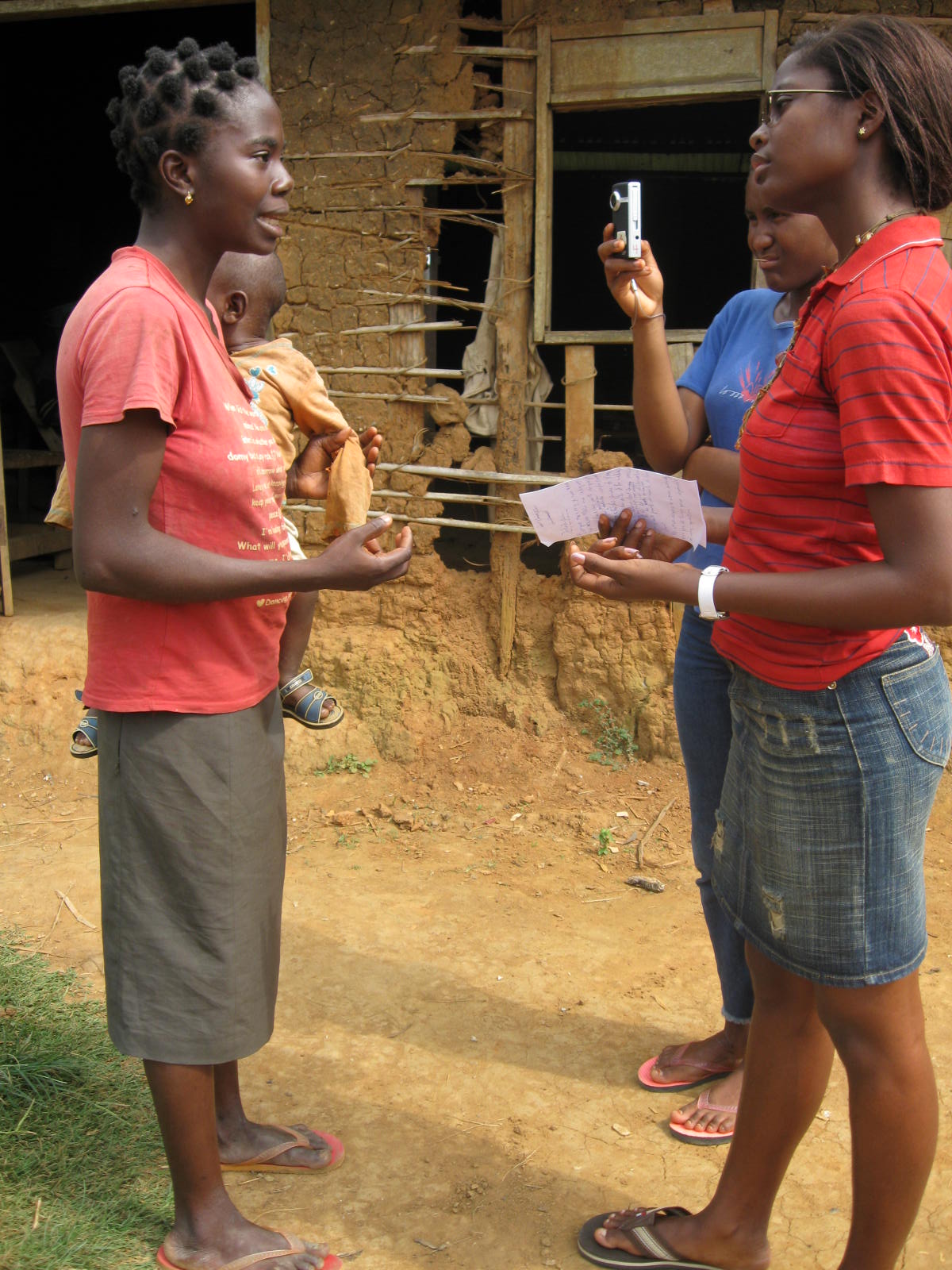
Making a film on birth registration, Cameroon

Strategically (Using ICTs as tools to support development processes): Beyond directly providing ICTs, new technologies can be used in a myriad of ways to support the broader development process. Starting from larger program goals, defining the roles that information and communication play, looking closely at the local context, and then researching existing tools that could be supportive is a good way to start when planning concrete initiatives. (Forthcoming is a second publication by Hannah outlining a good process for local contextualizing and ICT integration into specific programs). If there are no existing tools, a case can be made for developing or building onto a tool or an application.

Mobile phones, as tools for effective and timely dissemination of information, have real potential to strengthen the design and delivery of programs, for example in health, education, household economic security, disaster risk reduction and response, emergency and crisis management, HIV and AIDS prevention and treatment, child protection, youth-led advocacy, and water and sanitation. ICTs should be an integral part of local, country-level and broader strategic planning processes and they should be incorporated, where appropriate and relevant, into programs where they can add value, keeping a close eye during monitoring and evaluation on whether their purported benefits are real.

On-going capacity building and exchange at various levels is critical to help program staff become aware of advances in the field of ICTs and to help ICT advisors better understand programs, staff needs and community realities. Conversations across sector and silo boundaries are also critical to ensure that ICT integration is successful. ‘Bridge figures’ are helpful — those persons with good knowledge of both programs and ICTs — to help these processes along. In the absence of someone to serve as a bridge figure, well-structured teams with expertise in both areas should work closely together to take advantage of their specific expertise and to learn from one another.  ICT tools should be selected based on local needs and contexts as well as program priorities, starting with information and communication needs, rather than starting with new ‘breakthrough’ technologies. (Though other sectors often start with the cool technology and see if/how it can be useful). During strategic planning processes, program staff should be analyzing program information and communication needs and working with ICT staff to incorporate technology that may add value and help reach program goals in a higher quality and more effective way. Again, ‘bridge figures’ can be helpful in that process. Monitoring and evaluation are important along the way to check whether adding ICTs is actually helping. Sometimes things work perfectly fine without new ICTs.

Indirectly (Using ICTs to improve efficiency and communication within the organization): The wealth of knowledge and information that a development organization generates and uses needs to be documented, shared and communicated effectively in order to improve impact. Advances in knowledge management and on-line collaboration, including blogs, wikis and other social media tools and feedback mechanisms can bring immediate access to information and real-time discussion. Lower cost technology, notably in the areas of digital mapping, GPS, mobile mapping, mobile internet can help staff to carry out their daily work and improve information sharing and decision-making across departments and to engage and inform the public. Engagement with donors can also be heightened through ICT tools and social media, always taking into consideration the additional burden 24/7 demands can add to staff’s workload, and the child protection and other risks posed by more direct access to communities.

ICTs and social media can help make aid and development organizations more participatory, more agile, and able to pull in information from variety of sources and process it faster. This in turn can help pull people out of their silos and force them to consider new ideas and ways of working and thinking about challenges. Mobiles especially are helpful for better communication with community members and local organizations. Forward thinking organizations should be taking advantage of these new tools to gather direct feedback from those that they are supporting, for better dialog to improve their work, and for devolving helpful information to community members. Mobile data collection, for example, in addition to being a strategic tool for program implementation, can also be a way of improving the quality of data collection and increasing ownership by community members of their own data which support them to take back management of their own development processes from external agents. Mobiles are also a great tool for gathering data quickly from a broad subset of the population; data which can shape rapid responses and emergency interventions.

Twitter and blogging and other web-based services can serve as a springboard for deeper discussions and coordination among different development actors, government agents, institutions and the private sector. Social media is a way to share and discuss lessons learned and challenges faced, and to diffuse information about new ICTs and how they are being used by different agencies and individuals. Global partnerships can easily be initiated, developed and nurtured on-line. Organizations can provide on-line training opportunities to staff and save time and money by using new technologies such as forums, blogs for sharing and reporting, Skype and chat tools, and social networking. These same tools can be used to improve relationships with donors and with partners and staff working in disperse offices. However, in order for any of the above to happen, command and control practices that are common in large institutions and organizations need to be abolished so the tools can be most useful.  Here is an excellent post on use of social media tools in humanitarian work.

3-fold path

Using those three categories to think about ICT integration in an organization’s work can help clarify and strategize. Some initiatives may include all three categories and some may be more focused on one particular category.

In a follow-up post, I’ll share some examples of tools that I find interesting and helpful for organizations working at the grassroots level to achieve broader programmatic goals and to improve local community participation and ownership of the development process.

—–

MDG related posts on Wait… What?

MDGs through a child rights lens

5 ways ICTs can support the MDGs

ICT related posts on Wait… What?

11 concerns about ICTs and ‘social media for social good’

I and C, then T

Innovate but keep it real

ICT4D in Uganda — ‘ICT’ does not equal ‘computers’

Mind the gap

7 (or more) questions to ask before adding ICTs

It’s all part of the ICT Jigsaw: ICT workshop in Mozambique

Read Full Post »

The latest UN report on the MDGs states that progress towards the Millennium Development Goals has been made, but it’s uneven. It looks like the Goals will be missed in most regions.

I’m blaming Madonna for launching her line of MDG sunglasses and not linking them to an MDG promotion campaign (kidding!)

To discuss all this (well, except for the sunglasses part), MDG week is happening in New York from September 20-24, 2010.  I’ll be part of some of the activities, including 2 panels. The first panel is on ICTs, Innovation and the MDGs and the second is on Women/Girls and Mobiles. What better way to prepare than to write some blog posts to sort through some ideas?

This post looks at the link between child rights and the MDGs. I’ll write some additional posts and add links at the bottom of this post when they are ready. I would love feedback on which elements would be most important to highlight during the MDG panels next week.

Human rights and the MDGs

If you look at why some countries are more on track than others in achieving the MDGs, the answer often comes down to there being greater accountability and transparency at all levels, more citizen engagement, and more public debate. Human rights are instrumental in ensuring empowerment, access to social services, equality before the law, and poverty reduction. So the link between human rights and the MDGs is clear. There are a number of human rights concepts: shared responsibility, indivisibility, non-discrimination, equality, and accountability that are also necessary for achieving the MDGs.

Due to discrimination, the most marginalized are still not accessing their rights or being included in the MDGs. There are still massive inequalities between rich and poor, rural and urban, men and women, boys and girls, adults and children. Disability and ethnicity also prevent some groups from being included. Until these disparities are addressed, the achievement of the MDGs will be far off for many particular groups. The discussion around the MDGs needs to include and reflect the opinions and concerns of those who have been traditionally marginalized.

Girls and the MDGs

Children, especially girls, and especially girls in poor, rural areas and urban slums, are often the most marginalized in these processes and in general. The MDGs highlight some critical gender gaps, especially in education, but they do not reveal the power imbalances that are an underlying cause of these disparities. Girls are often subjected to harmful practices such as early marriage and sexual violence. In countries where literacy is lowest, girls’ chances of early marriage are highest. Girls spend more time working, shoulder the burden of household chores and are more often not in school. Organizations and entities working towards the MDGs need to do more to ensure that girls and other marginalized groups are not excluded.

MDGs through a child rights lens

Child rights are a set of specific rights for those under the age of 18. They are outlined in the Convention on the Rights of the Child. Much of the work that child rights organizations are doing is complementary to achieving the MDGs, and 6 of the 8 MDGs are directly related to children.

Working with children and young people to participate effectively in the development of their communities and the realization of their rights contributes directly and indirectly to the achievement of the MDGs. Ensuring that children, especially girls, and other marginalized groups are listened to and heard by decision makers at the local, district, national and global levels is critical in identifying and addressing the hidden power dynamics and the underlying issues that slow the achievement of the MDGs.

Applying a ‘child rights’ lens to the MDGs is helpful in identifying responsibilities for achievement of the different MDGs. A child rights lens can also help ensure the concepts of non-discrimination and the best interest of the child are incorporated into MDG work.

What is a child rights lens?  How can it be applied to the MDGs? In a simplified way, it means:

  1. Identifying and monitoring those persons and institutions responsible for ensuring children’s rights/achievement of the MDGs (the ‘duty bearers’).
  2. Helping children and adolescents (the ‘rights holders’ in this case), to empower themselves by knowing their rights/knowing the MDGs, and together with supportive adults and institutions, to hold duty bearers accountable for ensuring children’s rights/achievement of the MDGs.
  3. Supporting children to participate fully in the process. Children’s participation leads to better outcomes and policies, and involving children early in their lives helps them develop skills and attitudes that lead to a better society in the short and long-term. Not only do children have something to contribute to their societies now, but by engaging in community development and developing good leadership skills at a young age, they also become better leaders in the future.

A child rights approach should be central to all programs and funding that are addressing the MDGs, since the MDGs are interrelated with children’s rights to survival, development, participation and protection. In addition, the principles of non-discrimination and the best interest of the child should be paramount in all decisions taken related to the MDGs.

—–

Resources:

UNICEF’s Narrowing the Gaps to meet the Goals shows that paying attention to equity and the unreached can be a more cost-effective way of pursuing the MDGs in aggregate.

3 ways to integrate ICTs into development work

5 ways ICTs can support the MDGs

7 (or more) questions to ask before adding ICTs

Related posts on Wait… What

Child participation at events:  getting it right

Child protection, the media and youth media programs

Community based child protection


Read Full Post »

Salim Mvurya, Plan Kwale's District Area Manager

Plan’s Kwale District office in Kenya has been very successful in building innovative community-led programming that incorporates new ICTs.  I had the opportunity to interview Salim Mvurya, the Area Manager, last week, and was really struck by his insights on how to effectively incorporate ICTs into community-led processes to reach development goals and improve on child rights, child protection and governance.

In this video, Salim gives some background on how Plan Kwale has been using ICTs in their programs since 2003 (1:11). He shares ideas about the potential of new ICTs (3.42) and some key lessons learned since 2003 (5.03).

Watch the video to get the advice straight from Salim. Or if your internet connection is slow or you’re like me and you like to skim through an article rather sit still and watch a video, the transcript is below.

In a second video, Salim gives really astute advice to the tech community (0.15), corporations (1.19), and development organizations (1.57) on how to successfully integrate ICTs to enable good development processes. He also mentions the importance of moving with the times (4.43). Read the transcript here.

Transcript for Part 1:

ICTs and development Part 1: ICT tools for child rights, child protection and social accountability

My name is Salim Mvurya, I’m the Area Manager for Plan in the Kwale District. My core responsibility as an area manager is to provide leadersip to the Kwale team in both program issues and also operational issues within the organization. This week we have been here in a workshop where we’ve been focusing mostly on issues of ICT for development and particularly what we’ve been learning here is the issue of mapping. We’ve also learned Ushahidi. We’ve also learned from our colleagues in Kilifi on mGESA (a local application of mGEOS that Plan Kenya, Plan Finland, University of Nairobi and Pajat Mgmt are developing) and basically we have been looking at this workshop as providing opportunities for using ICTs for development, but more particularly for us in Kwale is the issue of child protection and youth governance.

How has Plan Kwale been using ICTs for issues of child rights, child protection and child participation?

ICT in Kwale has a bit of a long history and it’s because of the issues on child rights. Kwale has a number of issues. Child marriages, issues of violations of child rights through sexual exploitation, and child poverty. So the efforts to do media started in Kwale in 2003 when we rolled out our first video that was done by children at the time to profile some of the issues of child marriage. But more importantly in 2005, we began to think greatly how we can bring the voices of children to duty-bearers and at time we thought of having a children’s community radio.

Because of lack of experience, we were thinking maybe at the end of that year we could launch the radio station. But then it took longer than we envisioned because we needed to roll out a participatory process. Alongside the same time, we had ideas of community-led birth registration which was being done in one community based organization. But later we also thought about looking at how ICT can help us in moving that direction.

Then we also had this idea of inter-generational dialogue, where children and youth can sit with duty-bearers and discuss critical issues affecting them, so we began using youth and video there, children and video, and showing those videos in a community meeting where then people could discuss the issues.  Alongside the same time we were partnering with various media houses and also rolling out radio programs where people could listen and also foster some discussions on children.

So it’s been a long journey but I think what we are seeing is that we need now to consolidate the gains, the experiences and efforts so that we can have a more strategic approach to ICT for Development and this workshop basically provides us with an opportunity and a platform to think much more.

What potential do you see for some of the newer ICT tools for your work in Kwale?

I see great potential in some of the tools that have been learned here this week, more particularly to get information at the click of a button from the ground. We could use the tools to map out resources out in the community, to map zones where there are a lot of issues on child protection, areas where we have issues like low birth registration… There is great potential for the tools that we’ve learned here to assist us not only in planning for projects, but in issues of social accountability. For example if you map out the areas where we have projects for Constituency Development Fund you can easily see where we have projects that have been done well but where we also have projects where maybe communities will need to discuss much more with duty-bearers to be able to, you know, foster issues of social accountability.

What are your biggest challenges? What mistakes have you made?

One thing that we’ve been learning in the process… well, you know sometimes we have ideas that we think can work in the next week, like for example the children’s community radio when we were thinking about it we were thinking that it could take off in about 2 months. But what we learned is that there are processes to be involved. Communities have to be prepared well for sustainability. Children have to be trained, there needs to be capacity building. You have also to conform to government procedures and processes.

The same also with birth registration. We thought in 6 months we could send an SMS and get your birth notification, but what we have also learned is that it takes a process. It takes awhile. You have to get the government buy in.  You also have to work on software, where the government is having a critical input. Because, although it is a pilot, we also think that if it works well then it has to be replicated, so it has to conform with the thinking in government. Also, with the issues of youth and media, one thing that has to be very clear is that you have to get youth who are committed, so you start with a bigger group, and you end up with those who are passionate

So I think it’s very critical when somebody is thinking about ICT for Development that, one, you look at the context: is it relevant to that area? What kind of skills are needed? What kind of processes for sustainability? but also getting the passion. Getting people who are passionate to lead the process is also a very critical lesson.

Related posts on Wait… What?

Salim’s ICT4D advice part 2: innovate, but keep it real

Youth mappers: from Kibera to Kinango

A positively brilliant ICT4D workshop in Kwale, Kenya

Is this map better than that map?

Modernizing birth registration with mobile technology

Read Full Post »

Nothing to do with the topic of this post, but the Kwale coast is gorgeous.

Last week I was in Kwale, at a Plan Kenya hosted workshop as part of the Youth Empowerment through Technology, Arts and Media program. The team at Plan Kwale has been pointedly using ICTs in their community development programs since 2003 (not counting email and Internet of course) when they began working with radio and video as tools for raising awareness about children’s rights.

It’s really impressive to see how they’ve moved forward with very strategic ideas for integrating ICTs to help reach programmatic and development goals, especially in the areas of youth and governance, universal birth registration, and child/youth-led advocacy around rights and protection issues.

Over the 6 day workshop, the main things we wanted to do were:

  • look at the development context in Kwale, Kinango and Msambweni Districts (South Coast areas where Plan operates via the Kwale Office)
  • better understand the perspective of youth in the 3 districts
  • remind ourselves of rights-based approaches to community development
  • discuss youth issues, governance, advocacy, violence against children and gender within the local context
  • look at the ICTs currently being used by youth, communities and Plan in the Kwale Development Area
  • share and discuss new social media and ICT tools and ways they can be used
  • practice using new social media and ICT tools and see if they can be useful and sustainable in the 3 districts
  • determine next steps for integrating social media and new ICTs in specific local initiatives and plan for how to build on them in Plan Kenya’s overall work

Some elements that made the week positively brilliant:

workshop participants

Engaged and committed stakeholders

We were a group about 20, including staff and university student interns from Plan’s Kwale and Kilifi District Offices and Plan’s Country Office in Nairobi; Government District Youth Officers (‘DYOs’) from the Ministry of Youth, Sports and Culture; Youth Council members from Kwale, Kinango and Msambweni; 2 staff from Map Kibera and 2 youth mappers from Kibera.

This mix meant that we had a variety of perspectives and opinions, including those of youth from local communities, partner organizations, local government, frontline staff, protection and governance technical advisors, ICT managers, and senior level program managers. This helped to ensure that we were grounded in reality, technically and thematically sound, able to cross-pollinate and integrate new ideas with solid experience and practice, and take decisions immediately forward to a higher level.

Local partners and youth-youth networking

Peer-peer learning and exchange among all the participants was a big plus. Plan and Map Kibera have very similar visions and values, yet each has its own area of specialized technical expertise and experience.  The youth participants from local councils from the 3 South Coast districts and the youth mappers from Kibera brought different perspectives into the workshop which enriched the discussions.  We all learned a lot from each other. Combining expertise as partners brought the workshop to a whole new level, and will help to ensure that the efforts are sustainable and can be built on and expanded. The youth in Kwale can now extend their skills to more youth in their communities, the youth mappers from Kibera can take home new ideas to improve their work, the university-level interns gained practical experience, and the buy-in from the local government’s District Youth Officers (who manage government funds) in the 3 participating districts can help provide the necessary support to broaden the efforts.

Flexible workshop methodology

We had certain goals that we wanted to achieve and we were clear on that, but we let the agenda flow. We started by taking a deep look at the local context and resources. We heard from local experts in the areas that we wanted to focus on (youth and governance, child protection) as well as community youth and local authorities. We spent time getting to know some new tools and discussing the pros and cons of using them.

Hands-on with FrontlineSMS

Hands On Work

We had practical sessions and hands-on work on blogging, FrontlineSMS, Ushahidi, Map Kibera, and mGESA (a local application of the mGEOS mobile platform co-developed by Plan Kenya, Plan Finland, University of Nairobi and Pajat Management and being piloted in Kilifi).

This was important for helping participants feel confident about doing some of the work once the training team was gone. I imagine however that more practice will be needed during some follow up sessions, as most of the participants don’t have regular computer and Internet access for enhancing their skills on a daily basis with additional practice and exploration.

We spent one day mapping our Hotel on Open Street Maps, and another day in Kinango, mapping specific points in 4 teams.  Lessons learned during hands-on work included the importance of engaging and involving the community ahead of time, so that rumors about why people are mapping the community don’t fly. In my group, for example, we were moving around with George the District Youth Officer from Kinango. Someone that he ran into joked to him “Oh, now Kinango is going up for sale!”  A joke, but nonetheless if people don’t know why we were mapping, this or other rumours can quickly spread. (See the video about mapping in Kinango at this link and the background blog post here.)

End goals + new tools + back again

By starting with people’s expectations for the workshop, analysis of the local context, and an understanding of the goals that youth and staff wanted to achieve together, we could be sure that we stayed true to where we wanted to end up. At the same time, by learning about new tools, things that weren’t possible before became imaginable and people started to innovate and mix their existing knowledge and experience with some new ideas.

Combining the two, and having a good variety of perspectives in the room and a lot of space for discussion and practice means that next steps will be more achievable and sustainable, because people are clear and agree about where they want to go, and they feel capable of incorporating some new tools and ideas to get there.

The tools

We explored a number of new(ish) tools at the workshop. They had been identified over the past couple years due to their use by Plan or other organizations in areas such as: community development work, violence tracking, advocacy, governance and social auditing.  We talked about mobile phones, email, Internet, Facebook, Hi5, Google search and Google maps. We did a quick overview of Voice of Kibera, use of GPS, Open Street Maps, FrontlineSMS, Ushahidi, the YETAM project, the PlanYouth website, and a Plan pilot project in Benin using SMS to track violence against children.

The first day, the context analysis was very focused on youth and governance, transparency and social auditing, so we pulled out the 10 Tactics video by Tactical Technology Collective (which @hapeeg had given to me a couple days earlier). This video series talks about 10 tactics for turning information into action. It really sparked ideas among the participants for how they could use social media and ICTs in social accountability work and human rights/child rights work.  Map Kibera partners also shared a tool developed by SODNET (SMS for social auditing of the Constituency Development Fund).

We talked about the use of mapping and SMS in child protection work. One of the main child protection issues in the south coast area is the distance that a child, girl, family has to travel in order to report an abuse. Women’s lack of economic power, inability to own property and the importance of marriageability also mean that often women and girls feel unable to speak out or protest abuse when it’s happening. It’s still not certain what role ICTs can play in this context given the risks involved to those who report, but Plan’s child protection point person, Mohammad, is planning to host a series of meetings with local child protection authorities to discuss possible ways forward.

Digital mapping was immediately cataloged as an important tool for identifying resources, advocating for services and holding government accountable through social auditing. It was also recognized as a potential income generator once areas, shops and local businesses could be added to an on-line map, or if youth could purchase GPS units with funding from the District Youth Office and charge for their GPS services. George, the District Youth Officer for Kinango talks in this video about how mapping can be useful to the Kinango community, even if most members don’t have access to computers and broad band. (Click the link or watch below)

Information and communication gap analysis –> ICT integration plans

ICT integration for youth and governance program

Early on in the workshop, we worked in 2 groups to analyze the goals for the Youth and Governance and the Child Protection programs that Plan is supporting in Kwale. The groups discussed the information and communication gaps that needed to be filled in order to move towards the goals of the 2 initiatives. We looked at what ICT tools might best help reduce the gaps, from existing traditional tools (like meetings, face-to-face advocacy, drama, town criers, radio) to those new(ish) tools that we had discovered (see above paragraph) that might be useful to try out given the goals in the 2 key areas. The groups revisited this gap analysis on the last day after having had more hands-on use of the different tools and turned the gap analysis into an action plan.

ICT integration for child protection programs

Management buy-in and leadership

While the 2 groups worked on local action plans for integrating ICTs into their work, senior management from Plan’s Kenya office created their own action plan for how to build on the workshop experience, engage mid-level managers and other key staff in ICT integration, further develop partnerships and solidify cross-cutting incorporation of ICTs into Plan’s work in Kenya. The Kwale and Kilifi program units have been innovators within Plan for several years. Learning from, supporting and building on concrete work that they are doing on the ground allows for a solid and feasible country strategy based on reality. Having a strategy built from the ground up and with solid support and buy-in from national management means that there is less risk of donor led ICT funding, and more probability that new resources mobilized for ICT work go towards real needs and have better results.

Related posts on Wait… What?

Youth mappers: from Kibera to Kinango

Salim’s ICT4D advice part 1: consider both process and passion

Salim’s ICT4D advice part 2: innovate, but keep it real

Is this map better than that map?

ICT4D in Uganda: ICT does not equal computers

Read Full Post »

Of what value is a computer if you don’t have regular access to it? If you don’t have an operating system, some programs, virus protection, electricity, and increasingly, internet? Of what value is a school building without caring and qualified teachers, a relevant curriculum, engaged parents, students who desire an education, families that see the value in education for their children, and a community that is willing to take a lead in ensuring that the above happens?

Hardware without software is pretty much a waste of resources.

Child protection systems follow the same logic.  For example, a legal framework or a free, national helpline or an SMS-based system for child abuse reporting can be set up, and the government can express great support for it. But if there are no resources to manage it, no one answers the phone, operators or administrators are not trained, there is no response after reporting an incident, laws protecting children are not operationalized or enforced, there is corruption within the governmental systems, authorities are the actual abusers, the population is unaware that the laws or helpline exist or has had negative experiences with them, or people do not think violence is worth reporting or ending, it is like having a computer without any software, an old impractical machine that eats up resources with slow or nil results, or a device with a virus or corrupted files.

One of the areas where I’m currently supporting colleagues with ICTs (information and communication technology) is prevention of violence against children. In many cases, we are working in countries with weak government support and systems, making it very difficult to rely on government child protection services. Even in places where there is a reasonably strong national system, child protection services cannot rely only on official channels and systems managed by government duty bearers.  Communities, traditional leaders and authorities, families and children themselves need to be involved and active in their own protection.

In the organization where I work, we’ve had a lot of internal discussion, taking a strong look at our interventions and programs, talking with children, youth, communities, civil society, local and national authorities, and really challenging ourselves to find the best way to work with and strengthen local, district and national child protection efforts.

I was really happy when my colleague in Ghana shared with me a review titled “What Are We Learning about Protecting Children in the Community: An Interagency Review of Evidence on Community-Based Child Protection Mechanismswritten by Mike Wessells, and commissioned by several agencies. I might be coming late to the party, as it was published in 2009, but better late than never.

Community-based child protection mechanisms, the report explains, “are at the forefront of efforts to address child protection in emergency, transitional, and development contexts worldwide. The mobilization of such grassroots groups has become a common programming response in many settings, particularly in areas affected by armed conflict or displacement. For international agencies, they are a favoured approach in places where local and national government is unable or unwilling to fulfill children’s rights to care and protection.”

Community-based child protection groups “are a vital means of mobilizing communities around children’s protection and wellbeing. Organised with care and in a contextually appropriate manner, they make it possible to:  identify, prevent and respond to significant child protection risks; mobilise communities around child protection issues; and provide a base of local support and action that can be taken to scale through links with other community groups and with national child protection systems.

According to the report, not enough is known about how these groups operate, how effective they are, and how they could be strengthened, so this review was commissioned to pull together existing learning and evidence. A stated limitation of the report is that it is highly focused on initiatives started or supported by external agencies.  I’m looking forward to the second phase of the review which will focus on groups initiated and run by local communities without external support. It should offer up even more interesting information.

Another stated limitation of the review is the absence of a strong evidence base on community-based child protection groups. Not having sufficient evidence of what works and what doesn’t means that potential remains high for unintended harm caused by child protection efforts. Potential risks have been identified when agencies excessively target particular categories of children, impose external concepts which can create community backlash, and disregard existing local practices that protect children.  This will also be addressed in Phase 2.

7 things that make child protection groups more effective

The review was able to identify 7 factors that influence the effectiveness of a community-based child protection group (I encourage you to check out the full report here):

1)      Community Ownership: as in most situations, the higher the community ownership, the more effective.

2)      Building on existing resources: a concerning tendency was for external agencies to start new groups without finding out what child protection mechanisms already exist in the community; some programs seemed to disrespect and marginalize local culture and didn’t do enough to build on positive existing practices.

3)      Support from leaders: engaging traditional leaders is tricky and necessary, especially when child rights and child protection run counter to traditional practices.

4)      Child participation: in most cases child participation in community based protection groups was not high quality; when it was present it improved quality and impact.

5)      Management of issues of power, diversity and inclusivity: the more effective groups were the more diverse and inclusive ones that invested great time and effort in ensuring power issues were managed.

6)      Resources: to be effective, groups needed both human and material resources; however, external agencies should carefully think through how much and what they resource to avoid creating parallel systems or undermining existing systems and community ownership.

7)      Linkages: links to both formal and non-formal systems and structures were beneficial.

The document goes on to look at scale and sustainability, concluding that community-based child protection groups are a scalable model of benefiting significant numbers of at-risk children. It lists 3 different models for scale that have worked especially for HIV and AIDS related work.  Sustainability of both outcomes and processes were a challenge for most of the initiatives studied for the review, and community ownership was the most important enabler in terms of sustainability. Unpaid local volunteer groups, which drew on existing community organizations and which worked in partnership with local traditional and religious leadership seemed to be the most sustainable.

Six significant challenges were identified for agencies supporting community-based child protection systems: strengthening the evidence base; better enabling community groups; improving sustainability by looking at long-term outcomes rather than short-term funding efforts and avoiding parallel systems created by external agencies; having more respect for community values, processes and capacities; facilitating community ownership even in emergency situations; changing donor and agency practices around community-led child protection groups, including the tendency for short-term injections of high amounts of funding, and stigmatizing certain ‘categories’ of children by excessive targeting.

A series of recommendations for practitioners and donors is listed in the review based on the above challenges and gaps.

This is already quite a useful document for practitioners, agencies and donors working in the area of child protection or other types of community-based protection and support groups. Phase 2 should shed even more light on what makes for successful community-led and community-based protection services.

The author of the review is Mike Wessells. Agencies participating in the review include USAID Displaced Orphans and Children’s Fund, Oak Foundation, Save the Children, UNICEF and World Vision International.  The review summary is available at this link, and the full report (.pdf) is available here.

Related posts on Wait… What?

Fostering a new political consciousness on violence against children

7 (or more) questions to ask before adding ICTs
Finding some ICT answers in Benin

Tweaking: SMS violence reporting system in Benin

Child Protection: from emergency support to a sustainable mechanism

Child protection, the media and youth media programs

An example of youth-led community change in Mali


Read Full Post »

I’m in Bamenda, a beautiful, cloudy and cool, mountainous area of Cameroon, to support some training this week. On the drive out, my colleagues revealed that they’d booked me into ‘a very nice hotel’, whereas they would be staying at the ‘Family Hotel’. I asked why we were staying at different places and it became clear that they’d be staying with relatives and friends or at hostels they didn’t think I could handle to save their per diem. The nice hotel is indeed nice – not fancy, but brand new with clean, quiet rooms, fluffy white comforters, decent pillows, a hot water shower and most importantly – there are no mosquitoes. I would have protested, but my luggage didn’t arrive and I don’t have my mosquito net for at least another couple of nights, so I let it go.

I went down to breakfast this morning and there were a couple of older guys, maybe in their 60s, waiting to be served. We greeted each other with typical pleasantries. They said they were in Bamenda to recruit students for a school they run in the UK. I waited for about 15 minutes for some acknowledgement from hotel staff that there was going to be some kind of breakfast, but nothing. Pretty soon a few obviously wealthy Cameroonians affiliated with the 2 UK guys came in. They were clearly not used to waiting and began berating the kitchen staff to hurry up and get us all some breakfast. I apologized and asked for just some hot water to take to my room to make coffee, as the driver was going to arrive shortly.

Tonight I went down to dinner. I am not a soccer fan but thought I’d watch the Brazil-Chile World Cup match since I didn’t have anything else to do, mobile internet was slow, and there was a TV on in the bar area. I ordered a Guinness and asked if there was any dinner. The hotel is pretty much food made to order based on what’s available in the kitchen since there are very few customers. The cook I had bonded with over the soccer match and my dinner selection last night suggested he stir fry up some eggplant and zucchini with garlic and ginger. Fabulous. I timed my order so that I could eat at half time. Then I realized that I was making him miss the whole first half of the game because he was cooking my meal. And I don’t even care about soccer.

My 2 UK hotel-mates from breakfast arrived back to the hotel just as I started eating, and set up at the bar. Friendly chatting ensued about my meal. The first UK guy said he’d bring his own food and spices next time and cook his native Indian food in the kitchen since hotel staff were so slow. There was a young Cameroonian woman with the second UK guy. He was tickling her in a suggestive way. The finely dressed Cameroonian guy with them said to the first UK guy “Don’t worry, your ‘drink’ will be here in 30 minutes. You know what I mean, your ‘drink’?” How obvious.

Brazil was dominating at 3-0, but I decided to wait around in the bar for the game to be over just to see how old this guy’s ‘drink’ happened to be. I was glad to see that at least she was clearly over 18. Makes me wonder what kind of ‘school’ these guy are involved with. I suppose if you were a poor family in Bamenda and some wealthy looking guy from the UK offered to take your son or daughter to study over in the UK, you’d be cool with it. Or maybe I’m reading into things.

Read Full Post »

So, a few weeks ago I came across this fabulous article by Jay Rosen called “How the backchannel has changed the game for conference panelists“.  It was perfect timing because I had just been discussing how much I had enjoyed the public/private tweeting and live commenting happening during a live stream event I was watching, and how Twitter allows for a totally different and very engaging experience at these things than we used to have before.

I had no idea that there was actually a name for this phenomenon:  the backchannel; coined by Victor Yngve in 1970 and made famous in 2002 at the PC Forum conference (thank you Wikipedia!).

Rosen notes that “The popularity of the backchannel… has empowered those in the audience to compare notes and pool their dissatisfaction during a performance that misfires…. Especially at risk are ‘big name’ speakers whose online or offline status is such that they may complacently assume their presence alone completes the assignment and guarantees success.”

He goes on to give 10 tips for how to avoid getting killed in the backchannel. These tips are a good read for famous types who speak at conferences or panels. But they are also a good read for the rest of us, as a lot of it is still relevant. For example, I liked the idea of “blog it first” to get early reactions to what you are going to present so that you can tweak it before your actual presentation.

Now, I’m obviously the non-famous type, and I doubt the ‘audience’ will be harsh, but in mid-June, I’ll be in Karlstad, Sweden presenting at the 6th World Summit on Media for Children. My presentation is on one of the projects that I’ve been involved in over the past couple years: Youth Empowerment through Arts and Media (YETAM). I actually refer to it a lot in this blog, though I haven’t really written a summary post on it.  I normally refer people to this nice overview posted on the Communication Initiative website or to this post on the project’s overall methodology.

So, I thought I’d post my presentation here for the 99.9% of people I’m acquainted with who won’t be at the 6th World Summit, and of course as part of my plan to avoid any negative backchannel tweeting while I’m presenting!  Enjoy, and would love to have any comments to, you know, tweak it before it goes super live, just in case there are any hardcore backchannellers there….

Note: if you are reading on Google Reader, it seems the presentation doesn’t appear, so try clicking through to slideshare here…. or [NEW!] watch or download the file with notes here (if watching with notes, resize the .pdf document so that you can see the notes underneath the slides).

Related posts on Wait… What?

Hands on, hands on, hands on

Putting Cumbana on the map, with ethics

Being a girl in Cumbana

Demystifying Internet


Read Full Post »

The basic premise of the Convention on the Rights of the Child (referred to as the ‘CRC’) is that children are born with fundamental freedoms and the inherent rights of all human beings.

According to the CRC, the 4 main categories of rights that children have are survival, development, participation and protection. The CRC’s guiding principles help further shape the way that child rights should be interpreted. These are non-discrimination, the best interest of the child, right to life, survival and development, and respect for the views of the child.

Child protection concerns a child’s right not to be harmed and to protection from violence, abuse, neglect and exploitation.  It involves the duty of care placed on those that work with children or that come into contact with children.  It encompasses the responsibilities, measures, and activities that must be undertaken to safeguard children from both intentional and unintentional harm.

Child protection encompasses many different areas, such as juvenile justice systems and a child’s right not to be tried as an adult or incarcerated with adults; special care needed by unaccompanied children; protection from sexual exploitation and dangerous forms of child labor; prevention of trafficking and harmful traditional practices such as female genital cutting; support for children in emergency and conflict situations; prevention of exploitation by the media; the right not to be abused or taken advantage of by family, caregivers or institutions; and so on.  This link gives an explanation of a protective environment, and this one offers an excellent broad overview of child protection.

Child protection policies and strategies create mechanisms to prevent any type of harm to a child.

Child protection in youth media programs

The organization where I work frames its efforts within the CRC.  Most of the programs that I focus on are related to child participation and child protection.  These two areas go hand in hand, because good participation initiatives need to take child protection into consideration, and good protection initiatives are only successful when children participate in designing them and in protecting themselves.  Children should both know what their rights are and take an active part in achieving them and in protecting themselves.

This week, for example, I’m at a workshop with a small group of colleagues, teachers and local partners from the Upper West Region of Ghana. We’re preparing for a youth arts and media project that they will implement in June. By the end of this facilitator workshop, we will have a localized training plan that fits the context of the community and the youth participants, and the facilitators will have learned some new media skills that they will train the youth on when the project starts.

As part of the facilitators’ training, we cover the CRC, going in depth on child participation and child protection.  There is always a certain tension between these two areas. We want to encourage children to participate to their fullest, yet both children and adults need to be aware of potential risks that participation can bring with it, and know how to mitigate and manage them.

Three child protection risks that we are focusing on with facilitators at this week’s workshop are:

  • Intentional or unintentional abuse by staff or local partners
  • Retaliation or harm to a child who appears in a media story or art piece on a sensitive issue
  • Retaliation or harm to a child who authors or creates media or arts on a sensitive issue

Internal child protection policies

To begin our sessions on child protection, my colleague Joyce covered our organizational Child Protection Policy, which clearly states our intention to protect children from harm and advises that we will take positive action to prevent child abusers from becoming involved with the organization.

Joyce explained that child abuse is never acceptable:

  • Child abuse in our case is defined as:  All forms of physical abuse, emotional ill-treatment, sexual abuse and exploitation, neglect or negligent treatment, commercial or other exploitation of a child and includes any actions that result in actual or potential harm to a child.
  • Our child protection policy applies to staff at all levels, including board members, volunteers, community volunteers, supporters, consultants, contractors; partner organizations, local government people who have been brought into contact with children via our organization, visitors, donors, journalists, researchers and any other type of person or institution associated with us.
  • We recognize that child abuse may be a deliberate act or it may be failing to act to prevent harm. Child abuse consists of anything which individuals, institutions or processes do or fail to do, intentionally or unintentionally which harms a child or damages their prospect of safe and healthy development into adulthood.
  • We follow through on cases of child abuse to the fullest extent of the law.

Point three, unintentional abuse, refers to situations where someone has good intentions but their lack of planning, knowledge, foresight, or their recklessness puts children in harm’s way.  As Joyce explained, “It’s  like an excursion that is not well planned.”  The good intention is to take children out so that they could have some fun.  But if proper care is not taken to plan the trip and ensure children’s safety during the trip, then unintentional harm could be done. A child could be lost, a vehicle could be unsafe, a child could drown.  Though the good intention of the person planning this event is not in question — they wanted the children to have fun and enjoy themselves — if proper planning is not done and something happens that causes harm to a child, it is still considered child abuse.  Good intentions are not enough.

Here are some resources on institutional child protection standards and an excellent overview on minimum participation and protection standards when working with children and residential events.

Use of children’s images in the media

Since this is a youth arts and media project, we need to think about the use of children’s images and identities in the media: print, broadcast, radio, internet or visual arts. The CRC asserts that every child has the right to privacy, and this extends to the right not to have their image used for any purpose for which they have not given consent.

Key points related to the use of children’s images and working with children’s stories include:

  • If the person is below 18, you must seek the consent of the parents/guardians
  • Consent forms must be kept securely for future audit or proof purposes
  • A child’s real name should not be used in publication or broadcast unless they would benefit from increased self-esteem by seeing their name in print
  • The information given about the child should not allow their precise location to be identified (either directly or indirectly)
  • A story should not be published, with or without names or identities altered, if it could put a child, siblings or peers at risk
  • The best interest of the child comes above all else

Helping people see the implications

Expanding on the aspects above, Joyce offered ideas on how to discuss and ensure that children and adults that might portray others, or be portrayed in media, are aware of all the implications and potential risks:

  • Today’s media is global and can be accessed anywhere in the world through the internet.
  • When you talk to the media nowadays, you are talking to the world. The story may not reach everybody in every country, but you can be sure that it will reach further than you can imagine.
  • Ask yourself the following:
    • How would friends and family react if they saw the story, or found out that it had been published?
    • Think through who might be harmed.  Would the subject of the article, artwork or video be at risk of any harm if someone saw it?  Could this story or artwork put anyone in danger?
    • This story can stay documented for years. How would the person feel if their children were to read the story in a few years?
    • There is no guarantee that this story cannot be seen by people whom you do not want to know about it.  Help people thoroughly understand the implications of sharing their stories. This protects not only the subject of the story, but the person who is authoring the story.
    • Are there people we need to protect when telling our story? Friends that we need to protect?  What needs to be edited out so that nobody is implicated in the presentation of the work?

Here is an excellent resource on use of children’s images in the media, and a guide for journalists reporting on children, and guidelines for reporting on children in the context of HIV/AIDS.

Stories that cause unintentional harm

To illustrate some of the points above, we used 2 examples.  A New York Times/Nick Kristof article that identifies a child from the Democratic Republic of the Congo who was raped and his opinion piece on why he believes that was OK, and a scenario where a film is made of a girl who reports that her mother beats her and doesn’t allow her to attend school.

General consensus from the group in our workshop on the New York Times case was that child protection and media guidelines were not followed, and that Kristof was reckless and unintentionally put the girl at risk.  Workshop participants felt that appropriate respect for the child was not shown. “The journalist would never be able to do that in the US”.  One participant exclaimed “So, he didn’t feel that any Congolese would ever be enlightened enough to access the story?”  It was recognized that “his intention was good, that people should know about these terrible crimes, but there is no need to share all the specifics.” Participants wondered whether this was in the best interest of the girl, and how she would feel in the future if someone she knew found the article.  “In our culture, this type of thing can be very stigmatizing.”  Participants asked why technology wasn’t used to cover the girls’ face and disguise her voice, or why she wasn’t filmed from behind to conceal her identity.  The conclusion was that this story could have been told in a way that protected the child and had equal impact on readers.  [Update: Laura over at Texas in Africa has a great post on Connectivity and Child Protection which comes to the same conclusions.  You can also find related posts from awhile back on Wronging Rights.]

In the second scenario, consensus was that the story could create difficulties for everyone involved.  One participant commented that the mother might get angry and beat the child even more.  Another said that it the whole village might feel betrayed by the child exposing the story. “When a child does something, people ask – from which village are you? From which house?  From which family?  Whatever you do to a member of the village you do to the whole village. This can cause a threat to the child by the whole village.  Those who give out the story, if they are known by the village, will also be at risk.”  Another issue was that the community might say that the children are given too much power. “They will wonder who is behind it and may not wish to work any longer with the organization that is supporting the project.”  It was suggested that if a story like this were filmed, it should show a resolution, a happy ending, so that it could be used as an example. “That way you can favor all who are involved.”  The group concluded that when topics are quite sensitive or individuals are implicated, the story should be altered to protect identity and the same situation could be brought out using simulations, song, theater or drawings.

As we are training children as citizen journalists in this project, case studies that highlight the potential risks and impact of a story are critical learning tools.

In conclusion….

Child protection needs to be considered whenever children are involved.  Adults and children need to be aware of potential risks and thoroughly discuss how to mitigate them. Mechanisms need to be in place to address any intentional or unintentional harm that could be caused to a child or children.  There are plenty of good resources around on how to do this, so there is really no excuse not to.

————————–

The Child Rights Information Network provides excellent all around resources on child protection and child rights, and a list of over 1000 global resources on child rights

Keeping Children Safe offers a toolkit for developing your organization’s internal child protection policies

The International Federation of Journalists has created Guidelines and Principles for Reporting on Issues Involving Children

Related posts on Wait… What?

Child protection, from emergency response to a sustainable mechanism

Children in emergencies: applying what we already know to the crisis in Haiti

Read Full Post »

Henri from Plan Benin training on SMS reporting.

In February I was in Benin to support staff to pilot the idea of using SMS reporting (FrontlineSMS) and digital mapping (Ushahidi) to strengthen local and national systems for reporting, tracking and responding to violence against children.  We conducted 2 workshops in mid-February with youth leaders, frontline staff, community members, local authorities from the Center for Social Protection (CPS) and representatives from the Ministry of the Family to get things started.

For some more background, check out my previous posts on the Violence against Children (VAC) project, the questions we asked ourselves before getting started on the SMS and mapping initiative, and the February workshops in Benin and what we learned there.

Since February, staff in Benin have been following up with workshop participants and with local authorities and institutions, including: the Prefect, the Mayors, community supervisors, animators of the children’s/youth media clubs, headmasters and other school authorities and the CPS.  The youth in one community did a radio program about violence against children and talked about SMS reporting. They also designed an information sheet that’s been hung up all over the town to encourage the population to report cases of violence.

Henri, Plan Benin’s ICT Director who facilitated at the Benin workshops, went to Togo to replicate the training with staff and youth there.  He and Carmen, who manages the overall VAC project in Benin, have also been observing and collecting feedback on the system to see where it needs tweaking.  They have put a project plan together for the next 6 months or so.

Carmen the VAC project coordinator in Benin.

Observations that Henri and Carmen shared and some thoughts we have about resolving them:

Issue:

  • Most people call instead of sending SMS

Hmmm….

  • Why?  Habit?  Literacy?  Unclear indications of what to do or unclear expectations of what the system is for?  We need to find out more about this.  It would be good to know exactly what kind of volume we are talking about total in terms of SMS vs calls. (I will update this post when I find out.)
  • Should we start taking calls too then? And are there resources and capacity to manage calls in addition to FrontlineSMS (which is automated)? How are we linking with the Child Help Line in Benin?
  • Could both calls and SMS be administered in the Ushahidi system?  Eg., Just as an administrator needs to review any SMS’s that come into Ushahidi  before approving them, someone could be tasked with inputting information from a phone call into the Ushahidi back end to then trigger the rest of the process (verification, response, etc). And how would that impact on pulling data out of the system for decision making?  (See this post for more information on how the system is currently conceived)

Issue:

  • Some people are sending a re-call SMS (asking us to return the call)

Hmmm….

  • We need to find out why people are sending re-call messages instead of SMS’s.  Because in the current set-up, text messages are not free?  Literacy issues? Because our system looks like something else they’ve done where re-call was the norm?  Something else?
  • If it’s due to low literacy or language issues, how can we open the system to those who cannot read/write or who do not use French?
  • Plan Benin is discussing with the GSM provider to find a way to send back an automatic reply SMS informing people not to call but to send a message, and to take this opportunity to indicate in the message what is expected as information.  But if literacy/language is the issue, we will not have solved anything by doing this…. Sounds like we really need to make sure calling is an option, and that good integration with the national Child Help Line is a real priority.
  • Plan Benin is also negotiating getting a “green line” or free short code, so that might resolve part of this.

Issue:

  • Many people are not using the key word ‘HALTE’ (stop) at the beginning of the message, meaning that the commands don’t trigger the messages to automatically send the information to Ushahidi.  (In the current system, each SMS should include the key word ‘HALTE’.  This key word triggers a “thanks for your message” automatic response from FrontlineSMS, and the forwarding of the message to the Ushahidi back end for subsequent management and follow up by local authorities.)

Hmmm….

  • Staff noticed that most (but not all) of the messages without the key word ‘’HALTE’’ contained the word ‘enfant’ (child). Henri has added ‘enfant’ as a key word in addition to ‘HALTE’ — and says it is working fine.  So we will assess if this helps.
  • Another alternative would be to not use any keywords – we will need to look into whether we can set FrontlineSMS up so that any SMS that goes to that number gets auto forwarded to Ushahidi.

Early draft of a poster promoting violence reporting by SMS

Issue:

  • Most of the messages are too vague to find the place and the victim for responding (and people do not have GPS enabled phones).  We have suggested that an SMS report should contain certain information [HALTE+type of violence+where it’s happening (eg., school, home, etc)+village name+district+age+sex+name of child if known], but people don’t follow the suggested format.

Hmmm….

  • How can we simplify it or better explain the type of information that’s needed?  Something we need to dig deeper into and consult with users to figure out.  Carmen’s take is that we are at the beginning of the process and we need to be patient and sensitize a lot so that people get used to the idea and understand how things work.

Issue:

  • Compatible FLSMS phones and modems are very difficult to find.  We were only able to find one phone that was compatible in Benin (a used one) because newer phone models are not compatible and the modems we found refused to connect.

Hmmm….

  • We really need to get this resolved since the entire system in Benin rests on one phone. What if it stops working?  It’s really difficult to expand the project without a larger set of phone/modem options.  We’ll work with the FrontlineSMS forum or staff (both are always super helpful on this kind of thing) in the next couple weeks to figure out how to resolve the compatibility issues, because there are modems available in West Africa that should be compatible, but that we couldn’t get to function.

Issue:

  • We planned for community response teams to be able to subscribe to alerts on Ushahidi, so that when there is an incident reported in the zone where they work, they would be alerted by SMS and could set the follow up process in motion.  But we haven’t been able to get the alerts working on Ushahidi or set up email reporting there.

Hmmm….

  • We discussed with the Ushahidi team and the problem was that not all the strings of code in Ushahidi had been translated into French yet.  Thanks to @theresac and @penelopeinparis, who volunteered to translate a load of strings, we are getting everything into French, and Henry at Ushahidi is helping get alerts working.  We still need to finalize all the elements on our Ushahidi page however and get everything working.  We’d also like to customize our Ushahidi page to make it our own, similar to the customizing that Voices of Kibera has done with their Ushahidi instance.

Any additional thoughts or help on the above issues are most welcome!


As for next steps, Henri and Carmen shared their plans:

  • Present the system to political and administrative authorities, including: head of the Brigade for the Protection of Minors, juvenile judges, Ministry of the Family’s Director for Children and Adolescents, Director of Family Programs, Minister of ICTs, cabinet and authorities who regulate telecommunications, Ministry of the Interior and Public Security, National Assembly, mayors and prefects, schools and teacher-parent committees, community authorities, media
  • Train staff, government partners, school and parent committees, and local NGOs on the reporting system, including a 1-day workshop with all Plan staff and a 1 day workshop with local NGO partners, schools and government staff
  • Accompany child protection committees and organized youth groups to use the system.  This will be done by holding sessions with organized children and youth groups at village level to reinforce and raise awareness on the reporting system; training child protection committees to use the new reporting system; holding one day sessions each month with the village level child protection system staff to discuss follow up on reports that have come in, and installing FrontlineSMS in each local site and adding local focal points as Ushahidi administrators
  • Strengthen awareness in the public and with leaders to support violence reporting by developing a communications plan to generate awareness on the issue of violence, the importance of reporting, and the mechanisms to report via SMS; supporting youth to use arts and theater to raise awareness on the issue of violence against children; talking with religious leaders and village chiefs; creating television, radio, newspaper and web advertisements to reach the general public and decision makers
  • Secure a free short code (target:  by May)
  • Conduct a national level evaluation workshop with involved local and national actors (in 6 months)

As we move forward, more questions will surely come up and we’ll need to continually tweak things. But I feel that we’re off to a good start. The fact that people are calling in and SMS’ing in is a good sign already that the program has some potential, and that people are willing to report violence against children.

—————-

Related posts on Wait… What?

Breaking it down: violence against children

Fostering a new political consciousness on violence against children

Seven (or more) questions to ask before adding ICTs

Finding some ICT answers in Benin

Meeting in the middle

Read Full Post »

Yesterday I inadvertently clicked on a link to the first blog post by Talesfromthehood that I think I ever read. The post starts by saying ‘There is just no way around the critique that aid is ultimately about imposing change from outside….you’ve got to make your peace with that reality.’  (Not what I like to hear).  Tales goes on to say that we need to better define the term ‘bottom up‘ development and concludes that we may really not be talking about ‘bottom up‘ development at all, but more about ‘meeting in the middle‘.

The idea of imposing change from the outside is a little uncomfortable sounding when you normally think of your work as ‘bottom up‘, and you have seen the countless problems that ‘top down‘ approaches create.  But funny that Tales happened to include a link to that particular post in the more recent post that I was reading, because I was in the process of writing up some notes about a community development approach that I believe is quite good.  And looking more closely, it actually sounds a lot more like ‘meeting in the middle‘ than ‘bottom up‘….

I spent this past week in a workshop with colleagues from Cameroon, Mozambique and Kenya discussing a program we’re all working on at different levels. The initiative (Youth Empowerment through Technology, Arts and Media -YETAM) aims to build skills in youth from rural areas to claim space at community, district, national and global levels to bring forth their agendas. It looks to create an environment where peers, adults, decision makers, partners, schools, and our own organization are more open and supportive to young people’s participation and ideas.  It uses arts and ICTs (both new and traditional ones) as tools for youth to examine their lives and their communities; identify assets, strengths and challenges; build skills; share their agendas; and lead actions to bring about long term and positive change.

It is clear from listening to my colleagues that ICTs in this case have been effective catalysts, tools and motivators for youth participation and voice in their communities and beyond, but that other elements were just as critical to the program’s successes.  Throughout the meeting they kept saying things like ‘we are adopting the YETAM approach for our disaster risk reduction work’ or ‘we are incorporating the YETAM approach into our strategic plans’ and ‘we are going to use the YETAM approach with new communities’.  So I asked them if they could put into words exactly what they considered ‘the YETAM approach‘ to be so that we could document it.

I furiously typed away as they discussed how they are working, and what they consider to be the elements and benefits of the ‘YETAM approach.’ And it’s probably a pretty good example of what is normally called a ‘bottom up approach‘ but which might actually be a ‘meeting in the middle approach.’  And I’m definitely OK with that.

I like the approach because it builds on good community development practices that we’ve endorsed as an organization for quite awhile. It brings in new ideas, new tools and new ways of thinking about things at the community level, but it doesn’t do so in a top-down way.  It doesn’t encourage youth to abruptly raise controversial issues and then leave them to deal with the consequences.  It thinks about implications of actions and ownership.  It addresses the ‘what’s in it for me?’ questions but doesn’t turn the answer into unsustainable handouts.  It looks to instill a sense of accountability across the board.  On top of all that, it incorporates ICT tools in an integrated way that gets youth excited about engaging and participating and helps them take a lead role in advocating for themselves.

YETAM Point Persons: Mballa (Cameroon partner), Anthony (Plan Kenya), Pedro (Plan Mozambique), Lauren (Mozambique Peace Corps Volunteer teacher), Nordino (Plan Mozambique) and Judith (Plan Cameroon)

So, ‘bottom up’, or ‘meeting in the middle’ or whatever, here’s ‘the YETAM approach’:

Meetings…. Lots of them. We meet with men, with women, with children, with youth, with local authorities and district officials and relevant ministries, with partner organizations and community based organization, in short, with all those who have a stake in the initiative, to get their input.  This is an opportunity to understand what everyone wants to get out of the project, what value it adds to what they are doing or what they aspire to do, and what role everyone will play.  Then we meet with everyone all together at a community assembly. Once we pull together what everyone’s interests and contributions are, we can go forward.  This means a lot of time and a lot of meetings, which can be tiresome, but in the end it is worth doing for the long term success of the initiative.

Partnerships. Everyone brings something to the table – communities, local partners, young people, schools, teachers, local leaders, and us.  So we work to ensure that the contributions of each entity are clear and detailed, and that all sides are accountable if they don’t hold up their end of the deal. The community might contribute time or food or labor or a training space or some other resources that they have. We might contribute funds or technical advice or facilitators or the like.  Local partners might bring in technical expertise; schools or governments something else. Youth are putting in time and efforts also. To ensure that the project holds up and succeeds, we negotiate with all involved partners to see what they can contribute. If you see that people are not willing to put something into the initiative, it means that it is not of value to them.  If you push the project on people, and move it forward without it having value for them, it will be a constant struggle and a headache.  Seeing the level of commitment and interest in different community members can tell you if the initiative is a good thing for the community or not, so that you can adjust it and be sure it’s worth doing, not pursue it, or continue to work on buy in if some parts of the community are interested, but others are not.

Accountability. We set up agreements with all partners in the initiative, detailing what everyone will contribute and what they will get out of it, establishing everyone’s roles.  This is critical for accountability on all sides, and gives everyone involved a common basis for any future discussions or disputes, including if the community wants to hold us or a local partner accountable for not fulfilling our promises.

Buy-in. We don’t pay people to participate in projects or for sitting in workshops.  If you pay people to participate in a project once, you will have to pay them forever and it becomes a weak project without any real buy-in.  Our particular role in community development is not creating short term jobs, but contributing to long term sustainable improvements.  So what we do is to sit with the community and any participating partners or individuals from the very beginning and fully discuss the project with them. Then those who participate do so with a clear understanding of the set up, the longer term goals, the value to the community, and they have decided whether they want to be involved, and what is their level of commitment.

Some NGOs find that paying people to participate is an easy way to move budgets. This may help get things done in the short term, but for the type of programming that we do, it doesn’t work in the long term. It takes away people’s ownership of their community’s development if you pay them a fee to participate in their own project. So to avoid misunderstandings, everything needs to be clear before the project activities even start. We spend time with the community and all those who would be involved.  In the very first meetings with the community before concrete activities even get started, we address the issue of payment.  It’s not our project for the community and they are not working for us – it’s the community’s project.  We do negotiate with them to cover additional expenses that they may incur for participation in a workshop or event, for example, transport, food, etc.

What’s in it for me? Many NGOs have come around before, just giving hand outs, and people are used to seeing an NGO come in paternalistically to give them things.  They imagine that you have a lot of money and you’ll arrive to just start handing things out.  This is not how we want to work.  But people want to know – well, I’m not making any money from this, and I’m going above and beyond, so what do I personally get out of it? What’s in it for me? They even ask this directly, and that is normal. There’s a need to help people think beyond the immediate project. What value does this project add to people’s lives in the long term, to what they do on a daily basis?  If they are not thinking in the long-term, it may be hard for them to see value in the project. If during this discussion with them it’s clear that people don’t see any value in an initiative, then you should be aware that they are not really going to participate.  And that is also logical – if there’s really nothing in it for them, why should they do it? So you need to listen to people and be prepared to discuss and redesign and renegotiate the project so that they are really getting something of value for themselves and the community out of it.  If you come in with an idea from the outside and people don’t see value for themselves, and you go the easy route and pay people to participate in the project, you will see the whole thing fall apart and the efforts will have been for nothing, you will see no impact. So we take the time and discuss and co-design with the community to make it all work. That way it becomes a catalyst for long term positive changes.

Understanding local culture and how your government works. We work to involve local governments and ministries in this work as well as other kinds of decision makers. It’s important to understand how local culture works and what the hierarchies and protocols are in order to do this successfully. It’s critical to know what your government is like and how they work.  If you are not aware of this, it will create problems.  You need to know how to engage teachers, district officials, school directors.  We follow local protocols so that we can ensure good participation and involvement, especially when we need support from the government or ministries in order to move forward with something.  We involve people at these levels also because they are the duty bearers who have the ultimate responsibility here in our countries.  If you leave them out of the equation, you are really harming the initiative and its sustainability as well as losing out on an opportunity to make sustainable changes happen at that higher level.

Respecting community schedules. Communities are not sitting around, waiting for NGOs to show up so that they can participate in NGO activities and projects.  They have their own lives, their own other projects, their own work and their own goals that we need to harmonize with.  Projects that we are supporting are just one part of what community members are doing in their lives.  So we need to be flexible and let the community dictate the pace.  Sometimes partners, colleagues from other parts of the organization and outside donors do not understand this, which can cause conflicts and misunderstandings with the community.  In our case, for example, we are working with youth. They are in school.  We can’t interrupt their primary responsibility, which is getting their education, so we work with them during school holidays or after school.  Often parents want them to work during their school holidays. So again those meetings with parents, community leaders and so on become very important so that they see that their children are participating in a broader initiative and they see the value in it.

Gradual processes.  In this particular project, we are working with youth to have more of a voice.  This can be threatening to some adults in the community, and can go against local norms and culture, just like working with women to overcome gender discrimination can.  If youth are not used to voicing their opinions, they may be fearful of reprisals.  We don’t want to show up, give young people the tools and means to speak out, create conflict in the community, and leave.  This can be very counterproductive and even dangerous. This is where those meetings and building those relationships with different parts of the community again become very critical. We’ve adapted a methodology of intergenerational dialogue.  We sit with the elders, with the community leaders who hold elective positions, and share the project idea and what might come out of it, sit with women, sit with youth. This is like a focus group.  You don’t go in accusing people either. You ask them – what issues do you think youth are facing in the community? They will tell you, and when you’ve heard from everyone, you triangulate the information. Then you find a way to bring everyone together to find common points to start from.  The shift cannot come so strong and fast.  You need to take a slow process.

Listening to children and youth. The strongest point of reference will be what children and youth have talked about, because that is our focus. And for a child to tell you something, it’s taken a lot of work inside themselves to say something.  We had one case where a child decided to stand up and raise the issue of incest at an inter-generational dialogue meeting. A man stood up and said ‘you are lying, this doesn’t happen here’.  But there had been an on-going community process already, and there were other people in the community who were aware and were prepared to stand up and support the child.  In that case, a man stood behind the boy and said, ‘in our community we don’t talk about this, and it takes courage.  Let’s listen to the boy.’ This community process and work is really important to give confidence to the children to be able to speak.  If you are not yet at the point where children can stand up publicly and speak out, then ICTs can also be a good tool.  We’ve found that children’s radio is an excellent place to speak out anonymously about a sensitive community issue.  Children can call in to raise an issue and others can call in to confirm it if it’s happening in the community.  Theater, cartooning and other media area also good ways to raise issues.  Making a drama video on a sensitive topic and sharing it with the community can also be a way to raise an issue without directly accusing someone or implicating a child or youth for having raised it.

Expecting yourself to be held to task too. If there is a track record in the community with children speaking out but nothing happening or changing, then that will deter them from saying anything. So if you want to go down that road, of encouraging children and youth to speak out, you need to be prepared to take it through to the end, to support them. You have to be prepared to really take children and youth voices seriously, to follow things through to the end.  This is actually also true if they raise an area where your own organization has failed, that you yourself have not done something that you promised.  If we encourage them to use their voices, we have to expect that they will hold us accountable too.  We raise funds in the name of these children and communities, so we need to be accountable to them.  We need to be open to children, youth and the community also calling us out.  And have no doubt that they will. It’s happened before and will happen again. So we encourage them to challenge us as an organization, to be honest and to hold us to task.

Change and growth from within. As part of the whole community process, we do mapping, problem tree analysis, assets analysis with the youth and accompanying adults, and they learn much more about themselves. They think about where they are coming from and where they are going, and what local resources they have. This offers perpetuity, especially for the children and youth.  Because of knowing where you come from, you can know where you are going. Where you dream to be.  Using this kind of documentation and these tools actually helps a community to be open to absorbing new things, to be open to change and growth. But not external change and growth, change and growth coming from within the community.

Addressing gender discrimination. As part of the process of mapping and prioritizing issues, there is a lot of discussion.  Very often this brings up issues that are closely linked with gender discrimination.  We see this over and over again. Because we are working in a safe space and using different tools, the issues come up in a way that is not so threatening. Boys also are at a stage where they are more adaptable. They see their sisters and mothers being victims of discrimination and they are more open to hearing out their female peers.  So, we are able then to build a shared agenda that is favorable to girls, and which both boys and girls are then acting on and working to address.  Issues like child marriage, early pregnancy, girls’ schooling come up, but there is a way to look at them and do something.  We also open opportunities for youth leadership roles within the project, and we’ve seen girls start to fight to have a space there, whereas before they would not have thought that they could play an executive role.

Opening space for youth. We work to build new skills in youth to manage new technology, new media, and to do research in their communities.  Through this, youth claim a space that they didn’t have before and can influence certain things, advocate on certain issues they feel are important to them. You see them start taking ownership in communities and in leadership, they want to pick up new things for this role.  We used to invite youth to community meetings. We would start with 20 youth, then it would go down to 10, to 4, to 3 to none. They got bored with it because they didn’t see any relation to themselves. But with this integration of technology and arts, youth have a high interest. It’s really bringing in their opinions, their thoughts and ideas to join their voices with their parents. Now they use arts and media to promote communication, dialogue on their issues and look for ways to resolve them. Before they were totally missing. We tried to come in with programs for youth but they never worked before. With this new way of working, they have become more responsible because they  are not waiting for adults to come in with something and invite them in to ‘help’. Now they are designing strategies and solutions themselves and bringing these to the table.  It’s less easy for politicians and parties to manipulate them and incite them to violence.  Arts and media are effective in this way to share ideas, issues and to use in generating dialogue and solutions in their communities.

ICTs providing reach, motivation and skills. In addition to using ICTs to generate interest in young people and for them to take actions in their communities, we also use ICTs as a cost-efficient way of actually advocating at different levels. You can use video at the local level but also at the national, regional and global level. That is cost effective and has a real impact. You can use videos in invited spaces, for example, where governments, schools, other communities, or our organization itself invite children’s and youth’s voices in.  But we also support youth to use these tools to claim spaces, to fight for space and to get their voices heard there.  We give youth the tools, and you see their brains rewiring. They learn better hand-eye coordination by using a mouse and a computer, and you see then that in class, they can copy from the board without looking at their paper. They learn organizational skills by creating folders and sub folders. They learn structure from filming a video and making a time line while editing it.  They learn to speak with adults and decision makers from talking on the radio, using a recorder or a camera.  They become more motivated to complete school.  All this makes them more effective leaders and advocates for themselves and their agenda.  They also know that they’ve learnt a skill that puts them at the top of the pile in their community for jobs now. They are plugged into something that would never have existed for them before.

Related Posts on Wait… What?

7 (or more) questions to ask before adding ICTs

Is this map better than that map?

Mind the gap

An example of youth-led community change in Mali

Being a girl in Cumbana

Putting Cumbana on the map: with ethics

Read Full Post »

« Newer Posts - Older Posts »