Feeds:
Posts
Comments

Archive for the ‘smart aid’ Category

The February 5 Technology Salon in New York City asked “What are the ethics in participatory digital mapping?” Judging by the packed Salon and long waiting list, many of us are struggling with these questions in our work.

Some of the key ethical points raised at the Salon related to the benefits of open data vs privacy and the desire to do no harm. Others were about whether digital maps are an effective tool in participatory community development or if they are mostly an innovation showcase for donors or a backdrop for individual egos to assert their ‘personal coolness’. The absence of research and ethics protocols for some of these new kinds of data gathering and sharing was also an issue of concern for participants.

During the Salon we were only able to scratch the surface, and we hope to get together soon for a more in-depth session (or maybe 2 or 3 sessions – stay tuned!) to further unpack the ethical issues around participatory digital community mapping.

The points raised by discussants and participants included:

1) Showcasing innovation

Is digital mapping really about communities, or are we really just using communities as a backdrop to showcase our own innovation and coolness or that of our donors?

2) Can you do justice to both process and product?

Maps should be less an “in-out tool“ and more part of a broader program. External agents should be supporting communities to articulate and to be full partners in saying, doing, and knowing what they want to do with maps. Digital mapping may not be better than hand drawn maps, if we consider that the process of mapping is just as or more important than the final product. Hand drawn maps can allow for important discussions to happen while people draw. This seems to happens much less with the digital mapping process, which is more technical, and it happens even less when outside agents are doing the mapping. A hand drawn map can be imbued with meaning in terms of the size, color or placement of objects or borders. Important meaning may be missed when hand drawn maps are replaced with digital ones.

Digital maps, however, can be printed and further enhanced with comments and drawings and discussed in the community, as some noted. And digital maps can lend a sense of professionalism to community members and help them to make a stronger case to authorities and decisions makers. Some participants raised concerns about power relations during mapping processes, and worried that using digital tools could emphasize those.

3) The ethics of wasting people’s time.

Community mapping is difficult. The goal of external agents should be to train local people so that they can be owners of the process and sustain it in the long term. This takes time. Often, however, mapping experts are flown in for a week or two to train community members. They leave people with some knowledge, but not enough to fully manage the mapping process and tools. If people end up only half-trained and without local options to continue training, their time has essentially been wasted. In addition, if young people see the training as a pathway to a highly demanded skill set yet are left partially trained and without access to tools and equipment, they will also feel they have wasted their time.

4) Data extraction

When agencies, academics and mappers come in with their clipboards or their GPS units and conduct the same surveys and studies over and over with the same populations, people’s time is also wasted. Open digital community mapping comes from a viewpoint that an open map and open data are one way to make sure that data that is taken from or created by communities is made available to the communities for their own use and can be accessed by others so that the same data is not collected repeatedly. Though there are privacy concerns around opening data, there is a counter balanced ethical dilemma related to how much time gets wasted by keeping data closed.

5) The (missing) link between data and action

Related to the issue of time wasting is the common issue of a missing link between data collected and/or mapped, action and results. Making a map identifying issues is certainly no guarantee that the government will come and take care of those issues. Maps are a means to an end, but often the end is not clear. What do we really hope the data leads to? What does the community hope for? Mapping can be a flashy technology that brings people to the table, but that is no guarantee that something will happen to resolve the issues the map is aimed at solving.

6) Intermediaries are important

One way to ensure that there is a link between data and action is to identify stakeholders that have the ability to use, understand and re-interpret the data. One case was mentioned where health workers collected data and then wanted to know “What do we do now? How does this affect the work that we do? How do we present this information to community health workers in a way that it is useful to our work?” It’s important to tone the data down and make them understandable to the base population, and to also show them in a way that is useful to people working at local institutions. Each audience will need the data to be visualized or shared in a different, contextually appropriate way if they are going to use the data for decision-making. It’s possible to provide the same data in different ways across different platforms from paper to high tech. The challenge of keeping all the data and the different sharing platforms updated, however, is one that can’t be overlooked.

7) What does informed consent actually mean in today’s world?

There is a viewpoint that data must be open and that locking up data is unethical. On the other hand, there are questions about research ethics and protocols when doing mapping projects and sharing or opening data. Are those who do mapping getting informed consent from people to use or open their data? This is the cornerstone of ethics when doing research with human beings. One must be able to explain and be clear about the risks of this data collection, or it is impossible to get truly informed consent. What consent do community mappers need from other community members if they are opening data or information? What about when people are volunteering their information and self-reporting? What does informed consent mean in those cases? And what needs to be done to ensure that consent is truly informed? How can open data and mapping be explained to those who have not used the Internet before? How can we have informed consent if we cannot promise anyone that their data are really secure? Do we have ethics review boards for these new technological ways of gathering data?

8) Not having community data also has ethical implications

It may seem like time wasting, and there may be privacy and protection questions, but there are are also ethical implications of not having community data. When tools like satellite remote sensing are used to do slum mapping, for example, data are very dehumanized and can lead to sterile decision-making. The data that come from a community itself can make these maps more human and these decisions more humane. But there is a balance between the human/humanizing side and the need to protect. Standards are needed for bringing in community and/or human data in an anonymized way, because there are ethical implications on both ends.

9) The problem with donors….

Big donors are not asking the tough questions, according to some participants. There is a lack of understanding around the meaning, use and value of the data being collected and the utility of maps. “If the data is crap, you’ll have crap GIS and a crap map. If you are just doing a map to do a map, there’s an issue.” There is great incentive from the donor side to show maps and to demonstrate value, because maps are a great photo op, a great visual. But how to go a level down to make a map really useful? Are the M&E folks raising the bar and asking these hard questions? Often from the funder’s perspective, mapping is seen as something that can be done quickly. “Get the map up and the project is done. Voila! And if you can do it in 3 weeks, even better!”

Some participants felt the need for greater donor awareness of these ethical questions because many of them are directly related to funding issues. As one participant noted, whether you coordinate, whether it’s participatory, whether you communicate and share back the information, whether you can do the right thing with the privacy issue — these all depend on what you can convince a donor to fund. Often it’s faster to reinvent the wheel because doing it the right way – coordinating, learning from past efforts, involving the community — takes more time and money. That’s often the hard constraint on these questions of ethics.

Check this link for some resources on the topic, and add yours to the list.

Many thanks to our lead discussants, Robert Banick from the American Red Cross and Erica Hagen from Ground Truth, and to Population Council for hosting us for this month’s Salon!

The next Technology Salon NYC will be coming up in March. Stay tuned for more information, and if you’d like to receive notifications about future salons, sign up for the mailing list!

Read Full Post »

policy forum

This past Monday I had the opportunity to join Engineers without Borders (EWB) in Calgary, Canada, at their Annual Policy Forum on Global Development to discuss “How can open government contribute to community and economic development?”

Morning panels covered some examples of open government initiatives from Finland, Ghana and Canada. In the afternoon we heard about some of the challenges with open data, open government and the International Aid Transparency Initiative. Table discussions followed both of the panels. The group was a mix of Canadian and African government representatives, people from organizations and groups working in different countries on open government and open data initiatives, and young people who are connected with EWB. The session was under Chatham House Rule in order to encourage frank conversation.

Drawing from such documents as the Open Government Partnership’s Open Government Declaration, Harlan Yu and David G. Robinson’s “The New Ambiguity of “Open Government,” Beth Noveck’s What’s in a Name? Open Gov and Good Gov and Nathaniel Heller, A Working Definition of ‘Open Government’, the following definition of Open Government was used to frame the discussions.

EWB Definition of Open Government

Below (in a very-much-longer-than-you-are-supposed-to-write-in-a-blogpost summary) are the highlights and points I found interesting and useful as related to Open Development, Open Data, Open Government and the International Aid Transparency Initiative (IATI)

1.  Participation thresholds need to be as low as possible for people to participate and engage in open government or open data initiatives. You need to understand well what engagement tools are most useful or comfortable for different groups. In some places, to engage the public you can use tools such as etherpad, wiki platforms, google docs, open tools and online collaboration spaces. In other places and with other populations, regardless of what country, you may be more successful with face-to-face methods or with traditional media like television and radio, but these need to be enhanced with different types of feedback methods like phone calls or surveys or going house to house so that your information is not only traveling one way. Community organizing skills are key to this work, regardless of whether the tools are digital or not.

2.  Literacy remains a huge challenge hindering access to information and citizen engagement in holding government accountable in many countries. This is why face-to-face engagement is important, as well as radio and more popular or broad-based communication channels. One participant asked “how can you make open government a rural, rather than an urban only, phenomenon?” This question resonated for participants from all countries.

3.  Language is still a critical issue. Language poses a big challenge for these kinds of initiatives, from the grassroots level to the global level, within and among countries, for citizens, governments, and anyone trying to share or collect data or information. It was noted that all the countries who have published data to IATI are publishing in English. All the IATI Standards are in English, as is the entire support system for IATI. As one participant noted, this begs the question of who the information in IATI is actually designed for and serving, and who are the expected users of it. Open data initiatives should consider the implications of language they publish in, both politically and practically.

4.  Open data can serve to empower the already empowered. As one speaker noted, “the idea that everyone has the potential to make use of open data is simply not true.” Access to digital infrastructure and educational resource may be missing, meaning that many do not have the ability to access, interpret or use data for their own purposes. Governments can also manipulate data and selectively release data that serves their own interests. Some questioned government motives, citing the example of a government that released “data” saying its unemployment rate was 10% when “everyone knew this to be false, and people grumbled but we did not feel empowered to challenge that statement.” Concern was expressed over the lack of an independent body or commission in some countries to oversee open data and open government processes. Some did not trust the government bodies who were currently in charge of collecting and opening information, saying that due to politics, they would never release any information that made their party or their government look bad.

5.  Privacy rights can be exploited if data is opened without data protection laws and effort to build capacity around how to make certain data anonymous. Citizens may also not be aware of what rights are being violated, so this should also be addressed.

6.  Too much open data discussion takes place without a power analysis, as one participant commented, making some of the ideas around open data and open government somewhat naïve. “Those who have the greatest stake will be the most determined to push their point of view and to make sure it prevails.”

7.  Open data needs to become open data 2.0. According to one participant, open data is still mostly one-way information delivery. In some cases there isn’t even any delivery – information is opened on a portal but no one knows it’s there or what it refers to or why it would be useful. When will open data, open government and open aid become more of a dialogue? When will data be released that answers questions that citizens have rather than the government deciding what it will release? The importance of working with community groups to strengthen their capacity to ask questions and build critical consciousness to question the data was emphasized. A counter point was that government is not necessarily there to start collecting information or creating data sets according to public demand. Governments collect certain data to help them function.

8.  Intermediaries working on open government should be careful of real or perceived bias. Non-profits have their own agendas, and ‘open data’ and ‘open information’ is not immune to being interpreted in non-objective ways. Those working on civic engagement initiatives need to be careful that they are not biased in their support for citizen initiatives. One presenter who works on a platform that encourages citizens to be involved in petitioning new laws for contemplation in Parliament said “Our software is open source so that anyone can set up a similar process to compete with us if they feel we are biased towards one or another type of agenda.”

9.  Technology-based engagement tools change who is participating. Whether in Finland, Canada, Ghana or Malawi, it’s critical to think about reaching those who are not active already online, those who are not the typical early adopters. To reach a broader public, one speaker noted “We are going to remote places, doing events in smaller towns and cities to see how people want to influence and take part in this. Making sure the website is accessible and understandable.”

10. Technological platforms are modifying how political parties and democratic processes operate. This may or may not be a good thing. Normally priorities arise and are discussed within political parties. Will people now bypass the party process and use ‘direct democracy’ channels if they are passionate about an issue but do not want to enter into negotiation around it? Will this weaken political processes or longer standing democratic processes? One speaker considered this change to be positive. People are not happy with being able to vote every 4 years and they want opportunities to participate in between elections cycles and direct voice in how priorities are decided. Others questioned whether bypassing official processes can lead to less participation and more apathy overall on national issues. Some questioned whether within fairly long-standing democracies, open data will have any real impact, considering existing levels of apathy and the lack of political participation.

11. Strong information, statistical, monitoring and evaluation systems are critical for open data and open government processes and to ensure more effective management of development results. This is still a challenge for some countries that need to review their mechanisms and improve their tools and processes for data collection and dissemination. If there is no data, or no current data, there is not much point in opening it. In addition, there are capacity and technical competency challenges within institutions in some countries. One participant mentioned a lack of current government geological information about gold and oil deposits that weakens government capacity to negotiate with the private sector extraction industry and ensure partnerships and earnings will contribute to national development. In addition more evidence is needed on the impact, use, and outcomes of open data. At the moment it’s quite difficult to say with any real authority what the outcomes and impact of open data and open government have been.

12. IATI (International Aid Transparency Initiative) needs more partners. Government representatives noted that they are opening their data, but they can only open the data they possess. In order for data on aid to be useful, more data is needed, especially that of NGOs who are implementing programs. Not many NGOs have published their information to the IATI standard at this point. “The really interesting thing will be when we can start mashing up and mapping out the different kinds of information,” as one speaker noted, “for example, this is the goal of the Open Aid Partnership. It will involve combining information from the donor, development indicators from the World Bank, and country information, and this will open up amazing possibilities once this is all geo-coded.” There are reporting challenges related to IATI and open government data, however, because at times countries and NGOs do not see the benefits of reporting – it feels like just one more top-down administrative burden. There are also issues with donor governments reporting their committed intentions and amounts, recipient governments reporting back, and communications with citizens on both sides (donor and recipient countries). One example that was reported to be enjoying some success was the multi-donor budget support initiative in Ghana, where development partners and government work together to establish development indicators and commitments. If the government delivers on the indicators, the development partners will then provide them with the funding. Development partners can also earmark funding to particular areas if there is government agreement.

13. We need more accountability towards ‘beneficiaries’.Currently many of these initiatives are perceived as being focused on donors and donor publics. As one participant noted, “the interesting thing is less about government and more about getting regular people involved in these processes. When you engage the public you’ll engage government leaders in thinking they will need to change to respond to what citizens are asking for.” Another noted that the essential issue is the link between transparency/accountability and citizens and their own governments. In addition, as one participant asked, “How can you strengthen capacity among citizens to ask the right questions about the data that’s being opened?” For example, citizens may ask about the number of schools being built, but not ask about the quality of education being provided. Public education was a strong focus of discussions around citizen engagement during the policy forum.

14. Should citizens be consulted on everything? however, was one big question. The public at large may not understand the ramifications of its own deep misunderstandings on particular issues and may be inputting from a viewpoint that lacks scientific evidence or fact. “It’s one thing to have an opinion about whether your child should be able to drink energy drinks before age 16, it’s another to input about technical programs like the best policy for green energy,” commented one group.

15. Can citizens really have greater participation if government is still in control of data? was another big question. An example was given of an open consultative process that became unwieldy for a local government, which then shut down the consultation process and changed the nature of the documents to ‘administrative’ and therefore no longer open. Others asked why governments pat themselves on the back over being part of the Open Government Partnership yet they do not have Freedom of Information Acts (FOIA) or they prosecute those who open data in alternative ways, such as Bradley Manning and Aaron Swartz.

16. If citizens don’t get a response from government (or if they don’t like the response, or feel it’s biased or manipulated), apathy and cynicism will increase. It’s important to make sure that ‘open government’ is not just a box that gets ticked off, but rather a long-term change in mentality of those in power and deeper expectations and efforts by citizens for openness and participation in conversations of national importance.

The conclusion was that Open Government is somewhat of a paradox, rooted in aims that are not necessarily new. Open Government strives to enable leaders in their communities to create change and transform their lives and those of people in their communities. It is a complex process that involves many actors and multiple conflicting goals and interests. It’s also something new that we are all learning about and experimenting with, but we are very impatient to know what works and what the impact is. In the room, the feeling was one of ‘radical pragmatism,’ as one participant put it. Open Government is a big idea that represents a big change. It’s something that can transform communities at the global level and there is a great deal of hope and excitement around it. At the same time, we need to acknowledge the challenges associated with it in order to address them and move things forward.

I’ll do a follow up post with the points I made during the panel as this post is clearly way too too long already. Kudos if you are still reading, and a huge thanks to the organizers and participants in the EWB policy forum.

Read Full Post »

I’m just home after a week at the Open Knowledge Festival in Helsinki (and wishing I could have cloned myself and attended each of the 13 streams!):

Here’s a video summary of some of the highlights of the Open Development stream.

Thanks so much to everyone who organized, supported, funded and attended the sessions!

Also see:

Read Full Post »

The use of social media and new technologies in disaster and crisis situations will likely be framed forevermore as ‘Before Haiti’ (BH) and ‘After Haiti’ (AH). The terrible earthquakes that devastated the country and the resulting flood of humanitarian interventions that followed mark the moment that the world woke up to the role that new technology and new media can and do play in the immediate local response to a crisis as well as the ongoing emergency response once international volunteers and aid organizations arrive to the scene.

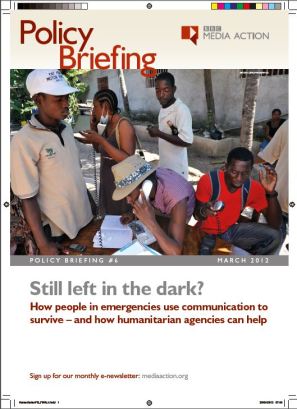
Still left in the dark? How people in emergencies use communication to survive — and how humanitarian agencies can help,’ is a new policy briefing by BBC Media Action. It does a fantastic job of highlighting the ways that new media is changing disaster response and the fact that the humanitarian industry is not doing enough to keep pace.

The briefing asks: ‘Are humanitarian agencies prepared to respond to, help and engage with those who are communicating with them and who demand better information?’ As the report shows, the answer is ‘not really’.

Many humanitarian agencies continue to see ‘communication’ as something done to raise money or boost the profile of their own efforts, says the report. Yet the sector increasingly needs a clear, strategic focus that responds to the information and communication needs of disaster-affected populations. ‘While responders tend to see communication as a process either of delivering information (‘messaging’) or extracting it, disaster survivors seem to see the ability to communicate and the process of communication itself as every bit as important as the information delivered.’ Communicating with affected populations can improve programming and response, not to mention, as highlighted in the Listening Project and referred to in the BBC report, ‘Listening is seen as an act of respect.’

The briefing is not one-sided, however, and it does a good job of understanding some of the common perceptions around the use of new technologies. There is ICT and social media hype on the one hand (often the position of international ICT specialists, based on very little hard evidence). And there is strong questioning of the value of these tools at all on the other hand (often the position of aid workers who are turned off by the hype and want to see proven practice if they are to consider investing time and resources in new ICTs). The briefing paper provides examples that may serve to convince those who are still unconvinced or uninterested.

Many of us see the reality that social media tools are still quite out of reach of the poorest members of a community or country. But writing new media and technologies off entirely is ‘too crude an analysis,’ says the briefing paper, ‘and one that is being challenged by data from the field.’ In Thailand, for example, use of social media increased by 20 percent in both metropolitan and rural areas when the 2010 floods began. ‘Communities now expect — and demand — interaction,’ the paper emphasizes.

Throughout the paper there are good examples of ways that in the immediate aftermath of a disaster local individuals and companies are quickly creating and rolling out communication platforms that are more relevant, feasible and sustainable than some of the initiatives that have been led by international agencies.

An important point that the report makes is that the most successful use of new media in disaster response combines multiple communication channels — new and old — allowing information to flow in and out, to and from different populations with different media habits and levels of access. For example, local journalists and radio stations may pull information from Twitter and Facebook and broadcast it via the radio. They may also be broadcasting online, meaning that they not only reach their local population, but they also reach the diaspora community. ‘Good communication work,’ the paper notes, ‘is, by definition, multi-platform. It is about integrating media, non mass media and technology tools in a manner that is rooted firmly in an understanding of how communities approach information issues.’

So ‘while aid agencies hesitate, local communities are using communications technology to reshape the way they prepare for and respond to emergencies.’ This hesitation remains in the face of growing evidence, according to the paper, that agencies who invest in meaningful communication with disaster-affected communities garner a range of benefits. ‘The communication process becomes central to effective relationships, mitigating conflict and identifying and preventing rumours and misunderstandings.’ Doing it right, however requires good program design, which in turn, requires aid agencies to focus time and expertise on improving communications with affected populations, which, of course, requires budget allocated to these kinds of activities.

For those agencies that want to look more closely at integrating some of these tools and approaches, the report gives several great examples. The recommendations section is also very useful.

One of the recommendations I think it is especially good to highlight is ‘analyse the communications landscape’ (see InfoAsAid’s materials). I would, however, have liked to see mention of involving members of local communities in a participatory analysis of that landscape. In addition to the technical analysis, it’s important to know who trusts which information sources, and why. For example, the information sources trusted by men may be different than those that women trust. The same goes for children, youth and adolescents. Access is also a critical issue here, especially in terms of reaching more marginalized groups, as the population affected by a disaster is not homogeneous and there will be hierarchies and nuances that should be considered in order to avoid leaving certain people or groups out. I would have liked more mention of the need to take a specialized approach and make a focused effort regarding communication with children and adolescents, with women, with certain ethnic groups or persons with disability, as they may be left out if care is not taken to include them.

Another recommendation I found very useful was ‘think of the whole population, not just beneficiaries.’ The paper cautions that working only with the population that directly benefits from an individual agencies’ funding is a positive angle for transparency and accountability, but it ‘seems to have a profoundly limiting effect in practice.’ Beneficiaries need information about more than just one aid agency, and those who are not benefiting from a particular agency’s programs also have information needs.

The report mentions that sometimes in the aftermath of a disaster, when people use new media to communicate, confidentiality and privacy risks are not fully considered. I’d like to see this aspect addressed a bit more in the future as there is a lack of documented good practice around privacy and protection. (Note: I’ll be involved in some research on ICTs, migration and child protection over the next year, so watch this space if it’s a topic of interest.) Humanitarian agencies may have strong policies here, but this is an area that others may not consider in their rush to offer support following a disaster.

Overall the report is extremely useful for those considering how to improve two-way (or multi-way) communication in a post-disaster situation and I very much enjoyed reading it as it sparked learning and fresh ideas, and documented some good work being done by local as well as international groups.

I don’t have a lot of pity or patience for aid agencies who are ‘left behind’ because they refuse to move with the changing times or because their approaches are not effective or relevant. There are several forces that are ‘disrupting’ humanitarian work these days, and  the report does a great job of identifying some of them. It also highlights the importance of local actors, local private sector and diaspora communities who have always played an important role in aid and development but have only recently been given more recognition.

International agencies still play a critical role in the humanitarian space, but they need to understand and adapt to the changes happening around them. This report can serve as a discussion piece and offer guidance for those agencies who want to use new media and technology to enable them to do a better job of listening to, working with and being accountable to disaster affected populations.

In summary, highly recommended reading!

Read Full Post »

This is a guest post by Roland Berehoudougou, disaster risk manager for Plan International’s West Africa Region. He explains the numerous factors that came together and conspired against the people of the Sahel, transforming the lean season into an emergency. 

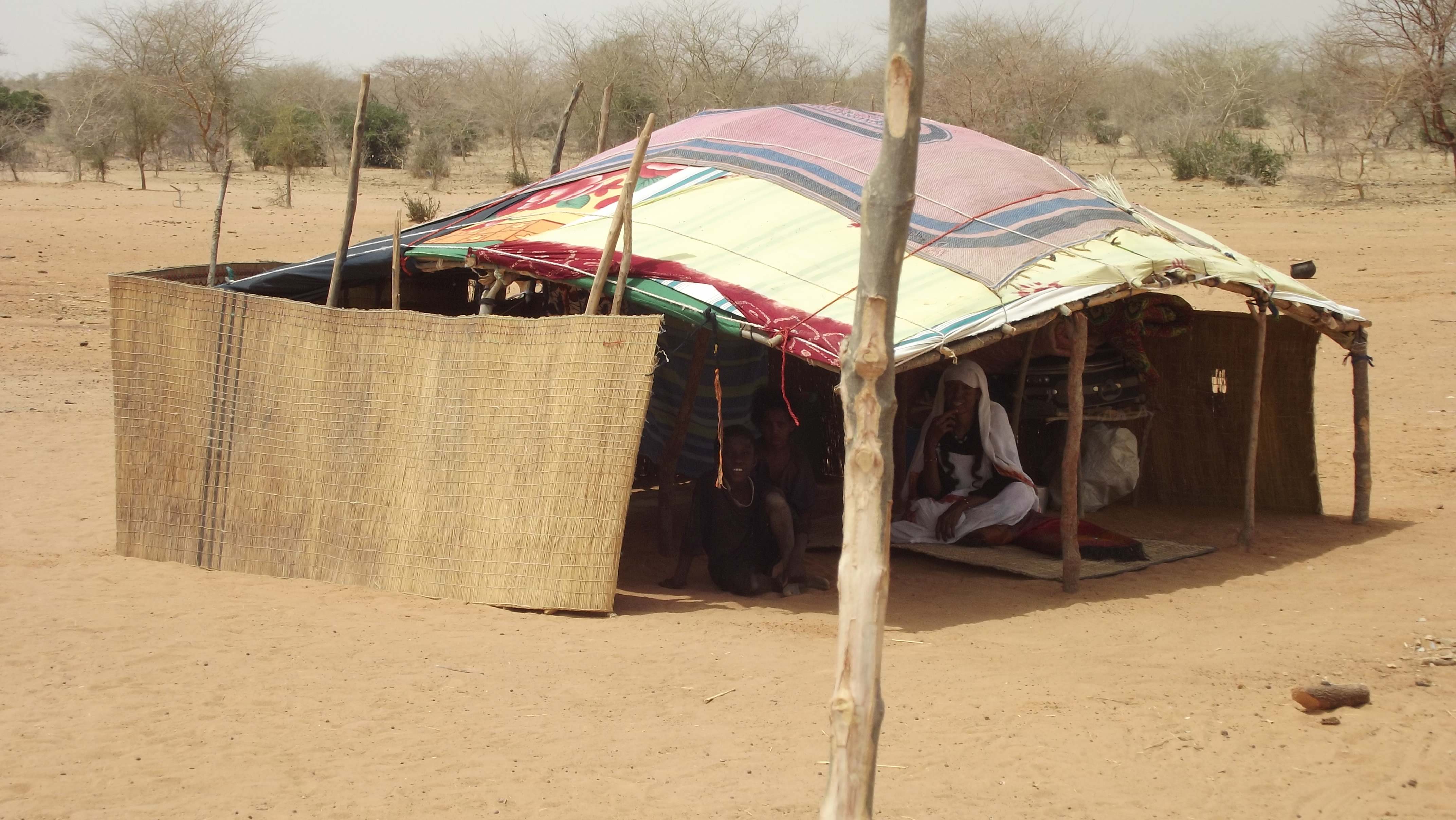
Photo: Roland Berehoudougou.

When Plan International and other aid agencies sounded the alarm bells and appealed for public assistance to finance an emergency response to the Sahel Food Crisis, there were those sceptics who saw this crisis as an annual chronic food shortage which was being exploited by aid agencies to raise money.

Those skeptics were wrong.

So what is an emergency? What is a food crisis? What is involved in declaring an emergency or pronouncing a situation to be a “food crisis”? A number of issues are taken into consideration including forecast about the availability, cost of food, environmental factors and other internal and external factors which are discussed below.

The Sahel Food Crisis is the result of a complex emergency in which these factors have come together to create this food and nutritional crisis. In fact, had these not occurred then there would be no food crisis, no emergency, and no fundraising appeals.

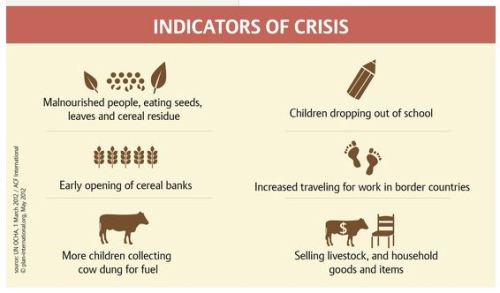
Captured from Plan International’s Pinterest. http://pinterest.com/pin/64809682107912974/

Drought causes conflict
In the last three to five years, the people in the Sahel have been confronted with either lower than average rain, normal rainfall or excessive rainfall causing floods. As a result harvest levels have been good in some places and poor in others.

In countries of poor harvests, farmers and their families have been coping using straightforward approaches of cutting back on their expenses. In the Sahel, families sold their livestock; others sold their furniture and other possessions. After three consecutive years, their assets have been depleted and men, women and children have been looking for work to supplement household incomes.

The conflicts in Cote d’Ivoire, the Maghreb, and Libya meant that more than 200,000 migrant workers from the Sahel had to flee those countries and return home. Given the average size of families in the Sahel, about 7-12 members per family, two million people suddenly became affected and had reduced incomes.

In addition, the Malian refugees which poured over the borders into neighbouring countries are an additional stress on food insecure areas. For every one refugee, there are five animals. So if you consider 375,000 animals coming over with 75,000 refugees, for example, those animals can dry up a water-scarce irrigation dam in just few days. Yet, cattle are a lifeline and in a food crisis, they cannot be forgotten.

In addition to depriving people of a considerable source of income, the drought in the Sahel is a source of conflict. Shepherds, for example, who are forced to take their animals southward in search of pasture, come into conflict with farmers.

Cultural differences
People in the Sahel eat a different staple to what is grown outside the region and this has implications during a food crisis. Let’s take a scenario where countries on the west coast, such as Liberia or Cote d’Ivoire, may have enough food to export. However, it is not the type of food that people in the Sahel eat and they therefore won’t import it. Instead they import from one another at prevailing market rates which has a knock-on effect on availability and cost.

Market forces – influenced by global factors – dictate price. There is a common market across West Africa where traders move and sell freely. When Nigeria is buying, WFP is buying, other NGOs are buying the price increases. If you look at food prices you will see that prices this year compared to the same period last year is more than 100% in Mali, more than 70% in Burkina 42% in Niger.

So, as an NGO, Plan International had to change its strategy and approach our donors for permission to do cash-for-work or food-for-work programmes rather than waiting to do food distribution programmes after the food stock is totally depleted.

A food crisis may, therefore, not necessarily mean a shortage of food but rather the inability of a people to afford to buy the food.

Arab Spring
In addition to the complications of prolonged inconsistent harvest levels, market forces, and inflow of refugees and their livestock, the situation has become complicated by the rise of desert locusts this year.

The breeding grounds of locusts are in the border areas of Libya and Algeria. When the Gadaffi government was in office, they provided a lot of money for insect control in locust breeding grounds but since the Arab Spring and events following it the finance for the pest control has dried up. The continuing insecurity on these borders also prevents pest control activities. We are now seeing a different impact of the Arab Spring spilling into the Sahel in the form of locust swarms.

The UN Food and Agricultural Organisation (FAO) which monitors locust movement say that swarms have been sighted in northern Niger. If these swarms come southward through the agricultural belt farmers will experience yet another problem. When these clouds of locusts descend on newly planted fields, they can devour acres of crops and trees in just 30 minutes. The locust swarms have also been sighted in northern Mali but because of the insecurity, no one can go there to control the pests.

NGOs do not do pest control as it is a very costly exercise involving planes and other equipment which we do not have. This role falls to specialised agencies such as FAO and governments. This is a looming disaster.

Road to hell
To cope with the food crisis, children have left school and have taken to the road to find work to help their parents. Some girls are working as domestic help in homes, other are begging on the streets, and boys are finding work in traditional gold mining in Burkina and Niger. A number of serious hazards face these children including respiratory problems from inhalation of dust and exposure to mercury, arsenic and other chemicals used in the process.

Many children who go to work on plantations, in cotton fields and other types of farming also face risks of exploitation and potential trafficking.

Finding solutions
At Plan we are trying to address the food insecurity, in the areas we work, in a holistic way.

We are providing drought-resistant seeds, supporting the government to train farmers in drought-season activities and supporting the 3N programme (“Niger Nourish Nigeriens”). One of its principal objectives is reducing dependence on climate through irrigation and rain water collection projects.

Plan, whose core work is Child Centred Community Development (CCCD), is also empowering communities to get involved in the cereal market and beat speculators at their own game by creating community-managed cereal banks. After a harvest the price of cereal drops and farmers are forced to sell their crops at low prices to meet the schooling cost for their children and other social costs. Speculators buy the cereal and store it until food shortages kick-in around mid-year and then release the cereal at high market prices.

Plan-supported communities are doing the same thing – except that they sell at a lower price to members of their village. The income generated is used to increase the storage capacity of the cereal bank and support social infrastructures in the village such as building facilities like medical centres and schools.

We are also implementing micro-finance project for women and youth using the VSLA strategy (www.vsla.net). We have discovered that if we provide economic empowerment for women then there is a trickle down effecting benefiting children who will receive balance meals, medical care and an education. We are seeing improvements in the quality of life for families in our programme areas.

Using this approach, many villages are now being lifted out of poverty and Plan is replicating this in other areas in which we are working.

No handouts
When Plan appealed to developing nations for assistance for the Sahel Food Crisis, it was not to address an annual chronic food shortage. It was to address a complex emergency that has stretched an already stressed situation to its breaking point which in turn has put four million children at risk of malnutrition.

No one is ever happy about being in a situation to ask for help to feed their families.

Plan is using aid money in such a way so as to prevent dependency on long-term aid. The United Nations agencies of OCHA and UNDP have demonstrated that for a dollar of foreign aid spent on preventing disasters saves an average of seven dollars in humanitarian disaster response.

At Plan we are seeking to empower and support the people living the Sahel to get out of the situation themselves. We are in it for the long haul. We are working hard to make ourselves and our work redundant and build resilience in the Sahel and hope. None of this is possible without the support of governments and people from the rest of the world.

Read Full Post »

Continue reading on Storify…

Amanda’s workshop was educational, thought-provoking, well-researched and participatory. The youth who participated in the workshop were from Bangladesh, Liberia, Haiti and across the US. They were incredibly savvy and insightful in their thoughts, analysis and comments. I learned a lot about ethical advocacy as well as about what makes a campaign or initiative interesting for well-informed, globally engaged young activists.

The rest of the workshop is captured here, including my favorite part:

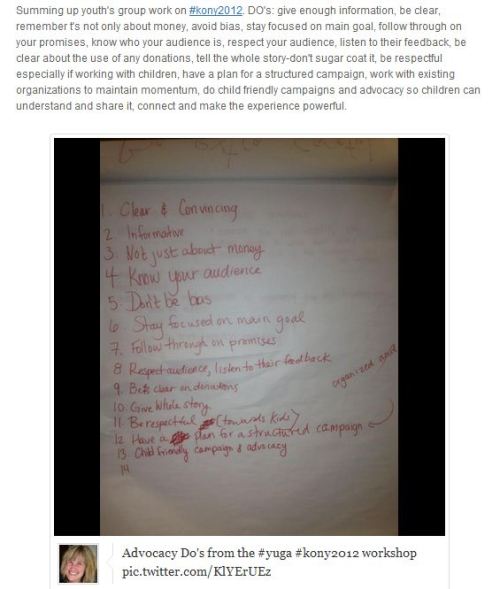
The advocacy Do’s and Don’ts that participants generated during group work:

And a key take-away:

Summary of the full workshop.

Amanda’s ebook “Beyond Kony2012: Atrocity, Awareness and Activism in the Internet Age.

Read Full Post »

In the INGO sector, we often discuss ways that development organizations can better bridge development and ICTs. If you ask me, this video shows one of the best ways to achieve it: Hire people like David.

Hire young, local folks who have spent time in communities, who understand local realities, who are passionate about helping make things better, and who are hungry to do new things that make sense. Hire people who are humble; people who listen and who ask questions when they don’t know the answer.

Hire people who are curious, who seek out information, who are self starters, and who are not afraid to work hard, to try, to take risks and to fail. Hire people with creative fire who know how to work in a team, how to collaborate with others and how to learn from those around them. Hire young people who use and understand new technologies and who spend enough time out of the office to know how they can realistically be applied to development issues in difficult settings.

Hire people like David.

But don’t only hire them.

Once you hire them, make sure that they have the conditions to thrive and achieve to their fullest.

Make sure people like David have access to opportunities. Make sure that they get to attend regional and global internal and external meetings to share what they know, to learn, and to make contacts and connections.

Notice people like David. Reward them, honor them, and congratulate them regularly, even if they are too busy getting the job done to spend lots of time on self-promotion or office politics.

Make sure people like David have mentors and managers who can take roadblocks out of their way. Listen to them. Respect them. Question them, yes, but do so with the honest belief that they have the capacity to come up with ideas that can work even if they are not the ideas you would have come up with. Don’t feel threatened by people like David when they know more than you do about something. We can all learn from each other if the space for dialogue is open and sincere.

People like David are the present and future of development efforts.

People like David are the reason I have a hard time giving career advice to folks in the US who are looking for jobs overseas. I’d rather see people like David in these positions.

David recently won the “Most Promising Newcomer” award for the Americas region during Plan International’s Global Awards. Follow David at @2drodriguez and learn more about what he’s up to at the website Mis Derechos Ante Desastres (My Rights in the Face of a Disaster), the project Facebook page, or at @deantede.

**Version Español

Read Full Post »

USAID has been busy lately with a redesign and roll-out of the new USAID.gov.

You can now access first-generation interactive maps at the country level for 40 missions (see screen capture below).

Screen capture from http://map.usaid.gov/ on July 5, 2012.

In addition, as part of the USAID evaluation policy that ‘sets ambitious standards for the quality and transparency of evaluation to demonstrate results, generate evidence to inform decisions, promote learning and ensure accountability’ the page that houses the Development Evaluation Clearinghouse (DEC) has been revamped. You can now search 50 years of international aid records, submit reports, and ‘get social’ by sharing, rating, tagging and blogging. Introduction videos are available to help you get started.

Not only is there better looking and more accessible information on-line, you can get two mobile applications (available for iPhone and iPad):

  • The DEC mobile app provides access to a subset of USAID Development Experience Clearinghouse (DEC) documents (recent evaluations).
  • The Portfolio Map mobile app allows you to browse the USAID portfolio for a subset of the countries in which USAID is working, access general country overviews at a glance and get more detailed information as needed.

In other news, alongside their own new website, on June 25th, 2012, USAID together with the Department of State announced publication of USAID’s foreign assistance obligation and expenditure data for Fiscal Year 2009-2011 on the Foreign Assistance Dashboard.

As explained during the DC Technology Salon on ‘How will IATI impact international development,’ the Dashboard is the US Government’s main tool for improving foreign aid transparency. It will play a key role in US Government reporting of foreign assistance data to the international community, one of the measures agreed on when the US Government signed onto the International Aid Transparency Initiative (IATI) in November 2011.

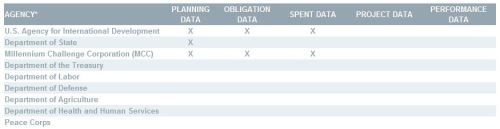
According to the June 25th press release, ‘the Dashboard also has budget planning data for the Department of State and USAID, as well as the Millennium Challenge Corporation (MCC)’s foreign assistance budget planning, obligation, and expenditure data.  Data on the site can be manually queried, filtered, and downloaded by users for further analysis.

The Dashboard is designed to allow a range of stakeholders, including U.S. citizens, civil society organizations, Congress, U.S. Government agencies, donors, and partner country governments; to examine, research, and track foreign assistance data in an accessible and easy-to-understand format. It aims to allow users to explore the impact of U.S. foreign assistance funding by country, sector, initiative, and agency by presenting data in a standard and user-friendly way.

According to USAID, ‘as the lead agency in implementing U.S. foreign assistance activities around the world, the launch of USAID obligation and expenditure data on the Foreign Assistance Dashboard represents a significant step forward in the U.S. Government’s efforts to make foreign assistance more transparent.’ (For additional discussion on this point, see the summary post from the aforementioned Technology Salon.)

The Dashboard is currently in an early stage of development. The site eventually plans for the incorporation of ‘budget, financial, program, and performance data in a standard form from all U.S. Government agencies receiving or implementing foreign assistance, humanitarian, and/or development funds.’ (See the table below for an idea of what is currently done and what is coming up.)

For more information about the Dashboard, see the Top Ten Things You Should Know page.

With all this information being made more accessible to everyone, it will be interesting to see if and how it’s used by different people and institutions for different purposes, especially in terms of improving coordination, program planning, transparency, accountability and aid effectiveness.

Read Full Post »

Image captured from page 19 of the Polis report.

Who cares? Challenges and opportunities in communicating distant suffering: a view from the development and humanitarian sector, a study conducted by Polis, (the journalism think-tank within the Department of Media and Communications at the London School of Economics- LSE) with Plan UKlaunched yesterday in London.
.
The study complements several pieces of research released over the past year or two on the UK public’s perception of foreign aid, development, giving, and the NGO sector; including Intermedia’s Building Support for International Development, the UK Public Opinion Monitor/Institute of Development Studies’ What Does the Public Think, Know and Do about Aid and Development? report, the Oxfam/Bond/DfID Finding Frames report and the Overseas Development Institute’s Understanding Public Attitudes to Aid and Development.

Whereas the other reports focus on various aspects of how the public sees charity, development and foreign aid, the Polis report gives a window into the debates and challenges of those working in advocacy, marketing, campaigning, fundraising and communication departments at INGOs. As my Plan UK colleague, Leigh Daynes, writes in the introduction:

‘…Our work to inform, to educate, to campaign for change and to recruit long-term supporters to fund change is valid. Often it is life-saving. Yet the least understood area of our work often is the impact of our communications on public understanding of and support for aid and development. The public are telling us they are saturated with suffering, that we are charming or disarming them into acts of compassion, and that we are abusing their emotions….

…Understanding the impact of the “lingua franca” of our industry matters because it has fuelled a template approach to the media reporting of suffering. It matters because the exponential growth in access to mobile and social media technology and platforms means we are no longer the de facto guardians we once were. And it matters because it speaks to the power between us and them, and you and me.’

As more and more research is done, the ways that the sector is shifting become clearer and I hope we will start to see some positive changes in the aid and development industry and the way it communicates with the general public.

Some angles and voices that could help round out the discussion are still missing, however. I would like to see research on the opinions of local and international staff managing programs on the ground. Most organizations have fierce internal discussions on how marketing and fundraising is done, as program staff often feel that some marketing and fundraising approaches are demeaning, disrespectful and undignified in their portrayal of program participants.  (For more on this, ask Talesfromthhood to share some of his blog posts with you, join some of the discussions on AidSource, or follow the #smartaid hash tag on Twitter). Some program staff worry that the long-term impact of media and fundraising shock tactics and overly simplistic messaging ‘cancels out’ the short-term gains achieved through program or emergency aid funding – a point that is raised in some of the research above – and that this contributes to two-dimensional views on aid and development and to the negative stereotypes about certain countries in Africa, Latin America and Asia that deter longer-term development and self-determination. It would be interesting to know more from this perspective.

What do donors want? Image captured from page 9 of the report.

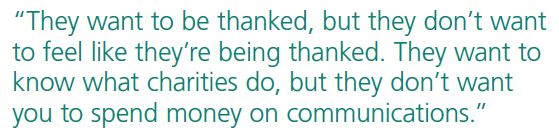
At the same time, INGOs are hard-pressed to come up with different and viable ways of funding their work, so this type of campaigning and fundraising continues. Although I’m familiar with some of the challenges my marketing colleagues face, I was struck seeing the kinds of donor demands that INGOs are expected to meet listed in the report. I was reminded of something a marketing colleague once said: ‘Poverty porn. That’s a good term. It is a lot like real porn. People don’t like to publicly admit to watching and responding to it, but in private it’s another story. People say they don’t like poverty porn and sad, desperate stories, but when you look at the numbers, it’s what makes them reach into their pockets and give.’

I would also like to see some research with the subjects (unfortunately often presented as ‘objects’) of INGO aid and marketing materials.  How do program participants feel about how they are portrayed? What impact does it have on them and their own perspectives and self-determination, if any? Strong voices on this come from diaspora communities and from blogs such as Africa is a Country, Uganda 2012: Trending Our Own Stories, and great projects like My Africa Is; but I’d also like to see some in-depth research and objective focus groups that talk with those who are most often shown in INGO marketing. Are people aware of how they are being represented? Do they care? Many of us speculate about this when we bash ‘poverty porn’ but I’ve yet to see published research that involves actual ‘beneficiaries’ of INGO programs or people and communities appearing in INGO marketing and fundraising pieces in this discussion. (Maybe I’ve missed it – if you know of  any, please share!)

The ‘Who Cares’ report notes in the conclusion that:

  • transparency, accountability, ‘value for money,’ and impact are becoming more important to the donor public
  • public trust is a central concern for NGOs in their work and their communications
  • the sector needs to assume more collective responsibility for ethically appropriate portrayal of disaster victims (eg, in compliance with Article 10 of the Red Cross Red Crescent Code of Conduct)
  • new technologies and competition mean that fundraisers are seeking supporters outside of their traditional constituencies
  • traditional gatekeepers of aid are being challenged by new media’s ability to put donors and ‘beneficiaries’ in more direct contact

As INGO institutional leadership space opens up to more people from ‘the global South’, diaspora communities grow, social media allows for commercials and fundraising appeals to reach global audiences (including people in the countries where INGOs implement their programs), attention is paid to the ‘new bottom billion‘ and new fundraising mechanisms arise (for example, INGOs raising funds within countries where they are implementing programs), it will be interesting to see how the conversations and approaches shift and change — or if they remain the same with new actors taking on the same challenges.

Stay tuned for further research and reporting over the next couple of years from Polis and download the report here.

Read Full Post »

This is a cross-post by Laura Pohl who works at the Bread for the World. The post is a summary of the latest Humanitarian Photography group meeting. The meetings are part of a series of meetings about photography in humanitarian work organized by CORE Group. (The original is posted here)

An employee at the Yemi Hanbok factory near Yanji, China, examines a traditional Korean skirt she is dyeing.The factory’s unique geographic position in China, near North Korea, means it can have work done cheaply in both countries and then sell to customers in South Korea. Photo © Laura Elizabeth Pohl

One of the most common questions I get asked at work is, “Can I use this picture?”

Oh, there are so many answers — and we talked about most of them at our latest Humanitarian Photography Group meeting this past Tuesday. Jim Stipe of Catholic Relief Services, Ann Hendrix-Jenkins of CORE Group and I organized the meeting. I led it, starting off with a talk on figuring out whether a photograph is yours or not. Sounds easy, right?

Well, if someone on your staff shot the picture then yes, the answer is easy: you can use it. But should you use it? (More on that later.) If your organization hired a freelancer to shoot pictures for you, then yes, you can use the pictures but possibly with restrictions. It depends on the type of contract between you and the photographer. The main point here is that the photographer usually still retains copyright to the picture and your organization is licensing the pictures. If this all sounds complicated and legalistic, don’t worry; we’ll be delving into copyright, contracts and licensing in a future meeting. Finally, if you don’t know who shot the photograph, where it came from or who owns the copyright, it’s best not to use the picture.

Next I talked a bit about Creative Commons licenses, which photographers use when they want to let the public publish their pictures without paying a licensing fee. CC-licensed photos abound on Flickr, a frequent source of pictures for nonprofit organizations. Just be sure the picture editor at your organization (or the person in this role) understands all six CC licenses and when a picture is fully copyrighted, all rights reserved. When I was a freelance photographer, an NGO once published my copyrighted photographs from Flickr without my permission. I found the copyright violation and sent the organization a stern letter and invoice for the pictures. The organization paid up. They never apologized, though. The organization had tasked their intern with finding pictures. It turns out he didn’t understand copyright.

Finally, I talked about content and technical criteria for publishing pictures, showing about 20 “bad” photos that Jim and I found. There are many reasons photographs shouldn’t see the light of day but I think the best way to summarize the photo usage criteria listed below is, “Do unto others as you would have them do unto you.” That out-of-focus photograph of 10 bored-looking people sitting in a meeting? You don’t have to use it. That portrait of a person with a strange expression on his face? Just don’t publish it. As Jim often says, “It’s better not to use a photograph than to use a bad photograph.”

  • Dignity – No emaciated children, flies in eyes, violence or stereotypical images.
  • Safety – Could the picture put the photo subjects in danger, even if they agreed to be photographed?
  • Context – No pretending photos of one thing are of something else. Sometimes photos published as a collection make sense together but one photo on its own from the collection doesn’t make sense.
  • Caption – Who’s in the picture? Where was it taken? Why is this picture important? Even if you can’t publish this information because of safety concerns, it’s important to have the information for your internal records.
  • Credit – Who took the picture? It’s just like attributing a quote.
  • Third effect – Two pictures paired together can take on a new meaning.
  • Focus – Is the picture sharp or blurry?
  • Framing – Is the photo framed well?
  • Exposure – Is the picture properly exposed?
  • Color – Does it look natural?

People had great comments and questions at the end. (By the way, Jim did a nice job tweeting the meeting at #NGOphoto.) A woman named Aubrey said her organization works on a lot of construction projects, roads, latrines, etc. They often shoot before and after photographs to show the impact of their projects. Another person asked about setting up or staging shots. Some people wanted to know more about contracts and how to work with country programs to set up photo shoots. These are all meaty topics. I can’t wait to get into them more in future meetings. We’re taking a break for the summer but we’ll meet again in September, so get in touch if you’d like to join us.

You can find summaries of other meetings here:

April: On the ethics of photos in aid and development work

May: Aid, ethics, photography and informed consent

Read Full Post »

« Newer Posts - Older Posts »