Feeds:
Posts
Comments

Archive for the ‘youth media’ Category

Continue reading on Storify…

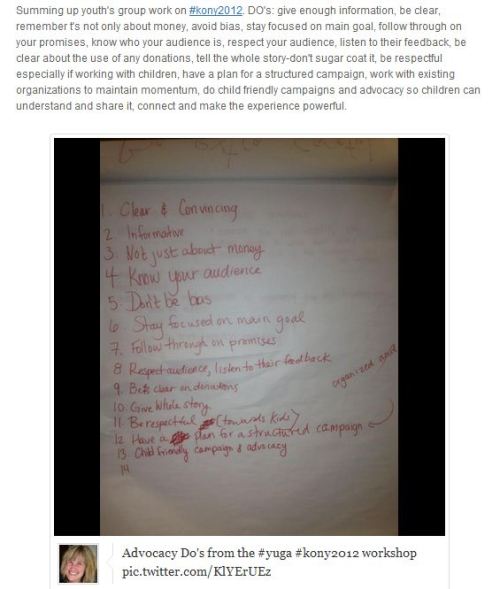
Amanda’s workshop was educational, thought-provoking, well-researched and participatory. The youth who participated in the workshop were from Bangladesh, Liberia, Haiti and across the US. They were incredibly savvy and insightful in their thoughts, analysis and comments. I learned a lot about ethical advocacy as well as about what makes a campaign or initiative interesting for well-informed, globally engaged young activists.

The rest of the workshop is captured here, including my favorite part:

The advocacy Do’s and Don’ts that participants generated during group work:

And a key take-away:

Summary of the full workshop.

Amanda’s ebook “Beyond Kony2012: Atrocity, Awareness and Activism in the Internet Age.

Read Full Post »

In the INGO sector, we often discuss ways that development organizations can better bridge development and ICTs. If you ask me, this video shows one of the best ways to achieve it: Hire people like David.

Hire young, local folks who have spent time in communities, who understand local realities, who are passionate about helping make things better, and who are hungry to do new things that make sense. Hire people who are humble; people who listen and who ask questions when they don’t know the answer.

Hire people who are curious, who seek out information, who are self starters, and who are not afraid to work hard, to try, to take risks and to fail. Hire people with creative fire who know how to work in a team, how to collaborate with others and how to learn from those around them. Hire young people who use and understand new technologies and who spend enough time out of the office to know how they can realistically be applied to development issues in difficult settings.

Hire people like David.

But don’t only hire them.

Once you hire them, make sure that they have the conditions to thrive and achieve to their fullest.

Make sure people like David have access to opportunities. Make sure that they get to attend regional and global internal and external meetings to share what they know, to learn, and to make contacts and connections.

Notice people like David. Reward them, honor them, and congratulate them regularly, even if they are too busy getting the job done to spend lots of time on self-promotion or office politics.

Make sure people like David have mentors and managers who can take roadblocks out of their way. Listen to them. Respect them. Question them, yes, but do so with the honest belief that they have the capacity to come up with ideas that can work even if they are not the ideas you would have come up with. Don’t feel threatened by people like David when they know more than you do about something. We can all learn from each other if the space for dialogue is open and sincere.

People like David are the present and future of development efforts.

People like David are the reason I have a hard time giving career advice to folks in the US who are looking for jobs overseas. I’d rather see people like David in these positions.

David recently won the “Most Promising Newcomer” award for the Americas region during Plan International’s Global Awards. Follow David at @2drodriguez and learn more about what he’s up to at the website Mis Derechos Ante Desastres (My Rights in the Face of a Disaster), the project Facebook page, or at @deantede.

**Version Español

Read Full Post »

I was chatting with my pal Ernst Suur from War Child Holland and he alerted me to this instructional video they’ve made about using participatory video for monitoring and evaluation in Northern Uganda.

“A PhD student working on video diaries with children commented: ‘What fascinates me is that there is a whole lot of data that they can give me, that they can share, but I cannot always see what it is, or know how to ask for it, or know it exists, and that is what the video diary does.'”

“Video diaries can enhance our transparency, as youth can communicate directly with a wide variety of people; providing field workers, project officers, headquarter staff and even donors with tangible insights into progress made at the individual level.”

Take a look. It’s worth it.

Hint: Flip video cameras are fantastic for filming, but the Flip video format is incompatible with a lot of (most?) video editing software. According to Ernst, if you’re using Flip video cameras and need to edit, Windows Movie Maker Live is the way to go.

Read Full Post »

This is a guest post from Jamie Lundine, who has been collaborating with Plan Kenya to support digital mapping and governance programming in Kwale and Mathare. The original was published on Jamie’s blog, titled Information with an Impact. See part 1 of this series here: Digital Mapping and Governance: the Stories behind the Maps.

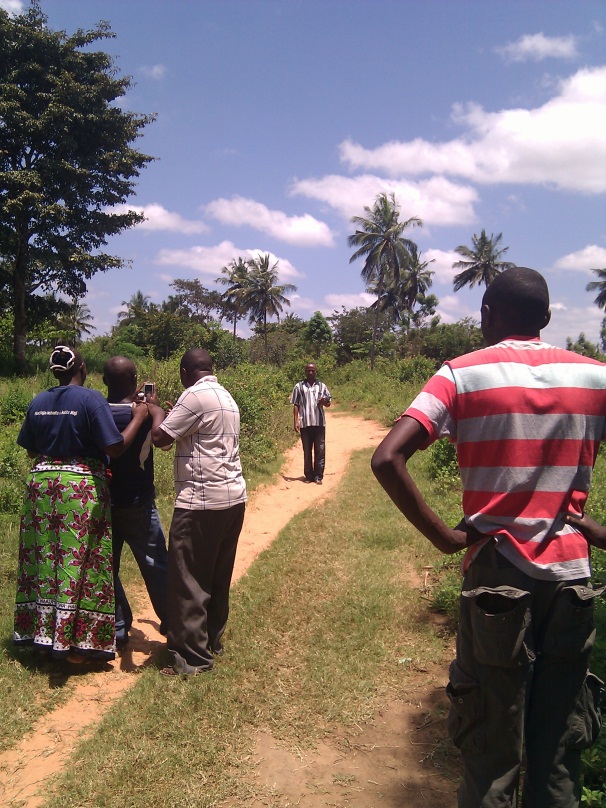
Mapping a school near Ukunda, Kwale County

Creating information is easy. Through mobile phones, GPS devices, computers (and countless other gadgets) we are all leaving our digital footprints on the world (and the World Wide Web). Through the open data movement, we can begin to access more and more information on the health and wellbeing of the societies in which we live. We can create a myriad of information and display it using open source software such as Ushahidi, OpenStreetMap, WordPress, and countless other online platforms. But what is the value of this digital information? And what impact can it have on the world?

Youth Empowerment Through Arts and Media (YETAM) is project of Plan International which aims to create information that encourages positive transformation in communities. The project recognizes young people as important change agents who, despite their energy and ability to learn, are often marginalized and denied opportunities.  Within the YETAM project, Plan Kenya works with young people in Kwale County (on the Coast of Kenya) to inspire constructive action through arts and media – two important channels for engaging and motivating young people.

Information in Kwale County

Kwale County is considered by Plan International to be a “hardship” area. Despite the presence of 5-star resorts, a private airport and high-end tourist destinations on Diani beach, the local communities in Kwale County lack access to basic services such as schools, health facilities and economic opportunities. Young people in the area are taking initiative and investigating the uneven distribution of resources and the inequities apparent within the public and private systems in Kwale County.

As one component of their work in Kwale, Plan Kenya is working with the three youth-led organizations to create space for young people to participate in their communities in a meaningful, productive way. There are different types of participation in local governance – often times government or other agencies invites youth to participate (“invited space”) as “youth representatives” but they are simply acting to fill a required place and are not considered  within the wider governance and community structures.

Youth representation can also be misleading as the Kwale Youth and Governance Coalition (KYGC) reports that “youth representatives” aren’t necessarily youth themselves – government legislation simply stipulates that there must be someone representing the youth – but there is no regulation that states that this person must be a youth themselves (they must only act on behalf of the youth). This leaves the system open to abuse (the same holds true for “women’s representative” – you can find a man acting on behalf of women in the position of women’s representative).  Plan Kenya and the young people we met are instead working to “create space” (as opposed to “a place”) for young people in community activism in Kwale County.

The 5 weeks we spent in Kwale were,the beginning of a process to support this on-going work in the broad area of “accountability” – this encompasses child rights, social accountability and eco-tourism. The process that began during the 5 weeks was the integration of digital mapping and social media to amplify voices of young people working on pressing concerns in the region.

To create the relevant stakeholders and solicit valuable feedback during the process of the YETAM work on digital mapping and new media, our last 3 days in Kwale were spent reviewing the work with the teams. On Thursday November 10th, we invited advisors from Plan Kwale, Plan Kenya Country Office, the Ministry of Youth Affairs and officers from the Constituency Development Fund to participate in a half-day of presentations and feedback on the work the young people had undertaken.

By far the work that generated the most debate in the room was the governance tracking by the KYGC. The team presented the Nuru ya Kwale blog which showcased 28 of the 100 + projects the youth had mapped during the field work. They classified the 28 projects according to various indicators – and for example documented that 23 of the projects had been completed, 1 was “in bad progress”, 2 were “in good progress” and 1 “stalled.”

The CDF officers (the Chairman, Secretary and Treasurer of the Matuga CDF committee in Kwale County) were concerned with the findings and questioned the methodology and outcome of the work.  They scrutinized some of the reports on the Nuru ya Kwale site and questioned for example, why Mkongani Secondary School was reported as a “bad” quality project. The officials wanted to know the methodology and indicators the team had used to reach their conclusions because according to the representatives of the CDF committee, the auditors gave the Mkongani Secondary School project a clean bill of health.

One important message for the youth based on feedback on their work was the need to clearly communicate the methodology used to undertake the documentation of projects (i.e. what are the indicators of a project in “bad” progress? how many people did you interview? Whose views did they represent?).

There is significant value in presenting balanced feedback that challenges the internal government (or NGO) audits – for example the data on Kenya Open Data documents that 100% of CDF money has been spent on the Jorori Water Project mentioned above, but a field visit, documented through photos and interviews with community members reveals that the project is stalled and left in disrepair. This is an important finding – the youth have now presented this to the relevant CDF committee. The committee members were responsive to the feedback and, despite turning the youth away from their offices the previous month, invited them to the CDF to get the relevant files to supplement some of the unknown or missing information (i.e. information that people on the ground at the project did not have access to, such as for example, who was the contractor on a specific project, and what was the project period).

Kwale youth with staff from Plan Kenya, officers from the CDFC and the local Youth Officer

Samuel Musyoki, Strategic Director of Plan Kenya who joined the presentations and reflections on November 10th and 11th, reported that:

“The good thing about this engagement is that it opened doors for the youth to get additional data which they needed to fill gaps in their entries. Interestingly, they had experienced challenges getting such data from the CDF. I sought to know form the CDFC and the County Youth Officer if they saw value in the data the youth were collecting and how they could use it.

The County Youth Officer was the most excited and has invited the youth to submit a business proposal to map Youth Groups in the entire county. The mapping would include capturing groups that have received the Youth Enterprise Fund; their location; how much they have received; enterprises they are engaged in; how much they have repaid; groups that have not paid back; etc. He said it will be an important tool to ensure accountability through naming and shaming defaulters.

The 5 weeks were of great value — talking to quite a number of the youth I could tell — they really appreciate the skill sets they have received-GIS mapping; blogging; video making and using the data to engage in evidence based advocacy. As I leave this morning they are developing action plans to move the work forward. I sought assurance from them that this will not end after the workshop. They had very clear vision and drive where they want to go and how they will work towards ensuring sustained engagement beyond the workshop.”

The impact of digital mapping and new media on social accountability is still an open question. Whether the social accountability work would have provoked similar feedback from duty bearers if presented in an offline platform (for example in a power point presentation) instead of as a dynamic-online platform is unknown.

The Matuga CDF officers were rather alarmed that the data were already online and exposed their work in an unfavourable light (in fairness, there were some well-executed projects as well). There is a definite need to question the use of new technology in governance work, and develop innovative methods for teasing out impact of open, online information channels in decision-making processes and how this is or isn’t amplifying existing accountability work.  There is definite potential in the work the young people are undertaking and the government officers consulted, from the Ministry of Youth Affairs and local CDF Committee (CDFC) stated that they were “impressed by the work of the youth”.

Within the community development systems and particularly the structure of devolved funding, there is a gap in terms of monitoring and evaluation (M&E) that the CDF committee to date has not been able to play effectively. As Samuel Musyoki stated the youth “could watch to ensure that public resources are well utilized to benefit the communities.” The Youth Officer even invited the youth to submit proposals for assistance in buying GPS gadgets and computers to strengthen this work.

Continuing the on and offline integration

As discussed, the work in Kwale on various issues is dynamic and evolving. The 5 weeks we spent with the teams were meant to provide initial trainings and support and to catalyse action that would be continued by the youth in the area, with support from Plan Kenya. Not only did we provide training to the young people, but Plan Kwale staff were also involved in the process and started documenting their work through the tools and techniques introduced by our team. With these skills, the Plan Kwale staff will support the on-going field mapping and new media work. We are also available to provide remote assistance with questions about strategies and technical challenges.

Some of the future activities include:

  • Holding a “leaders forum” during which the youth interact with a wider cross-section of stakeholders and share their work.
  • Continuing work on their various websites – updating the sites with results from social auditing work to be carried out throughout the last weeks of November, as well as digitizing previous information collected during historical social auditing.
  • Validating the data by revisiting some project sites and documenting projects that haven’t been done yet, gathering stories from some of the Project Management Committees, taking more photos, and potentially conducting surveys within the communities to get more representative views on project evaluations.
  • Each group also needs to develop a more structured advocacy strategy to direct their activities in these areas.
  • All teams expressed interest in developing proposals to submit to the Ministry of Youth Affairs, through the Youth Enterprise Fund and CDF Committee, based on the suggestion of potential funding for this process. Plan Kwale staff, as well as some of the Country Office advisers offered to support the youth in developing these proposals.
  • Most importantly, the teams want to consult the wider community in their respective areas to demonstrate the relevance of YETAM, including the skills they have gained, to the community stakeholders (beyond the relevant government authorities

The potential of new technologies, including digital mapping to promote accountability, is only as powerful as the offline systems into which it is integrated. Without offline engagement, existing community systems of trust and recognition will be threatened and thus undermine any online work. The youth must remain grounded within their existing work and use new technology to amplify their voices, build their network, share their stories and lessons and learn from and engage with others.

Read Full Post »

This is a guest post from Jamie Lundine, who has been collaborating with Plan Kenya to support digital mapping and governance programming in Kwale and Mathare.

Throughout October and November 2011, Plan Kwale worked through Map Kibera Trust with Jamie Lundine and Primoz Kovacic, and 4 young people from Kibera and Mathare, to conduct digital mapping exercises to support ongoing youth-led development processes in Kwale county. One of the important lessons learned through the Trust’s work in Kibera and Mathare is that the stories behind the mapping work are important for understanding the processes that contribute to a situation as represented on a map. To tell these stories and to complement the data collection and mapping work done by the youth in Kwale, the Map Kibera Trust team worked with the Kwale youth to set up platforms to share this information nationally and internationally. Sharing the important work being done in Kwale will hopefully bring greater visibility to the issues which may in the longer term lead to greater impact.

Sharing stories of local governance

To support their work on social accountability, the Kwale Youth and Governance Consortium (KYGC) mapped over 100 publicly and privately funded community-based projects. The projects were supported by the Constituency Development Fund (CDF), Local Area Development Fund (LATF), NGOs and private donors. As one channel of sharing this information, the Consortium set up a blog called Nuru ya Kwale (Light of Kwale). According to KYGC the blog “features and addresses issues concerning promotion of demystified participatory community involvement in the governance processes towards sustainable development. We therefore expect interactivity on issues accruing around social accountability.” This involves sharing evidence about various projects and stories from the community.

One example is the documentation of the Jorori Water project in Kwale; through the mapping work, the Governance team collected details of the constituency development fund (CDF) project. The funding allocated to upgrade the water supply for the community was 6,182,960 ksh (approximately 73,000.00 USD). From their research the KYGC identified that the Kenya Open Data site reported that the full funding amount has been spent.

A field visit to the site however revealed that project was incomplete and the community is still without a stable water supply, despite the fact that the funding has been “spent.”

Jorori Water Project, built using approximately 6.2 million shillings (73, 000.00 USD)

Read more about the questions the team raised in terms of the governance of CDF projects, including the detailed the project implementation process and some reflections on why the project stalled. This is information on community experiences (tacit information) that is well-known in a localized context but has not been documented and shared widely. New media tools, a blog in this case, provide free (if you have access to a computer and the internet) platforms for sharing this information with national and international audiences.

Addressing violence against children and child protection

Another blog was set up by the Kwale Young Journalists. The Young Journalists, registered in 2009, have been working with Plan Kwale on various projects, including Violence against Children campaigns. The group has been working to set up a community radio station in Kwale to report on children’s issues. Thus far, their application for a community radio frequency has encountered several challenges. New media provides an interim solution and will allow the team to share their stories and network with partners on a national and internal stage.

The Kwale Young Journalists worked with Jeff Mohammed, a young award-winning filmmaker from Mathare Valley. The YETAM project not only equips young people with skills, but through peer-learning establishes connections between young people working on community issues throughout Kenya. The programme also provides young people with life skills through experiential learning – Jeff reflects on his experience in Kwale and says:

Jeff and the Kwale Young Journalists shooting a scene from “The Enemy Within”

“My knowledge didn’t come from books and lecturers it came from interest, determination and persistence to know about filmmaking and this is what I was seeing in these Kwale youths. They numbered 12 and they were me. They are all in their twenties and all looking very energetic, they had the same spirit as mine and it was like looking at a mirror. I had to do the best I could to make sure that they grasp whatever I taught.”

Jeff worked with the Young Journalists on a short film called “the Enemy Within.” The film, shot with flip-cameras, tells the story of 12-year-old girl who is sold into indentured labour by her parents to earn money for her family. During the time she spends working, the young girl “falls prey of her employer (Mr.Mtie) who impregnates her when she is only 12 years old.” Jeff reflects that “early pregnancies are a norm in the rural Kwale area and what the young filmmakers wanted to do is to raise awareness to the people that its morally unacceptable to impregnate a very young girl, in Enemy Within the case didn’t go as far because the village chairman was bribed into silence and didn’t report the matter to higher authorities.” This is a common scenario in Kwale, and the young journalists plan to use the film in public screenings and debates as part of their advocacy work in the coming months.

Jeff and the Kwale Young Journalists shot the film in four days – they travelled to Penzamwenye, Kikoneni and also to Shimba Hills national park to shoot 7 scenes for the movie. Read more about Jeff’s reflections on working with the Kwale Young Journalists on his blog.

Sharing ecotourism resources

The Dzilaz ecotourism team – a group that encourages eco-cultural tourism in Samburu region of Kwale county — also integrated social media into their work. During the last week (November 8th-12th) the group set up a blog to market the community resources, services and products. They also plan to document eco-culture sites and the impact that eco-tourism can have on the community. As of November 10th, 2011 the Dzilaz team had already directed potential clients to their website and thus secured a booking through the information they had posted.

The importance of telling the stories behind the maps

One important component to mapping work is to tell the stories behind the map. The three groups in Kwale are working to build platforms to amplify their grassroots level work in order to share stories and lessons learned. The information documented on the various platforms will develop over time and contribute to a greater understanding of the processes at a local level where youth as young leaders can intervene to begin to change the dynamics of community development.

Read Full Post »

One of the great panels at last week’s Making Cents International’s Global Youth Economic Opportunities Conference was on technology and youth economic opportunities. (See my previous posts on seeing youth as assets and barriers girls face to economic opportunities, and my next post on soft skills and enabling environments).

In addition to the specific panel, I paid special attention throughout the conference for any mention of technology, and I asked some questions in panels that were not related to technology to see if people thought technology was an enabler for adolescent  girls or if my perception is biased because it’s my area of focus.

What I heard is that in regard to girls and technology, there are large gaps as well as areas where technology can serve as a bridge for girls to achieve economic opportunities. As Wayan Vota from Inveneo noted, globally, women are 20% less likely to have a mobile phone than men and in Asia, that number rises to 37%. How can we address the ‘girl gap’ especially in terms of the poor and disadvantaged 10% of adolescent girls who are the most marginalized of all? How can we help bring economic opportunities to this group?

Girl-focused programs. In terms of helping girls feel more comfortable accessing and learning about technology, Peter Broffman from Intel brought up the importance of safe spaces. Intel’s Learn program creates spaces that are ‘girls only, where they are not competing with boys,’ he said. ‘It takes a concerted effort to construct comfortable environments where girls can explore technology.’ We have special days for girls and girls only projects. Girls tend to be more comfortable creating and using technology in that kind of environment,’ he said. Vota agreed, saying that one simple way of making spaces more amenable to girls is by having all the computer screens in a computer lab or cafe facing the public, so that it’s easy to monitor what is being done on them (eg., so that accessing ‘adult’ content is impossible to hide). Katherine Lucey from Solar Sister, in a separate panel, also referred to the need for programs that are specifically designed for girls and women. She described a microfinance program operating in one of the same communities as Solar Sister where 90% of the participants are male. ‘Solar Sister is a program aimed at women because the existing programs are biased towards men.’

Girls and women in rural areas. David Mukaru from Kenya’s Equity Bank said that the bank reaches more women and girls simply because  the majority of rural population in Kenya is made up of women. Many men have migrated to urban areas. ‘Through the financial education which the bank embarked on 3 years ago, we addressed technology fears. We were able to train the women, create awareness on bank services, train them how to use technology, how to interact with bank officials. We also introduced technology to the rural agency. The agency uses a mobile. The agency in the rural area is the normal shop keeper and he has become an agent of training and penetrating in the rural areas. This guy is in the rural shop and he trains the woman how to use these technologies to do banking.’

Mobility.  Mobile tech can really be the great leveler, according to Jacob Korenblum from Souktel. It can really help to close gender gap.  ‘Many of the young women who use our services come from traditional families that would not allow them to go door to door to find employment. They are not allowed to go around town to find job opportunities. So their ability to find jobs is limited. But since many young women have mobile phones, within the household, as a young woman via Souktel you can start looking for work and even secure a job interview from home. Your family is comfortable with how you are doing this but you are still asserting yourself, you are taking that step to get a job.’

Another program that Souktel offers is support for women entrepreneurs via mobile phone groups. ‘Through a closed mobile phone peer network, women can ask questions to each other. In Iraq for example, women cannot travel, but they want to consult with other women on a business they are starting – they can send a question out to peers who can respond with advice. It’s like a list-serve via mobile phone. For female business owners, being able to consult peers via mobile is tremendous. It’s safe for them, it’s empowering. Our studies have shown this. We’ve been able to help women play catch up and access the same resources that men have, just through a different channel.’

Access is not enough. Raquel Barros from Lua Nova, a program that trains marginalized girls in Brasil to do construction work, said that in Brazil mobile phones are very expensive and they are a high status asset for the girls she works with. But ‘access is not sufficient for the phone to be used for something good or useful,’ she said. ‘It’s important to access the mobile phone but also important to do more education about how you can use the mobile phone. All our girls have Orkut but they don’t know their email. They have computers that they can use and we started to take some photos and that kind of thing, but the girls don’t always access and use mobiles and Internet in a good way. Access and education are both important.’ [Plan did some interesting research on girls use of technology in Brazil that confirms this also – see the Annex to Chapter 4.]

Technology as an economic enabler. Technology is everywhere according to Manjula Pradeep from Navsarjan, a trust that works with low-caste girls in India, “In Gujarat we have maximum mobile owners. The mobile is a status symbol, yes. In a family you can have 3-4 people owning a phone. And it does mean a lot when young women have mobiles, you can do your marketing, you have access to people, people can reach you on your mobile, you can put it on your shop board so people can reach you on mobile.’ In addition, computer training can allow girls to replicate and train others on computer skills. ‘A lot of girls have done computers; they are running classes for the children because children are not taught computers in schools. So the girls can teach this.’ However, as David Mukaru from Equity Bank in Kenya had noted earlier during the technology panel, ‘the challenge is access to a power supply.’ Not to mention other infrastructure. ‘When we work with the tribal populations, they have no access to transport, so how can you ever get a computer repaired?’ Some young people who Pradeep works with have started their own studios. ‘They start by buying a camera — it’s not cheap but they save and buy it. We have a lot of wedding ceremonies and rituals that happen that people can do a lot of video projects.’

Wearing pants. But as Pradeep said, technology can also bring about other personal changes. ‘Ultimately, your entire outlook changes with tech. Women with computers or cameras tend to wear trousers and shirts. I’ve seen women — if you get married you only have to wear saris, you can’t get out of a sari, you struggle with that identity — but these women are wearing trousers and using a camera. Sometimes they even cut their hair! Even just using a camera or cell phone,  you will see women changing. Technology really changes their role. To bring change, mobilizing the community is important but technology itself can also change the role of women.”

Interesting indeed!

Read Full Post »

This is a guest post by Bertil van Vugt, who works as the content director at Africa Interactive.  Bertil and I met for the first time about a year ago at a tweet up in Amsterdam, though I had known about Africa Interactive’s fantastic work with African media professionals for much longer. I was thrilled to hear from Bertil last week that they’ve been working with Plan in West Africa, and have made 4 videos about the Girls Making Media project that I had written about earlier this month. 

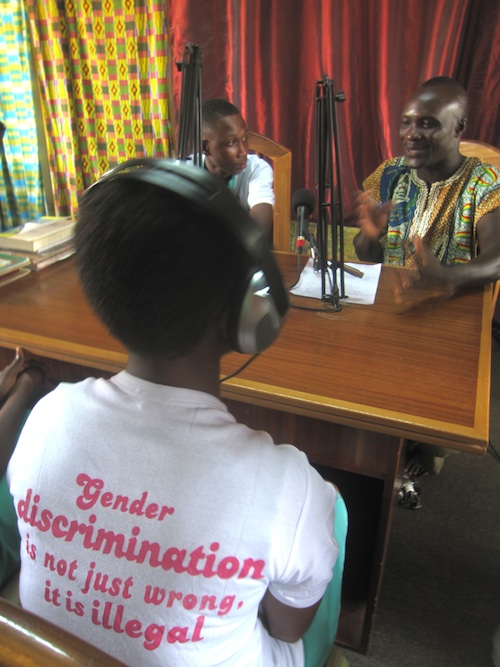
Girls Making Media in Ghana

Men dominate the African media sector. Looking at our own database of over 2000 media-professionals in 50 African countries we see predominantly males. Fortunately we are also working with many talented women throughout the continent. When we were asked to produce videos and case studies about Plan’s Girls Making Media Project we got really exited about the initiative that is preparing young girls for a career in the media sector.

I work for Africa Interactive, a social venture delivering media and communication services with offices in Amsterdam, Nairobi and Accra. As I mentioned earlier we are working with local reporters, camera-crews and photographers throughout Africa to document activities of NGOs, multinationals and governments. While these organizations previously worked with Western crews who travelled to Africa, we work with African media-professionals and guarantee the quality of the productions.

Local film-crews

There are many advantages of working with local crews. They know their way around; they speak the languages and understand the culture since it is theirs. These people can be fixer, translator and journalist at the same time. And not unimportant: the costs are lower compared to flying people in. For this Plan assignment we worked with experienced crews (male AND female) in Lomé (Togo), Bomi (Liberia), Makeni (Sierra Leone) and Sogakope (Ghana). Our, by the way female, employees in Accra and Nairobi did the video editing and we finalized the videos in our Amsterdam office.

GMM

The Girls Making Media project’s goal is to contribute to the elimination of gender discrimination and benefits at least 140 adolescent girls and 30 adult journalists in the most marginalized areas in each country. With this project, girls and adult journalists are trained on various topics aiming at increasing their capacity to produce quality information concerning girls’ rights. It is also empowering girls to advocate on issues concerning their well-being.

In the four videos we focus on the three-year program (which started one year ago) and show the development, achievements and challenges so far. We hear about the effect the project has on the girls and their communities. Also, the girls explain how they see themselves after learning media skills and talking about gender related issues on the radio and TV.

Liberia

Ghana

Sierra Leone

Togo

Girls interact with journalists

Together with the Plan West Africa office in Ouagadougou we developed the idea that the video-shoot should also be an opportunity for the girls to interact with our crews and learn from them. During the filming days there was room for questions and sharing of experiences. We received positive feedback from the crews and the Plan offices about the cooperation with the girls. I would like to use this space to thank the camera-crews who did a great job to create the videos:  Comfort + Yudawhere (Liberia), Wotay + Idriss (Sierra Leone), Paul + Gary (Ghana) and Rodrique + Anselme (Togo).

Let me conclude by saying that I hope to welcome the girls to our network after they have finalized the GMM project!

If you are looking for any content on your activities in Africa, just contact me via e-mail: bertil [at] africanews.com or Twitter: @brutuz.

Read Full Post »

Youth learning to use GPS in Pitoa, Cameroon (photo: Ernest Kunbega)

Last Monday I attended Africa Gathering London. The topic was ‘Social Media Revolutionizing Africa: How is new media changing Africa, giving voices to the voiceless, improving governance and transparency, and changing narratives?’

The event stimulated thinking and brought up some hot discussions around technology, traditional and social media, aid and development, participation and governance. (Big congratulations to Marieme Jamme  for curating a great line up that brought in an interesting and engaged group of participants and to William Perrin of Indigo Trust for keeping things on track and generating good debate!) See the program, the speaker bios and some short video interviews.

Some quotes, thoughts and debates from the day:

  • If your purpose is to bring more people into discussions, remember that radio, Facebook, and Twitter audiences are distinct and be sure you are thinking differently about how to engage them all. Remember that many people in Africa prefer to talk not write.  (from BBC’s Africa Have Your Say – @bbcafricahys‘s presentation)
  • You can’t resolve all of Africa’s issues with one approach. The countries are very different and local context really matters. But you also can’t design something for every tiny demographic. Where is the sweet spot between localized and scale? (discussion after the morning workshop)
  • People should not sit in the UK deciding and develop things for Africans. Develop things with Africans, or support Africans to develop things themselves. This idea got retweeted a lot, with lots of agreement. But H Taylor – @HFTaylor88 also commented via Twitter that this rhetoric has been around for ages within NGOs…. (discussion after morning workshop)
  • It’s great that the market has been able to bring mobile phones to so many people in Africa, but the market can’t do it on its own as many are still left out. There needs to be more incentive to reach remote areas. There needs to be education, cash transfers, government regulation if we want to really realize the potential of mobiles. Mika Valitalo – @vatamik commented that in many African countries, mobiles are still taxed as luxury items, making them more expensive than they should be. (Clare Melamed -ODI – @claremelamed‘s “Is the Mobile Phone Revolution Really for Everyone”.)
  • Any big story today on CNN has a social media component, yet there is still the idea that social media only breaks news and ‘it won’t make the history books until CNN or BBC report on it’. If CNN is not planning to do a story but sees everyone is talking about it on Facebook and Twitter, they will cover may rethink covering it. CNN finds good opinions and stories on social media, but their primary news source will continue to be their correspondents. Emrys Schoemaker – @emrys_s however questioned whether mass media use of citizen journalism is a broadening of voices or if it’s cheap content for big media – or both. (Faith Karimi/CNN/@faithCNN’s presentation and resulting discussions.)
  • Social media gives African youth an uncensored worldwide platform, letting them feel included in shaping Africa’s image, but the youth using social media in Africa are still the middle class and the rich. We need to find ways to include other youth. (Faith Karimi – @faithCNN’s presentation and resulting discussions.)
  • The Guardian’s Global Development Site and Poverty Matters blog are trying to get away from the vision of ‘poor Africa’ and have only been accused of ‘poverty porn’ once in 9 months (which Liz said irritated her to no end as they really try to avoid it). (I remember the case…) They stay away from the typical ‘flies in the eyes’ photos, but sometimes there really is starvation in Africa, and in those cases, a photo of a starving child might actually represent reality. (Someone countered that African newspapers should use photos of drunk, vomiting Brits to illustrate stories about parliament).  (Liz Ford/deputy editor/@lizford‘s talk and discussion)
  • Is the Guardian’s Global Development site one-sided, taking the view that aid is good rather than other ideas on how to best achieve development? Development is much larger than ‘aid’ and when talking about development we need to remember the bigger picture and the alternative views that maybe aid is not the best (or only) way to ‘do development’. The Guardian is quite open to new thoughts and ideas and invites anyone with ideas for blogs or stories to be in touch with them. They consider their site a ‘work in progress’. (Note: I like the Guardian’s site very much as it is one of the few media sources that discusses and seems to really promote and engage in the ‘#smartaid / @smart_aid‘ discussion). (Liz Ford’s talk and discussion)
  • Many African leaders, not to mention the public and the media, will listen when high level people call their attention to something, but problems can’t be solved by the same people who created them, especially if those people are considered morally bankrupt. Karen Attiah – @karennattiah  commented in from Twitter that a big part of development work should focus on rebuilding the broken social contract between governments and citizens in Africa. So how can we connect policy makers with ordinary Africans? How to bridge the gap between policy makers and grassroots approaches and implementation. (Panel with Alex Reid/@alreidy and Carolina Rodriguez /@caro_silborn – media heads at Gates Foundation and at Africa Progress Panel)
  • Not all sources are created equal – this is true for traditional and for social media. Social media is not about the technology, it’s about the human need to communicate. You can make traditional media more social also. Even those without access to social media will get around harsh barriers to tell their stories because of the urge to communicate. So the best thing is to create a social experience, not to worry so much about getting ‘jiggy’ with the technology. (from Kevin Anderson/@KevGlobal‘s presentation. See Putting the social in media.)
  • New technologies can impact on public debate, people’s political capabilities, citizen-state relations, relationships with other government actors. Frontline SMS Radio, for example, could be a very useful tool for this because radio is still the main way to communicate with the majority of Africa. Using Frontline SMS Radio, stations can sort through messages they get, understand them better, and use the information to orient their radio programs as well as other things. Radio can play a very strong and useful role in governance. (from Sharath Srinivasan/ @sharath_sri‘s presentation. See FrontlineSMS at Africa Gathering.)
  • Youth can have a big impact on community development if given space to influence. There is money (eg., in Cameroon, at local government level) but it needs to be better spent. Informed and involved youth can hold government accountable for spending it better. Local level advocacy has a greater impact on youths’ lives than global level initiatives because you can make as many laws as you like, but unless people are putting them into place and practice at a local level they don’t matter. Organizations should listen to young people but not make them dependent on NGOs because the real duty-bearers are family, community, government. NGOs need to be models of their own methodologies; eg., if an NGO is encouraging people to criticize the government, the NGO should be ready to receive the same scrutiny around its own work and behaviors. Social media can play a role in this process by showing what is happening at the local level to a global audience. (from my presentation and the resulting discussions. See Youth Empowerment through Technology, Arts and Media)
Julia Chandler (@juliac2) did a great round-up of the day’s presentations and discussions on her blog: Part 1 and Part 2. The Guardian continues the discussion here and of course the Africa Gathering website is a great place for more information.
.
Update – more posts about Africa Gathering:
Great perspective from Tony Burkson – @tonyballu – who I really enjoyed talking with at the post-event drinks: A Day at Africa Gathering.

Read Full Post »

Guest post by Rebecca Tapscott who, along with Joe Pavey, is interning with us in Cameroon.

Joe Pavey and I are here in Yaoundé working as ICT4D interns for Plan Cameroon to help develop an Ushahidi/Frontline SMS system to report violence against children (VAC) and gender-based discrimination.  The project is conceptually the same as the Ushahidi site set up for Plan-Benin that another colleague of ours, Paul Goodman, worked on last month, although we have not completed the planning stages or started to implement.  At the outset, it is apparent that there are certain logistical and systematic differences between the projects, particularly in terms of the role of government partners.

Our team consists of Joe and me, Judith Nkie (the National Coordinator of the YETAM project), Nathalia Ngende (the Child Rights Advisor), Georges Niatchak (South Sector ICT Coordinator) and Charles Chiappi (ICT Manager).  We met for a few hours this past week to clarify some details of the project. (Note: This discussion built on training conducted in late May with staff and partners working on the YETAM project. In that training, the goals of an Ushahidi component to the project were generally agreed on among all. In addition, the information flow was discussed, a role play was done to help clarify roles and responsibilities of different stakeholders, challenges and bottlenecks to work through were identified along with the need for alternative reporting channels for those without SMS access or those are not literate, need to establish a baseline and indicators for success was discussed, protection risks were raised, and sustainability and ways to promote the system and the idea of violence reporting were considered.) 

This post discusses the purpose of the project and how it might be useful in the short and long-term.  Joe will follow up in a second post with some information about the logistics of setting up the Ushahidi site, and some remaining questions and next steps*.

Why YETAM, why Bamenda?

YETAM (Youth Empowerment through Technology, Arts and Media) is a Plan project established in 2008 that has been implemented with youth between 12 and 21 in eight African countries (Benin, Cameroon, Ghana, Kenya, Mali, Mozambique, Rwanda, and Senegal).  Plan Cameroon has three YETAM sites, one in the Northwest region (Bamenda), one in the North region (Garoua), and one in the Center region (Yaoundé).  The Plan team has chosen to pilot the VAC-Cameroon Ushahidi project with YETAM for two reasons.  First, VAC is of utmost relevance to youth, so it makes sense to place this new project within a youth-based project.  Second, YETAM participants have shown enthusiasm and passion for the YETAM project, and Plan believes that this energy and dedication can make the Ushahidi reporting system a success as well.

In preparation for this pilot project, the YETAM participants have mapped the towns of Ndop (in the Bamenda PU), Okola (in the Yaoundé PU), and Pitoa (in the Garoua PU), which can be viewed on OpenStreetMap.com.  The Ushahidi component will be new to the project but the team has been thinking about using new tool since last year and learning from the project in Benin.

How can Ushahidi combat VAC and gender-based discrimination?

The VAC-Cameroon Ushahidi site will be used for reporting violence against children and gender-based discrimination.  The idea is to establish a partnership with government ministries, in particular the Ministry of Social Affairs (MINAS) to respond to reports with the necessary legal and social support.  The Ushahidi system provides certain tools that will help make reports actionable for both a government response to individual reports, and a youth-led response to VAC and gender-based discrimination at the community level.

In particular, the ability to map the location of the report and categorize each report by the victim’s age, gender, and the location of the incident (home, work, school, or community) will allow YETAM participants and Plan Cameroon staff to use the information to identify what types of violence are occurring in which communities.  This information can help Plan staff target awareness trainings to serve the needs of specific communities.  YETAM participants can use the information to develop social advocacy campaigns, which are already a part of the YETAM project.

Plan Cameroon also has a broader psychosocial program that works to build resilience and help victimized children reintegrate into their communities.  The psychosocial program can use information from the VAC-Cameroon Ushahidi site to better understand where different kinds of violence are prevalent and hold corresponding trainings for social workers and community-based organizations.

Additionally, MINAS recently drafted a child protection code that has yet to be finalized or ratified.  There is resistance to finalizing the code because Cameroon already has a Family and People’s Code, and some people believe that since children are a part of the family, a separate code would be redundant.  However, children face unique challenges and threats that are not addressed in the Family and People’s code.  We hope that the data gathered by the VAC-Cameroon Ushahidi site can demonstrate some of these unique problems and serve as special and innovative tool to facilitate reporting of child abuse and gender-based discrimination.

Challenges:

No initiative would be complete without its challenges, and there are some hurdles that still need to be overcome, including

  • Empowering government partners to ensure that perpetrators of VAC are pursued, that justice is served, and that children are protected.
  • Building government capacity to ensure a smooth handover of site management and long-term sustainability for the project.
  • Ensuring that there is a point person in the government (MENAS) who will approve and verify reports in a timely manner.
  • Securing long-term funding for the project.
  • Involving police so that perpetrators will not be released and with the hopes of reducing the child abuse cases.

Note: Joe and I are prioritizing the VAC-Cameroon Ushahidi project for our work over the next ten weeks.  However, we are quickly realizing that the Plan Cameroon team has a strong work ethic, passion, and deep capability.  It is already apparent that establishing this Ushahidi site, training YETAM participants and communities to use it, establishing a strong government partnership for the project, and launching the site will take more than our allotted time.  We will do our best during our time here to support the planning, development, and implementation of the project as it progresses.

Read Full Post »

I’m thrilled to write that we have 4 masters level students (or recent grads) who have been prepping for the past few months for 8-10 weeks of ICT4D, child participation, and child protection work with our teams at Plan Benin and Plan Cameroon.

My last post here on Wait… What? was an excellent guest post by Paul Goodman (@pdgoodman) who has been working with Plan Benin for most of May to help optimize the Frontline SMS / Ushahidi-based violence against children (VAC) reporting system that we initiated a little over a year ago. Paul is a Masters Level student at the School of Information Management and Systems at the University of California, Berkeley. In addition to on-the-ground ICT4D experience in Haiti, Pakistan and Bangladesh with DAI, he has worked on several USAID funded projects including the Cuba Development project and the Global Development Commons. Paul has also worked in business development and as a press assistant, multi-media editor and freelance photographer.

Jacqueline Deelstra has just completed her Masters at the Fletcher School at Tufts University. She’s worked overseas in the past with Twaweza in Tanzania and Kenya, World Teach in Ecuador and Tostan in Senegal. While at Twaweza, she focused on citizen reporting, village mobile phone surveys, and the use of mobile phones in development and governance programs. Jacqui will be spending her time in Atacora and Couffo, Benin, learning more about the social context and social challenges surrounding the implementation of the above-mentioned Violence against Children Reporting system in Benin, and looking at its contribution to good governance.

In Cameroon, we will be working with Joe Pavey and Rebecca Tapscott.

Joe (@joepavey) is a Master of Communications student in the Digital Media program at the University of Washington, where the program has an emphasis on storytelling and technology. Joe also spent 7 years at Microsoft, where he specialized on new standards of practice for processing and encoding video content. His undergraduate degree is in documentary film production. Joe will support the Youth Empowerment through Arts and Media (YETAM) Project on the technical side, helping youth and local partners in Cameroon to improve video production quality and to streamline the process from editing to uploading. He’ll also work closely with the well-skilled Cameroonian ICT team that is setting up a violence reporting system using Frontline SMS and CrowdMap, based on our learnings from the system in Benin.

Rebecca is a first-year Masters degree student at the Fletcher School at Tufts University, with experience in both development and journalism. She has also worked as an assistant researcher on a story about the Daniel Pearl case, a legal assistant and a production assistant at NPR. She previously completed a 6-month internship with Tostan in Senegal, where she worked closely with staff and program participants to support program implementation and evaluation. She also wrote stories for the Tostan website and blog. Rebecca will support the local partners and youth who participate in the YETAM project, especially with uploading content to the web and growing more accustomed to social media and ICTs in development. She will also be doing research on the traditional practice of breast ironing as an independent side project.

Joe and Rebecca will spend 8-10 weeks in Cameroon with the Plan team. I’m super excited to have Paul, Rebecca, Jacqui and Joe on board, as are the teams in Benin and Cameroon.

Look for some posts from the team on the Plan USA Blog and relevant cross posts here at Wait… What!

Read Full Post »

« Newer Posts - Older Posts »